



Abstract
Mathematical problem solving has been identified as one foundational area of mathematics for all students but is an area of weakness for students with disabilities. This investigation sought to determine the effects of peer-delivered schema-based instruction on the mathematical problem solving of the change problem type with four middle school students with extensive support needs using a single-case multiple-probe-across-participants design. We also wanted to determine if same-age peer tutors who received behavior skills training could deliver the academic instruction with fidelity. Students and peer tutors were representative of diverse backgrounds. Results showed a functional relation between peer-delivered modified schema-based instruction and students’ acquisition and maintenance of mathematical word problem–solving skills, and strong effect sizes were found. Peer tutors were able to provide instruction with high levels of fidelity across the study. Social validity data showed that all participants benefited from the peer-delivered instruction.
General curriculum access is of utmost importance for students with extensive support needs (ESN), which includes students with moderate to severe intellectual disability (ID), multiple disabilities, and autism spectrum disorder with comorbid ID, as additional skill building in inclusive settings correlates with more positive postschool outcomes (Mazzotti et al., 2021; Test et al., 2009). Legislation has led to increased expectations on academic instruction for students with ESN by requiring general curriculum access, accountability measures, and most recently, that students make progress in the general curriculum (Endrew F. v. Douglas County School District, 2017; Individuals With Disabilities Education Improvement Act, 2004).
Students with ESN are the 1% to 2% of students who require ongoing, pervasive supports across academic and daily living domains. Additionally, students with ESN often receive special education services under the eligibility categories of autism, ID, deaf-blindness, and multiple disabilities and qualify for their state alternate assessment (Kurth et al., 2019; Taub et al., 2017). As a result, a focus on providing high-quality, evidence-based instruction in academics aligned to alternate achievement standards for students with ESN has come to surface in education. Yet, it is not just legislation that has raised the bar or the call for the use of evidence-based practices but also that students with ESN are demonstrating they can make progress on grade-aligned academics when provided with high-quality instruction (e.g., Spooner et al., 2012). Students with ESN are the 1% to 2% of students who require ongoing, pervasive supports across academic and daily living domains.
However, there remains a need to embed generalization skills training of content (e.g., across settings, materials, people) to ensure a transfer of learning occurs for students with ESN (Stokes & Baer, 1977). One content area, mathematics, is an area where students with ESN have shown great progress in accessing grade-aligned content and demonstrating mathematical understanding (Browder et al., 2018; Spooner et al., 2019). Conversely, many teachers of students with ESN report feeling unprepared to teach and uncomfortable teaching the subject matter. This is troublesome considering 93% of students with ESN receive most of their instruction from special education teachers in self-contained settings (Kleinert et al., 2015).
Competency in mathematics in the 21st century is essential to ensuring high-quality-of-life outcomes for individuals with ESN, such as competitive employment, independent living, and engagement in society (Spooner et al., 2019). Research over the past two decades has shown that students with ESN can learn mathematics when given strong instruction using sound pedagogical strategies. They can also learn higher-level mathematics and demonstrate conceptual understanding (Spooner et al., 2017, 2019). To access the general curriculum content, there is a need to teach mathematical problem-solving skills to students with ESN beyond basic number recognition, operations, and measurement skills of time and money (Browder et al., 2008). Mathematical word problem solving has been identified by many teachers as the cornerstone of mathematical learning (National Council of Teachers of Mathematics, 2000; National Mathematics Advisory Panel, 2008) and is foundational in students with ESN being able to generalize solving mathematical problems in their everyday lives. Yet, mathematical problem solving can be challenging for students with ESN because mathematical word problem solving requires calculation and comprehension of linguistic information (Fuchs et al., 2008, 2015). Students with ESN often lack the calculation and reading skills to attempt mathematic problems typical of the general mathematics curriculum.
One method for teaching generalized problem solving to students with ESN is modified schema-based instruction (MSBI; Browder et al., 2008; Clausen et al., 2021; Spooner et al., 2017), which was derived from schema-based instruction (SBI) for students with high-incidence disabilities (Jitendra et al., 2015; Cook et al., 2020). An essential element of SBI, in general, is teaching students to recognize the underlying problem structure before solving. In MSBI, students are taught to solve contextualized mathematics word problems that the students may encounter in their everyday lives with realistic quantities. As in traditional SBI, students are taught to solve the problems via explicit instruction, but in MSBI, evidence-based practices for teaching mathematics to students with ESN also are included, such as read-alouds and systematic prompting (Spooner et al., 2019). Specifically, the system of least prompts (SLP), a response-prompting procedure that gradually increases the level of assistance, is embedded in the guided practice section of the intervention (Browder et al., 2020; Shepley et al., 2019). In traditional SBI and MSBI, students are given a heuristic or problem-solving strategy. In traditional SBI, the heuristic is typically in the form of a mnemonic, like “RUNS” (i.e., Read the problem, Use a diagram, Number sentence, and State the answer; Rockwell et al., 2011), but for students with ESN, who may not have the reading skills to use a mnemonic effectively, the students use a task analysis with visual supports to help them progress through the problem-solving process. Another key element of SBI and MSBI is visual representations, known as “schematic diagrams,” which show the relationship between quantities of problem types. In traditional SBI, students are taught to draw schematic diagrams. In contrast, in MSBI, these are premade for the learner with color coding and visual supports and have enough space for learners to use manipulatives to solve. A final component of MSBI is metacognitive strategy instruction with concise and consistent think-alouds modeled by the instructor, chants with hand motions that mimic the underlying problem structure, and a student-friendly task analysis that allows self-monitoring of the problem-solving process (Browder et al., 2018).
MSBI has gained mounting empirical evidence across the past few years (Clausen et al., 2021; Root et al., 2020). In the foundational study on MSBI, researchers evaluated the effects on students’ problem-solving skills using a multiple-probe-across-dyads-of-participants’ design. Results demonstrated a functional relation across four dyads of students (Browder et al., 2018). Since then, the effectiveness of MSBI on students’ problem solving has been replicated across several studies (e.g., Root et al., 2018, 2019).
Although research shows that students with ESN work on more academic skills and show greater gains in inclusive settings, mathematics is one of the least researched areas for effective instructional practices in inclusive settings. One of the biggest barriers to including students with ESN is the lack of knowledge of effective practices for teaching students in inclusive settings (Agran et al., 2020; Kuntz & Carter, 2019). Another major barrier is the lack of resources, such as time and staffing, to support students with ESN. Peer-support arrangements can provide a solution to these barriers through increased opportunities to interact with typically developing peers. Peer-support arrangements encompass inclusionary practices, equitable access to general education curriculum, general education classrooms, and adequate progress monitoring (Brock & Huber, 2017; Carter & Kennedy, 2006). Peer-support arrangements are an evidence-based practice for increasing social interactions among peers; however, more research is needed with positive outcomes on academic performance (Brock & Huber, 2017). Peer-delivered instruction is a strategy where one student (the tutor) assumes responsibility for providing academic instruction to another (the tutee; Greenwood et al., 1988) and provides benefits for both students involved (Rohrbeck et al., 2003). Research indicates students without disabilities show an increase in academic engagement, report the same or higher letter grades, gain an increased understanding of human diversity, improve their social skills, and develop increased empathy for others as a result of being a peer tutor (e.g., Carter & Hughes, 2006; Cushing & Kennedy, 1997; Jimenez et al., 2012). Current research has demonstrated that peer-delivered instruction can be used to teach academic skills to students with varying needs across grade levels and tutoring programs (Carter & Kennedy, 2006; Hudson et al., 2014; Jimenez et al., 2012), but there is limited information on using peers to deliver mathematics interventions. Heinrich et al. (2016) conducted a multiple-probe-across-participants study on embedded simultaneous prompting to teach science, technology, enginering, and mathematics skills to students with moderate to severe disabilities. One of three students participated in an algebra classroom and received instruction from a peer. Results showed that the participant made gains in acquiring discrete and chained mathematics skills. This result provides limited evidence that students with ESN can learn core mathematics content by acquiring discrete and chained mathematical skills.
For peer-support arrangements to be effective, the peers must be adequately prepared to support the student and provided with ongoing coaching and feedback while serving as the interventionist (Biggs et al., 2017). Behavior skills training (BST; Miltenberger, 2015) has been used to teach educators to implement a range of practices, such as systematic instruction, and may be a potential strategy to support peer tutors as interventionists. Behavior skills training is comprised of four key components: (a) providing written directions, (b) modeling the practice with high levels of fidelity, (c) direct rehearsal with the educator until they reach a set threshold of fidelity of implementation before working with students, and (d) providing immediate and ongoing coaching and feedback—all components that are consistent with coaching literature in special education (Kretlow & Bartholomew, 2010; Saunders et al., 2021). The success of the highly structured format of BST with ongoing feedback from teachers lends itself as a promising strategy to increase the fidelity of mathematics instruction delivered by peer tutors.
This study aimed to examine the effects of using peer-delivered instruction to teach mathematical word problem solving to students with ESN and if students can generalize the mathematical problem-solving skills to an unfamiliar peer to support the limited research on inclusionary practices for students with ESN. As part of a larger study funded by an Institute of Educational Sciences grant (R324A130001) to investigate effective instructional packages to teach group, compare, and change problem types to students with ESN, this study focused on investigating the change problem type and efficacy of peers to deliver instruction as a generalization measure. Further, this study evaluated the perceptions and attitudes that students with and without disabilities have of one another before and after this study.
The following research questions were addressed:
What were the effects of peer-delivered MSBI on the number of correct independent responses on the task analysis for problem solving by students with ESN? What were the effects of peer-delivered MSBI on the number of correct mathematical problems solved by students with ESN? What were the effects of peer-delivered MSBI delivered by an unfamiliar peer on the generalization of the learned mathematical skills to novel change problems by students with ESN? What were the effects of BST combined with ongoing coaching on the fidelity of peer tutors’ implementation of MSBI?
Method
Participants
Students With Disabilities (Peer Tutees)
Before the study began, institutional review board approval was received from the university and the school district. The special education teacher nominated four middle school students with ESN to participate in this study based on the following criteria: (a) identified as having ESN (IQ of 55 or below), (b) received instruction on the state's alternate achievement standards, (c) had consistent attendance, (d) had a clear response mode, and (e) had receptive language comprehension skills at a first-grade level or higher. After we obtained parental consent and student assent, student nominees were administered a prescreening measure. The prescreening measure assessed the tutees’ ability to (a) receptively and expressively identify numerals up to 10, (b) make sets of numbers 1 to 10, (c) count with one-to-one correspondence, (d) copy one- and two-word phrases, and (e) solve one-step word problems. Characteristics of the peer tutees are listed in Table 1.
Characteristics of Participants (Tutees).
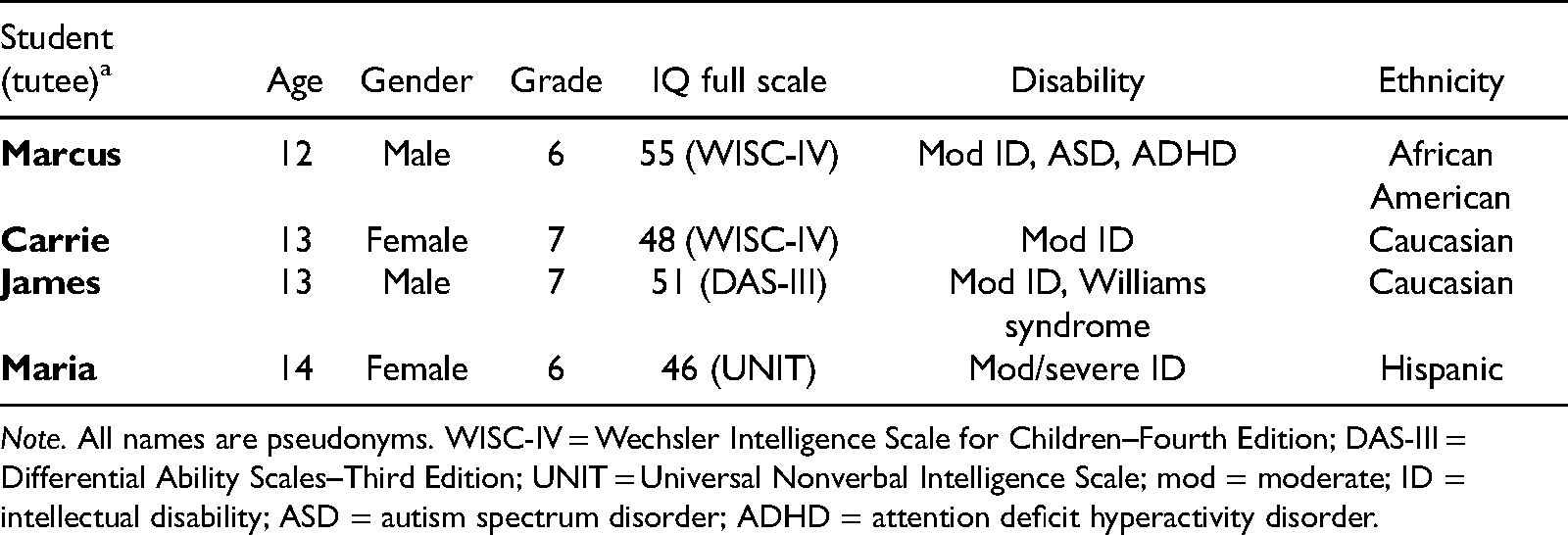
Note. All names are pseudonyms. WISC-IV = Wechsler Intelligence Scale for Children–Fourth Edition; DAS-III = Differential Ability Scales–Third Edition; UNIT = Universal Nonverbal Intelligence Scale; mod = moderate; ID = intellectual disability; ASD = autism spectrum disorder; ADHD = attention deficit hyperactivity disorder.
Marcus. Marcus was given the Wechsler Individual Achievement Test–Third Edition (WIAT-III; Wechsler, 2009) and received standard subcategory scores of 54 in Mathematical Problem Solving, 40 in Numerical Operations, 48 in Mathematical Fluency-Addition, and 67 in Word Reading, with an overall academic function rated as significantly below the average range in all areas measured. His most recent individual education program (IEP) stated that he could identify numbers 1 through 10 with 100% accuracy and had emerging basic addition skills. Marcus had an IEP goal of independently adding a set of single-digit mathematical problems.
Carrie. Carrie was given the Woodcock-Johnson Third Edition (WJIII; Woodcock et al., 2007) Tests of Academic Achievement as an educational evaluation and received standardized subcategory scores of 35 in Broad Mathematics and 36 in Basic Reading Skills. Carrie's IEP stated that her subcategory scores in Broad Reading, Broad Mathematics, Mathematical Calculations Skills, and Brief Mathematics were all in the very low range (grade equivalent between kindergarten and first grade), with no full standard scores reported. Her most recent IEP stated that based on teacher-made criterion-referenced assessments, she could identify numbers 1 through 10 with 100% accuracy and had emerging basic addition skills.
James. James was given the WJIII (Woodcock et al., 2007) Tests of Academic Achievement as an educational evaluation and received standard subcategory scores of 13 in Mathematical Calculation Skills, 41 in Mathematical Reasoning, and 32 in Basic Reading Skills. His academic skills and ability to apply those skills fell within the very low range (prekindergarten to first grade). His most recent IEP stated that James could solve single-digit addition equations using manipulatives and could match some coins and bills but was unable to demonstrate purchasing items using the next dollar method.
Maria. Maria was given the Universal Nonverbal Intelligence Scale (McCallum, 2003) and received a full-scale score of 46, the very low range. Maria was given the WIAT-III (Wechsler, 2009) as an educational evaluation, but evaluators were unable to obtain a composite score in any academic area. Her most recent IEP stated that she could now identify numbers 1 through 10 with 100% accuracy and had emerging basic addition skills.
Peer Tutors
The Honors Program mathematics teacher nominated five students without disabilities to participate as peer tutors in this study by meeting the following criteria: (a) were a middle school student enrolled in a general education mathematics course without a diagnosed disability, (b) received grades at or above a B in mathematics, (c) had consistent attendance, (d) agreed to be trained and to serve as a peer tutor, and (e) attended the same middle school as the students with ESN. Once student assents and parental consents were obtained, the nominated students were given a prescreening measure that consisted of (a) ability to read aloud and follow the task analysis for the change problem type, (b) ability to read aloud and follow a scripted lesson exactly as it was written, and (c) ability to solve 10 of 10 mathematical problems of the change problem type with 100% accuracy. All five teacher-nominated tutors were included in the study: four sixth-grade peer tutors (12-year-old Caucasian male, 11-year-old Hispanic male, 11-year-old Asian Indian female, 11-year-old African American female) and a fifth peer tutor (12-year-old Hispanic female) who served as a substitute in the instance a peer tutor was absent. The male peer tutors were assigned to the male tutees, the female tutors were assigned to the female tutees, and the generalization measure (unfamiliar peer tutor) consisted of switching assigned tutors.
Setting
The investigation took place in a public middle school in an urban district in the southeastern United States. The school served 780 students in Grades 6 to 8 with a student population comprised of 38% African American, 28%, Caucasian, and 28% Hispanic students and 6% from other ethnic groups. The school was categorized as economically disadvantaged, meaning the entire school qualified for free or reduced-price lunch. All four tutees received all academic instruction from a special education teacher in a self-contained classroom. Tutees attended lunch, music, and physical education together. The five peer tutors attended a schoolwide block called Academic and Enhancement (A&E), which was similar to a study hall. Intervention sessions were conducted in an unused classroom during the 45-min A&E block. The classroom had two long tables parallel to one another, a teacher's desk, whiteboards, a projector, and a projector screen. The peer tutors and tutees sat in pairs at separate tables, with the substitute peer tutor seated at the teacher's desk. The experimenter conducted all peer tutor trainings and the intervention in this room.
Materials
Materials were developed by a research team at the University of North Carolina at Charlotte (UNC Charlotte) and can be found at the Solutions Project web site (https://access.charlotte.edu/solutions-project). Physical materials used by the tutees included a graphic organizer for the change problem type (i.e., schematic diagram), a problem-solving mat for the organization of materials, change increase (addition) and decrease (subtraction) word problems, a laminated student self-directed task analysis checklist, manipulatives (e.g., counters), and dry-erase markers (see Supplemental Figure 2). Other materials included scripted lessons for peer tutors to follow and procedural fidelity and data collection sheets.
Fifteen themes with 10 corresponding word problems each (five variations per theme; 75 change increase, 75 change decrease) were developed for change problems to align with the principles of contextual mathematics (Root et al., 2018), to offer variation and maintain interest of students while repeatedly practicing the same skill (Browder et al., 2020), and to promote generalization through teaching sufficient examples (Cooper et al., 2020). The word problems were created using easy-to-decode words and sentences of the same length, familiar nouns, names from diverse cultures, verbs that show action, and numerals 1 through 10. The structured format included (a) the context presented in the first sentence; (b) the first amount with referent noun in the second sentence; (c) the change action verb indicating adding more or taking away, and the second amount with referent noun, in the third line; and (d) the problem to solve in the fourth line. Pictures were placed above the referent nouns in the second and third lines to support emerging readers. The word problems were presented with the ending quantity being unknown. The word problems and scripts were evaluated by content experts in schema-based instruction and elementary mathematics for content validity and reviewed for gender and cultural bias (Browder et al., 2008; Spooner et al., 2017).
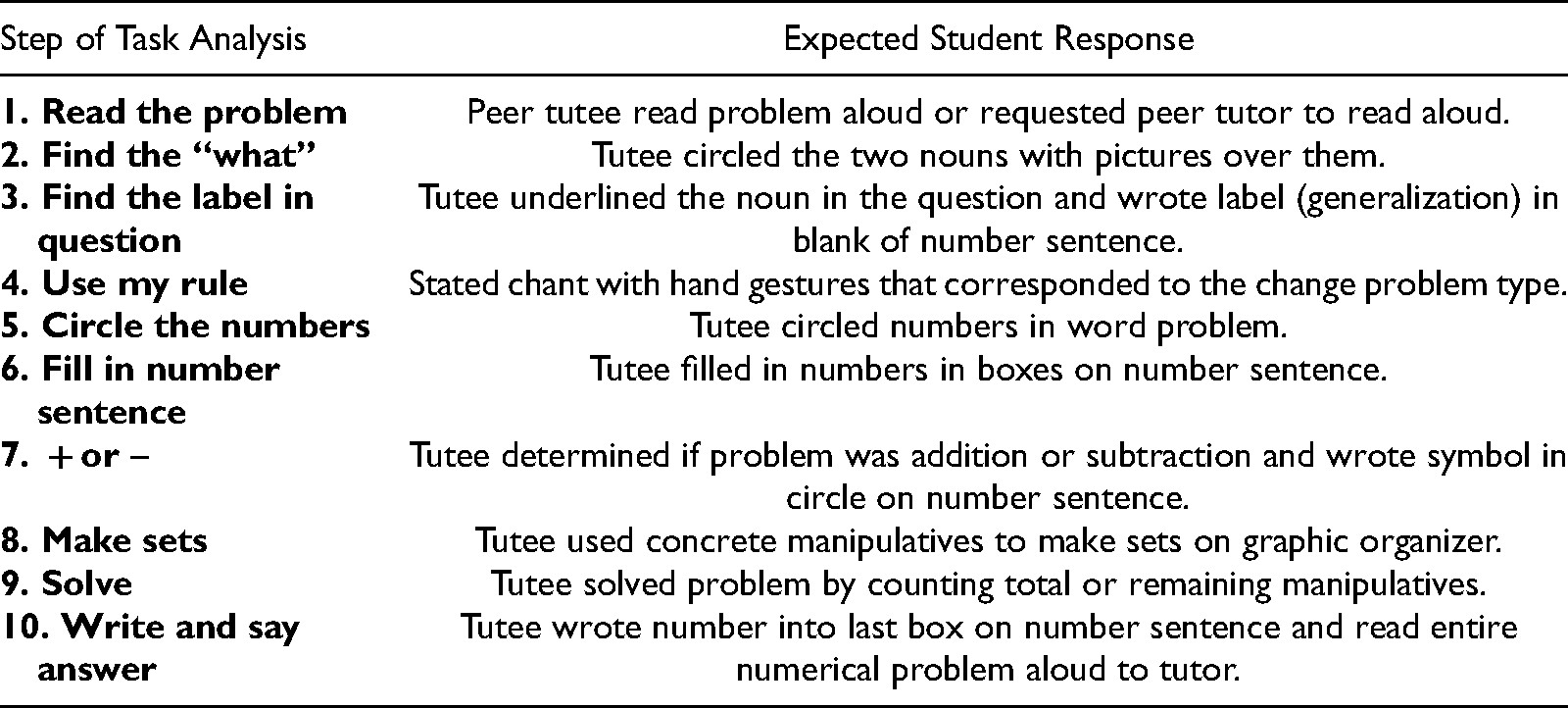
The complex skill of mathematical problem solving was taught through task-analytic instruction with picture supports, broken down into 10 sequential steps. Table 2 describes each task analysis step and the expected student response. Steps 1 to 4 targeted conceptual knowledge, understanding the underlying problem structure, and relationship between quantities (i.e., schema), and Steps 5 to 10 targeted procedural knowledge or solving to find the answer. Step 7 required students to discriminate between change increase and change decrease based on the action in the third line of the word problem. Supplemental Figure 2 illustrates the student-friendly version.
Steps in the Task Analysis and Expected Student Responses Defined.
Experimenter and Interventionists
The experimenter was a doctoral student at a local university with a total of 16 years of teaching experience working with students with ESN. The experimenter trained the peer tutors, directed all sessions, collected procedural fidelity data, provided in vivo feedback to peer tutors as they delivered instruction, and held coaching discussions after each session. The peer tutors were trained to implement the intervention and collect tutee performance data for two consecutive days during the A&E block. In addition, a second researcher (graduate research assistant) collected interobserver agreement (IOA) data for a minimum of 30% of all sessions across all conditions and phases, and a third independent observer (research assistant) determined in vivo IOA on procedural fidelity scoring using the same calculation during the first two sessions.
Experimental Design
A single-case design (SCD), multiple probe across four peer tutees, was utilized (Ledford & Gast, 2018; Horner & Baer, 1978). The implementation of the design adhered to the criteria established by the What Works Clearinghouse (Kratochwill et al., 2013). The study consisted of three conditions: baseline, intervention, and maintenance. The intervention condition was broken into three phases to lessen cognitive load demands: Phase 1, change increase (CI); Phase 2, change decrease (CD); and Phase 3, change mixed (CM). Data were collected on the primary dependent variable, total number of steps of the task analysis performed correctly, and the secondary dependent variable, number of problems correctly solved each session. The effectiveness of the independent variable on the dependent variables was determined through visual analysis of the graph and established through a functional relation (Cooper et al., 2020; Ledford & Gast, 2018). Researchers adhered to SCD guidelines on a visual analysis worksheet (Moeyaert et al., 2018) to examine the data following each session to determine an accelerating trend (e.g., increase in the number of steps completed independently correct) for consistency, immediacy of behavior change, and degree of data overlap across conditions to ensure experimental control and to determine if mastery criterion were met (Kratochwill et al., 2010). To complement the visual analysis, we used a quantitative nonoverlapping index (Tau-U; Parker et al., 2011) and an effect size (ES) measure (between-case standardized mean difference; Hedges et al., 2012; Pustejovsky et al., 2021), as there are mixed views on computing ES in SCD (e.g., Odom et al., 2018; Parker et al., 2011). First, a Tau-U (Parker et al., 2011) free online calculator was used to provide a nonparametric measure of effect, measuring nonoverlap between baseline and intervention conditions for all four students, and authors calculated an overall ES across all participants using a free online calculator for between-case standardized ES analysis (Pustejovsky et al., 2021). The between-case standardized ES is an analysis that is comparable to between-participants’ ES (e.g., Cohen's d) and accounts for the magnitude of change from baseline to intervention (Odom et al., 2018). We used the BC-SMD calculator, which uses restricted maximum likelihood estimation (Pustejovsky et al., 2021).
A minimum of five data points were collected at baseline, and once a stable trend was observed, the first participant entered intervention. Researchers used visual analysis to systematically assess for level, trend, and variability within and across conditions with attention to predictability and consistency of data values within each condition (Moeyaert et al., 2018). Tutees were randomly selected to go into intervention. Once the tutee demonstrated three consecutive data points of accelerating trend (e.g., increase in the number of steps completed independently correct), the next tutee entered intervention. This process was repeated until all four students were in intervention. The mastery criterion to move from one phase of intervention to the next was set at the tutee correctly solving both problems independently for two consecutive sessions. Before moving to the next phase in baseline and intervention, generalization data were collected on the tutees’ problem-solving steps of two novel mathematical word problems (one CI and one CD) presented by an unfamiliar peer. Tutees moved to maintenance once mastery was reached in Phase 3 of the intervention condition.
Dependent Variables
There were four dependent variables: (a) number of steps independently completed on the task analysis, (b) total number of problems solved independently, (c) generalization of problem solving to novel change problems with an unfamiliar peer tutor, and (d) peer tutor fidelity of implementation of MSBI. The primary dependent variable was the number of steps of a task analysis completed independently for solving mathematical word problems of the change problem type (see Table 2). The task analysis offered 20 opportunities for the peer tutee to respond (10 steps across two problems). Responses for each task analysis step were scored as “independent correct” if the participant performed the target skill within 5 s without prompting. The second dependent variable was the total number of problems solved independently correctly. The data collected from the primary and secondary dependent variables were used to make decisions for changing phases and conditions. The third dependent variable was generalization of problem solving to novel change problems with an unfamiliar peer tutor. The fourth dependent variable was peer tutor fidelity of implementation of MSBI. The primary experimenter collected procedural fidelity data using a checklist on each task analysis step and scored the peer tutors on the accuracy of implementation.
Procedures
General Procedures
The intervention consisted of three conditions: (a) baseline; (b) intervention (Phase 1, CI; Phase 2, CD; and Phase 3, CM), randomly alternating between a CI and CD problem; and (c) maintenance. The intervention condition was broken into three phases to reduce cognitive load demands required by problem solving and discriminating between addition and subtraction operations. Maintenance probes were given following mastery of Phase 3 of the intervention condition. The intervention also included peer tutor training and a generalization measure. Peer tutor training took place before baseline data collection. Generalization probes were delivered in baseline, following mastery of each phase during the intervention condition and in maintenance. Each session included two change mathematical word problems.
Peer tutor training. Before baseline, the peer tutors received two 1-hr training sessions from the experimenter until all five peer tutors had 100% procedural fidelity. The tutors were trained to fidelity to (a) follow a task analysis for the change problem type, (b) provide explicit instruction using the scripts, and (c) provide the SLP for nonresponses or remediate errors made by the tutee. The experimenter trained the peer tutors as a group in the media center using the scripted lessons and all study materials. To promote high fidelity of implementation, the experimenter used BST (Miltenberger, 2015; Saunders et al., 2021), which included written directions, modeling the procedures, performing direct rehearsal with immediate feedback, and providing ongoing coaching. Peer tutors were given scripts for instruction to read through, followed by the experimenter and secondary data collector modeling the procedures. Peer tutors were also trained on data collection during instruction, recording each task analysis step as an independent correct or incorrect response and then totaling the sum (e.g., 15/20 steps completed independently correctly).
The peer tutors each practiced by delivering the intervention to the experimenter with explicit feedback. Next, the peer tutors took turns delivering the intervention to one another while the experimenter observed, collected procedural fidelity on each peer tutor, collected IOA on the mock data, and provided feedback. Any peer tutor who did not have 100% on procedural fidelity or data collection was provided with feedback on steps performed incorrectly or missed. The tutors with the highest fidelity were assigned a peer tutee. The fifth peer tutor served as an alternate and was used to deliver the intervention when the assigned peer tutor was absent. Each peer tutee was paired with two peer tutors who alternated in delivering instruction. This allowed one peer tutor to always be present should one be absent. Because of the delay before starting intervention for Tiers 2 to 4, peer tutors received one booster training session before beginning to ensure fidelity had been maintained.
Baseline. The special education teacher used the Unique Learning System (N2y, 2015) instruction curriculum for all academic areas, including mathematics. Tutees were not instructed in mathematical problem solving during this study. During baseline, the tutee was presented with four mathematical problems of the change problem type (e.g., two CI, two CD) and all instructional materials (e.g., task analysis, graphic organizer, manipulatives, problem-solving mat). The instructor started the session by saying, “Today, we are going to solve some mathematical word problems.” The tutee selected the problem, and the instructor stated, “Show me how to solve this problem.” The experimenter recorded any steps on the data collection sheet the tutee responded to correctly with no specific praise or feedback. Single-opportunity chaining procedures were used during baseline; if the tutee did not attempt the problem within 10 s or responded incorrectly, the problem was removed, and the tutee selected the next problem. No prompting, error correction, or feedback was given during baseline probes.
The experimenter and peer tutors delivered baseline probes. The peer tutors conducted one baseline probe each by following the exact baseline procedures the experimenter conducted, resulting in a minimum of five data points (e.g., three conducted by the experimenter, one by each of two tutors) in baseline for all four tutees. In addition, one baseline data point was collected at least every eight sessions for the remaining tutees.
Intervention. The intervention was comprised of several critical features, including task-analytic instruction, self-monitoring checklist, read-alouds, graphic organizer, story grammar instruction and story mapping, think-alouds (metacognitive instruction), and the use of manipulatives. Problem solving was taught through task-analytic instruction, whereby steps for solving a word problem are broken down into 10 sequential steps. These steps were taught through total task presentation with the peer tutor modeling for 2 days, followed by the SLP until the student reached mastery. The first four steps (i.e., read the problem, circle the “whats,” find label in the question, and use my rule) address teaching conceptual knowledge (i.e., students identifying salient features of problem type), and the last six steps (i.e., circle the numbers, fill in number sentence, addition or subtraction?, make sets, solve, and write answer) teach solving using procedural knowledge (see Table 2).
In the first 2 days of instruction, tutees used strategy instruction and introduced the change problem type and graphic organizer. Using model-lead-test, tutees also were taught the change rule using hand motions and a chant: “One thing, add to it, or take away, and change." Following this, the first two sessions of each intervention phase consisted of the peer tutors modeling each step of the task analysis using the student self-directed task analysis, the graphic organizer, and manipulatives using forward chaining across two problems. To support the tutee in independently discriminating if the change word problem was addition or subtraction, the tutor provided explicit instruction with role-play of the action happening in the problem on Step 7 of the task analysis. If the tutee performed the step correctly, the tutor moved to the second step and repeated this process with all remaining steps. If the tutee made an error, the tutor stopped the tutee as soon as possible, modeled the skill again, and asked the tutee to replicate it. If the tutee continued to make errors, the tutor reminded the tutee to wait for help before guessing. Peer tutors also modeled self-monitoring their completion of the task analysis with a checkmark. The two assigned tutors each provided one modeling session for two modeling sessions for each peer tutee. No data were collected during these training sessions. Peer tutors were provided with coaching on their implementation as needed.
Guided practice began the third session of each phase, where tutees had an opportunity to perform the skill independently before the SLP was used by the peer tutor. The SLP consisted of three levels, including a generic verbal prompt of reading the step on the task analysis, a specific verbal prompt of providing a hint on how to perform the step, and a model prompt. Peer tutors were provided with a script of what to say and do for each prompt level. Tutees were given 5 s to respond before the peer tutor gave a prompt. If the tutee answered incorrectly, the peer tutor went directly to a model prompt for error correction and required the tutee to repeat the behavior before moving to the next step. The peer tutors used behavior-specific praise after each correct response (independent and prompted). As tutees became more proficient and consistently got steps independently correct, the behavior-specific praise was faded for those steps. The two assigned peer tutors alternated serving as the instructor daily. The experimenter provided coaching to the peer tutors on their implementation as needed. Tutees had to reach mastery (i.e., solving both problems correctly for two consecutive sessions) before moving to the next phase of intervention. A generalization probe with an unfamiliar peer delivering instruction was performed before moving to the next phase (CI, CD, or CM).
Maintenance. When a tutee met the mastery criteria of answering the problems correctly for two consecutive days in the CM phase, they entered the maintenance phase. Maintenance procedures replicated the baseline condition. The tutees were given only two problems (one CI and one CD) in random order to reduce the probability of satiation and fatigue. Maintenance probes continued intermittently throughout the remainder of the study until the final tutee received a minimum of one maintenance probe, which brought the study to a conclusion.
Generalization. A generalization probe, consisting of an alternate, unfamiliar peer tutor for all tutees, was conducted at least once during baseline, once during each of the phases of the intervention condition, and at least once during maintenance across two novel problems. Procedures and data collection during generalization probes were consistent with those utilized during baseline and intervention conditions.
Procedural Fidelity
To ensure the tutors were accurately following the prescribed procedures, a second independent observer used a procedural fidelity checklist to verify the degree to which the SLP procedure was implemented consistently as designed and trained (Billingsley et al., 1980; Ledford & Gast, 2018). To calculate procedural fidelity, the number of elements correctly implemented was divided by the total number of procedural elements, then multiplied by 100 (Billingsley et al., 1980). Fidelity was collected for a minimum of 30% across all conditions, and tutors had to maintain a criterion of 90% or above. The experimenter provided live coaching during each session and enacted a role-play following the session if tutors fell below 90%. Overall, the mean fidelity across peer tutors ranged from 93.5% to 99% (see Supplemental Table 3).
IOA
Video recordings and live observations of the sessions were used to collect IOA data by a second independent experimenter across 30% of all sessions, across all participants and conditions on word problem–solving steps, total number of problems solved, and generalization of word problem solving to an unfamiliar peer. IOA was calculated by dividing the number of agreements between the interventionist and the interobserver by the number of agreements plus disagreements, multiplied by 100 (Cooper et al., 2020). IOA data were collected during baseline for 40% of baseline sessions for Marcus (two out of five sessions), 33% of baseline sessions for Carrie (two out of six sessions), 43% of baseline sessions for James (three out of seven sessions), and 38% of baseline for Maria (three out of eight sessions). The mean IOA was 100% for all four participants during baseline. IOA data were collected during intervention for all three phases, generalization probes (33%–50%), and maintenance probes (33%–54%). The mean agreement was 100% for the task analysis steps for Marcus, Carrie, and James, with 93.75% for Maria. The mean agreement was 100% for total number of mathematical word problems solved for all four tutees for the total number of mathematical word problems solved. Additionally, a third independent observer evaluated in vivo IOA on fidelity scoring using the same calculation procedure during two different points in time with 100% agreement.
Social Validity
A pre- and a postintervention questionnaire on practicality, cost-effectiveness, social importance, and magnitude of change (Wolf, 1978) were given to the special education teacher and paraprofessionals working with the tutees (see Supplemental Table 4). Additionally, both the tutors and tutees were given pre- and postintervention questionnaires addressing perceptions and attitudes toward one another. These questionnaires were used to determine if using peer-directed instruction had a positive, neutral, or negative effect on the perceptions and attitudes of participants toward one another (see Supplemental Table 5).
Results
The investigation results are reported by participants and address each of the research questions. The outcomes for this study were determined using three methods: (a) visual analysis (e.g., synthesis guidelines, level, trend, variability and overlap; Ledford & Gast, 2018), (b) between-case standard mean difference (Pustejovsky et al., 2021), and (c) a nonparametric measure of effect, measuring nonoverlap between baseline and intervention conditions for all four students (Tau-U; Parker et al., 2011).
Visual Analysis
Figure 1 shows the effects of peer-delivered MSBI on the number of steps of a task analysis completed independently correctly by students with ESN. The graph depicts individual performance for each participant. All participants exhibited a stable baseline, and during intervention, all four participants demonstrated a change in level and trend, with no overlapping data from baseline performance. Visual analysis of the graph indicated a functional relation between peer-delivered MSBI on the number of steps of a task analysis completed independently correctly by students with ESN.

Number of correct responses on the task analysis across two problems. The arrows in baseline indicate peer-delivered probes. The squares represent change mixed probes (one addition and one subtraction problem) given during baseline; Phase 3, change mixed; and maintenance conditions. Circles represent Phase 1, change increase, and triangles represent Phase 2, change decrease. Open data points indicate generalization probes with an unfamiliar peer tutor.
Marcus received three probes delivered by the experimenter and two delivered by his assigned peers during baseline. His average rate of correctly responding during baseline was M = 3.8 (range 3–4), and he did not correctly solve any problems. During Phase 1, CI, of the intervention condition, Marcus demonstrated a jump in level and trend, reaching mastery in five sessions and maintaining 100% accuracy in the generalization probe. During Phase 2, CD, Marcus reached mastery in three sessions and maintained 100% accuracy in the generalization probe. During Phase 3, CM, Marcus reached mastery in 10 sessions and maintained 100% accuracy in the generalization probe. Marcus performed with 100% accuracy across all four probes in the maintenance phase.
Carrie received a total of six baseline probes with four baseline probes delivered by the experimenter and two delivered by her assigned peers with a M = 0 and did not correctly solve any problems. During Phase 1, CI, Carrie demonstrated an immediate jump in level and trend and reached mastery in seven sessions. Carrie maintained 100% accuracy in the generalization probe. During Phase 2, CD, Carrie reached mastery in three sessions and maintained 100% accuracy in the generalization probe. During the final phase of the intervention condition, Phase 3, CM, Carrie reached mastery in six sessions and maintained 100% accuracy in the generalization probe. Carrie responded with 100% accuracy across all four maintenance probes during maintenance.
James received four baseline probes delivered by the experimenter and three delivered by his assigned peer tutors. His average rate of correct responding during baseline was M = 3.9 (range 3–4), and he did not correctly solve any problems. During Phase 1, CI, of the intervention condition, James demonstrated a jump in level and trend and reached mastery in seven sessions. He maintained 100% accuracy in the generalization probe. During Phase 2, CD, James reached mastery in four sessions and maintained 100% accuracy in the generalization probe. During the final phase of the intervention condition, Phase 3, CM, James reached mastery in five sessions and maintained 100% accuracy in the generalization probe. James responded with 100% accuracy across all three maintenance probes.
During baseline, Maria received four probes delivered by the experimenter and four delivered by her assigned peers. Her average rate of correct responding during baseline was M = 0.4 (range 0–3), and she did not correctly solve any problems. During Phase 1, CI, of the intervention condition, Maria demonstrated an immediate jump in level and trend and reached mastery in nine sessions. Maria got 19/20 steps (i.e., 95% accuracy) but solved both problems correctly in the generalization probe. During Phase 2, CD, Maria reached mastery in six sessions and maintained 100% accuracy in the generalization probe. During Phase 3, CM, Maria reached mastery in three sessions and maintained 100% accuracy in the generalization probe. During the maintenance phase, Maria performed at 100% accuracy for both probes.
Supplemental Figure 3 shows the effects of peer-delivered MSBI on the cumulative number of problems solved corrected by students with ESN. The graph depicts individual performance for each participant. All participants exhibited a small number of problems solved during baseline, and during intervention, all four participants demonstrated an increase in the number of problems solved independently. The number of correctly solved problems correlated with the number steps of the task analysis completed independently by students with ESN. Visual analysis of the graph indicated an increasing trend between peer-delivered MSBI on the number of problems solved independently correctly by students with ESN.
ES and Nonoverlapping Index
To corroborate the visual analysis findings, the authors calculated a quantitative nonoverlapping index and an ES measure, as there are mixed views on statistical analyses in SCD (e.g., Odom et al., 2018; Parker et al., 2011). For baseline, we specified fixed effect and random effect for baseline level because this allows baseline phases to be different from zero and to vary across cases, respectively. For intervention, we specified fixed and effect to determine treatment level as there was a level change from baseline to intervention, but we did not select random effect because there was little difference across cases (Valentine et al., 2016). The effect size was 9.86 (95% confidence interval [CI] [7.7, 12.1]). This can be interpreted as a moderate to large effect (benchmarks for this measure: small [1.4], medium [3.6], large [10.1]), providing evidence that tutees were able to increase the number of correct independent responses on the task analysis, increase the number of correct mathematical problems solved, and generalize skills acquired to unfamiliar peers. Most notably, there was a clear demonstration that peer tutors could effectively deliver MSBI with fidelity when provided with behavior skills training with ongoing coaching and feedback. Additionally, we used the nonoverlapping index, Tau-U (Parker et al., 2011), where values were calculated for each participant, aggregated by phase, and then for the entire intervention, resulting in 1.00, with p value > .00, 95% CI [0.7398, 1.00], representing a large effect.
Social Validity
Overall, all nine participants responded positively to the pre- and postintervention questionnaires. There were 10 questions posed, such as “I feel anxious or nervous when I am alone with a peer tutor [tutee]” and “I would like to have a peer tutor [tutee] in more general education classes with me.” None of the participants reported that they had ever worked in or out of class with a peer partner before this study, with the tutors stating they were unaware the tutees attended school in the same building. The tutors reported decreases in the perception that tutees would make learning in class harder following this study. All participants reported they would like to remain working with their peer partners after the study, feeling they shared more similarities than differences and that learning mathematical word problems would help them later in life. The social validity data from the two special educators and two paraprofessionals of the tutees reported the importance for students with ESN to learn mathematical word problem solving, social benefits for participants, cost-effectiveness, and that all students made gains. One key finding was that educators reported using peers to deliver instruction was practical in reducing teacher time spent teaching mathematics one-on-one.
Discussion
This study investigated the effects of peer-delivered MSBI on the acquisition and generalization of mathematical problem-solving skills with four middle school students with ESN. A functional relation was found between peer-delivered MSBI on the number of correct responses for problem solving and the number of correct mathematical problems solved of the change problem type by students with ESN. All tutees were able to generalize their skills to solve mathematical word problems delivered by an unfamiliar peer and demonstrated maintenance of their skills to solve mathematical word problems delivered by both assigned peers and unfamiliar peers. Visual analysis revealed four demonstrations of effect at four different points in time. This outcome also was confirmed by a nonoverlapping index and ES measures, both of which demonstrated strong effects (Pustejovsky et al., 2021). Peer tutors and peer tutees’ social attitudes and perceptions also positively increased after participating in peer-delivered instruction. All students reported a positive experience from the intervention, including academic and social benefits.
This study addresses the need for 21st century skills (National Research Council, 2001) and higher-level thinking in mathematics for students with ESN (Browder et al., 2018). MSBI included evidence-based practices for teaching mathematics to students with ESN, such as read-alouds, systematic prompting as guided practice (Browder et al., 2020; Shepley et al., 2019; Spooner et al., 2019), a task analysis with picture cues, schematic diagrams, and metacognitive strategy instruction (Browder et al., 2018). The results of this study are consistent with the findings from a growing literature base on MSBI (e.g., Browder et al., 2018; Root et al., 2017, 2018; Saunders, 2014; Spooner et al., 2017); however, this study is distinct from the aforementioned investigations as it is the first of its kind to incorporate peer tutors to deliver the intervention.
This study expands current literature on peer-delivered instruction by examining its use in the content area of mathematics, specifically, mathematical problem solving. One key finding from this study was that peers were able to implement MSBI with high levels of fidelity. Another key finding is that tutees were able to generalize mathematical problem solving with unfamiliar peer tutors, which is more representative of what may occur in a general education setting, where peer tutors may need to change based on availability. These findings hold great promise for instruction in general education settings for students with ESN.
Limitations of the Current Study
There were three primary limitations identified. First, this study investigated only the additive change problem type, and the other problem types of group and compare were not addressed. Students were selected based on the prerequisite skills of having mastered early numeracy skills (such as identifying numbers to 10, counting with 1:1 correspondence, creating sets to 10, and early addition skills). The results may not be applicable to students who have not yet mastered these prerequisite skills. Finally, the study was not conducted in the general education mathematics setting. On the other hand, the investigation was conducted during the A&E enrichment block of time in a spare classroom with the primary author serving as the facilitator.
Future Research
The findings of this study provide several areas for future research related to using peer-delivered instruction on mathematical word problem solving for students with ESN. Researchers should investigate the use of peers to deliver MSBI in the general education mathematics setting to support the limited research on inclusionary practices for students with ESN. Additionally, given the limited research on peer-delivered mathematics instruction, it is necessary to investigate their implementation of strategies with other higher-order mathematical skills (e.g., algebra, geometry). Finally, this study focused on middle school–age students, but future studies should include students with ESN in elementary and high schools. It is crucial to determine if younger students have the maturity to play the role of a peer tutor and implement the approach with fidelity. Additional research also is needed to determine if high school students can demonstrate similar effective peer-delivered instructional practices given the increased difficulty in academic content and more rigid classroom structures.
Implications for Practice
When including students with ESN in the general education setting, resources are often one barrier, such as having adequate support personnel to provide instruction and the time spent delivering instructional trials to students. By allowing the classroom teacher to assume the role of an ongoing support coach to ensure fidelity, this strategy could additionally promote an efficient and cost-effective means to deliver high-quality, grade-aligned general curriculum mathematics concepts, as peer tutors provide a means to multiply the number of individuals receiving one-on-one academic instruction. As aligned to this study, classroom teachers could require tutors to demonstrate 100% procedural fidelity through the training and fidelity checks and ensure tutors memorize most (if not all) of the script, which would allow instruction to be delivered with fluency in a more natural tone and expression without straying from the script. Though scripts with training and ongoing coaching support are unlikely to be found in a typical school setting, they could be adopted as a viable and effective instructional strategy that could be implemented. Although the dosage (number of sessions needed for each tutee to meet mastery criteria) varied between participants and intervention conditions, the implications of this study demonstrate that having peers deliver academic instruction could extend the instructional outreach beyond the singular classroom teacher. By allowing the classroom teacher to assume the role of an ongoing support coach to ensure fidelity, this strategy could additionally promote an efficient and cost-effectivemeans to deliver highquality, grade-aligned general curriculum mathematics concepts, as peer tutors provide a means to multiply the number of individuals receiving one-on-one academic instruction.
Peer-delivered instruction to teach mathematical problem solving to students with ESN can offer an effective and feasible approach to promote access to and progress in the general education curriculum—one potential solution to this barrier. Additionally, the use of adults, such as paraprofessionals, can compete with social and academic inclusion goals by impeding student learning and growth, particularly in secondary settings, where adult presence can be stigmatizing (Carter & Kennedy, 2006). Peer-delivered instruction is time-saving for the educators, cost-effective, and beneficial to both the tutor and tutee academically and socially, and may be replicated for other academic areas. Peer-delivered instruction to teachmathematical problem solving to students with ESN can offer an effective and feasible approach to promote access to and progress in the general education curriculum Peer-delivered instruction is time-saving for the educators, cost-effective, and beneficial to both the tutor and tutee academically and socially, and may be replicated for other academic areas.
Conclusion
Problem solving is one of the most important functional mathematics skills that individuals with ESN need to master because it serves as the basis for solving real-world problems (Browder et al., 2018; Van de Walle, 2004). This investigation added to the literature by demonstrating that students with ESN can acquire and maintain grade-aligned mathematical problem-solving skills. A unique finding was that peer tutors could effectively deliver instruction in mathematical word problem solving to students with ESN with high levels of fidelity. Social validity data showed positive experiences for all participants. Overall, the findings of this investigation suggest that both peers and students with ESN can benefit from peer-delivered instruction. A unique finding was that peer tutors could effectively deliver instruction in mathematical word problem solving to students with ESN with high levels of fidelity.
Supplemental Material
sj-docx-3-ecx-10.1177_00144029221098764 - Supplemental material for Efficacy of Peer-Delivered Mathematical Problem-Solving Instruction to Students With Extensive Support Needs
Supplemental material, sj-docx-3-ecx-10.1177_00144029221098764 for Efficacy of Peer-Delivered Mathematical Problem-Solving Instruction to Students With Extensive Support Needs by Luann Ley Davis, Fred Spooner and Alicia Saunders in Exceptional Children
Supplemental Material
sj-docx-4-ecx-10.1177_00144029221098764 - Supplemental material for Efficacy of Peer-Delivered Mathematical Problem-Solving Instruction to Students With Extensive Support Needs
Supplemental material, sj-docx-4-ecx-10.1177_00144029221098764 for Efficacy of Peer-Delivered Mathematical Problem-Solving Instruction to Students With Extensive Support Needs by Luann Ley Davis, Fred Spooner and Alicia Saunders in Exceptional Children
Supplemental Material
sj-docx-5-ecx-10.1177_00144029221098764 - Supplemental material for Efficacy of Peer-Delivered Mathematical Problem-Solving Instruction to Students With Extensive Support Needs
Supplemental material, sj-docx-5-ecx-10.1177_00144029221098764 for Efficacy of Peer-Delivered Mathematical Problem-Solving Instruction to Students With Extensive Support Needs by Luann Ley Davis, Fred Spooner and Alicia Saunders in Exceptional Children
Supplemental Material
sj-docx-6-ecx-10.1177_00144029221098764 - Supplemental material for Efficacy of Peer-Delivered Mathematical Problem-Solving Instruction to Students With Extensive Support Needs
Supplemental material, sj-docx-6-ecx-10.1177_00144029221098764 for Efficacy of Peer-Delivered Mathematical Problem-Solving Instruction to Students With Extensive Support Needs by Luann Ley Davis, Fred Spooner and Alicia Saunders in Exceptional Children
Supplemental Material
sj-docx-7-ecx-10.1177_00144029221098764 - Supplemental material for Efficacy of Peer-Delivered Mathematical Problem-Solving Instruction to Students With Extensive Support Needs
Supplemental material, sj-docx-7-ecx-10.1177_00144029221098764 for Efficacy of Peer-Delivered Mathematical Problem-Solving Instruction to Students With Extensive Support Needs by Luann Ley Davis, Fred Spooner and Alicia Saunders in Exceptional Children
Footnotes

References
Supplementary Material
Please find the following supplemental material available below.
For Open Access articles published under a Creative Commons License, all supplemental material carries the same license as the article it is associated with.
For non-Open Access articles published, all supplemental material carries a non-exclusive license, and permission requests for re-use of supplemental material or any part of supplemental material shall be sent directly to the copyright owner as specified in the copyright notice associated with the article.
