



Abstract
Viewed through a social justice lens, preschool expulsion is an educational equity issue. This study focused on prior expulsion from preschool and child-care in a longitudinal study of 203 autistic children, ages 4 to 7. By parent report, 16%—one out of six autistic children—had been expelled from a preschool or child-care setting prior to elementary school; average age when expelled was 3.3 years. Expulsion history and reasons for expulsion were determined from parent report. Previously-expelled children went on to experience more conflict and dependency in their current student-teacher relationships. They also experienced greater teacher-reported externalizing symptoms than non-expelled children; these constituted the only child characteristics that distinguished expelled and non-expelled children. Children were more likely to be expelled from private versus public programs, suggesting a particular need for policies and practices supporting inclusion in private settings. Future work that examines contextual factors exacerbating expulsion risk is warranted.
Early childhood education provides a vital context for children's development of social and emotional abilities, participation in a school community, and other life skills (Bakken et al., 2017; Garcia et al., 2021). Unfortunately, this early school context can also be marred by exclusion—the practice of school expulsion or dismissal (Gilliam, 2005; Loomis et al., 2021). Certain groups of children are at particular risk of being asked to leave school temporarily (suspension) or permanently (dismissal, expulsion; Neitzel, 2018). In this study we examine preschool expulsion from any early childhood education setting (including preschool, child-care, or day care) among a well-characterized sample of young autistic children.
Note that in this paper we use identity-first language (“autistic children”) rather than person-first language to reflect the preference of the majority of autistic adults (Kenny et al., 2016; see Bottema-Beutel et al., 2020). Identity-first language acknowledges that autism is intrinsic to one's identity and reflects the fact that autistic individuals often do not view their autism through a lens of pathology (Kapp et al., 2013; Kenny et al., 2016).
Although there is little research on expulsion specifically among young autistic children, a consideration of the broader problem of preschool expulsion provides context for understanding this practice (Meek & Gilliam, 2016). According to a study of a nationally representative sample, 6.7 out of 1,000 students in state-funded pre-kindergarten programs were expelled per year, with expulsion rates in the preschool or child-care setting three times higher than those in K-12 (Gilliam, 2005). This problem has persisted with little policy-level change; recent national and state-level studies show that anywhere from 9% (Conners Edge et al., 2018) to 64% of preschool teachers and child-care directors report the expulsion of at least one child in the past year (Clayback & Hemmeter, 2021). Although suspension can be implemented in-school (the student is removed from class and educated elsewhere in the school) or out-of-school (the student is sent home temporarily), expulsion refers to permanent removal from the preschool or child-care center and as such is the most severe of the disciplinary options (NCES, 2019).
Rates of expulsion are not distributed equally across groups, with some preschool children experiencing elevated rates of expulsion (Davis et al., 2019). When viewed through a Dis/ability Critical Race Studies, or DisCrit, framework, early childhood expulsion can also be understood as a reflection of power differences between teachers or schools and children or families, in which children with disabilities or other marginalized identities are especially disempowered and at risk for being isolated, targeted, or excluded in child-care and preschool settings (Annamma et al., 2013). For example, with regard to race, Black and African-American children, especially boys, experience higher rates of expulsion across multiple studies both during preschool (e.g., Zeng et al., 2019) and beyond (e.g., Krezmien et al., 2006).
Disability status also relates to expulsion. The odds of expulsion for children with disabilities or socio-emotional challenges are 14.5 times higher than for their typically developing peers (Hooper & Schweiker, 2020; Novoa & Malik, 2018). These statistics were similar in a national study of over 14,000 3 to 5 year olds, where population estimates suggested that .5% of all children with disabilities and .9% of autistic children experienced expulsion relative to .1% of children without disabilities, suggesting that autistic children may be at greater risk for exclusion relative to children with other disabilities (Zeng et al., 2021). The heightened risk of expulsion facing autistic children is exacerbated by their greater use of child-care services to begin with; in a National Survey of Children's Health-based study, families with an autistic child reported higher use of child care services than families of non-autistic children (Montes & Halterman, 2008).
Although underexamined, autistic children may be particularly vulnerable to removal. Characteristics of autism, including lower social reciprocity and challenges in social communication, can be misinterpreted as non-compliance or willful non-responsiveness (Adams et al., 2019); rigidity or a preference for sameness may also pose challenges in the neurotypical classroom context. In addition, teachers often miss children's non-verbal attempts to communicate their needs (Keen et al., 2005). Elevated anxiety can also be expressed in the form of temper tantrums at this young age (Franz et al., 2013), and given the increased rates of anxiety among autistic children (e.g., Llanes et al., 2018), is also a risk in the classroom.
Further exacerbating this dynamic, teachers may lack an understanding of how to support children with developmental disabilities or delays, especially when these disabilities are not yet identified. Indeed, many autistic children are not diagnosed until preschool or elementary age, a delay that is even greater for children of color (Daniels & Mandell, 2014; Zuckerman et al., 2017) and one that may leave early childhood teachers ill-prepared to anticipate and support children's autism-related needs. As this topic of interest—expulsion among young autistic children—is a fairly recent one, details such as levels of teacher training, total number of preschool settings attended prior to expulsion, or even year of diagnosis, are missing from most studies, including this one.
Very few studies examine rates of expulsion in relation to autism. However, in the only study we identified looking at expulsion specifically during early childhood, rates were unsettling. Among preschool children aged 3 to 5, the rates were 10 times higher for autistic children than for non-autistic children in a nationwide sample. Expulsion rates for preschoolers designated as having behavior problems were 43 times higher than for children without (Novoa & Malik, 2018). Notably, a large percentage of young autistic children do have clinically significant externalizing symptoms, with rates ranging from 8% to 94% (Gillberg & Fernell, 2014; Hill et al., 2014), which in itself could place them at even higher risk of preschool expulsion.
Removing autistic children from the linguistically and socially enriched preschool environment is orthogonal to their developmental and educational needs, with potential downstream adverse effects on their education, social, and linguistic development. Indeed, expelled children are more likely to hold negative school attitudes, possibly drop out of school (U.S. Department of Education & U.S. Department of Health and Human [HHS] Services, n.d.), and experience later incarceration (Adamu & Hogan, 2015). Their parents may also experience negative effects, including employment disruption and stress. Parents are rarely offered an alternative placement for their child, and may either have to find another placement or leave their jobs (Stegelin, 2018).
Explanations for the high rates of preschool expulsion in the literature include disciplinary policies that are subject to bias, inadequate teacher training around supporting children's positive behavior, and teacher or director bias (Gilliam et al., 2016; Silver & Zinsser, 2020). This is supported by evidence that teacher workplace stress is highly related to school expulsion, especially in preschool and child-care settings (Zinsser et al., 2019). Stressed teachers, and teachers unaware of their own biases in responding to child behavior, tend to expel children, especially children of color, at higher rates (Davis et al., 2019). Lack of preparedness among early childhood teachers to support the needs of children with disabilities may add to this stress. Teachers’ interpretations of child externalizing behaviors may also exacerbate expulsion risk, particularly in the case of a delayed diagnosis of autism. Indeed, behaviors among autistic children may be incorrectly perceived as defiant or oppositional rather than reflecting autism-related challenges such as difficulties managing social interactions, meeting interpersonal expectations, or reacting to sensory overstimulation. The bottom line is that preschool expulsion for young autistic children removes them from crucial early learning settings and violates the spirit and mission of leading early childhood education organizations, as evidenced by policy statements against expulsion from the National Association for the Education of Young Children (NAEYC, 2016) and the U.S. Department of Education (U.S. Department of HHS, 2016).
In this retrospective study, we examine rates and correlates of expulsion history among young children diagnosed with autism. In contrast to previous studies based on secondary analyses of large datasets (Hooper & Schweiker, 2020; Novoa & Malik, 2018; Zeng et al., 2021) here, we leveraged the availability of a well-characterized research sample of autistic children living in two different U.S. states to examine experiences of preschool expulsion; variables of interest were gathered from child performance-based measures as well as parent and teacher reports. The following questions focused this initial inquiry: (1) What are the rate and reasons for preschool expulsion in autistic children? (2) What demographic and child characteristics relate to expulsion history and differentiate expelled and non-expelled children? We examined child race, other demographics, children's autism characteristics, developmental functioning, social skills, and behavioral and emotional functioning. Based on the extant literature, we expected children's externalizing behaviors in particular to be associated with expulsion.
Method
Participants
Participants were 203 children ages 4 to 7 (M = 5 years 6 months at the time of first study assessment, SD = 12.1 months) and their parents (88.2% biological or adoptive mothers) who were part of a longitudinal study of early school transition and adaptation among autistic children. Parents reported on any past expulsion or dismissal their child had experienced from a preschool or child-care setting up until the point of the present study's first assessment. Six children were excluded from the original sample of 209 due to missing data on expulsion history. Data included parent-completed questionnaires and child performance-based assessments; data were also provided by teachers for 173 children (85.2% of the sample). Eligible children were those who scored in the autism or spectrum range on the Autism Diagnostic Observation Schedule (ADOS; 77.8% autism range) and earned an estimated Full-Scale IQ over 50. For children with an existing medical diagnosis of autism spectrum disorder (ASD), ADOS and Wechsler Preschool and Primary Scale of Intelligence (WPPSI) were sufficient for eligibility. However, in cases where participants did not have a previous diagnosis prior to school enrollment (< 3% of the sample), the Autism Diagnostic Interview—Revised (ADI-R: Le Couteur et al., 2003) was also administered to the parent in addition to the ADOS. Research assistants, psychologists, and staff, trained in the ADI-R, collected developmental history information from caregivers; psychologists determined whether the child met criteria for ASD based on performance on ADOS, ADI-R, and clinical impressions.
The sample (81.3% boys) included children from two metropolitan areas, one in the Northeast (N = 74) and the other in Southern California (N = 129). Race was assessed with an open-ended parent-report item later aggregated into categories as shown in Table 1; children were 7.0% Asian, 20.1% bi- or multiracial, 4.0% Black or African-American, 11.1% Latinx, 4.5% other races, and 53.3% White. Most families (70%) had an annual income > $50,000, and 62.1% of parents had at least a bachelor's degree. Children were in the final year of preschool (34.9%), kindergarten (32.8%), first grade (24.6%), or second grade (7.7%) at study enrollment. At study intake, mean IQ was 87.0 (SD = 18.5), with 79.8% of children scoring > 70, and designated as having no cognitive disability.
Demographics and Service Receipt of Previously-Expelled and Non-Expelled Autistic Children.
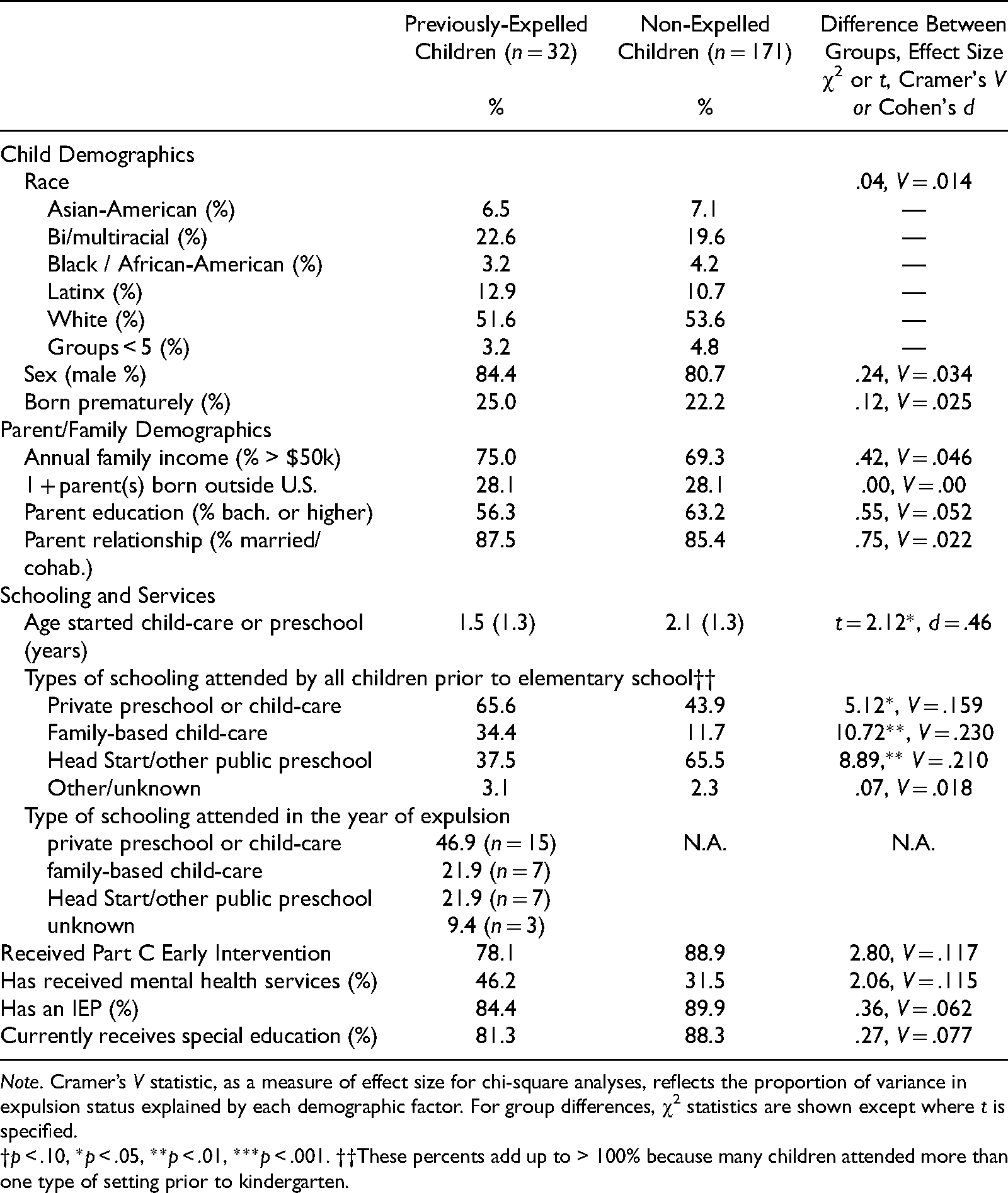
Note. Cramer’s V statistic, as a measure of effect size for chi-square analyses, reflects the proportion of variance in expulsion status explained by each demographic factor. For group differences, χ2 statistics are shown except where t is specified.
†p < .10, *p < .05, **p < .01, ***p < .001. ††These percents add up to > 100% because many children attended more than one type of setting prior to kindergarten.
Measures
Four teacher-rated instruments, and one parent-rated instrument, provided data on child social skills and behavioral and emotional functioning. Researchers administered performance-based measures to assess developmental characteristics (autism characteristics, language, and IQ) directly to the children. Thus, multiple informants and assessment methods mitigated method bias pertaining to child characteristics. Children were assessed at the time of study enrollment (at ages 4–7) and at two subsequent timepoints over a 1.5-year period. Developmental characteristics and expulsion history were assessed at the first assessment; data on social skills and behavioral and emotional characteristics, all teacher- and parent-reports, were drawn from the first assessment or, when unavailable, from the second or third timepoint up to 1.5 years later. Because data collection occurred when children were aged 4 to 7 years old, and parents were asked to report whether their children had been expelled from any past preschool or child-care settings, reported expulsions occurred 0 to 5 years prior to the data collection activities described here. Missingness was 14.8% to 15.3% for teacher measures and 6.9% for parent data; expelled and non-expelled children did not differ in missingness of teacher and parent data. Little's MCAR test provided confidence that the data were missing completely at random, χ2 (44) = 45.08, p = .43.
School History and Expulsion Experiences
Demographics, including children's schooling and expulsion history, were obtained from a parent-report questionnaire. Expulsion history, reason for expulsion, and age of expulsion were based on the following: Has your child ever been asked to leave or been expelled from a school or child-care setting for any reason? If yes, for what reason? At what age? After each of these three questions, parents were provided with a line on which to record their open-ended response; reasons for expulsion were later categorized by type, as described in the Analytic Approach. Any response that indicated an expulsion during the preschool years, prior to the child beginning kindergarten, was included in our definition of “preschool expulsion;” parent-reported expulsions after beginning kindergarten were not included.
To assess school history, including age of first schooling and type of school setting attended, parents were asked, for each year since birth, (a) whether their child attended any form of child-care or preschool, and (b) what type of child-care or preschool they attended, with the following options: Head Start, public preschool, private preschool or child-care, family-based child-care, or other. For analyses, Head Start and public preschool, both free and publicly-funded, were collapsed into one group. We use the term “preschool” to refer to any of the above settings the children attended prior to elementary school.
Child Developmental Characteristics
Autism Diagnostic Observation Schedule (Lord et al., 2000)
As part of eligibility criteria for the study, children were administered the ADOS and met criteria for autism or autism spectrum). The ADOS is a semi-structured, clinician-administered assessment of autism that demonstrates strong specificity and sensitivity in research and clinical settings (Hurwitz & Yirmiya, 2014). During our first wave of assessments for this multi-wave, longitudinal study, the ADOS-2 was not publicly available. For consistency, we administered the ADOS to all participants, including those enrolled after the release of the ADOS-2; we applied the revised research algorithms, which purportedly improve predictive validity and comparability across modules, outperform the original algorithms, and capture both social communication and restricted/repetitive behavior aspects of autism (Gotham et al., 2007, 2008). These revised algorithms (including total algorithm score, social affect score, and restricted/repetitive behavior score) are reported in Table 2 and utilized in analyses.
Characteristics of Previously-Expelled and Non-Expelled Children and Group Differences.

Note. ADOS = Autism Diagnostic Observation Schedule. prnt-rpt = parent report. RRB = restricted and repetitive behaviors. Stand. Sum. = sum of standard scores. STRS = Student-Teacher Relationship Scale, percentiles are based on normative sample. tchr-rpt = teacher report. For child performance-based measures, Ns = 171, 32 except for CASL (Ns = 142, 28). For teacher-report measures, Ns = 147–148, 25. For parent-report measures, Ns = 160, 29. F-values reflect differences between expelled and non-expelled children in a hierarchical linear regression after covarying for children's age at starting school. Effect sizes reflect differences between previously expelled and non-expelled children, after controlling for age at school entry.
*p < .05, **p < .01, ***p < .001. † = small effect (no moderate or large effects were detected).
Social Responsiveness Scale (SRS; Constantino & Gruber, 2005)
The SRS is a parent- or teacher-reported assessment of social reciprocity for children aged 4 to 18 years old. It is also a commonly used screener for autism (Moody et al., 2017). The SRS includes 65 items on a 4-point scale (1 = not true, 4 = almost always true). We used total t scores from the parent-reported SRS; higher scores indicate more behaviors characteristic of autism. In our sample, the mean t score was 80.0 (range = 46–91, SD = 10.8), considerably higher than the cut-off of 60 for clinically-significant social interaction difficulties (Constantino & Gruber, 2005). In our sample, 94.6% of children scored in the clinically-significant range; the SRS alpha was .88.
Wechsler Preschool and Primary Scale of Intelligence, Third Edition (WPPSI-III; Wechsler, 2002)
WPPSI-III is an assessment of cognitive ability for children aged 2 years, 6 months to 7 years, 3 months, yielding an IQ score (M = 100, SD = 15). We computed an estimated Full-Scale IQ from an abbreviated WPPSI-III, using the Matrix Reasoning, Vocabulary, and Picture Completion subtests. This three-subtest version has demonstrated predictive validity (r = .90) and adequate reliability (r = .95) as an indicator of cognitive ability (Sattler & Dumont, 2004).
Comprehensive Assessment of Spoken Language (CASL; Carrow-Woolfolk, 1999)
The CASL is a performance-based assessment of language skills for ages 3 to 21 years, previously used with autistic children (Reichow et al., 2008). We utilized two subtests assessing syntactic (Syntax Construction) and pragmatic (Pragmatic Judgment) skills. The two standard subtest scores (M = 100, SD = 15) were correlated at .78; they were summed to create a CASL sum of standard scores. In the normative sample, the subtests showed internal consistencies of .85 to .96 and test-retest reliabilities of .65 to .96 (Carrow-Woolfolk, 1999).
Child Social, Behavioral, and Emotional Characteristics
Social Skills Improvement System (SSIS; Gresham & Elliott, 2008)
The SSIS is a standardized, norm-referenced assessment of social skills for ages 3 to 18 years, including subscales specifically for autism. The parent version (SSIS-P) and teacher version (SSIS-T) reflect the frequency of child social behaviors on a 3-point scale (from 0 = never to 2 = very often, always). Both yield a Social Skills Total standard score (M = 100, SD = 15). The SSIS has strong test-retest reliability and construct validity (e.g., Gresham & Elliott, 2008). We utilized parent- and teacher-reported Total Social Skills scores, which showed good internal consistency with alphas of .93 and .95, respectively, in our sample.
Teacher Report Form (TRF; Achenbach & Rescorla, 2000, 2001)
The TRF was used to assess child behavioral and emotional symptoms. Teachers completed either the version for ages 1½ to 5 years (99 items) or the version for ages 6 to 18 years (112 items). We used broadband T-scores for Total Problems, Externalizing Problems, and Internalizing Problems, and narrowband scores for Aggressive Behavior, Oppositional Defiant Problems, Attention Problems, Anxious/Depressed, and Withdrawal (M = 50, SD = 10). Standard scores < 60 indicate non-clinical symptoms, and scores ≥ 64 are in the clinically significant range (Achenbach & Rescorla, 2001). Our sample shows good internal consistency at .87 to .94 for total and broadband scales and .68 to .89 for narrowband scales (Llanes et al., 2018).
Student–Teacher Relationship Scale (STRS; Pianta, 2001)
The STRS was completed by the child's teacher. This 28-item standardized measure with a five-point response scale assesses teachers’ perceptions of their relationship with a student. Designed for children 4 to 8 years old, the STRS produces a total score and three subscale scores: (1) Conflict (12 items) measures the teacher's negativity and conflict with the student (e.g., “This child and I always seem to be struggling with each other”); (2) Closeness (11 items) measures affection and open communication with the student (“I share an affectionate, warm relationship with this child”); and (3) Dependency (5 items) measures perceptions of the student as overly dependent (“This child asks for my help when he/she really does not need help”). The STRS shows adequate reliability and validity with students with and without disabilities (Pianta, 2001), as well as validity with autistic children (Blacher et al., 2014). Total and subscale scores were used; alphas were .82 (Total), .81 (Closeness), .83 (Conflict), and .53 (Dependency).
Procedure
This report is part of a larger study involving the transition to early schooling for young autistic children. Although the data reported here have not been previously published, other papers using this dataset also describe the longitudinal study (e.g., Eisenhower et al., 2015a; Levinson et al., 2020). As in previous reports, institutional Review Board approval was obtained for this study.
Prior to the initial visit to our research office, consent forms were sent to parents and signatures obtained; these were reviewed with parents at the beginning of the initial visit to clarify any questions. At the first visit staff confirmed whether children met criteria for inclusion in the study by administering the ADOS, the WPSSI-III, and the CASL; parents completed a demographic questionnaire. In addition, parents and teachers completed a battery of paper-and-pencil measures at the three timepoints of the study (over 1.5 years); parent measures were completed during research office visits; teacher measures were completed and returned via mail.
Analytic Approach
To examine the
To examine
In order to consider the relative and combined
Results
Rate and Nature of Expulsion Experiences
In this sample of 203 autistic children, 32 children, or 15.8% of the sample, had been expelled from a past child-care or preschool setting; this represents one out of six children sampled. On average, children were 3.27 years old when expelled (SD = 1.22, range: 2–6 years). Although children were in early elementary school or their final year of preschool at the time of assessment, we asked parents to report on the type of school setting attended during the year of their child's expulsion. Parent report indicated that, at the age of expulsion, expelled children had been attending a private preschool or child-care program (46.9%, n = 15), family-based child-care (21.9%, n = 7), public preschool (21.9%, n = 7), or unknown (9.4%, n = 3); no children were attending Head Start programs in the year of expulsion.
Reasons for Expulsion
The majority of parents reported that their children were expelled due to behavior problems (81%; N = 26). Of the 26 children who fell into this category, 10 (31% of overall sample) were dismissed due to severe or aggressive behaviors (e.g., screaming, biting, hitting, spitting); three (9%) were dismissed due to behavior problems related to a lack of school-readiness skills (e.g., difficulties paying attention, sitting still, following directions); six (19%) were dismissed due to unspecified behavior problems or both types of problems above (e.g., aggression plus lack of school-readiness skills); and seven (22%) were dismissed due to a combination of behavior problems and developmental issues (e.g., lack of toilet training). The remaining 19% (N = 6) not expelled due to behavior problems were expelled due to developmental and/or social problems (N = 2): teacher-reported inability to manage the child or need more support (N = 2); lack of toilet training (N = 1) or unspecified reasons (N = 1).
Demographics Predicting Expulsion History
We examined the demographic and developmental history characteristics of the 32 previously-expelled children relative to the 171 children with no history of preschool expulsion (see Table 1). Previously-expelled children did not differ from non-expelled children on any sociodemographic factors, including study site (Massachusetts (MA) vs. California (CA); 12.2% of MA and 17.8% of CA participants were expelled, χ2
Schooling Experiences of Previously-Expelled and Non-Expelled Children
We examined early schooling experiences of children who had been expelled versus non-expelled children, including type and number of programs attended and age of first schooling.
Types of School Settings Attended Prior to Kindergarten
We first examined the types of programs all children had attended prior to the assessment, including children who had experienced an expulsion and those who had not, over the course of early childhood prior to the current assessment. Across all children in the sample, 15.3% had attended family-based day care, 47.3% had attended private day care or private preschool, 12.8% of children had attended Head Start, and 53.2% had attended public preschool. Percents add up to over 100% because some children had attended multiple types of programs. As shown in Table 1, previously-expelled children were more likely to have attended a private child-care or preschool (65.6% vs. 43.9%) and/or a family-based child-care (34.4% vs. 11.7%) and less likely to have attended a Head Start or public preschool (37.5% vs. 65.5%) than non-expelled children. None of the expelled children were attending Head Start in the year of their expulsion.
Number of Programs Attended
We also examined the total number of preschool or child-care programs children had attended prior to age 5 or prior to the current assessment, whichever came first. Surprisingly, previously-expelled children had not changed programs or schools more frequently than non-expelled children, having attended an average of 2.0 programs (SD = 1.0, range: 1–5) versus 1.8 programs (SD = .9, range: 0–5) among non-expelled children (t = 1.34, p = .18, Cohen's d = .20).
Age of First Schooling
As shown in Table 1, children had begun attending child-care or preschool at age 2.0 years, on average (SD = 1.3, range: 0–5 years), with previously-expelled children having begun attending at a younger age than non-expelled children (t = 2.12, p = .035, d = .046). Because the age of starting school differed by expulsion status, we covaried this in subsequent analyses comparing expelled versus non-expelled children.
Among previously-expelled children only, we also examined how expulsion affected their subsequent school enrollment by assessing whether they were enrolled in school during the following year. We excluded five children from this examination who had been expelled too recently to assess subsequent school enrollment; 25 out of the remaining 27 children (93%) were enrolled in some form of preschool or child-care the year after expulsion.
Child Characteristics and Relationship Factors Predicting Expulsion History
We examined current child characteristics that were associated with past history of preschool or child-care expulsion, including: children's developmental characteristics (cognitive skills, autism characteristics, language skills), social skills, behavioral and emotional functioning (externalizing and internalizing symptoms), as well as current student-teacher relationship quality (closeness, conflict, and dependency with teachers). For each child characteristic or relationship variable, we conducted a linear regression with age of starting school included in Block 1 as a covariate, expulsion status in Block 2, and the child or relationship variable as the dependent variable; Table 2 shows F values for Block 2 as well as Cohens f2 effect sizes.
As shown in Table 2, previously-expelled children did not differ from non-expelled children on any autism characteristics (including total ADOS algorithm, social affect algorithm, RRB algorithm, and SRS total t score), cognitive skills (WPPSI-III Estimated IQ score), or language ability (CASL Standard Sum Score). Likewise, the two groups did not differ on measures of social skills or on any aspect of internalizing symptoms. However, previously-expelled children scored higher on externalizing problems; because this variable differentiated between expelled and non-expelled groups, we sought to determine which externalizing narrowband scales were involved. According to teacher report, previously-expelled children were rated as having more current aggressive behavior and oppositional defiant behavior. In addition, previously-expelled children currently had greater conflict and dependency in relationships with teachers but did not differ from non-expelled children in current student-teacher closeness.
Combined and Relative Effects of Child Characteristics on Expulsion History
Next, we conducted a multiple logistic regression to determine the relative and combined associations of child characteristics with expulsion status. This analysis only examined child characteristics, and not student–teacher relationship factors, as the latter reflected, in part, children's current teachers and not solely aspects of the child. Age of starting school was entered as a covariate in Block 1, with child autism characteristics (ADOS social affect algorithm, ADOS RRB algorithm, SRS total t score) in Block 2, cognitive and language skills (WPPSI-III Estimated IQ score; CASL Standard Sum Score) in Block 3, social skills (parent- and teacher-reported social skills standard scores) in Block 4, and behavioral and emotional functioning (TRF externalizing and internalizing broadband t scores) in Block 5. TRF narrowband scores for child behavior were not included in this combined regression, as they overlapped in item content with the broadband scores and were highly collinear with one another. Expulsion status was the dependent variable. Hosmer-Lemeshow tests were non-significant, indicating goodness of fit. In Blocks 1 to 4, the model was non-significant, and no individual child characteristics were associated with expulsion status. The Exp(B) adjusted OR for the variables in Blocks 1 to 4 ranged from .83 to 1.03, with 95% CI [.58, 1.22] intersecting with 1.00 as expected, reflecting non-significance. In Block 5, the final step, child externalizing behavior problems were significantly associated with expulsion status (Exp(B) adjusted OR = 1.12, 95% CI [1.04, 1.21]) but child internalizing problems were not (Exp(B) = .98, CI [.92, 1.03]). Block 5, as a whole, was significant, X2(2) = 9.97, p = .007, Nagelkerke R2 = .147. This suggests that, when all child characteristics are considered, only child externalizing problems explained a significant portion of the variance in children's expulsion status.
Discussion
This study focused on the expulsion of autistic children from preschool or child-care; according to parents, 16% of 203 autistic children, or one out of six children, had been expelled prior to elementary school. Children were more likely to be expelled from a private than from a public program. We examined current child characteristics of autistic children aged 4 to 7 in relation to whether they had ever been expelled or dismissed from a preschool or child-care program; there was a latency of 0 to 5 years between the time of their expulsion and the current assessment of child characteristics. Of particular importance, current externalizing behaviors were higher among previously-expelled autistic children than among autistic children without a history of expulsion, and was the only child characteristic that distinguished expelled and non-expelled children. Specifically, previously-expelled children were reported to display more aggression and more oppositional defiant behaviors currently than non-expelled children, a finding corroborated by other studies including children with disabilities (Zeng et al., 2021). However, previously-expelled and non-expelled groups did not differ on any other child characteristics as reported or observed by multiple informants (parents, teachers, researchers), including autism characteristics, cognitive ability, language, or internalizing symptoms. In terms of their relationships with their current teachers, previously-expelled children had student–teacher relationships that were marked by more conflict and greater child dependency.
Because about one third of the children in our sample were in the final year of preschool at the first assessment, some might have been expelled during that time, suggesting that we may be underestimating the true rate. In addition, many dismissals from preschool are “soft” dismissals—for example, repeatedly asking the parent to keep the child home, take them home early, or pressuring parents to find another program, or making the situation altogether infeasible for the family—rather than outright expulsion. Because “soft” expulsion is often not experienced as expulsion, our rates may underestimate the true expulsion rate (Novoa & Malik, 2018).
This study was stronger for its inclusion of parents’ perspectives rather than relying solely on school expulsion records or teacher perspective. Parents were forthright in reporting reasons for removal; in the majority of cases (81.3%), behavior problems were identified as the reason for removal. However, in some cases parents also identified developmental concerns (e.g., toilet training, social difficulties) or teachers’ need for more support in handling their child. Notably, no parent directly suggested that their child's autism was the reason for removal.
Reports on relationship factors provide a more nuanced perspective on student-teacher interactions. The heightened student-teacher conflict and dependency reported by teachers of previously-expelled children relative to non-expelled children is concerning given just how important the student–teacher relationship is during the early school years (Maldonado-Carreno & Votruba-Drzal, 2011), and given the risks already facing autistic children in terms of poorer student–teacher relationships than those of their neurotypical peers (Blacher et al., 2014; Eisenhower et al., 2015a, 2015b). This suggests that previously-expelled children—and their teachers—may not get the support that they needed to be successfully included in the classroom.
The Context of Expulsion
Although expulsion is a concrete, “final” marker of harsh discipline or a lack of support that may be especially prevalent for autistic children, it also reflects a host of subtler differences in the treatment autistic children may receive from teachers (e.g., Clayback & Hemmeter, 2021; Hooper & Schweiker, 2020). Moreover, expulsion disrupts children's burgeoning connections with teachers and classmates in a sudden and, to the child, incomprehensible way. In addition, expulsion undoes any progress in adapting to the routines of the setting, a crucial process for children on the spectrum (Bejnö et al., 2021; Stoppelbein et al., 2016). Expulsion also exacerbates inequities along the lines of disability and other marginalized identities (Loomis et al., 2021; Love & Beneke, 2021); its use and endorsement perpetuate stigma around behavioral and developmental challenges. As opposed to inclusion practices, expulsion and other exclusionary practices promote ableism and deficit-based views about disabilities that are harmful to students both with and without disabilities (Beneke et al., 2019). In all, our findings demonstrate that children with disabilities are being removed and segregated from their earliest school experiences, a pattern that may continue in various forms through later schooling.
Viewed through a social justice lens, preschool expulsion is an issue of educational and health equity that reinforces a preschool-to-prison pipeline by pathologizing and penalizing child behavior (Meek & Gilliam, 2016). Extant studies suggest that a disproportionate number of expelled children are boys and children of color, and a disturbing percentage have disabilities (U.S. Department of Education, 2014; Zeng et al., 2021). This study included a well-defined sample of autistic children from two states, which was, unsurprisingly, mostly boys. However, although the sample was almost half children of color, ethnic or racial differences in expulsion were not observed; the small number of children in each group was likely insufficient to identify patterns. It is also possible that patterns of race and gender bias in expulsion more broadly (U.S. Department of Education, 2014) manifest differently in the context of autism. Clearly, intersections between race, gender, and autism or disability status should be examined in future research with larger samples.
Limitations and Future Directions
As this overall study was not designed with the intent of examining preschool expulsion, we regret not having access to some variables that would allow additional exploration. Notable is the absence of the age of autism diagnosis; future research ought to examine whether the diagnosis, and teachers’ knowledge of the diagnosis, somehow served as protective factors against expulsion or, alternatively, whether this diagnosis, and the purported need for a distinct educational setting, may have served as a factor that facilitated expulsion. Furthermore, parents and teachers were reporting on children's current adjustment at age 4 to 7, rather than their adjustment at the time of expulsion. Thus, it is unclear whether children's behavioral adjustment contributed to their expulsion risk, whether expulsion experiences exacerbated children's incipient behavior problems, or whether additional variables played a causal role.
In addition, characteristics of the teachers whose care children were under at the time of expulsion, such as teacher training or experience, also ought to be considered in future explorations. We also do not have data on whether the children had been expelled more than once. However, we know that children who were expelled were more likely to be attending private preschools or child-care centers rather than public preschool, Head Start, or family child-care programs. In future research, it would be relevant to examine parents’ reasons for selecting different program types.
Although no racial or ethnic differences in expulsion history were observed within our sample of autistic children, our study was not well-designed to pick up such differences; the sample was well-characterized in terms of autism characteristics but racial and ethnic subgroups were too small to detect differences. For example, with only 4% of our sample identified as Black or African American, we were unable to determine whether the disproportionate expulsion experienced by Black and African American children was also present in children on the spectrum. In addition, many children of color have historically been diagnosed with autism later than White children, often not until the elementary school years (Blacher et al., 2019; Donohue et al., 2019; Zuckerman et al., 2017), and thus may be excluded from early childhood autism-focused studies such as ours. Where researchers have had access to large school-wide samples diverse in age, race, ethnicity, and gender (Davis et al., 2019; Petras et al., 2011), racial disparities have been detected; however, those studies rarely report separately on children specifically diagnosed with autism or have detailed data on child characteristics.
Conclusions and Implications
These findings have implications for child-care and preschool teachers who have autistic children in their classrooms. The startlingly high rate of expulsion, and the fact that behavior problems were both the reason for the vast majority of such expulsions and the primary, difference between expelled and non-expelled autistic children, have implications for parents, practitioners, educators, and researchers. Parents are likely to be unaware of the prevalence of preschool expulsion, and also unfamiliar with their—and their child's—rights under IDEA. Educational advocacy programs for parents might consider including training to empower parents to recognize the potential biases that they may face in childcare settings. For example, expulsion is strongly discouraged in public preschools or Head Start programs but may be unchecked and happening quietly in private settings.
In particular, these findings highlight the need for professional development for early childhood educators in several areas. First, greater training in, and familiarity with, socio-emotional, behavioral, and developmental milestones may enable teachers to recognize the difference between developmentally-appropriate behaviors and those behaviors that beg additional assessment and possible intervention. For example, teachers whose expectations for behaviors are too developmentally advanced may label children as challenging when their behaviors are within age-appropriate norms.
Second, training that enables greater attunement to the needs of children with disabilities would lessen the odds that children are removed for the very behaviors that are associated with, or even caused by, the disability. As child behavior problems seem to be the primary factor associated with expulsion, early intervention efforts can target emerging behaviors that are perceived as oppositional or aggressive in young autistic children (Giordano et al., 2021). Training and support around fostering strong parent-teacher collaboration may also help to prevent problems from reaching the point when expulsion feels necessary (Zulauf-McCurdy & Zinsser, 2022).
Third, training around implicit biases may enhance preschool teachers’ ability to detect and address bias in discipline practices (Novoa & Malik, 2018) and across gender and race (Neitzel, 2018), with teachers perceiving Black boys’ behavior as more disrupting or indicative of externalizing problems relative to the behavior of White and female preschool students (Gilliam et al., 2016). Fourth, in addition to training in implicit bias, teacher training to proactively prevent expulsion includes strategies to foster socio-emotional development. This may involve supporting teachers to make helpful, empathic attributions about autistic students’ behavior. For example, in a recent intervention to reduce school suspensions, middle school teachers were able to adopt an empathic rather than punitive mindset toward students and develop alternative attributions for student misbehavior; in turn, teachers were less likely to suspend students following the program (Okonofua et al., 2016). A similar, attribution-shifting intervention may be helpful for general education teachers who have autistic students in their early childhood classrooms. These teachers should also have access to behavioral or mental health consultation when needed to protect against expulsion (Hepburn et al., 2013; Silver & Zinsser, 2020). On this point, many autistic adults report significant mental health needs (McCauley et al., 2020), and these often manifest early in childhood as behavioral distress (Stringer et al., 2020). There is a need for more research incorporating the viewpoints and recommendations of autistic youth and adults around effective and affirming school-based support for autistic children (Berkovits et al., 2020; Penney, 2013).
Overall, it is important that teachers be mindful of the widespread racial and ethnic bias affecting early detection of autism, receive support for children who present with behaviors that teachers deem challenging, and learn how to enhance the student–teacher relationship. From a policy perspective, many have suggested that the practice of preschool expulsion be drastically reduced or prohibited altogether (Gilliam, 2008; Malik, 2017). We endorse that practice wholeheartedly, especially for autistic children. We also endorse providing teachers with appropriate knowledge about autism characteristics and clear direction and supports for addressing behavioral challenges early and constructively.
Footnotes
Authors’ Note
This study was funded by the Institute of Education Sciences (R324A110086; J. Blacher, P.I.) Support was also provided by the SEARCH Family Autism Resource Center in the Graduate School of Education, University of California–Riverside. We are indebted to the participating families and teachers and to our staff and students.
Declaration of Conflicting Interests
The authors declared no potential conflicts of interest with respect to the research, authorship, and/or publication of this article.
Funding
The authors disclosed receipt of the following financial support for the research, authorship, and/or publication of this article: This work was supported by the Institute of Education Sciences (grant number R3224A110086).
