



Abstract
Despite vast improvements in language rights and educational equity afforded through the legacy of the Lau v. Nichols decision, emergent multilingual learners’ educational trajectories often differ from those for whom English is a primary language. Prior research indicates that emergent multilingual learners are more likely to be placed into special education in later grades, compared to peers. There is, however, a paucity of research on how school context influences special education classification for those labeled as English Learners (ELs), and many studies cannot identify impacts over time. In this study, we leveraged longitudinal student data to analyze disproportionate representation of emergent multilingual learners, both in special education and in specific disability categories, given school contextual considerations, (e.g., school composition, presence of a school-wide transitional bilingual program). We found that emergent multilingual learners were underrepresented in special education in early years, compared to those not labeled as ELs, and twice as likely to be placed into special education—particularly for specific learning disability—in later grades. School context variables were salient predictors after controlling for student covariates. Together, these findings highlight the importance of context, policies, and school program offerings as important considerations for understanding special education risk for emergent multilingual learners.
Keywords
In 2021, more than 5 million students enrolled in public schools nationwide were labeled as English learners (EL i ), representing 10% of total student enrollment (National Center for Education Statistics, 2023). Since the Supreme Court’s landmark ruling in Lau v. Nichols (1974) regarding educational access for multilingual learners, policy has yielded vast improvements in language rights and educational equity, including a requirement that schools provide meaningful instruction to those learning English (Ovando, 2003). Yet, research indicates different educational trajectories for those labeled as EL, compared to peers for whom English is a primary language (Chin, 2021). For example, studies have found reduced academic proficiency compared to non-labeled peers (Umansky, 2016a), associated with differential access to core academic content and learning opportunities (Umansky, 2016b). These disparities are reflected in emergent multilingual learner representation in special education (Counts et al., 2018).
Studies examining emergent multilingual learners in special education have suggested underrepresentation in early years (Guarino et al., 2010) and overrepresentation in later years (Thompson, 2017). Studies have also shown differential placement into special education by disability category (Office of Special Education Programs, 2023; Yamasaki & Luk, 2018). For example, Estrem and Zhang (2010) found that EL-labeled students were underrepresented in autism, while Sullivan (2011) and Yamasaki and Luk (2018) both found EL-labeled students more likely to be placed into specific learning disability (SLD), and rarely placed into emotional disability (ED). Cooc (2023) found overrepresentation in SLD and Speech and Language Impairment (SLI) but underrepresentation in Other Health Impairment (OHI) and ED.
Together, these studies suggest that some disabilities may be difficult to disentangle from language development processes (i.e., SLD and SLI), interpretations of which may be influenced by context, resources, and available programs (Fish, 2019; Stiefel et al., 2024). Such school features “create conditions for the construction of multiple views of difference in which disparate markers of difference change their meanings … across contexts” (Artiles, 2011, p. 431). For instance, research has found differences in SLD and SLI representation depending on whether parents chose to waive language services, indicating a perception that students learning English need to choose between language support services or special education services, depending on quality and availability (Oh & Mancilla-Martinez, 2024). Thus, scholars have suggested further research on the “key relationships among education policy, context, and … disparities” (Tefera & Fischman, 2020, p. 434), as views of ability and language are intertwined, impacting bilingual education policies (Escamilla et al., 2022).
Emergent Bilingual Education and Special Education
Like special education designation, the EL label is subject to both policy and praxis, and thus over- and under-representation of emergent multilingual learners in special education is symptomatic of system-level characteristics, local-level program offerings, and practitioner perspectives (Cuba & Tefera, 2024). To better serve students, the field must understand the “fluid interrelationship that characterizes the language practices of bilingual communities,” (Flores & Chaparro, 2018, p. 369) in tandem with school institutional context and temporal patterns of emergent bilingual students’ placement into special education. For example, Artiles et al. (2005) found that emergent bilingual learners who qualified for special education and were enrolled in language acquisition programs were more likely to be placed in restrictive special education environments compared to their peers in English immersion. Ortiz et al. (2011) found that district- and school-level actors often relied on special education in place of other pre-referral interventions, and teachers in their study often provided superficial documentation of efforts to intervene before seeking a referral. These studies highlight mutually reinforcing systems of professional bias and institutional practices that maintain inequities in the process of determining eligibility and ultimately serving students in special education.
Research highlights the importance of longitudinal data in understanding entanglements between disability and language acquisition (Umansky & Reardon, 2014). Cruz and Firestone (2022) found that, controlling for student and school covariates, students labeled as EL experienced roughly four times the odds of having an Individualized Education Program (IEP) in middle grades compared to those not labeled as EL, indicative of persistent disparities between students whose heritage language is English, those who reclassify to English proficient, and those who remain labeled as EL (Saunders & Marcelletti, 2013). Similarly, Thompson (2017) determined that after 9 years of instruction in English, approximately one-fourth of students had not been reclassified, increasing their exposure to negative outcomes such as stigmatization and unequal opportunities to learn core content (see Umansky & Avelar, 2023). Of these students, 30% were eventually placed into special education. This suggests a critical reclassification window during the upper elementary grades that, if missed, places students at a higher risk for special education identification in later years.
Transitional bilingual education programs that allow students to learn academic content in their heritage language while simultaneously transitioning to English content hold potential to support bilingual students’ access to core academic learning opportunities (Umansky, 2016b), ultimately serving as a mitigating factor for placement into special education. On the other hand, schools with such programs may only serve to delay eventual placement as practitioners delay assessment until students reach English proficiency (Hibel & Jasper, 2012). Considering these disparate hypotheses, understanding temporal patterns, school-level factors (e.g., school composition, resources, and programs), and related effects of language supports is critical to understanding and potentially reducing the need for special education for multilingual learners.
Study Purpose
We aimed to understand school structures, policies, and practices that affect risk of placement into special education for this historically marginalized student group. Researchers have argued for analyses of local contextual factors to support educational reform in school districts (Bal et al., 2014). We examined emergent multilingual students’ temporal risk of identification for special education within a diverse district, given school contextual characteristics, such as their enrollment in schools featuring a transitional bilingual program (i.e., a program aimed at promoting English proficiency among Spanish-speaking multilingual learners). Although English acquisition support may be offered in a variety of formats (e.g., sheltered instruction, specialized pull-out services), some schools in the study’s focal district provided EL-labeled students with in-class instruction in both English and their home language to support accelerated English language development and reclassification, as well as academic access. Early grade instruction occurred primarily in students’ home language, and students gradually transitioned to English-focused instruction as they progressed to upper grades. Research questions included the following: (a) What is the relationship between EL-labeled students’ characteristics, school characteristics, and placement into special education? (b) What factors are related to variation in time to special education identification by disability category for students identified as ELs? and (c) Do schools with transitional bilingual programs serve to mitigate emergent bilingual learners’ overclassification into special education in later grades?
Conceptual Framework
We leveraged labeling theory (Raybeck, 1988), operating within agency-structure divides in school organizations (Kolluri & Tichavakunda, 2023), to examine school context and temporal patterns of emergent multilingual students’ placement into special education. Students with disabilities and students for whom English is not a heritage language both risk exposure to deficit ideologies and less rigorous curriculum compared to peers (Flores & Lewis, 2022; Shapiro, 2014; Umansky & Avelar, 2023). This is particularly true for students labeled as both EL and as having a disability (Kangas & Cook, 2020).
Labeling Theory
Blanchett et al. (2009) described how disability label application is used as a method of social control through sorting, stratifying, and excluding. Research indicates a complex hierarchy in the social mechanisms associated with different disability labels (Grue, 2016). For example, Fish (2019) considered variation in stigma, exclusion, and parental capital to define other health impairment (OHI), SLI, and autism as higher status disabilities, and ED and ID, which tend to come with increased stigma and segregated placements, as lower status disabilities. Fish described SLD as a category for which status is context-dependent and related to complex—and often inconsistent and subjective—ways in which students are referred for assessment and eventually classified. SLD is categorically subject to structural and institutional forces that may impact a diagnosis (Shifrer, 2018). Although current works have uncovered specific ways in which different disability categories are related to racialized placement into special education (Cruz et al., 2024b; Skrtic et al., 2021), few have examined this process for emergent multilingual learners.
Moreover, raciolinguistic ideologies that perpetuate linguistic hierarchies contribute to how the processes of referral, assessment, and classification transpire (Flores & Lewis, 2022; Flores & Rosa, 2015). Research has found emergent multilingual learners who spoke Spanish at home were more likely to be placed in special education and less likely to be reclassified as English proficient compared to children with other non-English home languages (Slama, 2014; Thompson, 2017). For example, while investigating the effects of English-only legislation in Massachusetts, Slama (2014) found EL-labeled students whose home language was Spanish were less likely to reclassify as English proficient compared to peers with other non-English home languages. Similarly, Thompson (2017) found that emergent multilingual learners who were male, spoke Spanish at home, and with parents who did not complete high school had a higher risk of remaining labeled as EL compared to their peers.
Structure and Agency
Counter-deficit scholarship has often focused on marginalization as occurring through mutually reinforcing pathways of deficit ideology and structural oppression (Kolluri & Tichavakunda, 2023). As Ray (2019) notes, “incorporating organizations into a structural theory of racial inequality can help us better understand stability, change, and the institutionalization of racial inequality” (p. 26). Just as organizations are racial structures that reproduce racialization processes, patterns of linguistic and disability hierarchy are also embedded within organizations via institutional practices that label and segregate students and prioritize normative notions of language acquisition and ability. This theory suggests that when students learning English fail to acculturate by hitting an arbitrary level of academic language proficiency, the organization enacts policies and procedures to explain “deviance” from norms, (Raybeck, 1988) as being endemic to the student through special education and EL labels (Flores & Lewis, 2022; Kangas & Cook, 2020; Thompson, 2017).
These theories informing our conceptual framework, in tandem, allowed us to examine a confluence of factors that may mitigate or exacerbate educational inequities for emergent multilingual students. Schools with higher aggregate teacher experience, for instance, might more effectively support students with higher support needs without special education services, but more experienced teachers might also be more adept at noticing academic difficulties that would lead to referral for an assessment. Therefore, this analysis included several school contextual features representing structure and time to label, including teachers’ average years of experience and school-level Free or Reduced-Price Lunch (FRPL), both of which captured the school-level resources available to students in each school (i.e., the organizational structure of each school). We also included compositional factors (e.g., school percent EL) and whether the district’s transitional bilingual program was offered in the school to examine how language-based academic resources function in relation to bilingual students’ risk of special education classification.
Method
Data
We analyzed student-level administrative records provided by an urban school district (with institutional review board [IRB] approval) in California to understand associations between EL designation and school contextual factors on special education identification. We focused on one district because we were interested in how the district’s organizational attributes interacted with the sorting and labeling of emergent multilingual learners. The use of a single district provided a multidimensional understanding of disproportionality from a contextual standpoint. Given our agency-structure conceptual framework, this approach differs from other quantitative research that considers numbers as neutral and prioritizes generalizability to larger populations (Gillborn et al., 2018).
The sample district was selected because its demographic features were comparable to California’s overall composition with some unique structural and sociodemographic features. For example, because the district served a higher number of EL-labeled students, district leaders chose to implement transitional bilingual programs in some elementary schools. The data included demographics for all students enrolled in the district from Fall 2011/2012 to Spring 2018/2019. We compiled school-level data from the California Longitudinal Pupil Achievement Data System (California Department of Education, 2019), which provides annual data on school characteristics (e.g., average years of teaching experience within the school). We combined these datasets using unique school identifiers provided in both databases.
Sample Characteristics
The dataset included school-by-year panels, and the combined panels represented 257,845 school-by-year observations across the 8 years (i.e., all students enrolled in the district from grades K–12 each academic year). This included 67,415 unique students, and students were represented for an average duration of 3.83 years within the dataset. The longitudinal nature of the data means that the first cohort of kindergarten students in 2011/2012 completed seventh grade in 2018/2019, while the last cohort in 2018/2019 only had 1 year of data. Latinx students represented the largest group of observations (51.5%) within the dataset, ii white students accounted for 25.2% of all observations, Asian students composed 15.5%, and African American students comprised 2.9%. Less than 1% of observations were American Indian or Alaska Native, and students whose parents declined to state an ethnicity composed 4%.
Students receiving special education services made up 10.2% of the dataset (total SD = .30; between year SD = .28; within year SD = .12). Almost half (45.3%) of the dataset’s students qualified for FRPL. Students labeled as EL made up 22% (total SD = .41; between year SD = .39; within year SD = .22), compared to 19% statewide (California Department of Education, 2019). Half (51.5%) of student observations were male, and percentage by disability category label mirrored state and national trends (SLD = 4.4%; SLI = 3.0%; Autism = 1.2%; OHI = 0.9%; ID = 0.4%). The majority (82.2%) of the dataset’s EL-labeled students spoke Spanish as a primary language; therefore, the district’s transitional bilingual program solely served Spanish-speaking students. Thus, the analyses consider three distinct groups: students whose primary language was English or those redesignated from EL to English Proficient (EP; 78%), students whose primary language was Spanish (EL Spanish; 18.1%), and students whose primary language was something other than English or Spanish (EL Other; 3.9%). EL-labeled students (i.e., EL Spanish-speaking and EL Other combined) were more likely to be male, were more likely to qualify for FRPL, and were more likely to have an IEP, compared to EP-labeled peers. We provide additional demographic information in Table 1S and Figure 1S of the Supplementary Materials for this article.
The analytic sample contained data for 41 total schools; this included 24 elementary schools serving students from kindergarten through Grade 5, two schools serving students from kindergarten through Grade 8, six middle schools serving students from Grades 6 to 8, five comprehensive high schools for students in Grades 9 through 12, and four alternative programs (i.e., transition and continuing education, and early-childhood programs).
Variables
Dependent variables. The dependent variables for this study included a dichotomous variable indicating whether a student had an IEP (with no IEP serving as the referent) and six dichotomous variables indicating disability category designation. We included the disability categories of SLD, SLI, OHI, ID, and autism (i.e., those with large enough sample sizes). In all analyses using these disability categories, students not in that category (including those with an IEP for a different category) served as the referent.
Student-level variables. Because the transitional bilingual program offered within this district focused on Spanish-speaking students, the primary covariate of interest was a time-varying indicator for whether a student was labeled as an EL with Spanish as a primary language (EL Spanish). We also included a time-varying dichotomously coded indicator for whether a student was labeled as an EL whose primary language was not English or Spanish (EL Other), with students labeled as EP serving as the referent. These indicators varied from year to year (i.e., once a student was redesignated to EP, they became a 0 in the next year-panel iii ). We also included gender (time-invariant) as a control variable, as research indicates that males are both identified for special education at a higher rate and reclassified to English proficient at lower rates, compared to female peers (Thompson, 2017). We included a time-varying dichotomous indicator for student FRPL as a proxy for socioeconomic status. Finally, we included a student-level race indicator as a time-invariant control, as research indicates disproportionate placement into special education by race/ethnicity (Cruz & Rodl, 2018).
School-level variables. The analysis included three continuous time-varying school-level predictors to represent school composition and context: percent FRPL, percent EL, and average years of faculty teaching experience. Aligned with our conceptual framework, these variables provide insight into the learning opportunities available to students, which can influence special education referral patterns, particularly as more experienced teachers may better support diverse learning needs (Estrada, 2014; Flores & Lewis, 2022), mitigating the need for special education referral, or they may be more likely to notice academic support needs and refer for assessment. During 2019, the average percent of students receiving FRPL was 45.2 (SD = 25.4), with a wide range of difference across schools (1.8% to 95.6%). The mean percent of EL-labeled students in each school also encompassed a wide range, with an average of 22.0 (SD = 16.1) and a range of 2.0% to 83.2%, indicating the need for a contextual examination of school organizations. For interpretability, we standardized these variables to z-scores, such that a unit change represents a standard deviation rather than a single percentage point. School-level average teaching experience ranged from 5 to 19 years, with a mean of 10.36 years (SD = 1.7).
We also included a time-invariant dichotomous indicator for whether the school had a transitional bilingual program. Nine out of the 24 elementary schools in the sample offered such a program. The sample district’s program was reserved for young emergent multilingual students for whom Spanish was a primary language. Students began learning in an all-Spanish setting and gradually transitioned to an all-English setting within six academic years (i.e., kindergarten through Grade 5). Instructional content delivered during this gradual transition was provided in both languages to support both English acquisition and access to core content, supported through a student’s primary language (i.e., Spanish). This language acquisition program differed from other programs—such as pull-out services and EL paraprofessional support—offered in other schools within the district (Valentino & Reardon, 2015).
Analytic Plan
The analytic plan predicted three related outcomes: (a) student- and school-level factors related to placement into special education; (b) time to placement given disability category; and (c) the effectiveness of schools offering a transitional bilingual program in reducing EL Spanish-speaking students’ overrepresentation in special education in later grades. The dataset featured a three-level structure (i.e., timepoint, nested within students, and students nested within schools). We employed a cohort-sequential design, allowing us to follow overlapping cohorts to identify a single trajectory, isolated by adding a fixed effect for the year-panel (Hox et al., 2017). This design suited the study because it allows for fitting efficient models, including incomplete longitudinal data for some cases, and allowing us to assess the role of institutional forces in shaping outcomes (Prinzie et al., 2006). To answer our first research question, we used multilevel logit models holding year as a fixed effect and allowing a random intercept for schools (Rabe-Hesketh & Skrondal, 2012). To answer our second research question, we employed discrete time survival analysis (Singer & Willett, 2003). Finally, to answer our third research question, we included indicator variables for both enrollment in a transitional bilingual program school and first IEP in middle grades.
Student and School Factors
To provide an overall picture of representation in special education and related variance components for our groups of interest, we began with a nested logit model. As prior work has examined these factors in detail (e.g., Sullivan, 2011), we considered this a preliminary analysis from which to begin understanding temporal patterns and association of the transitional bilingual program with special education placement. We began this analysis with an open model, examining bivariate representation of students labeled as EL Spanish-speaking and EL Other. In Model 2, we added student covariates. Model 3 included school covariates, and Model 4 included a dichotomous indicator for presence of the transitional bilingual program in the school. The final model is represented by the following equation:

Time to Identification
To estimate timing of students labeled as EL Spanish-speaking or EL Other given different special education labels compared to EP students, we used discrete-time hazard analysis (Singer & Willett, 2003). Hazard refers to the likelihood that special education identification would occur for a student in a particular grade, given that the event had not already occurred in a previous grade for that student. We constructed a person-by-period dataset with observations for each student, i; in each grade, j; situated in school, s; until either the event occurred, or the student no longer appeared in the data. The following logistic regression equation represents the full model:

Impact of Schools With Transitional Bilingual Programs
Our analysis of the effects of attending a school with a transitional bilingual program on special education labels in middle grades provided important information on strategies schools might leverage to improve student outcomes. One limitation of the data structure included censorship due to the limited number of panels available (i.e., students who started kindergarten in 2011 appear in the last year of data in seventh grade). Thus, the most direct way to examine this association required restricting the sample to students for whom there was uncensored data (i.e., students who appeared in the dataset within a timeframe that a transitional bilingual program would be available and for whom there were enough years of data to include middle school years). The sample for this research question included students from Grades K–8, flagged with two constructed variables: (a) years of enrollment in a transitional bilingual school anytime between Grades K–5 (labeled TBPdose), and (b) initial placement into special education anytime within Grades 6–8 (labeled IEPflag). The TBPdose variable ranged from 0 (never in a school with this program) to 6 (in a school with this program from K–5). The IEPflag variable is a dichotomous indicator with 1 = being given an IEP for the first time in any Grade 6–8.
We used a cross-classified nested multilevel model (Barker et al., 2020). This model compared changes over time between treated and untreated units, including a lagged dependent variable; the difference-in-difference effect is captured in the interaction term:

Again, in this model,
Of the total observations in the dataset, 176,345 were in grades K–8 (68.5% of the sample). Of these, 105,638 had enough uncensored data for the analysis (i.e., the student appeared at least once in grades K–5 and in Grades 6–8), indicating that 60% of the potential sample was retained after dropping censored observations. This censoring was roughly equal between left and right, and so we assume that the censored (unobserved) longitudinal data follow the same distribution assumed for the uncensored (observed) data (Hu, 2002). The parameter of interest for this analysis included coefficients of the interaction between TBPdose and each language group indicator. These terms estimate the difference in likelihood of middle grade special education identification for EL Spanish-speaking and EL Other students, compared to EP peers, given the number of years in a school with the transitional bilingual program. If EL-labeled students were proportionately identified in special education, there would not be a significant difference in the likelihood of special education identification for these groups.
Results
Student and School Factors
Our first research question established differences in representation of EL Spanish-speaking students in special education within the dataset. Although all EL-labeled students were represented in special education at a higher rate compared to EP peers, EL Spanish-speaking students were estimated as twice as likely as EP students to be placed into special education (OR = 2.01, SE = .04, z = 37.8, p < .001, CI [1.95, 2.08]), all net controls considered. Although teacher experience was not significantly associated with special education representation, increased percentage of EL-labeled students in a school was associated with reduced odds of special education identification (OR = 0.94, SE = .02, z = −2.87, p = .001, CI [0.90, 0.98]). Adding the transitional bilingual program indicator as a covariate indicated a continued overrepresentation of EL Spanish-speaking students. This indicator was associated with reduced special education representation, though this was not statistically significant (OR = 0.85, SE = .11, z = −1.26, p = .21, CI [0.66, 1.09]; see Table 1).
Odds Ratios: Representation of EL-Labeled Students in Special Education.
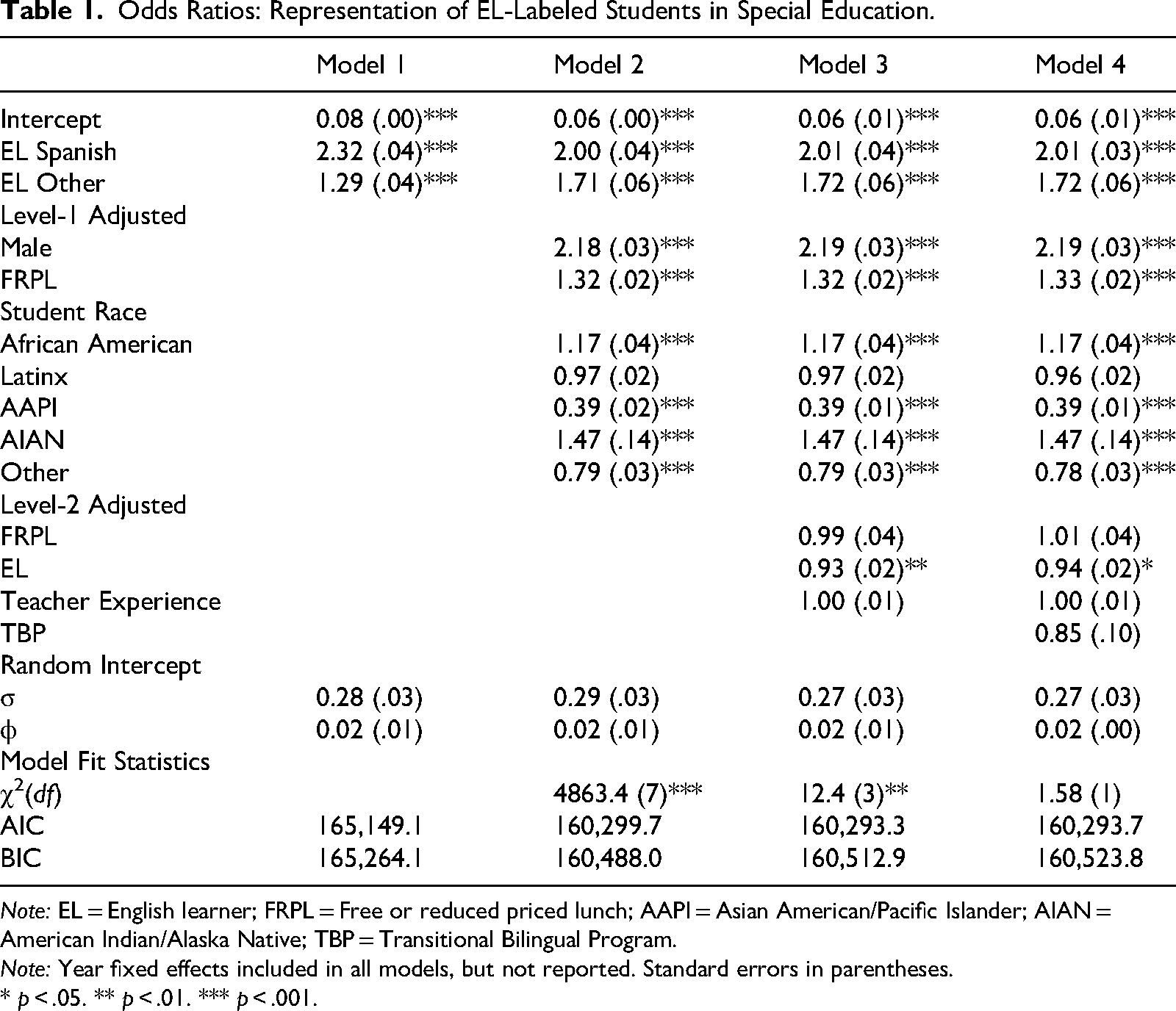
Note: EL = English learner; FRPL = Free or reduced priced lunch; AAPI = Asian American/Pacific Islander; AIAN = American Indian/Alaska Native; TBP = Transitional Bilingual Program.
Note: Year fixed effects included in all models, but not reported. Standard errors in parentheses.
* p < .05. ** p < .01. *** p < .001.
Time to Label
To answer our second research question, we sought to highlight the temporal patterns of risk by disability category. We used a discrete hazard logit model to examine the total number of instantaneous event rates for each label category. Interpreting the hazard ratio is like interpreting odds ratios; however, the hazard ratio represents the probability that an individual would experience the event (i.e., be given a particular special education label) at a particular point in time given they had not previously been given that label. We found that at any particular time, those labeled as EL in either group were twice as likely to be given an IEP compared to EP peers, all controls considered; by seventh grade, roughly 25% of all EL Spanish-speaking students were placed into special education, compared to just under 10% of non-EL students Figure 2S depicts a probability analysis indicating higher IEP probability for EL-labeled students than EP peers across educational trajectories, with widening probability between EL-Spanish speaking students and EL-Other students as they progress through school. Figure 3S depicts hazards by language group, indicating the grade points at which differences begin to appear.
Both student and school characteristics were associated with estimated differences in being given an IEP across years in the dataset. For example, student-level receipt of FRPL was associated with an estimated increase in special education labeling events, but students in schools with higher percentages of FRPL were associated with reduced event rates (HRR = 0.68, SE = .01, z = −28.07, p < .001, CI [0.67, 0.70]). However, students in schools with higher shares of EL-labeled students were associated with increased event rates (HRR = 1.53, SE = .02, z = 32.81, p < .001, CI [1.49, 1.57]). Students in schools with higher teacher experience in these models were associated with a slight but significant increase in hazard per year (HRR = 1.03, p < .001). Although across all language groups, being in a school with the transitional bilingual indicator was associated with increased IEP events, all net controls considered, the opposite was true for EL-labeled students specifically (Table 2). However, we note that because the program was only offered in elementary schools, this result only provides evidence that EL-labeled students’ enrollment in transitional bilingual program schools may have reduced placement into special education by the end of elementary school compared to EP-labeled peers.
Results for Hazard Models Predicting IEP.
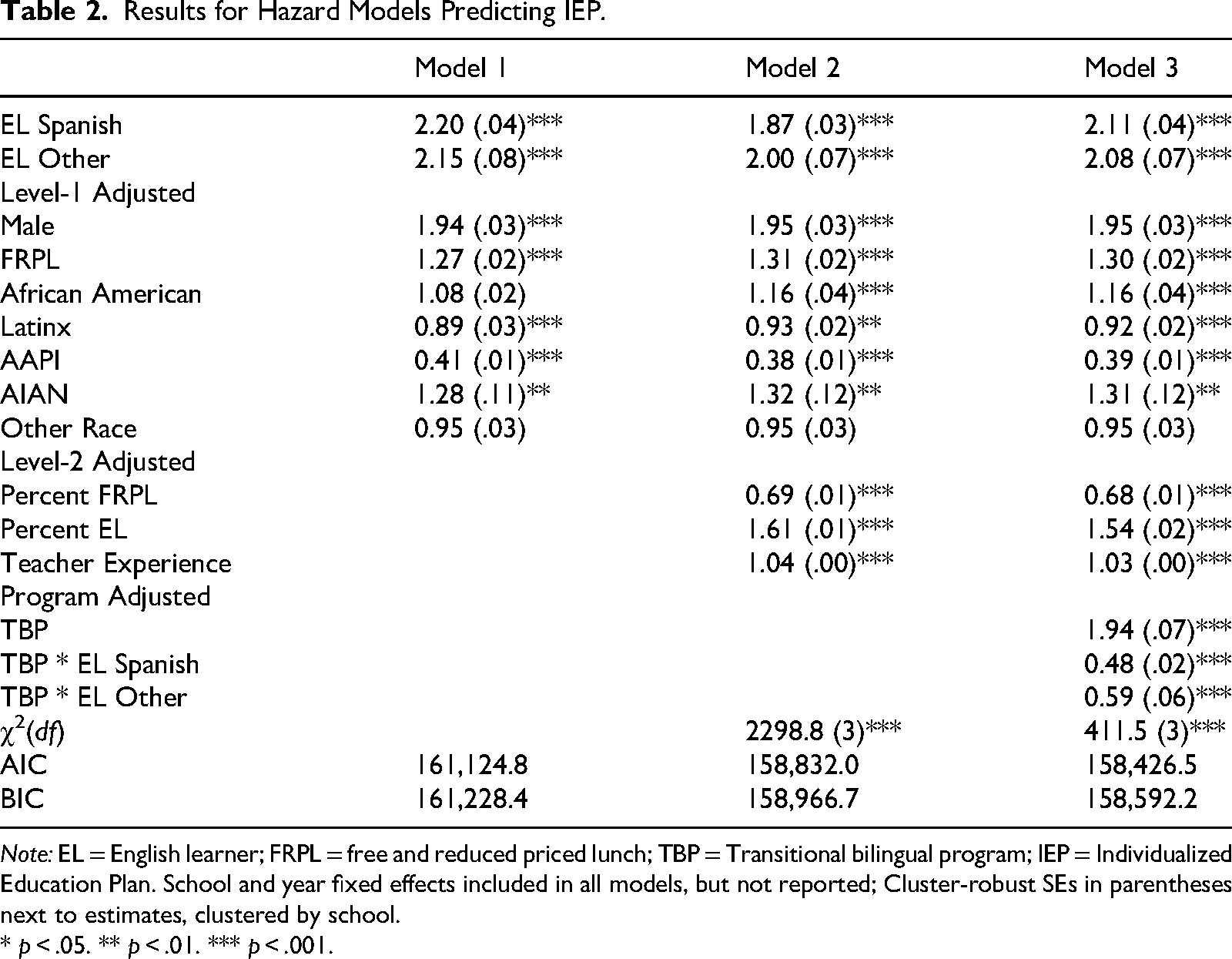
Note: EL = English learner; FRPL = free and reduced priced lunch; TBP = Transitional bilingual program; IEP = Individualized Education Plan. School and year fixed effects included in all models, but not reported; Cluster-robust SEs in parentheses next to estimates, clustered by school.
* p < .05. ** p < .01. *** p < .001.
In examining timing by category, we found that all EL-labeled students experienced elevated rates of disability at any particular time point (see Table 3 v ). Yet, whereas Spanish-speaking ELs were more likely to be sorted into the SLD and ID categories, EL Other students were primarily sorted into Autism (see Figure 4S). Timing of placement was also associated with language and disability labels, as students in schools with a transitional bilingual program were more likely to be given a disability label—with particularly elevated risk in SLI and Autism—compared to peers in other schools, all else held constant. However, being categorized as an EL in a school with this program was associated with reduced disability label across several categories, indicating that in elementary school, the program was associated with reductions in these labeling experiences for the target population.
Discrete Time Hazard Regression Models by Label.
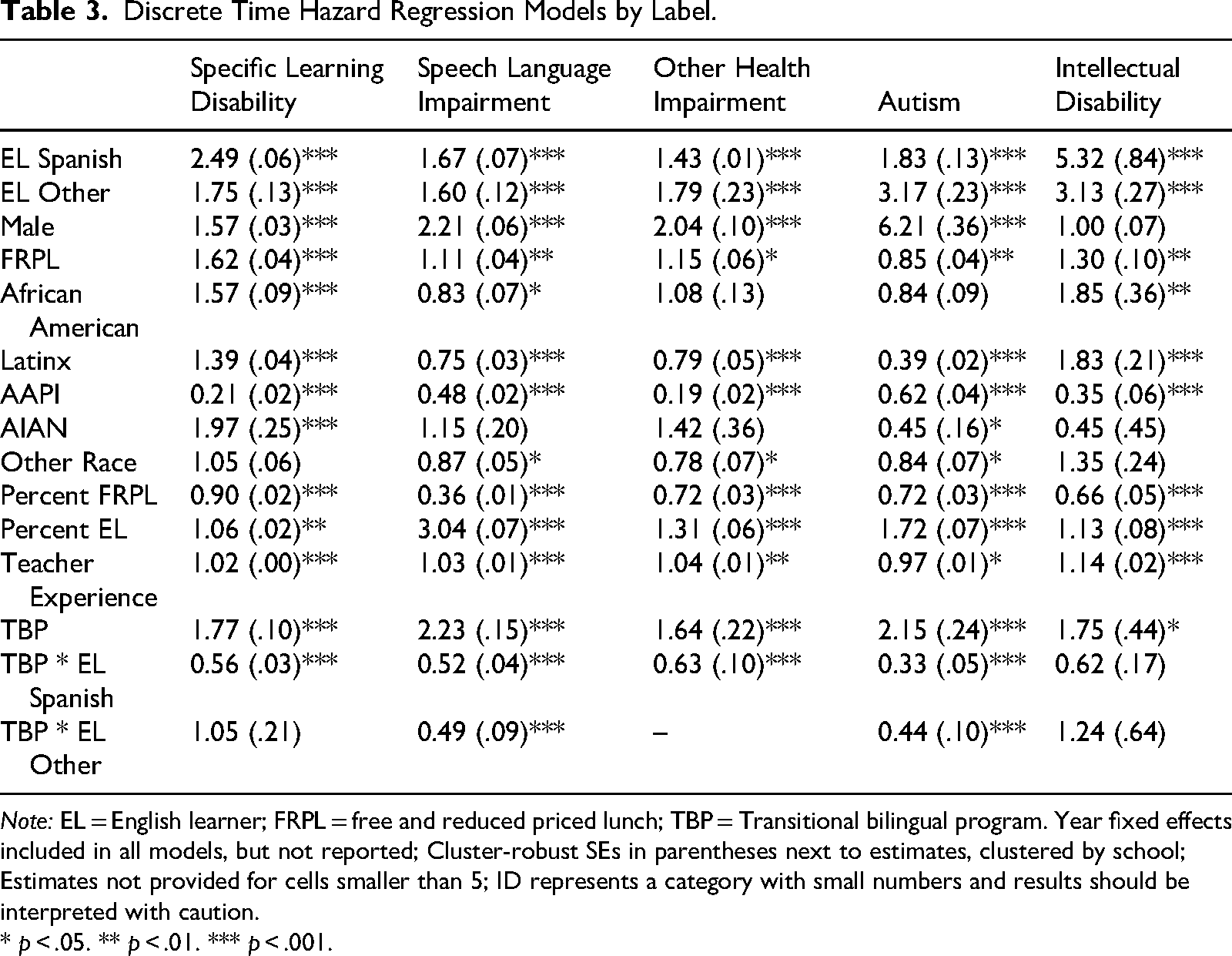
Note: EL = English learner; FRPL = free and reduced priced lunch; TBP = Transitional bilingual program. Year fixed effects included in all models, but not reported; Cluster-robust SEs in parentheses next to estimates, clustered by school; Estimates not provided for cells smaller than 5; ID represents a category with small numbers and results should be interpreted with caution.
* p < .05. ** p < .01. *** p < .001.
EL Spanish-speaking students faced a higher risk of placement in middle grades. Effects for whether a school offered a transitional bilingual program (i.e., the coefficients for TBP * category reported in Table 4) restrict the hazard ratio to students potentially within such schools, which only extended to Grade 5. Thus, Research Question 3 included a lagged variable examining likelihood of placement in middle grades for students who had been in transitional bilingual program schools, compared to those who had not been enrolled in these schools.
Logit Models Predicting IEP in Middle Grades.
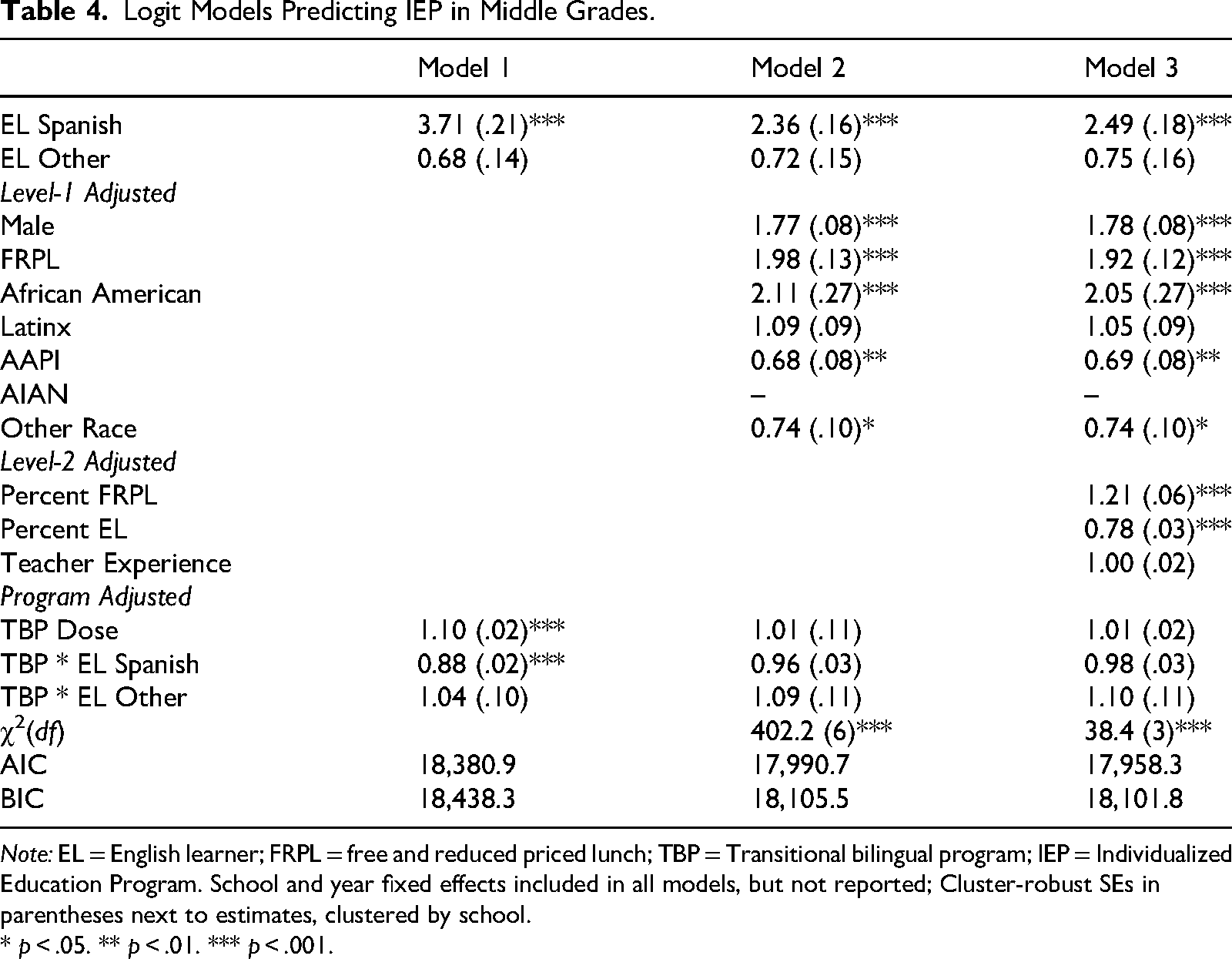
Note: EL = English learner; FRPL = free and reduced priced lunch; TBP = Transitional bilingual program; IEP = Individualized Education Program. School and year fixed effects included in all models, but not reported; Cluster-robust SEs in parentheses next to estimates, clustered by school.
* p < .05. ** p < .01. *** p < .001.
Transitional Bilingual Program and Label Trajectory
To examine the estimated trajectory associated with being in a school with the transitional bilingual program on special education identification for EL Spanish-speaking students, we modeled IEPflag as a function of TBPdose. As reported in Table 4, we found that, prior to controls, each additional year in a transitional bilingual program school from Grades K–5 was associated with a 10% higher likelihood of first being placed in special education anytime in grades 6–8 (OR = 1.10, SE = .02, p < .001), but that EL Spanish-speaking students in these schools were associated with a reduced likelihood of being placed in special education in middle school compared to students labeled as EP (OR = 0.88, SE = .02, p < .001). However, once adjustments for student and school controls were added, EL Spanish-speaking students were equally likely to be given an IEP in middle grades, indicating that attending schools with transitional bilingual programs was not associated with reduced special education placement in later grades. Taken together, these results indicated that net of all controls (including enrollment in a school with a TBP) EL Spanish-speaking students faced a significantly higher risk of special education identification in middle grades, particularly in SLD and ID categories.
Sensitivity Analyses
The lack of academic control variables represents an important limitation in our models. Current research indicates that student academic achievement is a significant predictor of racial disproportionality (Hibel et al., 2010). We considered including a standardized academic measure; however, as Shifrer (2018) notes, there is substantial overlap between race, poverty, language acquisition, and achievement, thus introducing endogeneity into the analysis. Achievement is neither a fixed characteristic, nor is it completely exogenous to special education placement (i.e., legally, students are not eligible for special education services if their disability does not impact academic progress; IDEA, 2004; see Fish et al., 2025). Additionally, the linguistic demands of standardized assessments may also introduce bias for students not yet English proficient. Missing data further complicated the inclusion of academic measures, as students do not take standardized assessments prior to Grade 2 in California and, across the years of data, the district switched from the California Standards Tests to the Smarter Balanced Assessment and opted not to assess students in the 2013 school year.
To address this limitation, we conducted a sensitivity analysis using the district’s standardized math variables for which we had data available to ensure validity of our parameter estimates of interest. We compared results across final models in each analysis to determine the extent to which including student math achievement scores changed our parameter estimates. We found that inclusion of academic measures did not change results in a substantive way, with significance and direction of coefficients remaining in these models. This suggests that the omission of academic variables was unlikely to bias our main results, although we note that including this variable did change the direction of the race/ethnicity control variables.
Discussion
The purpose of this study was to further understand emergent multilingual students’ risk of representation in special education by examining the influence of sociodemographic and school contextual characteristics, including the impact of school-based language acquisition programs. Consistent with prior research (Cruz & Firestone, 2022; Hibel & Jasper, 2012), results indicated that emergent multilingual students were overrepresented in special education in later grades. This finding supports the theory that students learning English are subject to more stigmatizing labels that seek to explain their inability to “catch up” (Samson & Lesaux, 2009, p. 150) with peers.
Our findings delineate the interaction between labels purported to allocate resources and raciolinguistic ideologies that perpetuate linguistic hierarchies that privilege subjective notions of standard English (Flores & Lewis, 2022; Flores & Rosa, 2015). We aimed to show how school systems—particularly those serving a large proportion of linguistically minoritized learners—can support linguistic diversity as an essential form of capital (Martínez, 2018; Ruiz, 1984; Yosso, 2005). In line with the intentions behind Lau v. Nichols (1974), this means that the provision of linguistic and academic support should remain in place, in part to avoid unnecessary special education identification, but, more broadly, to dismantle achievement models that are based on socially rooted monolingual and ableist perspectives (Artiles, 2011; Escamilla, 2006) that are reified through racialized structures (Ray, 2019). However, it is essential that these programs provide rigorous and meaningful instruction (Umansky & Avelar, 2023), and that teachers are prepared to provide it from a culturally and linguistically responsive pedagogical lens (Shelton et al., 2025).
Similar to past works, we uncovered reduced levels of disproportionality in early years, and risk of placement for EL students increased as students progressed through school. Although traditionally normative analyses may consider this an artifact of the reclassification process in that higher achieving students reclassify out of the EL label leaving a higher proportion of students with disabilities in the EL group, our results, framed in labeling theory, suggest a counternarrative: For students whose primary language was Spanish, this increased risk was true of the more stigmatizing labels ID and SLD, compared to the less stigmatizing labels autism and SLI, which were more likely diagnoses for those in the EL Other group. This substantiates past research on raciolinguistic power formations in students’ educational trajectories (Rosa & Flores, 2017), and a process by which school institutions seek to explain students’ inability to conform to a standardized educational system through labeling practices (Cruz et al., 2024a).
This analysis also highlights the role of school context as associated with special education identification and linguistic distinctiveness. In our hazard analysis, we found that students in schools with an increased percentage of EL-labeled students were associated with increased odds of special education, and students in schools with increased FRPL were associated with reduced odds. This finding aligns with past research indicating ways in which spatial segregation impacts student outcomes (Cruz et al., 2026), including special education placement rates (Elder et al., 2021). These results also substantiate Ray’s (2019) theory of schools as racialized organizations and highlights similar raciolinguistic patterns within school composition (Flores & Lewis, 2022). This finding held across disability categories, suggesting that special education identification depends on teachers’ differential interpretation of student differences (Fish, 2022). That students in schools with more experienced teachers had slightly elevated levels of special education receipt supports this theory, as those with more experience may be more likely to refer students for assessment. Future research should extend our understanding of school context and the conditions that create multiple views of difference for emergent bilingual students across contexts (Artiles, 2011). The relation between teacher experience, school composition, language status, and categorical placement indicated that students were sorted into different categories based on contextual inequities which may reinforce categorical disability hierarchies (Grue, 2016).
From a policy perspective, our findings suggest the need to invest in early bilingual supports and educator professional development that might ensure the efficacy of language acquisition programs and inclusive instructional strategies that can support social justice (DeMatthews & Izquierdo, 2017). For example, policy approaches that ensure quality instruction might dismantle the “widespread and systemic pattern of unequal opportunity to learn” for students labeled as EL (Umansky & Avelar, 2023, p. 122). Schools have the potential to reduce future disparities if different groups are able to access programs that intervene and support students and families at early stages and provide meaningful learning opportunities. District program offerings that can intervene and support students and families at early stages may have the potential to reduce future disparities, as long as different groups are able to access them appropriately. Our results suggest that language-acquisition supports are important contextual considerations in studies of disproportionality; bilingual programs might serve to attenuate risk of special education labels for students learning English, but it is more likely that they serve as an institutional mechanism that delays an eventual label, signifying that schools may engender policies and programs that are more likely to pathologize students rather than support them. In this way, “macro policies and their local enactments create multiple disadvantages” (Schissel & Kangas 2018, p. 568). Supportive academic programs, in conjunction with equitable policies, may still hold potential for reducing the need for eventual placement into special education, but implementation is complex and requires sustained investment.
Limitations
There are several limitations within this study, the first of which is that data were restricted to the operationalized variables made available from the district. We did not have information on individual teacher characteristics (e.g., teacher language background or percentage of teachers with specialized preparation for teaching multilingual students) or on program implementation fidelity. Inherent in the transitional bilingual program model, teachers are expected to provide opportunities to practice target linguistic forms in authentic contexts and to provide instruction in both English and the students’ home language. However, this study does not include evidence that these programs provided those opportunities. In this sense, the use of the transitional bilingual program as a treatment suggests an intent-to-treat approach that prioritizes a school’s authentic ability to implement a program, rather than a treatment-on-the-treated approach that prioritizes fidelity (Wilson et al., 2003). These results support a realistic mode of implementation in an authentic setting; however, future research should measure efficacy of the program in relation to selected outcome variables and should consider more granular detail about teacher characteristics.
A further limitation is that we did not have data on classrooms to which students were assigned, such that the transitional bilingual program was a school-level variable and not a student variable. Our purpose was to understand school context, and we considered this program an indicator of language acquisition support in a school. However, our results do not connect students directly to program access within the school, and we were limited in understanding how widespread the programs were throughout each school. Lastly, the dataset only included 8 years of data. Thompson (2017) suggested that students who participate in emergent bilingual programs may be less likely to be reclassified to English proficient in early years when they are receiving greater amounts of primary language instruction, but might be more likely to be reclassified in later years if emergent multilingual education scaffolds students’ English acquisition and content learning appropriately. Thus, preventing a special education designation may be dose dependent. However, the first cohort of data in this study (kindergarteners) were not present in the data beyond seventh grade, and, thus, it was not possible to evaluate whether students that had attended schools with transitional programs for all elementary years were placed into special education later than seventh grade. Future research should examine longitudinal data with at least 12 years of year-by-panel data to understand the full effect of the program across students’ years of schooling.
Conclusion
This analysis provides preliminary evidence that students encounter unique challenges regarding disability identification, as correlated with differing language backgrounds. Indeed, the history of bilingual education has been oriented toward “language as a problem and toward systemic racism with regard to language policies and practices” (Escamilla et al., 2022, p. 1), and the history of special education is characterized by interlocking racist and ableist practices (Annamma et al., 2013). However, with a clearer understanding of the nuanced ways that students experience these systems in schools, the field might build resistant capital to these forms of oppression (Yosso, 2005). Understanding the timing of special education identification for EL-labeled students may help to guide relevant policy and assist education leaders in better allocating resources among schools and programs that may ameliorate systemic inequities that funnel students into special education services.
Supplemental Material
sj-docx-1-ecx-10.1177_00144029261460198 - Supplemental material for Disproportionality of Emergent Multilingual Learners in Special Education: School Context, Language Supports, and Labeling Practices
Supplemental material, sj-docx-1-ecx-10.1177_00144029261460198 for Disproportionality of Emergent Multilingual Learners in Special Education: School Context, Language Supports, and Labeling Practices by Rebecca A. Cruz, Andrea L. Ochoa, Logan McDermott and Alexandra E. Shelton in Exceptional Children
Footnotes

Funding
The authors received no financial support for the research, authorship, and/or publication of this article.
Declaration of Conflicting Interests
The authors declared no potential conflicts of interest with respect to the research, authorship, and/or publication of this article.
Supplemental Material
Supplemental material for this article is available online.
Notes
References
Supplementary Material
Please find the following supplemental material available below.
For Open Access articles published under a Creative Commons License, all supplemental material carries the same license as the article it is associated with.
For non-Open Access articles published, all supplemental material carries a non-exclusive license, and permission requests for re-use of supplemental material or any part of supplemental material shall be sent directly to the copyright owner as specified in the copyright notice associated with the article.
