



Abstract
Modern translations are influenced by the debatable ending of יו or ה of Proverbs 30:19. German Bible translations such as – Zürcher Bibel, the German Einheitsübersetzung der Heiligen Schrift, the German Elberfelder Bibel revidierte Fassung 1993, the German Darby Unrevidierte Elberfelder 1905, and Textbibel von Kautzsch und Weizsäcker – have Frau (woman) or Mädchen (girl) or Jungfrau (virgin). These translations demonstrate that the favorable reading is girl (woman or virgin) because it is influenced by the ending of ה. The debatale ending of יו or ה is noticeable in English Bible translations. The ending of ה is followed by most of English Bible translations such as King James Version [KJV], American Standard Version [ASV], New International Version [NIV], English Standard Version [ESV]. Good News Translation [GNB] interprets it as the love story between a man and a woman. Aramaic Bible in Plain English, Young’s Literal Translation [YLT], Brenton Septuagint Translation, Douay-Rheims Bible [DRB], and Literal Standard Version [LST] read the ending of יו. Therefore, their translations are in his youth. This research argues for the ending of יו or in his youth as the original reading with the usage of textual criticism and the syntactical analysis of Proverbs 30:19 as its methodology.
Introduction
The debatable ending of Proverbs 30:19 does not appear in Biblia Hebraica Stuttgartensia (BHS) because this Hebrew Bible does not document this problem (Elliger & Rudolph: 1997, 1367). On the other hand, the recent Hebrew Bible – Biblia Hebraica Quinta (BHQ) – registers the variants. Biblia Hebraica Quinta (BHQ) lists that the Latin Vulgate, the LXX, the Syriac-Peshitta, and Syro-Hexapla have the ending of יו. Symmachus and Targumic Aramaic, on the other hand, follow the reading of the Leningrad codex by having the ending of ה (Waard, Althann, Dotan, & Schenker: 2008, 56). As a result, all Hebrew lexica follow the reading of the Leningrad codex (BDB, TWOT, Dictionary of Classical Hebrew, HALOT, and Holladay). Despite of the list of variants in BHQ, Biblia Hebraica Quinta does not incorporate Amiatinus manuscript (7 C.E), Salzburg manuscript (8 C.E), Cavensis manuscript (9 C.E), Manuscript 31, Babylonian tradition, Codex Regius 1890 (9 CE), Codex Regius 1990 (around 10 CE), Codex Regius 1992 (around 10 CE), Codex Regius 2436 (10 CE or 11 CE), Codex Regius 2435 (12 CE), Arab versions, and various versions of Latin Vulgate. A new contribution of this article, therefore, is to incorporate more witnesses to provide the textual history of both readings comprehensively and to argue for the ending of יו as the original one. Textual criticism and the syntactical analysis of Proverbs 30:19 will be used as its methodology (cf. Chia 2021; Barthélemy 2012:92; Chia 2022).
Identifying the problem
The debatable ending of Proverbs 30:19 is originated by the last word which could be read as with a בעלמה virgin or בעלמיו in his youth. Both readings have four identical consonants: בעלמ. The problem is on the last consonant(s) because it could be read as יו or ה. The reading of with a virgin (or maid) has ה, whereas the reading of in his youth has יו. Although ה looks so different from יו in our modern Hebrew Bible, these endings are identical in the ancient Hebrew’s handwriting. These identicalities are noticeable in the community rule manuscript (1QA), one of Dead Sea Scrolls which was preserved in Qumran cave (cf Knibb, 1987: 77-144; Barthelemy & Milik 1995; Stegemann 2009). In Col. 2, line 12, the Hebrew consonants יו were written identically with ה. The manuscript can be accessed at http://dss.collections.imj.org.il/community. Rico and Gentry (2020) argue for these identicalities in their book: The Mother of the Infant King, Isaiah 7:14. In summary, the last Hebrew consonant(s) – ה or יו – originate the readings of with a virgin and in his youth.
Presenting the textual history
The debatable ending of Proverbs 30:19 has been a problematic issue from ancient times to the present time. The earliest reading of with a virgin (בעלמה) is testified by Greek Symmachus (around 2 C.E): ἐν νεάνιδι or girl (maiden) (Field 1875: 372). After more than seven hundred years, the Aleppo codex and the Leningrad codex preserve the reading of with a virgin (בעלמה). The Aleppo codex is available at https://barhama.com/ajaxzoom/viewer/viewer.php?zoomDir=/pic/AleppoWM/&example=viewer5. The reading of with a virgin of Proverbs 30:19 is on left page of 584, 291v, and line 18 of the Aleppo codex. After the Aleppo codex and the Leningrad codex, the ending of has ה appeared in Latin manuscripts such as 11, 1 737, 2 650, 3 and 573 4 (de Rossi 1969: 104; Kennicott 1776-1780: 475). Babylonian tradition (Peiro 1986) and Targum Aramaic (Merino 1984) seem to follow the reading of the Masoretic text by having בְּעַלְמָה and בעולמתא respectively. In the present time, the Vulgate version of Weber both 1969 and 1983 favor the reading of in adulescentula or with a virgin. The manuscripts in the critical apparatus, however, endorse the reading of in youth or adulescentia.
The earliest reading of in his youth (בעלמיו) is found in the LXX which has ἐν νεότητι or in his youth (around 2 C.E). The Syriac Peshitta (around 2 C.E) and Syro-Hexapla (around 2 C.E) follow the reading of the Septuagint with  and
and 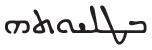 respectively (The Peshitṭa Institute: 1979: 53). Rico and Gentry, however, mistakenly attributed
 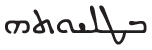 to Syro-Hexapla and
  to the Syriac Peshitta (Rico and Gentry 2020: 200, 202). The Latin Vulgate (around 4 C.E) also favor the ending of יו. Both Cavensis manuscript (9 C.E) and Amiatinus manuscript (7 C. E)
5
have adulescentia sua. Salzburg manuscript (8 C.E) has aduliscentiam, and the rest of Latin manuscripts understand it as adulescentia (Weber 2006). In Variae lectiones Veteris Testamenti librorum, the critical apparatus states that manuscript 31, Syriac versions, and Arabic manuscripts have in adolescentia sua. The later editor of manuscript 31, nevertheless, changed the reading from in his youth to with a woman or maid (de Rossi 1969: 103). This revision unfolds that in adolescentia sua is the first and the original reading. Five codex Regius – 1890 (9 CE), 2435 (12 CE), 2436 (10 CE or 11 CE), 1990 and 1992 (around 10 CE) – have the reading ἐν νεότητι or in his youth (Field 1875: 309). In the present time, Old Latin (Sabatier 1743-1751) and the Latin Vulgate version of Sabatier have in juventute and in adolescentia respectively. The Vulgate version of San Girolamo Edition (1926-1995) and Rico’s Critical Edition (2007) translate it as in adulescentia (sua).
to the Syriac Peshitta (Rico and Gentry 2020: 200, 202). The Latin Vulgate (around 4 C.E) also favor the ending of יו. Both Cavensis manuscript (9 C.E) and Amiatinus manuscript (7 C. E)
5
have adulescentia sua. Salzburg manuscript (8 C.E) has aduliscentiam, and the rest of Latin manuscripts understand it as adulescentia (Weber 2006). In Variae lectiones Veteris Testamenti librorum, the critical apparatus states that manuscript 31, Syriac versions, and Arabic manuscripts have in adolescentia sua. The later editor of manuscript 31, nevertheless, changed the reading from in his youth to with a woman or maid (de Rossi 1969: 103). This revision unfolds that in adolescentia sua is the first and the original reading. Five codex Regius – 1890 (9 CE), 2435 (12 CE), 2436 (10 CE or 11 CE), 1990 and 1992 (around 10 CE) – have the reading ἐν νεότητι or in his youth (Field 1875: 309). In the present time, Old Latin (Sabatier 1743-1751) and the Latin Vulgate version of Sabatier have in juventute and in adolescentia respectively. The Vulgate version of San Girolamo Edition (1926-1995) and Rico’s Critical Edition (2007) translate it as in adulescentia (sua).
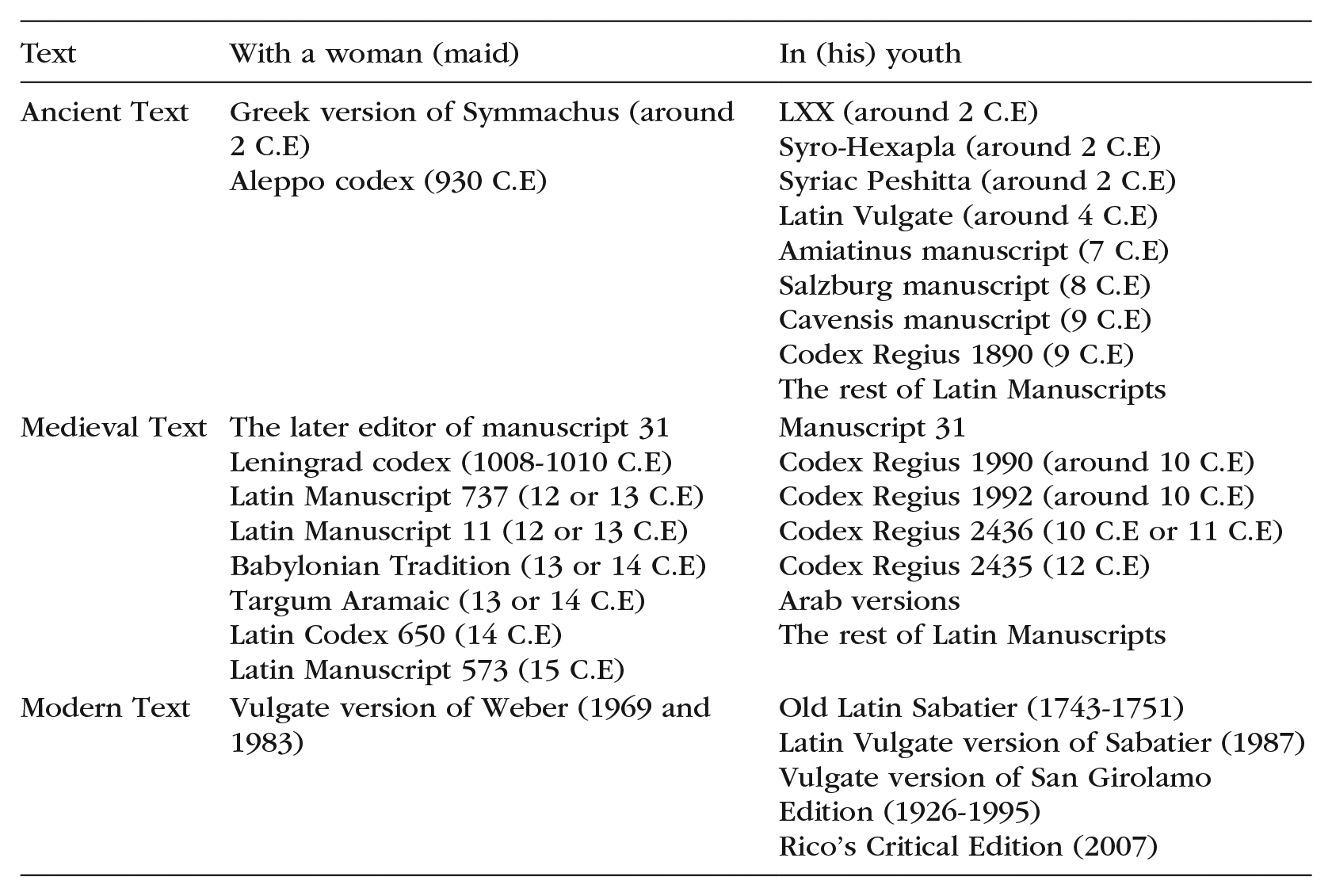
The research on the textual history demonstrates that the ending of יו and ה were spread out throughout the ages. The table below is the summary of the textual history of two variants. The table below presents the approximate dates of the texts. The table also categories the texts into three sections: ancient, medieval, and modern text. The ancient texts category will contain the manuscripts from the first century until the ninth centuries. The medieval text category will consist of the witnesses from the tenth centuries to the sixteenth centuries. The modern text category will cover the critical editions from the seventeenth centuries to the present time. Therefore, this research will not cover the modern Bible translations such as German or English. This timeline category, however, has a weakness. The Aleppo codex, for example, is only a few decades prior to the Leningrad codex. The editor(s) of the expository times say(s) that both manuscripts are often seen as “peas in a pod”. This research, nevertheless, categories the Aleppo codex in the ancient text, whereas the Leningrad codex is in the medieval text. The rationale of this category is a practical one to assist the reader(s) to observe the transition of the tradition from with a woman (maid) to in his youth. In other words, this timeline category is not related to the text history in essence, but it is related to the pedagogical strategy to assist the reader(s) to observe this transition.
Evaluating the evidence
To evaluate the evidence, this article uses a textual criticism and syntactical analysis (cf. Chia 2021; Barthélemy 2012:92; Chia 2022).
Textual criticism
This article argues for the ending of יו as the original reading for five reasons. First, the category of ancient texts demonstrates that only two witnesses that favor the ending of ה. The rest of the manuscripts, on the other hand, prefer the ending of יו. Second, there is a big-time gap – around 700 years – between the available readings of the ending of יו: the Greek Symmachus and the Aleppo codex. In contrast, the ending of יו has more readings and it occurs almost in every century. This evidence summarizes that the reading of in his youth is the popular reading in the early centuries. Therefore, it might be the original. Third, the ambiguous meaning of νεᾶνις by Symmachus favors the ending of יו as the original reading. Jobes and Silva (2000: 29) consider Symmachus as a considerably literal and careful translator. He, nevertheless, does not translate a Hebrew word for the same Greek equivalent, but he is sensitive to the target language or variety (Salvesen 1991: 192; Swete 2015: 32). Symmachus translates Hebrew concepts with a natural Greek expressions or clarity (Field, Norton, Hardin, and Origen 2005: 61-71; Barrera 1998: 313; (Natalio 2000: 130). Therefore, Jobes and Silva (2000: 41) summarize that Symmachus’ Greek translation is charaterized by variety and clarity. In Proverbs 30:19, nevertheless, his variety does not offers a clarity because νεᾶνις has two meanings: a young woman and youthful as an adjective (LSJ). If Greek Symmachus favor the translation in his youth, then the Aleppo codex is the only witness that endorses the reading with a maid (woman). Therefore, the ambigious meaning of νεᾶνις makes the reading of in his youth is more favorable in this case. Fourth, the transition of popular reading from with a virgin to in his youth in the medieval century. The ending of ה was well received by the Leningrad codex, Latin manuscript 11, 737, 650, 573, the Babylonian tradition and Targum Aramaic. This transition reveals that the ending of ה is not the original or the first reading. Fifth, the revisor of manuscript 31 demonstrates that the ending of יו is the original because the revisor deliberately emended in adolescentia sua (בעלמיו) to in adulescentula (בעלמה). This revision shows that adolescentia sua is the older reading. Although some of Vulgate versions and critical editions of the ancient Bible attempt to bring the readers back to the ending of יו, most of modern Bible translations seem to be influenced by the Aleppo codex and Leningrad codex.
In summary, this research favors the ending of יו. The majority texts of ancient manuscripts that prefer the reading in his youth, a big-time gap of the available manuscripts of the ending of יו, the unclarity meaning of νεᾶνις in Greek Symmachus, the transition from the reading in his youth to with a virgin, and the revisor of the manuscript 31 are the primary arguments for the ending of יו.
Syntactical analysis
The book of Proverbs is considered as a poetic book. Waltke argues that the terseness in Biblical poetry is achieved within the line by the object marker, the definite article, the relative pronoun, conjunctions, and particles (Waltke 2004: 45). Hebrew poetry is also characterized by parallelism and this parallelism is a cornerstone for meaning (Waltke 2004: 47). Therefore, to unfold the original reading, this article considers parallelism and particles in the Proverbs 30:19.
The first argument is derived from a preposition argument. Proverbs 30:19 has four prepositions. Three prepositions use בְּ, while one of them has עַל. All prepositions communicate a location. The first clause is דרך הנשׁר בשׁמים or the way of an eagle in a sky. The preposition בּׅ here denotes a location of an eagle. Where does an eagle fly? In a sky. The second clause is דרך נחשׁ עלי צור or the way of a serpent on a rock. Again, the preposition על here denotes a location of an eagle. Where does a serpent crawl? On a rock. Then, the third clause is דרך־אניה בלב־ים or the way of a ship in the heart of the sea. Where does a ship sail? In the sea. All these prepositions signal a location. Therefore, it is most likely that the last preposition also communicates a location due to the parallelism in this poetic book. Otherwise, the last clause breaks the poetic parallelism (Rico and Gentry 2020: 206). Therefore, the reading with a woman (or maid) is not parallel to the other clauses because the preposition בּׅ has a function of accompaniment instead of location. Then, the reasonable reading is in his youth (location). In his dissertation, Turalija (2014: 238), however, interprets in the lenses of predators that not only consume others, but can also be consumed themselves. Turalija sees that all subjects in had negative overtones such as scavenger, serpent, ship, and man are predators. The eagles eat the serpent, and the ship destroys men. The men destroy the virgin or unmarried woman should keep herself away from those men (2014: 238-240). Turalija’s analysis produces some difficulties. First, Turalija inconsistently treats the subject-object relationship. He argues that a man (a subject) tortures a virgin (an object). If he applied this subject-object relationship consistently, then an eagle would have destroyed a sky, and not a serpent. A serpent would have destroyed a rock. A ship would have destroyed a heart of the sea, and not a man. Second, Turalija interprets that all subjects such as scavenger, serpent, ship, and man are predators. The eagle and the ship in Proverbs 30:19 seem not to be read in a negative connotation. A serpent could deliver a negative nuance (cf. Genesis 3), but there is no evidence that a ship here is also negative.
The second argument is coming from the object of Proverbs 30:19: a realm, not a person. The realm of the first clause is בשׁמים or in a sky. The realm of the second clause is עלי צור or on a rock. The realm of the third clause is בלב־ים or in heart of the sea. Then, it is reasonable that the last clause communicates the realm of life: in his youth. The reading with a woman (or maid) will break the parallelism of the objects since it refers to the personhood and not realm.
The last argument is derived from a motion nuance (or pass through) of all clauses. The first clause is דרך הנשׁר בשׁמים or the way of an eagle in a sky. This clause communicates that an eagle passes through a sky. The second clause is דרך נחששׁ עלי צור or the way of a serpent on a rock. Where does a serpent pass through? On a rock. The third clause is דרך־אניה בלב־ים or the way of a ship in the heart of the sea. Where does a ship pass through? In the heart of the sea. All these prepositions signal a location. Therefore, it is reasonable to argue that the reading of in his youth is the original reading. A man passes through his youth.
The syntactical analysis demonstrates that the best reading is in his youth. The function of two of prepositions, the objects, and the motion nuance in Proverbs 30:19 reveals that בעלמיו is a better reading.
Conclusion
Is the ending of Proverbs 30:19 יו or ה? This debate occurs because of the identical letter(s) in the ancient Hebrew’s handwriting. The letter ה originates the translation with a virgin, whereas the letters יו causes the translation in his youth. The last consonant(s) originates these variants. This research, however, favors the ending of יו. The five arguments from textual criticism and three explanations from the syntactical analysis favor strongly the ending of יו that leads to the translation of in his youth as the original reading.
Website
Footnotes
Ethical considerations
This article followed all ethical standards for research without direct contact with human or animal subjects.
Competing interests
The author declares that he has no financial or personal relationships that may have inappropriately influenced him in writing this article.
Funding
The author(s) received no financial support for the research, authorship, and/or publication of this article.
Data availability
Data sharing is not applicable to this article as no new data were created or analysed in this study.
1
This manuscript contains Pentateuch, Targum Megilot, Job, Proverbs, and commentary. It is derived from 12 or 13 centuries (on page XCVIII in Variae lectiones Veteris Testamenti librorum).
2
This manuscript was written in 12 or 13 centuries (on page CXXI in Variae lectiones Veteris Testamenti librorum).
3
This manuscript was written in 14 centuries (on page CLVIII in Variae lectiones Veteris Testamenti librorum).
4
This manuscript has Pentateuch and commentaries of some Rabbis. It is derived from 15 centuries (on page CXIV in Variae lectiones Veteris Testamenti librorum).
5
The description of manuscript Cavensis is Cava, Archivio della Badia 1 (14), s.IX2 in Hispania, while Manuscript Amiatinus is Firenze, Bibl. Mediceo-Laurenz., Amiatino I, s. VII in. in Northumbria. Salzburg manuscript’s description is Stiftsarchiv St. Peter a. IX. 16, s. VIII ex. Salisburgi (in Ct vet. vers. lat. praebet).