




Abstract
This paper 1 re-examines the relationship between Dante’s Commedia and the Baptistery of San Giovanni from an art historical perspective. Drawing on –– and then departing from –– earlier work by Dante scholars who described figurative echoes between the Commedia and the Baptistery’s mosaic program, this article reconceptualizes the relationship between the two as not only figurative, but also liturgical. Using the texts of two extant medieval Florentine libri ordinales to reconstruct the liturgy of Holy Saturday, I document the ways in which the decorative mosaic imagery of the Baptistery is reflected in and reinforced by the multisensory performance of the baptismal rite. I argue further that Dante ekphrastically reimagines this rite in cantos 1–2 and 29–33 of Purgatorio. By exploring Dante’s liturgical imagination vis-à-vis the multivalent space of the Baptistery, this paper articulates and illuminates the profound interconnections that can exist between medieval art, architecture, liturgy, and poetry.
Set within a background of glistening golden tesserae evoking both divine light and infernal fire, the Duecento mosaics in the cupola of the Baptistery of San Giovanni in Florence (Fig. 1) present a totalizing vision of the cosmos that profoundly influenced the theological order of Dante’s Commedia.
2
Figurative resonances between the mosaics of San Giovanni and the Commedia have long been the subject of scholarly discussions that have focused, for the most part, on describing correspondences between Inferno and the iconography of Hell in the Last Judgment mosaics and between Paradiso and the iconography of Heaven in the chancel (scarsella) mosaics. To date, Purgatorio, which has no direct visual equivalent in the Baptistery’s mosaic program, has received little attention in these analyses. This paper seeks to redress this gap by reconceptualizing the relationship between the mosaics of San Giovanni and Purgatorio as liturgical rather than figurative.
3
Cupola Mosaics of San Giovanni Baptistery. Public Domain Image.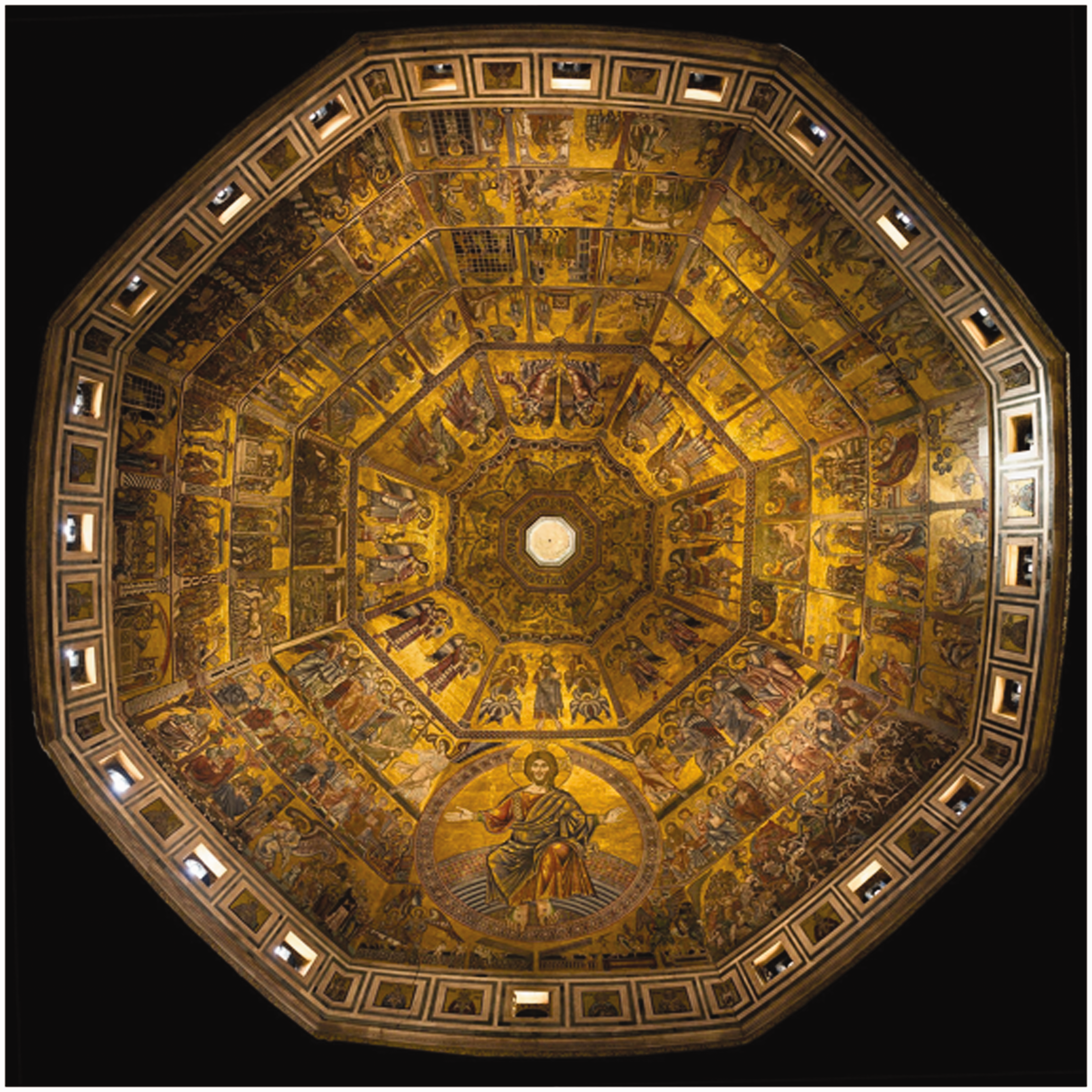
In a provocative essay on the place of liturgy within literary studies, Bruce Holsinger (2015) asks, “[...]in what sense might literature be seen as in part an effect of liturgy, a curious by-product of the immense cultural industry invested in the Work of God by the institutions that performed it?” Here, using insights derived from the “sensorial turn” in art history to respond to Holsinger’s question, I analyze Purgatorio within the context of the baptismal liturgy in medieval Florence, arguing that Dante’s memories of San Giovanni are in fact extensively present throughout the canticle through his sensorially-charged descriptions of the rite of baptism. 4
The performance of the medieval Florentine baptismal liturgy organized and mediated motion through urban space, time, and spiritual state of being. Two extant medieval Florentine libri ordinales –– Ritus in ecclesia servandi (ca. 1173–1205) and Mores et consuetudines canonice florentine (ca. after 1231) –– allow us to reconstruct the baptismal rite of Holy Saturday in Duecento Florence and to analyze how San Giovanni’s mosaic program reflected and reinforced the Florentine liturgy. 5 These ordinals serve as “stage directions” for the quasi-theatrical drama of the Florentine liturgy, specifying the order of the services throughout the day and charting the movements of a procession from Santa Reparata (the erstwhile cathedral of Florence) to San Giovanni, where mass baptisms took place. This liturgical program is closely mirrored in Purgatorio. I suggest that Dante’s ekphrastic descriptions of being rebaptized in Pg 1–2 and 29–33 serve as a poetic reimagining of the Holy Saturday rituals in San Giovanni and can be fruitfully interpreted within the context of the poet’s liturgical imagination. 6
Dante and the mosaics of San Giovanni: A figurative perspective
Dante saw a divine spark in the Baptistery of San Giovanni, affectionately calling it “mio bel San Giovanni” [my handsome San Giovanni] (If 19.17). In Pd 25, Dante, by then long-exiled from Florence, begins the canto by praying that one day he might be able to triumphantly return to the city of his birth to be crowned as its poet laureate in front of the baptismal font of San Giovanni, where he himself had been baptized in 1266. 7 Throughout Dante’s years in Florence, the Baptistery of San Giovanni served as a focal point of religious life. While in most medieval Italian cities, children were traditionally baptized in their local pievi (parish churches), all Florentines in the Duecento and the first part of the Trecento were baptised en masse in the Baptistery during the celebrations of Holy Saturday and Pentecost. 8 In the fourteenth-century Nuova Cronica, Giovanni Villani estimates that between 5,500 and 6,000 people were baptized each year in these mass ceremonies. 9 The baptismal rite served as a means of initiation into both the Florentine religious and political communities. 10 In the words of the Dominican preacher Giovanni Dominici (ca. 1355–1419), in San Giovanni’s baptismal font, a person would become “a man, a Christian, and a Florentine.” 11
The Baptistery of San Giovanni was sumptuously decorated in the thirteenth century with an elaborate mosaic program in its cupola. This decorative program was begun in 1225 by a certain Fra Jacopo; multiple workshops and masters continued the work in two stages (from 1225 to 1260 and from 1270 to 1310); notable among them was Coppo di Marcovaldo, to whom the Last Judgment mosaics are attributed.
12
The cupola mosaics can be analyzed in seven discrete sections (Fig. 2): (1) the Last Judgment, (2) symbolic figures representing the natural world surrounding the lantern, (3) the Choirs of Angels, (4) scenes from Genesis, (5) the life of Joseph, (6) the life of Christ, and (7) the life of John the Baptist.
13
Narrative Organization of the Cupola Mosaics. Public Domain Image.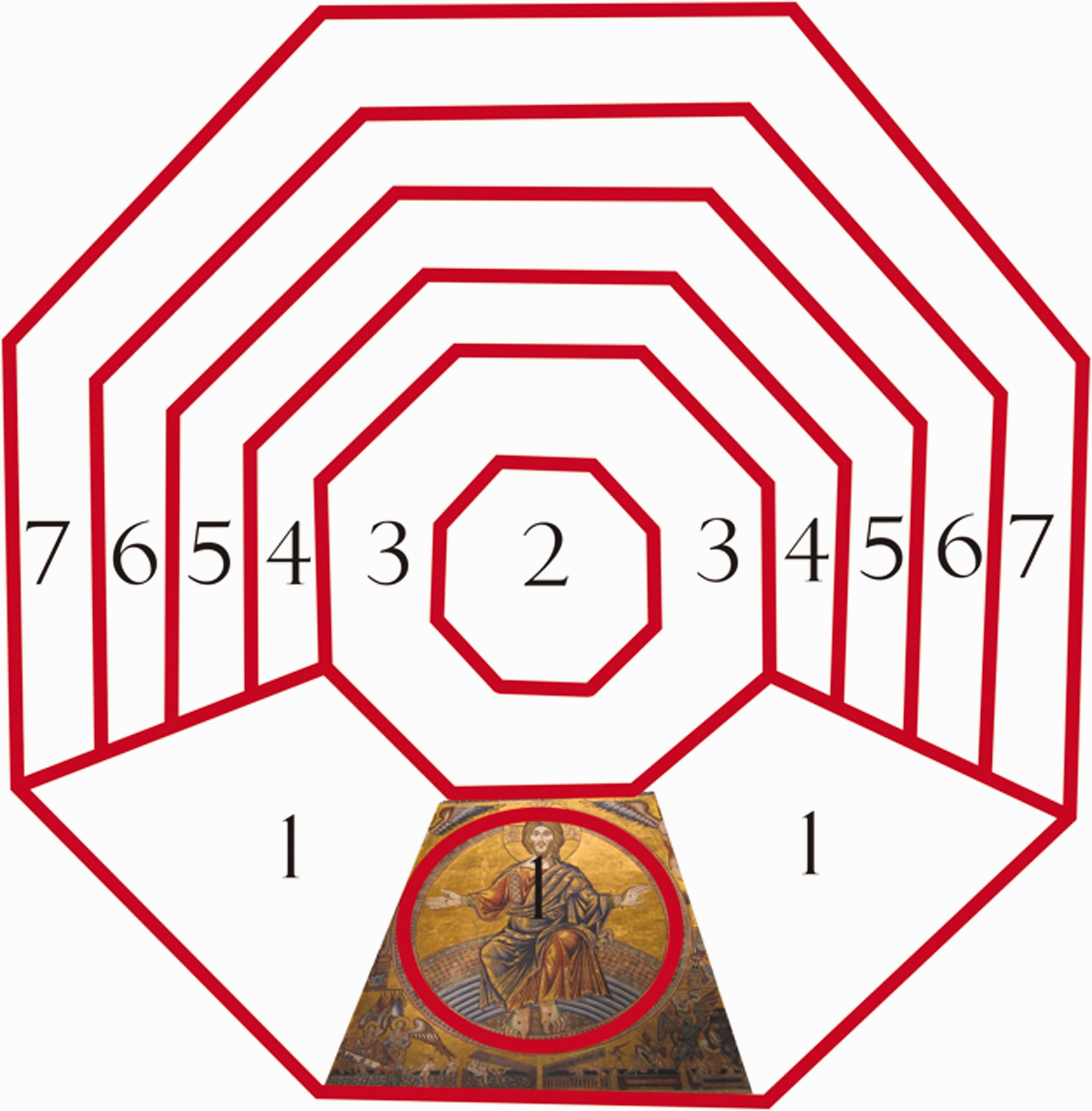
Christopher Kleinhenz (2003) has convincingly argued that the ordering of the Baptistery’s cupola served as a visual model that Dante translated into an epic poem that could be read and interpreted vertically as well as horizontally. While each band of the Baptistery mosaics, like each canticle in the Commedia, is a self-contained narrative sequence unfolding chronologically, certain thematic or visual connections link the four narrative bands vertically. For instance, in the Baptistery mosaics, the Beheading of John the Baptist is placed directly below and visually parallel to the Crucifixion, connecting the gruesome martyrdoms of these two Biblical figures. Likewise, the Creation of the World appears in the same vertical sequence as the Annunciation to Mary and the Annunciation to Zacharias, placing three Biblical moments of divine creation in parallel. 14 A similar set of vertical relationships can be observed in the Commedia. 15 As an example, in the sixth canto of each canticle of the Commedia, discussions of politics are juxtaposed with one another in an ever-expanding scale: If 6 discusses provincial Florentine politics, Pg 6 expands this discussion to the whole of Italy, and Pd 6 expands it further still to politics of the Roman Empire. Kleinhenz insightfully suggests that Dante’s sense of vertical mirroring is inspired by the spatial structure of narratives in the Baptistery mosaics.
Correspondences between the Commedia and the decorative program at San Giovanni can also be found at the level of specific detail. Ernest Hatch Wilkins (1927) was the first to note the numerous echoes between punishments in Inferno and in Hell as depicted in Coppo di Marcovaldo’s Last Judgment mosaic (Fig. 2 “1”; Fig. 3). In Coppo di Marcovaldo’s rendition, souls are crammed into space, their faces twisted in agony as various demons torture them. In the upper right quadrant of the mosaic, a demon stuffs a resisting sinner headfirst into a pit. This detail is echoed in If 19.13–28, where the souls of simoniacs are jammed headfirst into holes in the ground, each generation pushing the earlier one down in a parody of the rite of baptism and apostolic succession.
16
Likewise, there are two sinners in the mosaic’s representation of Hell whose heads grow out of shrubs and plants (on the bottom left and in the middle register to the right of Satan, respectively), a detail mirrored in the punishment of the Suicides and Self-Mutilators in If 13, who are turned into trees and shrubs.
Detail of Hell, Last Judgment.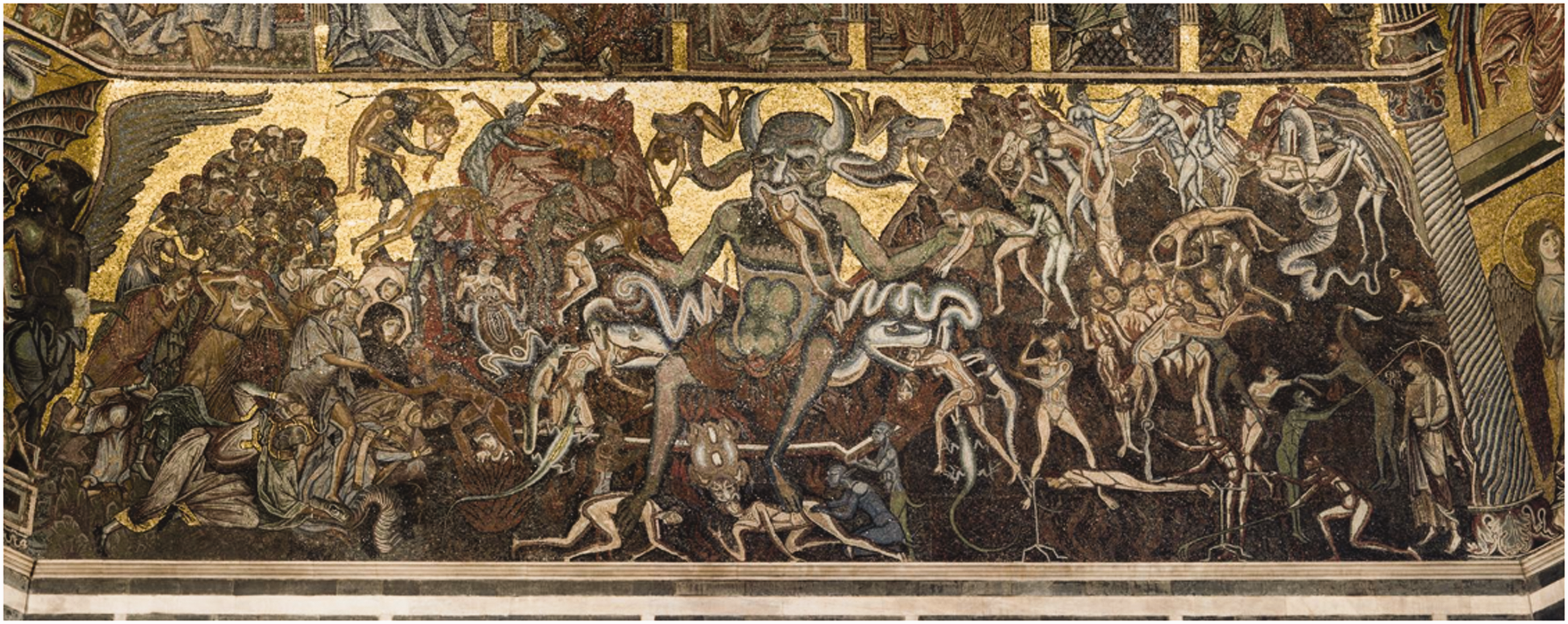
One of the more striking visual correspondences between the Baptistery’s mosaic program and punishments in Inferno is a scene in the foreground of Hell depicting sinners being tortured by serpents who bind their hands and twist around their bodies. One creature bites a sinner on the back of the neck, an image that finds a direct parallel in Dante’s text (If 24.97–99). 17 Another sinner to Satan’s left is in the middle of being swallowed whole by a grotesque reptile, appearing, for a moment, as a half-man/half-creature in the midst of a metamorphosis. This figure, in turn, is mirrored in the “double metamorphosis” in If 25.100–138, wherein five Florentine thieves are turned into reptiles and back to human form in a painful iterative cycle. 18
The most direct correspondence between Coppo di Marcovaldo’s mosaics and Dante’s text is the figure of Satan. 19 Dante’s Satan, hairy and unnatural, appears at Earth’s core, sporting three faces –– a grotesque parody of the Holy Trinity –– gnashing his teeth as he tears apart three treasonous sinners: Judas Iscariot is thrust headfirst in the central mouth, with Brutus and Cassius in Satan’s side mouths (If 34.61–69). San Giovanni’s monstrous Satan, likewise, has one main head, and two other serpentine faces that emerge from his ears. As in Inferno, he chews three sinners, one headfirst in the central mouth, and one in each of his side mouths.
The Baptistery mosaics are also evoked in Paradiso. Wilkins (1927: 3–6) notes that Dante’s description of the angelic hierarchy in the Primum Mobile (fixed stars) closely mirrors the spatial position of the various Choirs of Angels (Fig. 2 “3”) relative to God in the San Giovanni mosaics (Fig. 4, top). Likewise, Wilkins (1927: 3–4) also links the representation of Heaven in the chancel (scarsella) mosaics above the altar (Fig. 5) to Dante’s Empyrean. In the mosaics, a petal-like structure emanates from the Lamb of God, evoking the mystical Rose in Pd 30–33; in each petal sits an Old Testament patriarch (on the left) or a prophet (on the right). Dante’s Empyrean, like the mosaics it mirrors, is divided into two parts: those who believed in Cristo venturo (Christ to come) and those who believed in Cristo venuto (Christ who has already come).
View of West Sector of the San Giovanni Mosaics. © Genevra Kornbluth and used with her permission. Chancel (Scarsella) Mosaics. Public Domain Image.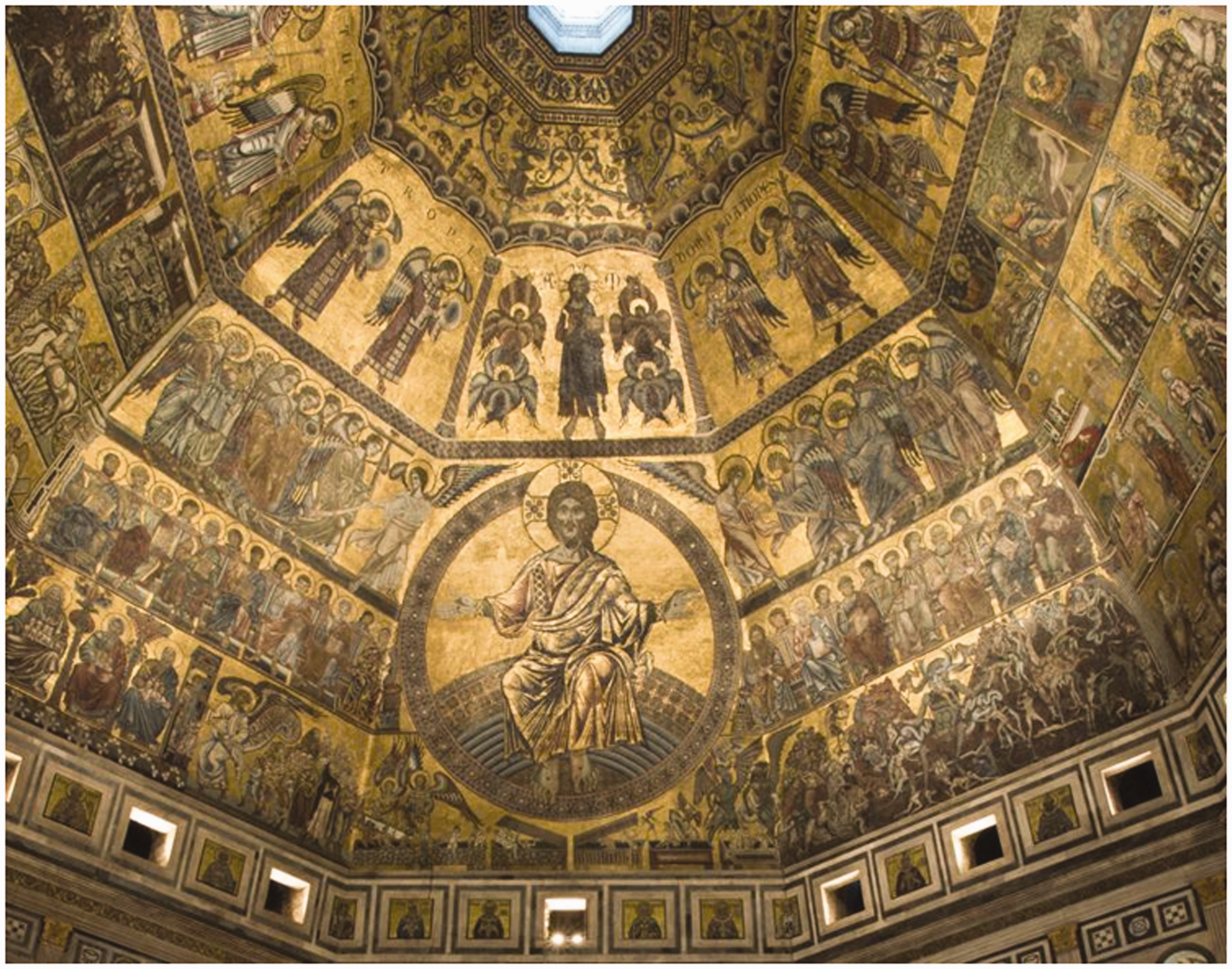

In contrast to the numerous echoes between the Baptistery’s iconographic program and Inferno and Paradiso, only a single visual correlation between the San Giovanni mosaics and Purgatorio has thus far been described. Wilkins (1927: 9) notes that as Dante ascends to Earthly Paradise in Purgatorio he is guided by a voice that resounds: Venite, benedicti Patris mei (Pg 27:58, from Matthew 25:34). Those very words appear on the bottom left of the Last Judgment mosaics (Fig. 2 “1”), where an angel welcomes the saved who emerge from their coffins as they enter the Kingdom of Heaven (Fig. 6). The relative lack of visual echoes between the Baptistery mosaics and Purgatorio is not entirely surprising, given that the representation of Purgatory as a mountain was of Dante’s own creation and therefore postdates the Baptistery’s mosaic program.
20
Yet the relationship between San Giovanni and Purgatorio is nevertheless a close one: extensive traces of the memories of the meaningful rituals lived and performed within the Baptistery can be found throughout the canticle. In essence, Purgatorio can be understood, in part, as Dante’s attempt to render in words the multisensory experience of the baptismal liturgy of San Giovanni. The interpretive lens I use in building this argument is one that Dante himself develops in his ekphrastic account of the divinely sculpted marble reliefs that he encounters on the Terrace of Pride (Pg 10–12) as he ascends the Mountain of Purgatory.
Detail of Angel Welcoming Souls into Heaven, Last Judgment Panel.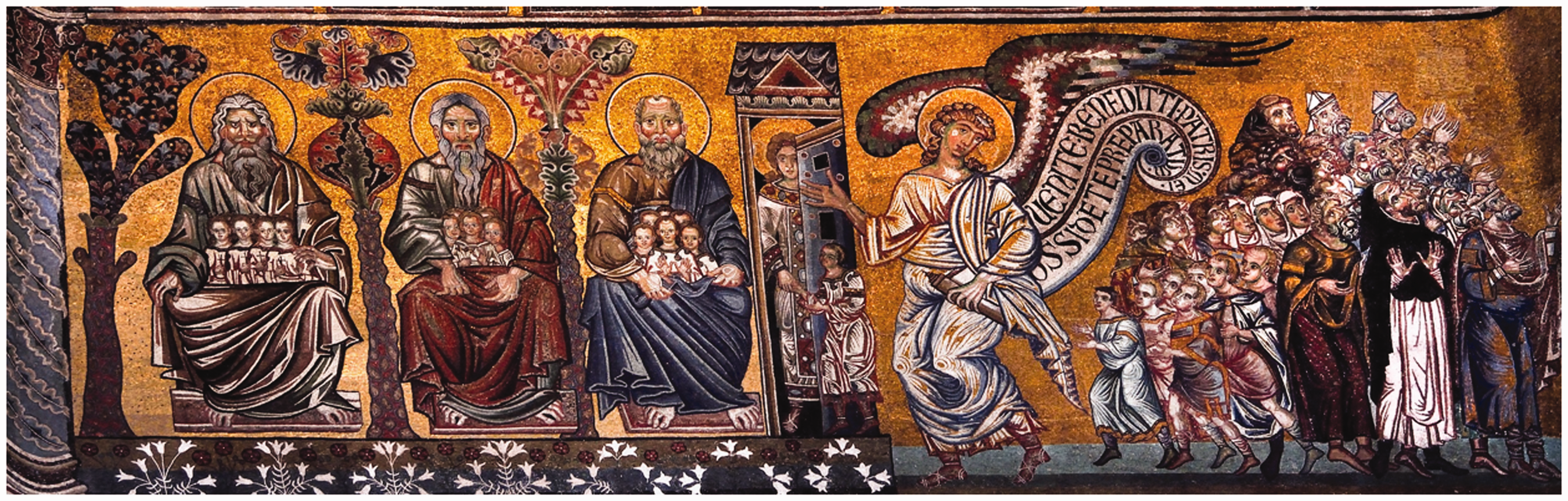
Visibile Parlare: Dante’s sensorial imagination
The three cantos that comprise the Terrace of Pride sequence in Purgatorio serve as an extended meditation on the nature of the visual arts. In Pg 10, Dante and Virgil encounter three exemplars of the virtue of humility in the marble bas-reliefs carved into the mountain: the Annunciation, King David dancing before the Ark of the Covenant, and Emperor Trajan comforting a poor widow. Later, in Pg 12, the poets encounter reliefs depicting the consequences of pride drawn from the Bible and classical literature. In these cantos, Dante takes up the pursuit of art history in an age before Giorgio Vasari 21 –– after all, what is art history save for an “extended argument built on ekphrasis,” as Jas Elsner (2010: 11) put it? –– and develops a revelatory theory of art built upon ancient and medieval modes of vision, a theory that allows his modern readers a glimpse into medieval sense perception. 22
Dante’s use of ekphrasis in the Terrace of Pride sequence pushes against modern definitions of ekphrasis; it acts not merely as description of the visual, or even as a confrontation between the verbal and visual, but as an expression of the inextricable nature of word and image in structuring sensory experience. 23 Accordingly, I suggest that Dante’s ekphrasis might be more fruitfully understood in terms of the Greco-Roman sense of the word, which can be defined as the use of rhetorical vividness (evidentia in Latin or enargeia in Greek) to make an audience imagine a scene “sub oculos subiecto” [as if it were placed before the eyes]. 24 Indeed, as readers, we are not given a straightforward description of the reliefs’ appearance as much as a description of the sensory effects that they evoke within Dante, the same sensory effects that Dante’s medieval readers might be expected to experience if the reliefs were placed before them. 25
In Dante’s ekphrasis, visibile parlare becomes an expression of the embodied experience of sensory perception between word and image, where he finds movement in stasis and sound in silence. In this ekphrasis, Dante makes reference to all five senses. He swears that, when viewing the bas-relief of the Annunciation, he can hear the Angel Gabriel declare “Ave” and the Virgin reply “Ecce ancilla Dei” (Pg 10.40–45). He witnesses the flags of the Roman Empire, stamped with a golden eagle, swaying in the wind over the figure of Trajan as he overhears the conversation between the Emperor and the widow (Pg 10.76–93). Likewise, Dante smells the smoke of incense before the Holy Ark (Pg 10.61–63). He also refers to the sense of touch, albeit less directly, feeling as if he too bore the vice of Pride as a weight upon his own back (Pg 12.7–9). Also present in the ekphrasis is the sense of taste, which is evoked in the moment when Thamyris said to Cyrus that he thirsted for blood (Pg 12.55–57).
Dante’s senses even begin to quarrel with one another: seeing the relief of the Israelites before the Holy Ark, he notes “a’ due mie’ sens / faceva dir l’un ‘No’, l’altro ‘Sì, canta’” [[The image] made two of my senses speak — one sense said, “No,” the other said, “Yes, they do sing”] (Pg 10.59–60). In the next terzina, Dante comments on the discordance between the visual and the olfactory: his eyes see the plumes of incense smoke rising, but his nose reminds him that this is a sensory illusion (Pg 10.61–64). 26 For Dante, then, reality and the sensory perception of that reality are not easily separated.
Dante’s multisensory experience described in the Terrace of Pride sequence can be interpreted as a mode of ritual participation. The penitents in the Terrace of Pride slowly circle the cornice while bent over, bearing large stones on their backs, weighted down by the symbolic heft of their vice. To see the examples of humility carved onto the marble wall in Pg 10, the penitents must stretch their necks and look upwards to behold God’s sculpture, as, in life, they would have had to stretch their necks to behold –– for example –– the full expanse of a medieval relief portal sculpture by prominent Tuscan sculptors such as Nicola and Giovanni Pisano and Arnolfo di Cambio. Likewise, in Pg 12, to see the sculpted examples of pride on the floor, the penitents must turn their heads downwards, assuming the same position that, in life, one would have needed to assume in order to peer at the bas-relief tomb slabs that depicted effigies of the dead in the pavement of the churches of Santa Reparata and Santa Croce in Florence. Dante, too, assumes the position of a penitent, bending down to talk to Oderisi da Gubbio in Pg 11 and again to see the reliefs in Pg 12; he does not stand erect again until the end of the canto. His participation in the ritual of penance is rewarded by an angel who, after singing the beatitude Beati pauperes spiritu, erases one of the P’s (for peccatum) branded on Dante’s forehead.
Participation in the liturgy is a privileged form of ritual ritual engagement not unlike the penitential performance which Dante describes in the Terrace of Pride sequence, an ephemeral experience that can be repeated, but never exactly recreated. To explore Dante’s relationship with the mosaics of the Baptistery requires, therefore, that we examine the inherent mutability of the multisensory context in which they were perceived, recognizing the ever-changing phenomenality of diurnal light, the sound of chanting, and the smell of incense. In what follows, I use Dante’s multisensory engagement with art as an interpretive lens that can reveal the ways in which his memories of the baptismal liturgy of Holy Saturday are imprinted in Purgatorio.
Facimus processionem ad fontem: The Holy Saturday rite in medieval Florence
The Baptistery of San Giovanni is a deeply kinetic space –– one that came vividly to life through the sensorially-charged performance of the liturgy during the Paschal season. Almost all of the references to the Baptistery in Ritus and Mores are found in their prescriptions for the order of processions between Santa Reparata and San Giovanni. 27 These ordinals reveal how medieval people moved through and interacted with the architectural space of the Baptistery.
As outlined in the Florentine ordinals, by the hour of Terce (approximately 9 am), the congregation would have gathered in Santa Reparata for the day-long celebration of Holy Saturday to find the altars already incensed. 28 After Terce, the preparation of those about to be baptized began with catechism and the recitation of the Apostles’ Creed. (In the case of infant baptism, the godparents would recite it in their godchild’s stead.) The priests would then separate the catechumens by gender, anointing their chests and shoulders with holy oil while reciting the Credo in deum.
At Nones (approximately 3 pm), the Easter Vigil would begin in semi-darkness, with all of Santa Reparata’s candelabra extinguished and the colorful tapers that the Florentine congregation would have carried unlit.
29
Outside the cathedral, the Kindling of the New Fire would occur. Villani’s Nuova Cronica notes that this holy fire –– ignited with flints taken from the Church of the Holy Sepulchre that had been gifted to Pazzino de' Pazzi during the First Crusade –– would be paraded in a cart through the streets of Florence and brought to Santa Reparata.
30
As the Paschal candle was lit with holy fire, the clerics would chant Lumen Christi three times.
31
This would be followed by the recitation of Exultet iam angelica turba by the deacon.
32
The Paschal candle and the processional cross would then lead a procession of clerics and catechumens from Santa Reparata into the Baptistery: Ultima lectione finita, sacerdote cum ministris preparatis. facimus processionem ad fontem, cereo benedicto et cruce precedentibus, postea binis et binis clericis subsequentibus, ad extremum subsequentibus duobus ceroferariis cum cereis accensis coram sacerdote et ministris preparatis cum turibulo. (Ritus ll.1493-1495) [After the last reading has been finished, and after the priest and his ministers have made their preparations, we process to the font, the holy [Paschal] candle and cross in front, and clerics following two at a time. At the end of the procession two torchbearers follow with lit candles before the priest and his ministers, carrying censers.]
33
The linear distance traversed by the procession was relatively short. 34 Nevertheless, it was a ritual replete with theological meaning, a multisensory performance that, while unfolding in liturgical time, nevertheless blurred temporalities to create a sense of “all time,” in which the entirety of human history was collapsed into a single moment. 35 This effect of temporal blurring can be analyzed in three ways: typologically, between the Old and New Testaments; historically, between pre-Christian and Christian Florence; and meta-historically, between the ongoing festivities and the promise of future resurrection. Each is discussed in turn.
Immediately prior to the procession, twelve lectiones and four tracts from the Old Testament would be recited, ending with the Blessing of the Water upon the chanting of the Sicut cervus: Prima lectione In principio creavit, secunda Noe vero, tertia Temptavit, quarta Factum est in vigilia. Post tractum Cantemus dicitur quinta Hec et hereditas, sexta Audi Israel, septima Facta est super me, octava Apprehendent. Sequitur canticum Vinea facta, nona Dixit dominus ad Moysem, decima Factum est verbum domini ad Jonam, undecima Scripsit Moyses. Sequitur tractus Attende celum, duodecima Nabuchodonosor rex, tractus Sicut cervus. (Ritus ll.1479-1487) [The first reading is In principio creavit (Genesis 1:1-2), the second, Noe vero (Genesis 5:31 - 8:21), the third, Temptavit (Genesis 22:1-9), the fourth, Factum est in vigilia (Exodus 13:25-15:1). After the tract Cantemus (Exodus 15:1-3) is sung, the fifth reading is Hec et hereditas (Isaiah 54:17-55:11), the sixth, Audi Israel (Baruch 3:9-38), the seventh, Facta est super me (Ezekiel 37:1-14), the eighth, Apprehendent (Isaiah 4:1-6). Next, we sing Vinea facta (Isaiah 5:1, 2, 7), and then read the ninth reading, Dixit dominus ad Moysem (Exodus 12:1-11), the tenth, Factum est verbum domini ad Jonam (Jonas 3:1-10), and the eleventh, Scripsit Moyses (Deuteronomy 31:22-30). The tract Attende celum (Deuteronomy 32:1-4) follows, then the twelfth reading, Nabuchodonosor rex (Daniel 3:1-24), and the tract Sicut cervus (Psalm 41:1-3).]
36
Water is a symbol that unites seven of the twelve lectiones and three of the four tracts. The liturgy self-consciously engages in Biblical typology, setting the New Testament ritual of baptism (the anti-type) within a framework of Old Testament readings (the type) in which water featured prominently as the medium of cleansing evil and creating new life. Baptismal imagery is especially prominent in the first reading, In principio creavit, in which the land is separated from the waters; the second reading, Noe vero, in which the Great Flood washes away the sinful; and the fourth reading, Factum est in vigilia, in which the Hebrews escape from Egypt by crossing the Red Sea, which, parting, saves them and later, coming together again, drowns their persecutors. The remaining lectiones serve as prophecies of the coming of Christ. In the Temptavit, for instance, Abraham’s willingness to sacrifice his son Isaac serves as a type for God’s own sacrifice of his only Son. Likewise, the ninth reading, Dixit dominus ad Moysem, describes the marking of the doors of the Hebrews with the blood of the Paschal lamb, a prophecy immediately reminiscent of the apocalyptic imagery of Revelations 7:14 and 22:14, wherein white-robed souls are washed with the blood of the Lamb of God. Medieval theologians linked these passages in Revelations to baptismal theology. 37 The aural experience of the recitation of the lectiones served not only to prepare the catechumens for baptism, but also to place the ritual within the narrative of Christian redemptive history stretching from the Creation of the World to the End of Times. The visual experience of seeing the mosaics of San Giovanni, in turn, reinforced these teachings.
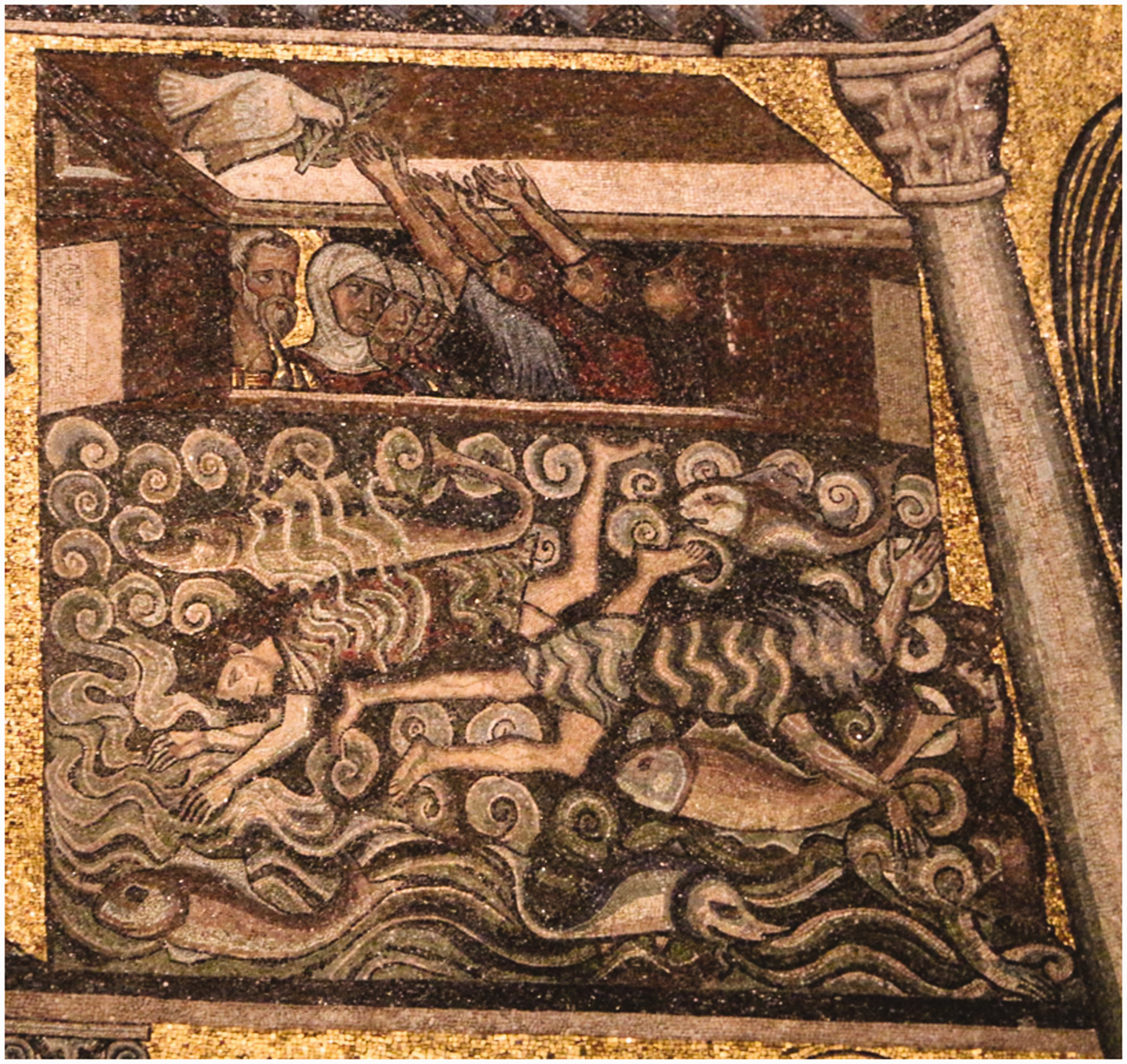
Two of these pre-baptismal lectiones are illustrated in the San Giovanni cupola: In principio creavit and Noe vero. The scenes of the creation and recreation of the world by water form the bookends to the narrative band of Genesis (Fig. 2 “4”) in the mosaic program. In the first image, God appears incarnated as Christ in a heavenly orb of blue light dotted with stars (Fig. 7). With His hand raised in blessing, the rocky land sustaining animal life emerges from the sea as the Holy Dove hurtles down towards earth to bless the fish-filled waters. In the last image of this narrative band, the tumultuous seas take the lives of the sinful on earth in the Great Flood, sparing Noah and his family, as a dove brings back the olive branch (Fig. 8). In the lower register of the image, the fish are joined by two drowning people, limbs flailing; one has the head of a monster as a physical manifestation of his sins.
Detail of the Creation of the World, Genesis. Public Domain Image. Detail of Great Flood, Genesis.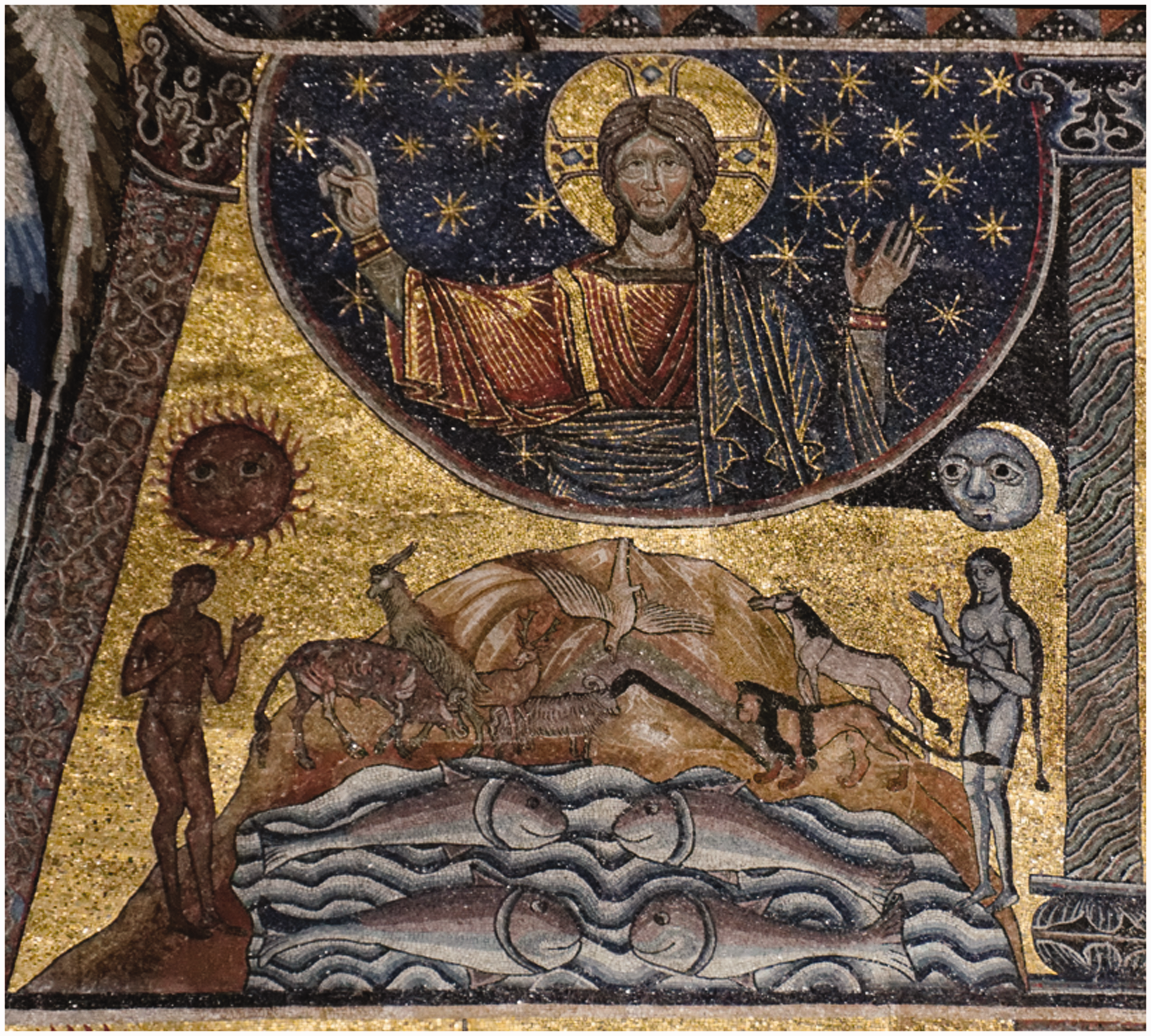
The Baptistery mosaics visually extend the baptismal metaphors of the Old Testament lectiones into the New Testament. In the Crucifixion panel (Fig. 9) of the band illustrating the Life of Christ (Fig. 2 “6”), a stream of blood and a stream of water spill out from the lance-wound in Christ’s torso, as described in John 19:34. Medieval theologians connected the water issuing from Christ’s wound to the baptismal waters, as Thomas Aquinas explains: [...] ex latere Christi fluxit aqua ad abluendum, sanguis autem ad redimendum. Et ideo sanguis competit sacramento Eucharistiae, aqua autem sacramento Baptismi. (Summa Theologiae 3.66.3)
Detail of Crucifixion of Christ. Public Domain Image. Source and License: https://commons.wikimedia.org/w/index.php?curid=41893592; Saiko, CC BY 3.0, via Wikipedia Commons. [Out of the side of Christ, water flowed in order to wash us, blood in order to redeem us. And therefore blood pertains to the sacrament of the Eucharist, and water to the sacrament of Baptism.]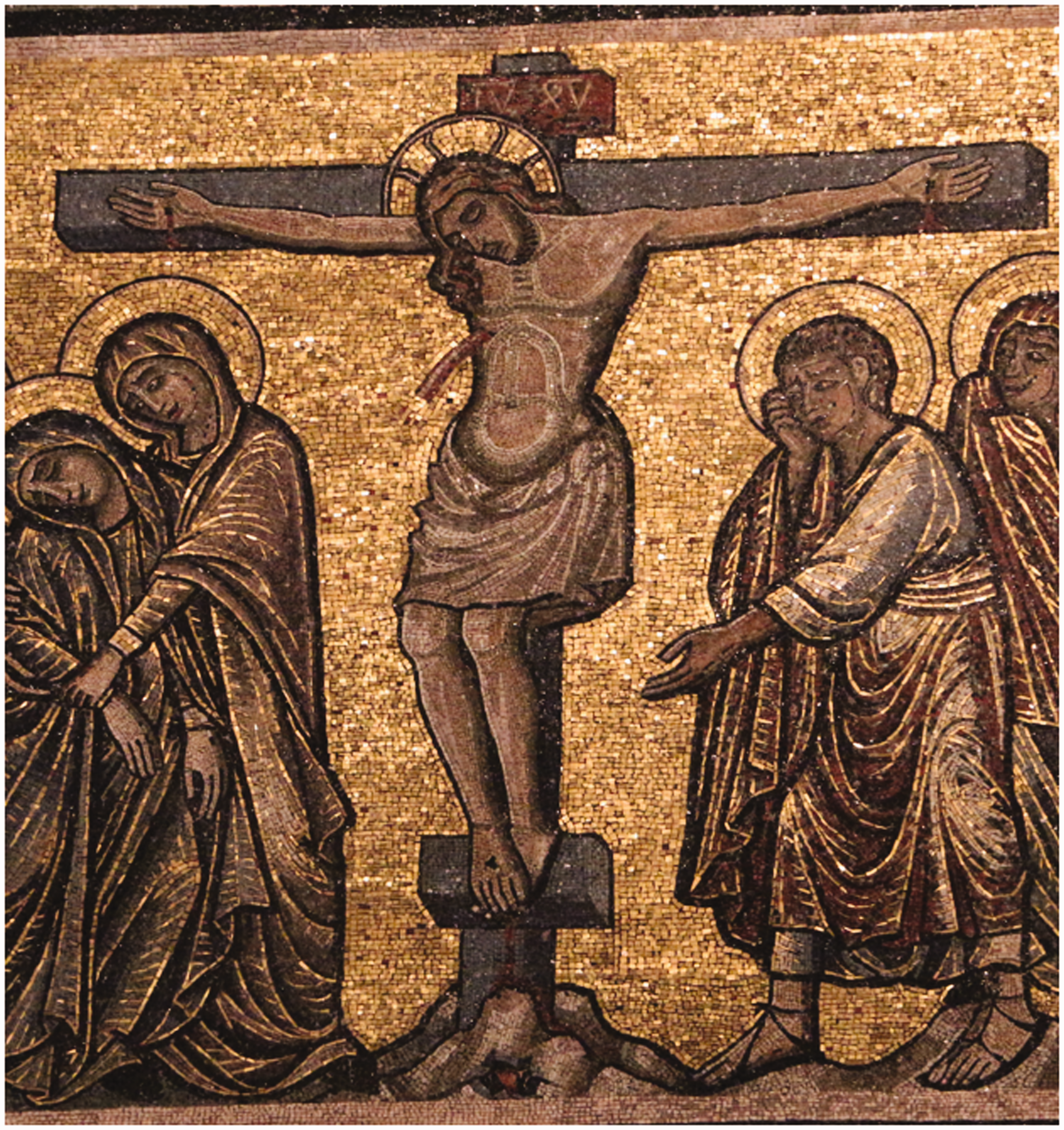
Anne Derbes (2016: 973) notes that this same iconography is repeated in depictions of the Passion in other roughly contemporary baptisteries across northern Italy, highlighting the associations between Christ’s sacrifice and the medieval Italian rite of baptism. 38
In the mosaic program at San Giovanni, the history of baptism is illustrated in the band depicting the Life of John the Baptist (Fig. 2 “7”). In one scene, he baptizes a disciple by pouring water from a hydria over the acolyte’s head (Fig. 10). In the medieval Florentine baptismal ritual, the priest becomes the proxy for John the Baptist; the vessels of holy water placed at four edges of the Baptistery’s Duecento baptismal font evoke the amphora that John the Baptist holds.
39
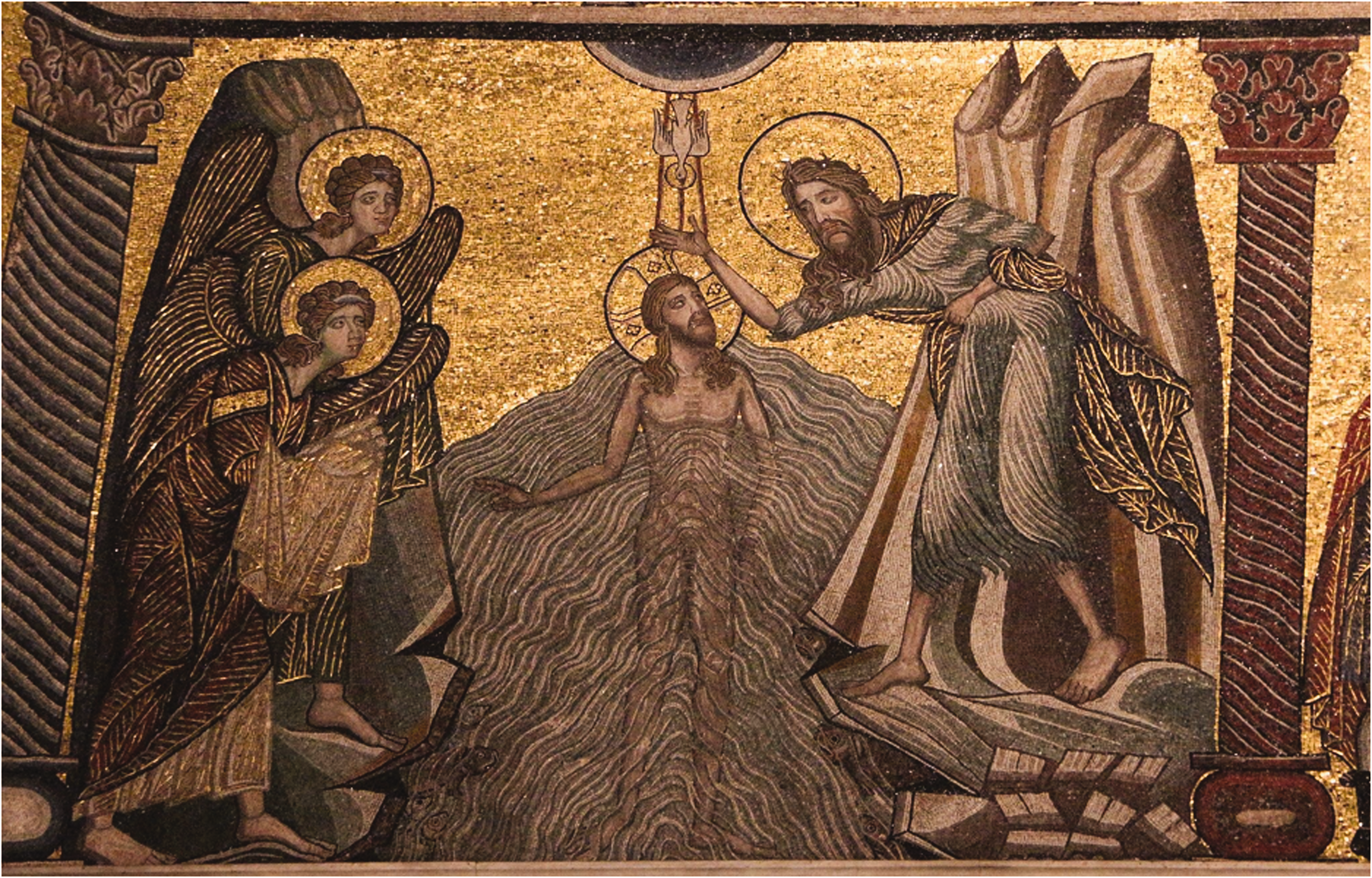
In the next scene, John the Baptist baptizes Christ (Fig. 11). Here, in contrast, it is not John the Baptist that pours water on Christ's head; rather, the water seems to tumble down from the heavens themselves, submerging Christ’s naked body as the Holy Dove glides in from above, a visual echo from the Creation of the World imagery (Fig. 7). In essence, the world is re-created at the moment of Christ’s baptism. Water creates and consumes all, and, as it does, it blesses.
Detail of John Baptizing a Disciple, Life of John the Baptist. Public Domain Image. Source and License: https://commons.wikimedia.org/wiki/File:Mosaici_del_battistero_di_firenze,_storie_del_battista,_1250-1330_ca.,_05_battesimo_delle_folle,_maestranze_fiorentine.JPG: Sailko, CC BY 3.0, via Wikimedia Commons. Detail of Baptism of Christ, Life of John the Baptist. Public Domain Image.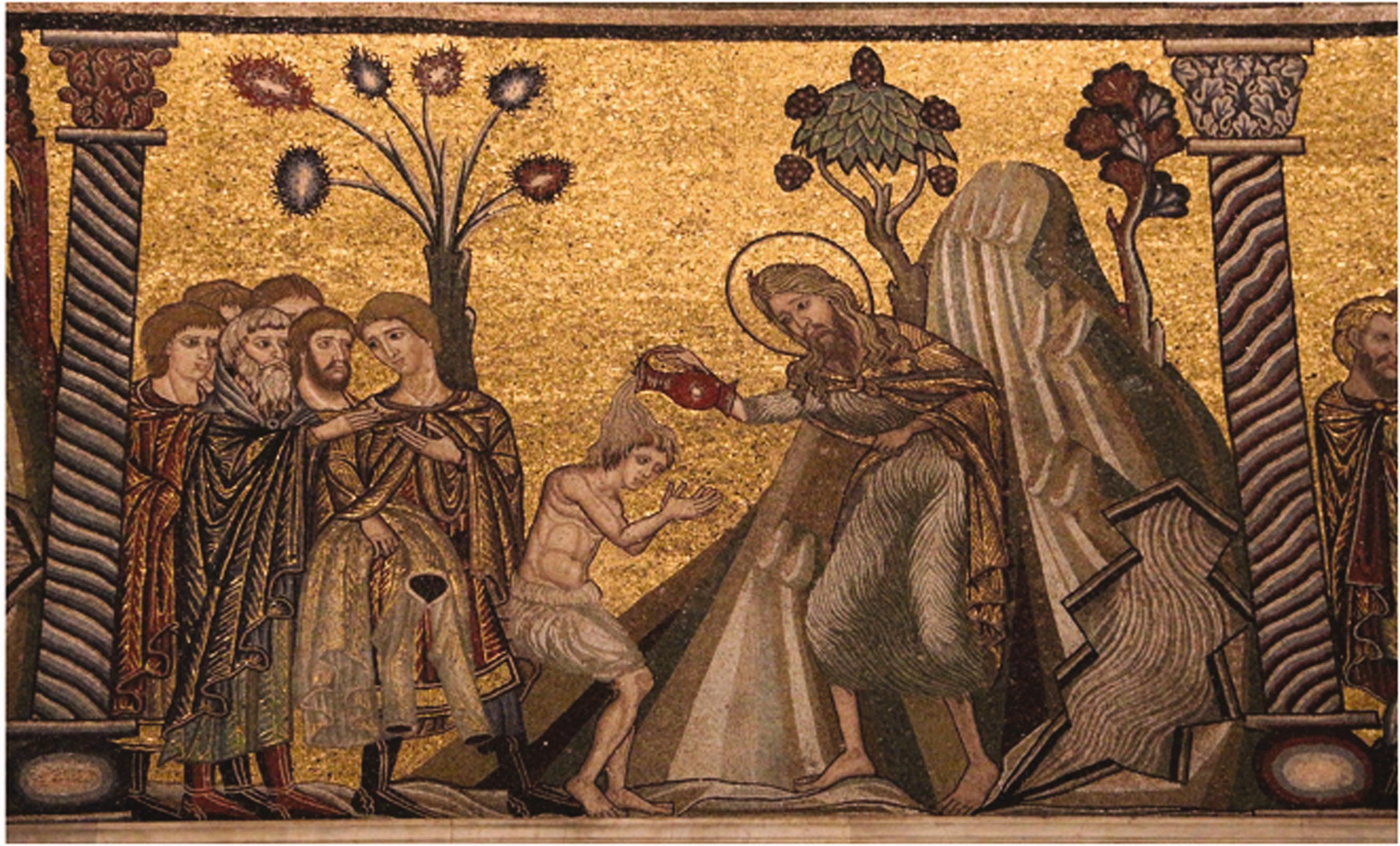

At the level of historical time, San Giovanni represented both the city’s pagan past and its Christian present. Both Dante’s Commedia and Villani’s Nuova Cronica reflect the popular (if apocryphal) belief that the Baptistery had been created as a Roman temple to Mars and re-consecrated to John the Baptist, the patron saint of Florence, following the conversion of Constantine. 40 It’s not difficult to imagine why medieval Florentines understood San Giovanni as having Roman origins: its exterior is decorated with Roman spolia from Florence and Fiesole and with granite pilasters taken from the ruins of the Roman forum in Florence. 41 In the Duecento, San Giovanni was also surrounded by a Roman cemetery –– its sarcophagi emptied and reused by medieval Florentine noble families –– until a 1296 petition passed by the Council of the One Hundred ordered the cemetery razed to open up more space for public ceremonies in the Piazza of San Giovanni in order “to provide for and procure the beauty and honor of the city of Florence.” 42 Dante, as a member of the Council, spoke in favor of the petition. 43 San Giovanni served as a multivalent space that bookended each Florentine Christian’s religious life; in the baptismal font, he or she could be reborn, and in the cemetery surrounding San Giovanni, he or she could be laid to rest. 44
On the level of the metahistorical, the act of baptism allows for the possibility of the salvation of the soul and the resurrection of the body during the Last Judgment. After the procession arrived at San Giovanni, the clerics would say seven litanies until they reached the font, and five more while encircling it. 45 The bishop or the priest would then recite Dominus vobiscum and bless the baptismal waters before baptizing each person in the waters of the font. 46 As a ritual, baptism implies a quasi-death (as the catechumen is submerged in the water and becomes temporarily unable to breathe or see clearly) and embodies a quasi-resurrection (as the newly-baptized person emerges from the water, cleansed). The towering figure of Christ as Judge would then fill their field of vision (Figs. 1 and 4), his arms open on Judgment Day to embrace the Florentine baptized. Sitting upon his celestial throne, Christ’s image serves as a reminder of the metahistorical importance of the baptismal ritual, which allows for the possibility of eternal salvation at the end of human life.
To the congregation gathered at the Baptistery and to the catechumens gazing at the mosaics with eyes still wet from the baptismal waters, the golden tesserae would appear to glisten. After the Blessing of the Waters, a cleric would light the tapers held by members of the congregation. It is at this moment in the liturgy that the full potentiality of mosaics as a medium would be realized. Each tessera functioned as a miniature mirror, reflecting and refracting the coruscating light emanating from both the tapers and the Paschal candle throughout the Baptistery, as the mosaics would appear to become animate before the viewers’ eyes. 47
The Florentine liturgy, reinforced by the visual splendor of the mosaics, therefore collapsed temporalities into a single moment of multisensorial consummation engaging each of the five senses. The Florentines entering the Baptistery on Holy Saturday would lose themselves in the visual, marveling at the mosaics, seeing the light flickering with the movements of the burning Paschal candle. They would touch the waters of the baptismal font as it cleansed their bodies and souls alike. They would hear the litanies being sung, giving the oft-repeated prayers a new, albeit ephemeral, life in the minds of those who heard them; they would smell the incense burning; they would taste the body of Christ in the form of the Eucharist during mass.
Puro e disposto a salire a le stelle: Dante’s baptisms
The multivalent sensorial experience of the Florentine baptismal rite –– which Dante had participated in as a child, as a father, and as a witness –– is mirrored in Purgatorio. Just as the narrative band of Genesis (Fig. 2 “4”) is bookended with water imagery in the San Giovanni mosaics, baptismal moments begin and end Purgatorio. In cantos 1–2, Dante is baptized in the Antipodean ocean surrounding the Island of Purgatory in preparation for a procession to the Mountain of Purgatory. In cantos 29–33, a grand allegorical procession through Earthly Paradise is followed by Dante’s rebaptism in the Rivers of Lethe and Eunoë.
More specifically, in Pg 1, using repeated allusions to newness and rebirth, Dante positions himself as an infant about to be baptized; his cheeks are tear-stained, like those of a child. Virgil cleanses Dante’s face with dew from the banks of the waters, washing away the nebbia [mists] and sucidume [grime] from Hell (Pg 1.96, 98). Here, the image of anointment with holy oils and cleansing with holy water, both of which feature prominently in the Florentine baptismal liturgy, are compressed into a single action. Virgil then girds Dante’s waist with a reed. As soon as Virgil plucks the reed from the ground, a new one springs up to take its place. Dante’s particular use of the word rinacque [reborn] (Pg 1.135) to describe this moment highlights the associations between baptism and rebirth; the auditory association between rinacque and acqua would have been immediately apparent to Dante’s readers.
The following canto in Purgatorio describes a procession that closely mirrors the processions from Santa Reparata to the Baptistery in the Paschal season. In canto 2, Dante describes the mystical sight of a boat helmed by an angel, carrying a hundred shades, landing on the shores of the Island of Purgatory (Pg 2.13–51). Dante hears the shades singing Psalm 113 (In exitu Israel de Aegypto). In parallel fashion, Ritus states that the final prayer in the procession at Vespers (approximately 6 p.m.) on Easter Sunday is In exitu Israel de Aegypto.
48
The liturgical hours of this Paschal procession correspond exactly to the passage of time within the universe of Purgatorio; Virgil and Dante exit Hell at dawn on Easter Sunday, and the first terzina of canto 2 makes it clear that they witness the procession of shades at Vespers. The resonances between the San Giovanni baptismal ritual and the language of Exodus were invoked in the fourth of the lectiones read on Holy Saturday and the first tract (Factum est in vigilia and Cantemus, respectively).
49
In his thirteenth-century summa on the Roman rite, Rationale divinorum officiorum, Guillaume Durand de Mende (Durandus) describes the typological associations of the singing of Psalm 113 during the Paschal procession with the ceremony of baptism: Sane, descendimus processionaliter ad fontes cum cereo per totam ebdomadam cantantes canticum exultationis, et populus sequitur, uidelicet uiri per se et mulieres per se, quod fit in memoriam eius quod Hebrei, Pharaone et suis in Mari Rubro submersis, fecerunt qui, in gratiarum actiones de submersione hostium, per totam ebdomadam redibant ad mare, uiri per se et mulieres per se, cantantes canticum illud Moysi: Cantemus Domino etc. Siquidem hostes nostri sunt demones, Mare Rubrum baptismus in quo submerguntur omnes hostes, id est uitia et peccata et demones. (Rationale VI.89.10) [Truly, in every day in Easter Week, we process to the font with candles, singing a song in exultation, and the people follow, namely, the men in one group and the women in another, in remembrance of what the Hebrews did after Pharaoh and his men were drowned in the Red Sea. Every day that week, the Israelites, in an expression of gratitude for the drowning of their enemies, returned to the sea, the men in one group and the women in another, singing that song of Moses: Cantemus Domino etc. It follows that our enemies are demons, and our Red Sea is the baptism through which our own enemies are drowned, that is, our vices and sins and demons.]
50
By drawing a parallel between the medieval processional rite and the crossing of the Red Sea –– a processional act in-and-of-itself –– Durandus highlights the fundamental link between Exodus and the Paschal liturgy as it would have unfolded at San Giovanni. This link is key to understanding the processional motion of Purgatorio. In the Epistle to Cangrande della Scala (of disputed authorship), Dante (or Pseudo-Dante) uses the example of Exodus to define the four senses of biblical exegesis –– literal, moral, allegorical, and anagogical –– which he asks his Veronese patron to apply to his readings of the Commedia. 51 In so doing, the author of Ep 13 builds upon the literal reading of the psalm In exitu Israel de Aegypto to reveal the allegorical sense (signifying the “redemption wrought by Christ”), the moral sense (namely “the conversion of the soul”), and the anagogical sense (or “the passage of the holy soul from servitude of this corruption [of life after the Fall] to the freedom of eternal glory.”) 52 By referencing this psalm in canto 2 and putatively glossing it in Ep 13, Dante signals that the Florentine liturgy of San Giovanni is not only a driving force of the movement within Purgatorio, but also a fundamental means for interpreting the Commedia as a whole.
A second and even grander procession occurs in the Earthly Paradise sequence of Purgatorio, described in cantos 29 and 30. Each element of this procession is allegorical, representing an element of Christian theology. 53 At the center of the procession is a chariot, representing the Church, pulled by a Griffin, whose hybrid eagle-lion body represents the hypostatic union of Christ as simultaneously both God and man. Umberto Bosco (1972: 291) has connected this allegorical procession, which Dante ekphrastically depicted in vivid color within the verdant environment of Earthly Paradise, with the equally vivid mosaics of the Basilica of Sant’ Apollinare in Classe outside Ravenna. 54 His argument is based on a comparison of the static nature of the figures in the Ravenna mosaics to the quality of slow, deliberate motion of the figures in Dante’s procession. While this is certainly plausible, in my view Dante’s Earthly Paradise processional sequence can equally be compared to the processions in the San Giovanni baptismal rite discussed earlier. The drama of Dante’s procession, like that of the Paschal processions in Florence, lies in its very phenomenality: the fire and smoke from the candelabra seem to paint the sky, the Theological Virtues dance to the singing of Hosanna, and the cast of allegorical characters is revealed to Dante through movement.
Furthermore, several direct connections between Dante’s description of the Earthly Paradise procession and the Florentine Holy Saturday procession can be observed. In her discussion of the baptismal rite in Trecento Padua, Anne Derbes (2016) convincingly explains the theological associations between the Book of Revelations and the medieval baptismal liturgy; these associations are echoed and extended by Dante in his description of the Earthly Paradise procession. 55 The allegorical characters in the procession are apocalyptic visions drawn from Revelations, including the seven candelabra (Rev. 1:14–20), representing the seven gifts from the Holy Spirit; the 24 elders (Rev. 4:1–5), representing books from the Old Testament; and the four living creatures (Rev. 4:6–11) each with six wings covered in eyes, representing the Gospels. At the end of the procession is “un vecchio solo [...] dormendo, con la faccia arguta” [a lone old man, his features keen, advanced, as if in sleep]; he represents the visionary John of Patmos, the author of Revelations (Pg 29.144). 56 Strengthening the associations between the Earthly Paradise procession and the liturgy at San Giovanni is the fact that the 24 elders wear white, the color of the baptismal robes worn by the Florentine catechumens. 57 Likewise, the elders walk two-by-two, exactly as prescribed for clerics in Ritus (ll.1493-1495).
After this procession, Dante is rebaptized in the Rivers of Lethe and Eunoë. Conforming to the classical mythology of the underworld, those that bathe in Dante’s Lethe will forget their sins on Earth. The river Eunoë (of Dante’s own invention) restores and strengthens the memories of good deeds. In Pg 31.94–102, Dante is baptized by immersion in Lethe, his head submerged such that he tastes its blessed waters, as a line of Psalm 50 (Asperges me) resounds through the air. This psalm would be recited each Sunday Mass in the Aspersion liturgy, as congregants would be sprinkled with holy water as a direct reminder of the sacrament of baptism. 58
This extended baptismal sequence begun in Pg 31 is completed in the last terzina of the canticle, when the journey up the Mountain of Purgatory is at last complete as Dante bathes in the River Eunoë. While the River Lethe cleanses, the River Eunoë restores. As he emerges from the baptismal waters of Eunoë, Dante gazes upon the heavens, refreshed and renewed, with moist eyes –– a final direct echo between the Purgatorio narrative and the sensorial experience of baptism in San Giovanni. In this moment of poetic ekphrasis, the glistening mosaics of San Giovanni become a vector for the heavens above. Dante is, by the waters of San Giovanni, made “puro e disposto a salire a le stelle” [pure and prepared to climb unto the stars] (Pg 33.145).
Final observations
By placing Dante’s baptismal ekphrasis in Purgatorio in conversation with the artistic program and liturgy of San Giovanni, we can uncover how the Baptistery functioned as a kinetic space within the medieval sensory imaginary and the role it played in the making of the Commedia. The Santa Reparata ordinals reveal that the procession from the cathedral to the Baptistery reached its climax around San Giovanni’s baptismal font, where the newly-baptized Christians were presented with a paradisiacal vision enveloping them within the vivid cosmological universe depicted on the cupola.
After his expulsion from Florence in 1302, Dante never again saw his bel San Giovanni. Given the deep figurative and liturgical resonances between the Baptistery and the Commedia, it seems that memories of the performance of the baptismal rite in San Giovanni were indelibly imprinted into his liturgical imagination, even while in exile. Dante’s Commedia is, in many ways, an expansion of themes highlighted by, and experienced in, the Baptistery of San Giovanni –– an epic poem as grand, as intricately created, and as breathtaking as its artistic predecessor.