




Abstract
Taking aim at the myth that il razzismo non esiste in Italy, this article explores the rhetorical mechanisms that underpin anti-black racism vis-à-vis Italian colonial fiction—fictions that give life to the deceit that Italy is colorblind. It focuses attention on the work of Orio Vergani (1898-1960) who was one of the most prolific documentarians of Italian East Africa. His reportage established a vast image repository of exoticized, black bodies that reinforced prevailing colonial stereotypes about Africa in the Italian cultural imagination during the early-20th century. Yet his novel, Io, povero negro (1929)—claimed to be Italy's first with a black protagonist—was written before Vergani ever set foot in Africa. The text presents a formulation of blackness conceived of obliquely, in the absence of Italy, and belonging to an elsewhere, that is, between an unnamed colony in Africa, France, and the United States. In so doing, it advances a rhetoric of race defined by absence, blockage, and deflection that was conceived transnationally, which, in turn, helps to set the conditions for both the denial and naturalization of racism in Italy today.
Introduction
The photograph on the book cover looked familiar: a young black boy dressed in tattered overalls, eyes raised sideways, crowded in line together with an older boy, possibly his brother. Both boys are looking at someone behind them, or something; their faces transmit uncertainty, plaintiveness, maybe hunger. This was the cover of the 1949 paperback reprint of Orio Vergani's novel, Io, povero negro, originally published more than twenty years earlier (Figure 1). It is the first Italian novel said to have a black protagonist (Colombo, 2016). 1
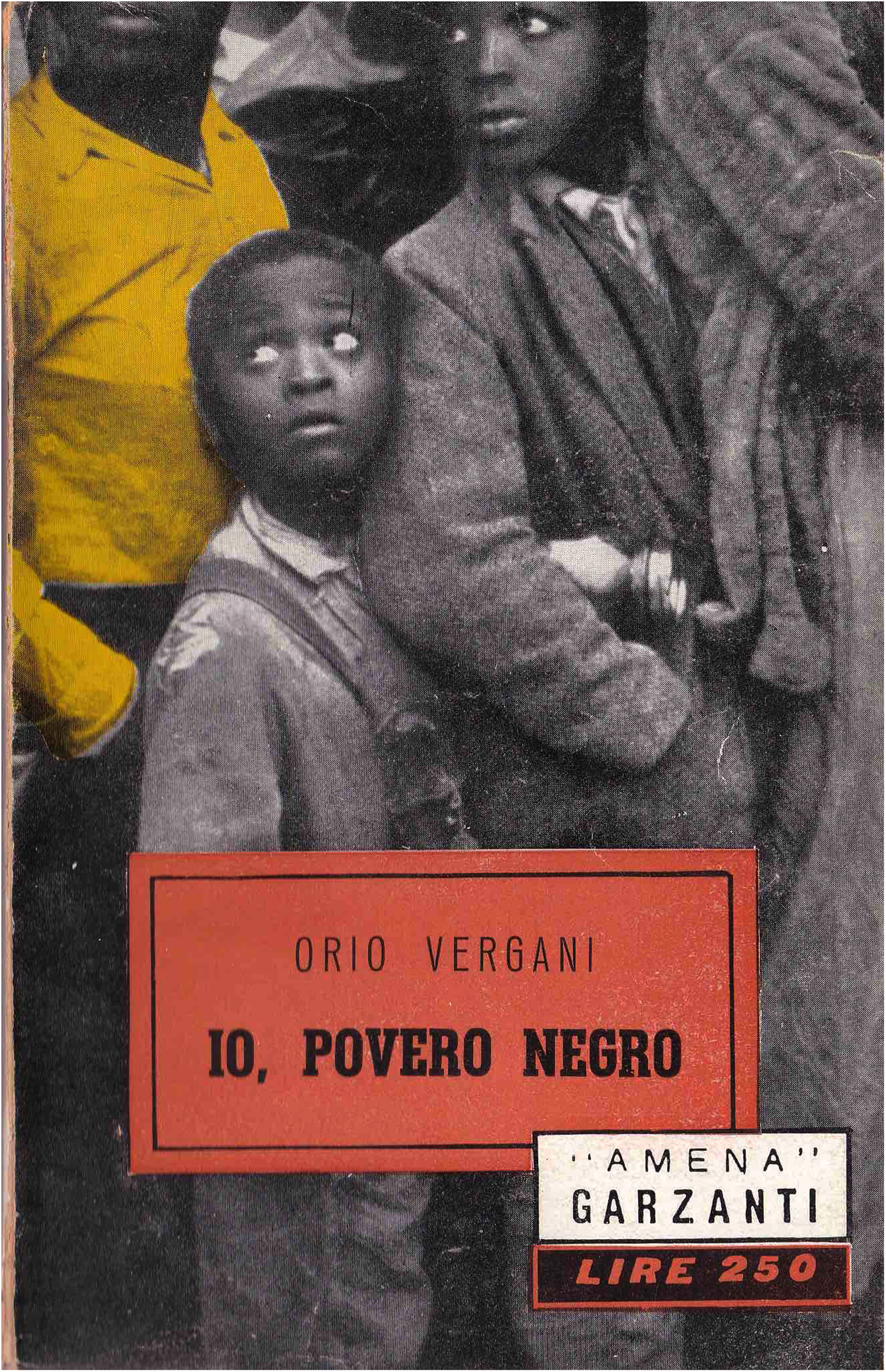
Book cover, Orio Vergani, Io, povero Negro (1949). Source: Public domain image reproduced from Library of Congress, Prints and Photographs Division, FSA/OWI Collection, LC-DIG-fsa-8a28727
Yet the photograph originated in the United States. It was taken in 1937 by Walker Evans as part of the renowned Farm Service Administration (FSA) initiative to document rural poverty during the Great Depression (Figure 2). The boys in the photograph are waiting for a meal. They are but two of the 15,000 flood refugees who landed in Forrest City, Arkansas, displaced by one of the worst floods in the region's history. So powerful and moving was this image that it ended up on the first-edition cover of Richard Wright's (1941) famed chronicle of black life in the Depression era, 12 Million Black Voices: A Folk History of the Negro in the United States (Figure 3). This book showcased FSA photographs alongside Wright's impassioned prose on the lived experience of Black people in the US, equal parts grievance, fury, lament, and call to action: ‘Look at us and know us and you will know yourselves, for we are you, looking back at you from the dark mirror of our lives!’ (Wright, 1941: 146, emphasis in the original).
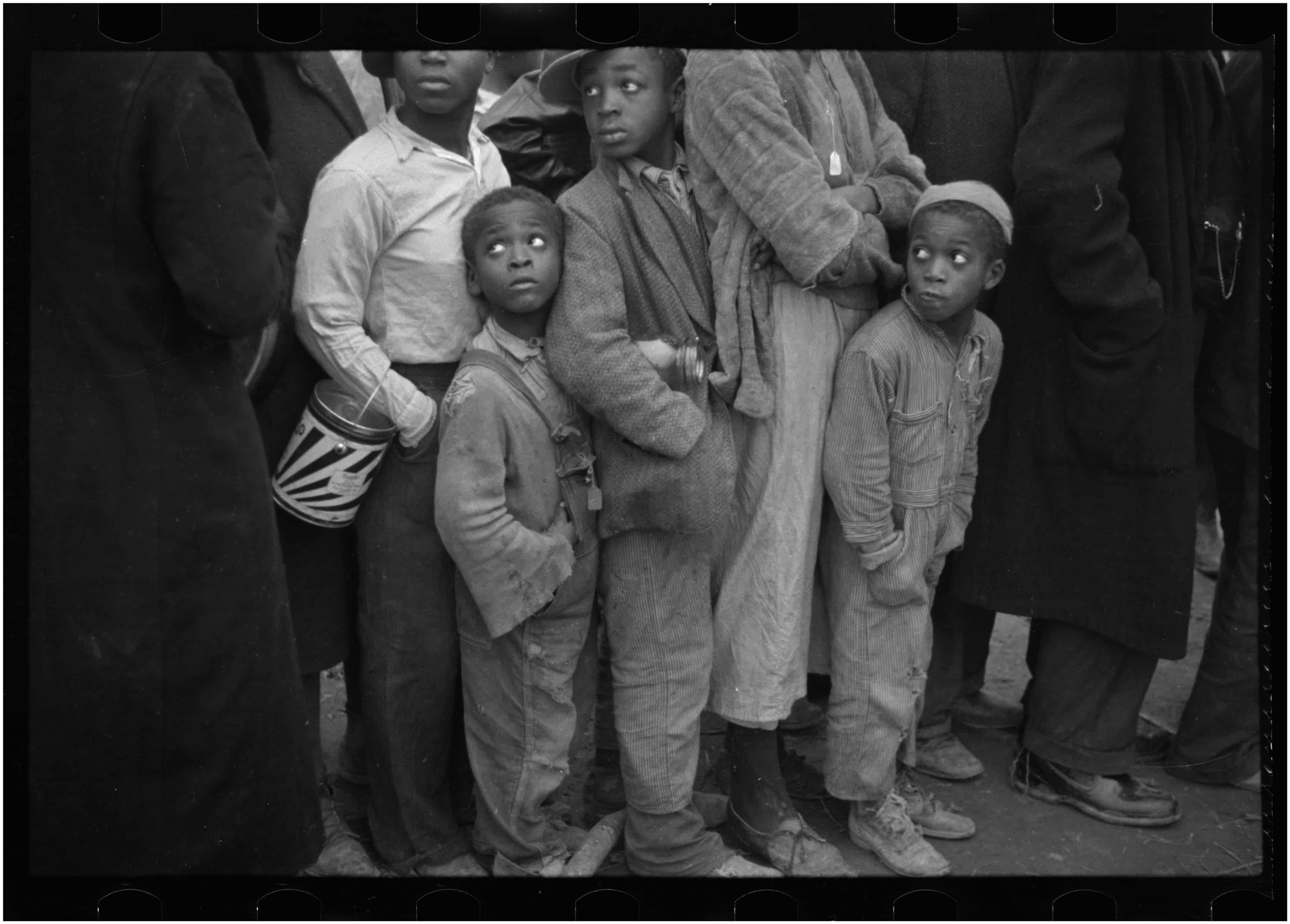
Photograph, Walker Evans, ‘Flood Refugees at Mealtime, Forrest City, Arkansas’ (1937). Source: Public domain image reproduced from Library of Congress, Prints and Photographs Division, FSA/OWI Collection, LC-DIG-fsa-8a28727
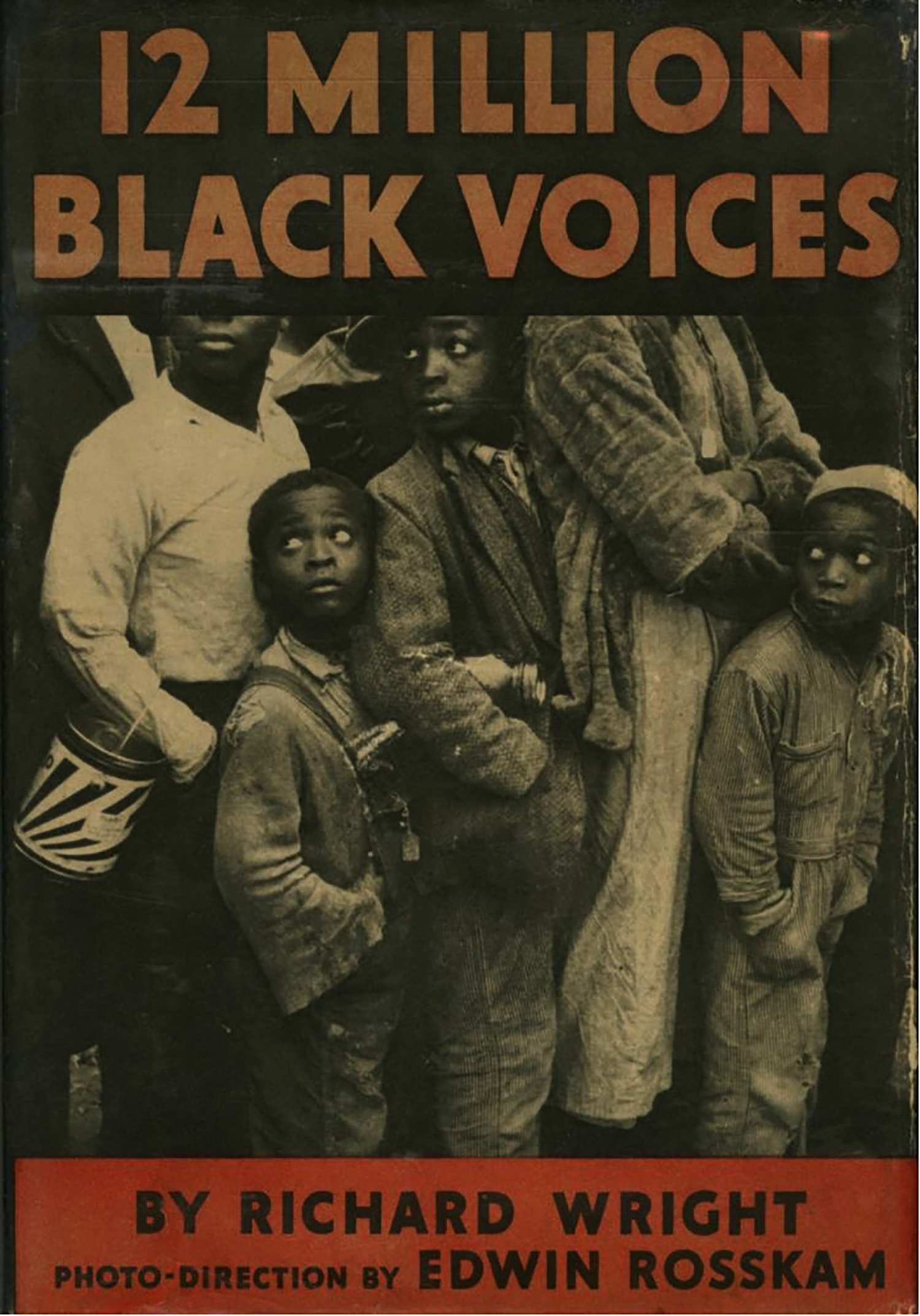
Book cover, Richard Wright, 12 Million Black Voices: A Folk History of the Negro in the United States (1941). Source: Public domain image reproduced from Library of Congress, Prints and Photographs Division, FSA/OWI Collection, LC-DIG-fsa-8a28727.
Io, povero negro is a dark mirror of sorts—as a text, it refracts several literary currents that coalesce around a black protagonist: colonial novels, pugilistic fiction, Bildungsromans, all peppered with a dash of surrealism. As a cultural object, Io, povero negro proves even more interesting. It connects to Italy's complicated colonial history insofar as its author, Orio Vergani (1898-1960), was the one of the most prolific documentarians of the Italian colonies, especially Italian East Africa, serving as the Corriere della Sera's foreign correspondent there throughout the late 1930s. His reportage and nonfiction reinforced prevailing colonial stereotypes about Africa and established a vast image repository of exoticized, black bodies that took root in the Italian cultural imagination. At the same time, Io, povero negro is very much the product of transnational race relations in the early-20th century. Just as the action in the text moves from Senegal to France to the United States, so, too, did the historical and cultural forces that gave shape to the work.
Following Camilla Hawthorne's (2017: 165) charge ‘to take seriously the histories of racial boundary drawing that were caught up with the process of national unification as well as Italy's own colonial history’, what we discover with Io, povero negro is a case study of blackness conceived in fiction and published in colonial real-time, a fiction produced by an author who, years later, staked out the racial boundary lines around blackness as a reporter in Eritrea, Somalia, and Ethiopia. It is an idea of blackness imagined largely in the absence of Italy: in the text, Italy appears briefly in the form of an itinerant Neapolitan gelataio who carries out a civilizing mission; at the same time, Italian is the language as well as the intended readership of the book. The black-and-white racial terrain of the text belongs chiefly to France and its colony, Senegal, with a transatlantic counterpoint in the US.
This article departs from the premise that the control of mobility is the fulcrum of empire, that the power over movement equates to power over people (Hom, 2019). Often, the tangible aspects of mobility take precedence in analysis, as it is easier to track the movements of people and objects. Yet the movement of ideas—mobile imaginaries—is a powerful force, if not the most powerful force, that organizes social life across distance. A superlative example of this organizing power is the idea of the Orient, which Edward Said (1994) has shown magisterially to be conceived of first in text, and then, to make a ‘preposterous transition’ (p.96) into practice. This practice, Orientalism, mobilizes the imaginary of the Orient to rationalize and justify imperial enterprise, that is, the exercise of power over people.
Given this premise, this article explores the idea of blackness as a mobile imaginary. It postulates a formulation of blackness in Vergani's novel Io, povero negro—that blackness is conceived of obliquely, in the absence of Italy, as belonging to an elsewhere—as that which inculcates a textual attitude that then transfigures into practice, into anti-black racism. It takes aim at the myth that il razzismo non esiste in Italy by exposing the fictions that underpin this specific expression of racism, fictions that give life to the deceit that Italy is colorblind. By setting Vergani's novel and its fiction of blackness into conversation with the critical scholarship and activism on race and racism in Italy (Giuliani, 2019; Hawthorne, 2017, 2021, 2022; Patriarca and Deplano, 2018; Pesarini, 2020a; Pesarini and Tintori, 2020; Proglio et al., 2021; Welch, 2016; Wong, 2006), it aspires to add a new dimension to the constellation of race-thinking in Italy that precipitates anti-black racism. In doing so, it entreats us to pay attention to the lived fictions that structure the everyday practices of racism, which, to varying degrees of violence, impact the lives of actually existing people who are welted and worn by sustained imperial duress (Stoler, 2016).
The argument that follows traces the contours of this racial terrain through twinned analytical strands: one, it offers a close reading of the literary text that shows how the absence of Italy reinforces the disavowal of its colonial history, and at the same time, validates its power to carry out a civilizing mission, thus creating a blind-spot that has allowed for complicity in the plunder of black minds and bodies; and two, it situates Io, povero negro in the historical and cultural circumstances of its time and shows that race-thinking crossed borders but also that blackness in Italy was perceived obliquely and kept at a distance. Blackness was something over there, a ‘problem’ belonging to France, the US, and elsewhere. Conceived as such transnationally, Blackness was deemed safe for intellectual contemplation in Italy in the 1940s, cohering into what Charles L Leavitt IV (2013) has called impegno nero, but the struggle for the right to live freely in a Black body and mind was never truly taken up at the time. Indeed, the struggle has not been taken up in Italy until quite recently, advanced by the seconda generazione of Black Italians giving voice and force to this movement of Black life.
Yet because of the way that the racial boundary lines of blackness were drawn early on—obliquely, in the absence of Italy, as a ‘problem’ elsewhere—it comes as no surprise that Black life struggles to gain purchase in Italy today. Blackness is thought to belong to somewhere other than Italy. In this way, one comes to understand how a photograph from an elsewhere, the US, documenting the lives of black people during the Great Depression, comes to adorn the cover of the first Italian novel featuring a black protagonist, who is not Italian and who squares off against racial tensions on three continents but not in Italy. Io, povero negro represents an example of transnational racial boundary drawing that fixes color lines, and at the same time, abnegates responsibility for the troubled, and often violent, processes by which the lines are drawn. If we follow this reasoning through to the present-day, we begin to understand how such an idea of blackness might sustain a belief that il razzismo non esiste in Italy, yet another myth, like Italiani brava gente (Fogu, 2006), that we know all too well to be untrue.
‘How a black baby is born’ and the birth of Io, povero negro (1929)
Italy's first novel with a black protagonist begins with a description of the birth of blackness. Tellingly, it begins with an excursus on ‘come si nasce un bambino negro.’ These opening pages are self-contained. They describe black babies as belonging to a primitive, timeless world, where they are born among fields or huts, under sun or rain, to mothers, fathers, and entire villages who seem wholly indifferent to their arrival: Ma nessuno si interessa soverchiamente delle nascite dei bambini negri dalle grosse teste e dalle gambette rattrappite…nel villaggio non si fa festa per la nascita del bambino…nascono in un mondo senza calendario e senza nomi: destinati a non avere onomastici o compleanni. (pp.2-4)
Black birth, too, is accompanied by death in this opening chapter. Nameless and dateless, black babies die on their mothers’ knees: ‘Muoiono sulle ginocchia nude della madre che si lamenta e li culla sperando che in questo modo i piccoli curiosi tondi occhi neri non si chiudano. Vanno via così dal mondo polveroso e nero che hanno appena conosciuto’ (p.5). According to the text, the mothers of these babies, in efforts to save them, make an offering to a forest god and employ shamans to perform a ritual dance, but all without success. The babies die anyway. ‘Tornano alla sua polvere che la bufera disperderà’ (p.6). The chapter ends on a somber note, implying that there will be no salvation for these ‘neri, freddi bambini morti’ (p.6) because their parents, as heathens, do not comprehend the concept of paradise.
These are the classic tropes used to describe Africa: an uncivilized, primitive, pagan, “Dark Continent”. It is a place that exists outside of time, an elsewhere inhabited by poveri negri, where birth and death co-exist as the ineluctable givens of everyday life. By engaging these tropes, this opening chapter reinforces prevailing stereotypes about both Africa and blackness that have long been in circulation. One need only to think of the human zoos at colonial exhibitions in the late-19th and early-20th centuries, where black people were repeatedly put on display as if they were animals, or, the popularity of minstrel shows across the antebellum US, with their performers in blackface playing to the stereotypes of black people as dim-witted, childlike, buffoonish, and lazy.
Like a colonial exhibition or a minstrel show, the opening chapter in Io, povero negro creates a spectacle—a spectacle of black birth that ends in death. Whether the authorial intent was to foster sympathy or horror in the reader, or perhaps a combination of both, remains unclear; however, the text does succeed in establishing that blackness is born from an elsewhere, a space distinctly outside time and civilization. That death accompanies black birth is also a harbinger of what is to come in the text: the metaphorical birth of a black protagonist twice over—first, from uncivilized African to civilized European, and second, from vagrant to world boxing champion—who is only then to die as a result of that double birth.
Io, povero negro was originally published in 1927 in serial form in La Lettura, the monthly illustrated magazine from the newspaper, Corriere della Sera. In 1929, it was published as a novel by Fratelli Treves, the famed Milanese publishing house known for its long list of Italian literati in the early-20th century. The author, Orio Vergani, was only 30 years old at the time, but he had been moving in Italy's journalistic and theatrical circles since he was a teenager. At 19, he began writing for the newspaper Messaggero della Domenica in Rome, where he made the acquaintance of writers like Federigo Tozzi and Luigi Pirandello. He even assisted with staging the first production of Pirandello's Sei personaggi in cerca d’autore (1921), which starred his sister, Vera, in the role of La Figliastra. In the early ‘20s, Vergani freelanced for several papers and magazines, including working as a correspondent for L’Idea Nazionale, the pro-nationalist and pro-imperialist weekly whose editors included Enrico Corradini and Luigi Federzoni, who were both, among many other things, outspoken advocates for Italian colonial expansion.
These years in Rome also established Vergani's connection to the Fascist regime, for, in addition to working for L’Idea Nazionale, he became friends with Gian Galeazzo Ciano, his neighbor in Prati, who would eventually become Mussolini's son-in-law and presumed successor (Vergani, 1974). Vergani landed a permanent position at Corriere della Sera in Milan in 1926 where his journalistic charge was to cover the most important events of the regime at home and abroad, not least because of his access to Ciano and the Duce's inner circle.
By the mid-1930s, Vergani was sent to cover Italian imperial expansion in the Horn of Africa, the intention being to drum up support for a military invasion of Ethiopia by showing the benefits of colonization. From 1935 to 1938, Vergani published at least four books of photographs and reportage detailing his travels through Libya and eastern Africa, including: 45° all’ombra: dalla Città del Capo al lago Tanganica (1935a); Sotto i cieli d’Africa (1935b); Riva Africana (1937); and La via nera. Viaggio in Etiopia da Massaua a Mogadiscio (1938). These books were in addition to the myriad articles Vergani published in the Corriere della Sera and other colonial propaganda vehicles (Vergani, 1932a, 1932b).
A typical example of how Vergani's nonfiction reinforced stereotypes about Africa and blackness was his description of an Ethiopian tribe that he calls the Giam-Giam in La via nera (1938). According to him, this tribe is said to inhabit the region south of Shala Lake in what is today known as the Great Rift Valley.
2
He describes these people as ‘figli della foresta’ who wear uncured animal pelts, freshly skinned from a goat or calf with bits of fat and blood still attached. Mothers give birth under trees, he writes, and after one hour, they strap their newborns to their bellies and continue onward. On market day, the Giam-Giam arrive carrying goods on their heads and shoulders like ‘formiconi neri, scarabei neri’ so that ‘tutto il mondo è un formicolar di Giam-Giam’ (pp.114-120). They are presented not only as less than human and less than animals, but they are also reduced to a black, swarming mass of insects. The scene culminates with what can be seen as the paradigmatic act of a civilizing mission: the Italian colonial official in charge of the region has been tasked to teach the Giam-Giam how to use soap. [L’ufficiale coloniale] Illustrò i vantaggi e i benefici del sapone, mostrò la bianca schiuma, fece lavare in piazza un ragazzino, che uscì dalla saponata nuovo nuovo. I Giam-Giam… mostrarono a capire la lezione, e cominciarono a lavarsi… Ma, chi sa perchè, non erano lieti. Si lavavano in silenzio, sospirando. Non potevano dire il motivo della loro tristezza. Levavano a salutare grandi nere mani insaponate: ma eran tanto tristi. (pp.117-118)
Confession and appropriation: ‘Sono io il povero negro’
Orio Vergani belonged to the coterie of Italian journalists that produced a large corpus of writing about the Italian colonial world in the 1920s and ‘30s. According to Charles Burdett (2011: 331), this body of work serves as an important resource for interrogating ‘the relation between the Italian community overseas and the subject populations of the newly created empire’ as well as examining ‘the degree to which writing that was intended for widespread consumption drew upon the received wisdom of academic disciplines that ranged from anthropology to orientalism’. With very few exceptions (Lombardi-Diop, 2005), they were all men, many of whom served as foreign correspondents for Italian newspapers and magazines. In addition to Vergani, some of the more well-known members of this writers’ circle included Mario Appelius, Mario Dei Gaslini, Angelo Pìccioli, and Ciro Poggiali; Burdett addresses much of their work in his in-depth study of interwar travel writing (Burdett, 2007, 2018, 2020a, 2020b; see also Deplano, 2018; Polezzi, 2012). It should be noted that Vergani was, according to Sandra Ponzanesi (2004), one of the most authoritative voices in the press at the time; however, he, along with the rest of the coterie, ‘fell under the spell of fascist propaganda and their articles did not have serious portraits of Africa, did not denounce the sordid aspects of colonization, but rather fell back into a process of exoticism with descriptions of nature and people which were in line with Mussolini's requirements’ (Ponzanesi, 2004: 133).
Few fictional accounts emerged in the years during and just after the end of Italy's direct colonial rule. The most famous was that of Ennio Flaiano with Tempo di uccidere (1947), a novel that centers on the rape and murder of an Ethiopian woman by an off-duty Italian soldier, his attempts to cover up the crime, his punishment vis-à-vis illness, his semblance of expiation, and, so exonerated, his return home. It is Italy's first postcolonial novel, according to Lucia Re (2017), a text that grapples with the messy moral quagmire wrought by both colonialism and fascism, and at the same time, levies a critique at realism (and neorealism) as modes of representation complicit in fascist and colonial violence. Loredana Polezzi (2007) demonstrates how Flaiano's novel foregrounds the mal d’Africa not only as a central trope of Italian colonial literature, but also shows how this ‘African malaise’ signifies the author's vexed, quasi-nostalgic relationship with Africa by re-writing individual memory into fantasy. Decades later, in the early-21st century, there has been a boom in literary and artistic production as well as scholarship interrogating Italy's colonial past and its ripple effects into the present day (Somigli, 2018).
Vergani's Io, povero negro predates Flaiano's work by almost 20 years. It was by no means of the same literary quality: Flaiano's novel won the Strega Prize, Vergani's received mixed critical reviews. In spite of the reviews, Vergani's novel found some international recognition; it was reviewed by Time Magazine in 1930 and, one year later, it was included in what can be described as that year's catalogue raisonné of ‘books by and about Negroes’ featured in the journal Social Forces (Johnson, 1931), which judged Vergani's style to be ‘in some respects amateurish but taken as a whole the story is effective’ (p.127). Almost 90 years later, it was the newspaper Corriere della Sera that heralded Vergani's work as the first Italian novel to feature a black protagonist (Colombo, 2016).
The blackness of characters like FT Marinetti's Mafarka, il Futurista (1911), or in the context of cinema, the Roman slave Maciste in Cabiria (1915) have been explored extensively in the scholarship on race in Italy (Pinkus, 2005; Reich, 2013; Spackman, 1996; Welch, 2016); yet these texts do not attempt to humanize their black characters in the way that Vergani's tries to. These characters are icons of blackness—sometimes monstrous and taboo, sometimes representative of Italy's ongoing struggle with versions of itself—they are symbolic registers of color that each turn in their specific representational orbits. What is unique about Vergani's work is the centrality of its black protagonist and the glimpses afforded into what can be described as his humanity as well as the near total absence of Italy in the narrative. This was not lost on Giuseppe Antonio Borgese, the literary critic who gratingly reviewed the novel in 1929 for the Corriere della Sera, Vergani's employer. It is worth noting that Borgese went into exile the US in 1931 after refusing refused to sign a loyalty oath to the Fascist regime, so this review may have been clouded by Borgese's opinion of Vergani, given the latter's close relationship with Ciano and the fascist powers that be.
According to Borgese (1929: 3), Io, povero negro was, above all, ‘una biografia esemplare, tipica: il Negro per antonomasia’. He implies that giving a lyrical voice to the black protagonist is the novel's greatest strength, a modest countercurrent to the stereotypical representations of ‘il negro in letteratura… un prestanome dell’uomo di natura, del gran fanciullo’ (Borgese, 1929: 3). Apart from this faint praise, Borgese skewers the absence of Italy in the novel and suggests that the elegiac tone struck by the black protagonist is but a guise for that of the ‘poetically deluded, tired, ironic, [and] nostalgic’ Italian, Vergani: Poca è l’ispirazione nostrana, lo stile casalingo di questo libro; di paese e Strapaese non c’è nulla. E questo non si riferisce soltanto ai personaggi e ai luoghi del racconto; dov’è, se la memoria non m’inganna, un gelataio napoletano, ma a Marsiglia; e tutti gli altri vengono da tutti i venti della rosa dei venti fuor che dagli zefiri di casa nostra; e in casa nostra non passano nemmeno da turisti; e l’eroe, un negro suddito francese, nasce in Affrica [sic], vive in Francia, muore in America… Sotto questa educazione di viaggio resta, naturalmente, l’italiano; e resta lui, Vergani. L’italiano, dico, della generazione dopo D’Annunzio; poeticamente un po’ delusa e stanca; ironica o nostalgica. Questo accento elegiaco nel negro di Vergani è stato già avvertito da altri critici. Tutto quell’esotismo poliglotta, quell’avventura su tre continenti, finisce per prendere un aspetto di mito autobiografico, di allegoria egocentrica. (Borgese, 1929: 3) In fin dei conti il “povero negro” ero stato io, con il mio carattere di eterno mancato ribelle. Avevo trasferito in lui la mia anima di incapace rivoltoso… Voglia il lettore perdonarmi se, ripetendo in modo assai presuntuoso la frase di Flaubert quando diceva: “Madame Bovary sono io…” dico “Sono io il povero negro, il povero negro Siki che non ho mai visto”. (p.3)
Vergani writes that his assumed blackness was a way to express his own incapacity to rebel (carattere di eterno mancato ribelle), that he transferred his own soul into that of the black protagonist, as if being black was linked to servitude, obedience, even obeisance, the opposites of rebellion. This operation could have only taken place in the blind-spot created by the absence of Italy and in the belief that blackness was an abstract condition belonging to an elsewhere, which together opened up the space for Vergani to figuratively plunder the mind and body of the povero negro for personal gain.
Blackness did not belong to Italy or Italians, but instead was something possessable and up for grabs. If a white author like Vergani could claim the identity of a black person so easily—‘sono io il povero negro’—then it makes sense that he would be unable to consider himself racist, for blackness always already belonged to him. Put another way, Vergani's appropriation suggests there could be no outside from which blackness would be interpellated via a white gaze à la Fanon. There could be no exclamation of ‘Look! A Negro!’ There could be no reification, no objectification. The occasion to confront the white gaze, too, would evaporate if the author had de facto appropriated and interiorized blackness.
In the op-ed, Vergani (1958a) takes his claim to blackness to even greater lengths. He affirms his long-held love for cultural expressions typically associated with Black culture: ‘Amavo, allora, i suonatori di sassofono, le cavallerizze e i trapezisti da circo, le musiche dei primi jazz, i pugilatori “suonati” e melanconici che viaggiano in terza classe, i bambini negri che avevo accarezzato sulle guance nel quartiere Sudanese di Tripoli’ (p.3). This list reads like a catalog of black stereotypes: jazz, boxers, saxophone players, third-class travel, circus performers, and poor black children in a foreign country. Vergani also reaches further back into his personal history to claim blackness, drawing parallels between himself and the protagonist of Io, povero negro as a young child: ‘La storia cominciava quando il “povero negro” era un negretto di cinque o sei anni, molto melancolico, che assomigliava moltissimo al ragazzino bianco ch’ero stato io una ventina di anni prima’ (p.3). It seems as if Vergani was covering all his bases to justify his appropriation of blackness: he had always loved expressions of Black culture and, as a white child, he was like a black boy.
In another op-ed, Vergani (1958b) adds more to this laundry list of justification. He describes being inspired by a black doorman employed by a cinema in Rome, the first black man that he claimed ever to see and get to know, who directed his attention to the ‘problem’ of race: ‘In quanto ai “negri”, il primo che io guardai e che conobbi e che mi ispirò la prima attenzione sul problema della sua razza, fu un gigantesco guardaportone… quel guardaportone diventò un personaggio del mio libro’ (p.3). Perhaps even more dramatically, Vergani describes how he witnessed the flogging of a black Sudanese man while on a trip to Libya in 1923, and how that prompted him to act against racial injustice by writing Io, povero negro: Intanto, io ero andato in Libia, e avevo visto, per la prima volta, un “colono” dare una “curbasciata” sulle spalle di un negro Sudanese. Quella “curbasciata”, di cui il colono andava orgogliosissimo, e che rigò a sangue le spalle di un inerme, fu per me una profonda lezione di pietà, un profondo consiglio a reagire contro una ingiustizia razziale. Quelle gocce di sangue mi sembrò scrivessero, su quella pelle colpevole soltanto d’esser nera, queste tre parole: “Io, povero negro”, che diventarono poi il titolo del libro. (Vergani, 1958b: 3)
A black man's flogging, the black boy within, a black doorman in Rome, his affinity for many expressions of Black culture—in retrospect, according to Vergani, these all provided him with inspiration for Io, povero negro. Yet at the same time, he does a volte-face and claims the novel was inspired by ‘una statua bianchissima,’ that is, a marble statue of a boxer by famed sculptor Antonio Canova. Vergani writes that he carried around a postcard of the Canova statue, although he does not specify which one exactly (presumably it is one of Canova's two boxers, Creugas or Damoxenos, housed in the Vatican Museums). For Vergani, the statue was his ‘first lesson in pugilism’ and represented his ‘badge of antiquity as a sportswriter.’ He sums up: ‘L’antenato del “povero negro”, e anche di Io, povero negro era dunque una statua bianchissima, di marmo statuario’ (p.3). Immediately after mentioning the statue, Vergani says he was also inspired by writers like Federigo Tozzi and Luigi Pirandello: ‘Vivevo, se non proprio coscientemente imitandoli, fiutando sempre la loro atmosfera’ (p.3). On one hand, Vergani justifies his novel by appealing to white, neoclassical (Canova) and literary (Tozzi, Pirandello) authorities, and on the other, he justifies it by invoking blackness and espousing racial justice.
What prompted Vergani to write these op-eds 30 years after the novel's publication? Why was he so intent on presenting this miscellany of inspiration? It turns out that Vergani was covering up a lie. These op-eds were confessions. Vergani's editor at the Corriere della Sera, Ugo Ojetti, had once asked him to write a story about the famed championship boxing match between Georges Carpentier and Amadou Louis M’barick Fall (known as Battling Siki) that took place in 1922. An avid sports fan, Vergani was known to attend every live boxing match at Teatro Jovinelli in Rome. He also covered the 1924 Olympics in Paris. But Vergani (1958b) writes that he never saw the Carpentier-Siki fight: ‘Posso confessare che non ho mai visto Carpentier, che non ho mai visto Siki, che non ero a Parigi il giorno del famoso match e, se anche ci fossi stato, non avrei avuto il denaro per pagarmi una sedia di ring’ (p.3). Loathe to admit this absence to Ojetti, Vergani spun a fiction that became the novel Io, povero negro. Vergani confessed that eventually he came to believe his own fiction, that indeed, he had seen the fight: ‘Da quel momento avevo finito per credere di aver visto il famoso match’ (p.3).
To rationalize his lie, Vergani appealed to white authorities (Canova's statue, Tozzi and Pirandello), and more presumptuously, he laid claim to blackness—‘io sono il povero negro’—as if to imply that his ‘blackness’ validated his right to tell the story. He was like a black boy. He could feel black pain. By claiming the body and the voice of the novel's protagonist, Vergani the author puts into practice the ultimate power move of colonization: he takes possession of black mind and body. Put another way, Vergani uses blackness to exculpate himself from his own lie, and to do so, he engages a well-worn technique of colonial rule. His drawing of racial boundary lines in Io, povero negro turns out to be more akin to boundary erasure: blackness always already belongs to the white Italian author, this soi-disant black man.
Blackness is thus hooked into processes of appropriation (io sono il povero negro), covering up (justifying a lie), dissociation (blackness belongs to others, such as a doorman or a Sudanese man being flogged), displacement (blackness belongs to an elsewhere like Africa) as well as material and discursive postponement (an author's confession 30 years later). These operations feel familiar because they are fundamental to the ways in which imperial formations work. What we uncover with Vergani's novel and his later ‘confession’ is an example of mobile imaginaries at work within empire's mobius strip. The idea of blackness, formulated in fiction and reified by confession, is thus forged in the crucible of Italy's protracted colonial endeavors.
A civilizing mission in the absence of Italy
The plot of Io, povero negro (1929) is fairly straightforward. In brief: it centers on an unnamed black boy whose story begins among European colonizers in an unnamed African locale. The boy befriends a Dutch sergeant, Van Duren, who gives him a shirt as well as a name: George Boykin. But soon thereafter that sergeant falls ill and dies. George then becomes an aide to an expatriate, Madame Germaine, who decides that he will accompany her to France. They arrive by boat to an unnamed French city where, upon disembarkation, George loses the madame in a crowd and is forced to survive on his own. After months of begging and odd jobs, George discovers he has an innate talent for boxing and the story transforms into a pugilistic hero's journey. His talent leads to victories in the ring, an affair with his trainer's wife, and eventually the light heavyweight championship of the world. As newly crowned champion, George lands in the US for more prizefights, but having indulged in the many excesses that come with fame (i.e., drinking, gambling, women), he ends up sabotaging his career. Part of that sabotage, too, is his internal narrative: he is but ‘un povero negro’ who has risen too far above what he believes to be his station in life. In the end, George descends into a feverish delirium. Police chase him through the streets of New York City, and he takes his own life by jumping out of a building window.
As foreshadowed by the opening excursus, George's ‘birth’ as both a civilized man and champion boxer is bound up with his death, for the text implies that a black man, un povero negro, could neither be civilized nor a champion, much less both at the same time. It even says as much: George had served his purpose for the ‘continenti bianchi’—to provide a good fight—and was no longer needed: ‘Ora pare che Geo abbia servito abbastanza. Adesso il posto è degli uomini. Il negro arranca sui gradini di un trono che non è il suo… non c’è niente da fare contro questa muraglia bianca’ (pp.275-276). For a moment, George sat on that throne as champion; however, he did not belong to this ‘place of men.’ The text suggests that George was less than a man, and for this reason, neither his championship nor his civilization had lasting purchase.
The text reverts to stereotypes to describe George in his final days, delirious and driven mad in ‘la città dei bianchi,’ and in such a way, reverses any sense of ‘civilization’ that he may have once had. He's a wild beast, a monkey, even a black panther loosed upon the streets. He's a black shadow that evades police and incites panic. He's violent, too, throwing punches and knocking down anyone who crosses his path. In his feverish state, the city turns into a forest before George's eyes, and he hallucinates a tribal mask hovering before him. The mask represents an idol, ‘il volto del Dio terribile’ (p.283), a connection with his not-so-distant animistic past. In his final delusion, George reaches for this mask, salutes the city-turned-forest, utters a cry of ululation to the good spirits, and leaps through a glass window. The boxing champion, the civilized man, and the povero negro are dead.
Although George's story ended in suicide, his journey from povero negro to boxing champion is one of becoming civilized, not once but thrice over. The civilizing mission, of course, was a key justification for European and US colonizing projects. Here it serves as a plot device that moves George's story forward, and at the same time, it implicates but ultimately absolves Italy of partaking in colonial subjugation and exploitation. In short, it reinforces the myth of Italiani brava gente, even with Italy absent, or appearing briefly in regional form.
The narrative introduces George as an unnamed black boy wearing nothing but the front of a dress shirt, attached around his neck with a bit of string. It begins by describing his current existential condition: ‘Per ora è soltanto un bambino negro…’ (p.6), as if to imply that George will become something more than ‘only a black boy.’ Van Duren is shaving when George meets him for the first time. George peers in on him from an open window and, noticing him, Van Duren says, ‘Vieni qui…vieni qui scimmia spelata!’ (p.14). George enters the room, and Van Duren asks, ‘Come ti chiami?…Come si chiama tuo padre?…Dove è la tua casa?’ (pp.14-15) to which George has no reply. This first meeting establishes George as less than human—a hairless monkey without a name who does not know his father and who has no home. He needs to be civilized.
It becomes clear that to be civilized means to become white, for shortly after this exchange Van Duren asks, ‘Vuoi diventare un bambino bianco?’ (p.16). When George replies yes, Van Duren slathers him with white shaving cream and proclaims, ‘Fatto!’ George is proud and he runs outside to show off his newly whitened face: ‘vorrebbe che lo vedessero, perchè crede di essere molto bello’ (p.16). George's civilizing process thus begins with an artificial whitening, an inauguration of sorts into the black-and-white framework of racial difference. George's temporary transformation from black boy into a white boy foreshadows how, as a black world champion, he would temporarily sit atop the throne predestined for white boxers.
The mission to civilize George continues with a shirt and a name. Van Duren gifts George an old dress shirt that he found in a wardrobe. Starched and yellowed, it has a stain on it in the shape of the letter ‘G.’ Van Duren takes some ink and transforms the stain into a name: George. The once ‘hairless monkey’ is now dressed and has a name. What is more, the shirt gives George his first pocket, which, according to Gerald Early (1988) is: Symbolic of his first real lesson in making himself a receptacle by which he can gather and store and eventually evaluate his experiences: it is the equivalent of language, for the pocket symbolizes the possibility of private ownership. It is the greatest, if misused and misunderstood, gift the European colonist can give the African boy; it is the gift that takes the boy from being a passive part of natural (i.e., non-white, animal) history to being an active part of human (i.e., white) history. (p.452)
His baptism would come later at the hands of the French expatriate, Madame Germaine, who took George under her wing. After the death of Van Duren, George moves from the unnamed rural outpost to an African port city, where he is initiated into the hierarchical relations realized by any colonial undertaking. There, George becomes familiar with, to borrow the words of Frantz Fanon (2008: 1), ‘the black man's dimension of being-for-others’. He spends his time in the port city finding ways to serve others, working as a shoeblack and a porter. After a harrowing episode in which white sailors get George involved in a drunken brawl that ends with him getting shot in the shoulder, he falls into the care of Madame Germaine. She has him baptized. He goes to church with her. George also receives a Christian name that he quickly forgets, a telling sign of the baptism's negligible impact. Yet George liked the boy he was becoming, thanks to Madame Germaine: Si diverte a guardarsi, vestito di bianco, nello specchio. Adesso ha tante tasche, nel vestito, e ha un temperino, e un piccolo portamonete da donna che la padrona gli ha regalato. Ha anche un rosario, di cui non sa ancora servirsi, e un lapis colorato, che non gli serve a nulla, ma che gli è stato donato dal capo della dogana. (p.70)
After weeks of searching for the madame and struggling to get by George meets an itinerant gelataio, Don Nicola, who sees him as an opportunity to boost production and sales. At dawn, George fetched the heavy cubes of ice to make the gelato from a factory across town. In the evenings, George served as an advertising gimmick to bring in customers, the black contrast to white gelato: ‘alla sera il negro fa un bellissimo effetto, tra le due lampade ad acetilene: gira quegli occhi neri e caldissimi, manovra come una scimmia quelle mani d’ebano umido’ (p.93). In return for his services, Don Nicola pays George one franc per day.
For a brief time, too, Don Nicola continues the civilizing mission begun by Van Duren and Madame Germaine. He finds George a makeshift home, shows him how to bathe and dress himself, and how to launder his clothes. He considers himself George's teacher: ‘“Fidati di Don Nicola”… Il faut avoir confiance dans maître Nicola’ (p.96). The text makes clear that Don Nicola is a Neapolitan who speaks French. It deploys stereotypes about Neapolitans to reinforce this difference. For example, George knows that no one, including himself, will steal anything from Don Nicola ‘perché il napoletano ha tanto d’occhi aperti’ (p.93), which is to say he is sharp, clever, and always aware of what was happening around him, all traits that fall in line with the stereotyped furbizia of the inhabitants of Naples.
Also, in keeping with stereotypes about the Italian South, Don Nicola is represented as animated and passionate, as well as one who does not speak Italian: ‘Il gelatiere si ostina, per tutta la mattina, a parlargli in napoletano, e a strillargli qualche ordine in francese, accompagnato da gesti infiniti’ (pp.93-94). His last bit of advice to George before leaving for the season is punctuated by the most Neapolitan of expressions of all: ‘La città è grande e ci sarà sempre da far qualcosa, guaglione’ (p.94). The term ‘guaglione’ can be translated as ‘boy’ but holds a meaning closer to words like ‘guy,’ ‘rascal,’ or even ‘bro’ in the English vernacular. There is no word clearer than guaglione as a linguistic marker of napoletanità.
The character of Don Nicola marks the brief and singular appearance of a figurative Italy in the whole of Io, povero negro, and to wit, it is Italy in regional form. Put another way, Italy is essentially absent from the text save for this one oblique, Neapolitan manifestation; hence the aforementioned critique of Borgese (1929) in his review, ‘Poca è l’ispirazione nostrana … in casa nostra non passano nemmeno da turisti’ (p.3). But Don Nicola teaches George the value of labor, language, and hygiene, and in such a way, even though Neapolitan, he embodies the myth of Italiani brava gente for he has successfully carried out a civilizing mission with George. Don Nicola's presence in the text both implicates and absolves Italy of having a role in George's subjection and exploitation. He concludes the unfinished colonial business begun by Van Duren and Madame Germaine. In short, it took an Italian-as-Neapolitan working in metropole France to open up new horizons for George (‘the city is big and there will always be something to do, guaglione’), which immediately leads George to his next and most successful career move: boxing.
From sweet science to colonial exhibition, or blackness belongs elsewhere
With the civilizing mission complete, the narrative transforms into a pugilistic hero's journey that uses boxing to set into relief blackness as an idea as well as a ‘problem’ belonging to an elsewhere. It tells the story of George's formation as a boxer: his raw talent and forceful punch, his regional victories, his self-inflicted obstacles to success (i.e., refusing to train, excessive drinking), which, for a brief moment, he transcends to become the light heavyweight champion of the world. To secure that victory, George makes a spontaneous decision not to throw the fight that had been fixed in favor of the white boxer. By refusing his status as povero negro and ascending the throne that had been preordained for the white champion, George, as a black boxer, embodies an earth-shattering transfiguration: ‘Non pensa che è, d’un tratto, come se si fosse spaccata la terra, il campione del mondo… sulla folla l’arbitro pallidissimo leva il braccio nero del nuovo idolo’ (p.274).
Race has always been the great through line of boxing history; in particular, the color lines drawn between black and white. Gerald Early (2019: 11) writes, ‘Promoters, from the earliest days of professional fighting, exploited this tendency of identification in audiences by underscoring differences between fighters. Jews, Irish, Italians, Filipinos, Mexicans—all were underclass, persecuted tribes with their heroic boxers.’ Black and white, of course, marked the most obvious and dramatic difference, the most epic difference between men of the modern age. Race infused boxing matches with dramatic tension: they became contests of racial superiority. The boxing ring represented an arena for racial dialogue, according to Louis Moore (2019: 60), wherein ‘whites looked at the ring as a symbol of superiority, and blacks viewed the ring as a sign of equality’.
Pugilistic fiction and film have long exploited this tension in their narratives. One need only think of the Rocky franchise as an example that deploys, reverses, and upends the sport's black-and-white color lines in countless ways. Characters like Sylvester Stallone's Rocky Balboa and Robert De Niro's Jake LaMotta (Raging Bull) as well as real-life champions like Rocky Marciano, also point to the importance of boxing to Italian American identities. In the early-20th century, around the time that Vergani was writing Io, povero negro, boxing challenged the racialization of Italian immigrants in the US, who, according to Gerald R Gems and others, were understood as not being fully white (Choate, 2008; Gugliemo, 2004; Gugliemo and Salerno, 2004). Anti-Italian discrimination and prejudice ran so high there were documented lynchings of Italian Americans, most famously in New Orleans in 1891. Gems (2013) notes that boxing helped Italian Americans to win whiteness, their lighter skin tone could not be denied in matches against black opponents.
Unlike the US where immigration and slavery subtended the contest of race in boxing, in Europe the specter of colonialism permeated many of the black-and-white match-ups in the early-20th century. One of the most famous bouts took place in 1922 for the light heavyweight championship, the aforementioned match-up between reigning world champion Georges Carpentier and Amadou M’barick Louis Fall, known professionally as Battling Siki (Figure 4); again, the purported source material for Vergani's novel. 3 These men were both boxers and French war heroes, but one was white and from metropole France, and the other black and from a colony, Senegal. The so-called Affaire Siki was similar to the one Vergani details in Io, povero negro about a fixed fight that turned into a real one, as was the professional and personal fallout experienced by Siki who, because of his refusal to throw the fight, was turned into a pariah and stripped of his boxing titles on a trumped-up charge of inappropriately wearing a colonial military uniform (Miller and Rivers, 2011). If a dress shirt was the sign of George's civilization in the Io, povero negro, Siki's downfall marked the limits of that civilizing mission: he was a colonial subject undone by wearing the dress of his colonizers.
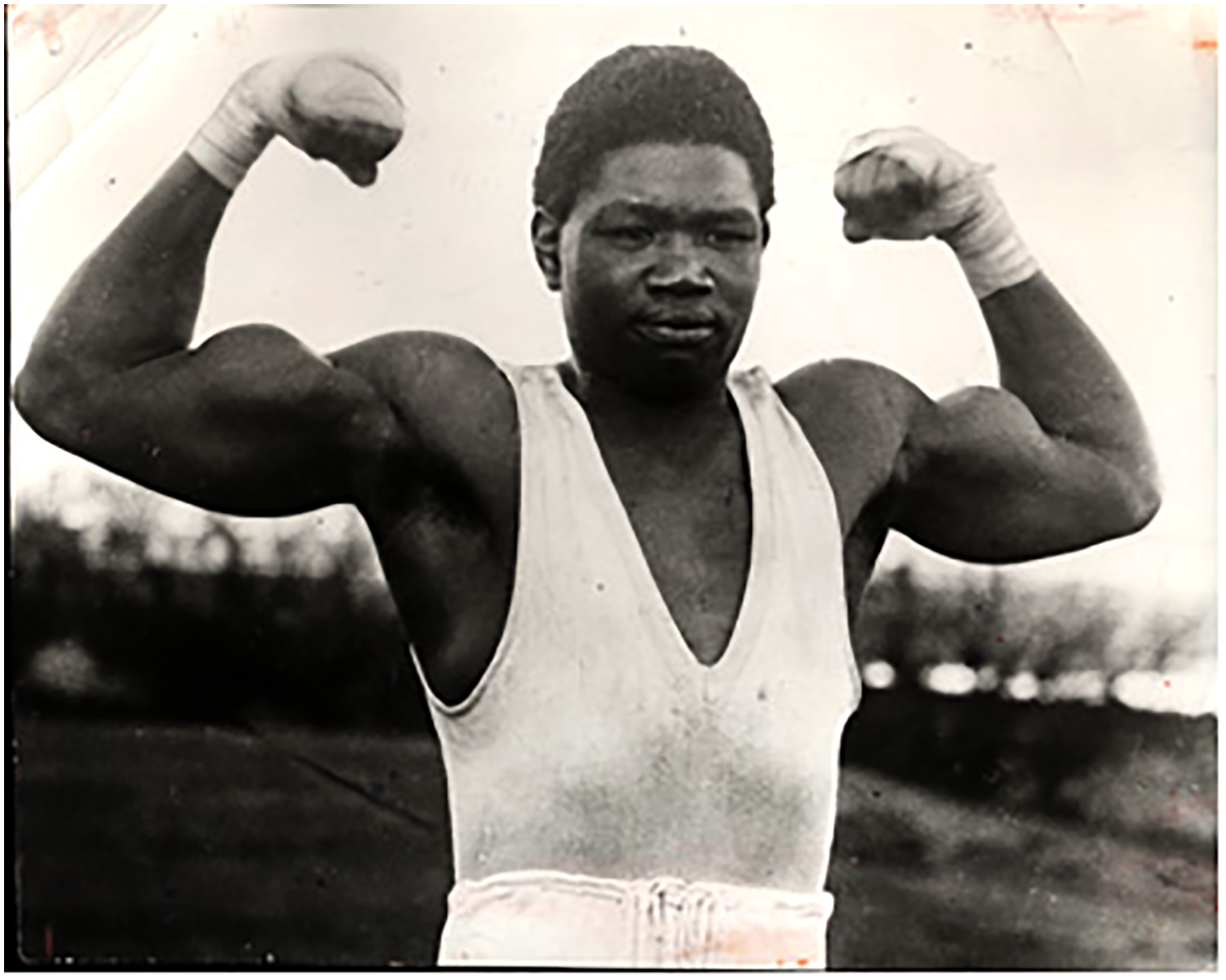
Amadou M’barick Louis Fall, known as Battling Siki, 1923. Source: Public domain image reproduced from Wikipedia, Collection Peter Benson, Boxing Encyclopedia. https://commons.wikimedia.org/wiki/File:BattlingSiki.jpg

It is also important to note that, as scholars such as Claudio Fogu and Rhiannon Welch have shown in scrupulous detail, the racial discourses circulating in Italy during the late-19th and early-20th centuries were formed by complex constellations of meridionalismo, mediterraneità, and productivity indebted to the race-thinking of criminal anthropologists like Cesare Lombroso, Giuseppe Sergi, and Alfredo Niceforo. Within these Southernist and Mediterraneanist logics, Fogu (2020: 107) writes, ‘Italians at home and abroad were simultaneously racialized and southernized as the ‘blacks’ of Europe’. Welch (2016) adds that it took Italy's imperial enterprise to bring epidermal blackness ‘into sharper focus for an Italian public who, up until that point, had maintained a comfortably distant relationship to exoticized Africans gleaned primarily through the armchair adventure novels of Emilio Salgari and accounts of nineteenth-century travel writers, ethnographers, and positivist social scientists of a Lombrosian stripe’ (p.195). Vergani's novel reinforces this comfortable distance, keeping blackness at bay for its Italian audience. Even as Italian readers got to know George, the black protagonist, he still belonged to the colonial fallout of another country, France, as he did to the race relations consequent to that project. Put another way, George and his blackness were externalized objects, plot devices meant for literary consumption, not necessarily for prompting reflection on notions of race in Italy.
Yet during Vergani's lifetime there was perhaps no better venue than the colonial exhibition for the objectification and consumption of blackness. The most famous example is perhaps that of the Exposition Coloniale Internationale staged in Paris in 1931, which recreated entire colonial worlds in the city's center, showcasing the ‘successes’ of civilizing missions in the form of pavilions, monumental reconstructions, and especially the villages nègres where blackness was exoticized and spectacularized through people brought from the colonies and put on display like mannequins in a shop window.
It is possible that Vergani's ideas about blackness, which were later disseminated through his East African reportage, were also informed by an exhibition—the Fiera di Tripoli—the longest running colonial exhibition staged on colonial soil (Hom, 2013, 2020; McLaren, 2006; Von Henneberg, 2005). Four years after the publication of Io, povero negro, Vergani (1932b) wrote a short review of the representations of Africa at the Fiera in which he declares the (simulated) continent to be finally civilized: Piace quest’Africa, che vorremmo chiamare froebeliana. Il vecchio continente analfabeta, il più forte, ma il più tardo fra tutti i cinque fratelli, ha tutta l’aria di essere finalmente andato a scuola… L’Africa, vecchio enfant prodige, massiccio e testone, mostra il quaderno dei suoi primi esperimenti di civiltà. (p.432) Esposizione che smobilita definitivamente Salgari e Verne… il selvaggio è stato mandato a letto presto, e forse senza cena, dai suoi fratelli civilizzati, perchè non disturbi nell’ora delle visite. L’antropofago e il pigmeo vengono presentati irriconoscibili entro l’uniforme kaki… Quello che meraviglia, nell’Africa e in particolare in questa Fiera interafricana, è l’assenza della storia… Nostro nonno potrebbe essere l’uomo bianco più antico dell’Africa… Lo zio Tom rappresenta l’Adamo di questa breve umanità cresputa e vestita di cotonina bianca. (p.431)
The Fiera di Tripoli demobilized (smobilitare) the fictional blackness represented in the adventure novels of Salgari and Verne, according to Vergani. The blackness belonging to savages, cannibals, and pygmies had been quite literally put to bed. Yet in this passage, ‘savage’ blackness is immediately replaced with the subservient blackness of another fictional character, Uncle Tom. As the titular character of Harriet Beecher Stowe's bestselling anti-slavery novel, Uncle Tom's Cabin (1852), Uncle Tom has long been praised and criticized as both the long-suffering black slave and the noble hero who draws on his Christian faith to live—and die—with compassion in spite of his enslavement and abuse (Baldwin, 2012). Here Vergani equates a fictional black character, Uncle Tom, who is specific to US race relations and that country's experience of slavery, with a biblical character, Adam, to express how blackness can assume a procreative, civilizing capacity in the context of colonization. It is possible for Uncle Tom to find humanity, but only if clothed in the white cotton provided by his colonizers, that is, the Italian grandfathers who are the ‘oldest white men in Africa.’ Seen in a different light, the savage is put to bed and replaced with the black slave who absolves the horrific acts of his overseers (colonizers) with Christian compassion and forgiveness.
Uncle Tom's submission and absolution of his abusers recalls a defining characteristic of what Robin Di Angelo (2018) has described as white fragility. She writes that the premise of such fragility is that ‘the white collective fundamentally hates blackness for what it reminds us of: that we are capable and guilty of perpetrating immeasurable harm and that our gains come through the subjugation of others’ (Di Angelo, 2018: 96) and that ‘these conditions reproduce the weight of racism that people of color must constantly carry: putting aside their own needs to focus on white needs’ (p.128). The character Uncle Tom puts aside his needs to forgive his overseers, ultimately reinscribing racism rather than ameliorating it. His forgiveness lodges racism ever more deeply into the social fundament.
By invoking Uncle Tom as the Adam of African humanity, Vergani lauds subservient blackness, for this brand of blackness, born and perfected in the context of US slavery, not only absolves Italian colonizers of their abuses but also promises them the possibility of Christian salvation. To go one step further, we might posit that the myths of Italiani brava gente and il razzismo non esiste might function in similar ways to the character of Uncle Tom, covering up and managing a specifically Italian white fragility linked not to slavery but rather to Italy's colonial enterprise.
When positioned in the arc of Vergani's oeuvre, blackness begins as a fiction in his novel Io, povero negro (1929); then it reappears as a spectacle at the Fiera di Tripoli colonial exhibition (1932); and finally, as both subject and object of his reportage in Italian East Africa (1935-1939). In all of these contexts, blackness is externalized and transnational; it is born of, belongs to, and moves through multiple elsewheres, that is, Africa, France, and the US. Oblique and kept at a distance, blackness in Vergani's texts—and the author's relation to them—tracks along the ways in which transnational discourses of race and racism crossed borders of all sorts, and in doing so, shaped practices of racial boundary drawing in Italy in the early-20th century. But these color lines were hardly solid; instead, they were blurred by language and by circumstance, often obscuring the racial dynamics being distilled through them.
Stereotypes of blackness and the intractable condition of being-for-others
Boxing is a performance art, a combination of sport and entertainment, which, according to Isabel Wilkerson (2020), was one of the few jobs that Black people could hold beyond the plow or the kitchen in the early-20th-century United States. Black American boxers like Jack Johnson, who unexpectedly knocked out James ‘The Great White Hope’ Jeffries in 1910 for the heavyweight championship, challenged ‘the racist notions that defined African Americans as intellectually, morally, and physically inferior’ (NMAAHC, 2019). Nonetheless, Johnson's victory in the so-called Fight of the Century sparked race riots across the country. White mobs raided African American communities, killing more than a dozen people and injuring hundreds, and instrumentalized terror to send a message that, as Wilkerson writes (2020: 138), ‘even in an arena into which the lowest caste had been permitted, they were to know and remain in their place’.
Racial tensions figure prominently in the pugilistic hero's journey of Vergani's 1929 novel. Both in and out of the ring, the text frames the protagonist's blackness in archetypical stereotypes. It also asserts that these characteristics are the reasons for George's success as well as his downfall. His blackness enables George to transform into ‘una belva’ (p.275) in competition. Often, George is linked to animals and forces of nature in the ring: he is told that blacks are ‘figli di scimmie’ (p.129); that they have ‘occhi di cani castigati’ (p.159); that he's an ‘uragano nero’ (p.227) and an ‘ombra nera’ (p.273); that he is the ‘selvaggio’ needed by civilized men. The text goes so far as to describe George as being from a land where rapacious gorillas kidnap white women à la King Kong: ‘Ma egli viene da laggiù: da dove i gorilla insaziabili rapiscono le mogli dei piantatori distratti’ (p.226).
Interestingly, the text also offers glimpses into George's interior state, that is, inside the mind and voice of a black man ventriloquized by Vergani, a white male Italian author. There are moments when the protagonist questions the stereotypes that categorize him, but ultimately accepts them as being inescapable. For example, having achieved some success as a prize fighter, George refuses to participate in a low-paying match; he believes he is deserving of a higher payout. When his manager, Monsieur Greco, refuses, George retorts by evoking colonial exploitation: ‘Volete colonizzarmi. Sono la vostra piccola colonia africana…’ (p.213). This statement runs contrary to the reading of Io, povero negro set forth by Giovanna Tomasello (2004), which claims that George represents the ‘incapacità del nero di comprendere un mondo ormai costruito, tanto in Europa quanto in Africa, dai bianchi’ (p.138). George seems to understand this world perfectly well, not least evidenced by his declaration of colonial exploitation. It is just that he is resigned to accepting his place in it as povero negro.
Such resignation is evident in George's naïveté-turned-surrender concerning his love affair with Martha Burns, the wife of his manager. Contrary to the stereotype of the hypersexualized black male, it is the white woman who seduces the black protagonist. The text presents George as a sexual innocent, presumably a virgin, who knows little about women, discovering a secret white world for the first time: Questa cosa gli dà come uno sgomento dolce e tormentoso… la scoperta che c’è al mondo questo segreto del tepore bianco, vivo e sottomesso, bianco tanto che lo si scorge anche nel buio, solo per questo riflesso di luna, questo tepore docile a cui si ha solamente paura di far male. È bianca, è bianca, gli dice qualcosa dentro di sè… Il negro ha appoggiato ora la fronte sulla sua spalla calda e mormoro “Padrona… padrona…” perchè è l’unica parola d’amore che sa trovare. (pp.149-151)
His internalization of povero negro as an intractable condition becomes even clearer on the eve of his championship fight. Shortly before George steps into the ring with the reigning world champion, he meets a young Dutch girl. Her name is Van Duren. She praises George and wishes him luck to which he replies that he is not going to win the fight. He gives her five hundred francs and implores her to place a bet against him. George is adamant that he will be knocked out because he knows the fight has been fixed in advance. There was nothing he could do about it. Resigned, he says: ‘E io, cosa sono? Io, un povero negro…’ (p.253). Put another way, George's complicity affirms that he knows and will remain in his place. The civilizing mission begun by sergeant Van Duren in Africa thus accomplishes its ultimate success—a black man who knows, accepts, and internalizes his being-for-others—an achievement so great that Van Duren comes back from the dead to witness it in the form of his female double.
The immutability of the povero negro as an existential condition is also underscored by a paragraph added to the English-language translation. The novel was translated in 1930 by WW Hudson and published in the US by the Bobbs-Merrill Company (already famous for printing books like Raggedy Ann and the Wizard of Oz) and in the UK by Hutchison. The few added sentences emphasize the fixity of George's place in the ‘great white world’: The great white world that was always incomprehensible, always right. True, he had beaten other white men, but they were different. This man was the champion. For widely different reasons, but with the same inevitability, his submission to the champion seemed as natural today as his whipping at the hands of Tommy Walsh had seemed on that other day long ago. Wasn’t he still only a poor nigger? (Vergani, 1930: 270) Il segreto della sua fortuna è in questo: che la sua forza si può comperare. Lasci fare ai bianchi; e, tra un match serio e uno combinato, tirerà avanti finchè vorrà. Obbedisca il manager: vinca se deve vincere, perda se conviene perdere. Se gli altri non si vendono, se gli altri boxeurs sono puri, è perchè a nessuno conviene comprarli: e conviene più lasciarli fare, e che se la cavino come meglio possono. In quanto a lui, a qualcuno converrà sempre che oggi vinca, e domani lasci in dubbio i giudici e il pubblico. Altrimenti, se volesse sempre vincere, dove dovrebbe arrivare? Se vuole, la strada è libera. (p.226)
The way was clear: George needed to throw the fight. He needed to accept his dimension of being-for-others by acquiescing to the arrangement. He needed to ‘[lasciar] fare ai bianchi.’ George had no recourse to complain. His fate, it seems, was inevitable owing to his existence as povero negro.
However, George decides not to throw the fight. It is a decision he makes in the heat of the moment, when he is knocked down on one knee, and the roar of the crowd seems to communicate: ‘Tutti vogliono la sua morte. Tutti lo vogliono finito’ (p.272). Something inside George shifts, and he says to himself: ‘No!’ He rises up and begins the furious assault on his opponent that will end in a knockout and crown him the first black boxer to become light heavyweight champion of the world.
But George's victory is fleeting. He loses the title one month later to a white Irish boxer. Defeated, he moves to the US, where he sells himself short in low-paying prizefights, a stunt to attract any boxer who wants to exchange blows with a former world champion. In a few months, George is destitute and delirious.
His refusal to throw the fight was an expression of his agency, his rejection of ‘[lasciar] fare ai bianchi.’ Yet that act of refusal held grave consequences. George was banished professionally and personally. His story ended: ‘L’avventura è finita. Pochi mesi senza scampo, un giorno più gravemente [sic] dell’altro’ (p.280). In his delirium, George repeats the words ‘Io, povero negro’ over and over, as if to protest the existential condition that consigned him to this fate. His final act—suicide—serves as the last means by which George can express some modicum of agency. He re-takes his power through self-annihilation. If George cannot control anything in his life owing to the fact that he is a povero negro, then at least he can and will control the circumstances of his own death.
Conclusion
George's suicide differed greatly from the fate of Amadou Louis M’Barick Fall, Battling Siki, the boxer upon whom Vergani based his character. Siki was murdered on the streets of New York in 1925, shot in the back several times with a .32 caliber pistol. The life of this former champion ended face down in a gutter pooled with blood. While it was clear that Siki's murder was premeditated, and theories abound as to his killers and the crime remains unsolved to this day (Benson, 2006).
Siki's murder, its unresolved status, and the lack of interest on the part of the criminal justice system to investigate the killing of a black man feel all too familiar, especially when framed in the context of Black Lives Matter activism in the US and Italy today. That Siki's death almost 100 years ago parallels so closely to the untold numbers of Black lives lost in the present testifies to the deep-rooted fortitude of anti-black racism. It testifies to the enduring fact identified by Ta-Nehisi Coates (2015) that racism is a visceral experience: ‘it dislodges brains, blocks airways, rips muscles, extracts organs, cracks bones, breaks teeth… [racism] lands with great violence upon the body’ (p.10).
There is no greater symbol today that personifies the violence of racism carried out upon the body than George Floyd. His needless death at the hands—or rather, the knee—of a white police officer in May 2020 galvanized anti-racism protests around the world. In the US, hundreds of thousands of people spilled into the streets demonstrating in solidarity with Black Lives Matter. The same happened in Italy, crowds filled piazzas and social media with BLM signs and hashtags, respectively, and it seemed as though awareness of anti-black racism had finally arrived in the country where il razzismo non esiste (Hawthorne and Pesarini, 2020).
When the dust of the protests settled, activist-scholar Angelica Pesarini (2020b) asked, ‘Perché non ci sono state proteste rilevanti per episodi simili in Italia ma ci si è mobilitati in maniera straodinaria per la morte di un uomo nero dall’altra parte dell’oceano?’ Naming men like Soumaila Sacko, Idy Diene, Samb Modou, and Diop Mor, all of whom were black men killed in Italy, Pesarini questions: why were they not deserving of their own protests? Why was it acceptable to express outrage at the murder of George Floyd, but so easy to sweep under the rug the injustice of killings of black men and women at home?
Vergani's novel, Io, povero negro, offers up the beginnings of an explanation. It is an historical case study of racial boundary drawing bound up with Italy's fascist and colonial history. It is an example of blackness conceived in fiction and its transference through the author's experience of colonial simulacra and his influential reportage on Italian East Africa. The novel discloses blackness as being fundamentally transnational, that is, as belonging to an elsewhere, a ‘problem’ confined to places like Africa, France, and the US. George Boykin and George Floyd are but two sides of this same coin. In the text, blackness as an existential condition develops obliquely, mostly in the absence of Italy. If Italy does appear, it manifests in regional form and only to carry out a successful civilizing mission, thus reaffirming the myth of Italiani brava gente.
In such ways, Vergani's novel provides a gateway into the discursive apparatus sustaining the cultural attitudes around blackness in Italy, the most predominant being that Italy is colorblind. Vergani himself also serves as an example of how few consequences existed for men like him who were complicit in colonialism and fascism (Vergani was promoted at the Corriere della Sera after the war, and in 1953, he went on to establish the acclaimed Accademia Italiana della Cucina) and who were responsible for inculcating the race-thinking that precipitated anti-black racism. By exposing the mechanisms rooted in fiction, as in Io, povero negro, and by shining light on their authorial histories, we can challenge the lived fiction that racism does not exist to make way for a thorough accounting and reconciliation of historical truths that may be otherwise left in darkness.
Footnotes
Acknowledgments
The author wishes to thank Laura Di Bianco, Claudio Fogu, Erica Moretti, Paul Myers, and the editors of this special issue for their invaluable feedback on previous drafts of this article.