




Abstract
Introduction
The 2020 Black Lives Matter protests sparked by George Floyd's murder were characterized by countless marches through America's cities and towns, as well as renewed calls for the removal of controversial memorial statues—sometimes resulting in their immediate defacement or even toppling by protesters. These acts of resistance played out differently in different parts of the USA, targeting most directly memorials to Confederate soldiers and leaders in the American South. But the summer also featured renewed calls for a reconsideration of the polarizing figure of Christopher Columbus, revered by some Italian American ethnics who see the Genoese explorer as inscribed into their own hybrid identity, and simultaneously reviled by other Americans who view him, instead, as a symbol of colonialism and genocide.
In Pittsburgh, PA, where a memorial statue of Columbus has stood on prime city property since its October 1958 dedication, 1 new but familiar graffiti soon appeared on the memorial's granite base, and a petition calling for its removal from city property garnered over 15,000 signatures in just a few weeks’ time before the summer was out. In his formal response to the petition and to the City Art Commission hearings that ensued, then-Mayor Bill Peduto wrote that he was of two minds. 2 The letter announcing his decision to remove the statue and “return it to the Italian American community” called out Columbus’ divisiveness in today's America, underscoring the “reckoning” that our society has begun to make with his legacy of cruelty to and oppression of indigenous groups. On the other hand, Peduto wrote, a shared Italian American heritage had shaped his ancestors’ vision of Columbus as a navigator, a discoverer, a figure that legitimized Italian immigrants’ “right to be here”; further, the former mayor seemed to be moved by the narrative of “generations of Italian-Americans raising nickels and dimes, passing plates after Mass and community picnics” to collect money for the statue's construction.
But was that narrative accurate? Had newly arrived Great Wave immigrants from Italy, seeking a positive face for their diasporic identity in America, really contributed their meager but symbolically charged “nickels and dimes” to the cause of a Columbus statue? Or was this a convenient myth for the recent immigrants and their children, a cover for different power dynamics within the Italian American community, and between that community and its host culture? According to Laura Ruberto and Joseph Sciorra (2020: 69): The symbolic linking of Italian Americans with Columbus was not a mass effort but rather the project of a small group of economic, political, and culturally elite immigrants. These prominenti (“prominent ones”) situated themselves between the often-undereducated working poor and Italian government officials and U.S. elites but in reality “concerned themselves almost totally with their own welfare, prestige, and public image” (Pozzetta 1971, p. 233). The rememoration of some contemporary Italian Americans often focuses on their working-class immigrant ancestors donating pennies to various Columbus projects, disregarding the reality that the few prominenti, self-proclaimed ethnic leaders, not the majority of working poor Italian immigrants, were driving the Columbus enterprise.
Ruberto and Sciorra's study focuses on the “Columbus enterprise” case studies of Manhattan's Columbus Circle (1882) and San Jose, California (1958). These two statues stand on earlier and later points (respectively) of the chronological spectrum of US-based Columbus veneration. Does their thesis offer a potential reading of the Pittsburgh situation, which itself spans much of that spectrum, as well? How to assess the importance of Pittsburgh-based prominenti in the temporal framework of Frank Vittor's 1958 statue, first imagined in 1909 but not fully realized until almost 50 years later? To what extent—and through which institutional channels, if so—did working-class Pittsburgh Italians knowingly engage in philanthropy for the purpose of funding the construction of the Columbus memorial? And how to make sense of the roles of the numerous beneficial societies, regional associations, organization chapters, and cultural groups as agents—or instruments—of Columbus veneration and philanthropy?
To begin to answer these questions I have turned to the archive, and to the collaborative energy of undergraduate student researchers at the University of Pittsburgh, where I teach. In January of 2021 with a cohort of seven students, I conducted the first in a series of 1 credit research laboratories 3 with Italian majors and minors who are interested in the Columbus controversy; in the history of Italians in the USA; in applying their classroom learning to a real-world problem; or simply in acquiring research experience in a Humanities context. Our administration tells us that roughly two-thirds of incoming Pitt students intend to complete a health-related major during their time here, so our students arrive primed by their STEM framework to desire and value research experiences even beyond their home departments. In two separate groups so far (these research teams do their work in the spring semester) we have combed through both the Italian-language “immigrant” press and mainstream English-language newspapers to begin to explore the central question of how diasporic Italians of all class affiliations in Pittsburgh felt about committing their money to the proposed Columbus memorial, as well as to other even more ephemeral forms of Columbus veneration.
Since this work began in a phase of COVID-imposed inaccessibility of bricks-and-mortar archives, the first group of students started with digital materials, a body of newspaper resources so voluminous that we still have not exhausted them in the spring of 2023. In the project's first semester, each of the group's seven students took responsibility for a run of certain English- and Italian-language periodicals, cataloging and capturing along the way any materials that made reference to Columbus as a representative of Italian identity; his veneration in public, collective settings; or his commemoration either in fixed (statues, hospitals, etc.) or ephemeral (parades, dances, and the like) forms. I held weekly meetings with the group, in which students discussed their findings, consulted with me and with peers about their relative importance, and began to collectively construct a narrative about Columbus in Pittsburgh during the 1910s, 1920s, and 1930s. We used easily accessible tools like Google JamBoard to “storyboard” our narrative and gather evidence in the form of scanned newspaper items, complete with metadata as recommended by Pitt's Digital Scholarship team. 4
In our second year, three students picked up where the first group had left off, purposefully seeking out information to fill in chronological gaps in the narrative and beginning the work of pursuing more nuanced information about the individuals and beneficial or regional società whose efforts seemed to animate Columbus veneration year after year. By the end of the second round of the research “lab,” my students had constructed a fairly robust Scalar 5 site that, while still very much in progress, already sketches out many of the dynamics that began to emerge in Pittsburgh's Italian immigrant community around fundraising for the Columbus statue. Early findings from this work have already been presented to the Heinz History Center's Library and Archive Staff, as well as to their Italian American Community Advisory Board. Next semester, a new group will be formed, for the first time including a participant from Pitt's “First Experiences in Research” program, signaling the project's ongoing potential to bring new members into an established research framework and to afford younger students the possibility of staying on with the project in subsequent years.
Leaning in to the Italian diaspora
This and projects like it are an example of a sort of curricular innovation through Community-Based Learning (CBL) that puts American-based italianistica and Italian Diaspora Studies in productive dialogue, with the aim of creating a robust transnational curricular space at the juncture of two fields that have not historically sat easily next to each other in the American academy. 6 The field of Italian American Studies has long struggled to gain institutional footing: its interdisciplinarity has allowed it to carve out small and unfortunately precarious niches in departments of History, Folklore, Comparative Literature, and American Studies, but these have failed to translate into widely established and dedicated academic spaces for the field as a whole. The even broader picture of Italian diasporic mobility and its phenomena has not yet fully crystallized for many American scholars of Italian migration, who have tended to plot the boundaries of their field on an American or (at most) North American terrain, missing opportunities to make important historical and theoretical connections with other sites of diasporic mobility and encounter.
American departments of Italian, meanwhile, operated until relatively recently in the (Italian-influenced) default mode of literary studies, resistant to interdisciplinary contaminations and reluctant to embrace contemporary critical approaches to, and broader notions of, cultural production. Italian American Studies was long (is still?) seen as an inferior and unfortunate off-shoot of canonical Italian culture, a linguistically and geographically marginal body of knowledge better suited to American or Ethnic Studies departments than to departments dedicated to the study of the tre corone. The fundamental interdisciplinarity of Diaspora Studies—reaching beyond literature and film to address political and historical contexts on one hand, as well as a rich array of less canonical cultural production on the other—has been particularly difficult for programs of italianistica to embrace, even those that rebranded their units from “Italian Language & Literature” to “Italian Studies” a decade or two ago. 7
I argue here that Italian programs in the USA stand to benefit from an approach that leans into the potential of fields like Transnational Italian Studies and Italian Diaspora Studies by adopting a more interdisciplinary and less strictly literary optic than is the current norm.
8
One way to achieve this is through a particularly Italian brand of CBL: that is, by leveraging relationships with virtual and “bricks & mortar” archives of the Italian diasporic experience. CBL configured in this way and for these communities not only achieves the typical aims of CBL or even CBLL, CBL's language-learning variant, but in this specific area has the potential to smooth over the long-standing divide that has prevented italianistica and Italian Diaspora Studies from productive collaborations and synergy. Specifically, projects such as these serve to:
Approach the teaching of italianistica from a transnational perspective that attends to the realities of Italian mobility from and to the Italian peninsula and its islands, as well as the distinctions between diasporic and ethnic communities; Help students to develop the robust critical frameworks necessary to approach questions of ethnicity and diversity; Introduce students of Italian to public-facing applications for their language proficiency, such as translation and public history; Engage students of Italian and Italian American Studies in CBL opportunities stemming from History Museums and Archival collections; and from the transcription, translation, and curation of their holdings; Teach students how to use important digital storytelling platforms and give them agency in the work of rendering transnational stories more accessible to a broader range of publics and communities; Create frameworks for meaningful and authoritative student interventions in conversations on current and even urgent social issues.
The CBL curriculum and its communities
For the purposes of this article, I am adopting the very broad terminological use of CBL made by Joan Clifford and Deborah S Reisinger. For them, CBL is: an umbrella term that provides models of how to engage in curricular and co-curricular experiences with local communities. As pedagogy, CBL encompasses service-oriented interactions with the community, such as service learning, as well as other solidarity-building practices that transform worldviews, highlight social issues, co-create knowledge, and foster authentic relationships based on connection. Generally speaking, CBL can interest and motivate students by providing a foundation for exploring intellectual and social issues through rigorous engagement, discussion, and reflection. (Clifford and Reisinger, 2019: 6)
As they explain, CBLL is furthermore oriented toward explicit language acquisition goals for the students engaged in such activities. Much of the authors’ approach is informed by the US-based Spanish- and Francophone-language context that they work in; their CBLL projects largely put student learners of an L2 into direct contact with Hispanophone and Francophone communities. In these instances, students gain proficiency by working directly with native speakers of the L2 they are studying, while at the same time facilitating their participation in service-learning activities—ranging from tutoring to interpreting or translation—that enrich their own worldview while benefiting the communities themselves (see Figure 1). But CBLL is not limited to these directly reciprocal situations and may also encompass more indirect relationships in which students’ service is comprised of tasks done for the community as opposed to with the community in question. 9 I would argue that community-based projects relating to Great Wave immigration from Italy fit into this latter category, and that indeed we may even begin to theorize the workings of a sort of asynchronous CBL(L) 10 dynamic, as represented in Figure 2.
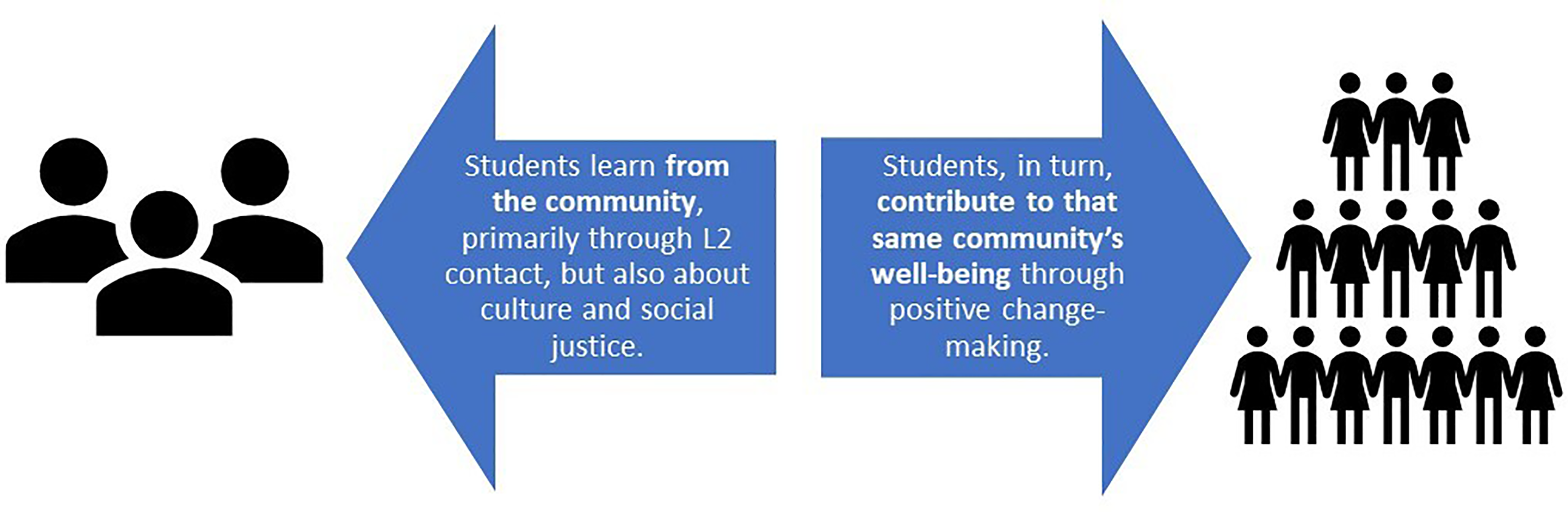
Reciprocity in CBL(L).
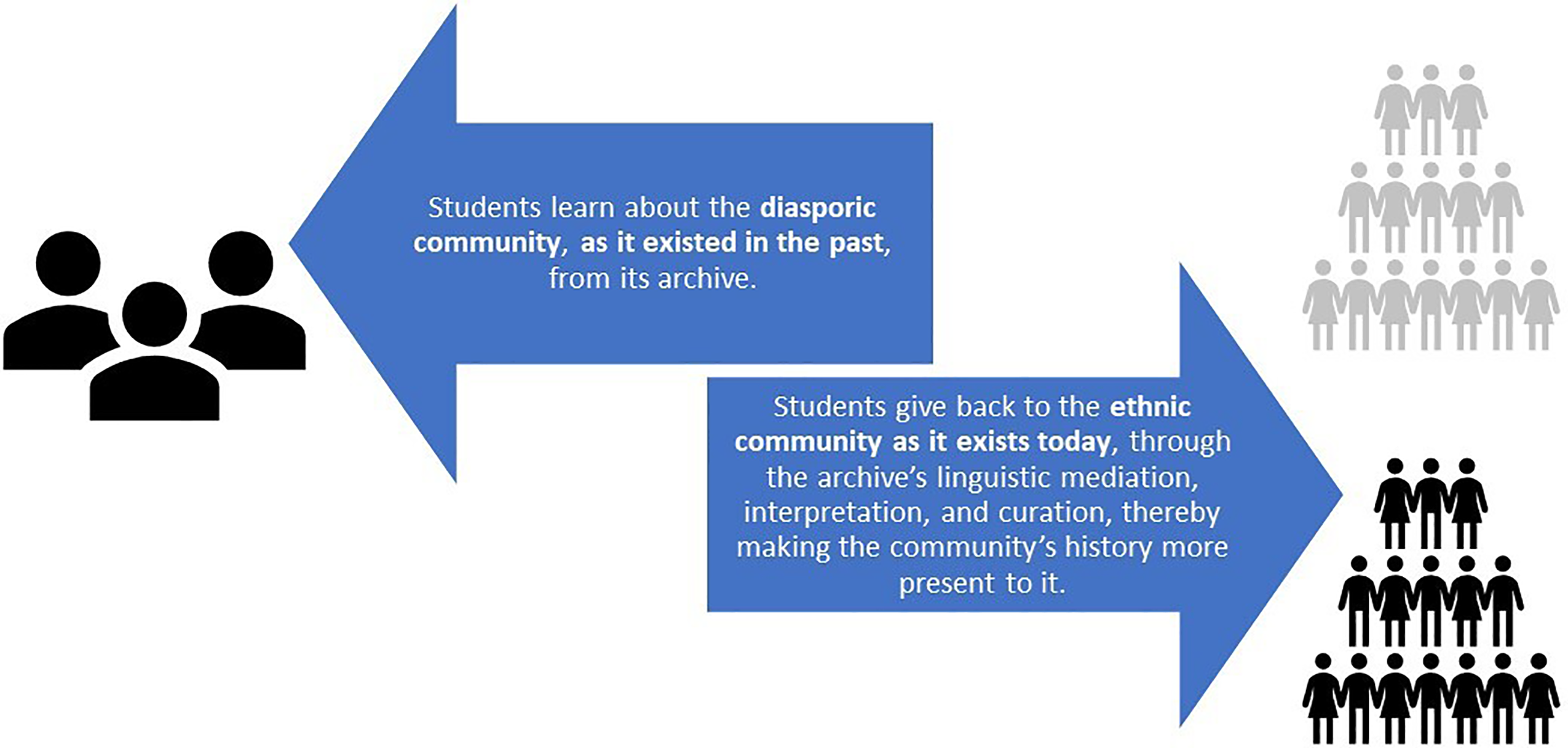
Asynchronous reciprocity in CBL(L).
Whether synchronous or not, the CBL(L) model assumes that the students’ exposure to and interaction with the community (however it may be defined) will lead to enhanced contextualization and applicability of their learning (of the L2, of community dynamics, of social issues pertaining to the community, etc.) and that the community will become an extension of their classroom. In the cases described here, students engage with two communities: the historical one they are studying and whose archive they are mediating; and the contemporary one that constitutes their audience for an informed interpretation of the historical community's past. 11 In the first instance of archival study, students focus more narrowly on the diasporic group's country of origin and their experience as transnational migrants, and less on the broader context of their welcoming culture. In the second instance, as mediators (whether that be through linguistic translation, or analytical interpretation, or both) of those same archival materials, they must shift their gaze from diaspora to American ethnicity and the contemporary dynamics of ethnic Italian identity. This work requires students to consider the multi-faceted nature of ethnic belonging, ethnics’ changing relationship to whiteness, their lateral connections to other ethnic groups, and possibly the ways in which the students themselves are implicated in these contemporary dynamics. Students, given the proper structures and tools for self-reflection at the end of the experience, are ultimately asked to reflect not only on the historical and cultural differences between (past) diasporic communities and their corresponding (contemporary) ethnic groups, but also on the role their mediation may have in effecting real social change.
In what follows, I sketch out a few different formats for CBL(L) learning related to the Italian diasporic archive. Based on these inter-related but somewhat varied experiences, I will make some claims about what students, Italian programs, and the fields in question stand to gain from projects, such as these, that are community-facing and seek to bridge the curricular gaps between italianistica, Italian Studies (its American cousin), and Italian Diaspora Studies.
Teaching the archive
After experimenting with a number of different collaborative projects for the undergraduate students in my Italian Translation Workshop course (whose term-end portfolios have always contained a service-learning component), I began to seek out materials that would dovetail with signature themes and curricular values of the Italian Program such as migration and experiential learning. At the same time, my own research agenda had brought me closer to that same space—between italianistica and Italian Diaspora Studies—that I wanted to fill in my program's curriculum. A longstanding and fruitful collaboration with the Italian American Program at the Heinz History Center in Pittsburgh (through student internships and collaborative programming) gave me access to parts of their archive that were unprocessed, untranscribed, and untranslated. I approached the Program Director, Melissa E Marinaro, about identifying materials that would be relatively coherent and allow a group of student translators to work collaboratively; the result was an exceedingly positive experience with the minute books of the Lega Toscana di Protezione, a regional beneficial organization founded in 1917 by Tuscan (mostly lucchesi) immigrants to Pittsburgh.
My students that semester learned about Great Wave immigration, the Tuscan community in Pittsburgh, their labor and food ways, and the institutions that emerged out of their early presence in the area. Then, they researched best practices for the transcription and translation of similar archival materials, adapting them to our needs, and crafted a style guide to assist the group in its collaborative translation and ensure standardization across student work. The transcribed and translated first volume of those minute books (1919–1926), as well as high-quality scans of the original pages, are now available in digitized (searchable) form to researchers of all kinds. As that semester wound to a close, I gave the group the opportunity to propose research topics for the following semester; if I had enough applicants, we would form a research team. In the end, four students made proposals to investigate various aspects of the Tuscan community in Pittsburgh—spanning from their labor and industry footprint to their institutional organization, from their use of English loan words in the minutes to their geodemographic shifts over time—that were eventually curated and collected in a microsite (toscana.newtfire.org) built by one of the students, Zac Enick. The experience culminated in our joint presentation to the Heinz History Center's library and archives staff, as well as at that year's meeting of the Canadian Society for Italian Studies in Ottawa, in a session on Italian Studies and the Digital Humanities. The students’ research was supported by a stipend provided by our European Studies Center, and their conference participation was fully funded by Pitt's Honors College. 12
Two years ago, intent on building on the Lega Toscana experience, I launched the multi-year “Columbus, Interrupted” project, which has conducted its work in each of the last three spring semesters (2021, online; 2022 and 2023, in person). This project is designed to allow different “generations” of students to join and leave the project over time. Its participants are linguistically heterogeneous: some do not study Italian but most do, and the Italian-language students furthermore represent a broad swath of different proficiency levels. Generally speaking, these students have brought a variety of interests and courses of study to the table, along with the methodological approaches that their fields employ: History, Literature, Political Science, Religious Studies, Anthropology, even Physics and Astronomy. Since we have been operating as a research team for the duration of the project's work, “Columbus” students doing research in Italian-language newspapers and archives have to pay special attention to accuracy as they transmit their findings to non-Italophone members of the group. Over time, these students with less or no Italian proficiency have begun serving as interlocutors and even proofreaders for the former group's translations, and moving forward I intend to ask students to reflect on these synchronous and asynchronous linguistic exchanges as part of their formal assessment.
The Columbus controversy in Pittsburgh is still a very urgent matter for those who claim Italian heritage as a dimension of their identity, pitting traditionalists against ethnics with weaker ties to Columbus veneration in what often seems a generational battle, or the umpteenth iteration of contemporary culture wars. The statue itself, though slated for removal, today remains on city property, covered with a tarp that has been regularly vandalized over the past two and a half years. At the time of his decision, Pittsburgh's then-mayor had asked the History Center to institute programming on the statue with the explicit aim of fostering a dialogue between the Italian American community, local Indigenous groups, and other community stakeholders, but the change in mayoral administration in 2021 sidelined the statue while bringing other initiatives and other community conflicts to the fore. Still, the statue's ghostly presence—still in place, but under wraps as if to neutralize its power 13 —remains a sore spot for the Italian American community, perhaps all the more so because of its phantom-like presence on the city's landscape. It is also true that one of the organizations historically most closely associated with the construction of Pittsburgh's monument, the Pittsburgh-based ISDA, has over the last half-century become a national force in the anti-defamation arena, with (Cleveland-based) President Basil Russo currently looming large over national pro-Columbus advocacy efforts in the form of high-profile lawsuits seeking to reverse Columbus statue removal orders. 14 As this article was being finalized, Allegheny County Common Pleas Judge John McVay Jr had recently handed down his ruling in the suit, deciding that the City of Pittsburgh was within its rights in acting to remove the statue and in expressing “government speech” on its own property (Guza, 2022). The ISDA has appealed the decision, signaling that the organization will not soon concede its position on a matter that has become central to its public-facing mission. 15 Participation in the development of this dialogue is also among the objectives of our “Columbus” project and aims to accomplish exactly the kind of generative reciprocity—real social change—that characterizes the very best of CBLL initiatives. When the ISDA holds its national convention in Pittsburgh in the summer of 2023, we hope to engage in real dialogue about the statue and its place in the history of Pittsburgh's ethnic communities.
Finding purpose in community-facing historical inquiry
What do students stand to gain from their participation in these experiences, and more broadly from the transnational framework of these particular projects? A 2019 Gallup poll revealed that college students are looking for meaning and purpose in their academic and professional pursuits (Gallop-Bates, 2019). At the same time, the various beneficial, regional, and cultural associations that have historically been vehicles for Italian American ethnic expression and community formation in this region are united in a common chorus: how do they attract Italian American youth to their meetings, their events, their mission? I would like to suggest that the symbolic ethnicity represented in many of these organizations does not exactly meet Generation Z's standards for purposeful and authentic engagement with real-world problems (De Witte, 2022); while my students, by contrast, are energized by meaningful interventions into contemporary society through a careful and scholarly engagement with the past.
In which ways, specifically, do students stand to gain meaning and purpose from this engagement? If my experience so far is any indication, in part they benefit from a scholarly setting that, while deeply immersed in an L2 and its culture, largely jettisons constraints and hierarchies of linguistic purity. This allows them to participate—week in, week out—in the kind of authentic translanguaging of the sort that “immigrant” newspaper publishers 100 years ago were engaging with as a matter of course. Throughout our collective work thus far, the Columbus project has revealed itself to be an intellectual space in which English and Italian are equally valuable, if not always equally visible, modes of expression for the immigrant community. Likewise, these students have discovered that our collective use of both languages in dialogue with each other is central to our ability to conduct our research as fully as possible. For the first time in their experience of acquiring Italian as an L2, their “official” level of proficiency is far less important than their ability to use it to decode meaning, make meaning in turn, use it in context, and leverage it for the success of long-term project goals. In this environment, translation becomes an embedded and necessary skill that serves both as process (in weekly discussions and decision making), and as product (to render Italian-language press materials legible and accessible on our public-facing Scalar site).
Further, when they explore the identities and networks of belonging of Pittsburgh's Italian immigrants of a century ago, my students are also exploring the textual practices that made up important community institutions such as beneficial society minute books and Italian-language newspapers. It was student work on La Trinacria, an Italian-language newspaper published in Pittsburgh between 1900 and the mid-1930s, that led to the publication of an article about department store advertising in both English and Italian and immigrant consumerism (Insana, 2017). Beneficial society minute books such as those kept by Pittsburgh's Lega Toscana reflect the linguistic hybridity of that group's meetings and reveal the challenges of adapting to American financial, bureaucratic, and procedural practices as their core mission to provide workers’ insurance for their members began to acquire broader social and even philanthropic dimensions. Linguistic analysis of these minute books also allows us to demystify popular notions of Tuscan linguistic purity in the diaspora and to complicate such mythologized frameworks as “native speaker” and “mother tongue.” The linguistically diverse nature of my current research group invites—indeed, requires—students to rove around in their own translanguaging spaces without fear of failing to stay in a certain standard brand of L2, as is usually the case of their more traditional L2 coursework. In other words, to say it with David Gramling, projects such as these operate outside of the institutional force of the “linguacene,” a monolingual regime that enforces myths of discrete monolingual spheres and demands “a flexible, translational functionality that decommissions agentive, creative, and critical multilingualism” (Gramling, 2016: 219). Research experiences such as mine create and foster small but important curricular spaces of resistance to the linguacene in its curricular, academic form. Just as the discreteness of languages is necessary to their translatorly efficiency, so has it become necessary to the increasingly minute and rigid financial accounting of academic labor, in terms of the duration of intellectual activity (the semester); its intensity (the credit or unit); and its language (courses are expected to be entirely “in” the L2 or entirely out of it). A more nuanced understanding of language ecologies comes with its own benefits for understanding the translanguaging decisions and landscapes of a century ago. While I believe that there is a place for rigorous insistence on staying “in” the L2, that place is not here, in this more fluid and flexible corner of our Italian curriculum.
In addition to these linguistic benefits, students involved in these projects also gain a historically contextualized awareness of Italian diasporic communities, not through the lens of more or less assimilated contemporary American ethnics, but through that of migrant transnationals of a century ago, fully in the process of negotiating new identities through citizenship, institutional participation, language, foodways, leisure time decisions, philanthropy, and their practicing of public spaces. Projects like these further reflect an approach to learning that leads students to explore the complexities of diasporic identities in the wake of the Great Migration out of Italy from two different perspectives. In other words, when we look at the Italian Great Wave as the story of transnational subjects and phenomena, we glimpse a moment when questions of national belonging and transnational mobility converge. As Mark Choate tells us, just as the Italian nation is formed politically when the wars of Risorgimento gather up the final crucial pieces of a peninsular (and, crucially, insular) “Italy,” its citizens breach its borders to create free or “spontaneous” colonies 16 abroad, so planting the seeds of a multi-faceted “Italy” in other national environments. And yet, for Donna Gabaccia (2003), it is in the far-flung and fundamentally transnational diaspora that a multitude of diverse linguistic, social, cultural, and political traditions come to be unified under the rubric of an Italian “national” identity.
My approach to transnationalizing the curriculum through undergraduate research labs is not without its challenges, and requires us to actively engage our students in transversal, oblique methodologies and lines of inquiry that do not often map onto the way we have come to think about Italian American Studies in relation to italianistica: derivative, not quite, not yet, not enough. And yet, if our fields are truly committed to addressing all manner of diversity, equity, and inclusivity concerns, the kind of multi-lens linguistic approach that I sketched out above is crucial to disrupting these hierarchies of center-periphery; native and non-native; home and displaced. Frustratingly, the 1 cr., multi-semester research lab also sits awkwardly within the curricular structures that have become embedded in our institutions: they do not easily satisfy General Education (distribution) requirements, or even departmental ones. As a result, their equitable implementation often demands negotiations with administrators to ensure that faculty labor is fully accounted for. Further, I have had to work hard to navigate often byzantine university policies and secure student research stipends: student labor, after all, is also labor.
However, there are exciting opportunities adjacent to these challenges, as we invite students to leverage adjacent competencies that have the potential to take us and our research beyond what we have understood our field's parameters to be. 17 In this way, we in effect partner with our students in applying core critical skills to our work instead of framing what we do as the transmission of “information” or even as a tradition of interpretation: asking questions of all texts, no matter what kind; writing in clear and genre-appropriate ways; understanding and deploying platforms and strategies of dissemination for our research outputs (digital or print as they may be).
It is also true that participants benefit from their position in a chain of mediation of primary historical resources (whether in English or Italian), as well as from exposure to expanded professional opportunities and institutional networks. In the case of the “Lega Toscana” and “Columbus” projects, the students’ work product—in the form of scholarly mediation, translation, and interpretation—comes to then reside in those same institutions; these are in turn shared with the full range of publics and communities for whom museums, libraries, and archives do their work. Ultimately, in cases like the “Columbus” project, students acquire the authority that accompanies the production of new knowledge. Here, this new knowledge is central to ongoing debates about a polarizing historical figure with particular significance for Italian American ethnics and the broader debates that animate contemporary life. Given its potential to intervene in these debates, to shape them and change their course, this knowledge is a particularly powerful lure into the world of research.
And what does the field gain? As Viscusi intuited (Tamburri and Gardaphé, 2015), one of the main challenges of combining italianistica and Italian Diaspora Studies lies in the linguistic divide between the two and the siloing that results: in the USA, the introduction of English into the Italian-language classroom is typically forbidden on L2 purity grounds, and it is often not possible to introduce Italian into the Diaspora Studies context given uneven Italian language proficiency among scholars in American and Ethnic Studies. The fundamental linguistic hybridity of the translation studies classroom (and, for that matter, of mixed-group research teams) turns this challenge into an asset, by forcing students to not simply move between the two languages, but to actively work between them, to mediate and operate in the productive space between them, to see themselves as cultural and linguistic mediators. This operational space between languages has a parallel between the two fields in question. Working between italianistica and Italian Diaspora Studies in this way thwarts attempts to see diasporic cultures as derivative, corrupt, or impure; rather, it allows us as educators and researchers to use the classroom—and, by extension, community-based experiential learning—to actively interrogate the differences between Italian and diasporic cultures, to look at their points of contact, and to think critically about their divergent trajectories.