




Abstract
While the project of the European Union (EU) incorporated gender equality as one of its foundational objectives and its institutions have been mandated to integrate gender equality into all of their policy areas, the EU has fallen short of materializing these objectives. Gender inequality at the EU level is perpetuated through a process in which the EU, as a structure anchored in economic considerations, interfaces with androcentric institutions and member states. This substantially determines the policy instruments, tools and mechanisms within and outside its periphery, rendering ‘gender’ to be co-opted, secondary and subdued policy areas. While the discourse on gender equality policy has evolved through ‘equal opportunity’, ‘positive action’ and ‘gender mainstreaming’ approaches, the policies mostly focus on auxiliary benefits such as maternity leave, childcare services and part-time work, aiming to assist women in reconciling their work and life situations. These benefits do not substantially transform conventional gender roles within the family or at the social-economic and political levels, which to a large extent perpetuate gender inequality at large. This article analyses the trajectory of gender equality policy at the EU, the inherent factors and processes that constantly define and determine it and how it implicates the larger EU policy discourse. Using a feminist standpoint, the article explores the extent to which the new female leadership in the EU has prioritized and problematized gender equality with corresponding initiatives and actions, and the major challenges it may face in contemporary times in order to meet its objectives. To this end, some existing labour market and family policies are taken up as case studies. Various EU policy documents, key EIGE reports, press releases and other existing literature have been used as reference points for the analysis.
Keywords
Gender equality: The core value of the EU
Since its inception in 1957, the European Union (EU) has made achieving gender equality one of its primary principles and objectives. In a landmark ruling of 1976, 1 the European Court of Justice (ECJ) acknowledged the need for gender equality in the economic and social dimensions, expanding the reach of the article beyond the labour market. Article 2 of the Treaty of Lisbon (2007) established gender equality as a core fundamental value of the EU, building on the progress gained in the Treaty of Amsterdam (1997). Protections for women's and men's rights were further reckoned in the Charter of Fundamental Rights of the European Union. Gender equality has emerged as a core value for the EU and has helped shape the bloc's political identity over the years.
Helena Dalli, the European Commissioner for Equality, recently reaffirmed the EU's decade-long commitment towards building a more inclusive and democratic society, stating that ‘Our vision is of a Europe where all women and men, girls and boys, in all their diversity, may thrive, lead and be free’ (Neven, 2021). Throughout the years, the EU has implemented diverse initiatives including ‘equal treatment legislation; gender-mainstreaming 2 and positive measures for the advancement of women’ (European Commission, 2020a: 1) to address gender inequality across Europe. The EU is seemingly working to abolish gender stereotypes, misogyny and violence against women in all of its forms. The bloc attempts to change people's thinking and attitudes, promote gender equality in business, politics and public life and incorporate a gender lens into all programmes and policies.
Following in the footsteps of the EU commitments, Ursula von der Leyen, the first female president of the European Commission, in her maiden remarks indicated that ‘equality for all and equality in all its senses’ forms the top priority of her Commission (European Commission, 2019). The EU's institutions are tasked with ensuring that gender equality is a central tenet of all EU policy areas. The European Commission's recent Gender Equality Strategy 2020–2025 aims to fulfil von der Leyen's pledge to a Union of Equality. The manifesto provides an ambitious foundation for advancing gender equality in Europe and beyond. The strategy aims to focus on five key areas for women in EU member states: freedom from violence and stereotypes; prospering in a gender equal economy; leading equally throughout society; gender mainstreaming and funding; promoting gender equality and women's empowerment across the world (European Commission, 2021).
The strategy guides the European Commission's gender equality initiatives, and sets forth policy objectives and key actions for 2020−2025 (EU Monitor, 2020). The EU resolutions and actions prioritize gender equality, the protection of human rights, the functioning of democracy, respecting the rule of law, economic growth and sustainability. The EU has unequivocally raised concerns about the UN2030 Agenda for Sustainable Development which is infused with the principle of gender equality.
The development in gender equality policy in the EU
EU policy aimed at achieving gender equality has been profoundly influenced by discussion of the welfare state and gender relations. In her critique of the welfare state, Ann Orloff (1996) argues that entrenched socio-cultural, political, economic and welfare institutions are to blame for perpetuating gender inequality and stratification in any given country. Sylvia Walby (1997: 48) echoed this sentiment, writing that ‘gender relations are influenced and shaped in significant ways by the wider political and policy issues’. While modern macroeconomic policies aim to boost economic growth and high productivity, they nonetheless marginalize women as second-class citizens by treating them as unskilled and low-productivity workers and by ignoring the reproductive economy, thus impeding women's social and economic advancement (Walby, 1997).
New economic challenges on the one hand, and demands to keep the European welfare states’ commitment to the EU's entrenched values of democracy, equality and social justice on the other hand, have resulted in a constant demand for restructuring the European welfare system since the beginning of the 20th century. And the push for gender equality to a large extent has been co-opted in this process.
Conceptually, gender equality is a contentious concept in general, owing to: its frequent appearance as both a harmonious and a conflictual concept, either due to a tendency to homogenize diversity under a dominant norm (as in the EU) or due to an explicit ‘strategic framing’ of the concept to make it more easily enter the policy agenda as a common accepted goal. (Verloo and Lombardo, 2007: 22)
There is minimal agreement among research scientists, political players and civil society organizations over what constitutes gender equality or what it should include, and as a result, the concept is treated differently throughout societies, states and countries. The concept is seen as an ‘empty signifier that takes as many meanings as the variety of visions and debates on the issue allow it to take’ (Verloo and Lombardo, 2007: 22). As such, different gender equality definitions and concepts have led to varied EU political agendas (Squires, 2007).
Gender equality seemingly has been stated at the EU level through three key visions that are further translated into diverse strategies. The first is the gender equality as sameness approach. In this, the ‘problem of inequality’ is seen as arising from the exclusion of women from political participation and so this strategy found resolution in ‘equal opportunities strategies’ that seek to integrate women into the male-centric system without changing its underlying norms. The concept of sameness is based around the notion that all people, regardless of sex, should be treated alike, enjoy the same rights and opportunities and be treated in accordance with the same principles, norms and standards.
The second is the gender equality as difference approach. Here, we see that ‘the problem of inequality’ stems from not critically questioning the existing male norms that have discriminated against women for centuries. Thus, compensatory benefits or favourable discretions are sought to help women out of their precarious situations. Affirmative action is focused towards taking gender into account while setting up employment and decision-making roles.
The third is the gender equality as transformative approach. In this approach, the gendered system is problematized and deconstructed, and the proposed solution appears to deconstruct the socio-political discourse that forms the gender system, questioning the categories and meanings of gender relations in theory, in mainstream politics and in practice. This transformative vision translates into the strategy of gender mainstreaming (Squires, 2005), which requires mainstreaming gender into all policy areas ‘to understand whether changes in one domain are likely, ultimately, to have implications for other domains’ (Walby, 2004, 2005).
Each of these three concepts takes a somewhat different approach to the problem of how to bring about gender equality in society. The strategies are intertwined at the EU level, serving as a ‘three-legged stool’ (Booth and Bennett, 2002: 435) that is ‘complementary and in continuation with their predecessors’ (Jacqot, 2015: 8) in the pursuit of gender equality in the EU.
Framing gender equality policies in the EU
Article 119 of the Treaty of Rome (1957) was the first step towards tackling gender disparity between men and women in the six founding states of the European Community. It established the principle of equal treatment in the form of equal work for equal compensation. This served as a cornerstone for subsequent initiatives aimed at protecting women's rights in European society. Reflecting what has been the principle of equal protection since 1957, 3000 female workers in a Belgian weapons-manufacturing company, the Fabrique Nationale d’Armes de Guerre de Herstal, protested for equal work for equal pay in 1966 (Table 1).
Multiple visions of the principle of gender equality.

Source: Jacqot (2015: 4).
The equal treatment would apply to 10 directives that cover issues such as wage parity, access to work, training and career advancement, the working environment and social assistance for both employed and self-employed workers.
Even though the scope of action for equal treatment was broadened with the commencement of the Amsterdam Treaty in 1997, and many of its provisions pointed to the need to employ gender equality as one of the EU community's significant tasks (Article 2 TEC) and activities (Article 3 TEU) (Bryan, 2002), corresponding initiatives on gender issues were limited. The new equal treatment directive (Article 13 TEC) prohibits direct and indirect discrimination on the basis of sex, race or ethnicity, religion or belief, age or sexual orientation in the workplace. It also addresses the real gender concerns beyond labour market (Arribas and Carrasco, 2003).
It was not until the 1980s that the European Social Fund began implementing action-based programmes to help women into the labour market. It appeared that the scope of equal treatment had broadened with the advent of these programmes, which tried to promote equal opportunities while also addressing concerns of domestic work, childcare, political representation, women's health and sexual harassment (Jacqot, 2015). However, legislative instruments for implementing these issues were limited to the labour market and member states did not propose any additional and substantial initiatives. Consequently, the idea of equal opportunity was finally formalized at the European level in 1992 with the signing of the Maastricht Treaty. The treaty advocated for affirmative actions to promote gender equality in the workplace and mandated that pregnant women workers needed to be treated differently from men in order to protect their health and safety. There was renewed interest in positive actions in 2012, when the European Commission brought a new directive mandating companies and public enterprises to ensure that women’s representation on their boards was at least 40 per cent (Jacqot, 2015: 10). The Beijing Conference 1995 promoted gender mainstreaming as a new political strategy to overcome gender inequality, and so gender mainstreaming had been integrated into EU parlance by the Amsterdam Treaty 1997 to address existing inequality across the social economic and political landscape. The Amsterdam Treaty outlines the details of gender mainstreaming and mandates generalization and integration of this principle into the policy-making process at the EU level (Jacqot, 2015: 11).
The interface between gender equality, the market and European integration
Since its inception, the European Community (now the European Union) had to build its ‘core structure’ primarily on economic liberal principles. It also had to justify its cultural liberalism and democratic and humanitarian values as essential to its existence. While the EU's economic integration has been challenged with several obstacles such as economic recession, demographic deficit, low fertility issues and many more over the decades, the scenario conforms to what Joseph Weilier properly called a ‘crisis of ideas’ (McGlynn, 2001: 241–272). According to Larry Sidentorp, the ‘crisis’ has been massively impacted by an ‘economism’ that is pervasive in EU operations, jeopardizing the legitimacy of the European project in the absence of a moral consensus or substantive philosophy (McGlynn, 2001). Additionally, the presence of feminist works and movements influencing community policy, as well as a growing need to protect citizens’ rights inside the EU as a welfare state, contributed to the development of the ‘social face’ of the EU. And addressing gender equality through equal treatment and equal opportunity policies offered legitimacy to the EU’s social and moral face.
Gender equality policy encapsulates the market-driven regulations of the EU. The initial insertion of Article 119 into the Treaty of Rome was in reality initiated to protect member states against unfair competition between them rather than to promote gender equality (Irigoien, 2019). It was a design to eliminate the differential payment structure between countries and their employees, which otherwise would have created imbalance in the integration process. According to Sohphie Jacquot (2015) ‘as far as gender equality is concerned, the dynamic of market making is consistent with equal treatment and the insertion of Article 119 in the Treaty of Rome corresponds in part this logic.' (Jacqot, 2015: 11–12) This action was taken to harmonize the wage structure between men and women and to promote fair competition between EU member countries: ‘Economic actors therefore were gaining profits from these rights, irrespective of differences in national and sexual identities’ (Jacqot, 2015: 12).
Furthermore, directives regarding equal opportunities could be seen as initiatives aiming to increase the participation of women in the labour market, and as such, measures were taken to address issues of maternity, childcare and sexual harassment, all of which were thought to create impediments to women's participation in the labour market, and thus eliminating these barriers became imperative to ensure the growth of the European economy.
Gender equality policy has long been part of the EU and was governed by Article 119, later Article 141 and finally Article 157 as per the Treaty on the Functioning of the EU. It has since become fundamental to EU social policy. TH Marschall argued, however, that European social policy has always co-existed in a specific relation with the market economy of the EU (Jacqot, 2015: 13). For Walby (2005: 192–193), ‘the integration of the European union has been largely set through economic and social basis concurrently. The former seeks to promote competitiveness and deregulation, while the latter is oriented towards promoting social cohesion and social integration’. Although the social dimension has always occupied a central position in most EU projects, its social policy fell short of its desired objective (Walby, 2005).
For instance, the neoliberal economic policies of the EU put forth by the Maastricht Treaty's convergence criteria have been inconsistent with the progress towards gender equality. In order to meet the criteria, EU member states were required to maintain low rates of inflation, fiscal deficits and public indebtedness. The Maastricht Treaty's proposed macroeconomic circumstances ran counter to the EU's social policy goal. This has resulted in economic shrinkage in all member nations, particularly reflected in austerity cuts and social spending (Young, 2000). National politicians have touted the prerequisites for monetary unification as a pretext for slashing welfare spending. And, since women were given a disproportionate amount of such spending, the EU's economic policies and their ramifications have become critical issues in gender relations (Walby, 1997; Zachorowska-Mazurkiewicz, 2009).
Interestingly, the framing of political strategies corresponding to different visions and conceptualizations of gender equality at the EU level is extensively linked to the dynamics involved in the process of European integration: The dynamics of market forces became a constituent factor for European gender policy, which was entrenched within the polity of EU and was originated on the basis of economic liberalism and with the initial goals of promoting movement of capitals, good and services. (Jacqot, 2015: 12)
Hence, policy discourse on gender equality was placed behind the priorities for economic growth and competition (Jacqot, 2015: 14). Many feminists have pointed out that components of gender equality policies are moulded by market dominance and are part of a neoliberal strategy that exacerbates gender disparities (Elman, 2007; Kantola, 2010).
Problematizing gender equality and politics in the EU
The Discursive Politics of Gender Equality (Lombardo et al., 2009) ‘pertinently explains how the concept of gender equality has been contested within the EU policy making discourse due to the multiple meanings and interpretations it acquires’ (Lombardo et al., 2009: 3–4). This book operates on the premise that the social construction of discourse and politics of meaning significantly matter. It systematically explores the discursive construction of gender equality in the formation of EU policy discourse, showing how gender equality as a policy area has struggled over its multiple meanings more than other policy areas, rendering itself a product of contestation and power. The linking of gender equality as a means to reduce unfair competition in the 1960s, to create equal opportunity during the unemployment of the 1970s and 1980s, to create full employment and a knowledge economy in the 1990s under the Lisbon framework and most recently to combat discrimination and encourage diversity all reflect the need of the EU to adapt itself with the changing socio-political and economic needs rather than with gender (Lombardo et al., 2009).
Despite the much-touted promise of gender parity, achieving gender equality continues to be approached as a target-oriented rather than a value-oriented goal. This can be seen from a virtual visit to the EU's official webpage – ‘Europa’ – which displays all of the ‘key thematic’ areas in which the EU institutions seemingly have been active and engaged with. Strangely, ‘gender equality’ is not put as a standalone and independent area on the official EU website; instead, one must delve deep into more substantial sections to find references to gender equality. This murkiness may result from the fact that gender equality has been braided into EU's other priority areas and intersected with policy lines across the union, including in employment and social rights policy. This has resulted in casting a shadow on the term's actual meaning.
Crowley and Sansonetti claim that: Gender equality has been regarded as an instrument of market realisation within EU framework; it is both excluded from and subjugated in economic debates; and gender equality concerns are not only overlooked in large parts of the economy, but are labelled as social issues and rendered as inferior. (Crowley and Sansonetti, 2019: 2).
According to Crowley and Sansonetti, the EU sees gender equality from two different perspectives: on the one hand, promoting women's equality is part of its ‘smart policy making or business deal’, and is therefore important for materialising multiple objectives that it seeks to attain; on the other hand, gender equality is part of its ‘rights-based policy deal’, which holds EU legislations and institutions accountable for committing to promoting equality between men and women in all areas including employment, work and pay (Crowley and Sansonetti, 2019). Mieke Verloo reiterates the politics surrounding the discourse of gender equality, discussing how EU policy texts primarily reflect demographic concerns and issues of employment, economic growth and competitiveness rather than real gender inequality issues within the family and the workplace, and that changes in meanings of EU gender policy are not coincidental, but rather part of ongoing disagreements between political actors over the meaning of gender (in)equality (Verloo, 2007). Issues like family policy, domestic violence, gender disparities in politics, prostitution, migration, LGBT rights and anti-discrimination are not routinely stated on a European scale, but rather are moulded according to the demands of individual EU member countries’ political needs or concerns.
As a result, ‘gender knowledge’ at the EU level is muddled due to competing definitions and meanings. Synonymously equating ‘gender’ with 'women’ has further rendered EU gender equality policy a women-centric policy. Because the EU is primarily concerned with economic issues, it overlooks the underlying structural causes of gender inequality, perpetuating stereotypes and rigid gender roles in European society.
Scrutinizing diverse policies within the EU could uncover the extent to which gender equality is being subsumed under major policy goals of the EU. One such policy is ‘Reconciliation of paid work and family life’, which has been a significant part of the EU social policy framework and has been widely used as part of the employment policy framework in order to address pressing issues relating to balancing work with family.
The policy figured in the top political agenda during the 1990s and it has been in effect as the EU's key policy innovation ever since. Under the policy framework, ‘reconciliation’ between work and family was proposed and a variety of legislative measures such as the ‘recommendation on child care’, ‘pregnancy and maternity directive’, ‘parental leave directive’ and ‘part-time workers directive’ were enacted at the EU level in response to the framework's call for ‘reconciliation’ between work and family. All of these initiatives seemingly have been anchored in the EU's fundamental goal of increasing women's participation in the labour market for its economic growth, but they ultimately fell short of tackling inherent gender inequality. For instance, childcare service commendations are encouraged because ‘reconciliation is encouraged as part of eliminating barriers for women to participate in the labour market’ (McGlynn, 2001: 241–272) and not to promote transforming gender roles for men within families. Likewise, while maternity leave directives improved the rights of pregnant women in many European member states, they did little to alter the power dynamics between men and women and merely served to strengthen pre-existing gender norms. Notwithstanding the importance of maternity leave, the directive reaffirms women's commitment to the domestic and did not articulate reforms bringing change in men's responsibilities (McGlynn, 2001). Women in the EU spend more time than men on unpaid childcare. On average, women do 15.8 hours of unpaid care work every week, while men only do 6.8 hours. Because of the need to cut back on work hours or take time off to care for children, this has a major impact on women's employment opportunities and wages (EIGE, 2020). During the Covid-19 pandemic, women spent an average of 18.4 hours per week on child and household care, while men spent an average of 12.1 hours (EIGE, 2020). The regulation of parental leave is also not based on unified policy directions and reflects divergent practices across the EU. The parental leave directive is problematic in many ways, as discussed below.
In Spain, there is no individual right to take parental leave. In Italy the regulation excludes women and men working in atypical professions in actual practice from applying for parental leave. Additionally, the provisions of unforeseen circumstances are not incorporated into the directives for France. The issue of compensation and incentives is still contentious in many European countries (Clauwaert and Harger, 2000: 6).
Additionally, issues like the non-transferable pay principle, lack of remuneration, misuse of parental leave by fathers, the preponderance of male breadwinner families and the prevalence of conservative forces reaffirming women's bearing and rearing jobs, among others, add to the long list of barriers. As a result, men often appear hesitant to avail themselves of lengthy parental leave due to pre-existing societal beliefs that conform to rigid care roles for mothers (OECD, 2019).
In the EU as a whole, women face discrimination when it comes to the ‘eligibility’ criterion for taking parental leave. Overall, gender gaps on ineligibility rates show a disadvantage to women across the EU, except for Portugal, where a higher percentage of men (32%) than women (23%) are eligible for parental leave. Gender gaps also tend to be very large in the Member states with the most restricted access to parental leave. Across the EU–28, there are several reasons for this gap of ineligibility including unemployment or economic inactivity, different employment conditions such as length of service or self employment among others (EIGE, 2019). In Malta, for example, the ineligibility disparity between women and men of parenting age is 31 percent, whereas discrepancies of more than 10 percent exist in 12 member states. Although parental leave is widely recognized as an important measure of work–life balance, women are disproportionately disadvantaged by strict eligibility rules (EIGE, 2019). Often, women's participation in the employment market adds onto their current household and care responsibilities, resulting in a double shift in their lives without significant alterations to the division of labour within household and family activities. Because the initial objectives were altered to match the modern political and economic goals of the EU, most social and family policies in most European nations lack a meaningful gender focus. Therefore, it is plausible to argue that the EU's gender policy rhetoric has been deliberately framed into the dominant policy frame of persistent socioeconomic issues only (Mazey, 2000), and the same has been absorbed or co-opted within priority policy areas, as is suggested in the case of work/family reconciliation policies here (Stratigaki, 2004).
Gender inequality in the EU: The persisting gap
Gender inequality remains a glaring reality in the EU, despite significant progress in recent years. While many EU countries have made strides in promoting gender equality in various spheres, including social, economic and political, there is still a significant gap that needs to be addressed. According to released data on the Gender Equality Index by the European Institute for Gender Equality (EIGE), the EU scores 68 points out of 100, a less than one per cent improvement over the previous year (Barbieri et al., 2021). In terms of social inequality, women in the EU are still disproportionately affected by gender-based violence and discrimination. According to a survey 3 published by the EU Agency for Fundamental Rights (FRA), one in three women in the EU has experienced physical and/or sexual abuse since the age of 15 and one in 20 women has been raped. Women are also more likely than men to experience intimate partner violence, with 43% women reporting having suffered from psychological abuse and/or controlling behaviour from a spouse at some point in their lives (European Union Agency for Fundamental Rights, 2015).
The employment sector equally reflects a glaring gender disparity. Though women's participation in the labour market has witnessed a rise because of various measures and policy initiatives by EU member states, the EU as a whole has a huge employment gap between females and males in the labour market, with women’s employment rate being lower than men’s. According to Eurostat, the employment rate for women aged 20–64 in the EU was 62.7% in 2020, compared to 76.4% for men. At the EU level, in 2021, women in the EU had a gross hourly earnings average of 12.7% less than men in the EU and 13.6% less in the euro region. There was a difference of 20.7% percentage points between men and women's median annual earnings across EU member states, with the highest gender pay gap recorded in Estonia (20.5%) and the lowest in Luxembourg (−0.2%) (Figures 1 and 2) (Eurostat, 2023).

Gender pay gap in Europe, 2021. Source: Eurostat (sdg_05_20).

EU employment rate by sex and country, 2021. Source: Eurostat (13 April 2022).
In the EU, women continue to be underrepresented in positions of power. Although the numbers demonstrate steady progress in terms of women's participation, the European Parliament (2019) has not yet been able to reverse the male dominance within its own membership. More so, there are at least nine member states in which less than a third of MEPs are women, with Cyprus having no woman member at all (EIGE, 2021b). In its 2019 elections report the European Commission observed that while European Parliament reflects a better gender balance, women's democratic involvement is still lacking (European Commission, 2023: 33). A study conducted by European Equality Law Network (EELN) identified major obstacles to women's participation in politics referred to as 'five Cs': care, cash, confidence, culture and candidate selection. The report shows that member-states are taking a range of measures to promote more women decision-making positions in legislature, the leadership of political parties and executives. Nonetheless, the proportion of women members in unicameral or lower houses of national parliament in on the decline, falling from 33.2% in November 2021 to 32.4% in 2022 (European Commission, 2023: 34–35). Sweden, Finland, Denmark, Spain, Belgium and Austria are the only six member states with a strong gender balance, with more than 40 per cent of parliament members being women. Meanwhile, in Bulgaria, Ireland, Slovakia, Romania, Greece, Cyprus and Hungary, women make up less than 25 per cent of parliament (Figure 3).
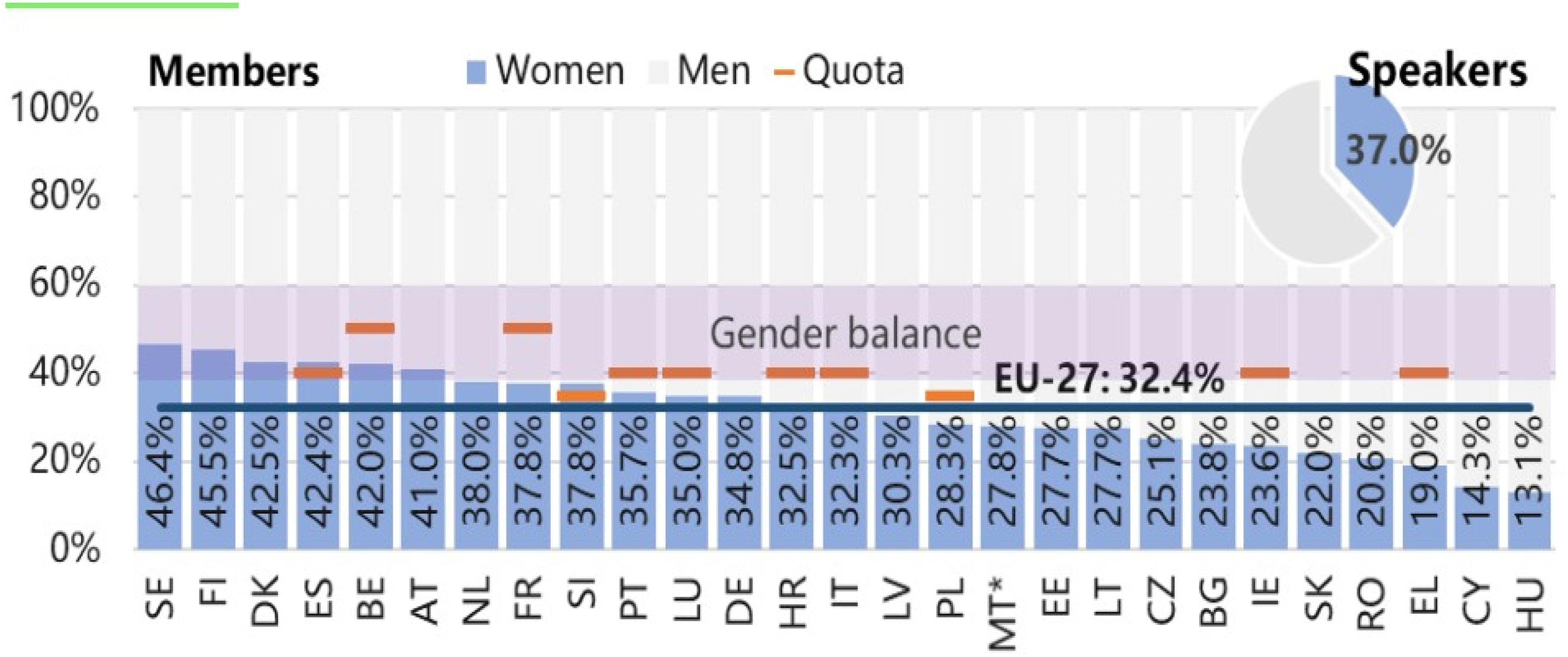
Share of women and men in lower house of national governments in the EU, 2022 (European Commission, 2023). Source: EIGE Gender Statistics Database: National parliaments.
An analysis by EIGE found considerable discrepancies in the allocation of portfolios between male and female senior ministers in national governments. Core portfolios such as foreign and domestic affairs along with defence and law have been predominantly assigned to men, and women, who make up only 32.3% of senior ministerial positions, are typically assigned a lesser share of such core portfolios. Instead, women are assigned portfolios mostly pertaining to social or cultural arenas (42.6%) (Figure 4) (European Commission, 2023).
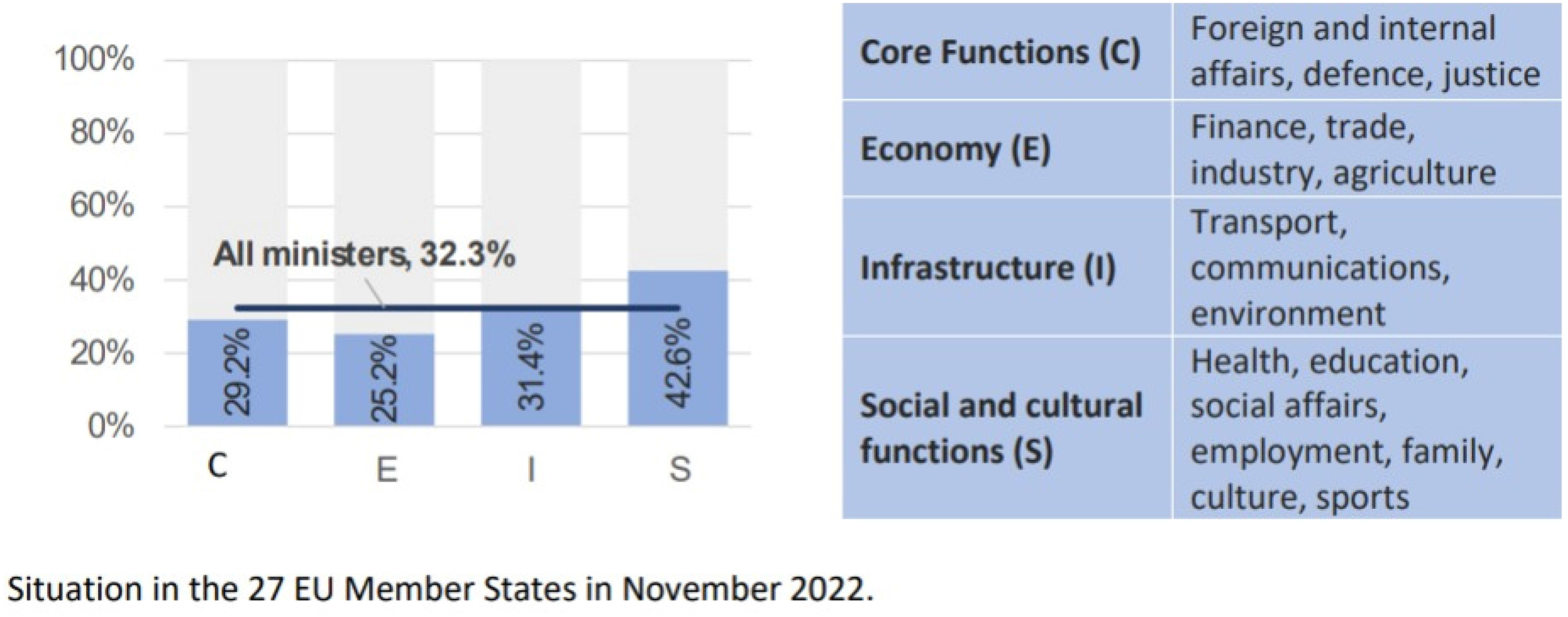
Share of women ministers by type of portfolio (European Commission, 2023). Source: EIGE Gender Statistics Database: National governments (European Commission, 2023).
The EU has been dedicated to bridging the gender gap; towards this end, the EU's 2010–2015 Strategy promoted target initiativess to improve gender diversity in firms across Europe' launched women on the Board Pledge for Europe in 2011, prompting increase in women's presence on corporate board to 30 percent by 2015 and to 40 percent by 2020 (European Parliament, 2014: 67). Nonetheless, despite these efforts, the truth is that women make up less than a third of EU national parliament members and the progress towards gender parity is too slow and inconsistent across different countries. Additionally, just a fifth of major political parties have a woman leader, with the number reaching a one third when it comes to deputy leaders (European Commission, 2020b) (Figure 5).
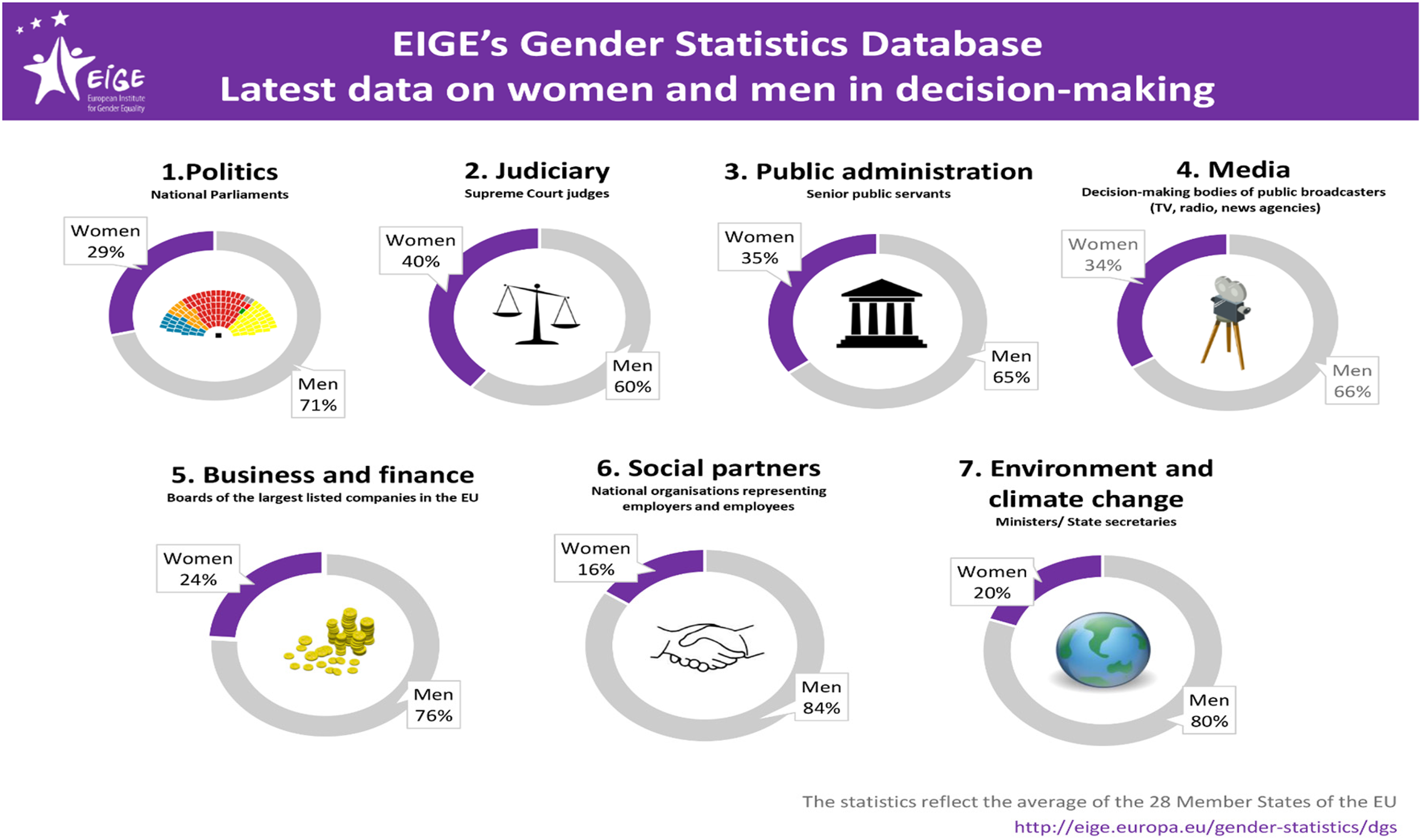
Women and men in decision making. Source: EIGE (2021a).
The data support a gradual improvement in the numbers of women participating in decision-making roles in the economic arena. However, as regards the target of achieving 40 per cent in terms of inclusion of women in corporate boards (European Parliament, 2014), less than 29 per cent of all board members in the largest publicly listed companies registered in the EU constitute women. Further, the data are even more grim when it comes to women CEOs and Board Chairs (European Commission, 2020b). The numbers vary across EU states, from as high as 45 per cent of board members being women in France to more than half of the corporate houses in Bulgaria, Estonia and Hungary having no women on their boards. Additionally, in almost one in five corporate houses in the EU there are no women board members (EIGE, 2021).
The new female leadership in the EU and revisiting commitments
The right-wing populism that has emerged across Europe in the last decade in response to widespread social unrest brought on by global economic liberalization has further increased unemployment, perilous working conditions and skewed resources. This has contributed to a rejection of increasingly multicultural and ethnically and socially diverse societies, and resulted in disparaging the gender equality discourse and institutional frameworks directed to achieve gender equality in the EU (Sandford, 2017). For example, the European Parliament's Commission on Women's Rights and Gender Equality in one of its studies indicates that governments in six EU member states – Austria, Hungary, Italy, Poland, Romania and Slovakia – engage in regressive policies by, among other things, limiting space for egalitarian civil society mobilizations, continuing to defund or marginalize gender equality institutions and redefining policies to focus more on the family and traditions than on women or gender. They also glorify the constructs of ‘gender theory’ (Andrea et al., 2017). There is an ongoing wave of anti-egalitarianism in modern Europe, as evidenced by the popularity of ‘men's rights’ organizations and the refusal to ratify or threaten to withdraw from the Istanbul Convention which aims to prevent and punish all forms of violence against women and domestic abuse.
However, with the renewal of Europe's institutions in 2019 and a large mandate for female candidates in the European Parliament, there is an opportunity to revisit policy topics via a gender perspective. In order to build a more gender-sensitive structure in the EU, key political actors play a significant role in shaping the gender equality discourse. And the EU female leadership provides a strong base in that direction. To ascertain if the EU integration process's intrinsic masculine hegemonic narrative has developed into a more inclusive discourse in recent times, it may be greatly instructive to analyse the policy activities of EU officials like von der Leyen, Christine Lagarde and Jeff Hearn.
Von der Leyen, in her maiden remarks on the Political Guidelines for 2019 − 2024, expressed her vision for ‘a prosperous and social Europe meeting out equality for all and equality in all of its senses’ (European Commission, 2020c). In her own words, ‘I will not rest when it comes to building a Union of equality’ (European Commission, 2020c). With 13 women and 14 men in the executive council, the new administration represents a strong and powerful example of the ‘Union of Equality’ it aspires to create. As part of creating a more inclusive union, von der Leyen’s Commission has outlined an ambitious roadmap for gender equality for the years 2020 − 2025. The European Commission's 2020–2025 gender equality strategy lays out the organization's goals and plans for advancing gender parity at the EU level. The ultimate aim is to create a Union of Equality where women and men, girls and boys, in all their variety, are free to pursue their life goals and have equal opportunity to prosper, participate and take on roles of leadership across Europe (European Commission, 2020c). The EU's action plan for gender equality and women's empowerment 2021 − 2025 (GAP III) builds on the global strategy for achieving gender parity from 2020 to 2025. Politically, the new administration is committed to ending gender-based violence, confronting gender stereotypes, decreasing gender disparities in the labour market, attaining gender parity in economic participation across sectors, resolving gender pay and pension gaps and so on (European Commission, 2020b). In addition, there are a variety of processes, policies and efforts underway to combat the pervasive prejudice and stereotyping that plague contemporary European society (European Commission, 2020d).
The Commission proposed a Directive recently to address the issue of domestic and sexual abuse against women. The proposal has as its overarching goal the establishment of uniform minimum standards across all member states for the criminalization of specific forms of violence against women, the provision of protection and support to victims, the provision of equal access to justice for victims and the prevention of such violence. The proposal also requires member states to address sexual harassment at work in national policies and establish targeted actions, such as awareness-raising campaigns and research and education programmes for sectors where workers are most exposed (European Commission, 2023).
The European Parliament and the Council established a consensus on the Commission's pay transparency directive proposal that would implement measures to increase pay transparency, marking a significant milestone in the process. The new regulations are intended to put forth the idea of equal pay for equal work, which has been a cornerstone of the Treaty since 1957. The Council has also accepted two Commission Recommendations on long-term care and on early childhood education and care (the Barcelona targets 2030) as part of the European Care Strategy. These projects aim to provide high-quality, affordable and accessible care services across the EU and to improve the lives of care receivers and their carers. The Recommendation on the Barcelona Targets 2030 intends to help women into the workforce and will also help member states meet their European Pillar on Social Rights Action Plan goal of 78 per cent employment by 2030, including halving the gender employment gap.
The Commission's proposed directive on violence against women also takes intersectionality into account. The proposal alludes to member states’ unique responsibility to account for the higher risk of violence experienced by victims who have experienced intersectional discrimination. The first-ever LGBTIQ Equality Strategy 2020 − 2025 addresses the inequalities and challenges faced by this community, outlining a plan of action for the next five years that includes legislative and financial initiatives. The initiatives revolve around combating prejudice, providing safety, fostering inclusive societies and leading the global push for LGBTIQ equality (European Commission, 2020d).
While the journey of female leadership in the EU has only just started, the gender-equitable feature of the new EU will be defined in the coming years. Time will tell if the new female leadership will break the prevailing androcentric discourse and be able to address the underlying gender inequality in a more effective manner.
