




Abstract
This essay offers a material culture reading of Martin Scorsese’s 1973 film, Mean Streets, highlighting how the film narrates not only a small-time criminal gang in working-class New York City but a decidedly Italian American one, caught within a specific time and place. The film, emphasizing a neorealist style, is full of visual reminders of the ways objects—the things of everyday life—inform and reflect the lived experiences of an ethnic community, one that is alive, changing, and resilient, even as it may seem to possess, and almost embrace, a closed and stagnant sense of itself. In particular, I focus on what I refer to as “silent presences” in the film, especially around the Italian-American Civil Rights League of the 1970s and a legacy of Fascism. In so doing, I demonstrate how the characters’ layered prejudices and ethnic boosterism are in part defined by and defining the setting of the film in a manner that ultimately keeps those same characters away from assimilation in a time period when their neighborhood is changing. Focusing on the objects and materiality that structures the film’s setting helps illustrate how the characters react against change, against wholesale assimilation, retaining and reshaping Italian American identity along the way.
Keywords
Charlie is not the sort of guy to use Kleenex. – Vincent Canby (1973b) Charlie Try this on – see if the cuffs are too long. Let me know. Mom
These two scenes are not particularly related or even pivotal to the film's narrative. Each alludes to other realities, many of which are outside the frame of the film. For starters, we never see or learn much about Charlie's mother (or father) and we never witness Johnny Boy performing any kind of manual labor. And yet, the two scenes tell us so much. Charlie's mother, with her skilled needlework and thoughtfulness, takes care of Charlie, helping him achieve the stylish look he aspires to, and, except for her needlework and the paper note itself, she is absent in the scene. Johnny Boy's retort gives us some insight into the social hierarchy among his friends, the possibility of legitimate labor, and perhaps even some of what motivates him in his careless actions.
In different ways both scenes also give shape to the working-class Italian American culture so crucial to the film. The ironed, folded shirt, altered so that it fits perfectly, illustrates unpaid, skilled labor once associated with Italian and Italian American women and domesticity; the unskilled labor of Johnny Boy's presumed job, although never clarified, is also a marker of a historical Italian American working-class (male) culture outside the home. Even the men's use of a handkerchief might read as Italian American and reflects back on female domestic labor (given assumptions about who washed and ironed them). None of these examples render as Italian American per se, but together with the overall framework and tenor of the film, they help develop a story set in and among New York City-based Italian American life in the early 1970s.
I begin with these two examples to suggest the possibility of more deeply—or differently—understanding the film by approaching it from its own margins, or what I refer to here as silent presences within its frame. I am interested in the real, physical spaces of the film and the objects that fill those spaces; that is, the material culture of the film and how it shapes the narrative, the characters, and the overall themes and tone of the film. I am especially interested here in the material culture that may be less obvious or central to viewers but that, on closer inspection, might reveal new ways of understanding the film.
In this article, I discuss how the study of material culture can be used to unpack Italian ethnic signs in Mean Streets. Beyond more apparent ways that the material culture in Scorsese's film reveals Italian ethnicity, here I elaborate on specific ethnic details of the film's silent presence, especially around the Italian-American Civil Rights League of the 1970s and a legacy of Fascism. My focus is on two characters in particular: the local organized crime boss and Charlie's uncle, Giovanni Cappa, or “Uncle Giovanni” (Cesare Danova), and the owner of the neighborhood bar where Charlie and his pals hang out, Tony DeVienazo (David Proval). Through a material culture analysis, the spaces associated with these two men become visually linked to a politicized kind of Italian American ethnicity. By highlighting the silent presence of a specific kind of Italian American ethnicity, I demonstrate how the characters’ layered prejudices are in part defined by and defining the setting of the film in a manner that ultimately keeps those characters away from assimilation in a time period when their neighborhood is changing.
Released in the United States in October 1973, Mean Streets, Martin Scorsese's third feature-length film, presents a neorealistic approach to a story about small-time, working-class criminals in the Italian American neighborhood of Little Italy in Manhattan, the neighborhood Scorsese was mostly raised in. 1 Centered in the contemporary moment, the film is among Scorsese's earliest works to capture Italian ethnicity on screen, with a particular focus on the lives of a few young men. The film boldly counters Francis Ford Coppola's The Godfather, which had been released the year prior but which Scorsese (and his co-writer, Mardik Martin) was already aware of given the success of Mario Puzo's 1969 novel and the hype around the novel's film adaptation. Mean Streets offers what Pellegrino D’Acierno (2011: 107) has characterized as a “demythologization of the mafia movie.” Where Coppola mythicized and glamourized, Scorsese grounded his story in a street credibility that felt gritty and authentic.
Over 50 years after its release in the United States, Mean Streets is in some ways not easy to write about due to the abundance of scholarly works about it. Many interpretations of the film emphasize its male characters’ closed-mindedness and ambivalence about the outside world beyond the few blocks of Little Italy. This insularity is generally explained through the use of religious motifs, violence, and notions of Italian American masculinity; and it is formally constituted through such elements as the musical score, the explicit and implicit associations with the history of cinema itself, and the constructed realism of its urban setting. 2 In WS Di Piero's (1976: 392) words, the young men in Mean Streets are “at once open-ended and fatally provincial. Their way of thinking and feeling is as pre-determined and insular as that of the peasants in a Calabrian village. Yet they are, after all, New Yorkers.” The narrow-mindedness of the main characters—including their racism, sexism, homophobia, and Italo-ethnocentrism—is defined by and defining the physical spaces they occupy. The characters are inescapably both shaped and bound by the neighborhood.
Giorgio Bertellini's analysis of Italian American cinema offers us a useful paradigm to apply to Mean Streets. He suggests that “physical violence and pathos that are profoundly marked by prejudice and racial self-celebration…. are narrative topoi and entwined visuals” in various cinematic examples of Italian Americans (Bertellini, 2007: 102). He goes on to summarize that this “catalyst” is “tied to the strong, white, racial positioning experienced by Italians in America at the beginning of the twentieth century” and that continued throughout the 20th century, connecting specifically to the location of New York (Bertellini, 2007: 102). Bertellini proposes that the cinematic boundary of New York (he does not distinguish between the city and the state) reinforces and allows for this “racial positioning” (Bertellini, 2007: 102). Importantly, he suggests that it pushes against “total assimilation,” keeping those characters in realms that are not always open to non-ethnic whites (Bertellini, 2007: 102).
Applied to Mean Streets, Bertellini's approach helps illustrate how Scorsese's Italian American men are not only defined through their prejudices but are also limited by them to the point of not able to belong within mainstream (white) America. A material culture reading of Mean Streets can further elucidate this relationship by highlighting how the film narrates not only a small-time criminal gang in working-class New York City but a decidedly Italian American one, caught within a specific time and place. The film is full of visual reminders of the ways objects—the things of everyday life—inform and reflect the lived experiences of an ethnic community, one that is alive, changing, and resilient, even as it may seem to possess, and almost embrace, a closed and stagnant sense of itself.
The stuff of Mean Streets
Scholars of material culture understand the subject of their discipline as any physical object: including artwork, handcrafted objects, mass-produced consumer products, built landscapes, and architecture. As a field whose focus is the physical, material world, it is generally more associated with disciplines such as anthropology, folklore, and history rather than film studies even as plenty of film-studies approaches favor the materialities related to cinema, that is, the study of physical objects associated with cinema. Included in such an approach are critical attention to the settings, props, costumes, sets, and other aspects of the art and design production within film (e.g. the obliquely built sets of The Cabinet of Dr Caligari as emblematic of German Expressionism) or analyses that engage with the details and effects of production and editing equipment (e.g. archival work around film restoration or the visual styles associated with different cameras and lenses). Spectator-studies approaches to film analysis also place emphasis on the material world by considering such issues as the role and influence of screens large and small (e.g. public theater spaces versus smart phones). Thus while material-culture studies and film studies rarely self-consciously overlap, inquiries around material culture fall within conventional frameworks of film studies in a multitude of ways (see Massey, 2000).
In considering Italian ethnicity, studying material culture can help illustrate, as Joseph Sciorra and I have summarized, how objects can “work symbolically to express human sentiments, fragilities, and strengths alike while also illuminating modes of production, political forces, and socio-cultural dynamics” (Ruberto and Sciorra, 2021–2022: 6). In addition, “this approach also offers new interpretive strategies to accepted Italian ethnic cultural texts and historical realities about Italian migration, Italian Americans, and the Italian diaspora generally” (Ruberto and Sciorra, 2021–2022: 7). Through considering objects in relation to individuals and communities, analyses can reveal how things shape experiences and how cultural identities are invested in meaning through the physical environment. Recognizing such connections can lead to different understandings of historical moments, cultural expressions, and personal narratives.
Applying an ethnic-slanted material-culture analysis to cinema—that which Anthony Julian Tamburri's close reading of clothing in The Godfather calls the “the visual rhetoric” of the film—can lead us to reconsider pivotal examples of consumer culture (Tamburri, 2019: 95). The props, costumes, and settings in a film can be particularly useful to ethnic-inflected analyses as they can illustrate, as Simone Cinotto (2014: 3) has suggested with respect to consumer culture, “a visible and coherent array of values and styles widely shared in the group and defining the group as an active and empowered collective entity in the society at large.” Practicing object studies within a film can reveal more complex understandings about where, when, and how Italian ethnicity is represented on screen. For example, Edvige Giunta (1997: 76) argues that in Nancy Savoca's True Love, a film that has been compared to Mean Streets for its emphasis on “urban ethnics,” the objects in the protagonists’ respective homes shape the narrative crisis around intimacy and gender roles. Material culture as a tool for making sense of ethnic identities and histories does not function in isolation but rather through relationships with other contextual elements, such as historical moments, political pressures, and a variety of forms of personal and creative expression.
Visual analysis and space
As a reference point to shape our understanding of Mean Streets through visual analysis of material culture, let us return to the scene in Charlie's home with which I opened this article. The scene favors lighting natural to the setting, captured first by the bright bathroom light, and then, as he moves around his family's apartment, the low-level luminosity from table lamps. In the bathroom, where the sequence starts, a barely oblique over-the-shoulder mirror shot of him as he shaves echoes, albeit less explicitly, other self-reflective moments in the film, such as when he plays with fire in church or when he is seated at a bar. A handheld camera stays close to him and his movements, and follows him intimately around his domestic space, encouraging viewers to be comfortable with that visual familiarity. A series of close-up shots—showing, for instance, Charlie softly caressing the embroidered C.C. initials on his shirt—reminds us of his nuanced, sensitive personality, one that comes across elsewhere in more interpersonal ways in his relationships with Johnny Boy and Teresa. But here there is more ego. The attention in his gaze is simply because he wants to look good. He wants to look like one of his uncle's “honorable men.”
The low lighting in the bedroom and living room barely permit us to see how the space is furnished: a simply made twin bed, a sofa covered by a crocheted throw blanket, small end tables, one with Mario Puzo's The Godfather just visible on the lower shelf. Similarly, we get only passing glimpses of the home's decorations: plastic flowers, an ash tray, molded chalk figurines, religious objects and figures (e.g. a Saint Teresa, a Saint Anthony, a crucifix, pillar candles), Italianate landscape paintings, a drawing of a tree, and notably, a poster of Ustica—one of Italy's islands that Stephanie Malia Hom (2019: 37–45) calls the “carceral archipelago,” a group of penal colonies which became especially central in Italy's colonial occupation of Libya beginning in 1911 when indigenous Libyan leaders were sent there and in the 1930s when it also housed anti-fascist political prisoners. This sequence, with no dialogue, offers viewers a peek into Charlie's domestic space and routines. As he walks out of the apartment—and the frame of the shot—he leaves one light on in the hallway, but the camera lingers on the empty space as if waiting for others to return home.
In Mean Streets, the material culture making up the mise-en-scene captured on screen facilitates the depiction of an authentic Italian American New York City neighborhood. This ethnic cityscape filled with Italian ethnic objects, placed in the larger context of the film, creates what Thomas Ferraro (2005: 3) might call one that “feels” Italian, a notion that for Ferraro (2005: 3) is in part “made in America from cultural formations that arose in Italy” and is self-consciously an “aesthetic” with a “play of ambiguity.” In Scorsese's rendering, the atmosphere is not generically Italian American but specifically so, reflecting the time (the early 1970s) and the location (Manhattan's Little Italy neighborhood) where the story is set. The film relies on recognizable New York City streets and locations, as well as a series of motifs around religion, foodways, criminal activities, and family life that are meant to read as Italian American. The objects of everyday life of the neighborhood are brim full of Italian Americanness.
Throughout the film, the camera cuts and pans to show hand-painted signs on the doors and windows of businesses in Italian as well as Italian imported goods for sale. The walls of businesses are covered in tourist posters of Italy and landscape paintings of the Italian countryside. The inside of Charlie's apartment and the buildings themselves are decorated with religious objects associated with Italian American practiced religion. The neighborhood streets are illuminated with traditional festa lights (see Figure 1) and street vendors for the San Gennaro Feast, while red, white, and green flags and ribbons festoon windows and street lamps. 3 The use of Italian ethnic material culture is so on point that most responses to the original release of the film note its documentary-like authenticity, going as far as stating (wrongly), as Vincent Canby did, that the film was “shot entirely on its New York locations” (Canby, 1973a: 38); in fact only a few days of shooting were in New York City, and the rest was shot in Southern California (Kelly, 1991: 68–80).
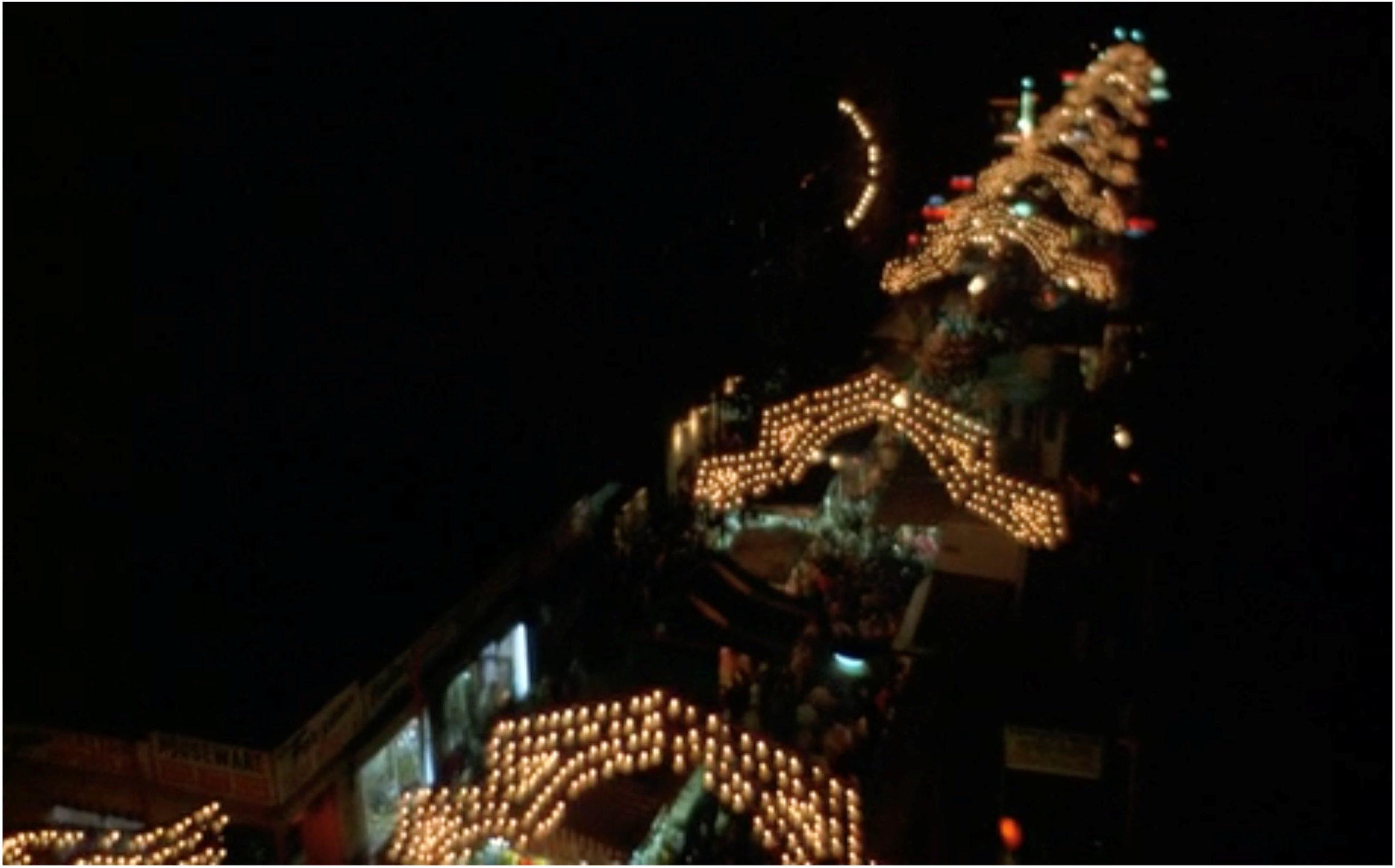
Lights for the San Gennaro Feast, Little Italy, New York City. Screen capture, Mean Streets.
Regardless of the production locations, the film's mise-en-scene, through its material culture details, helps reflect and capture an Italian New York sensibility, one that is at the same time shored up by other ethnic details, other ethnic consistencies, such as language use and music. The Italian soundscape reverberates off the walls of bars, cafes, and apartments; it is audible in the streets, the alleys, and even within the airshafts between the old tenement buildings Charlie and Teresa (Amy Robinson) communicate through. Taken together, these Italian-ethnic embellished spaces aurally and physically capture the characters in their location, helping to show why “total assimilation” is impossible (Bertellini, 2007: 102). 4
Civil rights and conservative politics
Affixed on Uncle Giovanni's cafe's walls, Tony's bar's walls, Tony's car's window, and other locations in the neighborhood are logos for the Italian-American Civil Rights League (IACRL). Among the dozens of Italian imported tomatoes lined up on a shelf, the Italian calendars and posters, the small glasses of wine, and other such markers of Italianness are a number of IACRL stickers. Their presence in the film points to the political views of its characters, the neighborhood, and ultimately of New York City's Italian Americans in the 1970s.
While scholars have not remarked upon the stickers, the logoitself is striking and easily recognizable in the film once a viewer thinks to look for it. The IACRL logo is a gold-encrusted medallion-like shape with a red, white, and green design and lettering. Even with the tricolore present, gold dominates the sign. At the center is a circular white background with a green-filled map of the 48 contiguous states of America, bordered in gold. Placed on top of the map, stretching well into what would be Canada and down into Mexico is a large single numeral 1, filled in bright red and also bordered in gold. A similarly red-filled, gold-bordered ring encircles the map with the words, in capital letters, ITALIAN AMERICAN-CIVIL RIGHTS LEAGUE. Golden-hued laurel leaves tied up like a bow frame the logo, evoking a neo-classical motif.
With the recognizable map of the continental United States, the logo visually emphasizes the organization's unequivocal relationship to America, while the red, white, and green color motif highlights the connection to Italy. The meaning intended by the large number 1 in the middle seems at odds with the reference to civil rights (that is, equal social and legal rights guaranteed under a political system), given that the focal single digit suggests blatant ethnic boosterism: Italian Americans are number one. The IACRL's presence in Mean Streets helps mark the characters and spaces as Italian American at a time when those spaces and identity were changing and when they may have seemed to be threatened.
The IACRL was founded in 1970 by Joseph Colombo, of the Colombo Family crime syndicate. As Richard Ross (2017: 25–26) clarifies, the organization “was modeled on more established anti-defamation groups” and had a particular “brand of aggressive activism,” which included “mass protests … a more militant image … and engaged in a complex dance in which they embraced stereotypes while simultaneously decrying them.” Barely a year after it began, the IACRL had chapters in 19 states and had held a popular Unity Day for Italian Americans at Manhattan's Columbus Circle. And yet the IACRL was short-lived: with an assassination attempt on Colombo and rising debts, the organization had “fizzled” by 1972 (Ross, 2017: 43).
However, the IACRL's impact on consumer culture and media remains in great part due to its interference with the production of The Godfather. The IACRL led a public campaign to stop the film from being made given concerns that Italian Americans would be maligned by the story's emphasis on Italian-identified criminals. At least a bit of irony exists in an organized crime-created organization vehemently criticizing a Mafia-themed film. Those who publicly denounced the film, often with the support of the IACRL, included “U.S. congressmen, New York State legislators, judges, businessmen, entertainers, and representatives of the chapter-based national organization Order Sons of Italy” (Sciorra, 2016: 1). At the same time, the production of the film was riddled with labor disputes, coming from the organized crime-powered studio labor unions. Eventually, Paramount Pictures, in conversation with Colombo and other IACRL leaders, agreed to what were in fact nominal changes in the script: within days the labor disputes went away and the film's production continued smoothly (see Santopietro, 2012: 120–125; Sciorra, 2016: 1–2; Ross, 2017: 43). 5
That Tony and Uncle Giovanni are in particular connected to the IACRL makes sense given their roles in the community. They are associated in different ways with power, leisure time, and a host of shady and illegal ventures. Tony, with his big car and seedy bar (heroin use, strippers, an attempted murder, a caged tiger), is a small-time but successful businessman engaging in demonstrably questionable activities. Meanwhile, Uncle Giovanni, with his tailored suits and afternoon espresso, comes across as an elegant and distinguished (if not feared) ethnic leader and businessman. He refers to himself and his associates as “honorable men,” a term for a specific kind of Italian masculinity connected to organized crime leaders who respect tradition and familial responsibilities (Gardaphé, 2006: 74–76). Uncle Giovanni's position as both a mobster and an authoritative community figure is not dissimilar to what had been happening with the IACRL's involvement in The Godfather's production, whereby a “blurring occurred in which the mobbed-up League was conflated in the popular imagination with civic-minded spokespeople” (Sciorra, 2016: 1). 6
The IACRL's anti-defamation work coincides with the pre-production of Mean Streets, suggesting a self-conscious effort by Scorsese to make the IACRL part of the mis-en-scene. Given what was the ubiquitous presence in 1971 of IACRL, “banners on neighborhood streets and the emblems on family automobiles,” we can imagine that those authentic film locations Scorsese relied on had retained those logos (rather than him having put them there purposely) by the time he was filming (Kelly, 1991; Ross, 2017: 39). Whether or not Scorsese purposely included the IACRL logos, their presence might have been seen as a provocation by the young director toward a contingent within Italian America that supported singular views of what it meant to be Italian American. As such, Mean Streets then becomes a sort of critique of the IACRL's role in trying to shape the media's depiction of organized crime and Italian Americans generally.
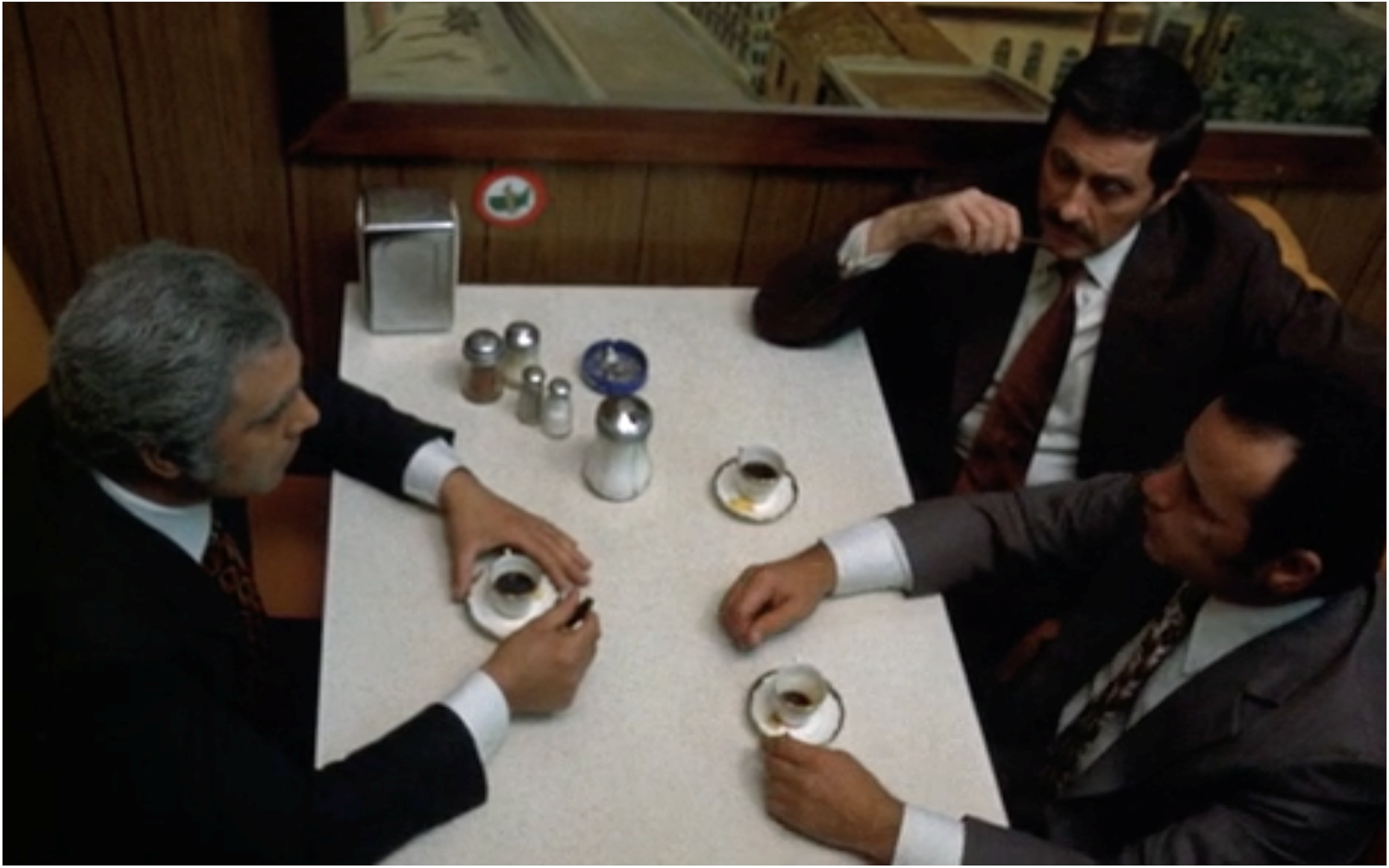
“Honorable men” at the table, with an IACRL sticker on the wall. Screen capture, Mean Streets.
IACRL logos appear in different spaces depicted throughout the film, but those in association with Tony or Uncle Giovanni are of particular interest.
An IACRL sticker is visible every time the passenger side of Tony's car, a 1972 Chrysler Imperial LeBaron, appears. (Dangling from the car's rearview mirror are also two Italian amulets against the malocchio, which are also popular symbols of Italian American identity: a cornicello and the mano cornuto fingers.) Tony's association with the IACRL is also clear from his bar where a sticker is visible on an otherwise bare wall near the bathroom. Uncle Giovanni's cafe has at least two IACRL stickers. A large one hangs between Italian and US flags (see Figure 3), squarely above framed portraits of the murdered Kennedy brothers and Pope John XXIII.
7
A smaller one (see Figure 2) appears on the wall next to a napkin dispenser on the table where Uncle Giovanni is speaking to his associates about protecting Charlie (as Charlie eavesdrops from the bathroom).
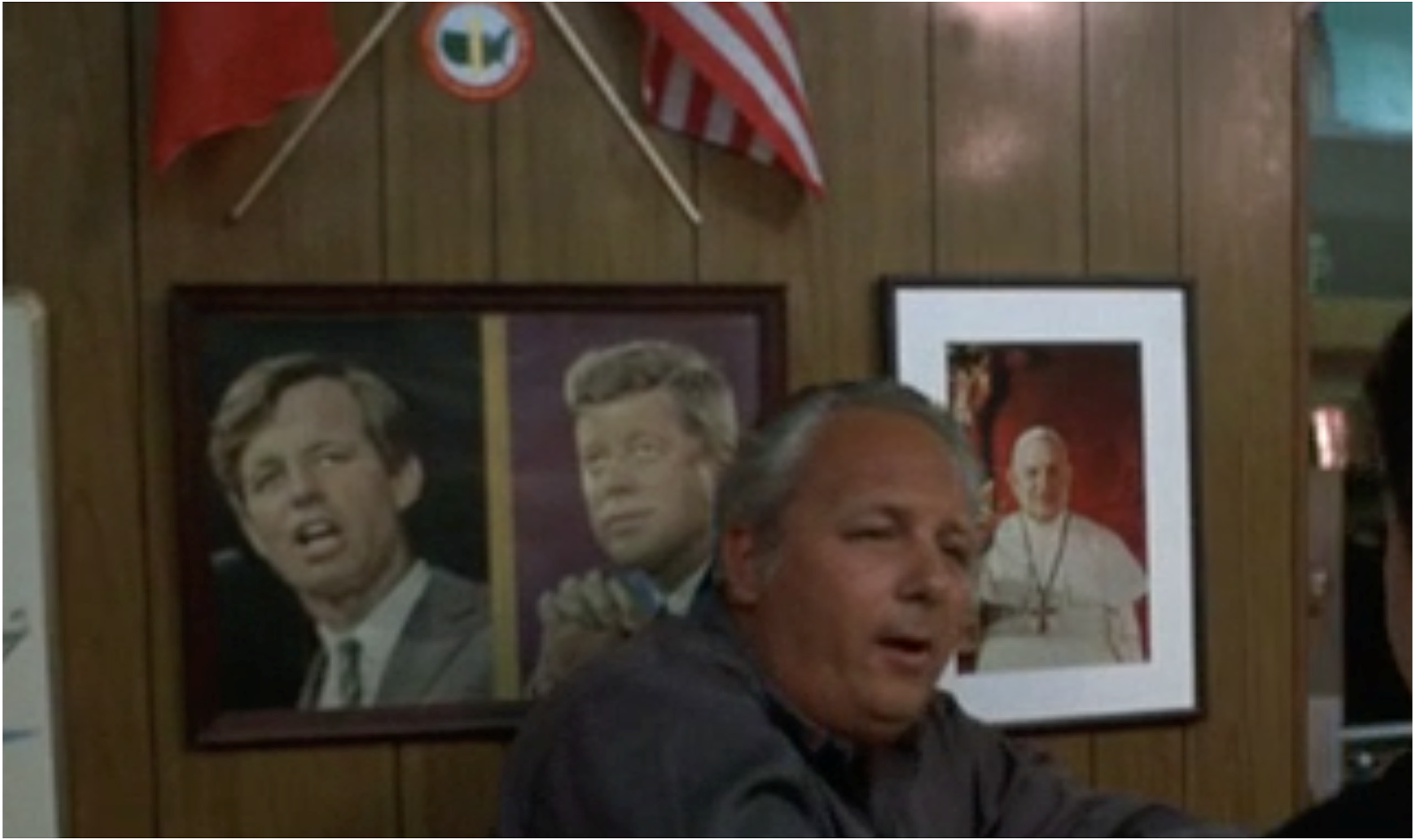
IACRL logo and the Kennedy Brothers, close-up. Screen capture, Mean Streets.
The presence of the IACRL in these small but consistent ways reinforces Uncle Giovanni's and Tony's positions in the community and demonstrates aspects of their political views with respect to ethnicity. The spaces associated with the IACRL are insider ethnic spaces delineating who belongs or not in that community. Ross (2017: 46) argues that the IACRL helped develop and sustain a particular kind of Italian American ethnic identity, one “that was distinctly blue-collar and distinctly superior to contemporary American culture,” giving Italian Americans a public identity to latch on to during the post-Civil Rights era of significant shifts in American understandings of race and ethnicity. In other words, the IACRL helped make Italian American identities visible and unique at a moment when Italian Americans were becoming more and more associated with white, mainstream America.
The IACRL itself did not raise concerns about Mean Streets. By the time the film was released, the IACRL was no longer as viable, and also the film's relative modesty (e.g. a low budget, and a director and actors who were lesser known) might have made targeting it less impactful. Even so, playwright Burt Marnik called out Mean Streets for its negative depiction of Italian Americans. In a New York Times letter to the editor, he describes the film as “an insult to Italian Americans and a slander to them” and suggests that the “IACRL which is fighting against the gangster stereotype of the Italian American in the movies and TV, throw up a picket line outside the theater that is showing Mean Streets” (Marnik, 1973: 4).
But rather than claims of defamation of Italian Americans in Mean Streets, any accusations of racism in the film are usually leveled at the Italian American characters themselves. Their racism is explicit and unapologetic, mainly targeted at African Americans but also Jewish and Chinese people. Aggeo Savioli (1975), in L’Unità, describes the protagonists and community in Mean Streets as “una comunità chiusa, alienata, che nutre in se stessa i medesimi pregiudizi (il razzismo, in primo luogo) dei quali è vittima” [a closed community, alienated, that nurtures in itself those same prejudices (racism above all else) of which it is a victim]. The insensitivities and prejudices of the characters are numerous and rather obvious; they reinforce and shape the characters’ small-time thinking, lack of confidence in their place in the world, and overall immaturity. The racism seen in the film goes hand and hand with the characters’ other expressions of misogyny, sexism, homophobia, and antisemitism as well as repeated references to and imagery of violence against women and other defined groups.
At the time of the film’s release in the United States, the Congress on Racial Equality (CORE), an organization that also helped create the Coalition Against Blaxploitation (CAB), publicly remarked on the film's bigoted limitations. 8 Ranking films “from a black perspective using black standards as a gauge of excellence,” Mean Streets was the first film ranked by CORE, which gave it a “negative 25” on a 100-point scale (Variety Magazine, 1973). Such observations, when considered along with the IACLR logos and other politically tinged material culture of the film, raise further questions as to the ideological views of the characters and the neighborhood depicted.
Early on, Charlie visits Uncle Giovanni in his uncle's cafe. The space, the walls, counters, and tables are decorated in a fashion not surprising for such an establishment: Italian tourist posters, a large espresso maker on the counter, etc. Among those standard elements is one unexpected object: a golden-hued commemorative plate made in the image of a portrait of Benito Mussolini wearing a Fascist helmet (see Figure 4).
The plate, a standard dinner-plate size, sits in center frame, near the back of Charlie's head, as we see him in profile while he faces and listens to his uncle. Uncle Giovanni has his hands on Charlie's shoulders suggesting to Charlie that he disavow any connection to the shooting that happened the night prior. With Mussolini on one side of Charlie and Uncle Giovanni on the other, Charlie is visually stuck between these two problematic figures. Like the IACLR stickers, none of the characters nor anyone discussing the film since ever mentions the Fascist plate, and yet the power of its silent presence cannot be ignored.
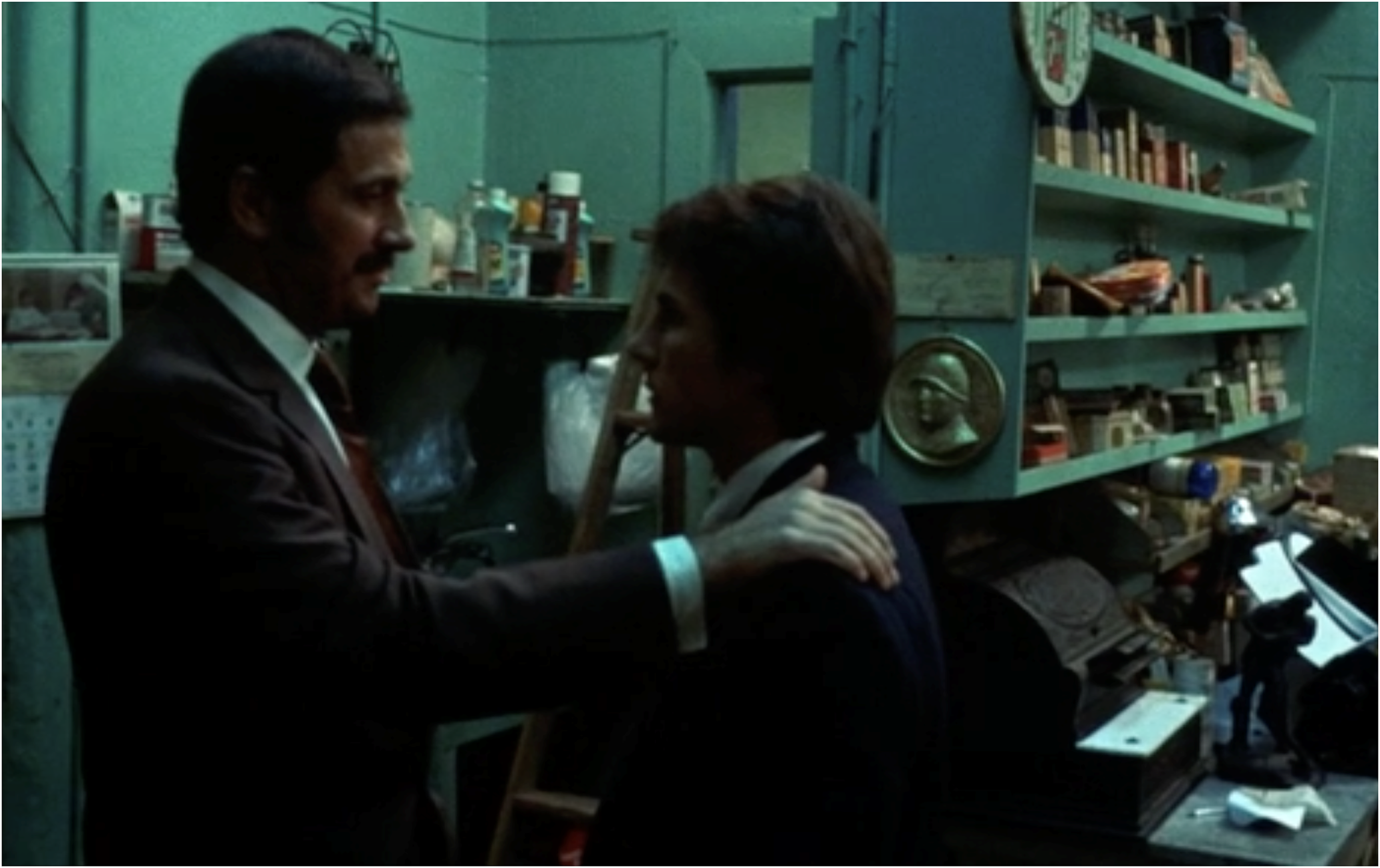
Uncle Giovani, Charlie, and Mussolini plate. Screen capture, Mean Streets.
Regardless of intentionality, its presence demonstrates the neighborhood's continual connection to Italy and the lasting legacy of Fascism. In various political and cultural ways, pro-Fascist sentiments survived among Italian Americans in the postwar decades (see Pretelli, 2009). As late as 1993, T-shirts with the image of Benito Mussolini were being sold at E. Rossi and Company, one of the longest-lasting Italian American businesses in the same Little Italy depicted in Mean Streets (Kavros, 1993).
The film also emphasizes Fascism's presence through its soundscape given that the festa band repeatedly performs an instrumental version of “Faccetta nera,” a Fascist-era song celebrating Italy's invasion of Ethiopia by emphasizing an implied sexual relationship between the Italian military and an Abyssinian woman. The lyrics speak of abduction as well as both sexual and political coercion: Faccetta nera, piccola abissina, ti porteremo a Roma, liberata Dal sole nostro tu sarai baciata Sarai in Camicia Nera pure tu. [Little black face, little Abyssinian woman/ We will take you to Rome, a freedwoman/ You’ll be kissed by our sun and/ You too will wear a Black Shirt] (Lyrics by Renato Micheli, translation mine)
The tune is heard throughout Scorsese's film. But the song becomes especially significant when played by the festa band inside Uncle Giovanni's cafe, where, along with the Mussolini plate, it symbolically acts to connect Uncle Giovanni to this Fascist legacy. 9 Together, these conservative political elements reinforce the role of prominenti in continuing a politics based on exclusion and prejudice. 10
In Mean Streets, these damaging characteristics suggest the impossibility for Charlie and others in his circles of conforming to dominant notions of whiteness and thus to assimilation even as there are multiple pulls all around them suggesting otherwise. The prejudice and racism in the film, when considered alongside the silent presence of the IACLR and Fascism, suggest a defensive position, trying to safeguard the neighborhood at a time when change was afoot.
Beyond Little Italy
Looking back today, the early 1970s was a pivotal time for New York City's Little Italy and Italian Americans, with nearby Chinatown seeming to encroach, more outsiders coming to the neighborhood, and major civil and social shifts happening across the United States effecting change among Italian Americans too. 11 In discussing Manhattan's Little Italy, Philip F Napoli (2002: 16) argues that “in the 1970s Italians struggled to retain a presence in the district and along the way were forced to articulate and redefine what constitutes an Italian community.” He documents the creation of the “Little Italy Restoration Association” in 1974 (stemming in part from IACRL's success), which explicitly worked against what was seen as an “Asian invasion” felt in the neighborhood (Napoli, 2002: 20–21). Even the San Gennaro Feast was adjusting to new demographics, with 1972 being the first year that membership in the Società San Gennaro was “not limited to men born in Naples or whose parents were born in that city … [but open to] anyone in the United States of Italian descent, who is more than 18 and male” (Schumach, 1972: 31). By the time Scorsese was filming Mean Streets, “the old neighborhood had changed. Little Italy had become a contrived medley of restaurants and cafes that catered to tourists. Real neighborhood life retreated into social clubs and secret places” (Kelly, 1991: 69). Indeed, Charlie and his friends’ quotidian spaces were being unsettled, disrupted in all directions.
The cinematic built environment where the characters of Mean Streets live, work, and play reveals some of the tensions brought about from these disruptions. The material culture of the film, including those less-visible silent presences from the IACRL and Fascism, reflects neither a generic Italian American neighborhood nor an insular Italian New York City one, but rather one shaped by the specific realities of 1970s ethnic politics, organized crime, transnational connections, and popular-consumer culture. The Little Italy of Mean Streets was not the closed, insular ethnic enclave it is conventionally seen as but rather one in the midst of transformation, aware of and to some degree receptive to the cultural transformations taking place. When Johnny Boy exclaims, “I hate that feast with a passion”—because the streets he normally moves freely around get crowded with outsiders—he is also responding to these changes. Teresa, the only woman with any character development in the film, is likewise aware of these changes and wants to experience them from outside the neighborhood's boundaries. The film's narrative does not offer her that possibility, in part because she also continues to be held back by her own insecurities and racist views.
But Charlie, Johnny Boy, Tony, Uncle Giovanni, and all the other men also recognize the change, even though they respond differently from Teresa, wanting to stay in the neighborhood. Their prejudices, their boisterous bullying, violence, sexism, and ethnic boosterism reveal not an insular community so much as a community at the very moment when it stopped being insular, if it ever was. These actions, when seen from the objects and materiality that structure the film's setting, help illustrate how the characters react against change, against wholesale assimilation, retaining and reshaping Italian American identity along the way.
