



Abstract
Trade across countries in the world has assumed a new dimension with the emergence of global value chains (GVCs). GVCs are associated with trade in intermediate parts and components being processed and assembled in multiple countries. The current article analyses the impact of India’s participation in GVCs on the wage gap between male and female workers. Dearth of studies exploring this issue in the Indian context is a motivation for the current research. India’s participation in GVCs is measured by two indicators—domestic value added in intermediate goods as a share of gross exports (DVAXINT) and foreign value-added share of gross exports (FVAX). Both pooled and panel regression analyses based on secondary sources of data suggest that none of the indicators of GVCs have been helpful in improving the relative wages of female workers in India.
Introduction
With the increase in flow of inter-country foreign direct investment (FDI) and associated enhanced role of multinational companies, global production networks have gained importance in world trade. Hence, the current world trade scenario is no longer based on exchange of final products between countries. Now multiple countries take part in producing a final product, with each country involved in adding value to the intermediate product imported. Hence, as we see now, inter-country trade in intermediates are increasing, and they constitute the main drivers of growth in world goods trade (Feenstra, 1998; Meng et al., 2012). Lower trade barriers on intermediate goods have also contributed to the prevailing world trade scenario (Miroudot et al., 2009). So, we are living in a world where production is internationalised, with firms in every country organising and coordinating cross-border production arrangements through established external networks (Raju, 2014). This phenomenon of internationalisation of production structure has been described in various alternative terms in the literature, like global value chains (GVCs)/fragmentation of production/outsourcing/vertical specialisation/value-added trade.
The issue of global production networks and their consequences for the world trade has been extensively analysed in the literature (Ando & Kimura, 2005; Baldwin & Robert-Nicoud, 2014; Grossman & Rossi-Hansberg, 2008; Hummels et al., 2001; Kimura et al., 2007; Markusen & Venebles, 2007; Ng & Yeats, 2001; Yi, 2003). The matter of concern for the trade economists is the impact of such changing world trade scenario on the macroeconomic indicators such as output, prices, employment, etc., in the participating countries. Accordingly, significant volumes of literature can be identified that have tried to determine the impact of GVCs on the labour markets of participating countries by means of extensive data analyses. Some of these studies have investigated the employment-generating prospects of GVCs (Banga, 2016; Lopez-Acevedo & Robertson, 2016; Shepherd & Stone, 2013). Some of the other studies have explored the role of GVCs in increasing the demand for skilled workforce (Bertulfo et al., 2019; Calì & Hollweg, 2016; Crinò, 2012; Farole et al., 2018; Fernandez-Stark et al., 2010; Iberahim, 2013; Pathikonda & Farole, 2017; Taglioni & Winkler, 2016). A few others have tried to analyse the impact of GVCs on workers classified on the basis of gender (Ahmed, 2013; Bamber & Fernandez-Stark, 2013; Barrientos, 2014; Basi, 2009; Bhattacharya & Rahman, 1999; Christian, 2013; Christian et al., 2013; Fontana, 2012; Frederick & Staritz, 2012; McKay, 2006; Shepherd & Stone, 2013; Silvander, 2013;). India has also been an active participant in GVCs, with possibilities for its enhanced role due to the initiation of trade war between the USA and China. Further, India is characterised by a labour market with disparate employment and payment structure for workers classified on the basis of gender, as recognised in existing literatures (Agrawal, 2014; Bhattacharjee et al., 2015; Bhaumik & Chakrabarty, 2008; Poddar & Mukhopadhyay, 2019). Since there is a pressing need across the world to move towards a gender-neutral society, the consequences of the changing world trade scenario on male and female workers is a matter worthy of consideration for the Indian policymakers.
GVCs may increase or decrease the relative wages of female workers, depending on the requirements of specific kinds of skills, skill composition of workers and the policies (discriminatory or non-discriminatory against female workers) adopted by the participating firms. According to Jenkins (2005), wages and working conditions of women employees may be better in GVCs than for those employed in other activities. This could be linked to monitoring of the firms associated with GVCs, by various national and international agencies. Hence, many firms may have been compelled to establish a gender-neutral environment by improving the wages and working conditions of female employees (Bamber & Staritz, 2016). The current article will, therefore, attempt to examine the validity of the above-mentioned statements by considering how India’s participation in GVCs has impacted the workers classified on the basis of gender. The article will specifically analyse the effect of GVCs on the movement in relative wages of female workers, with some associated observations on female relative employment.
For the purpose, the article considers the two individual components of GVCs identified in the Trade in Value Added (TiVA) Database (2018) by the Organisation for Economic Co-operation and Development (OECD). These two components are foreign value-added share of gross exports of a country (backward linkages associated with GVCs and labelled as FVAX) and domestic value added in exports of intermediate products as a share of the gross exports of the country (forward linkages associated with GVCs and labelled as DVAXINT).
Employing the methods of panel and pooled regression analyses, the article arrives at the conclusion that DVAXINT and FVAX have not worked in favour of female workers.
The article is henceforth divided into four sections. The second section provides a brief review of the related literature. The third section provides a background to the structure of GVCs in India and the relative employment and wages of female workers in the Indian labour market. The fourth section details on the methodology applied and data used for the purpose. The fifth section discusses the results. The sixth section concludes the article. Finally, the seventh section outlines the limitations of the study and possible course for future research in this area.
Review of the Literature
Several studies have documented the impact of a country’s participation in GVCs on the relative position of female workers. Shepherd and Stone (2013), for instance, found that GVC participation to be beneficial for female workers in a group of developing and transition economies for the period from 2006 to 2010, as firms with greater international linkages employ more female workers. They applied fractional logit model to firm-level data in order to arrive at the conclusion. 1
According to Bamber and Staritz (2016), significant volume of evidences can be presented to prove that developing countries’ participation in GVCs have led to increased female employment. Developing countries typically, first, target the lower-valued, labour-intensive segments of non-traditional agriculture, basic manufacturing and tourism while entering GVCs (Bamber et al., 2013; Cattaneo et al., 2013). These lower-valued segments of the production chain have been found to employ a higher proportion of female workers. Several case studies can be cited in this respect. Barrientos (2014), for instance, noted that 60–80% of the production workers employed in apparel manufacturing firms in leading 27 apparel-exporting countries are women. Bamber and Fernandez-Stark (2013) found that 70–80% of the packing jobs in the horticultural sector across the world are accounted by women. Christian et al. (2013) also observed that, globally, 75–80% of the workers operating in floriculture are women. According to Christian (2013), 70% of the workforce in the tourism sector across the world are females.
However, women’s involvement in GVCs has remained concentrated in lower sections of value chain, where lower levels of skills would be required. Evidences in favour of the argument have been noted from various countries in the literature. According to Bamber and Fernandez-Stark (2013), in horticulture industry across developing countries, men are involved in transportation and logistics and, even in management positions, that require higher levels of skills. Women, on the other hand, are involved in nursery work, transplanting, washing, grading and packing, which do not demand higher skill levels. Christian et al. (2013) also note that in floriculture sector, in Uganda, senior supervisors are mostly men, while 70–85% of the harvesters are women. Fontana (2012) documents that in the rice sector of Lao, higher skilled activities such as transport, networking and marketing are assigned to men, while some processing activities requiring lower levels of skills are assigned to women. A similar situation is also observed in the manufacturing sector like the apparel and electronics industry (Frederick & Staritz, 2012; McKay, 2006; Silvander, 2013). In the service industry, whether tourism or information technology, women are designated lower-ranked positions with requirements of lower skills, as compared to their male counterparts (Ahmed, 2013; Basi, 2009; Christian, 2013). It is then obvious how the prevailing scenario contributes to persisting wage inequalities between male and female workers in GVCs. As observed by Bamber and Staritz (2016), women are constrained by unequal access to resources, training and skill development programmes, and networks and information, limiting their participation in higher value-added activities which require higher levels of skills.
It may, however, be noted that skill differentials are not necessarily the determining factor behind wage differential between male and female workers in any industry. For the same kind of work, women are often paid less than their male counterparts, suggesting discriminatory practices adopted by many firms. Christian et al. (2013), for instance, takes note of the fact that in Indian cocoa sector, women are paid less than men for similar work. Similar situation also persists in the apparel sector of Bangladesh (Bhattacharya & Rahman, 1999; Frederick & Staritz, 2012).
Economic upgrading by a country, in the form of either upgrading to higher value-added activities within the same sector or movement to a different sector with requirements of higher levels of skills, often leads to displacement of female workers by their male counterparts (Kucera & Tejani, 2014). Mechanisation of the production process, product and process upgrading in industries such as apparel, electronics, information technology, etc., has resulted in increase in employment of male workers over females (Bhattacharya & Rahman, 1999; Frederick & Staritz, 2012; McKay, 2006).
While some of the above-mentioned studies like Basi (2009) and Christian et al. (2013) have investigated the relationship between GVCs and gender–wage and employment disparity in the Indian labour market by means of various case studies, they did not explore empirically, how the gender–wage gap may have evolved over time with India’s involvement in GVCs. This identified gap in the existing literature will be explored in the current article. Hence, the current study will proceed to determine whether GVCs have helped India to move towards or away from a gender-neutral society with declining wage gap between male and female workers.
Background
Before starting with the analysis of the research objective, it is worthwhile to have a look at the integration of India into GVCs and the nature of its labour market.
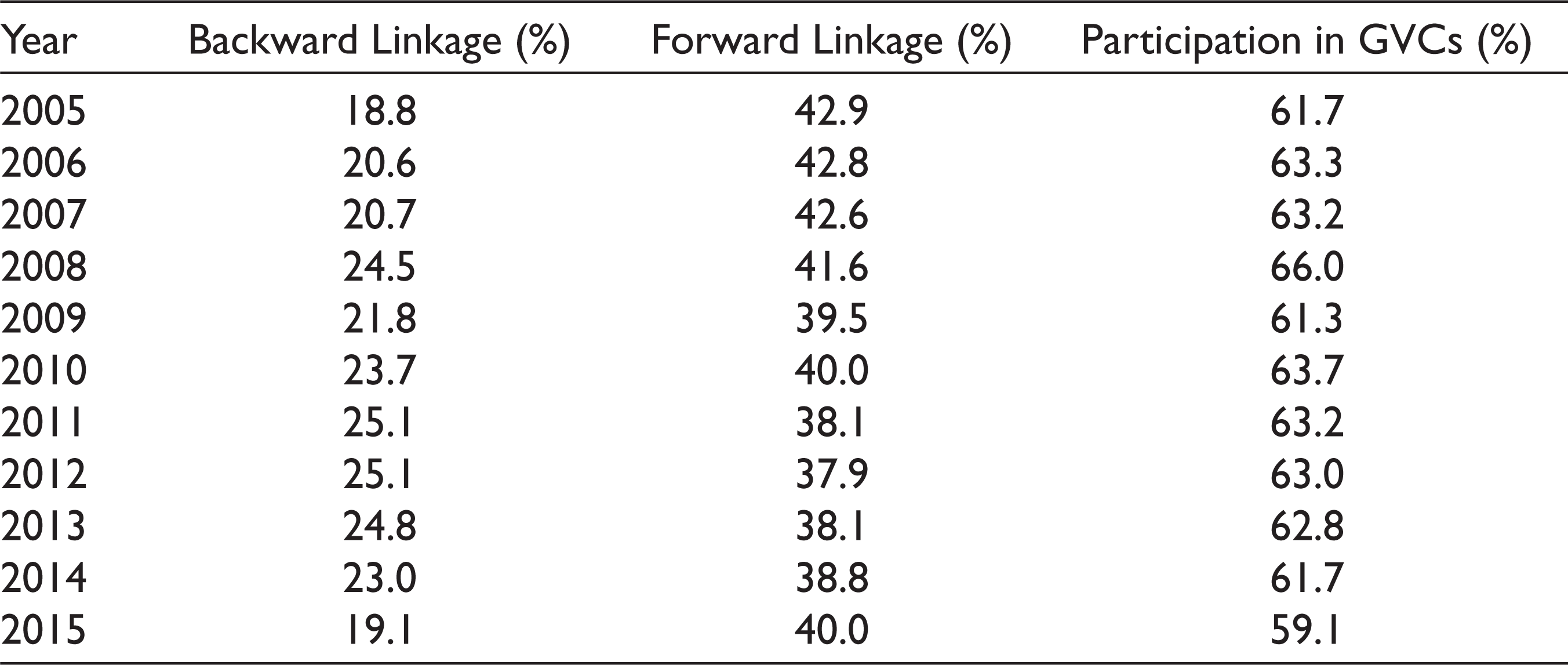
Like the other countries of the world, India too has demonstrated its presence in GVCs. To determine the extent of a country’s involvement in GVCs, the TiVA Database (2018) developed an index named ‘participation in global value chains’. The index is considered to be the sum of FVAX and DVAXINT. Table 1 provides an estimate of the index values for India over a period of 11 years. It is obvious that India has been involved in global production networks more through forward linkages (DVAXINT) than backward linkages (FVAX). We do not notice an increasing trend in the index values over the considered years. However, considering the magnitude of the index, it cannot be denied that India is a significant participant in GVCs.
India’s Participation in Global Value Chains (GVCs).
A more detailed idea about the developments in India’s value-added trade can be formed from Figure 1. Figure 1 demonstrates the movements not only in chief components of GVCs but also the movements in domestic value added in exports as a share of gross exports (labelled as DVAX), domestic value added in exports of final products as a share of gross exports (labelled as DVAFX) and domestic value-added share in gross imports (labelled as DVAXIMP). As apparent, India’s DVAX (and hence DVAXINT and DVAFX) is considerably higher than FVAX, suggesting lower foreign content in gross exports. Further, the two flows behave in a reverse manner. FVAX demonstrates an increasing trend up to 2012 and a decreasing trend thereafter, while DVAX witnesses a decline initially, with tendencies to improve since 2012. Hence, although we do not have data after 2016, we may infer decreasing foreign content and increasing domestic content in the exports of goods and services by India.

The graphs further show that the country initially added value mostly to intermediate goods and services to be processed further abroad. However, over time, the domestic value addition in export of final goods and services seems to have coincided with that of intermediate exports. This may imply country’s growing involvement over time in higher stages of value addition. DVAXIMP is almost constant and negligible, signifying that very little previously exported domestic value added, returned to India through import of final and intermediate goods and services. This provides evidence for the fact that contrary to the countries such as the USA, Germany and China, India imports very little of its previously processed goods and services.
Under the stated circumstances, an analysis of the Indian labour market is worth considering. Indian labour market, as stated earlier, is characterised by low employment growth and persisting inequalities in employment and wages of workers classified on the basis of gender. A clearer picture about the relative position of female workers in the Indian labour market could be formed when we take into consideration the skill content of workers.
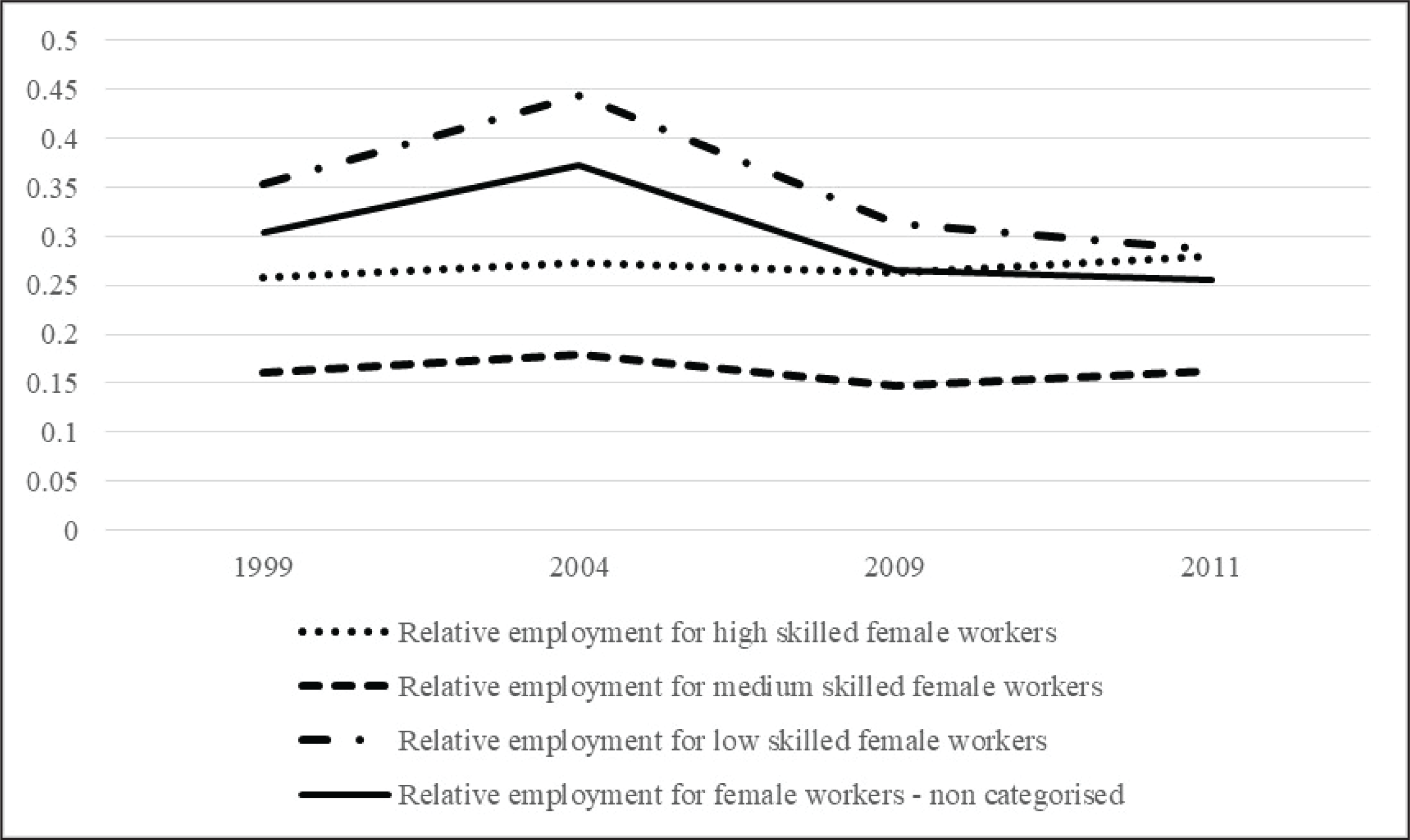
A graphical analysis of the employment data in Figure 2 suggests that in India, there has been a declining trend in the relative employment of female workers since 2004, with associated decline in relative position of low-skilled female workers, and marginal improvements in relative position of high-skilled and medium-skilled female workers since 2009. With workers mostly low skilled, the relative position of female workers is determined by the changes in relative employment of low-skilled female workers.
A more detailed information about the structure of employment on the basis of skills and gender would be available from Table 2. As evident from Table 2, employment is skewed towards male workers in all skill categories. Both the male and female workers are mostly low skilled. Out of the remaining male workers, most are medium skilled, and the rest are high skilled. Out of the remaining female workers, most are high skilled, and the rest are medium skilled. The share of low-skilled workers in total female employment is greater than the share of low-skilled workers in total male employment for all the years considered. However, there is a declining trend in the involvement of female workers in low-skilled sectors. The share of high-skilled workers in total female employment shows an increasing trend and is found to exceed the share of high-skilled workers in total male employment in the year 2011. Such findings, therefore, suggest gradual move towards skill up-gradation of female workers. The share of medium-skilled workers in total female employment is found to be less than the share of medium-skilled workers in total male employment for all the years considered.
Employment Structure on the Basis of Skills and Gender in India.

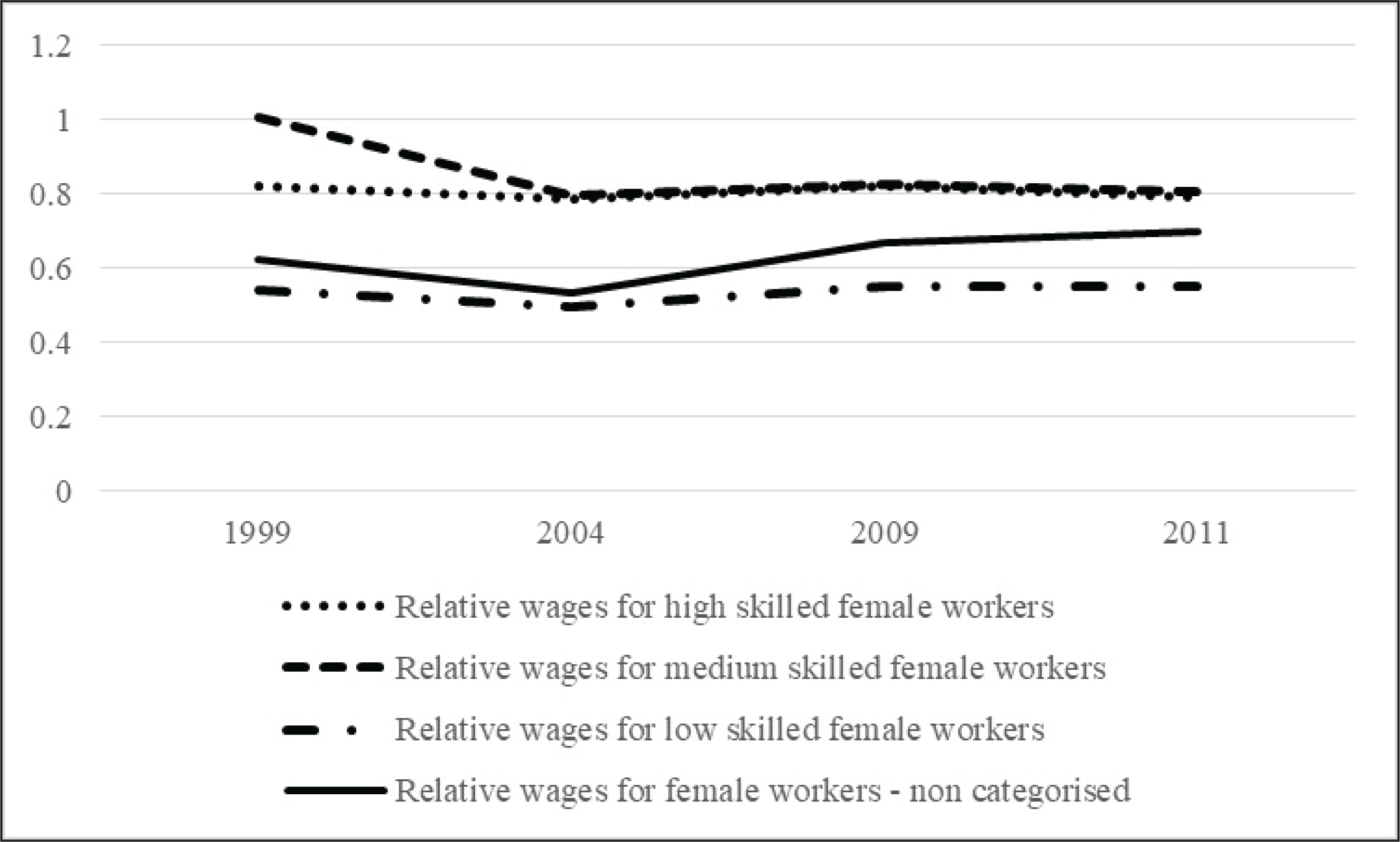
The graphs on relative hourly wage of female workers presented in Figure 3 suggest developments in contradiction to Figure 2. An improvement in the relative position of low-skilled female workers, with corresponding marginal deterioration in the relative positions of high-skilled and medium-skilled female workers (particularly after 2009) would be noticeable from Figure 3. Hence, the improvement in the relative hourly wages of female workers (non-categorised) over the years is governed by the changes in relative hourly wages for low-skilled female workers.
The above-mentioned detailed developments in the labour market may have been influenced to a certain extent by the India’s participation in GVCs. The current research will try to explore the issue.
Before proceeding with the analyses in this article, a preliminary examination of the skill requirement and gender composition of the different sectors contributing towards India’s DVAXINT and FVAX is worth considering. Inspections of Tables A1 and A2 in Appendix A suggest that the sectors are heterogeneous in terms of skill requirements, and most employ higher proportion of male workers. However, ranking of the sectors in terms of contributions towards different components of GVCs for the year 2011 shows, among the top 10 sectors receiving highest FVAX, most are intensive in the use of low-skilled workers, followed by high-skilled workers. The top 10 sectors recording highest amounts of DVAXINT employ more of high-skilled workers, followed by low-skilled workers. Given the fact that female workers are mostly low skilled, with a tendency towards their growing involvement in high-skilled sectors, GVCs may produce some effect on the relative wages and employment of female workers in the involved sectors.
Data and Methodology
The household-level wage and employment data (both rural and urban) for different industries (based on National Industrial Classification of Economic Activities) for India are collected from the Employment–Unemployment Surveys by National Sample Survey Office (NSSO) under Ministry of Statistics and Programme Implementation (MOSPI), Government of India. The NSSO collected and published these large-scale data in different survey rounds, usually conducted at gaps of 5 years. For subsequent analyses in this article, three rounds of survey data are considered—61st round (pertaining to the year 2004–2005), 66th round (pertaining to the year 2009–2010) and 68th round (pertaining to the year 2011–2012). The data on industry-level DVAXINT and FVAX, classified on the basis of International Standard Industrial Classification of All Economic Activities (ISIC) Rev. 4, from the years 2005 to 2016, are collected from the TiVA Database (2018) by the OECD. The sectoral industry data from the two sources (NSSO and TiVA) based on different industrial classification had to be coordinated, and, finally, industrial classification based on ISIC Rev 3.1 is considered for analyses.
In order to evaluate the effects of GVCs on wage inequality between male and female workers, regressions are run for two sets of data. The first set comprises original data collected from the sources mentioned. The second set is obtained by applying the method of interpolation on the first data set, with the objective of procuring wage and employment data for the years 2005, 2006, 2007, 2008 and 2010, not provided by NSSO. 2
The regression model to be estimated is based on the standard model of labour demand adopted by many of the studies mentioned earlier. However, contrary to the existing studies, the current research will analyse relative changes in the labour market, as absolute changes cannot highlight the relative gainers and losers due to increased role of GVCs.
The model considers average of hourly wages (constant at 2011 prices) from each industry in each year. The average hourly wages are calculated, from the data on unit-level weekly wages provided by NSSO, after categorising the workers on the basis of sex and skill levels. Hence, first, the hourly wages are calculated from the weekly wages by means of the following formula:

Next, the data are expressed at constant 2011 prices on the basis of the following formula:
3

Finally, the hourly wage (at constant 2011 prices) data obtained at unit level are transformed into average by considering the number of workers under each category.
To set up the model, following Banga (2005), a constant elasticity of substitution (CES) production function with constant returns to scale (CRS) technology for a firm in industry i at time t is considered:

where
Q = output produced;
FW = units of female workers;
MW = units of male workers;
α = factor share coefficient (0 < α < 1);
ρ = substitution parameter (−∞ ≤ ρ ≤1); and
δF and δM are the gender-specific technological coefficients.
The first-order condition for output maximisation by a representative firm in industry i at time t is expressed as:

where wf and wm are the respective average hourly wages paid to female and male workers.
Taking logarithms on both sides of expression (2):

Now, the level of technology of a firm may be influenced by factors like a country’s exposure to foreign trade and investment over time (Banga, 2005; Greenaway et al., 1998). It can, therefore, be assumed here that the gender-specific technical efficiencies are influenced over time by the firm’s participation in GVCs through backward and forward linkages. A firm’s participation in GVCs may call for adoption of technologies biased towards the usage of specific kinds of skills for which either male or female workers would be appropriate. For instance, production processes involving physically demanding manual labour would require employment of more male workers. On the contrary, production processes requiring better social skills and ability to handle minute specifications may require employment of more female workers. Hence, requirement of skills specific to either male or female workers is considered to be the determining factor behind the relationship between gender–wage gap and a country’s participation in GVCs.
The gender-specific technical coefficients for a firm in industry i at time t can be represented as:


where:
γ0F, γ1F, γ2F, γ0M, γ1M, γ2M > 0;
T is the exogenous time trend. FVX and DVAXINT have been previously defined.
Substituting expressions (4) and (5) in expression (3):

where
Equation (6) will, thus, aid in determining the effects of backward and forward linkages, on the relative wages of female workers in India, through the following regression model:

The coefficients for DVAXINT and FVAX can be either positive or negative, signifying growing GVC involvement to increase or decrease the relative wages of female workers. Hence, by running the regression model (7), we test the null hypothesis of no relation between dependent and independent variables, against the alternative hypotheses of positive or negative associations between the dependent and independent variables.
Both pooled and panel regression models with dummies for different skill categories are fitted to the original data obtained from NSSO. The time trend is, however, replaced by time dummies in the regression models to account for yearly shocks on the dependent variable rather than being concerned only about linear movements of the outcome variable over time. It is to be noted that for interpolated data, pooled regression results are not reported, as the data have to be defined in panel format for interpolation. 4 The regressions are run with robust estimate of standard errors to account for heteroscedasticity in the data. Further, in case of panel models, the variables are found to be stationary on the basis of Augmented Dickey–Fuller unit root test. However, stationarity test could not be performed on non-interpolated data set due to non-sufficient yearly observations. 5 Further, due to non-availability of sufficiently large data set, the model could not be tested for causality and endogeneity.
Discussion of Results
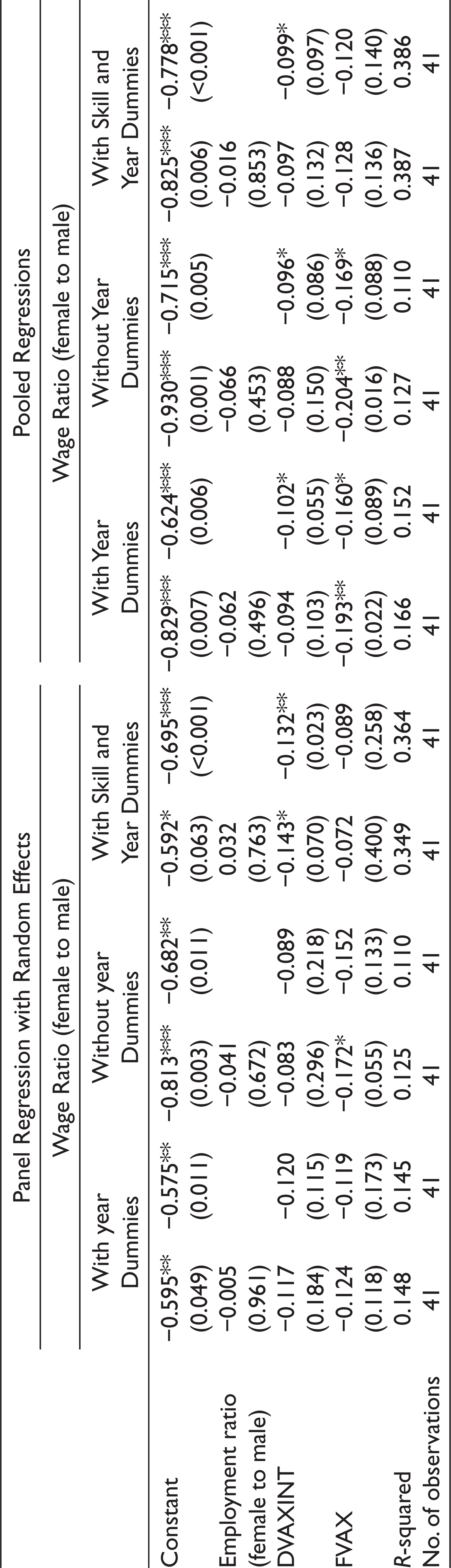
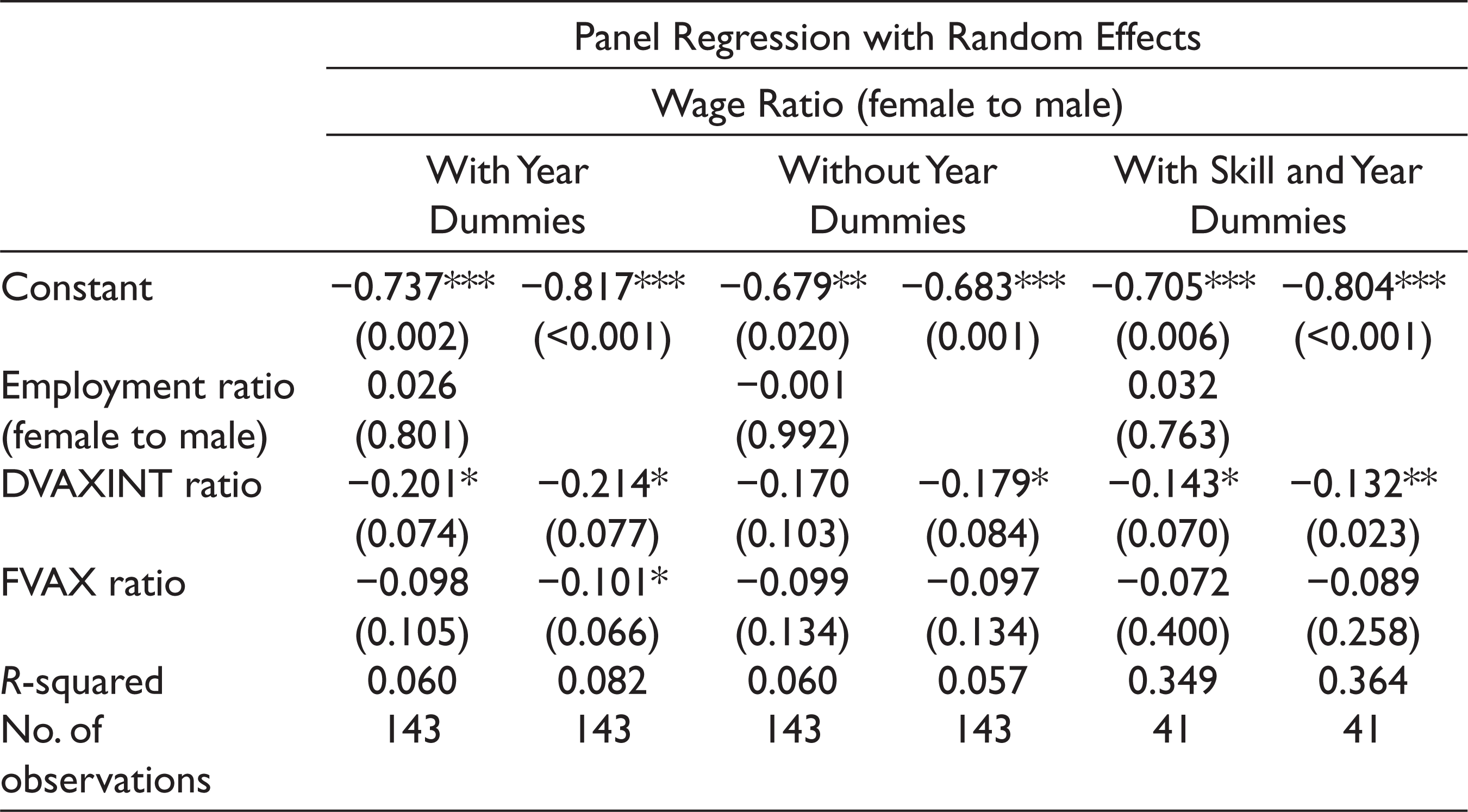
The regression results pertaining to originally available data set are presented in Table 3. The result pertaining to the interpolated data set are presented in Table 4.
As evident from Table 3, the regression coefficients for DVAXINT and FVAX are negative and statistically significant in some cases. With panel data modelling, the coefficients for DVAXINT are significant only when the skill category of workers are controlled for. Hence, DVAXINT affected female relative wages not through skill content of workers. In pooled regression models, the coefficients of DVAXINT are significant when employment ratio is not controlled for. Hence, the significant coefficients for DVAXINT may demonstrate the combined effects of DVAXINT and employment ratio. DVAXINT on its own may not influence the female relative wages. In panel regression models, the coefficients for FVAX are significant, only when the full model is considered without dummies for time or skills. Introduction of dummies, however, make the coefficients insignificant. The coefficients for FVAX are significant in pooled regression models, with or without incorporation of employment ratio and yearly dummies. Introduction of dummies for skill category of workers, however, makes the coefficients insignificant. Thus, skill content of workers may have some role in determining the relationship between FVAX and female relative wages.
Coefficients of Regression Between DVAXINT and FVAX Ratios and Relative Wages of Female Workers (without data interpolation).
With interpolation of data in Table 4, the coefficients for FVAX ratio in the panel regression model continue to be insignificant in most cases. The performance of DVAXINT ratio is, however, found to improve in terms of negative significant coefficients.
Coefficients of Regression Between DVAXINT and FVAX Ratios and Relative Wages of Female Workers (with data interpolation).
Conclusion
This article seeks to determine the role played by GVCs in influencing the position of workers categorised on the basis of gender in India. The article considers the standard indicators of GVCs identified by TiVA Database (2018), namely DVAXINT and FVAX, for analyses. The analyses in this article reveal that the regression coefficients for DVAXINT and FVAX (based on both original and interpolated data set) assume significant negative signs in selective cases, signalling reduced relative wages for female workers. Hence, based on the results obtained from alternative models, we may draw the conclusion that both DVAXINT and FVAX may have some effect in reducing the relative wages of female workers. But their effects may not be strong enough under many circumstances. These outcomes need to be noted in the context of the fact that India connects with other countries more through forward linkage (via DVAXINT) rather than backward linkage (via FVAX).
According to Figure 1 in the third section, DVAXINT was found to follow a decreasing trend, while FVAX followed a rising trend over the period from 2005 to 2012, or the period considered for regression analyses. Hence, a negative association between FVAX and relative wages of female workers for the considered time period would imply that a rise in FVAX has led to falling relative wages of female workers or rising relative wages for male workers. Since most industries employ greater proportion of male workers, greater FVAX may have led to greater relative employment for male workers and hence their relative wages. The negative association between DVAXINT and relative wages of female workers can similarly be explained. Falling DVAXINT is associated with rising relative wages of female workers or falling relative wages of male workers. With most industries employing higher proportion of male workers, the result is quite expected. However, over the considered time period, relative wages of female workers are found to increase, with simultaneous decrease in their relative employment (as presented in Figures 2 and 3 in the third section). Further, the changes in relative wages and employment of non-categorised female workers are driven by the changes in relative wages and employment of low-skilled workers. Since, among the top ten industrial recipients of FVAX, most are intensive in the use of low-skilled workers, a rise in FVAX during the observed period may have increased relative employment of low skilled, and therefore, non-categorised male workers. But the resulting effect of FVAX in reducing the relative wages of low-skilled, and therefore non-categorised female workers, may not have been strong enough for the economy. DVAXINT, on the other hand, seems to be relatively important in explaining the rising relative wages of female workers in the economy during the observed period. However, the indicator may not be that effective in explaining the changes in relative wages of female workers, categorised on the basis of skills. As discussed, the top 10 industrial recipients of DVAXINT are mostly intensive in the use of high-skilled male workers. Hence, falling DVAXINT may produce rising relative wages for high-skilled female workers. But that is not apparent from Figure 3.
Limitations and Future Course of Research
The analysis in this article is, however, not without drawbacks. First, due to limited data, the model could not be tested for causality and endogeneity. Hence, the reliability of the results could be questioned. Second, the article analyses the relationship between India’s integration into GVCs and relative wages of female workers at an aggregate level. Consideration of specific sectors, and studying the effect of GVCs on relative wages of female workers employed in those sectors, would permit a more exhaustive analysis of the problem. The current article, nevertheless, provides a preliminary examination of the issue, and it may help the researchers in conducting an in-depth sector-specific study with relevant firm-level data.
Footnotes
Declaration of Conflicting Interests
The author declared no potential conflicts of interest with respect to the research, authorship and/or publication of this article.
Funding
The author received no financial support for the research, authorship and/or publication of this article.
Appendix
Ranking of Sectors on the Basis of Highest FVAX and DVAXINT, and the Associated Gender Employment Ratio for the Year 2011.

| FVAX Ranking of Sectors (2 Digit ISIC Rev. 3.1) in Descending Order | FVAX - Female to Male Employment Ratio | DVAXINT Ranking of Sectors (2 Digit ISIC Rev. 3.1) in Descending Order | DVAXINT-Female to Male Employment Ratio |
| 23 | 0.02 | 13 | 0.09 |
| 31 | 0.09 | 65 | 0.20 |
| 28 | 0.06 | 74 | 0.18 |
| 27 | 0.03 | 50 | 0.03 |
| 35 | 0.02 | 1 | 0.58 |
| 36 | 0.13 | 23 | 0.02 |
| 26 | 0.19 | 40 | 0.09 |
| 24 | 0.24 | 60 | 0.02 |
| 22 | 0.07 | 24 | 0.24 |
| 25 | 0.04 | 26 | 0.19 |
| 64 | 0.10 | 15 | 0.13 |
| 60 | 0.02 | 21 | 0.13 |
| 17 | 0.25 | 64 | 0.10 |
| 13 | 0.09 | 72 | 0.25 |
| 55 | 0.13 | 17 | 0.25 |
| 92 | 0.06 | 31 | 0.09 |
| 10 | 0.05 | 28 | 0.06 |
| 20 | 0.04 | 10 | 0.05 |
| 85 | 0.91 | 32 | 0.13 |
| 74 | 0.18 | 35 | 0.02 |
| 15 | 0.13 | 36 | 0.13 |
| 50 | 0.03 | 70 | 0.12 |
| 65 | 0.20 | 20 | 0.04 |
| 72 | 0.25 | 92 | 0.06 |
| 1 | 0.58 | 55 | 0.13 |
| 80 | 0.56 | 93 | 1.59 |
| 75 | 0.14 | 85 | 0.91 |