



Abstract
This article uses panel data with 6,743 country-year observations to investigate the effects of participation in the global value chain (GVC) on export survival rate for the period 2005–2014. GVC participation is measured as the value addition embedded in exports, looking both backward and forward from a reference country. The empirical results show that both backward and forward linkages have positive effects on the chance of export survival; these effects are persistent and increasing over time, and they become more pronounced when taking the endogeneity issue into account. On the policy front, the preceding findings suggest that governments should implement policies to upgrade a country to GVC integration in order to enhance the sustainability of exports.
Introduction
The two concerns of international trade that have been recently highlighted by researchers are the low rate of export survival (Besedes & Prusa, 2006a, 2011; Brenton et al., 2009) and the increase in trade fragmentation (Baldwin & Lopez-Gonzalez, 2015; Hermida et al., 2022; Koopman et al., 2010; Mukherjee & Chanda, 2022). Export survival is defined as the ability of a firm to continue exporting after entering the export market. Export survival plays an important role in export performance, and this has led to a call for research on the driving forces for this low survival rate. There has been growing literature on the determinants of export survival, ranging from product/market features to common gravity model variables. While sunk entry costs 1 are a key element in the persistence of trade, the short-lived export flows are attributed to the degree of uncertainty about future demand and associated exporting costs, and imperfect information about the costs of searching for a suitable counter-partner. While the fragmentation of production across nations considerably grows, the production processes and phases of a specific product are disintegrated and spread to various nations along the value chains, fostering the development of trade intermediate goods and shaping the creation of global value chains (GVCs). Thus, being a part of a GVC may be a crucial way to improve export survival by mitigating the uncertainty and asymmetry of information (Díaz-Mora et al., 2018; Zhu et al., 2019). It suggests a thorough study of the effects of GVC’s participation on export survival.
In theory, Besedes and Prusa (2011) extend Melitz’s (2003) model to explain the role of GVC integration in export survival. Two main messages are conveyed. First, trust and reliability between partners are the prerequisite conditions for the success of GVC production. International fragmentation requires close collaboration between the chain members. This leads to the sharing of technological knowledge, workforce qualifications and business strategies. To meet the demand of final consumers, one of the main tasks is to find suitable chain members who meet the requirements for technical quality and delivery schedule. Once a suitable supplier has been decided, it is less likely that the chain will switch to a new one. 2 Hence, trade in tasks is more secure than other forms of trade. Second, concerning incomplete information, solid ties between GVC partners create an effective framework for exchanging information. Firms can make use of their counterparts to obtain up-to-date information about foreign environments or to expand their contacts. In this sense, the risks and costs associated with exporting could be reduced.
Several empirical studies confirm the above prediction. Obashi (2010) employs a semi-parametric Cox proportional hazard method with intra-East Asian data, while Corcoles et al. (2015) apply a time-discrete duration approach to analyse Spanish production chains. They show that trade in intermediate goods has a higher survival rate as compared to final goods. Türkcan and Saygili (2019) calculate the degree of vertical integration in Turkey’s machinery sector and indicate its positive association with export duration. In a broader framework, Díaz-Mora et al. (2018) use a discrete-time duration method to confirm the positive impacts of backward and forward linkage on the possibility of export survival at a product-country level. They obtain Input-Output data from OECD Inter-Country Input-Output (ICIO) to compute the index of GVC participation defined by Koopman et al. (2010). For the export duration, they use yearly trade data to measure a spell, which is the number of years of continuous exporting. These previous studies, however, have abstracted the endogeneity issue due to the reverse causality between GVC participation and export survival, and the omitted variables.
The present study fills the gaps by making a main contribution to the literature. In particular, it utilises the bilateral structure of the data to revisit this relationship. Similar to Díaz-Mora et al. (2018), it uses the index of GVC participation from the TiVA 2018 OECD database. However, instead of computing the export spell from bilateral trade flows, which are censored on both sides due to the unobserved beginning and ending years of the trade spell––the present study uses the survival rate of exporting entry firms from the Exporter Dynamics Database version 2.0 of the World Bank, which is computed from custom data. This data set reports the entrant’s survival rate in the first, second and third years after entering the export market. It is directly linked to the theoretically micro-founded model developed by Albornoz et al. (2016), and accurately reflects the exit decisions of exporting firms. After merging and cleaning the data, we have 6,743 country-year observations. Since the values for the survival rate fall within the range 0–1 and linear models typically predict values outside that interval, we apply the fractional probit model. Estimation bias may arise due to the reverse causality between GVC participation and export survival, and the omitted variables. On the one hand, upgrading a country to GVC involvement is expected to enhance export survival. Further, the low survival rate signals a bad prospect and adversely influences the behaviours of incumbent and potential exporting firms. As a consequence, a reduction in export extensity and intensity dampens GVC integration. The omitted variable bias arises due to the existence of factors such as export-oriented policies that affect both GVC participation and the survival chances of exporters (Esteve-Pérez et al., 2008). We apply the instrumental variable (IV) to mitigate the endogeneity issue.
The main finding of this article is that deeper involvement in GVC linkages improves the chances of export survival. This effect becomes stronger in the later years of exporting entry, and it is more pronounced when we take the endogeneity problem into account. Maintaining export relationships is as essential as creating new ones. These findings suggest that the government should implement policies to foster GVC integration so as to improve the longevity of exports.
The rest of this article is organised as follows: The second section provides the literature review, and the third section describes the methodology. The fourth section discusses the empirical results. the fifth section concludes.
Literature Review and Hypothesis Development
Theoretical Framework of Export Survival
There has been no consensus on the theoretical framework particularly designed to examine export survival (Fugazza & Molina, 2016; Hess & Persson, 2011). Nevertheless, the sunk-cost models pioneered by Baldwin (1988) and the search-cost models initiated by Rauch and Watson (2003) may be applied to construct a theoretical framework for the empirical study. The sunk-cost models suggest that after paying sunk-entry costs, firms tend to stay in the foreign market, even if suffering a temporary loss of exports, which may result in export longevity. One empirical study indicates that sunk costs are huge and may be a main driver of export survival (Bernard & Jensen, 2004).
In the second model, search costs play a pivotal role in creating and maintaining long-lived trade relationships. Buyers in an advanced nation tend to trigger a relationship with an exporter with modest trial orders when they have higher search costs and uncertainty about their supplier’s ability. Consequently, small initial values are associated with lower export survival rates (Besedes & Prusa, 2006b; Besedes, 2008).
Determinants of Export Survival
Factors Related to Exporters’ Characteristics
The literature has emphasised the decisive role of exporter-specific factors in export survival. We first pay attention to the impacts of diverse types of costs. Specifically, the sunk-cost models proposed by Baldwin (1988) show that, if firms have to pay sunk-entry costs in exporting activity, they are more likely to remain in the foreign market, even if they experience a temporary loss. This leads to export persistence. The empirical research by Roberts and Tybout (1997) and Bernard and Jensen (2004) reveals the importance of sunk costs for export persistence. Bekes and Murakozy (2012) argue that the survival probability rises when firms can pay sunk costs to decrease variable trade costs. The second theoretical framework on this issue is the search-cost model developed by Rauch and Watson (2003), which emphasises the essential role of search costs in initiating and maintaining export activities. In a developed country, if buyers incur higher search costs and are uncertain about the capacity of a supplier to satisfy their specifications, they tend to begin with small trial orders. In the case of less uncertainty about the supplier’s capacity, buyers are more likely to place larger orders. The empirical findings by Besedes and Prusa (2006b) and Besedes (2008) have validated these model predictions. In addition to these two genres of costs in exporting activity, other studies show that fixed costs are a significant source of export persistence (Albornoz et al., 2016; Impullitti et al., 2013).
Variation in export survival could also be explained by the effect of previous export experience. In particular, Alvarez (2007) uses data from Chilean manufacturing firms to provide empirical evidence for the role of previous export experience, multinational spillovers and productivity in export survival. A similar discussion is provided by Stirbat et al. (2015) and Araujo et al. (2016), who demonstrate that experience improves the probability of survival at the firm level. Moreover, Araujo et al. (2016) offer a theoretical model in which contracts are not perfectly enforceable and the re-sellers or distributors might cause the exporter to default. Exporters use their experiences in similar markets to identify defaulting partners, thus allowing for their longer export survival. Albornoz et al. (2016) apply the model with a perfect contract to the data using firm-level Argentine export information to indicate the positive impacts of experience on export survival. Carrère and Strauss-Kahn (2017) reveal that the survival of new exports to the OECD increases with respect to a rise in the export experience of non-OECD countries.
Previous studies have also documented the effects of product diversification and market diversification in explaining sources of export survival. In particular, Besedes and Prusa (2006b) and Fugazza and Molina (2016) provide empirical evidence for differentiated products having a longer export duration than homogenous ones, while Nitsch (2009) incorporates product type, exporter characteristics and market structure to account for the prevalence of short-lived trade flows in Germany for the period between 1995 and 2005. Görg et al. (2012) also provide evidence on the role of product diversity, rather than the core product, in the success of Hungarian exporters. Although previous studies have emphasised the role of product diversification, empirical results suggest that either new trade relationships with new partners or new market destinations lead to a higher probability of survival in export—when compared to new products. By using the firm-level data from developing countries, Tovar and Martinez (2011) highlight the more important role of market diversification, compared to product diversification, in extending export duration for novel exporting firms.
Some empirical studies examine the effects of other exporter-specific factors on export survival. For example, Nicita et al. (2013) investigate the effects of comparative advantages on the export survival rates of the least developed countries during the period 1993–2007. By concentrating on the distinctions between a product’s factor intensity and the factor endowment, which is relatively abundant in the exporting country at the time the product is traded, they indicate a shorter duration of export when it is outside the comparative advantage frontier. This reduction might stem from a lack of competitiveness. Other factors, such as initial trade value (Besedes, 2008; Fugazza & Molina, 2016), the development of financial systems (Besedes & Blyde, 2010) or the role of financial constraint (Jaud et al., 2009), are also highlighted in the export survival analysis.
Factors Related to Country Characteristics
Another line of studies on export survival analysis examines country factors that are most related to the characteristics of destination markets. Previous studies focused on the trade partner’s characteristics. Specifically, Besedes (2008) employs US product-level import data from 1972 to 2001 to emphasise the positive influences of initial trade values on the persistence of export status. These values, however, are contingent on the reliability of suppliers. In particular, the more reliable the suppliers, the greater the initial value and the higher the probability of export survival. Additionally, Araujo et al. (2016) provide both theoretical and empirical evidence to advocate the effect of contract enforcement on export duration. By developing the model with agents owning the learning ability about the reliability of trade partners, they anticipate that better institutions in the destination market will be associated with longer trade relationships. They contend that good institutions lead to more confident producers and a less uncertain environment—thus making contractual defaulting more difficult. Their findings are aligned with the argument that the survival potential of trade relationships depends upon factors that reduce uncertainty and increase the trust and reliability of trade partners. To this end, these factors are crucial for explaining the duration of trade ties in the particular case of GVC.
Previous studies have also documented the impact of other characteristics of destination markets. In particular, Cadot et al. (2013) use a dataset with transaction-level export data from African countries to explore the influence of the number of competitors exporting similar products to similar destination markets. They argue that the probability of success improves with the number of competitors, which exert a positive externality on new entrants. The increasing factor of market competition, however, negatively affects the probability of export survival in the case of Chile, as shown in Namini et al. (2013). Hence, the empirical findings imply that the effects of market competition on export survival are ambiguous. Other studies, such as Besedes and Blyde (2010), show that export duration is significantly determined by the distance between partners, transportation costs, the economic scale of trading partners and language. Shao et al. (2012) find a positive association between the GDP of the export destination and export duration.
Hess and Persson (2011) investigated the effects of traditional gravity variables, such as distance, common language and income levels—on export survival. Fugazza and Molina (2016) showed that export survival has a positive association with the level of economic development.
The Effects of the Global Value Chain on Export Survival
In recent years, empirical research on export survival analysis has shifted attention to the role of GVCs, which is also the main concern in the present study. However, work on this issue is scarce (Díaz-Mora et al., 2018). There are few studies exploring the influences of GVC. By measuring GVC participation by trade in parts and components, Obashi (2010) and Corcoles et al. (2015) employ the data from intra-East Asian networks and Spain, respectively, to address this question. Their focus is on the machinery and transportation equipment industries. Both articles indicate that trade in parts and components leads to longer-lived relationships and higher survival rates, as opposed to trade in finished products. This implies that there is a positive relationship between GVC and export survival. Similarly, Türkcan and Saygili (2019) concentrate on machinery exports in Turkey during the period 1998–2013 to investigate the influences of being involved in GVC on export survival. With a measure of vertical specialisation degree for GVC participation, his findings support the importance of GVC for the export duration in Turkey. The probability of export survival, especially of trade in parts and components related to GVC, increases due to vertical product differentiation and market diversification. Díaz-Mora et al. (2018) use the OECD ICIO to examine the same issue and provide explanations for distinctions between developing and developed countries. In their article, they also provide insights into the effects of diverse genres of GVC participation, including backward and forward participations, on export survival. This consideration is directly relevant to our study. Their empirical findings highlight the role of deeper participation in GVC in achieving a stable trade relationship. These effects are also contingent on the type of GVC participation and on the type of value chain partners that are developing or have been developed. Further, Zhu et al. (2019) argue that product quality, product diversity and investment in asset-pricing improvements for firms integrating into GVC—leads to a positive extension of export duration.
Based on the above arguments, we proposed the following hypothesis:
H1: GVC participation has a positive association with export survival.
Methodology
The most common method of analysing trade duration is a continuous-time hazard model (Cox, 1972). However, Hess and Persson (2011) documented several disadvantages of the Cox model. First, the occurrence of heavy ties deriving from the large amount of short-lived linkages results in a biased estimation. Second, it is inappropriate to take into account the unobserved heterogeneity due to the large set of data, leading to spurious estimation. Third, the Cox model requires an unrealistic assumption of proportional hazards. Hess and Persson (2011) introduced the application of discrete-time duration models that can solve the heavy ties problem, unobserved heterogeneity and proportional hazards’ assumptions. Moreover, the conventional regression techniques for binary response panel data can be applied. The bilateral structure of GVC participation and export survival naturally suggests the adoption of a gravity model to examine the linkage between them. Finally, as our export survival variables lie between 0 and 1, we apply the fractional probit approach.
We specify the following model to estimate the effect of GVC participation on export survival:
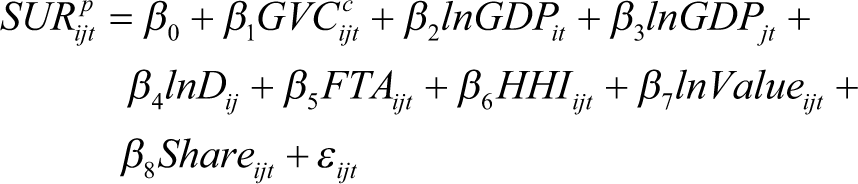
where superscripts i and j denote countries, t denotes year and ln is the natural logarithm. SUR is a set of export survival rate measures: p ∈ (FSUE, SSUR, TSUR), which are, respectively, the ratios of the numbers in the first, second and third year survivors; against the number of entrants in year t. 3 GVC is a set of global value chain measures: c ∈ (Backward, Forward), that is, the values of backward and forward participations divided by gross exports. Variable GVCtotal is the sum of them. GDPi and GDPj are the gross domestic products of countries i and j, respectively. These variables capture the market sizes, which are expected to determine the amount of GVC trade. Variable D is the bilateral distance between countries i and j. FTA is a dummy variable that receives a value of 1 if countries i and j belong to the same FTA and 0 otherwise. HHI is the Herfindahl index, which measures the concentration in the exporting market. Value is the export value per entrant, whereas Share is the share of new products in the total export value of incumbents.
The index of GVC participation is collected from the OECD TiVA 2018 database with 61 countries for the period 2005–2015. Variables SUR, HHI, Value and Share are withdrawn from the Exporter Dynamics Database of the World Bank at country-destination-year level. This database is constructed from customs agencies and is available for 69 countries from 1997 to 2014. GDP data and manufacturing share are available from the World Bank database. Data on weighted distances are from the Centre d’Etudes Prospectives et d’Informations Internationales (CEPII). After merging and cleaning those data sets, we have 6,743 observations with 1,231 country pairs from 2005 to 2014. The statistical description is reported in Table 1. We report the marginal effects at mean value.
Statistical Summary.

The average survival rate of the firms in the first-year exporting is 39.3%, and this decreases to 23.8% and 16.9% in the second and third years, respectively.
Table 2 presents the correlation coefficients between all variables. As the correlation coefficients are smaller than 0.8, the multicollinearity problem is supposed to not arise in our regression (Hair et al., 2010).
Correlation Matrix.

Empirical Results
Main Results
Table 3 reports the estimation results of Equation (1). The first three columns are the results of the regressions of FSUR, SSUR and TSUR on Backward, respectively. Similarly, columns 4–6 are for the regression on Forward, whereas columns 7–9 are for the GVC total.
Regression Results of Export Survival Rate on GVC Participation.

Robust standard errors in parentheses.
The signs of the GVC index are positive and statistically significant at a 1% level in all specifications. This result is consistent with the current literature, that is, that being involved in GVC helps firms to reduce uncertainty and asymmetric information by obtaining more information on the search costs and actual profits, thereby raising the possibility of export survival. The effect of each type of GVC participation on the survival rate is stronger in the second and third years after exporting. This implies that the success of working in the production chain in the first year reinforces the position of the firms in the chain and makes them less likely to be replaced in the following years. In addition, the firms may make use of the contacts of the chain members to extend their networks. Our result is aligned with the idea that firms within GVC networks bear higher fixed investment costs (i.e., sunk costs), which makes it more difficult and costly to start and quit new export relationships, causing relatively longer export durations (Corcoles et al., 2015; Obashi, 2010; Shao et al., 2012; Türkcan & Saygili, 2019). The other result is that the forward dimension has a higher impact than the backward one, which is aligned with Díaz-Mora et al. (2018). This implies that the supply side captured by forward participation plays a more important role in maintaining the trade relationship than the sourcing side reflected by backward participation.
Most of the control variables show the expected results. The positive and significant sign of lnGDPj implies that exporting to larger markets considerably enhances export survival due to the thick market externalities (Türkcan & Saygili, 2019). In addition, the larger the size of importers’ GDP, the easier it will be to seek new customers when the current trade relationship breaks. However, the mixed effects of lnGDPi can be explained by the interaction of the following effects. On the one hand, the level of economic development in the exporting country is expected to raise export survival as developed countries have fewer credit constraints (Brenton et al., 2009). The fact that it is costlier and riskier to establish a trade link with firms in a developing nation; means that these links are less likely to fail when compared to a trade connection with a developed nation, once this relationship is successfully formed (Díaz-Mora et al., 2018). The negative sign of the exporter’s GDP is also consistent with Nitsch (2009) and Hess and Persson (2011) in the sense that richer exporters are more likely to suffer a higher hazard. We further examine the role of economic development by using manufacturing share (Manu) as a proxy, and similar results are observed in Table A1.
The negative effect of bilateral distance (lnD) indicates that the proximity reduces the risk of export failure due to a reduction in transaction costs. It is natural to assume that, ceteris paribus, a high level of trade costs makes a trade relationship more vulnerable to adverse shocks, and reduces the probability of survival. The FTA enhances export survival only in the second and third years. Trade agreements directly reduce trade costs between members by cutting import duties, customs costs, burden of regulatory and administrative border procedures. They also indirectly lower competition with the rest of the world (Corcoles et al., 2015). The initial export value of the entrant (lnValue), capturing the initial trust towards the counterparts in the sustainability of their trade relationships, improves export survival, and this result is consistent with Besedes (2008) and Impullitti et al. (2013). By contrast, competition in the destination market (HHI), and the share of new products of the total export value of surviving entrants (Share)—dampen the likelihood of survival. The former result is aligned with Esteve‐Pérez et al. (2013), who explain that a rise in the number of exporters to a destination market, increases competition among exporters and thereby reduces the survival rate. We check this result by re-regressing the model (1) with HHI replaced by the share of the top 1% exporters. The result described in Table A2 is robust. However, previous papers also document that firms follow other exporters to make export decisions (Aitken et al., 1997). Therefore, we further examine whether a greater number of exporters selling the same HS6 product (Exporter), and a larger number of HS6 products per exporter—enhance the survival rate by reducing uncertainty on that market through information spillovers (Product). Tables A3 and A4 both show positive results.
Endogeneity Problem
Until now, we have ignored the endogeneity problem that may arise due to reverse causality between GVC participation and export survival, and omitted variables. For reverse causality, export survival may affect GVC linkage. Three arguments support this idea. First, the export survival rate of trade in parts and components is lower than that of trade in final products (Corcoles et al., 2015). This fact may shape the export strategy of firms towards trading more in the former goods. As GVC relates to trade in intermediate products, this high survival rate improves GVC integration. Second, the short-lived export rate signals a gloomy future and raises uncertainty about the potential costs and expected returns (Besedes & Prusa, 2011), and therefore discourages firms from entering or expanding export markets. In this sense, export survival affects GVC involvement via both export extensity and intensity. Third, since GVC participation can enhance the stability of trade flows in countries facing a low survival rate, the governments can implement trade policies to upgrade these countries to deeper GVC integration (Díaz-Mora et al., 2018). Concerning the omitted variables, the existence of unobservable factors such as export-oriented policies that influence both the firm’s survival, and its participation in GVC, can lead to a biased estimation (Esteve-Pérez et al., 2008).
The above arguments imply the potential existence of the endogeneity issue, which can distort our analysis. Hence, we propose an IV to deal with the endogenous bias. Based on the seminal works of Bombarda and Gamberoni (2013), Doan and Le (2021) and Thang et al. (2021), this article uses the de minimis rules of origin (RoO) as IVs for GVC participation. There are plausible reasons to explain our selection. First, we contend that RoO have an impact on GVC. RoO specifies the qualification of goods for benefiting from a tariff reduction under preferential trade agreements (PTAs). RoO affects GVC through transaction costs and by suppliers switching channels (Thang et al., 2021). In the former channel, strict RoO reduces GVC participation by decreasing the utilisation rate of PTA. In the latter channel, PTA may lead to switching from non-member to member suppliers and motivate firms to source from domestic suppliers. Hence, stringent RoO negates GVC participation. Applying regime-wide RoO, such as de minimis, can mitigate the negative effects of RoO, thereby enhancing GVC integration. 4 The de minimis rule allows firms to use a certain ratio of non-originating inputs that do not meet the technical requirements or change in tariff classification, without affecting the origin status. Doan and Le (2021) provide empirical results to support this argument. Second, we demonstrate that there is no relationship between RoO, especially de minimis, and export survival. De minimis is exogenous to export survival as it is optional for the exporting firms to take advantage of the de minimis rule. In addition, unlike the local content value, which is usually up to 40%–60%, de minimis rate is about 5%–10% (Estevadeordal et al., 2009). Hence, it is unrealistic to expect that the employment of de minimis will directly affect the firm’s decision to exit.
We use two measures for de minimis: a dummy variable, De Minimis, which takes a value of one if countries i and j form an FTA with de minimis, and the variable DeMrate, which is the rate of de minimis. The data for de minimis is collected from Estevadeordal et al. (2009) with an update from FTA’s WTO database. Using the IVs fractional probit method, we report the estimation results in Tables 4 and 5. It can be seen that when the endogeneity problem is controlled, the positive effects of the GVC index become more evident, except for the regression of FSUR on Forward in Table 4, in which we fail to reject the null hypothesis of Wald’s exogeneity test. The coefficients of GVC participation in Tables 4 and 5 are consistent with each other in terms of signs and the level of statistical significance.
IVs Fractional Probit With De Minimis.

Robust standard errors in parentheses.
IVs Fractional Probit with De Minimis Rate.

Robust standard errors in parentheses.
Conclusion
This article applies the fractional probit model to examine the effects of GVC involvement on export survival with country-year panel data. Our main findings demonstrate that both backward and forward participations have positive influences on the export survival rate; the effects of the latter are greater than those of the former. These effects become more salient when taking into consideration the endogeneity problem. These findings suggest that the government should conduct trade policies to upgrade countries into GVC linkage so as to raise the sustainability of exports and thereby facilitate exports and economic growth.
Our article has several policy implications. First, our findings strongly reinforce the significance of GVCs in the creation of long-lasting export linkages. Therefore, policies should be implemented to promote participation in GVCs, not only for joining overseas markets but also for the long lasting in export status. Second, the significant effects of backward linkage imply the role of tariffs and other trade resistance on intermediate imports, suggesting the removal of such trade resistances could result in easier access to intermediate goods from overseas markets, enhancing longer export duration. Meanwhile, the greater impact of forward participation highlights the role of value added sent to the third country for further processing and export via the value chain. Lastly, reducing trade costs by entering into more FTAs contributes to the survival of export flows.
Footnotes
Data Availability Statement
The data that support the findings of this study are available from the corresponding author upon reasonable request.
Declaration of Conflicting Interests
The authors declared no potential conflicts of interest with respect to the research, authorship and/or publication of this article.
Funding
The authors disclosed the following financial support for the research, authorship and/or publication of this article: This research is funded by Banking Academy of Vietnam under grant number NCM_02/2023.