



Abstract
The purpose of the article is to articulate and compare three major approaches or paradigms of gifted education, so that researchers and practitioners can be more explicit about their assumptions, goals, and educational strategies in their research and practice. We first define the term paradigm, and then delineate three paradigms in the historical context. We then compare and contrast the three paradigms to elucidate their continuities and discontinuities. Finally, we discuss the importance of articulating the paradigmatic nature of approaches for educational and research purposes. The ultimate purpose of articulating the distinct approaches is to seek a common research agenda with clarity, rigor, and relevance.
Keywords
Introduction: The Problem
In a recent article, Ambrose, VanTassel-Baska, Coleman, and Cross (2010) asked whether the field of gifted education, as it currently stands, is unified, insular, and firmly policed, or fractured, porous, and contested. Based on their assessment, the field does not have the coherent conceptual structure in theory and research, and there is also a disconnect between research and practice. Ziegler and Raul (2000) examined the way giftedness was defined in research and found a lack of agreement on the conceptual and operational definition of giftedness. Dai, Swanson, and Cheng (2011) completed a survey of 1,234 empirical studies conducted during 1998-2010 in the field and concluded that this body of research is preparadigmatic or nonparadigmatic in the sense that there is a clear lack of norms and canons; that is, standards governing, organizing, and coordinating research efforts. As they put it,
the tendency of research efforts to diverge in numerous directions and have a short “attention span” is disconcerting, as the consequence can be a fragmented, highly idiosyncratic body of research, with no coherent themes and issues, no conceptual clarity and methodological rigor, no agreed-upon criteria for judging the merits of a study, and no continuity of research efforts over time. (Dai et al., 2011, p. 127)
How do researchers impose order on the seeming chaos? Gagné (1999) called for unifying the terminology and nomenclature. Although a unified approach might be desirable for an academic discipline, it may not be so for a practical field such as education (or gifted education for that matter; see, Ambrose et al., 2010). Not only are gifted education practices social constructions; the very notion of “giftedness” is socially constructed to serve practical ends, for good or ill (Borland, 2003). Thus, it is inevitable that different values and priorities influence the ways we conceptualize giftedness and define the mission of gifted education.
Technically, cognitive psychology identifies different types of concepts: Some concepts can be clearly defined by their central attributes; other concepts can only be defined by evoking typical cases (i.e., prototypes), and still others cannot even be defined by evoking prototypes; they have to be demonstrated by specific instances, so much so that we might call a child prodigy in mathematics “gifted” but the child may bear little resemblance to another child who is “gifted” in another way. What this means is that even if we see gifted children as “real” out there to be served (Gallagher, 2000), the heterogeneity of high potential may defy any essentialist construal of “giftedness”; the IQ-based definition of giftedness (e.g., Gagné, 2005) can only be seen as a prototypical one (Coleman & Cross, 2005). Socially speaking, the concept of giftedness is fundamentally value-laden. A person gifted in one culture may not be seen as gifted in another largely because each culture may value and accentuate certain qualities while downplaying others (Sternberg, 2007).
Regarding the nature of gifted education as a profession, it is mainly concerned with effecting desirable changes in our most able students through proper educational provisions and adaptations, which often entail effecting desirable changes in our entrenched education systems and institutional practices. Educators have espoused different visions of what gifted education is for or ought to be (Dai, 2010). They have to do with a whole range of educational, ethical, social–political, and pragmatic considerations related to whether and how we should provide services deemed necessary to a selective group of students. It is a normative enterprise rather than a purely academic exercise, deciding on the issue of “what ought to be,” rather than “what is” (Simon, 1969). Solving the problems of means is impossible if we cannot even agree on what ends the means serves. In other words, we need to address the question of “why,” as well as that of “what.”
Given the situation delineated above, a delicate balance needs to be struck between hasty consensus building and laissez-faire (Dai, 2010). Instead of seeking consensus on definitions and nomenclature, we can assess how giftedness is conceptualized and gifted education fashioned to serve its designed purposes in the current practice. In this article, we undertake to articulate different assumptions, goals, and practical strategies undergirding major approaches or paradigms of gifted education. The purpose of the exposition is to seek conceptual clarity in our scholarly and scientific discourse, and ultimately clarity, rigor, and relevance in research and practice in gifted education.
Defining Paradigm
The term paradigm implies a system of thought or practice that dominates thinking, feeling, and doing in a field, so much so that it becomes the norm, deviation from which can be quickly and easily detected (Kuhn, 1962). Paradigms and paradigm shift have been discussed in gifted education for decades (Borland, 2003; Feldman, 1992; Matthews & Foster, 2006; Treffinger & Feldhusen, 1996; Ziegler & Phillipson, 2012). What we describe as “paradigms” in gifted education sometimes present themselves explicitly, and other times implicitly in our practice, functional but not well articulated. One of the main purposes of this article is to make these unarticulated or underarticulated paradigms explicit enough to allow for systematic research and comparison so that practices of gifted education can be truly disciplined, subject to critical scrutiny, comparative analysis, and self-correction. For the purpose of this article, we consider any human practice as paradigmatic to the extent that it has a coherent set of assumptions, goals, and procedures agreed on by a group or community of practitioners as standards of practice. Four major elements define the nature of a paradigm in gifted education:
A clear assumption of the nature of giftedness and what “educational needs” it presents (the question of “what”). The question goes beyond definition issues to reflect one’s understanding of the nature, constituents, and development of the so-called “gifted” quality. Ziegler and Phillipson (2012), for example, call for a paradigm shift in our thinking toward a systemic view of giftedness and gifted education.
A clear purpose of educational provisions and services and consequently what criteria determine the “success” of such services or programs (the question of “why”). Subotnik, Olszewski-Kubilius, and Worrell (2011), for example, call for a change of direction toward a talent development approach with eminent domain contributions as its ultimate goal, in effect a paradigm shift in the raison d’être of gifted education.
A clear delineation of the means and ends of identification that is consistent with the assumption (“what”) and purpose (“why”) and meets the criteria of reliability and validity (the question of “who”). For example, instead of determining and verifying the “gifted” status, the diagnostic approach to identification advocated by some scholars (Coleman & Hughes, 2009; Matthews & Foster, 2006), which assesses what provisions, interventions, or instructional adaptations are appropriate given the manifest needs, fundamentally changes the meaning and function of identification, and thus represents a paradigm shift.
A clear articulation of educational provisions, adaptations, or interventions to achieve the set goals (purpose) as well as assessment systems to keep track of their progress and success (the question of “how”). For example, recent movements in gifted education reflect two distinctive approaches: various attempts to break the boundaries of traditional schooling and its institutionalized practices for talent development purposes on one hand, and various attempts to individualize learning with curriculum-based interventions for advanced learners within the confines of schooling on the other. These two approaches, on scrutiny, show paradigmatic differences, as we shall discuss later.
Paradigm of practice defined by this What, Why, Who, and How framework distinguishes itself from scientific paradigm (Kuhn, 1962). A paradigm of research on natural phenomena is only concerned with the questions of “what” (ontology) and “how” (epistemology) and is often claimed to be universally valid. In contrast, a paradigm of educational practice goes beyond the question of “what” is the nature of learning and development involved; it addresses the normative question of “why” certain changes or outcomes are desirable, and “how” these changes can be effected through education, and “who” will benefit from specific provisions or interventions; a paradigm of gifted education so defined needs to be representative of the canons of gifted education, but is by no means universally viable. Practically, a paradigm that specifies “what,” “why,” “who,” and “how” operates at a programming level (Moon & Rosselli, 2000). Figure 1 shows how the four components related to one another, what we might call rhetorical structure, or simply the logic.
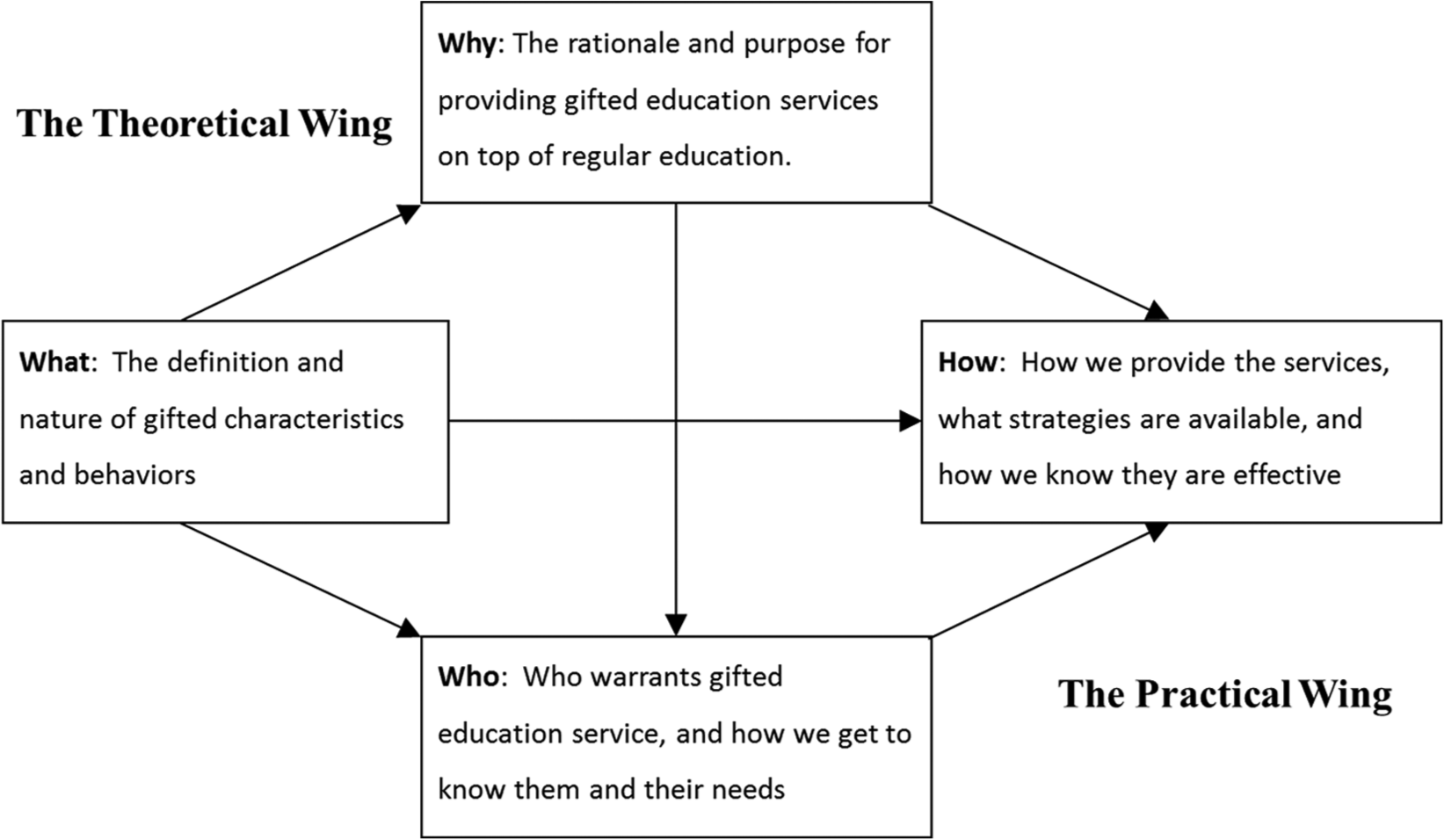
Components and relationships of a paradigmatic approach to gifted education.
As indicated in Figure 1, the assumption of the nature of giftedness constrains, but does not dictate, purposes of gifted education. In other words, the conceptualization of purposes of gifted education has to be compatible with how giftedness is understood; however, given the same understanding of the nature of giftedness, there can be multiple ways to justify gifted education provisions, which are value-laden by nature. By the same token, answers to the “what,” “why,” and “who” questions will collectively constrain answers to the “how” question, but there will always be multiple ways to tackle a problem, from which optimal solutions or “best practice” might emerge. The logic of a paradigm, which consists of a chain of reasoning connecting the four components, is judged by its coherence. Another criterion for a paradigm is conceptual distinction, which means that assumptions, purposes, and strategies and tools fashioned in a practical approach have a distinct identity, thus distinguishable from other approaches. Thus, a talent development approach can be easily identified as different from a gifted child approach, so on and so forth.
Besides coherence and conceptual distinction, there is a third element to a paradigm of practice: its practical and empirical grounding, meaning that a paradigm of practice needs to be realized in particular social–cultural settings and practically and empirically viable. This pragmatic feature makes a paradigm of practice contextually bounded rather than universal, as a scientific paradigm typically aspires (Kuhn, 1962). Here a distinction needs to be made between the theoretical validity of a paradigm and its practical viability under a specific social–cultural condition. It is one thing to say that a paradigm suffers from logical flaws (e.g., incoherent) and is theoretically untenable, but another to argue that a paradigm, albeit theoretically sound, is not feasible in a particular social–cultural context. For instance, we may criticize differentiation for highly able students in the regular classroom as “unrealistic” due to the lack of proper training for classroom teachers, but this is not the reason for discrediting it as theoretically invalid. It could be a viable option if certain practical conditions are met (e.g., well-trained classroom teachers and individualized instruction). We call the latter “conditions of satisfaction,” or simply, practical constraints for implementation of a paradigm. The practical success or failure may depend on, among others, the following factors (from macro to micro levels):
General sociocultural context (e.g., values held by a community)
Local, state, and national policy (e.g., whether high-level excellence is a priority)
Institutional mission and leadership (e.g., whether there is strong leadership)
Social organization of learning (e.g., whether it is conducive to emergence of giftedness)
Curricular and pedagogical adaptations (e.g., effective and creative implementations)
Supporting tools and resources for particular learning activities and goals
Professional development, particularly for teachers
Psychosocial dynamics of learning (microlevel optimal fit of the person and learning environments)
A paradigm may be successful in one cultural or institutional context but failing in another, mainly because one of the above components may not be present or strong enough. Whether support or criticism is based on theoretical and scientific (the logic) or on practical (condition of satisfaction) grounds is an important one. Conditions of satisfaction lead to pragmatic considerations of a paradigm of practice: No matter how theoretically ideal it may be, a paradigm of practice has to be “tested” in practical contexts, and prove applicable to a range of educational and cultural settings, and show robustness when conditions for implementation are not optimal.
Defined as such, a paradigm of practice should be distinguished from a practical model. A paradigm operates at a more general, theoretical level, from which specific implementations or models can be derived. For example, Talent Search programs, or schools specialized in arts or science, are practical models that instantiate a paradigm of Talent Development. Because a paradigm operates at a more general level, multiple practical models under the same paradigm should be common: While holding their paradigmatic integrity, specific models are adaptive to available local resources, conditions, and constraints.
In the following section, we will delineate three paradigms of gifted education, based on the framework: (a) the “gifted child” paradigm, (b) the “talent development” paradigm, and (c) the needs-based “differentiation” paradigm. Identification of the three paradigms is based on historical and theoretical grounds, though it is conceivable that there may be new, emergent paradigms that meet the criteria we have specified above.
A Delineation of Three Paradigms of Gifted Education
Historically, each paradigm has its own tractable history, basic assumptions, and distinct concerns and practices. The gifted child paradigm is a dominant paradigm throughout most of the 20th century in the United States until 1990s, when there was a surge of talent development models (Coleman, 1985; Feldhusen, 1992; Gagné, 1995; Piirto, 1994; Renzulli, 1994). Indeed the term paradigm shift was used (Feldman, 1992; Treffinger & Feldhusen, 1996). Morelock (1996) was one of the earliest to identify the gifted child and the talent development models as two distinct modes of gifted education. A third force, differentiation, has its own predecessors (e.g., V. Ward, 1961) but has emerged largely from changing practices in special education in the context of full inclusion, initially in terms of differentiated instruction and then response to intervention (RtI). In the main, it seeks a classroom-based, diagnostic approach without the need for labeling some children “gifted” or setting up separate programs for the “gifted” (Borland, 2003; Coleman & Hughes, 2009; Matthews & Foster, 2006).
The Gifted Child Paradigm
Terman and Hollingworth were the most important figures in starting this tradition. 1 The import of intelligence testing by Terman (1925) can be considered a technical “breakthrough” that made it possible to claim that it is not only theoretically sound but practically viable to designate a group of children as “gifted.” The motivation for establishing this category of children was the betterment of the human race, a cause associated with Social Darwinism popular at the time (Hall, 2003), though the focus was later shifted toward the well-being of these children themselves, as Hollingworth (1942) advocated. In the larger scheme of education, the categorical approach to gifted education (identifying a generic category of gifted children for educational purposes) was related to the social efficiency model of education, which stratifies children based on IQ as the main indicator of human potential and sets up differential educational goals accordingly (Borland, 2003; Shepard, 2000). These constitute the main historical backdrop for the emergence of the gifted child paradigm in the United States. For a full representation of this paradigm, we also include Torrance (1963) as part of this tradition, given his vision and research regarding the creatively gifted.
Assumption: The “what” question
The gifted child paradigm assumes that giftedness is a general human quality that can be mostly reliably measured by intelligence tests (Terman, 1925). This quality is equated with the ability to learn at a fast rate, to master complex ideas, to reason at a high level of abstraction (Carroll, 1997; Gagné, 2009; Gallagher, 2000), hence its pervasive impact on one’s life (Gottfredson, 1997). Those who rank very high on the measure of this personal quality are likely to become a cognitive elite and make significant contributions to the civilization and culture in various ways, as general intelligence can presumably be “flexibly channeled and utilized in multiple ways, depending on environmental circumstances and motivations” (Dai, 2010, p. 39). Although Torrance deviated from the IQ legacy by placing a premium on creative potential, he also tended to think of this human capital as pervasive in its influence across domains of human activities and enduring throughout life. The high facility in intellectual functioning aside, what drove this paradigm was a deeply rooted assumption that gifted children and adults are qualitatively different from the rest of the population, as they show distinct differences in ways of thinking, social–emotional characteristics, educational needs, and developmental trajectories and pathways (Hollingworth, 1942; Roeper, 2006; Torrance, 1963). These two ways of thinking about how gifted children differ from their peers (i.e., high potential and unique personhood) lead to different answers to the “why” question.
Purpose: The “why” question
Prescribed goals for gifted education vary within the gifted child paradigm, ranging from a focus purely on individuals to a focus on both personal ends and social contributions. We can roughly distinguish between a Terman tradition and a Hollingworth tradition, and see Torrance as a third force. The Terman tradition is more instrumental: The aim of gifted education is to make the most productive use of high potential; namely, to make gifted children future leaders on various fronts of human endeavor; serving them promotes the welfare and vitality of a society. The Hollingworth tradition, in contrast, is more intrinsic to identified gifted children themselves. Hollingworth emphasized interventions tailored to the uniqueness of gifted and talented students’ cognitive development, social–emotional experiences, and corresponding educational needs, not unlike special provisions for the mentally retarded or learning disabled (see Dai, 2010; Renzulli & Dai, 2003). In comparison, Torrance saw education not as a medium for achieving greatness, as Terman would advocate, nor as a way of self-understanding and making social adjustments, as Hollingworth would stress, but as a way to maintain and nurture personal creativity as a way of life (Torrance, 1963, 1970).
Targeted students: The “who” question
Historically, the gifted child paradigm has predominantly used various IQ tests as the main criterion for establishing one’s gifted status. The status definition makes the identification of the gifted de facto a practice of classification. The current practice is more flexible, typically including achievement tests and other rating scales. Yet having a metric is still essential for determining who and what proportion of students at the high end of a normal distribution on some critical measures should be classified as gifted for service purposes (indeed, many states in United States define gifted students as a percentage). Following the Terman tradition, a small proportion of students (ranging from 3% to 5%, depending on school districts; the National Association for Gifted Children [NAGC] workforce recently proposed 10% of the population) are eligible for special services; characteristically, the cutoffs are quite arbitrary (Hertzog, 2009). Based on this metric, the presence, degrees, and levels of giftedness can be determined, from moderately gifted, extremely gifted, to profoundly gifted (Gagné, 2005). The nomothetic approach can also stipulate a typology and profiling of various subgroups, such as the creatively gifted (Gagné, 2005; Torrance, 1963), gifted girls (Kerr, 1997), gifted underachievers (Reis & McCoach, 2002), students with twice exceptionalities (Assouline, Foley Nicpon, & Whiteman, 2010), extremely gifted students (Winner, 1997) and the like for interventions (see, Betts & Neihart, 1988, 2004; Neihart, 2010, for a typology).
Strategy: The “how” question
The Terman tradition, with its assumption of giftedness as high potential, makes gifted education an integral part of the social efficiency model of education, whereby those identified as gifted are offered services in the form of various pullout or self-contained programs aimed at enhancing creativity, leadership, and higher order thinking. These provisions serve a distinct set of educational goals deemed particularly (sometimes exceptionally) suitable for the gifted (Shore & Delcourt, 1996). Various forms of subject-based and grade-based acceleration are also a main approach to accommodating the fast learning pace of gifted students (Rogers, 2007).
Many scholars agree with Terman that high intelligence is a necessary, but not sufficient, condition for ultimate adult achievement and eminence; nonintellective and environmental catalysts play an important role (e.g., Gagné, 2004; Lubinski, 2004). Intrapersonal catalysts include motivation and personality, and environmental catalysts include environmental opportunities and instructional and technical support (Gagné, 2004). Thus, gifted programming should provide challenges on a regular basis for the gifted and allow them to work in their unique areas of passion; it should also provide opportunities for the gifted to learn with intellectual peers in a stimulating environment (Rogers, 2007). For Torrance (1963, 1970), a pedagogy that encourages creative learning and thinking is essential. Affective curriculum is a very important component of gifted education (VanTassel-Baska, Cross, & Olenchak, 2009). Counseling for social–emotional issues and self-development is also a distinct component of many intervention programs for the gifted (Kerr, 1997; Silverman, 1993).
The Talent Development Paradigm
Although talent development as a movement did not occur until 1980s and 1990s, it was presented as an alternative to the gifted child paradigm for many decades (see A. R. Robinson, 2012). Discontent with the gifted child paradigm derived from several concerns: (a) an IQ-based definition fails to identify a broad range of individuals who are talented in specific domains (Witty, 1958); (b) the gap between “schoolhouse giftedness” and “creative productive giftedness” (Renzulli, 1986); and (c) developmentally informed educational practices that better cultivate talents on various fronts of human endeavor to their fruition in the form of eminent contributions (Bloom, 1985). It first started as a definition issue. For example, Witty (1958) made the following suggestion that attempted to challenge the IQ dogma:
There are children whose outstanding potentialities in art, in writing, or in social leadership can be recognized largely by their performance. Hence, we have recommended that the definition of giftedness be expanded and that we consider any child gifted whose performance, in a potentially valuable line of human activity, is consistently remarkable. (p. 62)
In this definition, the scope of giftedness was broadened to include a range of authentic activities that go beyond the orthodox conception of giftedness as indicated by high scores on measures of general intelligence. More important, the notion of the generic “gifted” as a category of children was replaced by that of diverse manifestations of gifted behaviors and performances. Renzulli (1978) cited research in support of the argument that “creative accomplishment is not necessarily a function of measured intelligence” (p. 182). He proposed the first developmental conception of giftedness in history: the three-ring model of giftedness. It postulates that some essential components of giftedness, such as task commitment and creativity, are developmental and contextual in nature. What is unique about this theory is the argument that nurturing these “gifted” qualities through education are as important as, and sometimes more important than, merely identifying these qualities (see also Renzulli, 1999). Moreover, according to Renzulli, schools often fail to pay attention to these qualities. Subotnik and Olszewski-Kubilius (1997) later picked up and developed these themes. Since the 1980s, drawing on the conceptions of multiple and multidimensional intelligences (e.g., Gardner, 1983; Sternberg, 1985), researchers in gifted education (e.g., Bloom, 1985; Feldhusen, 1992; Feldman, 1992; Gagné, 1985; Passow, 1985; Piirto, 1994; Tannenbaum, 1983) have started to look at various manifestations of talent in different domains and how these talents develop (see Subotnik et al., 2011, for a comprehensive review).
Assumption: The “what” question
Compared with the traditional, hereditary conceptions of giftedness prevalent under the gifted child paradigm (Gagné, 2005; Gallagher, 2000; Terman, 1925), giftedness from a talent development perspective is a more malleable set of developing capabilities and potentialities, cognitive or noncognitive (Feldman, 2003; Horowitz, Subotnik, & Matthews, 2009; Sternberg, 1999; Subotnik et al., 2011). Although not excluding the possibility that general intelligence plays a role in a particular line of talent development, the talent development paradigm assumes a broader psychosocial basis of gifted and talented potential, stressing (a) the evolving, changing, and increasingly differentiated or domain-specific nature of talent; (b) the significant role of motivation; (c) the crucial role of timely opportunity and in-depth domain experiences; (d) differential trajectories, pathways, and niches; and (e) technical and social support (including mentorship) every step of the way (Bloom, 1985; Csikszentmihalyi, Rathunde, & Whalen, 1993; Feldman, 2003; Subotnik et al., 2011).
Purpose: The “why” question
The aim of the talent development paradigm is mainly to cultivate a broader, more diverse range of strengths and interests and to help students achieve excellence in their chosen areas. Although domain excellence is seen as the goal of gifted education in the talent development paradigm, a range of foci exist. Some researchers focus on culturally well-defined domains, professional standards, and eminent creative contributions (Subotnik et al., 2011); the main task for educators, then, is to decide on the timing and trajectory of specialization as well as when to institute formal training, coaching, and mentoring. Others have a more personal focus; the main task for educators is to provide abundant opportunities so that gifted students can make their own selections and create their own niches. As Sternberg (2007) argued,
[p]eople develop their intellectual skills in line with where in life they wish to go: Professional tennis players, artists, violinists, and plumbers all need to develop somewhat different (although partially overlapping) sets of intellectual skills to succeed in their respective lines of work. (p. 148)
Although sharing the same vision with the gifted child paradigm in terms of education for leadership (Renzulli, 1999; Sternberg, Jarvin, & Grigorenko, 2011; Subotnik et al., 2011), the talent development paradigm promotes leadership in a more diverse range of human activities and stresses the unique contributions that each individual can make to the rich fabric of society. As Renzulli (1998) stated,
[o]ur vision of schools for talent development grows out of the belief that everyone has an important role to play in the improvement of society and that everyone’s role can be enhanced if we provide all students with the opportunities, resources, and encouragement to develop their talents as fully as possible. (p. 107)
Targeted students: The “who” question
Since the definitions of and criteria for giftedness have shifted from contrived testing to authentic performance, from some alleged general mental superiority to diverse capabilities and aptitudes that are developing, the talent development paradigm targets a more inclusive, heterogeneous group of individuals. Identification in this paradigm consists of a set of criteria for cognitive or noncognitive aptitudes deemed uniquely fit for a particular line of talent development. Sometimes identification takes the form of formal selection (e.g., in a specialized school or program) through a combination of quantitative and qualitative assessments to determine who is likely to benefit from a given opportunity for talent development (Lohman, 2005, 2009). Other times students self-select themselves into particular opportunities (clubs, optional enrichment activities, advanced placement classes, research opportunities). For example, Renzulli and colleagues (Renzulli & Reis, 1986, 1997; Renzulli, Reis, & Smith 1981) proposed the revolving door identification model, in which a talent pool of students receive regular enrichment experiences and are given the opportunities to self-select into Type III creative productive experiences (see also, Passow, 1981). Testing of IQ become less central in selecting students, and are sometimes used as a threshold requirement in the midst of a variety of criteria in facilitating an informed judgment of goodness of fit vis-à-vis a talent development activity.
Strategy: The “how” question
Logically, if inclusiveness and diverse opportunity characterize the talent development paradigm in terms of targeted students, providing a range of interest-based learning experiences and in-depth domain experiences is the means to an end of further engagement and more serious pursuit of their interests. These learning experiences need to be authentic, resembling what professionals do in the real world as much as possible, involving productive thinking and product-driven activities that have a real social impact (Renzulli & Reis, 1997). What distinguishes member schools of the National Consortium of Specialized Secondary Schools for Math, Science, and Technology from others in the United States is not merely a heavier STEM (science, technology, engineering, mathematics) course load. Engaging students in research on real problems and nurturing the modus operandi of a profession are a hallmark of their pedagogy (Canipe, 2012). For participation in a valued line of human endeavor, apprenticeship and mentorship experiences are indispensable (Subotnik, 2006), which often involve experts outside school. To make this kind of talent development occur for a wide range of human activities beyond basic school subjects within the traditional school system is challenging because of both resource and logistic constraints. Therefore, specific talent development models characteristically attempt to overcome practical constraints in school settings by enlisting resources and supports from parents, communities, colleges, and industries, among others (Brody, 2004; Subotnik & Olszewski-Kubilius, 1997).
Although signs of talent might appear at different times and under varying conditions, talent development requires long-term involvement in a domain (Dai & Coleman, 2005). Therefore, talent development approaches and models pay special attention to long-term trajectories and pathways (Feldhusen, 2003; Lubinski & Benbow, 2006) so as to proactively develop an agenda in educational programming that addresses unique advancing needs of talented students.
The Differentiation Paradigm
Although explicit paradigmatic prescriptions about needs-based differentiation did not emerge until recently, the notion of differentiation has been around for decades. In essence, the differentiation paradigm argues that curriculum and instruction should be adapted to the needs of gifted students on an individual-by-individual basis. N. M. Robinson and Robinson (1982) proposed the notion of optimal match of educational setting for the highly able learners through providing flexibility in learning progression instead of the rigid age-graded academic placement. Questioning the effectiveness of the pullout gifted program as merely an added-on to the regular curriculum without any systematic design, M. Ward (1982) argued that the regular curriculum within schools should be adapted to provide all day learning environment that meets the needs of those advanced learners and ensure continuity in their learning experiences.
In addition to these theoretical and practical concerns, the inclusive educational movements act as a major catalyst for the emergence of the differentiation paradigm (Sapon-Shevin, 1994, 1996; Stainback & Stainback, 1990). Full inclusion and heterogeneity of classes make curricular and instructional differentiation even more imperative, since students typically spend most of their school time in general education classrooms regardless of the ability level (Borland, 2003; Tomlinson, 2004). As the diversity of students escalates, the question of how to meet precocious and advanced learners’ unique learning needs through appropriate, personalized education services in the regular classroom becomes even more salient for educators.
Like the other two paradigms, the differentiation paradigm also has variations in its implementation. Matthews and Foster (2006) posit that gifted education should be conceptualized as “providing a dynamically responsive education match for students who otherwise experience a mismatch with the curriculum normally provided” (p. 65). Borland (2003) views differentiated curriculum as the raison d’être of gifted education. Tomlinson (2005, 2008) sees differentiated curriculum and instruction as the mainstay of gifted education. More recently, the RtI approach and models of tiered services have been borrowed from special education for designing interventions with advanced learners (e.g., Coleman & Hughes, 2009; King, Coleman, & Miller, 2011).
Assumption: The “what” question
The differentiation paradigm defines educational needs of gifted students specifically in the context of school subjects and determines whether the “needs” are met in real-time classroom situations. Therefore, needs presented to educators are situational (e.g., a mismatch), right there in the classroom, defined within the confines of school curriculum. When curricular content and process fall outside a student’s zone of proximal development (i.e., too easy or too hard), differentiation is called for (Dai, 2010). The differences in learning curve demonstrated by gifted learners are believed to be subject-specific and open to change rather than domain-general and permanent. As for how educational needs are further explicated, some focus exclusively on the issue of the appropriateness of content, such as learning pace, curricular depth, and representational complexity (e.g., VanTassel-Baska & Stambaugh, 2008), and others have a broader conception of “needs,” including individual interests and a range of personal characteristics such as learning and thinking styles, as the basis for differentiation (e.g., Renzulli & Reis, 2009; Tomlinson, 2005, 2008).
Purpose: The “why” question
The practice of needs-based differentiation is purported to better align services with the manifest needs of advanced students in the regular classroom rather than vague conceptions of “aptitude” or “potential.” The main impetus of differentiation is to (a) avoid gifted–nongifted bifurcation that raises equity concerns and (b) better match services with specific identified strengths, interests, and styles. Instead of pursuing long-term goals and prospects, to which the gifted child paradigm and the talent development paradigm often aspire, the differentiation paradigm considers what is “appropriate” given a child’s profile of strengths, interests, and styles (Tomlinson, 2008). Thus, the educational concerns of the differentiation are less ambitious and more subscribed than the other two approaches, with a focus on current concerns, problems, and needs in school settings (Borland, 2012).
Targeted students: The “who” question
Under the differentiation paradigm, the meaning and nature of identification has changed (or some may say the term identification is no longer appropriate): It is not to establish the “gifted” status (as in the case of the gifted child paradigm) or select a group of students for a particular line of learning activities (as in the case of the talent development paradigm), but to diagnose what are the unmet educational needs presented by individual students (gifted or disabled alike) in the current situation, and how these needs can be best matched with an appropriate curriculum and instruction. Diagnosis can be performed with high-ceiling tests (Matthews & Foster, 2006), by assessing levels of mastery vis-à-vis curriculum (Reis, Burns, & Renzulli, 1992), or by the RtI (Coleman, 2012; Coleman & Hughes, 2009).
Strategy: The “how” question
Gifted education under the differentiation paradigm is conceptualized as providing a dynamically responsive educational match for students who otherwise experience a mismatch with the curriculum they receive. It is done through diagnosing their current levels of subject-specific mastery, and matching their needs with appropriate curriculum and instruction given the resources within school (Matthews & Foster, 2006; Tomlinson, 2008).
Based on different understandings of the nature of “needs,” there are two ways of thinking about differentiation: qualitative and quantitative. Differentiation in qualitatively different ways means that curricular and instructional modifications and adaptations are discontinuous from what is offered in regular classroom, so much as that separate provisions are warranted (Matthews & Foster, 2006). Adding interest and style components as “needs” accentuate the qualitative difference argument. In comparison, differentiation in quantitatively different ways is a less radical argument, based on the assumption that “[t]here are no environmental modifications; principles of content, process, or product; or instructional strategies uniquely appropriate for gifted learners” (Tomlinson, 1996, p. 173). In other words, there is no unique curriculum or pedagogy that works exclusively for the “gifted” (see also Kaplan, 2003). The basis of education for gifted students, like all students, is the curriculum. Differentiation is
grounded in differential standards of performance at a given period of time. Standards are constant; time is the variable. Such an approach holds promise for gifted students in that the level and pace of curriculum can be adapted to their needs. (VanTassel-Baska & Wood, 2010, pp. 346-347)
The “How” question ultimately relies on the “Why” question. If gifted services are more confined to school subjects stipulated by the curriculum standards (say, the Common Core), then an existing curricular framework may be sufficient to accommodate individual variations in pace, depth, and/or complexity. If educational services are more “learner-centered,” differentiation will have to be more qualitatively different to accommodate unique strengths, interests, and styles individual learners present, leading to an agenda broader than what the school curriculum prescribes.
Theoretical Comparison of the Three Paradigms: Continuities and Discontinuities
In the preceding section, we have delineated three paradigms in terms of their logic, conceptual distinction, and practical and empirical grounding. Although there are obvious tensions and differences among the three paradigms in terms of the questions of What, Why, Who, and How, they share the same conviction that there are fundamental individual differences among human beings that required differential educational treatments. Educational equality does not mean that we should endorse a one-size-fits-all, age-graded curriculum. Logically, for highly able or advanced learners, some degree of optimal match is warranted between their levels of development and learning needs on one hand, and educational provisions on the other. In this sense, the two late comers, the talent development paradigm and the differentiation paradigm have inherited a legacy of the gifted child paradigm. Apparently, the differentiation paradigm inherits the legacy of the gifted child paradigm in its emphasis on optimal match but with more detailed understandings of education-relevant characteristics, changes, and related intervention strategies. The talent development paradigm inherits the legacy of the gifted child paradigm in its emphasis on developing leaders of the future on various fronts of human endeavor, but with a more pluralistic, contextual, dynamic outlook regarding human potential.
Despite the continuities mentioned above, paradigmatic differences imply some qualitative differences or discontinuities. Table 1 compares the four major dimensions of the three paradigms using the 4W (What, Why, Who, and hoW) framework.
Major Points of Differences Between and Among the Three Paradigms.

The Talent Development Paradigm Versus the Gifted Child Paradigm
The main difference between the two paradigms is whether one adopts an essentialist or developmentalist perspective on giftedness (i.e., the “what” issue; Dai, 2010); this commitment influences the entire rhetorical structure (“who,” “why,” and “how”). The gifted child paradigm has long been criticized for treating giftedness as an essence that has a genetically predetermined unitary structure, thus committing an error of reification (Borland, 2003; Dai, 2005; Lohman, 2009; Treffinger & Feldhusen, 1996; Ziegler & Heller, 2000; Ziegler & Phillipson, 2012). Based on this paradigm, gifted children are seen as an exclusive category of individuals; those who are identified as “gifted” by virtue of test scores somehow enjoy a permanent identity as “gifted” (once “gifted,” always “gifted”), whereas the rest by default are nongifted regardless of their task performance and authentic achievement; a category assignment entitles them to special educational provisions. In contrast, the talent development paradigm embraces a more diverse, inclusive set of markers for giftedness, and views developmental corridors, trajectories, and pathways as more important than aptitude test scores (Dai & Renzulli, 2008; Dai & Speerschneider, 2012; Haensly, Reynolds, & Nash, 1986; Lohman, 2005, 2009; Subotnik et al., 2011; Treffinger & Cross, 1994; Treffinger & Feldhusen, 1996; Ziegler & Phillipson, 2012; see Dai, 2010, for discussion of foundational issues). It tries to distinguish between domain-general and domain-specific aptitudes, and universal and nonuniversal developmental trajectories (Feldman, 2003). Furthermore, gifted behaviors can be nurtured rather than merely identified. In other words, rather than a static quality or an absolute and permanent state of being, “giftedness involves continual doing, changing, and becoming toward a more advanced level” (Dai & Coleman, 2005, p. 377), and talents are “nurturable and emergent rather than as fixed and immutable” (Treffinger & Feldhusen, 1996, p. 186).
The Differentiation Paradigm Versus the Gifted Child Paradigm
Although the notion of differentiated curriculum and instruction is highly congenial to the gifted child paradigm with the “why” question, in that both stresses “optimal match” as a hallmark of a good learning environment (N. M. Robinson & Robinson, 1982), the differentiation paradigm focuses on manifest needs and proximal characteristics closely associated with the current curriculum (what is taught) and instruction (how it is taught). It avoids making general, categorical assumptions and claims about the “gifted” that are hard to verify (indeed, the gifted child paradigm is characterized by Matthews and Foster as a “mystery model”; see Matthews & Foster, 2006, p. 64). For this reason, identification becomes purely diagnostic, determining a child’s educational needs presented in a classroom situation rather than determining whether a child is “gifted.” The need to establish one’s gifted status for the purpose of providing services (a categorical approach) disappears, as assessment of functionality and educational progression go hand-in-hand and become reciprocal at the individual level.
Moreover, the differentiation paradigm fully situates gifted education within the school curriculum framework that emphasizes subject-matter knowledge as well as thinking skills. Such an approach typically has more academic rigor than, say, thinking skill training in some enrichment programs for the gifted, and less vulnerable to the criticism of gifted education as ineffective (Berliner & Biddle, 1995) or elitist (Margolin, 1994). Because the differentiation paradigm pays close attention to ongoing assessment of the match and mismatch between what the child is capable and what is offered, it theoretically ensures a high degree of the continuity of educational experience, thus avoiding the problem of a disconnect between what is offered in regular classroom and what is offered in pullout programs (V. Ward, 1961).
The Talent Development Paradigm Versus the Differentiation Paradigm
As we mentioned above, historically, both the talent development and the differentiation paradigms have evolved and departed from the gifted child paradigm out of the same discontent. For example, they both assume the heterogeneity of gifted populations (e.g., compare Lohman, 2005, and Tomlinson, 2005), take a domain-specific approach (e.g., compare Dai & Coleman, 2005 and Matthews & Foster, 2006), and prefer to label services rather than persons “gifted” (e.g., compare Renzulli, 1986 and Borland, 2003). However, the two paradigms differ from each other in important ways.
First, for the “what” question, the talent development paradigm still endorses the concept of “aptitude” or “potential” used by the gifted child paradigm, and various distal and proximal measures of domain-general and domain-specific abilities and achievement can be used to gauge the aptitude for a particular line of talent development (Lohman, 2009; Lubinski & Benbow, 2006). In contrast, the differentiation paradigm attempts to avoid the concept of potential and instead use manifest “needs” in situ as the main basis for interventions.
These differences between the talent development and differentiation paradigms regarding the “what” question also betray their differing educational goals and priorities (i.e., the “why” question). In other words, they have differing educational ambitions (what is gifted education for), and consequently differing needs for assessment (the “who” question), and differing scopes of service envisioned (the “how” question). From a talent development perspective, promoting talent development and creative productivity is the main goal of gifted education (Feldhusen, 2003; Renzulli, 1986; Subotnik et al., 2011). Thus, all qualities known to facilitate talent development, endogenous (e.g., abilities, interest, and task commitment) or exogenous (e.g., research and mentorship experiences), need to be identified and mobilized for this purpose. Transitions from one stage to another needs to be carefully charted and supported (Horowitz et al., 2009; Subotnik et al., 2011). In comparison, the differentiation paradigm has a more circumscribed goal for gifted education: matching curriculum and instruction with students’ capabilities and characteristics in a given classroom situation, which is made possible by ongoing assessment and flexible adaptation in curriculum and instruction. To a certain degree, differences between the talent development paradigm and the differentiation paradigm can be seen as a continuation of the old debate between advocates of enrichment and those of acceleration, a legacy of gifted child paradigm that bears fruition (two divergent paths) in today’s context (Callahan & Miller, 2005; Coleman, 2004).
Consequently, for the “who” question, identification for the talent development paradigm retains its selection function. Predictive validity is still a main concern (i.e., who has a distinct strength and advantage vis-à-vis a particular line of talent development?), whereas ongoing assessment of educational progression and appropriate adaption in the differentiation paradigm makes identification purely an issue of dynamic assessment for intervention (diagnosis of match and mismatch; see, Matthews & Foster, 2006, or in the case of RtI, an intervention–diagnosis–intervention cycle).
Regarding the “how” question, the talent development paradigm envisions various strategies, such as infusing a talent development agenda into the existing curriculum, providing out-of-school authentic learning experiences, creating a community of kindred spirits through clubs or Internet, providing mentorship experiences with university- or industry-based experts, thus, not as restricted by boundaries set up by traditional schooling, whereas the differentiation paradigm, by and large, attempts to work within the school boundary, particularly its curriculum structure. From a practical point of view, because of the differences in goals and scopes of services, the talent development paradigm has a natural tendency to expand beyond school walls to enlist resources across school, home, community, university, industry, and Internet in forming a support system for talent development. In comparison, the differentiation paradigm attempts to fit gifted education within the confines of existing school systems with a finite set of resources (e.g., curriculum, infrastructure, expertise). It is not surprising that various Talent Search centers are university-based (e.g., Center for Talented Youth at Johns Hopkins University) or industry-based (Intel Science Talent Search), whereas most of the differentiation models (e.g., RtI) were firmly based on school practices. “Conditions of satisfaction” at the practical level for the two paradigms are quite different.
We are not the only ones who identify this divergent pattern of development in gifted education. Callahan and Miller (2005) identified two distinct approaches to gifted education predicated on two kinds of learning and developmental pathways: one is academic–accelerative path (a Julian Stanley’s legacy), and the other creative–productive path (Joseph Renzulli’s tradition). In the same vein, Coleman (2004) identified two influential definitions in the field, one representing an academic content orientation, and the other representing a process/creative product orientation. They parallel the trends portrayed in Figure 2. In response to Subotnik et al.’s (2011) call for a paradigm shift to a talent development approach to gifted education, McBee, McCoach, Peters, and Matthews (2012) argue that incoherence is an inevitable consequence of the fundamental incompatibility of psychological and educational approaches, and that the field would fare better if split into two different approaches: a talent development approach based on high-ability psychology and an advanced academics approach. Worrell, Olszewski-Kubilius, and Subotnik (2012) argue in their rejoinder that it is impossible to separate an educational endeavor from its psychological foundation, including the assumption of high ability. 2 We agree with Worrell et al. that the success of the field relies on a meaningful integration of psychology into educational practice (Dai et al., 2011). Although we are less sanguine about the possibility of having a unified vision of gifted education (cf. Gagné, 1999, 2009), dialogues among these paradigms are not only possible but important; a common basis can be found for identifying the niches that they occupy, continuities and discontinuities between them, and complementarity that each of them might provide to satisfy the multiplicity of giftedness (Dai & Chen, in press). In the following section, we provide a conceptual framework as a common basis for determining the niche each paradigm occupies, and make a more focused theoretical comparison of the three paradigms accordingly.

Plotting three paradigms in a three-dimensional conceptual space.
An Overarching Framework for Understanding the Three Paradigms
An overarching framework is proposed in Figure 2, which has three dimensions, mirroring the functional, temporal, and developmental dimensions presented in Dai (2010; see also Dai & Renzulli, 2008).
The first is the Functional/Assessment Dimension: Assessment of student performance/competence (e.g., capabilities and aptitudes) is predicated on fundamental understandings and assumptions of human functioning/development. We postulate a nomothetic–idiographic, static–dynamic continuum along which the three paradigms differ. A static approach to assessment is based on the assumption of ability dimensions as traits normally distributed in a population and enduring by nature; it represents the nomothetic end of assessment. In contrast, a dynamic approach to assessment attends to nuanced individuality and intrapersonal changes; it represents the idiographic end (see, Dai, 2010, Chapter 6 for a detailed discussion of the nomothetic–idiographic dimension). Correspondingly, treating gifted children as a homogeneous, permanent category and using a norm-referenced criterion, the gifted child paradigm is positioned closer to the static–nomothetic end. The differentiation paradigm, which emphasizes the use of ongoing, diagnostic assessment, is the closest to the dynamic–idiographic end. The talent development paradigm, which adopts both threshold requirements of static ability measures and dynamic assessment to gain rich information about a student (e.g., Renzulli & Reis, 1997), is located somewhere in between.
The second dimension is Educational Progression, a prescriptive path corresponding to the temporal dimension in Dai (2010), representing typical age-graded curriculum offerings in the school system. This path has two properties. The first property is that it is structured for most part by academic subjects, with increasing specialization and formalization, from basic skills, literacies, and integrated curriculum in early years to disciplinary knowledge and (to a lesser degree) inquiry skills in later years. And the second property is that it prescribes a standard structure and age-graded progression and does not tailor to individual needs. Characteristically, this prescribed age-graded progression assumes a standard educational progress for all, creating a distinct tension between individual children and the existing curricular offerings, a perennial problem pointed out a long time ago by John Dewey (1902/1990). Thus, the differentiation paradigm is responsive to discrepancies and mismatches occurring within the frame of prescribed standard educational progression. The gifted child paradigm does not respond directly to the prescribed educational progression. Instead, it assumes a priori that the mismatch is inevitable without special provisions.
The third dimension is Individual Development. This dimension describes a process of “increasing differentiation” in terms of intraindividual changes and interindividual divergence, resulting in differential trajectories and pathways (Dai, 2010, p. 118). Intraindividually, increasing differentiation means that “a person will develop ever refined response and action patterns vis-à-vis environmental opportunities and challenges (or affordances and constraints)” (Dai, 2012, p. 48); interindividually it means that developmental corridors, milestones, trajectories, and pathways for each individual are increasingly nonuniversal and unique over time (Feldman, 2003), because of personal dispositions, characteristic adaptations to particular experiences, self-direction, and social–cultural mediation (see, Dai, 2010, for four levels of analysis on increasing differentiation, and Dai & Renzulli, 2008, for how interindividual differentiation and divergence occur). Individual development also means that differential trajectories and pathways occur within a personal framework (“subjective action space”; Ziegler, 2005, p. 417), leading to unique personal niches through lifespan development (Bloom, 1985; Ericsson, 2006). The talent development paradigm sits closely to this dimension. As Subotnik et al. (2011) indicate, talent development paradigm is more responsive to what we know about talent trajectories and pathways than the other two paradigms, and is often dissatisfied with the curriculum structure, even the prevalent educational philosophy in school (e.g., the “Whole Child Educational Model”; Coleman & Cross, 2005, p. 267). As indicated in Figure 2, there is a natural tension between the talent development paradigm, which focuses on unique individual trajectories and pathways leading to excellence by age-appropriate standards, and the gifted child paradigm, as the latter does not consider giftedness as undergoing developmental changes and becoming increasingly differentiated in terms of intraindividual changes in action repertoires and profiles (Ziegler, 2005) and interindividual differences in unique patterning of strengths, interests, and personal visions (Dai, 2010). There is also a tension between unique developmental trajectories and pathways of talented individuals, and the typical educational progression prescribed by the standard curriculum (Subotnik & Olszewski-Kubilius, 1997). Although the differentiation paradigm attempts to accommodate to individual developmental changes by making curricular and instructional adaptations (represented by its fan spread toward the Individual Development dimension), it is fundamentally constrained by the existing curricular framework and school infrastructure and resources in its capacity to fully respond to individual needs for various lines and pathways of talent development. School may help students master much foundational knowledge for later professional development (Cross & Coleman, 2005). However, school, in both its curriculum and pedagogy, may be limited in its capacity to develop the kind of in-depth knowledge and expertise typically seen in well-established professions (Ericsson, 2012), particularly when the whole child model of education is adopted (Coleman & Cross, 2005). Nor does it do well in facilitating critical and creative thinking dispositions (Langer, 2012; Scardamalia & Bereiter, 2006). The distinction made by Renzulli (1986) between schoolhouse giftedness and creative productiveness highlights this tension. Making a transition from schoolhouse giftedness to creative productive giftedness is a developmental task crucial for talent development in domains entailing creative productivity (Piirto, 1994; Renzulli, 1986; Siegler & Kotovsky, 1986; Subotnik et al., 2011; Subotnik & Jarvin, 2005).
As shown in the three-dimensional plot in Figure 2, each paradigm occupies a unique niche in the three-dimensional conceptual space. The gifted child paradigm focuses on a small segment of individuals at the top who purportedly warrant special services, with the assumption that their educational progression has little overlap with that of the general population. The talent development paradigm focuses on the developmental trajectories and pathways of talented individuals in authentic cultural domains, and opportunities and support needed to facilitate their transitions and optimal development. Therefore, its concerns may overlap in some aspects with the prescribed educational progression (e.g., the existing curriculum structure may be used to some extent to support the buildup of foundational knowledge as well as specialized, disciplinary knowledge). However, it envisions an agenda of individual development needs (e.g., providing threshold experiences of professional applications, such as using mathematics in architecture, or using mechanics in civil engineering) that simply go beyond the purview of the school curriculum. The differentiation paradigm is the closest in location to the prescribed educational progression, since school is still the major venue where the majority of students obtain their learning experiences, though the trajectories of gifted students are in general steeper in one or more school subjects. Within the confines of school curriculum and available resources, the differentiation paradigm strives to achieve an optimal match between what a child is capable of and what should be offered. In this sense, the differentiation paradigm works for all individuals, of which gifted learners are only a special case.
Why Bother? The Importance of Conceptual Clarity for Research and Practice
So far we have delineated three paradigms of gifted education, one well established and the other two emergent in the past two decades or so. We have also analyzed and compared them in light of a conception of paradigm of practice we propose in this article. As we alluded to earlier, not all researchers and educators firmly claim to use a particular paradigm in their research or educational practice. Rather, degrees of articulation can range from highly implicit to highly explicit. Also, a paradigm is not a rigid formula but rather a set of interrelated arguments, principles, and norms that guide programming, while allowing for some variations along each dimension of What, Why, Who, and How (i.e., some degrees of freedom within each paradigm; Holton, 1981).
The main purpose of articulating these paradigms is to enhance conceptual clarity and logical stringency, and relevance. Ultimately such an intellectual exercise serves important social functions in a community of scholars and/or practitioners in terms of canon, commitment, communication, and coordination (Holton, 1981; Kuhn, 1962). We have argued that, in order to be “paradigmatic,” a practical model needs to have three properties: rhetorical structure (the 4W logic), conceptual distinction, and practical and empirical grounding. To be sure, specific methods and strategies can always be used with different paradigms. For instance, curriculum compacting or acceleration is a strategy that can be used for the purpose of talent development (e.g., Reis, McCoach, Little, Muller, & Kaniskan, 2011; Renzulli & Reis, 1997). This way, one can visually see in Figure 2 how the differentiation paradigm leans toward the Individual Development dimension in terms of transitions from mastery to application and innovation. But ultimately, when the “what,” “why,” “who,” and “how” questions are addressed, the paradigmatic nature of a practical model will distinguish itself from others. A paradigm might lean toward another paradigm but still maintain its own identity and distinction in terms of core assumptions, goals, and principles.
Are the three paradigms an exhaustive list of all possible paradigms? We think not, as there are potentially other paradigms that can have a niche in the conceptual space. However, we believe that currently the three paradigms we delineate here are the most representative and important paradigmatic or quasi-paradigmatic approaches. Does the English model (Eyre, 2009; W. Robinson & Campbell, 2010) represent a fourth paradigm? Possibly. The English model has a complex rhetorical structure, situated in the inclusion movement in education and the policy context of equity and excellence (the term meritocracy is used in the model). It seems to share some features of the differentiation paradigm (e.g., integrate gifted education into general education, close to the notion of gifted education without gifted programs; Borland, 2003), yet its answer to the “why” question resembles that of the gifted child paradigm (e.g., emphasizing excellence and meritocracy). At any rate, the English model can be easily mapped onto the conceptual space we draw in Figure 2. The viability of this model, like those we delineated earlier, other than its theoretical soundness, is contingent on practical and empirical grounding or application research that helps produce a “prototype” that is applicable and robust with regard to “conditions of satisfaction.” This work seems to be under way (see W. Robinson & Campbell, 2010, for a series of case studies). Is Ziegler’s (2005; Ziegler & Phillipson, 2012) actiotope model of giftedness “paradigmatic”? We believe that the actiotope model is a theoretical model, rather than a paradigm of practice. In other words, it still seems to be a theoretical model of “what,” with “why,” “who,” and “how” yet to be mapped out in a way grounded in practice and empirical research. A recent volume devoted to application of the actiotope model in Asian educational contexts (Phillipson, Stoeger, & Ziegler, in press) provides hopes that eventually it can be practically grounded, and may even become an alternative paradigm of practice in gifted education that meets the criteria specified in this article.
Another concern regarding the utilities and effects of articulating such paradigms is whether such articulation of the three paradigms splits rather than unites the field of gifted education. We believe that confronting differences head-on is the best way to communicate and coordinate our efforts within the community of researchers and practitioners so that we know the nature and sources of our differences (see, Ambrose et al., 2010; Dai, 2011). Given that it is unlikely that we can reach a firm consensus on “what” is the nature of giftedness, “who” are “gifted,” and “why” we need gifted education in the first place, and “how” to best provide gifted education (see Gagné, 2004), clear thinking about hidden principles and assumptions is crucial in conducting more rigorous research with well-articulated rationale and approaches. In history, distinct, parallel development of multiple paradigms is normal and healthy in certain transition phases (Holton, 1981), however confusing they might appear. There are many indications that we might just be in such a transitional phase in history. One indication is that many scholars and researchers call for a paradigm shift (e.g., Borland, 2003; Dai & Coleman, 2005; Feldman, 2003; Matthews & Foster, 2006; Subotnik et al., 2011; Treffinger & Feldhusen, 1996), whereas many others call for caution not to give up the old and embrace the new too fast and too readily (Coleman, 2004; Gallagher, 2000; VanTassel-Baska, 2006). Paradigm shifts do occur but they never occur abruptly without competition. Our purpose in articulating the well-established and emerging paradigms is to stir up more thought and discussion, even debate, on these foundational issues undergirding our everyday practice and research.
Implications for Practitioners and Researchers
Practitioners in gifted education need to articulate “what,” “why,” “who,” and “how” in their programming efforts. If their approach falls into one of the three paradigms delineated above, they need to conceptualize and implement it with fidelity, integrity, and creativity (including how they define and measure the success of their programming efforts, and how they adapt a paradigmatic approach to local conditions). Otherwise, they need to articulate the underlying logic, conceptual distinction, and practical and empirical grounding that set their respective approaches apart from others.
From a research point of view, it can be said that a large portion of empirical research on gifted education practices accumulated so far lacks the kind of rigor and systemic quality that warrants the term paradigmatic (Dai et al., 2011). It is not unusual for a particular study to examine the “who” or “how” question without articulating “what” and “why.” Comparison of research studies on the question of “who” or “how” is impossible when implicit assumptions of “what” and “why” for these studies are different. Metaphorically speaking, articulation of paradigms helps us determine when we are comparing different kinds of apples (under the same paradigm), and when in fact we are comparing apples and oranges (different paradigms). Besides the enhanced conceptual clarity, the theory–practice coherence of “what,” “why,” “who,” and “how” is also important, as it adds to the rigor, validity, and credibility of a practical model and avoids a tendency toward fragmentation and anarchy, to which the field is prone (Ambrose et al., 2010; Dai, 2011). Finally, articulation of the paradigmatic properties also makes the relevance and significance of a particular line of research clear to the community of gifted education practitioners. Although stakeholders may have different views and priorities regarding gifted education (which is likely the case given the value-laden nature of any educational endeavor), a well-articulated research program can inform practitioners about (a) a particular niche it tries to fill, (b) a comparative advantage it enjoys over other approaches from a theoretical as well as practical point of view, and (c) specific contexts in which evidence-based claims can be made about a particular approach.
Conclusion
Gifted education is undergoing deep changes as we are writing this article. The diverse, competing claims and debatable shifts are not the cause for concern, but the lack of explicitness and articulation in theory, research, and practice is. For the purpose of enhancing the clarity, rigor, and relevance in our research and practice, we undertake to articulate different assumptions, goals, and practical strategies undergirding major approaches or paradigms of gifted education as they currently stand in the practical field and active research. While fully realizing that the delineation we make of the three paradigms in this article is open to debate, we hope that the 4W framework will serve as a scaffold for a better articulation of the distinct ways and approaches to gifted education, for mapping the diverse approaches onto a common research agenda for gifted education suggested by the overarching framework represented in Figure 2, and even for striving for a common vision of gifted education that is well supported by theory, grounded in rigorous research, and highly relevant to the optimal development of diversely able students through education.
Footnotes
Declaration of Conflicting Interests
The authors declared no potential conflicts of interest with respect to the research, authorship, and/or publication of this article.
Funding
The authors received no financial support for the research, authorship, and/or publication of this article.