



Abstract
Using survey responses from students who participated in the summer programs at two university-based gifted education institutions, this study examined changes in gifted students’ perceptions of their learning environments, accelerated summer programs and regular schools, and social support in lives after participation in the summer programs. Our sample of gifted students was generally favorable about their classroom experiences and interactions with their teachers both in the gifted programs and regular school classes. Some noticeable differences were greater acceptance and support for giftedness, a stronger connection to peers, and greater ease in peer relationships reported during the programs, and enhanced maturity and orientation toward future after the programs. While all students relied on family and peers as sources of social support before, during and after the summer programs, older students also endorsed being able to rely more on themselves. Perceptions of greater social support seemed to be related to more positive assessment of students’ summer and school classes, although causality can go in either direction. Overall, this study suggests that gifted students’ summer program experiences may be instrumental in receiving affirmation about their giftedness from peers, enhancing independence and maturity for academic life, and building stronger belief in themselves.
Social support is defined as assistance in the form of informational resources, instrumental aid, material support, emotional support, and guidance received from members or groups within one’s social support network (Kim, Sherman, & Taylor, 2008; Olszewski-Kubilius, Grant, & Seibert, 1994; Seeman, 1996). Social support networks consist of various individuals, such as family members, peers, teachers, coaches, and members of the community, with whom individuals have strong emotional bonds and functional relationships (Olszewski-Kubilius et al., 1994; see Vondra & Garbarino, 1988, for more complete definition). Social support systems include both the social network and the types of social support. Support gained from members of one’s social network is crucial for individuals’ physical health and psychological well-being (Thoits, 2011; Vondra & Garbarino, 1988) and overall life satisfaction (see Olszewski-Kubilius et al., 1994, for a summary). Social support is especially important in dealing with stressful life events (Fleming, Baum, Gisriel, & Gatchel, 1982; Thoits, 2011) and the lack of adequate or appropriate social support for a particular event or problem can lead to a significant psychological distress (Cauce, 1986; Kim et al., 2008).
All individuals have social support networks, including children. The social networks of children are initially populated predominately by family and individuals that their parents interact with, but, with development, these social networks expand to include friends and peers, teachers, and other individuals important to them. In this article, we presented a study of social support for gifted adolescents with a focus on the effect of different educational contexts on perceived social support.
How Social Support Affects Development
Research has documented positive correlations among adolescent students’ levels of perceived social support, academic achievement, and social development. Higher levels of support from teachers, peers, and family members are positively associated with academic motivation and engagement in school (Niehaus, Rudasill, & Rakes, 2012; Wang & Eccles, 2012), higher educational aspirations (see Wentzel, 1998, for a summary), increased self-competence, reduced anxiety and greater enjoyment of school (Ahmed, Minnaert, van der Werf, & Kuyper, 2010), and better peer relationships (Cauce, 1986).
Social Support and the Development of Gifted Students
Very little research about social support and social support networks has been conducted specifically with gifted students (Swiatek, 2012). This may be because gifted students are generally perceived as coming from advantaged circumstances with helpful and supportive schools and families as well as easy access to community resources—that is, not at risk for poor social support or poor psychological or academic outcomes. However, not all gifted students come from these circumstances. A recent longitudinal study of 950 gifted students in Australia found that while students were rated by the teachers as well adjusted, they perceived less satisfaction with their social support than nongifted students (Vialle, Heaven, & Ciarrochi, 2007). Therefore, it is important to study social support for this population of students in order to gain an understanding of what circumstances can cultivate the types of social support needed for gifted students to stay on talent development paths as well as acquire the psychological skills that help sustain high achievement and facilitate talent development.
Social and Psychological Issues Faced by Gifted Students
Gifted students can encounter challenges that pose potential psychological and social vulnerabilities which require social support for effective coping. Some issues reported in the literature to affect gifted students include asynchronous development between their academic and nonacademic areas, such as being able to envision a project but not have the physical or organizational skills to carry it out (T. L. Cross, 2011; Robinson, 2002, 2010; Silverman, 2012); educational environments that do not address their advanced abilities and faster learning rates (Neihart, 1999, 2006, 2007; Robinson, 2002); the negative social stigma associated with giftedness that exists in many school environments (Coleman & Cross, 2005; Rimm, Rimm-Kaufman, & Rimm, 1999; Robinson, 2010; Swiatek, 2012); stress from very high expectations for achievement from parents and/or teachers, from competitive peer environments and challenging classes, or as a result of fixed mind-sets (Dweck, 2006; Shaunessy & Suldo, 2010; Speirs Neumeister, Williams, & Cross, 2007, 2009); the Big-Fish–Little-Pond (BFLP) phenomenon (Makel, Lee, Olszewki-Kubilius, & Putallaz, 2012; Marsh & Hau, 2003); maladaptive forms of perfectionism (Greenspon, 2012); heightened sensitivities or intensities that make them feel different and nonnormal (Robinson, 2010; Swiatek, 2012); difficulty finding intellectual peers and friends (J. R. Cross, 2012; Hollingworth, 1942; Janos, Fung, & Robinson, 1985; Rimm et al., 1999; Robinson, 2010); bullying due to giftedness (Peterson, 2014; Peterson & Ray, 2006); and conflicts between achievement and affiliation with peers, particularly for some cultural and racial/ethnic groups (Kitano, 2012; Worrell, 2014).
Research has documented that for gifted students, difficulty finding a supportive environment that acknowledges, supports, and normalizes giftedness can result in choosing inappropriate coping strategies, such as denying giftedness, underachieving, or masking their giftedness from classmates to gain peer acceptance (T. L. Cross & Swiatek, 2009). Gifted students who perceive their giftedness as a social handicap or believe that others see them as different because of it are more likely to choose maladaptive coping strategies (T. L. Cross, 2011; T. L. Cross, Coleman, & Stewart, 1995; Swiatek, 2012). Highly gifted students (Swiatek, 2012) and culturally and linguistically diverse gifted students (Olszewski-Kubilius & Clarenbach, 2012) are especially vulnerable to using psychologically unhealthy coping strategies (Swiatek, 2012). Social support from teachers and peers can help gifted students cope with and manage these and other stresses as well as develop responses that are psychologically healthy.
Research on Social Support and Giftedness
The limited available research evidence on social support and gifted students suggests similar relationships between perceived social support and indices of healthy psychological adjustment that are found for heterogeneous populations of adolescents (Niehaus et al., 2012; Wang & Eccles, 2012). Dunn, Putallaz, Sheppard, and Lindstrom (1987) studied social support among gifted science and math students who attended a state-supported residential high school using a social support self-assessment scale developed by Fleming et al. (1982). Major findings included that support from significant people, such as family and peers, and overall level of perceived social support affected gifted students’ psychological adjustment at school, and that overall social support was negatively related to indices of psychological maladjustment (e.g., depressive symptoms, perceived stress, anxiety, etc.). Perceived support from family members was associated with a more successful adjustment to the selective school as indicated by higher grade point averages and a decrease in the number of unexcused class absences and dormitory problems. Females reported better psychological adjustment than males even though they perceived less social support from their peers, while a lower level of peer support was found to be associated with higher psychological distress for males.
In another study, VanTassel-Baska, Olszewski-Kubilius, and Kulieke (1994) examined perceptions of social support among low and high socioeconomic status (SES) gifted adolescents who qualified for a self-contained gifted program. They found that higher SES students perceived higher levels of support from all four categories of significant others—parents, classmates, friends, and teachers than did lower SES students. Also, gifted males perceived greater support from friends and classmates than did gifted females, corroborating the finding of Dunn et al. (1987).
Olszewski-Kubilius et al. (1994) used the lens of social support systems to describe the impact of two very different intervention programs for at-risk gifted students, low-income students talented in the arts and low-income minority students talented in math and science. The authors argued that intervention programs for gifted students who are at risk for underachievement can assist students in their talent development by populating their social support networks with additional supportive adults from their schools and communities. Examples of supportive adults are mentors, tutors, coaches, teachers, extended family members, and community members from afterschool clubs, summer programs, and enrichment activities, who then provide multiple and varied forms of additional emotional support and direct instrumental aid (e.g., providing information on higher education or tacit knowledge about career paths). Social support networks may provide a useful framework for crafting successful intervention programs for gifted students with less than propitious home or school environments (Olszewski-Kubilius & Clarenbach, 2012).
Challenging Learning Environments for Gifted Students and Social Support
Research supports the view that challenging educational services including advanced classes, special programs (e.g., summer, online, and weekend programs), and selective schools (e.g., residential schools, special schools for the gifted) benefit gifted students not only academically but also socially and psychologically (see Eddles-Hirsch, Vialle, Rogers, & McCormick, 2010). A significant body of research empirically demonstrates positive academic and scholastic outcomes resulting from the provision of these kinds of classes and programs to gifted students including long-term outcomes, such as creative achievements in adulthood (Corwith & Olszewski-Kubilius, 2012; Fredricks, Alfeld, & Eccles, 2010; Olszewski-Kubilius, in press; Wai, Lubinski, Benbow, & Steiger, 2010). Research also documents their social benefits, although studies on this topic are much less prevalent (e.g., Adams-Byers, Whitsell, & Moon, 2004; T. L. Cross & Swiatek, 2009; Moon, Swift, & Shallenberger, 2002). One negative effect of selective educational environments is the BFLP phenomenon (Marsh et al., 2008) although its impact has been challenged for accelerated summer programs for gifted students (Makel et al., 2012).
There are only a few studies that have investigated the relationship between learning environments and social support with gifted students, and they are summarized below. Fredricks et al. (2010) interviewed 34 students aged 17 to 21 years who had been previously identified as gifted by their elementary school and ranked in the top 25% of the grade point average distribution among the gifted students in their school. The students said that their in-school gifted classes offered them an opportunity to mingle with other gifted students with whom they shared similar goals and values, which provided them with greater peer support for high academic achievement.
Eddles-Hirsch et al. (2010) interviewed 27 fourth- through sixth-grade students from three types of schools that cater to the special academic needs of gifted students. The schools offered challenging academic options, such as weekly pullout programs, whole-grade acceleration, full-time ability grouping, cross-grade classes, and subject area acceleration and enrichment. The academically challenging curriculum at school positively affected the students’ academic motivation but also resulted in a greater sense of community within the classroom and fostered more supportive relationships with peers and teachers. Some students expressed that they received emotional support from their teachers, who encouraged both collaboration with others and autonomy in learning, and described their peers not only as accepting but also as empathic.
Moon et al. (2002) conducted a case study of a special self-contained class of fourth- and fifth-grade students who were identified as highly gifted with IQ scores of 145 or above. Parents of these students perceived that the gifted class enabled their children to feel better about themselves and their academic accomplishments. Both teachers and parents of the students identified improved social skills as the most beneficial social effect of the special class. The parents listed building friendships, better peer relationships, and feeling of acceptance by like-minded peers as outcomes they observed in their children. Students echoed the sentiments of their parents and teachers, although some students lamented that the change to the self-contained class caused them to lose friends from their school.
Similar positive social outcomes have also been found for residential high schools and highly selective programs where rigorous curriculum and instruction are provided to gifted students. T. L. Cross and Swiatek (2009) administered the Social Coping Questionnaire to 300 students at a gifted residential high school at least twice during their 2 years in attendance and found that the students felt greater peer acceptance after a year at the school compared with their previous school placements. This feeling persisted for these gifted students after high school. The authors concluded that the residential academy experience helped reduce the negative social stigma associated with giftedness for these students.
Cunningham and Rinn (2007) assessed the social impact of a selective summer residential program for gifted adolescents who qualified based on high SAT and ACT scores. They found that emotional stability (i.e., freedom from emotional dysfunction) increased among the gifted participants from the beginning to the end of the 3-week program. The authors suggested that the residential program enhanced students’ emotional stability by enabling them to form strong relationships with teachers and other intellectual peers.
While the above studies showed that gifted programs can positively affect students’ perceptions of social support from peers and teachers, there is some evidence that the type of program may be a factor. Ingersoll and Cornell (1995) studied two groups of gifted students, a group that entered college 1 to 4 years early and a group that attended an academically selective residential high school. They compared these gifted students with a group of typical college students and found that overall, the typical college students perceived more social support, particularly from family and peers, than did the gifted groups. This is surprising given that a great deal of social support might be needed to enter college early. However, it might also be that early college entrance is a controversial decision, and significant others in the lives of early college entrants may not have been uniformly positive about and accepting of the students’ decision. These findings also suggest that gifted students who choose unusual paths for their talent development may need additional social support to proceed down a “road less traveled.” However, support may not always come from typical sources and may need to be augmented with support from other students and families who have made similar decisions or from the administrators of the programs that students are choosing to enter. The gifted students who were attending the residential high school were similar to college students in social adjustment as assessed by several self-report measures. One difference was that the regular college students had higher scores on social conformity (e.g., conformity with social values and norms) than the selective residential school students.
Collectively, the findings from studies of gifted students in various types of gifted programs indicate that there are effects of program and/or educational environments on social support, mostly positively, but possibly also negatively. However, there is very little research on these effects and most studies include small subject pools and limited qualitative data based on interviews and case studies. It is important to understand these effects better, as increased social support in specialized gifted programs is often proposed as a key benefit of and a rationale for their existence. In addition, gifted programs often include increased demands in terms of homework, study, and level of performance as well as more competitive peer environments, possibly resulting in greater stress and hence a greater need for support for some students. A better understanding and further empirical documentation of the proposed effects of gifted programs, particularly in terms of fostering social support for talent development, is needed.
The study reported here involved students who participated in an accelerated, fast-paced, academically challenging summer program for the gifted. The study assessed how students perceived their educational experience, especially in terms of social support within the challenging learning environment of a gifted summer program and compared with their regular school environment.
About This Study
The major purpose of this study was to examine gifted students’ perceptions of social support within various learning environments. An overarching assumption of the study was that compared with regular school programs, gifted students enrolled in specialized summer programs would have more positive, affirming, supportive experiences with teachers and peers, which would be reflected in enhanced feelings of social support in these environments. Students were asked to compare their summer and school year learning environments at two differing times, at the end of the summer program and 6 months later, on key characteristics including the quality of classes, teacher support, and peer acceptance. Also, their perceptions of social support in general were assessed 3 times: before coming to the summer program, at the end of the program, and 6 months after the program.
The specific questions examined in this study were these: What differences do students perceive between their summer program and school environments in terms of the quality of classes and teachers, support from teachers, acceptance by peers, and other qualities of their learning environments? Do these perceptions differ by students’ gender and grade levels? Do students’ perceptions of social support change over the course of their summer program experiences and after they return home? Do these perceptions vary by students’ gender and grades? Are gifted students’ ratings of general social support related to their ratings of the summer programs and regular school environments? Are there any differences in students’ ratings of the two learning environments according to their perceived level (i.e., top 25th vs. lowest 25th percentiles) of social support?
Method
Participants 1
Participants were gifted students who had attended summer programs in 2007 at two university-based gifted education institutions in the United States. Both institutions are designed to serve middle and high school students who scored at or above the 95th percentile on a standardized, grade-level achievement test in the fifth or sixth grade. Students then take an above-grade-level standardized test (either the ACT or the SAT) in the seventh grade, with participants scoring high enough qualifying for participation in summer programs.
Qualifying scores differ slightly across programs and courses, but generally students must score the equivalent of or higher than either a 430 on the SAT-Verbal or 500 on the SAT-Math (see Olszewski-Kubilius, 2005; Putallaz, Baldwin, & Selph, 2005, for details). Participants in summer programs enroll in one 3-week course, either as residents or commuters, 2 which consists of 5 to 7 hours of daily instruction on a college campus along with part-time work on Saturdays. Total course hours slightly differ by gifted education institutions. For example, at one institution involved in this study, courses consist of 82.5 hours of in-class instruction and 12 hours of outside class meetings, while the other institution offers 108 hours of courses mostly on weekdays and 3 hours on Saturdays. The typical class is similar to a first-year college seminar or lab course which is taught by master teachers. Courses include areas, such as introductory psychology, creative writing, nanotechnology, neuroscience, and primate biology. Summer program participants are evaluated via written instructor comments, individual face-to-face meetings, end-of-term rubrics, and/or grades for courses and course assignments. Summer programs also provide a variety of organized social opportunities for students to interact with peers in nonacademic settings (see also, Makel et al., 2012).
Our sample of gifted participants was evenly distributed by gender (51.1% males and 48.9% females). The majority were in Grade 7 or 8 (62.6%), Caucasian (63.0%), and the oldest child in the family (64.1%). They attended public schools (66.4%) from a suburban/metropolitan area (69.3%) in the South/Southeast (52.0%) or Midwest (26.5%) regions. Both parents had completed college or higher education (81.3% fathers; 80.7% mothers). Science or engineering (29.9%), social science (24.3%), and math or computer (16.9%) courses were the three most popular summer courses chosen by the students. Most of the students participated as residents (82.1% residential vs. 17.9% commuter) and 36.9% of the students had previously participated in the summer programs (see Table 1, for detailed information about student demographics).
Demographic Information About All Student Participants.

Survey
An online and paper survey was developed by two gifted education institutions to collaboratively study the effects of the summer programs on gifted students’ psychosocial development, particularly their perceptions of social support. The survey consisted of two sections with a total of 57 items: one with 32 items regarding comparisons between summer program and regular school classes and the other with 25 items assessing sources of social support. The comparative items regarding summer program and school classes were developed based on the survey items used by the gifted institutions to evaluate the effectiveness of their academic programs, including summer programs. Items assessing sources of social support were based on a scale developed by Fleming et al. (1982), then used and revised for gifted adolescents by Dunn et al. (1987). Both sections used a 5-point response scale from strongly agree (5) to strongly disagree (1) for ratings.
Comparisons Between Summer Program and School Classes
Thirty-two items were created to assess students’ perceptions of their summer program classes versus their local school classes on a variety of dimensions. The items focused on various aspects of their educational experience (e.g., course quality, level of challenge, improvement in learning and study skills, change in confidence and independence, leadership/life skills, peer and teacher relationships). Factor analysis 3 was conducted on the 32 items; five factors were extracted based on a principal axis factoring, accounting for 51.5% of the total variance of the 32 items, and then were rotated using the oblique rotation procedure. We used the oblique rotation (i.e., oblimin in SPSS) because we assumed that the factors were correlated in nature. The rotated solution yielded five interpretable factors: (a) maturity and future orientation, (b) friends, (c) academic stimulation, (d) challenge, and (e) self-directed learning skills. Individually, the five factors accounted for 35.7% (maturity and future orientation), 6.2% (friends), 4.5% (academic stimulation), 2.9% (challenge), and 2.2% (self-directed learning skills) of the prerotation variance (see Table 2, for factor loadings).
Results of Factor Analysis for the Items of Summer Program and School Environments.

Maturity and future orientation consisted of nine items including tasting college life, increased confidence about career plans, greater open-mindedness, and enhanced independence. Friends included six items that included a strong connection with peers, and peer support, acceptance and encouragement of academic talents. Academic stimulation included eight items that ranged from teacher recognition and support for academic talent, ease of interacting with teachers to course enjoyment, and increased interest in the subject matter. Challenge consisted of two items related to teachers who challenged students and challenging learning experiences. The self-directed learning skills factor was composed of seven items that assessed growth in time management, study and critical thinking skills, and being more independent and responsible for one’s own learning (see Table 2, for details about the items). The coefficient alphas confirmed the reliability of the scores on the subscales, which ranged from .79 to .90, and can be found on Table 2.
Perceived Social Support
Twenty-five items were used to measure students’ perceived social support. The original scale (Fleming et al., 1982) consisted of five subscales measuring perceived (a) general social support, (b) support from family, (c) peer support, (d) support from neighbors, and (e) opinions about the importance of social support (Dunn et al., 1987). As students were the subjects of this study, we modified items regarding perceived support from neighbors by replacing the word “neighbors” with “students living near me” (see Dunn et al., 1987).
A confirmatory factor analysis (CFA) was conducted to verify the number of underlying factors and the pattern of factor loadings (Brown, 2006) of the previously published social support scale. The acceptability of the fitted CFA solution was evaluated using the overall goodness of fit indices, χ2(265) = 2330.57, p < .001, root mean square error of approximation (RMSEA) = .06, comparative fit index (CFI) = .87, Tucker–Lewis index = .85. An item of Factor 3 was removed, as the pattern coefficient for the item was extremely low (.05), then model fit for the CFA was reevaluated. Each index suggested that although the CFI indicated less than good/adequate fit, the RMSEA showed adequate fit, χ2(242) = 2119.35, p < .001, RMSEA = .06, 90% confidence interval [.058, .063], CFI = .88, Tucker–Lewis index = .86. Thus, the original model (see Dunn et al., 1987) was properly supported and yielded five interpretable factors: (a) peer support, (b) family support, (c) self-support, (d) general support, and (e) support from nearby students. Cronbach alphas ranged from .60 (scores on self-support), .66 (scores on general support), .82 (scores on peer support), .86 (scores on family support) to .87 (scores on nearby students support), indicating below the generally accepted .70 level for the scores on two of the subscales and good reliability for the others. See Figure 1 and the appendix for details.
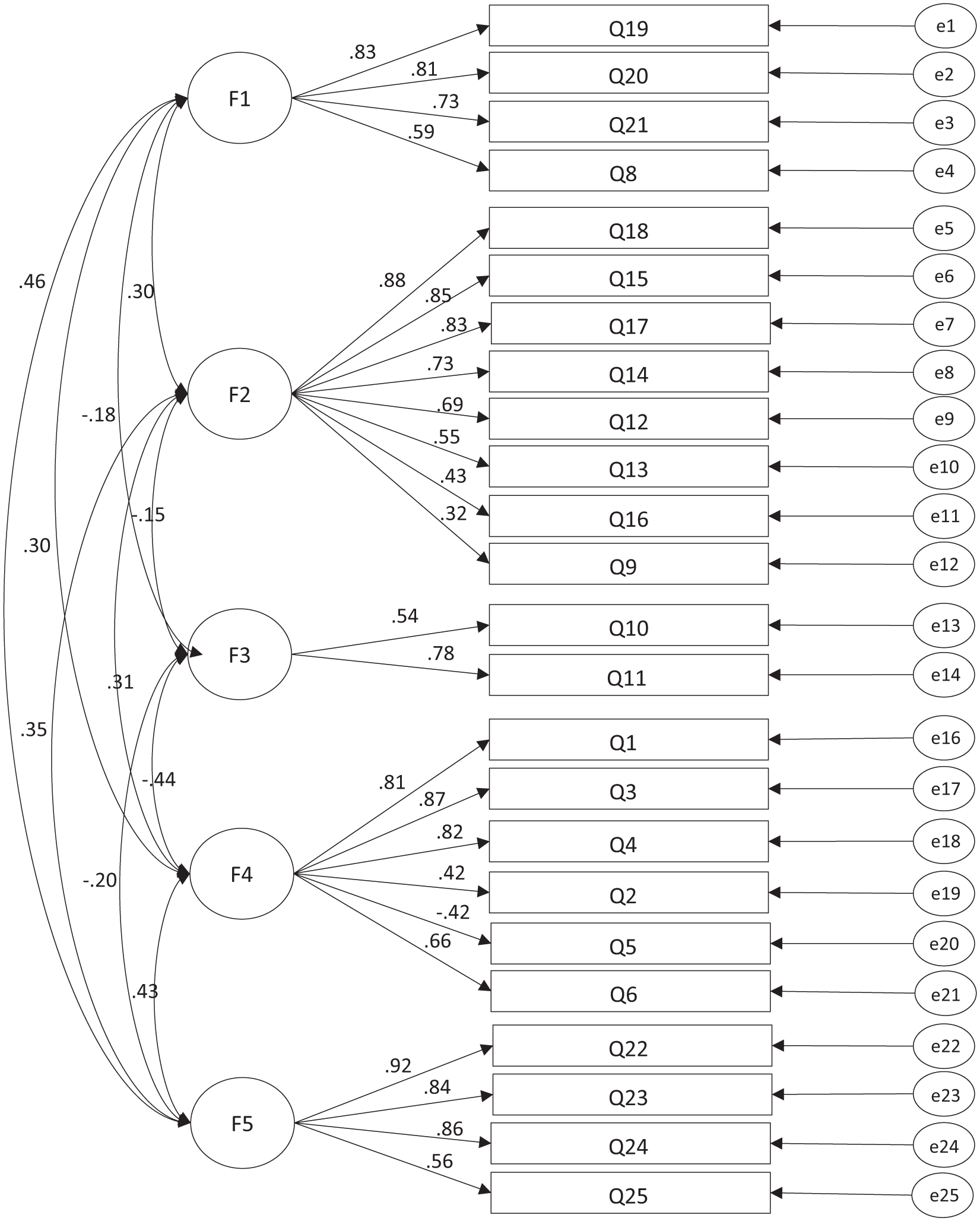
Result of a five-factor model of confirmatory factor analysis for the social support scale.
Data Collection
A few weeks prior to the 2007 summer programs, a letter was sent to the parents of over 2,300 students who registered for the summer programs at one of the two gifted institutions. The letter described the research study, asked students to give their assent to participate in the study, and asked parents for permission for their child to participate. Students and parents assented and consented via a survey website. The students could then complete the full survey before participating in the summer programs (Time 1), again while participating in the programs (Time 2), and 6 months after the programs ended (Time 3). Items included in the surveys for Time 2 and Time 3 were identical, with the exception that the comparative items were not included at Time 1, because students had not yet participated in the programs. The items regarding students’ social support were included at each of the three data collection points.
The Time 1 survey was sent to students online at home. A total of 2,131 students responded to the Time 1 survey, yielding a 91.1% response rate. For Time 2, the survey was given to students on-site at the end of each session of the program. Given the complexity of students’ schedules, they could opt for either an online survey or a paper survey. A total of 1,392 students, 65.3% of the students who had responded at Time 1, completed the survey at Time 2. In February 2008 (at Time 3), 8 months after Time 1 and 6 months after Time 2, the final survey was e-mailed to the 2,131 students who had given their permission to participate. Several e-mails were sent to the students’ parents to solicit student responses. Between the two gifted education institutions, 834 students completed the online survey at Time 3, yielding a 39.1% response rate from the students who had participated at Time 1. Compared with the students who participated in the survey only once or twice, a larger number of female, Caucasian, and middle school students were found among the students who completed all three surveys (see Table 3)
Demographic Information About Student Participants by Time.

Note. T1 = participation at Time 1; T2 = participation at Time 2; T3 = participation at Time 3.
Data Analysis
Composite mean scores were computed for each of the generated factors for both sections of the survey. For comparisons between summer program and regular school classes at Time 2 and Time 3 4 , a two-way repeated measures analysis of variance (ANOVA) and a follow-up paired sample t tests were conducted. A mixed-model ANOVA including both within-group and between-group comparisons was performed to examine differences by students’ gender and grade levels in their ratings for two periods of data collection (Times 2 and 3) and under different environments (summer program vs. school).
For social support, one subscale regarding support from nearby students was not included for analysis, because it was deemed remotely related to the purposes of the study, and it was not clear how students interpreted “nearby.” Using a one-way repeated measures ANOVA and a follow-up paired sample t tests, students’ responses between all three data collection points (Times 1, 2, and 3) were examined. Differences by gender and grade levels for each of the three levels of time were examined using a mixed model ANOVA.
Last, correlations were computed to examine the relationships among the subscales measuring students’ perceptions of two learning environments (summer program vs. school classes across the two data collection points) and social support (across the three data collection points) variables. Also, a total of 120 and 117 students were identified as the top 25th percentile and bottom 25th percentile groups, respectively based on the composite mean score from Time 1, Time 2, and Time 3 on the social support measure. A one-way multivariate ANOVA was performed to assess if students who perceived greater or lesser amount of social support differed in their ratings of the two learning environments.
Results
Perceptions About the Summer Program and Regular School Classes
Changes During and After the Programs
Multivariate tests results showed a statistically nonsignificant effect for environment (summer program vs. school), Wilks’s λ = 1.00, F(1, 386) = 0.008, p = .930, a statistically significant effect of time (Time 2 vs. Time 3), Wilks’s λ = 0.44, F(1, 386) = 498.55, p ≤ .001, and a statistically nonsignificant environment by time interaction, Wilks’s λ = 1.00, F(1, 386) = 0.004, p = .952. In order to understand what led to the statistically significant main effect of time, follow-up tests using pairwise comparisons of the means for Time 2 and Time 3 across the two learning environments were conducted. Of the five pairwise comparisons, items on maturity and future orientation t(497) = −2.39, p = .017, and friends, t(560) = 2.41, p = .016, yielded statistically significant differences, favoring Time 3 over Time 2 for maturity and future orientation, and favoring Time 2 over Time 3 for friends. Effect sizes were very small for the differences (d = 0.10 and −0.08 for each). There were no statistically significant mean differences found between Times 2 and 3 for the other comparisons on academic stimulation, t(503) = −0.29, p = .769, challenge, t(540) = −1.60, p = .110, and self-directed learning skills, t(504) = 0.46, p = .645 (see Table 4, for details).
Comparisons of Ratings During and After Summer Program Participation on the Summer Programs/School Classes Factors.

Note. Time 2 = at the end of the summer program; Time 3 = 6 months after participation in the summer program. Ratings were based on a scale of 1 (strongly disagree) to 5 (strongly agree). Data were not collected before the summer program (Time 1).
Differences by Gender and Grade Levels
Tests of between subject effects for the variables of gender, F(1, 383) = 0.021, p = .884, and grade, F(1, 383) = 0.915, p = .339, revealed no statistically significant mean differences. Also, no statistically significant interactive effect was found between gender and grade, F(1, 383) = 0.312, p = .577. Students’ ratings of the summer program versus school classes, during and after the summer programs, did not vary significantly either by gender or grade levels.
Perceived Social Support
Changes Before, During, and After the Programs
Over the three data collection points, students’ perceived level of social support remained relatively stable (see Table 5). The Mauchly’s W statistic was 0.979, χ2(2, N = 473) = 9.779, p = .008), indicating that the violation of sphericity occurred, which can result in an increase of the Type I error rate. Modifications were made using the alternative univariate tests, and the tests yielded no statistically significant time effects for students’ ratings of social support: F(1.96, 924.993) = 1.934, p = .146 (Greenhouse–Geisser); F(1.97, 928.809) = 1.934, p = .146 (Huynh–Feldt).
Comparison of Ratings Before, During, and After Summer Program Participation on the Social Support Factors.
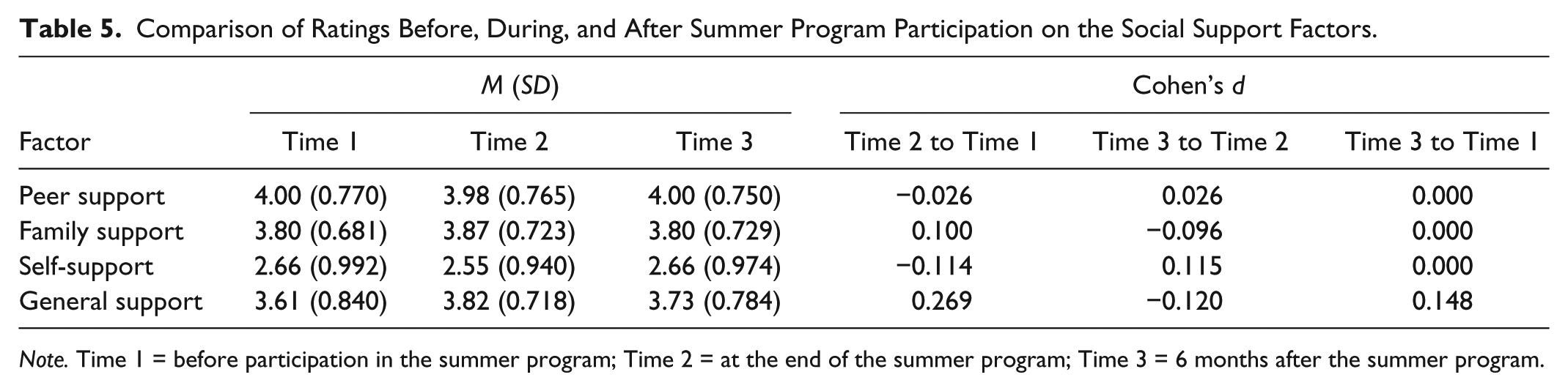
Note. Time 1 = before participation in the summer program; Time 2 = at the end of the summer program; Time 3 = 6 months after the summer program.
Differences by Gender and Grade Levels
The students’ ratings of their social support were not statistically different according to their gender, F(1, 469) = 2.73, p = .099, but varied by grade levels, F(1, 469) = 6.48, p = .011. Across the three time periods of data collection, middle school students generally had higher means than high school students, with small effect sizes for these differences (d = 0.19, 0.16, and 0.24 for Time 1, Time 2, and Time 3, respectively). Specifically, middle school students had more positive perceptions of their family (d = 0.36) and friends (d = 0.26) as sources of social and emotional support and felt that they have someone whom they could rely on and ask for help when needed (d = 0.29) than older students. High school students felt more positive about their ability to support themselves and handle things on their own than relying on and asking help from other people (d = 0.33, see Table 6, for details). The interaction between gender and grade was not statistically significant, F(1, 469) = 1.83, p = .177.
Comparison of Ratings by Grade Level—Before, During, and After Summer Program Participation—on the Social Support Factors.

Note. Overall = mean of the four factors; Time 1 = before participation in the summer program; Time 2 = at the end of the summer program; Time 3 = 6 months after the summer program. Effect size = difference between middle school and high school students.
Relationships Between Students’ Perceptions
Correlations Among Perceived Variables
Relationships between students’ perceptions of the summer programs, school classes, and social support were explored using the combined data across the two (for summer program and school classes variables) or three data collection points (for social support variables). Results of these correlational analyses showed statistically significant relationships between most of the variables (see Table 7). The correlations between five of the summer program and school classes factors (i.e., maturity and future orientation, friends, academic stimulation, challenge, and self-directed learning skills) and three of the four factors of social support (peer, family, and general) were positive and modest (p < .001). The self-support variable was negatively correlated with the summer program and school class variables, particularly with the school classes. All these relationships were statistically significant (p < .001). Therefore, the higher the students rated their summer programs and school classes, the greater they endorsed perceiving social support from others.
Intercorrelations Among the Factors of Summer Program, School Classes, and Social Support Scales.

Note. F1 = maturity and future; F2 = friends; F3 = academic stimulation; F4 = challenge; F5 = self-directed learning skills. Factors of the summer program and school classes were identical.
p < .05. **p < .01.
Differences by the Perceived Level of Social Support
Students’ responses to the two learning environments were compared by their levels of social support (top vs. bottom 25th percentiles). The Wilks’s λ of 0.66 was statistically significant, F(2, 145) = 37.62, p < .001, indicating differences between the top and bottom 25th percentile groups on their ratings of the two learning environments. Both on the summer and school program classes, higher means were found for the top group of students than the bottom group of students with large effect sizes for the differences. Effect sizes for the differences between the two groups of students were generally larger for the items on regular schools (0.44 ≤ d ≤ 1.05) than summer program classes (0.38 ≤ d ≤ 0.88). Also, both students in the top 25th and bottom 25th percentile groups rated their summer program classes more favorably than their school classes. Therefore, students who perceived that they had multiple and various sources of social and emotional support and were willing to look for help and support from others rated both summer program and school classes more positively, and particularly their summer classes, than students who did not perceive these same levels of social support (see Table 8).
Comparison of Ratings by High/Low Social Support—During/After Summer Program Participation—on the Summer Program/School Choices Factors.
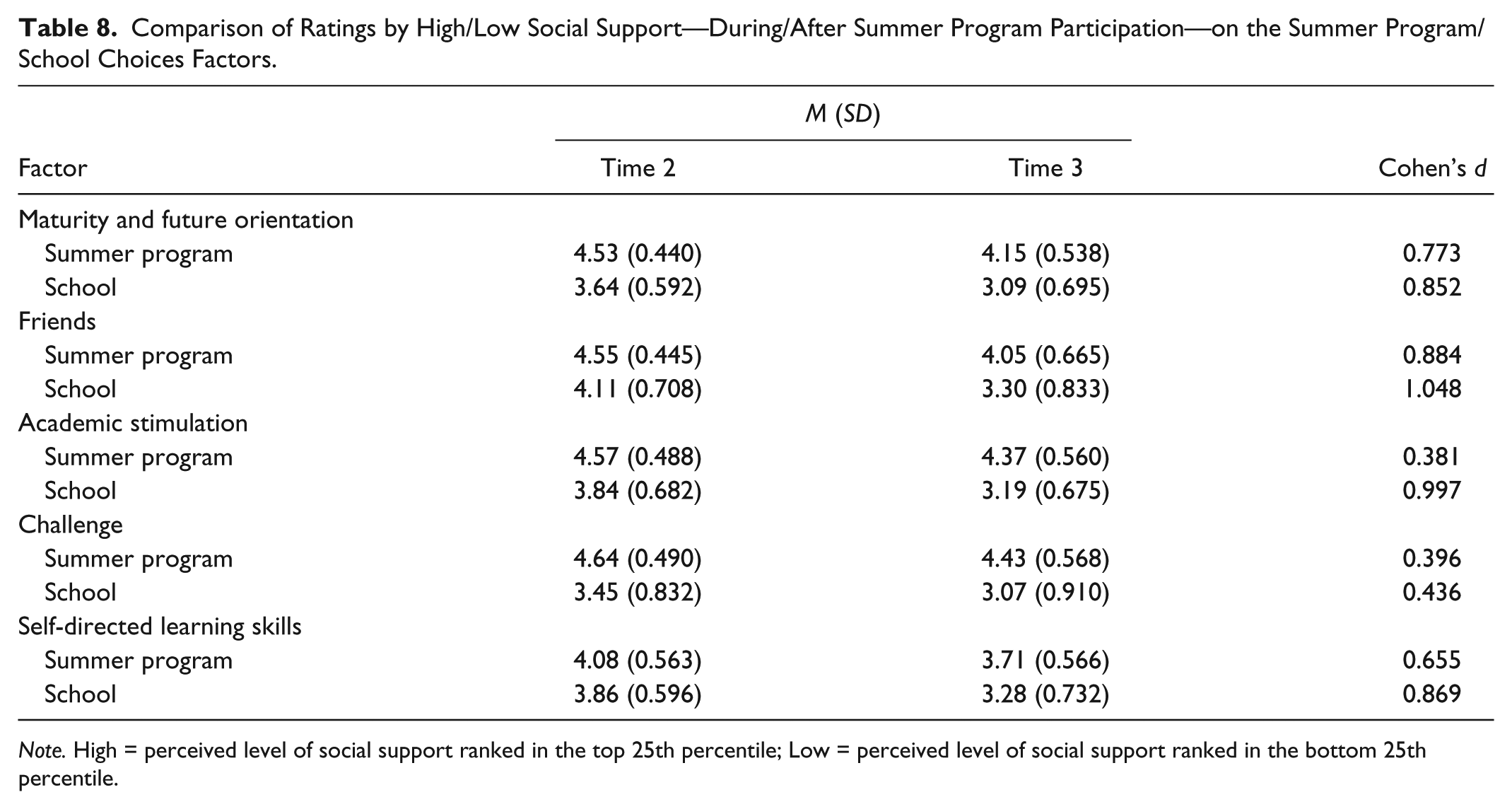
Note. High = perceived level of social support ranked in the top 25th percentile; Low = perceived level of social support ranked in the bottom 25th percentile.
Discussion
Overall, our sample of gifted students was generally favorable about their class experiences and interactions with teachers both in the summer programs and regular school classes. Most of the ratings were between a 3 (neutral) and a 4 (agree) out of a 5-point rating category. Some small, yet noticeable, differences were that the students perceived more acceptance and support for their giftedness, a stronger connection to peers, and greater ease in forming friendships while in the summer programs than after they left the programs and returned to their home schools. This is not surprising and has been reported as a benefit of involvement in gifted programs more generally (T. L. Cross & Swiatek, 2009; Cunningham & Rinn, 2007; Fredricks et al., 2010; Robinson, 2010) and summer programs specifically (Olszewski-Kubilius & Lee, 2008). The summer experiences also enhanced aspects of students’ independence and confidence. Following the programs, students described themselves as having gained in independence from their family, open-mindedness, tolerance of others, and confidence about taking challenging academics in the future and pursuing career plans and professional goals. It is interesting that effects, though small, were found for broad aspects of students’ development, such as open-mindedness and tolerance for others but not for specific aspects of their learning. The fact that students opted to attend the summer program may have influenced their ratings. Therefore, caution is needed for interpretation of these results.
We did not find any differences between the students’ summer and home school classes in terms of impact on study or organizational skills or self-directed learning. It may be that our students are already quite self-sufficient, organized, and independent learners, that a summer program could not boost these skills any higher given its duration at least from the students’ perspective, or that their typical school learning environments are relatively good. It is heartening though, that brief, albeit intense summer academic programs can affect important aspects of gifted students’ general social and emotional development such as openness, willingness to explore, and tolerance.
Regarding social support for these adolescents, students’ sources of support remained primarily the family and peers across the duration of the study. Students also saw themselves as a source of support, and increasingly so with age and development. We conjecture that being in a college-like, residential environment, which is new to many students and experienced by most as requiring new levels of independence and responsibility, may necessitate continuing to rely on support from parents to manage the additional challenges. Although summer programs can afford gifted students the opportunity to stretch their wings and “fly solo” for a while, students are mindful that parents are available for help if needed. Yet the students consistently endorsed peers as a source of support. This suggests that highly gifted students do find peers a source of support in their lives and manage to do so when their peer environment changes quickly, such as when they participate in a selective summer program. In fact, students’ perceptions of positive acceptance from peers seemed to grow during the summer programs despite the fact that it was a new peer environment for them. The summer programs may provide true intellectual peers or friends who are more similar in terms of interests and level of academic ability. The results of the study likely support the positive impact of summer programs on peer relationships for gifted students.
Summer programs, particularly residential ones, may play a significant role in fostering the healthy social and emotional development of participants, enabling them to use and identify multiple sources of social support beyond their families. We did not measure other sources of social support in this study, but as gifted adolescents develop, they will necessarily need to turn increasingly to teachers and mentors for guidance in educational and career paths (e.g., to identify important opportunities, benchmark progress, set new goals), necessitating the confidence to seek social support from others outside the family (Subotnik, Olszewski-Kubilius, & Worrell, 2011).
Positive relationships between the summer program/school class variables and the social support variables, and the negative correlation between self-support and these variables confirmed that favorable summer and school experiences and outcomes were intertwined with sources and levels of perceived social support. These findings are consistent with the relationship between perceived social support and positive academic outcomes noted in previous research (Ahmed et al., 2010). Similarly, when we examined the data based on differences between groups of students on perceived levels of social support, greater social support was related to more positive assessments of summer and school-learning environments in terms of perceptions about friends, maturity and future orientation, and self-directed learning skills. As with any nonexperimental data, causality can go in an either direction. Students with greater social support may have more confidence to take on and succeed in challenging learning and living environments and may be better able to reap the benefits of those experiences. Alternatively, being in challenging learning and living environments may boost self-confidence and willingness to elicit and accept support from others. Both in the highest and lowest social support groups, students rated their summer classes higher on all the aspects we assessed than their regular school environments, suggesting a better fit between these gifted students’ needs and their educational environments in the summer classes.
Summer programs for gifted students are complex social contexts for development. On the one hand, they may immerse students in a more competitive academic situation, possibly activating the BFLP phenomenon for some students (Makel et al., 2012), but with the potential to help students acquire strategies to deal with increased levels of stress and competition, and higher expectations and levels of challenge. Alternatively, these environments often alleviate other potential peer issues such as the social stigma attached to giftedness (Coleman & Cross, 2005; Rimm et al., 1999; Robinson, 2010; Swiatek, 2012) and potentially provide more peer support for giftedness and outstanding achievement (Fredricks et al., 2010). Additionally, summer programs often involve instructors with a special interest in and appreciation of gifted students, which can result in greater support for students’ learning and social and emotional needs in the classroom. While empirical research has documented some of the benefits and effects of these specialized environments on a global level, an understanding of how particular components, such as peers, teachers, and the residential environment, specifically affect students or how they interact to produce effects is currently lacking. A more nuanced understanding of how program components affect students would be helpful to the field, particularly in engineering intervention programs for subgroups of gifted learners, such as low-income or culturally and linguistically diverse students with special social and emotional needs and barriers to their achievement (Olszewski-Kubilius & Clarenbach, 2012).
Gifted programs often purport that summer residential experiences help students become more independent, confident, and more oriented toward future talent development. Our data lend empirical support for these proposed benefits as the student participants reported enhanced confidence and independence in facing and dealing with issues and situations in their lives, greater inspiration about future career pursuits, and better understanding and tolerance of other people after they had the summer experiences. Our results suggest that summer programs may provide a venue for gifted students to meet and interact with like-minded peers from whom they receive strong affirmation about their abilities and giftedness, and expand their thinking about their futures and the world, resulting in a boost to their confidence to take on increasingly challenging learning environments. This study not only adds to the empirical support for purported benefits of academic summer programs for gifted students (e.g., Barnett & Durden, 1993; Olszewski-Kubilius, 2003, 2005; Olszewski-Kubilius & Grant, 1996; Olszewski-Kubilius & Lee, 2008, for summary), but importantly extends those findings to aspects of social support. It also lends support to the longer term effects of summer programs as our results suggest that some benefits persist beyond the duration of the program.
This study did not reveal differences by gender regarding peer support as has been reported in previous studies (see Dunn et al., 1987), which may be accounted for by differences in the educational environments across studies. The results suggest that students look for help and support more from themselves than family and friends as they move to a higher grade, a finding that is in line with developmental expectations. Previous research has found that significant others, beyond family, play a vital role socially and emotionally as well as professionally in the process of talent development in late adolescence (see Bloom, 1985) and that peers at similar levels of competency increase motivation to persist in the talent domain (Subotnik et al., 2011).
Future Research
There is little empirical research on the developmental paths of social support networks for gifted and talented teens, which may differ from that of nongifted adolescents. For example, parents may be a critical source of support longer, providing access to teachers, coaches, and outside of school opportunities, monitoring practice, and negotiating schedules and logistics, because of the demands of the talent field. A recent study revealed that gifted students with higher levels of social competence rated their family more favorably than those with lower social competence (see Olszewski-Kubilius, Lee, & Thomson, 2014), which allowed them to draw on parents and siblings for continuing social support. Teachers, mentors, and coaches may simultaneously grow in terms of their importance as sources of social support for talented teens as well as other similarly talented and motivated peers. The development of talent to a high level may require more social support overall and from a more varied set of individuals. Future studies need to address if and when mentors and other outside the family sources become a significant component of the social and emotional support network for gifted adolescents, how this affects both their general social and emotional growth as well as the development of their talent, and how social support networks, including types of support and providers of support, vary by the talent field.
How aspects of learning environments, such as academic summer programs for the gifted, affect perceptions of social support also needs further study. New research attests to the vital role of noncognitive skills in academic achievement (Farrington et al., 2012) and specifically in the fruition of potential and ability to high levels of achievement in adulthood (Subotnik et al., 2011). Farrington et al. (2012) suggest that there are malleable noncognitive skills such as resiliency, mind-sets, and varied learning strategies that can be actively developed and cultivated. The authors further suggest that these should not be thought of as traits that some individuals possess but as outcomes of students’ interactions within optimal educational environments—ones that create a sense of belongingness for all students and support their learning and psychosocial needs—that provide social support for learning. It behooves educators of all children, including gifted ones, to be more thoughtful about the design of learning environments that cultivate psychosocial skills and social support for high achievement. Future research should focus on understanding what features are critical to bringing about growth in social support and psychosocial development. Farrington et al. (2012) propose that a significant component of supportive educational environments is the nature of student–teacher interactions, which has received little attention in the gifted education field.
Limitations
This study involved two to three waves of data collection points in order to examine changes induced by the programs over time. A major limitation was subject loss over the duration of the study. About one third of the students who had initially participated in this study did not respond to the survey during the programs, and about 60% of the initial respondents did not do so 6 months later. Part of a loss of data from Time 1 to Time 2 was due to inaccurate e-mail and contact addresses of the parents who had to give us consent for their child’s participation. Therefore, our sample may not be representative of all students attending the summer programs.
Another limitation has to do with selection effect. All the students in this study chose to come to the summer programs. This may have skewed their ratings of the summer programs in the positive direction.
Listwise deletion is suggested if the sample is large enough for data analysis and if data are missing completely at random (MCAR; Allison, 2000, 2001). In this study, the total sample size at Time 3 was over 800, which was large enough for analysis. However, Little’s MCAR test revealed that our data did not meet the MCAR assumption, and thus, we acknowledged that listwise deletion is not the best way of dealing with missing cases. Having multiple waves of data is a merit; however, attrition rates over the data collection periods must be considered seriously and compensated for in future research.
Some measurement issues need to be improved for future studies. Following the results of the CFA, one item with a very low pattern coefficient was removed, resulting in a two-item factor. The removal of the item increased the reliability coefficient (from .45 to .60) but did not raise the overall goodness of fit. Also, the fit of the CFA was less than adequate as were the reliabilities of the scores on two of the social support subscales.
The entire process of data collection occurred within a year, which is relatively a short period of time to follow up on changes using the same sample. A longer term follow-up study, particularly involving students in different developmental stages (e.g., early childhood, childhood, early adolescence, adolescence) would contribute to our knowledge of how social support networks change with development for gifted students, especially for those students who continue on paths of high achievement compared with students who do not.
Footnotes
Appendix
Items of the Social Support Scale.

| Q1 | I often feel lonely like I don’t have anyone to reach out to. |
| Q2 | When I am unhappy or under stress, there are people I can turn to for support. |
| Q3 | I don’t know anyone to confide in. |
| Q4 | I used to have close friends to talk to about things, but I don’t anymore. |
| Q5 | When I am troubled, I keep things to myself. |
| Q6 | I am not a member of any social group (such as church groups, clubs, teams, etc.). |
| Q7 | I believe in myself and my ability to handle new situations without any help from others. |
| Q8 | It is important to me that I have emotional support from friends. |
| Q9 | People should feel comfortable turning to a priest (minister, rabbi) for support and comfort. |
| Q10 | I rarely ask for support from others. |
| Q11 | I don’t think people really need other people; they can do just as well on their own. |
| Q12 | As a child, I received a great deal of support from my parents. |
| Q13 | My brothers and sisters are supportive of me. |
| Q14 | There were always people around when I was growing up who could help me when I needed it. |
| Q15 | I can turn to my parents or siblings when I am troubled. |
| Q16 | When I don’t have my family’s support, I feel more anxious about what I am doing. |
| Q17 | I feel comfortable when asking my family for support. |
| Q18 | My family provides me with satisfaction and a sense of strength. |
| Q19 | Even when I feel bad about myself, my friends can cheer me up and make me feel important. |
| Q20 | I have friends who will support me no matter what I do. |
| Q21 | I often feel that my friends will be nice to me regardless of what I am doing or feeling. |
| Q22 | The students who live near me make me feel that I am cared about. |
| Q23 | My interactions with the students who live near me make me feel important. |
| Q24 | I can always count on the students who live near me to help me when I am distressed. |
| Q25 | I often feel that I don’t have as much support from people living near me as I would like. |
Note. Q7 was removed following the result of the confirmatory factor analysis.
Declaration of Conflicting Interests
The author(s) declared no potential conflicts of interest with respect to the research, authorship, and/or publication of this article.
Funding
The author(s) received no financial support for the research, authorship, and/or publication of this article.