



Abstract
Openness to experience is a personality factor in the five-factor model of personality, and it is composed of six facets. Facets of openness appear conceptually analogous to overexcitabilities (OEs), which are displays of inner energy guiding individuals toward advanced potential according to the theory of positive disintegration. This study examined the similarity of OEs to corresponding openness to experience facets in a sample of 149 creative adolescents and adults and 312 adults from the general population (total N = 461). Exploratory structural equation modeling tested competing models in which each OE and corresponding openness facet were modeled as separate factors and as joint factors. The separate-factor model had acceptable fit but uninterpretable loadings, while the joint-factor model had acceptable fit and interpretable loadings; thus, openness seems to encompass OEs. Accordingly, the field should align with well-researched psychological theories like the five-factor model of personality and begin to talk about openness rather than OEs.
Keywords
A controversy exists in gifted education regarding certain personality traits that appear to be related to giftedness, yet when describing those traits the majority of the literature does not use known personality theories. Psychology can provide an answer to this problem with the five-factor model of personality (FFM). This is a well-researched and generalizable personality model that is valid across ages and cultures (McCrae, 2010; McCrae, Terracciano, et al., 2005). Gifted education would benefit from adopting this interdisciplinary stance in scientific studies.
Overexcitabilities (OEs) describe heightened intensity and sensitivity in five areas, namely imaginational, sensual, emotional, psychomotor, and intellectual, that according to their original theory, the theory of positive disintegration (TPD; Dabrowski, 1967), indicate a heightened activity of the nervous system (Mendaglio, 2012; Mendaglio & Tillier, 2006) and might lead to advanced moral and emotional development (Piechowski, 1979, 2006). However, other personality theories describe similar traits. For example, the most important personality theory in psychology is the FFM, a theory that has strong generalization across cultures and ages (McCrae, 2010; McCrae, Terracciano, et al., 2005). The FFM can provide an explanation of behaviors described by OEs in a more parsimonious theory. In their seminal article, Subotnik, Olszewski-Kubilius, and Worrell (2011) strongly argued for the need to incorporate constructs from psychological science into the gifted education literature. Despite the potential to inform the field with empirically well-established constructs, psychological science remains largely underrepresented. This insufficient representation occurs especially in resources for parents and educators; for example, the award-winning and popular book A Parent’s Guide to Gifted Children (Webb, Gore, Amend, & DeVries, 2007) does not mention well-researched personality theories such as the FFM, but includes a section devoted to OEs.
Openness to experience, one of the personality factors in the FFM, closely relates to and may in fact explain OEs. According to Costa and McCrae (1992), individuals who are open to new experiences enjoy both outer and inner worlds, are curious, and hold novel ideas. They have high aesthetic sensitivity, intellectual curiosity, vivid imagination, and evolving value systems. This description appears extraordinarily analogous to descriptions of OEs, which describe active imaginations, enjoyment of sensory pleasures such as art and beauty, intensity of feelings, love of learning, and a pull for action (Piechowski, 1979, 2006). The bulk of OE research appears to be atheoretical, thus misrepresenting Dabrowski’s original TPD (Mendaglio, 2012) and making it more plausible to say that the behaviors called OE are in reality openness to experience. In this study, we will explore the potential connection between OEs and facets of openness to experience, suggesting that they represent similar or equivalent constructs.
OEs and TPD
The few published empirical studies focus primarily on OEs without connecting them to Dabrowski’s larger TPD and the role they play in achieving one’s developmental potential (Mendaglio, 2012). Despite the popularity of OEs, empirical evidence supporting their existence is scant, and patterns of OEs in gifted individuals are inconsistent (Mendaglio, 2012; Winkler, 2014). Many studies have low sample sizes (e.g., Gallagher, 1986; Schiever, 1985), and not all studies are published in peer-reviewed journals (e.g., Falk, Yakmaci-Guzel, Chang, Pardo de Santayana Sanz, & Chavez-Eakle, 2008). Even with these problems, the OE literature continues to cite them.
Certain proponents of OEs even claim that personality-based measures, especially ones based on OEs, should be at the basis of identification for giftedness (Carman, 2011). This becomes a problematic circular definition of giftedness. TPD states that the five OEs must be present for a person to reach their full developmental potential (Mendaglio, 2012), yet only some studies found that gifted individuals surpassed the general population on the five OEs (C. M. Ackerman, 1997; Siu, 2010; Tucker & Hafenstein, 1997), and other studies found differences only in one or two OEs (Wirthwein, Becker, Loehr, & Rost, 2011; Yakmaci-Guzel & Akarsu, 2006). However, empirical evidence does not support identification based on personality or OEs (Mendaglio, 2012; Wirthwein & Rost, 2011), and the usefulness or even existence of the OE construct is debated (Rost, Wirthwein, & Steinmayr, 2014).
Openness to Experience and the FFM
Along with intelligence, personality is the construct that most consistently predicts a wide variety of human behaviors, including achievement, job success, well-being, and life satisfaction (DeYoung, 2011). The FFM is the most widely accepted personality theory in psychology (McCrae, 2010) and has support across the lifespan and in various cultures (McCrae, 2010; McCrae, Terracciano, et al., 2005). This personality theory encompasses five major factors or domains: extraversion (E), neuroticism (N), openness to experience or openness/intellect (O), agreeableness (A), and conscientiousness (C). Each of these domains is divided into six facets or subscales, with the openness facets reporting the aspect of life in which a person remains open. The six openness facets are labeled O1 Fantasy, O2 Aesthetics, O3 Feelings, O4 Actions, O5 Ideas, and O6 Values, and are backed by theory (Costa & McCrae, 1992) and empirical studies (Furnham, Guenole, Levine, & Chamorro-Premuzic, 2013). We will describe these facets, highlighting the conceptual similarity found in OEs and supporting the claim that openness can explain behaviors seen in OEs. Given the strong research support for the FFM and its parsimonious nature, we propose that the FFM should be favored.
O1 Fantasy describes people with an active and detailed imagination who believe in the power of fantasy and daydreaming and engage vividly in those activities (Costa & McCrae, 1992), analogous to imaginational OE (Piechowski, 1979, 2006). High O2 Aesthetics indicates an ability to become absorbed in beauty and arts, with strong enjoyment of these activities (Costa & McCrae, 1992). Sensual OE, aesthetics’ corresponding OE, refers to being moved by sensory experiences and a need for pleasure and beauty (Piechowski, 1979, 2006). Openness to a full range of feelings, both in variety and in intensity, defines the O3 Feelings facet (Costa & McCrae, 1992) as well as the emotional OE (Piechowski, 1979, 2006). O4 Actions describes a love of novelty and moving out of one’s comfort zone (Costa & McCrae, 1992), while psychomotor OE refers to high energy and even restlessness to take action (Piechowski, 1979, 2006). O5 Ideas describes extraordinary curiosity, a passion for learning, and a need to understand theories and reasoning (Costa & McCrae, 1992), similar to the intellectual OE (Piechowski, 1979, 2006). People who do not place importance on authority or tradition score high on O6 Values. They do not support dogmas and can revise rules whenever needed (Costa & McCrae, 1992). There does not seem to be a clear overlap of O6 Values and any OE, though it might relate to emotional OE as Piechowski (2006) claimed that people with emotional OE have a strong sense of social justice, but this theoretical correspondence is the weakest connection in the two sets of constructs.
Studies find a relationship between openness to experience and intelligence in the general population, mostly with a small to medium effect size (P. L. Ackerman & Heggestad, 1997; DeYoung, Quilty, Peterson, & Gray, 2014; Gignac, Stough, & Loukomitis, 2004; Harris, 2004; Moutafi, Furnham, & Crump, 2006). Studies with gifted samples show similar results. McCrae et al. (2002) as well as Zeidner and Shani-Zinovich (2011) found a small to medium effect size on openness to experience when comparing gifted adolescents with the general population, and Altaras Dimitrijević (2012) found that a composite factor, mainly constituted of facets of openness, could discriminate among gifted and nongifted samples. Cross, Speirs Neumeister, and Cassady (2007) and Sak (2004) found their gifted samples had a stronger preference for intuition over sensory information, a preference that relates to openness to experience (Costa & McCrae, 1992). Openness to experience is high in creative individuals regardless of creative domain (Feist, 1998; Gorman & Feist, 2014; Ivcevic & Mayer, 2007; Kerr & McKay, 2013) and can predict creative performance and participation in creative activities (Batey, Chamorro-Premuzic, & Furnham, 2010; Kaufman, 2013). Not surprisingly, the literature shows a relationship between openness to experience at the domain level and OEs (Botella et al., 2015; Limont, Dreszer-Drogorób, Bedyńska, Śliwińska, & Jastrzębska, 2014; Rost et al., 2014), yet no studies to date have explored this relationship at the facet level, where we would expect to see the strongest relationships as each OE appears to correspond to an openness facet.
The Present Study
Two hypothesized models tested the hypothesis that openness facets and their corresponding OEs represent the same latent constructs. In the separate-factor model, indicators of OEs and indicators of openness facets were modeled as two separate constructs expected to show a very strong correlation. Openness facets and their corresponding OEs are as follows: O1 Fantasy and imaginational OE, O2 Aesthetics and sensual OE, O3 Feelings and emotional OE, O4 Actions and psychomotor OE, O5 Ideas and intellectual OE, and O6 Values on its own. The joint-factor model made this hypothesized relationship more explicit by having all openness and OE items belonging to each combination load into one single latent variable. Different personality tests measuring the exact same constructs have correlations ranging between .70 and .80 (Goldberg, 1999). Therefore, if OEs show similar relationships with openness facets, or if items of OEs and openness load onto the same factor, it could be assumed that they are measuring very similar or equivalent constructs.
Method
Participants and Procedure
For this study, 461 participants from two distinct samples were recruited. This was to ensure the inclusion of the population of interest, creatively gifted individuals, yet prevent restriction of range due to their expected high scores on openness to experience facets and OEs. Therefore, one sample was composed of persons judged to be creatively gifted, and the second sample was composed of adults from the general population. According to FFM theorists, personality traits are normally distributed in the population (DeYoung, 2015; McCrae, Terracciano, et al., 2005), yet OEs are not supposed to be normally distributed (Mendaglio, 2012). Including two samples expected to have a wide range of scores on openness and OEs would allow testing for normal distributions.
The decision to select highly creative individuals was based on the literature reviewed, in which creatively gifted individuals generally score higher than the general population on OEs (Falk et al., 2008; Yakmaci-Guzel & Akarsu, 2006), while intellectually gifted individuals show an inconsistent pattern of scores. Both creatively gifted and intellectually gifted are covered under the umbrella of the federal giftedness definition (Elementary and Secondary Education Act, 2002) and thus represent the population that is considered pertinent to proponents of OE.
Sample 1: Creative Adolescents and Adults
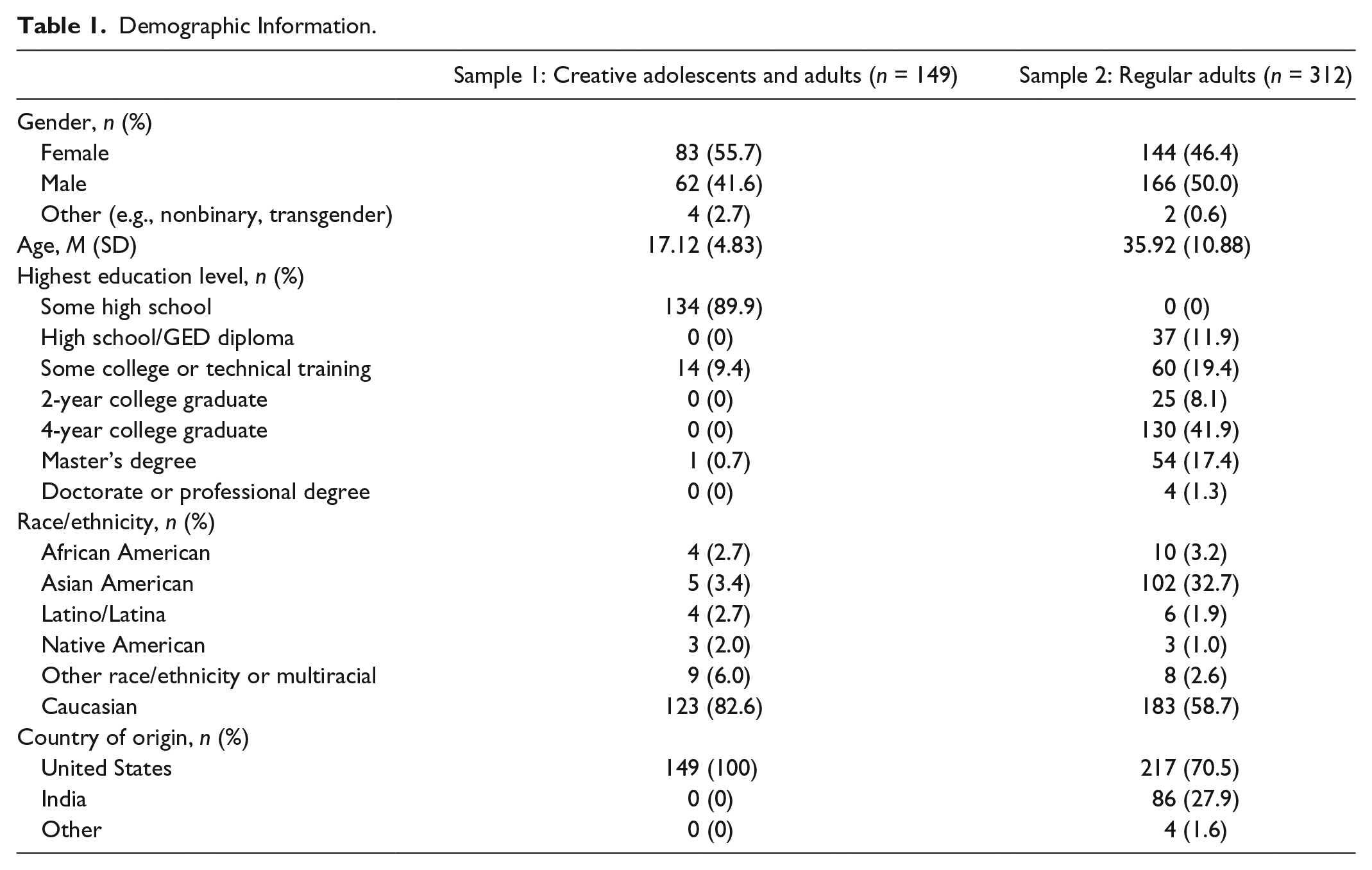
Participants in the first sample were 149 creatively and intellectually gifted adolescents and adults from the Midwest identified via a profiling technique developed by Kerr and McKay (2013; see the appendix). They were recruited via invitations to high schools (in particular their gifted programs), as well as creative programs at universities (e.g., arts, creative writing, graphic, and industrial design). Schools received profiles that described eminent adults who achieved high creativity in their domains when they were younger, and school personnel selected students who fit the profiles. Previous research indicated the promise of this identification method as many of these adolescents and adults already had creative accomplishments, and their personalities resembled those of creative individuals (Kerr & McKay, 2013). Demographic information can be found in Table 1.
Demographic Information.
Data collection for the first sample took place in the context of a larger project approved by the institutional review board in 2007. Schools received informed consent forms and distributed them to potential participants. Participants younger than 18 years signed and turned in their own assent forms along with consent forms signed by their parents or legal guardians. Participants aged 18 years or older signed their own informed consent form before participating in the study. Recruitment of participants and completion of questionnaires occurred between February 2014 and May 2015.
Sample 2: Adults From the General Population
The second sample included 312 adults recruited via Amazon Mechanical Turk or MTurk, a crowdsourcing platform, by posting a request for completion of the study via a screener survey with demographic information and a follow-up survey with the assessments. MTurk members typically perform tasks such as completing surveys posted on the platform and receive payment for completion of those surveys. MTurk only allows adults to use its services, and no other prerequisite for participation was requested. Research has shown that results obtained with MTurk participants are similar to those obtained in college and community samples, and thus MTurk is gaining acceptance in the behavioral sciences (Shapiro, Chandler, & Mueller, 2013). Demographic information is in Table 1.
For the second sample, institutional review board approval was secured, and both questionnaires were set up in Qualtrics. A Human Intelligence Task was posted on MTurk with a request for participants, the information statement, and a screener survey asking for demographic information. First, 472 potential participants completed the screener survey for which they received a payment of $0.02. After we approved the screener survey, those 472 potential participants received a $0.01 bonus payment with an embedded custom link to the assessments in Qualtrics via a private message. This custom link was related to that MTurk unique Worker ID, and was a one-time use link. We checked which participants completed the assessments in Qualtrics using the custom links and paid those participants an additional bonus of $1.97, for a total payment for $2.00. In total, 312 participants completed the instruments on Qualtrics. These additional steps were part of the license agreement for online use of the NEO PI-3, while abiding by terms of service of MTurk. Recruitment of participants and completion of questionnaires occurred in March 2015.
Instruments
NEO Personality Inventory-3
The NEO Personality Inventory-3 (NEO PI-3 (McCrae, Costa, & Martin, 2005) is a 240-item measure based on the FFM. Five domain scales of 48 items per domain, each corresponding to a personality trait, make up six facet subscales of eight items in each subscale. The facet scales for openness to experience are openness to fantasy, aesthetics, feelings, actions, ideas, and values. Copyright prevents the inclusion here of sample items. Results are presented as raw scores that can be converted to T scores to compare results with the suitable norming group. The normative sample of the NEO PI-3 included adolescents and improved readability compared with previous iterations (McCrae, Costa, & Martin, 2005).
Overexcitabilities Questionnaire–Two
The Overexcitabilities Questionnaire–Two (OEQ-II; Falk, Lind, Miller, Piechowski, & Silverman, 1999) is at present the only quantitative instrument available to assess OEs, for which reason it was used in this study. The OEQ-II measures psychomotor, sensual, imaginational, intellectual, and emotional OEs on a 5-point Likert-type scale (50 items) for group comparison purposes only. Copyright prevents the inclusion here of sample items. Psychometric quality might be a concern with the OEQ-II, as one published confirmatory factor analysis (CFA) found that OE models did not fit and did not hold measurement invariance across genders (Warne, 2011), and a later study using exploratory structural equation modeling within a CFA framework (ESEM-within-CFA or EWC; Morin, Marsh, & Nagergast, 2013) found acceptable fit only with model modifications and partial measurement invariance across genders (Van den Broeck, Hofmans, Cooremans, & Staels, 2013).
Data Analysis
Items in the NEO PI-3 were converted to a 1-to-5 Likert-type scale as used by the OEQ-II for ease of interpretability. Data were screened with normality tests. Measurement models were designed including each openness/OE pair as separate latent factors or as a single latent factor. Kline (2010) stated that latent variable modeling studies could be advantageous to gifted education research to test relationships among hypothetical constructs such as openness or OEs. Latent variable models define constructs with multiple indicators correcting for measurement error, and can separate reliable and unreliable indicators (Little, 2013). Population parameters estimated in latent variable models are unbiased and thus more exact and generalizable.
Models were tested using CFA in the R package lavaan (Rosseel, 2012) using the robust maximum likelihood (MLR) estimator to account for the ordinal nature of data. ESEM was conducted in MPlus 7.1.3 (Muthén & Muthén, 2013) with MLR estimation and Geomin rotation, as CFA is not always suitable for personality tests (Marsh et al., 2010). The appropriateness of CFA for personality instruments is debated in the literature, with several FFM researchers supporting the position that CFA is not the optimal choice for these instruments (Gignac, Bates, & Jang, 2007; Marsh et al., 2010; McCrae, Zonderman, Costa, Bond, & Paunonen, 1996; Morin et al., 2013). McCrae et al. (1996) stated that personality instruments have many correlated residuals and cross-loadings due to the nature of the constructs and the manner in which instruments are created, and thus would have poorer fit indices in CFA or would need multiple modifications to achieve good fit. This need for modifications ultimately results in data-driven models, which go against the basic rationale of CFA that relies on theory-driven models (Gignac et al., 2007). Facing this dilemma, ESEM was introduced as a theory-driven alternative to CFA to assess structure of personality instruments (Marsh et al., 2010).
Confirmatory Factor Analysis
Two competing measurement models indicated the possible relationships among each openness/OE combination. In the separate-factor model, each openness facet and each OE were represented as separate latent variables, with indicators corresponding to test items of each openness facet and OE. To be able to observe correlations among constructs, the fixed-factor method set the scale. In the joint-factor model, each openness facet/OE combination represented a single construct, with O6 Values not matching with any OE. Again, the scale setting method fixed the factor variance. However, previous studies using pure CFA models for personality tests and the OEQ-II resulted in poor fit for the instruments (Gignac et al., 2007; Van den Broeck et al., 2013; Warne, 2011), and this poor fit might stem from excessive correlated residuals and cross-loadings found in personality instruments (Gignac et al., 2007), thus, we elected to conduct additional ESEM analyses to address these problems.
Exploratory Structural Equation Modeling
Models of openness facets and their corresponding OEs as separate or joint factors were tested using ESEM. ESEM differs from traditional exploratory factor analysis in that it incorporates advanced methodological estimation procedures for latent variables used in SEM and CFA that exploratory factor analysis cannot estimate (Morin et al., 2013). Unlike CFA, ESEM permits small cross-loadings for indicators; thus, models using ESEM (Morin et al., 2013) allowed openness facets and OEs to be included in one model without compromising model fit as in CFA (Gignac et al., 2007), as indicators can load on multiple factors. Researchers are increasingly applying ESEM when working with personality instruments as the methodology is more flexible to manage the minor cross-loadings that are expected in these personality tests (Morin et al., 2013; Van den Broeck et al., 2013).
Model Fit
Model fit statistics followed Hu and Bentler’s (1999) and Little’s (2013) suggested definitions of acceptable fit if comparative fit index (CFI) > .90, root mean square error of approximation (RMSEA) < .08, and standardized root mean square residual (SRMR) < .11, or very good fit if CFI > .95, RMSEA < .05, and SRMR < .06, following combinational rules based on SRMR and other fit indices’ rejection rate of Type I and Type II errors. The combination rules of RMSEA and SRMR presented by Hu and Bentler indicate that with a sample size close to 500, the combination of RMSEA between .05 and .08 and SRMR between .06 and .11 yields an acceptable ratio of Type I and Type II errors and thus can be used to select useful models. However, these values were used as guides rather than stringent cutoff values as advised by Fan and Sivo (2005), particularly because instruments with 5 to 10 factors and 5 to 10 items per factor will inherently have difficulties achieving restrictive fit conventions (Marsh, Hau, & Wen, 2004).
Results
Initial Analyses
There were no missing data as all items required a response in the Qualtrics environment as we set it up. All indicators in the models appeared normally distributed with skewness <|1.5| and kurtosis <|2|. To calculate descriptive statistics, item scores of openness facets and OEs on a Likert-type scale of 1 to 5 were added to create a subscale score. Reliability was good for all subscales with Cronbach’s alpha greater than .70. Means, standard deviations, and Cronbach’s alpha can be found in Table 2.
Descriptive Statistics on Openness Facets and OEs.

Correlations of Openness Facets and OEs
Intercorrelations among openness facets and OEs can be found in Table 3. Below the diagonal are the subscale Pearson correlations calculated according to the manuals’ instructions for subscale scores; however, these correlations must be interpreted carefully as they contain measurement error from treating latent variables as manifest variables (Little, 2013). Above the diagonal are the interfactor latent correlations from the Model 1 CFA.
Subscale and Interfactor Correlations Among Openness Facets and OEs (N = 461).
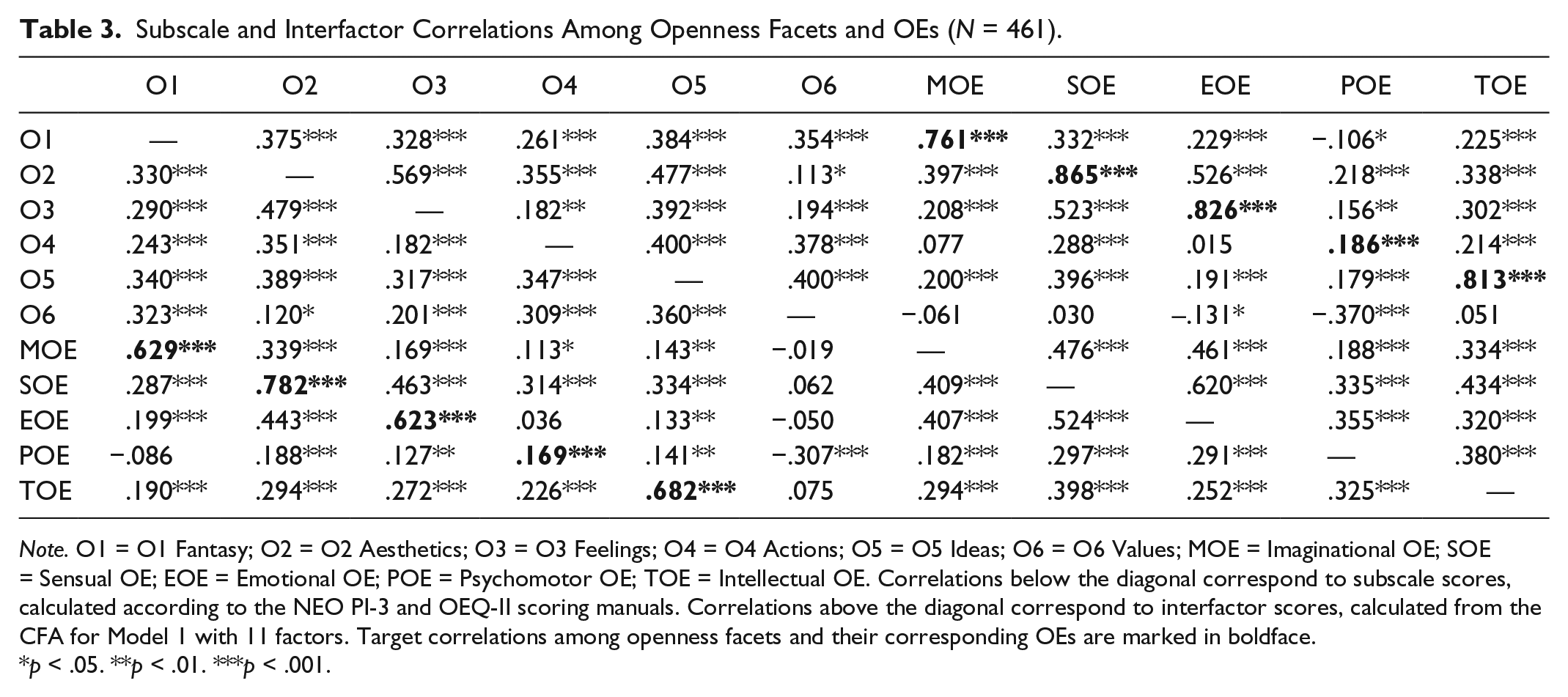
Note. O1 = O1 Fantasy; O2 = O2 Aesthetics; O3 = O3 Feelings; O4 = O4 Actions; O5 = O5 Ideas; O6 = O6 Values; MOE = Imaginational OE; SOE = Sensual OE; EOE = Emotional OE; POE = Psychomotor OE; TOE = Intellectual OE. Correlations below the diagonal correspond to subscale scores, calculated according to the NEO PI-3 and OEQ-II scoring manuals. Correlations above the diagonal correspond to interfactor scores, calculated from the CFA for Model 1 with 11 factors. Target correlations among openness facets and their corresponding OEs are marked in boldface.
p < .05. **p < .01. ***p < .001.
Target correlations among openness facets and their corresponding OEs were in the expected range, with the exception of psychomotor OE and O4 Actions. Subscale correlations include measurement error and were slightly lower than interfactor correlations. O1 Fantasy and imaginational OE had correlations of .76 and .63, O2 Aesthetics and sensual OE had correlations of .87 and .78, O3 Feelings and emotional OE had correlations of .84 and .62, and O5 Ideas and intellectual OE had correlations of .81 and .682. These correlations suggest that these could be equivalent constructs from different instruments (Goldberg, 1999). O4 Actions and psychomotor OE had correlations of .19 and .17. O6 Values was not expected to correlate to OEs or perhaps to emotional OE, yet the only significant correlation was a negative correlation of −.307 with psychomotor OE.
Latent Variable Analyses
Confirmatory Factor Analysis
First, CFA models were tested with the entire sample using MLR estimation. The CFA for Model 1, where openness facets and their corresponding OEs were modeled as separate latent constructs, had indices that varied; χ2(4600, N = 461) = 11971.632; CFI = .688, Bayesian information criterion (BIC) = 120854.264, SRMR = .086, RMSEA = .059 (.058-.060). The Model 2 CFA, with indicators loading on a single latent construct for each openness facet and corresponding OE combination, yielded a relatively worse fit, χ2(4640, N = 461) = 13400.236; CFI = .629, BIC = 122037.532, SRMR = .095, RMSEA = .064 (.063-.065).
Exploratory Structural Equation Modeling
When testing with ESEM, the first model did not converge, as three variables were uncorrelated to all other variables in the model. These variables were from the NEO PI-3; one was a part of O5 Ideas (Q143), and the other two part of O6 Values (Q178 and Q238R). A prerequisite of ESEM is having variables that correlate with all other variables in the model and thus those three variables were removed from further ESEM analyses. Model 1 in ESEM, with openness facets and OEs as separate latent constructs, fit the data; χ2(3475, N = 439) = 5944.441; CFI = .875, BIC = 117579.070, SRMR = .028, RMSEA = .040 (.038-.042). The Model 2 ESEM, with indicators loading on a single latent construct for each openness/OE combination, yielded worse fit, χ2(3910, N = 439) = 8457.564; CFI = .790, BIC = 117491.513, SRMR = .041, RMSEA = .051 (.050-.053).
Comparison of CFA Versus ESEM
Indices showed fit that ranged from very good to acceptable for both CFA and ESEM, except CFI which fell below the guideline of .90 (Little, 2013) for all models. All fit indices performed better with ESEM analyses, in accordance with claims of Morin et al. (2013) regarding personality tests. With the exception of CFI, other indices were very good in ESEM while barely reaching acceptable guidelines in traditional CFA; moreover, CFI seemed consistently worse in the CFA models compared with ESEM models. For those reasons, ESEM analyses were selected for interpretation of the results.
Marsh et al. (2004) cautioned against conventional fit guidelines being too restrictive for models with numerous factors and numerous indicators. In fact, Kenny and McCoach (2003) demonstrated empirically that CFI may worsen in models with more indicators per factor, which adds a caveat to interpretation. This problem of lower CFI in models with multiple factors and indicators can be seen in McCrae et al. (2002) where RMSEA showed excellent fit while CFI appeared poor. The present study has even more factors and indicators than McCrae et al. (2002), which warrants caution in interpreting the overall impact of CFI. High sensitivity to misspecified factor loadings is another drawback of CFI (Sun, 2005), and FFM measurement models are particularly prone to this issue due to the cross-loadings that naturally exist in FFM instruments (McCrae et al., 1996), which can explain the significantly lower CFI indices in CFA compared with ESEM. Additionally, CFI appears to favor models that are more complex (Sun, 2005), which can explain why in this study Model 1 had relatively better fit compared with Model 2 both for CFA and ESEM.
Selection of ESEM Model
Both proposed models fit the data in an acceptable manner. However, one model could not be meaningfully interpreted based on theory. Model 1, in which each openness facet and each OE were presented as separate constructs, did not follow the expected factor structure (see Table 4). One factor that was among the first ones extracted was uninterpretable, as it did not have meaningful item loadings. Items mostly loaded on their openness facet or OE, with some expected items not loading on their expected factor. Items for sensual OE, psychomotor OE, and O6 Values all loaded on the expected factors based on significance tests, with sensual OE having two items from O2 Aesthetics with meaningful loadings (higher than .3 with p less than .05). O1 Fantasy, imaginational OE, O2 Aesthetics, and O4 Actions had one item each that did not load on the expected factor based on significance testing. Moreover, O1 Fantasy had two meaningful loadings from imaginational OE, and O2 Aesthetics had three meaningful loading items from sensual OE. O3 Feelings and emotional OE items appeared to load onto a single factor based on significance tests, yet with two expected items not loading for O3 Feelings and four expected items for emotional OE. Additionally, emotional OE loaded onto a separate factor with two expected items that did not load based on significance, and one meaningful loading from O3 Feelings. Items for O5 Ideas and intellectual OE loaded onto one single factor based on significance tests, with one expected item not loading. Thus, Model 1, despite appropriate fit indices, was not useful in interpreting the relationship of OEs and openness given the discrepancy between theory and actual results.
ESEM Loadings for Openness Facets and OEs as Separate Factors (N = 461).
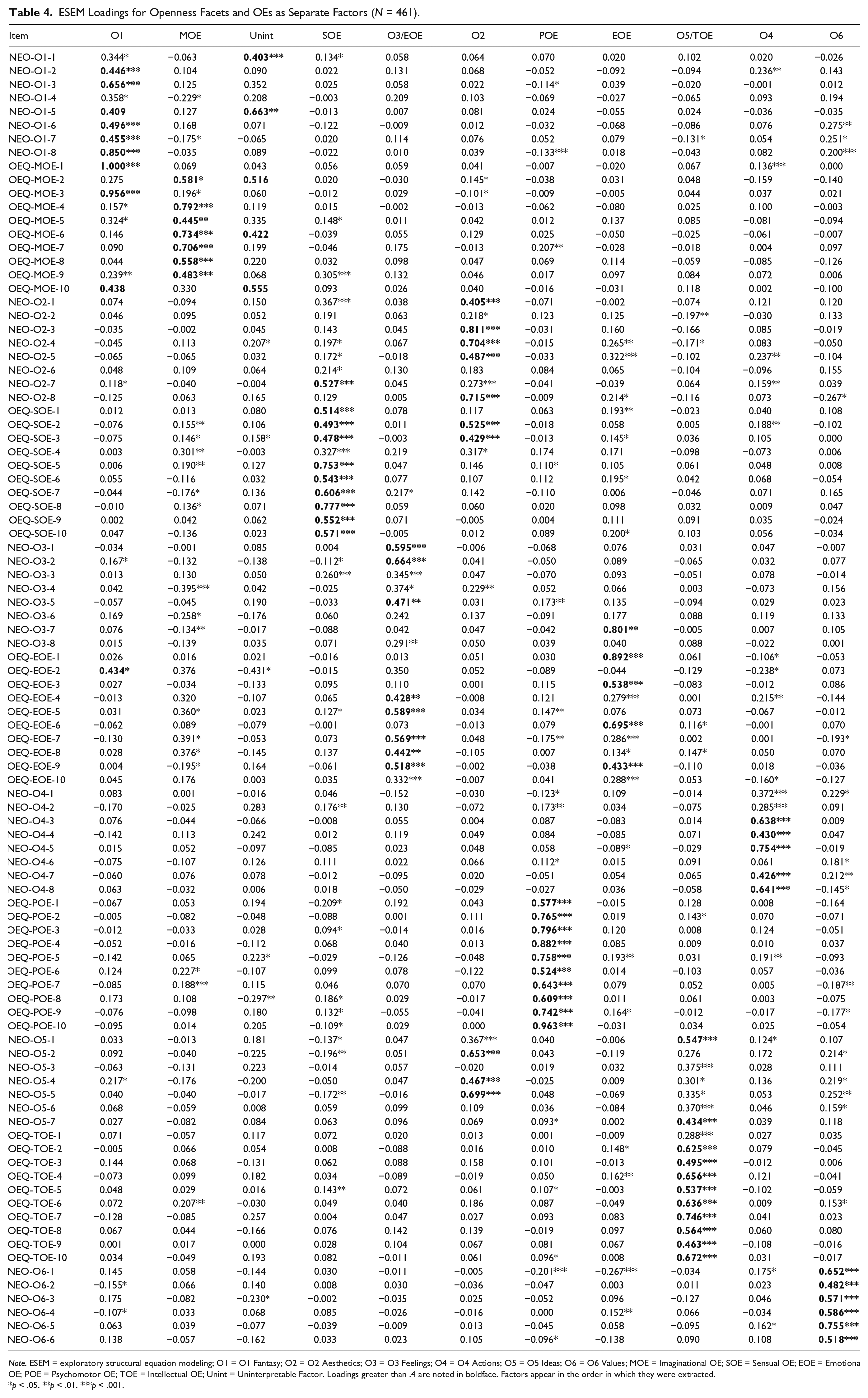
Note. ESEM = exploratory structural equation modeling; O1 = O1 Fantasy; O2 = O2 Aesthetics; O3 = O3 Feelings; O4 = O4 Actions; O5 = O5 Ideas; O6 = O6 Values; MOE = Imaginational OE; SOE = Sensual OE; EOE = Emotional OE; POE = Psychomotor OE; TOE = Intellectual OE; Unint = Uninterpretable Factor. Loadings greater than .4 are noted in boldface. Factors appear in the order in which they were extracted.
p < .05. **p < .01. ***p < .001.
Model 2, in which openness facets and their corresponding OEs were specified as joint factors, fit the data well with the exception of CFI, and results were interpretable. Every openness facet except O6 Values loaded onto one factor in combination with their equivalent OE (see Table 5). O2 Aesthetics and sensual OE, O3 Feelings and emotional OE, and O5 Ideas and intellectual OE loaded onto the same factor; all expected items loaded based on significance tests and most with high loadings. O1 Fantasy and imaginational OE loaded onto the same factor, with one expected item not loading based on significance. O4 Actions and psychomotor OE loaded onto the same factor even though this combination was the most diverse based on theory, with two expected items not loading based on significance and O4 items having lower loadings than psychomotor OE items. O6 Values was a single factor with no OEs loading in conjunction as a block, though with several items from other openness facets and OEs. Theory supports the results in this model, and most fit indices are good. Therefore, this model was selected as the best one and was used to interpret the results obtained.
ESEM Loadings for Openness Facets and OEs as Joint Factors (N = 461).
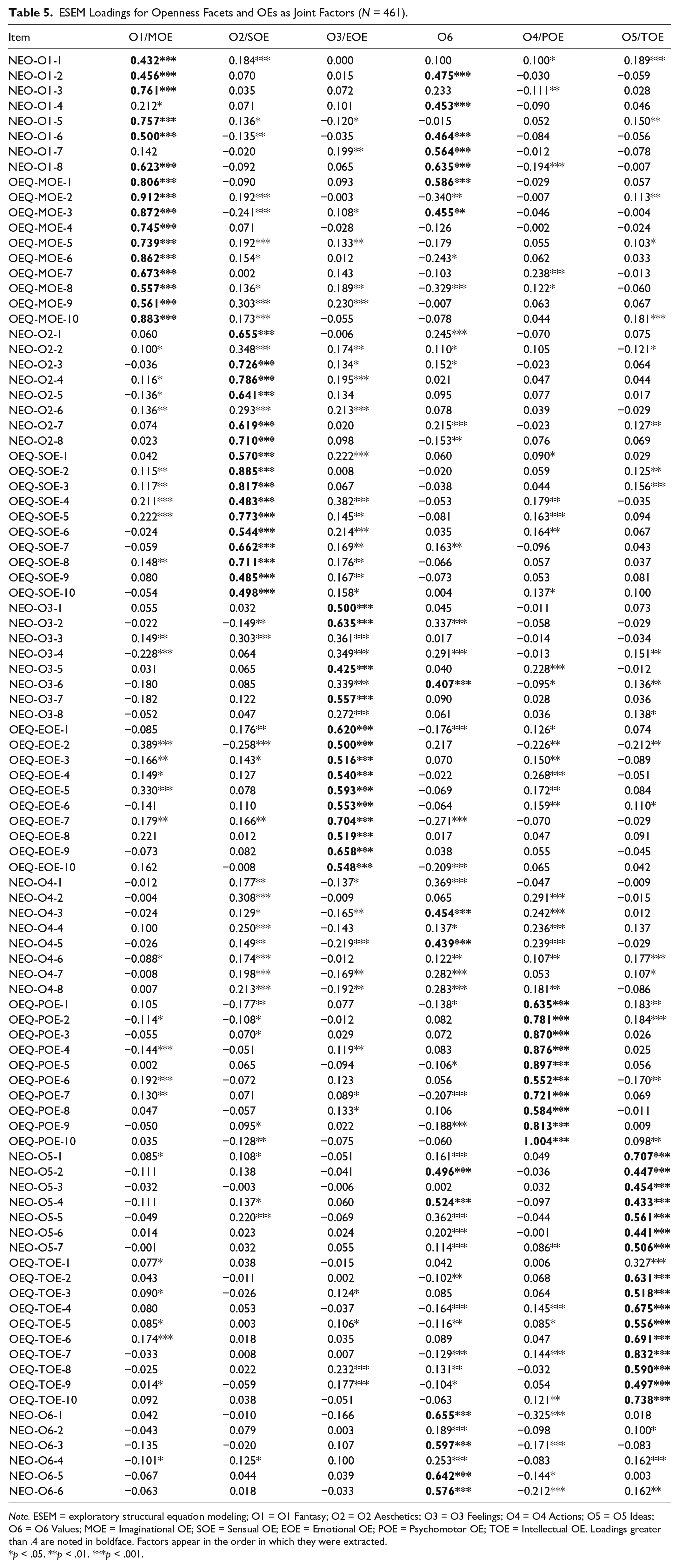
Note. ESEM = exploratory structural equation modeling; O1 = O1 Fantasy; O2 = O2 Aesthetics; O3 = O3 Feelings; O4 = O4 Actions; O5 = O5 Ideas; O6 = O6 Values; MOE = Imaginational OE; SOE = Sensual OE; EOE = Emotional OE; POE = Psychomotor OE; TOE = Intellectual OE. Loadings greater than .4 are noted in boldface. Factors appear in the order in which they were extracted.
p < .05. **p < .01. ***p < .001.
Discussion
Based on the results, openness to experience and OEs seem to represent largely the same construct. O1 Fantasy and imaginational OE, O2 Aesthetics and sensual OE, O3 Feelings and emotional OE, O4 Actions and psychomotor OE, and O5 Ideas and intellectual OE appear to be equivalent to each other as they loaded onto the same factor. O6 Values did not load with any OEs per ESEM analyses. Subscale Pearson correlations among openness facets and OEs, even though containing measurement error because they do not treat constructs as latent, as well as interfactor correlations from Model 1 CFA, show that intercorrelations between each openness facet and its corresponding OE are high enough that they can be considered as an equivalent construct measured by different instruments (Goldberg, 1999).
These results were obtained with our data set that included two different samples; one of the samples was composed of creative individuals, and the other included individuals from the general population. Creative individuals were expected to score higher on openness and OEs based on previous research (Batey et al., 2010; Falk et al., 2008; Feist, 1998; Furnham, Batey, Booth, Patel, & Lozinskaya, 2011; Furnham, Hughes, & Marshall, 2013; Gorman & Feist, 2014; Ivcevic & Mayer, 2007; Kaufman, 2013; Kerr & McKay, 2013; Wolfradt & Pretz, 2001; Yakmaci-Guzel & Akarsu, 2006) and thus are a helpful criterion for studies such as this one. Considering these findings, all five OEs can be entirely represented by a facet of openness.
Conceptual Similarity
Openness to fantasy and imagination, which is measured in O1 Fantasy, seems to encompass the construct measured by imaginational OE as evidenced by their joint factor in ESEM, correlations, and conceptual descriptions. Individuals open to fantasy are prone to daydreaming, which likely is of adaptive value to them and serves personal goals (McMillan, Kaufman, & Singer, 2013). Piechowski (2006) agreed that daydreaming and using imagination in general opens a myriad possibilities. Fantasy, along with aesthetics, feelings, and actions, is related to creative potential (Nusbaum & Silvia, 2011), creative achievement in the arts (Kaufman, 2013), and implicit learning (Kaufman et al., 2010).
Openness to sensory pleasures and aesthetic experiences is measured by O2 Aesthetics and sensual OE. From their conceptual descriptions to the results of this study from ESEM and correlations, these two factors appear undifferentiated. One single factor fit the data even though items in the NEO PI-3 focus more on enjoyment of the arts, while items on the OEQ-II focus on everyday sensorial experiences. Aesthetics, just like fantasy, relates to implicit learning (Kaufman et al., 2010) and creativity (Kaufman, 2013; Nusbaum & Silvia, 2011). Individuals high in openness to aesthetic experiences tend to be strongly moved by beauty found in nature and in arts, and often experience aesthetic chills in their bodies in response to these stimuli (McCrae, 1997; Silvia & Nusbaum, 2011).
Regarding personal emotional life, O3 Feelings and emotional OE also appeared as a single factor in ESEM and had high correlations. Both seem to describe the same openness to a wide variety and depth of feelings that individuals have related to creative achievement and potential (Kaufman, 2013; Nusbaum & Silvia, 2011), as well as to the experience of aesthetic chills (McCrae, 1997; Silvia & Nusbaum, 2011). Individuals who are open to feelings value emotions as an important part of life and are in tune with their emotional states; both their positive and negative emotional experiences are more intense than those of others (Costa & McCrae, 1992). Piechowski (2006) also describes extremes from ecstasy and emotional aliveness to fears and preoccupation with death. Although one might consider that such a wide range could render individuals vulnerable to mood disorders, particularly bipolar types, openness to feelings does not predict either unipolar or bipolar mood disorders (Quilty, Pelletier, DeYoung, & Bagby, 2013).
O4 Actions and psychomotor OE loaded onto the same factor, with the exception of two reverse-scored items referring to enjoying one’s old ways of doing things. In ESEM analyses, items of O4 Actions had lower loadings when compared with psychomotor OE items; correlations were also in the low range. O4 Actions describe an openness to change in general, adaptability to novel situations, and refusal of routines (Costa & McCrae, 1992). These individuals continuously revise their actions, trying to find alternative ways of doing things (Costa & McCrae, 1992). O4 Actions negatively predicts depression (Quilty et al., 2013), likely due to the adaptability and willingness to change until satisfying alternatives emerge, and is less related to cognitive abilities than the other facets of openness (DeYoung, Peterson, & Higgins, 2005). Psychomotor OE refers to increased general activity and expression through motor modes as well as an excess of physical energy (Piechowski, 2006). People who continually seek novel alternatives are probably in constant motion, yet these two can be mutually exclusive for some individuals.
Intellect is one of the most widely studied aspects of openness to experience, with many theorists calling the domain Openness/Intellect rather than simply openness (DeYoung, 2015). The model measuring O5 Ideas and intellectual OE as a single construct fit the data in ESEM, and correlations were high. O5 Ideas and intellectual OE appeared to describe the same construct of intellect, which has been previously linked with working memory (DeYoung, Shamosh, Green, Braver, & Gray, 2009), fluid intelligence (DeYoung et al., 2005; Nusbaum & Silvia, 2011), and crystallized intelligence (DeYoung et al., 2005). Intellect serves as a predictor of creative achievement in the sciences (Kaufman, 2013).
Openness to revising one’s values and conceptions of the world as measured by O6 Values was not a part of OEs, and in correlations had a moderate negative relationship with psychomotor OE. Openness to values should theoretically relate in a positive way to OE descriptions of Piechowski (2006) about self-examination and moral awareness, which should be encompassed in the OEQ-II under the emotional OE subscale. Perhaps said items do not adequately capture the vastness of Piechowski’s descriptions, or perhaps items that related to that construct were left out during the development of the OEQ-II. Theory cannot feasibly explain the negative relationship of O6 Values with the energy described in psychomotor OE. An alternative explanation would involve the findings of DeYoung et al. (2005) who found that O6 Values and O5 Ideas more closely related to fluid intelligence and dorsolateral prefrontal functions than the other openness facets did, and explored a potential relationship between intellectual curiosity, intelligence, moral relativism, and rejection of dogmatic beliefs. In this case, O6 Values would be related to intellectual OE, given that O5 Ideas and intellectual OE were practically indistinguishable in this study. Thus, further research is needed to empirically elucidate this question.
Problems With OEs and TPD
Research on OEs and TPD has two elemental problems. According to Dabrowski’s TPD, OEs serve a purpose within a larger theory and are meaningless on their own (Dabrowski, 1967; Dabrowski, Kawczak, & Piechowski, 1970; Mendaglio, 2012). TPD and OEs supporters appear to imply that the scarce OEs research validates the existence of OEs and therefore supports TPD. However, this link is missing in the literature. First, OEs research is atheoretical and does not connect OEs to the original theory (Mendaglio, 2012), and second, TPD presently lacks sufficient empirical support (Mendaglio, 2012). No studies have yet validated the assumptions of the overactive nervous systems, the different brain wirings, and the enhanced experiences attributed to people presenting with OEs. In fact, neural efficiency theory and corroborating studies indicate that intelligence is associated with less brain activity to accomplish tasks (Langer et al., 2012). The enactment of personality-related behaviors is also associated with lower brain activity (Knyazev, Pylkova, Slobodskoj-Plusnin, Bocharov, & Ushakov, 2015).
The only study that used brain imaging for OEs (Kuo et al., 2012, as cited in Chang & Kuo, 2013) found similar results as brain imaging studies of openness (Adelstein et al., 2011; DeYoung, 2010; DeYoung et al., 2010). Mendaglio (2012) suggested that assuming a normal distribution for OEs would be incongruent with TPD; however, all OE items and subscales had a reasonably normal distribution in this study, which is more consistent with the FFM (Costa & McCrae, 1992). Thus, at present, OEs merely describe behaviors and cannot be linked to any biological etiology.
Parsimony is the reason to avoid a complicated theory if a simple one provides better explanations for the phenomena studied. The relationships among OEs and openness indicate that they are the same underlying construct with different names. As Wirthwein et al. (2011) posited, OEs are possibly “old wine in new bottles” (p. 150) instead of a distinct and useful personality construct that can describe characteristics of gifted and creative individuals. Researchers such as Rost et al. (2014) and Winkler (2014) concluded that the relationship between giftedness and OEs is unclear and thus the usefulness of the construct is limited.
Limitations and Suggestions for Future Studies
Choice of instruments, sample size, and sample selection can improve in future studies. Quality of instruments has likely affected results of this study, as the OEQ-II has shown inadequate fit in the literature (Van den Broeck et al., 2013; Warne, 2011); however, it is thus far the only instrument available in English to measure OEs in adolescents and adults. With poor fit for the instrument it would be difficult to obtain adequate fit for other models that included this instrument. Inspecting both instruments showed that the NEO PI-3 had overall longer items than the OEQ-II. This might be a purely psychometric reason that could differentiate among openness facets and OEs that would not relate to the constructs themselves, but would be an artifact of measurement tools.
Self-report instruments rely on participants for accuracy of results, which is a major limitation. Studies with observers’ reports of personality such as the NEO PI-3 Observer Rating Forms (McCrae, Costa, & Martin, 2005) will add to these findings. Additionally, if the relationship of openness to OEs is robust it should hold with different personality instruments such as the IPIP (Goldberg, 1999). Future studies could include large-scale samples to confirm these results.
Samples in this study had a disparity in age; means in one sample did not overlap with the other sample’s range. It was not possible to find comparable samples of the same age for this study, though sample comparison was not the principal aim in this study. Covarying age would be particularly important in studies with the main focus of comparing samples. Future studies could include age as a covariate in a multiple indicators multiple causes or MIMIC model in structural equation modeling, to prevent spurious effects due to age differences.
Replications of this same study in other samples will facilitate further generalization. This study included a creatively gifted sample as a criterion sample, as creative individuals tend to score highest on openness to experience, and a sample of adults from the general population. However, OE research has largely focused on intellectually gifted individuals. Thus, the inclusion of intellectually gifted individuals as a separate group would be advantageous. If proponents of OEs continue to believe that OEs and openness to experience are separate constructs, then it is on them to conduct future studies to validate the conceptual differences in deeper detail, as well as empirically support Dabrowski’s TPD.
Conclusion
Openness facets and OEs appear to represent the same construct, and thus the giftedness field would benefit from discussing the construct as the personality trait of openness to experience. Subotnik et al. (2011) urged gifted education to use the vast body of psychological research to inform practice. In this case, the FFM is the personality model with the strongest research support and professional acceptance in the present day (Costa & McCrae, 1992; Goldberg, 1999).
The reason for this change from OEs to openness to experience goes beyond a mere change in names; the change will positively affect interpretation of behaviors. Adding the FFM and openness to experience to the daily vocabulary of gifted education researchers, teachers, counselors, and parents can connect these behaviors seen in creatively and intellectually gifted individuals to the vast literature base on personality. It will provide a sounder explanation of the behaviors linked to openness facets. The literature also can predict a developmental trajectory of openness for most individuals (McCrae et al., 2002). Openness as a personality trait can even affect career choice as it relates to artistic and investigative vocational interests, and working within realms of one’s vocational interests leads to higher career satisfaction (Larson, Rottinghaus, & Borgen, 2002).
Another reason to favor openness to experience and the FFM is the leap one might make based on the explanation for the behaviors seen. OEs have a place in a theory, TPD, which has insufficient empirical support. When reading about OEs, parents and practitioners can gravitate toward the theory and make assumptions that go beyond the description of openness- or OE-related behaviors. Such a leap is dangerous as it might present individuals who are open to experience as more moral following the original tenets of TPD (Dabrowski, 1967), an assumption not rooted in science. The leap becomes even more dangerous when OE is presented as an identification tool for giftedness, when studies have consistently shown that intelligence and openness have correlations in the .20 to .40 range (P. L. Ackerman & Heggestad, 1997; Austin, Deary, & Gibson, 1997; Austin et al., 2002; Moutafi et al., 2006; Moutafi, Furnham, & Crump, 2003; Zeidner & Shani-Zinovich, 2011).
Gifted education researchers and practitioners would benefit from the adoption of the FFM of personality as used by psychologists across the globe. The FFM of personality is a better option as it will permit meta-analyses and further generalization of findings. In addition, it will allow practitioners and parents to have a shared vocabulary with other sciences to describe a personality trait commonly seen in creatively and intellectually gifted individuals, such as openness to experience.
Footnotes
Appendix
References from Appendix
Declaration of Conflicting Interests
The author(s) declared no potential conflicts of interest with respect to the research, authorship, and/or publication of this article.
Funding
The author(s) disclosed receipt of the following financial support for the research, authorship, and/or publication of this article: This investigation was supported through awards from the University of Kansas Office of Graduate Studies Doctoral Student Research Fund, University of Kansas School of Education Graduate Student Research Fund, and University of Kansas School of Education Copwood-Hill Dissertation Scholarship.