



Abstract
The concept of giftedness has historically been shaped by theories of IQ, creativity, and expertise (including early conceptions of metacognition). These theories focus within the mind of the individual learner. Social, emotional, and motivational qualities of giftedness were treated as add-ons, not part of the core construct. This created misalignment with the social construction of knowledge—a position widely supported in gifted education practice. Newer, broader conceptions of metacognitive, self-regulated, and self-regulated learning processes have garnered interest. However, because these theories borrowed language from each other and earlier theories, assigning new meanings to old constructs, confusion arose about how to distinguish each of these three theories from each other or apply them to instruction. This article distinguishes among metacognition, self-regulation, and self-regulated learning, relating each to notions of giftedness, highlighting implications for practice, and especially highlighting self-regulated learning as a valuable contributor to understanding giftedness and designing instruction in gifted education.
Keywords
This article addresses three relatively new constructs and related theories that can valuably inform the idea of giftedness, namely, metacognition, self-regulation (SR), and especially self-regulated learning (SRL). In education generally, and gifted education particularly, these terms have not been sufficiently distinguished and have been used loosely or interchangeably. Grouping them together under a superordinate category and a single phrase such as regulatory component or processes is useful shorthand when a brief categorical description is needed, but doing so blurs nontrivial points of contrast among the three ideas. In addition, our purpose is not to displace high performance or potential for high performance as central to whatever the term giftedness conveys. Performance and regulatory components or processes are both important parts of high human potential, and the purposes of education include enhancing both, as well as the civic, social, and content goals expressed in the objectives of virtually all educational governing bodies. The contribution of this article is very specific; we do not propose a redefinition of giftedness but do hope that as discourse continues about what giftedness is or means, that our points will be taken into account. The purpose of this article is to clarify some of the most important distinctions among metacognition, SR, and SRL; how they relate to concepts of giftedness and to instruction in gifted education; and to encourage accurate and precise use of these terms in discourse and as a rationale for instructional decisions. Explicit juxtaposition of these ideas, from theory to practice, is summarized in Table 1; referring ahead to this table provides a guide to the main points we have made.
Selection of Key Characteristics Distinguishing Metacognition, Self-Regulation, and Self-Regulated Learning in Relation to Gifted Education.
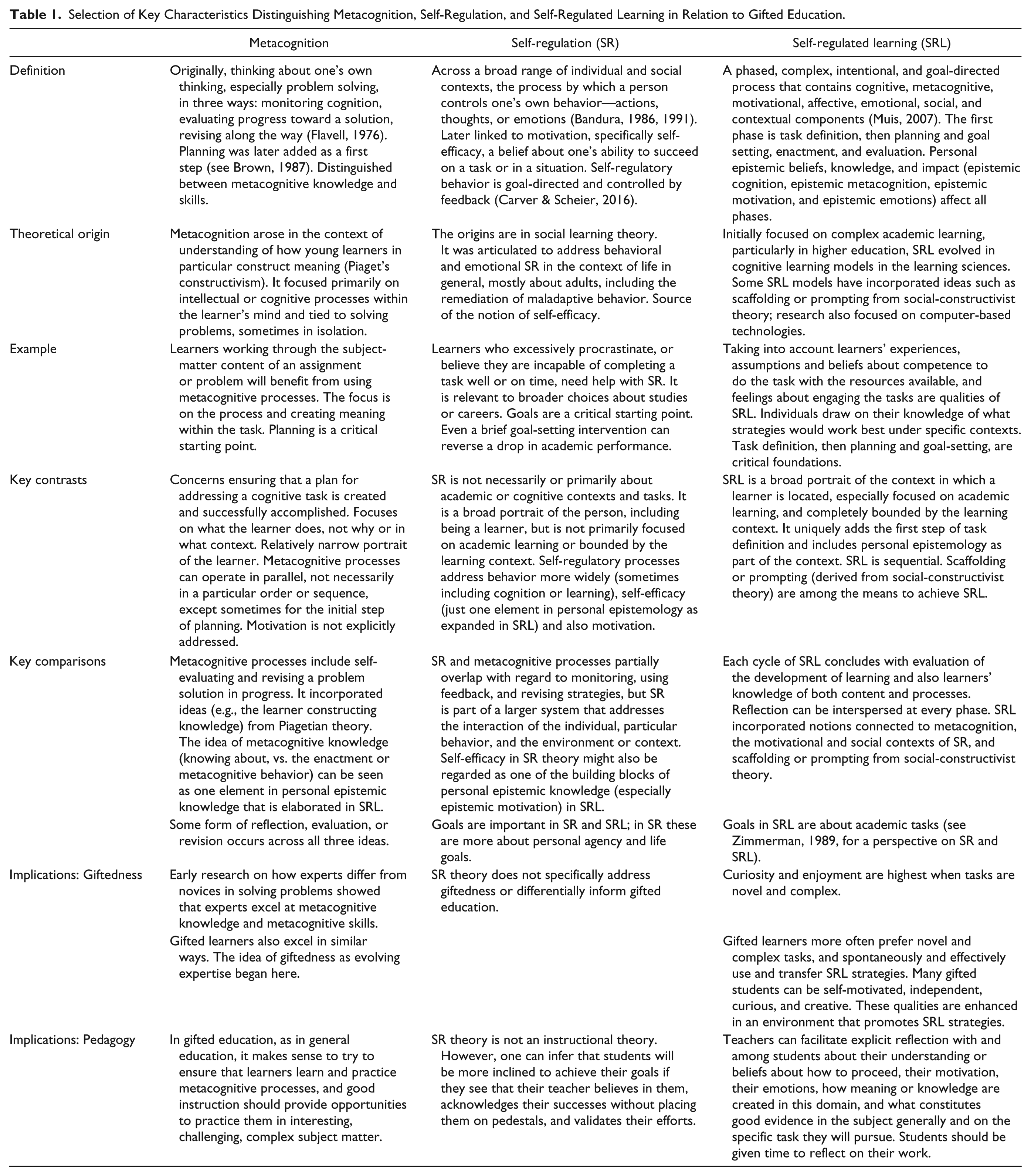
This article gives SRL theory a place of prominence among these three important ideas. It does so, first, because SRL encompasses many of the key ideas in metacognitive theory but in combination with social–emotional and motivational foci that are highly consistent with contemporary social-constructivist learning theories. Second, especially in contrast to SR theory, SRL began as and remains a primarily educational theory. These comparisons are elaborated in the discussion that follows. Third, gifted education can benefit from sound awareness of SRL theory and from awareness that there is a potential reciprocal benefit. Fourth, metacognition and SR are already well represented in the gifted education literature; we review them with SRL to illuminate the distinctions.
Literature Review
The Social–Emotional and Motivational Gap
The concept of giftedness has been a moving target, and it will probably remain so. Most of the focus in research on giftedness and gifted education has been on academic and cognitive criteria. Some relatively recent attention has been paid to social–emotional variables (Blackett & Webb, 2011; Piechowski, 1997), but usually as supplementary characteristics of giftedness among learners who have been identified by IQ or performance. For example, none of the 24 chapters in Sternberg and Davidson’s (2005) theoretical conceptualizations of giftedness has a social or emotional variable in its name. In Gagné’s (2004, 2005) model, motivations, social norms, and expectations are considered catalysts to turn gifts into talents but, in and of themselves, they are secondary and not part of the essence of giftedness. The importance of these variables has been asserted over almost a century (e.g., Feldhusen, 2005; Hollingworth, 1926; Renzulli, 2005; Strang, 1960; Tannenbaum, 1983) but not always systematically taken up in identification, instruction, and curriculum models for gifted education. Gifted education also needs points of connection with general education at which reciprocal contributions can be made to escape from what Webb (2017) described as its rather considerable isolation from most of general education to the rest of society at large.
Social–emotional constructs especially emphasized that learners who have been or might be identified as gifted are children and adolescents and they need to be treated as whole persons even when focusing on their academic and cognitive needs. The effort to link social, emotional, and motivational variables to the academic and cognitive foci that have dominated conceptions of giftedness is important to the goal of this article. Psychometric (and specifically IQ-focused) theory does not make this connection. Creativity theory partially does so; in their historical study of the evolution of themes in the study of creativity, Williams, Runco, and Berlow (2016) reported that group brainstorming and connected key words were among the most common 10 of the 163 key words they identified, and motivation was 23rd. Although educational research, notably about idea generation, was one of the three largest categories of creativity research, the primary domain of creativity research has become workplace innovation, not academic learning, curriculum, or instruction. They did, however, identify the present journal as one of the four primary publishers of research on creativity. Understanding how these social, emotional, and motivational variables are linked to the academic and cognitive foci processes that conceptually contribute to giftedness can help integrate these different domains and help gifted education practice address both processes more effectively and with greater conceptual cohesion.
Research has demonstrated that cognitive performance and growth can be facilitated by social interactions (e.g., Ybarra et al., 2008). Students can be taught to interact effectively with their peers by being patient and listening to each person’s point of view. These social interactions can enhance each individual’s ability to develop perspective taking, thus becoming more reflective about themselves and others. Renzulli (2010) described teaching students to interact effectively and patiently, and to listen to each person’s contributions, as part of building social capital and enhanced concern for the well-being of people and the earth.
Expertise and Giftedness
In the last third of the 20th century, two new and closely related threads, the study of cognition and of expertise, began in cognitive psychology and the learning sciences (Chi, Feltovich, & Glaser, 1981; DiSessa, 1987). Cognitive psychology especially addressed how people solved problems and it led to major advances in artificial intelligence. The focus of artificial intelligence was to study how experts versus novices in some domain of interest (e.g., mathematics or chess) solved problems and to try to design computer models that could emulate this superior performance. In turn, this interest in superior versus initial performance supported a connection to gifted education.
In the 1970s, Renzulli’s (1986, 2005) three-ring conception of giftedness, which consisted of above-average ability, creativity (in both school-house and creative-productive forms), task commitment (a motivational variable), and the interplay among these (Renzulli, 2010), drew on the development of expert thinking and emulating what experts do (e.g., coming up with a question or problem based on student interest, working collaboratively, planning extensively, and sharing what you learn with a suitable audience). Renzulli noted that developing and manifesting these characteristics requires diverse educational experiences that are not typically found in most regular classrooms. He emphasized that an individual did not necessarily have to possess all three qualities equally to be considered gifted and, most important, that these qualities should not be used as prerequisites for the identification of giftedness and providing tailored programs. Instead, instruction should foster learners’ growth by widely providing novel and interesting content.
Other theoretical and program models, such as Sternberg’s (1984) triarchic theory and Betts and Neihart’s (1988) description of six different profiles of learners identified with gifts or talents, made expert thinking the norm across most gifted-education models. By the 1980s, the theory was articulated more clearly as several researchers argued that giftedness was more than a state or trait or demonstrated simply by a score or product, but rather especially a process, and specifically a process of becoming an expert or at least like an expert in a particular domain (Shore & Kanevsky, 1993; Sternberg, 2001; Sternberg, Ferrari, Clinkenbeard, & Grigorenko, 1996). This work focused on linking giftedness to the development of expert versus novice thinking (Ericsson, Roring, & Nandagopal, 2007), metacognition (discussed below), and perspective taking.
The link between expert-versus-novice thinking and giftedness has been illustrated in studies in which high-performing students have demonstrated cognitive processing skills more similar to experts in certain fields when compared with typical students, for example, how they connect new ideas to their existing knowledge base and how they categorize problems (Austin & Shore, 1993; Pelletier & Shore, 2003). Experts and successful learners are more reflective, monitor themselves more accurately, devote more time to higher order planning in problem solving, and spontaneously generate multiple solution steps (E. Coleman & Shore, 1991). Expertise theory is also related to perspective taking; learners identified by high IQ can appear to be more expert and acquire elements of expertise in certain fields by taking the perspective of others (Barfurth, Ritchie, Irving, & Shore, 2009). The shift toward an expertise-based view of giftedness brought three important changes to the idea of giftedness.
First, it helped move the idea of giftedness away from the belief that it is an innate, fixed, permanent characteristic or trait of the person. Expertise is learned and requires experience to develop. Therefore, to some degree at least, people can be taught to be more intelligent in certain domains by developing some of the skills that experts use to solve problems.
Second, giftedness does not require expertise in every field. One can excel in one thing or a few things. Failure to succeed on one specific task should not prevent recognizing a child’s giftedness. A learner can exhibit extreme giftedness (e.g., be capable or knowledgeable or creatively productive) in one area and be seriously challenged in other areas of academic or social performance; such individuals are termed as twice-exceptional (Hernandez Finch, Speirs Neumeister, Burney, & Cook, 2014). These include, among others, students identified as gifted and as having learning disabilities. Using more than just one criterion in parallel, not in series, to identify giftedness in students ensures that children with dual exceptionalities are more likely to be acknowledged by their teachers and thus stand a better chance of receiving the necessary tools to excel in their academics, in other words, reducing false negatives in identification (Hernandez Finch et al., 2014). hannah and Shore (2008) further showed that students with high IQs who also had dyslexia responded to incongruities intentionally inserted in an unfamiliar reading task in the same ways and amounts as high-IQ students without learning disabilities, and in both cases differently from control group students. Viewed from the perspective of giftedness as emerging expertise and in light of the thinking processes they used to overcome contradictions and absurdities in the texts, dual-exceptional children showed performance associated with giftedness first and learning disabilities second; yet such students are typically placed in classes that address their weaknesses before their strengths (Hernandez Finch et al., 2014).
Third, and possibly most important, it changed the focus away from what people know (the stereotypical walking encyclopedia) to at least an equal concern about the processes that effective learners and knowledgeable adults use to acquire knowledge, organize it in hierarchical and interconnected ways, and tackle novel situations.
Despite this progress, an important limitation remained in understanding giftedness. With few exceptions, all the above insights into giftedness have focused on what goes on within the mind of the individual learner. Partial exceptions included the expertise-based models of giftedness that addressed sharing new learning with others, and creativity development approaches that used group activities (e.g., brainstorming) to catalyze the process. But psychometric variables (including IQ), creativity, and expertise are primarily about what goes on inside the learner’s brain. These elaborations made defining giftedness much more complex but also broad enough that more children could be seen as having giftedness and given opportunities to hone their abilities.
Historically, in the development of the understanding of giftedness, three broad implications for instruction have emerged. Psychometric theory (whether reflected in IQ, other aptitude, or achievement tests) made the case for acceleration, learning more, more advanced material, and more quickly (e.g., Colangelo, Assouline, & Gross, 2004; Stanley & Benbow, 1982). Creativity theory opened the door to learners bringing interests and alternative perspectives to the classroom, valuing social and multiple learning approaches (e.g., Renzulli, 1998, 2005; Treffinger & Isaksen, 2005) and paying attention to the processes of building a range of creative-productive- or critical-thinking skills, in contrast to conceiving the end result as finding one right or best answer (e.g., Csikszentmihalyi & Getzels, 1976). Expertise theory, with its roots in cognitive psychology, placed the emphasis on the problem-solving processes, both straightforward and complex, by which learners think and know (Ericsson et al., 2007; Shore & Kanevsky, 1993; Sternberg, 2001). Giftedness is a complex topic, and is more than one number stamped indelibly on a child’s forehead.
Metacognition and Giftedness
Being more reflective about oneself and others, and its implications for being able to facilitate civil dialogue, is central to many contemporary models of metacognition, SR, and SRL (Muis, 2007). The following overviews of metacognition, then SR, and SRL, draw extensively from the insights of a review of their connections and differences (Dinsmore, Alexander, & Loughlin, 2008) and an accompanying analysis of the same issues (Lajoie, 2008). One difficulty is that similar words are used to mean different things. For example, metacognition also appears in SR theory, and SR is in the phrase SRL. With some oversimplification, it is possible to compare these terms and relate each to giftedness and to defensible practices in gifted education.
The terms metacognition and metacognitive initially found their way into the vocabulary of gifted education around the same time as expertise, in the 1970s and 1980s (e.g., see Borkowski & Peck, 1986; Kanevsky, 1995; Steiner & Carr, 2003; and a summary by Chichekian & Shore, 2014). The meaning of metacognition has evolved, so today it is best not to use the word alone as a noun, but as an adjective as in metacognitive processes. As originally defined by Flavell (1976), metacognition meant simply thinking about one’s own thinking, especially problem solving, in three ways. Originally, these were monitoring one’s cognition, evaluating progress toward a solution, and adjusting or revising what one is doing along the way. To this, planning was gradually added as a first step. This elaborated the understanding of abilities but still focused primarily on cognitive processes within the learner’s mind. Seen in retrospect, Flavell’s initial definition was rather simplistic and incurred the risk that teachers, especially new teachers, might underestimate the extent of cognitive resources that learners need to invoke for successful metacognition. It was, however, a starting point. The original context for Flavell’s work was to better understand how preschool children’s thinking evolved in these three ways. Metacognition was not a pedagogical theory, although it makes good sense to teach schoolchildren to plan or set goals; to frequently pay attention to their thinking, speaking, and writing; to evaluate if their approach to a problem is taking them in the right direction; and to take a new approach as needed.
Defined by these four processes, several studies in the 1980s (summarized by E. Coleman & Shore, 1991) showed that metacognitive processes were demonstrated more often by experts than by novices in any field, and also by learners identified as gifted (variously defined, but typically by students admitted to formal programs, hence with high IQ or strong actual performance), who demonstrated these processes sooner and more often than other learners did. Students identified as gifted have a larger repertoire of metacognitive processes and use them successfully more spontaneously and more often than typical students (Manning, 1996). Teaching any students skills of metacognitive control, for example in the forms of planning, monitoring, evaluating, and revising, can improve academic performance as well as encourage habits-of-mind that could potentially help them develop expertise in chosen fields (Veenman & Verhiej, 2003). Many of these metacognitive control skills were deemed to be domain-general, that is, independent of the subject matter; this is in contrast to the usage of the term metacognition in SRL theory, within which the subject matter is an important contextual consideration.
By the 1990s, research and theorizing about metacognition had moved well beyond loosely defined thinking about one’s own thinking to include individuals’ metacognitive theories, that is, “systematic frameworks used to explain and direct cognition, metacognitive knowledge, and regulatory skills” (Schraw & Moshman, 1992, p. 351). By two decades later, metacognitive processes were being merged into personal epistemologies and SRL theories (Barzilai & Zohar, 2014).
There is a temptation to label metacognitive processes and self-regulatory processes interchangeably. We advise not doing so, because there are important differences between metacognitive theory and SR theory. One difference, noted in a relatively new line of theorizing (cf. Miele & Scholer, 2018), is that SR theory adds emotional and motivational elements. When discussing the intellectual skills or processes of planning, monitoring, evaluating, and revising, the reference in metacognitive processes is strictly to intellectual or cognitive processes and skills. These ideas address what the learner does, not why or in what context. Metacognitive processes, broadly defined, are tied to solving problems, sometimes in isolation; this is why they are a good fit to expertise theory. Second, as noted earlier, metacognitive skills can be regarded as relatively domain-general, whereas SRL skills are domain-specific or, at the least, identified with regard to the subject matter.
Even with this self-imposed limitation, metacognition and expertise are powerful and educationally useful ideas. Encouraging high proficiency in metacognitive processes adds an important level of precision to what is meant when stating that giftedness is associated with early and more extensive signs of thinking like experts. When teaching or encouraging the processes of planning, monitoring, ongoing evaluation of progress toward a problem solution, and revising the plan if a new attempt as needed, those practices derive from metacognitive theory and the half-century of research that supports its value.
In gifted education, as in general education, it makes sense to take actions that increase the likelihood that students learn and practice metacognitive processes. Learners identified as gifted excel at these processes (Barfurth et al., 2009), and good instruction should provide opportunities to practice them in interesting, challenging, complex subject matter. White and Frederiksen (1998) demonstrated an even wider impact. They developed a computer-based experience to enhance metacognitive knowledge and skills that helped low-achieving urban students from 12 science classrooms in Grades 7 to 9 leap-frog in performance on inquiry-based research projects and inquiry tests to surpass their average-performing classmates and more closely approach the quality of work from the top-performing students. Metacognitive theory, however, like psychometric, creativity, or expertise theories on their own, does not within itself define the pedagogical or instructional mechanisms that enable any learner, and particularly a learner identified as gifted, to progress through increasingly complex and challenging material. That kind of support, called prompting or scaffolding, is addressed in SRL (more below) and in another contributing theory known as social constructivism (Vygotsky, 1978).
Self-Regulation and Giftedness
SR is not the same thing as SRL, despite the overlapping terminology. SR, a broader term, comes from a very different set of psychological concerns, yet can also contribute to an expanded, more contemporary understanding of giftedness. Using the term too loosely detracts from professionals’ ability to understand and improve the lives and especially school experiences of learners identified as gifted or who would be identified were a service model in place. SR theory was articulated by Bandura (1986), not as an educational or cognitive enterprise, but originally to refer to behavioral and emotional SR in the context of life in general, mostly among adults. SR theory found a home in domains ranging from overcoming addictions to anger management or other maladaptive social behavior (Vohs & Baumeister, 2016). Carver and Scheier (2016) described SR as behavior that is both guided by goals and controlled by feedback. Of course, goals and feedback are highly relevant to education.
The important point here is that SR refers in part to something within the learner but, when SR is added to the vocabulary of giftedness and gifted education, several important new ideas come to the forefront. The focus on goals is important. For example, even a brief goal-setting intervention of just a few minutes can reverse a drop in high-ability college students’ grade point averages in the following semester (Morisano, Hirsh, Peterson, Pihl, & Shore, 2010). Feedback functions in metacognitive processes, but in SR the feedback also extends to information coming from the broader context, such as the responses of other persons. Indeed, interaction with the broader social context and environment in general is core to SR theory.
Bandura (1986) also created an explicit link to motivation and expanded his idea of SR to include self-efficacy (Bandura, 1997). Self-efficacy is a belief about one’s ability to succeed on a task or in a situation. Students will be more inclined to achieve their goals if they see that their teacher believes in them, acknowledges their successes without placing them on pedestals, and validates their efforts. Teachers can raise the self-efficacy and ultimately the academic progress of students identified as gifted by providing a positive classroom environment and ensuring that students are motivated in addition to employing effective strategies (Zimmerman & Martinez-Pons, 1990). In gifted education, for example, self-efficacy can be invoked as part of an explanation of teenage girls’ lower beliefs about their own mathematics abilities even when they outperform boys in their classes (Phillipson & Callingham, 2009). Another new and important construct, namely, beliefs, has emerged as a point of overlap with SRL as addressed below.
SR and metacognitive processes partially overlap with regard to monitoring, using feedback, and revising strategies, but SR is part of a larger system that addresses the interaction of the individual, a particular behavior, and the environment or context. The difference can perhaps be illustrated with an example: A learner working her way through the subject matter content of a complex, individual social studies assignment will benefit from using metacognitive processes. If, however, she engages in prolonged procrastination, berates herself for not understanding everything the first time she reads an original source document, and comes to believe that she is incapable of completing the assignment well or on time, the situation involves SR. If it is about SR, we can explore motivation, emotionality, behavior, and self-efficacy. If it is strictly about ensuring that the plan for addressing the task is being followed successfully, that is a metacognitive process. SR is not necessarily or even primarily about learning, academic contexts, or cognitive tasks. If and when it might be related to learning, SR is not bound by the learning context. Metacognition as originally defined was always about cognitive processes. As we have indicated below, SRL is always tied to learning and is also bound by the learning context or situation. These distinctions matter because greater professionalism is displayed when we as educators can identify the scientific and theoretical basis for what we do. Anticipating the next topic, were one to take this learner’s experience a step further and take into account her assumptions and beliefs about her competence to do the task with the resources available to her, and also her feelings about engagement in the tasks, this would be a reference to SRL, not metacognition, and not SR (Winne & Hadwin, 1998).
In gifted education, therefore, SR is usually not an appropriate theory to invoke when trying to understand or improve a learner’s performance on a particular task or curriculum unit. Within gifted education, Betts and his colleagues (e.g., Betts, 1985; Betts & Kercher, 2009) developed the autonomous learner model independently of the emergence of SR theory. The notion of learner autonomy is a good companion to self-efficacy, and the model strongly emphasizes social and emotional development and well-being as life skills. This model is not tied to any age group or academic domain, and neither does it anticipate personal epistemology (i.e., one’s thinking about knowledge and knowing), hence it offers a good link between gifted education and SR theory. SR is a good theory to invoke when looking at the broader choices students make about studies or careers (Jung, 2017), whether or not they enthusiastically engage in a challenging task (Roche, Clarke, Sullivan, & Cheeseman, 2013), how they work with each other and on their own, or why they might have difficulties in school or in life—in spite of their high abilities or previous high performance (Reis & McCoach, 2000), their creativity, the degree of expertise they exhibit in a single or cross-disciplinary domain, or their metacognitive processes. These different terms imply looking at the learner through different lenses. One way to avoid confounding metacognitive processes and self-regulatory processes is not to use the names interchangeably.
What, then, is missing in SR that could be important to giftedness and gifted education? The answer is the particular focus on academic learning. After the first two pillars of understanding giftedness were erected—namely, psychometric variables, such as IQ and school performance, and creativity—the major ideas that followed, from metacognition to executive functioning (planning, evaluation, etc.), and the development of expertise, have all been integrated into an important instructional and learning idea, namely, self-regulated learning.
Self-Regulated Learning and Giftedness
SRL first emerged in the 1980s (see Zimmerman, 1989) and especially took root in the 1990s. Initially, it was exclusively focused on academic learning, particularly in higher education. Because higher education, to a large extent, addresses advanced subject matter, it is relevant to gifted education. Subsequent SRL research has especially focused on the use of computer-based technologies to promote learning. Muis (2007; also see Muis, Chevrier, & Singh, 2018; Muis & Singh, 2018) defined SRL as a complex event that occurs during learning: This multidimensional event is intentional and goal-directed, and it contains cognitive, metacognitive, motivational, affective, emotional, and social components. It is easy to see how metacognition, SR, and SRL can be confounded.
SRL and Metacognition
Self-regulatory-learning processes and metacognitive processes are different even though students who develop metacognitive skills such as planning, monitoring, and evaluating may become better self-regulated learners and ultimately achieve better academic success (Gonzales & Leticia, 2013). SRL researchers borrowed language from the metacognitive literature, which not surprisingly blurred the lines between the constructs (Barzilai & Zohar, 2014). Planning, monitoring, and control or evaluation of processes would be considered by some to be metacognitive, but metacognitive researchers do not like the fact that SRL researchers adapted these terms to explain the various phases of SRL. Muis et al. (2018) unraveled some of that confound by untangling the common language and clarifying the developmental or phased nature of SRL. Metacognitive processes are not necessarily phased; rather they occur in parallel and, when they occur in sequence, planning has normally been cited as the first step. In Muis’s (2007) model of SRL, the first phase is, instead, task definition, and the second phase is planning and goal setting. These are followed by enactment and evaluation. Task definition is similar to problem representation, an initial step in expert-like problem solving. Metacognitive models suggest that planning is a metacognitive event, and it can be. Problem representation and task definition in themselves are cognitive events, but when thinking about how one is doing them they are metacognitive as well. If the learner is connecting how the task fits into his or her existing frame of reference, self-efficacy, or motivation to do the task, or dealing with the emotional and social context, it is a self-regulated-learning event. When the cognitive and metacognitive components are isolated, the latter should be called metacognitive processes and not self-regulatory processes, unless they are embedded into some kind of phase-like model that situates metacognition as part of the core of SRL as done by Muis (2007), Winne (1995), and Winne and Hadwin (2008).
SRL and SR
At the risk of being excessively repetitive in the overall message, SRL is not the same thing as SR. SRL is about learning. The cross-usage or borrowing of words makes life difficult for theorists and teachers alike. In their review, Dinsmore et al. (2008) searched for the words common to the literatures on metacognition, SR, and SRL. They found seven: monitor, control, regulate, cognition, motivation, behavior, and knowledge. However, these words were not all used the same way or equally often. Scaffolding or prompting, mentioned earlier and elaborated below, barely appears in the SR literature and is therefore not on the list of common terminology, even though it is an important educational tool. Comparing metacognitive processes and SR, both frequently refer to monitoring and control, but they differ in what is being monitored or controlled. Metacognitive processes address cognitive events. Self-regulatory processes address behavior more widely (sometimes including cognition or learning) and also motivation. The common vocabulary especially affects SR and SRL, although both have less often used the term knowledge.
Therefore, how is SRL more than merely the combination of metacognition and SR? SRL adds a new and important construct, personal epistemology. Epistemology is the branch of philosophy about knowledge and knowing, topics of great interest in the field first known as natural philosophy and now psychology. Personal epistemology has typically focused on individuals’ epistemic beliefs, that is, how individuals think and what they believe about knowledge and knowing, including notions of evidence and what is true, in both their own thinking and in general. It is the act of being reflective or critical (in the analytic rather than negative sense) about one’s own thinking processes or strategies (Mason, Boldrin, & Ariasi, 2010). It is not content knowledge itself, but because the content one learns is a crucial part of the context; hence, it is part of the equation. Neither should epistemic thinking be regarded as a specific metacognitive component but, rather, it can be conceptualized by extending our conceptualizations of metacognition to incorporate the elements of self-knowledge and beliefs about its components (Barzilai & Zohar, 2016). A widely studied example of personal epistemology is learners’ understanding of the nature of science, how science knowledge is organized versus other disciplines, and misconceptions about the content and methods of science inquiry (e.g., Schraw & Sinatra, 2004). When a student makes a claim about knowledge, this taps into his or her epistemic beliefs when asked in class, for example, “How do we know that? How do we know it is true? Why did you ask that question?”
Muis et al. (2018) noted that SRL is not a snapshot of a moment during or at the end of a learning event. It is a dynamic or moving picture of the development of learning and also learners’ knowledge of both content and processes. It unites four facets of personal epistemology, namely, epistemic cognition, epistemic metacognition, epistemic motivation, and epistemic emotions. Epistemic cognition, therefore, comprises the learner’s knowledge and beliefs about how she or he learns or solves problems, or generally about learning and solving problems, usually in a particular context. Epistemic metacognition, in turn, addresses such knowledge and beliefs about how the learner and learners in general plan, monitor, evaluate, and revise learning and problem-solving strategies, and how these are sequenced (though except for planning, sequencing is not a defining characteristic of metacognition itself). There is also the unique, initial SRL step of task definition. A key distinction between metacognition and epistemic metacognition, therefore—and this contrast applies to all four elements—is the reflection on one’s knowledge and beliefs about the processes as well as the processes themselves. Similar meta-level focus applies to motivations and emotions.
There is undeniably overlap between parts of epistemic metacognition and metacognitive knowledge, and that is why we are trying to untangle these constructs. SRL gathers together and adds to ideas from the worlds of metacognition and SR. How is SRL more than the sum of its parts? Consider this example: In strictly metacognitive research, a learner might be asked to think aloud while solving a problem. The goals might be to look for indications that the learner worked with a plan or made interim evaluations of progress toward a solution, and those events and their frequencies can be compared with the quality of the outcome. Research focused on metacognitive processes is partly about mastering those processes, but it also addresses the specific content being taught and learned. In a parallel SRL study, it is possible to directly ask the learner what solution strategies would be appropriate, how one might make those judgments within that subject matter, what initiates interest (see, e.g., Renninger & Hidi, 2016) and persistence working on the problem (see, e.g., Skinner, Pitzer, & Steele, 2016), and what apprehensions might have had to be overcome or personal strengths brought to tackle it. The specific content to be learned is less dominant in the equation.
Implications for Understanding Giftedness
Of particular interest to gifted education in Muis’s (2007) SRL model (also Greene, Muis, & Pieschl, 2010; Muis et al., 2018) is the role of task novelty and complexity. Curiosity and enjoyment are highest when tasks are both novel and complex. Research on giftedness has also demonstrated strong preference among learners identified as gifted for novel and complex tasks (e.g., Garofalo, 1993; Neihart, 2008). These differences cannot be accounted for in psychometric theory or by SR theory alone. Once emotions are added to the mix, a theory exists that can explain and predict these outcomes.
Early in the development of SRL theory, Winne (1996) anticipated how individual differences might be expressed in SRL. He proposed “a provisional typology of five sites where individual differences may originate that affect SRL: domain knowledge, knowledge of tactics and strategies, performance of tactics and strategies, regulation of tactics and strategies, and global dispositions” (pp. 327-328). In what appears to have been the first literature review to explicitly link early conceptions of SRL and giftedness, Risemberg and Zimmerman (1992) observed that learners identified as gifted (the definition was unspecified for the cited studies, but at the time the criterion was likely high IQ or performance), compared with others, more often used SRL strategies spontaneously and effectively. When trained to use such strategies, they more easily transferred such strategies to novel tasks. Risemberg and Zimmerman foresaw potential in using such information to identify giftedness in learners and enhance behavior that might be noted as gifted. In parallel with the highlighted dynamic nature of SRL (Muis et al., 2018), whatever competence or behavior we deem “gifted” should also be understood as dynamic rather than static, subject to change and continued improvement. In essence, we should embrace the notion of giftedness in the making rather than viewing giftedness as a permanent state of being.
Although some learners who meet gifted program selection criteria demonstrate metacognitive and self-regulatory learning processes such as monitoring their progress and making necessary changes when solving problems, it is not a matter of waiting for these capabilities to occur “naturally.” Rather, these processes are learned, like reading. Stoeger and Ziegler (2010) supported the idea of incorporating self-regulated learning strategies into gifted education. Doing so would help students develop an approach to learning and work style that is well aligned to their own abilities. Housand and Reis (2008) also stressed this point: Students who self-regulate their learning utilize and initiate volitional control to direct cognitive and behavioral strategies during the learning process, and it is well documented in the research literature on learning that active engagement in the learning process produces increases in academic performance. (p. 108)
The mechanism (or its directionality) that supports any relation between SRL performance and giftedness is not yet known. SRL behavior might facilitate the development of giftedness, qualities associated with giftedness might differentially facilitate the acquisition of SRL skills and affect, or both might be to some degree outcomes of a third influence not yet identified.
Despite the fact that gifted education has typically treated SRL as a supplement to the concept of giftedness rather than a core part of the construct, SRL-based approaches have been recognized as a valuable tool to overcoming underachievement among learners with potential to achieve at very high levels (e.g., Reis & Greene, n.d.). This makes sense. Underachievement can result from not understanding the content, but it can also be due to poor initial definition of the learner’s task or role, low efficacy or motivation, or negative emotions attached to the task or context. In their introduction to two case studies of underachievement and giftedness, Bennett-Rappell and Northcote (2016) highlighted the importance of attention to underachievement among learners identified as gifted (Landis & Reschly, 2013; Reis & McCoach, 2000) and the connections between these phenomena. Such underachievement might easily be overlooked if, on the surface, observed performance was age- or grade-typical, yet it was far below a given student’s potential (Gagné, 1993, 2007). Siegle (2012) also identified self-efficacy, setting appropriate and achievable goals, and a sense that they are participating in meaningful activities as important to counteracting underachievement by students who in favorable conditions could be identified as gifted, and failure to intervene can have long-term negative consequences. Environmental and intrapersonal factors or misalignment, as well as chance (Gagné, 2007) can contribute to underachievement. For example, Peters and Engerrand (2016) identified low family income and some cultural norms as contributing barriers. Other possible contributors fall into physical, cognitive, or affective categories, or personal variables such as low SR, self-efficacy, or self-motivation (Siegle & McCoach, 2002). The sources of underachievement among potential high achievers vary widely and require individual attention to determine the optimal interventions (Reis & McCoach, 2000). Likely related to the importance of seeing their work as meaningful to overcoming underachievement, L. J. Coleman, Micko, and Cross (2015) proposed seeking direct input from the student in their own words, to be able to fully understand what the combination of underachievement and giftedness comprises in each instance. Many of these contributors would be readily denoted as contextual in SRL theory. Even students with potential to achieve at very high levels and who have the relevant skills also need the motivation to use them. Some affective variables (e.g., anxiety) can be counterproductive or most helpful at optimal levels neither too high nor low. This balance of cognition and affect is embedded within SRL models, which we could call the skill and the will.
Not all students with exceptional potential have had the opportunities at home or at school to develop SRL-related knowledge and skills, therefore SRL is a set of strategies that can be taught so that it becomes self-directed and channels mental abilities into academic skills (Gonzales & Leticia, 2013). If a caution is to be echoed, this teaching should be in the context of real and meaningful subject matter. Struggling students, regardless of ability level, can benefit from being taught SRL skills. But a key caution is that only learners who do not initially demonstrate the skills will benefit from training (Muis, Psaradellis, Lajoie, Di Leo, & Chevrier, 2015; Zimmerman, 2001). Students who already have them do not benefit, which seems obvious—but learners identified with gifts or talents too often experience being “taught” what they already know or know how to do. Learners who do not initially possess or demonstrate those skills benefit greatly—at all levels of ability. They simply require modeling first, followed by scaffolding with feedback, with scaffolding slowly being removed as their skills increase in proficiency (Zimmerman & Labuhn, 2012).
Scaffolding and Prompting
This section is a side-note to the main propositions of this article, namely, that metacognition, SR, and SRL are three separate but connected theories, and that all are relevant to the greater understanding of giftedness. This side-note is important because scaffolding and prompting play an important role is SRL theory, and they come from a unique source. SRL does not favor any one particular teaching or instructional methodology or curriculum. It applies equally to learning from a book, watching television, taking an online course, a piano lesson, a classroom with the desks in rows with the teacher doing most of the talking, or an inquiry- and project-based learning experience. Scaffolding, also called prompting, has been mentioned three times, in reference to metacognition, SR, and SRL. It can be useful to briefly place it in historic and conceptual context with regard to these three theories.
In the 1930s, Vygotsky (1978—the year the work was first translated into English) filled an important gap in Piaget’s widely known cognitive-developmental stage theory. Piaget made the important point that one cannot impose meaning on learners; they create their own meaning whatever is done; hence, the label constructivism was created to describe a Piagetian view of learning. This was entirely a cognitive theory, and Flavell’s (1976) work that led to the idea of metacognition was part of that tradition. Piaget, however, did not specify the mechanism by which learners moved from stage to stage. Vygotsky did. He proposed that a learner’s repertoire of knowledge and skills advanced as a result of interaction with more knowledgeable others, for example, parents, teachers, and peers. In such interaction, the key activity was dialog, and because dialog—not just casual conversation but goal-directed interaction—is a social event, Vygotsky saw individual meaning as socially constructed—hence the term social constructivism.
Social constructivism and social cognitive theory share the words “social” and sometimes “cognitive” but, as we have noted earlier, different uses of the same words is a source of confusion among these theories. Social constructivism is about creating meaning or understanding of primarily academic or cognitive tasks. The social part is the mechanism, active dialog with a more knowledgeable peer or teacher, within the bounds of the zone of proximal development (ZPD). Unlike social cognitive theory, it does not posit modeling or observing in a social context. Modeling is neither prompting nor scaffolding. The goals are social, not necessarily academic. Vygotsky’s theory could conceivably apply to a learner making meaning of social relations or situations, but we have added our side-note because in SRL it is more than “could”; prompting is an essential building block of SRL theory.
Vygotsky was not the only educational theorist to advocate social support for learning, but his unique insight was to connect social interaction directly to how conceptions and misconceptions are formed and modified. Dialog is motivating and includes an emotional element (Barfurth & Shore, 2008, provided explicit examples of how both qualities play out in disagreements during group problem solving). It also provides concentrated practice using new ideas, instant and varied feedback, and contextualization. Vygotsky described three constantly shifting zones of student knowledge or competence. First is the zone comprising what a learner can understand or do unassisted. At the opposite end are things a learner cannot do or understand even with help, for whatever reason—for example, in SRL terms, cognitive, metacognitive, motivational, emotional, or contextual. In between are things a learner can accomplish with support. He called that support scaffolding. That middle zone is the zone of proximal (meaning nearby or attainable) development—ZPD. As meaning is created or skills acquired, externally or self-tested, modified, and validated, the ZPD moves forward. Dialog provides scaffolding.
Scaffolding therefore fits very nicely as a learning tool in metacognitive and SRL theories. It occurs less often as an explicit concept in SR theory, but it is no less relevant, say, to helping a procrastinator end that often-maladaptive behavior. The equivalent terms, prompting or prompts, came from the world of computer-based instruction—a domain that has tried to emulate and improve on what an expert teacher would do. When software scaffolds, it prompts. As performance improves, the prompts are removed. SRL is a highly regarded and extensively used frame of reference in computer-based learning environments, as is scaffolding (see, e.g., Jarrell, Harley, & Lajoie, 2016).
Scaffolding or prompting was not an inherent part of either metacognition or SRL theory. It came from social constructivism. All three theories, described here as important candidates for consideration in relation to giftedness, have borrowed and incorporated ideas from elsewhere. Scaffolding stands on its own as an instructional tool. Scaffolding helps strengthen the link of SRL, in particular, to the wider world of teaching and learning.
Discussion and Overview
Dominant theoretical contributions to definitions of giftedness over the past century, notably psychometric, creativity, and expertise, have been especially focused on processes, knowledge, and skills within the individual learner (see Table 1). Social, emotional, and motivational qualities have been treated as consequences or associated characteristics, sometimes positive and sometimes negative; they have not yet become an integral part of most of the many conceptions of giftedness in ways that clearly affect practice in gifted education. There has been some progress, however, toward interpretations of giftedness, such as expertise-based ones, that recognize that the cognitive processes characteristic of giftedness are not wired-in (as for language—a human quality learned without formal instruction; see Pinker & Bloom, 1990) or immutable, but can be learned and taught. This distinction is not dichotomous; as we have learned from modern developmental psychology, these biological and environmental factors are often dynamically interrelated (see Dai & Coleman, 2005, for how such theory relates to giftedness). For example, what might be called natural ability in a given domain may lead an individual to seek out environments that further nurture and accelerate that knowledge or skill development, and that are more than merely additive in their effects on development. An individual might seek out such supportive environments, or respond more positively to such environments when encountered, or the environment might come to the individual (e.g., it was important that Mozart’s home had a piano and other resident musicians and teachers).
The fact that we have juxtaposed the concepts of expertise, SRL, and giftedness does not imply that high-level expertise can be exclusively attributed to a person’s regulatory advantages or to any other causal link. We are proposing that both are valuable windows through which to view giftedness. The regulatory components in metacognition, SR, and SRL are, however, essential for ensuring long-term development of giftedness and talent in all their forms.
Recognition of the learned nature of these contributions to giftedness does not deny the existence of individual differences, but it reduces an important barrier between gifted and general education by ascribing to both the same processes of cognitive development, if not the same potential upper limits, outcomes, or opportunities for dynamic interaction with favorable environments. Learners described as gifted are not distinguished solely by an all-determining overdose of cognitive endowment, and therefore gifted education, in reflecting how to optimally take advantage of ability, has a pedagogical contribution to make to and benefit to draw from general education.
The necessarily selective overview presented above of metacognition, SR, and SRL as additional theoretical underpinnings for the idea of giftedness suggests the following generalizations. These are different ideas that, for better or worse, use some common words to mean different things. They address different kinds of behavior or performance. Metacognitive processes are largely familiar to the gifted education community, and they are part of the overall cognitive performance that dominates thinking about giftedness. When the focus shifts, however, from cognitive tasks to life span behavior, the use of a word such as monitoring is not the domain of metacognitive theory but of SR theory. There is still a focus on the individual, but not necessarily or even primarily on school-related learning. One of the ways the boundaries have been blurred is to refer to SR processes in terms of monitoring, evaluating, and revising cognitive behavior during learning. Rather, such academic attention is now the province of self-regulated-learning processes. Adding the word learning is not just a casual modifier; it is an entirely different theoretical field and one that is totally grounded in academic learning.
Conclusion
Self-regulated-learning theory goes beyond both metacognition and SR theories in at least two ways that are important to gifted education. First, it adds new concepts, especially personal epistemology. Learning beliefs are different from beliefs about knowledge and knowing: “How do I know that?” is different from “How can I learn that?” Second, it is a broad, systemic, contextualized view of the learner. One context is the subject matter.
Self-regulated-learning processes can be learned. Given that SRL encompasses (or perhaps has appropriated) key ideas in metacognitive theory and SR theory, and assuming for the moment that the umbrella of expertise theory might subsume creativity (because one of the things experts do is create new knowledge), we suggest that a clear and well-articulated understanding of SRL theory is important to theoretical discussions of giftedness—whichever kind of giftedness is under consideration—and to gifted education.
Implications of SRL for the Idea of Giftedness
Giftedness is an elusive term. It is educationally useful, but not always seen as endearing as a personal label because it can have a positive or negative impact on self-concept (Colangelo & Brower, 1987; Ryan, 2013). There is also the challenge of taking any conceptualization of giftedness and adding another very complex set of ideas. The notion of expertise is valuable, even if there is some redundancy with SRL (e.g., metacognitive processes) because SRL does not as directly connect to subject content and its nature. SRL does, however, add another important strength to conceptualizations of giftedness: It is about academic learning. It is also about social, affective, and emotional processes and capabilities affecting learning.
Not only is SRL theory good for the understanding of giftedness; giftedness and gifted education are good for understanding SRL. When the idea of giftedness moved, in theory if not fully in practice, from high relative mental age (or IQ) on a narrow range of cognitive tasks to the broader ideas represented by creativity and expertise developing in one or more domains of human activity, giftedness took on features of societally valued high performance, either achieved or potential. Studies of expertise extended from adult learning and performance to how expert-like behavior and knowledge develop in younger learners. The question posed in an interview by Parents magazine (Schulman, 1993) to Nobel Prize–winning physicist, Isidore Rabi, became highly relevant: How did you become a scientist? Rabi replied that it was because his mother did not quiz him about what he learned at school each day. His mom asked what good question (not just any question) he asked at school that day. It is reasonable to assume that a future Nobel laureate would have met some criterion for giftedness, but we also have a marvelous example of a parent creating an environment that hints strongly at principles of SRL. Rabi had to reflect on his cognitive and metacognitive performance. He was motivated and supported in the process of asking questions. Emotional support for what might have been seen as challenging or impudent behavior by some teachers was frequent and regular. He did not report his mom’s interrogation as punitive; she was building his skills, his expectations of his role as a learner and pupil in a classroom, and his belief that asking good questions and sharing both the asking and the answering are what learning is about. Of course his mom provided more than a daily quiz; she was part of everything from his genes to his lunch and the books and gadgets in the house. SRL research can benefit from examining high-performing or otherwise identified exceptionally capable learners when exploring the connection between SRL processes and academic achievement. Performance at the top can sometimes be different from performance in the middle. Also, if a student has an achievement test score at or near the top possible on that measure, the full potential impact of whatever is contributing to that performance has not been explored. Including giftedness in SRL research sampling can help avoid potential ceiling effects on outcome measures.
Implications of Incorporating SRL in Gifted Education Classroom Practice
The ultimate purpose of theorizing in an applied field like education is to strengthen its practical mission through theoretically sound practice. Several suggestions have been woven into the preceding discussion that also reported that incorporating self-regulated-learning strategies in the classroom helps students both learn the content and learn how to learn the content. Education generally and teachers in particular benefit from effective research-based strategies that can be incorporated into instruction (what the teachers and learners do) and the course of study to ensure the academic success of the full range students in terms of academic or other potential (Stoeger & Ziegler, 2005). Recognizing and building instruction around SRL-related learning strengths could also communicate to able learners and their parents that their important strengths as a group (not necessarily expressed equally in every individual) in academic, social, motivational, and emotional domains are being attended to in the curriculum.
Many students identified as gifted have strong metacognitive skills, quick and logical thinking processes, internal locus of control, and a deep desire to be challenged (Mooij, 2008). They can also be self-motivated, independent, curious, and creative. These qualities are enhanced in an environment that promotes SRL strategies. Some of these students regularly use metacognitive strategies such as planning, self-monitoring, and making necessary changes when something is not working (Housand & Reis, 2008; Shore, 2000). Teachers can expand these abilities by making specific accommodations in the classrooms that draw on processes emphasized in SRL, such as beginning with task definition and how students understand the assignment or project. Teachers can be explicit in discussion with and among their students about such issues as their understanding or beliefs about how to proceed, their motivation, and their emotions. How meaning or knowledge are created in this domain can be explored (e.g., what constitutes good evidence in the subject generally and on the specific task they will pursue). The focus should be on the process, not simply the final product, and students should be given time to reflect on their work. Some learners need specific instruction to acquire SRL skills, but by including a precheck of SRL-related knowledge and processes, students should not be exposed to training on what they already know and can do. Employing SRL strategies can be greatly beneficial, even essential, to the academic success of students with strong cognitive abilities (Stoeger & Ziegler, 2010).
Incorporating moments of reflection during the learning process is a critical part of developing self-regulated learners (Housand & Reis, 2008). Teachers should organize their learning activities in ways that include specific periods to evaluate progress as well as time to question understandings and brainstorm ways of addressing ambiguities. Doing so is a form of scaffolding. Students can use tools such as journals or portfolios to support their reflection and serve as memory aids about the process as well as the products, and these journals can be linked to language arts and writing. The teacher can positively reinforce this scaffolding and establish multiple methods that students can use to work through challenging situations, including asking the teacher or a classmate for help (Stoeger & Ziegler, 2005). Students should especially feel comfortable interacting with their peers.
Teachers can also foster students’ use of SRL by planning learning activities that involve social interactions, notably dialog, but at the same time are respectful of individual differences. Some students might experience difficulty with peer interactions and, in such cases, educators should act as facilitators to shape the environment to promote success. They can use modeling and other forms of scaffolding (e.g., videos, sociodramas, and self-help materials) to guide positive discussions and encourage collaborative learning. Small groups may enable more opportunities for practice and communicating; they can also be motivating (Mooij, 2008), but care needs to be taken to ensure the groups’ members are in the zone of proximal development for building these skills. Walker, Shore, and Tabatabai (2013) found that groups in which students had some say in with whom they partnered and who undertook a task that required a consideration of the audience’s understanding (e.g., making a presentation to a younger class) more often explicitly referred to the task through others’ eyes and showed more epistemic emotion in their roles and interventions, compared with students in teacher-designated groups assigned relatively cognitively based assignments (e.g., making a historical timeline). The latter group in that study became dysfunctional with bickering, not because the students could not cope with the content, but rather, because they could not cope with each other. Letting students choose with whom they work, at least sometimes, provides an extra scaffold, cognitively, metacognitively, motivationally, and emotionally. This is especially important with learners identified as gifted (and their parents) who have the additional concern that all participants in group work make a meaningful contribution and that the full burden of effort does not fall on those deemed the most able (Walker & Shore, 2015). The teacher would need to observe these interactions and then gradually decrease his or her supervision as students become more confident and successful. It is particularly crucial to make sure that every child has a voice in the group and is given the chance to participate. Students should be coached to take over responsibility for facilitating this full-group participation as much as possible. Students should feel that their ideas are valued while sharing and working with others so that they can learn from others without jeopardizing their self-efficacy.
A close alignment exists between implications for classroom teaching derived from SRL theory and practices that have been widely discussed in the gifted education literature. As noted elsewhere, limiting these examples to citations in this article (e.g., Barfurth et al., 2009; Housand & Reis, 2008; Manning, 1996; Mooij, 2008; Reis & Greene, n.d.; Renzulli, 2010; Shore & Kanevsky, 1993; Siegle & McCoach, 2002; Stoeger & Ziegler, 2005), specific instances of the relevance of SRL or key elements of SRL to gifted education have been elaborated on numerous occasions. To the best of our knowledge, on the other hand, among the prime contributors to SRL research, only two, Alexander (e.g., Alexander, 1985; Alexander & Muia, 1982; Kulikowich & Alexander, 1990) and Zimmerman (e.g., Risemberg & Zimmerman, 1992; Zimmerman & Martinez-Pons, 1990) have included learners identified as gifted in some of their earlier publications. To illustrate the convergence, a current review and synthesis of SRL theory and models (Muis et al., 2018) made several recommendations about general instructional implications of their refined model of SRL, most of which resonate well with pedagogical advice given in the gifted education literature (see, e.g., Renzulli & Reis, 2014; Robinson, Shore, & Enersen, 2006; Shore, Cornell, Robinson, & Ward, 1991; Tomlinson et al., 2008; VanTassel-Baska & Little, 2011). The seven recommendations were the following:
Select ability-appropriate tasks that are novel, complex, with sufficient challenge and many-sided, but still understandable, in order to evoke positive emotions, such as curiosity.
Reassure learners that confusion is normal and expected at the outset when learning almost anything important. Share and demonstrate how to regulate confusion (e.g., through dialog, paraphrasing, or otherwise trying to restate or explain the idea in different ways—part of task definition).
Invite students to think about their own epistemic beliefs and understanding regarding the particular assignment, express the degree of their related self-efficacy, and ponder the value and usefulness of the task.
Give learners increasing responsibility for the choice of classroom tasks.
Emphasize student engagement and social construction of knowledge using activities that include dialogue, negotiation, contemplation, reflection, debate, and consensus building.
Make time for students to listen to, think about, and respond to the others’ viewpoints, especially those that might conflict with their own, and to learn to regulate their own emotions while doing so. (Regulating emotions does not mean suppressing them! It can be very appropriate to vigorously express pleasure or displeasure or a danger warning.)
Regarding the quality of evidence, teach students to identify and “differentiate and evaluate the validity and reliability of various sources of information, how to consider alternative paths to problem-solving, and how to use deep learning strategies, such as knowledge elaboration or critical thinking. Such training has been shown to increase constructivist-oriented epistemic beliefs and self-efficacy (Muis & Duffy, 2013)” (Muis et al., 2018, p. 16).
It also makes good sense, as anticipated by Risemberg and Zimmerman (1992), to add strong SRL processes to the qualities that might qualify students as eligible for differentiated curriculum in gifted programs. Of course this would add to the variety of giftedness identified and further decrease the appropriateness of one-size-fits-all instruction. A high IQ might warrant acceleration, but well-developed epistemic motivation or emotions call for different experiences perhaps more related to leadership development, for example. Leadership training has been featured as an add-on in gifted-education programs, but there has not previously been a theoretical justification for this good idea to be closer to the core.
Teachers can promote SRL skills by making learning meaningful, encouraging social interactions through dialog, and including specific SRL strategies in daily lessons. All learners, whether or not they have as yet exhibited or had the chance to exhibit characteristics of giftedness, deserve to have positive and successful educational experiences.
Footnotes
Declaration of Conflicting Interests
The author(s) declared no potential conflicts of interest with respect to the research, authorship, and/or publication of this article.
Funding
The author(s) received no financial support for the research, authorship, and/or publication of this article.