



Abstract
Much has been written about the relationship of giftedness and attention-deficit/hyperactivity disorder (ADHD), as well as the relationship between ADHD and underachievement. The present study examined whether students who were identified as gifted underachievers were more likely to manifest symptoms of ADHD, as measured by the ADHD-IV. Over half of the gifted underachievers met the screening criteria for ADHD based on teacher reports, and almost 30% of the gifted underachievers met the screening criteria for ADHD based on parent reports. Most of these students had elevated scores on the inattention scale. The prevalence of inattention was over 2 times as high as the prevalence in the norming sample using the teacher rating scales and over 5 times as high as the prevalence in the norming sample using the parent rating scales. Although parents and teachers rated students similarly on the hyperactivity scale, teachers rated students as more inattentive than parents did. However, elevated parent ratings of inattention negatively predicted students’ self-regulation, goal valuation, and self-efficacy. Self-regulation was most strongly related to inattention. We cannot know whether the gifted underachievers with high inattention scores have undiagnosed ADHD. However, our results suggest that a substantial percentage of gifted underachievers exhibit attentional problems at home, and that these attentional problems are severe enough to merit further examination.
Keywords
Understanding the root cause(s) of gifted underachievement is the first step in designing appropriate interventions (e.g., McCoach & Siegle, 2003b; Reis & McCoach, 2000; Ritchotte et al., 2015; Rubenstein et al., 2012). Students who seem unmotivated may have attention deficits (Busch & Nuttall, 1995), and academic underachievement could result from nonidentified attentional difficulties. Relatively little empirical work has examined these potential connections among underachievement and attention-deficit/hyperactivity disorder (ADHD) in gifted students (Antchel, 2008). The current study examines the prevalence of ADHD symptoms in a sample of gifted underachievers and explores the relationships between self-regulation and inattention.
Accounting for environmental context may help identify attention disorders in underachieving gifted students. Attention issues need to be present in two or more contexts to qualify for a diagnosis of ADHD (American Psychiatric Association [APA], 2013). Students who struggle to regulate attention in school may be selective consumers (e.g., Speirs Neumeister & Hébert, 2003). However, struggling to regulate attention across both home and school environments may be indicative of an attention disorder. Despite the importance of context, most studies have examined underachievement within one environment (e.g., school) or from one perspective (e.g., student ratings; White et al., 2018).
Therefore, the first goal of this study is to consider gifted underachieving students’ ability to regulate attention and behaviors across two key environments: home and school. Distinguishing between intellectual boredom and clinically significant attention deficits is crucial because appropriate interventions for these subgroups may be radically different (Reis & McCoach, 2000). For instance, conventional treatments for students with ADHD often include a combination of medication and behavioral interventions (Antshel, 2008; Grizenko et al., 2012). In contrast, interventions for gifted underachievers often include curricular modifications, independent projects, and counseling interventions (Baum et al., 1995; Hua et al., 2014; Rubenstein et al., 2012; Siegle et al., 2017).
The second goal of this study is to determine whether some gifted underachieving students might benefit from a medical referral. If students struggle both at school and at home, it may be necessary to conduct a medical evaluation for the presence of attention disorders. Understanding how many students may need this referral provides important information to gifted professionals. Just as school psychologists and preservice teachers may overlook the possibility of giftedness (Hartnett et al., 2004; Rinn & Nelson, 2009), gifted professionals may overlook the possibility of attention disorders. If gifted underachievers are more likely to need additional medical consultation, gifted professionals should be aware of this possibility. To examine this issue, we compare the rates of elevated inattention within our sample with the general population.
Finally, this study examines the extent to which students’ ability to regulate attention in multiple environments relates to other underachievement factors (e.g., self-efficacy, task value) and academic outcomes (grade point average). Increasing our understanding of how inattention may contribute to underachievement in gifted students provides information to guide the development and selection of multifaceted and dynamic interventions.
Literature Review
Defining Gifted Underachievement
Reis and McCoach (2000) proposed one of the most commonly used definitions of gifted underachievement, suggesting that gifted underachievement is the severe discrepancy between gifted students’ potential and their performance that is not a direct result of a learning disability. Reis and McCoach did not explicitly exclude students with ADHD in their definition of underachievers. However, they acknowledged that gifted students can have attention deficits (Baum et al., 1998), which may in turn cause underachievement: “Distinguishing between a chronic underachiever and a gifted student who has processing deficits, learning disabilities, or attention deficits is crucial because the interventions that are appropriate for these subgroups may be radically different” (Reis & McCoach, 2000, p. 163).
Issues remain with operationalizing any underachievement definition, specifically in determining (a) the measurement of both potential and performance, (b) the degree of discrepancy necessary to identify a gifted underachiever, and (c) the length of time the symptoms must persist (Reis & McCoach, 2000). Despite these issues, identifying gifted underachievers serves as both an intervention itself, and as the gateway to a formalized intervention program (Rubenstein et al., 2012).
Defining Attention-Deficit/Hyperactivity Disorder
To design effective interventions for gifted underachievers, it is essential to determine what factors contribute to the underachievement (Rubenstein et al., 2012). Underachievers may have attentional deficits (Reis & McCoach, 2000), and some may have attention deficit hyperactivity disorder. ADHD is a neurodevelopmental disorder affecting approximately 9% of school-age children (Danielson et al., 2018). ADHD diagnoses are determined by a medical professional, based on the Diagnostic and Statistical Manual of Mental Health Disorders (DSM) guidelines. These guidelines are periodically updated and presented in revised editions. This current study was conducted under the DSM-IV-TR (APA, 2000) guidelines and used aligned instrumentation (Du Paul et al., 1998), as the publication of the DSM-5 (APA, 2013) postdates development of our measurement instrument. However, the general guidelines for diagnosing ADHD remain quite similar across the DSM-IV-TR and the DSM-5 (Epstein & Loren, 2013).
The DSM-IV-TR delineates three types of ADHD: predominantly inattentive, predominantly impulsive, and a combined type including both inattentive and impulsive symptoms. DSM-IV-TR outlines nine core symptoms for each of the subtypes. The primarily inattentive type is characterized by forgetfulness, making careless mistakes, difficulty with organization, distraction, and difficulty engaging in tasks that require sustained mental effort. In contrast, the primarily hyperactive/impulsive type is characterized by physical motion and behaviors, such as talking excessively or moving constantly. To be diagnosed as ADHD, these symptoms must result in significant impairment in social, academic, or occupational settings, and the symptoms must be present in two or more settings (APA, 2000). The required presentation of symptoms in two or more settings remains in the DSM-5 and is an important consideration within this current study.
Students with ADHD often struggle to achieve academically (Merrill et al., 2017). Early research in this area suggested that the presence of low achievement for students with ADHD was nearly 20% (Frick & Lahey, 1991). Even after controlling for both socioeconomic status and IQ, students with ADHD appear to exhibit poorer academic outcomes (Kent et al., 2011). Specifically, students with ADHD have lower grade point averages (GPAs), are in fewer Honors courses and more remedial courses, complete fewer assignments, and have higher failure and dropout rates than non-ADHD students (Kent et al., 2011).
Students with ADHD may exhibit deficits in self-regulation caused by lower executive functioning. Some researchers view ADHD as a disorder of executive function that involves deficits in self-regulation (Barkley, 2013). In fact, Barkley (2013) described ADHD as “a disorder of self-control, executive functioning, will power, and the organizing of behavior toward the future” (p. 70). In one recent study, college students with ADHD exhibited greater difficulty with organization, planning, inhibition, working memory, metacognition, sustained attention, vigilance, and controlling impulsivity than their non-ADHD peers (Weyandt et al., 2017). Given the relationship between ADHD and poor academic performance, it seems plausible that some underachieving gifted students may actually have ADHD.
Giftedness and ADHD
In the field of gifted education, many authors have highlighted the symptomatic overlap between gifted characteristics and ADHD diagnostic criteria (Baum, 1998; Baum, & Olenchak, 2002; Baum et al., 1998; Hua et al., 2014; Webb et al., 2005). For example, ADHD criteria include making careless mistakes in schoolwork, being forgetful in daily activities, and failing to finish schoolwork, all of which could also be a result of unchallenging curriculum (Hua et al., 2014). The DSM-IV-TR (APA, 2000) formally acknowledged this possibility by stating: “Inattention in the classroom may also occur when children with high intelligence are placed in academically understimulating environments” (p. 91).
However, some gifted students may also have ADHD, and failing to diagnose ADHD in gifted children can have negative consequences (Kaufmann et al., 2000). Antshel (2008) and Antshel et al. (2007, 2008) established ADHD as a valid diagnosis for individuals with high IQs. Students with high IQ and ADHD had a higher prevalence rate of familial ADHD, and they demonstrated psychological and behavioral characteristics similar to those of students with average IQ and ADHD. Specifically, familial connections, lower performances on working memory and executive function subtests, and severe academic/psychopathological issues (e.g., repeating a grade, seeking academic tutoring, mood and anxiety disorders) built a strong case that these gifted students were not simply bored within the regular classroom environment (Antshel, 2008). Rather, they had a significant impairment that influenced their ability to function in a variety of settings. Additional research supports Antshel’s (2008) conclusions: Gifted students with ADHD demonstrate unique characteristics, such as lower working memory scores (Fugate et al., 2013), lower self-esteem/behavioral self-concepts/happiness (Foley-Nicpon et al., 2012; Fugate & Gentry, 2016), lower executive functioning (Brown et al., 2009), problems shifting or maintaining attention (Kalbfleisch, 2000; Zentall et al., 2001), emotional difficulties (Moon et al., 2001), social maturity (Kaufmann et al., 2000), and homework issues (Zentall et al., 2001).
Distinguishing Giftedness and Twice-Exceptionality (Giftedness/ADHD) in Gifted Underachievers: The Role of the Environmental Context
Although environmental context has received less attention in underachievement literature (Dai et al., 2011; White et al., 2018), it may hold an important key to understanding how students self-regulate. Multiple studies have demonstrated that students regulate differently in different subjects and tasks (Cleary & Chen, 2009; Lodewyk et al., 2009; Urdan & Midgley, 2003). Therefore, to distinguish gifted students’ self-regulatory issues from undiagnosed ADHD issues, students’ behaviors must be observed in multiple contexts. The DSM requires symptoms to be present in two or more settings. The requirement that symptoms be present in multiple contexts is designed to ensure that the symptoms represent true executive functioning deficits, rather than environmentally induced behaviors. Therefore, professionals generally collect data from both school and home environments. If ADHD-related behaviors are present only at school, academic underachievement may be the result of boredom, lack of academic challenge, or other contextually influenced factors. However, if ADHD-like symptoms manifest themselves both at home and at school, an ADHD diagnosis may be appropriate.
Determining underlying causes of individuals’ underachievement is instrumental in designing appropriate interventions for gifted underachievers (Siegle et al., 2017). The gifted field promotes interventions targeting specific deficits in goal valuation, self-efficacy, environmental perceptions, and self-regulation/motivation (Rubenstein et al., 2012; Siegle, 2013). In addition, strength-based approaches encourage independent projects, out of school interests, and creative tasks/assignments (Baum et al., 1995; Hua et al., 2014). Yet rarely would these gifted interventions alone provide a holistic approach that would adequately address all the needs of gifted students with ADHD.
Medical studies have demonstrated that students with ADHD respond well to psychostimulants (i.e., methylphenidate; Grizenko et al., 2012), and medical professionals may recommend this course of action (Antshel, 2008; Grizenko et al., 2012). Other ADHD behavioral interventions include daily report cards, class-wide peer tutoring, computer-assisted instruction, homework support, and directed note taking, which are not always recommended within the gifted field (Antshel, 2008). (These interventions represent a small sample of available interventions, not an exhaustive list.)
For gifted students with ADHD, integrating gifted and ADHD interventions may be the best approach, recognizing both the strengths and deficits of the students. Several recent books have synthesized both fields to provide practical information on the design of interventions (e.g., Baska & VanTassel Baska, 2018). However, to our knowledge, only two empirical studies have examined the efficacy of interventions and treatment options for gifted students with ADHD (Leroux & Levitt-Perlman, 2000; Liu et al., 2005). The development of interventions for gifted students with ADHD may be especially difficult because recommendations from the two fields diverge. In some cases, typically prescribed gifted underachievement interventions may be in direct opposition with the ADHD recommendations. For example, independent studies may be recommended for the gifted (Baum et al., 1995) but are contraindicated for students with ADHD. Antshel (2008) warns, “By expecting more independence, high IQ students with ADHD may be less able to manage gifted curricula” (p. 297).
It is also important for students, parents, and teachers to accurately understand the nature of the students’ academic difficulties. For example, educators have different assumptions about the volitional control of ADHD and underachievement. Whereas teachers, parents, and other professionals may perceive a gifted underachiever’s inattention to be a choice or a behavior that is under a student’s control, they are more likely to perceive inattention emanating from ADHD as outside of the student’s control. Formally recognizing attentional difficulties “can provide educationally relevant information that can help teachers to understand which barriers exist and how they impede the learning of particular students” (Graham & Tancredi, 2019, p. 297).
Determining Prevalence Rates
In the 1940s, Dr Theodore Woodward instructed medical interns, “When you hear hoofbeats, consider horses not zebras,” meaning doctors should consider the most likely diagnosis before considering a more exotic option (as referenced in Sotos, 2006). When addressing the underachievement of gifted students, the same principle applies. If some causes are quite rare, they should be considered after more common causes have been explored. As previously stated, ADHD affects approximately 9% of school-age children (Danielson et al., 2018), making it the most common mental health disorder among children (Merrill et al., 2017). The gifted field, in general, has been wary of the misdiagnosis of ADHD (Baum, 1998; Baum & Olenchak, 2002; Baum et al., 1998; Hua et al., 2014; Webb et al., 2005), yet considering the possibility of ADHD for underachieving gifted students may be particularly valuable. Given Antshel’s (2008) longitudinal work, we would expect gifted students with ADHD to experience significant academic difficulties. However, we do not know how likely it is for underachieving gifted students to experience attentional difficulties. Furthermore, it is unclear whether underachievement is more likely to be caused by school contextual factors, including placements in unchallenging learning environments (Little, 2012; Snyder & Linnenbrink-Garcia, 2013), or by individual factors such as attentional difficulties. Investigating the attentional issues manifested by gifted underachievers may provide important insights for parents and schools.
Examining Correlates and Outcomes of Attention Difficulties
Multiple studies have explored why gifted students underachieve (McCoach & Siegle, 2003a; Siegle et al., 2017; Snyder & Linnenbrink-Garcia, 2013; White et al., 2018). In general, these studies have examined: (a) home factors, such as parenting practices and family involvement (Abelman, 2007; Reis et al., 2004); (b) school factors, such as attitudes toward schools and teachers, and classroom climate (Figg et al., 2012; Reis et al., 2004; Schick & Phollipson, 2009); and most commonly (c) individual factors, such as motivation, self-regulation, goal valuation, and self-concept (Abu-Hamour & Al Hmouz, 2013; McCoach & Siegle, 2003a; Ritchotte et al., 2014). Often, however, these factors are not examined across contexts or raters (e.g., parents, teachers, and students; White et al., 2018).
In this study, we consider the relationships among student-level factors and the students’ observed ability to regulate their attention and behaviors at home and school. Specifically, we explore students’ perceptions on three constructs: self-efficacy, goal valuation, and general self-regulation/motivation. These elements are core components of the achievement orientation model (Siegle & McCoach, 2005; Siegle et al., 2017). Self-efficacy is the belief that one can accomplish a task (Bandura, 1989). Considerable research has demonstrated important relationships among self-efficacy, academic achievement, and task persistence (Ames & Archer, 1988; Artino, 2012; Multon et al., 1991; Robbins et al., 2004; Schunk, 1981; Schunk & Pajares, 2013). Goal valuation is the belief that doing well in school is important, and it is a significant predictor of gifted students’ achievement (McCoach & Siegle, 2003a; Wigfield & Eccles, 2000). Self-regulation/motivation is students’ ability to recognize goals, plan methods to achieve those goals, and monitor and adjust strategies when needed; self-regulation also is strongly related to academic achievement (Zimmerman, 2002; Zimmerman & Kitsantas, 2014).
Previous work demonstrated the importance of each construct in academic achievement (Baslanti & McCoach, 2006; Emerick, 1992; Ford, 1993; McCoach & Siegle, 2003a; Ritchotte et al., 2014; Snyder & Linnenbrink-Garcia, 2013). Many studies have examined these elements, using quantitative scales, such as the School Attitude Assessment Survey–Revised (SAAS-R; McCoach & Siegle, 2003b), or taking a more inductive, qualitative approach (Barbier et al., 2019; Brigandi et al., 2016; Brigandi et al., 2018; McCoach, 2002; McCoach & Siegle, 2003a; Mofield & Peters, 2019; Rubenstein et al., 2012; Siegle, McCoach, et al., 2014; Siegle, Rubenstein, et al., 2014). In general, the model components predict educational aspirations (Kirk et al., 2012) and differentiate high and low achievers at different ages and in a variety of countries (Davies, 2012; Figg et al., 2012; Long & Erwin, 2016; McCoach & Siegle, 2003a; Perez et al., 2017; Ritchotte et al., 2014; Suldo et al., 2008).
Research Questions
Given the importance in accurately identifying factors contributing to gifted underachievement, in this study, we address the following research questions:
Collectively, this work provides additional insight into potential causes of underachievement among gifted students.
Methodology
Sample Recruitment and Procedures
We recruited teachers and schools by distributing fliers about the study during research team members’ presentations at the National Association for Gifted Children’s annual conference and at state conference presentations. We also sent study advertisements to the editors of state gifted association newsletters and asked them to publish study advertisements in their newsletters. Finally, we sought participants through an article in the National Research Center’s newsletter. All solicitations sought teachers who were interested in participating in a study on gifted underachievement. Educators from 325 districts inquired about participating in the study. We eliminated six that were outside the United States.
We supplied interested educators with information about the study and a letter of agreement to participate in the study to be signed by the district superintendent. We received 53 signed district letters of agreement, resulting in 127 potential schools. The letter of agreement asked the district to name a district research liaison in the district with whom we would work. The contact was usually the gifted and talented coordinator for the district or for a school. The contact coordinated with classroom teachers and teachers of the gifted to identify gifted students who were underachieving based on the following criteria. To meet the eligibility criteria as gifted, the student had to demonstrate evidence of potential for high academic performance by meeting at least one of the following criteria:
Individual IQ test score (either Stanford Binet LM or WISC-III) of at least 120 given no earlier than 6 years of age, or
Composite standardized achievement test scores (administered within the past 3 years) in the 90th percentile locally
To meet the eligibility criteria as an underachiever, the student also needed to demonstrate evidence of lower than expected academic performance by meeting both of the following criteria:
Had grades in the bottom half of his or her class in reading/language arts and/or math (grade lower than 50% of the students in the class) or had a C average or below in reading/language arts and/or math
Was recommended by classroom teacher, gifted specialist, and/or counselor as being a bright underachiever
Students in Grades 5 through 12 were eligible for participation in the study. Students’ schools selected possible participants after the first grading period in the fall. The district research liaison contacted parents during the second grading period. To be eligible for the study, the student needed to be underachieving during the current academic school year. Students who had performed poorly in previous school years, but who had improved their grades recently were not considered. Students receiving special education services or who were identified with diagnosed learning disabilities were ineligible to participate. We did not screen for or collect information on 504 eligibility, diagnosis as ADHD, home language, or medical, physical, or psychological diagnoses.
The district research liaison sent the parents of qualifying students a letter describing the study and requesting permission for the student and parent to participate. We required both students and parents to sign an informed consent form. The informed consent and invitation to participate letter were available in both English and Spanish. Once we received the informed consent form from the parent and student, we instructed the district research liaison to distribute and collect surveys from the student’s classroom teacher, student’s parent/guardian, and the student. Teachers and students completed the survey at school. Parents received the survey in a sealed envelope sent home with the student from the school, and students returned it to the district research liaison at the school in a second sealed envelope. Parents had 1 week to complete and return the survey. Students’ teachers reminded them during the week to encourage their parents to complete and return the survey. Subsequently, the district research liaison mailed all of the surveys to the researchers.
Sample
Participants consisted of 212 students in Grades 5 and higher from 85 different schools. Of those, 45 schools had only one student participate in the study, 29 schools had 2 to 4 students participate in the study, 8 schools had 5 to 7 students participate in the study, and 3 schools had 10 to 20 students participate in the study. Even when students attended the same school, they were often identified by (and therefore rated by) different teachers. In our sample of 212 students, 140 different teachers rated the students. Most teachers (n = 110) rated only one student. A smaller number of teachers (n = 26) rated two to four students, and only four teachers rated five or more students. For this reason, we elected not to treat the data as clustered for the analyses.
The students ranged in age from 9 to 17 years. The mean age of the participants was 12 years; most (almost 94%) were between the ages of 10 and 15 years. Over 75% of the underachievers were male; under 25% were female. We had access to IQ scores for over half of the students in the sample (n = 121). The mean IQ score for those students was 131.8; the standard deviation was 9.2 points. Approximately 74% of the students were White, 13% were Latino, 4% were African American, and 2.5% were Native American.
Although we had ADHD-IV School rating scales for 212 students, only 134 of the students in the sample had ADHD-IV Home rating scales, and only 128 of the students had both home and school rating scales. Therefore, analyses of the school scales have a sample size of 212, analyses of the home scales have a sample size of 134, and analyses that jointly consider the home and school rating scales have a total sample size of 128. Two of the students with home and school rating scales did not complete the student survey. Therefore, the sample size for the analyses that combine the home and school ADHD-IV rating scales with the student survey was 126. We handled missing data with listwise deletion. Generally, the largest source of missing data was lack of information on the parent rating scale. It is plausible that students with either more severe inattention or more severe underachievement may have been less likely to return the parent rating scales. For this reason, we did not consider multiple imputations of the parent data. Instead, we acknowledge that the 128 students who had both parent and teacher rating scales may be different in substantive ways from the 84 students who had no parent data, and this represents a limitation of the current study.
Normative Sample
To determine whether the prevalence of elevated inattention scores and elevated hyperactivity scores were similar to the general population, we compared our descriptive results with the results reported for the normative sample for the ADHD-IV available in the ADHD-IV Rating Scales Technical Manual (Du Paul et al., 1998). The normative sample was a large, nonclinical sample of students, designed to represent a sample of school-age children.
Instrumentation
ADHD-IV Rating Scales
The ADHD-IV rating scales (Du Paul et al., 1998) consist of an 18-item home version and an 18-item school version. Both the home version and the school version of the ADHD rating scales contain two 9-item subscales: inattention and hyperactivity/impulsivity. Each of the items is a virtually verbatim restatement of the 18 diagnostic criteria outlines in the DSM-IV-TR. Raters evaluate student behavior on a 4-point scale from 0 = never or rarely to 3 = very often. The ADHD-IV rating scales have undergone extensive validation. The alpha reliability estimates for scores in the current sample are inattention/teacher rater = .88, impulsivity/teacher rater = .91, inattention/parent rater = .93, impulsivity/parent rater = .89. Du Paul et al. (1998) proposed that an item score of 2 or 3 (occurs often or very often) indicated presence of a symptom. The DSM-IV defines ADHD as meeting six of nine symptoms of inattention, and/or six of nine symptoms of hyperactivity-impulsivity. Therefore, they categorized students as meeting the criteria for an ADHD subtype if they had scores of 2 or 3 on at least six of nine items on the inattention scale or the hyperactivity impulsivity scale. Children who met the criteria for both the inattention scale and the hyperactivity scale were designated as a part of the combined group. In the current study, we applied the same criteria with our sample of gifted underachievers and compared the prevalence rates within our sample with the prevalence rates in Du Paul’s normative population.
School Achievement Attitudes Survey–Modified
In addition, we collected students’ responses to a modified version of the School Achievement Attitudes Survey–Revised (SAAS-R; McCoach & Siegle, 2003b). For the current analyses, we used three scales from the modified SAAS: academic self-efficacy (confidence to perform academic tasks), goal valuation (valuing academic tasks and finding them meaningful), and self-regulation (modifying behavior to reach desired goals).
Because we modified the original SAAS instrument, we conducted a confirmatory factor analysis to determine whether the hypothesized factor structure adequately reproduced the data. The CFA model indicated reasonable model data fit. Root mean square error of approximation (RMSEA) was .085, the comparative fit index (CFI) was .904, and the standardized root mean square residual (SRMR) was .059. The standardized factor loadings ranged from .64 to .77 on the self-efficacy factor, .63 to .77 on the self-regulation factor, and .66 to .88 on the goal valuation factor. There were no discriminant validity issues: The correlations among all three factors were below .65. The goal valuation and self-regulation factor were more highly correlated (r = .62). The self-efficacy factor correlated at .39 with self-regulation and at .50 with goal valuation. The reliability estimates for the subscales were .86 for self-regulation, .89 for self-efficacy and .92 for goal valuation. The Supplemental Appendix A (available online) contains a list of the questions for the three subscales. Students indicated their agreement with items on the survey using a 7-point scale that ranged from strongly disagree to strongly agree.
First-Quarter Grade
Teachers selected a subject area of underachievement for each student and provided the grade for each participating student in the subject of underachievement for the first quarter of the academic year. Teachers supplied grades on 4-point scales with A = 4, B = 3, C = 2, D = 1, and F = 0.
Results
We compared within-person score patterns to determine (a) whether gifted underachievers’ scores on the inattention scale were higher than their scores on the hyperactivity scale, (b) whether teacher or parents tended to give higher ratings to the students, and (c) whether the type of rater (parent or teacher) moderated the differences between the hyperactivity and inattention ratings.
To answer this question, we ran a mixed-effects analysis of variance (ANOVA) model in which we modeled rater (teacher = 0; parent = 1), scale type (hyperactive = 0 or inattentive = 1), and their interaction as fixed effects. We included random effects for rater, scale type, person (constant), and the residual/interaction effect. Given the crossed design, all variance components were assumed to be uncorrelated with each other. The mixed-effects ANOVA resulted in four statistical tests for the four fixed-effect parameters: intercept, rater, type, and rater-by-type interaction, as well as four random-effects parameters: intercept variance, rater variance, type variance, and within-person (residual variance). Table 1 contains the results of this analysis.
Within-Person Analysis of Type and Rater Effects.
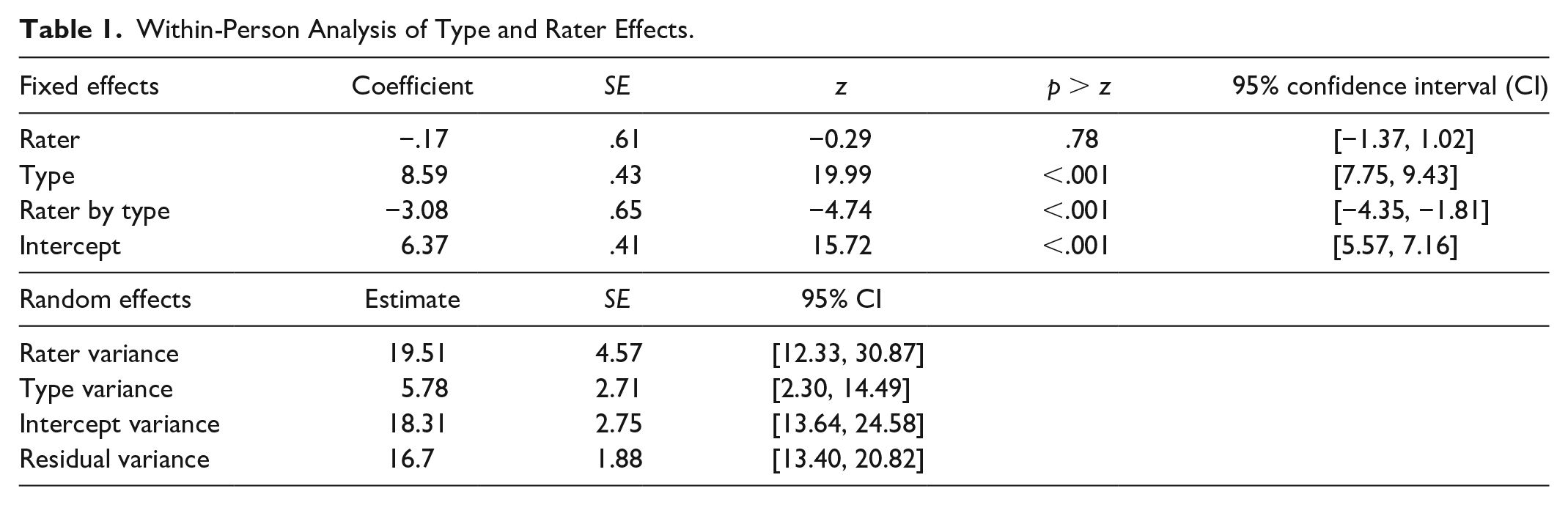
As coded, the intercept (6.37) is the model predicted score on the hyperactivity scale. The rater effect (−.17) captures the difference between the home and school ratings on the hyperactivity scale. The type effect (8.59) captures the difference between the teachers’ scores on inattentiveness and hyperactivity scales. The rater by type interaction (−3.08) quantifies the degree to which the difference between students’ inattention scores and hyperactivity scale scores differs on the home scale as compared with the school scale.
Parents and teachers gave students similar ratings on the hyperactivity subscale (−.17, NS). This suggests that ratings of students’ hyperactive behaviors are similar across contexts. The mean for teachers on the hyperactive scale was 6.37 and for parents it was 6.20. Given that there were nine items on the hyperactivity scale, these scale scores indicate that on average, students scored approximately 0.7 points per item. Recall that the criteria for elevated hyperactivity are scores of 2 or more on at least six items, which requires a score of at least 12 on the hyperactivity scale. The mean hyperactivity scores were well below this threshold.
The type effect of 8.59 indicates that teachers rated students’ inattention 8.59 points higher than their hyperactivity. Teacher’s mean scores on the inattention scale were 14.96, representing an average of 1.66 per item and exceeding the minimal threshold of 12. The rater by type interaction (−3.08) indicates that the gap in ratings was larger for teachers than it was for parents. Parents rated students 5.51 (8.59 + −3.08) points higher on inattention than on hyperactivity. Parents’ inattention ratings were 11.71 (6.20 + 5.51), which is an average of 1.30 per item, and is just below the threshold of 12. There was substantial between-person variability in intercepts, rater effects, and type effects. To recap, both parents and teachers rated students’ inattention substantially higher than their hyperactivity. However, on average, teachers’ inattention ratings were even higher than parents’ inattention ratings. Thus, both teachers and parents report more inattention than hyperactivity, and teachers report more inattention than parents do.
A diagnosis of ADHD requires elevated levels of inattentiveness and/or hyperactivity behaviors within two or more settings (e.g., home and school). Therefore, a joint examination of the home and school scales provided information on which students exhibited ADHD symptoms within each context and then, across both contexts. (Although, it is important to note, we are uncertain of how many of these students were formally diagnosed or had been recommended for medical consultation. We are only concerned with how many students might be referred.) Within the sample of 128 students with home and school scales, approximately 19% (n = 24) of the gifted underachievers met the criteria for ADHD on both the home scale and the school scale; 32% of students met the criteria for ADHD on the school scale but not the home scale; 11% of students met the criteria for ADHD on the home scale but not the school scale. Only 38% of the gifted underachievers were not elevated on either the home scale or the school scale. Table 2 contains a cross-tabulation of these data.
Cross-Tabulations.

This sample size represents the number of parents and teachers who both completed a rating scale for the same child (N = 128). Therefore, this sample size is different from the total number of teachers or parents completing the rating scales.
As would be expected given the analyses presented in Research Question 1, most gifted underachievers meeting the criteria for ADHD had elevated inattention scores. In fact, only two students from the sample had elevated hyperactivity scores without elevated inattention scores, and for both students, the elevated hyperactivity score occurred on the school scale. Of the 24 students who had elevated scores across both the ADHD home and school scales, all students (regardless of whether or not they had elevated hyperactivity scores) had elevated inattention, both at home and at school. In other words, all of the students with elevated ADHD scores across home and school were inattentive or combined inattentive/hyperactive. No students with elevated home and school scores exhibited predominantly hyperactive/impulsive symptomatology.
To address this question, we compared the analysis in Research Question 2a with the normative results reported in the ADHD-IV manual. The prevalence rates below refer to the percentage of students who exceeded the cut score on the ADHD screening tool that we administered for research purposes. We compared the percentage of students in our sample who exceeded that threshold with the percentage of students in the normative group who exceeded the screening threshold. Again, this does not indicate that these gifted underachievers were identified or should be identified as ADHD; all ADHD diagnoses must be conducted by a medical professional.
Parents
On the home scale, almost 30% of the gifted underachievers met the screening criteria for any type of ADHD, which was almost 4 times higher than the prevalence rate in the normative sample (see Table 3). As previously noted, most students who met the criteria for ADHD did so on the inattention scale. On the home scale, the prevalence rate for ADHD–primarily inattentive for our sample of gifted underachievers (23%) was over 7 times as high as the prevalence rate for the norm group (3.2%). On the home scale, no gifted underachievers were elevated on hyperactivity alone: The nine students (6.7%) with elevated hyperactivity also had elevated inattention. The percentage of students who met the ADHD screening criteria for inattention, regardless of whether they met the ADHD screening criteria for hyperactivity, is the sum of the students who met the screening criteria as ADHD–primarily inattentive (23%) with the students who met the criteria as ADHD–combined (6.7%). We refer to this group as students with elevated inattention, meaning that they met the specified screening criteria for inattention. On the ADHD Home scale, 29.9% of the sample had elevated inattention scores, as compared with 5.4% of the normative group. In other words, according to their parents, this sample of gifted underachievers exhibited elevated levels of inattention over 5.5 times as frequently as the students in the normative sample did.
ADHD-IV Home Scales.
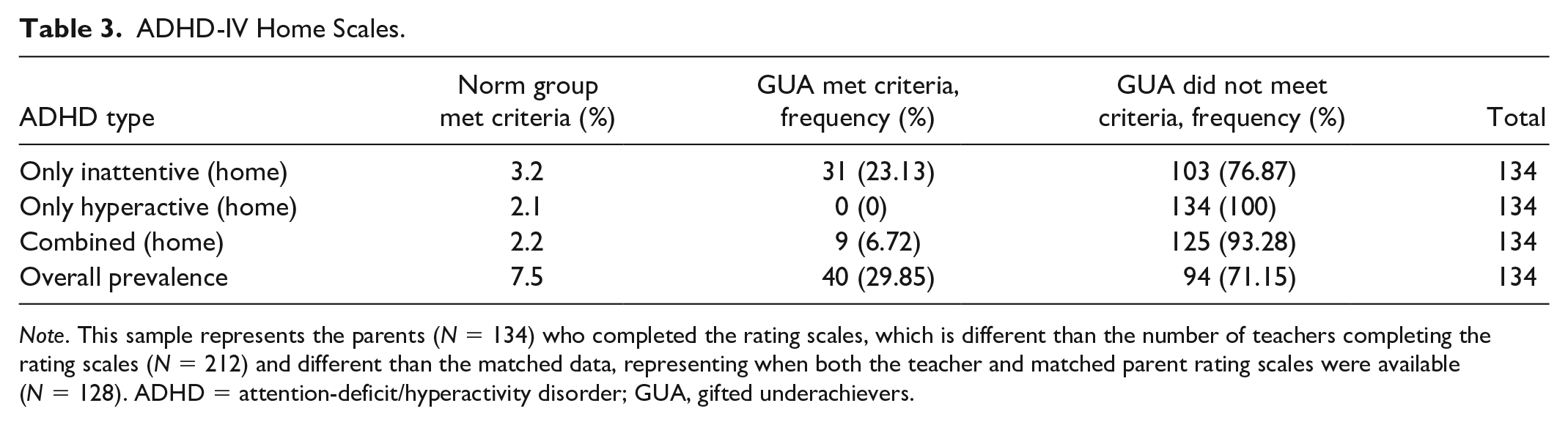
Note. This sample represents the parents (N = 134) who completed the rating scales, which is different than the number of teachers completing the rating scales (N = 212) and different than the matched data, representing when both the teacher and matched parent rating scales were available (N = 128). ADHD = attention-deficit/hyperactivity disorder; GUA, gifted underachievers.
Teachers
On the school scale, over 50% of the gifted underachievers in our sample met the screening criteria for ADHD, which is more than double the observed prevalence in the norm group (see Table 4). The percentage of primarily inattentive students in our sample of gifted underachievers (39.62%) was almost 4 times as high as the percentage of primarily inattentive students in the norm group (10%). Again, we computed the prevalence of elevated inattention by summing the percentages from the predominantly inattentive and the combined groups. On the school scale, the prevalence rate for inattention was over 2.5 times as high in our sample of gifted underachievers (49.05%) as it was in the normative sample (18.4%). In our sample, the percentage of students in the combined type (9.4%) was fairly similar to the percentage in the norm group (8.4%), and the percentage of predominantly hyperactive students in the gifted underachiever sample (1.89%) was slightly lower than in the norm sample (3.2%).
ADHD-IV School Scales.

Note. This sample represents the number of teachers completing the rating scales (N = 212), which is different from the number of parents (N = 134) who completed the rating scales and different from the available, matched data, representing when both the teacher and matched parent rating scales were available (N = 128). ADHD = attention-deficit/hyperactivity disorder; GUA, gifted underachievers.
Parents and Teacher Ratings
Interestingly, in our sample, for both the parent and teacher rating scales, the prevalence of clinically significant hyperactive/impulsive behavior was similar to or lower than it was in the norm group. However, the prevalence of elevated inattention was well over twice as high in our sample, suggesting that the gifted underachievers exhibited a great deal more inattention than would be expected from a normative sample of students. As an aside, in our sample of gifted underachievers, male and female underachievers appeared to be proportionally identified as meeting the criteria for ADHD, and they were proportionally identified as inattentive.
To meet the official diagnosis criteria for an attention disorder, symptoms must be present in two or more settings. When both parent and teacher scales were considered together, 18.75% of the gifted underachievers exhibited clinically significant levels of attention difficulties both at home and at school. These are the students who are most likely to meet the criteria for ADHD, should they be referred for medical diagnosis.
To address this question, we ran initial correlations among all variables, including parent/teacher ratings on ADHD behaviors and student perceptions of their own self-regulation, goal valuation, and self-efficacy (see Table 5). Parents’ and teachers’ ratings of hyperactivity (r = .30) and inattention (r = .33) were only modestly related. Students’ self-regulation scores were negatively correlated with both home (r = −.39) and school (r = −.22) inattention scores. In other words, when parents and teachers reported more inattentive behaviors, students reported lower levels of self-regulation. Interestingly, parental inattention scores were at least as strongly related to students’ self-regulation scores (−.39) as they were to teachers’ inattention scores (.33). Table 5 contains the correlations among the four ADHD-IV scales and the three modified SAAS scales.
Correlations Among the ADHD Hyperactivity and Inattention Scales at Home and at School and the Three Modified SAAS Subscales.
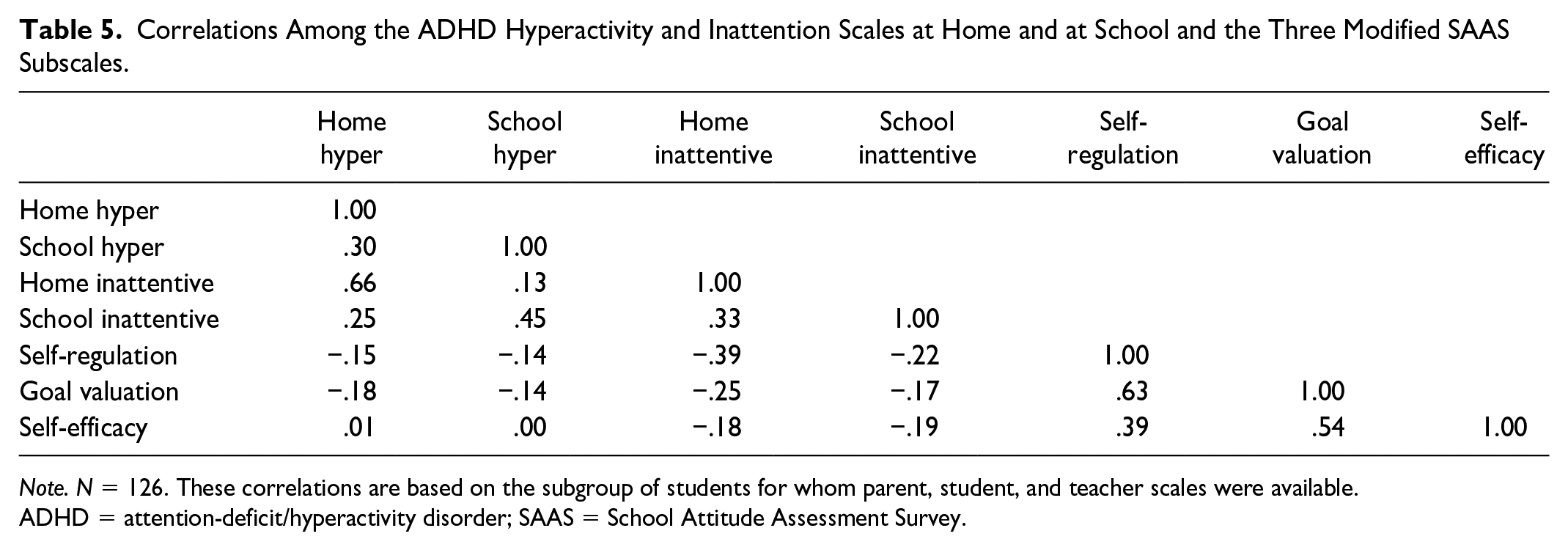
Note. N = 126. These correlations are based on the subgroup of students for whom parent, student, and teacher scales were available. ADHD = attention-deficit/hyperactivity disorder; SAAS = School Attitude Assessment Survey.
Specific Relationships With Inattentive Behaviors
Given inattention appeared to be the more prevalent issue for our sample of gifted underachievers, the remaining analyses only examine the inattention scale rather than the hyperactivity scale. We wished to determine whether elevated scores on either the home or school versions of the ADHD inattention scale predicted students’ ratings of their self-efficacy, goal valuation, and self-regulation/motivation. Because students could be elevated on the home version of the inattention scale, the school version of the inattention scale, or both, we conducted a two-way multivariate analysis of variance (MANOVA), followed by a discriminant function analysis (Huang, 2020) and a series of four two-way ANOVAs. Elevated home inattention and elevated school inattention were both dichotomous variables: 1 = elevated inattention if the student scored a 2 or a 3 on at least six of the nine inattention items, regardless of his or her score on the hyperactivity items, and 0 = otherwise. The two factors, elevated inattention (home) and elevated inattention (school) and their interaction predicted scores on all three subscales: self-efficacy, goal valuation, and self-regulation. In other words, these analyses determined whether there were group differences between gifted underachievers with elevated inattention scores and those without elevated inattention scores in terms of their self-efficacy, goal valuation, and self-regulation.
For the MANOVA, the main effect for elevated inattention on the home scale was statistically significant (Wilks’s Λ = .90, p = .01). However, the main effect for elevated inattention on the school scale and the interaction between the home and school scales were not statistically significant.
As a follow-up test, we conducted a one-way, two-group discriminant function analysis, comparing the group of students who exhibited elevated inattention on the home scale with the students who were in the normal range for inattention on the home scale. The standardized canonical discriminant function coefficients were .18 for self-efficacy, .36 for goal valuation, and .65 for self-regulation, indicating that self-regulation was most predictive of group membership. Because the sample sizes in the two groups were unequal, we used unequal (proportional) prior probabilities. The first discriminant function was able to correctly classify 33% of the high inattentive gifted underachievers and 92% of the non-inattentive gifted underachievers, producing an overall correct classification rate of 75%. However, self-efficacy contributed very little to the solution when considered in combination with the other variables. A two-variable discriminant function analysis that included only self-regulation and goal valuation performed similarly: It correctly predicted 95% of the non-inattentive group and 31% of the elevated inattention group, resulting in an overall classification rate of 76%. These results suggest that gifted underachievers with elevated inattention scores on the home scale report lower goal valuation and lower self-regulation than gifted underachievers without elevated inattention scores.
Next, we examined the univariate differences between the elevated inattention group and comparison group using a series of two-way ANOVAs. There were 39 gifted underachievers in the high inattention group and 93 gifted underachievers in the comparison group for these comparisons. For each of the three univariate ANOVAs, the pattern was the same: There was no statistically significant interaction between the school-based inattention and the home-based inattention variables. In addition, the main effect for the school inattention contrast was never statistically significant. However, the main effect for the home inattention contrast was always statistically significant (p < .05). We computed Hedge’s g (and Cohen’s d) effect sizes comparing the elevated home inattention group with the comparison group on each of the three subscales.
Inattention and Self-Efficacy
Gifted underachievers with high inattention scores on the ADHD-IV Home scales exhibited lower self-efficacy scores than other gifted underachievers. Gifted underachievers with elevated inattention on the home scale had a mean of 5.23 on the self-efficacy scale; the mean for gifted underachievers without elevated inattention on the home scale was 5.74. Hedges’s g (and Cohen’s d) effect size for this difference was approximately .48 standard deviations units, and the correlation between the home inattention scale and self-regulation scale was −.19. Table 6 contains the means and standard deviations for self-efficacy, disaggregated by elevated inattention status, at home and at school.
Means (and Standard Deviations) on the Self-Efficacy Scale, Disaggregated by Inattention Status on the Home and School ADHD Scales.

Inattention and Goal Valuation
Gifted underachievers with high inattention scores on the ADHD-IV Home scales also exhibited lower goal valuation scores than other gifted underachievers. Students who were rated as inattentive by their parents had a mean of 5.40 on the goal valuation scale, which is substantially lower than the mean for gifted underachievers without elevated inattention on the home scale, 6.09, and represents an effect size of 0.66 standard deviations. Students with higher home inattention scores tended to score lower on the SAAS goal-valuation subscale (r = −.28). Table 7 contains the means and standard deviations for goal valuation, disaggregated by elevated inattention status, at home and at school.
Means (and Standard Deviations) on the Goal Valuation Scale, Disaggregated by Inattention Status on the Home and School ADHD Scales.

Inattention and Self-Regulation
Gifted underachievers with elevated inattention scores on the ADHD-IV Home scales exhibited lower self-regulation scores than other gifted underachievers. Students with elevated home inattention scores had a mean of 3.57 on the self-regulation scale, which was substantially lower than the mean for gifted underachievers without elevated inattention on the home scale, 4.45. In other words, gifted underachievers with elevated home inattention scores scored approximately 0.74 standard deviations lower on the self-regulation subscale. When examining the ADHD-Rating scale data continuously, the same pattern emerged: Students with higher inattention scores on the ADHD-IV Home version tended to score lower on the SAAS self-regulation subscale (−.39). Table 8 contains the means and standard deviations for self-regulation, disaggregated by elevated inattention status, at home and at school.
Means (and Standard Deviations) on the Self-regulation Scale, Disaggregated by Inattention Status on the Home and School ADHD Scales.

In summary, gifted underachievers with elevated home inattention scores had lower scores on all three modified SAAS-R subscales: self-efficacy, goal valuation, and self-regulation. The largest difference between the two groups occurred on the self-regulation scale, where the gifted underachievers with elevated inattention scores on the home scale scored three quarters of a standard deviation lower than the other gifted underachievers. Gifted underachievers with elevated inattention scores on the home scale also scored almost two thirds of a standard deviation lower than the other gifted underachievers on the goal-valuation scale. Of the three variables, self-efficacy exhibited the weakest relationship with the inattention home scale.
Gifted underachievers’ first-quarter grade in their area of academic underachievement was negatively related to students’ home inattention scores (r = −.21) and school inattention scores (−.39). Given that the teacher who completed the inattention survey also assigned the first-quarter grades, this finding makes sense. Students with lower first-quarter class grades were rated as more inattentive, and the same teachers assigned both the ratings and the grades. Gifted underachievers with elevated school inattention scores had GPAs that were 0.76 standard deviation units lower than gifted underachievers with nonelevated school inattention scores. However, there were no differences between the students with elevated inattention scores and the other gifted underachievers in terms of age, IQ scores, or time spent doing homework.
Discussion
This study provides initial information to illuminate the complex relationships among self-regulatory behaviors/motivations influencing academic achievement in underachieving gifted students.
Importance of Environmental Contexts
The current study addresses the call to consider multiple contexts in gifted underachievement studies (White et al., 2018). Considering both teachers’ and parents’ perspectives provides helpful information in identifying the difference between unchallenging school environments and potentially diagnosable ADHD. Furthermore, it provides information regarding the types of behaviors gifted underachievers exhibit within the home and school environments. Both parents and teachers rated students’ inattention as higher than hyperactivity, and inattentive behaviors were reported more frequently in the classroom than in home environments. The prevalence rate of inattention on the ADHD-IV School scale was almost 50%, suggesting that teachers see a substantial portion of gifted underachievers as inattentive. In contrast, parents identified just under 30% of their children as having attention issues.
Several explanations for this finding exist. First, parents may have developed effective strategies for reducing inattentive behaviors at home. Second, in the home environment, parents are less likely to observe inattention resulting from boring and unchallenging curriculum. In other words, gifted students who are not challenged or intellectually stimulated in school may exhibit inattention that may be absent in home (or other) environments. Thus, context-specific inattentive behavior in school but not at home may be the result of boredom or lack of challenging curriculum, rather than ADHD. This has been a commonly voiced concern within the gifted field: Gifted students who are bored within the regular classroom may demonstrate high levels of inattentiveness, resulting in the misidentification of ADHD (Baum et al., 1998; Hua et al., 2014; Webb et al., 2005).
However, in our sample of gifted underachievers, the prevalence of elevated inattention on the home scale was quite substantial, and it was over 5 times as high as in the normative sample. Although teachers were more likely to identify inattentive behaviors than parents were, for many of the gifted underachievers, these behaviors were observed in both environments. In our sample, a substantial percentage of gifted underachievers exhibited attentional issues, even outside of an academic environment. Gifted underachievers with attentional difficulties also tended to report lower goal valuation and self-regulation, and they tended to have even lower grades. Given the large number of underachieving gifted students with elevated inattention scores, school personnel and parents should consider screening for ADHD more frequently when gifted students underachieve in school, especially when parents report inattentive behavior in the home.
Prevalence Rates of Attention Difficulties
To determine how likely gifted underachievers should be referred for additional medical consultations, we considered the extent to which teachers and parents both identified clinically significant levels of hyperactivity and inattention. (Again, we are uncertain how many of these students have been referred or identified, but this provides information on how many should be referred.) Although the prevalence of hyperactivity within this sample was similar to (or perhaps even lower than) that of a typical school-age population, the prevalence of inattention was much higher. Gifted underachievers were far more likely to have elevated inattention scores than students from the ADHD-IV normative sample.
Many of the gifted underachievers in our sample appeared to have clinically significant levels of inattention. When both parent and teacher ratings were considered, approximately 19% of the gifted underachievers in our sample had elevated inattention both at home and at school, which far exceeds the expected prevalence rate. Given the recruitment and sampling procedures, this estimate cannot be generalized back to the entire population of gifted underachievers and should not be interpreted as a population prevalence estimate. Even so, our results do suggest that a substantial percentage of the students in our study of gifted underachievers appeared to exhibit elevated inattention in two settings, which meets the DSM guidelines for a potential ADHD diagnosis. The current study suggests that inattentive behaviors may negatively influence gifted students’ levels of achievement and may be clinically significant. Given our findings, gifted professionals should receive specialized training to help identify gifted students who may have clinically significant attentional issues and/or ADHD. Teachers should consider the possibility of ADHD as a factor leading to underachievement. Interventions for gifted underachievers with attentional issues should target attentional issues as well as curricular issues. Gifted underachievers with attentional issues may require specialized intervention plans to promote academic achievement, including both medication and specified strategies to support learning (Antshel, 2008; Grizenko et al., 2012).
Relationships Among Inattention and Additional Underachievement Factors
Within our study, observed inattention behaviors were strongly related to other self-regulatory factors, such as students’ perceptions of their own self-efficacy, task-value, and self-regulation. Specifically, students who would likely meet the DSM-IV-TR guidelines for an ADHD diagnosis were significantly more likely to have lower perceptions of their self-efficacy, goal valuation, and self-regulation than students who did not exhibit elevated inattentive behaviors. This demonstrates the interconnected nature of these self-regulation variables as demonstrated within many self-regulation models (Zimmerman, 2000).
The strongest correlation was between students’ perceptions of self-regulation and external reports of inattentive behaviors, which suggests that the self-regulation subscale of the modified SAAS and the inattention subscale of the ADHD-IV are measuring either the same construct or similar constructs. All three factors (self-efficacy, task value, and self-regulation) were related, yet self-efficacy exhibited the lowest correlation, mirroring the inconsistent relationship between self-efficacy and underachievement reported with gifted students (Diaz, 1998; Ford, 1996; Lupart & Pyryt, 1996; McCoach & Siegle, 2003a). Both task value and self-regulation were correlated with inattentive behaviors. Therefore, when inattentive behaviors are observed, task value may be also be a co-occurring factor. Finally, inattention observed only at home was accompanied by lower student self-ratings than when inattentive behaviors were only observed in school.
The correlations among these variables demonstrate how challenging it is to identify a single factor to address within an underachievement intervention. Previous work posited that self-regulation was the result of the combination of self-efficacy, task value, and environmental perceptions (McCoach & Siegle, 2003a). The current study confirms the relationship among those variables, but it is unable to determine the direction of the relationship. It is possible that the direction differs based on the origin of the attention difficulty. Clinically significant attention difficulties (i.e., ADHD) may lead to lower self-efficacy, task value, and self-regulation habits whereas, nonclinically significant attention difficulties may be the a result of low task value or self-efficacy.
Limitations and Future Research
Although these elevated levels of inattentive behavior are certainly cause for concern, these results do not indicate that all of the students who screened positive for ADHD on these rating scales would actually meet the full diagnostic criteria for ADHD, as determined by a medical or psychological professional. This study provides initial data to suggest that a considerable number of underachieving gifted students may be struggling with ADHD and should be referred to a medical professional. Some of the students in this study’s sample may have had preexisting diagnoses, as we were unable to gain access to their personal files and 504 plans. The initial screening, however, did request that nominated students not have a diagnosed learning disability.
Furthermore, we did not collect data on all potential factors. For example, we did not consider learned helplessness or depression. We also did not gather data regarding the languages spoken at home, and future studies may want to consider the influence of English learner status on inattention and underachievement of gifted students. It is important to remember that the results of this research are correlational. It is impossible to determine from these data whether students who exhibit inattentive behaviors become underachievers or if underachievers exhibit inattentive behaviors. Future studies may want to explore this possibility.
The lower response rate we reported for the parent survey might reflect a selection bias. We asked students to hand deliver and return the parent survey. As one reviewer of this article noted, students with self-regulatory issue may have been less responsible in returning the parent survey. This might account for some differences between the teacher and parent ratings. In fact, all students and parents consented to be part of the study. It is possible that underachievers who chose not to participate in the study differ in meaningful ways from those who agreed to participate.
Although we refer to the prevalence of inattention and hyperactivity within our sample, these cannot be interpreted as population prevalence values and many potential selection issues confound and compromise our best attempts to determine the prevalence of gifted underachievers who exhibit behaviors that are indicative of ADHD. For instance, we found that a very low percentage of gifted underachievers in our sample had elevated hyperactivity. Perhaps students who exhibit hyperactivity and impulsivity are less likely to be identified as gifted. In general, it is possible that some gifted underachievers are never identified as gifted.
Future work should also continue to examine the linkages between home inattention, self-regulatory factors, school inattention, and academic achievement. A more complex, and potentially longitudinal, model may better represent these relationships. Understanding self-regulatory characteristics and inattention in gifted underachievers is multifaceted and complex. Our study provides areas for further exploration rather than definitive answers.
Conclusion
To summarize, gifted underachievers exhibited higher rates of inattention in both home and school environments than what would be expected within a typical school population; however, gifted underachievers did not display greater levels of hyperactive behaviors. Both parents and teachers identified elevated levels of inattention in 19% of our sample, suggesting that a high proportion of gifted underachievers may also qualify for an ADHD diagnosis. When this is the case, it is worth pursuing additional diagnostic information before determining an intervention, as interventions vary based on specific diagnoses. Further, inattentive behaviors were related to other known underachievement factors, including students’ perceptions of their self-regulation/motivation, self-efficacy, and goal valuation.
Our results suggest that a substantial percentage of gifted underachievers exhibit attention problems at home, and that these attention problems are severe enough to merit further examination. We cannot know whether the gifted underachievers with high inattention scores have undiagnosed ADHD. However, based on this research, when gifted students underachieve, we recommend collecting additional behavioral information from parents. These parent data may help clarify potential reasons for the students’ underachievement and may suggest the need for further evaluation to determine whether undiagnosed ADHD may help to explain the student’s pattern of underachievement. Collectively, it is important to evaluate each individual gifted underachiever for the possibility of ADHD and to develop appropriate intervention plans, should ADHD co-occur with underachievement.
Supplemental Material
Appendix_A – Supplemental material for Pay Attention to Inattention: Exploring ADHD Symptoms in a Sample of Underachieving Gifted Students
Supplemental material, Appendix_A for Pay Attention to Inattention: Exploring ADHD Symptoms in a Sample of Underachieving Gifted Students by D. Betsy McCoach, Del Siegle and Lisa DaVia Rubenstein in Gifted Child Quarterly
Footnotes
Declaration of Conflicting Interests
The author(s) declared no potential conflicts of interest with respect to the research, authorship, and/or publication of this article.
Funding
The author(s) disclosed receipt of the following financial support for the research, authorship, and/or publication of this article: The work reported herein was supported under the Jacob K. Javits Gifted and Talented Students Act, PR/Award Number is 305A060044, as administered by the Institute of Education Sciences, U.S. Department of Education. The findings and opinions expressed in this report do not reflect the position or policies of the Institute of Education Sciences or the U.S. Department of Education.

Supplemental Material
Supplemental material for this article is available online.
Author Biographies
References
Supplementary Material
Please find the following supplemental material available below.
For Open Access articles published under a Creative Commons License, all supplemental material carries the same license as the article it is associated with.
For non-Open Access articles published, all supplemental material carries a non-exclusive license, and permission requests for re-use of supplemental material or any part of supplemental material shall be sent directly to the copyright owner as specified in the copyright notice associated with the article.
