




Abstract
Gifted youth frequently experience perfectionism, which for some can affect their emotional well-being. This study evaluated the effectiveness of a 6-week mindfulness intervention for 42 middle school students who were identified as Gifted and Talented. Participants’ levels of self-oriented and socially prescribed perfectionism, as well as their use of mindfulness practices, were evaluated pre- and post- intervention, as well as at a 5-week follow-up to assess changes in perfectionism ratings and use of mindfulness. Three Bonferroni-adjusted, one-way, repeated measures analyses of variance were performed, and the results indicated a significant decrease in self-oriented perfectionism and an increase in mindfulness at both the end of the intervention and at follow-up. These findings support the use of mindfulness as an appropriate intervention to reduce self-imposed forms of perfectionism among gifted youth.
The social–emotional development of gifted and talented individuals has been a source of interest and discussion for decades. Many educators, counselors, and parents of gifted students have noted the stressors of being identified as gifted and the ongoing pressure of meeting high-performance expectations (Callard-Szulgit, 2003; Colangelo & Wood, 2015; Mofield et al., 2016; Mofield & Peters, 2019). Though research is mixed, there is some evidence that gifted populations are more likely to exhibit perfectionistic tendencies than their nonidentified peers (Chan, 2011; Guignard et al., 2012). Perfectionism, or “striving for flawlessness” (Flett & Hewitt, 2002, p. 5), has been associated with social and emotional difficulties in gifted students including depression and anxiety (Christopher & Shewmaker, 2010; Gnilka et al., 2012; Reyes et al., 2015).
Several interventions have been tried to mitigate the negative effects of perfectionism, including affective programming (Mofield & Chakraborti-Ghosh, 2010), cognitive behavior therapy (James & Rimes, 2018), and mindfulness (James & Rimes, 2018). There is growing interest in the use of mindfulness as a tool for gifted students to increase self-awareness, reframe potentially negative tendencies such as perfectionism, and improve attention to the present moment (Sharp et al., 2017). This type of intervention may be particularly useful in middle school, as students are in a developmental stage rife with physical, cognitive, and emotional changes (Lawlor, 2014; Roeser & Pinela, 2014). Although there is a growing body of mindfulness research with youth, few studies have explored the effectiveness of mindfulness programming to address perfectionistic tendencies among gifted adolescents. Therefore, the purpose of this study was to use an evidence-based mindfulness program with gifted students to determine whether it reduced self-ratings of perfectionistic thoughts and behaviors.
Perfectionism and Gifted Youth
Perfectionism, which is not itself a disorder but has the potential to be maladaptive, has been associated with students who are gifted and talented for decades (Schuler, 2000; Speirs Neumeister, 2018). Conceptualizations of perfectionism have changed greatly over the years, with predominant views in the 1970s and 1980s describing perfectionism as one-dimensional and pathological. However, two major theories emerged in the 1990s that portrayed perfectionism through a multidimensional lens, and these views have continued to expand over the last half a century (Sirois & Molnar, 2016).
Multidimensional theories of perfectionism focused on different features (e.g., Frost et al., 1990) and types (e.g., Hewitt & Flett, 1991) of perfectionism. This early work by Hewitt and Flett (1991) has continued as a framework for understanding different manifestations of perfectionism including (a) self-oriented perfectionism (SOP), described as when individuals set unrealistic and excessively high goals and standards for themselves; (b) other-oriented perfectionism, when individuals hold unrealistic and excessively high goals and standards for significant others; and (c) socially prescribed perfectionism (SPP) when individuals perceive that others are holding one to an exceptionally high and unrealistic standard. Individuals with high levels of SOP may derive no pleasure from meeting their goals, and often believe that they could have done better (Brustein, 2014). On the other hand, those with high levels of SPP may feel helpless because they perceive the expectations of others are impossible to achieve. Finally, those with higher levels of other-oriented perfectionism may be critical of others and can be considered to have a form of externalized SOP.
Ongoing research has emphasized a nuanced understanding of perfectionism and its correlates, with differing outcomes based on the type. For instance, though SPP has been correlated with many negative outcomes (Flett et al., 2016; McCreary et al., 2004), the relationship between these outcomes and SOP is not as clear (Flett et al., 2016). In one study, adolescents who displayed high levels of SOP and SPP were more likely to have recurrent automatic thoughts and depressive symptoms and to worry more, which correlated with increased educational stress (Flett et al., 2011). Alternatively, Stoeber et al. (2009) considered SOP to be an ambivalent form of perfectionism due to its mixed findings. Others have even promoted the idea of adaptive perfectionism (e.g., Rice & Preusser, 2002). However, many researchers acknowledge that although certain facets of perfectionism have the potential to be partially adaptive at points in an individual’s life, they also note these tendencies can negatively affect individuals, particularly during times of heightened stress or when dysfunction is present (Flett & Hewitt, 2015). Greenspon (2012) summarized that it may be better to emphasize “ . . . helping perfectionists to utilize their talents in the pursuit of excellence . . . [rather than] on helping perfectionists utilize their perfectionism in healthy ways” (p. 603). In other words, the emphasis should not be on perfectionism at all but rather on striving for excellence.
Because of the potential negative effects of perfectionism, there are ongoing calls for those who work with gifted students to help students maintain healthy cognitions and expectations (Cross & Cross, 2015; Margot & Rinn, 2016). Although the studies are not consistent, there is evidence that youth who are gifted tend to engage in more perfectionistic thinking than other students. For example, Guignard et al. (2012) found that gifted sixth graders had higher levels of SOP than their nonidentified counterparts while earlier work by Parker and Mills (1996) found no such relationship. In a large study with Chinese youth (n = 1,200), Chan (2011) found higher rates of perfectionism among gifted youth as compared with their peers. The lack of consensus as to whether gifted youth have higher rates of perfectionism likely relates to difficulties achieving statistical significance given small samples and varied methods for measuring giftedness (Chan, 2011). Additionally, there may be differences in the types of perfectionism and how they affect Gifted and Talented and nonidentified students (Stricker et al., 2019).
Qualitative research and anecdotal reports from teachers consistently support the idea that students who are gifted may experience greater rates of perfectionism (e.g., Adelson, 2007; Rimm, 2007). For example, Rimm (2006) surveyed gifted and nonidentified students to compare how they described themselves across various characteristics and found that 22% of gifted middle school students endorsed perfectionism as a self-descriptor, whereas only 16% of nonidentified youth identified this trait. Similar results were identified by Schuler (2000) who interviewed 20 gifted middle school students and found that the majority described themselves as either having maladaptive perfectionistic tendencies (29%) or as “normal perfectionists” (58%). Those students who indicated the highest levels of perfectionism were strongly fixated on mistakes and reported heightened levels of anxiety. Of particular concern is the level of maladaptive perfectionism among gifted populations, defined as perfectionism motivated by a need to meet excessively high standards and fear of disappointing others or failure (Flett & Hewitt, 2002). This type was endorsed by 38% of adolescents enrolled in a high school for academically gifted youth (Dixon et al., 2004). Given the consistency of findings in more recent studies, it appears there is evidence that many gifted youth are managing perfectionistic tendencies.
Although positive correlates between perfectionism and higher levels of depression in gifted child and adolescent populations have been demonstrated (Christopher & Shewmaker, 2010; Reyes et al., 2015), the association between perfectionism and anxiety is less clear. For example, Christopher and Shewmaker (2010) reported that higher rates of perfectionism were negatively correlated with anxiety. In contrast, significant positive relationships between maladaptive perfectionism and anxiety were reported for undergraduates (Gnilka et al., 2012). Guignard et al. (2012) found significant positive correlations between both SOP and SPP with worry/oversensitivity components of anxiety for elementary-aged youth. Furthermore, there is limited information available on how the relationship between perfectionism and internalizing symptoms might change over time.
Noticeably lacking from studies of perfectionism is intervention and treatment research. In their review of perfectionism in children and adolescents, Morris and Lomax (2014) found 84 studies addressing mental health and perfectionism, with only seven focusing on potential interventions. Additionally, only one examined a perfectionism treatment explicitly, while the others examined perfectionism among other correlates. Two interventions were play therapy case studies and one was an eating disorder study that examined if lessons about perfectionism and/or media literacy reduced levels of perfectionism. The two most robust studies, both randomized control trials, examined cognitive behavior therapy as an intervention and found that it was effective in decreasing perfectionism in two samples.
School-Based Mindfulness Programming
Given the maladaptive thinking that often accompanies perfectionism, interventions that help individuals change their thoughts and perspectives would seem to be appropriate. Mindfulness, or the practice of paying attention to each moment of the present, with a nonjudgmental and curious frame of mind (Kabat-Zinn, 2005), represents a promising approach. Research focusing on the application of mindfulness-based interventions has grown exponentially in the last decade (Zenner et al., 2014). The practice of mindfulness has been associated with improved attentional control and self-awareness (Greeson, 2009), as well as increased academic performance and emotion regulation (Tang, 2017). Mindfulness can increase metacognitive awareness and help individuals be aware of their feelings and reactions to their current situation (Broderick & Jennings, 2012), which may help prevent impulsive responses. Specifically, it is hypothesized that the practice of mindfulness promotes top-down aspects of control such as cognitive flexibility and sustained attention, as opposed to the more emotionally reactive facets of bottom-up control such as stress, anxiety, and arousal (Zelazo & Lyons, 2012). This theory of change is particularly salient for young adolescents who are learning these skills during this developmental period.
Adolescence presents an ideal time to implement social–emotional learning programming through interventions such as mindfulness, as youth are experiencing rapid changes in their physical, cognitive, and social growth and are more open to change during this period (Lawlor, 2014; Roeser & Pinela, 2014). Adolescents who are high in dispositional mindfulness (heightened frequency and intensity of mindful states) were found to have a lower risk for psychopathology than their peers with lower levels of mindfulness (Pepping et al., 2016). Additionally, mindfulness-based interventions have been found to decrease adolescents’ experiences of psychological distress (Tan & Martin, 2013). Children and adolescents’ levels of mindfulness have also been positively correlated with overall quality of life ratings, and negatively correlated with internalizing behavior problems and somatic complaints (Greco et al., 2011).
The school setting represents an excellent location to deliver social–emotional curricula such as mindfulness interventions as it provides easy access to students (Weare & Nind, 2011), and the basic tenets of mindfulness can be useful and potentially even important for success in the classroom. However, only four mindfulness curricula have met research criteria for effective social and emotional learning programs for adolescents (Collaborative for Academic, Social, and Emotional Learning, 2015). These programs are Learning to Breathe (Broderick, 2013), Transformative Life Skills (Bose et al., 2017), (Mindfulness in Schools Project; https://mindfulnessinschools.org/), and Kripalu Yoga (www.kripalu.org). Kripalu Yoga and Transformative Life Skills are both yoga-based programs for secondary students, while Mindfulness in Schools Project focuses on attention training skills and has predominantly been used in the United Kingdom.
Learning to Breathe is based in Mindfulness-Based Stress Reduction and has been used in multiple studies in the United States to reduce perceived stress and increase emotional regulation skills (Metz et al., 2013), as well as to increase metacognitive awareness (Broderick & Jennings, 2012). This manualized program is designed around the first six letters of BREATHE (i.e., Body, Reflections, Emotions, Attending, Tender, Habit), with the seventh letter (e) standing for the overall goal of empowerment (Broderick, 2013). For example, the theme of Week 1 is “Listen to your body” and included activities such as mindful listening, eating, and walking (Broderick, 2013). The following lessons focused on acknowledging thoughts; identifying and experiencing emotions; reducing stress through attending to one’s body, emotions, and thoughts; being kind to oneself; and making mindfulness a habit.
Though there has been a call for mindfulness programming for gifted youth, few studies have examined the effectiveness of this type of intervention (Haberlin, 2015; Sharp et al., 2017). Recently, Haberlin and O’Grady (2018) found that gifted elementary students enrolled in mindfulness programming reported heightened awareness and increased calmness after 10 weeks of lectures and practice using mindfulness techniques such as belly breathing, mindful eating, and progressive muscle relaxation. Another study with gifted middle school students did not find significance for the effect of mindfulness on anxiety or perfectionism (Doss & Bloom, 2018). However, no specific mindfulness curriculum was used, making it difficult to determine the fidelity with which mindfulness concepts and practices were taught.
Similar studies with older participants, university, or postgraduate students (e.g., Hinterman et al., 2012; James & Rimes, 2018), suggest the potential for this type of intervention. In these studies, mindfulness was positively related to higher rates of coping and self-esteem (Hinterman et al., 2012) and lower levels of perfectionism with increased levels of self-compassion (James & Rimes, 2018). Additionally, mindfulness mediated the impact of SPP on distress (Short & Mazmanian, 2013). It is possible that mindfulness does not eliminate all aspects of perfectionism but reduces the distress that is commonly associated with some of the cognitions. This research with young adults provides additional support for the use of mindfulness as a mediator for perfectionism in adolescence.
More research is needed to establish whether mindfulness programming delivered in a school-based setting might be an effective intervention to help gifted youth reduce their levels of perfectionism. If supported, the incorporation of mindfulness programming could provide a valuable intervention for decreasing unhealthy perfectionism. The purpose of this quantitative study was to assess whether the implementation of an evidence-based mindfulness program increased reported levels of mindfulness practice and reduced levels of SOP and SPP among a population of young adolescents identified as gifted. Although it was not possible to implement a control group design due to the limited number of students identified as gifted at the school (presence of a control group would have necessitated nearly 100% participation in the school), a follow-up phase was added to determine whether any differences persisted once the intervention concluded. It was predicted that levels of both SPP and SOP would be reduced after the intervention and that these results would remain at the 5-week follow-up. Additionally, it was predicted that students would demonstrate higher levels of mindful practice and cognitions between the pre- and posttests, and that these gains would remain at follow-up.
Method
Participants and Setting
The participants in this study were 42 students at an International Baccalaureate school who were identified as gifted and enrolled in sixth, seventh, or eighth grades, with a general age range from 11 to 14 years. In the Western state where the study was completed, students may be identified gifted in one or more of following domains: (a) general or specific intellectual ability; (b) specific academic aptitude; (c) talent aptitudes (e.g., visual arts); (d) creative or productive thinking; and (e) leadership abilities. Participants in this study represented a convenience sample and were recruited from one middle school. Initially, participants were recruited through e-mails to parents of students identified as gifted and talented, detailing information on the study and including a cover letter discussing the benefits of mindfulness for both mental well-being and academic success and identifying the variables that would be measured (i.e., perfectionism and mindfulness). The informed consent and assent documents were also attached. The first author additionally attended a school event specific to the gifted and talented program and introduced the study directly to students. Though perfectionism was noted in all recruitment documentation, references to it were kept to a minimum in order to minimize response bias. All middle school students in this specific middle school who were receiving gifted programming (n = 97) met inclusion criteria, and the 42 included were those who turned in informed consent prior to the start date of the study. Descriptive statistics for demographic variables are reported in Table 1.
Number and Percentage of Individuals in Each Demographic Category.
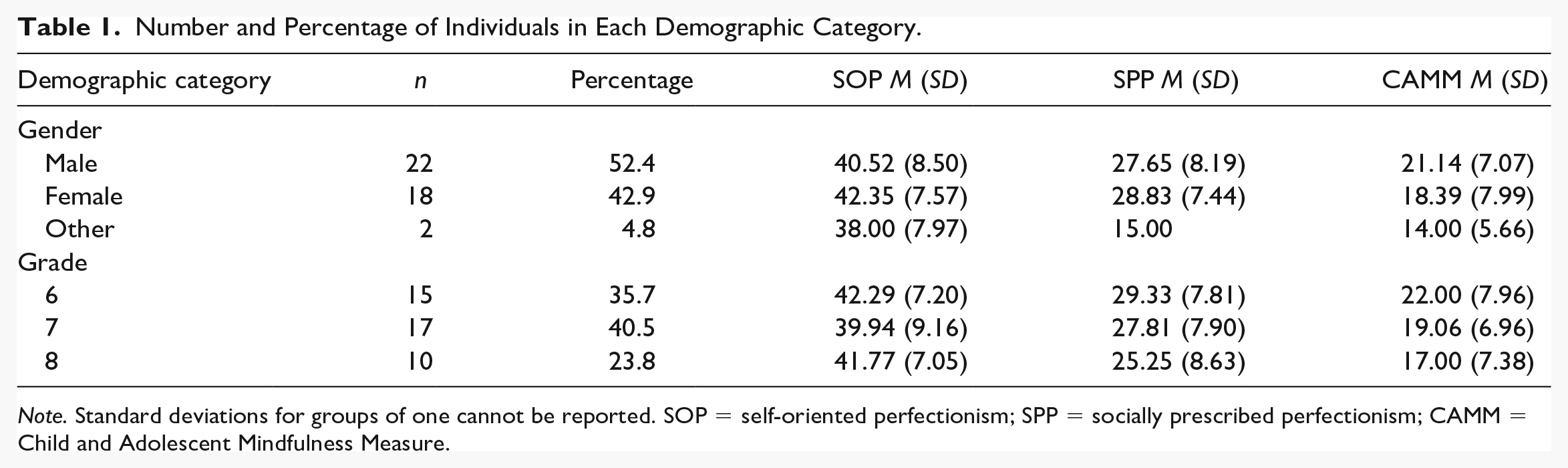
Note. Standard deviations for groups of one cannot be reported. SOP = self-oriented perfectionism; SPP = socially prescribed perfectionism; CAMM = Child and Adolescent Mindfulness Measure.
Measures
Participants completed a brief demographic questionnaire identifying their grade and gender. Three measures, described below, were completed at three distinct points: before the intervention during the first session, immediately following the intervention after the last session, and at a 5-week follow-up. After collecting each measure at each time point, the forms were de-identified, and the data were entered into a spreadsheet.
Child–Adolescent Perfectionism Scale
Levels of perfectionism were measured using the Child–Adolescent Perfectionism Scale (CAPS; Flett et al., 2016), a 22-item, norm-referenced measure for children aged 6 to 18 years. This test is an adapted version of the Multidimensional Perfectionism Scale (Hewitt & Flett, 2004), originally designed to measure perfectionism in adults. Items on the CAPS are divided into two scales: SOP and SPP with no overall score calculated. Though other-oriented perfectionism is included in the original conceptualization for the Multidimensional Perfectionism Scale, it was excluded for the child and adolescent version due to its unknown developmental timeframe. All 22 items for the CAPS are scored on a 5-point Likert-type scale from 1 to 5 with 1 = false, not at all true of me to 5 = very true of me (Flett et al., 2016). Three items are reverse-coded. Scores for each scale range from 11 to 55, with high scores indicating greater levels of perfectionism. The SOP scale included 12 items with items such as “I get mad at myself when I make a mistake” and “I can’t stand to be less than perfect.” The SPP scale included 10 items with sample items such as “(P)eople expect more from me than I am able to give” and “(O)ther people expect me to be perfect” (Flett et al., 2016, p. 638). There are separate norms for the SOP and SPP scales, and higher scores are indicative of increased levels of perfectionism.
Reliability of the CAPS was reported to be .85 for SOP and .81 for SPP with the standardization sample that included 247 Canadian children and adolescents (Flett et al., 2016). Test–retest reliability of the original scale was .74, and .66, for SOP and SPP, respectively, over a 5-week interval (Flett et al., 2000). After 1 year, the test–retest reliabilities were .65 and .59 (Flett et al., 2016). Adequate concurrent validity (r = .64, p < .01) was also obtained when comparing scores between the CAPS–SOP and a measure of personal desire for perfection from the Academic Reasons Survey (Ryan & Connell, 1989). For the participants in this study, the internal-consistency reliability for the CAPS was .87 for SOP and .88 for SPP.
The total means and standard deviations for each measure were computed across each time period (see Table 2). The initial mean SOP score of 41.00 for this population was greater than one standard deviation above the norm group (M = 29.38, SD = 8.34), as reported in Flett et al. (2016), supporting previous research (e.g., Guignard et al., 2012) and suggesting that students who are gifted endorse more perfectionistic thoughts. The SPP score was comparable to the normative data (M = 25.88 for current study vs. M = 25.80 in normative sample).
Means and Standard Deviations for SOP, SPP, and CAMM Across Time Points.
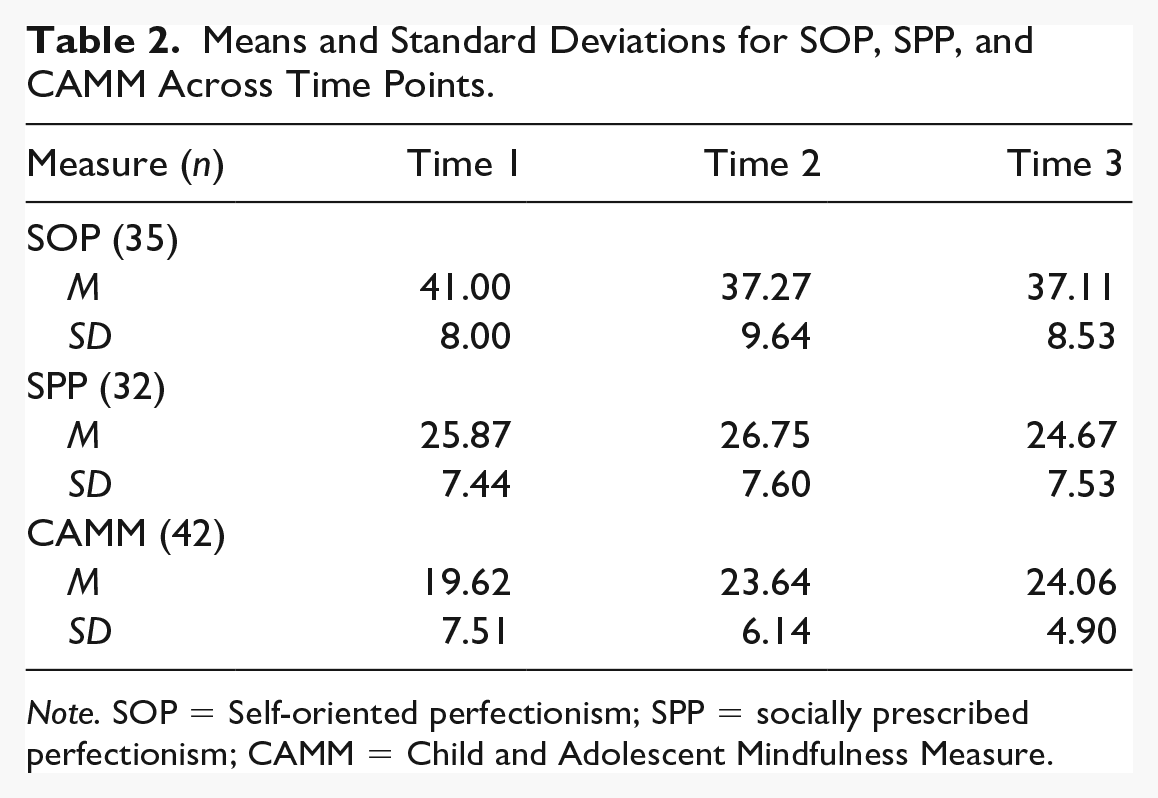
Note. SOP = Self-oriented perfectionism; SPP = socially prescribed perfectionism; CAMM = Child and Adolescent Mindfulness Measure.
Child and Adolescent Mindfulness Measure
Mindfulness was measured using the Child and Adolescent Mindfulness Measure (CAMM; Greco et al., 2011), a 10-item screener for children and adolescents aged 10 to 17 years. Items are scored 0 to 4 and measure how well statements reflect a student’s beliefs and practices, with a zero being “never true” and a four being “always true.” All items are reversed coded, thus when scoring, higher numbers correspond with greater levels of mindfulness (Greco et al., 2011). This measure includes questions such as “I get upset with myself for having certain thoughts” and “I tell myself I shouldn’t be feeling the way I’m feeling” (Greco et al., 2011, p. 609). In a sample of 562 adolescents aged 12 to 15 years, internal reliability was adequate, with a Cronbach’s α of .84 (Kuby et al., 2015). In the same sample, convergent validity was compared with measures of psychological functioning and distress resulting of .54 with the Penn-State Worry Questionnaire for Children (Chorpita et al., 1997) and a correlation of .46 with the total score on the Strengths and Difficulties Questionnaire (Goodman & Goodman, 2012). No test–retest reliability was available with the original sample, but research with a French–Canadian population yielded test–retest reliability of .72 after 2 weeks and .58 after 3 months (Dion et al., 2018). The internal reliability with the current sample was .83.
Procedures
Research approval was obtained through the school district as well as through the university’s institutional review board. After all permissions were received, participants were recruited using the strategies described earlier. To obtain the necessary minimum sample size, the researchers conducted an a priori power analysis through G*Power 3.1 (Faul et al., 2009; the α was set at .017 to account for using the same subjects on three measures [Bonferroni adjustment]). Researchers chose a moderate effect size of 0.25 and the power was set at .8, the recommended level for tests in the behavioral sciences (Cohen, 1988). Finally, a conservative estimate of the correlation between measures was .6, as test–retest reliabilities for SPP and self-oriented perfectionism were .59 and .65, respectively (Flett et al., 2016) while the test–retest reliability for the CAMM has been found to be .72 at 2 weeks and .58 after 3 months (Dion et al., 2018). The power analysis found a minimum necessary sample size of 31. Though the intervention was relatively short and fit within a semester, the likelihood of every student attending each session was unlikely. To account for attrition and absences, a larger sample was recruited. Other studies examining mindfulness included participants attending at least 80% of the intervention days (Crowley et al., 2018; Fung et al., 2016), thus, all students who attended at least five of the six sessions were included in the final analysis.
Once a sufficient number of participants were identified, they were organized into one of several intervention groups based on grade level, with 15 participants in Grade 6, 17 in Grade 7, and 10 in Grade 8. Arrangements were made with participants’ teachers outlining when and how students would be released from class to attend the group as well as the process for transitioning to their next class. The 6-week curriculum of the mindfulness intervention, Learning to Breathe (Broderick, 2013) was delivered to all participants with each lesson lasting 45 minutes. It is one of four mindfulness programs that has met the research criteria established by the Collaborative for Academic, Social, and Emotional Learning (2015) for an effective intervention.
Each weekly session started with a preview and presentation of the theme of the day, followed by activities related to the theme and opportunities for in-class mindfulness practice. At the end of the sessions, students were given “homework” to practice what they had learned throughout the week and when they were at home. Each student was given a workbook in which they could complete activities, journal, and keep track of learned skills. The first author, who was affiliated with the school but not a staff member, guided each lesson for all participants. Fidelity of implementation was addressed through adhering to the curriculum and ensuring that any students who missed more than one session were not included in the final analysis, though ultimately no student missed more than one session. Homework was not monitored formally, but students were asked to raise their hand if they had practiced mindfulness at any point during the week at the beginning of each session. No formal data were gathered on students reporting home practice; the purpose of prompting was to establish the importance and expectation of practicing at home. Data were collected at three time points with the first occurring prior to the intervention during the first session. As noted, data were collected after all sessions had been delivered, and again at a 5-week follow up. Students filled out the forms in a group setting during each of the three occasions.
Research Design
A quasi-experimental design was used to assess changes in self-ratings of perfectionism and mindfulness across pre, post, and follow-up time points. Formal tests of potential assumption violations including Mauchly’s Test of Sphericity found no violations. A correlational analysis between the variables at the first time point indicated that SOP and SPP were significantly correlated (r = .533, p < .01). Mindfulness practice was negatively correlated with both SOP (r = −.201, p < .05) and SPP (r = −.230, p < .05).
Three one-way, repeated measures, within factors analyses of variance (ANOVAs) were completed on SOP, SPP, and levels of mindfulness (CAMM). Time point was the independent variable (i.e., Pre, Post, Follow-up), and the dependent variable was each measure (i.e., SOP, SPP, CAMM scores). Any significant reduction in scores was considered indicative of a functional intervention. Because the same individuals would complete the three measures across each time frame, a Bonferroni adjustment to p < .017 was used to reduce Type I error. Pairwise comparisons were then analyzed to see whether there were significant differences between time points. Results were analyzed using IBM’s SPSS 24 to ascertain whether participants reported lower levels of perfectionism (SOP and SPP) and higher levels of mindfulness (CAMM), across the three time points. Specifically, Time 1 (preintervention) was compared with Time 2 (postintervention) and then Time 1 was compared with Time 3 (follow-up) to see if there were significant effects across these different time points.
Results
Self-oriented perfectionism was predicted to decrease after the intervention and that the results would be maintained through the follow-up. The results of the one-way ANOVA supported this hypothesis; F(2, 68) = 8.35, p = .001, η2 p = .197, indicating a large and significant effect of time on measures of SOP. Pairwise comparisons between the time points showed significant differences between the pretest and the posttest as well as between the pretest and the follow-up (Table 3). 1 There was no difference between student scores at Time 2 and at follow-up (Time 3), suggesting that students maintained the lower levels of reported SOP.
Pairwise Comparisons Between Time Points for Self-Oriented Perfectionism.
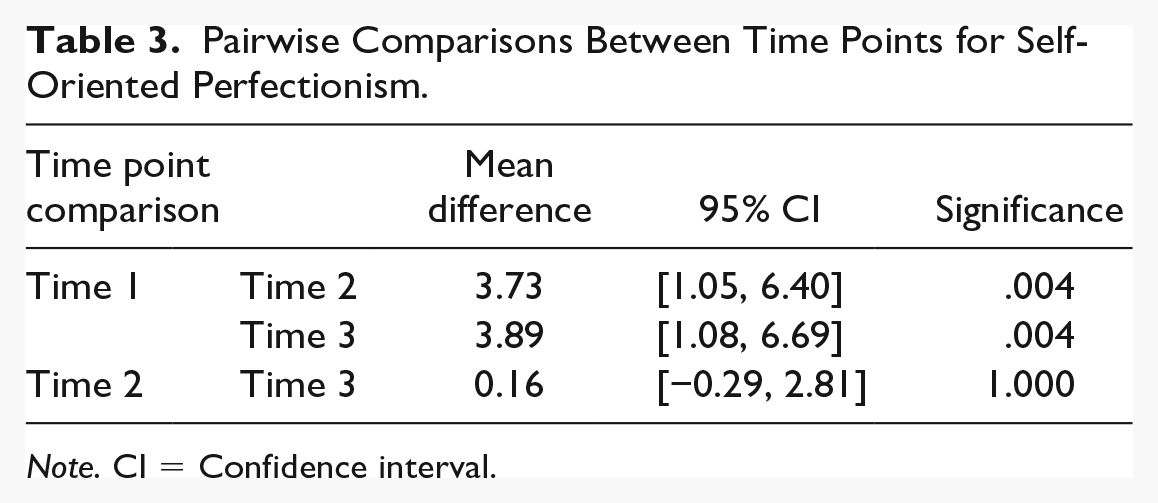
Note. CI = Confidence interval.
SPP was hypothesized to decrease after the mindfulness intervention. The results did not support this hypothesis, and there were no significant differences between the pretest, posttest, and follow-up: F(2, 62) = 2.346, p = .104, η2 p = .070. No pairwise comparisons were necessary due to the nonsignificant results.
Finally, to ascertain if participants reported higher levels of mindfulness behaviors after participating in the group and several weeks later, a one-way repeated-measures ANOVA was performed. The results followed the hypothesis that levels of mindfulness would increase significantly from baseline and would be maintained at follow-up. According to the analysis, there was a significant difference and large effect size based on the time points on levels of mindfulness; F(2, 82) = 15.099, p = .000, η2 p = .269. Pairwise comparisons (Table 4) indicated significant differences between the pretest and posttest, as well as between the pretest and the follow-up. Notably, there was no significant difference between the posttest and the follow-up.
Pairwise Comparisons Between Time Points for Child and Adolescent Mindfulness Measure.
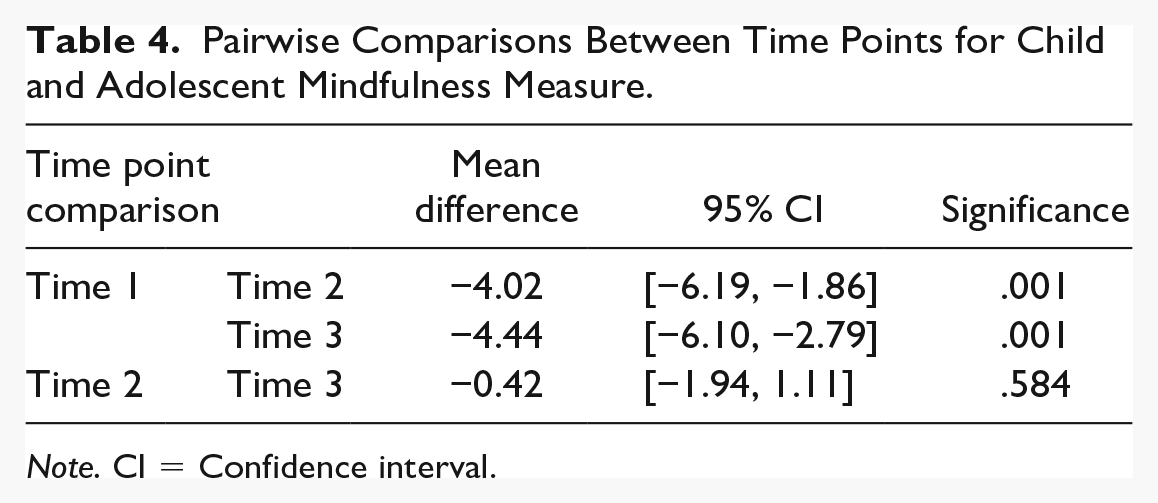
Note. CI = Confidence interval.
Discussion
In our high-pressure society, perfectionism appears to be a growing problem among youth (Curran & Hill, 2019). This trend is concerning given the relationship between high rates of perfectionism with internalizing symptoms such as anxiety (Gnilka et al., 2012) and depression (Reyes et al., 2015). This study examined the effectiveness of a mindfulness intervention on reducing self-ratings of perfectionism among gifted middle school students. It was expected that students who learned different mindfulness techniques would report experiencing fewer maladaptive cognitions associated with perfectionism.
Results from this study indicated that middle school students participating in a gifted and talented program reported significantly lower levels of self-oriented perfectionism after participating in the mindfulness group; a change that was maintained at least 5 weeks after the completion of the intervention. These findings are consistent with other studies of mindfulness that have found that adolescents reported positive changes after participating in mindfulness interventions such as decreases in anxiety (Felver et al., 2016), fewer externalizing behaviors (Fung et al., 2016), and an increased ability to manage stress (Zenner et al., 2014).
In the preintervention assessment, negative correlations were found between perfectionism (SOP and SPP) and mindfulness, supporting the idea that perfectionistic cognitions may be antithetical to mindfulness practices. Furthermore, it was interesting to note that prior to the start of the intervention, on average, these gifted youth rated themselves more than one standard deviation above the reported norms in the area of SOP. These preliminary findings support both the idea that students who are gifted endorse high levels of SOP in contrast to the general population and the inverse relationship between mindfulness practices and perfectionism. There remains a debate among scholars as to whether aspects of perfectionism might be considered adaptive (e.g., Leone & Wade, 2018). It has been suggested that SOP might be considered an ambivalent form of perfectionism, as there is research to suggest both positive correlations with elements such as intrinsic motivation for studying (e.g., Stoeber et al., 2009) and higher levels of pathology (e.g., Flett & Hewitt, 2014). Given the framework of the authors of the CAPS instrument (i.e., Flett & Hewitt, 2014) who described perfectionism as maladaptive, the findings of this would likely be considered as reducing maladaptive perfectionism for gifted students. In fact, at the end of the intervention, participants rated themselves as being in the average range in terms of their SOP scores after previously significantly elevated levels.
Mindfulness may be a particularly well-suited intervention for perfectionism due to the ability for mindfulness to reshape cognitions as well as to enable self-regulation by directing one’s attention to the present (Greeson, 2009; Sharp et al., 2017). It is possible that by helping youth to notice and accept their cognitions, emotions, and somatic experience without judgment, they may have learned to apply their newfound nonjudgmental frame of mind to their perfectionistic cognitions. Indeed, these results were consistent with studies that found mindfulness interventions were correlated with a decrease in perfectionism (James & Rimes, 2018). Unfortunately, there was not a large enough sample in this study to demonstrate whether increased levels of mindfulness mediated lower levels of perfectionism.
According to Hewitt and Flett’s (1991) conceptualization, one important type of perfectionism is the degree to which individuals believe others as having unreasonably high expectations of them (SPP). This type of perfectionism was considered to be salient for young adolescents because they are often acutely aware of how others might be perceiving them. Contrary to expectations, no significant findings were identified either at the end of the intervention or several weeks thereafter. Previous work by Mofield and Chakraborti-Ghosh (2010) also did not find significant differences on this aspect of perfectionism. It is possible that adolescents did not believe that changing their own thinking would have an effect on this type of perceived external pressures. Additionally, participants in this study did not report elevated levels of SPP, and therefore, may not have been experiencing distress as related to the expectations of others, and thus, saw no reason for change. Still, it was interesting to note that SPP was significantly negatively correlated with mindfulness during the initial assessment even when it was in the typical range. Thus, it appears that worrying about the expectations of others is contrary to the practices of mindfulness.
Participants reported engaging in significantly higher levels of mindfulness practice after participating in the intervention and several weeks afterwards. Overall, this was an expected result, as many studies have reported this finding (e.g., Bernay et al., 2016; Galla, 2016; Viafora et al., 2015). Even when delivered in small dosages, teaching mindfulness results in a change in reported practices. For example, Galla (2016) found that an intensive 5-day mindfulness retreat delivered to adolescents resulted in significantly higher levels of mindfulness practices immediately following the workshop and were retained at the 3-month follow-up. Although the present study only followed participants for 5 weeks, it is possible that mindfulness gains may be sustained much longer following an intervention.
Finally, the results of this study supported the utility of the Learning to Breathe curriculum (Broderick, 2013) as an effective intervention delivered in a school setting for adolescents. Previous studies such as that of Metz et al. (2013) reported positive results on emotion regulation, psychosomatic complaints, and stress reduction among youth after their participation in this program. Furthermore, Broderick and Jennings (2012) noted greater metacognitive awareness and lower levels of depression (Bluth et al., 2016) after implementing this program with youth. The current findings add to this body of work by supporting the use of the Learning to Breathe curriculum as a potential intervention for reducing perfectionistic pressures placed on oneself.
Implications
Although aspects of perfectionism may be viewed positively, most scholars agree that perfectionism can become maladaptive (Flett & Hewitt, 2015). Therefore, it seems reasonable to monitor students in programs for gifted youth for maladaptive cognitions that might reflect unrealistic expectations for themselves. The findings of this study suggested that mindfulness interventions such as the Learning to Breathe (Broderick, 2013) curriculum may be effective in reducing levels of self-imposed perfectionism. As noted, the mean reported level of SOP for this sample was much higher than the average scores of the normative sample (Flett et al., 2000). Additionally, students were in an International Baccalaureate middle school where pressures to succeed may be greater. Given this context, mindfulness programming might be introduced as part of a health class or the general curriculum such that all students, including those who might be experiencing high levels of perfectionism are able to learn specific skills that encourage them to change their cognitions.
Given the rapid growth in mindfulness programming, it will be important to use curriculum that has empirical support and to monitor the effectiveness of these types of programs. Because gifted programming can vary so much between schools and districts, it is difficult to create an overarching recommendation for its delivery. However, as many school districts have organized their supports along tiered levels of delivery that vary by intensity (Jimerson et al., 2016), mindfulness might be introduced as a universal program for all students or be delivered in a more focused manner to students who are in gifted programming in recognition that these students may be at greater risk for maladaptive cognitions. Gifted students may be particularly able to connect with concepts of mindfulness, such as the importance of recognizing thoughts and stressors while not letting them rule their life and impact their mental well-being.
The current results contribute to the growing body of research indicating that mindfulness programming can be effectively delivered in school settings and may help to reduce self-oriented perfectionism in gifted youth. Given the rapid developmental changes that occur for all students who are entering adolescence, interventions that promote acceptance of current states and being present in the moment are ideal. Mindfulness programming has helped gifted students to report increased calmness and heightened awareness (Haberlin & O’Grady, 2018) as well as the use of mindfulness skills in other settings (Doss & Bloom, 2018). Ultimately, given the need for interventions related to perfectionism in gifted populations, and the call for mindfulness to be used with these populations (Sharp et al., 2017), the findings of this study support the promise of this type of programming.
Teachers of gifted students may have particular insights as to what types of perfectionism their students may be experiencing and whether it is becoming problematic and consider social–emotional interventions that could address some of these negative cognitions and emotions. Mindfulness in particular has been demonstrated to be well-suited to the needs of gifted students and can be easily delivered within the small group format that is common to gifted programming.
Limitations
The largest limitation of this study was the lack of control group, which introduces the possibility that other internal or external factors unrelated to the intervention (e.g., maturation, other programming in the school) may have contributed to change in the scores. It was also difficult to know what specific aspect of the intervention may account for the reported changes. Participants received extra attention from the researcher, were able to interact with their gifted peers in a group format, and had a weekly break from their classes while receiving the intervention. It is possible that any one or a combination of these factors contributed to the lower ratings of perfectionism. Without a comparison group that shared some of these features (e.g., study group with gifted peers), it is difficult to determine why the ratings changed. Furthermore, the generalizability of these findings is limited as the small number of participants were drawn from an International Baccalaureate school that has high standards for all of its students. Additionally, parents may have held positive views towards mindfulness and therefore opted to have their children participate in the group. Out of the 97 identified Gifted and Talented students in the school, a substantial proportion participated (43%), but there was still room for potential selection bias. Finally, there may have been social bias in the responses of the students; they may have wanted to please their group facilitator (and first author) by responding in more positive ways. As Jackson and Peterson (2003) noted, gifted student’s advanced intellect may make them more capable of adjusting their answers according to their perception of the needs of the test.
Future Directions
Introducing mindfulness programming early in the education of gifted youth may help them develop important skills to manage higher levels of pressure throughout their lives. However, it will be important to replicate this type of research with more diverse samples of youth who are identified as gifted. Additionally, future research should include a control group with random assignment that offers an alternative program so that the potential effects of the mindfulness program can be separated from other aspects of the intervention setting. Finally, a much larger sample is needed in order to conduct the types of analyses that would allow researchers to determine whether students who demonstrate the increases in mindfulness practices are also those who demonstrate the greatest reductions in perfectionism. Without this explicit mediation effect, it is difficult to explicitly state that it is the practice of mindfulness that is reducing perfectionist cognitions and beliefs. Each of these approaches would allow for stronger conclusions regarding the effectiveness of mindfulness in reducing levels of perfectionism.
Finally, there is much to be learned about how mindfulness changes the cognitions of students, what mechanisms of change are related to perfectionism, and how developmental level affects the ways in which perfectionism is experienced. In other words, there are important qualitative elements that would lend greater insight into the practices of mindfulness and how students change in their beliefs, behaviors, and thoughts that cannot be captured through standardized surveys. Future research might include a mixed method design to include the qualitative experiences of both participants and stakeholders (e.g., parents, teachers).
Conclusion
The purpose of this study was to better understand how teaching gifted middle school students about mindfulness might help reduce levels of perfectionism. Findings from this study lend credence to the hypothesis that youth who are gifted and talented may be struggling with heightened levels of self-oriented perfectionism as compared with their nonidentified peers. The delivery of mindfulness programming may hold promise for gifted young adolescents because participants reported lower levels of perfectionistic pressures placed on them that maintained over a 5-week period. Overall, this study supports the potential for mindfulness programming to help reduce some types of perfectionistic cognitions among gifted students.
Footnotes
Declaration of Conflicting Interests
The author(s) declared no potential conflicts of interest with respect to the research, authorship, and/or publication of this article.
Funding
The author(s) received no financial support for the research, authorship, and/or publication of this article.
Open Science Disclosure Statements
The data analyzed in this study are not available for purposes of reproducing the results. The code or protocol used to generate the findings reported in the article are not available for purposes of reproducing the results or replicating the study. There were no newly created, unique materials used to conduct the research.
