



Abstract
In 2012, Florida adopted the Academically Challenging Curriculum to Enhance Learning (ACCEL) statute establishing minimum requirements for local education agencies to provide access to accelerated learning options for eligible K–12 public school students. This study examined Florida public school district acceleration policies for elementary students one decade after the enactment of the statute. We analyzed Student Progression Plans, school board policies, and district websites to explore the status of acceleration policy in the state, compare the accessibility of acceleration information across districts, and identify policy elements that support equity and those that create potential barriers for elementary students with advanced learning needs who could benefit from acceleration. The findings of this study indicated several areas for improvement, including the accessibility of acceleration information, the service options available to K–5 students, the protocols districts use, criteria for decision-making, and the implementation of acceleration. In addition, we discuss implications for school districts developing or revising acceleration policies and several avenues for future research. The preregistration and open-access materials for this study are available at https://osf.io/yc3xd/.
One of the most widely researched approaches for meeting the needs of advanced learners is acceleration (Assouline, Colangelo, & VanTassel-Baska, 2015). Acceleration is “progress through an educational program at rates faster or at ages younger than conventional” (Pressey, 1949, p. 2). Accelerated learning pathways may result in a student advancing a grade or more (e.g., grade skipping, radical acceleration) or receiving advanced instruction in one or more subjects (e.g., subject-area acceleration). Even though over eight decades of research support the use of acceleration for advanced students in PreK–12 education contexts, policymakers, educators, and caregivers still harbor misconceptions about what acceleration is, how it works, and who it benefits (Plucker & Callahan, 2020).
In the United States, the term acceleration is increasingly used in general education contexts to describe interventions for students who have been retained or have not met minimum grade-level standards on state accountability testing. In these contexts, acceleration refers to instructional strategies that address remediation needs and current grade-level content simultaneously, which differs drastically from acceleration in advanced learning contexts (see Fong, 2021). These disparate understandings of acceleration can cause confusion among policymakers, educators, caregivers, and students about the goals of accelerated academic placements, how to identify students for these learning pathways, and how to meet their academic and psychosocial needs within accelerated learning contexts. Given the potential misunderstandings about acceleration in a post-pandemic educational landscape where learning loss is at the forefront of education policy conversations, it is vital to have strong state and local policy documents to pave the way for students with advanced learning needs.
Formal acceleration policies can provide clarity about the goals of acceleration, increase access to advanced learning opportunities, ensure students receive credit for completing advanced coursework, and guide decision-making processes, but very few states in the United States have this type of legislation (e.g., Florida, Illinois; Lupkowski-Shoplik, Behrens, & Assouline, 2018; Rinn et al., 2022). Without equitable and transparent guidelines for acceleration, important decisions about educational placements for students with advanced learning needs may be based on misconceptions or the personal beliefs of state and local school district leaders. On the other hand, poorly written policies that do not include careful planning, systematic assessment, and dynamic monitoring throughout the acceleration process may create barriers when they were intended to provide opportunities (Guilbault, 2023; Lupkowski-Shoplik, Behrens, & Assouline, 2018; Plucker et al., 2017; Southern & Jones, 2004).
In this study, we define equitable acceleration policies as those that ensure students from all racial, cultural, linguistic, economic, and geographic backgrounds can reasonably access acceleration opportunities in their school district and transparent acceleration policies as those that provide clear descriptions of options, protocols, and criteria and identify the specific steps students and their caregivers must take to access acceleration opportunities. Policies, such as those in the state of Florida, have the potential to provide equitable access to acceleration and create more transparency about how acceleration decisions are made locally. To ensure that students with advanced learning needs are considered in education policy conversations, it is critical to examine existing acceleration policies to identify supports for equitable services and barriers that could limit access to accelerated learning pathways. This study contributes to the literature on acceleration by identifying themes related to access, service options, protocols, and identification criteria across the policies in one state and providing guiding questions school leaders in all states can use to evaluate and refine their acceleration policies.
Acceleration for Advanced Learners
In this literature review, we discuss acceleration in the context of advanced academics and examine research evidence that shows (a) what acceleration is and how it works, (b) why, contrary to widespread belief, accelerated learning options are necessary for many students, and (c) who benefits from accelerated learning pathways.
Forms of Acceleration
There are 20 forms of academic acceleration outlined in the landmark report, A Nation Empowered: Evidence Trumps the Excuses Holding Back America’s Brightest Students (Assouline, Colangelo, & VanTassel-Baska, 2015). Within this list of acceleration options, there are two key categories, including grade-based acceleration, where students spend a shortened amount of time in the PreK–12 education system (e.g., early entrance, grade skipping, continuous progress, combined classes, telescoping curriculum), and content-based acceleration, where students remain with similar-age peers for most of their instructional time but are provided advanced content in one or more subjects (e.g., subject acceleration, curriculum compacting, mentoring or tutoring, distance/online learning, self-paced instruction, extracurricular programs). Due to differences in educational contexts, some forms of acceleration may overlap and do not fall neatly into just one category. For instance, a student might take an online accelerated mathematics course outside of school, which is considered content-based acceleration. However, virtual instruction may also enable the student to graduate early, which could be considered grade-based acceleration. Although some types of acceleration are more suitable for older students, including dual enrollment and Advanced Placement courses in high school (see also Assouline, Colangelo, & VanTassel-Baska, 2015), many types of acceleration, including early entrance and curriculum compacting, are appropriate for elementary students (see also Southern & Jones, 2015), but these options for younger students may not be as easily accessible. This study examined the types of acceleration Florida public school districts provided for elementary students to identify the options most frequently available to students in the state.
Misconceptions About Acceleration
Although there are decades of research that support acceleration as an effective means of allowing advanced learners to progress, it is not widely used in schools due in large part to persistent misconceptions and equity concerns (Assouline, Colangelo, & VanTassel-Baska, 2015; Colangelo et al., 2004; Gallagher & Smith, 2013; Guilbault, 2023; Siegle et al., 2013). Despite the strong research base, many educators and caregivers are hesitant to accelerate elementary-aged students for fear of negatively affecting their development, concerns about readiness, and the belief that their academic needs can be effectively met in mixed-ability classrooms (Assouline, Colangelo, & VanTassel-Baska, 2015; Neihart, 2007; Siegle et al., 2013). In addition, conversations about educational equity often point to advanced learning services, including acceleration, as inequitable due to policies that perpetuate the underrepresentation of students from culturally, linguistically, and economically diverse backgrounds in accelerated learning pathways (Dixson et al., 2020; Plucker & Callahan, 2020). However, strong acceleration policies can address these misconceptions and provide opportunities for all students to accelerate in their areas of strength.
Social, Emotional, and Psychological Development
One chief concern about acceleration is the fear that although students may be academically ready to advance, their social, emotional, and psychological development will suffer if placed with older students for part- or full-time instruction (Assouline, Colangelo, & VanTassel-Baska, 2015; Neihart, 2007; Siegle et al., 2013). There is substantial empirical support to suggest that acceleration is positively related to academic achievement and psychosocial development for advanced learners and has benefits in the short and long term (Assouline, Colangelo, & VanTassel-Baska, 2015; Lupkowski-Shoplik et al., 2022; McClarty, 2015; Steenbergen-Hu & Moon, 2011). In a meta-analysis of 28 studies across PreK–12 (n = 21) and postsecondary (n = 7) settings, Steenbergen-Hu and Moon (2011) noted not only that “acceleration does improve high-ability learners’ academic achievement” (p. 46) but also that across these studies, the findings “support the notion that acceleration is not harmful to social-emotional development” (p. 47).
Longitudinal studies also show a relationship between early academic acceleration and positive outcomes in adulthood (Lubinski et al., 2014; McClarty, 2015; Steenbergen-Hu & Moon, 2011). A follow-up with the first two cohorts of the Study of Mathematically Precocious Youth (SMPY; Lubinski et al., 2014) examined the outcomes of participants who were in the top 1% of performers in mathematics at age 13. The study emphasized that 40 years later, “these early manifestations of exceptional mathematical talent did lead to outstanding professional accomplishment and professional leadership” (p. 2229), and participants reported high levels of life satisfaction and psychological well-being. Collectively, these findings suggest that students who are accelerated tend to outperform similar-ability peers who were not accelerated (e.g., Rogers, 2015; Wai, 2015) and they adjust well socially and emotionally to their new placements (e.g., Jung & Gross, 2015; Lupkowski-Shoplik, Behrens, & Assouline, 2018).
Readiness
Caregivers and educators often express concerns about pushing children to work on advanced learning material before they are ready. However, there are research-based tools that can be used to evaluate a student’s readiness to accelerate, including the online Integrated Acceleration System (Assouline et al., 2021) and the Iowa Acceleration Scale (IAS-3; Assouline et al., 2009) which allows educators, students, and caregivers to collaboratively examine academic achievement, developmental factors, and student input to determine the likelihood of success in an accelerated placement. Early entrance to kindergarten, for example, is an effective intervention for carefully selected advanced learners; however, educators and families must consider “children’s learning needs, parents’ values, whether the learning needs match what is offered in the receiving environment, and how well the parent can project the impact of the decision onto the child’s future” (Hertzog, 2022, p. 141).
Although many accelerated children show positive social-emotional effects (e.g., Lupkowski-Shoplik, Assouline, & Colangelo, 2018), individual differences among children and the timing of acceleration are also key considerations. In their study of children who skipped a grade in elementary or middle school (n = 238), Kuo and Lohman (2011) noted that children who accelerated earlier (kindergarten) showed higher academic achievement in reading and math by Grade 12 than those who accelerated later. Taken together, these findings suggest that early acceleration can be less disruptive for a child with advanced learning needs and that delaying acceleration or denying access can slow or stall academic talent development trajectories.
Equity Concerns
Another concern about acceleration is that providing advanced academic services to some students uses resources that could be directed to students with greater academic needs. However, academic need is academic need, regardless of whether a student requires intervention or more challenge. In a study of Florida school district websites, R. Johnson and Hodges (2023) noted that the job of advocating for advanced learning needs often falls on parents or caregivers but that school districts can support students and their families by making policy information accessible and available. In two studies of New York City public schools, children from diverse backgrounds who attended public pre-kindergarten programs took gifted and talented screening tests at higher rates than their peers who did not attend public Pre-K (Lu et al., 2020; Lu & Weinberg, 2016). These findings suggest that when families and caregivers have information about specific programs that can meet their child’s academic needs, they may be more likely to advocate for their child’s participation (e.g., initiate a referral, schedule required testing).
Nevertheless, the responsibility to advocate for a child’s inclusion in accelerated learning pathways should not fall solely on parents or caregivers. Peters (2022) identified universal consideration as one practice to equitably identify students for advanced learning services, including acceleration. In a universal consideration model, schools examine academic data for all students and look for evidence of the need for an accelerated pathway. For example, educators can examine annual state testing data for all students in a grade, identify a pool of students who scored at the advanced level, and determine whether those students meet local acceleration criteria (e.g., curriculum compacting, subject-area acceleration). Universal consideration proactively identifies students in need of additional academic challenges rather than requiring students or their caregivers to initiate screening (Plucker et al., 2022; Plucker & Peters, 2016).
Elementary Students and Acceleration
Many students could benefit from acceleration. Talent development models recommend that schools create wider, more inclusive talent pools of students, provide these students with advanced learning opportunities, and see how they respond to the challenge (e.g., Renzulli, 2012). In a typical classroom, there are children with a wide range of abilities, interests, and motivations (Dixson et al., 2020; Lubinski & Benbow, 2021; Lubinski et al., 2023; Peters et al., 2017). In one study, Peters et al. (2017) noted that at the beginning of an academic year, between 16% and 37% of fifth-grade students in their sample had already demonstrated proficiency in mathematics content for the next grade level. In addition, 20% to 49% of the fifth graders in the same sample were already performing at least 1 year above grade level in reading. In their meta-analysis on acceleration, Steenbergen-Hu et al. (2016) highlighted the fact that students who were accelerated demonstrated higher levels of academic achievement when compared with their same-age peers, but they also performed at levels similar to or greater than the students in their accelerated placements. These findings indicate that not only are there elementary students across the country who could benefit from accelerated pathways but also that, with responsive classroom supports, accelerated students can achieve at or beyond the rate of their new peers.
Florida defines a gifted student as “one who has superior intellectual development and is capable of high performance” (Special Instructional Programs for Students Who are Gifted, 2002). Although students identified for gifted services are not the only ones who benefit from academic acceleration, there is a substantial body of research (e.g., SMPY; Lubinski & Benbow, 2021) to suggest that students with high cognitive ability thrive in responsive learning environments that vary the pace and depth of the content. Several longitudinal SMPY studies (e.g., Bernstein et al., 2019; Kell et al., 2013; Makel et al., 2016) have noted that early talent identification and subsequent educational adaptations, such as acceleration, were related to professional accomplishments in adulthood (e.g., advanced degrees, leadership roles, publications, patents), which suggests that allowing students to accelerate early can start the process of moving from interest to competence and expertise in an academic talent domain (Dai, 2017; Subotnik et al., 2011, 2018).
Elementary Acceleration Policies
Academic acceleration is not meant to replace advanced academic services, such as gifted and talented programs. Rather, acceleration should be one facet of the continuum of services school districts provide for students with advanced learning needs (Assouline, Colangelo, & VanTassel-Baska, 2015). As such, state and district policies and procedures must be carefully written to ensure they complement each other and do not lead to unintended consequences or create unnecessary hurdles (Lupkowski-Shoplik, Behrens, & Assouline, 2018). For example, due to varying identification criteria, participation in a gifted program should not be a prerequisite for academic acceleration.
State rules can help or hinder acceleration practices at the elementary level, but they vary greatly and, in some cases (e.g., early entrance, grade skipping, course credit), policies have language that conflicts (e.g., using strict birthday cut-offs, prohibiting skipping of tested grades). In 2009 and 2018, a national workgroup developed research-based recommendations to guide states and school districts as they create or revise acceleration policies. The authors (Lupkowski-Shoplik, Behrens, & Assouline, 2018) recommended that acceleration policies include provisions for equitable access, clear implementation guidelines, systematic processes (e.g., documentation), consideration of nonacademic barriers, appeals processes, regular evaluation of policies, and research-based decision-making tools (e.g., IAS-3; Assouline et al., 2009). Clear policies can make acceleration opportunities open “to all students who would benefit” and “encourage more educators to use the intervention” (Lupkowski-Shoplik et al., 2022, p. 144). In short, written procedures can create objective guidance and support sound state and local decision-making.
Florida ACCEL Statute
The state of Florida has a long history of supporting gifted education through legislative mandates to identify students with advanced learning needs, provide gifted education services, fund those services, and require gifted education certification for those who teach identified gifted learners. In 2012, Florida passed the Academically Challenging Curriculum to Enhance Learning (ACCEL, 2021) Act which outlines acceleration options that all school districts must provide for eligible K–12 students, including (a) whole-grade and mid-year promotion, (b) subject-matter acceleration, (c) virtual instruction in higher grade level subjects, and (d) the Credit Acceleration Program (CAP, 2021) for high school students (Florida Department of Education [FLDOE], 2021). Additional mandates delineated in the ACCEL policy include provisions for equitable access to accelerated learning options (e.g., parent request process, procedural safeguards) and transparency about local acceleration protocols (e.g., communication to students and families, publicly available policy documents).
The Current Study
Florida’s ACCEL (2021) statute establishes minimum requirements for local education agencies to provide an accelerated curriculum to eligible K–12 public school students. As school districts have some flexibility in how they implement acceleration policy locally (e.g., menu of services, referrals, screening, decision-making, assessments) and the application of these acceleration policies can evolve in response to local needs (e.g., procedures, eligibility requirements), we examined how ACCEL policies were presented in publicly available documents, including Student Progression Plans (SPPs), school board policy, and district websites 10 years after ACCEL was adopted by the state of Florida. We chose to focus on elementary policies for this study because Florida’s secondary accelerated learning services (e.g., dual enrollment, AP courses) are typically open to all students, which differs from policies for elementary acceleration. Prior studies of elementary acceleration indicate that adults (e.g., teachers, principals, caregivers) may be more reluctant to accelerate younger students due to misconceptions about social and emotional harm or potential gaps in knowledge (Guilbault, 2009; Sankar-Deleeuw, 2002; Siegle et al., 2013). Therefore, we examined elementary policy documents to identify barriers and supports for acceleration as an early intervention. We did not examine secondary acceleration policies; however, that is a direction for future research.
Research Questions
The following questions guided the data collection and analysis processes:
Research Design
Sociocultural theories acknowledge the importance of social and cultural interactions within systems such as state education agencies and local school districts (Plucker et al., 2021). Academic acceleration policy in Florida requires school districts to implement the ACCEL (2021) statute locally and document procedures for acceleration in an SPP (2021). However, districts must balance the diverse learning needs of students in their district with their available resources (e.g., financial, personnel, space). A social constructivist framework provided a lens to examine the application of the ACCEL statute in districts across the state and how the needs of advanced learners were addressed in publicly available acceleration plans. First, we used content analysis techniques (Elo & Kyngäs, 2008; Schreier, 2012) to gather data from school district plans, including SPPs, board policy documents, and district websites. Then, we conducted a thematic analysis (Braun & Clarke, 2022) to identify similarities and differences among school district policies and create themes.
Conceptual Framework
Lupkowski-Shoplik, Behrens, and Assouline (2018) created guidelines for developing academic acceleration policies. These guidelines present several best practices that can be used to critically examine acceleration policy. The first key practice for acceleration policy is to ensure it “is characterized by accessibility, equity, and openness” (Lupkowski-Shoplik, Behrens, & Assouline, 2018, p. 11). These characteristics are vital in district-level acceleration policies because students and their caregivers cannot advocate for advanced learning needs, including acceleration, if they are unaware of the options, cannot find information about accessing the options, or if acceleration pathways are not open to all students. The second key practice for acceleration policies is to include “features that prevent unintended consequences” (Lupkowski-Shoplik, Behrens, & Assouline, 2018, p. 12). This practice is critical because although acceleration policies are intended to meet the needs of students who could benefit from additional academic challenges, some policies may inadvertently create barriers for students by applying eligibility criteria that ultimately restrict access to acceleration (e.g., requiring caregivers to provide transportation, age restrictions).
Across the suggestions for whole-grade and single-subject acceleration, this policy guide recommends having clear district-level guidelines that (a) allow some flexibility to address the short- and long-term needs of individual students and (b) do not allow nonacademic issues (e.g., school funding disincentives, extracurricular participation) to keep students from accelerating. In this study, we used the guidelines in Lupkowski-Shoplik, Behrens, and Assouline (2018) to critically examine the accessibility of Florida public school district acceleration policies, the acceleration options available to elementary students in each district, and the procedures for acceleration to identify supports that align with these recommendations and barriers that could be removed to make acceleration more equitable.
Method
Sampling
For this study, we collected a comprehensive sample (R. B. Johnson & Christensen, 2020) of SPPs and board policy documents for each county in the state of Florida (n = 67). For most school districts, we used SPPs for the 2022–2023 school year, but if a school district did not have a plan for that year (n = 9; 13.4%), we used the most recent version available (see Table 1). We did not include university lab schools, youth centers, or Florida Virtual School due to the possibility that acceleration may be managed differently, given the specialized focus of these schools. Concentrating our analysis on public school districts allowed us to make comparisons about (a) the existence and accessibility of district acceleration documents, (b) the types of acceleration available to elementary students, (c) specific supports for students with advanced learning needs, and (d) barriers those district policies create for elementary students with advanced learning needs in Florida public schools.
Demographic Information for Florida Public School Districts.
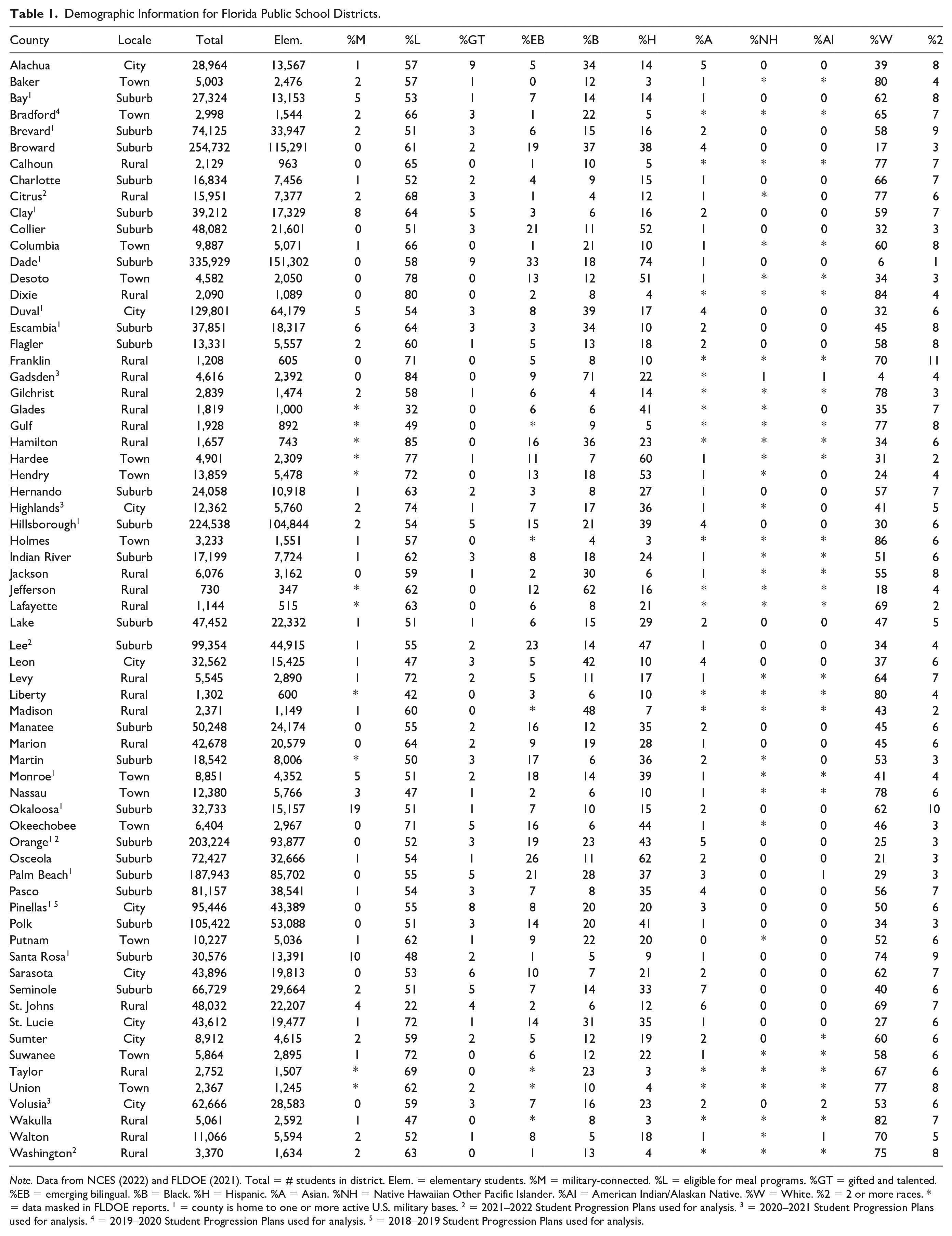
Note. Data from NCES (2022) and FLDOE (2021). Total = # students in district. Elem. = elementary students. %M = military-connected. %L = eligible for meal programs. %GT = gifted and talented. %EB = emerging bilingual. %B = Black. %H = Hispanic. %A = Asian. %NH = Native Hawaiian Other Pacific Islander. %AI = American Indian/Alaskan Native. %W = White. %2 = 2 or more races. * = data masked in FLDOE reports. 1 = county is home to one or more active U.S. military bases. 2 = 2021–2022 Student Progression Plans used for analysis. 3 = 2020–2021 Student Progression Plans used for analysis. 4 = 2019–2020 Student Progression Plans used for analysis. 5 = 2018–2019 Student Progression Plans used for analysis.
Data Collection
Data for this study included (a) elementary ACCEL information in district SPPs, (b) school board policy documents related to elementary ACCEL, and (c) information from public-facing web pages on elementary ACCEL.
Data Sources
SPPs (2021) are publicly available documents required by law that explain the criteria Florida students must meet to progress from grade to grade. Florida’s ACCEL (2021) statute requires public school districts to include acceleration information in these documents. Consequently, SPPs should describe district acceleration options and the procedures that eligible students and their families must use to access these options. School board policies outline legal requirements from the state education code and the procedures the district has adopted for adhering to those requirements (General Powers of District School Board, 2021). Board policy documents cover all aspects of school district operations, including personnel, fiscal management, and instruction. SPPs and ACCEL information are most often found in the Instruction section of board policy. District websites are another source caregivers and others routinely consult to find policies and procedures related to academic acceleration.
For the preparation phase of content analysis (Elo & Kyngäs, 2008), we collected district SPPs, links to district board policies, and links to district websites. We began collecting data in September 2022. If documents were not available on the first search, we checked back monthly. The search concluded in March 2023. We thoroughly read each SPP, school board policy, and district web page related to K–12 and elementary acceleration policy prior to data extraction.
Data Extraction Procedures
In the organization phase of the content analysis (Elo & Kyngäs, 2008), we reread each document to identify and record (a) district demographic information (see Table 1), (b) the availability and accessibility of policy documents (see Table 6), (c) each district’s menu of services (see Table 7), (d) referral, screening, and decision-making processes (see Table 8), and (e) assessment criteria (see Table 9). From March 2023 to May 2023, we compiled all extracted information in a shared spreadsheet.
District Demographic Information
For each school district, we recorded information on the locale, district size, and programs, including the percentage of students eligible for federal free or reduced meals, gifted education services, or services for English language learners, and the racial and ethnic groups represented in each school district (see Table 1). Florida is home to 21 active military bases, and children from military families experience non-promotional school transitions that may increase their need for acceleration (Meyer, 2022), so we also recorded (a) whether the district was in a county that had a military base and (b) the percentage of military-connected students in each district (i.e., dependents of active duty, National Guard, or Reserve personnel; Interstate Compact on Educational Opportunity for Military Children, 2016).
ACCEL Policy Documents
For each school district, we examined both the existence of ACCEL policy documents and the accessibility of those documents through publicly available means (e.g., internet searches; see Table 6). To verify the existence of district policies, we recorded whether each school district had an SPP that included the ACCEL policy for elementary students (1 = yes; 0 = no), a school board policy that included the ACCEL policy for elementary students (1 = yes; 0 = no), and a web page on the school district website that included the ACCEL policy for elementary students (1 = yes; 0 = no). In addition, we checked to see whether these documents were translated into languages other than English and recorded the additional languages provided by individual school districts (1 = yes; 0 = no).
To determine the accessibility of those documents, we examined the ease with which someone interested in acceleration policy information could find it. For the SPPs, we checked to see (a) if “ACCEL” or “Acceleration” was listed in the table of contents and (b) that the information in that section included the ACCEL policy for K–12 or a specific policy for elementary students. Districts were coded 1 if the SPP met these criteria and 0 if it did not. These data indicate whether caregivers and educators can locate acceleration information without sifting through every school district policy related to student academic progress and promotion (e.g., state testing, graduation requirements) in documents that often exceed 100 pages.
For school board policies, we examined whether “ACCEL,” “acceleration,” or “Student Progression Plan” were (a) searchable or listed in the board policy table of contents and (b) that the information in those policies included K–12 or elementary-specific acceleration options. Districts were coded 1 if the school board policy had a specific section for K–12 or elementary ACCEL policy and 0 if it did not. This information is critical because school boards are the governing bodies of public school districts in the state of Florida (Fla. Stat. § 1001.41), so these policies are used to make determinations when appeals and grievances are filed.
For school district websites, we examined whether a search using the terms “ACCEL,” “acceleration,” “Student Progression Plan,” or “gifted” identified a page with information or documents related to K–12 or elementary-specific acceleration policies. If we could not locate acceleration information or policy documents with the website search feature, we looked at a series of pages on each site, including Parent Resources, Curriculum and Instruction, Gifted and Advanced Academic Services, and Assessment and Evaluation. District websites that had a page detailing elementary acceleration policies or linked to SPPs containing this information were coded 1 and those that did not were coded 0. Although acceleration procedures may be provided directly to students who are enrolled in Florida public schools and their caregivers, families moving into a district, individuals who want to verify district processes, and other interested parties may use school district websites to obtain information about acceleration.
Menu of Services
For each school district, we collected information on the services schools must offer for elementary students (e.g., whole-grade acceleration, mid-year acceleration, subject-area acceleration, virtual school) and services they may offer for elementary students (e.g., curriculum compacting, flexible grouping, cluster grouping, combined groups, telescoping, self-paced curriculum, enrichment, science, technology, engineering, and mathematics [STEM]-focused enrichment). We did not record information about services that are only provided to middle and high school students, including the Credit Acceleration Program. For each subcategory, districts were coded 1 if they offered the service for elementary students and 0 if they did not. In addition, we gathered data on whether the school district had an appeal process (1 = yes; 0 = no), whether they required a trial period (1 = yes; 0 = no), and the length of the trial period. This information showed the range of acceleration options available to elementary students in each district (see Table 7).
Referral, Screening, and Decision-Making Processes
For this category, we collected data on (a) who can initiate an acceleration referral, (b) whether acceleration decisions are made by a committee or by an individual, (c) who serves on the evaluation committee or makes the individual decision, (d) who determines the procedures, (e) the required time frame for review, and (f) whether or not students are put on a performance contract or accelerated education plan. This information provided a sense of who engages in decisions about acceleration in each district and how students are monitored after accelerated placements (see Table 8).
Assessment Criteria
We recorded information on the range of criteria districts used to determine whether acceleration was appropriate for elementary students, including (a) testing, (b) psychosocial factors, (c) recommendations or approvals, (d) academic requirements, and (e) limitations (e.g., conduct, absences). These data showed the scope of information used to make acceleration decisions in school districts across Florida (see Table 9).
Data Analysis
For the presentation phase of the content analysis (Elo & Kyngäs, 2008), we used the data we extracted from each of the school district documents to (a) examine patterns in the descriptive codes from the content analysis and (b) organize a priori categories, emergent pattern codes, and data exemplars to develop themes (Braun & Clarke, 2022).
Categories
From the conceptual framework (Lupkowski-Shoplik, Behrens, & Assouline, 2018) and the information extracted from the SPPs, we designated four a priori categories, which included (a) access (see Table 2), (b) options (see Table 3), (c) protocols (see Table 4), and (d) criteria (see Table 5). As we descriptively coded these acceleration policy documents in the organization phase of the content analysis, we used these a priori descriptive codes to start grouping, categorizing, and developing abstractions to articulate key themes (Braun & Clarke, 2022; Elo & Kyngäs, 2008).
Accessibility Categories, Codes, and Themes From the Content and Thematic Analysis.

Note. SPP = Student Progression Plan; SBP = school board policy; ACCEL = acceleration statute in Florida that requires districts to create and share policies and procedures; LOTE = language other than English; TOC = table of contents.
Service Options Categories, Codes, and Themes From the Content and Thematic Analysis.

Note. STEM = science, technology, engineering, and mathematics.
Protocol Categories, Codes, and Themes From the Content and Thematic Analysis.

Note. MTSS = multi-tiered system of supports.
Decision-Making Criteria Categories, Codes, and Themes From the Content and Thematic Analysis.

Codes
We took the descriptive codes from the content analysis organization phase, which included access codes (n = 3) and subcodes (n = 7), options codes (n = 2) and subcodes (n = 11), protocol codes (n = 11) and subcodes (n = 18), and criteria codes (n = 5) and subcodes (n = 18) and collapsed them into pattern codes that reflected trends across the plans (see Tables 2–5). This process yielded a set of emergent pattern codes, including access codes (n = 5), options codes (n = 8), protocol codes (n = 12), and criteria codes (n = 7).
Themes
We assigned representative data exemplars to each pattern code to check the extent to which each code was present across the acceleration policy documents. Then, we synthesized the data about elementary acceleration policies across Florida public school districts by combining the categories, pattern codes, and data exemplars into thematic statements (Braun & Clarke, 2022; Saldaña, 2021). We developed one theme for each category (accessibility, options, protocols, criteria) and provided representative data exemplars in the findings (see Tables 2–5).
Positionality
The first author teaches in an online EdD program and leads a graduate program in gifted education. She identifies as a White female and is a former elementary teacher of gifted students in Florida and a former district coordinator of accelerated learning programs in a mid-Atlantic state. She has conducted prior research on academic acceleration and has been involved in the development of district and state acceleration policies. She acknowledges that her experience as both a recipient of acceleration during her K–12 experience in Florida and her experience as the parent of a bilingual, profoundly gifted child who was accelerated in Florida may affect her interpretation of the findings. The second author identifies as a White female who is a military spouse and the parent of an active-duty service member. She teaches qualitative and mixed research methods in an EdD program and conducts research on education policy for advanced learners. She has conducted several qualitative studies, including a document analysis of state plans for advanced learning services. Although this author is familiar with education policy in several states, she has not worked in the state of Florida. Having both insider and outsider perspectives (Corbin Dwyer & Buckle, 2009) in the data collection and analysis process allowed us to critically examine these policies through the lenses of equity and transparency. Both authors used reflexive journaling to bracket their thoughts and enhance reflexivity throughout the research process (Corbin Dwyer & Buckle, 2009; Saldaña, 2021). In this study, we inductively explored how local education agencies in Florida are addressing acceleration for elementary school students in the state to identify ways to make these policies more equitable and transparent.
Trustworthiness
We took steps to address trustworthiness (confirmability, credibility, dependability, transferability) throughout the research process (Lincoln & Guba, 1986; Nowell et al., 2017; Stahl & King, 2020; Tobin & Begley, 2004). For each school district’s SPP, board policy documents, and public-facing website, we conducted independent parallel coding and met to negotiate agreement on the codes, categories, and themes to establish confirmability (Lincoln & Guba, 1986; Stahl & King, 2020) and triangulate the findings (Carter et al., 2014; Denzin, 1978; Patton, 1999). When there was a discrepancy in coding, we coded the document together and refined the codebook based on the research questions, the conceptual framework, and the ACCEL statute. We addressed credibility and dependability by using data memos to support reflexivity, guide research team meetings, identify trends in the data, and develop themes that capture common threads among the plans. We support transferability (Lincoln & Guba, 1986; Stahl & King, 2020) by including tables, figures, and data exemplars in the research report. To support the rigor and transparency of this work, we preregistered the study and have made open-access materials, including the SPPs and data collection spreadsheet, available for others at https://osf.io/yc3xd/.
Findings
In this section, we discuss the findings for all four research questions, including where districts list K–5 ACCEL policies, what types of acceleration are available to K–5 students in Florida, local supports for elementary acceleration, and barriers to elementary acceleration. This section is divided into findings related to equity and findings related to transparency. In the equity section, we discuss accessibility and service options, which are directly tied to ensuring students from all backgrounds (e.g., racial, cultural, linguistic, economic, geographic) can reasonably access acceleration opportunities. In the transparency section, we discuss protocols and criteria by examining whether the policies contain clear directions and specific steps for students, their caregivers, and school personnel to follow. In each subsection, we (a) present the overarching themes developed through thematic analysis (see Tables 2–5), (b) share the frequency data collected from the content analysis (see Tables 6–9), and (c) provide data exemplars to highlight supports and barriers in the elementary acceleration policies.
Frequency Counts for ACCEL Policy Documents.

Note. SPP = Student Progression Plan; SBP = school board policy; LOTE = language other than English.
Frequency Counts for Elementary Acceleration Service Options.

Note. Must provide = the ACCEL statute (Fla. Stat. § 1002.3105) requires districts to provide the service option. May provide = districts may choose to provide the service option, but it is not required.
Frequency Counts for Referral, Screening, and Decision-Making Protocols.

Note. MTSS = multi-tiered system of supports.
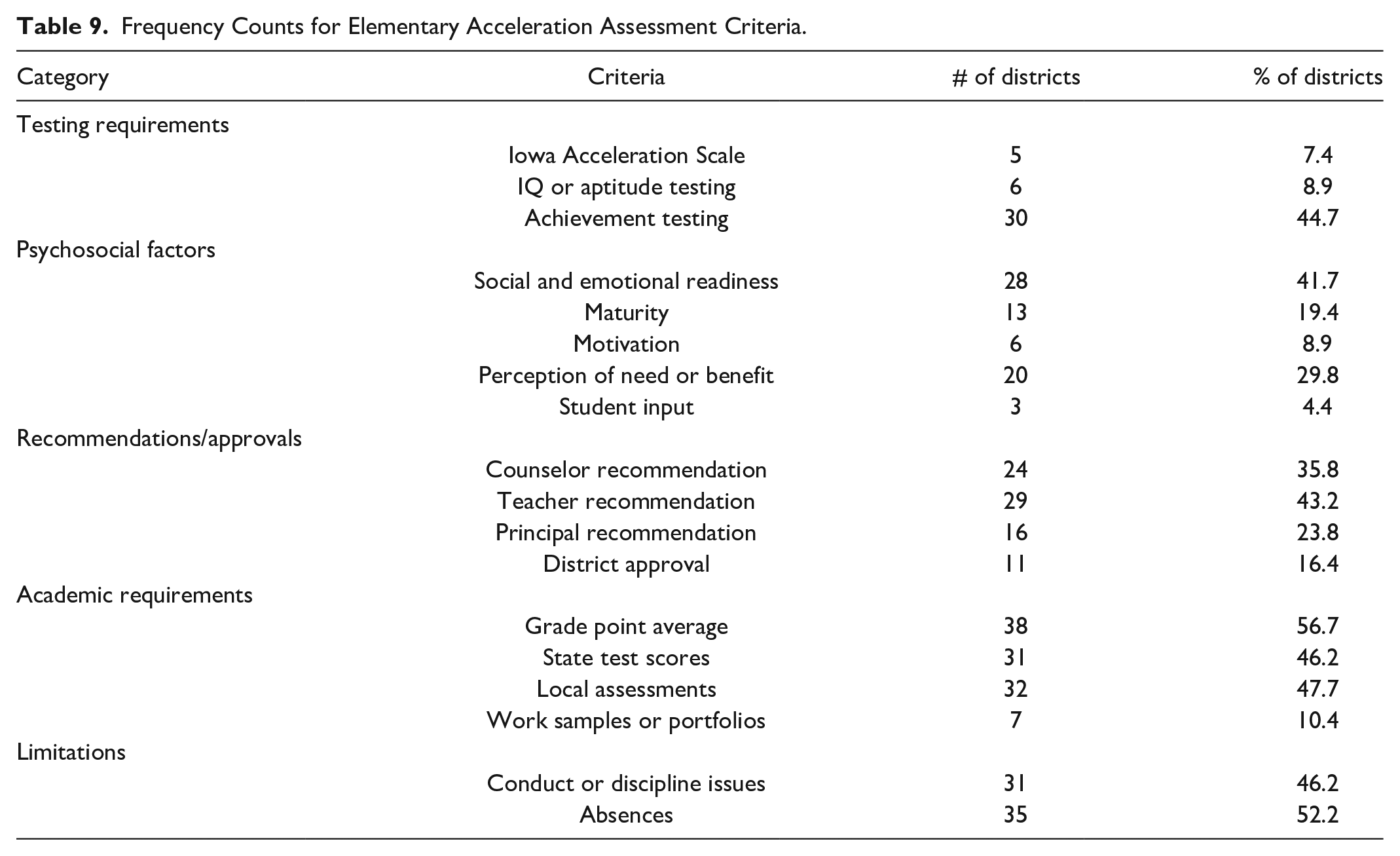
Frequency Counts for Elementary Acceleration Assessment Criteria.
Equity in Elementary Acceleration Policies
Equitable education policies ensure that all students are considered for programs and services, that eligibility criteria are fair, and that decisions are made by considering a range of data that provide a holistic picture of students’ current ability and their potential for future success (Lupkowski-Shoplik, Behrens, & Assouline, 2018; Meyer et al., 2023; Peters, 2022; Wai & Lakin, 2020). Using best practice guidance for acceleration policy (Lupkowski-Shoplik, Behrens, & Assouline, 2018), we examined (a) accessibility by evaluating where community members can find elementary acceleration policy documents for their district (see Table 6) and (b) options by examining the specific provisions in each district’s elementary acceleration plan (see Table 7).
Accessibility
One theme related to access is that beyond providing policies in multiple locations, the accessibility of acceleration policy documents could be improved by streamlining access on district websites, explaining procedures in plain language, and translating policy documents for linguistically diverse families.
Availability
Most Florida public school districts (n = 53; 79.1%) have a written SPP that includes elementary acceleration, but slightly fewer districts (n = 47; 70.1%) have ACCEL or elementary-specific policies for ACCEL on the table of contents of the SPP so caregivers can easily find that information without having to sift through all grade-level promotion and graduation policies. Similarly, nearly three quarters of Florida public school districts (n = 49; 73.1%) have school board policy documents that include elementary acceleration information, but only 68.6% (n = 46) of districts make K–5 ACCEL information easier to find by placing it on the table of contents or ensuring that a keyword search (e.g., ACCEL, acceleration, SPP) yields relevant policy documents. Fewer than half of Florida public school districts (n = 32; 47.7%) have elementary acceleration information on their district website, and only 46.2% (n = 31) make ACCEL or elementary ACCEL information easily accessible on that website.
Close to one third of Florida public school districts (n = 21; 31.3%) provide elementary acceleration policy in all three places (SPP, school board policy, district website), but even fewer (n = 16; 23.8%) met the accessibility criteria for all three sources of acceleration policy information. These findings (see Table 6) suggest that the availability and accessibility of elementary acceleration policy documents could be improved across public school districts in Florida. The ACCEL (2021) statute requires schools to inform students and caregivers of acceleration options and to provide information on how to request acceleration. Today, many people’s first stop for information is the internet; however, fewer than half of public school districts provide acceleration information in easily accessible formats, such as the district website (n = 31; 46.2%).
Plain Language and Clear Processes
True accessibility means that not only can interested parties find a piece of information, but they can also get, understand, and use that information (Cheung, 2016). Less than a quarter of Florida public school districts (n = 16; 23.8%) met the accessibility criteria for all three data sources (SPP, school board policy, public-facing website), which suggests that there are some very real barriers to finding and getting elementary ACCEL documents. Even when policy documents were available to download, they did not always contain elementary acceleration information (e.g., Flagler, Franklin, Gulf). This indicates that in some districts, there are additional steps a caregiver must take to access information about the acceleration policy, such as contacting the school.
The Plain Writing Act of 2010 defines plain language as “writing that is clear, concise, well-organized, and follows other best practices appropriate to the subject or field and intended audience” (2010). This federal policy for government documents circulated to the general public and other best practice recommendations for communication with key decision-makers (e.g., Cheung, 2016) note that policy documents should be written with all end-users in mind, including students and caregivers who are culturally, linguistically, and economically diverse. Well-organized policies with understandable language allow students, their caregivers, and educators to understand and use the information more effectively. For example, the SPP for St. Johns County has a K–5 acceleration policy that clearly outlines the procedures for whole-grade and single-course acceleration by providing a description of each process, a list of procedures, and examples to illustrate key points. In addition, the St. Johns County plan includes language about how schools should conduct regular evaluations and long-term planning (St. Johns County School District, 2022). Other plans were less comprehensive. In Seminole County, the SPP notes that “options may vary by school” (Seminole County Public Schools, 2022, p. 19) and that “the final decision for grade placement is the responsibility of the principal” (Seminole County Public Schools, 2022, p. 19).
Linguistic Diversity
In this analysis, only 8.9% of districts (n = 6) provided SPPs in languages other than English (see Table 8). For example, in Miami-Dade County Schools, 33% of students receive English language learning services, and 58% of students qualify for federal meal programs. In this very large suburban district where 74% of the student population identifies as Hispanic, acceleration policy documents are provided in English, Spanish, and Haitian Creole (Miami-Dade County Public Schools, 2022). Some sizable districts with large Hispanic student populations (e.g., Broward, Hillsborough, Orange) either do not offer the SPP in languages other than English or do not make those versions of the document clearly available on their district websites. However, in Bay County, a relatively small percentage of students identify as Hispanic (14%), and even fewer receive emerging bilingual services (7%), but this district still provides acceleration information in Spanish (Bay District Schools, 2022). Equitable access to acceleration opportunities can be supported by ensuring that all students and their caregivers can access information about acceleration in their home language.
Service Options
One theme related to service options is that the most common K–5 acceleration options require students to demonstrate proficiency well beyond grade level, which may overlook the need for within-grade or within-subject acceleration options that are not as uniformly available to students across the state.
Elementary Acceleration Services
The Florida ACCEL (2021) statute distinguishes between acceleration services districts must provide (whole year, mid-year, subject-area, virtual) and those they may choose to provide (grouping, curriculum, enrichment). For the required acceleration options, 92.5% of Florida districts (n = 62) offered whole-grade and mid-year acceleration, 86.5% offered subject-area acceleration (n = 58), and 67.1% offered virtual acceleration (n = 45; see Table 9). Optional services were offered far less frequently across the state. Several district policy documents noted that they offer flexible grouping (n = 20; 29.8%), combined grouping (n = 14; 20.8%), or cluster grouping (n = 12; 17.9%) to allow elementary students to work with peers who have similar domain-specific advanced learning needs.
Only a handful of districts noted curricular adjustment options for elementary students with advanced learning needs, such as self-paced curriculum (n = 14; 20.8%), compacted curriculum (n = 13; 19.4%), and telescoping curriculum (n = 12; 17.9%). Enrichment and STEM-specific enrichment were even less common with these services offered by 16.4% (n = 11) and 7.4% (n = 5) of districts, respectively. Nine out of 67 Florida public school districts (13.4%) explicitly list differentiation as a service option in acceleration policy documents.
Service Options That Change Setting or Format
Some acceleration options require changes to the setting (e.g., new class, new school) or format (e.g., in-person, virtual, self-paced) of instruction. These options require students to take large steps, such as skipping a grade or moving to the next level in a core content area subject. Larger steps can understandably cause some apprehension among students, their caregivers, and educators, but these are the most widely available acceleration options for Florida elementary students.
Individual districts manage changes of setting and format very differently. In the elementary education section of the Wakulla County School District, a rural district where 0% of students receive gifted education services, the SPP states that “an elementary student may be granted an accelerated promotion from an elementary school to a middle school” (Wakulla County School District, 2022, p. 32). This type of policy focuses on educational needs rather than age or setting differences. In contrast, rural Marion County’s SPP explicitly notes that “an elementary student who has received whole-grade promotion under Academically Challenging Curriculum to Enhance Learning (ACCEL) to Grade 6 or above will be instructed virtually” (Marion County Public Schools, 2022, p. 30). If an elementary student in this county is eligible to be promoted to middle school, they must also make the decision to change from in-person to virtual instruction, which may discourage some students and their families from selecting this option.
Service Options That Change Grouping, Pacing, or Content
Other acceleration options vary in grouping configurations, instructional pacing, or content. These variations are often handled within a student’s current educational setting and use instructional formats with which they are already familiar (e.g., cluster grouping, pull-out, push-in). These accelerated learning pathways require smaller steps, which may cause less apprehension for students, educators, and caregivers; however, these within-grade and within-subject options were far less available to elementary students across the state of Florida. Accelerated grouping options were offered by 17.9% to 29.8% of districts, accelerated curriculum options were offered by 17.9% to 20.8% of districts, and enrichment options were offered by 7.4% to 16.4% of districts. Not every student is ready to skip a grade or move to the next level in a content area, but many students can benefit from within-grade and within-class options that vary in grouping, curriculum, and enrichment.
Some Florida school districts treat acceleration as an option of last resort. Pasco County Schools, a diverse suburban district, noted in its SPP that “if data supports student mastery in all content areas and differentiation is not adequate to meet the needs of the student, grade acceleration may be recommended” (Pasco County Schools, 2022, p. 15). Similarly, in Sarasota County, a city district that serves nearly 20,000 elementary students, the SPP emphasizes that “For most students, in-class differentiation provides the learning opportunities needed for advanced students to be challenged” (Sarasota County Schools, 2022, p. 64). In a district that identifies 6% of students for gifted services, this suggests that there may be many other students in need of acceleration opportunities that have the added burden of demonstrating that they need more challenge than in-class differentiation can provide. This indicates that the default option for addressing advanced learning needs in many districts is differentiation rather than acceleration.
Transparency in Elementary Acceleration Policies
Transparency in education policy ensures that information is available and that decisions are made in a consistent and fair manner. Transparency is essential for access and accountability. We examined transparency in district acceleration policies by reviewing (a) protocols that guide districts in the referral, screening, and decision-making process (see Table 8) and (b) criteria by examining specific assessments, requirements, and eligibility factors (see Table 9).
Protocols
One theme related to elementary acceleration protocols is that despite the fact that acceleration protocols gather input from a variety of individuals, (a) the burden of initiating referrals and providing evidence falls largely on caregivers, (b) student voices are frequently left out of the process, and (c) deficit-focused transition plans can create unrealistic expectations that do not adequately support retention in accelerated placements.
Referral and Screening
Sixty-four districts (95.5%) had information about elementary acceleration procedures in the SPP, school board policy, or both. Only one district SPP (Baker County) provided expectations for the length of the review period, which was 45 days. Forty-eight (90.6%) SPPs included information on how an acceleration referral can be initiated. Overwhelmingly, SPPs note that caregivers must initiate the screening process (62.6%; n = 42), followed by principals (n = 21; 31.3%) and teachers (n = 19; 28.3%; see Table 8).
Acceleration Committee
Almost half of the local school districts require elementary acceleration decisions to be made by a committee rather than by an individual (n = 31; 46.2%). Sixteen districts (23.8%) did not include detailed information regarding who determines accelerated placement. Twenty district plans (29.8%) indicate that the decision is left up to at least one individual, typically the principal (n = 18; 26.8%) or a district administrator (n = 2; 2.9%), such as a gifted education specialist or an area superintendent. A few plans (n = 5; 7.4%) specified that the committee responsible for acceleration decisions is the existing Multi-Tiered Support System (MTSS) decision-making team (e.g., Brevard, Hernando, Indian River, Nassau, St. Johns). Decision-making teams varied in composition, but only one plan (1.4%; Citrus County) explicitly listed the student as an optional member of this committee. The three most frequently named committee members include the principal (n = 27; 40.2%), followed by a counselor (n = 21; 31.3%), and the current classroom teacher (n = 20; 29.8%; see Table 8).
Language about decision-making committee members was vague in some SPPs. Several (e.g., Marion, Okeechobee, Seminole) stated that the principal would consult with other school personnel to review referrals. These statements indicate that more than one person is involved in the decision, but the policy provides flexibility for individual schools to decide who serves on the committee based on expertise, staffing, and the principal’s preference. Thirty-two districts (47.7%) included the development of a performance contract or acceleration plan in the board policy or SPP; however, a few (e.g., Leon, Santa Rosa, St. Lucie) stated that an acceleration contract is only required if the parent initiates the acceleration request or for subject-area acceleration, which mirrors the language in the ACCEL statute. One policy in a large city district in which 72% of elementary students qualify for federal meal programs included additional language noting that the parent “must petition the principal each school year” (St. Lucie Public Schools, 2022, p. 38) for continued acceleration. Although this information is transparently stated in the district policy, it can create barriers for students and caregivers.
Transition Plans
Thirty-two school district plans (47.7%) required schools to provide a written performance contract, sometimes referred to as an acceleration education plan (AEP). Some language about acceleration contracts in the policy was general. In Pinellas County, a city district that serves nearly 44,000 elementary students, the policy notes that “a performance contract including progress monitoring will be established and signed by the parent and student, if the student is eligible” (Pinellas County Public Schools, Policy 5410.01, 2019, p. 4). But other policy language was more specific. For example, in Baker County, a town district that serves about 2,500 elementary students, the policy states:
If acceleration is recommended, an Acceleration Education Plan will be developed. The trial plan will be in effect for one full grading period and monitored by a designated staff member to ensure successful implementation. Acceleration trial shall commence at natural transition points within the school calendar. (Baker County School District, 2022, p. 45)
Many plans referred to the ACCEL policy language in their eligibility and procedural requirements, specifying that “a performance contract must be executed if a student participates in an ACCEL option by parent request. A performance contract is not required if a principal initiates a student’s participation in an ACCEL option” (2021). Taken together, this information suggests that the transparency of elementary acceleration policies can be improved by giving students, their caregivers, and school personnel clear guidelines on how to access acceleration opportunities in their schools.
Criteria
We also examined eligibility criteria through the lens of transparency. One theme related to acceleration criteria is that although the state gives districts some flexibility in how they set acceleration criteria, there are gatekeepers and non-negotiable restrictions (e.g., age, grade) that can create barriers for students with advanced learning needs.
Assessments
A variety of instruments are used to inform the acceleration decision-making process in districts across the state of Florida (see Table 9). SPPs provide general guidance (e.g., types of tests) but often leave it up to individual schools to select appropriate instruments in these categories. Achievement tests are most frequently listed in SPPs (n = 30; 44.7%), followed by IQ scores or aptitude assessments (n = 6; 8.9%) and the IAS-3 (n = 5; 7.4%). Several plans (e.g., Martin, Nassau, Sumter) included requirements that the candidate show performance that is above grade level or that demonstrates exceptionally high achievement but did not provide specific criteria or cut-off scores. A few SPP guidelines included exceptionally high expectations for achievement. Calhoun and Holmes counties, two small districts with high percentages of elementary students who qualify for federal meal programs (65% and 57%, respectively) and report serving 0% students in gifted programs, students must have a record of performance three or more years above grade level. While other districts, such as Hernando County, a suburban district with 11,000 elementary students that identifies 2% of students for gifted services, were less rigorous. Their policy notes that to access acceleration, students should show performance “one or more years above grade level” (Hernando County School District, 2022, p. 28).
In reviewing specific achievement requirements in SPPs, we found a wide range of score and grade criteria. State achievement test scores in reading and mathematics on the Florida Assessment of Student Thinking (FAST) test were listed in 17 plans (25.3%). FAST scores are reported as Levels, which range from 1 to 5, with Level 3 representing a passing score. Of the plans that included FAST score criteria, one required an average score of Level 3 in reading and mathematics, 35.3% (n = 6) required a Level 4 or above, and 76.5% (n = 13) required a Level 5.
Some district SPPs included language that excluded students in Grade 3 from eligibility for accelerated placement due to state testing requirements in that grade. Rural Walton County district’s SPP states that “Initial third-grade students are not eligible for accelerated placement because they are required to take the third grade Florida Benchmarks for Excellent Student Thinking (B.E.S.T.) Standards Assessment” (Walton County School District, 2022, p. 28). Some districts (e.g., Dixie, Madison, Manatee) explicitly excluded Grade 3 students from consideration for subject-matter acceleration in English Language Arts due to the state FAST Reading assessment. Others (e.g., Brevard, Duval) restricted acceleration for children under age 6 due to the state age requirements for kindergarten and Grade 1 entry.
Thirty-eight district SPPs (56.7%) included course grades as one criterion for acceleration decisions. Of these districts with grade requirements, 18.4% (n = 7) provided specific grade point averages, ranging from 3.5 to 4.0, or letter grade requirements, ranging from all As and Bs to straight As in some or all content areas. Some plans listed cut-off scores on local assessments or end-of-year subject exams ranging from the top 1 percentile (e.g., Jackson, St. Lucie), 2 years or more above grade level (e.g., Hillsborough, Leon, Okaloosa), or between 80% and 100% on end-of-year exams (e.g., Broward, Gilchrest, Okeechobee). In many of the plans, it was not clear what end-of-year exams were used, but they were described as district-adopted or district-created. No information on the validity or reliability of the assessments was provided.
Nonacademic Factors
We reviewed SPPs and school board policy documents to identify other criteria used to assist with acceleration decisions, including (a) social-emotional readiness, (b) maturity, (c) motivation, (d) perception of need or benefit, (e) student input, (f) discipline or conduct, and (g) attendance. Seventeen districts (25.3%) did not list any specific instruments or eligibility criteria (see Table 9). Strict attendance requirements were found in multiple plans, including Duval County, a large city district that serves over 64,000 elementary students. Their policy notes that students can have “no more than five absences in 30 days or 10 in 90 days” (Duval County Public Schools, 2022, p. 18). Similarly, Holmes County, a small district, notes in their policy that students can have “fewer than five unexcused absences in the previous semester” (Holmes District School Board, 2022, p. 6). In Okaloosa County, where 19% of elementary students are military-connected and may experience multiple school transfers as a result of their parents’ military service, the policy notes that to be eligible for acceleration, students must have “a minimum number of absences and/or transfers” (Okaloosa County School District, 2022, p. 43). Including nonacademic factors in acceleration requirements can create inequitable barriers for elementary students with advanced learning needs.
Beyond attendance criteria, some plans required the student to show a need for acceleration or the potential to benefit from acceleration (n = 20; 29.8%), a counselor recommendation (n = 24; 35.8%), or a teacher recommendation (n = 29; 43.2%). The need or benefit requirement mirrors Florida’s criteria for gifted identification, which requires an IQ score in the top 2 percentile, a majority of the characteristics on a teacher and parent checklist, and a need for services (Florida Administrative Code, 2016). However, it was not always clear how students could demonstrate the need for acceleration, the potential to benefit from acceleration, or how they should request recommendations from counselors or teachers. This lack of transparency may create roadblocks for students and caregivers without strong advocacy skills.
Discussion
Often, advanced learning pathways are guided by policies that adopt a scarcity mentality and have procedures designed to exclude students from services. Achieving educational equity will require expanding resources, services, and identification practices to include all students who can benefit from them. The purpose of this study was to examine elementary acceleration policy across Florida public school districts one decade after the introduction of ACCEL (2021). The findings indicate promising practices that provide equitable opportunities for elementary students in Florida to accelerate, but they also indicate the need to craft local policy elements that expand, rather than restrict, academic talent development opportunities. We identified aspects of Florida elementary acceleration policies that have the potential to create more equitable opportunities for students in the state, including expanding (a) access to acceleration, (b) participation in shared decision-making processes, and (c) conceptions of readiness and success.
Expanding Access to Acceleration
There is well-documented evidence that students from culturally, linguistically, and economically diverse backgrounds are underrepresented in gifted programs (e.g., Dixson et al., 2020; Gentry et al., 2019; Peters, 2022) and that students who could benefit from acceleration are not always given that opportunity (e.g., Peters et al., 2017; Plucker & Callahan, 2020). One noteworthy finding in this study was that very few district SPPs (n = 6; 8.9%) specify that aptitude or intelligence scores must be used in the acceleration decision-making process. Although the state of Florida requires specific cut-off scores to determine eligibility for gifted education services, acceleration decisions are not as restrictive and may open this intervention to a much wider pool of students. Florida defines a gifted student as “one who has superior intellectual development and is capable of high performance” (Special Instructional Programs for Students Who are Gifted, 2002). State gifted identification criteria include an IQ score of two standard deviations above the mean and a majority of the items on a checklist of gifted characteristics. Although some SPPs (e.g., Palm Beach, Pinellas, Seminole) require acceleration candidates to first be screened for gifted services, this does not appear to be the norm across the state. Rather than relying on IQ scores and subjective checklists, the policies in many Florida districts address equity by allowing students to demonstrate the need for acceleration in other ways (e.g., course performance, test scores).
While many SPPs include multiple measures for acceleration decisions, there is evidence of heavy reliance on grades and strict cut-off scores on assessments that may not be appropriate for identifying accelerated learning potential. Advanced learners who are underachieving in their current grade placement due to lack of challenge, motivation, or other exceptionalities may be penalized by these criteria (Dixson et al., 2020; Steenbergen-Hu & Moon, 2011). Other nonacademic factors (e.g., age, attendance, discipline) and reliance on teacher recommendations for referrals and eligibility infuses potential bias into the process that may create another barrier (e.g., Dixson et al., 2020; Meyer et al., 2023; Peters, 2022). In line with prior research, universal screening for acceleration using existing data for entire grade levels (e.g., FAST scores, group ability tests) could level the playing field and widen the pool of acceleration candidates (Peters, 2022; Plucker et al., 2022; Plucker & Peters, 2016). This approach has the potential to provide more equitable access to advanced education pathways for young students in the early stages of their academic talent development trajectories.
Issues of systematic inequity in advanced education are often the result of identification practices that include high score cut-offs and multiple gatekeepers (e.g., Peters, 2022; Wai & Lakin, 2020). The findings of this study show some district acceleration policies that are consistent with prior literature recommending that schools (a) identify a larger talent pool to expand opportunities to learn (e.g., Renzulli, 2012), (b) provide multiple pathways to access advanced learning services (e.g., acceleration or gifted services; Plucker & Peters, 2016; Wai & Lakin, 2020), and (c) ensure that information about advanced learning pathways is readily available to students and their families (e.g., R. Johnson & Hodges, 2023). However, there is room for growth. Florida districts and other states can address equity by regularly evaluating their policies for barriers that may prevent elementary students from accelerating.
Expanding Participation in Shared Decision-Making
Shared decision-making is a collaborative approach that can weigh the needs of all parties involved in the acceleration process, including caregivers, students, and school personnel. In many districts across Florida, the referral process places a heavy burden on parents, who are expected to initiate the process in 62.6% of school districts (n = 42). This may create a barrier for caregivers who do not understand the process or may not feel comfortable advocating for their child in this way. This is consistent with prior literature about advanced education in Florida that noted ways to support parents or caregivers by providing (a) clear information about processes and (b) assistance navigating campus and district-level procedures (R. Johnson & Hodges, 2023).
Self-nomination is a best practice to close gaps between student subgroups at advanced levels of performance (excellence gaps; Plucker et al., 2022), but only 7.4% (n = 5) of Florida districts allow elementary students to initiate an acceleration referral, and only one district plan mentioned the student as part of the acceleration decision-making team. Including students in the acceleration process can provide information about their interests, their motivation for accelerating, and the areas in which they may need support (e.g., psychosocial skills, academic content). Prior literature (e.g., Peters, 2022; Plucker et al., 2022) indicates that effective home-school collaborations require clear communication and shared goals, so including students in the process may support their motivation to engage in challenging learning experiences.
Evaluations made by teams of qualified individuals who have expertise in gifted education, acceleration, and assessment can lead to improved student outcomes in accelerated placements (Lupkowski-Shoplik, Behrens, & Assouline, 2018). Surprisingly, fewer than half of the local school districts (n = 31; 46.2%) specify that a committee should make acceleration decisions rather than an individual. The composition of the acceleration committees varied greatly across the state, with some including only the principal (n = 18; 26.8%) and others utilizing a team approach (n = 31; 46.2%). Very few districts (n = 4; 5.9%) included the elementary school’s teacher of the gifted. This is a missed opportunity to bring expertise to the table since Florida elementary students identified for gifted services are served by a teacher of the gifted with a K–12 gifted education endorsement. This educator has training on the needs of advanced learners and best practices for acceleration and would be an asset to the acceleration committee. Effective partnerships can ensure that students’ short- and long-term needs are met through accelerated placements.
Expanding Conceptions of Readiness and Success
Measures of readiness and success varied widely in the elementary acceleration policies across Florida. Nearly half of the districts in the state (n = 32; 47.7%) use local assessments to make acceleration decisions. This poses a challenge since these tests may not be designed to assess above-level aptitude in core subjects. Research-based instruments, such as the IAS-3 (Assouline et al., 2009), were only required for whole-grade acceleration decisions in 7.4% (n = 5) of district plans. The IAS-3 allows school personnel to collect data on the whole child, including aptitude, ability, achievement, motivation, physical size, age, social-emotional development, and attitudes toward acceleration. For schools that do not have psychologists with acceleration training or gifted education experts to facilitate the data collection and decision-making process, tools such as the IAS-3 or the Integrated Acceleration System (Assouline et al., 2021) may be highly valuable when evaluating student readiness to accelerate.
Accelerated students may need support in their new placements, and progress monitoring through a formalized plan is one way to do this. Progress monitoring can be used to evaluate student performance and suggest additional supports or adjust placements (Lupkowski-Shoplik, Behrens, & Assouline, 2018). Although almost half (n = 32; 47.7%) of the districts mentioned transition plans in their SPP or board policy, most of these documents stated that an acceleration plan is only required if the parent initiates the process. Best practice guidance for acceleration (e.g., Lupkowski-Shoplik, Behrens, & Assouline, 2018) notes that once a student is recommended for acceleration, a written plan with short- and long-term goals should be developed and shared with caregivers and anyone who is part of the child’s education team. It is clear from the findings in this study that there are unintentional barriers (e.g., transportation, changing to virtual school, lack of access to extracurricular activities) created by local policies that could be addressed with formal acceleration plans. Schools can carefully craft written acceleration plans to include guidelines to maintain student access to activities (e.g., sports, extracurriculars) and ensure they receive official transcript credit for accelerated coursework.
Implications for Practice
Guidelines for developing academic acceleration policies emphasize that acceleration policies should be equitable and transparent, address short- and long-term needs, and prevent unintended consequences (Lupkowski-Shoplik, Behrens, & Assouline, 2018). We developed four guiding questions schools can use to develop or revise their acceleration policies (see Figure 1).
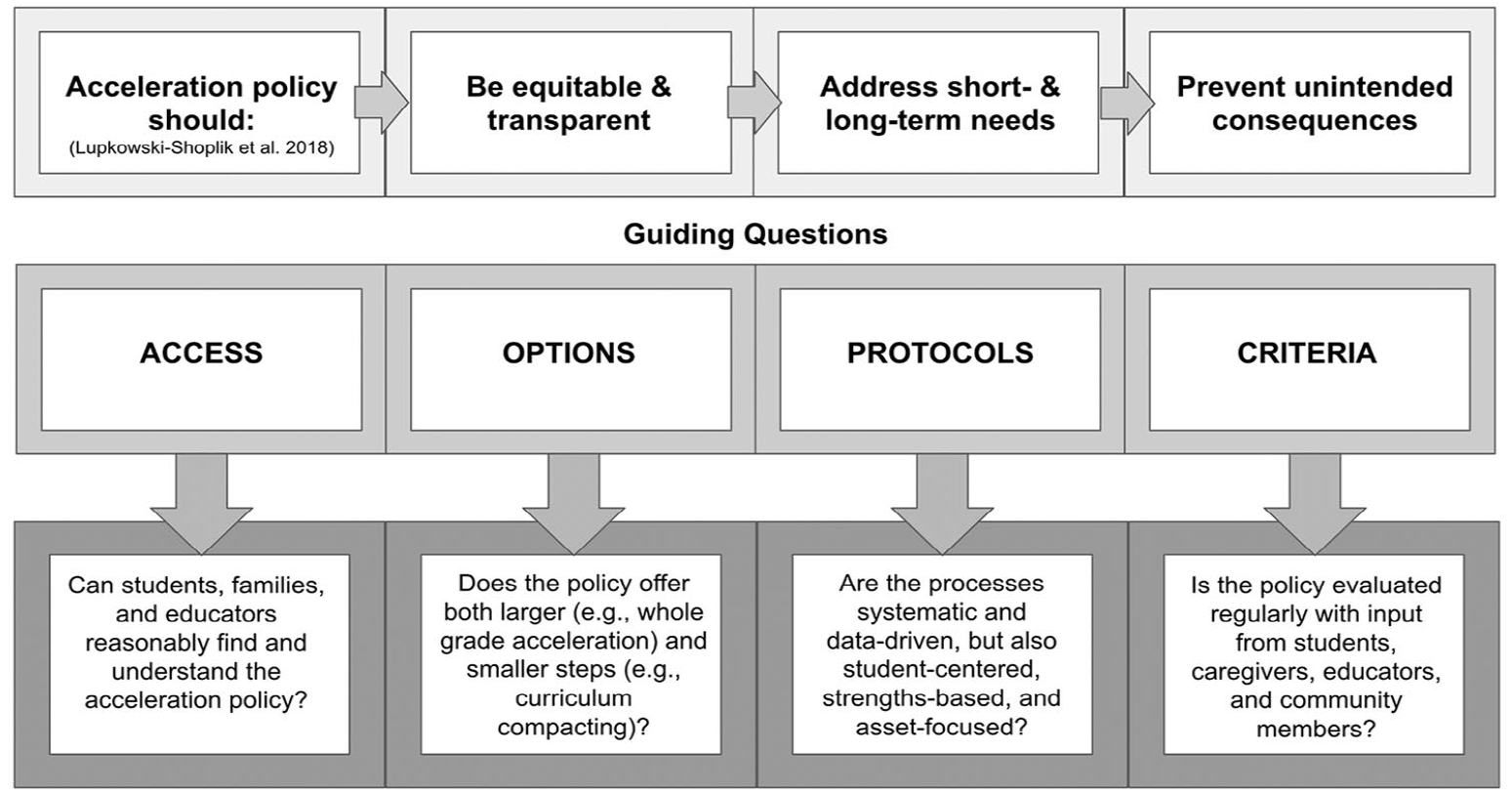
Guiding Questions for Creating or Revising Acceleration Policies.
Access
Can students, families, and educators reasonably find and understand the acceleration policy? District and school websites should provide information on acceleration options, procedures, criteria, forms (e.g., referral, appeal), and contact information for caregivers who need assistance. As parents were required to initiate the referral process in the majority of the Florida elementary acceleration policies (n = 42; 62.6%), it is critical that school districts ensure caregivers can reasonably access information and that it is written in plain language and translated into the home languages of linguistically diverse families. Prior literature (e.g., Ford, 2015; R. Johnson & Hodges, 2023) emphasized that placing the burden of identification and screening on caregivers creates equity issues, so it is imperative for schools to take additional steps to ensure information about the acceleration process is provided to students and their families in readily available formats, such as the school district website.
Service Options
Does the policy offer both larger (e.g., whole-grade acceleration) and smaller steps (e.g., curriculum compacting) to meet a range of student needs? The ACCEL policy states that an acceleration contract is only required if the parent initiates the request for subject-area acceleration; however, fewer than half of the districts required the development of a contract in either the board policy or the SPP (n = 32, 47.7%). Prior literature (e.g., Meyer et al., 2023; Steenbergen-Hu et al., 2016) stressed the importance of regularly evaluating a student’s response to advanced learning interventions, such as acceleration and adjusting as needed to support continued academic and psychosocial development. A formal acceleration plan that is collaboratively created by educators, the student, and their caregivers can support all parties involved in the process. Best practices for acceleration (Assouline, Colangelo, & VanTassel-Baska, 2015; Assouline, Colangelo, VanTassel-Baska, & Lupkowski-Shoplik, 2015; Lupkowski-Shoplik, Behrens, & Assouline, 2018) recommend written plans to ensure successful transitions through progress monitoring and long-term planning for future placements.
Protocols
Are the processes systematic and data-driven, but also student-centered, strengths-based, and asset-focused? Across the literature (e.g., Dixson et al., 2020; Hertzog, 2022; Peters, 2022; Peters et al., 2017), there is a clear consensus that multiple pieces of data should be used to make academic placement decisions, including the student’s input. Protocols need to be systematic and use a variety of data, but they also need to work from a strengths-based perspective that allows motivated and academically prepared students to have opportunities to accelerate in areas of strength and interest (e.g., Plucker et al., 2022). There are research-based guidelines and tools (e.g., Lupkowski-Shoplik, Behrens, & Assouline, 2018) schools can use to develop and evaluate acceleration policies that include equitable and transparent protocols.
Decision-Making Criteria
Is the policy evaluated regularly with input from students, caregivers, educators, and community members? Elementary school is a critical time for students with advanced learning needs; however, lingering misconceptions about young students are still evident in acceleration policies across the state of Florida. Early opportunities to accelerate can shape talent development trajectories and allow students to pursue areas of strength and interest now and in the future (Dai, 2017; Subotnik et al., 2011, 2018). There is consistent evidence across the literature (e.g., Bell et al., 2018; Kuo & Lohman, 2011; Meyer et al., 2023; Wai & Lakin, 2020) that erring on the side of equity and allowing students to try accelerated placements has benefits in the long term. Rather than creating policies to screen out students, school districts can take a more flexible approach that gives students opportunities, monitors their progress, and consistently matches their current needs and their academic placements.
Limitations
We collected data from publicly available acceleration policy documents, but Florida public school districts may provide additional information to elementary students and their caregivers through other means, such as digital communication (e.g., parent newsletters, emails), in-person meetings, or virtual presentations. Although these other means of communicating acceleration policies were not apparent to us, they may be available to students and their families. However, using publicly available documents (e.g., internet searches, school district websites) for this analysis allowed us to examine public access to policy documents. The reliance on publicly available documents led to another limitation: data on accelerated students is not collected universally across Florida and is not available for public access. Consequently, we did not gather data on the frequency of acceleration for Florida elementary students or their academic achievement after accelerated placements.
We chose to focus on elementary acceleration policies and did not examine the policies for middle or high school students. Due to this focus on K–5 policies, this study presents only a partial picture of the acceleration landscape in each Florida public school district. Understanding the early opportunities available to students with advanced learning needs provides some context with which to interpret the academic talent development trajectories available to students in Florida public schools. In addition, since Florida state legislators meet annually, there may be changes to the ACCEL policy that were not captured at the time of our data collection and analysis. Although this statute may continue to change, this study initiates a critical conversation about underlying assumptions in policy documents that can unintentionally create barriers for students with advanced learning needs.
Future Research
To build on the findings of this study, future qualitative research could include interviews with educators, administrators, families, and students to discuss perceptions of ACCEL policy and their experiences with acceleration. This line of inquiry could further examine caregivers’ perceptions of access to information and acceleration opportunities. In addition, this topic could be explored quantitatively by examining educational outcomes for students with advanced learning needs who were and were not accelerated. Additional research could examine local acceleration policy in relation to the number of students across demographic and socioeconomic subgroups receiving various forms of acceleration to assess the proportionality of representation. Furthermore, this study could be replicated to explore Florida’s acceleration policies at the secondary level and in other states with acceleration statutes (e.g., Illinois) to examine state policy and application at the local level. Open-access copies of the data extraction spreadsheet are available for states, districts, and individuals interested in conducting an initial policy review.
Conclusion
Florida’s ACCEL statute provides a template for local school districts to follow when developing their acceleration policies and procedures. Ambiguity in state policies can be beneficial if it creates the flexibility for local education agencies to customize their offerings to meet community needs (Lockhart et al., 2022; Plucker & Peters, 2016). However, recent education policy conversations have been dominated by discussions of accelerated learning that are tied to pandemic-related learning loss and interventions that combine remediation and grade-level content. Although these interventions can help students who have not yet met grade-level standards, the goals are vastly different from acceleration for students who need academic challenges. Furthermore, learning loss interventions and academic acceleration for advanced learners require vastly different implementation strategies. Therefore, it is critical to ensure that the needs of gifted, talented, and academically advanced students who can benefit from acceleration are considered in state and district policy decisions. The findings in this study provide key insights for developing equitable and transparent acceleration policies that support research-based practices for advanced learners.
Footnotes
Declaration of Conflicting Interests
The author(s) declared no potential conflicts of interest with respect to the research, authorship, and/or publication of this article.
Funding
The author(s) received no financial support for the research, authorship, and/or publication of this article.
Open Science Disclosure Statement
The data analyzed in this study are available for purposes of reproducing the results at https://osf.io/yc3xd/. The link contains the code used to generate the findings reported in the article and may be used for purposes of reproducing the results or replicating the study. The link also contains the newly created, unique materials used to conduct the research that are available for purposes of replicating the procedure. The study preregistration is available on the OSF repository at  .
.