




Abstract
Objective:
This study sought to examine the efficacy of inoculation message treatments to facilitate resistance to health nutrition–related (HNR) commercial food advertising claims.
Design:
Data were collected across three phases extending across a 5-week period conducted over two semesters at a Midwest US university. A 2 × 3 between-subjects factorial design was adopted, with multivariate and univariate analyses being used to interpret the results.
Setting:
Pittsburg, USA.
Method:
Participants were emerging adult undergraduate students (aged 18–25 years) recruited from introductory communication courses. A total of 167 students participated in Phase 1 of the work, of whom 152 completed Phase 2 and 145 completed Phase 3 (resulting in an 86.8% retention rate). Among these, 45% were men.
Results:
The results indicated (F(3, 129) = 9.83, p < .001, partial η2 = .18) that compared to control (M = 5.20, standard deviation [SD] = .84), participants who received an inoculation treatment experienced greater Phase 3 attitude strength (M = 5.73, SD = .77) to the position that eating healthy food is necessary to maintaining a healthy life. Inoculated participants reported greater Phase 3 attitude certainty (M = 77.15, SD = 19.21) for the above position than the control group (M = 65.43, SD = 25.48). Inoculated participants held less favourable views towards the source of the HNR claims (M = 4.80, SD = 1.18) relative to controls (M = 5.73, SD = 1.36) and generated greater numbers of counter-arguments (M = 3.90, SD = 1.74) compared to control groups (M = 2.75, SD = 1.69), thus demonstrating resistance to persuasion.
Conclusion:
Inoculation was demonstrated to be an effective preemptive strategy against potentially deceptive HNR advertising claims. Hence, it may offer an effective strategy for helping to protect the health-conscious attitudes of emerging adults by providing resistance to the ‘pufferised’ appeals used by many commercial food advertisers.
Modern public health infrastructures face enormous challenges resulting from an increased population density, worldwide technological threats, antimicrobial resistance and emerging infectious diseases. The US health domain today reveals significant risks resulting from the rising rates of non-communicable disease (NCD) development (e.g. cardiovascular disease, diabetes, cancer and chronic respiratory illnesses). McClaughlyn (2010) contends that approximately 80% of NCDs can be prevented by addressing known risk factors such as unhealthy diets, physical inactivity and tobacco use. This research sought to examine the efficacy of inoculation message treatments that may assist with public health efforts to counter the rising rates of NCD by facilitating resistance to commercial food advertising appeals that impact consumer food selection practices associated with obesity, a known contributor to NCD development.
In July 2014, Mexico, recognising the relationship between commercial food marketing and obesity, began restricting commercial advertising of unhealthy products targeted to children through popular media (e.g. cinemas, morning and afternoon television spots when children under the age of 12 years are the primary audiences) (Guthrie, 2014). Effertz et al. (2014) assert that ‘the potential of advertising to deceive young adolescents is problematic especially when it results in unhealthy food choices’ (p. 279). The authors hold that while product warnings are supposed to raise awareness of potential negative outcomes, they are often in competition with other advertising elements such as product claims, visual frames and images.
US guidelines governing health nutrition–related (HNR) advertising claims have undergone several transitions since the 1970s. Prior to 1983, diet-disease claims were banned by the Federal Trade Commission (FTC) from labels and advertisements. Between 1983 and 1990, diet-disease claims (i.e. adequate calcium throughout life may reduce the risk of osteoporosis) were permitted when given additional consideration based on the Policy Statement on Deception (Ippolito and Mathios, 1990). Lohmann and Kant’s (1998) review of commercial food advertising found many products promoted were in fact energy-dense, nutrition-poor foods of questionable benefits. Today, in an effort to avoid possible deception violations from regulatory agencies, food marketers have responded through product labelling and advertising claims meant to resemble full disclosure of relevant information, ranging from a product’s low-fat content to claims that consumption may reduce the likelihood of disease development.
Much of the marketing research into health and nutrition content claims has focused on labels and packaging (Mitra et al., 1999; Roe et al., 1999). Despite the level of disclosure on product labels, additional research has recognised the difficulty of consumers to process HNR product information (Ford et al., 1990; Jacoby et al., 1977; Moorman, 1990).
Yosifon (2006) argues an unregulated ‘doctrine of puffery’ plagues regulatory efforts meant to prohibit false or deceptive advertising although such puffery may not constitute what is legally recognised as deception. Puffery is legally defined as ‘advertising or sales representations which praise the item to be sold with subjective opinions, superlatives or exaggerations, vaguely and generally with no specific facts’ (Kamins and Marks, 1987: 6). Puffery may avoid being characterised as deception because of its transparent nature – that is, it generally contains information upon which ‘no reasonable consumer’ would rely. Examples of such statements are batteries that claim they ‘last forever’ or the world’s ‘best hamburgers’. Puffery encapsulates an exaggerated form of advertising which can promote the product with external affective attributes such as vitality, fun and excitement (Hoffman, 2006).
Because of the exclusionary acceptance of puffery as outside of the deception policy, many marketing agencies have begun to rely heavily on nothing but puffery. The equation of concepts such as fun, vitality and magic with unhealthy food may contribute to skewing public perceptions towards the nutritional quality of the food, as well as minimising the potentially negative outcomes resulting from consumption.
It is important to note that the term healthy remains a reserved, special HNR claim that warrants additional scrutiny from the Food and Drug Administration (FDA), because as Golonder (1993) notes, ‘healthy’ is a very useful advertising term. For a product to be classified as healthy, FDA guidelines require it to have a low total fat content, as well as low levels of saturated fat, sodium and cholesterol. On face value, products such as multigrain breads, fat-free yogurts and all-natural granolas appear to be healthy, but as Zinczenko and Goulding (2009) report these products may not in fact be all that low in saturated fat, sodium or cholesterol, therefore failing to meet the federal requirements for being classified as such.
This research is novel in that it aims to help address the US obesity epidemic through a systematic inoculation effort meant to facilitate resistance to commercial advertising claims, thereby impacting the attitudes and behaviours of emerging adults. This population is vulnerable as entrance into higher education for some can be a difficult and transitory period. Stress, anxiety, homesickness or even sadness can trigger unhealthy food choices. Furthermore, one or all of these may result in the development of long-term poor food selection practices (Arnett, 2007; Schulenberg and Zarrett, 2006).
Resistance paradigm
The roots of inoculation research are grounded in Lumsdaine and Janis’ (1953) work on message-sidedness in the early 1950s, which concluded greater resistance to persuasion is conferred against counter-attitudinal messages when both sides of an issue are presented (i.e. both pro-attitudinal and counter-attitudinal) – and particularly when counter-attitudinal arguments are accompanied by refutations.
Drawing from the conclusions of this early work, McGuire (1961a, 1961b; McGuire and Papageorgis, 1961, 1962) began developing a formal theory to explain and test the above concepts; the resulting product is inoculation theory. The biological analogy of inoculation theory asserts that, like a medical inoculation treatment, once a weak form of a counter-attitudinal attack message is introduced to a message target, the target’s cognitive system will move to overcome the foreign attack, thereby bolstering systemic immunity in preparation for a time when an actual attack might be encountered.
One key provision in inoculation research often overlooked is the requirement for a pre-existing attitude targeted for attack (and hence suitable for inoculation) to be in place. A successful inoculation treatment can only affect (i.e. strengthen) pro-attitudinal structures already held by the target. An understanding of this basic requirement has opened the door and expanded the application of inoculation theory into a wide range of contexts including interpersonal and mass communication (Burgoon and Chase, 1973; Burgoon et al., 1976; Burgoon et al., 1978), commercial advertising (Burgoon et al., 1995; Pfau, 1992; Wan and Pfau, 2004), political campaigns (Pfau and Burgoon, 1990; Pfau et al., 1990, 2001a) and health campaigns (Godbold and Pfau, 2000; Pfau, 1995; Pfau and Van Bockern, 1994; Pfau et al., 1992, 2001b).
In contrast to other influence theories – or theories dealing with resistance to influence – addressing why individuals respond to persuasive messages based on situational states and/or psychological traits (e.g. the Elaboration Likelihood Model [ELM], Heuristic-Systematic Model [HSM] or psychological reactance theory), inoculation theory centres on the process of how resistance is conferred. The biomedical analogy suggests that just as an inoculation to the body provides immunity against infection, an inoculation message treatment builds resistance to counter-attitudinal influence. Initial inoculation studies posited the inoculation process works through the interrelated mechanisms of threat and counter-argumentation. These key assumptions have been confirmed empirically in a variety of laboratory settings (McGuire, 1961a, 1961b, 1962, 1964, 1966; McGuire and Papageorgis, 1961, 1962; Papageorgis and McGuire, 1961; Pfau et al., 1997a, 2000, 2001a, 2004, 2005, 2010).
Threat
In McGuire’s early work, the concept of threat was used only for explanatory purposes. Treating threat as a primitive term in the early inoculation work has been criticised given that threat is a pre-requisite to inoculation and has been found to function as a motivational catalyst which compels the bolstering of counter-arguments to defend against an expected attack (Pfau et al., 2010). The role of threat is to provide notice or awareness of an impending attack against pre-existing attitudes and beliefs. The idea of threat as merely ‘notification’ of the vulnerability of a held attitude or belief is somewhat underdeveloped. The ability of threat to serve as a motivational catalyst results from the uncertainty surrounding the possibility of attack. Threat is posited as a requisite motivational trigger, emboldening the target to prepare counter-arguments in anticipation of an attack.
Refutational preemption
Inoculation strategies are not simply about providing functional answers for use in responding to specific arguments (Pfau, 1992). When counter-attitudinal information is difficult to counter-argue or refute, even well-motivated respondents may yield to its persuasive influence (Ditto and Lopez, 1992; Petty and Cacioppo, 1986). Thus, beyond demonstrating that a threat to one’s attitudes may be imminent, there is the additional need for an inoculation message to raise and provide a functional guide for bolstering counter-argumentation. The purpose of refutational preemption is to answer this challenge, and while threat has been found to foster resistance to persuasion via counter-argumentation, refutational preemption has been found to increase one’s arsenal of counter-arguments and encourage the practice of its use (Wyer, 1974).
Threat and refutational preemption have been posited as the basic mechanisms allowing inoculation treatments to confer resistance to counter-attitudinal attacks, and within the context of HNR advertising, threat is expected to motivate the bolstering of pre-existing attitudes against yielding to persuasive commercial advertising, whereas refutational preemptions will provide the rational for conferring resistance to the specific persuasive attacks by priming the process of counter-argumentation. This rationale leads to the following hypothesis:
H1. Relative to the control (no inoculation) condition, inoculation treatments will (a) generate greater threat, (b) foster greater attitude certainty and (c) foster greater attitude strength.
McGuire explored the effectiveness of refutational same and refutational different (novel) treatments. Refutational same messages make use of the same content presented in the preemptive treatments as anticipated to appear in subsequent attacks; refutational different messages vary the content between treatment and attack. Past research has indicated both refutational same and refutational different message approaches work well, however, for very different reasons (see Lee, 1997; Pfau, 1992; Pfau et al., 2001a). The content of the message appears to carry the weight in refutational same messages; however, the motivation generated from the initial threat appears to bolster the attitude and serves as the functional mechanism within refutational different (novel) messages (Pfau et al., 2004, 2005). The classification of messages as either refutational same or refutational different refers to the relationship between treatment and attack. This study employs refutational different messages. The findings presented relate to the ability of inoculation as a health promotion strategy to confer resistance to common commercial HNR advertising appeals. Resistance to the HNR claims will be demonstrated by indicating a less positive attitude towards the attacking source, a reduced reported likelihood of purchasing the product and higher levels of reported counter-argumentation. The below hypothesis concerns the expected impact upon the perceptions of the attacking source and counter-argumentation, whereby it is expected that
H2. Relative to the control condition, those who receive an inoculation treatment will demonstrate greater resistance against HNR claims including (a) less positive attitudes towards the attack, (b) reduced reported likelihood of purchasing the product and (c) higher levels of counter-argumentation.
Generalised perceived self-efficacy refers to the ability of an individual to respond to stressful situations (Schwarzer and Jerusalem, 1995). A refutational preemption provides an arsenal of arguments, while at the same time it cognitively fortifies the target with a ready defence comprising reasons and justifications for holding the threatened attitude. Therefore, inoculation is expected to enhance self-efficacy as a result of the message pretreatment.
H3. Relative to the control condition, inoculation treatments will enhance participants reported self-efficacy.
Method
This investigation employed a 2 (condition: inoculation/control) × 3 (HNR attack claim) between-subjects factorial design. Participants were emerging adult (aged 18–25 years) undergraduate college students recruited from introductory communication courses from a Midwestern university in the US State of Kansas. Data collection required three phases extending across a 5-week period conducted over two semesters and received approval through the Committee for the Protection of Human Subjects Institutional Review Board at Pittsburg State University. Participants were told they were participating in a Message Processing Study. A total of 167 students participated in Phase 1, of whom 152 completed Phase 2 and 145 completed Phase 3 (resulting in an 86.8% retention rate). Of the 145 participants included in the analyses, 45% were men.
Procedures
Phase 1 of the study collected basic demographic information and assessed initial attitudes towards health/nutrition. Following the collection of these data, participants were assigned to conditions. Those who indicated a positive attitude towards health/nutrition were randomly assigned to one of the two conditions either as inoculation or control. A total of 32 participants who indicated negative attitudes towards health and nutrition (scoring 3.5 or less on the 7-point Likert scale) were excluded from the study since inoculation can only provide resistance to attitudes already in place.
Phase 2 took place over a 2-week time period immediately following Phase 1 randomisation. At Phase 2, participants received inoculation messages in text format; the control condition received no inoculation message and participated in assessment phase only. Threat manipulation checks were employed to assess the effectiveness of the message to elicit threat. Threat was operationalised by the following statement: Despite your opinion on this issue, there is a possibility you may come into contact with arguments contrary to your position that are so persuasive they may cause you to rethink your position. I find this possibility … Additionally, the criterion measures of self-efficacy, attitude strength and counter-argumentation were measured, the latter being assessed using a check-off procedure first introduced by Miller and Baron (1973) described below.
Phase 3 commenced between 7 and 14 days following the inoculation treatment in Phase 2. McGuire (1964) suggested a delay is necessary to allow participants time to generate arguments to defend their positions. As in past inoculation work, Phase 3 commenced after a 7-day delay following Phase 2. In Phase 3, all the participants, including control, received a counter-attitudinal attack, and criterion variables were measured, including attitude strength, attitude to attack, counter-argumentation, likelihood of purchase and general self-efficacy.
Message construction
The first part of each inoculation pretreatment was designed to generate threat. As in past inoculation research, threat was operationalised as the warning of a potentially imminent, influential attack on the participants’ current attitudes – in this case, their attitudes regarding healthy food products. Participants were warned that although they may perceive certain food products as being healthy, many may in fact not be healthy. Furthermore, they may be subjected to persuasive commercial appeals by food advertisers that are so persuasive as to cause the participant to question their own attitudes towards what are and are not healthy food choices.
The second and third paragraphs were used to bolster the strength of the attitude towards healthy food intake by introducing arguments to support positions contrary to HNR content claims. This portion of the message focused on refutational preemption, which raised three arguments against the key topics of cost, taste and accessibility. The messages themselves were classified as cognitive as they contained content based on verifiable evidence and research findings with minimal affective valence or triggers (Lee, 1997).
To control for extraneous factors, and because language and other variables can impact the outcome of message processing, Becker et al.’s (1961) Index of Contingency for the Evaluation of Readability of Sentences was used to ensure consistency in the writing style and readability. Inoculation messages featured identical font size, typeface, layout and paper size. Only the printed title of source, Center for a Healthy America, was provided. The length of the inoculation messages ranged from 353 to 358 words.
Attack messages
The content of the attack messages was primarily cognitive, similar to the treatment messages covered above. The attack messages did not contain affectively laden triggers which would be associated with either positive or negative affect, but did include cognitive (reason-based) HNR advertising claims. Attack messages were original laminated copies of common grocery store items. The first, General Mills cereal brand Fruit Loops claimed – Now provides fiber: A great way to keep kids healthy, while the second, Sunbelt Oats and Honey Granola Bars, claimed – Whole grain oats, Great taste and quick energy and the third, Progresso’s Chicken Tuscany Soup, claimed – Low fat, High fiber. The first example represents a structure–function HNR claim, the second a general nutrition HNR claim and the third an absolute HNR claim. All HNR claims incorporated are currently used on a wide array of product classes to imply health, opposed to declaring what is and is not healthy.
Predictor variables
Predictor variables include treatment condition (inoculation/no inoculation control). Participants assigned to the control group did not receive an inoculation message, but they did read the attack message in the Phase 3 and responded to the assessments following.
Initial attitudes
To gauge attitudes towards health/nutrition, participants were asked to indicate their overall impression of the subject on a four-item, 7-point semantic differential scale employing polar adjectives including negative/positive, dislike/like, bad/good and undesirable/desirable. This scale has demonstrated good internal consistency in past research (e.g. Dillard and Shen, 2005) and did so in this study as well (M = 5.80; four-item α = .93).
Manipulation check
Threat was assessed using five bipolar adjacent pairs including nonthreatening/threatening, not harmful/harmful, unintimidating/intimidating, not risky/risky and safe/dangerous measured on a 7-point semantic differential scale used in past inoculation research (Pfau, 1992; Pfau and Burgoon, 1988; Pfau et al., 1992) and demonstrated good internal consistency (M = 3.38; five-item α = .93).
Criterion variables
Criterion variables were measured at both Phase 2 and Phase 3. Following the inoculation treatments in Phase 2, threat and counter-arguing output were accessed. Following the attack message in Phase 3, attitudes towards the attack, attitudes toward source of attack, counter-argumentation, and self-efficacy were measured.
To assess the strength of attitude in H1, four pairs of adjective opposites measured on 7-point semantic scales were used, including unimportant/important, uncertain/certain, irrelevant/relevant and no interest/great interest. This scale has also demonstrated good internal consistency in past research (Pfau et al., 2005), as was the case in this study (M = 5.67; four-item α = .82).
To address H1 and H2, measures were employed to assess attitudes towards health/nutrition. A six-item, 7-point semantic differential scale was used. Scale items include right/wrong, positive/negative, good/bad, acceptable/unacceptable, wise/foolish and favourable/unfavourable. This attitude scale has demonstrated good internal consistency in past research (e.g. Burgoon et al., 1978; Pfau and Burgoon, 1988; Pfau et al., 1992) and did so in this study as well (M = 5.71; six-item α = .85).
Counter-argumentation
Existing literature has assessed counter-argumentation in the inoculation context using several approaches, including thought-listing, check-listing and hybrid models (Pfau, et al., 1997a, 1997b, 2005). The optimal mode of capturing what has been referred to as the arsenal of argumentation has yet to be established (Wyer, 1974). Thought-listing is the most popular procedure but is confounded by both validity issues and the subjectivity of the ratings and coding. Miller and Baron (1973) provided a check-list alternative meant to minimise the variance resulting from open-ended questions. This method developed 20 statements that represent major arguments for and against an issue. Subjects are instructed to first check off arguments opposed to their position on the subject, then revisit the list checking off how they would counter-argue against those positions and finally weight each argument based on the respective strength of argument quality with 1 (weak) and 7 (strong). The index value is derived by multiplying each of the arguments checked off by its ranked weight and then dividing the calculated values of the arguments and counter-arguments.
Check-list procedure was employed in this analysis via open-ended items made available for participants to enter their own supporting or opposing positions not provided in the list. Due to the complexity of this section, participants were encouraged by both print and verbal instructions to only mark the thoughts occurring to them following the processing of the message and to ask questions before marking responses if they were unclear of the instructions.
Likelihood of purchase
To gauge the likelihood of purchasing the product for H2, measures for behavioural dispositions were assessed using 0–100 probability scales (M = 58.5) assessing the following statements: If given the opportunity I will buy this product, When I see this product I do not believe it is healthy and I will examine the nutrition label to determine the saturated fat, sodium and cholesterol content. Similar probability scales have been used extensively in past inoculation research (Pfau et al., 1990, 2001a).
Self-efficacy
To assess H3 concerning self-efficacy, Schwarzer and Jerusalem’s (1995) generalised perceived self-efficacy 10-item scale was used. Participants were asked to indicate, on a 7-point Likert scale, their responses to a series of statements such as If someone opposes me, I can find the means to get what I want and When I am confronted with a problem, I can usually find solutions. This scale has also demonstrated good internal consistency in past research, as was the case in this study (M = 3.30; 10-item α = .82).
Findings
Multiple strategies were used to analyse the data. This section reports the manipulation check on perceived threat and the multivariate and univariate analyses used to assess the hypotheses.
Manipulation check
Given that threat is theorised to be a requisite mechanism within the inoculation process, a manipulation check was conducted to ensure a significant level of threat was elicited by the inoculation treatments. An independent sample t-test revealed significant differences between the experimental and control conditions t(142) = 4.10, p < .001, r = .33. Compared to control (M = 2.81, standard deviation [SD] = 1.54), experimental conditions perceived increased levels of threat (M = 4.00, SD = 1.38).
Multivariate and univariate results
H1 posited that participants who received inoculation treatments would generate threat and foster both greater attitude certainty and attitude strength. To assess the effects of inoculation treatments, a 2 (inoculation/control) × 3 (HNR advertising claims) multivariate analysis of variance (MANOVA) was computed to determine the ability of inoculation treatments to confer resistance on the criterion variables of attitude strength, attitude certainty and the perceived threat generated from the inoculation pretreatments.
As Table 1 indicates, the tests revealed a main effect for the inoculation condition (F(3, 129) = 9.83, p < .001, partial η2 = .18) and non-significant effects for the HNR advertising claim attack condition (F(6, 260) = 1.70, p = .12) and the interaction between inoculation condition and attack condition (F(6, 258) = .62, p = .71). H1 was supported through subsequent analyses, which revealed significant univariate effects for the inoculation condition on the dependent measures of Phase 3 attitude strength (F(1, 131) = 11.16, p = .001, partial η2 = .08), Phase 3 attitude certainty (F(1, 131) = 5.07, p < .05, partial η2 = .03) and perceived threat (F(1, 131) = 14.52, p < .001, partial η2 = .10). The results indicated that compared to control (M = 5.20, SD = .84), participants who received an inoculation treatment experienced greater Phase 3 attitude strength (M = 5.73, SD = .77) to the position that eating healthy food is necessary to maintaining a healthy life. Inoculated participants also reported greater Phase 3 attitude certainty (M = 77.15, SD = 19.21) for the above position than control (M = 65.43, SD = 25.48). The effectiveness for inoculation pretreatments to generate threat was confirmed by inoculated individuals reporting significantly higher levels of threat (M = 3.98, SD = 1.37) than controls (M = 2.81, SD = 1.54).
Phase 2 impacts on attitude strength, attitude certainty and threat.
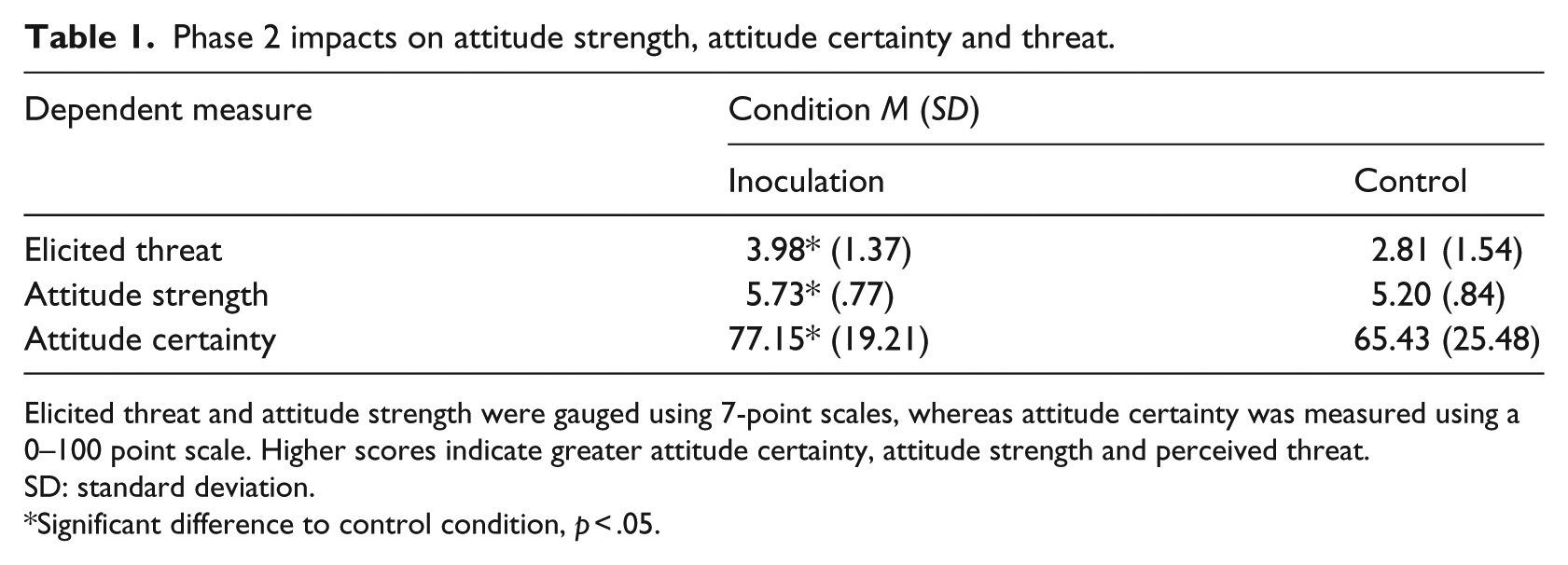
Elicited threat and attitude strength were gauged using 7-point scales, whereas attitude certainty was measured using a 0–100 point scale. Higher scores indicate greater attitude certainty, attitude strength and perceived threat.
SD: standard deviation.
Significant difference to control condition, p < .05.
H2 posited that, compared to controls, those who received an inoculation treatment would demonstrate greater resistance against HNR advertising claims demonstrated by less positive attitudes towards the attack, a reduced likelihood of purchasing the product and engagement in higher levels of counter-argumentation. To determine the ability of inoculation treatments to confer resistance as posited in H2, a 2 (inoculation/control) × 3 (HNR advertising claims) MANOVA was computed, revealing a main effect for inoculation (F(3, 112) = 5.02, p < .05, partial η2 = .12); however, there were no significant differences found due to HNR attack condition (F(6, 224) = 1.52, p = .17), nor the interaction between HNR attack condition and inoculation condition (F(6, 224) = .49, p = .81).
Although univariate tests indicated a significant main effect for inoculation condition on Phase 3 attitude towards HNR attack (F(5, 119) = 3.11, p = .05, partial η2 = .12) and Phase 3 counter-argumentation (F(5, 119) = 2.09, p < .05, partial η2 = .11), no significant effect was found on the likelihood to purchase the relevant product (F(5, 137) = .23, p = .95). Also, although no significant differences were detected between the inoculated participants (M = 59.19, SD = 30.46) and controls (M = 53.46, SD = 32.30) on likelihood to purchase the relevant product, inoculated participants did hold a significantly less favourable view of the attacking source (M = 4.80, SD = 1.18) relative to controls (M = 5.73, SD = 1.36) and generated a significantly greater amount of counter-argumentation (M = 3.90, SD = 1.74) relative to controls (M = 2.75, SD = 1.69), thus demonstrating resistance to persuasion (see Table 2).
Phase 3 inoculation impact on attitude towards attack, likelihood of purchase and counter-argumentation.

Attitude towards attack was gauged using 7-point scales with lower scores indicating more resistance to counter-attitudinal attack, whereas likelihood of purchase was measured using a 0–100 point scale. Counter-argumentation was assessed using a check-list procedure. Higher scores signify more counter-argumentation.
SD: standard deviation.
Significant difference to control condition, p < .05.
H3 argued that because the nature of an inoculation message fortifies held attitudes through refutational preemption, it should also enhance inoculated individuals’ perceived self-efficacy. To test this, a 2 (inoculation/control) × 3 (HNR advertising claims) MANOVA was computed. Multivariate results for the inoculation condition support this hypothesis (F(2, 130) = 8.80, p < .001, partial η2 = .12). However, no significant effects were reported for the HNR attack condition (F(4, 262) = .30, p = .88), nor the interaction between HNR attack condition and inoculation condition (F(4, 260) = .81, p = . 52). Further examination of the univariate results indicated significant differences between the inoculated and control conditions for Phase 2 efficacy (F(1, 131) = 12.54, p = .001, partial η2 = .09) and Phase 3 efficacy (F(1, 131) = 6.03, p < . 05, partial η2 = .04). The results presented in Table 3 show inoculated participants reported elevated levels of both Phase 2 efficacy (M = 3.30, SD = .41) and Phase 3 efficacy (M = 3.59, SD = .60) compared to Phase 2 control (M = 2.96, SD = .55) and Phase 3 control conditions (M = 3.21, SD = 1.13).
Impact on reported Phase 2 and Phase 3 self-efficacy.
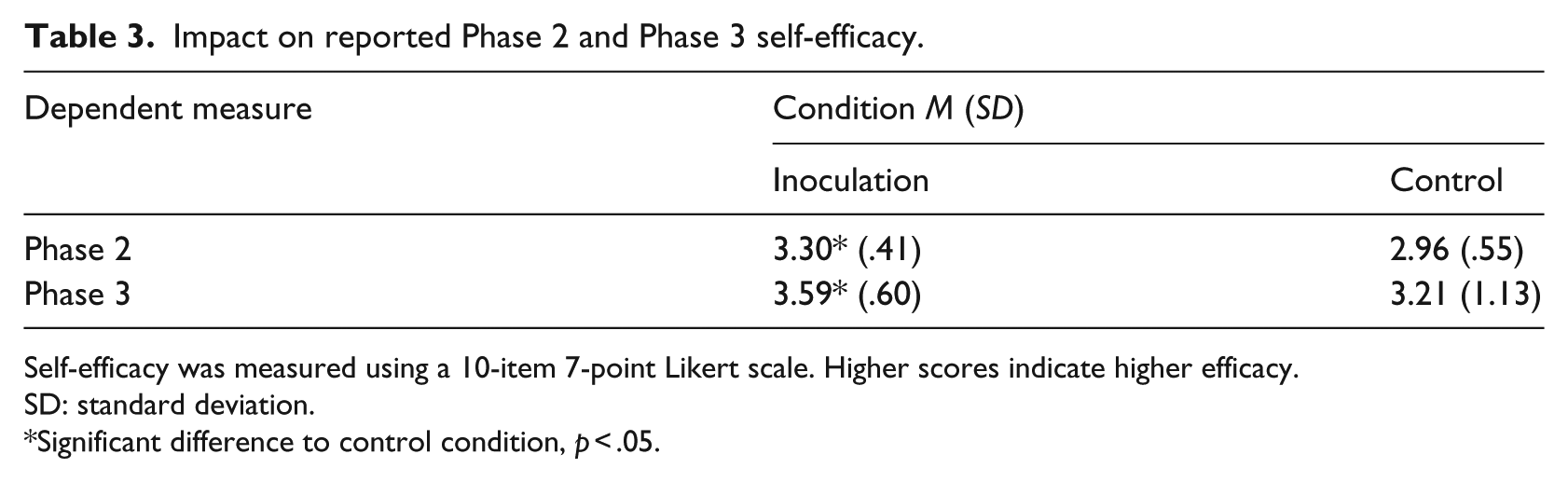
Self-efficacy was measured using a 10-item 7-point Likert scale. Higher scores indicate higher efficacy.
SD: standard deviation.
Significant difference to control condition, p < .05.
Discussion and limitations
The purpose of this investigation was to determine the effectiveness of inoculation treatments in providing resistance to puffery in the form of commercial advertising appeals targeting low nutrition foods, as a method for helping to address the rising rates of obesity, a known contributor to the development of NCD, within the emerging adult population within the USA. As hypothesised, inoculation appears to be a complementary technique to the more common prevention efforts of health education and health literacy. Inoculation was demonstrated to be an effective preemptive strategy against common yet questionable HNR advertising claims. Hence, inoculation may offer an effective strategy for helping to protect the health-conscious attitudes of emerging adults by providing resistance to the ‘pufferised’ appeals utilised by many commercial food advertisers.
A significant limitation to these findings is that attitudes were only attacked once and in print form. Although this research provides evidence for the utility of inoculation as a preemptive strategy against potentially deceptive commercial food advertising appeals, once inoculated these attitudes were only attacked once. Given the ubiquitous nature of puffery throughout a large variety of food product classes, it remains to be seen whether inoculated participants would demonstrate the same level of resistance against repeated attacks.
Another significant limitation of the investigation was the overall sample size. Because of reduced cell size, homogeneity of variance for some analyses may have been less than ideal, and rather than relying on Wilk’s Lambda, Pillai’s criterion was used to determine effect significance. Although Pillai is robust to violations of the assumption of homogeneity of variance, it is unclear whether the differences would have been as strong had a larger sample been used.
This study argues that inoculation serves as an effective strategy to circumvent the potentially deceptive ‘pufferised’ persuasive appeals of commercial food advertisers; however, participants may through inoculation become desensitised to the point that they may not be able to discern ‘valid’ HNR product claims. It may be found that inoculation’s threat component raises doubt such that all HNR claims are cognitively processed in a bias manner and believed to be invalid, thus demonstrating a boomerang effect. Because valid ‘healthy’ commercial food product claims, which have met and are verified by the FTC guidelines, were not employed as a control against the pufferised, or invalid, claims within the attack messages and the given results only compared inoculation participants to non-inoculated participants, the results do not inform or ensure against potential boomerang effects. Therefore, further investigation into an inoculated participant’s ability to distinguish invalid puffery from valid HNR claims is needed.
From a theoretical standpoint, traditional past inoculation applications have characterised attack messages in an explicit manner and operationalised direct counter-attitudinal attacks geared directly towards specific, targeted inoculated attitudes. The reliance on the mere exposure of products shrouded in ‘puffery’ in this application is a novel, indirect approach towards the operationalisation of a counter-attitudinal attack.
This research was broad in scope, and further examination is needed to refine and assess the potential latent effects resulting from a broad-based, health campaign application. Pfau et al. (1997a) notes, ‘It is difficult to specify the precise circumstances (e.g. contexts, topics, message approaches, and receivers) in which inoculation is an appropriate approach’ (p. 191). The current efforts of promoting health literacy and health education in this context may be most effective at increasing issue-based involvement levels within vulnerable populations, serving as a desired pre-requisite to subsequent inoculation campaigns meant to facilitate resistance.
The current investigation only investigated the effectiveness of inoculation on emerging adult populations; it is unknown whether the effect sizes can be duplicated in younger or older populations, and therefore additional research is needed. Although inoculation effect sizes may appear to be relatively small in magnitude, they remain meaningful nonetheless. As Banas and Rains (2010) contend, even small inoculation effect sizes can contribute to the good of public health when the inherent value resulting from application has a demonstrable impact on a large population.
Footnotes
Acknowledgements
The authors would like to thank the staff in the Department of Communication at Pittsburg State University who provided subjects for this study. This manuscript is respectfully dedicated to Michael Pfau.
Funding
This research received no specific grant from any funding agency in the public, commercial or not-for-profit sectors.