




Abstract
Objective:
This study aimed to describe Discourses on vegetarian food in the Swedish school subject Home and Consumer Studies.
Design:
The study involved the observation of naturally occurring classroom talk, with audio recording and in some cases video-taping.
Setting:
The study was conducted during Home and Consumer Studies lessons in five different northern Swedish schools.
Method:
Fifty-nine students and five teachers were observed, recorded and in some cases video-taped. The resulting data were analysed with a focus on big ‘D’ Discourses.
Results:
Results indicated that gendered Discourses of absence, deviance and unattainability restricted some students’ access to vegetarian food. The absence of meat was constructed as simultaneously healthy and unhealthy, a lack of cultural familiarity with vegetarian cooking made finding recipes difficult and students perceived the loss of taste as very negative. The vegetarian was seen as deviant, with vegetarianism being conceptually equated with sickness. Access to meat-free food required a commitment to a vegetarian lifestyle, and this was seen as a sacrifice and as too much work, not only for the individual but also for others.
Conclusion:
To counteract the restricted access to vegetarian food, Home and Consumer Studies teachers can redesign activities in the subject with the help of critical food literacy. For example, cooking could focus on popular plant-based dishes instead of ‘empty’ vegetarian themes, all students could be allowed to share vegetarian dishes instead of reserving them for vegetarians, the possibly strict rules of vegetarianism could be relaxed for those who do not wish to commit to them and vegetarian food could be deliberately connected to strength and masculinity. However, this presupposes sufficient economic resources and ample food storage space.
Introduction
There is ample evidence for the health benefits of a plant-based diet (Craig, 2009; Larsson et al., 2001; Sanders, 1999). Partly because of this, vegetarianism is on the rise (Rothgerber, 2013), but at the same time, powerful social norms can act as barriers to eating a meat-free diet. Vegetables and health behaviour in general can be seen as typically feminine and therefore weak (Gough, 2007; Lupton, 1996), while meat is typically tied to masculinity and power (Rothgerber, 2013; Ruby and Heine, 2011). Consequently, vegetarians are viewed as healthy and virtuous, but also as effeminate (Fox and Ward, 2008; Ruby and Heine, 2011).
The question of whether or not to consume meat tends to polarise opinion (Cole and Morgan, 2011). Sometimes reactions against veganism can be quite aggressive, as when self-identified omnivores imagine eating vegans (Potts and Parry, 2010). The current number of vegetarians and vegans in Sweden is somewhere between 3% and 10% (Rothgerber, 2013), with the highest prevalence among 15- to 24-year-olds. Despite this, vegetarianism can be controversial. For example, while more and more Swedish schools offer a vegetarian lunch alternative for everyone, 1 the emerging concept of ‘meat-free days’ can spark hostile reactions. The Federation of Swedish Farmers famously protested during such a day by handing out free hamburgers outside a school (Sveriges Radio [Swedish Radio], 2014). This reaction illustrates the concept of ‘othering’, organised around a supposed consensus on what is acceptable and normal to eat in a particular culture or social group (De Garine, 2001). Through their eating habits, people enact social identities and show group belonging, but sometimes, such in-group identification leads to out-group hostility and ridicule. Among young people, for example, it may be important to eat what they regard as ‘cool’ food in order not to be socially excluded (Stead et al., 2011).
Such norms may become relevant in school, both during lunch and during the Swedish equivalent of the school subject home economics, here called Home and Consumer Studies 2 (HCS). In this mandatory subject, taught for a total of 118 hours in compulsory school, young people from different backgrounds gather together to cook and share meals, and to discuss food and health (National Agency for Education, 2011). Social relationships become salient through collaboration in kitchen units and forced commensality. Specifically, students often cook a meal in small groups and then eat it together. Sometimes, dishes are shared with the whole class. In such a context, food norms and social relationships are bound to influence behaviour (Fletcher et al., 2011).
In a study on meat Discourses in HCS (Bohm et al., 2015), vegetarian food frequently cropped up as an antithesis that reinforced the centrality of meat. Even though low meat consumption was sometimes seen as healthy, it was undermined by the simultaneous assumption that cutting down on its consumption was dangerous. Since meat-eating was the norm, any reduction could also elicit teasing. These findings urged us to continue the analysis from the point of view of meat-free food and the vegetarian identity. The present study aimed to describe teacher and student Discourses on vegetarian food in five northern Swedish schools. Vegetarianism was defined as a diet devoid of animal flesh but including dairy products and eggs.
Theoretical framework
Since the goal of the study was to scrutinise and question taken-for-granted ‘truths’, we adopted Gee’s (2010) method of big ‘D’ Discourse analysis. The theory behind this method holds that language both influences and is influenced by social practices, and that a close study of linguistic tools in authentic communication can reveal underlying assumptions, cultural beliefs and identity positioning. It also recognises that speech is used in interplay with other modes of expression. Applied to the area of food, this means not only talking about food, but also cooking it, enacting food identities, assessing food and expressing beliefs about it.
The Discourses found through this analysis were related to a modified version of Belasco’s (2008) triangle of culinary contradictions (Figure 1). This model shows how the three factors identity (e.g. culture and taste), responsibility (e.g. health) and convenience (e.g. time and resources) influence food choice. These factors can harmonise with each other (Höijer et al., 2014), but they can also clash (Bohm et al., 2015; Belasco, 2008).
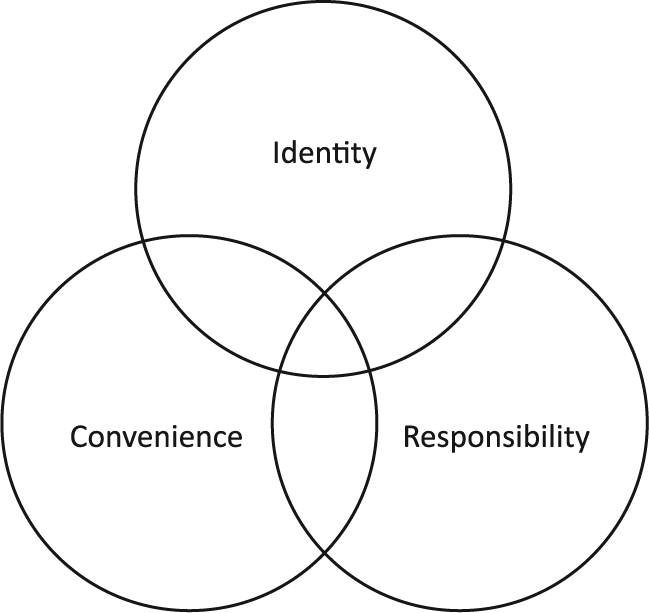
A culinary model of competing influences, based on Belasco’s (2008) culinary triangle of contradictions (used with permission from the author).
We also adapted Janks’ (2010) model of critical literacy to suggest improvements in the way HCS is taught. According to this model, the power of dominating Discourses is historically contingent and helps reproduce societal structures that favour certain groups. In order to perpetuate their power, access is restricted for outsiders, and diversity is suppressed. A redesign of Discourses is needed to lessen the power of dominant groups. So, for example, certain food habits can be constructed as better than others (power), and access to these better food habits is restricted through social norms that guide what different types of people can/should eat. Diverse ways of eating well are ignored in order not to undermine power. To effect a change, redesign could promote diverse food habits as being equal to the elite’s (for a longer discussion, see Bohm et al., 2015). By using such a lens in this study, we hope to see beyond the potential problems of current Discourses on vegetarian food and open up for alternative ways of viewing them.
Method
To capture naturally occurring talk during HCS lessons, we conducted an observation study with audio recording and in some cases video-taping. All data collection was finished before analysis began.
Participants
The study focused on 26 HCS lessons in grades 5, 7, 8 and 9 (Table 1) during 2010–2012. Fifty-nine students (38 girls, 21 boys) and five teachers (all women) participated. Student ages ranged from 10 to 16. The five schools were located in five villages and towns in two northern Swedish municipalities, a convenience sample based on geographical proximity and known teachers. The area had a strong hunting tradition, but one of the municipalities also had a history of veganism with a much higher prevalence of vegetarians (15.6%) than the national mean (Larsson, 2001). The schools in this area served a vegetarian lunch alternative that was available for everyone, while the schools in the neighbouring municipality reserved it for confirmed vegetarians.
Participants, schools and data collection methods in an observation study on vegetarian Discourses in Home and Consumer Studies.

Written, informed consent for audio recording, observations and video-taping was obtained from the teachers, the students and, for students under 15, also from legal guardians. Participants knew that the study was about how they experienced HCS, and that they could drop out at any time. The study was approved by the regional ethics board (Dnr:, 2010-255-31M) and the Research Codex (Swedish Research Council, 2011) was followed. To avoid the possible identification of individual participants, all names have been changed.
Procedure
Participants were observed, recorded with individual mp3 recorders and, in the 7 out of 10 groups where consent was obtained, video-taped. The observer did not interact with participants unless she was personally addressed, in which cases she replied politely but did not invite further interaction. Sometimes, she physically approached the students in order to move a camera to a better vantage point, but she mostly stayed at a distance and observed the whole room. From a total of 165 hours of sound recordings, 10,500 words’ worth of talk about meat and vegetarian food were identified and transcribed verbatim. The data were analysed by the first author (I.B.), using the 27 tools described by Gee (2010). Since Discourse analysis is context dependent, each utterance was interpreted on its own instead of assigning generalising codes. The videos were watched to provide context.
In a first step, utterances were analysed for details like word choice, grammar and intonation. For example, in the following, one student used the personal ‘I’ formulation to express that he wanted to become a vegetarian, and a more impersonal formulation (‘it probably won’t happen’) to explain why he put it off. This choice of wording indicated that he had good intentions, but that external obstacles made it difficult to follow through:
I have thought of becoming a vegetarian. (laughs) But then I thought … (affected voice) I’ll do it next year. But then, y’know, it’s so difficult because … you have to … then I have to change it now, like you ha … you have to talk to the school kitchen … no, you see, you have to. But it probably won’t happen, but … oh well, whatever.
On a second level of abstraction, utterances were analysed for what participants tried to accomplish with what they said. In the example, the student connected himself to an ideal (vegetarianism), but then explained that school rules made the dietary change difficult. This emphasised external conditions rather than individual responsibility.
The third level concerned what the participant tried to ‘build and destroy […] in the world’ (Gee, 2010: 84). To exemplify, the above student built an identity that set him apart from his fellow students, who identified strongly as meat-eaters. However, he undermined his chosen identity by concluding that a dietary change was too difficult.
The fourth level involved summarising and merging the findings from all the earlier steps. At this stage, all the authors met several times to discuss and revise the analysis until big ‘D’ Discourses could be created. When disagreements arose, the utterance was re-read in context and discussed until we agreed on a modified, often less drastic interpretation. The above example yielded the two Discourses vegetarianism is deviant and vegetarianism is an unattainable ideal.
Results
We identified three overlapping Discourses on vegetarianism: absence of meat, deviance and unattainable ideal. The absence Discourse was supported by sensory, cultural and nutritional aspects; the deviance Discourse referred to deviant food, deviant lifestyle and deviant people; and the unattainable ideal Discourse involved sacrifice, obedience and social confrontations.
‘There’s no food in it’: the absence of meat
Vegetarian food was the absence of meat rather than the presence of some other ingredient. It was viewed as empty because it did not contain meat, and it was also viewed as vague and tasteless. It was protected by rigid boundaries, which served to keep vegetarian food apart from and uncontaminated by meat. Absence attracted negative attention among both boys and girls of all ages and in all schools. The very term ‘vegetarian’ could elicit strong objections.
The sensory absence
One reason was the loss of taste. During the planning of a vegetarian meal, some students were unenthusiastic to the point of not wanting to make anything at all:
This is worthless.
I think we should make the pasta gratin.
I think …
I think we should diet.
[…]
Vegetarian lasagne.
(sceptical) What’s that, then?
Lasagne is good, but ‘vegetarian’ doesn’t sound good. (laughs)
There’s no meat in it.
(Group 8:4 3 )
Thus, the normally appealing lasagne was ruined by the absence of meat. Anders even proposed not making any food at all – ‘diet’. Even though these and several other students professed to like different vegetable-based dishes at some point, the vegetarian theme was still seen as a problem.
The only meat-free dish that did not elicit any student negativity was pancakes. Many students who had trouble finding vegetarian recipes finally chose pancakes, expressing relief to have thought of it. However, the teacher disapproved because she wanted the students to make ‘real’ vegetarian food – a term she never defined.
The cultural absence
Since vegetarian food was based on an absence, it appeared empty and vague. In contrast to lesson themes that focused on concrete ingredients like minced meat or eggs, a vegetarian theme did not have a centre:
Next time it’ll be something vegetarian … that you’re going to choose.
(moans) No …
Oh yes, we’re going to do it. Have to do that too.
Oh yes … Meat soup! (laughs)
(Group 8:4)
Here, the teacher used vague vocabulary – ‘something vegetarian’. Reacting to the implied absence, Lars jokingly started suggesting meat dishes. Another boy joined in, and the girls next to them talked about how impossible and boring it would be to abstain from meat. Only one boy was enthusiastic about the vegetarian theme, but he still had trouble finding recipes. The teacher referred to the course book, but it contained no specific vegetarian section. Since the dishes were defined by what they lacked, students had to look through all the ingredients to see whether a recipe qualified. They sometimes found appealing recipes which turned out to contain meat, but the teacher did not help modify them. This bred annoyance and resignation.
Nutritional absence
Because of its ‘empty centre’, vegetarian food could also be seen as a health risk. In contrast with the more ‘aggressive’ threat of meat, which had to do with a surplus of fat or protein, it was dangerous because of what it lacked. Fully vegan food could even be likened to non-foods like ‘wood’ or ‘bark’, as if the absence of animal products made it unfit for human consumption. This also implied an oblique reference to sensory properties. Because of its nutritional emptiness, vegetarian food was a problem that must be solved through careful planning.
The perceived emptiness of vegetarian food was sometimes reflected in an actual absence of nutrient-dense vegetables, like pulses. For example, one teacher had students cook a vegetarian pasta gratin that only contained pasta, onions, milk, flour and cheese. In other cases, legumes were mentioned and/or used as a replacement for meat, but they were seen as deficient. In one case, Quorn, a meat substitute made with fermented mycoprotein, was described as ‘as good for you as meat’ (boy, 9:1), making it unique for these data in its perceived ability to compensate.
In one of the groups where there was a vegetarian student, everyone made a vegetarian portion of their dish to serve at a buffet that they all tasted from. When making their vegetarian variety, students strove to make it taste and/or look similar to the meat-based dish, and sometimes to contain the same nutrients. For example, one girl planned to marinate Quorn as a substitute for the chicken filling in a pita bread. When the minced Quorn did not visually resemble the chicken, she decided to marinate tomatoes instead. However, the vegetarian, Ronja, expected her to compensate for the nutritional content, too:
But if you make it with tomatoes, there’s no … (doubtful) food in it.
You know, there’ll be rice too.
Yeah, but … yeah b[ut] …
That sounds strange. Marinated tomatoes.
But you know, there’ll be a salad …
I’m jus … I’m just saying, I’m just saying it for your sake, because she [the teacher] might say that there’s no protein in it, because there isn’t.
(Group 9:3)
Here, the absence of protein was a problem that would attract the attention of the teacher. It was even equated with ‘food’. During another lesson in the same group, two other girls made palt, a Swedish dumpling made with potatoes and flour, with a filling of minced pork. This time Ronja did not question the nutritional content of the pork-free variety, even though on a nutritional level, it resembled the pita bread with tomatoes. The reason might be that one traditional variety of the dumpling, flatpalt, is already meat-free. Curiously enough, Isabelle still chose to fill it with chopped potatoes to make it look like the pork-filled palt that the others ate, even though to the authors’ knowledge, no such tradition exists.
‘One of those special diets’: deviance
According to the deviance Discourse, vegetarian food was different, strange and exclusionary, and the vegetarian person was partly outside the rest of the group and required special treatment.
Deviant food and lifestyles
Vegetarian food was consistently constructed as different. One teacher attempted to challenge student perceptions by having them cook a vegetarian pasta gratin as part of the normal curriculum, but she re-established the deviance Discourse by emphasising that they had not made a ‘normal’ dish:
What did you think of the food? […] Do you know what you’ve eaten now? Vegetarian food. We’ve made a vegetarian dish, you see.
(Group 7)
Thus, while attempting to show her students that vegetarian food could be tasty, she did so by emphasising the deviance of the dish.
Since vegetarian food was strange, students could question it, and teachers defended it by describing it as a one-off school assignment. One consequence of such a view was that only vegetarians could eat meat-free food. It was tied to a certain lifestyle, and to practical obstacles:
She [a vegetarian student] is on one of those special diets, then?
Yes. But then you have to have a certificate from a doctor and things like that. […] No, but to be allowed to eat that food in the lunch canteen, you have to have a doctor’s certificate. Or from the school nurse, or something like that.
(Group 7)
Here, distancing words and phrases like ‘one of those’ and ‘things like that’ strengthened deviance. Vegetarianism was even equated with sickness, since access required a medical certificate.
Deviant persons
Students were expected to make a special dish for any vegetarian in the group, and this dish was frequently marked as belonging solely to that student:
(while presenting their meal) And a little, um … (laughter in her voice) Quorn variety for Ronja. (laughs)
Mm. So don’t take from that one.
(Group 9:3)
Here and elsewhere, students used the genitive form to show that the dish was only for a particular student. Such special treatment was not afforded to other students who wished to avoid a specific food. For example, if someone expressed a dislike for vegetarian food, they were not allowed to cook meat.
Since any leftovers were thrown away, it was important not to make the vegetarian portion too big. It was also important to make it resemble the meat dish, but this could be difficult if the meat dish was seen as an inviolable whole that could not be modified. In such cases, students either did not make a vegetarian version, or they instructed the vegetarian to eat only the side dishes. The vegetarian expressed dismay at this, and the teacher explained how the students could have made a vegetarian version.
Sometimes, the food was so connected to the person eating it that students conferred actual responsibility for it onto the vegetarian:
Ronja?
What is it?
Is it done?
What?
Is it done now?
But taste it yourself, I’m not the one to judge. Agnes, it’s your food. I’m not making your food – I’m stressed out!
(Group 9:3)
Here, Agnes asked the vegetarian Ronja for help even though they were not in the same kitchen unit and Ronja had her own meal to finish on time. She did not ask the teacher for help, perhaps because she wanted to appear competent.
‘Too much work’: the unattainable ideal
The unattainable ideal Discourse saw the vegetarian diet as an ideal from a health, ethical or environmental perspective, but it was difficult to live up to.
Sacrifice and obedience
Following a vegetarian diet was a sacrifice and not worth the effort. It entailed a life decision to follow a system of rules, which prompted one girl to liken it to religion:
It’s too much work to be a vegetarian, that’s the problem. […] I’d love to … It’s like my dad’s mate, his grandpa, um, was a Jew. And, um, yeah but look, and then like … ‘Isn’t it hard to keep it kosher and stuff?’
‘Yeah, well I only ever eat, um, kosher. (dramatic pause) Except for bacon. Because it’s so good!’
(Fellow students laugh)
(Group 9:2)
This joke worked because like religion, vegetarianism was morally correct, and any transgression was as laughable as breaking a religious rule. Consonant with the religious imagery, there was guilt over meat-eating among some women students and a consciousness of doing something wrong, but also an inability to stop. The guilt was constructed as shared, which may have helped to soothe their consciences.
Social confrontations
Difficulties were not limited to the individual, but also affected other people:
I have thought of becoming a vegetarian. (laughs) But then I thought … (affected voice) I’ll do it next year. But then, y’know, it’s so difficult because … you have to … then I have to change it now, like you ha … you have to talk to the school canteen … no, you see, you have to. But it probably won’t happen, but … oh well, whatever.
(Group 8:4)
Although Alex professed to think about becoming a vegetarian, he concluded that reality posed too many problems for him to go through with it. Later, when his kitchen group planned their vegetarian meal, he wanted to avoid pancakes because he aimed for a good grade. However, when he could not find any appealing recipes, he finally gave in to his group’s wishes and agreed to the pancakes. While vegetarianism might still be a theoretical ideal for him, it proved too difficult to put into practice.
Similarly, Ronja, who was a vegetarian, sometimes questioned why some fellow students did not cook a special dish for her. A few of these other students expressed dismay at the extra responsibility the vegetarian dish required. Because of her deviant diet, both she and her friends had to discuss how to solve the ‘problem’, thus creating social friction.
Discussion
Restricted access and ‘extra responsibility’
Instead of viewing vegetarian food as a natural part of the diet, both students and teachers constructed meat as the centre around which everything else revolved. Even though benefits were sometimes acknowledged, vegetarian food was also constructed as deficient. This conflicted view was likewise seen in US elementary school curricula (Hanson, 2012), where vegetarian food was simultaneously healthy and dangerous. Such contradictions may make it more difficult to accept a meat-free diet, since any health claims can be countered with the argument that vegetarian food is unhealthy.
Vegetarian food was also culturally empty and deviant. Teachers could justify vegetarian cooking by stressing that it was a school assignment and not relevant outside the HCS context. This made sure that vegetarian meal designs stayed on the margins instead of finding avenues of distribution (Janks, 2010). Rigid boundaries and strict entrance requirements restricted meat-eater access to the possible health benefits (power) of a diet that included vegetarian food.
Viewed through the lens of the culinary model of competing influences (Belasco, 2008), this meant that students who wanted access to meat-free food had to show extra responsibility by fully committing to the vegetarian identity. This choice entailed a chain of events, obligations and social confrontations. A possible explanation for this was convenience, since an additional dish would require more personnel, time and resources in the school canteen, and stretch the budget in HCS. Nevertheless, it ruled out spontaneous eating of vegetarian food, even though mood is a known factor in food choice (Gardner et al., 2014).
The deviance of vegetarians lead to both positive and negative othering (De Garine, 2001), evident in the expectation that special dishes be made for them, and in the construction of vegetarianism as equal to sickness. Even when students tried to make the vegetarian variety resemble the meat-based one, the vegetarian was still left out, since nobody else ate the same dish that they did.
The rigid boundaries between meat-eating and vegetarianism have possible religious overtones (Hamilton, 2000). Judeo-Christian values construct a strong dichotomy between body and mind, resulting in a moral obligation to intellectually control the body through eating habits (Counihan and Kaplan, 1998). Any lapse or transgression is viewed negatively, and such black-and-white thinking obscures more flexible and diverse diet designs (Janks, 2010) that include both meat and vegetarian meals (Ashley et al., 2004).
Cultural reproduction and lost opportunities
Two of the teachers did encourage access to vegetarian cooking for everyone, but they still constructed it as an absence, as deviant and unattainable. This illustrates how even an attempt to normalise diversity can involve unconscious reproduction of dominant Discourses (Janks, 2010). Challenging these Discourses requires balancing state expectations and societal Discourses on food with the teacher’s own culture, that of their students and the local context of the school. Thus, even as teachers try to convey the responsibility advocated by the syllabus (National Agency for Education, 2011), there are many different identities to take into account, not to mention the convenience aspects that limit what is possible to do with a tight budget and a mere 118 hours of instruction.
Cultural context also influences familiarity with vegetarian cooking. One teacher did not succeed in helping the students cook vegetarian dishes, and her dilemma seemed to stem from a personal lack of experience with vegetarian food. To overcome such barriers, the Internet is a good source for recipes and information, as are the students themselves – although the data showed that too much reliance on a single vegetarian could result in undue pressure on them. Specifically, Ronja was asked to assist fellow student Agnes, even though she had her own dish to prepare and was under stress.
However, diversity did exist among the meat-eaters, too. Even the boys who objected to the vegetarian theme made several suggestions for vegetable-based dishes that could have qualified with minor modifications. When they did not receive help to do this, the opportunity was lost and the deviance of vegetarianism was confirmed.
To make planning easier, it might be a good idea to base the meal on a specific ingredient, such as lentils or beans. This would also help to combat an ‘empty’ definition of vegetarian food. It might also be possible to use culturally sanctioned meat-free dishes like flatpalt or pancakes as a starting point. Students could, for example, create their own crepes with a selection of vegetables. Crepes are also more consonant with a ‘proper meal’ (Ekström, 1990) than pancakes with jam, which might make teachers more prone to accept it as ‘real vegetarian food’.
However, even with the help of diverse recipes and traditions, student resistance may remain, perhaps partly due to regional identity. Since food habits are an expression of social cohesion and identity, they can be used to mark differences between groups (Delormier et al., 2009; Fischler, 1988). The area where we conducted the study is constructed as macho, rural and traditional, as opposed to the modern, urban south (Eriksson, 2010; Stenbacka, 2011). We speculate that meat-eating is a way of expressing this.
Gender norms and a possible loophole
Despite clear evidence for gender norms surrounding meat-eating and vegetarianism (Nath, 2011; Rothgerber, 2013; Ruby and Heine, 2011), the data showed many exceptions in practice. Some boys enacted a rebellious masculinity (Newcombe et al., 2012) by contemplating becoming a vegetarian or arguing for vegetarian dishes, and several girls identified strongly as meat-eaters, perhaps because of a strong regional identity. However, gender was more subtly reproduced through the discursive construction of the food itself.
The absence Discourse mirrored the time-honoured view of the female body as lacking male parts. It also connected the lack of muscle-building protein to weakness and therefore femininity (Lupton, 1996), which suggests traditionally female passive-aggressiveness. Meat was only seen as dangerous because it contained too much saturated fat and protein, which made it an active, masculine threat. To balance this view, it can be mentioned that uncooked beans contain ‘active’ toxic elements (Campos-Vega et al., 2010), and meat lacks certain nutrients like vitamin C and fibre (National Food Agency, 2001).
Because of the absence Discourse, vegetarian food required careful planning to meet nutritional requirements, and such carefulness can in itself be regarded as feminine (Gough, 2007). On a vocabulary level, the deviance Discourse mirrored how women are sometimes constructed as deviant from a masculine norm. For example, ‘actress’ is a linguistically marked form compared to the unmarked form ‘actor’, highlighting the fact that a particular actor is a woman. In the same way, ‘vegetarian lasagne’ signalled that the dish deviated from a meat-centred norm and should not be confused with the more neutral, original version.
The unattainable ideal Discourse, with its connotations of virtue and personal sacrifice, also harmonised with traditional femininity: women abstain, most certainly from food, while men conquer and take what they want (Counihan, 1992). This means that the responsibility aspect of the culinary model of competing influences can be linked both to vegetarian food and to femininity. This may make students who enact a traditional masculinity or a rebellious femininity less likely to accept vegetarian food.
On the other hand, students who dissociated themselves from vegetarian food could also profess to like vegetable-based dishes. This indicated that while the Discourses on vegetarian food per se could be used to resist responsibility, the very same students could still get access to it by using a more general sensory Discourse instead (Bohm et al., 2015). Therefore, teachers might be able to circumvent the problem by avoiding the term ‘vegetarian’. Of course, the presence of a vegetarian in the group makes the absence and deviance Discourses more salient, but even in such cases, the deviance Discourse can be counteracted by giving all students access to both meat-based and meat-free food. This requires an adequate budget and storage space, which means that a prerequisite for critical food literacy in HCS is sufficient convenience (Belasco, 2008). The school lunch is also a possible learning opportunity, and offering a vegetarian alternative for everyone may help normalise this type of food (National Food Agency, 2014).
To summarise, with the help of human diversity, such as diverse student tastes, the concept of flexitarianism and male vegetarianism, the gendered Discourses of absence, deviance and unattainable ideal may be redesigned to allow for more flexible and universal access to plant-based food.
Limitations of the study
The study also focused on a small geographical area, traditionally coloured by a strong hunting tradition on the one hand, and by veganism on the other. Other parts of Sweden might yield different results, but the transferability of our study is strengthened by the fact that the Discourses accurately reflect both current societal debate and earlier research.
Conclusion
The most important finding was that gendered Discourses of absence, deviance and unattainability restricted some students’ access to vegetarian food. To counteract such exclusion, HCS teachers can redesign activities with the help of critical food literacy and the culinary model of competing influences. For example, cooking can focus on popular plant-based dishes instead of ‘empty’ vegetarian themes, all students can be allowed to share vegetarian dishes, the strict rules of vegetarianism can be relaxed for those who do not wish to commit to them and vegetarian food can be deliberately connected to strength and masculinity. All this presupposes sufficient economic resources, enough lesson time and ample storage space. Further research, perhaps in the form of intervention studies, is needed to see whether such redesigns can make an impact on teacher and student Discourses in a subject as limited in time as HCS.
Footnotes
Funding
The author(s) received no financial support for the research, authorship, and/or publication of this article.