



Abstract
Objective:
The objective of this study was to investigate the relationship between classroom psychological climate and the physical and sedentary behaviour of primary school students after the implementation of an innovative education programme regarding nutrition and physical activity.
Design:
Randomised controlled trial.
Setting:
Study participants were 729 students, aged 8–10 years, in the third and fourth grade of 30 public primary schools in the Athens Metropolitan Area.
Methods:
Students were randomly assigned to three study groups: an Intensive Intervention Group (IIG) that underwent an intensive nutrition and physical activity education programme delivered by specialised personnel and teachers, an Intervention Group (IG) that underwent a less intensive programme delivered by their regular teacher and a Control Group (CG) that received no instruction. Classroom Psychological Climate (CPC) was measured in all groups, and the data regarding physical activity and sedentary lifestyle habits, such as the time spent viewing TV or video games (screen time), were recorded.
Results:
Friction declined and satisfaction increased significantly after the intervention in the IG compared with the CG. There was no significant difference in physical activity and screen time between the groups. Daily screen time was positively associated with increased friction, which is a measure of conflicts between students in the school environment.
Conclusion:
A school nutrition and physical activity education programme was shown to decrease friction by decreasing daily screen time and increasing outdoor activities. These findings also suggest that teachers alone may be more effective in delivering optional health education programmes than specialised personnel and instructors.
Background
The classroom learning environment comprises a physical space and a learning setting that includes instructional processes, student attitudes and inter-relationships among students and between students and teachers (Brophy, 1999; Fraser et al., 1991; Moos and Van Dort, 1979). Numerous studies have demonstrated that the perceived learning environment is significantly related to student achievement (Fraser, 1994; Moos and Van Dort, 1979) as well as to emotional and social outcomes (Anderman, 2002; Anderman et al., 2001; Fraser, 1994; Turner et al., 2002). Classroom psychological climate can be defined as the emotional way in which students, as individuals and subgroups, experience and perceive the psychosocial attitudes present within the classroom. Classroom climate may promote or be a barrier to learning and overall classroom behaviour. Indeed, understanding and encouraging a positive classroom climate can help a school to achieve its ultimate goal, which is to create adults who truly enjoy their life and their work.
Previous research has revealed significant associations between classroom climate and student engagement, behaviour, self-efficacy, achievement, social and emotional development and overall quality of school life (Fraser, 1994, 1998a, 1998b; Freiberg, 1999). There is evidence to suggest that attempting to control behaviour and motivate performance by demanding higher test scores and reliance on social or tangible rewards may contribute to a classroom climate that is reactive or over-controlling (Mahony and Hextall, 2000). In the 1960s, Walberg began researching the educational aspect of the classroom psychological climate. He focused on developing the initial edition of the Learning Environment Inventory (LEI), which was designed to assess classroom psychological climate. Since then, many tools have been designed to collect data on the psychological climate in various learning environments, which in turn have been used as part of a comprehensive plan for school improvement (Anderson and Walberg, 1968; Fraser et al., 1991; Levy et al., 1980).
Research regarding classroom psychological climate has been prolific in the early 21st century. Much of it has concentrated on student participation rates, teacher support, learning goals and psycho-emotional assessment. Classroom climate has been linked to the physiological regulation of stress, with students in a non-supportive classroom climate showing suppressed cortisol profiles and students with conflict-loaded relationships with their teachers being less able to downregulate stress (Ahnert et al., 2012). Classroom climate has also been implicated as a contributor to changes in aggression as students move from kindergarten to second grade (Thomas et al., 2011) and in influencing the mental health of primary school children. More specifically, a poor classroom climate has been shown to increase emotional and behavioural problems in both boys and girls (Somersalo et al., 2002).
Fraser was the first to use classroom climate in the assessment of an Australian physical education programme (Walberg, 1979). Since then, many studies have aimed to evaluate the impact of intervention programmes on the classroom climate. While the implementation of such programmes may have improved classroom climate with reference to involvement, organisation, cohesion, satisfaction level, duty orientation and arrangement in the classroom (Fisher and Fraser, 1983; Habiaouris et al., 2009; Koutsikou et al., 2005), few have examined the effects of a health education programme. Research to date on nutrition and physical activity education programmes has focused largely on the school rather than on the psychological climate of the classroom. Specifically, Parcel et al. (2003) studied the relationship between school climate continuation and the effectiveness of the CATCH programme using the Classroom Teacher School Staff Questionnaire. In this study, 42 questions measured the perceptions of school climate among primary education instructors. The questionnaire included items regarding teacher demographics, experience and training, participation in professional organisations and the use of CATCH physical education teaching methods and materials. Findings showed that health promotion programmes were more likely to be effective and sustainable if they took into account the school climate (Parcel et al., 2003). In a different study, Gittelsohn et al. (2003) examined factors that affected the implementation of the ‘Pathway’ intervention programme, with the goal of preventing childhood obesity in students by encouraging them to eat healthily and to increase their physical activity. The study was conducted in 21 schools and examined barriers related to school climate affecting the effectiveness of the programme. Overall positive support for the programme was evident from the interviews of the school administrators, physical educators, teachers and food service managers. Perceived barriers were scheduling, lack of time, lack of appropriate facilities, scheduling conflicts and not following the Pathways guidelines. Moreover, school climate score was positively associated with the classroom curriculum and student exposure but not with family attendance, food service or physical activity implementation indices (Gittelsohn et al., 2003).
Nutrition and physical education are important aspects of the school curriculum, as results from prospective analyses support the hypothesis that food preferences and food habits are established early in life and that later changes are unlikely to be as effective (Lake et al., 2006). Screen time may offer surplus of time for food consumption, and high levels of television viewing are being associated with reduced nutritional quality of the diet of school-aged children (Coon and Tucker, 2002; Haerens et al., 2008; Hare-Bruun et al., 2011).
Studies also suggest that physical activity is strongly associated with academic achievement and the potential to increase time on tasks and reduce ‘problem behaviour’ in the classroom (Booth et al., 2014). There is strong evidence that exercise has a positive psychological effect on children (Annesi, 2005). The adoption and implementation of an integrated, interdisciplinary school curriculum that targets health issues and physical activity seem to have a positive impact on the teaching and learning climate, and most teachers report perceived benefits to their teaching and students (Wiecha et al., 2004). Participants in randomised controlled physical activity interventions show better health outcomes, including better general and health-related quality of life, better functional capacity, better mood states and better reading and mathematics capacities (Fredericks et al., 2006; Grissom, 2005; Penedo and Dahn, 2005; Sallis et al., 1999; Singh et al., 2012). Health-related physical education programmes also increase cognition, decrease friction among students and do not interfere with overall academic achievement (Sallis et al., 1999).
The reported benefits of physical activity and exercise on mental health and functions are numerous. A systematic review by Biddle and Asare (2011) revealed that physical activity has potentially beneficial effects on school-aged children and adolescents. It reduces anxiety, improves self-esteem (at least in the short term) and is associated with improved cognitive performance and academic achievement. The review also highlights consistent negative associations between mental health and sedentary behaviour in this population. Specific activities, such as traditional martial arts (e.g. Tae Kwon Do), appear to improve a child’s executive functions (EFs), a family of control actions that are required for thinking and concentrating (Diamond and Lee, 2011). These functions depend on a neural circuit, in which the prefrontal cortex plays a prominent role (Anderson et al., 2008) and includes inhibition, working memory and cognitive flexibility (Miyake et al., 2000). Together, these functions form the foundation for higher order EFs, such as reasoning, problem solving and planning (Lunt et al., 2012). There has been very little research on the effects of health education programmes on the classroom psychological climate in primary schools, and no studies have been conducted on the effects of an innovative education programme on nutrition and physical activity education. Therefore, the aim of this study was to measure classroom psychological climate and investigate its relationship to students’ physical activity and sedentary life habits following an innovative education programme on nutrition and physical activity in a sample of Greek primary school students.
Methods
Participants
Study participants were 729 students, aged 8–10 years, studying in the third and fourth grade at 30 public primary schools in the Athens Metropolitan Area. The schools were chosen according to the socioeconomic status of each area in an effort to represent all socioeconomic levels. The sample was divided into three groups: an Intensive Intervention Group (IIG), an Intervention Group (IG) and a Control Group (CG). The IIG consisted of 322 students from 11 primary schools (165 girls and 157 boys), the IG consisted of 157 students (88 girls and 69 boys) and the CG comprised 250 students (136 girls and 114 boys).
The study was approved by the Institute of Educational Policy and the Ministry of Education of Greece (Protocol number: 13819/C7). Parents gave consent for the participation of their children.
Instrumentation
The My Class Inventory (MCI) was used to measure classroom psychological climate (Fisher and Fraser, 1981; Fraser et al., 1982, 1991; Fraser and O’Brien, 1985). The MCI is based on the LEI and was developed for use in primary education settings. The complete edition of the MCI is composed of 38 questions, and the brief edition comprised 25 questions. The latter evaluates the following five dimensions of the psychological climate of the classroom: ‘satisfaction’, ‘friction’, ‘competitiveness’, ‘difficulty’ and ‘cohesiveness’. This questionnaire was administered to the students, and after a short explanatory introduction, the students were asked to complete it by themselves.
The dietary assessment was based on a validated, self-report, semi-quantitative, food frequency questionnaire consisting of 44 food items commonly used in local cuisine (Farajian et al., 2009). All participants were asked about their usual frequency of consumption of these food items over the past 6 months (e.g. every day, 3–6 times/week, 2 times/week, once/week, 1–2 times/month, seldom/never). Participants were also asked to quantify the portion of the food item they usually consumed with the help of food samples illustrated in the questionnaire. The questionnaire also included supplementary questions about food quality (e.g. whole wheat bread vs white bread, low-fat dairy products vs full-fat products).
Physical activity was assessed by a questionnaire based on the Physical Activity Questionnaire for Older Children (PAQ-C) (Kowalski et al., 2007), along with several questions about sedentary habits, such as time spent in front of a screen (screen time).
The dietary and physical activity questionnaires were completed in the class by the students, with guidance from the researchers. All questionnaires were responded to anonymously.
Procedure
The study commenced in November 2010 and ended in June 2011. A curriculum focused on theatrical play was implemented in the IIG, with the participation of specialised personnel consisting of a group of nutritionists and life scientists trained in science communication, for 20 weekly class sessions, 10 of which were carried out by the specialised personnel and 10 more of which were implemented by the teacher alone. The topics addressed were based on the Healthy Eating for Young People in Europe guide (Dixey et al., 1999).
In the IG, the students participated in a nutrition education programme that was delivered by their teacher and was based on the National Education Institute’s (NEI) manual for Nutrition, Diet Habits and Health. The NEI is a governmental body, being part of the Ministry of Education with the authority to develop national education policy. The programme was delivered over 20 weekly class sessions. The timetable for these two groups is presented in Table 1.
Intervention protocol.
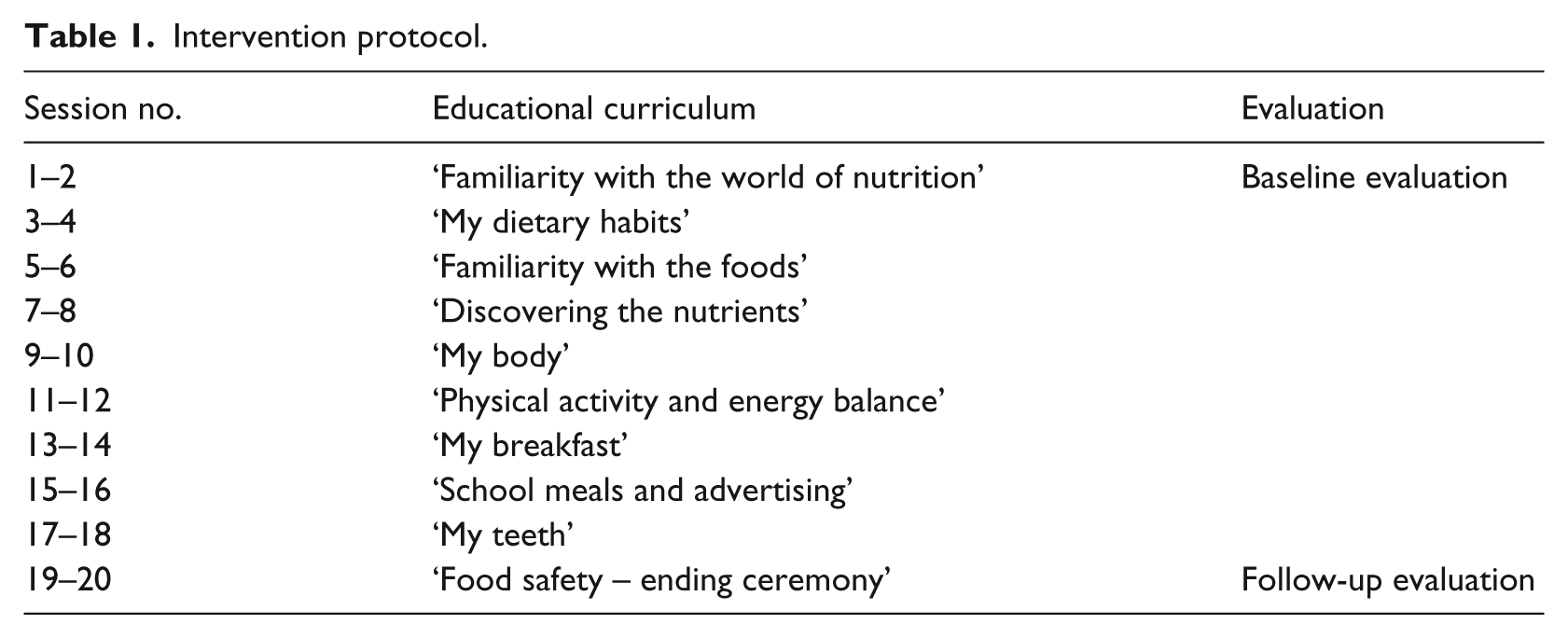
Each topic was covered in two sessions. In the IG group, all sessions were delivered by classroom teachers, whereas in the IIG group, one session was led by the teacher and the other by specialised personnel.
The CG participated in no nutrition education programme, which was feasible because nutrition education in primary schools is optional within the Greek education system.
Because the allocation of the groups to each intervention was dependent on the ability of the teacher to deliver teaching in line with the study protocol, inevitable differences in the group sizes occurred.
Statistical analysis
Data are reported as the mean values and standard deviations for continuous variables and as mean changes and 95% confidence intervals (95% CIs) compared with baseline. Differences between variables were assessed using the Chi-square or Fisher’s exact test, where appropriate. The differences compared before and after the intervention were assessed for every variable in the model and for each group. A multi-component linear regression analysis was performed to evaluate the relationship between psychological climate and the characteristics of our sample. The five dimensions of the psychological climate (satisfaction, friction, competitiveness, difficulty and cohesiveness) constituted the dependent variables, while the independent variables were gender, daily screen time, daily outdoor activities and other. Within-group changes were assessed by a paired-samples Student’s t-test. Changes between groups over time were assessed by repeated-measures analysis of variance (RMANOVA) or equivalent non-parametric tests (Wilcoxon signed-rank test [Z] or Friedman test). Adjustments were made for baseline values when they differed significantly from each other. SPSS 17.0 software was used for the analysis. The level of statistical significance was set at p ⩽ .05.
Results
Table 2 presents students’ scores on the five partial dimensions of the CPC before (T1) and after (T2) the intervention, as calculated based on the MCI, as well as the results of partial comparisons (Wilcoxon signed-rank test [Z]).
Means (M) and standard deviations (SD) of partial dimensions of the classroom psychological climate before (T1) and after (T2) the intervention.

IIG: Intensive intervention Group, IG: Intervention Group, CG: Control Group.
Z∫∫ for the effect of time between the pre- and post-intervention measurements.
p′ for the group effect.
p for repeated analysis of variance (ANOVA) measurements. Differences in the change from one measurement to the other between the three groups.
p < .10; **p < .01.
Satisfaction did not differ between the three groups before the intervention (p = .248), although a significant difference was observed in satisfaction post-intervention (p = .034). Students in the IG had a higher satisfaction than the CG (p = .045). Children in the IIG group displayed a statistically significant decrease in satisfaction post-intervention compared with pre-intervention (p = .001).
Some differences were observed in friction between the three groups at baseline (p = .001), but these differences disappeared post-intervention (p = .094). Students in the IG had significantly lower friction levels than those after the intervention (p = .007). In the CG, competitiveness after intervention was higher than that in the IIG (p = .020) and IG (p = .009). Finally, cohesiveness differed pre-intervention (p < .001) between the three groups compared with cohesiveness post-intervention, where no significant changes were noted (p = .314). Differences in this psychological factor between groups were found to be significantly more apparent over time (p = .001).
Physical activity and sedentary lifestyle habits were examined to assess the effect of the intervention on screen time and time spent on outdoor physical activities. Table 3 shows students’ scores for their frequency of outdoor activities and screen time on weekdays before (T1) and after (T2) the intervention, as well as the results of partial comparisons (Wilcoxon signed-rank test [Z]).
Means (M) and standard deviations (SD) of outdoor activity frequency and screen time before (T1) and after (T2) the intervention.

IIG: Intensive intervention Group, IG: Intervention Group, CG: Control Group.
Z∫∫ for the effect of time between the pre-intervention and post-intervention measurements.
p′ for the group effect.
p for repeated analysis of variance (ANOVA) measurements. Differences in the change from one measurement to the other between the three groups.
p < .10; **p < .01.
A non-significant difference appeared in the IG between the two measurements (Z = .24, standard error [SE] = 0.14, p = .078), and no significant difference was found compared with the IIG and the CG. Notably, time spent on outdoor physical activities was shown to have a tendency to decline in the IG; however, the difference was not significant. No significant difference was observed in screen time at baseline compared with the follow-up between the groups, although children in the IIG showed a significant increase in their daily screen time (Z = −.38, SE = .11, p < .001) compared with the other two groups. Data on psychological climate, physical activity and daily screen time were entered into a linear regression model to examine inter-relationships between these variables. An attempt to identify factors affecting the CPC dimension was made using linear regression models. The dimensions of the CPC (satisfaction, friction, difficulty and cohesiveness) were set as dependent variables, while gender, daily screen time and outdoor activities were set as independent variables.
Screen time and time spent on outdoor activities were statistically significant co-determinants of differences in friction (DFriction) when compared with pre- and post-intervention (Table 4). Increased daily screen time contributed significantly to increased friction. In contrast, outdoor activities seemed to have the opposite effect by decreasing friction. Gender was found to be a significant factor, as girls were found to have increased friction compared with boys.
Linear regression model, where DFriction is the dependent variable.
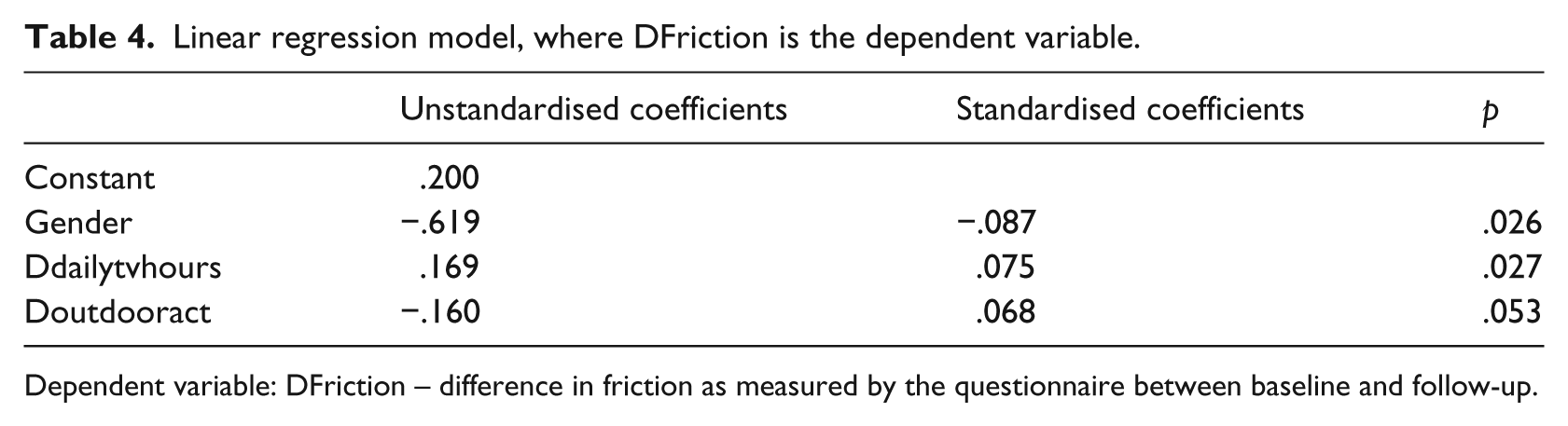
Dependent variable: DFriction – difference in friction as measured by the questionnaire between baseline and follow-up.
Discussion
This study showed favourable changes in the IG, namely, friction significantly declined after the intervention. Furthermore, children in the IG had significantly higher satisfaction than children in the CG after the intervention. With respect to the IIG, satisfaction levels significantly decreased after the intervention, while no significant difference was observed regarding friction in this group. Regarding physical activity and screen time, no significant difference was found between the groups, neither before nor after the intervention. Despite this result, the IG had a non-significant decline in time spent on outdoor physical activities. Daily screen time after the intervention in the IIG was significantly higher than that in the IG and CG. In addition, the IIG showed a statistically significant increase in daily screen time compared with the other two groups, which showed no significant change. The lack of beneficial changes in terms of physical activity indices has been reported previously (Caballero et al., 2003; Kipping et al., 2014) in school-based interventions. It could be suggested that changes in physical activity require longer interventions and possibly more intensive training at the individual level, including training from parents and in the school setting.
Gender, physical activity and screen time were found to be important factors affecting changes in classroom psychological climate. Furthermore, gender was found to be a significant factor in friction change, as it decreased in boys and increased in girls after the intervention (mean difference: −.17 and .33, p < .05 for girls and boys, respectively). We also found that the daily screen time increase during the intervention was positively correlated with friction change, while time spent on outdoor activities was negatively correlated with friction change.
The concept of classroom psychological climate implies an intent to establish and maintain a positive context that facilitates classroom learning; however, in practice, classroom climates can range from hostile or toxic to welcoming and supportive and can fluctuate daily and over the school year. It has been established that there is a positive correlation between students’ perceptions of the psychological climate of the classroom and cognitive, emotional and social learning (Fraser, 1998b; Stevens and Sanchez, 1999). Furthermore, students’ learning ability has been found to be positively correlated with cohesion and satisfaction levels and duty orientation in the classroom (e.g. loyalty to and supportive behaviour towards other members of the class), while it is negatively correlated with disruption and friction between students (Fisher and Fraser, 1983). Because of this, students who experience a positive school psychological climate are more likely to have improved academic performance, reduced delinquent behaviour and higher self-esteem (Houpas, 2010; Matsagouras and Voulgaris, 2006).
In this study, a significant favourable change in the psychological climate was not observed. A possible explanation for this finding may be the presence of specialised personnel in the classroom. Students are not used to being taught by ‘outsiders’ and may need more time to accept a new person in their classroom. However, the IG showed favourable changes in the psychological climate, which may be attributed to their teacher’s involvement in the programme. The fact that Greek students may be unfamiliar with innovative experiential learning techniques, such as those used by the specialised personnel in the IIG, cannot be disregarded.
In Greece, a relatively small number of primary school students have participated in innovative nutrition education interventions (40%), and even fewer have participated in health promotion programmes (31%), probably due to the restricted time available or lack of interest by schools and teachers. Reasons for this small participation may include a relatively inflexible school curriculum, inadequate teacher training and the fact that the implementation of such programmes may demand working after regular school hours without any additional funding. In addition, in most European countries, school-based health education programmes are primarily led by teachers with high initiative and interest (Spiropoulou et al., 2008). Moreover, the fact that Greek students are not familiar with experiential learning techniques and team collaborative learning was a potential barrier to achieving more positive results in our study.
Limitations
This study was conducted in a large urban school district, and the results may not be generalisable to non-urban settings. Greek students are generally unfamiliar with experiential learning techniques because the number of classes that participate in health education programmes where these techniques are extensively used is limited. We cannot comment on the impact of the implementation because there was not always an observer in the classroom, with the exception of the classes in the IIG. Regarding students’ physical activity, there may have been some seasonal variation due to relative differences in temperature between November and June, which were the initial and second evaluation months, respectively. Similarly, minor seasonality issues may have affected the students’ food intake because the availability of certain foods, such as fruits and vegetables, is different in November compared with June (e.g. in November, there is a high availability of green leafy vegetables, while in June, vegetables include tomatoes), although the questionnaire was developed to estimate dietary habits rather than specific food intake.
Conclusion
Our study has shown that a nutrition and physical education programme in primary school may benefit from using active learning techniques, but the involvement of the classroom teacher seems irreplaceable. It was evident that when the programme was implemented by the teacher alone, friction among students was shown to decrease. However, more time is needed for students to familiarise themselves with specialised personnel. Long-term nutrition and physical activity–targeted initiatives must be designed and implemented in the classroom to increase physical activity and reduce screen time in school-aged children.
Footnotes
Acknowledgements
The authors would like to thank the team of teachers and specialist personnel who taught the curriculum and the team of dieticians who participated in the project.
Funding
The author(s) disclosed receipt of the following financial support for the research, authorship, and/or publication of this article: Part of the project was funded by Nestle Hellas in the context of the Healthy Kids Corporate Social Responsibility Programme.