



Abstract
Objective:
This study aimed to compare the effectiveness of adolescents’ use of smartphone applications and educational booklets in an educational programme about sexually transmitted infections (STIs).
Design:
Non-equivalent control-group time-series design.
Setting:
The study was conducted in two public high schools located in two urban areas of South Korea.
Methods:
The following measures were developed using Roger’s protection-motivation theory as the study’s conceptual framework: STI knowledge, STI vulnerability, STI prevention self-efficacy and STI prevention intentions. Data from 88 senior students were analysed: 47 students in the smartphone application group (experimental) and 41 in the educational booklet group (control). The procedures consisted of a face-to-face lecture plus self-study and a period of self-study only. Participants were tested at three time points: pre-test, post-test 1 (immediately after the programme’s completion) and post-test 2 (5 weeks after the programme’s completion).
Results:
Significant group differences were found at different times in STI knowledge, vulnerability, prevention self-efficacy and prevention intentions. Smartphone applications were more effective in sustaining the effects of the educational programme than the educational booklets.
Conclusion:
Researchers and educators should examine the role of relevant learning materials in the promotion of adolescents’ development of self-study skills and their knowledge acquisition.
Keywords
Introduction
According to the Korean Centres for Disease Control and Prevention (Korean Centers for Disease Control [KCDC], 2014), the rate of sexually transmitted infections (STIs) in young people aged 15–39 years has steadily increased over the past few years. The prevalence of syphilis in this group is higher than in any other age group, except for individuals in their 20s and early 30s (KCDC, 2014). STIs are prevalent in the Korean adolescent population as well as among young people aged 15–19 years in other countries. In the USA, 10 million young people aged 15–24 years are infected with STIs yearly (Satterwhite et al., 2013), and in the United Kingdom, young people aged 15–19 years are the second highest group diagnosed with an STI (Public Health England, 2014). Japanese adolescents have a Chlamydia infection rate similar to that of individuals in their 30s (Lee, 2013), and among Taiwanese young people aged 15–24 years, the rate of gonorrhoea has increased between 2010 and 2014 (Taiwan Centers for Disease Control, 2012).
Young people with STIs require more attention than infected individuals in other age groups because gonorrhoea, Chlamydia and syphilis, which are prevalent in adolescents, are associated with ectopic pregnancy and pelvic inflammatory disease (PID), which are known to contribute to infertility (Watson, 2015). Other STIs also result in complications, such as acute PID, salpingo-oophoritis and endometritis (Casari et al., 2010). However, most adolescents, including both young women and men, do not visit a doctor because they are unaware of their STI status and they lack knowledge about the consequences of STIs (Cherie and Baheretibeb, 2012; Malta et al., 2007; Seo et al., 2014; Tarr and Gilliam, 2008). It is crucial, therefore, that young people receive accurate knowledge about STIs, including the ability to recognise their symptoms.
Korean adolescents’ sexual health may be at risk because they may obtain incorrect information related to sexuality from the Internet and other sources (Lim et al., 2014). Even if they were willing to acquire correct information about sexuality from teachers or parents, in reality, parents do not have the time to provide the information in a systematic way (Lim and Lee, 2007) and teachers cannot educate them effectively because of limitations in the curricula. The use of smartphone applications makes it possible to promote self-directed learning and learning at one’ own pace, which may increase young people’s interest in learning (Ministry of Education and Science Technology, 2011). Smartphone applications have advantages over other educational methods, such as lack of Internet time restrictions and lack of space requirements. Therefore, if young people receive good quality STI education through smartphone applications, they should obtain STI knowledge and prevention skills, in addition to their teachers’ or parents’ guidance. Given that approximately 90% of high school students in South Korea use smartphones (Korea Information Society Development Institute, 2015), STI education using smartphone applications could be an attractive health education method and, therefore, an alternative approach.
Against this background, this study examined the effects of an STI educational programme using smartphone applications and compared it with the use of educational booklets for self-study activities among adolescents.
Methods
Participants
This study was conducted after receiving ethical approval from the institutional review board at the Kangnam Sacred Heart Hospital. Third-year students from two public high schools, who were at least 18 years of age, were recruited to participate in this study. Approximately 60% of the recruited students agreed to participate. The age cut-off was selected to avoid the requirement to obtain parental permission for students’ participation. Smartphone owners were enrolled in the smartphone application (experimental) group. We provided accounts for the students in the experimental group to access the smartphone application. After they had created their own accounts, they could log in and begin their education using the application. The researchers controlled access to the application through a management site. Students were enrolled in the control group, regardless of whether they owned a smartphone. The smartphone application was not discussed with them. The two schools that we selected for the control and experimental conditions were similar in size, but were located in different cities to prevent contact between the students that could influence the study’s results.
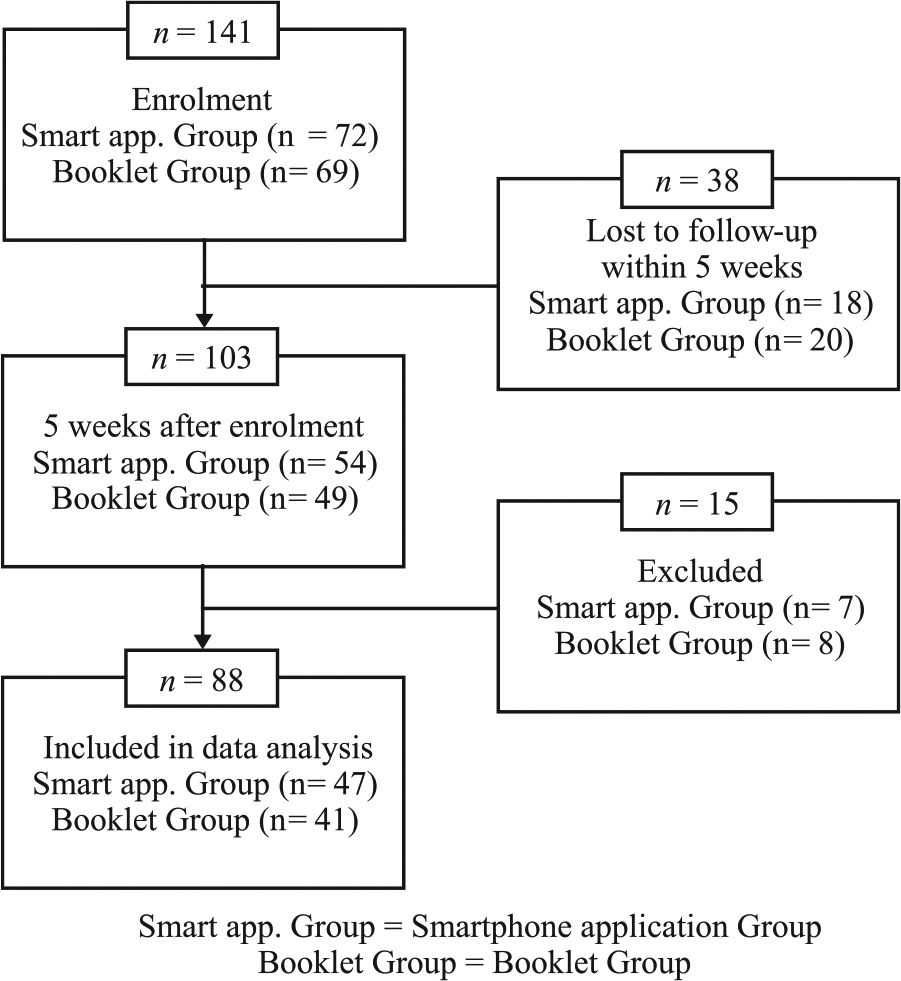
Sample size was calculated using the G*power 3.1.0 programme (Faul et al., 2009) using α = .05, effect size = .3 and 1 − β (power) = .8 for a repeated-measures analysis of variance (ANOVA). Based on the results of our pilot study, we selected .3 as the effect size. The minimum sample size required for an effect size of .3 was 62 (experimental group = 31, control group = 31). Originally, the expected dropout rate was approximately 30%, which was estimated based on previous research (Black et al., 2011; Jones et al., 2013; Reid et al., 2009). Initially, 72 students in the smartphone application group and 69 students in the educational booklet group participated in this study, but as of week 5, 38 participants had been lost to follow-up (smartphone application module = 18, educational booklet module group = 20).
In the final data analysis, we excluded 15 students who gave invalid responses, such as missing items and checking the same number in response to all items after week 5. Consequently, 88 participants were included in the data analysis (smartphone application module group = 47, educational booklet module group = 41; see Figure 1). Overall, the dropout rate in this study was higher than that of previous studies. This was attributed to the period of data collection, which was during the students’ winter vacation; during this period, some students travelled abroad and others were working at part-time jobs. In addition, it was the time for third-year high school students in South Korea to apply for university admission and some wanted to focus on preparing their applications.
Data collection.
Conceptual framework and educational modules
Our conceptual framework was provided by protection-motivation theory (PMT), which is based on expectancy value theory (Rogers, 1983). PMT posits that individuals make decisions based on their fears of diseases or objects that trigger fear and cognitive activity, which cause them to feel a need to protect themselves. Among the original concepts associated with PMT (perceived severity, perceived vulnerability, perceived self-efficacy, perceived response efficacy, intentions and behaviour), we selected perceived vulnerability, perceived self-efficacy and intentions to be focused on in this study. Perceived severity and response efficacy were not selected because they were not found to be effective in changing behaviours related to STI prevention education in another study (Dehdari et al., 2014). Behaviour was not used because of the low rate of reported sexual intercourse, which was 7.7% among high school students in South Korea (Lee, 2016) and cultural influence, which taboos open discussions on sex among adolescents (Yoon et al., 2009).The STI educational content that was included in the smartphone applications and educational booklets was based on this conceptual framework. We examined all the contents in this educational module and received approval by six experts: two professors in the Department of Nursing at Ewha Womans University, two medical doctors in the Division of Infectious Disease at Hallym University and two school nurses in Baekhyun high school and Jeil high school.
We developed two different educational modules for the self-study component of our study: a smartphone application and an educational booklet, which had the same content. The STI smartphone application had five major buttons: STI risks, STI knowledge, STI prevention skills, STI coping skills and websites related to STIs on the Internet. An information-technology (IT) professional helped develop the study’s smartphone application. The content presentation of STI knowledge included cartoon clips, which were created and developed with the assistance of a professional cartoonist. The developmental process associated with the smartphone application used in this study is published elsewhere (Jeong and Cha, 2017). A comparable 33-page educational booklet printed on A4 size paper in colours designed to attract the young people’s attention included the same five subtitles as the smartphone application.
Procedures
Data were collected between 13 January 2016 and 26 February 2016. We explained the study’s purpose to the school principals and school nurses before conducting it. After obtaining their approval, we arranged the schedule for the STI educational programme. We first visited Baekhyun academic high school in Yogin city with three research assistants whom we trained regarding the data collection procedures and then collected data from the educational booklet group. Subsequently, we collected data from the smartphone application group at Sangrok academic high school in Ansan city. We collected data on three separate occasions: pre-STI education, post-STI education and 5 weeks post-STI education. The studies that reported educational effects on sexual knowledge and sexual attitude and HIV/AIDS prevention had collected data 4 weeks after the post-test; therefore, we selected the 5-week time point for the intervention period (Jeong et al., 2003; Kiene and Barta, 2006).
After obtaining written informed consent from participants, we conducted a pre-test followed by a traditional face-to-face lecture that lasted 50 minutes. When the lecture was finished, we explained that participants would be involved in self-study for 30 minutes. Educational booklets were distributed to the educational booklet group and smartphone applications to the smartphone application group. Afterwards, we explained the booklets’ content briefly to the booklet group and allowed the students 30 minutes self-study. We provided instructions for downloading and using the smartphone application, including the icons for STI education to the smartphone application group and allowed them 30 minutes self-study. When participants had completed the self-study portion of the programme, we conducted the post-test. In addition, we stated that students should commit to allocating 15 minutes per week to self-study for 5 weeks using the educational booklet or smartphone application. We sent reminders via text messages to the participants once a week. After 5 weeks, we revisited the schools with the research assistants and conducted the third survey. At the same time, we distributed mobile coupons of varying amounts (US$5–20) to participants, depending on their STI knowledge scores.
Measures
For the study, four scales (STI knowledge, STI vulnerability, STI prevention self-efficacy and STI prevention intentions) were developed. Items for these scales were created using the results of an earlier qualitative investigations (Seo et al., 2014), guidance contained in STIs among Adolescents (World Health Organization, 2005), the International Guidelines on Sexuality Education (United Nations Educational, Scientific and Cultural Organization (UNESCO), 2009), the Standards for Sexuality Education in Europe (World Health Organization, 2010), and a literature review related to STIs among adolescents (Kaljee et al., 2005; Kinsman et al., 2001; Lee et al., 2011; Li et al., 2011;). The content validity of the items was examined by six experts using the content validity index (CVI). Items that scored below .8 on the CVI were deleted. After confirming the items’ content validity, we conducted a pilot study in Muju high school located in Muju city with 60 senior high school students (30 students = control group; 30 students = smartphone group). We distributed the developed questionnaire and conducted an offline lecture for 50 minutes. Next, we provided booklets for the control group and smartphone application for the smartphone group in each class for 30 minutes. After this, we requested for feedback from the students. Finally, we revised some medical terms in the scales for easier understanding based on students’ feedback (e.g. papules was changed to spots and vesicles to blisters). The questionnaire was administered to the students before and after they received STI education. Based on post-test interviews of students and pilot study’s results, we adjusted the number of items and the difficulty level, measured reliability of the scales, and selected final items for our study.
We developed 29 items that measured general STI knowledge and knowledge of six STIs (AIDS, gonorrhoea, Chlamydia, syphilis, genital herpes and genital warts). The response options for the items were ‘true’, ‘false’ or ‘don’t know’. Examples of items on general STI knowledge included ‘If you take oral pills before and after sexual intercourse, STIs can be prevented’ and ‘Women with gonorrhoea can have yellow or green vaginal secretions’. The total possible score ranged from 0 to 29. A high score indicated a higher level of STI knowledge. The scale’s reliability, as measured by Cronbach’s alpha, was .872.
Three scales measuring STI vulnerability, STI prevention self-efficacy and STI prevention intentions consisted of four items each. A Likert scale ranging from 1 (strongly disagree) to 4 (strongly agree) was used to rate each item on the three scales. The total possible score for each of the scales was 4–16 points.
STI vulnerability pertains to the young person’s perceived susceptibility to acquiring STIs and young people’s belief that exposure to an STI results in negative physical effects. A higher score on the STI vulnerability scale indicates a stronger belief that STI exposure increases one’s susceptibility to acquiring it. Two examples of items are ‘If you have sex, you can acquire STIs’ and ‘I have the potential to acquire STIs in the future’.
STI prevention self-efficacy concerns young people’s trust and belief in their ability to prevent STIs. A higher score on the STI prevention self-efficacy scale indicates a stronger belief in one’s ability to prevent STIs. Examples of this scale are ‘I am sure that I can use condoms correctly’ and ‘I am sure that I know the risk factors of STIs’.
STI prevention intentions involve plans to use condoms to prevent STIs and intentions to decrease high-risk sexual behaviours related to STIs. A higher score on the STI prevention intention scale indicates stronger intentions to avoid high-risk behaviours known to cause STIs. Examples of items on this scale include ‘To prevent STIs, I will use condoms’ and ‘I will not have more than one sex partner’. Cronbach’s alpha for these three scales were .605, .702 and .795 respectively.
Statistical analysis
IBM SPSS statistics version 22.0 was used for the statistical analysis. Proportions, mean values and standard deviations were calculated for the baseline data. Homogeneity between the two groups was tested using Chi-square tests, Fisher’s exact test and independent t-tests. The differences in scores before the intervention, immediately after the STI educational programme and 5 weeks after completion of the programme for general STI knowledge, STI knowledge by type, STI vulnerability, STI prevention self-efficacy and STI prevention intentions were analysed using repeated-measures ANOVAs. Mauchly’s test in the repeated-measures ANOVA indicated that the differences in the variances of STI knowledge and STI prevention self-efficacy between the two groups violated the assumption of sphericity. Thus, we made corrections to these variables using the Greenhouse-Geisser method to interpret the sphericity.
Results
Tests of homogeneity between the two groups’ demographic characteristics and the other variables
Of the 88 students who participated in the study, 44.7% were in the smartphone application group and 55.3% were in the booklet group. No significant differences were found between the two groups’ demographic characteristics, previous exposure to STI education in elementary and middle school, or previous experiences of having sex. No significant differences in the selected PMT-related constructs were found between the groups, as shown in Table 1.
Homogeneity of the demographic characteristics and variables between the two groups (N = 88).

STI: sexually transmitted infection; SD: standard deviation.
Fisher’s exact test.
Comparison of the smartphone application and the educational booklet as self-study materials
The participants used the educational materials under two conditions: (1) during a self-study period in school after a face-to-face lecture and (2) during self-study time at home for 5 weeks. Throughout this period, all participants engaged in self-study at home during their free time once a week. The results for all STI measures are shown in Table 2.
Comparison of participants’ score changes on the measures by type of educational module.

SD: standard deviation; Smart-Apps: smartphone application group; booklet: educational booklet group; STI: sexually transmitted infection.
p < .05; **p < .01; ***p < .001.
STI knowledge
The experimental group’s mean score for STI knowledge increased dramatically after the face-to-face lecture plus self-study period, and it remained steady 5 weeks later, whereas the control group’s mean score also increased initially (Post-test 1) but decreased 5 weeks after the STI education. A significant difference in STI knowledge was found between the two groups (F = 8.19, p < .001); and STI knowledge which varied significantly across the three time points (Pre-test, Post-test 1 and Post-test 2) (F = 159.67, p < .001). Thus, the three test times and the groups produced a significant interaction (F = 15.11, p < .001).
STI vulnerability
The experimental group’s mean score increased by 1.40 points after the face-to-face lecture plus self-study period, but it did not change after that; the control group’s STI vulnerability level showed a flat line in the comparison between the before and the after face-to-face lecture plus self-study test times. It was sustained for 5 weeks after the STI education. The difference in the degree of STI vulnerability between the two groups over time revealed no significant differences between them (F = 2.94, p = .090), but slight changes emerged in the STI vulnerability score of the control group. Significant differences were found across the three time points (F = 12.18, p < .001). The test times and group scores for STI vulnerability revealed an interaction (F = 4.72, p < .033; see Table 2).
STI prevention self-efficacy
Participants’ mean score for STI prevention self-efficacy showed the same pattern as that for their STI knowledge. There was a marked increase after STI education in the experimental group, and during the 5-week self-study period, the mean score did not change. Although the control group’s score increased after the face-to-face lecture plus self-study, it decreased by 1.40 points during the 5-week self-study period. Significant differences were found by group (F = 13.41, p = .001), and significant differences emerged across the three test times (F = 80.80, p < .001). Moreover, test time and group had an interaction effect on the scores for STI prevention self-efficacy (F = 8.01, p < .001; see Table 2).
STI prevention intentions
The mean level of STI prevention intentions increased by 1.40 and 1.27 points after the face-to-face lecture plus self-study in the experimental and control groups, respectively. After that, the experimental group showed a slight increase in its mean score for STI prevention intentions, but the control group’s mean score decreased by .95 after 5 weeks. A significant difference in STI prevention intentions was found between the groups (F = 9.65, p = .003), and at the three test times (F = 13.90, p < .001). In addition, there was an interaction of test time and group for scores on STI prevention intentions (F = 6.41, p < .013; see Table 2).
Discussion
The mean STI knowledge scores of the participants in the smartphone application and educational booklet groups increased 5 weeks after the STI educational programme. Acquiring STI knowledge is crucial because it is closely related to attitudes and behaviours related to STI prevention (Tung et al., 2011). Consistent with our study’s results, a study of Nigerian young people (Mba et al., 2007) found that their STI knowledge on a post-test significantly increased 6 weeks after their participation in an STI educational programme. In another study among young people in Mexico, the smartphone application group participated in a school-based HIV prevention programme twice a week for one semester. Their HIV-related knowledge increased significantly after this programme and it was retained up to 1 year (Givaudan et al., 2008). Consequently, the results of several studies support the use of a smartphone application as an effective educational method for improving STI knowledge among young people, with sustained effectiveness of up to 1 year.
Although awareness of STI vulnerability increased significantly in smartphone application group compared to the educational booklet group, the baseline scores on STI vulnerability for all participants were quite high. Awareness of AIDS and STI among Korean college students in another study was also high (Kang, 2001; Park et al., 2002). However, groups vulnerable to STIs have shown lower levels of perceived risk of acquiring an STI (Seo et al., 2014). It has been conjectured that young people in the general population have little experience with sexual intercourse or STIs, whereas high-risk groups have had to deal with STI treatment by themselves or are more likely to have had indirect experience with STIs through contact with their friends. Therefore, developing STI programmes highlighting awareness of STIs is important.
In this study, the self-efficacy of the smartphone application group increased dramatically after face-to-face lectures in addition to self-study, and it was sustained for almost 5 weeks, whereas the self-efficacy of the educational booklet group increased markedly after lectures and self-study, but then dropped by 1.44 points. This pattern is the same as that for STI knowledge. That is, self-efficacy had a strong relationship with academic performance and academic achievement. More importantly, previous studies of adolescents in China, Vietnam and Taiwan, who share a similar cultural background with adolescents in South Korea, revealed that HIV prevention self-efficacy increased after HIV prevention education (Kaljee et al., 2005; Lee et al., 2016; Pham et al., 2012). Self-efficacy is an important predictor of healthy behaviours and changes in behavioural intentions in STI high-risk situations (Lee, 2010). Consequently, it is understandable that during adolescence, learning about STIs may increase sexual health self-efficacy prior to engaging in sexual intercourse.
In recent years, the number of smartphone users has increased due to the convenience of using smartphone applications. Although STI prevention and treatment programmes are continuously evolving, evaluation studies of the effectiveness of smartphone applications within these programmes have not been conducted. Most investigations of the effects of smartphone applications have been conducted with high-risk groups, such as people who use drugs, men who have sex with men and people living with HIV. Other studies on STI smartphone applications have been conducted to identify the number and types of applications that are available (Muessig et al., 2013). Thus, the development of new smartphone applications and evaluation of the effectiveness of STI education using them are needed. Given the paucity of existing research, this study’s results have important implications.
This was the first study to investigate the effect of using a smartphone application in an STI educational programme for young people in South Korea. This STI educational programme had positive effects on the students participating in our study. Smartphone applications were more effective than educational booklets in sustaining these effects. Given these findings, schools, youth centres and hospital clinics may wish to consider using smartphone applications for STI education to improve young people’s sexual health.
Limitations
Some study limitations should be noted. First, this study was conducted in only two high schools using convenience sampling; therefore, the results cannot be generalised to other settings. Second, we used self-report data from the control group about whether they had studied the materials provided, whereas we were able to review the experimental group’s use of the smartphone applications for 5 weeks, using the manager’s page. Therefore, it is impossible to determine the accuracy of the control group’s self-reports of their self-study behaviours and their possible effects on the results. Third, our study had a higher than expected dropout rate (38.6%). Although the dropout rate may have introduced selection bias, as the power analysis was based on a sample size of 62 and our final sample size was 88, the ability of our study to detect the expected effect size of .3 at .8 power was not affected. However, previous studies on online education have also reported a 20%–60% dropout rate (Finnegan et al., 2008; Jones et al., 2013; Packham et al., 2004). Therefore, the reasons for high dropout rates in studies of online education need to be investigated. Finally, our study did not use a randomised control trial (RCT) design. We used convenience sampling to collect the data and our sample size was small. Therefore, the study’s results should be interpreted with caution.
Footnotes
Ethical approval
This study was conducted after receiving approval from the Institutional Review Board of Ewha Womans University for the ethical protection of subjects (IRB 105-7).
Funding
The author(s) received no financial support for the research, authorship and/or publication of this article.