



Abstract
Objective:
This study aimed to identify predominant search patterns in a recent search for health information and a potential search for strongly needed cancer information, to identify the commonly scanned sources of information that may represent stable elements of the information fields characteristic of these patterns, and to evaluate whether search patterns are the same for cancer patients and non-patients.
Design:
Analysis of Health Information National Trends Survey 4 Cycle 2 (HINTS 4.2) data, a nationally representative survey administered by the US National Cancer Institute.
Methods:
The search patterns of individuals responding to survey questions about a recent search for health information and a hypothetical search for strongly needed cancer information were identified by cross-classifying the first source of information to be consulted in both search contexts. Using a mixed-model repeated-measures analysis of variance (ANOVA), we evaluated the relationship between search patterns and scanned sources of cancer information.
Results:
Five predominant search patterns or groups were evident: Internet–doctor (29%), Internet–Internet (25%), doctor–doctor (16%), Internet–cancer organisation (6%) and print–doctor (6%) for recent search and for the hypothetical search for strongly needed information, respectively. Patterns did not vary by presence/absence of cancer diagnosis. Information search groups differed both demographically and in the sources of information scanned. Patterns were replicated in data from two additional HINTS surveys which differed in the wording of the focal questions.
Conclusion:
Differences among the patterns in various health-related attitudes and behaviours are identified. Implications for patient engagement in shared decision-making, particularly in the presence of rapid developments in health information technology, are discussed.
Keywords
In the literature on health information seeking, two of the most frequently cited sources of information are the Internet and health care provider (Saulsberry et al., 2014). Family/friends, library and print sources are also frequently cited (Altizer et al., 2014; Fagnano et al., 2012). Preferred channels of cancer information seeking vary with type of information sought. Johnson and Case (2012) state, when people are concerned with whether or not they have cancer and appropriate treatments, they are more likely to turn to authoritative channels for health information, but the advent of the Internet and resources like Medline Plus* and various support groups have led to disintermediation and a broadening of people’s conception of what and who is authoritative. (p. 15)
Indeed, these same authors suggest that the Internet has become an ‘omnibus channel’ with the potential to fill both authoritative and interpersonal information needs indicating an increasing reliance on the Internet for cancer information at all stages.
Nevertheless, the Internet may not be the preferred source for cancer information in all phases of searching. Nagler et al. (2010) studied how cancer patients navigated multiple information sources and found it common for them to move among different types of information sources (e.g. Internet, print, health professional) to serve various purposes. Niederdeppe et al. (2007) reported that when respondents were seeking information relevant to prevention or screening decisions, physician was the most frequently cited source of information and Internet was the least. Faith and Thorburn (2014), using Health Information National Trends Survey 4 Cycle 1 (HINTS 4.1) data, found the Internet was the first source of information for a large majority of respondents (69.7%) the most recent time they had searched for health and medical information. However, when asked to identify their first choice of information in the event of a strong need for health or medical information, only 36.8% of respondents chose the Internet.
To study whether the information-seeking behaviour of people who have had a diagnosis of cancer differs from those without such a diagnosis, Kim and Kwon (2010) used HINTS 2005 data to develop four groups based on whether respondents had ever been diagnosed with cancer (cancer patient vs non-patient) and whether they had ever used the Internet (online vs offline) to search for cancer information. They found among those who had ever searched online, 60% of cancer patients and non-patients alike had used the Internet as their first source of cancer information for their most recent search. When asked what source they would use for cancer information the next time they had a strong need for cancer information, online cancer patients were about equally split between doctor and the Internet (about 45% each), whereas about 60% of non-patient online seekers preferred the Internet. Among the offline searchers, both patients and non-patients selected the doctor as their first choice for a recent cancer search and as their preferred source for the next search. Of the offline patients, 80% selected the doctor as their preferred source for the next search.
These results imply the emergence of different patterns of information seeking as preferred information channels and sources reflect changes in individuals’ experiences, motivations and needs. In the Faith and Thorburn (2014) and the Kim and Kwon (2010) studies, the contexts of the two HINTS questions reflected an actual recent search for information in the one and a potential search for strongly needed information in the other. Both studies’ authors interpreted the potential search as representing a preferred search source distinguished from the actual source used in the recent search. However, in both studies, the survey question contained the phrase ‘strong need for information’ in reference to the potential search. Results of both studies suggested a preference for health care professional over the Internet when information seeking is associated with strong need, perhaps as the need becomes more urgent. However, as both studies have shown, even when there is a strong need for health or cancer information, a reasonably large number of individuals still say they would choose the Internet as their first source of information.
We are interested in the search patterns emerging in the implied two-step sequence of a recent search for medical or health information and a future/hypothetical search for strongly needed cancer information. We examine the first source of information used in both search contexts.
In addition to sources for intentional information searches, we were interested in the attention people pay to the different sources of information they may be exposed to as a matter of course. The literature on health information seeking distinguishes information scanning, which involves some minimal level of attention to information encountered in the normal flow of information, from seeking which represents active efforts to obtain specific information outside of the normal patterns of exposure (Hornik et al., 2013; Lewis et al., 2017; Shim et al., 2006). Lewis et al. (2017) define information seeking as ‘a purposeful process by which individuals actively aim to change their state of knowledge through searching for information about a specific topic from one or more information sources’ (Lewis et al., 2017: 2). These authors note that scanning is not passive – an individual coming across a topic must decide to attend to it for it to leave a memory trace and potentially have an impact on attitudes or behaviour (Lewis et al., 2017; Niederdeppe et al., 2007). Seeking and scanning are associated with knowledge acquisition, healthy lifestyle behaviours, increased likelihood of screening, and discussing information with physicians (Hesse et al., 2006; Johnson et al., 2001, 2006; Kelly et al., 2009; Nguyen et al., 2010; Niederdeppe et al., 2007; Shim et al., 2006). Scanning, but not seeking, was shown to predict a multifactorial belief about the causes and controllability of cancer (Waters et al., 2016). Stable sources in the information field (e.g. scanned sources attended to frequently) may provide an important starting point for more active information searches (Johnson et al., 2006).
The purpose of this study therefore was (1) to identify predominant search patterns formed from a recent search for health information and a potential search for urgently needed cancer information and (2) to identify the commonly scanned sources of information that may represent stable elements of the information fields characteristic of these patterns. We evaluate the extent to which these search patterns differ among cancer patients and non-patients using the Health Information National Trends Survey 4 Cycle 2 (HINTS 4.2) data.
Methods
The HINTS is a nationally representative survey administered by the US National Cancer Institute (NCI). The programme was developed to assess the influence of health information and health communication on health-related beliefs and behaviour. Data collection for HINTS 4 includes four mail-mode data collection cycles that began in October 2011 and were completed in April 2014. The survey includes a 205-item long form and a 134-item short form administered in both English and Spanish. Healthy People 2020 designated HINTS as the data source for tracking objectives related to health communication and information technology utilisation (Rutten et al., 2006). Cycle 2 data were released in May 2013. The response rate for Cycle 2 was 40% (N = 3,630; NCI, 2013).
The HINTS 4.2 dataset contains a number of items that address different aspects of health and cancer information seeking. The two key questions for this study ask about the first source consulted – The most recent time you looked for information about health or medical topics, where did you go first? and Imagine you had a strong need to get information about cancer. Where would you go first? For both questions, respondents were instructed to select one source from a list of 12. Responses to these two questions were used to identify the search patterns. Another set of questions asked respondents to quantify on a 4-point scale How much attention do you pay to information about cancer from each of the following sources? The sources included newspapers (print and online), health magazines, the Internet, radio, local TV news and national/cable TV news. These items reflected the attentional, stable aspect of the information field as they imply ongoing scanning activity. Attention to sources has been used in prior research as a proxy measure of information scanning (Ruppel, 2016; Shim et al., 2006; Waters et al., 2016).
Demographic variables
In this study, gender was coded male or female for all analyses. Age in years was included in the analysis as five age groups (18–34, 35–49, 50–64, 65–74, 75+). Race/Ethnicity was derived from categorical responses to Are you of Hispanic, Latino/a, or Spanish origin? and What is your race? Five categories were reported: Hispanic, White, Black, Asian and other. Education consisted of five ordered categories ranging from Less than High School to Post-Bachelor’s (Table 1).
Weighted proportions (n) of demographic categories and cancer diagnosis.

HS: high school.
Total proportions are for the entire sample; subsequent analyses may use subsets of the sample.
Results
The data file was constructed, cleaned and processed by the NCI. The public dataset was downloaded and imported into Stata 13 and SPSS 20 for analyses. Demographics of the sample are presented in Table 2. Using weighted proportions, the sample is 67% White with approximately equal proportions of male and female respondents. The median age range is 35–49, and about 67% have at least some college. Approximately 13% of the sample report having received a cancer diagnosis.
Favourite Internet sites for cancer information – unweighted proportions (n).

Meaning of the Internet as information source
Before we present the results of the primary analyses, it is important to address how survey respondents likely interpret the Internet as a source of cancer information. As has been previously noted and discussed elsewhere (Doolittle and Spaulding, 2005; Johnson and Case, 2012; Johnson et al., 2006), the Internet is not a single channel or source, but rather a cluster of matrices. We note that as a response option to the questions involving ‘Where would (or did) you go first’, the Internet overlaps with other survey options. For example, information from a cancer organisation can be accessed via multiple channels – the Internet, telephone or email contact, print brochures, through television and radio, or through personal contact. Likewise, books can be accessed in the library, or downloaded from the Internet in both print and audible formats. The Internet is a channel for health information sources from authoritative health sites such as WebMD and the NCI as well as from more general search engines such as Google and Yahoo and is the conduit for social media.
In order to identify the kinds of sources respondents may have had in mind when they reported that the Internet is the first place they would go for cancer information if they had a strong need, we looked at responses to the following question: Is there a specific Internet site you like to go to for information about cancer? This question was answered by the 486 respondents who said they had used the Internet to look for information about cancer for themselves in the past 12 months. In all, 28% said they have a favourite Internet site for cancer information (n = 137) and most provided the name of the Internet site they especially like as a source of cancer information. Results regarding a specific Internet site are presented separately for those reporting having received a cancer diagnosis and the non-diagnosis groups in Table 2. The diagnosed and non-diagnosed groups responded very similarly in that over 70% of those providing a site in both groups identified an authoritative site. A somewhat higher percentage of non-cancer patients identified general health sites such as WebMD, whereas cancer patients selected general health sites, hospital websites and cancer organisation websites with approximately equal frequency.
The information supplied by those who identified a preferred Internet site may give us a clue as to the type of information being sought by the respondents. If this group’s Internet usage can generalise, it appears likely that when respondents encountered a HINTS survey question that referred to Internet searching for cancer information, they responded to this in terms of a searchable database of health or cancer information from an authoritative source. However, with respect to hospital websites, there is no way to determine whether this is restricted to documentary information or whether they may be accessing a chat line.
Information-seeking context – general health or strong need for cancer information
Those with and those without a cancer diagnosis responded ‘yes’ in similar proportions (84% and 81%, respectively) to the question of whether they had ever looked for information about health or medical topics from any source (see Table 3). More than 80% of both groups cited either the Internet or a health provider as their first source with Internet the most frequently cited source by both groups (56% and 67%). Of those who had searched for health information, a much higher percentage of those with a cancer diagnosis had also searched for cancer information (81% vs 44%). When asked where they would go first if they had a strong need for cancer information, the top two preferred sources were still the Internet and health care provider. However, the preference reversed dramatically with health provider now the top choice for both groups (65% and 56%) and the Internet reduced to 22% and 27% for diagnosed and non-diagnosed respondents, respectively.
Weighted proportions (n) of responses to information seeking questions and cancer diagnosis.

Patterns of information seeking
To identify the primary patterns of information seeking with respect to preferred sources for general health information and intended sources for strongly needed cancer information, we cross-classified sources for the two search contexts and identified the most common patterns. This was done separately for the two diagnosis categories and the results are displayed in Table 4. Although the proportions varied somewhat between the two groups, the most common patterns were very similar. Most frequently, respondents reported searching the Internet first for general health information but intending to consult a health provider first in the event they strongly needed cancer information. This was followed closely by either searching the Internet first for both general health and strongly needed cancer information or consulting a health provider first in both situations. These three patterns were by far the most common and nearly equal in frequency for those with a cancer diagnosis. The doctor–doctor pattern was relatively somewhat less frequent for non-diagnosed respondents. The other patterns were included because of the large number of respondents selecting cancer organisation in the strongly needed information cancer context (primarily non-diagnosed), and print in the general health context for Patterns 4 and 5, respectively.
Patterns of searching for general health and cancer information – unweighted proportions (n).

Total valid responses to all three questions N = 2,096; n = 279 with diagnosis.
Demographic profiles for the groups of respondents classified by the different search patterns suggest that the Internet-cancer organisation group had a larger proportion of women than the other two Internet patterns. The doctor–doctor group was older, had more Hispanic respondents, a higher proportion of respondents with less than a high school education than other patterns and the second highest proportion earning less than $20,000 per year. This group had the highest proportion reporting only fair health and was tied with Internet–doctor for having the lowest rate of uninsured respondents (see Table 5). The print–doctor group had a higher proportion of African Americans and the highest proportion of respondents in the bottom income bracket compared to other groups. This group had the highest proportion of uninsured respondents and one of the highest proportions reporting only fair health. The Internet–Internet and Internet–doctor groups tended to be White, more highly educated with higher incomes, reporting better health and relatively younger than the doctor–doctor group. The Internet–cancer organisation group had a higher proportion of women and the second highest proportion of African Americans. This group had one of the lowest reporting only fair health. Finally, the Internet–Internet and Internet–doctor groups differed only in that the Internet-Internet group was more highly educated.
Demographic profile for information-seeking patterns – weighted proportions (95% CI).

CI: confidence interval; HS: high school.
Superscripts (i.e. a = larger proportions and b = smaller proportions) indicate significant differences in patterns for multiple comparisons (i.e. 1, 2 and 3). Income represented in thousands.
Information scanning
Table 6 displays sources of scanned information operationalised as responses to the question How much attention do you pay to information about cancer from the following sources? As a whole, approximately 60% of the sample reported paying a lot or some attention to cancer information from health magazines and from Internet sources. This was followed by approximately 34% and 31% who paid at least some attention to cancer information on the national and local television news, respectively. The least attended sources for cancer information were radio and online and print news.
Weighted proportions (n) of responses to cancer information scanning question.

Scanning and information patterns
To examine the relationship among the search patterns, cancer diagnosis and cancer information scanning sources, we evaluated a univariate mixed-design repeated-measures analysis of variance (ANOVA) model with the within factor comprising the seven sources of scanning; information search pattern and cancer diagnosis were the two between factors. Because there were so few diagnosed respondents in the Internet–cancer organisation pattern, it was eliminated leaving four patterns for this analysis. The rating in response to the question How much attention do you pay to information about cancer from each of the following sources? was the dependent variable for the analysis. The analysis was conducted in SPSS using a general linear model (GLM) (repeated) on the unweighted sample data because Stata currently does not provide an option for conducting a mixed-design ANOVA with complex samples. However, follow-up comparisons were conducted in Stata using jackknifed means and confidence intervals (see Table 7).
Information scanning (attention to sources) by search patterns (Jackknife Means and 95% CI).

CI: confidence interval.
Superscripts (i.e. a = larger proportions and b = smaller proportions) indicate significant differences in patterns for multiple comparisons (i.e. 1 and 2).
The assumption of sphericity was tenable with Greenhouse–Geisser and Huynh–Feldt estimates of epsilon greater than .80 (Lomax and Hahs-Vaughn, 2012). Levene’s test of homogeneity was violated (p < .05) for two of the scanning sources (health magazines and Internet). However, the ratio of largest to smallest variance was approximately 2 in both cases, and the ratio of sample sizes of largest to smallest was less than 1:4 so the effect of the violation was judged to be minimal (Tabachnick and Fidel, 2007). There was no significant main effect nor were there any significant interactions involving cancer diagnosis.
Because cancer diagnosis was not a significant predictor of differences in attention paid to sources of cancer information, the model was analysed without cancer diagnosis and the Internet–cancer organisation pattern was included in the analysis. The two-way mixed-design repeated-measures ANOVA with seven levels of within factors and five levels of between factors was evaluated for sphericity and homogeneity. Again, the assumption of sphericity was tenable with Greenhouse–Geisser and Huynh–Feldt estimates of epsilon greater than .80 and findings with respect to homogeneity of variance were similar to those reported previously. For this model, the pattern × information source interaction was significant, F(24, 11,583) = 23.245, p < .001,
The eta-squared effect size for sources scanned was large (Lomax and Hahs-Vaughn, 2012). The means by search patterns are displayed in Table 7 and Figure 1. The scale ‘of attention to sources’ is 1 = not at all, 2 = a little, 3 = some and 4 = a lot. The range of means was 1.81–3.15. The least scanned sources tended to be online news and radio; the most scanned were the Internet and medical/health magazines. While some search patterns involved more scanning than others, the effect sizes for the effects involving search patterns were small. Except for medical/health magazines, the doctor–doctor pattern paid less attention to sources in general than did other patterns. Search patterns were distinguished primarily by their attention to scanning the Internet. Respondents whose search pattern involved consulting the Internet as a first source, not surprisingly, reported paying more attention to the Internet for cancer information than the two other patterns, with the most attention to the Internet coming from the Internet–Internet pattern.
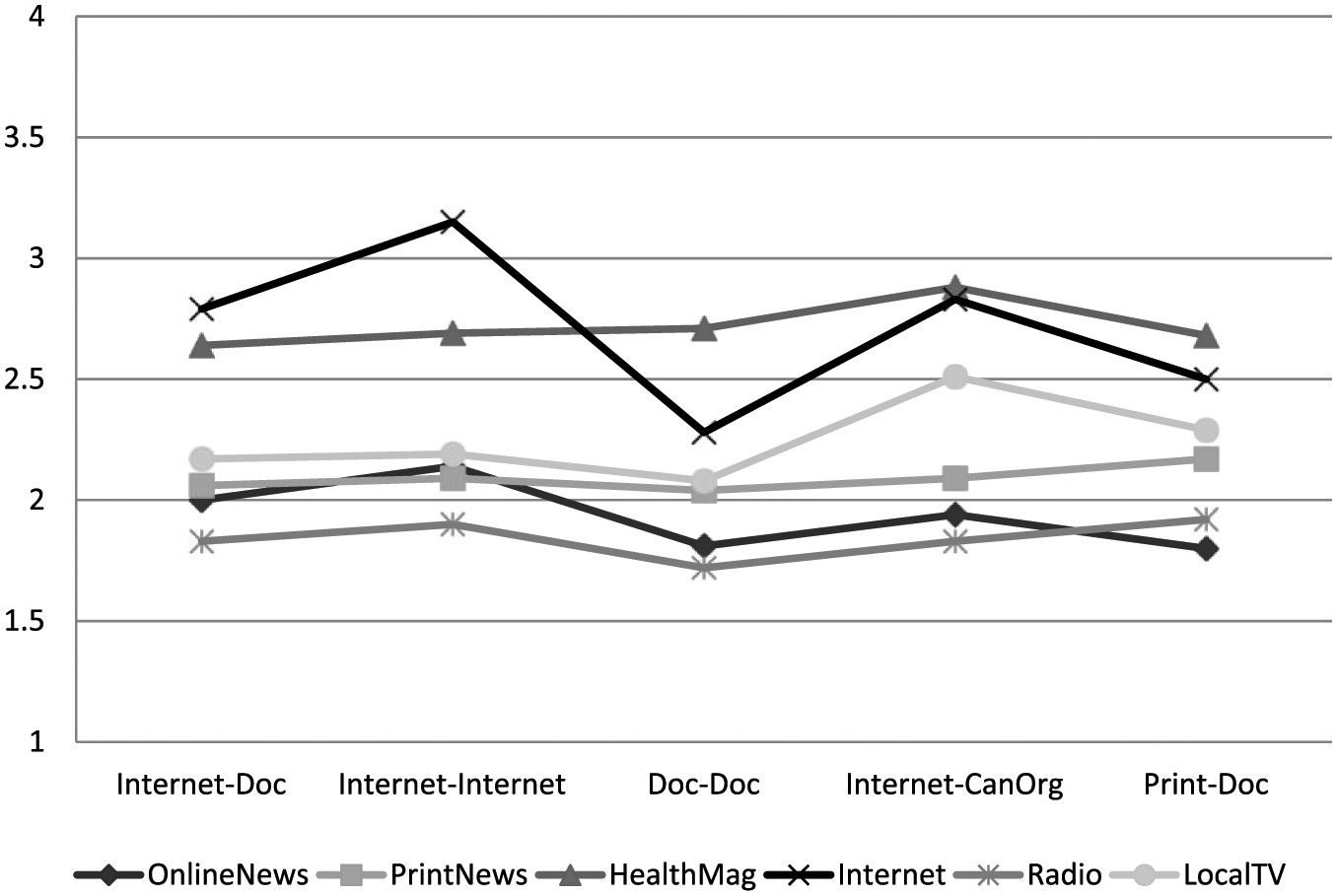
Attention to sources by search pattern.
Validity of search patterns
We stated earlier that ‘we are interested in the pathways emerging in the two-step sequence of an early stage search for general health information followed by a later stage search, representing a more urgent search for cancer information’. These stages were intended to differ primarily in urgency, as indicated by the contrasting phrases, ‘the most recent time you looked for information’ and ‘had a strong need to get information’. While they do represent that difference, the questions differed in other ways as well. The first search had actually happened – ‘where did you go first’; whereas, the second search was hypothetical – ‘where would you go first?’ The searches differ in topic – the first was for medical or health topics and the topic of the second was cancer. This raises a legitimate question regarding the construct meaning of the search patterns we identified.
To examine the extent to which the context difference in content (health or cancer information) and strength of need were confounded, we analysed two additional HINTS datasets. HINTS 4.1 (NCI, 2012) posed the same search questions; however, the question about the most recent search and the hypothetical search for strongly needed information both involved health or medical issues, not cancer. This is the same dataset examined by Faith and Thorburn, 2014. We also examined HINTS 2 data released in 2005 (NCI, 2005), the data used by Kim and Kwon (2010). This survey posed the same search questions but both involved seeking cancer information. All three datasets showed the same four most common search patterns of Internet–Internet, Internet–doctor, doctor–doctor and print–doctor for respondents with and without a cancer diagnosis. The HINTS 4.1 patterns emerged in the same order as for the HINTS 4.2 data with the exception that the top two were reversed for those with and without cancer. Interestingly, for the older HINTS 2 data, the doctor–doctor pattern moved into first and second place for the cancer and non-cancer groups, respectively, competing with Internet–Internet. The fifth pattern with smaller numbers of respondents varied across the three datasets – for HINTS 4.2 (our primary dataset), it was cancer organisation; for HINTS 4.1, it was print–Internet; and for the 2005 HINTS 2 data, it was tied between print–Internet and print–print.
The demographics characterising the search pattern groups were very similar across the three datasets as well. An examination of the scanning variables available in both the HINTS 4.2 and 4.1 datasets (attention paid to sources of information) by search patterns showed nearly identical results in terms of significant effects, effect sizes and scanning patterns. The HINTS 2 dataset contained different scanning variables operationalised as exposure to health information. One question, in particular, seemed to capture the meaning of scanning: Some people notice information about health on the Internet, even when they are not trying to find out about a health concern they have or someone in the family has. Have you read such health information on the Internet in the past 12 months?
Answer: YES or NO. If yes, ‘About how often have you read this sort of information in the past 12 months? Would you say once or more per month or less than once per month?’
The pattern of responses to these two questions was striking: 87% and 85% of the Internet–doctor and Internet–Internet groups responded affirmatively compared to 60% and 58% of the doctor–doctor and print–doctor groups, respectively, with 73% and 77% of the Internet–doctor and Internet–Internet groups saying more than once per month. Interestingly, the Internet–Internet group had a significantly (p < .05) lower proportion who watched health segments on local news than any other group.
Discussion
This study, like many others, found that while people often reported turning to the Internet as a first source of health or cancer information, it was not necessarily the first source they planned to consult when they had a strong need for health-related information. Specifically, in this study, among those with and without a cancer diagnosis, the Internet was the primary source of health information the most recent time they searched. However, for both groups, most would prefer to consult with a health care provider for strongly needed cancer information. Those with a personal history of cancer were somewhat more inclined to consult a health provider than were those without such a history in both contexts.
These results are mostly in concert with those reported by Kim and Kwon (2010) though they found cancer e-patients about evenly split between the Internet and doctor for strongly needed cancer information. Their e-patients were a subsample who had used the Internet for cancer information seeking previously, whereas the current study did not have this filter. Our study went beyond reporting the separate frequencies to identify the search patterns represented by cross-classifying these two search contexts. Five patterns classified nearly all respondents. Three patterns included only the Internet and the health provider and classified about 85% of the respondents in both diagnostic categories. These were ‘used Internet recently for health information-will use Internet for strongly needed cancer information’, ‘used Internet-will use doctor’, and ‘used doctor-will use doctor’. The percentages of respondents classified into these search patterns differed by fewer than 6% between those with and without a cancer diagnosis. The other two search patterns were Internet-cancer organisation and print-doctor.
Amount of information paid to seven different sources of cancer information served as a proxy measure of information scanning. When the amount and source of scanned information was compared among the respondents grouped by search pattern, results showed that the doctor–doctor pattern scanned with less frequency than Internet–Internet, Internet–doctor or Internet–cancer organisation patterns. Having a cancer diagnosis was not predictive of the amount or the sources of information scanning. Most frequently scanned sources were health magazines and the Internet; least frequently scanned were radio and online news.
A small percentage of the sample said they had a favourite Internet site for cancer information. Of these, about 75% of the diagnosed and non-diagnosed respondents identified authoritative sources such as WebMD, the Mayo Clinic and the NCI. The next most frequently cited types of sources were search engines such as Google.
In the study of health information seeking, the concepts of information fields and pathways provide a useful framework (Johnson and Case, 2012; Johnson et al., 2001, 2006). People construct a health information field comprising channels (e.g. mass media, Internet), sources (e.g. health magazine, hospital website) and messages (e.g. prevention, symptom checker). They attend to some resources regularly and access others in response to specific needs. Pathways describe characteristic ways of negotiating the information matrix and refer to the sequencing of individuals’ actions to gain information. Johnson and Case (2012) noted, ‘seeking information from the Internet and then going to a physician is distinct from going to a physician and then consulting the Internet’ (p. 30). Thus, it may be useful to conceptualise the search patterns as pathways to cancer information.
We found three distinct implied information pathways for obtaining strongly needed cancer information from a health care provider. Among respondents with this preference, those who obtained health information from a doctor reported very few sources of cancer information other than health or medical magazines in their cancer information field. On the other hand, respondents who went to the Internet for general health information but would prefer a health provider for strongly needed cancer information tended to pay more attention to the Internet in addition to scanning health and medical magazines for cancer information. The doctor–doctor pathway was characterised by less information scanning – fewer sources and lower frequency of scanning. This is consistent with Niederdeppe et al.’s (2007) observation that information scanning is a precondition to seeking. Information sources that are attended to on a regular basis tend to become familiar and eventually become a primary source for information search.
Maibach et al. (2006) have also developed a typology of health information seeking. They used cluster analysis of attitudinal and behavioural data to identify four groups based on how actively they sought health information (active/passive) and the extent to which they depended on a health provider for that information (independent/doctor dependent). The intent of their research was to use a segmentation framework to provide guidance in programme planning, communications and delivery of health services by identifying barriers to health care. Our typology shares some features with theirs. Both identify grouping based on the relative dependence on a doctor for health information and characterise the amount and sources of information in the stable information field.
It has been suggested that those who rely primarily on a health care provider for health information are less well prepared for their doctor visits and may experience less of a partnership relationship with their doctor than Internet users (Doolittle and Spaulding, 2005). They may have poorer health outcomes as a result. The problem is not that people rely on their doctor for information, but rather that these patients may find it more difficult to navigate a health care system that is moving in a direction of patient autonomy (Tauber, 2005) and shared decision-making (Elwyn and Charles, 2009; Rogers, 2009). The ability to engage patients in health care depends on knowing also how they receive information, how engaged they wish to be in their own health care (Coulter, 2011) and how they perceive their own roles and abilities in the patient–provider relationship (Barnes et al., 2013).
One of the most interesting pathways was followed by those who got their general health information from the Internet, but intended to get their cancer information first from a cancer organisation. They tended to scan the Internet and medical/health magazines and, though TV scanning was not high, this group tended to pay attention to TV for cancer information more than those who followed the doctor–doctor or the Internet–doctor pathways. Given that cancer organisations were cited by about 13% of those who reported having a favourite Internet site for cancer information, it is relevant that this group specifically identified cancer organisation as a channel or source separate from Internet. This may indicate a preference for an interpersonal information channel (Doolittle and Spaulding, 2005), but unlike those who prefer a health care provider, this group tends to scan a variety of information sources. Although it is one of the less frequent pathways, additional investigation of this pathway is warranted with a larger sample, including more respondents with a history of cancer.
We note that attention is one aspect of information scanning and ‘attention to sources’ as an operational definition of scanning has been criticised. Although alternative measures of scanning have been developed that specifically measure scanned information exposure (e.g. Hornik et al., 2013; Kelly et al., 2009;), the attentional measures are the only measures available in the HINTS 4 data releases and continue to be usefully employed in research of cancer information seeking and scanning (e.g. Ruppel, 2016; Waters et al., 2016). The current study showed that respondents who used the Internet to seek health information and who intended to use the Internet to search for urgently needed information tended to scan the Internet for cancer information more, and generally engaged in more information scanning than those who relied on a practitioner for their health information needs. Whether these are causal or correlational, one implication is that knowledge of a patient’s health seeking and scanning proclivities should help the health care practitioner be prepared to recommend information sources to patients and even to anticipate the type of preferred patient/provider relationship.
The potential confounded meaning of the two-step search was addressed at least partially by analyses investigating the validity of the search patterns. The replication of these primary search patterns and their associations with other variables across three datasets in which the search context was manipulated allowed us to test the confounding. This provides evidence that the predominant search patterns identified in the HINTS 4.2 data are valid and replicable across contexts. They represent characteristic patterns of searching that distinguish between a search that has taken place and a search that is precipitated by a strong need for information, regardless of whether both searches are identified as being for cancer information, health information or a switch between health and cancer information. They represent preferences for sources of information under two different conditions of need, perhaps urgency.
Characteristic profiles that go beyond demographics may be useful to understanding and predicting health-related behaviours such as length of time since last checkup and quality of self-care. For instance, some preliminary analyses underway with HINTS 4.2 data (results not presented here) suggest that the doctor–doctor group was more likely to have had a routine checkup within the past year and reported more frequent doctor visits compared to the Internet–Internet group. This suggests that the doctor–doctor group is proactive in seeking care. Are they also more likely to take advantage of and request specific screening tests? It seems likely that the doctor–doctor group would have a stronger desire for an ‘agency relationship’ with their health care provider and have less desire for a prominent role in managing their own health care. What about those in the Internet–doctor group? These individuals are active information seekers and scanners who are likely fully engaged in their own health care. At the point they are faced with a serious medical situation where there is a strong need for information, they turn to their health provider, and likely to a specialist for answers. However, this is unlikely the last stop for information. Nagler et al. (2010) found that patients often turned to the Internet following a medical visit in order to verify or gain clarification. Li et al. (2014) examined online information seeking after a medical visit to examine predictors of patients’ post-visit online health information seeking. Specific sources of online information were reported by patients post-visit. These included online support forums, consulting with a doctor online, emailing with forum members, as well as websites for authoritative information. Patients with higher levels of eHealth literacy and increased worry following the visit and having a physician, particularly a specialist, with low levels of patient-centred communication were predictors of post-visit online health information seeking.
With rapid developments in information technology such as electronic medical records, wellness portals, E-health and the burgeoning field of M-Health, and the spread of social media networking sites (see, for example, Nimkar, 2016), it is increasingly important to assess the extent to which technology has empowered patients and improved health. These interactive systems are designed to allow patients to be more active participants in their health care and have been shown to produce positive patient outcomes. However, the technology literacy required to take advantage of these is not evenly distributed and some have speculated that these enhanced technologies widen the digital divide. Kontos et al. (2014) have expressed concern that health information technology, while providing opportunities for improved access and health outcomes, may leave behind the most vulnerable populations, creating more health disparities in chronic health outcomes among racial and social groups. They write, ‘it is essential that researchers thoughtfully examine any differences in the implementation, uptake, and impact of eHealth strategies across groups that bear a disproportionate burden of disease’ (Kontos et al., 2014). This will present a challenge to practitioners and patients alike, particularly for those patients whose first inclination is to get their health information needs met from a practitioner. While patient and wellness portals are designed to make patient provider communication easier, it may not seem so easy to those who lack technology skills or who simply have given up trying to stay current with rapidly changing technology. Knowledge of how a patient typically accesses or prefers to access information, why they choose to use technology or whether they perceive it as a choice, whether and when they seek information outside of the doctor’s office would help practitioners better understand and meet their patients’ information and health needs.
Footnotes
Funding
The author(s) received no financial support for the research, authorship and/or publication of this article.