



Abstract
Objectives:
Engaging in sexual risk behaviour can be a maladaptive strategy for international students to deal with stress. This study examined the role of poor mental health in mediating the relationship between acculturative stress and condom-use intention among international students in Beijing, China.
Methods:
The study used a cross-sectional design, and the participants were enrolled through convenience sampling. The mediation effects of poor mental health were assessed using structural equation modelling.
Setting:
Participants included 299 international students (143 men, mean age = 21.87 ± 3.23) who were studying in Beijing, China.
Results:
Correlation analysis revealed that acculturative stress was negatively associated with condom-use intentions (r = –.250, p < .01) and positively associated with poor mental health (r = .458, p < .01). Condom-use intentions were negatively related to poor mental health (r = –.258, p < .01). Structural equation model analysis showed that overall poor mental health, as well as anxiety, phobic anxiety and psychoticism, mediated the relationship between acculturative stress and condom-use intentions among men. The same mediation effects for women were not statistically significant.
Conclusions:
Poor mental health can mediate the relationship between acculturative stress and condom-use intention among male international students in Beijing, China. Findings suggest that programmes and interventions to target acculturative stress and psychological problems may be useful in preventing international students from engaging in sexual risk behaviour.
Introduction
HIV is a global health threat. There are 36.7 million people worldwide living with HIVs (UNAIDS, 2016). Considerable effort has been devoted to prevention, treatment and care in at-risk populations, including injection drug users, men who have sex with men and sex workers (UNAIDS, 2014). In order to end the HIV epidemic by 2030 as advocated for by United Nations Programme on HIV and AIDS (UNAIDS), attention should also be directed towards other populations at increased risk of HIV infection. These may include the growing number of international students in various countries around the world.
International students are young and sexually active. Despite having the intention to pursue academic success, such students often experience high acculturative stress while adapting to new cultures and environments (Berry, 1997). Persistent exposure to this stress may lead to poor mental health, such as anxiety and depression (Crockett et al., 2007). Subsequently, in order to deal with stress and other mental health problems, international students may engage in unprotected sex as a coping strategy, exposing them to HIV infection. Research has documented a higher risk of HIV infections among international students than among local non-international students (Vivancos et al., 2009), as well as higher levels of unprotected sex among immigrant youth than among their native peers (Haderxhanaj et al., 2014).
Acculturative stress among international students
In line with the precepts of acculturation theory (Berry, 1992, 1997, 2005; Berry et al., 1987; Berry and Annis, 1974), international students may face stressors when they go through the process of adapting to a new culture and environment. Typical acculturation-related stressors include identity threat (IT), opportunity deprivation (OD), rejection (RJ), lack of self-confidence (SC), lack of cultural competence (CC), value conflict (VC) and homesickness (HS) as reported in previous studies (Sandhu and Asrabadi, 1994; Yu et al., 2014).
If international students are not well prepared or are unable to cope with cultural and environmental related stressors, stress and mental health problems may occur. In particular, acculturative stress has been shown to pose a challenge to sociocultural adaptation and personal wellbeing (Berry, 1997; Redfield et al., 1936; Yu et al., 2014).
Acculturative stress, health risk behaviour and poor mental health
Heightened stress can increase the likelihood of a person engaging in health-related risk behaviours, including substance use and abuse, and sexual risk behaviour (Cardoso et al., 2016; Wu et al., 2016). These risk behaviours may be considered coping strategies against the experienced stress (Farley et al., 2005). Likewise, acculturative stress, as a type of stress, may also be related to risk behaviours, including unprotected sex. Research has suggested that acculturative stress is a significant predictor of substance use (Zamboanga et al., 2009) and sexual risk behaviour (Jardin et al., 2016) in different populations. However, few reported studies have examined these relationships among international students.
Findings from diverse studies indicate that acculturation stress is a significant predictor for poor mental health among different populations, including refugees, migrant workers, international students and other international or domestic migrants (Ellis et al., 2008; Hamamura and Laird, 2014; Hovey and Magana, 2002). For example, acculturative stress can increase depression and anxiety (Crockett et al., 2007; Du et al., 2015; Lorenzo-Blanco and Unger, 2015; Revollo et al., 2011). Acculturative stress is also reported associated with a higher risk of suicidal ideation and attempt (Gomez et al., 2011; Hovey, 2000; Walker et al., 2008). Acculturative stress has also been found to significantly predict bulimic symptoms (Van Diest et al., 2014).
Poor mental health increases the risk of engaging in unprotected sex
Reported studies have indicated a strong correlation between poor mental health and unprotected sex. Individuals with poorer mental health are more likely to engage in sex with multiple partners (Elkington et al., 2010), to have sex without using a condom (Murphy et al., 2001) and to have sex after using alcohol or drugs (Seth et al., 2009). In addition to increasing the risk of HIV infection, engagement in risk and unprotected sex is reported in the USA to be associated with unintended pregnancies and sexually transmitted infections (DiClemente et al., 2001; Seth et al., 2009).
Potential mediation roles of mental health status
Data from previous research suggest that poor mental health may mediate the association between acculturative stress and sexual risk behaviour. Specifically, the mediation model predicts a positive relationship linking acculturative stress with poor mental health, a positive relationship linking acculturative stress and health risk behaviour, and finally, another positive relationship linking poor mental health with health risk behaviour.
Evidence directly supporting the role of poor mental health in mediating the relationship between stress and risky sex and other health risk behaviours among various populations has been reported in the literature (Barbosa-Leiker et al., 2014; Wang and Chen, 2015). In a recent study among rural-to-urban migrants in China, a significant effect was observed for poor mental health status in mediating the association between migration-related stress and engagement in sex with high-risk partners (Yu et al., 2016). However, no reported study has ever tested this mediation model among international students in China.
Condom-use intentions as an alternative to assessing unprotected sex
In HIV prevention research, condom use is often adapted as an outcome variable. Although this measure appears to have certain reliability and validity in high-risk populations, such as injection drug users and sex workers (Tracas et al., 2016), it may not be the best measurement for populations such as international students. Many international students are single or study alone in another country, even if they are married (Yu et al., 2014). International students come from different cultures with different levels of openness towards sex and condom use behaviour (Chen et al., 2015). Instead of assessing condom use behaviour, intentions to use condom may provide an alternative measure to address these challenges. According to the Planned Action and Reasoned Behaviour Theory, intention is a good predictor of a behaviour (Ajzen, 1991). An association between condom-use intentions and actual condom-use behaviours has also been reported in both cross-sectional and longitudinal studies (Heeren et al., 2009; Reinecke et al., 1996).
Purpose of the study
The present study aimed to study the relationship between acculturative stress and condom-use intentions and to test the proposed mediation model that links acculturative stress to condom-use intention through mental health status. We conducted the research using data collected from a sample of international students in Beijing, China. The purpose of the study was to provide data extending our understanding of the relationship between acculturation and health-related behaviour, and to provide new evidence to inform evidence-based interventions to promote safer sex as part of HIV prevention and control.
Methods
Participants and procedures
The study participants were international students pursuing their undergraduate or graduate studies at colleges and universities in Beijing, China. As the nation’s political, cultural and educational centre, Beijing is often the first choice for many international students. According to the Ministry of Education of China, 181 higher education institutions in Beijing enrol one fifth of the country’s total international students, with students coming from approximately 200 countries worldwide (Ministry of Education of the People’s Republic of China, 2015, 2016).
Participants were recruited from three universities, including one comprehensive institution, one arts and literature-based university and one engineering and technology university. Students were selected using convenience sampling. Data collectors were trained graduate students majoring in epidemiology. They approached participants directly with the assistance of university staff responsible for international student affairs and international student leaders. Of the 339 participants approached in this way, 310 (91.4%) completed the survey. Of the completed questionnaires, 11 were excluded due to missing data on key variables, yielding a final sample of 299.
The survey was conducted between September and November 2015. An anonymous questionnaire was used for the data collection. Participants individually complete the survey themselves in a private place near or within students’ dormitories. It required 30–40 minutes for a typical participant to complete the survey. Prior to the survey, all participants were informed that the survey was being conducted anonymously and confidentially, and the survey data would be used for statistical analysis only. Participants were allowed to complete the questionnaire only if they agreed to voluntarily participate and provided signed informed consent. After completing the survey, each participant received 20 RMB (Chinese Yuan, 1 RMB approximately equals to 0.15 US dollars) as compensation for their time and effort.
Variables and measurements
Outcome variable
Condom-use intention was the outcome variable and was assessed using the Condom-use Intention Scale (CUIS). The development of the CUIS was informed by construal-level theory (CLT) (Trope and Liberman, 2003, 2010). Different from the conventional scale used to assess condom-use intention, CUIS first has one item for self-assessment and then three items that assess the participant’s perception of intention to use a condom during sex for three groups in his other social network respectively: best friends, classmates and school mates (all students at the same school). All four items were evaluated using a 5-point Likert scale, with scores varying from 1 (very unlikely) to 5 (very likely). This method has been demonstrated to be effective in reducing self-report bias when answering sensitive survey questions (Chen et al., 2015). Cronbach’s alpha was equal to .814. Mean scores were computed for analysis by summing the four item scores, with higher scores indicating a stronger intention to use a condom during sex.
Predictor variable
The predictor variable was acculturative stress. Acculturative stress was measured using the 28-item Acculturative Stress Scale for Students (ASSS-28). This scale consists of 28 items organised according to 7 sub-constructs including identity threat (IT), opportunity deprivation (OD), rejection (RJ), self-confidence (SC), cultural competence (CC), value conflict (VC) and homesickness (HS) (Yu et al., 2014). The participants were asked to rate the extent of their agreement with each item and then score the items from 1 (strongly disagree) to 5 (strongly agree). Cronbach’s alpha of ASSS-28 was .905 in the present study. Mean scores were calculated for analysis with higher scores indicating severer acculturative stress.
Mediator
Mental health status was used as the mediator and was assessed using the Brief Symptom Inventory (BSI) (Derogatis and Melisaratos, 1983). Participants were asked to rate the extent to which they were bothered by a set of mental health–related symptom in the past 7 days, rating from 0 (not all) to 4(extremely). In addition to overall mental health status, BSI consist of nine subscales, including somatisation (SOM, 7 items), obsessive-compulsive (O-C, 6 items), interpersonal sensitivity (I-S, 4 items), depression (DEP, 6 items), anxiety (ANX, 6 items), hostility (HOS, 5 items), phobic anxiety (PHOB, 5 items), paranoid ideation (PAR, 5 items) and psychoticism (PSY, 5 items). In the current study, Cronbach’s alpha was .968 for the overall BSI scale and the alpha varied from .743 to .817 for the nine subscales. The mean scores were computed for analysis such that higher scores indicating worse mental health.
Covariates
Demographic variables included age (in years), single status (yes/no), religious belief (Buddhism/Christian/Islam/Other/None), region of origin (Asia/Africa/Europe/Other) and education level (undergraduate/graduate). In addition to these general demographic factors, three additional factors were included: (1) duration (in months) of staying in China was measured by asking, ‘How long have you been staying in Beijing?’; (2) Chinese language competence was assessed by asking, ‘How competent is your Chinese language for living and studying here in China?’; and (3) academic competence was assessed by asking, ‘How competent are your knowledge basis and skills to complete your degree training?’ A 5-point Likert Scale was used to rate the language and academic competence, ranging from 1 (not competent at all) to 5 (very competent).
Statistical analysis
Descriptive statistics (e.g. range, mean, standard deviation, and proportion) were used to characterise the study sample. Pearson’s correlation coefficient was used to assess associations between the predictor, mediator, outcome variables and covariates. Structural equation modelling (SEM) (Kline, 2011) was used to test the proposed mediation models (Figure 1), and bootstrapping technique (Preacher and Hayes, 2004) was used to estimate the 95% confidence interval (CI) for all model coefficients. The 95% CI of a model coefficient not containing zero was used to indicate p < .05 for statistical inference. The following criteria were used for SEM to assess data-model fit: Chi-square statistics (χ2) p < .05, root-mean-square error of approximation (RMSEA) ≤ .06, standardised root-mean-square residual (SRMR) ≤ .08, and comparative fit index (CFI) ≥ .95 (Ullman, 2001).

SEM analysis of the effect of BSI in mediating the association between acculturative stress and condom-use intention (standardised coefficients).
The SEM analysis, including direct and indirect effects and 95% CIs was conducted using IBM SPSS Amos 21.0 (IBM, Armonk, New York, USA). Other analyses were completed using SAS version 9.4 (SAS Institute, Cary, NC, USA).
Ethical approval
The research protocol and questionnaire were approved by the Institutional Review Board of Wuhan University in China.
Results
Characteristics of participants
Table 1 summarises the characteristics of the study sample. Of the 299 participants, 143 were men, 184 (61.54%) were from Asia, 22 (7.36%) were from Africa and 66 (22.07%) were from Europe, with a mean age overall of 21.87 years (standard deviation [SD] = 3.23). The three primary religions among the participants were Buddhism (62, 20.74%), Christianity (121, 40.47%) and Islam (38, 12.71%). More detailed information is presented in Table 1.
Demographic characteristics of study participants.

Correlation analysis
Pearson correlation coefficients (Table 2) indicated that acculturative stress was negatively associated with CUI scores (r = –.250, p < .01) and positively associated with the overall BSI scores (r = .458, p < .01) and the nine BSI subscale scores, with correlation coefficients varying from .308 (p < .01) for O-C to .484 (p < .01) for ANX. CUI scores were also negatively correlated with BSI (r = –.258, p < .01) and eight of the nine BSI subscales with correlation coefficients ranging from –.200 (p < .01) for HOS to –.259 (p < .01) for PSY.
Pearson’s correlation coefficient between acculturative stress, BSI and CUI.
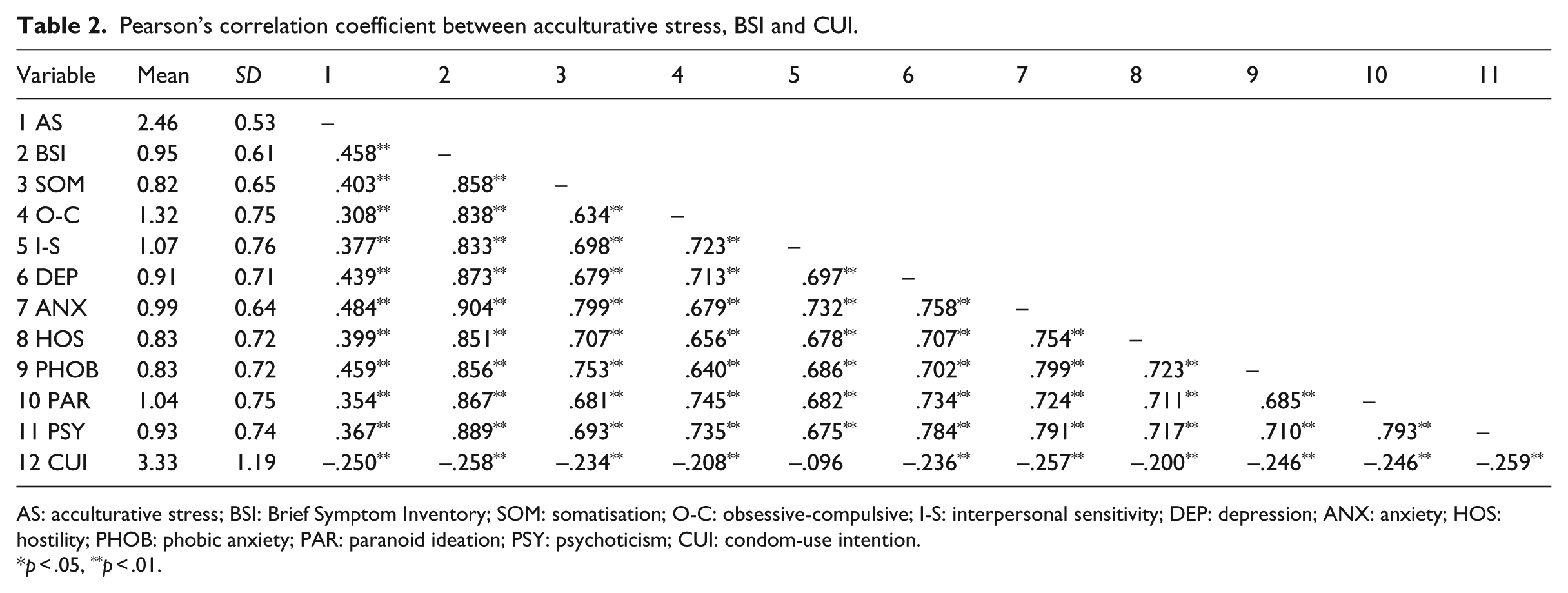
AS: acculturative stress; BSI: Brief Symptom Inventory; SOM: somatisation; O-C: obsessive-compulsive; I-S: interpersonal sensitivity; DEP: depression; ANX: anxiety; HOS: hostility; PHOB: phobic anxiety; PAR: paranoid ideation; PSY: psychoticism; CUI: condom-use intention.
p < .05, **p < .01.
SEM of mediation modelling analysis
The proposed effect of BSI in mediating the relationship between acculturative stress and condom-use intention was assessed using SEM analysis. The data-model fit met the criteria with χ2 = 964.62, df = 501, p < .001; RMSEA = .04; SRMR = .05; CFI = .95. As shown in Figure 1, acculturative stress was positively associated with BSI, with β [95% CI] = .50 [.39, .60], p < .01, which in turn was negatively associated with CUI, with β = –.20 [–.34, –.05], p < .01. Acculturative stress was significantly associated with CUI through direct effect (effect = –.15 [–.28, –.01], p < .05) accounting for 60% [.15 / (.10 + .15)] of the total effect, as well as indirect effect (effect = –.10 [–.18, –.03], p < .05) accounting for 40% [.10 / (.10 + .15)] of the total effect.
When analysed by gender, among men, the indirect effect from acculturative stress to CUI mediated by BSI was significant (effect = –.10[–.21, –.01], p < .05) while the direct effect was not significant (effect = –.13[–.34, .08], p > .05). No significant direct (effect = –.36[–.86, .15], p < .05) and indirect effects (effect = –.10 [–.22, .02], p < .05) were observed among women.
The results from an in-depth analysis of individual BSI subscales (Table 3) indicated that among men, among the nine BSI subscales, ANX, PHOB and PSY significantly mediated the relationship between acculturative stress and CUI (column 3 in Table III). None of the mediation effects of the nine BSI subscales was statistically significant among women (column 3 in Table 3).
Results from mediation modelling analysis of acculturative stress, BSI and condom-use intention by gender, standardised effect (95% CI).
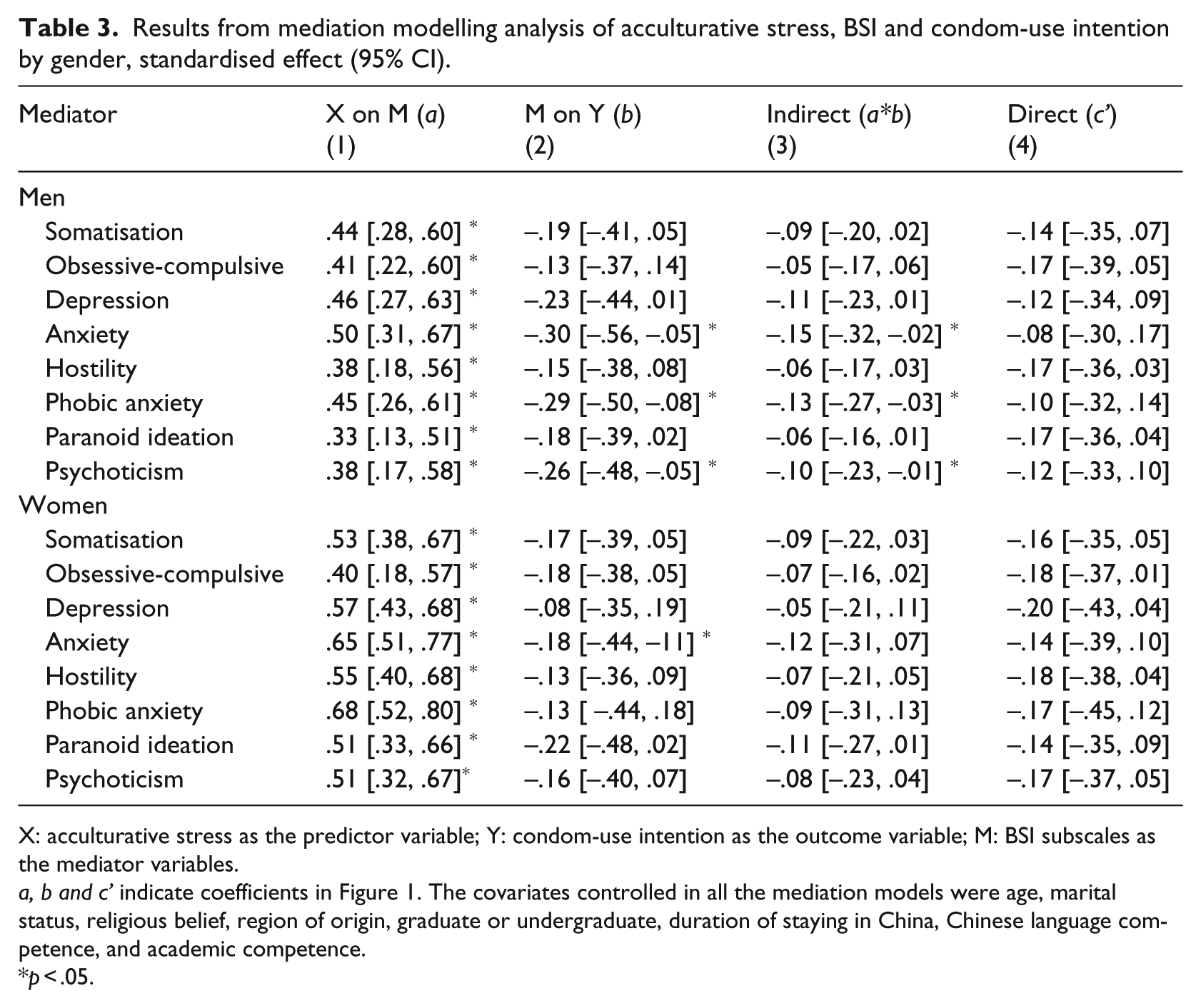
X: acculturative stress as the predictor variable; Y: condom-use intention as the outcome variable; M: BSI subscales as the mediator variables.
a, b and c’ indicate coefficients in Figure 1. The covariates controlled in all the mediation models were age, marital status, religious belief, region of origin, graduate or undergraduate, duration of staying in China, Chinese language competence, and academic competence.
p < .05.
Discussion
International migration has been increasing along with globalisation, and the international student is a special part of the mobile population. Despite enjoying advantages compared to other mobile populations, international students have to go through a similar acculturation process to many other mobile populations in order to complete their academic programmes and achieve their educational goals, and this process can potentially result in acculturative stress. Such stress represents a risk factor for mental and behavioural problems, as reported by other research (Berry, 1997; Jardin et al., 2016). Building on previous research into the relationship between acculturative stress, mental health and health risk behaviour, and newly collected data for this study, our research has confirmed the mediation model we proposed for international students in China, in which poor mental health serves as a mediator significantly bridging the relationship between the predictor variable (acculturative stress) and the outcome variable (intentions to use condom during sex).
Findings from our study point to a direct and negative association between acculturative stress and condom-use intention. These associations remained significant after the mental health measure BSI was considered. This finding is consistent with those from published studies (Jardin et al., 2016). In line with this finding, it might be predicted that students from other countries studying in Beijing may be more likely to have sex without using a condom if they suffer from acculturative stress, because experiencing acculturative stress may mean they have a reduced intention to use condoms during sex. This phenomenon of engaging risk behaviour is supported by theory suggesting that stress can activate coping behaviour, but ineffective coping may lead to health-related risk behaviour (Wills et al., 2001). On the other hand, a rather different kind of explanation could be that having unprotected sex represents avoidance coping, in which students attempt to dissociate themselves from stressful situations (Roth and Cohen, 1986).
More important than confirming the relationship between acculturative stress and intention to use a condom during sex is that we demonstrated a mechanism to explain the relationship between the two factors – namely a mediation mechanism by poor mental health status. The partial mediation effect observed from our study suggests that for some international students, acculturative stress was directly associated with reduced intention to use a condom during sex. However, for other students, only if acculturative stress leads to poor mental health (e.g. anxiety and depression) does it activate negative or ineffective coping, resulting in reduced intentions to use protective measures (e.g. using a condom during sex). These findings are similar to those of previous studies in which poor mental health was found to mediate the relationship between different kinds of stress and health-related risk behaviours (Barbosa-Leiker et al., 2014; Yu et al., 2016).
We also noted gender differences in the mediation mechanism. For men, the effects of acculturative stress on condom-use intention were fully mediated by poor mental health. The indirect effect from acculturative stress to condom-use intention mediated by BSI was not statistically significant among women at a significance level of 0.05. However, the upper limit of the 95% CI of indirect effects (–.10 [–.22, .02]) among women was only slightly beyond 0, which may be caused by an insufficient sample size, with a lower statistical power. Thus, the indirect effect among women may also be of practical significance, but with a relatively lower effect size than the indirect effect among men.
Further analysis of BSI by its sub-constructs indicated that anxiety and phobic anxiety each significantly mediated the relationship between acculturative stress and condom-use intention. This finding appears reasonable for international students. Anxiety is an emotion based on the symbolic, anticipatory and uncertain appraisal of threat (Spielberger, 1972). Individuals with phobic anxiety or agoraphobia are likely to be fearful and anxious about certain situations, such as public transport, open spaces and crowds (American Psychiatric Association, 2013), all of which are applicable to the situation of international students. Some stressed students may perceive the new culture and environment as threats rather than opportunities (Berry, 1997).
Psychoticism is another BSI sub-construct that significantly mediated the relationship between acculturative stress and condom-use intention. Psychoticism is a measure of social alienation (Derogatis and Melisaratos, 1983). The significant mediation mechanism suggests that international students with acculturative stress are more likely to think that they are alienated, isolated or marginalised; therefore, their intentions to use a condom may be reduced as a poor or ineffective coping. In a related mechanism, separation from the host culture due to acculturative stress can lead to inadequate social support, reducing the likelihood of engaging in safer sex (Glick and Golden, 2014; Lee et al., 2009).
Findings from this study, if verified by larger scale data, may be of significance in developing programmes and interventions to reduce risk of HIV infection among international students, particularly those under acculturative stress. At the macro and societal level, such programmes should recognise that acculturative stress may be long-lasting because stressors such as opportunity deprivation, value conflict and rejection can only be eliminated gradually along a part of ongoing adjustment and development (Berry, 1997; Sandhu and Asrabadi, 1994; Yu et al., 2014).
At an individual student level, findings from this study suggest a significant role of acculturative stress in predicting condom-use intentions, and poor mental health may explain the ineffective coping with acculturative stress that leads to reduced condom-use intentions (Berry, 1997; Ward and Rana-Deuba, 1999). Consequently, programmes and interventions to help students suffering from acculturative stress may provide a useful way of promoting condom use.
In addition to reducing acculturative stress, the findings from our study suggest another method of promoting condom use by improving mental health status. If stressed students can successfully maintain good mental health status, this may ‘block’ the impact of stress on unhealthy behaviour, and therefore increase the intention to use condoms.
Limitations
The present study has some limitations. First, our mediation model was tested using cross-sectional survey data. A longitudinal study is needed in order to draw causal conclusions. Second, the study sample was a convenience sample selected from a small number of institutions in Beijing only. Thus, serious caution is needed when generalising the findings of this study.
Conclusion
Despite its limitations, this study is the first to examine a mediation model in predicting intention to use condoms among international students in China, in which poor mental health serves as a mediator that significantly bridges the relationship between acculturative stress and condom-use intentions. Such information extends our understanding of the relationship between acculturation and health-related behaviour and may be valuable as part of broader efforts for HIV prevention.
Footnotes
Authors’ Note
The first two authors, Ningxi Yang and Yayun Xu, have contributed equally to this work.
Ethical Approval
All procedures performed in studies involving human participants were conducted in accordance with the ethical standards of the institutional research committee approving the study and the 1964 Helsinki Declaration and its later amendments.
Funding
The author(s) disclosed receipt of the following financial support for the research, authorship, and/or publication of this article: This study was funded by School of Health Sciences, Wuhan University, Wuhan, Hubei, China.