



Abstract
Aims:
The aim of this study was to evaluate the outcomes of Cool and Clean, Switzerland’s largest substance use prevention programme, targeted specifically at 10- to 20-year-olds who belong to a sports club and train as part of a team.
Method:
Based on a representative sample of young people who belong to a sports club and train as part of a team (both participants and non-participants in ‘cool and clean’), a post-test–only static group comparison was used to analyse data on 1,887 individuals from 179 teams (mean age: 13.8; 33.5% girls). Outcome variables included sports-related aspects (achievement motivation, fair play); attitudes towards tobacco, cannabis and alcohol use, and doping; and substance use (tobacco, cannabis and alcohol use).
Results:
Cool and Clean participants self-reported beneficial effects of the programme in all outcome areas. They also had a more critical attitude towards doping and substance use in general and had a lower reported frequency of cannabis use than non-participants. We found no significant group differences in terms of sports-related variables, tobacco and alcohol use. However, in each of these areas, better outcomes were found among Cool and Clean participants who trained with teams that implemented the programme more comprehensively.
Conclusions:
There is cross-sectional evidence for the effectiveness of the Cool and Clean programme. Moreover, the level of impact of the programme depends not only on participation per se but also, and more decisively, on how comprehensively the programme is implemented.
Introduction
Substance use is a major risk factor for morbidity and premature death worldwide (Lim et al., 2012; Warren et al., 2006) and presents an enormous burden for individuals and society (Rehm et al., 2007). Adolescence is a critical window of vulnerability to substance use disorders (Ewing et al., 2014). Substance use that often first occurs during adolescence is often associated with negative consequences in that particular period of life (Boden and Fergusson, 2011; Inchley et al., 2016; The ESPAD Group, 2016). However, it is also associated with riskier substance use patterns later in adulthood (Chassin et al., 2004; Chen and Jacobson, 2012; Riggs et al., 2007), hence the plethora of prevention initiatives that specifically target the adolescent age group (Griffin and Botvin, 2010).
A recent meta-analysis of 46 systematic reviews (Das et al., 2016) showed that school- and family-based interventions are effective in preventing the use of tobacco, alcohol and combined substances. Although empirical findings for other settings, such as those that are sports-related, are scarce, some studies have indicated the beneficial effects of interventions to promote healthy behaviour and improve health outcomes (Geidne et al., 2013; Kingsland et al., 2016; Kokko et al., 2014). However, to date only three randomised controlled trials have been conducted in this specific setting, with only two of them reporting positive outcomes regarding alcohol use (Kingsland et al., 2016). Therefore, there is currently no major evidence of the effects of such prevention efforts on young people’s substance use (Flatz et al., 2016). The aim of the present study was to evaluate the outcomes of Cool and Clean, Switzerland’s largest substance use prevention programme (Solèr et al., 2015), which involves about 50,000 young participants between the ages of 10 and 20.
Sports organisations hold great potential for health promotion (Crisp and Swerissen, 2003; Giles-Corti et al., 2001; Kokko, 2014). Kokko (2014) summarises the following advantages of sports club interventions: (1) sports clubs’ reach and involvement of a large number of young people, (2) the provision of role models with great potential for influence, (3) how risky behaviours such as substance use can impair sports performance and athletic development is easily comprehensible and observable for young people and (4) as participation in the sports activity is voluntary, sports clubs provide a excellent setting for informal education. This last argument is clearly an advantage compared to school-based programmes. However, limited control over facilities, other club priorities and limited funding can impede the implementation of preventive efforts in these organisations (Dobbinson et al., 2006; Payne et al., 2002) as well as their evaluation and publication (Priest et al., 2008). A partnership between practitioners and academic based researchers could therefore provide theory-based, appropriately evaluated programmes that can be published and disseminated (cf. Payne et al., 2002; Priest et al., 2008).
The target population of Cool and Clean is 10- to 20-year-olds who belong to a sports club and train as part of a team. This corresponds to about 55% of the total Swiss population in that age group (Lamprecht et al., 2011). Cool and Clean, which is run by Swiss Olympic, is applicable to all sports (individual as well as group sports) that involve training in teams as a leisure-time activity. The prevention programme also offers modules targeted at the next generation of sporting talent and the organisers of sports events; however, they are not the subject of the present study. Cool and Clean is a universal prevention programme (i.e. the programme targets young people in sports teams in general; Gordon, 1983) based on a life skills approach (World Health Organization [WHO], 1997), which aims to prevent problematic behaviour via the facilitation of intra- and interpersonal skills that equip the individual to deal with everyday challenges and developmental tasks. The programme adopts a holistic approach to prevention, and its primary focus is on tobacco, cannabis and alcohol use. However, it also incorporates awareness-raising about doping, critical attitudes towards doping and substance use (i.e. predictors of later substance use; Hemphill et al., 2011) and sports-related aspects of substance use.
Once team leaders have signed up a sports team to Cool and Clean, all of its members automatically participate in the programme. The team leaders form the link between the organisers of the programme (i.e. Swiss Olympic) and team members, as the organisers do not directly contact the young people. While all team leaders receive educational/teaching materials (e.g. educational games, resources for group discussion, a DVD) and suggestions on how to implement the programme, team leaders are free to decide which elements to use. Therefore, across Cool and Clean teams, the degree of implementation varies considerably (for further details about the preventive measures see the Method section). However, young people training in Cool and Clean sports teams are expected to adhere to what the programme calls ‘commitments’; these not only relate directly to the programme content but are in themselves a preventive instrument. The six commitments are as follows: (1) ‘I want to achieve my goals!’, (2) ‘My behaviour is fair!’, (3) ‘I achieve without doping!’, (4) ‘I say no to smoking!’, (5) ‘I say no to alcohol!’ (applies specifically to the under-16 age group) or ‘When I drink alcohol, I do so without causing harm to myself or others’ (applies specifically to the 16+ age group) and (6) ‘I/We … ’ (a commitment defined either by the individual or the team).
The outcomes of the Cool and Clean programme have previously been evaluated (Annaheim et al., 2007, for data collected in 2007; Wicki et al., 2012, for data collected in 2009 and 2011) using post-test–only static group comparisons (Spector, 1981), which compared young people who trained with participating sports teams (participant group, PG) and those who trained with non-participating teams (comparison group, CG). In these studies, the PG tended to have a more critical attitude towards doping and substance use than the CG; findings were less clear in relation to substance use. Within the PG, a more comprehensive programme implementation was associated with a more critical attitude towards substance use, as well as lower tobacco, cannabis and alcohol use. However, the comprehensiveness of the implementation was based only on the young people’s reports. To test for a possible selection bias in the 2009 and 2011 assessments, an additional waiting-list group (WG) was included to test whether young people in teams, who were interested in participating in ‘cool and clean’ but had yet joined, differ from the CG (Wicki et al., 2012). No significant difference in terms of the outcome variables (achievement motivation, fair play, critical attitude towards doping and towards substance use, the use of tobacco, cannabis or alcohol) between the WG and the CG could be found in the 2009 and 2011 assessments (with one exception: the prevalence of smoking was lower in the WG than in the CG in the 2011 assessment). Therefore, the alternative explanation that teams with especially ‘well-behaved’ young people sign up for the programme was eliminated, and differences found between PG and CG were interpreted as positive effects due to Cool and Clean participation.
To overcome the limitations of the previous outcome evaluations of Cool and Clean, the present study asked both young participants and team leaders about the implementation of the programme. Other studies have found that the benefits of universal substance use prevention programmes are linked to the programme’s exposure and lesson coverage (Durlak and DuPre, 2008; Ferrer-Wreder et al., 2010). Based on previous outcome evaluations (Annaheim et al., 2007; Wicki et al., 2012) and the international literature (Das et al., 2016; Faggiano et al., 2014), we explored three types of indicators to determine any beneficial effect of the programme and established the following three hypotheses: (1) the PG perceives improvements in the outcome variables (sports-related outcomes, attitude towards doping and substance use, and current substance use) due to Cool and Clean (I. ‘appraisal of the programme’); (2) within the PG, a more comprehensive implementation is associated with more benign scores for the outcome variables (II. ‘degree of implementation’) and (3) the PG achieves better scores for the outcome variables than the CG (III. ‘group comparisons’).
Method
Preventive measure
Cool and Clean interventions are intended to provide young people with emotional access to the commitments, rather than the transfer of knowledge per se. This is accomplished, for example, by participation in educational games or group discussions. While the programme recommends that young people sign the commitments and that educational games are used to reinforce them, team leaders are free to decide to which degree they wish to implement the programme. Based on a life skills approach (WHO 1997), Cool and Clean seeks to enhance participants’ personal responsibility (e.g. by signing the commitments), to strengthen purposefulness and personal competence (e.g. in the context of the first commitment by learning to use strategies to structure and track short- and long-term goals), to experience and establish relationships independent of the use of psychoactive substances (e.g. by spending time in a sports team where peers say no to tobacco and alcohol), to take responsibility (e.g. by formulating the sixth commitment), and to improve communication skills (e.g. by participating in the group discussions after the educational games). 1
Study design
The present evaluation could not utilise a randomised control trial design because the Cool and Clean programme is an ongoing intervention with participating teams registering of their own accord and many teams having already participated for several years. The study, therefore, used a pseudo-experimental design that included and compared young people from teams who had been participating in Cool and Clean for at least 6 months (PG) with young people from non-participating teams (CG).
Data collection
Team leaders were informed about the study by letter and contacted by telephone to encourage them to participate. As an incentive, three gift vouchers for sports equipment (approximately €400) were raffled among all of the teams participating in the study (PG and CG). The evaluation questionnaires (separate questionnaires for young people and team leaders) were sent to the participating team leaders by post (at the end of January 2015), filled out by all of the young people present during a routine training session and returned (by the end of April 2015). All questionnaires were available in German, French and Italian. Three follow-up reminders (one by letter, two by e-mail) were sent to enhance study participation. In accordance with the Helsinki Declaration (World Medical Association, 2013), participation in the study was voluntary for the young people and full anonymity was assured (e.g. young people placed their completed questionnaires in an unmarked envelope before handing them back to the team leaders).
Sample
Team leaders were randomly selected based on a full address list provided by Swiss Olympics, the organisers of Cool and Clean (for the PG), and from Youth+Sport, the umbrella organisation of sports associations in Switzerland (for the CG). Sampling was stratified by linguistic region (German-, French- and Italian-speaking) and by type of sport to ensure that the distribution of sports in the PG and CG was representative of the total Cool and Clean population. A total of 369 team leaders (PG = 162, CG = 207) were contacted and 179 (PG = 92, CG = 87) returned completed questionnaires. As 42 teams (PG = 15, CG = 27) were neutral non-participants (e.g. sports teams which had since been disbanded), the participation rate at team level was 54.7% (PG = 62.6%, CG = 48.3%). All the team leaders in the PG and 92.1% of team leaders in the CG returned the study protocol including answers to questions on programme implementation (see Table 1 for details). Of the 2,088 (PG = 1,204, CG = 884) questionnaires that were completed by young people, 121 (PG = 89, CG = 32) were excluded due to missing answers on gender or age or due to highly inconsistent responses. Furthermore, 80 questionnaires (PG = 51, CG = 29) were not considered in the analyses as participants were older than 20 or younger than 10 years. The final sample of young people consisted of 1,887 individuals (33.5 % girls) aged between 10 and 20 years of age (M = 13.8, SD = 2.30).
Overview of variables.
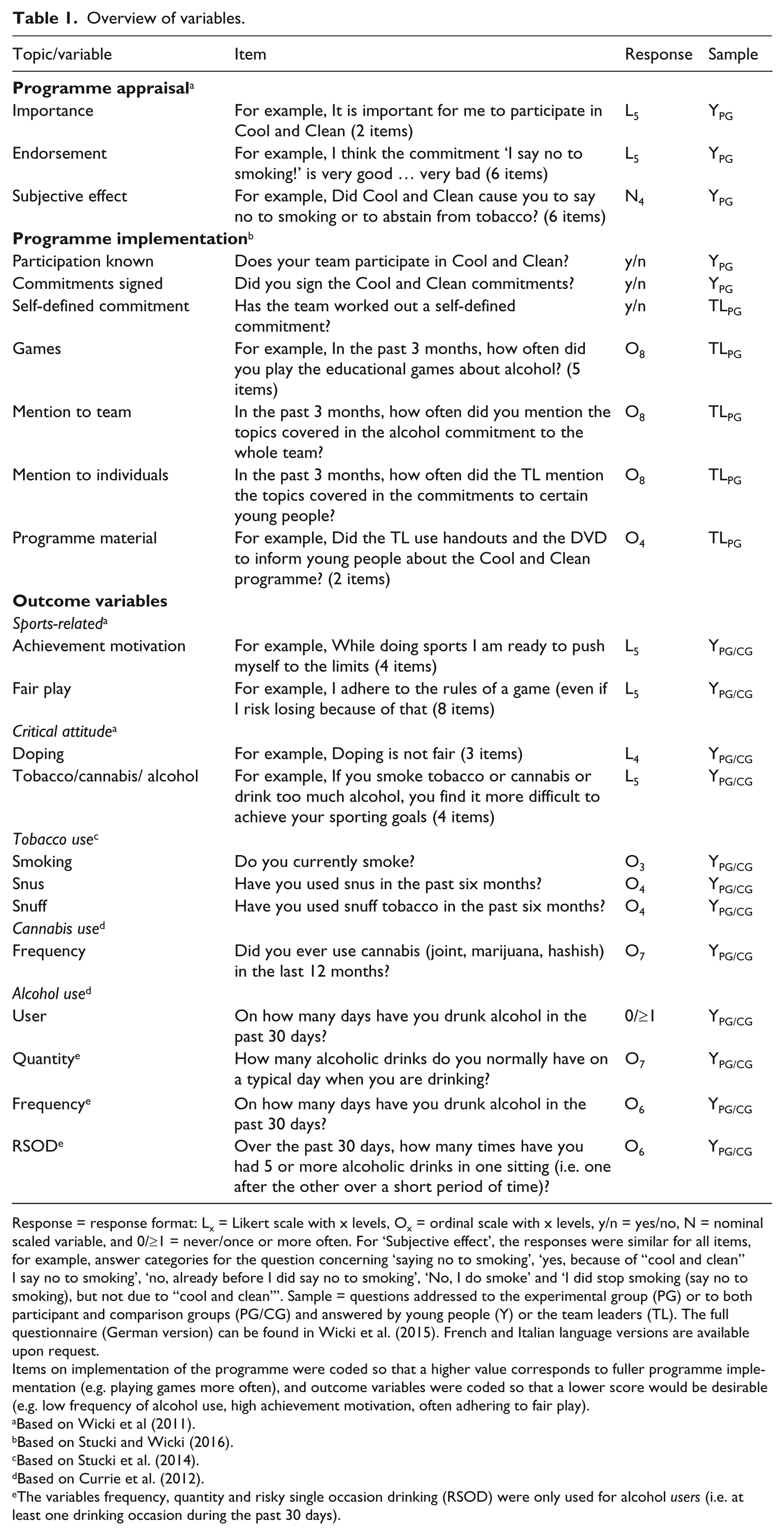
Response = response format: Lx = Likert scale with x levels, Ox = ordinal scale with x levels, y/n = yes/no, N = nominal scaled variable, and 0/≥1 = never/once or more often. For ‘Subjective effect’, the responses were similar for all items, for example, answer categories for the question concerning ‘saying no to smoking’, ‘yes, because of “cool and clean” I say no to smoking’, ‘no, already before I did say no to smoking’, ‘No, I do smoke’ and ‘I did stop smoking (say no to smoking), but not due to “cool and clean”’. Sample = questions addressed to the experimental group (PG) or to both participant and comparison groups (PG/CG) and answered by young people (Y) or the team leaders (TL). The full questionnaire (German version) can be found in Wicki et al. (2015). French and Italian language versions are available upon request.
Items on implementation of the programme were coded so that a higher value corresponds to fuller programme implementation (e.g. playing games more often), and outcome variables were coded so that a lower score would be desirable (e.g. low frequency of alcohol use, high achievement motivation, often adhering to fair play).
Based on Wicki et al (2011).
Based on Stucki and Wicki (2016).
Based on Stucki et al. (2014).
Based on Currie et al. (2012).
The variables frequency, quantity and risky single occasion drinking (RSOD) were only used for alcohol users (i.e. at least one drinking occasion during the past 30 days).
Measures
Table 1 provides an overview of the variables used in the study and indicates whether the questions were addressed to young people or the team leaders in the PG and CG. All items were used and pre-tested in previous studies covering all three linguistic regions of Switzerland (German, French, Italian: Currie et al., 2012; Stucki and Wicki, 2016; Stucki et al., 2014; Wicki et al., 2012).
Programme appraisal
As shown in Table 1, young people in the PG rated the importance of the programme, their endorsement of the commitments and whether they perceived a subjective effect of Cool and Clean (in terms of achievement motivation, fair play, doping knowledge, tobacco, cannabis and alcohol use).
Programme implementation
In addition, young people as well as team leaders in the PG indicated to what extent the programme had been implemented in their team. For example, young people were asked whether they had signed the commitments, while team leaders were asked how often they played the educational games.
Outcome variables
Young people in both the PG and the CG answered questions on all programme areas: sports-related variables (achievement motivation, fair play); critical attitude towards doping and to tobacco, cannabis and alcohol use; and use of tobacco (smoking, snus [a moist powder tobacco product, usually placed under the upper lip], snuff tobacco [ground tobacco, usually inhaled into the nasal cavity]), cannabis (frequency) and alcohol (use, quantity, frequency, risky single occasion drinking [RSOD]); for full details see Table 1.
Covariates and independent measure
Gender (female = 0, male = 1), age (in years and months) and age group (10- to 13-year-olds, 14- to 15-year-olds, 16- to 20-year-olds) were used as covariates. Group condition (CG = 0, PG = 1) was used as an independent measure.
Analysis
Results for hypothesis I were based on descriptive analyses (means, 95%-confidence intervals). For hypothesis II and III, ordinal logit regression models were used to regress outcome variables on the indicators relating to the degree of implementation and group conditions (CG = 0, PG = 1), respectively, and age (in months). To adjust for possible gender and non-linear age effects, the analyses were stratified by gender and age groups, and estimated effects for implementation and group differences were pooled using a meta-analytic strategy with random effects (METAN, Higgins et al., 2003) in StataCorp (2013) 13. To assess ‘degree of implementation’ (II), effects for the different implementation indicators (see “Programme implementation” in the “Measures” section) were estimated separately, and these effects were then pooled for each outcome variable (e.g. overall effect of implementation on critical attitudes to doping). A two-step strategy was used for the outcome variables on alcohol use. First, use during the past 30 days was considered as an outcome variable, then frequency, quantity and RSOD were analysed among users only. All analyses took the cluster sampling into account, and a weight variable was used to adjust the distribution of different types of sports within the PG and CG to the ‘cool and clean’ population.
Results
The overall sample included 1,887 young people of whom 33.5% were girls, and the mean age was 13.8; this gender and age distribution corresponds well to the target population (Lamprecht et al., 2011). The large majority of young people in the PG and the CG were non-smokers and had never tried snuff, snus or cannabis (cf. Table 2). Of the 40% of young people who had already used alcohol, the majority did not usually drink more than one alcoholic drink on any occasion and had not engaged in RSOD in the past 30 days.
Sample description.

Importance = ‘not important/neutral’: any of the item rated as ‘strongly disagree’, ‘disagree’ or ‘neutral’; ‘important’: both items rated as ‘strongly agree’ or ‘agree’; Commitment = ‘bad/neutral’: any of the commitments rated as ‘very bad’, ‘bad’ or ‘neutral’; ‘good’: all commitments rated as ‘very good’ or ‘good’.
Usual quantity, frequency and risky single occasion drinking (RSOD) in the past 30 days among ‘users’ (i.e. those who used alcohol once or more often in the past 30 days).
Programme appraisal
In the PG, about 60% of the young people rated the programme and their participation in it as ‘important’ or ‘very important’ (cf. Table 2). Also, the vast majority (approximately 90%) rated each commitment as ‘very good’ or ‘good’. A large share of young people in the PG felt their behaviour was already ideal especially in terms of substance use, but also regarding fair play and achievement motivation (cf. Table 3). The area where young people reported the greatest improvement due to programme participation was ‘doping knowledge’, followed by ‘achievement motivation’ and ‘fair play’. Young people reporting an improvement attributed this more often to Cool and Clean than to other factors (as shown by non-overlapping confidence intervals). However, this result was not significant for alcohol and cannabis use.
Subjective effects of Cool and Clean: perceived improvements in the areas of substance use and sport-related outcomes among the PG (percentage and 95%-confidence interval).
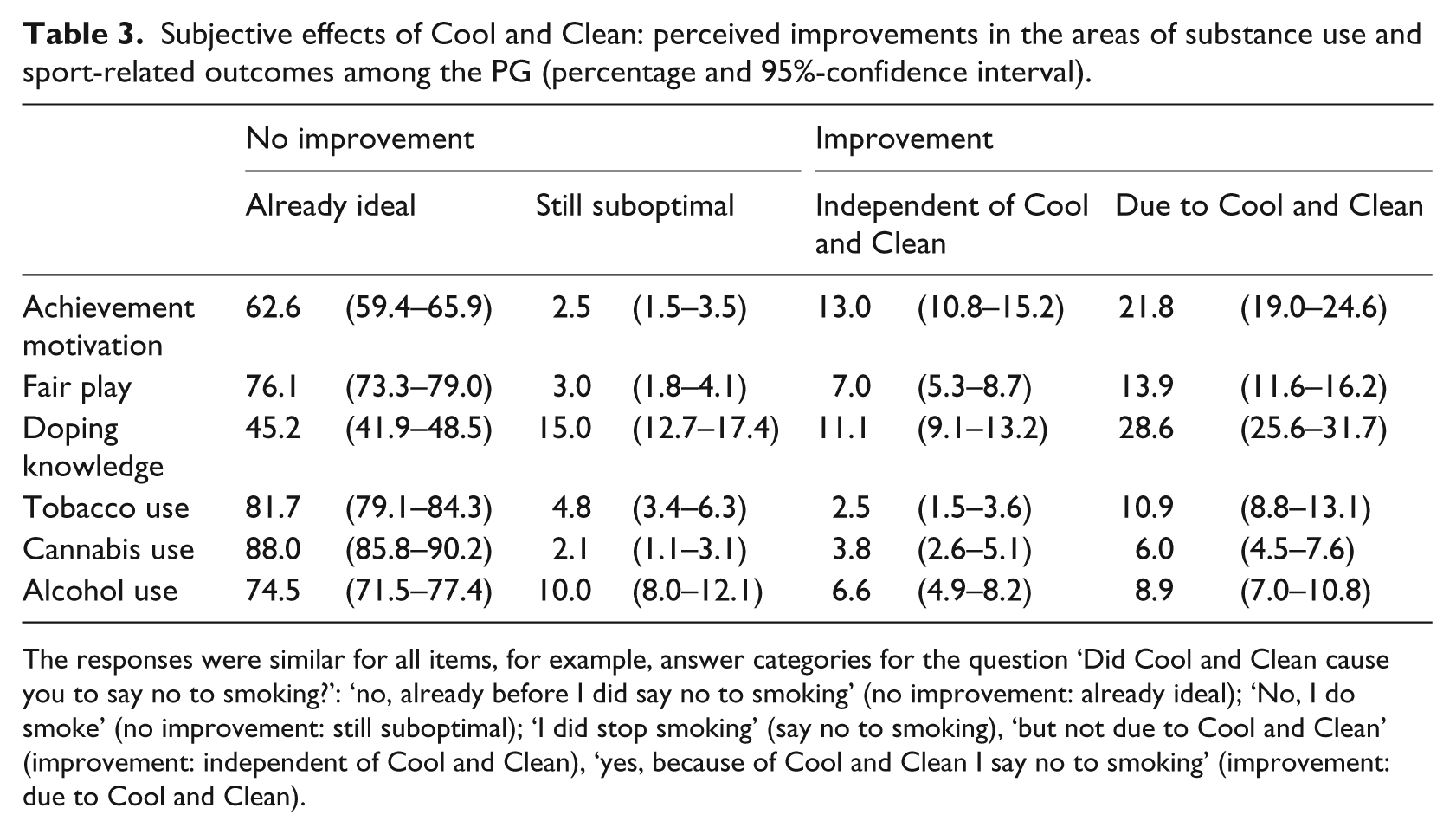
The responses were similar for all items, for example, answer categories for the question ‘Did Cool and Clean cause you to say no to smoking?’: ‘no, already before I did say no to smoking’ (no improvement: already ideal); ‘No, I do smoke’ (no improvement: still suboptimal); ‘I did stop smoking’ (say no to smoking), ‘but not due to Cool and Clean’ (improvement: independent of Cool and Clean), ‘yes, because of Cool and Clean I say no to smoking’ (improvement: due to Cool and Clean).
Degree of programme implementation
Among the teams in the PG, 79.6% of young people were aware that their team participated in Cool and Clean, and 54.2% reported that they had signed the programme commitments. A total of 40.3% trained in teams with a self-defined commitment, and 34.8% played the educational games monthly or more. Another 40.2% reported that the subjects addressed in the commitments were mentioned monthly or more within the team, and 36.4% stated that the team leader also discussed the commitments with team members on a one-on-one basis. More than one-third of young people (37.6%) received the handouts and watched the DVD with their team (results not presented in Table 4).
Estimated effects due to the degree of programme implementation in the PG and due to group condition (CG vs PG).
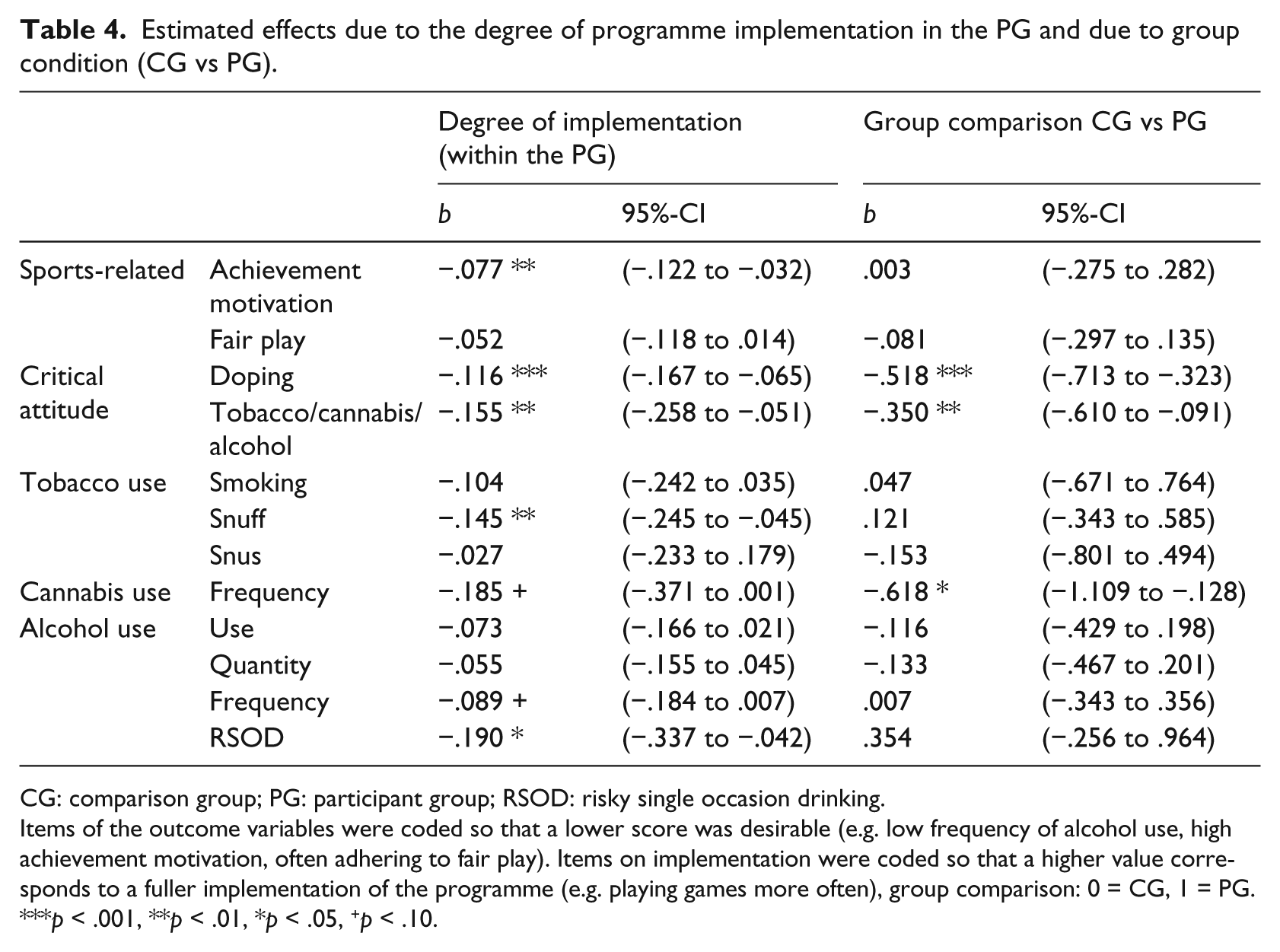
CG: comparison group; PG: participant group; RSOD: risky single occasion drinking.
Items of the outcome variables were coded so that a lower score was desirable (e.g. low frequency of alcohol use, high achievement motivation, often adhering to fair play). Items on implementation were coded so that a higher value corresponds to a fuller implementation of the programme (e.g. playing games more often), group comparison: 0 = CG, 1 = PG.
p < .001, **p < .01, *p < .05, +p < .10.
The more comprehensive the programme implementation was, the better the scores on the outcome variables (Table 4, detailed results by age groups are available from the authors upon request): young people reported higher achievement motivation, had a more critical attitude towards doping and substance use, used snuff less frequently, while alcohol using adolescents engaged in RSOD less frequently. A similar effect could be found for cannabis use and the frequency of alcohol use but at a significance level of p < .10. Effects for the remaining five outcome variables (fair play, smoking, snus use, alcohol use and quantity of alcohol use) showed similar trends, however, they were not statistically significant.
Group comparisons
When the PG and the CG were compared, young people from participating teams did not score higher on sports-related outcomes (achievement motivation, fair play), but reported a significantly more critical attitude towards doping and tobacco, cannabis and alcohol use (Table 4, detailed results by age groups are available from the authors upon request). Regarding substance use, a significantly lower frequency of cannabis use was found among those in the PG compared to those in the CG. There were no significant differences for tobacco or alcohol use between the two groups.
Discussion
The aim of this study was to evaluate the Cool and Clean prevention programme in a context where the implementation of a randomised control trial or longitudinal study was not possible. Based on a post-test–only static group comparison, three types of indicators of a beneficial effect on 10- to 20-year-olds who belong to a sports club and train as part of a team could be shown: (1) subjectively perceived positive effects due to Cool and Clean and (2) better outcomes in the case of a more comprehensive programme implementation among participants, as well as (3) group differences between participants and non-participants in the desired direction. Findings were in line with previous studies and the international literature (Annaheim et al., 2007; Wicki et al., 2012).
Critical attitude
At a mean age of nearly 14 years, the vast majority of young people reported tobacco or cannabis abstinence. Of the 40% who reported using alcohol in the past 30 days, only one-third drank more than one drink on any one occasion or had engaged in RSOD over the past 30 days. Given the low prevalence of substance use, a floor effect exists (Pinquart and Silbereisen, 2004), making it difficult to find associations with the degree of implementation or differences between the PG and CG. However, when we look at the critical attitude towards substance use, which has been shown to be a protective factor for later substance use (e.g. Hemphill et al., 2011), the present results demonstrate that programme participants reported a more critical attitude towards doping, as well as to tobacco, cannabis and alcohol than non-participants. Among participants, the attitude was even more critical with more comprehensive programme implementation.
Degree of programme implementation
Regarding the comparisons between the PG and CG, we found indicators that the programme was effective for the critical attitude towards doping and substance use and for cannabis use; no effect was found for sport-related outcomes, tobacco and alcohol use. However, in all of these three areas, more comprehensive implementation was associated with a better outcome: higher achievement motivation (which is in terms of the life skills approach to an important personal competence (WHO, 1997), lower snuff use, lower frequency of RSOD and, as a trend (.10 > p > .05), lower frequency of alcohol use. These findings indicate that the possible impact of the programme depends not only on participation per se but also, and more decisively, on how comprehensively it is implemented. A parallel qualitative evaluation study among participating teams (Stucki & Wicki, 2015) showed that team leaders were not more inclined to further implement Cool and Clean if the teams already showed positive behaviour reflected in outcome variables (e.g. low substance use). Therefore, the alternative interpretation of the degree of implementation findings, i.e. that the found associations were due to pre-intervention differences, seems quite unlikely. Furthermore, the findings of the present study are also in line with those of two reviews showing that programme exposure and lesson coverage (i.e. the degree of implementation) play a key role and are positively linked to the benefits of universal substance use prevention programmes (Durlak and DuPre, 2008; Ferrer-Wreder et al., 2010). Based on the review by Durlak and DuPre (2008), which analysed factors affecting the implementation process, and based on the qualitative study among participating teams (Stucki & Wicki, 2015), key factors for the implementation of Cool and Clean seem to be trainers’ perception of the usefulness of the programme (e.g. training in life skills even before the initiation of substance use), their skills in implementation, and the provision of support (e.g. how to address substance use in their team). Finally, it is crucial that the interventions (e.g. educational games or teaching material) are compatible and adaptable, for example, to the type of sports or the age group.
Teams in sport clubs as an ideal setting
The general advantages of sports club teams as a setting for health promotion, as detailed by Kokko (2014), are valid for the Cool and Clean programme: that is, (1) a large proportion of 10- to 20-year-olds are involved in a sport club and train as part of a team (especially 10- to 14-year olds and boys: cf. Lamprecht et al., 2011); (2) teams participate voluntarily in the programme, and participants rate the commitments as valuable and describe the programme and their participation in it as important; and (3) educational games and group discussions are used to help young people obtain emotional access to the commitments. In addition, Cool and Clean benefits from already established structures within Youth+Sports and Swiss Olympics (e.g. team leader training and information dissemination) that help to save costs, but also ensure that the source of the prevention information provided is evidence-informed and trustworthy. However, due to the rather low prevalence of substance use among young people (Inchley et al., 2016), team leaders need to be motivated to engage in a programme to prevent substance use and to help develop the necessary life skills before young people initiate substance use. In the case of Cool and Clean, this is achieved by including both sports- and substance-related topics, establishing clear commitments and widening the focus to cover life skills in general.
Strengths and limitations
A shortcoming of the present study is its cross-sectional post-test–only static group comparison design preventing teams from being randomly assigned to the participant or comparison group. As the intervention programme is ongoing, all participating teams registered of their own accord and many teams had already been participating for several years. Without pre–post measurements, it was not possible to analyse changes within the PG or CG, and any observed differences (between the PG and CG or due to the degree of implementation) can only be used as an indicator of the Cool and Clean effects. However, experience from previous data collection (2009, 2011) shows that due to structural difficulties (e.g. there were no address lists of adolescents participating in sports teams, so contacts could only be established via the team leader) and considerable fluctuation in team membership, a longitudinal study design or a pre–post measurement would be difficult and would have required considerably more resources (Wicki et al., 2012). Based on prior analyses, the authors assume that there was no a priori difference between the comparison group and teams interested in participating in the programme (Wicki et al., 2012). However, the present study also used quota sampling, weighting and stratified analysis to ensure that PG and CG were comparable in terms of sports, language region, gender and age and corresponded to the distribution of these characteristics in the Cool and Clean target population. Given that up to now only a few randomised control trials have evaluated intervention studies for substance use in sports club settings (Kingsland et al., 2016; Priest et al., 2008), the present study makes a valuable contribution by triangulating several indicators of the beneficial effects of the intervention programme for young people.
Conclusion
In the absence of other clear evidence of substance use prevention in a sports club setting (Flatz et al., 2016) or other good quality evaluations such as randomised control trials or prevention approaches that have been proven effective in other settings (e.g. Das et al., 2016; Faggiano et al., 2014), the findings from the present study provide a guide for prevention efforts in this area by highlighting the importance of the programme implementation. The present study found three different indicators of beneficial effects on young people’s sports-related and substance use–related attitudes and substance use: the perceived effects of the programme; the degree of the implementation and differences between participating and non-participating groups. These findings suggest that team sports provide a useful vehicle for effective communication to and behavioural influence on adolescents and point to implementation practice that can be translated to other intervention programmes.
Footnotes
Acknowledgements
The authors thank Edith Bacher, Anna Fankhauser, Ruth Flury, Christiane Gmel, Yeelen Maole, Miriam Menzi, Silvina Stettler and Undine Zippler for their assistance in relation to the fieldwork and project administration. Matthias Wicki, Stephanie Stucki and Beatrice Annaheim conceptualised the evaluation study, with inputs from Sandra Kuntsche. Matthias Wicki and Stephanie Stucki conducted the fieldwork and data collection, with input from Beatrice Annaheim. Matthias Wicki and Simon Marmet conducted the statistical analysis and wrote the first draft of the article. All authors contributed to and approved the final article.
Funding
The author(s) disclosed receipt of the following financial support for the research, authorship, and/or publication of this article: Support for this research was provided by Swiss Olympic (principal investigator: Matthias Wicki). Swiss Olympic, the Tobacco Control Fund (TCF) and the Federal Office of Public Health (FOPH) had no role in the study design, collection, analysis or interpretation of the data, the drafting of the article, and the decision to submit the article for publication. The study was conducted independently from the tobacco industry.
