



Abstract
Objective:
To examine whether the completion of a course of study relating to preventive health and lifestyle risk factors was associated with alterations in health behaviours.
Design:
Within-group intervention, repeated-measures design.
Setting:
Health behaviours of university students studying a course focused on health and well-being.
Method:
Undergraduate university students (n = 56) completed a questionnaire assessing health behaviours at the start and end of a course which was oriented towards a healthy lifestyle, concentrating on preventive health and lifestyle risk factors. Beliefs about the importance of various health behaviours addressed within the course content were also assessed.
Results:
Physical activity was unaltered across the duration of the course, while a number of dietary behaviours were improved, including an increase in the weekly frequency of eating breakfast, reduced frequency of adding salt to meals, increased frequency of choosing reduced fat dairy options, reduced frequency of consuming drinks with added sugar, and consuming alcohol (p ≤ .05).
Conclusion:
Health-focused course content may benefit students through the knowledge gained that can be applied in future professional settings and also via positive alterations in their own health behaviours. These positive influences on health behaviour in early adulthood may have implications for lifelong health and well-being.
Introduction
There is evidence to suggest that health behaviours established in early adulthood may have implications for the lifelong health and well-being of the individual (Sacker and Cable, 2006; Sawyer et al., 2012). The health behaviours of undergraduate university students are of particular concern given that the majority do not meet recommendations for healthy eating or appropriate levels of physical activity (Huang et al., 2003; Racette et al., 2005). Accordingly, any intervention that positively influences the physical activity levels or nutritional intake of university students is warranted.
It has been suggested that universities may be well placed to promote healthy lifestyles given the potential to engage large numbers of students (Plotnikoff et al., 2015). One indirect pathway by which health behaviours may be altered in university students is through studying courses that relate to health and well-being. Although such courses are intended to enhance knowledge in their respective field (i.e. preventive health, nutrition, exercise prescription), it is unclear whether this increased knowledge translates to actual changes in health behaviour at the individual student level. Indeed, it is not typically the intention of such courses to directly alter student health behaviour per se; however, several effective behaviour change techniques may be present within the course content and associated learning activities. These may include the provision of information on the consequences of health behaviours, normative information about the behaviour of others, encouraging goal-setting behaviour, identification of barriers to healthy behaviours, promotion of self-monitoring, information about how to perform health behaviours and facilitation of social comparison (Michie et al., 2011).
Previous research focused specifically on nutrition courses suggests some potential to affect aspects of healthy eating, such as increasing fruit and vegetable consumption (Ha and Caine-Bish, 2009), as well as preventing weight gain (Matvienko et al., 2001). Studies examining the effect of more global health and wellness courses incorporating aspects of physical activity in addition to nutrition are limited. Previous work has shown that a 15-week health and wellness course as part of student’s general university education improved physical activity levels and dietary outcomes (Hager et al., 2012). However, it is not known whether similar outcomes can be achieved in populations of university students with a course major in the health and wellness field (i.e. those entering the course with background interest and knowledge in the field).
Accordingly, the aim of this study was to examine whether the completion of a 13-week undergraduate course relating to preventive health and lifestyle risk factors for health (including nutrition, physical activity levels, alcohol consumption and stress) by final year exercise and health science students was associated with changes in health behaviours over the duration of the unit. The effect of the course on students’ attitudes about the perceived importance of a number of health behaviours was also assessed. The rationale for assessing these attitudes was based, in part, on the Theory of Planned Behaviour – a framework which suggests that attitudes regarding a particular health behaviour contribute towards intentions and subsequent behaviours (Ajzen, 1991).
Methods
Undergraduate students enrolled in a final year undergraduate course (Exercise Prescription and Nutrition for Health and Fitness) taught at the University of Western Australia were invited to complete a questionnaire regarding their health behaviours at the start of the course and again upon completion of the 13-week course. The course was oriented towards a healthy lifestyle and concentrated on preventive health and lifestyle risk factors for the disease challenges of modern living (particularly coronary heart disease), including aspects of healthy nutrition, lifestyle physical activity, exercise prescription, alcohol consumption and stress. Weekly lectures (2 hours per week) centred around the theoretical underpinnings of these aspects of preventive health, while small group classes (1 hour per week) focused on practical activities relating to health and fitness assessment, including the measurement of blood pressure, body composition, aspects of fitness and nutritional analysis. Course content was weighted more on the specifics of exercise prescription compared with nutrition. Participation was voluntary, and the research was approved by the Institutional Human Research Ethics Committee at the University of Western Australia.
The questionnaire included an assessment of physical activity using the Godin Leisure-Time Exercise Questionnaire (Godin and Shephard, 1997) and an assessment of nutrition based on the Australian Dietary Guidelines (National Health and Medical Research Council, 2013), taking ~15 minutes to complete. Briefly, this involved assessing the frequency (ranging from 5 [everyday/always] to 1 [never]) of eating the recommended amount of fruit and vegetables (guideline 2), limiting the intake of foods high in saturated fat (guideline 3a), added salt (guideline 3b), added sugars (guideline 3c), alcohol (guideline 3d) and skipping meals. The specific questions are displayed in Table 1. The final component of the questionnaire was an assessment of beliefs regarding the importance of various health behaviours addressed within the course content. This involved rating the importance of performing 11 different health behaviours (exercising regularly, not eating too much animal fat, eating enough fibre, keeping body weight within the normal range, eating enough fruit and vegetables, not smoking, not consuming too much salt, eating breakfast, getting adequate sleep, not drinking too much alcohol, managing stress) on a 10-point Likert-type scale ranging from 1 (of very low importance) to 10 (of very great importance). To minimise the potential for socially desirable responses, all questionnaires were distributed and collected by a research assistant who was independent of the course instructor. Furthermore, the research assistant was not involved in the allocation of student grades. In addition, volunteers were informed that data would be de-identified and that individual students would not be known by the researchers.
Frequency of various dietary behaviours in undergraduate university students before and after completing a course in preventive health (n = 56; median [interquartile range]; higher score indicates increasing frequency ranging from 1 [never] to 5 [everyday/always]).
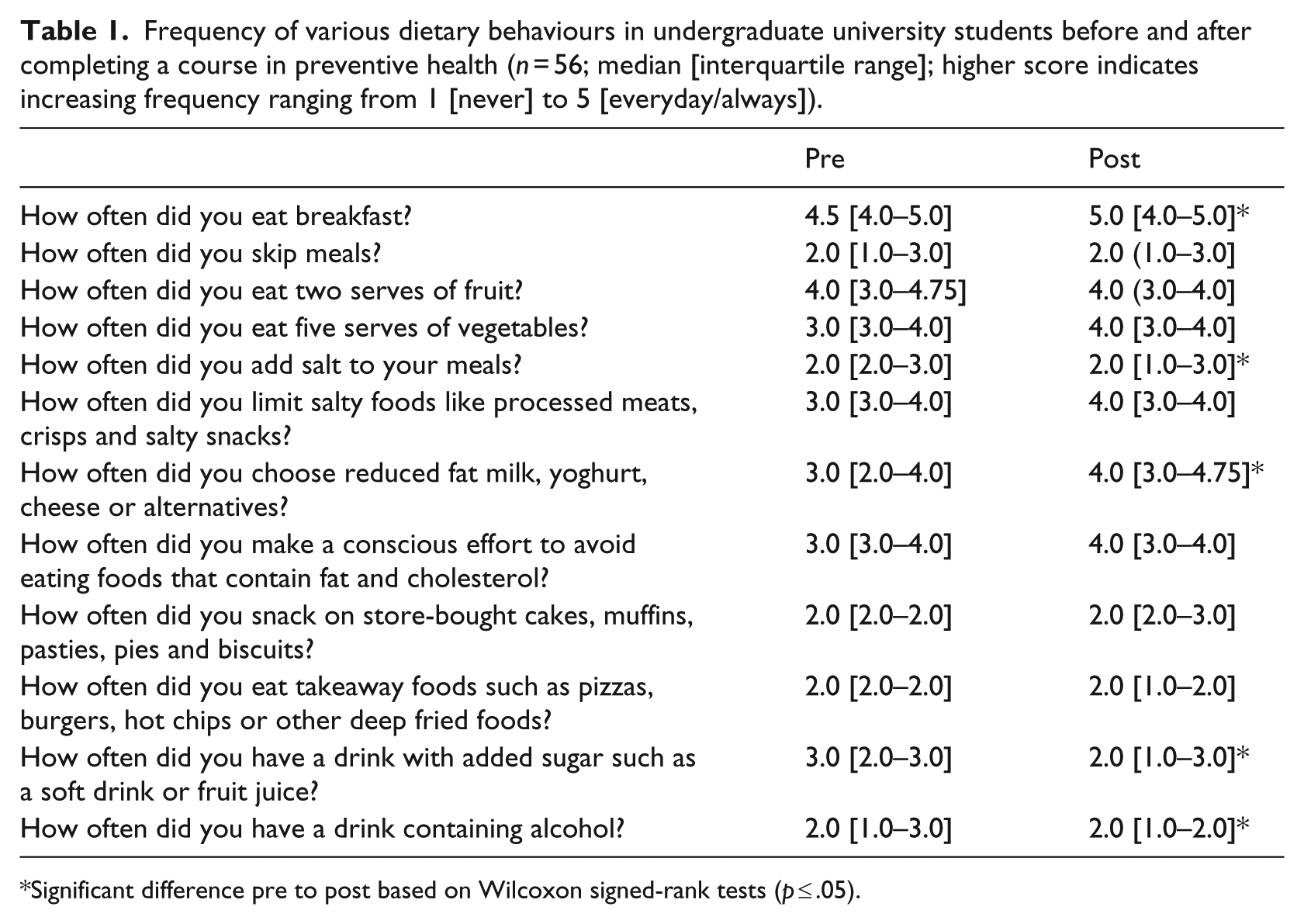
Significant difference pre to post based on Wilcoxon signed-rank tests (p ≤ .05).
Data were summarised using medians and interquartile ranges based on data normality. Using a within-subjects repeated-measures design, responses to the questionnaire were compared between the commencement and the end of the course using Wilcoxon signed-rank tests. In addition, differences between sexes were investigated using Mann–Whitney U-tests. Analyses were conducted using SPSS software (version 23; SPSS Inc, Chicago, IL), and statistical significance was accepted as p ≤ .05.
Results
Of the 145 students enrolled in the course, 84 volunteered to complete the questionnaire. Of these, 56 students completed the questionnaire at both time points (pre- and post-course) and were therefore included in the analyses (mean ± standard deviation [SD] age, 21.2 ± 4.7 years; body mass index [BMI], 22.4 ± 2.7 kg/m2; 48% men; all non-smokers).
Weekly physical activity based on the Godin Questionnaire was unaltered across the duration of the course (median [interquartile range]: 43 [32–59] vs 42.5 [32.25–55.5] arbitrary units; p = .67), nor was there any difference in the number of sessions of weekly strenuous (pre, 3 [1–5]; post, 3 [1.25–4]; p = .82), moderate (pre, 2 [1–3], post, 3 [2–4]; p = .47) or mild exercise (pre, 2 [1–4], post, 1 [0–3.75]; p = .12) between time points. In contrast, a number of dietary behaviours were improved from the start to end of the course. These changes included an increase in the frequency of eating breakfast, reduced frequency of adding salt to meals, increased frequency of choosing reduced fat dairy options, reduced frequency of consuming drinks with added sugar and consuming alcohol (Table 1; p ≤ .05).
The frequency of other behaviours such as skipping meals, eating fruit and vegetables, limiting salty foods, avoiding foods containing fat and cholesterol, eating store-bought cakes, muffins, pasties, pies and biscuits, as well as takeaway foods such as pizza, burgers, hot chips and other deep fried foods, were unaltered across the course (p > .05). When comparing men and women, there were no differences in dietary behaviour between the sexes at baseline (p > .05). However, at the end of the intervention, men reported higher frequency of limiting salty foods (p = .023) and avoiding foods high in fat and cholesterol (p = .024), together with reduced frequency of snacking on cakes, muffins, pastries, pies and biscuits compared with women (p = .009). Meanwhile, women reported a lower frequency of alcohol consumption compared with men at the end of the course (p = .027).
With respect to beliefs about the importance of various health behaviours (Table 2), students reported an increase in the perceived importance of not consuming too much salt (p ≤ .01); furthermore, the importance of not eating too much animal fat approached significance (p = .06). There were no changes in the perceived importance of exercising regularly, eating enough fibre, keeping body weight within the normal range, eating enough fruit and vegetables, not smoking, eating breakfast, getting adequate sleep, not drinking too much alcohol and making deliberate efforts to control or avoid stress. When comparing men and woman, the sexes gave similar ratings of importance for each health behaviour at baseline, except for the importance of keeping body weight within the normal range which was rated higher by women compared with men (p = .030). At the end of the course, men rated the importance of regular exercise higher than women (p = .044).
Beliefs about the importance of various health behaviours in undergraduate university students before and after completing a course in preventive health (n = 56; median [interquartile range]; Likert-type rating ranging from 1 [of very low importance] to 10 [of very great importance]).
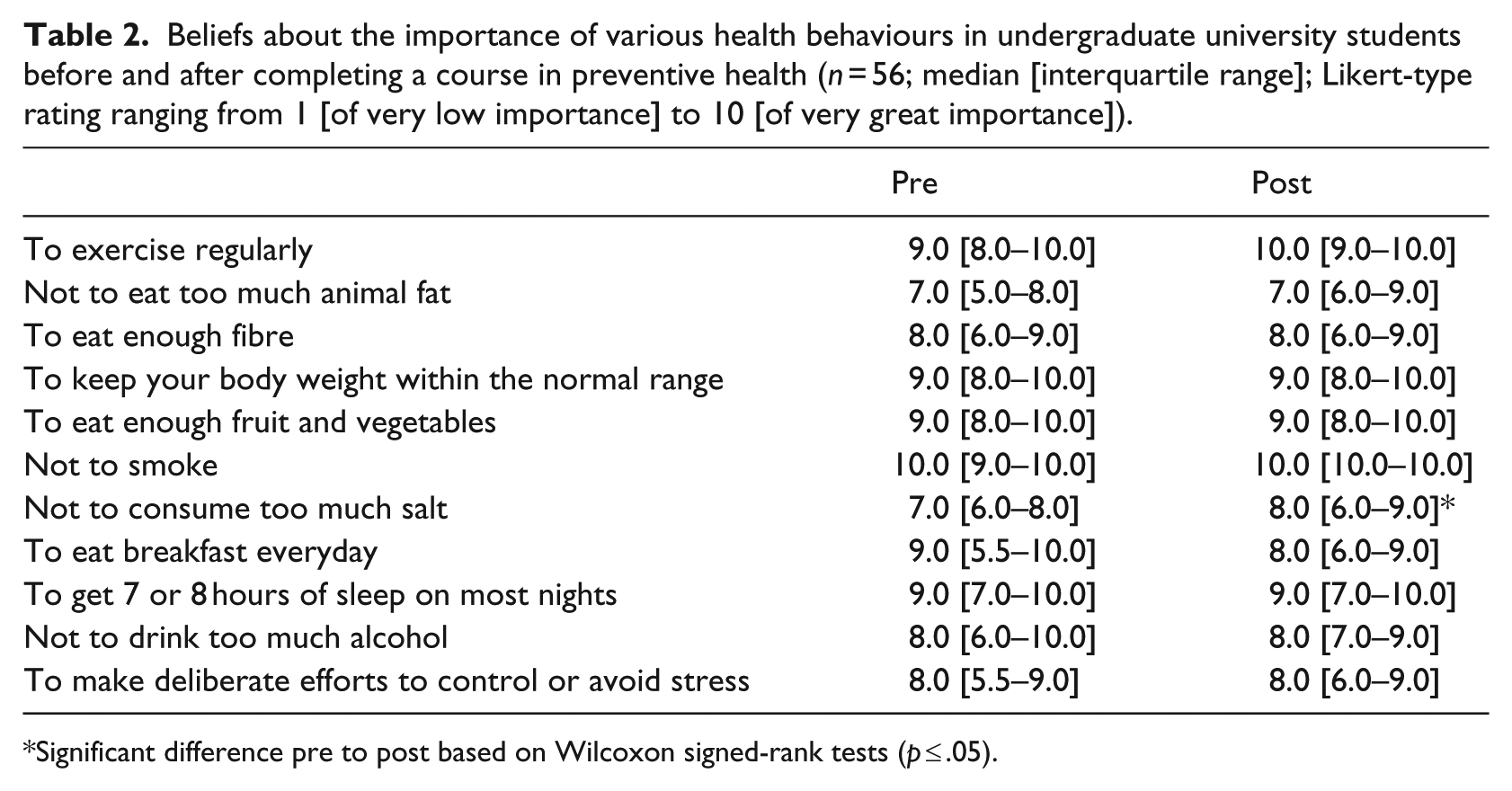
Significant difference pre to post based on Wilcoxon signed-rank tests (p ≤ .05).
Discussion
One pathway by which health behaviours may be altered in university students is through studying courses that relate to health and well-being (Ha and Caine-Bish, 2009). This study found that a 13-week course relating to preventive health was associated with limited alterations in students’ views on the perceived importance of various health behaviours, but was associated with improvements in a number of actual health behaviours specifically relating to nutrition. Although the course was expected to enhance knowledge relating to health and wellness, it was unclear whether this increased knowledge would be associated with actual changes in health behaviour. Of note, the changes observed in dietary behaviours are important given that many undergraduate students do not meet the recommendations for healthy eating (Huang et al., 2003; Racette et al., 2005).
While previous research has shown that a 15-week health and wellness course as part of students’ general education improved physical activity and dietary outcomes in university students (Hager et al., 2012), to our knowledge, this is the first study to focus on a population of students enrolled in a health and exercise science degree (i.e. those with background interest and knowledge in the field). The inclusion of exercise science students may help to explain, at least in part, the lack of alteration in physical activity across the duration of the course as it might be expected that this population would already have a reasonable level of activity participation, with less room for improvement. In contrast, significant alterations in a number of dietary behaviours were noted, including an increase in the weekly frequency of eating breakfast, reduced frequency of adding salt to meals, increased frequency of choosing reduced fat dairy options, reduced frequency of consuming drinks with added sugar and a reduced frequency of alcohol consumption. It is possible that the population of students studied here had more potential for improvements in dietary behaviour given that they would have had less focus on nutrition compared with exercise prescription during their undergraduate studies prior to commencing the present course. This notion is supported by the high ratings of the importance of regular exercise at baseline, while the ratings for the importance of some aspects of diet had lower ratings, and therefore possibly more potential for improvement.
Of interest, the specific dietary health behaviours altered appeared to differ between the sexes, with men reporting higher frequency of limiting salty foods, avoiding foods high in fat and cholesterol and reduced frequency of snacking on cakes, muffins, pastries, pies and biscuits compared with women at the end of the course. Meanwhile, women reported lower frequency of alcohol consumption compared with men during the post-course questionnaire period. The reasons for these unique differences are unclear. Previous research has also reported differences in dietary behaviours between young men and women, but these differences generally highlight that women are more likely to follow healthy eating guidelines compared with men (Wardle et al., 2004). In contrast, we saw improvements in healthy eating in both men and women – albeit different types of changes. Although the noted improvements were small, these changes may have implications for future health if sustained in the long term. Indeed, there is a growing body of evidence to suggest that health opportunities in adolescence can have a sustained impact on health in adulthood. More specifically, many health-related behaviours, including physical activity, dietary intake and patterns of alcohol consumption, are altered in early adulthood, and these changes may track into later adulthood, as well as have implications for the risk of non-communicable diseases that develop later in life (Nelson et al., 2008; Sacker and Cable, 2006). Furthermore, the marketing of many aspects of an unhealthy lifestyle, such as alcohol consumption and foods high in fat, sugar and salt, often targets young people (Nelson et al., 2008; Story and French, 2004). Accordingly, health promotion strategies targeting early adulthood may have a significant impact on initiating healthy behaviours to last across the life course (Nelson et al., 2008; Sawyer et al., 2012).
The majority of changes in dietary behaviour were not associated with alterations in the perceived importance of those behaviours. Only the perceived importance of not consuming too much salt was altered across the duration of the course. Meanwhile, women rated the importance of keeping body weight within the normal range higher than men at baseline. The latter observation is consistent with previous research suggesting that women tend to be more concerned than men about body weight (Pliner et al., 1990). Regardless, the limited changes in the perceived importance of the health behaviours assessed in this study suggest that this was unlikely to be responsible for the majority of changes in dietary behaviours observed, although this may not be surprising given that the ratings for most health behaviours were already high at the commencement of the course. An alternative possibility for the improved dietary behaviours seen here may be the focus of attention on these aspects of health and well-being throughout the course, with constant reinforcement through learning activities influencing daily activities outside of the learning environment. However, this is purely speculative, and the mechanisms through which behaviour was modified remain to be investigated. Furthermore, it is possible that the changes in behaviour observed here may not be directly attributed to the course itself. Self-selection bias cannot be ruled out, although this could not be avoided given the voluntary nature of the study and necessary ethics requirements for unforced participation. The response rate of 58% was disappointing; however, the reasons for participation/non-participation are unclear. It is also possible that the results were affected by maturation or larger societal changes occurring at the time of the study, although this may be unlikely given the limited time frame and the fact that many variables remained stable across the duration of the course.
Other limitations that are important to note include the data being self-reported, so it is possible that students’ actual behaviour may vary from that reported here. Although more objective measures of physical activity would be possible through the use of accelerometry, the assessment of nutrition by methods other than self-report is not really feasible. It must also be acknowledged that the nature of data collection on a group of university students undertaking an approved university course did not allow for inclusion of a control group, and the assessment of nutrition, based on the Australian Dietary Guidelines (National Health and Medical Research Council, 2013), was performed using a non-standardised questionnaire. Another consideration for future research is the impact of pedagogy on these outcomes, as it is likely that different teaching and learning tasks would have differing levels of impact. Furthermore, it should be acknowledged that the development and implementation of behaviour change interventions are enhanced by the explicit use of theory (Michie and Prestwich, 2010). This was not applied in this study since the intervention itself (the course) was not developed for the purpose of modifying behaviour, and therefore, the specific active ingredients (i.e. behaviour change techniques inherent in the course) were not developed for the purpose of this study. Rather, the intention was to assess the course in its current form. Accordingly, future studies could modify course structure and the nature of specific learning activities consistent with a theoretical basis. Finally, it remains to be determined whether the changes observed here are maintained beyond the completion of the course in order to confirm any potential benefits for lifelong health and well-being. Also, the sample size was limited to those students enrolled in the course that consented to participate; as a result, larger samples sizes are needed to investigate the emerging differences between the cohort of men and women observed here and should extend beyond completion of courses to assess the potential for long-term impact.
Conclusion
In conclusion, courses related to health and well-being may benefit the student not only through the knowledge gained that can be applied in future professional settings but also via positive alterations in their own health behaviours. Health promotion in a university setting may be ideal given that students are in a learning environment (Plotnikoff et al., 2015) and that positive influences on physical activity and nutrition in early adulthood may have implications for lifelong health and well-being. The positive influences on health behaviours observed here may provide a rationale for future studies, including larger samples and control/comparison groups, to identify the specific components of such courses that may have the most influence on student health behaviours. In particular, future studies should consider assessing changes in physical activity levels using objective accelerometry, while additional health behaviours such as sleep and stress levels could be assessed using validated questionnaires. In relation to nutrition, more detailed analyses in the form of food diaries may be incorporated to gain a greater understanding of the nature of changes in food and drink consumption. A greater understanding of such factors would provide for the manipulation of course content and activities to strengthen health outcomes for students in the future.
Footnotes
Funding
The author(s) received no financial support for the research, authorship and/or publication of this article.