



Abstract
Objective:
The goals of this study were to (1) describe physical activity levels during school recess in 8-year-old children, (2) analyse the percentage of children who achieved physical activity recommendation at recess, and (3) examine if recess physical activity levels varied by gender, weight status, and parental educational level.
Methods:
In all, 291 children (mean age ± SD = 8.3 ± 0.3 years, 156 boys) from 7 schools of Granada (Spain) were recruited by convenience. To analyse sedentary time and physical activity levels during recess, children wore a tri-axial accelerometer attached to the wrist over five consecutive school days.
Results:
Sedentary time (29.6% vs 40%) and light physical activity (33.2% vs 35.5%) were lower in boys than in girls (all p < .001). Conversely, moderate physical activity (26.7% vs 20%), vigorous physical activity (10.5% vs 4.4%) and moderate-vigorous physical activity (37.2% vs 24.4%) were higher in boys than in girls (all p < .001). Only 12% of the children accomplished the moderate-vigorous physical activity recommendations during recess (21.2% boys vs 1.5% girls). Lower body mass index values were associated with higher vigorous physical activity intensity.
Conclusions:
Levels of moderate-vigorous physical activity during school recess are very low in children, being lower in girls than in boys, a very low percentage of children achieve moderate-vigorous physical activity recommendations during school recess, and girls and overweight/obese children show lower values in moderate-vigorous and vigorous physical activity.
Introduction
Nowadays, low physical activity (PA) level in youth from developed countries and high obesity prevalence are considered some of the most important public health issues in the 21st century (World Health Organisation [WHO], 2000). The percentage of young people who accomplished the moderate-to-vigorous physical activity (MVPA) recommendations of the WHO (2011) is generally low in European children (30.4% in Spain) (Konstabel et al., 2014).
According to Sallis et al. (2000), active living and PA are influenced by various determinants: among them, intrapersonal influences, such as demographic (child’s gender) and biological (weight status) factors, as well as interpersonal factors (parental education). In general, boys are more physically active during discretionary time periods compared to girls (Beighle et al., 2006) and at school recess (Shervey and DiPerna, 2017). However, it should be pointed out that some studies have not found sex differences in PA levels during recess (Erwin et al., 2012) or have found girls to be more physically active than boys (Mota et al., 2005). A study carried out in a sample size of more than 5,000 12-year-old children found an inverse association between PA and obesity that was stronger in boys (Ness et al., 2007). Most of the studies included in a recent systematic review found significant relationships between PA with overweight/obesity (Janssen et al., 2010).
Parental education is associated with children’s PA levels. One study analysed the effect of parental education on children’s PA in seven European countries (Jiménez-Pavón et al., 2012), finding a positive association with children’s PA in Greece and Spain, and with boys’ PA in Norway. In contrast, a systematic review by Boxberger and Reimers (2019) found a negative association between high parental educational level with children’s outdoor play. These differences may occur more often outside of school because middle- to high-income parents may let their children spend more time in organised activities. Against this background, it is important to know whether intrapersonal factors such as gender and weight status and interpersonal factors (parent’s educational level) are associated with PA levels at recess, in order to develop programmes and interventions focused on specific groups according to their needs and characteristics.
Nowadays, PA opportunities at school have been reduced due to an increased emphasis on academic study and the time devoted to core subjects (Marshall and Hardman, 2000; Sallis et al., 2012). Nevertheless, the strong link between health and education is recognised worldwide (Sallis et al., 2012) and public health professionals as well as researchers have identified schools as a strategic place in which to promote PA (Efrat, 2013; Hyndman et al., 2014). School is the institution where children spend most of their time, and it is the ideal setting for health and PA promotion, specifically through physical education lessons and break or recess time (Roberts et al., 2012; Sallis et al., 2000; Sarkin et al., 1997; Stratton, 2000).
Recess has been considered a valuable opportunity for all school-aged children to increase their levels of PA (Ridgers et al., 2012; Roberts et al., 2012) and PA during it may prevent and reduce overweight in the school-aged population (Sigmund et al., 2012). In Spain, children have 30 minutes of recess time each morning every day. Recess is particularly attractive for the promotion of PA because it is integrated into the majority of schools’ timetables, and it does not directly impact on lesson time (Erwin et al., 2013). Recess is one of the preferred moments of the school day for children, providing opportunities for children to participate spontaneously in an activity they choose and providing an important occasion to promote PA engagement and children’s socialisation (Chaves-Álvarez, 2013; Erwin et al., 2012).
Stratton and Mullan (2005) have extrapolated the US Department of Health and Human Services physical education criterion to recess (US Department of Health and Human Services, 2012), suggesting that children should be engaged in MVPA for at least 50% of recess time. However, empirical studies are required to ascertain whether children achieve these standards during recess periods. Other authors have suggested that children should engage in MVPA for at least 40% of recess time in order to contribute to overall daily PA in a significant way (Erwin et al., 2012; Ridgers et al., 2012). Erwin et al. (2012) found that even a 15-minute recess can make a valuable contribution to children’s school-day PA, especially for inactive children.
Tri-axial accelerometers are widely used in health and sports sciences to measure PA and sedentary time, being the most accurate devices to use in free-living environments (Migueles et al., 2017). To the best of our knowledge, however, few studies have used tri-axial accelerometry to analyse PA at recess in school-age children, and only two in Spain (Frago-Calvo et al., 2017; Grao-Cruces et al., 2019).
The purposes of this study therefore were to (1) describe PA levels during school recess in 8-year-old children, (2) analyse the percentage of children who achieve PA recommendation at recess and (3) examine if recess PA levels vary by gender, weight status and parental educational level.
Material and methods
Participants and study design
Data were collected between January 2017 and March 2017 as part of the PREVIENE Project (Tercedor et al., 2017). PREVIENE aims to increase PA levels in children though different school-based interventions. Seven schools in Granada (Spain) were convenience sampled (four private schools in the city and three public schools in the outskirts).
A total of 498 children were invited to participate in the study. However, the final sample comprised 377 third grade schoolchildren (mean age ± SD = 8.3 ± 0.3 years) who participated in this study. Participants with missing information regarding children’s body mass index (BMI), mother’s and/or father’s education level, or those who did not wear the accelerometer for 30 minutes recess during 5 consecutive days, were excluded from data analyses.
A total of five scholar recesses were analysed over corresponding consecutive days. The children had one 30-minute recess in the playground every school day. Recess frequency and its duration are determined by the Spanish Ministry of Education and Science for primary schools (BOE 160, 1995).
The Regional Ministry of Education endorsed the participation of each selected school in the study. At the start, the families of all children received information about the study. Both children and parents were encouraged to participate in the study. Parents signed an informed consent about their children’s participation in the study. The study protocol was approved by the University of Granada Human Research Ethics Committee (Reference: 57/CEIH/2015).
Measures
Sociodemographic characteristics
Parents completed a questionnaire about their child’s sociodemographic characteristics (e.g. birthdate and gender) and parental education which was categorised into ‘primary or secondary school’ when both parents did not start or finish their university studies, and ‘university education’ when at least one of the parents finished an undergraduate university degree, a master’ degree or a doctorate.
Anthropometry
The research team received training to correctly assess the anthropometric measures prior to conducting the evaluation. Both body mass and body height were assessed wearing PE clothes (shorts and a short sleeve t-shirt) and barefoot. Body weight was measured twice with a 0.1 kg approximation using a Seca 876 weighing system (Seca, Ltd., Hamburg, Germany). Body height was measured twice using the Frankfort plane, with a 0.1 cm approximation using a Seca 213 stadiometer. The average of the two measurements was used in the analysis.
BMI was calculated as the body weight in kilograms divided by the square of the body height in metres. Weight status was determined using age- and gender-specific BMI cut points proposed by the International Obesity Task Force (IOTF) (Cole et al., 2007): overweight in boys of 8 years (18.44–21.59 kg/m2), 8.5 years (18.76–22.16 kg/m2) and 9 years (19.10–22.76 kg/m2); and obesity in boys of 8 years (⩾21.60 kg/m2), 8.5 years (⩾22.17 kg/m2) and 9 years (⩾22.77 kg/m2); and overweight in girls of 8 years (18.35–21.56 kg/m2), 8.5 years (18.69–22.17 kg/m2) and 9 years (19.07–22.80 kg/m2); and obesity in girls of 8 years (⩾21.57 kg/m2), 8.5 years (⩾22.18 kg/m2) and 9 years (⩾22.81 kg/m2).
Sedentary time and PA
Sedentary time and PA (light, moderate, vigorous and moderate-to-vigorous) were measured using a tri-axial accelerometer (Actigraph wGT3X-BT, Pensacola, FL, USA) being the most accuracy device for measuring sedentary time and PA in free living conditions (Migueles et al., 2017), on 5 consecutive days, 24 hours/day. The children wore an accelerometer attached to the non-dominant wrist (Chandler et al., 2016). Previously, the research team had explained to children the use and care of the accelerometer. The accelerometer was placed on the wrist, which has shown to increase wear compliance in older children (Nyström et al., 2017). In the current study, the children were required to wear the accelerometer during a 5-day period, and the accelerometers were initialised at 6.00 am on the first day. Wear time during the 30-minute-recess was used in the data analysis.
Actilife software (v 6.13.3 Life Edition) was used to download, clean and analyse data. The accelerometers were initialised at 60 Hz, and after downloading data, they were reintegrated into 5-s epochs as suggested by Chandler et al. (2016). The cut-off points were based on vector magnitude sedentary time (<305 counts), light PA (306–817 counts), moderate PA (818–1968 counts) vigorous PA (>1969 counts), and moderate-to vigorous PA (⩾818 counts).
Data analysis
Descriptive statistics (means, standard deviations, and percentages) were calculated for all the relevant variables. Multivariate analysis of variance (MANOVA) was used to analyse overall differences in sedentary time, light PA (LPA), moderate PA (MPA), vigorous PA (VPA), and MVPA according to sex (i.e. boys and girls), weight status (i.e. normal weight, overweight and obesity), sex * weight status and separately by parental educational level. Cohen’s d statistic was used to assess the effect size of the aforementioned differences. Cohen’s d values of approximately 0.25, 0.5 and 0.8 represented small, medium and large effect sizes (Nakagawa and Cuthill, 2007).
We used linear regression analyses to examine the association between BMI and PA levels, with BMI as the independent variable, and sedentary time, LPA, MPA, VPA and MVPA as dependent variables in separate analyses, adjusted by sex. In addition, we conducted the same linear regression analyses separately for boys and girls. All the analyses were adjusted by sex. We used the Statistical Package for Social Sciences (SPSS Version 20.0 for Windows, IBM Corp., Armonk, NY, USA), and we set the level of significance at p < 0.05.
Results
The sociodemographic and anthropometric characteristics of the participants (53.6% boys) are shown in Table 1. A total of 38.5% of participants’ parents had non-university levels of education. Regarding weight status, a total of 71.1% of the participants presented with normal weight. The BMI mean value of the total sample was 17.52 kg/m2 (standard deviation [SD] = 2.79). According to MANOVA results, overall differences in sedentary time, LPA, MPA, VPA, and MVPA across weight status categories did not emerge (p = .400).
Parents’ educational level and participants’ anthropometric characteristics.

BMI: body mass index.
The PA levels of the children who participated, by gender are shown in Table 2. According to the MANOVA results, overall differences in sedentary time, LPA, MPA, VPA, and MVPA between genders were observed (p < .001). In particular, sedentary time (29.6% vs 40%) and LPA (33.2% vs 35.5%) was lower in boys than in girls (p < .001). Conversely, MPA (26.7% vs 20%), VPA (10.5% vs 4.4%), and MVPA (37.2% vs 24.4%) were higher in boys than in girls (p < .001).
Mean sedentary time and physical activity (PA) intensity levels during recess.

PA: physical activity; MVPA: moderate-to-vigorous physical activity; SD: standard deviation.
The values are presented as the average of the percentage of time of each group for each type of PA. Significant values are highlighted in bold.
According to MANOVA results, the interaction of sex and weight status (i.e. sex * weight status) was not associated with sedentary time, LPA, MPA, VPA, and MVPA (p = .550). Figure 1 shows the percentage of children by gender who met the MVPA recommendations for recess according to total recess time. A total of 12% of the children engaged in MVPA for at least 50% of recess time, and a total of 25.4% of children engaged in MVPA for at least 40% of recess time. In girls, the percentage of children engaged in MVPA for at least 50% or 40% of recess time was lower (1.5% and 7.4%, respectively) than in boys (21.2% and 41%, respectively).
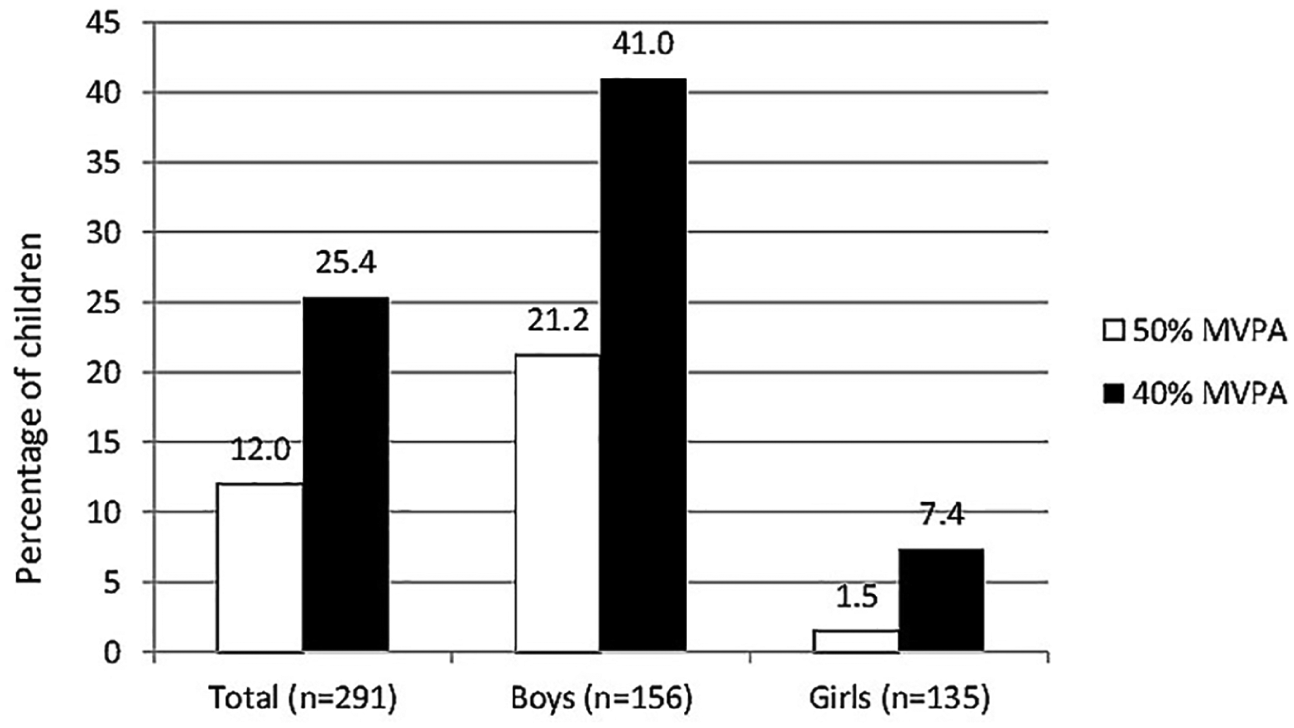
Percentage of children that met the recess physical activity recommendations.
The association between sedentary time and different PA intensity levels with BMI is presented in Table 3. Lower BMI was associated with higher VPA in the whole sample (β = –.108, p = .026), whereas higher BMI was associated with higher LPA (β = 0.067, p = .014). In analyses separated by sex, boys with lower BMI presented with higher VPA (β =−0.196, p = .008) and boys with higher BMI presented with higher LPA (β = 0.162, p = .029).
Association of sedentary time and physical activity (PA) levels with body mass index.

MVPA: moderate-to-vigorous physical activity; PA: physical activity; CI: confidence interval. β: standardised coefficient, B: unstandardised coefficient.
Significant values are highlighted in bold.
We did not find any differences between sedentary time, light PA, moderate PA, vigorous PA or MVPA and parental educational levels (all p > .05).
Discussion
This study assessed PA intensity levels during school recess in a sample of Spanish children. The main findings reveal that children spent a low time in MVPA and therefore a low percentage of them met the PA recommendations during school recess, girls and overweight/obese children being those with the lowest values in VPA. No association was found between PA intensity levels and parental education.
To our knowledge, only a few studies have assessed PA during school recess. They have mostly used direct observation and heart rate telemetry to assess PA. Very few of them have measured PA by accelerometry (Ridgers et al., 2012), which is considered a more valid and reliable tool with which to assess PA, and only two have reported PA during recess among Spanish 8-year-old children using tri-axial accelerometry (Frago-Calvo et al., 2017; Grao-Cruces et al., 2019) in a sample of primary school students, with the accelerometer attached to the waist. In this study, boys spent more time in MPA and VPA than girls, who presented with higher values of light PA and sedentary time, but they attached the accelerometer to the wrist so the comparison may be done cautiously with others (Tudor-Locke et al., 2015). These results are in accordance with the wider literature, which shows that boys are significantly more active than girls (Van Hecke et al., 2016) and MVPA (McKenzie et al., 2000) on a daily basis and during school recess (Frago-Calvo et al., 2017; Grao-Cruces et al., 2019; Ness et al., 2007; Pawlowski et al., 2016; Ridgers et al., 2005; Shervey and DiPerna, 2017). Only the study carried out by Mota et al. (2005) found higher values of MVPA in girls than in boys (38% vs 31% of recess time in MVPA, respectively) among Portuguese children. These findings support the idea that school playgrounds can offer good opportunities to enhance MVPA participation, especially among girls.
Compliance with PA recommendations during recess
Regarding international PA recommendations for recess (Stratton and Mullan, 2005), a study carried out by Ridgers et al. (2005) analysed the level of compliance with the recess PA recommendations during three recess breaks on one school day. In a sample of 5- to 10-year-old children from 23 schools in the North West of England, 14.9% of boys and 4.3% of girls engaged in MVPA for at least 40% of recess time (39.8% and 7.5%, respectively, in our sample). Lower values than those of the current study could be explained because of higher recess frequency per day compared to the current study. Consequently, it might be useful to analyse different recess’ duration and frequency to test the potentially best option to achieve PA recommendations. In a study by Frago-Calvo et al. (2017) of a sample of Spanish children, a very low percentage of boys and girls engaged in MVPA for at least 40% of recess time (6.4% and 1.2%, respectively). Methodological differences between these studies and the present study (e.g. place of wearing the accelerometer, cut-off points used, etc) might explain the differences in the percentage of children satisfying recess MVPA criteria. However, the low percentage of children satisfying these criteria among studies is worrisome.
Children’s PA during recess is low, particularly among girls. Recess offers an unstructured environment in which children are free to interact with their peers through PA (Pate et al., 1996), and school playgrounds offer opportunities to increase children’s MVPA engagement (Sarkin et al., 1997; Zask et al., 2001). Despite this, it has been proposed that gender differences in MVPA are more apparent in this setting (Blatchford et al., 2003). The reasons underlying these are not widely understood (Scruggs et al., 2003), albeit they could be attributed to the social context of recess (Evans, 1996). It has been found that boys were significantly more likely to be involved in competitive ball games, and girls in more conversation, sedentary play, jumping and skipping, and verbal games (Blatchford et al., 2003). The difference may partly be explained because girls prefer the schoolyard over the field in order to avoid competitive games, whereas boys dominate the field playing this kind of game play (Pawlowski et al., 2016).
Association between BMI and PA levels
In this study, lower BMI values were associated with higher PA levels, particularly in the case of VPA, which aligns with previous study findings (Bin et al., 2016; Lopes et al., 2009; Ness et al., 2007; Ridgers et al., 2014). It has been suggested that overweight/obese children are often socially withdrawn and display aggressive–disruptive behaviour (Zeller et al., 2008), and that children rejected by their peers are less likely to play with others (Blatchford et al., 2003). Ness et al. (2007) carried out a cross-sectional study in more than 5,000 children from Bristol (England), concluding that there is a strong negative association between obesity and VPA. Besides, it has been shown that a modest increase of 15 minutes of MVPA is associated with lower odds of obesity of over 50% in boys and nearly 40% in girls (Ness et al., 2007). Recess may provide an opportunity to increase VPA behaviour, thus contributing to managing and/or reducing childhood obesity (Ara et al., 2009). However, future research is needed to confirm if recess is a useful tool to lower BMI in obese students.
Association between parental educational level and PA
In this study, parental educational level was not associated with sedentary time nor any PA intensity level. A study in seven European countries analysing the total weekly amount of PA, found that parental educational level was directly associated with children’s PA in more than half of the countries involved (Jiménez-Pavón et al., 2012). These differences may be found after school because families with higher educational level and socioeconomic status tend to be more extensively engaged in organised activities (Randal and Bohnert, 2009). However, the results of our study support that parental education and socioeconomic status may not have relation to the children’s PA level during recess, even when it might be related with the children’s daily PA. Consequently, it must be taken into account to increase the tie that children is involved in PA independently of the parental educational level.
Strengths and limitations
A strength of this study lay in the objective measurement of PA using accelerometry and a relatively large sample size. Moreover, to our knowledge, only two previous studies have analysed recess PA over a 5-day school period (Frago-Calvo et al., 2017; Grao-Cruces et al., 2019). Most studies have reported recess PA by analysing 4 days a week (Kolle et al., 2009), 3 days a week (Pawlowski et al., 2016; Sarkin et al., 1997), or even only over one day (Ridgers et al., 2005). Most published studies have also used waist-worn accelerometers to record PA, while wrist-worn accelerometers have been suggested to increase wearer compliance in older children (Nyström et al., 2017); the output from the wrist is higher than from the hip during more intense activities, but similar to lower during sedentary activities (Hildebrand et al., 2014).
There, however, several limitations to the study. Crucially, it used non-random sampling (raising questions about representativeness and typicality) and PA variability was not evaluated in relation to seasonality, even though seasonal variability in PA during school recess has not been well-established (Ridgers et al., 2006). Although all the data were collected in the same season, taking weather data (temperature and rain) into account might be relevant as suggested elsewhere (Ridgers et al., 2012). Another limitation derives from the fact that the structure of recess, the size of the school, the influence of playground markings and available equipment on the level of PA was not analysed. It has been found that PA is higher in small schools compared with larger schools (Zask et al., 2001), perhaps because social inclusion may be stronger in small schools due to smaller numbers of children, so children who are less fond of sports than their peers are included in games. Finally, this study did not analyse the possible effect of children’s physical fitness and PA performed throughout the day on recess PA.
Conclusion
Levels of MVPA during school recess are very low in children, with girls being more physically inactive than boys. In this study, a very low percentage of children achieved MVPA recommendations during recess. No association between parental education and PA intensity levels was found.
It is therefore necessary to encourage children to spend more time in MVPA during recess, especially girls and overweight/obese children due to their low engagement in VPA at this time. Schools should develop new strategies to achieve this important objective such as providing material or activities to encourage exercise and guidance to help teachers in this task.
Footnotes
Acknowledgements
We express our appreciation and gratitude to the teachers and children who participated in this study, and also to all the schools involved and their staff members who became an important part of this work. We are grateful to Carmen Sainz-Quinn for assistance with English language editing.
Funding
The author(s) disclosed receipt of the following financial support for the research, authorship, and/or publication of this article: This work was supported by the Spanish Ministry of Economy and Competitiveness (DEP2015-63988-R, MINECO-FEDER, EU) and by a grant from the Spanish Ministry of Education, Culture and Sport (CAST17/00072).