



Abstract
Objective:
To examine if Arduino microcontrollers and Fitbits can serve as proxy measures for the direct observation of sitting and standing time in college students using height-adjustable standing desks. The preferred type of standing desks and reasons to use the desks were also assessed.
Design:
Classroom-based intervention, plus cross-sectional survey.
Setting:
Mid-sized Midwestern US university classroom.
Method:
Students were randomised to either a tabletop or stand-alone height-adjustable standing desk. They followed an alternating sit/stand protocol, then completed an 11-item questionnaire on preferences and reasons for or against using the desks. Data were collected in October 2018.
Results:
Twenty-two students completed the protocol (16 women; 15 in third or fourth year of study). Arduinos provided accurate representation of sitting. Correlations between Fitbits and Arduinos were moderate (.23–.49). Sixteen of the 22 participants preferred tabletop (vs stand-alone) height-adjustable desks. Main reasons to use standing desks were to improve health and preferring to stand. Main reasons for not using them were being tired and preferring to sit.
Conclusion:
Arduinos served as an adequate stand-in for direct observation, which has implications for studying the sedentary behaviours of large numbers of students simultaneously. More research is needed on using Fitbits for assessing sitting and standing time. Student preferences and reasons for/against using standing desks provide foundational evidence for standing desk interventions in this population.
Introduction
Declining amounts of physical activity, along with increasing sedentary behaviour, has put young adults, including college students, at greater risk for numerous health conditions later in life. These health conditions include obesity, cardiovascular disease, diabetes and cancer (Biswas et al., 2015; Ekelund et al., 2016). In addition, sedentary behaviour is associated with lower cognitive performance and higher mental distress (Falck et al., 2017; Hamer et al., 2014). For college students, this is concerning as they may sit for up to 8–10 hours per day and specific domains of leisure-time sedentary behaviour may have an unfavourable influence on working memory and academic performance regardless of the time spent in physical activity (Felez-Nobrega et al., 2017; Rouse and Biddle, 2010). With over 20 million students expected to attend US colleges by autumn 2027 (National Centre for Education Statistics, 2019), and considering that sedentary behaviours show evidence of tracking over the lifespan (Biddle et al., 2010), it is crucial to find ways to reduce sedentary time in the college population.
Reducing or interrupting bouts of sedentary behaviour provides a variety of health benefits (Carr et al., 2016), including improvements in physiological indicators such as glucose tolerance and insulin sensitivity (Dempsey et al., 2014). In addition, replacing sitting with standing results in increased metabolic health (Fountaine et al., 2016) and caloric expenditure (Benden et al., 2011, 2014). One method for reducing sedentary time is through standing and sit-to-stand transitions while using height-adjustable standing desks. Interventions using standing desks in K-12 school settings and in the adult workforce have shown reductions in sitting time and increases in time spent standing (Carr et al., 2016; Minges et al., 2016; Straker et al., 2013), which can increase physical activity and energy expenditure, potentially lowering the risk for health issues later in life.
Few college students have experienced opportunities to reduce sedentary time in classes via adjustable standing desks, and the literature is sparse for the use of standing desks in university settings. What is known is that a majority of students report sitting for 75% or more of class time, students and faculty are open to using standing desks and exhibit high favorability for using them (Benzo et al., 2016) and standing desks can increase standing time during college classes (Jerome et al., 2017). Furthermore, using a standing desk does not impair reading comprehension or creativity performance in college students (Finch et al., 2017). However, best strategies for measuring the accuracy and validity of sitting and standing time are lacking, in general, and while using height-adjustable desks, in particular. Sedentary behaviour measurement remains underdeveloped (Atkin et al., 2012), despite the importance of accurate measurement for understanding health and planning interventions (Kang and Rowe, 2015). Some researchers have used techniques such as videotaping participants and recording sit/stand time (Jerome et al., 2017), yet this is time-intensive. and participants outside the scope of the video camera lens may be excluded. Others have used accelerometers to assess sedentary behaviour in a laboratory setting, but only a limited range of activities were assessed that may not reflect free-living conditions (Berninger et al., 2018). Recent evidence indicates that some accelerometer cut-points to assess sit-to-stand transitions have poor acceptability (Mitchell et al., 2017). Some studies have only used stand-biased desks (Benden et al., 2011, 2014), which are set at a fixed height and may provide a different experience from adjustable standing desks. Finally, direct observation, which is time-consuming and labour-intensive, can serve as a valid criterion of activity and sedentary behaviour (Lyden et al., 2014). However, direct observation may be limited to use with smaller samples, and there is a need to improve upon existing observation strategies in order to bring this method to larger studies, including the college classroom setting.
Arduino microcontrollers, which consist of a low-cost, programmable software-driven circuit board, can be used in a variety of applications, including to assess a force being applied, and therefore could perhaps serve as a proxy measure for direct observation of sitting and standing behaviour. Arduinos could replace more expensive cameras or the need for smaller sample sizes. Fitbits are a wearable device designed for consumers that are commonly used in research (Coughlin and Stewart, 2016), yet have not been explored for their ability to assess sitting and standing while using height-adjustable standing desks in college students. Since a large proportion of college students already use wearable devices (Papalia et al., 2018), understanding the ability of these devices to measure sitting and standing could help in the design of future interventions. In addition, with a variety of types of standing desks that could be used in classrooms, including adjustable, and tabletop or stand-alone models, it is not known what type of desk might be most preferred among college students. Understanding these preferences, as well as potential reasons that college students would or would not use standing desks in classrooms, can also inform future research. Therefore, the objectives of this study were to (1) examine the validity of Arduino microcontrollers and Fitbits to measure sitting and standing against direct observation in a sample of college students when following a sit/stand protocol, (2) examine the association between Fitbits and Arduinos for measuring sitting and standing time and (3) assess college students’ preferred type of standing desk and examine reasons for or against using height-adjustable desks in college classrooms via cross-sectional survey.
Methods
Data collection occurred in October 2018. The study received approval from the Institutional Review Board at the University of Missouri–Kansas City. A total of 28 students enrolled at the university were recruited to participate via flyers posted around campus and word of mouth. Inclusion criteria were ⩾18 years old and being a currently enrolled student at the university. Exclusion criteria were not speaking English, and/or having an injury or medical condition that would prevent the ability to stand. All students meeting those criteria were eligible to participate.
Data were collected in a campus classroom that included stand-alone and tabletop adjustable standing desks (Figure 1). Each desk had an accompanying stool that was fitted with two layers of conductive foam sandwiching a copper wire coil, which was soldered to an Arduino attached underneath the stool seat for collection of sitting and standing data. The Arduinos use open-source software for a variety of purposes, including automation, data collection and analyses. Their small size makes them ideal for capturing data in a confined setting. The Arduinos were powered by USB cables plugged into multi-port hubs connected to a laptop computer that stored data during the study.
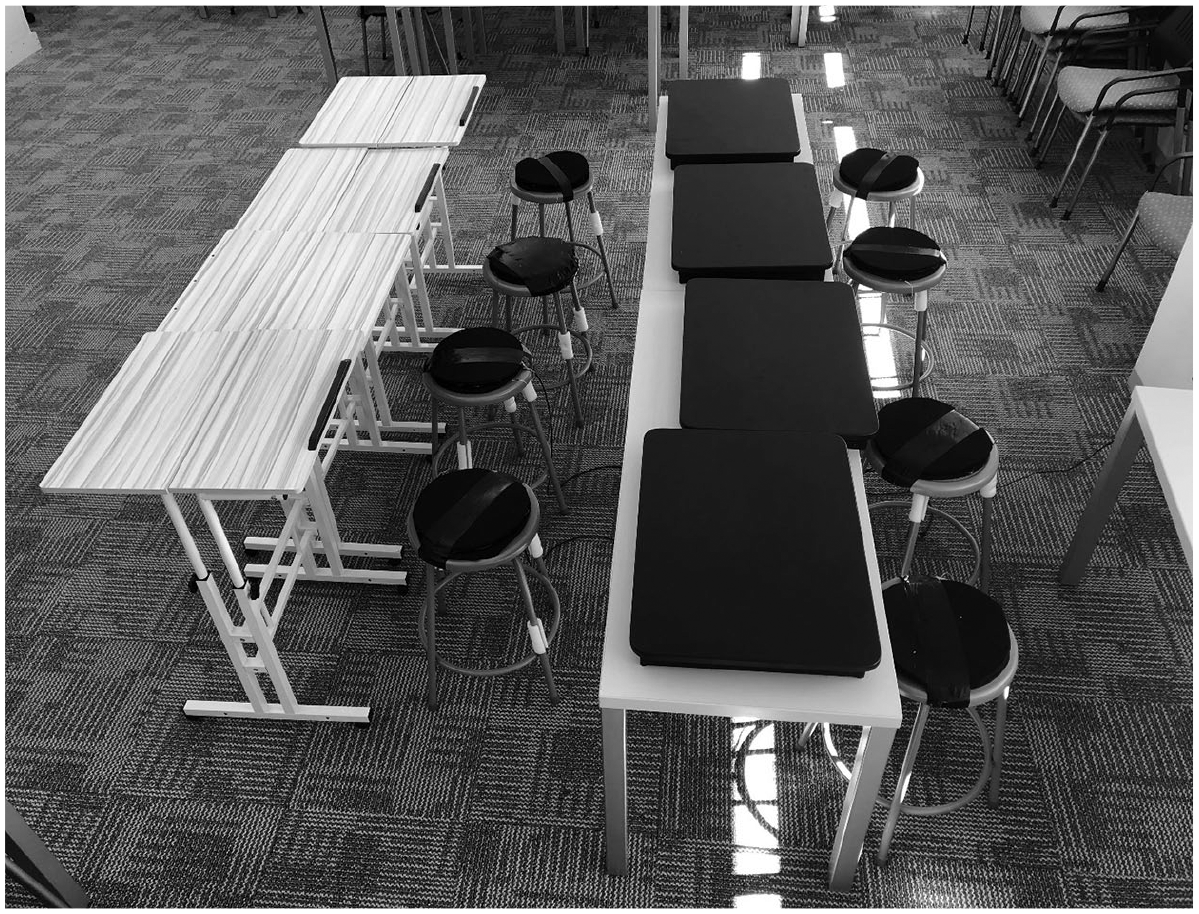
Set up of height-adjustable stand-alone (left) and tabletop (right) desks in the study classroom.
The stand-alone desks (GD Marketing, USA) were adjustable from a height of 26½ to 44½ inch. The tabletop desks (Desk Riser 28X, Colorado, USA) were adjustable from a height of 3 to 14 inch off a desk, with three separate height settings. The stools (Learniture, Cincinnati, OH, USA) were 24 inch high and not adjustable. The conductive foam (Techni-Stat, Worcester, PA, USA) was ½-inch thick. Foam that was ¼-inch thick was also examined but initial results indicated that the force signal was not sensitive enough for use in this study. The wire used was standard 12-gauge copper wire, which was cut into approximately 7-foot lengths and then coiled across the stool to maximise the cross-section that would come into contact with the conductive foam while participants were seated. Copper wire of 18-gauge was also tested and the conductive signal was found to be too weak.
Fitbit Versas (Fitbit, Inc., San Francisco, CA, USA) are commercially available fitness trackers worn on the wrist that provide real-time data on heart rate and physical activity through a smartphone app. Activity count data (e.g. standing time) were extracted from the Fitbits using a Fitbit Studio programme designed by one of the investigators (S.Y.) to capture activity counts during sitting versus standing periods in the protocol described below. Prior to data collection, each participant was asked to become familiar with adjusting their desk and determine a comfortable height for both sitting and standing behind it. Participants were randomly assigned to either a stand-alone or tabletop desk.
Protocol
Upon arrival at the study location classroom, each participant was asked to complete a short questionnaire to obtain demographic information (age, gender, grade level), was weighed on a digital scale (GreaterGoods, St. Louis, MO, USA) and had their height measured by trained research assistants using a standard tape measure. They were then provided with a Fitbit Versa to be worn on their non-dominant wrist during data collection.
Participants were then instructed on the study protocol, which included the following: sitting for 5 minutes, standing for 5 minutes, sitting for 10 minutes and standing for 10 minutes. A documentary film on the effects of drinking alcohol was shown during data collection and participants were instructed to pay attention as if it were a classroom lecture. Students were allowed to adjust the desks if needed during the documentary. At the conclusion of the protocol, participants were asked to answer four additional survey questions related to their acceptability and preference for using standing desks in a classroom setting, and reasons for or against using them. These questions were pretested by two college students to ensure readability and face validity prior to use in this study.
Four total data collection sessions were held, with 3–8 participants at each session (a maximum of 10 participants per session was possible due to the number of available desks and stools). At least three members of the research team were present at each session to observe the students; all students followed the protocol with no issues. All participants who completed the protocol were emailed a $20 gift card code to a national retailer for their participation.
Data analyses
Arduino sensors recorded pressure applied to the stool seats every 0.5 seconds, and Fitbits were set to report accelerometer measurements every 0.5 seconds. The Arduino sensors reported positive integers between 0 and 250 and Fitbit accelerometer measurements ranged from approximately −100 to 1,000. All observations for each individual participant were standardised. Data were entered into R Studio (version 1.1.463) for analyses, and there were no outliers that exceeded the magnitude of ±3 standard deviations.
Survey data were entered into SPSS (SPSS, Inc., Version 24, Armonk, NY, USA) for analyses. Descriptive statistics were used to summarise demographic information and survey data. Measured height and weight were used to determine each participant’s body mass index, which was classified according to standard US Centres for Disease Control and Prevention (2017) cut-off points. A chi-square using Fisher’s exact test was used to examine preferred desk type by the desk randomly assigned to participants in the protocol.
Results
A total of 22 participants completed the protocol described above. Six students did not show up to their scheduled session. Data were not collected on those six students, and reasons provided for not participating included travel and scheduling issues. Demographic characteristics are shown in Table 1. The participants were evenly assigned to a tabletop or stand-alone desks (11 each).
Demographic characteristics of university students (N = 22) participating in the standing desk study.
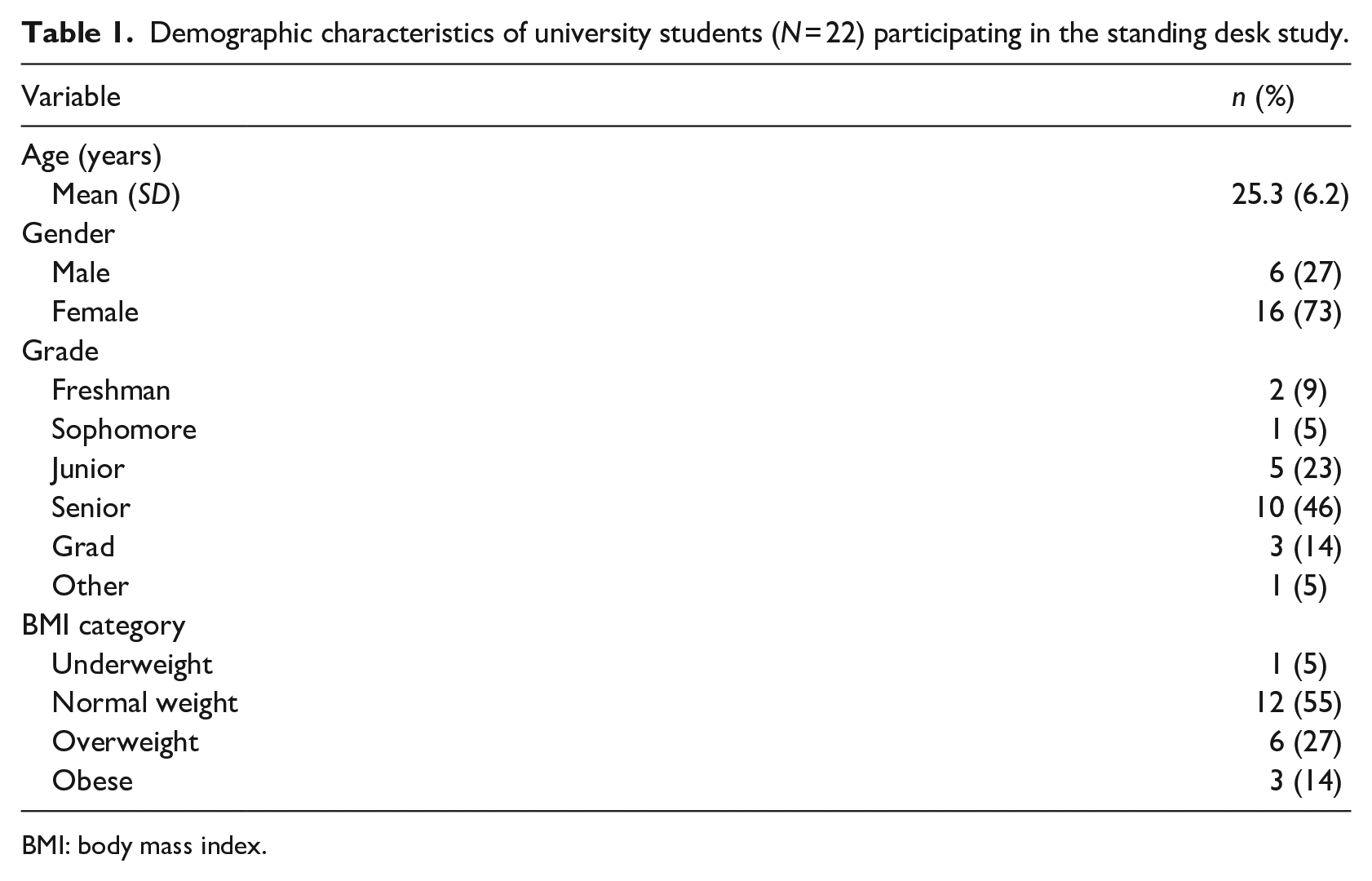
BMI: body mass index.
Sitting and standing time assessment
For Arduino sensor data, changes in pressure applied to the seat were clearly found. Specifically, while a participant was standing up, raw values ranged from 0 to 20, whereas, when a participant was sitting down, raw values ranged from 100 to 250. Figure 2 displays the time-series plot of standardised measurement readings of pressures for participant 3 in session 2. Two data peaks are visible indicating the duration of sitting down. The two sharp drops indicate the motion of standing up, and length of plateau shows the duration of no pressure applied to the seat. The magnitudes of sharp rises and drops differed by participant due to instrumental measurement errors; however, all conversions were detected very clearly, indicating the usefulness of this strategy as a substitute for direct observation of sitting and standing.
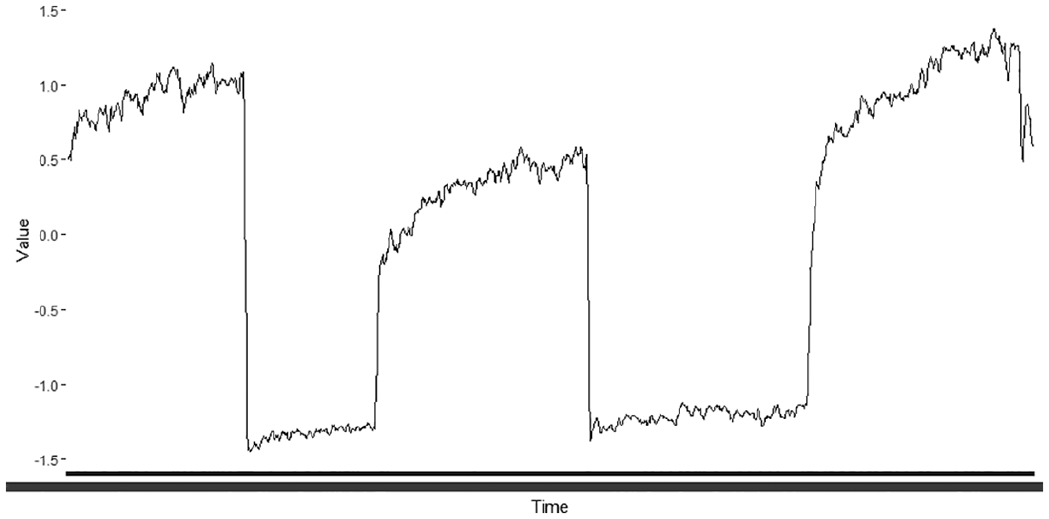
Moving-average smoothed Arduino sensor measurements over 30 minutes (session 2, participant 3).
Pearson’s correlation was computed to measure the magnitude of agreement between two time-series variables, the values retrieved from Arduino and Fitbit. For Arduino measurements, raw values were standardised for values in the range aforementioned. For Fitbit data, standardised vertical movement coordinates were used. Both values were collected at every second and exact times were matched for all pairs. Among 22 participants, 13 pairs of Arduino and Fitbit data were recorded successfully. Arduino sensors did not operate correctly for 9 participants whose sensors were misplaced after initial sitting and standing movements. For 13 pairs, the Pearson’s correlation ranged from .23 to .49.
Student preferences
Regarding preference for stand-alone versus tabletop desks, 14 of 22 participants reported a tabletop desk was preferred. There were no differences of preference whether participants used a stand-alone or tabletop desk during the study protocol. When asked if the seat and stool was acceptable for use with the standing desks, 16 of the 22 participants responded that it was acceptable. Fourteen participants reported they would use a standing desk in a college classroom, 7 reported they might use them, and only one reported they would not use them.
The most frequent reasons reported for using a standing desk included ‘improve my health’ (n = 14) and ‘prefer standing to sitting’ (n = 6). Open-ended responses regarding ‘other’ reasons for using a standing desk included being more attentive, alert and awake while battling boredom and the distraction of comfort while seated (n = 7); being more focused and less distracted (n = 4); reducing back pain (n = 2); and liking the option to sit or to stand (n = 2).
The most frequent reported reasons for not using a standing desk included being ‘too tired’ (n = 7) and ‘prefer sitting to standing’ (n = 5). Open-ended responses regarding ‘other’ reasons for not using a standing desk included feeling hurt, sick and dizzy (n = 2); standing for a long lecture would feel like punishment or being in a restaurant (n = 2); and doing work would be harder while standing (n = 1).
Discussion
This study examined a novel method for assessing sitting and standing time in college students via wearable activity devices and microcontroller technology while using height-adjustable standing desks. With respect to objective 1, there was a clear indication that Arduinos can serve as an adequate proxy measure for direct observation of sitting while following a sit/stand protocol. In relation to objective 2, Fitbits and Arduinos produced moderate associations of sitting and standing time among these technologies. For objective 3, results revealed college students prefer using tabletop adjustable desks, and that health reasons and a preference for standing or sitting were reasons for or against the use of standing desks. Findings here can inform future interventions using standing desks in the college setting and exposure to a choice of standing during class has the additional potential to influence college students to seek similar alternatives at home and/or when they join the adult workforce.
For large-scale studies of sitting and standing such as in a classroom setting, Arduinos could potentially replace the time and labour costs associated with directly observing many participants at once. Furthermore, Arduinos are unobtrusive and could reduce distractions on participants from having someone directly observing their behaviour. Students in this study followed a sitting and standing protocol, and research is needed to determine if the Arduinos can provide valid data on sitting in free-living conditions, particularly when instructed to use standing desks for classroom-based work. Different thicknesses of conductive foam and copper wire were tested, and the combination of those that provided that strongest signal for sitting on the stool was selected for use in this study. However, combinations other than those used here may be necessary to determine optimal accuracy for assessing sitting via Arduino technology. Other commercial devices (e.g. smart cushions) can assess sedentary behaviours while also providing feedback on posture and vital signs (heart rate, respiratory rate), as well as guidance to interrupt sitting via a smartphone application. Arduino starter kits can be purchased for less than $30 USD, thus providing a range of options when planning studies of sedentary behaviours.
Study results found that Fitbit data were moderately correlated with Arduino data, indicating their use for measuring standing and sitting time may be modest, likely somewhat due to the noise accrued when wearing the Fitbits on the wrist. Our protocol of alternating periods of 5 and 10 minutes of sitting and standing provided a larger overall data collection period than one study that gathered an average of 5.7 and 5.5 minutes of sitting and standing, respectively (Berninger et al., 2018). While others have used video recording and accelerometers to assess standing time and sit-to-stand transitions (Berninger et al., 2018; Jerome et al., 2017; Raulli, 2017), there is still a need to determine if using wearable devices can inform standing desk intervention research, particularly as this field is rapidly evolving (Sherry et al., 2016).
Students largely preferred the tabletop versus stand-alone desks. No other published studies have assessed this preference. Considering the variety in available and existing space, equipment and budgets, it is likely that universities may be limited in potential standing desk options offered to students; therefore, study findings offer some initial insight regarding college students’ preferences that could be accounted for by universities and their facility services when contemplating standing desks options. The cost of the tabletop desks was cheaper ($120 USD per desk) than that which other studies have reported for stand-alone height-adjustable desks ($240 USD per desk; Jerome et al., 2017).
College instructors have exhibited high agreement regarding the importance for their school to make efforts to reduce students’ sitting time, indicating that classroom efforts to reduce sitting should be natural and easy (Laine et al., 2017). An adjustable tabletop standing desk could serve as a convenient strategy to reduce or interrupt sitting on college campuses that are already equipped with tables in classrooms. Furthermore, studies of standing desks in classrooms have provided a largely positive consensus among students and teachers, with very little negative feedback regarding their use (Sherry et al., 2016). Others have found acceptability for using standing desks in college classrooms (Benzo et al., 2016; Laine et al., 2017) and university libraries (Bastien Tardif et al., 2018), and in this study, all but one student reported they would use a standing desk in a classroom.
College students have reported that using standing desks increases attention, focus, alertness and engagement, and reduces restlessness and boredom (Bastien Tardif et al., 2018; Finch et al., 2017; Jerome et al., 2017), findings which are largely supported by results in this study. Students also mentioned that standing desks helped improve back pain, which is an encouraging finding. However, students also mentioned that using standing desks could make it harder to complete work while standing, and that standing for a long lecture could feel like a punishment. Interestingly, others have found that student alertness declined after 15 minutes of sitting in class, and that students report being uncomfortable after sitting for approximately 75 minutes (Hosteng et al., 2019). More research is needed to determine the optimal frequency and duration of using standing desks in college classrooms for both academic (focus, engagement) and health (reducing pain or dizziness) reasons. Other studies are needed to confirm our findings as they relate to the Fitbits’ assessment of sitting and standing time; perhaps Fitbits would be useful when measuring energy expenditure, step counts or heart rate during sit-to-stand transitions.
Strengths and limitations
Strengths of this study include testing a novel method for assessing sitting and standing time, the use of wearable technology and the classroom-based setting for data collection. Findings support other research while providing a new foundation for future interventions in this field. Limitations of this study include the small sample size, which limits the generalisability of the results and prevents larger group comparisons. In addition, Fitbits were worn on the non-dominant wrist, and it is possible that the results may have shown a higher correlation with standing and the Arduino data if they were worn on the waist. Finally, students were not asked their preferences regarding stand-biased (fixed height) desks.
Conclusion
Implications for practice from this study include consideration of using Arduinos to capture sitting while using adjustable standing desks. This is a relatively inexpensive strategy with which to assess sedentary behaviours in a classroom. Study findings offer additional support for providing and promoting use of height-adjustable standing desks in college populations, particularly tabletop desks that can be applied in a variety of settings. There is a need to better understand instructor perspectives for using standing desks in college classrooms, including their potential role in standing desk interventions and preferences for type of desk used.
Footnotes
Funding
The author(s) disclosed receipt of the following financial support for the research, authorship, and/or publication of this article: This work was supported by Project ADVANCER for Academic Development via Applied and Cutting-Edge Research at the University of Missouri–Kansas City.
