




Abstract
Objective:
Classroom teachers can play an important role in supporting the implementation of a Comprehensive School Physical Activity Programme (CSPAP) by integrating physical activity (PA) into academic lessons, providing PA opportunities at recess and becoming role models for school-aged children. Grounded in the expectancy-value model, the goal of this study was to explore preservice classroom teachers’ perspectives towards the programme in terms of their expectancy-related beliefs and subjective task values.
Setting:
A large public research university in the southwestern region of the USA.
Method:
Participants were 192 preservice classroom teachers (Mage = 19.85 years, SD = 0.6; female = 92%) enrolled in a public university. Participants responded to open-ended questions about their beliefs and values related to the CSPAP after learning about the programme model. Using thematic analysis, initial codes were generated from participants’ responses, and three researchers who were knowledgeable in the CSPAP approach identified the final main themes.
Results:
The results revealed several overarching themes for understanding preservice classroom teachers’ expectancy-related beliefs and subjective task values towards implementing CSPAP in schools, including the essential role of CSPAP in the family and community, innovation in pedagogy and the influence of the CSPAP on daily PA.
Conclusion:
Our study adds to the literature on preservice classroom teachers’ beliefs and values towards the CSPAP using an expectancy-value model. Potential applications and suggestions for future practice are discussed.
Keywords
Introduction
More than half of elementary school children worldwide do not meet the recommended 60 minutes of moderate-to-vigorous physical activity (MVPA) guidelines (Tremblay et al., 2014) and live a sedentary lifestyle (LeBlanc et al., 2015). In addition, children’s engagement in physical activity (PA) in multiple school contexts, including before, during and after school, declines over the school years (Gu and Zhang, 2016; SHAPE America, 2015). Increasing health problems among children have been noted, including cardiovascular disease, type 2 diabetes, asthma (Lavie et al., 2016; Mokdad et al., 2003) and depression (Daniels, 2006). A growing body of research has indicated that regular participation in PA and reduced sedentary behaviour have a positive influence on weight control, cognitive function, attention and academic performance, which are essential for students’ success in school (De Greeff et al., 2018; Donnelly and Lambourne, 2011). To expand children’s PA opportunities and decrease their sedentary behaviours, the US Centers for Disease Control and Prevention (CDC, 2013) identified the Comprehensive School Physical Activity Programme (CSPAP) as a potential means of encouraging children to be physically active in schools (Carson et al., 2014).
CSPAP
A major goal of the CSPAP is to ensure school-aged children undertake at least 60 minutes of daily MVPA through the delivery of a multi-component implementation plan (CDC, 2013). The components of the CSPAP include (a) physical education (PE), (b) PA during school, (c) PA before and after school, (d) staff involvement and (e) family and community engagement.
Specifically, the quality of PE serves as the cornerstone of CSPAP. PA during school provides sources of PA during school days, such as recess time, lunch time and classroom breaks. PA before and after school offers opportunities for students to engage in intramural programmes, clubs or informal recreation. Staff involvement aims to enhance staff wellness (e.g. among teachers, administrators, counsellors and staff) through staff PA promotion (e.g. staff involvement in promoting children’s PA). Family and community engagement is designed to improve parents’ and communities’ awareness about the importance of providing PA for children outside of school, along with methods for doing so (Castelli et al., 2014; Doherty et al., 2019).
Aligned with the concept of a whole-school approach to maximising PA opportunities (National Academy of Medicine, 2013), the CSPAP aims to enhance PA throughout the school day as well as outside of school. CSPAP has become an important means for achieving ‘50 Million Strong by 2029’ goals which are intended to foster healthy and physically active children through effective health and PE programmes in schools (SHAPE America, 2015).
Role of classroom teachers
A successful CSPAP programme requires a coordinated effort by the entire school staff. The lead role of health and PE teachers is emphasised in the implementation of the CSPAP (Webster et al., 2013; Zhang et al., 2018). However, the role of classroom teachers in achieving this coordinated effort has been less fully discussed (Lee et al., 2019). Classroom teachers play a particularly vital role in CSPAP implementation by including PA breaks during every school day, assisting in the coordination of before- and after-school activities, encouraging support from other teachers and families, and becoming physically active role models (Russ et al., 2015; Webster et al., 2016). Considering elementary school children spend most of their time with their classroom teachers, it is critical for elementary classroom teachers to understand and value the CSPAP in order to enhance children’s health and wellness (Erwin et al., 2013; Hall et al., 2011; Webster et al., 2013).
Research has shown that classroom teachers who have positive perceptions of the CSPAP and share their ideas of PA promotion are more likely to affect other teachers’ decisions towards leading a PA break (Jordan et al., 2018). However, classroom teachers can also have negative dispositions towards the teaching and leading of PA (Cothran et al., 2010). A variety of obstacles may prevent or discourage classroom teachers from promoting health and PAs. Classroom teachers often lack experience in teaching PA and are consumed by numerous other pressures, such as academic testing and fulfilling other curriculum requirements (McMullen et al., 2014).
A preservice classroom teacher is ‘an undergraduate student majoring in elementary or early childhood education who aspires to work professionally as a school generalist classroom teacher’ (Webster et al., 2016: 319). Reflecting on the role of classroom teachers as part of the CSPAP and obtaining CSPAP-related knowledge during the preservice teacher education period would greatly help preservice classroom teachers in establishing the professional knowledge and skills to implement CSPAP in their future schools (Lee et al., 2019; Webster et al., 2013).
To date, an increasing number of universities have started to include reference to CSPAP in their preservice classroom training curriculum by providing CSPAP-related lectures, incorporating classroom-based PA and initiating online CSPAP-related discussion (Lee et al., 2019; McMullen et al., 2014; Michael et al., 2019; Webster et al., 2016, 2019). However, there is lack of research with regard to preservice classroom teachers’ own perspectives towards the CSPAP. In recent qualitative studies, preservice classroom teachers proved willing to incorporate PA into future classroom after taking a PE-related course and authentic field-based practicum experiences (Linker and Woods, 2018; Webster et al., 2019). Since individual beliefs and values are key determinants of behavioural choices (Eccles and Wigfield, 2002), it is important to gain an understanding of classroom teachers’ beliefs and values towards the implementation and application of CSPAP in their future classrooms.
Expectancy-value model
The expectancy-value model (Eccles and Wigfield, 2002) directs attention towards expectancy-related beliefs and subjective task values that influence performance, persistence and task choices. For instance, individuals who have higher expectancy-related beliefs and subjective task values tend to perform better and put more effort into tasks than those with lower expectancy-related beliefs and subjective task values do. Expectancy-related beliefs may be defined as beliefs about one’s possibility of success towards upcoming tasks, whereas subjective task value refers to one’s reasons or incentives for engaging in tasks, which includes attainment values, intrinsic values, utility values and cost (Eccles and Wigfield, 2002). Attainment values indicate the importance of attaining success on a given task. Intrinsic values refer to the perceived enjoyment from learning or performing a task. Utility values involve the perceived usefulness of the tasks based on an individual’s interest. Finally, cost refers to negative consequences and perceived expenses that will inhibit an individual from learning or mastering the tasks (Eccles and Wigfield, 2002).
Previous studies have examined preservice classroom teachers’ beliefs related to school-based PA (Linker and Woods, 2018; McMullen et al., 2014; Webster et al., 2013). Preservice classroom teachers have high intention and beliefs towards incorporating PA into the classroom when they perceived support from social agents (e.g. teachers, parents, governors; Faulkner et al., 2004) and the feasibility of activities (e.g. easy to manage, quick, academically oriented; McMullen et al., 2014). Moreover, after hands-on experience of the implementation of PA (e.g. taking school physical pedagogical courses, leading active classroom break), preservice classroom teachers demonstrate positive changes in beliefs of integrating PA into classrooms (Fletcher et al., 2013; Linker and Woods, 2018; Michael et al., 2018). Although previous studies have examined preservice classroom teachers’ perceptions of PA promotion, there is no consensus to what extent their expectancy-related beliefs and subjective task values talk about the concepts, components and challenges of the CSPAP.
Preservice classroom teachers have a crucial role to play in facilitating the implementation of the CSPAP in schools (Lee et al., 2019; Webster et al., 2013). Their expectancy-related beliefs and subjective task values with respect to the CSPAP may be important motivational factors towards providing opportunities for children to engage in PA in schools. Understanding preservice classroom teachers’ beliefs and values about the CSPAP would provide meaningful insight into teacher education programmes to encourage preservice classroom teachers’ commitment to implementing the CSPAP in their future classrooms.
Using an expectancy-value theoretical framework as an a priori model (Eccles and Wigfield, 2002), this study sought to examine preservice classroom teachers’ perspectives towards the CSPAP. The following questions were addressed: (a) what are preservice classroom teachers’ expectancy-related beliefs and expectancies for success regarding the CSPAP, and (b) what are preservice classroom teachers’ subjective task values (i.e. attainment values, intrinsic values, utility values and cost) towards the CSPAP?
Methods
Participants
Participants in this study were 192 preservice classroom teachers (Mage = 19.85 years, SD = 0.6) enrolled in a public university in the southwestern region of the USA during spring and autumn semesters in 2017. Participants comprised 176 women (91.7%) and 16 men (8.3%). Based on self-report, participants were White (56%), Hispanic/Latino (25%), Asian (7.8%), Black/African American (6.3%), African Indian/Alaska Native (0.5%) or two or more races (4.7%). The academic year level distribution of the cohort was third year (63%), second year (25%), fourth year (11%) and first year (1%). Participants were studying for a BSc degree in interdisciplinary studies to obtain an Early Childhood to Sixth Grade (EC–6) classroom teacher certification. Approximately 97.4% of participants reported that they wanted to become classroom teachers in the future. Participants received extra class credit for their involvement in the study after completing the online survey.
Procedures
Following University of North Texas’ Institutional Review Board approval of the research protocol, participants’ informed consent was obtained before data collection. The principal researcher (J.L.), who is knowledgeable in PA promotion in public school, introduced the CSPAP model for 90 minutes during one of the PE pedagogy courses. The CSPAP lecture included (a) an introduction to the CSPAP; (b) detailed information about each domain in the CSPAP model; (c) the relationships between the CSPAP and physical, cognitive and affective outcomes; and (d) discussions about the implementation of the CSPAP in an elementary school setting. After learning about the CSPAP model from lecture courses over 2 weeks, participants then completed an eight-question online survey to elicit their perspectives towards the CSPAP model. An Internet-based approach to collect qualitative data was used based on Neville et al.’s (2016) suggestions.
Guided by expectancy-value theory (Eccles and Wigfield, 2002), we adapted eight items (see Table 1) from a previously validated questionnaire in PE (Xiang et al., 2003) to investigate factors influencing preservice classroom teachers’ beliefs and values related to the CSPAP. To ensure adequate content validity of the questionnaire, three researchers (J.L., T.Z. and K.H.W.) discussed and reviewed the preliminary survey. We subsequently conducted a pilot test with 49 preservice classroom teachers to determine their understanding of the items in spring 2017, followed by item modifications including the order and wording of the items.
Questions related to expectancy-value model towards the CSPAP.

CSPAP: Comprehensive School Physical Activity Programme.
We then further adjusted the CSPAP lecture to include more specific examples and student discussion opportunities, and the data collection procedures were amended to provide tablet computers for students who did not have smartphones or laptops to complete the survey. A 5-point Likert-type scale was used for questions about subjective task values (i.e. attainment, intrinsic and utility values). For example, the Likert-type scale for attainment value was (1) ‘not very important’, (2) ‘not important’, (3) ‘not sure’, (4) ‘important’ and (5) ‘very important’. To probe for more in-depth information, a follow-up open-ended question asked why participants chose each answer. About 95% of the preservice classroom teachers completed the open-ended questions.
Data analysis and trustworthiness
Descriptive statistics (e.g. percentages, mean) were computed based on participants’ demographic information. Participants’ responses to the open-ended questions were extracted to Microsoft Excel, and thematic analysis (Braun and Clarke, 2006) was used to identify, analyse and report on themes from these responses regarding beliefs and values towards the CSPAP, as informed by the expectancy-value model. Figure 1 displays the procedures used to generate and develop themes. Two coders (J.L. and X.Z.) independently coded approximately 20% of the data, demonstrating 92.5% inter-coder agreement. The same coders (J.L. and X.Z.) then read through all participant responses and highlighted meaningful data to develop initial codes independently. Face-to-face discussions were held between the two coders (J.L. and X.Z.) until they could resolve the discrepancies and create one master codebook. Two researchers (T.Z. and T.L.C.) with extensive knowledge in the CSPAP and school PA promotion then reviewed the codebook to minimise coder bias and provide an external perspective on interpreting the developed themes. Data triangulation using both Likert-type scale and open-ended surveys, peer debriefings and an external audit enabled us to establish credibility and confirmability, thereby enhancing the trustworthiness of this study (Shenton, 2004; Whittemore et al., 2001).

Procedures of generating and developing themes and steps taken to ensure trustworthiness.
Results
The qualitative analysis identified several themes. In line with the expectancy-value model, subthemes within the qualitative results were aligned with expectancy-related beliefs, attainment value, intrinsic value, utility value and cost. Several broader themes were then generated to synthesise preservice classroom teachers’ expectancy-related beliefs and subjective task values towards implementing CSPAP in schools.
Expectancy-related beliefs
Participants’ expectancy-related beliefs reflected their confidence in implementing CSPAP in schools. These beliefs were of two types: positive and negative expectancy-related beliefs.
Benefits to student activity and lifestyle
Some participants held positive beliefs about their ability to implement CSPAP in future teaching situations. In all, 82.0% of preservice classroom teachers indicated that CSPAP could provide a variety of health benefits, such as increasing PA and healthy behaviour change throughout the lifespan: CSPAP allows students to become more physically active, therefore increasing their overall motivation to become more physically fit. (Respondent 154) [CSPAP] shows how helpful a general education teacher can be in promoting active lifestyle; it isn’t just the PE teacher’s role. (Respondent 56)
Effective PA leadership
In all, 14.5% of respondents believed that classroom teachers can acquire teaching skills to incorporate PA into the classroom through the CSPAP model: I think it is important as a future teacher for me to know about all of this. (Respondent 11) If we want to be effective teachers, it is important to learn what we can about all the options that benefit our students, especially in exercise because it helps benefit the student’s overall lives. (Respondent 8)
Non-alignment with career goal
A few participants expressed negative beliefs and low confidence when it came to implementing CSPAP in schools. In total, 2.5% of preservice classroom teachers with negative beliefs shared the stereotype of classroom teacher who focuses only on academics and the belief that it is the health and PE teachers’ responsibility to promote students’ PA: I am not going to be a PE teacher so I’m not sure how important it is for me. (Respondent 115) I don’t know how much of it will really pertain to my career. (Respondent 124)
Non-alignment with traditional teaching styles
One percent of participants reported that classroom teachers do not have enough time to encourage PA during a school day. They also pointed out that most schools only emphasise improving students’ academic scores: I think that I would rather not learn about it just because there are other things in a classroom that as a teacher we have to cover, and this is a less important one. (Respondent 190) The school systems where I live in care more about test scores and teachers just want to secure their jobs so that that the time for PA would be less. (Respondent 111)
Subjective task values
Preservice classroom teachers revealed subjective task values that were categorised in terms of attainment values, intrinsic values, utility values and cost.
Attainment values
Attainment values refer to the reasons why implementing CSPAP is important. Eighty-eight percent of preservice classroom teachers considered CSPAP to be ‘important’ and ‘very important’ as follows.
Involving parents and the community
In all, 33.1% of preservice classroom teachers indicated that the CSPAP model promoted PA within and outside of school by working with the family and community: It educates students on a healthy lifestyle inside of the classroom and collaborate with their families as well. (Respondent 61) It is important because it will be beneficial for students and the community to know how to work well and to ingrate PA within their daily life. (Respondent 82)
Increasing PA and motor skill practice opportunities
Twenty-nine percent of respondents stated that through CSPAP children would be provided with opportunities to engage in various physical activities and improve their motor skills: Students would be encouraged to learn motor skills and all things involving PE; thus, promoting PA outside of school and throughout their lives. (Respondent 47) It will give students opportunities to participate in interesting PA in a school. (Respondent 105)
Developing physically literate children
In all, 28.1% of participants reported that CSPAP was important because the programme would help students develop physical literacy, which would lead to healthy and physically active lifestyles across the lifespan: It will help students in all knowledge about physical literacy. (Respondent 28) Physical literacy would improve and hopefully teach students to be physically active into adulthood. (Respondent 2)
Intrinsic values
Intrinsic values were related to preservice classroom teachers’ interests and enjoyment of CSPAP. In total, 81.3% of preservice classroom teachers indicated that they ‘like it’ and ‘like it very much’. Three themes related to participants’ intrinsic values.
CSPAP as a creative and interesting model
In all, 34.7% of respondents stated that the CSPAP model was innovative because the programme provided various ways to engage students in PA: It helps introduce a new way of education that I was not aware about, and it is a good thing to get kids involved in at a young age for their physical health. (Respondent 55) It incorporates PA everywhere, and everyone is endorsing it because it’s great and there isn’t much of that. (Respondent 118)
Enjoyment at seeing the benefits of positive learning environment
In all, 14.5% of participants reported that CSPAP encouraged children to participate in PA with peers that contributed to building a learning environment: I think they will enjoy participating in PA with peers and build positive learning environment in classroom. (Respondent 56) I feel CSPAP helps students’ learning effectively. (Respondent 105)
Innovative teaching style
In all, 13.4% of participants indicated that their intrinsic values stemmed from believing CSPAP would boost motivational climate, encourage movement and improve academic achievement: When students see the outcome of moving and being active they will more likely have motivation to continue to do so. (Respondent 129) [There is an] obvious relationship between academic success and PE. (Respondent 13)
Utility values
Preservice classroom teachers’ utility values were often associated with extrinsic reasons linked to personal goals. In total, 92.7% of the preservice classroom teachers reported CSPAP as being ‘useful’ and ‘very useful’ in this respect.
Fostering a healthy lifestyle among students
In all, 40.5% of respondents stated that CSPAP can promote a healthier lifestyle for students and that being physically active could relieve stress and depression due to academic pressures: They will benefit from many ways. They will feel less stress and more energized to do daily work at school as well as less anxiety and depression issues. (Respondent 82) CSPAP will lead to more PA and a healthier lifestyle that lead to a release of stress and therefore a more positive attitude. (Respondent 144)
Improving students’ concentration and academic performance
Thirty-one percent of preservice classroom teachers believed that CSPAP would encourage movement which would allow children to improve their classroom focus and academic performance: I believe it would be effective and allow kids to pay attention more in an academic setting. (Respondent 10) It gives children an opportunity to be active and will give them the ability to concentrate more in school. (Respondent 34)
Connecting teachers, parents and students
Because the CSPAP model adopts a multi-component approach, 20.7% of preservice classroom teachers valued CSPAP as likely to synergise relationships between teachers, parents and students: Cooperation between parents, teachers, and students because of this programme would be greater. Information that parents never knew would be brought to life to improve their children educational learning. (Respondent 14) [It] gets everyone involved in helping children exercise and be healthy. (Respondent 21)
Cost
Cost was perceived as creating a number of challenges for the effective implementation of CSPAP.
Lack of support from parents, the community and the administration
In all, 51.8% of preservice classroom teachers were concerned about the lack of time available for implementing CSPAP in a classroom, because they expected that parents and school principals wanted classroom teachers to focus only on improving students’ academic performance: Teachers don’t have the time or not enough time in a week for children to be active. (Respondent 7) I see administrators arguing that the students need to be taking notes instead of being physically active. There’s too much pressure on exams, and the students aren’t enjoying school because of that. However, I see parents arguing that their children are at school to learn, not to be physically active. (Respondent 154)
Difficulty in engaging all children, especially children with disabilities
In all, 29.5% of participants indicated that it would be difficult to engage children with disabilities using the CSPAP model: [The] challenge may be that of the disability factor and that some children may have disabilities, so incorporating this programme may cause some issues for the disabled children. (Respondent 190) Some children with disabilities may struggle with this programme, and maybe not all children will benefit from it. (Respondent 89)
Lack of funding for implementation
Finally, 21.2% of respondents were worried about the limited financial support available for equipment to help students’ engagement in PA in the classroom: Most schools run on a tight budget, so it could be hard for schools to find the funds. (Respondent 85) [There is] not enough funding for a comprehensive programme. (Respondent 38)
Broader themes
Three broader overarching themes were identifiable in participants’ responses as shown in Table 2.
Summary of the main themes.
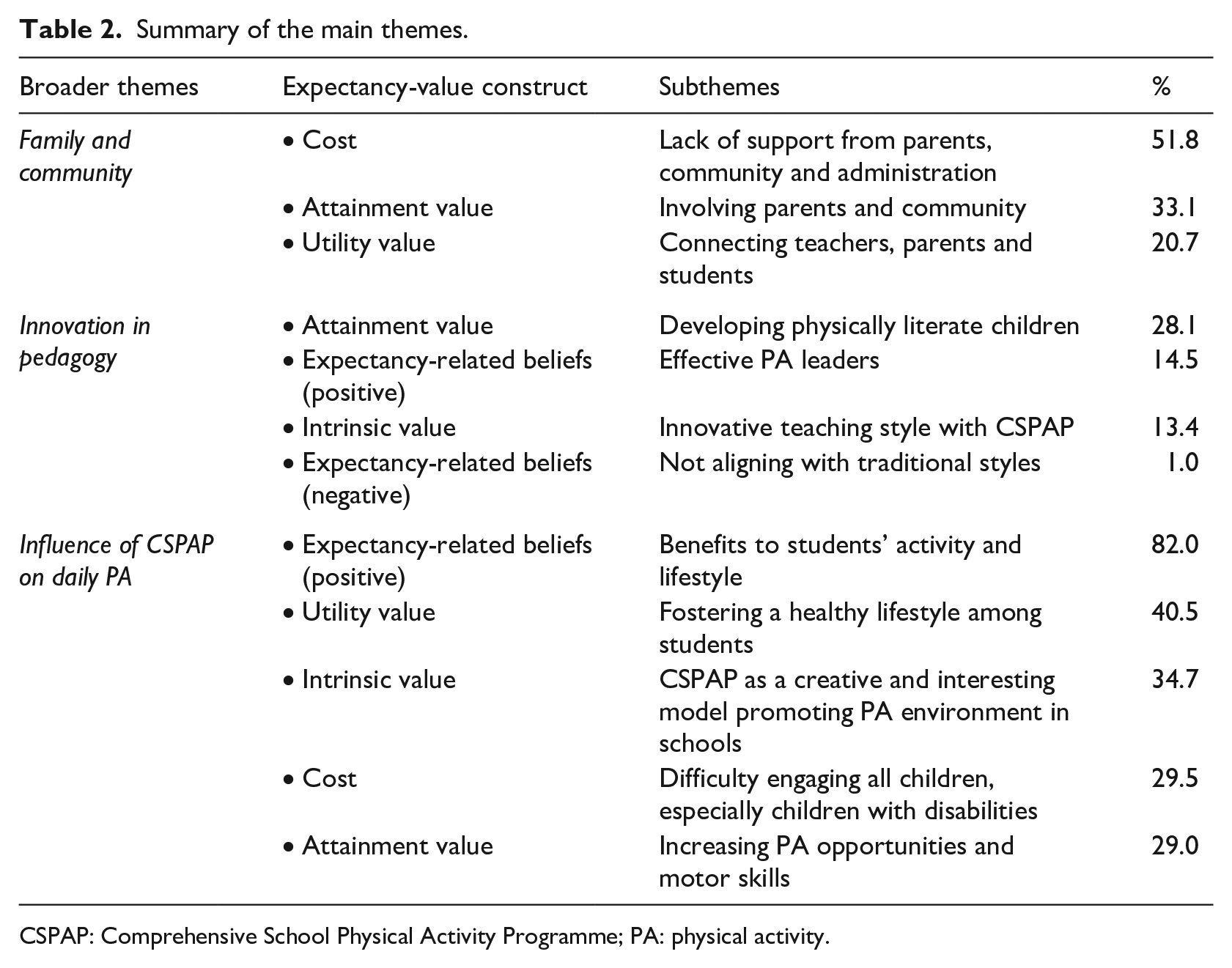
CSPAP: Comprehensive School Physical Activity Programme; PA: physical activity.
Family and community
Preservice classroom teachers reported that CSPAP involves family and community support (utility values), which are essential to CSPAP adoption inside and outside the classroom (attainment values). However, teachers expressed concerns about possible lack of support for CSPAP because parents, community and administration focus more on academic achievement than on other issues (cost).
Innovation in pedagogy
Some participants believed CSPAP implementation could lead to innovation in pedagogy by linking PA with academic activities in the classroom environment for health promotion purposes (attainment values, expectancy-related beliefs [positive]; intrinsic values). Other participants believed that classroom teachers should concentrate on increasing students’ academic performance rather than engaging with other activities due to limited time (expectancy-related beliefs [negative]).
Influence of CSPAP on daily PA
Some preservice classroom teachers indicated that they could become facilitators of children’s physical health by fostering the adoption of healthy lifestyles (expectancy-related beliefs [positive], utility values, intrinsic values and attainment values). However, participants also identified potential problems. For instance, children with disabilities might experience difficulties while engaging in CSPAP, and thereby not receiving the benefits of the programme compared to typically developing children (cost).
Discussion
The goal of this study was to explore preservice classroom teachers’ perspectives with respect to the CSPAP. Findings from the study revealed high expectancy-related beliefs and subjective task values towards implementing the CSPAP among preservice classroom teachers. The study also explored the underlying beliefs and values preservice classroom teachers held towards implementing the CSPAP.
Expectancy-related beliefs
The majority of participants believed that the CSPAP was a beneficial and effective programme for supporting children’s healthy lifestyles and improving teachers’ effectiveness. In contrast, participants attributed negative expectancy-related beliefs to their lack of experience and opportunity to learn about the importance of PA promotion for students in their future classrooms, supporting Webster et al.’s (2016) notion that health and PE programmes do not adequately engage classroom teachers in school PA promotion. Lack of experience working with families and the community in schools was perceived to be one of the biggest challenges when applying the CSPAP (Kwon et al., 2018; Michael et al., 2018). To facilitate the development of this experience, it would be productive to re-visit the coursework provided to preservice classroom teachers so as to prepare them more adequately to think about and deliver a CSPAP programme.
Some preservice classroom teachers’ low confidence in implementing the CSPAP was associated with a traditional educational style of focusing only on academic subjects. Preservice classroom teachers may lack an understanding of new curricula or be unfamiliar with how to integrate PA into academic subjects in the classroom in schools. Closer linkage between coursework and training in university settings and in real-world contexts (e.g. in actual elementary school classrooms) can do much to improve preservice classroom teachers’ perceived competence and attitudes towards a CSPAP.
Subjective task values
Preservice classroom teachers acknowledged that the CSPAP could involve parents and communities to increase children’s healthy and active lifestyles. The inclusion of a wide range of players was understood as central to achieving CSPAP goals and increasing awareness of the programme. Health fairs and field days are practical ways to encourage the involvement of parents and communities in this (Russ et al., 2015; Van Lippevelde et al., 2012).
Preservice classroom teachers showed high intrinsic values with respect to implementing a CSPAP in the schools they may work in the future. Participants were interested in the CSPAP because it allowed classroom teachers to use active learning styles and fostered a strong PA environment in schools. Participants’ intrinsic and utility values towards CSPAP were also influenced by students’ concentration and academic performance. In alignment with previous findings, preservice classroom teachers valued the involvement of different school and community groups in the CSPAP (Goc Karp et al., 2014; Russ et al., 2015). It is important to educate preservice classroom teachers on how to work closely with other staff, including administrators, activity coordinators and counsellors in school settings.
Preservice classroom teachers perceived a number of costs to applying the CSPAP. Participants expressed concern about lack of support from parents, the community and the school administration; limited time amid busy schedules; and lack of funding for implementing a CSPAP in schools. Because applying new curricula requires comprehensive support (Guskey, 2002; Van Lippevelde et al., 2012), this absence of support may add to teachers’ concern about the success of the intervention. Creative and low-cost ways of implementing the programme are needed. These might include integrating PA into the teaching of academic subjects (Bartholomew and Jowers, 2011). Schools may also work with community organisations to build a more inclusive PA environment (Brian et al., 2017). Overall, understanding of current barriers can be used to help school administrators and teachers to review the structure and content of courses delivered to facilitate PA.
Limitations and strengths
This study has several limitations. First, although the use of an online qualitative survey may be a speedier way to collect qualitative data than a traditional approach (e.g. a face-to-face interview), Internet-based qualitative data collection provided a limited in-depth understanding of participants’ responses. Future studies should use additional methods, such as semi-structured individual interviews and/or focus group interviews, to gain a deeper insight into participants’ perspectives. Finally, conducting the survey during class time may have limited students’ autonomy while completing the survey (Oliver et al., 2008). Despite these limitations, findings from this study offer insight into teacher perceptions of implementing CSPAP in schools, and to our knowledge, this study was the first to examine preservice classroom teachers’ beliefs and values related to this using Eccles’ expectancy-value model as a framework.
Conclusion
Findings from this study reveal that preservice classroom teachers identified the important role of programmes such as CSPAP in increasing daily PA, in working with family and community and in supporting innovation in pedagogy. Findings from the study provide insights to help promote the development of preservice classroom teachers’ beliefs and values concerning this style of work. First, more time, practice and knowledge are needed to strengthen preservice classroom teachers’ beliefs and values concerning the incorporation of PA into classroom and recess time. Second, university instructors can enrich preservice classroom teachers’ knowledge and experience of CSPAP implementation via collaborations with community and schools. Finally, practice and experience implementing the CSPAP model in real-world elementary classrooms are likely to increase preservice teachers’ motivation and confidence, thereby promoting the success of CSPAP implementation in the future.
Footnotes
Acknowledgements
We thank the course instructors who helped us collect data from their teacher education classes and the preservice classroom teachers who participated in the study.
Funding
The author(s) received no financial support for the research, authorship and/or publication of this article.
