




Abstract
Objective:
College students are among the age-group most affected by sexually transmitted infections, yet few evidence-based interventions have proved effective in increasing college student condom use. The goal of this study was to determine which combination of referent proximity and width of discrepancy between perceived and actual norms within a normative feedback intervention produced the greatest motivation to increase condom use among US college students.
Design:
A 2 (proximity) × 2 (width of discrepancy) × 2 (gender) randomised-factorial experiment was conducted.
Setting:
Sexually active college students (N = 212; 50.5% female; 70.4% White) were recruited via Amazon Mechanical Turk, an online labour market.
Method:
Participants were randomised, stratified by gender, to one of four sham feedback conditions: proximal referent wide discrepancy, proximal referent narrow discrepancy, distal referent wide discrepancy and distal referent narrow discrepancy. Following delivery of the feedback, participants completed measures assessing their willingness to change their condom use.
Results:
A three-way factorial analysis of covariance revealed a significant interaction between referent proximity and width of discrepancy (F = 7.88, p = .005,
Conclusion:
Findings from this study indicate that it may be beneficial to assess students’ perceptions of their peers’ sexual behaviour before selecting the reference group to include within normative feedback. This is the first study to demonstrate that the importance of selecting referents within normative feedback may be dependent on the accuracy of students’ perceptions.
Introduction
College students are among the age-group most affected by sexually transmitted infections (STIs; Centers for Disease Control and Prevention [CDC], 2021). Although youth (aged 15–24) represent 25% of the sexually active US population, they account for half of the 20 million annual STIs (CDC, 2021). While consistent condom use has been identified as the most accessible STI prevention strategy, only 41% of US college students report always consistently and correctly using a condom (American College Health Association, 2020). Interventions designed to increase condom use among college students are thus a public health priority.
Most colleges (86.3%) in the USA have implemented campus-wide condom distribution programmes in which condoms are made available at student health services (Butler et al., 2014). However, evidence suggests that increased access to condoms may not translate to increased condom use behaviour (Campbell and Mzaidume, 2002). Because of this, the CDC recommends that condom distribution programmes be coupled with behavioural interventions. Yet, a recent review on behavioural interventions targeting college student condom use identified a limited number of interventions developed between 2006 and 2016 (N = 7; Whiting et al., 2019), very few of which explicitly focused on increasing the behaviour of condom use.
Whiting et al.’s (2019) review highlighted the need for more evidence-based intervention studies to elucidate the intervention components efficacious for increasing college student condom use. Because there are few behavioural condom promotion interventions for college students (Whiting et al., 2019), interventions that have been shown to be scalable and efficacious for modifying college student alcohol use are useful to consider. One such intervention is normative feedback.
Normative feedback interventions for condom promotion
According to the social norms theory, behaviour is influenced by perceptions of how peers think and act; however, these perceptions are often formed via selective, biased observations of visible risk behaviours (Perkins and Berkowitz, 1986). Misperceived observations generate a discrepancy between what is viewed as the typical standard in a group (i.e. the perceived norm) and the real beliefs or actions of a group (i.e. the actual norm), and these inaccurate beliefs have been shown to be predictive of personal engagement in such behaviours (Dempsey et al., 2018). Thus, correcting erroneous normative perceptions via feedback is a proposed mechanism of behavioural change (Dempsey et al., 2018). Interventions utilising normative feedback are especially well-suited for populations that tend to be influenced by peer behaviours, such as college students (Dempsey et al., 2018). Normative feedback interventions have demonstrated substantial success in reducing college student drinking (Dotson et al., 2015), yet less is known about the efficacy of such interventions for sexual outcomes such as condom use (Whiting et al., 2019).
Normative feedback may be an effective approach for condom promotion. Researchers have found that US college students endorse erroneous perceptions of peer engagement in sexual behaviour (e.g. Chernoff and Davison, 2005; Lewis et al., 2007), and elevated perceived norms have been shown to predict personal sexual behaviour (e.g. Lewis et al., 2007), indicating that correcting erroneous perceived norms may elicit behavioural change. Some studies have incorporated normative feedback for condom promotion as a component of a larger skills-based STI risk-reduction intervention (e.g. Dermen and Thomas, 2011); however, only two studies have evaluated the efficacy of stand-alone normative feedback for condom promotion among youth (Chernoff and Davison, 2005; Lewis et al., 2019). Of these two studies, only one utilised a college student sample (Chernoff and Davison, 2005). Chernoff and Davison (2005) found that male college students who received normative feedback for their condom use significantly increased personal condom use at 30-day follow-up, whereas condom use remained the same for women at pre- and post-intervention. The mixed-efficacy of this intervention may be partially explained by the decision to use a generic ‘typical student’ referent in the feedback, which may not have been perceived as a salient peer across gender (Lewis and Neighbors, 2006a).
Specificity of normative referent group
While most normative feedback interventions in the alcohol literature utilise a ‘typical student’ referent (Lewis and Neighbors, 2006a), social comparison theory purports that socially proximal (i.e. demographically matched) referents may have a greater influence over personal attitudes, beliefs and behaviours compared with socially distal referents (Festinger, 1954). Indeed, several intervention studies have found that perceived norms of demographically matched, compared with generic, referents were more predictive of personal behaviour (Carey et al., 2010; Larimer et al., 2009; Lewis et al., 2007). Yet, other evidence is less conclusive. In fact, LaBrie et al. (2013) demonstrated normative feedback for a ‘typical student’ referent was most efficacious for reducing college students drinking. The authors hypothesised that students were able to project characteristics perceived as most prototypical of a heavy-drinking college student onto the non-descriptive referent. As a result, the typical student referent was perceived as having the pattern of heaviest alcohol consumption, subsequently generating the greatest discrepancy between students’ perceived norms of peers’ alcohol consumption and peers’ actual reported alcohol consumption. In support of the primary assumption of normative feedback interventions (Dempsey et al., 2018), drawing attention to the large discrepancy between perceived and actual peer behaviour resulted in the greatest reduction in weekly drinking.
Discrepancy of actual norm with perceptions
Presumably, for normative feedback to be effective, inaccurate beliefs must be present (Lewis and Neighbors, 2006a), and the greater the discrepancy between actual and perceived norms, the greater the potential impact of the feedback (LaBrie et al., 2013). Although the amount of discrepancy needed to produce behavioural change remains unclear, it is well-supported in the literature that utilising a ‘typical student’ referent produces the greatest discrepancy between perceived and actual norms (LaBrie et al., 2013; Larimer et al., 2011). This is likely because students’ perceptions of peers’ behaviours become more distorted for groups they know less well, and estimates for proximal groups may be more factually based than estimates for distal groups (Perkins and Berkowitz, 1986). Although students may perceive feedback for proximal referents as more relevant, and therefore more motivating, the greater accuracy of perceptions for proximal referents may reduce the discrepancy and motivating potential of the feedback. Therefore, the evidence presented thus far indicates that both reference group proximity and width of discrepancy between perceived and actual norms independently influence the efficacy of normative feedback. However, the literature has yet to examine how both factors interact to influence willingness for behavioural change, specifically in the context of college students’ condom use.
Present study
The present study aimed to address this gap in the literature by exploring the combination of reference group specificity and width of discrepancy that produces the greatest willingness to increase condom use among college students. We hypothesised that participants who were provided feedback that produced a wide discrepancy between perceived and actual norms for a gender-matched (i.e. proximal) referent would be most willing to increase their personal condom use, and participants who were provided with feedback that generated a narrow discrepancy between perceived and actual peer norms for a gender-neutral (i.e. distal) referent would be least willing to increase their own condom use. We expected this interaction to differ by gender such that the proximity manipulation would exert less influence on male participants’ willingness to increase personal condom use, given that the typical college student is perceived as male (Lewis and Neighbors, 2006b). For the purpose of this paper, ‘gender’ is referring to gender identity (e.g. cisgender woman) and not biological sex (e.g. female at birth).
Methods
The study proceeded in two phases. In Phase 1, pilot studies were conducted to examine whether participants perceived the referent proximity and width of discrepancy manipulations as intended. In Phase 2, a 2 (proximity) × 2 (width of discrepancy) × 2 (gender) randomised-factorial experiment was conducted.
Materials
Condom use feedback manipulation
Formative work with 36 college students was conducted to develop the experimental manipulation. Referents were either a gender-neutral student (e.g. ‘typical student at your university’) or a gender-matched student (e.g. ‘typical male/female student at your university’). Based on findings in the alcohol literature, a wide discrepancy was defined as a positive difference of 20% between the perceived and actual norm for condom use and a narrow discrepancy was defined as a 5% difference (LaBrie et al., 2013).
Feedback for condom use followed the format: You stated that [perceived norm of condom use as percentage] of [referent] use a condom all or most of the time during sexual intercourse in the past three months. In fact, [width of discrepancy] of [referent] use a condom all or most of the time during sexual intercourse in the past three months. You underestimated the [referent’s] condom use by [width of discrepancy].
T-test analyses were conducted to determine the efficacy of both manipulations.
In the first phase of pilot testing (N = 20; 65% female), participants did not perceive the reference groups as different in proximity; however, the discrepancy manipulation was perceived as intended. After several changes had been made to the feedback to increase the length of time participants were exposed to the feedback, a second phase of pilot testing was conducted (N = 16; 50% female). In Phase 2, both manipulations were successful. Thus, these procedures were retained for use in the experimental study.
Procedures
Participants were recruited from universities across the USA via Amazon Mechanical Turk (MTurk), an online labour market in which individuals are paid to complete online tasks (Buhrmester et al., 2011). Prior to enrolment, participants completed a pre-screening questionnaire to determine eligibility to the following criteria: (1) age 18–25 years, (2) current fourth-year, US college student, (3) heterosexual and (4) sexually active within the past year. Eligible participants were redirected to the full survey administered via Research Electronic Data Capture (REDCap), a secure, web-based, data-collection system. Participants completed several descriptive measures and were then randomised, stratified by gender, to one of four sham feedback conditions: (1) gender-neutral, wide discrepancy, (2) gender-neutral, narrow discrepancy, (3) gender-matched, wide discrepancy or (4) gender-matched, narrow discrepancy. Following delivery of the feedback, participants completed measures assessing their willingness to change their condom use. Participants were provided with a debriefing statement and awarded compensation (US$0.50).
Measures
Demographics
Data on age, class year, gender identity, sexual orientation, race, ethnicity, residential status and relationship status were collected.
Sexual behaviour questionnaire
Participants were asked to report on their lifetime, past year and past 3-month sexual partners and frequency of oral, vaginal or anal sex; alcohol use prior to sex; and talking with a partner about condom use in the past 3 months and past 30 days (Stappenbeck et al., 2013).
Individual-difference measures
To account for potential covariates, the following measures were administered: Sexual Sensation Seeking Scale (Kalichman et al., 1994), Sexual Motives Questionnaire (Cooper et al., 1998), Inventory of Dimensions of Emerging Adulthood (Baggio et al., 2015) and Drinking Motives Questionnaire (Cooper, 1994).
Perceived descriptive norms
Participants were asked to estimate the percentage of typical university students, men and women, who had engaged in past 3-month condom use (Chernoff and Davison, 2005).
Willingness to change condom use
To assess participants’ willingness to modify their condom use, they were asked, ‘On an 11-point scale ranging from “not at all” (0) to “extremely” (10), how willing are you to increase your condom use over the next three months?’ (Chernoff and Davison, 2005).
Identification with reference group
To assess for differences in perceived social proximity of the referents during development of the experimental manipulations, the Inclusion of Other in the Self (IOS) scale was administered (Aron et al., 1992). Participants were presented with seven Venn diagrams ranging from 1 to 7, with 1 representing completely non-overlapping circles (i.e. very low identification) and 7 representing completely overlapping circles (i.e. very high identification). Participants were asked to select the diagram which best represented their level of identification with the feedback referent.
Identification of discrepancy
To assess for differences in perceived width of discrepancy between perceived and actual norms, participants were asked the following: Describe the width of discrepancy between your perception of your peers’ condom use in the past 3-months and your peers’ actual reported condom use in the past 3-months on an 11-point scale ranging from 0 (no discrepancy) to 10 (large discrepancy).
Data analyses
All analyses were conducted using the Statistical Package for Social Sciences (SPSS) version 23. For continuous variables, means, medians, standard deviations, percentiles and ranges were generated; frequencies and proportions were used for categorical and ordinal variables. Chi-square analyses and analyses of variance (ANOVAs) were conducted to test for differences in participant characteristics by condition to determine whether randomisation was successful. To examine the effects of referent proximity, width of discrepancy and gender on willingness to increase condom use, a three-way factorial analysis of covariance (ANCOVA) was conducted. Significant bivariate correlations were included as covariates.
Results
Participant characteristics
Data for this study were collected between 20 May and 5 July 2020, 2 months after declaration of COVID-19 as a national emergency. A detailed description of the effect of COVID-19-related mitigation efforts on participants’ sexual behaviour has been published elsewhere (Firkey et al., 2021). Participants who completed the survey in under 5 minutes (n = 3) or failed to accurately respond to validity/attention checks (n = 15) were excluded from analyses. Participants (N = 212) were mostly non-Hispanic White (70.4%), fourth-year students (44.6%) with a mean age of 22.09 years (SD = 2.09; Table 1). Half (50.5%) identified as women, and 50.0% stated they were in a monogamous relationship. Participants reported an average of 2.22 (SD = 4.61) past-year partners (Table 2). Most participants (77%) reported engaging in vaginal sex in the past 3 months, yet only 24.9% of the sample endorsed consistent condom use over that time frame. Most participants (64.8%) had consumed alcohol or cannabis (44.6%) prior to sex at least once in the past 3 months.
Participant demographic characteristics by experimental condition.

Note. Total Ns = 212. aN = 50; bN = 62; cN = 51; dN = 49. Percentages may not add up to 100% due to missing data (i.e. participants declining to respond to certain measures).
**p < .01.
Participant sexual behaviour by experimental condition.

Note. Total Ns = 212. aN = 50; bN = 62; cN = 51; dN = 49; eBased on a Likert-type scale ranging from 1 (never) to 5 (always). Percentages may not add up to 100% due to missing data (i.e. participants declining to respond to certain measures).
**p < .01.
Effect of normative feedback on willingness to change condom use
Results of an ANCOVA (Table 3), controlling for past 3-month condom use, revealed a significant main effect of referent proximity, such that participants who received feedback for a gender-matched referent (MProximal = 7.45, SD = 2.68) endorsed greater willingness to increase condom use compared to participants who received feedback for a gender-neutral referent (MDistal = 4.94, SD = 2.97; F = 60.38, p < .001,
ANCOVA on the influence of gender, referent proximity and width of discrepancy on willingness to change condom use.

ANCOVA: analysis of covariance.
N = 212.
**p < .01.
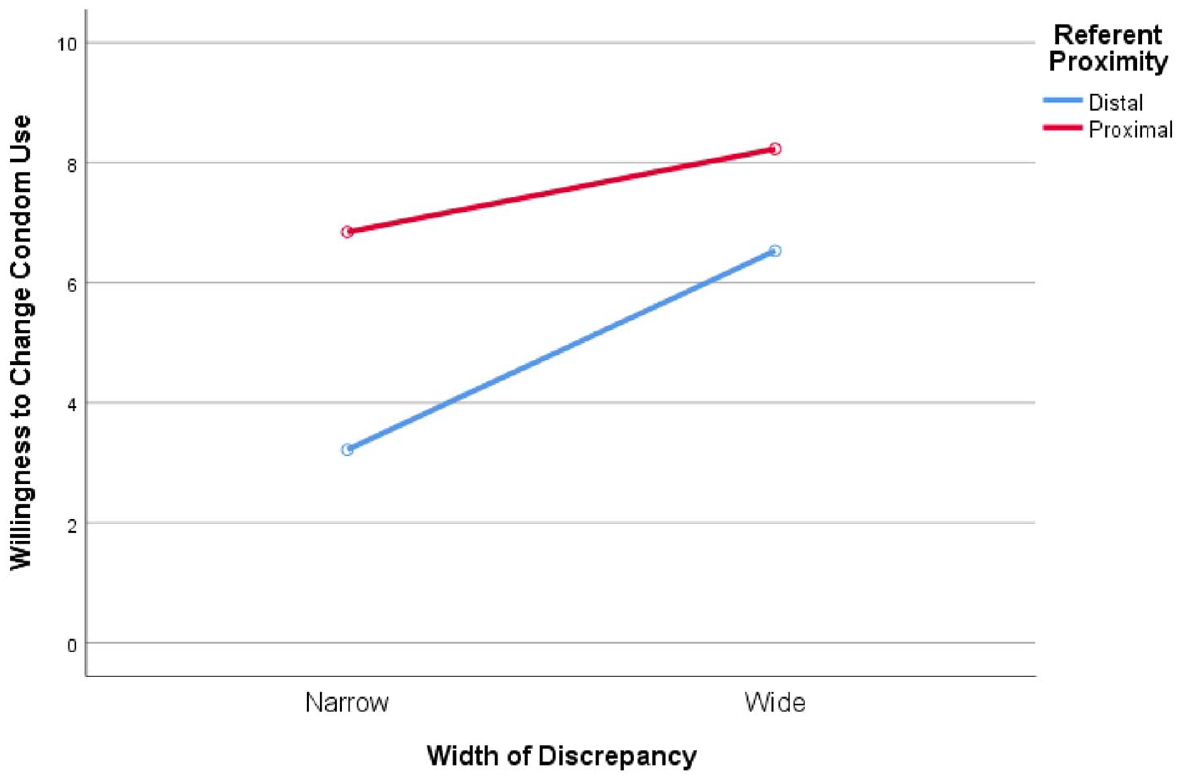
Influence of referent proximity and width of discrepancy on willingness to change condom use.
Discussion
This study examined the effects of referent proximity and width of discrepancy between perceived and actual norms on willingness to increase condom use. Results revealed that the effects of referent proximity on willingness to use condoms varied depending on the width of discrepancy between participants’ perceived and actual norms, such that referent proximity had a greater impact on willingness to use condoms when feedback generated a narrow, compared with wide, discrepancy. This finding suggests that providing feedback for a demographically similar referent may be necessary for motivating behavioural change in condom use among students who report more accurate perceived norms. Yet, as students’ perceptions of their peers’ behaviour become less accurate, the influence of referent specificity subsequently decreases. Although previous studies have demonstrated that behaviour is more closely influenced and modelled on socially proximal referents (e.g. Lewis et al., 2007), this is the first study to demonstrate that the importance of selecting referents may be dependent on the accuracy of students’ perceptions. As such, it may be beneficial to assess students’ perceptions of their peers’ sexual behaviour before selecting the normative feedback referent.
Findings from this line of research can inform the delivery of future normative feedback interventions for condom promotion. The relationship between referent proximity and width of discrepancy discovered by this study suggests that selection of a referent should be contingent on the accuracy of students’ perceptions. For those who have accurate perceptions of their peers’ sexual behaviour, a socially proximal referent may be necessary, whereas those with less accurate perceptions may benefit from feedback with any referent regardless of proximity. Such intervention tailoring has not previously been emphasised in the normative feedback literature, yet might be most effective for eliciting behavioural change. Future research should examine feasible ways to integrate this type of intervention tailoring through the use of automated algorithms (Dijkhuis et al., 2018). Feedback regarding a range of sexual behaviours (e.g. number of sexual partners) can be integrated into the intervention following a similar algorithm, and additional demographic characteristics (e.g. race, academic standing) can be utilised to engender greater social proximity to the referent.
Interpretations of these data must be made in light of national events that occurred during data collection. Because of social distancing guidelines seen during the COVID-19 pandemic, most students in this sample reported a decrease in opportunities to have sex (55.2%) and frequency of sexual activity (57.5%; Firkey et al., 2021). Although condom access and use remained relatively unchanged for most (63.2% and 65.1%, respectively; Firkey et al., 2021), students may have perceived their peers as engaging in more frequent condom use to limit the spread of COVID-19. Consequently, these data may not accurately depict college students’ typical behaviour or perceptions of peers’ behaviour prior to the COVID-19 pandemic.
Limitations
There are some limitations to this study. First, the inclusion criteria for participation may not generalise to students at highest risk for STI acquisition. While study eligibility criteria required that participants had been sexually active within the past year, participants did not have to be inconsistent condom users or in non-monogamous relationships. As such, those who endorsed a history of protective sexual behaviour or monogamous relationship status may have been less willing to increase personal condom use. Second, normative feedback in this study did not elaborate on the role of alcohol intoxication as a barrier to risk reduction in sexual situations. Not only is alcohol use prevalent on college campuses (Hingson et al., 2009), but most participants (64.8%) in this sample had consumed alcohol prior to sex at least once in the past 3 months. There is compelling support in the literature that acute alcohol intoxication causes greater intentions to engage in condomless sex (Scott-Sheldon et al., 2016). Since the feedback provided in this study did not explicitly state the context in which peers engaged in condom use, we are unable to determine if students perceived the feedback as relating to their peers’ condom use while intoxicated, sober, or both. Students’ willingness to increase their own condom use may have been reflected in how they interpreted the context of the feedback. Only one level of referent specificity was utilised in this study, yet prior research suggests that increasing levels of referent specificity (e.g. gender and race) are most predictive of behaviour (Larimer et al., 2011). Utilising one level of referent specificity may have limited the perceived social proximity of the referent, and thus reduced the extent to which participants were willing to endorse behavioural change. Future research should examine how incorporation of additional levels of proximity influences students’ willingness to increase condom use.
Recruiting participants via MTurk also has implications for the generalisability of the findings. Although established psychological effects have been replicated using samples from MTurk, and research has found that MTurk workers are as likely to pass manipulation checks as traditional undergraduate samples (Buhrmester et al., 2011), it is possible that college student MTurk workers are a unique sub-population of college students. Thus, these findings should be replicated with a traditionally-recruited sample of college students. It is also noteworthy that condom use behaviours vary nationwide as a result of geographic differences in condom availability and attitudes (Shacham et al., 2016). While region of the USA was not significantly associated with willingness to change condom use at the bivariate level in this sample, future normative feedback interventions should tailor intervention content by using local (e.g. regional) condom use norms.
Conclusion
This study is the first to examine the influence of both referent proximity and width of discrepancy between perceived and actual norms on the efficacy of normative feedback for condom promotion. The results demonstrated a significant interaction between referent proximity and width of discrepancy such that effect of referent proximity was contingent on the accuracy of students’ perceptions. Findings from the study suggest that it may be beneficial to assess students’ perceptions of their peers’ sexual behaviour before selecting the referent to include in normative feedback. College health centres represent an auspicious resource for delivering normative feedback interventions given their ability to screen health behaviours for large numbers of students and disseminate brief interventions to those who endorse low levels of condom use.
Footnotes
Declaration of conflicting interests
The author(s) declared no potential conflicts of interest with respect to the research, authorship and/or publication of this article.
Funding
The author(s) received no financial support for the research, authorship and/or publication of this article.
