




Abstract
Objective:
We investigated how students’ interest in healthy eating changed after the introduction of on-site school lunch, prepared on campus, at a Japanese junior high school.
Design:
One-year follow-up study.
Setting:
Participants were 166 students in their second year of study at a public junior high school in Japan which introduced an on-site school lunch programme instead of students bringing lunch from home.
Method:
Students’ interest in healthy eating habits was evaluated using the Japanese Questionnaire of Consciousness in Dietary Life for Adolescents Form (JQCDL–AF).
Results:
Data from 139 students who completed all three surveys were analysed. Total scores after 1 month increased significantly compared to baseline. This increase was sustained among boys 1 year later. The introduction of on-site school lunches is an effective strategy not only for providing healthy meals but also for increasing interest in the development of healthy eating habits.
Conclusion:
Increasing opportunities to get involved in meal preparation through the introduction of on-site school lunches may be an effective means of facilitating healthy eating among students.
Background
Schools have an important role to play in promoting healthy diet and good nutrition and can offer an enabling environment for health promotion in children (World Health Organization, 2021). School food environment policies include nutrition education within health and food literacy (Kelly and Nash, 2021; Nash et al., 2021) and direct food provision, including school lunches (Cohen et al., 2021). Several strategies have the potential to improve school meal consumption, and most studies in a recent review found improvements in school meals (Cohen et al., 2021). Furthermore, a meta-analysis found that school food environment policies improved children’s overall dietary habits, both inside and outside school (Mansfield and Savaiano, 2017; Micha et al., 2018).
School lunch programmes are one of the school food environment policies carried out in many countries including the USA (National School Lunch Program; NSLP), India (Mid-Day Meal; MDM), Brazil (Programa Nacional de Alimentação Escolar; PNAE), and Indonesia (Programme Gizi Anak Sekolah; PROGAS). School lunches are useful not only in providing essential nutrition during childhood, but also for acquiring healthy eating habits. Students from schools who participated in the NSLP, for example, were more inclined to make healthy food choices (Mobley et al., 2012). Cohen et al. (2012) reported that the introduction of a chef in the school lunch preparation team increased the daily per-student consumption of whole grains and vegetables. These results suggest that providing healthy meals can improve students’ food consumption behaviour.
School lunches in Japan commenced in 1889 when free lunches were provided to children from poor families. In 1954, the School Lunch Act was enacted, and today’s school lunch programme was established. A basic plan for promoting shokuiku (food and nutrition education) has been implemented since 2006, and the provision of school lunch has played an important role within the shokuiku programme (Ministry of Education, Culture, Sports, Science and Technology, 2021). According to the School Lunch Act, school lunches are considered to ‘fulfill a significant role in cultivating an accurate understanding and judgment skills about food’. Japanese-style school lunches serve the same menu to all students in the same school. Pupils on school lunch duty are selected by rotation to serve school lunches to other pupils (Maruyama and Kurokawa, 2018; National Institutes of Biomedical Innovation, Health and Nutrition, 2019).
Matsumoto and Fukasawa (2003) reported that differences in systems of provision for school lunch (e.g. via an external food contractor, through a central kitchen, or by means of on-site school preparation) in junior high schools affected students’ food consumption attitudes and behaviours. In Japan, school lunches are provided in most elementary (99.1%) and junior high schools (88.1%), but it remains unclear how the introduction of on-site school lunches will affect behaviours and interests about healthy eating habits among Japanese children. Likewise, the long-term effects of introducing on-site school lunches prepared in a kitchen in the school on junior high school students’ interest in healthy eating are unknown. Therefore, this study investigated how students’ interest in healthy eating changed after the introduction of an on-site school lunch in a junior high school where students previously brought their own lunch.
Methods
Participants and ethical considerations
Surveys were carried out in a full-time, coeducational public junior high school in Hyogo, Japan. The school catered for students in grades 1 to 3 (aged 12–15 years). In 2019, the total number of students was 506; 166 students in their second year (13–14 years old) participated in the study. Home economics and diet and nutrition teachers explained the details of the study orally to students. Consent to participate in the study was inferred from students’ decision to answer the questionnaire. The surveys were approved by the principal of the school as well as the Mukogawa Women’s University Research Ethics Committee (Approval numbers: 18–87 and 19–58).
Study design and questionnaire for surveys
Figure 1 shows the study design. The first survey was conducted in January 2019. In February 2019, the lunch system was changed from students bringing lunchboxes from home (hereafter referred to as ‘lunchboxes’) to the provision of an on-site school lunch. After this change, all students were provided with school lunches. Students with food allergies were provided with tailor-made meals. The second and third surveys were conducted in March 2019 (after 1 month) and February 2020 (after 1 year).

Study design.
The surveys were conducted immediately before a home economics class. A home economics or diet and nutrition teacher distributed the surveys and explained the purpose of the study. The questionnaire consisted of items assessing students’ interest in healthy eating habits and their breakfast and snack habits. Most students answered the questionnaire within 10 minutes.
Interest in healthy eating habits was measured using the Japanese Questionnaire of Consciousness in Dietary Life for Adolescent Form (JQCDL–AF; Maeta et al., 2022). This scale comprises two main elements factors: Factor 1, measuring a reduction in the consumption of unhealthy food while eating out or snacking (4 items), and Factor 2, focusing on meal manners and preparation (7 items). A copy of the questionnaire is available from the corresponding author on request. Responses were given on a 4-point Likert-type scale, 1 = ‘I am not conscious at all’; 2 = ‘I am not very conscious (about 30%)’; 3 = ‘I am a little conscious (about 60%)’; and 4 = ‘I am very conscious (about 90%’). Higher scores on the JQCDL–AF show a greater interest in healthy eating habits.
Regarding snacking habits, participants indicated all the foods that they frequently ingested including instant noodles, rice balls (onigiri), processed snack products, snack breads, Western desserts including chocolate, Japanese desserts, ice cream, milk, juices and fruit.
School lunch at a Japanese public junior high school
Lunch was prepared and served every day at the school, from Monday to Friday. School lunches were made in the school’s kitchen by cooks supported by a diet and nutrition teacher. Students on school lunch duty delivered the cooked food and served the other pupils, which is an approach commonly used in Japan (Maruyama and Kurokawa, 2018; National Institutes of Biomedical Innovation, Health and Nutrition, 2019).
All students in the surveyed school were provided with school lunch meals. Students with food allergies were provided with tailor-made meals. The reference intake values for energy (Ministry of Education, Culture, Sports, Science and Technology, 2018), nutrients and average food components in the school lunches are presented in online Supplemental Tables A and B. Sample lunch menus are shown in Figure 2.

Picture of lunches prepared in-school.
Following the introduction of the programme, the school started to distribute school lunch newsletters and provided information relevant to the preparation of school lunch meals such as on how to cook, key ingredients, nutrients and catering for different cultural backgrounds during lunchtime. In the study school, shokuiku (food and nutrition education) took place as normal.
Statistical analysis
Data were analysed both descriptively and inferentially. Relevant descriptive data are presented as medians and 25th–75th percentiles. The effect size index (d) was calculated using the Cohen (2013) and the Suzukawa methods (Suzukawa and Toyoda, 2011). G*power version 3.1.9.2 (Statistical Power Analyses [Heinrich Heine University], Dusseldorf, Germany) was used to determine the number of study participants (Faul et al., 2007, 2009)

Where
Friedman’s test, a method of paired one-way analysis of variance (ANOVA), was used for analysis. Factors in which significant differences were observed in the Friedman’s test analysis underwent a multiple comparison test using the Wilcoxon signed-rank test with Bonferroni correction. A comparison of changes in the JQCDL–AF scores between boys and girls was conducted using the Mann–Whitney U test. GraphPad Prism version 5.0 (GraphPad Software, San Diego, CA, USA) was used for analysis. Interaction analyses between the student’s sex and the surveyed points in time (Sex × Time) were conducted using a repeated two-way ANOVA with Greenhouse-Geisse correction). Differences with p < .05 were considered significant.
Results
Participants
In the first survey in January 2019 (lunchbox), 152 students participated (cooperation rate: 91.6% [152/166]). Two students left blank or incomplete responses in the JQCDL–AF. In the second survey in March 2019 (after 1 month), 147 students participated (cooperation rate: 98.0% [147/150]). All students answered the JQCDL–AF completely. In the third survey in February 2020 (after 1 year), 143 students participated (cooperation rate: 97.3%, 143/147). Four students left blank or incomplete responses in the JQCDL–AF. Therefore, 139 students participated in all three surveys. Data on students’ breakfast and snacking habits are shown in Table 1.
Sex and breakfast and snacking habits of participants.
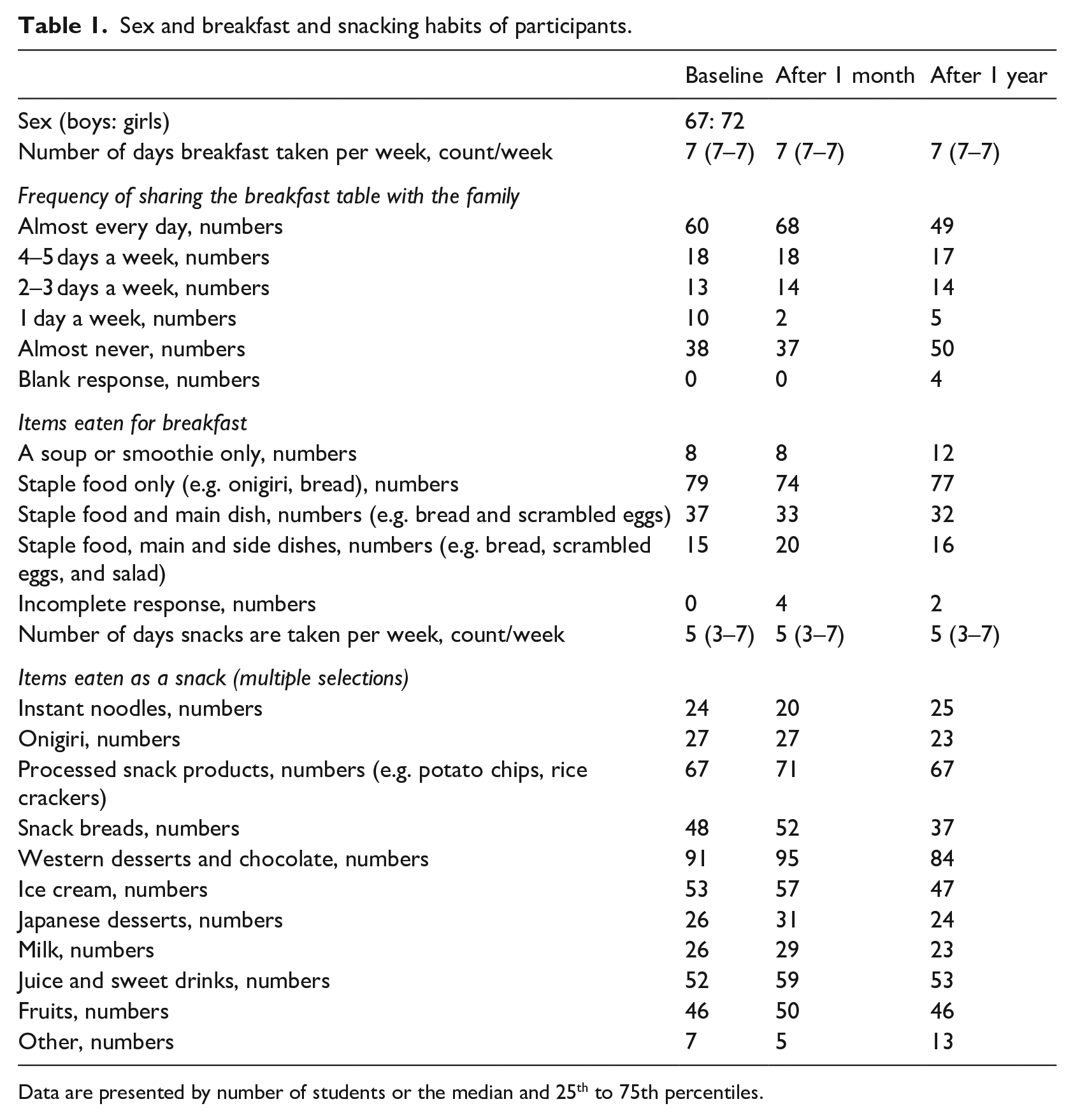
Data are presented by number of students or the median and 25th to 75th percentiles.
Changes in the JQCDL–AF scores with the introduction of on-site school lunch in a junior high school
The total JQCDL–AF scores 1 month after introducing on-site school lunch increased significantly from baseline (Table 2). The effect size after 1 month was 0.398. However, the total JQCDL–AF scores after 1 year were comparable to those at baseline (Table 2). The effect size after 1 year was 0.068. Therefore, the increase in total JQCDL–AF scores after introducing on-site school lunch disappeared between 1 month and 1 year after introducing the on-site school lunch.
Change in JQCDL–AF scores after introducing on-site school lunch. 1
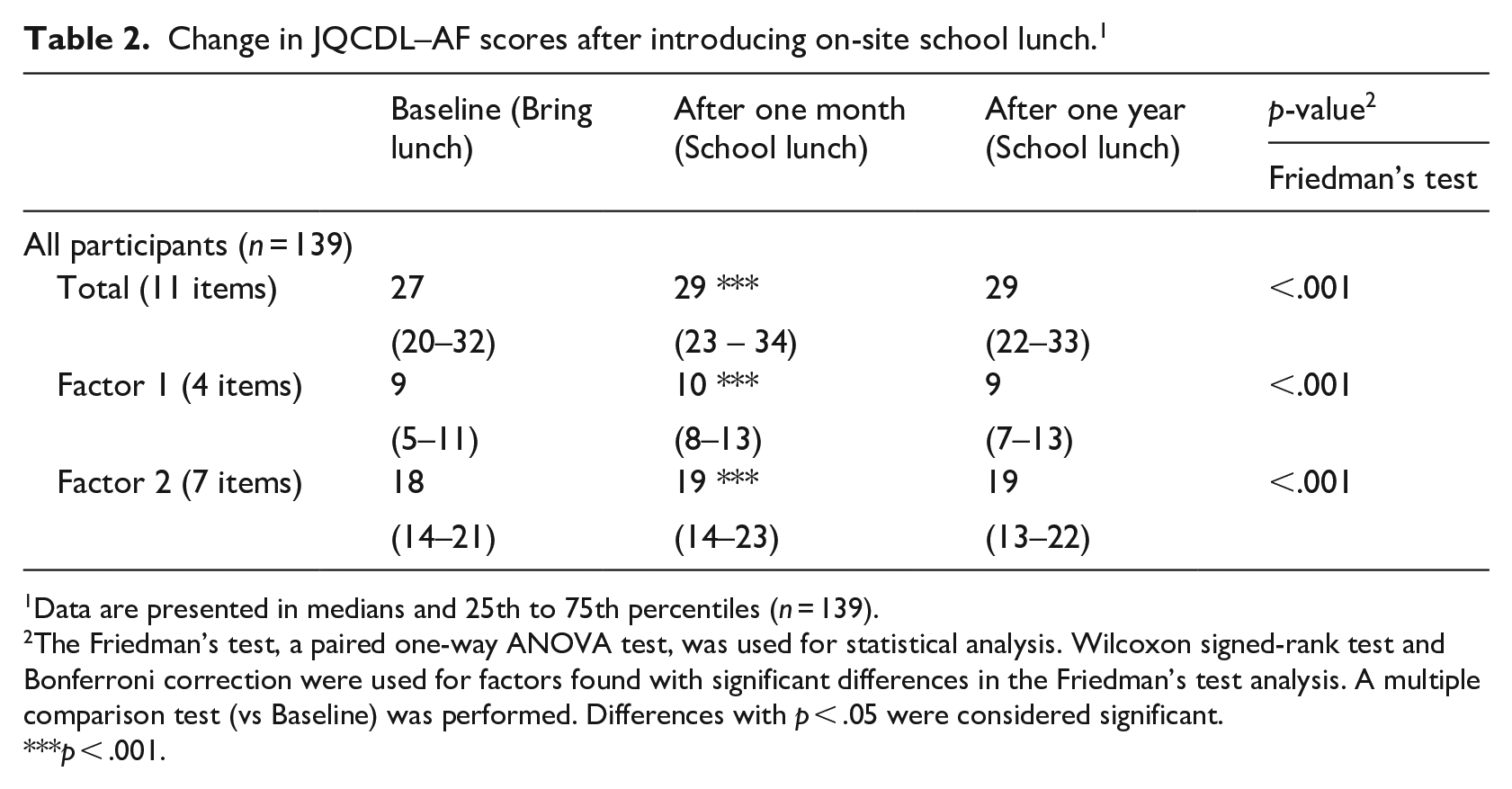
Data are presented in medians and 25th to 75th percentiles (n = 139).
The Friedman’s test, a paired one-way ANOVA test, was used for statistical analysis. Wilcoxon signed-rank test and Bonferroni correction were used for factors found with significant differences in the Friedman’s test analysis. A multiple comparison test (vs Baseline) was performed. Differences with p < .05 were considered significant.
p < .001.
Relationship between sex and changes in the JQCDL–AF scores
Of the total, 72 participants were girls and 67 were boys. The repeated two-way ANOVA (Sex × Time) showed a significant interaction between the total and Factor 2 scores (P = 0.014 and 0.002, respectively). Among girls, the total and Factors 1 and 2 scores 1 month after introducing on-site school lunch increased significantly from baseline (Table 3); however, after 1 year the scores were comparable to those at baseline (Table 3).
Change in JQCDL–AF scores after introducing on-site school lunch among girls and boys. 1
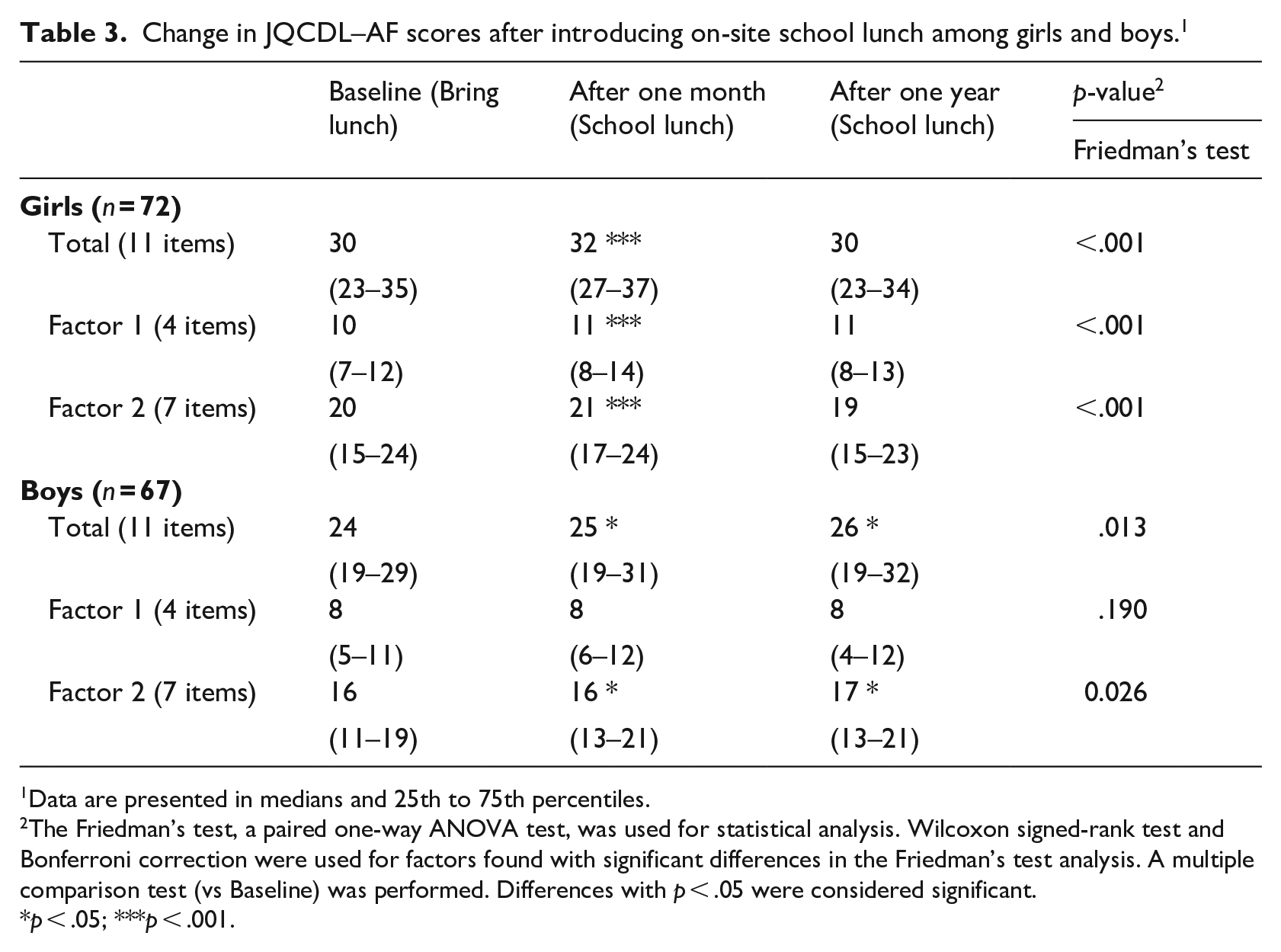
Data are presented in medians and 25th to 75th percentiles.
The Friedman’s test, a paired one-way ANOVA test, was used for statistical analysis. Wilcoxon signed-rank test and Bonferroni correction were used for factors found with significant differences in the Friedman’s test analysis. A multiple comparison test (vs Baseline) was performed. Differences with p < .05 were considered significant.
p < .05; ***p < .001.
Among boys, the total scores 1 month and 1 year after introducing on-site school lunch increased significantly from baseline (Table 3). The effect sizes after 1 month and 1 year were 0.323 and 0.336, respectively. However, the Factor 1 scores were not significantly different across the three surveys (Table 3). The Factor 2 scores 1 month and 1 year after introducing school lunch increased significantly from the baseline (Table 3). The changes in the total and Factor 2 scores after 1 year were significantly higher among the boys than among the girls (Figure 3; p = .032 and .003, respectively).
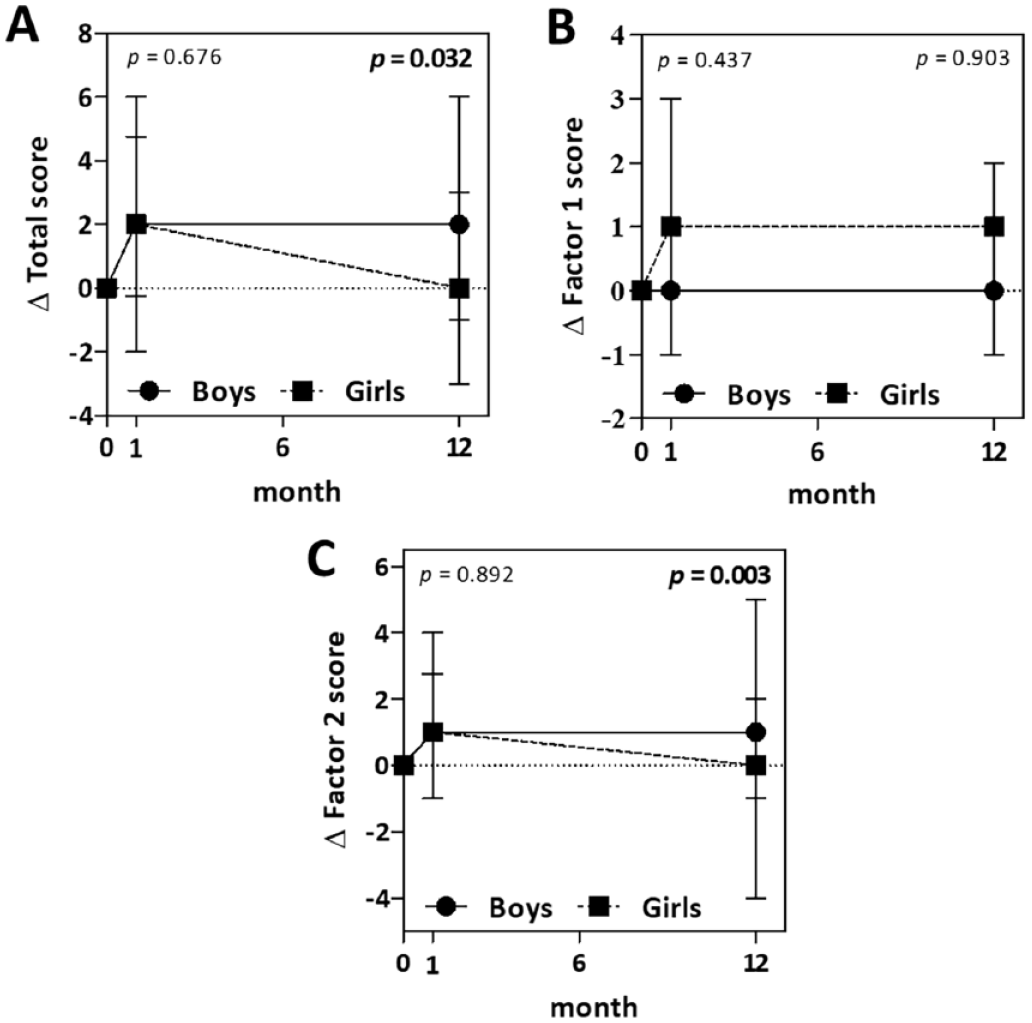
Changes in the JQCDL–AF scores (Total: A, Factor 1: B, and Factor 2: C) among boys (n = 67, circle) and girls (n = 72, square) after introducing on-site school lunch.
Discussion
School lunch in Japan has an important role to play as part of shokuiku (Ministry of Education, Culture, Sports, Science and Technology, 2021). However, there are few reports of the benefits of introducing on-site school lunch on healthy eating habits. Shokuiku has been implemented in most elementary and junior high schools in Japan. The three aims of shokuiku in the area where the survey school was located was conducted were to acquire food and nutritional knowledge and skills related to an interest in healthy eating habits, to increase food literacy and to learn about meal manners and human relationship skills through food culture and food production (Hyogo Prefectural Board of Education, 2020). In the survey school, shokuiku in line with these aims was carried out before and during introduction of on-site school lunches. Therefore, food environment policies and practices in this school did not change dramatically before and after the introduction of on-site school lunch.
Our analysis showed that introducing on-site school lunch improved students’ interest in healthy eating habits in the short term, but that this effect was not sustained 1 year later. The switch from eating homemade lunch to school lunch was a novelty for students and increased interest in their dietary habits, at least initially. After 1 year of eating on-site school lunch, the novelty likely faded and their level of interest in eating habits returned to pre-introduction states. However, there were significant interactions between students’ sex and the points surveyed. Introducing an on-site school lunch improved interest in healthy eating among both boys and girls in the short term. While the effect sustained after 1 year among boys, it was not among girls.
Interest in reduction in the consumption of unhealthy food while eating out or snacking (Factor 1) among boys did not differ after the introduction of on-site school lunch. In other research in Japan, unhealthy food consumption by fifth year elementary school students did not improve after shokuiku lectures (Haruki et al., 2008). Among Japanese high-school male students attending a baseball club, a combined intervention of shokuiku lectures and face-to-face individual nutritional guidance improved their food intake, dietary balance and athletic performance (Ueda et al., 2021). Therefore, it is suggested that multi-faceted interventions may be needed to change food consumption behaviours.
In this study introducing on-site school lunch effected an increase in interest in meal manners and preparation (Factor 2). Kajiyama et al. (2010) have reported that boys in Japan help prepare meals less often than girls. In this study, serving on-site school lunch increased opportunities for boys to become more involved in preparing meals. Elsewhere in Japan, Yoshii et al. (2021) reported that a short-duration cooking programme for elementary schoolchildren increased participation in cooking at home. Ng et al. (2022) reported that culinary nutrition education including hands-on healthy meal preparation affected children in positive ways and helped build their interests in healthy food and cooking. A meta-analysis found that an effective strategy for facilitating healthy eating among primary school children enhances experiential learning (Dudley et al., 2015). A literature review showed that school-based experiential cookery interventions may impact health-related aspects among children positively (Bennett et al., 2021). Increasing opportunities to cook and to be involved in meal preparation may therefore be an effective strategy because it can facilitate healthy eating habits among students with low interest in that area. In a cross-sectional survey, schoolchildren aged 10–11 years who helped in cookery and meal preparation at home showed the more favourable food intake than those who did not do so (Nozue et al., 2016). Therefore, introducing on-site school lunch could be a useful starting point for enhancing students’ interest in healthy eating.
Limitations and strengths
This study has several limitations. Importantly, we did not compare the data against that obtained from a control junior high school that did not introduce on-site school lunch. We were not permitted to access participants’ demographic data except for sex and the socioeconomic status of students’ families. The average annual income calculated from reports of municipal taxation status in 2020 was 1.9 times higher in the area the junior high school was located in than the average in Japan, so the results may well be atypical. Moreover, none of the survey items measured health-related quality of life (HR-QoL), so we could not examine the relationship between the changes of interest in healthy eating and any impact on HR-QoL. Finally, this study involved only one junior high school and, therefore, the results are not generalisable to all Japanese junior high schools.
That said, this 1-year follow-up study of changes in junior high school students’ interest in healthy eating after the introduction of an on-site school lunch, showed that the introduction of the lunches did improve students’ interests in healthy eating in the short term. Among boys, it induced a sustained increase in interest in meal manners and preparation after 1 year. Elsewhere, Battjes-Fries et al. (2016) have reported that nutrition and food education with additional hands-on activities was more effective in enhancing children’s interest in healthy eating than without. Our findings offer support for this position.
Conclusion
Increasing opportunities to cook and become involved in meal preparation by introducing on-site school lunch may be an effective way of facilitating interest in healthy eating among students. Implementing multi-faceted interventions such as education about food, nutrition and manners, alongside cooking practice and the opportunity to eat healthy and traditional meals, likely increases children’s interest in healthy eating.
Supplemental Material
sj-docx-1-hej-10.1177_00178969221149261 – Supplemental material for Preparing on-site school lunches improves adolescents’ eating habits: A one-year follow-up
Supplemental material, sj-docx-1-hej-10.1177_00178969221149261 for Preparing on-site school lunches improves adolescents’ eating habits: A one-year follow-up by Maeta Akihiro, Oku Mizue and Takahashi Kyoko in Health Education Journal
Footnotes
Declaration of conflicting interests
The author(s) declared no potential conflicts of interest with respect to the research, authorship, and/or publication of this article.
Funding
The author(s) received no financial support for the research, authorship, and/or publication of this article.

Supplemental material
Supplemental material for this article is available online.
References
Supplementary Material
Please find the following supplemental material available below.
For Open Access articles published under a Creative Commons License, all supplemental material carries the same license as the article it is associated with.
For non-Open Access articles published, all supplemental material carries a non-exclusive license, and permission requests for re-use of supplemental material or any part of supplemental material shall be sent directly to the copyright owner as specified in the copyright notice associated with the article.
