



Abstract
Objective:
The impact of social media on public health has been examined in various studies. However, none have explored user engagement based on the type of Facebook posts related to renal disease. Therefore, the present study sought to determine which type of nephrology-related posts have greater user engagement.
Setting:
Facebook pages.
Methods:
The posts on a specific Facebook page curated by a team of nephrologists in Malaysia were examined in this cross-sectional study. The type of post, likes, comments, shares of a post and reach of a post were used for data analysis. Analysis of variance was used to quantify the relative contribution of each independent variable to the odds of the post being highly liked or shared. The Kruskal–Wallis test was used to compare links, photos, shared videos, status and videos for parameters such as reach, the number of times a specific piece of content has been displayed on a screen (impressions), and user engagement.
Results:
Shared videos and photos received the highest median reach of 5,862 and 5,880, respectively. People who ‘liked’ the page in 2019, 2020 and 2021 numbered 193, 4,196 and 2,835, respectively. Among the types of content on the Facebook page, photos and shared videos received the highest median lifetime reach of the post compared to links, status and videos in terms of ‘people who liked the page’.
Conclusion:
The study findings suggest that posting a video or photo maximises the chance of engagement and meaningfully impacts public health outcomes.
Introduction
Chronic kidney disease affects 1 in 10 adults globally. The significant morbidity and mortality associated with these diseases, particularly due to cardiovascular risk, poses a public health problem. Malaysia had an incidence rate of 216 per million population of end-stage renal disease in 2016 with 37,781 individuals on renal replacement therapy. A study conducted in Malaysia in 2018 showed that there was an increase in the prevalence of chronic kidney disease by 6.41% over a 7-year period. An ageing population and an increase in non-communicable conditions such as diabetes and hypertension could be the reason for this trend. This emphasises the need to educate the community to detect chronic kidney disease early (Saminathan et al., 2020).
Social media allows for the exchange of important health messages via Facebook, YouTube and Pinterest through images, texts, gifs and videos. Health educators using social media as a tool to impart health messages have documented the need to personalise the messages to ensure the engagement of individuals spanning different demographics and cultural backgrounds. Employing the services of social media moderators can help improve engagement by carefully scheduling messages and providing prompt responses (Stellefson et al., 2020).
Social networking sites (SNSs) facilitate health promotion interventions by harnessing user-generated content and the power of networking. Successful sites have a large reach and rapidly communicate tailored messages. Interactivity with participants is influenced by how stimulating the content is. Participation by commenting, challenging or modifying the content facilitates engagement and improves learning. Sharing personal beliefs and experiences with peers on these sites can improve interaction with the site and modify healthcare behaviour (Syred et al., 2014).
The health benefits of social media include increased accessibility to health information, the dissemination of more tailored forms of information, peer support, public health surveillance and the opportunity to influence health policy. Patients can communicate with each other and share health information via sites such as ‘PatientsLikeMe’. YouTube has been utilised to share videos on symptoms, diagnosis and medications and includes personal accounts and stories. Blogs allow healthcare professionals to share healthcare information with the public. ‘MySpace’ has been utilised by asthma groups to share personal experiences and stories. Social media has helped provide social support for smoking cessation therapy. Facebook has been used by health professionals, caregivers and the public to share information about diseases, diagnoses and management (Moorhead et al., 2013).
User engagement with social media is predicted by gender, age and personality trait. Extraversion has been shown to increase usage among both men and women; however, emotional instability was found to increase usage only in men. Extraversion in younger individuals and openness to novel experiences in older individuals have also been shown to be associated with greater engagement (Moorhead et al., 2013). Among adolescents, SNS such as Facebook have proved popularity for social interaction and may therefore be considered a ‘novel setting’ that could be utilised for health advocacy. Health promotion on Facebook is reported to be successful because it encourages user interaction and content creation (Loss et al., 2014). Facebook may also be useful in managing chronic diseases through traditional group-based programmes (Partridge et al., 2018). It offers a potentially effective addition to traditional in-office counselling due to its affordability both by healthcare providers and online health seekers (Facebook Page Insights).
Several papers have been published regarding the use of social media for chronic diseases, including diabetes (Farmer et al., 2009; Greene et al., 2011). A study in Latin America has shown that user preference for information and communication technology is successful in spreading awareness about chronic obstructive pulmonary disease (COPD). While short message services (SMS) and WhatsApp are commonly used to receive information from the physician about COPD; Facebook was rated as useful for receiving healthcare information from physicians (Cherrez Ojeda et al., 2018). In a systematic review with a focus on the use of social media to promote health education among Hispanics, Facebook (89%) was identified as the most used platform followed by MySpace, websites, Twitter, Craigslist and YouTube. The highest featured health topic was sexual health (44%). Other topics included healthy eating, active living, women’s health and substance abuse (Hudnut-Beumler et al., 2016). However, no study has examined the type of posts on Facebook dealing with renal disease that trigger user engagement. Therefore, this study was carried out by a group of healthcare professionals in Malaysia to determine the type of posts on Facebook that generate greater user engagement.
Methods
Study design and approach
This study is a retrospective content analysis of a Facebook page started by a group of healthcare professionals, mainly nephrologists, in July 2019, with the aim of educating the public about the importance of kidney disease and preventing non-communicable diseases in general. The page was named MYBuahPinggang, which literally means kidney in the Malay language, and had 31,000 followers in 2019. At the time of the analysis, 70.4% of the audience are women 25–44 years of age. Between July 2019 and August 2021, the page received 51,080 ‘likes’. Posts on the page included health-related details regarding kidney disease, a supportive diet and vaccinations for the overall health benefits of patients. The page itself can be accessed through www.facebook.com/mybuahpinggang.
The posts were created by the nephrologists in charge of the page. Patients could also contribute their ‘stories’ to the page but with guidance from the medical personnel in charge. A production company contributed to the design of the page. New content was published 3 to 4 times a month (at least once a week). Videos shared on the page contained content to educate the public on kidney health. They included live-stream videos, interactive live questions and answers, animations and animated demonstration videos.
The data for this study were collected using Facebook Insights, a tool provided by Facebook for self-evaluation, which used metrics to analyse total reach, total likes, the total number of people talking about a specific page and so on (Facebook Page Insights, 2011 1 ). A total of 383 Facebook posts were analysed and included in this study. Facebook Insights automatically exports the data collected into MS Excel format. The information included the type of post, time of post, total likes, comments, and shares of a post and the number of Internet users reached by a post.
‘Reach’ is defined as the number of people who have seen the content. ‘Facebook impressions’ are the number of times a specific piece of content has been displayed on a screen. If a user views a video on their phone screen and then again on their desktop while browsing Facebook, both instances will count as an impression. Users can view the content multiple times; therefore, impressions are always greater than reach. Post reach is specific to posts. ‘Organic reach’ refers to unpaid reach, which can be calculated by subtracting paid reach from the total reach.
Lifetime engaged users are defined as the number of unique people who engage in certain ways with the page post, for example, by commenting on, liking, sharing or clicking on particular elements.
Data extraction
Facebook users’ action type was used as an indicator to identify the most popular health-related content on the Facebook page. In this study, the kind of information most liked, shared and commented on by viewers (photo/video/status) was analysed. Data were extracted for the period 1 August 2019 to 31 August 2021 from Facebook’s web page. Data collection identified the most ‘liked’, ‘shared’ and ‘commented on’ Facebook photos, statuses, content and videos.
Statistical analysis
Statistical analyses was carried out using R software (version 4.2.2). Categorical variables were presented as frequencies and percentages, while other descriptive statistics were presented as medians. The normality of the data was assessed using Shapiro-Wilk and Kolmogorov-Smirnov tests. As the data violated the normal distribution, non-parametric tests were employed for analysis. The Kruskal–Wallis test was used to compare the links, photos, shared videos, status and videos for parameters such as reach, the number of times a specific piece of content was displayed on a screen (impressions) and user engagement. The ranks for the data were calculated and Bonferroni multiple comparisons/Student’s-t test multiple comparisons were carried out for the post hoc comparison between any two forms of the median (link vs photo, link vs shared video, link vs status, link vs video, photo vs shared video, photo vs status, photo vs video, shared video vs status, shared video vs video and status vs video). Statistical significance was defined as p
Results
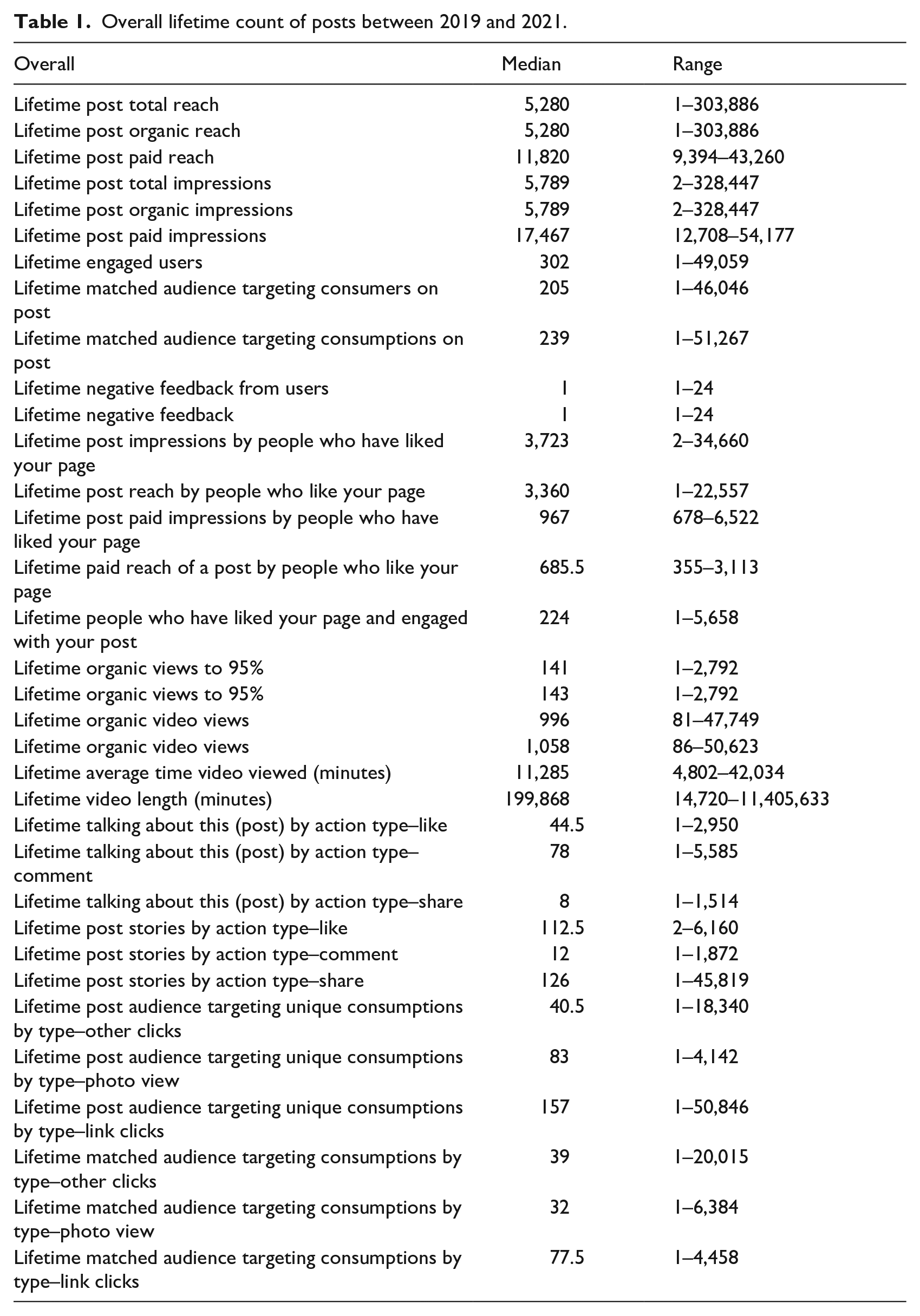
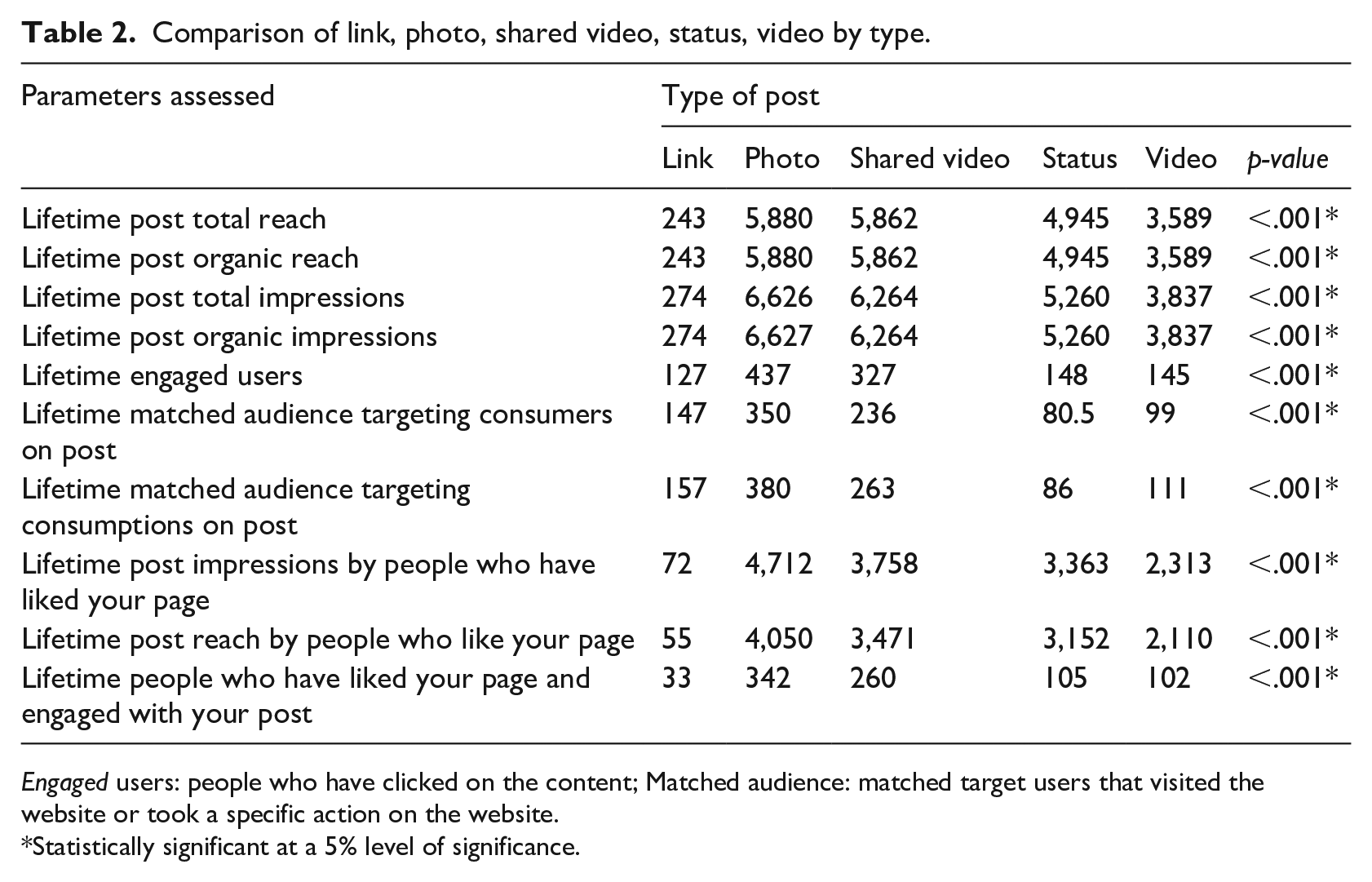
The overall (n = 383) lifetime counts of posts included in this study from 2019 to 2021 are presented in Table 1. The comparison of links, photos, shared videos, status and videos differed significantly in only 10 types of posts (p < .05) as shown in Table 2. Table 3 presents post hoc comparisons between the various forms of Facebook posts by comparing them against each other, two at a time.
Overall lifetime count of posts between 2019 and 2021.
Comparison of link, photo, shared video, status, video by type.
Engaged users: people who have clicked on the content; Matched audience: matched target users that visited the website or took a specific action on the website.
Statistically significant at a 5% level of significance.
Pairwise comparison of Facebook posts by type.
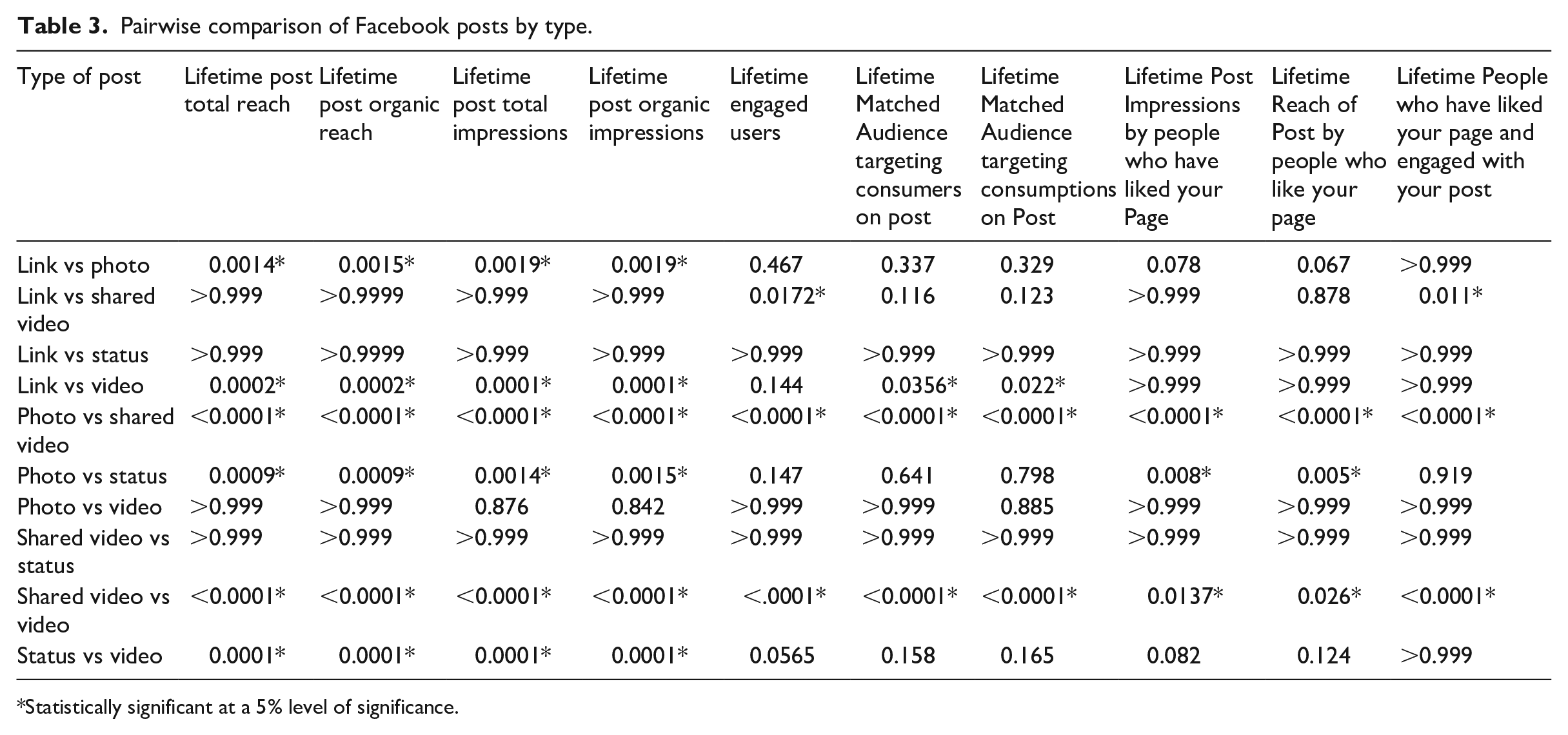
Statistically significant at a 5% level of significance.
Table 1 lists the overall lifetime count of posts between 2019 and 2021. Table 2 compares links, photos, shared videos, status and videos on parameters such as reach, impression and user engagement. The lifetime counts of a type of post and the distribution during 2019–2021 are shown in detail in Figure 1. The year-wise distribution of various types of posts on Facebook is shown in Supplemental File 1.
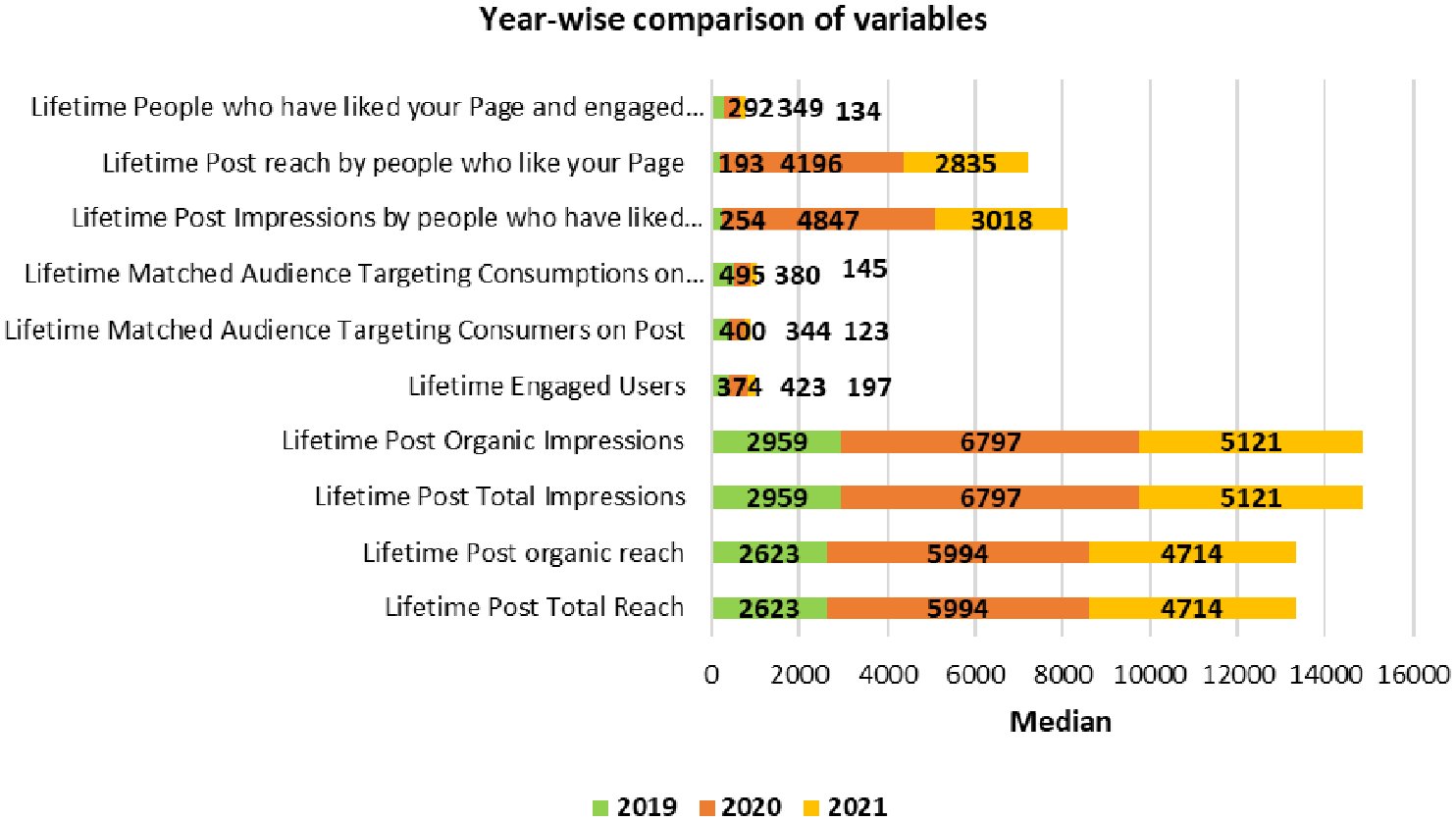
Year-wise comparison of variables.
Data on post reach
The median lifetime total/organic reach of posts was 2,623 in 2019 and almost doubled to 5,994 in 2020 (Figure 1). Among the types of content on the Facebook page, shared videos and photos received the highest median lifetime total reach of post at 5,862 and 5,880, respectively (Table 2).
In contrast, the median lifetime reach of the post by ‘people who like your page’ was only 193 in 2019. This grew to 4,196 in 2020 and declined to 2,835 in 2021 (Figure 1). Among the types of content on the Facebook page, photos and shared videos had the highest median lifetime reach of the post compared to links, status and videos in terms of ‘people who liked the page’ (Table 2).
Data on impressions
The median lifetime total/organic impressions of posts was 2,959 in 2019 and almost doubled to reach 6,797 in 2020 (Figure 1). Among the types of content on the Facebook page, shared videos and photos received the highest median lifetime post total impressions (Table 2).
Data on Facebook users and matched audience
The median number of lifetime engaged users was 374 in 2019 and increased to 423 in 2020, but reduced to 197 in 2021 (Figure 1).
Discussion
This is the first study to have examined how different types of Facebook posts can engage the public in the dissemination of kidney health information. According to a cross-sectional web-based survey of 231 healthcare professionals who used social media, 70.6% (163/231) used it for professional purposes (Alsobayel, 2016). A few Facebook pages such as those run by Mums United – Heart Foundation (heart disease), Headspace (mental health), SunSmart (skin cancer prevention), How to Drink Properly (alcohol), Quit Victoria (smoking) and Shape Up Australia (obesity) had been active for several years, with an average range of 0.1–2.0 posts per day and a median of 33,077 total fans (Kite et al., 2016). Facebook is the most popular social platform in Malaysia, with 22 million Internet users and 64% of Malaysian Facebook users accessing Facebook every day. According to Facebook, 80% of all Malaysians who had access to the Internet were also on Facebook. Facebook topped social media networks in Malaysia with 26 million Malaysians using the platform. 2 Malaysians had 1.6 times more friends on Facebook than the global average (Malaysians lead the world in social media and mobile). In terms of time spent watching video content on Facebook, Malaysia was the leading country in Southeast Asia. Malaysians spend an average of 18 hours every week using the Internet, and 7.2 hours every week watching online videos. 3
The current study focused on 383 posts from 2019 to 2021 (Table 1). Videos and photos had the highest median reach of the post and median total impressions of the post. The median reach of the post for videos was 5,862 and for photos was 5,880 (Table 2). Similar results were obtained in a study from Australia, which found that overall posts with videos received 25% more ‘likes’ than ones with photos, while links and text posts received 37% and 31% fewer likes, respectively. Researchers found that video posts were the most engaging type of post, shared four times more than photos. Video posts were thus more likely to be seen as novel, interesting and shareable by users, which was in line with findings of this study. Since videos require users to pause scrolling for a moment to consume content, this may also drive engagement. In fact, videos can carry a message without an accompanying text, which makes them a more engaging and potentially effective form of communication (Kite et al., 2016). According to previous research, users of SNS such as Facebook tend to share information primarily when they see the content as beneficial (Syn and Oh, 2015). Moreover, social media users are generally receptive to receiving health-related messages. Further research is needed on maximising user engagement and exploiting SNS for the mass dissemination of information regarding health interventions (Maher et al., 2014; McNab, 2009).
According to a study by Haddad and Mourani (2019) in Lebanon, 75% of patients (children of age 11 ± 7 years) and their parents used Facebook to communicate with other chronic kidney disease patients (Haddad and Mourani, 2019). The National Kidney Disease Education Programme (NKDEP) in the USA offers a ‘Make the Kidney Connection’ Facebook page for community health champions and kidney disease patients. In addition to connecting users who are advocates for kidney disease, the page also aims to connect people who have or are at risk of kidney disease. It particularly benefits African Americans and Hispanics, who are both at high risk of kidney failure and frequent users of social networking (Goldstein et al., 2013). The Facebook page in this study was designed to benefit patients with health-related information specific to kidney disease, supportive diet, vaccinations and many more. The patients responded well by sharing likes and positive actions on the page. The page facilitated meaningful conversation and communication and provided a platform for sharing kidney-related posts. It also directed users to content on the NKDEP site and related US National Institutes of Health programme sites (Goldstein et al., 2013). Another online support group for kidney care is the Renal Patient Support Group (RPSG 4 ). It was founded to disseminate knowledge about chronic renal disease on a global scale. It is a support group for caregivers, families and guardians to share everyday challenges and real-life experiences (RPSG4).
A study conducted in Australia examined the role of Facebook in mass media campaigns for public health awareness. The authors observed that although paid posts had a higher reach, significantly greater user engagement was found with organic or unpaid posts. This was noted specifically in connection with videos (Kite et al., 2019). The organic reach of posts with live videos created a genuine sense of community, resonating with the audience and triggering members to initiate conversations in the comments made. In our study, the organic reach of the post was greater in 2020 compared to the previous year (Figure 1). The median lifetime total impressions of the post almost doubled in 2020, which may have been a result of the COVID-19 pandemic. A study conducted during the epidemic in Singapore compared the number of Facebook posts on kidney disease by social services agencies in the pre-COVID-19 and peri-COVID-19 periods. It found an increase in posts from 115 to 293 between these periods (Tan et al., 2021).
Rahim et al. (2019) in a landmark paper presented the first comprehensive report on health information engagement among Internet users in Malaysia. The authors reported that educational and risk communication posts that appeal to the audience’s emotions best encourage behavioural change. Video-based content with timely dissemination garnered better user engagement than photos, links and textual content which aligns with the results of the present study (Rahim et al., 2019). The Provincial Health Committee in China is using micro videos to engage residents and communicate healthcare information. However, a Chinese study assessing the role of Tik Tok micro videos in the dissemination of healthcare information found that compared to the number of likes and reposts, the number of comments was fewer. This suggests that users may not have interacted with the app, with the use of Tik Tok favouring one-way communication (Zhu et al., 2020).
Limitations
A key limitation of this study is that it was conducted during the COVID-19 pandemic, and this may have influenced users’ behaviour by causing them to spend more time on Facebook at a time when face-to-face communication was difficult. Future research in the same arena should shed light on differences in user patterns in the pandemic and post-pandemic era. Another limitation is that the analysis was based on quantitative data provided by Facebook Insight. An indictive thematic analysis will provide valuable information for healthcare providers especially nephrologists and public health physicians to help design more appropriate strategies for health promotion using social media.
Conclusion
This study has begun to fill the knowledge gap regarding the effective use of Facebook by healthcare professionals in Malaysia. It identified some of the characteristics of nephrology-related Facebook posts that increased or decreased user engagement. Notably, greater reach was achieved for videos. In this study, photos and shared videos had more post organic reach and post organic impressions compared to statuses and links. This reinforces the need for posting video- or photo-type content to maximise the chance of higher engagement and to potentially have a meaningful impact on public health outcomes.
Supplemental Material
sj-docx-1-hej-10.1177_00178969231156078 – Supplemental material for Identification of Facebook posts on nephrology-related terms that benefit patient outreach
Supplemental material, sj-docx-1-hej-10.1177_00178969231156078 for Identification of Facebook posts on nephrology-related terms that benefit patient outreach by Rafidah Abdullah, Nor Fadhlina Zakaria, Lily Mushahar and Suryati Yakob in Health Education Journal
Footnotes
Acknowledgements
We thank the Ministry of Health, Malaysia and Baxter Healthcare Sdn Bhd for their encouragement and support of this research. We would like to also thank BioQuest Solutions for providing editorial support.
Declaration of conflicting interests
The author(s) declared no potential conflicts of interest with respect to the research, authorship and/or publication of this article.
Funding
The author(s) disclosed receipt of the following financial support for the research, authorship and/or publication of this article: this work was supported by Baxter Healthcare Sdn Bhd. The Funding agency has no role in the analysis and interpretation of results.

Supplemental material
Supplemental material for this article is available online.
Notes
References
Supplementary Material
Please find the following supplemental material available below.
For Open Access articles published under a Creative Commons License, all supplemental material carries the same license as the article it is associated with.
For non-Open Access articles published, all supplemental material carries a non-exclusive license, and permission requests for re-use of supplemental material or any part of supplemental material shall be sent directly to the copyright owner as specified in the copyright notice associated with the article.
