



Abstract
Background:
In the USA, lower income minority ethnic children and teenagers report high consumption of sugar sweetened beverages, which cause dental erosion and dental carries, and play a significant role in overweight, obesity and diabetes.
Objective:
This study aimed to examine urban adolescents’ beliefs about sports and energy drinks to identify factors for health messaging to discourage youth consumption.
Design:
Focus group study involves 34 adolescents in urban areas (12 women, 12 men and 10 unreported sex; 19 Hispanic, 11 non-Hispanic Black, 2 Asian and 2 unknown race or ethnicity).
Setting:
Four focus groups were conducted with adolescents in urban areas.
Method:
Each on-time moderated group discussion was structured to generate an inventory of attitudinal, normative and efficacy beliefs associated with sports and energy drink consumption and reduction. Thematic analysis was used to analyse the data.
Results:
Attitudinal and normative beliefs were more positive towards sports drink consumption and energy drink reduction. Misperceptions about the need for sports drinks to avoid dehydration during physical activity were evident. Product accessibility and advertising pervasiveness were facilitators influencing consumption and barriers to reduction for both products.
Conclusion:
Results highlight important differences in perceptions about sports and energy drinks that indicate the need for different approaches and messages for interventions designed to curb consumption of these products. Recommendations for message design are provided.
Keywords
Introduction
Sugar-sweetened beverages (SSBs), defined as sports drinks, non-diet soft drinks and sodas, energy drinks, fruit drinks and flavoured milk products (Farhangi et al., 2020; Imamura et al., 2015; Laniado et al., 2020; Malik et al., 2013; Malik and Hu, 2019; Valenzuela et al., 2021), cause dental erosion (Coombes, 2005) and dental caries (Marshall, 2013) and play a significant role in overweight, obesity and diabetes in the USA (Malik et al., 2010; Ogden et al., 2010; Palmer et al., 2008). In the USA, adolescents (aged 12–19 years) consume more SSBs than other age groups (i.e. 6–11 years; <20 years; Marriott et al., 2019), with lower income youth, Black and Mexican American children and teenagers reporting the highest consumption patterns (Harris et al., 2020). Small corner stores, well-established dwellings in US urban landscapes, are frequently used food sources particularly in low-income, urban areas and ethnically diverse communities often have incentivised agreements to give these products prime shelf placement (Borradaile et al., 2009; Cannuscio et al., 2010; Emond et al., 2012; Sanders-Jackson et al., 2015). This potentially contributes to existing health disparities between members of these populations and those who have access to larger grocery stores with healthier options (Hales et al., 2017).
Health messaging to reduce sugary drink consumption has focused primarily on sugary drinks in general, with an emphasis on carbonated drinks such as soda (Malik et al., 2010; Narain et al., 2016; Vargas-Garcia et al., 2017). Although there have been declines in other sugary drink consumption among adolescents over time, sports and energy drink consumption has increased among young people (Bleich et al., 2018; Vercammen et al., 2019), with 57.6% of adolescents in the USA reporting sports drink consumption during the past week in a 2015 survey of a nationally representative sample of high school students (Cordrey et al., 2018) and 1.4% of adolescents in the USA reporting energy drink consumption in 2016 (Vercammen et al., 2019). Although energy drink consumption remains somewhat low, adolescent consumption of these products has been linked to thousands of visits to the emergency room among 12–17-year-olds in the USA for energy drink-related emergencies (US Department of Health and Human Services, 2013), highlighting the need for interventions to minimise adverse events related to using these products. There are currently no federal health policies in the USA to reduce consumption, so public health interventions to motivate individuals to decrease consumption on their own are warranted.
Research has identified beliefs associated with sugary drink reduction in general (Jordan et al., 2012; Kassem and Lee, 2004; Miller et al., 2020; Zoellner et al., 2012), but little is known about urban adolescents’ beliefs about sports and energy drinks specifically. Sports and energy drinks represent a unique sub-type of SSB’s because advertising promotes the belief that these products are healthy and helpful for achieving one’s goals (Bleakley et al., 2022), and there is more public uncertainty about their healthiness compared with other SSBs including carbonated beverages (Hennessy et al., 2015; Munsell et al., 2016; Pfender et al., 2023).
This study was conducted to examine beliefs about sports and energy drinks held by urban adolescents in the USA that can be incorporated into health messaging to educate this population about the true risks and benefits associated with consumption of these beverages.
Using behavioural theory to guide in the design of dietary intake patterns improves message effectiveness (Ammerman et al., 2002). The reasoned action approach (RAA; Fishbein and Ajzen, 2010) provides insight into the cognitive determinants of a given target behaviour. According to the RAA, health behaviours are determined by behavioural outcome expectancies (Behling and Starke, 1973) – the ‘underlying beliefs’ that predict the determinants of intention (i.e. attitudes, normative pressure and autonomy/efficacy; Yzer, 2012). Attitudes are conceptualised as a composite of one’s beliefs about positive and negative outcomes associated with each behaviour. Descriptive and injunctive norms comprise normative pressure. People who are important to the target population serve as injunctive referents for approval of different behaviours, and perceptions of whether groups like themselves are engaging in a particular behaviour shape descriptive normative perceptions. Intention is also shaped by individuals’ confidence in their ability to engage in the behaviour (perceived behavioural control). Confidence is impacted by the presence of facilitators and barriers to engaging in the behaviour of interest. Each of these constructs is based on corresponding underlying beliefs.
We sought to elicit beliefs about four behaviours: sports drink consumption, sports drink reduction, energy drink consumption and energy drink reduction. Informed by the RAA, we identified the following research questions:
RQs 1–4: What are the most prevalent (a) positive and (b) negative outcomes associated with (1) sports drink consumption, (2) sports drink reduction, (3) energy drink consumption and (4) energy drink reduction?
RQs 5 and 6: Who are the most common referents of (a) consumption, (b) approval and (c) disapproval discussed about (5) sports drinks and (6) energy drinks?
RQs 7–10: What are the most prevalent (a) facilitators and (b) barriers to (7) sports drink consumption, (8) sports drink reduction, (9) energy drink consumption and (10) energy drink reduction?
Methods
Sample
We conducted a series of focus groups with primarily Black and Hispanic youth aged 14–18 years old. The sample was drawn from Philadelphia, PA and Camden, NJ, a large city located in the greater Philadelphia region with a predominately Black and Puerto Rican population. Thirty-four young people (M = 15.78, SD = 1.28; 12 women, 12 men and 10 unreported sex; 19 Hispanic, 11 non-Hispanic Black, 2 Asian and 1 unknown race or ethnicity) were recruited to participate in a 60–90-minute focus group in exchange for a $40 gift card. Groups ranged in size from 4 to 10 participants.
Participants’ responses to introductory questions about their levels of sports and physical activity as well as their sports and energy drink and soda consumption indicated that the sample was fairly active, as most reported participating in at least 60 minutes of physical activity that raised their heart rates more than twice in the past 7 days. Participants reported a range of sports and energy drink and soda consumption. Several participants reported consuming no sports drinks or soda in the week prior to the group, but several others reported consuming sports drinks and soda every day in the 7 days prior to the study. Energy drink consumption was low, as most participants had not consumed any energy drinks in the 7 days prior to the group and those who had done so only consumed them once in 7 days. Participants were recruited through youth recruiters and through a partner youth serving organisation.
Procedures
Participants first completed a brief demographic questionnaire and then came together for the moderated focus group discussion. In total, four focus groups were conducted at the university or on site at partner community organisation between November 2019 and February 2020. Groups were structured using a detailed guide to generate a reasoned action-informed inventory of attitudinal, normative and efficacy beliefs associated with sports and energy drink consumption and reduction. Sports drinks were defined as flavoured beverages often containing carbohydrates, minerals and electrolytes (salts), and sometimes vitamins or other nutrients. Energy drinks were defined as SSBs that contain stimulants, with caffeine as the primary source of ‘energy’, along with varying amounts of other ingredients. All focus groups started off with a sorting task that helped to ensure agreement on what beverages were sports drinks versus energy drinks for the remainder of the focus group discussion and provided visual cues of beverages that may not initially be top of mind for participants.
Attitudinal beliefs were elicited by asking: What are the good things that can happen if you were to reduce sports/energy drink consumption? What are the bad things? Descriptive normative perceptions were assessed by asking participants to list important others in their lives who regularly consume sports/energy drinks. To elicit injunctive normative perceptions, participants were asked who in their lives approve of their consumption of each beverage, and who would disapprove of their reducing consumption of each beverage. To assess efficacy beliefs, participants were asked: What might make it easier for you to reduce sports drink consumption? What might make it harder? This approach is a standardised and validated methodology for identifying beliefs specific to a target behaviour (Fishbein and Ajzen, 2010).
This set of questions was asked in four different rounds per focus group, with each combination of behaviour – consumption and reduction – and SSB type – sports drinks and energy drinks – as a focus. The order in which each behaviour (consumption or reduction)–SSB type (sports drinks or energy drinks) combination was asked was randomised for each group. Focus groups were audio recorded for transcription purposes and extensive notes were kept during each discussion. All procedures were approved by the Institutional Review Boards at the University of Pennsylvania and the University of Delaware. Data were analysed using an approach to thematic analysis following the six steps developed by Braun and Clarke (2006): (1) familiarisation, (2) coding, (3) generating themes, (4) reviewing themes with the larger team, (5) defining and naming themes and (6) writing.
Results
Attitudes
Sports drinks
Hydration was listed as a positive outcome associated with drinking sports drinks in all four focus groups. This outcome was most often discussed in terms of replenishing electrolytes, vitamins and nutrients and quenching thirst during and after sports or exercise participation. Taste was also discussed in multiple groups. Participants noted that they got bored drinking water, so sports drinks were a good supplement to ensure that they are drinking enough fluids (Table 1).
Attitudinal themes: positive and negative outcomes for each behaviour as expressed in at least two groups.
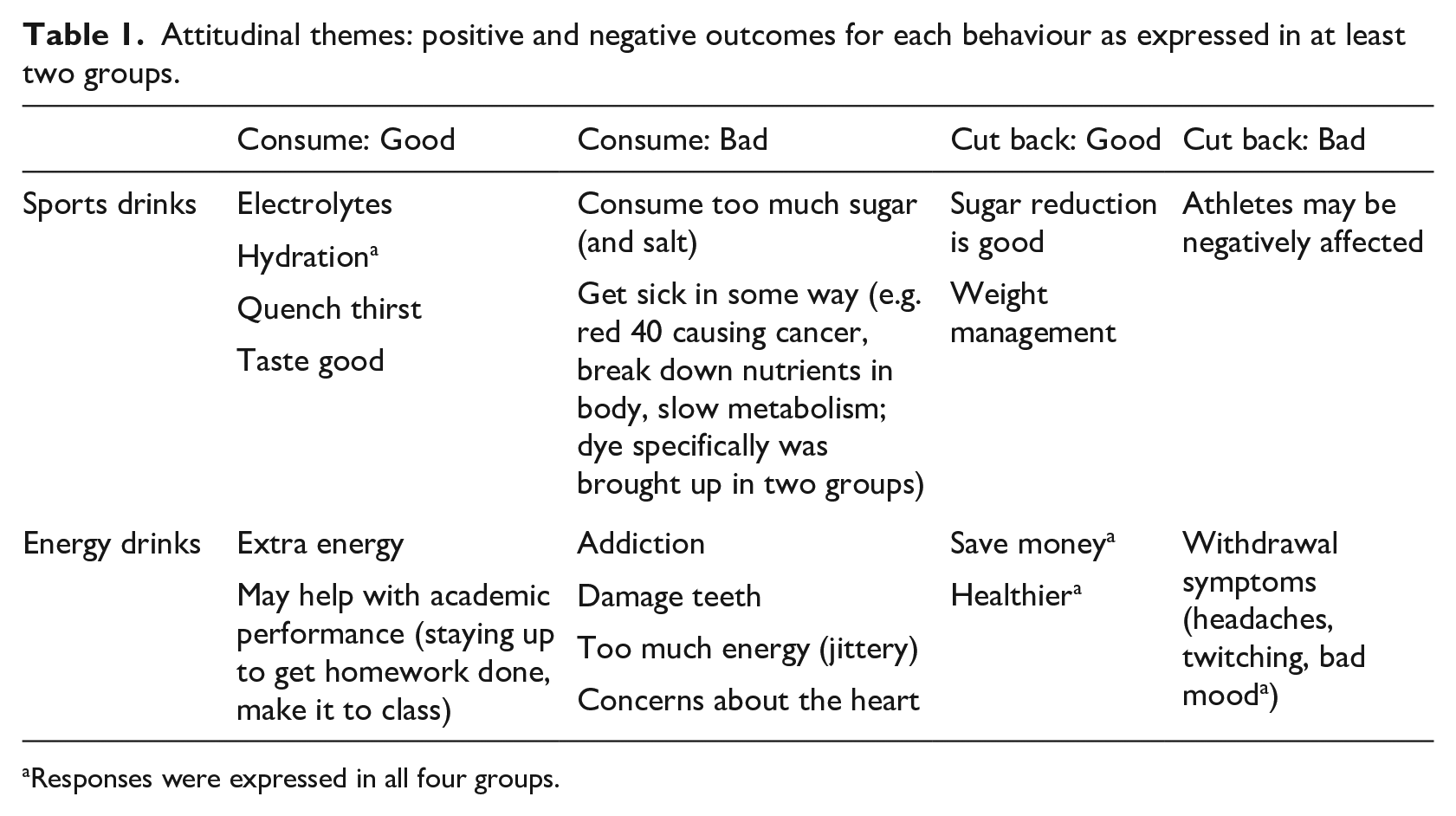
Responses were expressed in all four groups.
Participant responses indicated that they did not view sports drink consumption as an unhealthy behaviour. When asked to list bad things that could happen from consumption, one participant responded ‘nothing’. Those who expressed negative outcomes associated with consumption most often cited ingredients in sports drinks that could potentially cause illness over time (e.g. too much sugar causing weight gain and other unnamed health problems; red dye and other ingredients causing cancer; products breaking down nutrients in the body or slowing metabolism). Multiple participants used the word ‘addiction’ when describing drawbacks associated with consumption, referring to a potential mental or physical dependency on certain sports drinks for a specific type of energy or mind-set during sports participation.
Most negative outcomes associated with sports drink consumption were discussed as minor risks that athletes take to maximise their sports performance and avoid other more serious health risks (e.g. dehydration and nutrient depletion), and some people specified that certain drawbacks are only a concern when sports drinks are consumed outside of athletic or exercise-based contexts (e.g. drinking sports drinks without utilising the energy they provide is unhealthy; calories consumed in the absence of exercise can lead to weight gain).
The most referenced positive outcomes associated with sports drink reduction were decreased sugar intake and weight management. When asked about negative outcomes associated with reduction, several participants speculated that sports drink reduction may impair athletic performance.
Energy drinks
Most benefits associated with energy drink consumption were related to productivity. Participants described energy drinks as a means for performing undesirable tasks such as schoolwork or exercising when one is too tired or unmotivated to complete them unassisted. Fewer participants described energy drinks as ‘fun’, which may be related to consumption in social settings such as parties. Unlike sports drinks, participants did not consistently perceive any health benefits to drinking energy drinks that might offset the health drawbacks associated with consumption.
In contrast to sports drinks, participants expressed consensus that energy drinks are unhealthy. Health concerns associated with consumption were more immediate and serious in nature compared with sports drinks. Potential addiction was a recurrent theme across groups. Many participants described withdrawal symptoms associated with cutting back on energy drinks, including ‘tweaking’ (i.e. a slang term often used to describe erratic behaviour exhibited by a drug user), headaches, sickness and mood swings. Several participants specifically noted anger as a by-product of cutting back. Participants described the experience of energy drinks making them feel like they had ‘too much energy’, ‘jittery’ and ‘anxious for no reason at all’, which negatively impacted their sleep patterns and led some to worry about doing damage to their hearts. Multiple participants also expressed concern about energy drinks damaging their teeth.
In all four groups, saving money and being healthier overall were listed as positive outcomes associated with energy drink reduction. Negative outcomes of reduction were mostly tied to withdrawal symptoms once one develops a dependency on energy drinks (e.g. mood swings, headaches, tweaking), which were described in all four groups.
Norms
Sports drinks
Friends and family members were most commonly listed as those who consumed sports drinks themselves. Participants’ responses about approval of consumption and disapproval of reduction reflected normative pressure and approval to replenish electrolytes with sports drinks at specific times when dehydration was a concern (i.e. during sports participation, while exercising and while sick). Coaches and teammates were most often named as those who approved of sports drink consumption and would disapprove of a reduction, followed by groups who profited from their sales (e.g. manufacturers) (Table 2).
Normative themes: important others who will approve/disapprove of each behaviour as expressed in at least two groups.
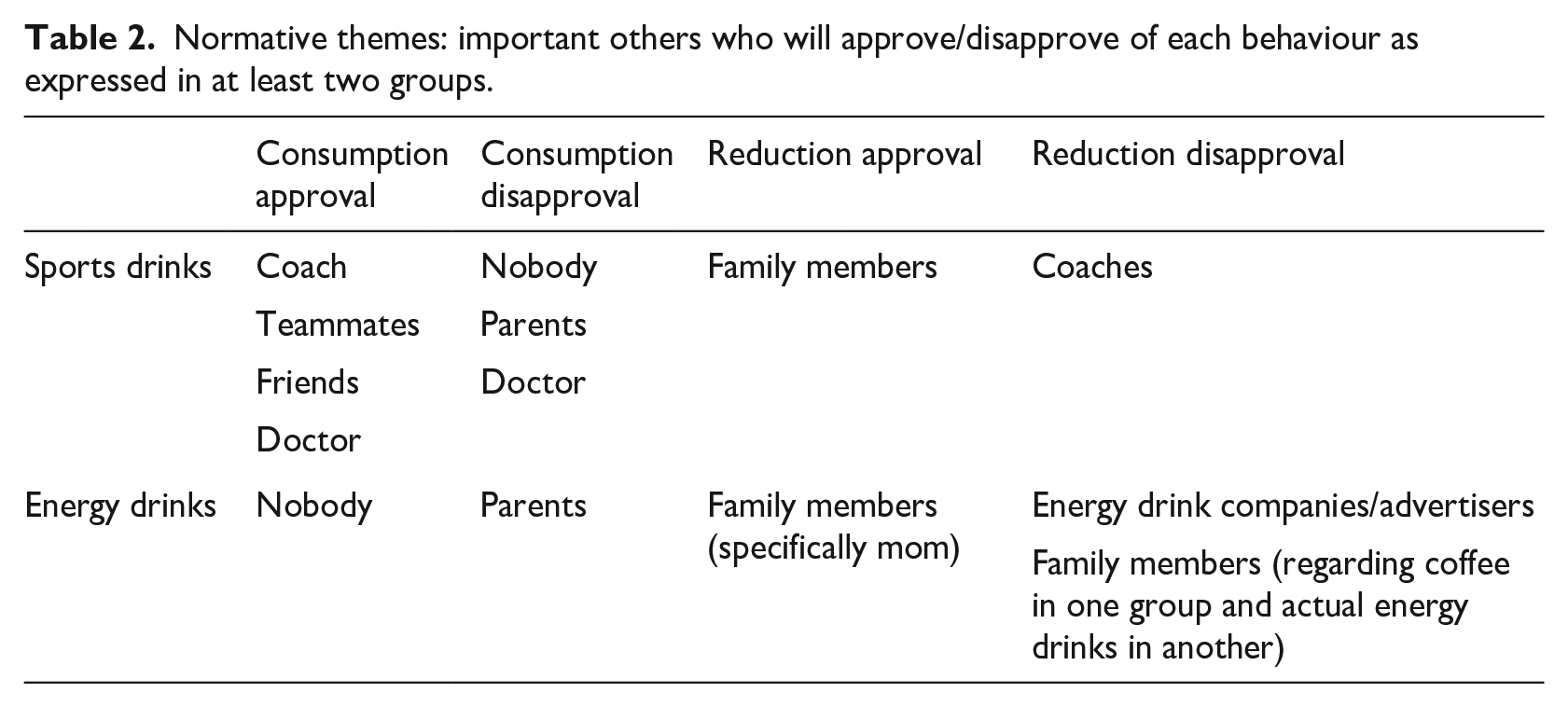
Patterns of sports drink disapproval of consumption and approval of reduction were less clear. Multiple participants named doctors, parents and specific family members when asked about disapproval, noting concerns about sugar and calories, but several others specifically stated that ‘nobody’ disapproved of their sports drink consumption because, as stated by one participant, ‘it is not a bad thing’. Thus, normative pressure to consume sports drinks seems to be limited mostly to replenishment to avoid dehydration when exercising and participants did not seem to perceive any consistent normative pressure to reduce consumption in any context.
Energy drinks
When asked who approved of their energy drink consumption, participants most often responded ‘nobody’ and noted that ‘everyone’ wanted them to reduce their intake. Similar to sports drinks, multiple participants listed people who make money from sales (e.g. manufacturers, advertisers) as those who approve of energy drink consumption and would disapprove of cutting back.
When asked about people who disapproved of their energy drink consumption and approved of their cutting back, participants listed a broad range of important individuals including family, friends, coaches and doctors.
Efficacy
Sports drinks
Participants discussed multiple sources of sports drink advertising exposure, including television, social media (specifically, Instagram) and point-of-purchase advertising. Participants most often referred to advertisements featuring sports figures and considered celebrity endorsements of these products to be particularly persuasive. Advertising pervasiveness was a strong theme across all groups. Participants described sports drink advertising as being ‘everywhere’, and asserted these ads were barriers to reducing sports drink consumption (Table 3).
Efficacy themes: facilitators and barriers to each behaviour as expressed in at least two groups.
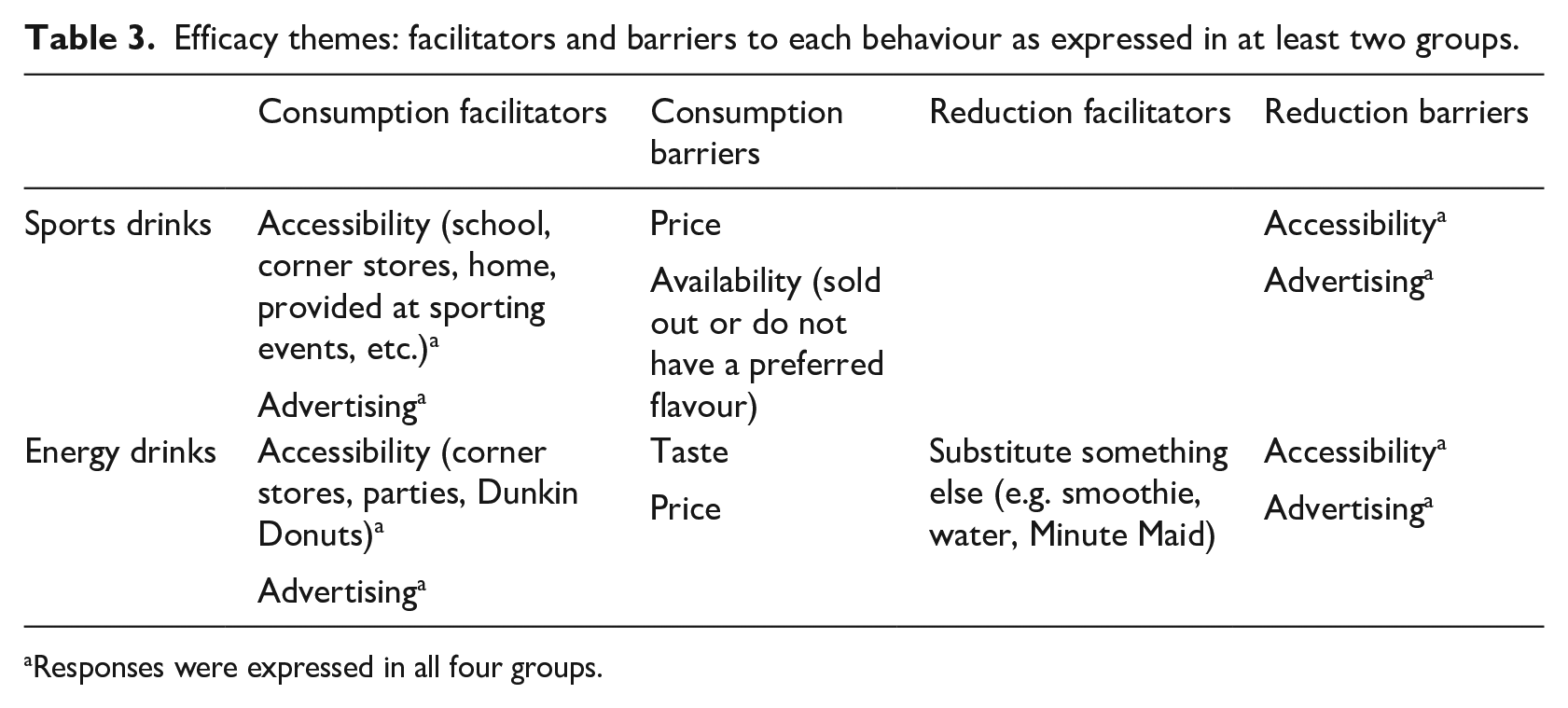
Responses were expressed in all four groups.
In addition to advertisements, participants also noted that the sports drinks themselves were ubiquitous in their daily lives. One participant discussed sports drink prominence in terms of how much space it takes up, describing purchasing scenarios in which one has to go out of their way to get around sports drinks to get to water. When asked about facilitators of sports drink consumption and barriers to cutting back on sports drinks, participants discussed the availability of the products sold in corner stores and school vending machines, provided by coaches while participating in athletics and stocked in their own home refrigerators make them a quick and convenient option.
Prevalence of advertising and availability of the product were also the top two issues raised when participants were asked about facilitators to reduction and barriers to sports drink consumption. Across multiple groups, participants stated that they would be less likely to consume sports drinks if they were not constantly exposed to advertisements and opportunities to consume them.
Participants in multiple groups cited drinking water as a healthy alternative to sports drink consumption and suggested that this could be facilitated by making water options more available and appealing. For example, a participant in one group raised the possibility of making water dispensers more readily available for participants to refill reusable containers; however, another noted the unappealing nature of water dispensers they currently had access to and suggested that they could be improved by offering filtered cold water.
Energy drinks
Advertising and accessibility were common facilitators of energy drink consumption across all groups. Unlike sports drinks, however, these factors were not as clearly delineated as the most important barriers to energy drink reduction as they were for sports drinks. Discussions of energy drink availability were limited to convenience stores, as opposed to the expansive access through on-campus vending machines, athletic participation and home refrigerators that participants described regarding sports drinks. Furthermore, although availability was a facilitator of consumption across all four groups, the decision to consume energy drinks was described as a more deliberate action taken for the purpose of staying awake and completing undesirable tasks in comparison with the mindless, simple hydration option participants described regarding sports drinks.
Multiple participants noted barriers to consumption that were either internal (e.g. disliking the taste or the way that the drink makes them feel while consuming the product or afterwards) or external (e.g. age requirements for purchasing energy drinks in some convenience stores, parents forbid it). One participant suggested getting more sleep as a facilitator of energy drink reduction, but the most common facilitator that was raised in all four focus groups was substituting a different type of drink to keep them awake (e.g. drinking a smoothie, shocking the system awake with cold water).
Discussion
Results from this study highlighted stark attitudinal and normative differences between sports drinks and energy drinks, and important similarities in advertising and availability that impact efficacy beliefs, all of which have implications for further research and message design efforts. Because beliefs about sports drinks differed from beliefs about energy drinks, efforts to educate and motivate these populations to reduce consumption should adopt different persuasive approaches.
Implications for educational interventions
Results highlight both population-level and individual-level factors that contribute to urban adolescents’ consumption of sports and energy drinks. This suggests an ecological approach to interventions to curb consumption may be warranted (McLeroy et al., 1988). At the intrapersonal and interpersonal levels, messages to correct misperceptions about the utility of SSBs for performance, particularly sports drinks, may be necessary. At the community and institutional levels, data call for efforts to decrease accessibility of SSBs and increase accessibility of healthier options. Finally, at the policy level, restrictions on misleading advertising claims (e.g. that sports drinks hydrate better than water) could play an important role in efforts to reduce SSB consumption.
Analysis of sports drink data suggests three strategies may be effective future efforts to fully inform the target population and curb consumption: (1) consciousness-raising about the negative health outcomes associated with consumption, (2) correcting misperceptions about the health benefits and competitive edge these products offer and (3) reducing access and availability of these products and their promotions in comparison with healthier options such as water.
Stage models of health behaviour change that have guided public health interventions for decades highlight the importance of the population of interest’s awareness and acknowledgement that a change in existing behaviour would be optimal for one’s health maintenance or improvement (Prochaska and DiClemente, 1983; Rogers, 1962). Attitudinal beliefs expressed by participants suggest that many members of these groups have not acknowledged reducing or abstaining from sports drinks as a healthy behaviour because they are unaware of the negative outcomes associated with consumption. In addition to this lack of awareness, several prevalent misperceptions about these products and the degree to which they are necessary for maximal performance and replenishment also emerged. Thus, many adolescents in this study not only failed to recognise sports drink reduction as a healthy behaviour, but they also seemed to believe that abstaining from sports drinks during physical activity may, in fact, be an unhealthy behaviour that puts them at risk of dehydration. Despite the noted lack of evidence for the efficacy of sports drinks to improve athletic performance or prevent dehydration more effectively than water, electrolytes, replenishment and maximising sports performance were commonly cited positive outcomes associated with sports drink consumption in group discussions.
Participants’ normative beliefs about sports drinks suggest that misperceptions about the hydration and athletic performance that these products offer are not limited to the young people in this study. The fact that sports drinks are provided and promoted by coaches during athletic activity and are made readily available in school vending machines and in the home indicates that caregivers and authority figures may also be underinformed about the negative aspects of sports drink consumption and misinformed about the benefits they offer. Thus, interventions aimed at correcting misperceptions about these products may be more successful if they include parents, caregivers and authority figures as a secondary target audience.
Research on correcting misperceptions suggests that enhanced correctives that evoke emotion and tell a story that can fill in any processing gaps that may occur from countering a previously held belief may correct misperceptions more completely than simple negation correctives (Cappella et al., 2015; Lewandowsky et al., 2012). One story that may serve as a basis for narrative correctives about the health and athletic benefits to be gained from sports drink consumption is a description of sports drink companies’, retailers’ and advertisers’ efforts to mislead the public about the utility of these products for improving athletic performance and replenishment more effectively than water. A recent content analysis of online and television sports drink advertising indicated that improved athletic performance and competitive edge were common themes in sports drink advertisements despite a lack of scientific evidence to support such claims (Bleakley et al., 2022). Product advertising and promotions were the most frequently listed facilitator of sports drink consumption and barrier to sports drink reduction in this study and multiple participants acknowledged that sports drink companies, retailers, and advertisers are among those most likely to disapprove of their reducing sports drink consumption. Thus, adolescents in this study recognised both stakeholder motivation to sell sports drinks and the degree to which advertising plays a role in their own consumption of sports drinks, but their assertions that sports drinks serve an important role in hydration and athletic performance suggest they are unaware of how misleading promotions about the utility of the product for enhancing performance and maintaining health are.
In contrast to sports drink consumption, which seemed to be largely driven by positive attitudes and normative pressure to consume them, decisions to consume energy drinks were more closely tied to efficacy. Participants expressed negative attitudes towards the product and felt normative pressure to reduce consumption, but still intended to engage in the behaviour because they did not have confidence in their own ability to be productive and complete certain tasks in the absence of the stimulant. Identification of a substitute behaviour that would provide the same energy and stimulation offered by energy drinks was a commonly discussed facilitator of energy drink reduction, and advertising and availability were noted as common barriers to reduction. This suggests that effective messages designed to reduce energy drink consumption might promote a healthy substitute through methods similar to current energy drink advertising. Promotion of a substitute behaviour that is like energy drink consumption (e.g. drinking water, unsweetened tea or black coffee) and highlighting the substitute’s viability as a superior stimulant may be preferable to promoting strategies that would require more of a lifestyle change or long-term commitment (e.g. time management strategies and getting more sleep).
Limitations
As with all studies, findings from this research are limited in some aspects. First, although the focus group moderator provided clear definitions at the beginning of the group and engaged participants in a short exercise to ensure that they understood what was meant by the terms ‘sports drink’ and ‘energy drink’, some participant responses suggested that they were thinking of products that were not a focus of this study (e.g. a participant’s referral to coffee as an energy drink, but black coffee would not qualify as a SSB). This limits the internal validity of some responses. In addition, the self-selected convenience sample from this study limits external generalisability of findings. Generalising beyond the study sample is not the objective of focus group research. Instead, this methodology allows for an unconstrained exploration of beliefs members of the population of interest hold about the product.
Conclusion
Results from this study indicate that public health messages about different types of SSBs (i.e. sports drinks and energy drinks) need to be different as perceptions about, and motivations to consume, each product differ. In this study, participants not only failed to recognise sports drink consumption as an unhealthy behaviour, but they also expressed the viewpoint that reducing sports drink consumption may be an unhealthy behaviour that puts individuals at risk of serious health complications resulting from dehydration. Energy drinks are almost universally recognised as unhealthy among urban youth, but the risks of consumption were considered necessary on a situational basis. Sports and energy drink accessibility and advertising pervasiveness were facilitators of consumption and barriers to reduction for both products.
Footnotes
Acknowledgements
The authors express their thanks to LUCY Outreach – a Philadelphia-based programme that encouraged young people to take part in educational, social, leadership and service-oriented programming for youth development – for helping to provide study participants.
Funding
The author(s) disclosed receipt of the following financial support for the research, authorship and/or publication of this article: this research was funded by a grant from the US National Institute of Dental and Craniofacial Research (NIDCR: 1R21DE028414-01).
