



Abstract
Objective:
The objectives of this study were to (1) measure the acceptability of Students As LifeStyle Activists (SALSA) Youth Voices (SYV) programme, (2) determine the skills gained by peer leaders from their participation in SYV and (3) determine whether peer leaders were able to design and implement an action to promote healthy eating and physical activity in their school.
Design:
Process evaluation.
Setting:
Peer leaders (aged 15–16 years) from high schools in Western Sydney, Australia.
Method:
We conducted a process evaluation to determine the reasons why students participated in SYV, which workshop activities they enjoyed, the skills they gained from participating in SYV and whether the actions were designed and implemented. Peer leaders completed an online survey at the end of the Leadership Day. The peer leaders then presented their actions at an SYV Action Day event and completed a further online survey.
Results:
Eighty-four peer leaders from seven high schools in Western Sydney participated in SYV. Peer leaders reported their involvement with the SYV programme as positive, with 68% rating it as ‘very valuable’. Skills gained by the peer leaders included teamwork (90%), communication (85%), leadership (77%) and confidence (65%). Peer leaders planned and devised actions, which included installing water refill stations, fitting the school gymnasium with new equipment, redesigning girls’ sports shorts, and other strategies to engage girls in physical activity. Students from all seven schools presented their actions to receive feedback and expressed confidence that their actions were sustainable.
Conclusion:
The SYV programme showed that providing peer leaders with ownership of their actions was successful in creating healthy school environments, while building leadership, teamwork, communication skills and confidence in adolescents.
Background
Adolescents can be influential agents of personal and community change if given prominence in health decisions and health promotion initiatives that affect them (Greenwald et al., 2006; New South Wales [NSW] Department of Education and Communities, 2015). The concept of youth voices engages seriously with the perspectives, ideas, experiences, knowledge and actions of young people (Hadfield and Haw, 2001). The cornerstone of youth voices programmes is to provide leadership opportunities for all youth, especially among those whose voices are often not heard, for example, young people from socially disadvantaged communities. Human behaviour models posit that opportunities to voice one’s own opinions and to influence decision-makers are strongly connected to individual well-being and empowerment (Cantor and Sanderson, 2003).
Why schools?
Schools have long recognised the significance and value of involving students in school decision-making, and many schools have actively promoted this within education policy and practice. When students are given a voice in a safe environment, such as in schools, it shows that their contributions matter and that they are valued (Greenwald et al., 2006; NSW Department of Education and Communities, 2015). It also assists students to develop a range of pro-social and emotional skills that prepare them for adulthood (Knowles-Yánez, 2005; Mitra, 2004). In NSW (Australia), the Wellbeing Framework for Schools focuses on giving students a voice, becoming active learners and developing strong character qualities that will enable them to succeed, thrive and contribute positively throughout life (NSW Department of Education and Communities, 2015).
The Students As LifeStyle Activists programme
The Students As LifeStyle Activists (SALSA) programme provides an opportunity for students at schools to build leadership skills while motivating high school students to increase physical activity and improve their diet. It is an effective Australian peer-led leadership programme offered to high schools, in which trained Year 10 students (aged 15–16 years) deliver structured lessons to Year 8 students (aged 13–14 years) (Foley et al., 2017; Shah et al., 2011, 2017; Shrewsbury et al., 2020). The programme’s theoretical framework is based on Bandura’s Social Cognitive Theory (Bandura, 1986) and an empowerment education approach (Wallerstein and Bernstein, 1988) to influence health behaviours in students and build students’ capacity to advocate for change in their schools, homes and neighbourhoods (Davison and Birch, 2001; Shah et al., 2017). Physical activity and healthy eating behaviours are targeted for the SALSA programme, identified as key protective factors for disease prevention by local doctors and the school community (Shah et al., 2011). The Australian Government’s Physical Activity Recommendations for Children and Young People recommend children (aged 5–17 years) undertake a minimum of 60 minutes of moderate to vigorous physical activity each day (Australian Government Department of Health, 2021). The Australian Dietary Guidelines recommend children and adolescents consume a wide variety of foods from the five food groups and limit foods containing saturated fat, added salt, added sugars and alcohol (National Health and Medical Research Council, 2013). However, research indicates that physical activity and healthy eating behaviours are sub-optimal among Australian adolescents (Boylan et al., 2017; Hardy et al., 2017a, 2017b), and barriers to improving these behaviours are higher among adolescents from low socio-economic areas (Peralta et al., 2019).
The SALSA programme addresses these health inequities by training SALSA Peer Leaders from Year 10 to deliver four 60-minute lessons to Year 8 students using games, activities and a video. The programme is delivered to schools at no cost, in partnership with schools and supported by local medical associations in Western Sydney (Shah et al., 2011). A key component of the SALSA programme requires students to identify and develop School Action Plans to improve access to physical activity and/or healthy eating in their schools (Shah et al., 2017). An extension of the SALSA programme, SALSA Youth Voices (SYV), was developed in response to feedback from peer leaders in schools, who cited needing more time to develop and implement their School Action Plans (see Figure 1).
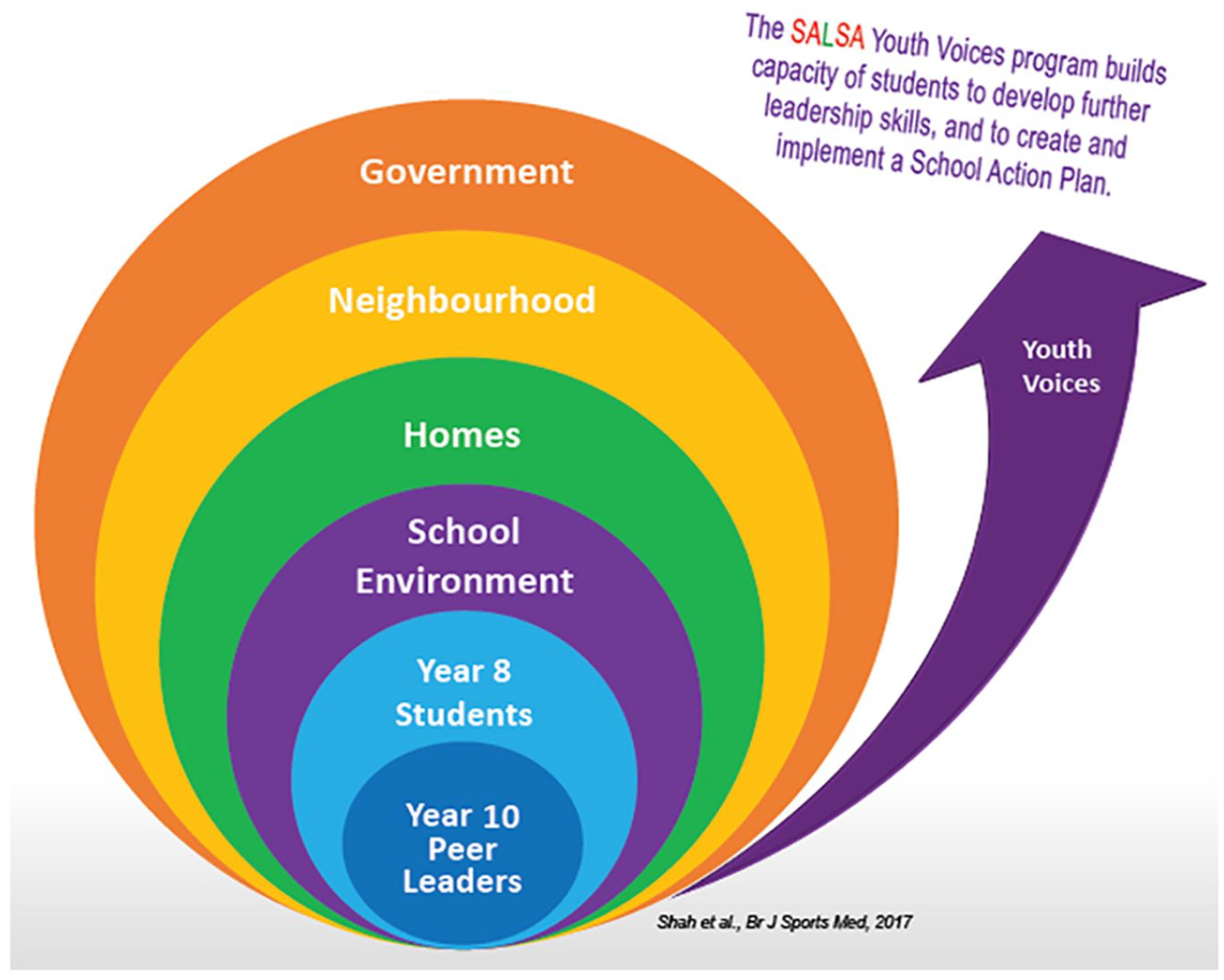
The SALSA Project model.
SALSA Youth Voices
Health environments may be conceptualised as the external physical, social and institutional factors which affect an individual’s health-related behaviours. Socio-ecological and social-cognitive theories of behaviour change offer insights as to how these environments shape behaviours. In parallel, the social-cognitive theory asserts that an individual’s behaviours are influenced by personal and environmental (Wechsler et al., 2000) factors through a mechanism of reciprocal determinism. SYV was piloted in 2016 and initiated in schools in 2019 in line with the socio-ecological framework (Davison and Birch, 2001) (see Figure 1). The aim of SYV was to provide SALSA Peer Leaders with an opportunity to further develop leadership skills while creating a supportive environment within their school to promote healthy eating and increase participation in physical activity. The objectives of this study were to (1) measure the acceptability of the SYV programme, (2) determine further skills gained by peer leaders from participating in SYV and (3) determine whether peer leaders were able to design and implement an action to promote healthy eating and physical activity in their school.
Methods
Participants and procedure
High schools that participated in the SALSA programme in 2019 were invited to participate in SYV, which comprises a Leadership Day and an Action Day. The evaluation of SYV received ethics approval from the University of Sydney Human Research Ethics Committee (approval number: 2018/272) and the NSW Department of Education (SERAP approval number: 2014096). Approval by the University of Sydney Human Research Ethics Committee allowed exemption from written consent by students for participation on the grounds that completion of the surveys was not considered controversial or harmful to the student. The SALSA programme is run in partnership with schools; any data collected from students are non-identifiable and aggregated for school reports. Moreover, students were able to withdraw their participation at any time. The Index of Community Socio-Educational Advantage (ICSEA) score (mean = 1,000, SD = 100), which is an indicator of the socio-educational background of students, was sourced for each participating school from the My School® website: a resource providing nationally consistent school-level data for all schools in Australia (http://www.myschool.edu.au).
SYV Leadership Day
The workshop was held at a professional sports club and delivered by the SALSA team (S.S. and K.R.L.) with assistance from a member of the sports club. The students were accompanied by a teacher from each school. The workshop consisted of a combination of presentations, group discussions and interactive games/activities addressing topics such as ‘Why youth voices?’; barriers to and enablers of adolescent physical activity participation and healthy eating; skills needed to develop a School Action Plan; and planning for change within their school environment (Supplemental File 1). Peer leaders were provided with templates (Supplemental Files 2a and 2b) to guide the planning, delivery and evaluation of an action undertaken in their schools. Peer leaders, supported by their teacher, identified a change that would benefit their school. They conceptualised the idea, set up the project, engaged with teachers for support and presented their plans at the end of the workshop.
SYV Action Day
On Action Day, peer leaders presented their plans or showcased the actions that they had implemented in their schools. The event was held in an auditorium at a local hospital, with the students presenting to an audience of over 100 invited health and education professionals.
SYV evaluation
A key aspect of the process evaluation is acceptability and reflects the extent to which the people delivering or receiving a healthcare intervention consider it to be appropriate, relevant, or engaging. Peer leaders completed a brief evaluation survey following the Leadership Day workshop. The survey was used to determine (1) why students participated in SYV Leadership Day, (2) which workshop activities they enjoyed, (3) how helpful the activities were in developing a School Action Plan and (4) the overall perceived value of SYV (Supplemental File 3).
At the start of the Action Day, students completed a second survey to evaluate (1) whether the School Action Plan was implemented, (2) challenges faced by the peer leaders and (3) perceived skills gained from participation in SYV (Supplemental File 4).
Study data were collected and managed using the REDCap electronic data capture tool (Harris et al., 2009) hosted at the University of Sydney. Due to the relatively small numbers, descriptive statistics were used to summarise the results.
Results
Sixteen high schools participated in the SALSA programme and 309 Year 10 students (age 14–15 years) trained to be peer leaders in 2019. Of these, seven schools (44%) and 84 SALSA Peer Leaders (27%) participated in SYV. Table 1 summarises the school characteristics and peer leaders participating in SYV. One school was for girls only, six were coeducational, and the average ICSEA of participating schools was 951 (range: 870–1,021), with the total school student enrolments ranging from 476 to 1,075.
Characteristics of schools participating in SYV.
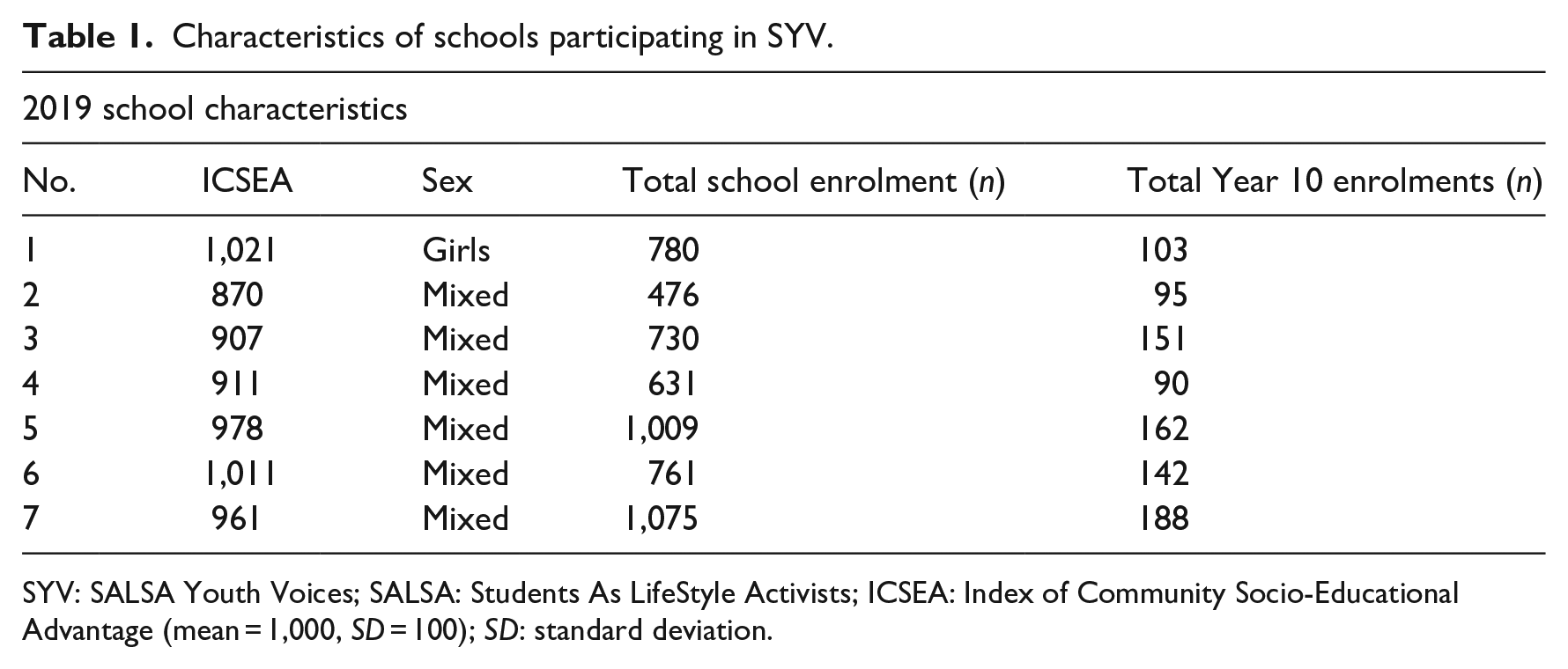
SYV: SALSA Youth Voices; SALSA: Students As LifeStyle Activists; ICSEA: Index of Community Socio-Educational Advantage (mean = 1,000, SD = 100); SD: standard deviation.
SYV Leadership Day
Eighty-four peer leaders participated in the Leadership Day workshop. Of these, 51 (61% response rate, girls = 67%) completed the Leadership Day evaluation survey. Figure 2 shows peer leaders’ responses as to why they volunteered to participate in Leadership Day. The most common response was that they wanted to strengthen their leadership skills.
I want to apply my skills to plan and implement healthy eating and physical activity activities in my school. (Student Peer Leader [SPL]) I am interested in how to lead a healthy lifestyle. (SPL)

Reasons why peer leaders volunteered to participate in SYV (n = 51).
Most (77%) of the peer leaders reported that the School Action Plan template was very useful (Supplementary Figure 1) and helped in designing an action plan at their school. Two-thirds (68%) of peer leaders reported that the workshop activities were helpful in planning their actions, and 65% reported they were very confident that their plan would be implemented.
Following the workshop, peer leaders reported building skills such as teamwork (90%), communication (85%), leadership (77%) and confidence (65%) (Figure 3). One third of the peer leaders reported building skills for advocacy and almost half reported building problem-solving skills.
We were able to use problem-solving skills to interact with our peers and discuss how to install a water refill station.

Peer leaders’ perceived skills developed at the Leadership Day workshop (n = 51) and from SYV (n = 28).
SYV Action Day
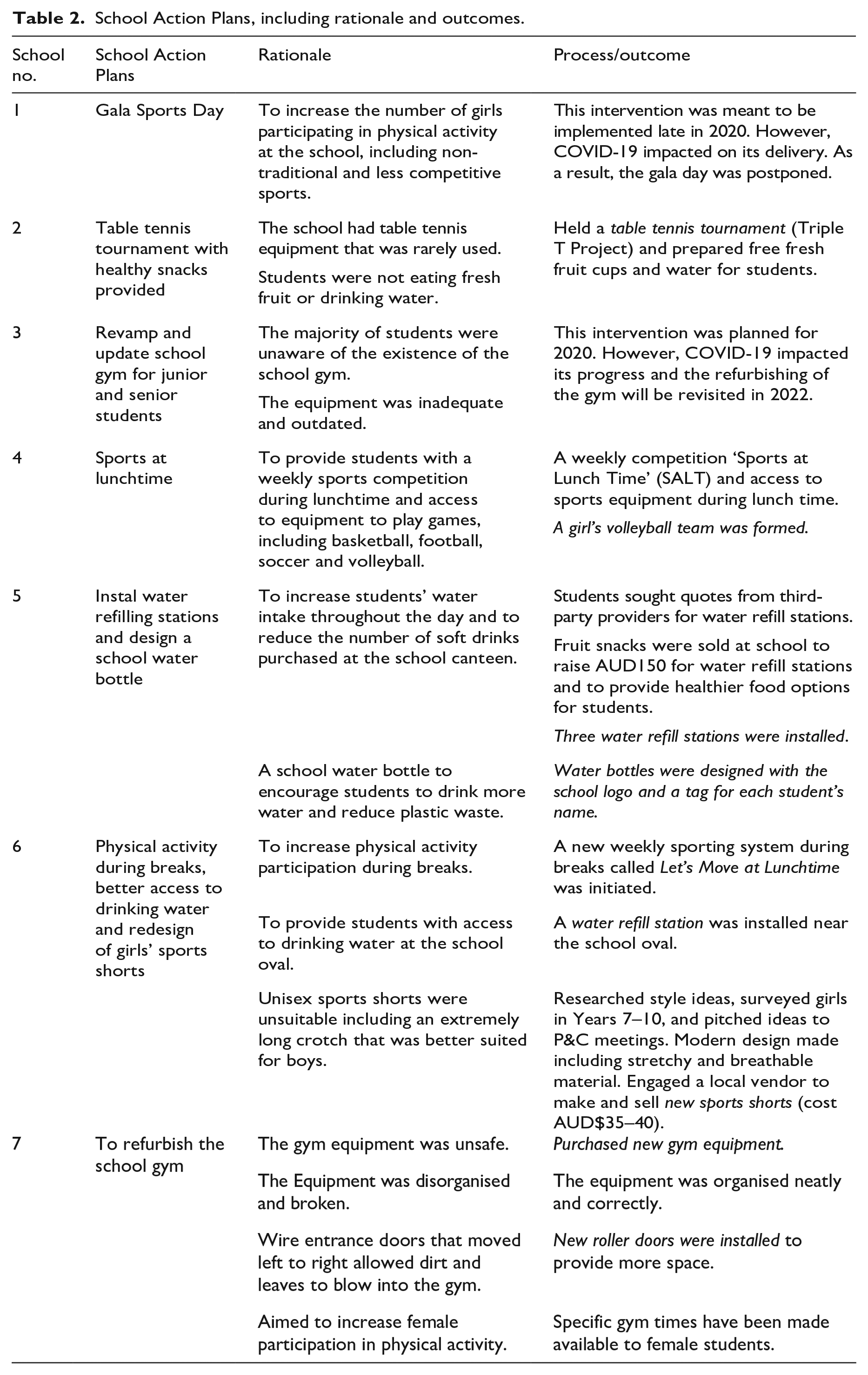
Thirty-six peer leaders (43%) were selected by their schools to present on Action Day. A description of the peer leader–designed School Action Plans, rationale and process/outcomes are shown in Table 2. Collectively, four actions aimed to increase physical activity participation among girls at their school. The strategies included redesigning girls’ sports shorts, providing non-traditional and less competitive sports, forming a girls’ volleyball team, and redeveloping the school gym to be amenable to girls. Two actions involved improving access to drinking water and the installation of water refill stations, with one school designing a reusable water bottle. Two schools organised lunchtime activities and access to sports equipment, and two schools focused on reopening and refurbishing their school gyms. Most of the activities required peer leaders to scope and source service providers in their local community, including a retail franchise to design unisex sports shorts and a local health district to contribute to funding for water refill stations.
School Action Plans, including rationale and outcomes.
Twenty-eight peer leaders (78% response rate, girls = 86%) completed the evaluation survey. Peer leaders from five of the seven schools reported that they implemented their School Action Plan and the activities worked ‘really well’ and should continue the following year. The peer leaders from one school reported that their intervention was meant to be implemented the following year but was disrupted by COVID-19. Another school that had planned to refurbish the school gymnasium the following year was unable to do so due to the time taken for approval, purchasing of equipment and installation, and disruption caused by the COVID-19 pandemic. The most common challenges peer leaders encountered while developing and implementing their actions were communicating the activity to other students (36%) and lack of time (29%) (Figure 4).

Challenges encountered by peer leaders in designing and implementing the intervention (n = 28).
Overall, 68% of peer leaders rated their involvement in SYV as ‘very valuable’. Most peer leaders identified that SYV helped build skills in leadership, communication, confidence and teamwork, with 25% of peer leaders indicating they also developed advocacy skills (Figure 3). Qualitative feedback and an account from peer leaders highlight the benefits of participating in SYV, as indicated below: It provides a voice for all young people – upgrading our creativity and leadership skills. The SALSA programme provides me with confidence when it comes to advocating for our School Action Plan. It gave me an idea of what it’s like to be a leader and promote a healthy lifestyle. We were able to learn new information as well as educate others. We were able to use problem-solving skills to interact with our peers and discuss how to install a water refill station.
The following is an account of the SALSA Peer Leaders’ experience in one school: The SALSA leaders at one school decided to improve the healthy environment and quality of learning for students by implementing a water refill station. The peer leaders recognised that this would not only impact the health of students but also help to improve student wellbeing. The peer leaders considered many factors to suit the purpose of ‘their School Action Plan’ which was ultimately to install a water refill station. The factors they considered included accessibility for all students and staff, cost, placement, installation and filtered water. They did all the research for the water refill stations and decided on two options. The students sourced and corresponded with the suppliers to seek quotes. With these quotes, they organised a meeting with their principal and gained funding support. Their financial contribution came through the money they raised from a healthy snack stall. The initial funding came from the Mt Druitt Medical Practitioner’s Association. They used this money to buy ingredients, make healthy snacks and sell the products. Their plan was not only to raise money but to introduce healthier options for students. To prepare these healthy meals and snacks all SALSA peer leaders participated in a one-day incursion preparing the healthy meals for the following day. They raised a total of $403 and made a profit of $150. This fruit store was taken as a learning experience. To make more profit they concluded that purchasing fruit in season would decrease the total amount of money spent on the fruit store, allowing them to raise more money. The school has since installed a total of five water refill stations.
Discussion
To our knowledge, SYV is the only Australian leadership programme offered to high school students from socio-economically disadvantaged areas which engages and empowers them to conceptualise and design actions to promote healthy eating and physical activity at school. The findings indicate that SYV was highly acceptable to students and had the potential to improve healthy food and physical activity environments at their schools. The programme also enhanced the leadership, communication and teamwork skills of students, a similar result to other international adolescent leadership programmes (Shook and Keup, 2012).
There is strong evidence to suggest that the development of skills such as leadership, teamwork and communication helps to prepare adolescents for post-school achievements and the workforce (Gaines and Mohammed, 2013; United Nations Children’s Fund (UNICEF), 2012; Villarreal et al., 2018). Furthermore, participating in leadership roles as an adolescent has been shown to improve a student’s chances for a tertiary education and build a foundation for future leadership opportunities (Murphy and Johnson, 2011). This is of particular importance for students from lower socio-economic status (SES) areas, given evidence showing poorer learning outcomes and lower ambition to achieve a tertiary education compared with students from higher SES areas (Thomson et al., 2019). Offering SYV to schools in low-SES areas is therefore one strategy for helping to achieve equitable outcomes for students. While we invited all 16 schools to participate in SYV, only the first 7 schools who responded were invited, due to the limited capacity and availability of the facilities where the training occurred.
Capturing student voices has been shown to be a powerful and effective tool for school planning and improvement (Manefield et al., 2007; Thomson et al., 2019). The School Action Plans developed by students were realistic and achievable, with the potential to positively impact the whole school community. Over 5,000 students were enrolled at the seven participating high schools at the time the study was conducted, highlighting the significant reach of these actions.
The Australian Government’s ‘Physical Activity Recommendations for Children and Young People’ recommend children (aged 5–17 years) undertake a minimum of 60 minutes of moderate to vigorous activity each day (Australian Government Department of Health, 2021). However, population data from 146 countries (including Australia) show that 81% of adolescents aged 11–17 years are not meeting physical activity guidelines (Guthold et al., 2020). Prevalence of insufficient physical activity was highest among girls aged 11–17 years, with the data indicating no significant improvement in girls’ physical activity levels since 2001 (Guthold et al., 2020). While many adolescents do not meet national guidelines for physical activity, girls have consistently been proven to be less active with more rapidly declining levels of physical activity compared to their male peers. Factors associated with girls’ physical activity include physical self-perceptions, self-efficacy, competence and enjoyment. However, girls’ relationship with physical activity becomes exceedingly complex throughout their development due to its interaction with gender roles, societal norms and self-appearance (Sebire et al., 2018; Spencer et al., 2015). In this respect, it is unsurprising that students identified low levels of physical activity in girls as an opportunity to develop actions that foster social norms supportive of the uptake of physical activity in girls.
The health actions designed in SYV are therefore of great importance in helping to correct gender disparities in physical activity levels. Despite all but one of the schools being coeducational, most of the actions focused on increasing participation in physical activity among girls. For example, ‘Redesigning of the Girls Sports Shorts’ by peer leaders, one school’s plan aimed to design a new style of girls’ sports shorts to encourage increased female participation, enable girls to feel more comfortable and not feel judged. The peer leaders wanted the change due to the awkward length, the unbreathable, non-stretchy material, tightness around the legs, the extremely long crotch and the ‘unisex’ style being more suited towards the male figure. To achieve their plan, they found data about poor participation rates for girls, researched style ideas, sought approval from the school principal and deputies, surveyed girls in Years 7–10, pitched their idea at a parent and community meeting, and consulted with a supplier. The shorts they designed were stretchy, lightweight, and breathable, with an elastic waistband, drawstring and pockets. Since 2020, the shorts are now on sale as the school’s official girls’ sports shorts.
In contrast to most school-based health promotion initiatives, SYV is student-centred and supported by school staff, which may have contributed to the peer leaders taking ownership of their actions. This is echoed by positive youth development which posits that youth leadership programmes are most effective when students receive support from their teachers (McKay-Jackson, 2014; Visser, 2005). Peer leaders’ engagement in SYV may also have been positively influenced because the workshop was held at a popular professional sports club and delivered by the SALSA team (S.S. and K.R.L.) with assistance from a member of the sports club. Another unique feature of SYV was that peer leaders had already delivered the SALSA programme to their younger peers and were therefore motivated to further their leadership skills. We had to limit the number to 10 students from each school due to venue capacity.
Considerations for the future
Following the success of 2019 SYV, we have continued to offer this opportunity to our SALSA schools as an annual event. Ongoing relationships with the principals and school staff and being respectful of the schools’ timetables and competing priorities have been key in ensuring their participation in SYV. Considerations for the future should include conducting follow-up with the schools to assess the sustainability of the actions and their impacts on the student population. To help ensure the sustainability of the student initiatives, it is important to strengthen partnerships with external organisations that can contribute funding towards the actions, for example, local medical associations. Approximately 40% of students felt that communicating their activity to other students was a challenge in designing and implementing their action plan. Effective communication strategies and building advocacy skills should be included in future workshops. The majority of those who took part in SYV were girls, indicating the need to consider ways of recruiting and engaging boys. Finally, to increase post-survey evaluation completion rates, possible strategies could include using both paper-based and electronic surveys (link provided via QR code) and encouraging teachers to oversee the process.
Conclusion
The SYV programme provides a unique opportunity for high school students to build teamwork, communication and leadership skills, and be agents of change in creating a school environment that supports physical activity and healthy eating. It empowers students to act on their own health priorities, resulting in potential benefits for the whole school community. The SYV model could be applied to other health issues facing adolescents.
Supplemental Material
sj-docx-1-hej-10.1177_00178969231173266 – Supplemental material for Youth voices creating healthy eating and physically active environments in schools
Supplemental material, sj-docx-1-hej-10.1177_00178969231173266 for Youth voices creating healthy eating and physically active environments in schools by Smita Shah, Kym Rizzo Liu, Catriona Lockett and Emma Sainsbury in Health Education Journal
Footnotes
Acknowledgements
The authors thank the schools and students involved in the study, Rooty Hill High School Principal Christine Cawsey, and the Blacktown, Hills and Mt Druitt Medical Associations. We acknowledge the involvement of Louise Hardy in the acquisition, analysis and interpretation of the data, and thank her for having undertaken the first draft of the manuscript.
Declaration of conflicting interests
The author(s) declared no potential conflicts of interest with respect to the research, authorship and/or publication of this article.
Funding
The author(s) disclosed receipt of the following financial support for the research, authorship and/or publication of this article: SALSA Youth Voices was supported by the Western Sydney Primary Health Network and a philanthropic donation (Patricia McAlary and Family).

Supplemental material
Supplemental material for this article is available online.
References
Supplementary Material
Please find the following supplemental material available below.
For Open Access articles published under a Creative Commons License, all supplemental material carries the same license as the article it is associated with.
For non-Open Access articles published, all supplemental material carries a non-exclusive license, and permission requests for re-use of supplemental material or any part of supplemental material shall be sent directly to the copyright owner as specified in the copyright notice associated with the article.
