



Abstract
Objective:
To assess whether adolescents who appeared in an after-school cooking nutrition programme (Teen Battle Chef) sustained healthful food behaviours in the ensuing years into young adulthood.
Design:
Interviews involving a short verbal survey assessing six health behaviours coded dichotomously and open-ended questions coded for themes describing how participants did or did not sustain behaviour change.
Setting:
Adults who had previously participated in TBC culinary nutrition programme while in high school discussed whether any lifestyle changes prompted by the programme continued into their adult lives.
Method:
The 30 young people were interviewed (in-person or by telephone) and the interviews were audio-recorded. Transcripts were made verbatim to allow for NVivo analysis of responses.
Results:
Thirty 17- to 24-year-olds, 6 months to 7 years after TBC programme, reported current favourable health behaviours. Results were similar for participants <3 and 3+ years post TBC. In interviews, 27 of 30 provided in-depth description of how TBC had changed their behaviours. They described cooking skills learned in TBC that they still practised. Participants discussed specific ways in which peers and family supported them to sustain behaviour change.
Conclusion:
Even modest findings of short-term evaluations of cooking programmes may be significant if impacts are sustained. More longer-term evaluations are needed to confirm these results.
Keywords
Introduction
Poor diet among adolescents and young people affects their growth and development (Norris et al., 2022), physical health (Akseer et al., 2020) and emotional wellbeing (O’Neil et al., 2014). In addition to eating not enough fruit and vegetables and skipping meals, another common dietary behaviour among adolescents is consuming food prepared away from home. Approximately 50% of adolescents in the USA consume more than two meals a week that were prepared away from home (Golper et al., 2021). Eating away from home is associated with greater energy intake and poorer diet quality (Wellard-Cole et al., 2021).
It is well accepted that aspects of the physical and social environments play a powerful role in determining how and what young people eat (Patrick and Nicklas, 2005). Available evidence suggests that young people who have healthy foods available at school and in their homes (Story et al., 2008) share meals with their families (Fulkerson et al., 2014), develop food-preparation skills early in life (Berge et al., 2016; Utter et al., 2016) and engage in healthier eating behaviours (Utter et al., 2018b).
Cooking programmes offer promise as an intervention to actively engage young people in food-related skills and activities. This is particularly true as youth-oriented cooking programmes are often offered in a school setting, utilise peer support and relationships, and attempt to engage the wider family. Collectively, cooking programmes for children (Hersch et al., 2014), young people (McGowan et al., 2017; Utter et al., 2017) and adults (Reicks et al., 2014) appear to positively influence participants’ cooking skills, preferences for healthy foods and eating behaviours in the short term. For example, the evaluation of a pilot programme Diet for a Healthy Planet with Teen Battle Chefs found that participants improved their overall diet quality and consumption of vegetables as snacks following the intervention (Bukhari et al., 2011).
However, medium- to long-term evaluations of cooking programmes are more difficult to conduct given limitations in study design and the length of time needed for evaluation. Anecdotal and observational studies suggest that learning to cook during adolescence may be positively associated with better eating behaviours well into adulthood (Hagmann et al., 2020; Utter et al., 2018b), although few, if any, youth cooking programmes have reported on the experiences of participants as they emerge into young adulthood.
The aim of this study was to assess how the healthy eating behaviours promoted by an after-school nutritional cooking programme for adolescents were sustained by participants in the years following the intervention and explore the role of the programme, peers and families in sustaining these behaviour changes over the long term.
Methods
The study utilised a mixed-methods study design. Interviews that included closed questions about diet and physical activity behaviour frequencies and open-ended questions to allow participants to discuss their behaviours in more detail were conducted. In this way, participants described how the Teen Battle Chef programme was seen as having influenced their current behaviours, enabling an understanding of motivators, facilitators and barriers to sustaining these behaviours.
Intervention
The development of the programme was based on principles derived from Social Cognitive Theory (SCT) (Bandura, 2001), the Social Ecological Model (Bronfenbrenner, 1977) and Empowerment Theory (Zimmerman, 2000). Table 1 outlines the theory-based determinants used in the development of the programme to enhance motivation, facilitate action and create a supportive environment (Contento and Koch, 2021). It also documents the experiential drivers (Fredericks et al., 2020) used during implementation to engage and connect with the lived experiences of participants.
Theory-based determinants and experiential drivers used in the development and implementation of Teen Battle Chef.
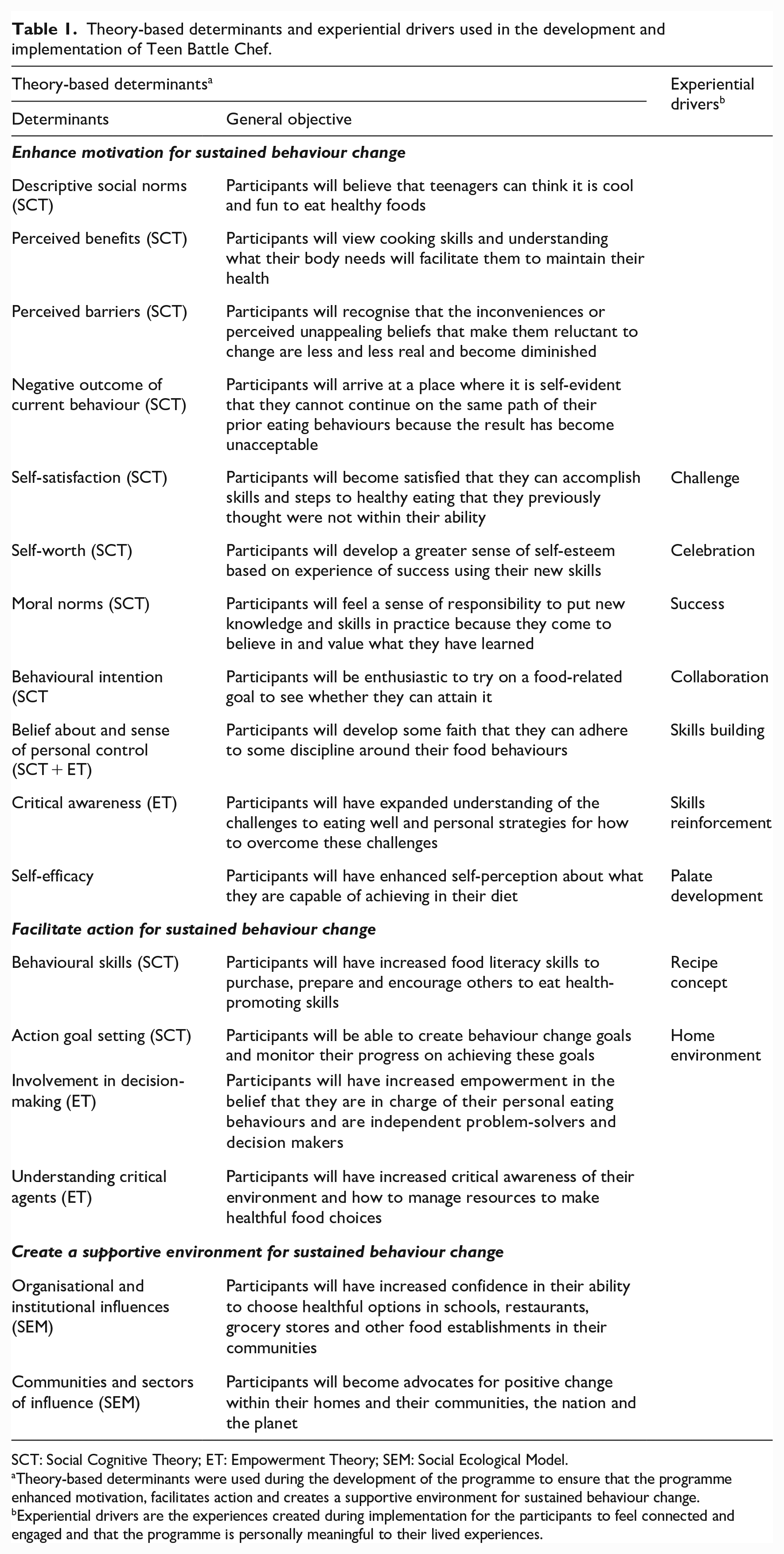
SCT: Social Cognitive Theory; ET: Empowerment Theory; SEM: Social Ecological Model.
Theory-based determinants were used during the development of the programme to ensure that the programme enhanced motivation, facilitates action and creates a supportive environment for sustained behaviour change.
Experiential drivers are the experiences created during implementation for the participants to feel connected and engaged and that the programme is personally meaningful to their lived experiences.
The programme comprised 8 weeks of structured lessons that included an active cooking component that started with cooking basics and progressed to full meals by the third week. The cooking component was conducted by students divided into teams and modelled from TV-style cooking competitions where the two teams of students ‘battle’ to prepare a nutritious meal (all recipes include multiple fresh fruits and vegetables) with various cultural origins. In addition, weekly recipes were provided to young people to take home and customise with local, seasonal and culturally relevant ingredients.
Students developed SMART goals and tracked their awareness about changes in their bodies and energy level as they focused on new dietary behaviours. Beginning in 2008, FamilyCook Productions, a not-for-profit organisation founded to develop culinary nutrition education for K–12 learners, developed the Teen Battle Chef programme and piloted the programme in two NYC public schools. The outcomes of this pilot work were published (Bukhari et al., 2011), and the programme was widely disseminated via other national not-for-profit organisations across the USA, SNAP-Ed programmes 1 in multiple states and in individual high schools through a low-cost programme licence.
Instructors on the staff of partner organisations were trained by FamilyCook Productions to deliver the programme, and research assistants conducted fidelity checks on lesson presentations delivered by the trained instructors. Between 2009 and 2016, the programme was delivered to more than 10,000 adolescents attending low-resource schools in 22 states. After completion of the 8-week programme, instructors segued into its leadership component. Students become ‘youth leaders’ who were agents of change in their schools and were encouraged to support wellness campaigns for their peers and support family-based cooking activities at home.
Participants
Interview participants were recruited from students who completed the Teen Battle Chef programme in New York City. Approximately 150 programme participants from 20 NYC schools continued after the initial 8–12 sessions to participate in a summer cooking internship. Students could self-select to apply for the internship. Applicants were interviewed and selected based on their availability and evidence that they had learned the basics during the high school programme. FamilyCook Productions retained current contact information for 64 of these (~43%). These young people were invited to participate in the research through Facebook announcements and e-mail. Ethical approval for the study was granted by the Columbia University Institutional Review Board.
Data collection
Data were collected between May 2016 and July 2017 through phone and/or in-person interviews and were audio-recorded. The frequency of six eating and activity behaviours was assessed using a close-ended, Likert-scale single question with five response options. These specific behaviours were chosen because they aligned to key messages embedded in both the Teen Battle Chef programme and the Dietary Guidelines for Americans (US Department of Health and Human Services and US Department of Agriculture, 2015).
FamilyCook staff and trained research assistants conducted the interviews. The open-ended interview questions asked participants to discuss the aspects of the programme that facilitated their dietary behaviours. Specifically, questions asked participants to reflect on how their participation in the programme was believed to have influenced their own behaviour and that of their friends and family.
Data analysis
The interviews were transcribed verbatim by the research staff. Responses to the section of the interview that contained the closed-ended questions were coded to determine for each participant whether or not they were following the six behaviours. Determinations on whether the participant was enacting the behaviour were based on Dietary Guidelines for Americans. For each behaviour, we calculated the percentage of participants practising that behaviour. As the range of length of time from programme completion was wide and it was possible that time since completing the programme might influence the behavioural outcomes (Kwasnicka et al., 2016), behaviours were reported for students completing the programme in two groups: less than 3 years ago and 3 or more years ago.
Responses to the open-ended questions were analysed using a phenomenological approach. This aimed to describe the common experiences of the participants and the meanings these had for the individuals (Creswell, 2007). The focus was on factors that helped participants sustain behaviour change and the influence of (and on) their friends and families. Two authors undertook the qualitative coding and discussed discrepancies until consensus was reached. The data were organised and coded with the use of NVivo Pro 11, with nodes created based on the questions asked. Reports from these nodes were reviewed to create emergent themes that described participants’ lived experience, how they saw themselves applying what they had learned in the programme later in life and which programme experiences were seen as influencing their behaviour change (Table 2).
Themes and nodes used to create the themes.

Results
In total, 30 former students (17 women, 13 men) from 14 schools agreed to participate in the research. Participants’ ages ranged from 17 to 24 years, with time since completing the Teen Battle Chef programme ranging from 6 months to 7 years (Table 3). Specifically, time since completion was less than 1 year for 3 participants, between 1 and 2 years for 11 participants, between 3 and 4 years for 10 participants, between 5 and 6 years for 5 participants, and 7 years for 1 participant.
Description of study participants.

Sustaining key eating behaviours and physical activity
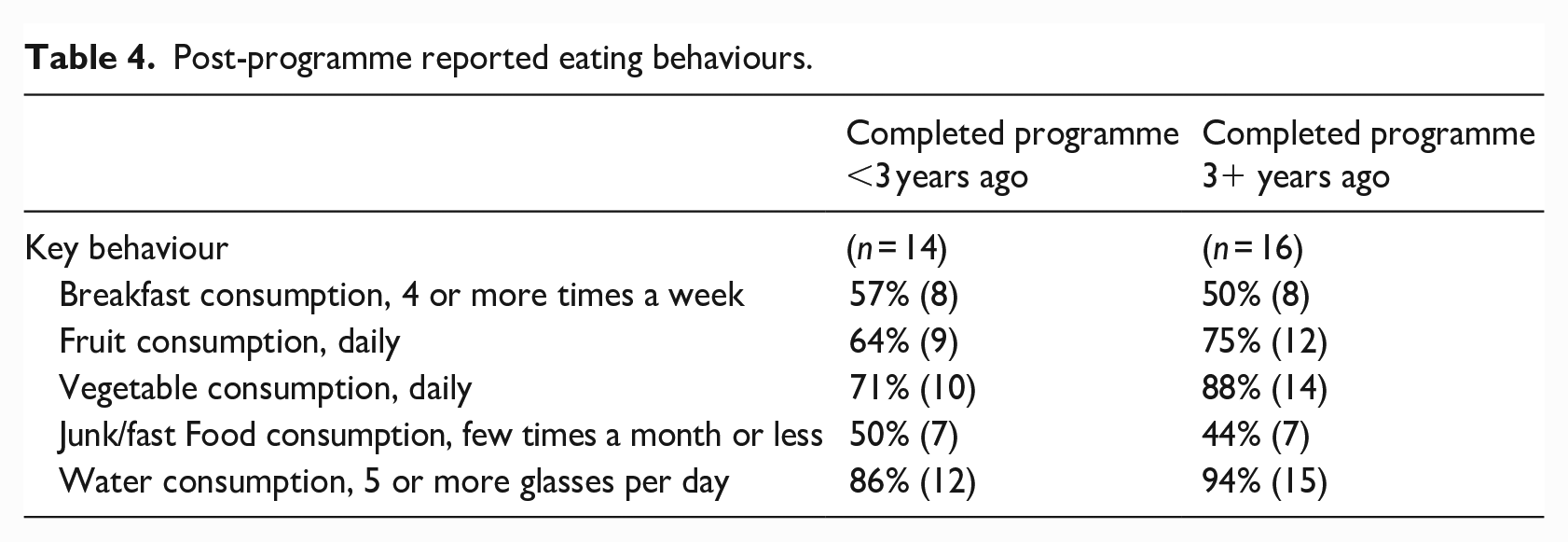
Overall, former participants in the programme reported current favourable eating and activity behaviours, and these were consistent for those participants completing the programme (less than 3 years ago or 3 or more years ago (Table 4). More than half of the participants reported frequent breakfast consumption and approximately 70% reported daily consumption of fruit and vegetables.
Post-programme reported eating behaviours.
In the open-ended interview, almost all (27/30) the participants described a change to the way they ate as a result of the programme. As one participant said, I think Teen Battle Chef just made it more like evident like that I need to eat more healthy . . . Like before, I think it was just from like trying something new, but now it’s like I really invest time in myself, like being healthy for me. (F, 21 years)
Another participant linked changes in their eating and activity behaviours to their body size: By eating healthy, I was . . . more inspired because I felt like if I was eating good then maybe if I worked out a little bit. . . I could lose a little bit of weight. Which it did work. (F, 19 years)
Qualitative analysis of the individual interviews provided context for the positive eating behaviours students reported after completing the programme. Three key themes that identified the development of skills, peer influence and family support as helpful were developed from this analysis (Table 2).
Skills development
When asked to discuss the aspects of the programme that were most useful in achieving these behaviour changes, participants consistently referred to the skills-based aspects of the programme. Students discussed cooking skills and techniques specifically: The hands-on experience, learning how to cut, learning how to use a knife, learning how to use different utensils. If someone is going to cook for themselves or cook for a group of people, how are they going to do that if they don’t have the skills? (M, 23 years)
Participants also discussed skills in adapting recipes to the ingredients available: ‘Sometimes you go shopping and they don’t have all the ingredients, so like you need to switch it up a little’. Last, some students commented on the importance of developing broader skills in communication and cultural engagement: Communicating with others opens up. . . horizons that you’ve never been to before. You never have gone there, like different cultures, different types of people, different cooking. You talk about what you cook at home, your ethnicity. (F, 21 years)
Peer influence
Many participants talked about how their friends had played a significant role in sustaining health behaviour change after the programme. The programme was perceived as offering participants an experience worth sharing: I was able to talk to my friends about the programme and what it teaches you, different things about healthy eating, there is so many facts about healthy eating that people don’t know exist, I tried to translate that to my friends. (M, 22 years)
Skills learned in the programme also became the basis of activities that participants undertook with their friends in later years. As one participant described it, Few friends that have kids too, when they do come over and visit, we cook a meal together and I’m trying to make meals with more vegetables, because it is healthy for the kids and important when they are growing. (F, 18)
Participants identified several aspects of the programme that supported peer relationships and collaboration. Specifically, participants described how working alongside their friends felt supportive: ‘When they do it in group cooking, it is always helpful to have you friends there, to kind of encourage you, but also be honest with you’ (M, 22 years). Other participants commented on the enjoyment of cooking with peers: ‘Cooking with other people around your age, sharing that moment and then sharing it with others is really great’ (F, 19 years). Finally, several participants commented on the unique opportunity that the leadership programme offered in learning how to influence peers: ‘When I was a mentor, I learned how to introduce and kind of like encourage without being, you know, judgmental’ (M, 19 years).
Family influence
Participants reflected on the role of their family in sustaining their new eating behaviours. Some participants commented on the long-term changes to the home environment: ‘In my household we never really ate vegetables at home, but now we definitely do’ (M, 23 years). Others noted that they made food choices to benefit others in their household. As one participant described, I used to live with my younger cousin . . . he would get sad when he would see everyone else start to drink soda or juice . . . So, I was just like, ‘oh look, I’m drinking water! It’s better for you!’ And it just stuck with me. It helped him. (F, 18 years)
The main aspect of the programme that supported family relationships was the encouragement for students to share their newly acquired skills at home: I would always tell my mom about what we made and how my day went and then my mom . . . she’d apply it to what we did at home, and then we would just all just like eat together as a family, she started making us sit down and eat together as a family and eat healthier things and make healthier choices and when we go shopping she doesn’t buy junk food. . . now, we sit down together as a family . . . it brings us together. (F, 18 years)
Discussion
Following completion of the Teen Battle Chef programme, participants reported sustaining multiple healthy eating and activity behaviours. This is of interest as relatively few programme evaluations have followed participants over such a long time period (Utter et al., 2017). These findings are consistent with those from several observational studies which suggested that learning to cook and involvement in cooking as a young person impacts meal preparation and indicators of healthier eating over the long term (Fulkerson et al., 2014; Hagmann et al., 2020; Laska et al., 2012; Utter et al., 2018b). This is significant as available evidence suggests that adults who cook have better diets and better indicators of health (including maintaining a healthy weight, cardio-metabolic health, as well as social determinants of health such as cultural identity and closer personal relationships) (Mills et al., 2017).
Participants in this study identified various factors that facilitated changes to their eating behaviours following completion of the programme. These included skills development, peer engagement and family support and relationships. These factors are supported by the broader nutrition literature on determinants of eating behaviours and general theories of human development as well as the aforementioned experiential drivers of behaviour change (Fredericks et al., 2020). Research exploring early skills development in cooking suggests that these skills sustain long term. In a nationally representative study of adults in Ireland, those who had acquired cooking skills early in life had reported they experienced more positive attitudes towards cooking, spent more time in food preparation and experienced better diet quality as adults (Lavelle et al., 2016). Similarly, adults who rated their cooking skills positively as young adults were more likely to participate in meal preparation and ate fast food less frequently than young adults with poorer cooking skills (Utter et al., 2018b).
For young people specifically, cooking is a social activity. Evaluations of cooking programmes for young people have noted that cooking programmes can offer social benefits for young people (Utter et al., 2017). A systematic review exploring the role of peer support in complex behaviour change found that peer support was an effective tool for supporting behaviour change, over a range of interventions across multiple settings (Fisher et al., 2017). The authors of this review note that peers can help to support behaviour change by providing practical and emotional support and encouragement. With nutrition and cooking specifically, peers can help with food preparation, sharing meals and encouraging to try new foods. Families also play a key role in supporting young people to cook as young people involved with food preparation at home report having stronger family connections and emotional wellbeing (Utter et al., 2016). Similarly, multiple studies have documented that families can be an important source of learning to cook (Lavelle et al., 2016; Utter et al., 2018a), suggesting that the successful development of skills benefits from family engagement.
The skills-based and socio-environmental factors attributed to sustained behaviour change by participants in this study also align with theoretical predictions (Bandura, 2001; Bronfenbrenner, 1977; Zimmerman, 2000) and features of the design and development of the Teen Battle Chef programme (Fredericks et al., 2020). At its core, the programme builds and reinforces food-related skills. Skills development is practised in a socially supportive and collaborative environment (after-school programme). The programme also enables participants to practice and share their skills at home, thus influencing the family environment.
Strengths and limitations
Strengths of this study lie in the long-term follow-up of former programme participants. That said, the study had several limitations. First, the study comprised a convenience sample of former participants who could be reached. This sample may be biased positively in terms of the study findings as those who were contactable may have had a more positive experience of the programme than others. Second, the length of follow-up time was variable from 6 months to 7 years. It is possible that sustained behaviours attenuate over time. In the current analyses, data were presented for those completing the programme more recently (less than 3 years ago) or 3 or more years ago in recognition of this possibility. Last, this study did not include an assessment of measures at baseline or with a comparison group. As such, the findings observed cannot be attributable to the Teen Battle Chef programme specifically. Future evaluations with more robust designs are needed to confirm these results, although conducting such studies with such a long follow-up period is limited by feasibility.
Conclusion
Study findings suggest that even modest findings of short-term evaluations of cooking programmes may be significant if the impacts are sustained over the long term. Future research should consider investing in long-term evaluations of cooking programmes, where possible, to confirm these findings. For practitioners, the findings from this study emphasise the value of the aspects of food and nutrition programmes which are skills-based, socially engaging and can involve families. Where possible, ongoing nutrition education with young people should prioritise these aspects of their programmes as they may ultimately make these types of programmes more successful.
