



Abstract
Objective:
School-based fruit and vegetable provision programmes can improve children’s eating patterns and health by ensuring access to fruit and vegetables and providing nutrition education. However, the effectiveness of these programmes may be significantly affected by the implementation quality. The objective of this study was to identify barriers and facilitators to the implementation of the EU School Fruit and Vegetables Scheme according to Italian teachers’ perspective.
Design, Setting, and Method:
We carried out semi-structured interviews with teachers in two elementary schools in Italy that had participated in the EU School Fruit and Vegetables Scheme for several years. The interview protocol was based on domains, constructs and sub-constructs from the Consolidated Framework for Implementation Research (CFIR). Qualitative data from the interviews were coded deductively using the CFIR to identify the main barriers and facilitators to implementing the EU School Fruit and Vegetables Scheme.
Results:
Among the main facilitators of implementation of the EU School Fruit and Vegetables Scheme were the quality and variety of the products, as well as the educational intentions behind the scheme, and teachers’ overall level of engagement. Barriers were to be found in lack of teacher training, an absence of accompanying measures, limited knowledge about a healthy diet, the low involvement of parents, and finally, problems with product delivery.
Conclusions:
Providing more comprehensive teacher education and training and extending access to accompanying measures may improve the EU School Fruit and Vegetables Scheme’s implementation quality and effectiveness. Moreover, allowing greater flexibility in between suppliers and accounting for each geographic area’s unique character are crucial to overcoming the delivery problems that currently act as barriers to the implementation of the scheme.
Keywords
Introduction
Childhood overweight and obesity constitute serious health issues in the European Region, being linked to many non-communicable diseases (NCDs) – from cardiovascular disease to diabetes and cancer. One in three school-aged children in Europe are living with overweight or obesity, and rates are increasing in many member states (World Health Organization [WHO], 2022). In Italy, over 20% of children are overweight (20.4%), with 9.4% of children considered obese and 2.4% severely obese (WHO, 2020).
Considering children’s food habits, data show that almost 1 in 2 children need an adequate breakfast in the morning, and 1 in 4 consume fruit and vegetables less than once a day (European Commission, 2022b). As low levels of fruit and vegetable consumption and unhealthy diets may result in a rise in the number of children who are overweight and growing levels of child obesity, the European Union introduced the EU School Fruit and Vegetables Scheme, hereafter referred to as ‘the Scheme’, as part of the Common Agricultural Policy in the school year 2009/2010 (Commission of the European Communities, 2005; European Commission, 2022b). The Scheme was introduced to support children from nursery to secondary schools (from 6 to 11 years old) develop healthy diets through direct fruit and vegetable distribution, educational and information measures. The literature evaluating the impacts of nutritional education programmes supporting fruit and vegetable consumption and thus the development of healthy eating habits among school-aged children, is rich. Examples of successful approaches include nutrition initiatives in schools such as the Dutch ‘Schoolgruiten program’ (Tak et al., 2009), the ‘Food Dudes’ initiatives (e.g. Laureati et al., 2014; Presti et al., 2015), as well as the European School Fruit and Vegetables Scheme itself (e.g. Methner et al., 2017; Ransley et al., 2007; Wolnicka et al., 2021). However, to the best of our knowledge, fewer empirical studies evaluate the implementation quality of these programmes, especially of the Scheme (Soares et al., 2019).
Given the consistent evidence of the significant relationship between implementation quality and programme outcomes (Dowling and Barry, 2020; Durlak and DuPre, 2008), the objective of this study is to identify barriers and facilitators to the implementation of the EU School Fruit and Vegetables Scheme from the Italian teachers’ perspective. To the best of our knowledge, this represents the first attempt to explore the implementation of the Scheme in the Italian context.
The School Fruit and Vegetables Scheme and its implementation in Italy
The EU provides countries with considerable flexibility when designing national School Fruit and Vegetables Schemes (e.g. regarding the frequency of distribution and the duration) along with their implementation (the entities that will be considered beneficiaries of the Scheme at the local level are, e.g. municipalities, suppliers, schools). Each country must however describe the design of the Scheme as part of a six-year national strategy (Commission of the European Communities, 2005 and 2007; European Commission, 2022b).
The most distributed fruit by the EU Scheme are apples, pears, plums, citrus fruits, peaches/nectarines, strawberries, bananas, other berries and grapes. Meanwhile, the most distributed vegetables are carrots, tomatoes, cucumbers and peppers. However, there are differences between countries regarding the diversity of fruits and vegetables offered to children. Indeed, most often, health, seasonality, and products that are of local/regional origin are prioritised criteria by participating countries (European Commission, 2022b).
As part of the Scheme, fruit and vegetables are made available free of charge to children. The frequency and duration of distribution vary greatly across countries, and in some cases, neither are reported or determined ahead of time – instead, these are decisions left for individual schools to make (European Commission, 2022b).
The COVID-19 pandemic severely affected the implementation of the Scheme, with differences between EU countries that can be considered the result of the variety of control measures and public health policies deployed by national governments. As a matter of fact, the increasing trend of participation in the fruit and vegetable school scheme reversed when the COVID-19 pandemic started. From 2017 to 2020, a decrease in the number of children participating in the Scheme was identified; simultaneously, the total distributed quantities of fruit and vegetables decreased by about 22% (European Commission, 2022a).
In Italy, the Fruit and Vegetables in Schools programme was led by the Ministry of Agriculture, Food, and Forestry, in collaboration with the Ministry of Education, University and Research, the Ministry of Health, the Agency for Disbursements in Agriculture (AGEA), the Regions and Autonomous Provinces of Trento and Bolzano. The Italian Scheme is an ‘educational programme’, so its primary aim is to promote food culture through a systemic approach from the youngest age groups upwards, as part of an integrated educational programme (http://www.fruttanellescuole.gov.it/il-programma/monitoraggio). The programme is aimed at children in primary school (6 to 11 years), and its goal is to increase the consumption of fruit and vegetables and raise awareness of the benefits of a healthy diet. The objectives of the Scheme as cited on the official Italian programme website 1 are:
to reveal the value and meaning of the seasonality of products;
to promote the involvement of families so that the food education process started at school continues in the family context;
to spread understanding of the importance of certified quality: i.e. products having a designation of origin (e.g. PDO–Protected Designation of Origin or PGI–Protected Geographical Indication) of organic production;
to raise pupils’ awareness of the importance of respect for the environment, and the need to reduce food waste.
In Italy, products associated with the scheme are usually distributed for 4 to 12 weeks a school year (European Commission, 2017). Accompanying measures are planned by the Italian Ministry of Agriculture, Food Sovereignty and Forests through the ‘Consiglio per la ricerca in agricoltura e l’analisi dell’economia agraria (CREA)’ 2 and have the objective of ‘informing’ and promoting the consumption of fruit and vegetables, favouring fresh products. The programme includes the creation of specific theme days, such as visits to educational farms, tasting courses and sensory workshops, to encourage children to consume fruit and vegetables and support them in establishing healthy eating habits. Accompanying measures include the setting up of school gardens, farm visits, sensory laboratories, training for teachers, and games such as the Fruit Olympics (European Commission, 2017).
As shown by the ISMEA Monitoring Report (2021-2022) detailing the results of the Fruit and Vegetables Programme in Italy (fruttanellescuole.gov.it), the Scheme can encourage an appreciation of vegetables, especially fruit, among children in the programme. Participation in the Scheme has been shown to influence children’s eating practices and is associated with a lower consumption of carbonated soft drinks and a greater intake of fruit and vegetable-based products (http://www.fruttanellescuole.gov.it/il-programma/monitoraggio).
Methods
Design
As a starting point for the present study, the Consolidated Framework for Implementation Research (CFIR) was used as a guide to prepare the semi-structured interview protocol and formulate questions on factors that might represent barriers or facilitators to the implementation of the Scheme (Damschroder et al., 2009). The interviews were developed in Italian as this was the interviewees’ mother tongue. In addition to the use of the CFIR, semi-structured interview protocols were developed following guidelines for the design of such methods (Bryman, 2016; Magnusson and Marecek, 2015). The interview guide listing the questions asked can be found in online supplemental file 1.
Sampling and participants
To explore the attitudes of teachers towards the Scheme, two public full-time elementary schools with a broadly similar number of students (approximately 80-100 students per school) were selected as follows. Both were located in semi-rural areas of cities of approximately the same size in the North and the Centre of Italy. Semi-rural areas are characterised by lower-density residential neighbourhoods, recreation areas, agricultural operations and related commercial uses. Both schools had participated in the Scheme for several years, and teachers in both of them had several years’ experience of the Scheme.
Teachers were selected as respondents since they provide the engine for the programme, being responsible for enrolling the school in the Scheme and promoting the programme in the school in which they work (Aretè, 2019). Furthermore, they have an operational role in distributing the fruit and vegetables to the children during break. After discussion with the schools’ principals, participants were sent an email invitation to participate in the study, informing them about its origins and goals. Teachers interested in participating in the study were then asked to contact the authors to arrange an interview directly. Participants provided written informed consent and agreed to the recording of the interviews.
Ten semi-structured interviews were conducted between January and May 2021 using Microsoft Teams with five teachers from each of the two selected schools. Interviews were carried out individually and lasted from 21 to 62 minutes. In the first school, data were collected from the current coordinator of the Scheme, the previous coordinator of the Scheme, and three teachers (five individuals in total). In the second school, interviews were conducted with the current coordinator of the Scheme and four teachers (five individuals in total).
Data analysis
In line with the procedure described by Gale et al. (2013), following data collection, the interviews were transcribed verbatim and translated into English to allow discussion between the research team members, some of whom were not Italian speakers. After familiarisation, interviews were imported into NVivo 12 Pro to begin the analysis. Deductive coding took place using predefined codes based on constructs/sub-constructs from the CFIR. The coding frame was then exported from NVivo, and the contents under each CFIR construct/sub-construct for each respondent were summarised and charted into a matrix. Summaries also contained illustrative quotations from the respondents.
Following this step, barriers and facilitators in each domain/construct/sub-construct of the CFIR were identified and discussed between the co-authors. As recommended by Gale et al. (2013), throughout the research process, regular discussion took place between research team members regarding data analysis and interpretation. The authors also agreed on grouping the results under specific thematic headings and consulted with each other and gave feedback on the text throughout the write-up process.
Data collection and ethical considerations
Ethics review of the study was conducted and approval granted by the Commissione Etica della Ricerca in Psicologia in the Department of Psychology at the Catholic University of Sacred Heart, Milan.
Results
In Table 1, we summarise barriers and facilitators to the implementation of the Scheme as they emerged during the interviews using our coding of CFIR constructs and subconstructs provided by Damschroder et al. (2009) and by the official website (cfirguide.org). For clarity purposes, in the discussion of the results, we group the identified barriers and facilitators within each constructs/sub-construct of the CFIR into five thematic areas: (1) Stakeholders, namely people that are mostly involved in the Scheme; (2) Costs associated with the Scheme; (3) Perceived quality of the Scheme, followed by the description of the quality associated with its practical execution; (4) Perceived quality of the Scheme implementation; and (5) Perceived quality of the Scheme as compared to other similar initiatives. A Table with the full set of results can be found in online supplemental file 2.
Barriers and facilitators to the Fruit and Vegetable Scheme implementation according to CFIR constructs.

Notes: N.F. stands for ‘Not Found’ in cases where no elements pertaining to a particular category were evident.
To allocate contents to their respective CFIR domains and subdomains, we used the coding system provided by Damschroder et al. (2009), for example Cons. V, SubC. B where Cons. is the abbreviation for Construct and SubC for Subconstruct. Roman numerals identify Constructs, while letters and Arabic numerals identify subconstructs.
Stakeholders
Teachers and other school staff
Teachers are the front line in implementing the Scheme in schools, as they are involved in evaluating whether to apply to join the Scheme yearly, informing families regarding participation in the Scheme, distributing food products to the students and managing potential issues arising from the Scheme implementation in their classes. Teachers agreed on the centrality of their role: a teacher who strongly believed in the Scheme was seen as essential for its successful implementation (Cons. V, SubC. B3, B5). This was especially true for the Fiduciary Teachers 3 , chosen by other teachers who strongly recognised themselves in her or his vision (Cons. V, SubC. B2).
Several teachers reported that, particularly during the early stages of participation in the Scheme, it had been difficult to agree with colleagues and parents on the level of ‘exclusivity’ of the Scheme, namely the degree to which the school decided to commit to a project (e.g. by sticking to every rule without deviating from them). For instance, teachers, especially in School 1, did not allow children to bring snacks from home so as to encourage them to consume the fruit and vegetables provided by the Scheme. Moreover, they gave precise instructions about what children could bring with them from home as a snack also on those days when the Scheme was not implemented, giving a limited choice, including fruit (Cons. III, SubC. C; III, SubC. D1; Cons. V, SubC. B5).
In addition, at the early stage of participation, teachers felt that students’ families might not recognise the need to eat fruit and vegetables as part of a healthy diet, which could pose a significant barrier to programme implementation (Cons. IV, SubC. A). Linked to this, some teachers reported feeling they could not force children to eat fruit and vegetables, especially if they were not used to doing so at home. The only thing they could do in these circumstances was to encourage children to understand the importance of healthy eating (Cons. IV, SubC. B).
There were mixed perspectives among teachers about the amount of work required of them and of other school staff involved in Scheme implementation. According to some teachers, participating in the programme might increase the workload for both groups in ways that were not formally recognised. This was especially true for support staff who were responsible for receiving and preparing the food products.
Students
According to interviewees, students who did not have breakfast at home tended to eat unhealthy and high-calorie snacks during the morning break and consequently skipped lunch (Cons. II, SubC. A). It was also said that some students’ families do not recognise the need to eat fruit and vegetables as part of a healthy diet (Cons. III, SubC. D1). As a result, some children are reluctant to participate in the programme, at least initially, because they are not used to eating fruit and vegetables at home (Cons. V, SubC. B6). On the other hand, distributing fruit and vegetables that are well-liked by children might improve children’s engagement with this kind of food, resulting in a more ‘enjoyable’ experience, thanks in some cases to ‘peer pressure’ (Cons. V, SubC. B1; SubC. B6).
Parents
According to teachers, parents were not involved in the decision to participate in the Scheme since decisions about the latter were taken at school level. Parents were also not provided with enough information and/or involved in the promotional activities linked to the Scheme (Cons. V, SubC. B6).
A concern for some parents was the possibility that students who rejected the fruit provided by the Scheme for the mid-morning snack, might end up fasting until lunchtime. Parents’ also expressed concern about the variety of fruit provided at each delivery, and the fact that no alternatives were provided to participation in the programme. Late deliveries could result in parents providing their children with snacks to ensure they had something to eat during the morning break. Problems could also arise when the fruit that was not consumed at school was distributed to children to take home, especially when parents complained about finding rotten fruit in their children’s backpacks (Cons. I, SubC.D; Cons. V, SubC. B6).
In contrast, allowing children to take the fruit home could enable parents to perceive the quality of the fruit distributed to children, which might be a facilitator. Moreover, as the Scheme provides fruit for the morning break, parents do not have to buy or prepare a snack for their children on the day the fruit of the Scheme is distributed (Cons. I, SubC.D; Cons. V, SubC. B6).
School managers
In addition to granting permission to participate in the Scheme, school managers were not actively involved in its implementation. When asked about potential monitoring activities to evaluate the Scheme, teachers answered that the schools carry out no such activities (Cons. V, SubC. D).
Costs
Overall, according to teachers, the benefits of participating in the Scheme exceeded its costs (i.e. the cost of fruit and vegetables as well as delivery costs), also taking into account the opportunity costs (i.e. the time and effort expended by teachers and other school staff). Overall, the feedback received by teachers about the Scheme was encouraging, and they recognised the value it provided to schools (Cons. I, SubC. H). According to teachers, even though the benefits associated with Schools’ participation were not easily quantifiable from a financial standpoint, they believed their effort in Scheme implementation was worth it in terms of the benefits it brought to the children. However, they recognised that the time and effort spent on implementation might be more for other members of the school staff (Cons. I, SubC. H).
Perceived quality of the scheme
According to the teachers interviewed, a key weakness of the Scheme was its relatively short duration (2 or 3 months), when the more regular distribution of food products throughout the school year would help to better achieve its educational goals (Cons. I, SubC. G; Cons. IV, SubC. A; Cons. V, SubC. A).
Moreover, as fruit for the entire week (i.e. 3 portions per child) was delivered all at once, this created some management issues at the school level, as teachers and janitors had to decide which fruit to distribute first and make plans for the week. Moreover, sometimes it happened that some products were not completely ripe by the end of the week, so they could not be distributed to students at all (Cons. I, SubC. G).
Lack of support materials to explain the Scheme was mentioned as a current weakness of the Scheme by teachers at both schools, together with the absence of digital or multimedia materials to explain the programme to children and attract their interest. In addition, some teachers said the Scheme failed to provide reward-based incentives to students, as it did not involve the provision of small gifts to the children (Cons. I, SubC. G).
Many teachers complained about the lack of training received prior to the start of the Scheme, which might have helped them achieve higher child and parental involvement. Disappointment was also expressed concerning the lack of support materials provided by the Scheme implementation (e.g. napkins, glasses, etc.) and also the lack of personnel, leaving school staff with the responsibility of managing everything (Cons. III, SubC. E2; E3; Cons. V, SubC. A; Cons. V, SubC. B2).
The main strengths of the Scheme quality were the high quality and variety of the delivered fruit and vegetables. For example, the delivery of seasonal produce, as well as the good portioning up of the products (e.g. single-portioned sliced fruit) (Cons. I, SubC. G).
Perceived quality of the execution of the scheme
A key barrier to Scheme implementation in schools derived from the fact that even after being notified about their participation in the Scheme, teachers were not given any details about programme scheduling (i.e. start date, length of implementation, related activities) until it began. As a result, it had been difficult for schools to plan accordingly (Cons. V, SubC. C).
Moreover, as the fruit and vegetable distribution was concentrated over a short period of the year, this often entailed the waste of products and created management problems, especially for other school staff (Cons. V, SubC. C).
Variability in the timing of product delivery was also reported as a barrier. In the case of late deliveries, children were not provided with a mid-morning snack, and so, if not allowed to bring snacks from home, they did not eat until lunchtime (Cons. V, SubC. C).
In a few cases, teachers described problems related to the quality of the received products, as sometimes they were partly deteriorated or unripe, so they could not be given to children (Cons. III, SubC. A; Cons. V, SubC. C).
Concerning the compatibility between the Scheme and the School environment, teachers highlighted a good fit, as food education is an important part of civic education (: Cons. III, SubC. D2). Moreover, fruit and vegetables were distributed during the mid-morning break, so their distribution did not hinder normal school life activities (Cons. III, SubC. D2).
Perceived quality of the Scheme versus other similar initiatives
Overall, teachers argued that their previous participation in other nutrition programmes had helped them understand the positive consequences of such a programme for individuals, leading them to have an overall positive attitude towards the Scheme (Tab. 1: Cons. IV, SubC. A).
Compared to other nutrition programmes offered to schools, however, the Scheme did not provide enough materials or practical activities for children to engage with in addition to the distribution of fruit and vegetables. Therefore, children felt less engaged than in other nutrition programmes where, for instance, they might have had the chance to cook their own meals (Cons. I, SubC. C). Moreover, variation in the punctuality of food delivery was perceived as a weakness compared to other nutrition programmes currently in place.
Even though teachers at both schools recognise that a key weakness of the Scheme was its limited duration, it is also important to acknowledge that it still lasted for longer than other nutrition programmes in schools, whose duration might only be a few weeks. Therefore, by ensuring a regular input of fruit and vegetables, despite being less engaging, the Scheme made a substantial contribution to the development of healthy food habits among children.
Discussion
Overall, teachers are well satisfied with the Scheme since they recognised its value and the role it played in improving food habits towards healthier consumption patterns. Importantly, the Scheme’s mission was an educational one, and even if it did not last the whole school year, it sought to help children develop healthy food habits.
As shown in Figure 1, which summarises the key findings from the analysis, teachers played a crucial role in the Scheme’s implementation. In particular, teachers’ inner motivation and enthusiasm were important contributors to the positive outcomes of the programme. Further, as food education is already a part of civic education, the Scheme fitted well with other teaching activities. The Scheme also provided some benefits to parents particularly when they did not have to buy or prepare a snack for their children on the days the fruit was distributed. Beyond the identified positive characteristics and facilitators of the Scheme there were some factors that required improvement.
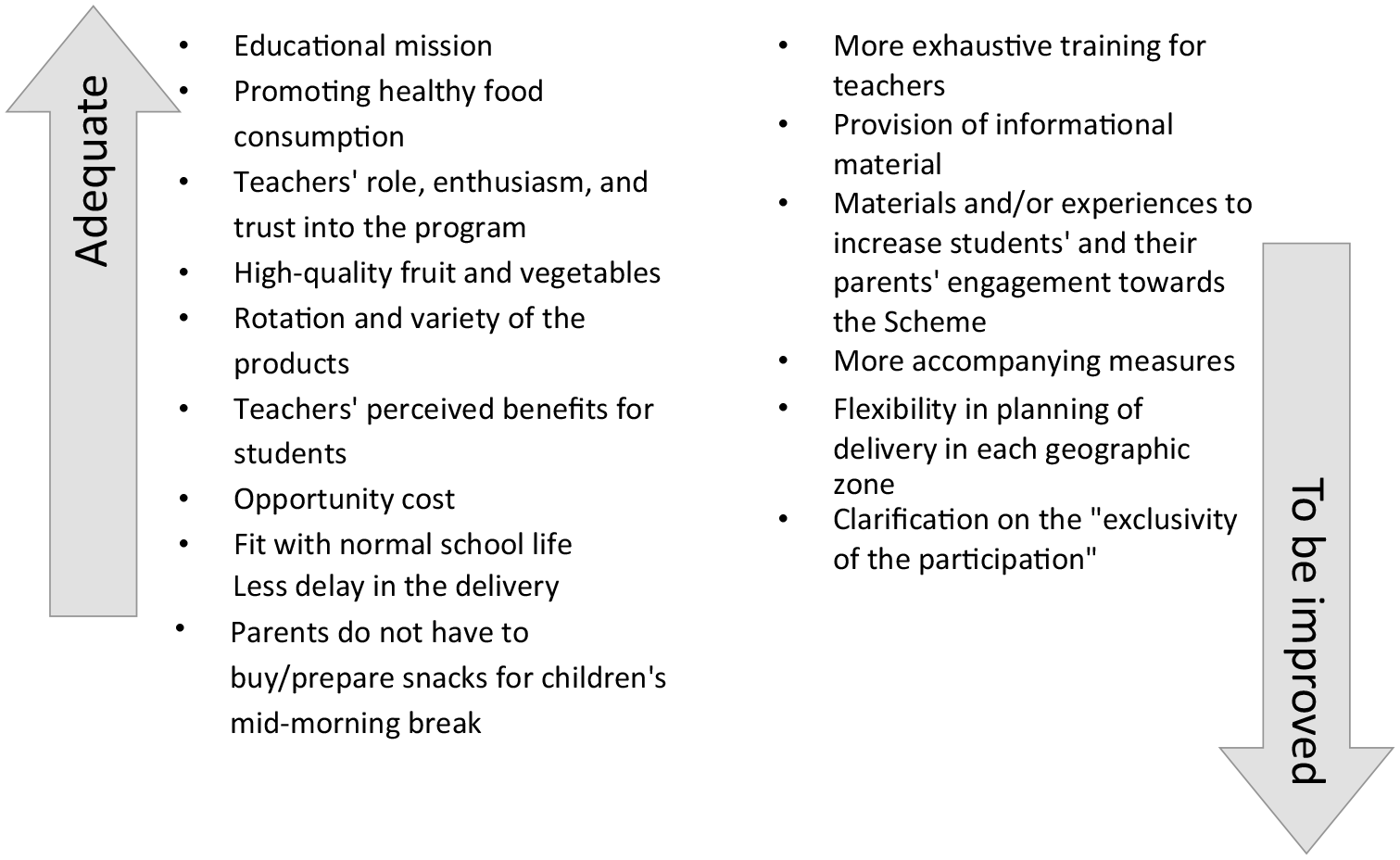
Barriers and facilitators of the School Fruit and Vegetable Scheme, as identified by the analysis.
First, as teachers’ inner motivation and enthusiasm are key to the successful implementation of a Scheme such as this, they should not be unduly burdened by what is required of them. Findings show that teachers would have benefitted from more comprehensive training and support in the delivery of the programme alongside support to other school staff, in line with findings from Roccaldo et al. (2017). Previous research has shown that educating teachers about a new intervention through activities such as workshops, is key to ensuring teachers’ ownership of the intervention as well as its success in the long term (Cirillo and Morra, 2018; Jørgensen et al., 2014). In this study, providing additional details about days of delivery, types of products, and the origin of the fruit and vegetables might have helped teachers explain to students what they are eating and where it comes from.
In addition, teachers and schools would have benefitted from the receipt of more informational material, especially digital content, to promote the Scheme to children and families. According to teachers, parents and/or families are not always aware of the importance of healthy nutrition for their children, so it is essential to provide them with materials to promote awareness about this. As previous studies have shown, when parents are aware of these issues, they can help the implementation and impact of a programme (Knapp et al., 2019). In addition, parents themselves could become a secondary target group for the Scheme, improving their own eating habits, as well as those of the whole family (Chen et al., 2014). An increasing number of school-based initiatives to prevent childhood obesity are targeted at children but also involve parents and families since they are an integral part of children’s learning environment (Lindsay et al., 2006).
In line with previous studies, results from this study show that delays in the delivery time or lack of delivery of fruit and vegetables acted as a key barrier to the implementation of the Scheme (Aarestrup et al., 2014; Bouck et al., 2011; Potter et al., 2011). Previous literature has identified the location of the school as relevant in this respect, as more distant schools were problematic for distributors to reach (Aarestrup et al., 2014; Bateman et al., 2014; Carbone et al., 2016; Knapp et al., 2019). As schools in different regions and geographic areas are characterised by different logistic arrangements and procurement costs, the Scheme should provide more flexibility to suppliers in regard to planning the delivery.
Finally, promoting the exclusivity of the Scheme participation may facilitate its implementation and support its educational role.
Limitations and Conclusions
This study is not without its limitations. First, the research was conducted in two schools which although they were located in different regions of Italy, shared many similarities. Thus, this did not provide the diversity of responses that might have been observed had we analysed barriers and facilitators in a wider range of schools. Moreover, the reported results came from the same group of stakeholders in each school, namely teachers. Had we accessed the views of other stakeholders such as school principals, support staff, students and parents, different findings might have emerged.
It is important to recognise that data for this study were collected during the COVID-19 pandemic, which was a challenging time for schools overall and for participants in the Scheme in particular. The pandemic not only posed unique challenges to the implementation of the Scheme but also limited possibilities for a more diverse recruitment of participants. Future research might investigate other stakeholders’ opinions to provide a broader picture of strengths and weaknesses. Finally, our research aimed to provide an overview of various barriers and facilitators to the implementation of the Scheme, rather than identify which were the most important factors impacting implementation. A quantitative approach eliciting evidence from a larger sample might be a good direction to pursue in future research of this kind.
Conclusion
In conclusion, the present study highlighted some of the strengths and weaknesses of the European School Fruit and Vegetable Scheme implementation in its current formulation in two elementary schools in Italy. To the best of our knowledge, this is the first attempt by academic study to analyse the implementation of such an initiative in Italy, discuss its policy implications and provide recommendations for its improvement.
Supplemental Material
sj-docx-1-hej-10.1177_00178969231210933 – Supplemental material for Teachers’ perspectives on the EU Fruit and Vegetable Scheme implementation in Italy
Supplemental material, sj-docx-1-hej-10.1177_00178969231210933 for Teachers’ perspectives on the EU Fruit and Vegetable Scheme implementation in Italy by Veronica Vitali, Giulia Tiboldo, Elena Castellari and Biljana Meshkovska in Health Education Journal
Supplemental Material
sj-docx-2-hej-10.1177_00178969231210933 – Supplemental material for Teachers’ perspectives on the EU Fruit and Vegetable Scheme implementation in Italy
Supplemental material, sj-docx-2-hej-10.1177_00178969231210933 for Teachers’ perspectives on the EU Fruit and Vegetable Scheme implementation in Italy by Veronica Vitali, Giulia Tiboldo, Elena Castellari and Biljana Meshkovska in Health Education Journal
Footnotes
Acknowledgements
We would like to express our sincere gratitude to all the teachers who participated in this study for their time and willingness to share their experiences. Their contributions have been invaluable in helping us to understand the topic and draw meaningful conclusions.
Funding
The author(s) disclosed receipt of the following financial support for the research, authorship, and/or publication of this article: The PEN project ( ) is funded by the Joint Programming Initiative “A Healthy Diet for a Healthy Life” (JPI HDHL), a research and innovation initiative of EU member states and associated countries. The funding agencies supporting this work are, in Italy, the Ministry of Education, University and Research (MIUR); and, in Norway, The Research Council of Norway (RCN).
Supplemental material
Supplemental material for this article is available online.
Notes
References
Supplementary Material
Please find the following supplemental material available below.
For Open Access articles published under a Creative Commons License, all supplemental material carries the same license as the article it is associated with.
For non-Open Access articles published, all supplemental material carries a non-exclusive license, and permission requests for re-use of supplemental material or any part of supplemental material shall be sent directly to the copyright owner as specified in the copyright notice associated with the article.
