




Abstract
Background:
Rates of physical inactivity and obesity among children, including those in Israel, continue to rise. While childhood is recognised as a crucial stage for developing lifelong physical activity (PA) habits, the extent to which the school environment and individual pupil characteristics are associated with leisure-time physical activity (LTPA) is not yet well understood.
Objective:
This study aimed to explore which characteristics of pupils and elementary schools in Israel were associated with the frequency of pupils’ LTPA.
Methods:
This cross-sectional survey included 1,398 pupils (aged 10–12 years) and 134 parents across 29 schools. Fourteen of them were Health Promoting Schools (HPS), representing Jewish secular, Jewish religious and Arab populations across Israel. The survey questionnaire examined pupils’ LTPA and potential related factors, including school population group, school climate, school health policies, parental involvement and the integration of PA into school routines. Data were also collected on pupils’ socioeconomic background, gender and school’s recognition as an HPS.
Results:
LTPA was significantly associated with pupils’ engagement in school sports activities (p < .001) and a positive school climate (p < .001). Boys engaged in significantly more LTPA than girls (p < .001). However, socioeconomic status, school affiliation with the HPS initiative and population group were not significantly associated with LTPA.
Conclusion:
Integrating sports activities into everyday school routines, fostering positive school climates and considering gender differences are essential factors for enhancing LTPA among elementary school pupils. Furthermore, being an HPS, having high socioeconomic status and implementing health-promotion policies in the school do not necessarily guarantee higher frequency of LTPA among pupils.
Introduction
Childhood is a critical period for establishing behaviours that influence later life health behaviours, including Physical Activity (PA). Regular PA has been widely recognised for its significant benefits, such as improving physical fitness, mental health, cognitive performance and social well-being (Bailey et al., 2013; Janssen and LeBlanc, 2010). Despite these advantages, rates of physical inactivity and childhood obesity are rising globally, including in Israel, posing significant public health challenges (Tremblay et al., 2014; World Health Organization (WHO), 2021). In 2020, approximately 26% of Israeli children were classified as overweight or obese, emphasising the need for interventions targeting this age group (Ministry of Health (Israel), 2020; n.d.). Schools provide a key environment for addressing this issue given the substantial amount of time children spend in these settings and their unique role in shaping behaviours and attitudes (Gortmaker et al., 2012; Ridgers et al., 2012).
The World Health Organization (WHO) has identified schools as key settings for promoting PA among children. The Health Promoting Schools (HPS), developed by WHO (2018), emphasises a holistic approach to health promotion by integrating health education into the curriculum, creating supportive environments, engaging families and communities and implementing school policies that encourage healthy behaviours. In Israel, the Ministry of Education has adopted many of these principles in its school-based health-promotion programmes, which aim to enhance pupils’ PA habits. Schools participating in the HPS are required to develop comprehensive programmes, appoint health leaders and train staff to ensure programme sustainability (Israeli Ministry of Education, 2020; Langford et al., 2014). However, research suggests that while the HPS framework provides a structured model, its impact on pupil’s health behaviours, particularly PA, remains unclear (Beck et al., 2021).
While HPS membership provides a structured framework, many schools in Israel implement health-promotion initiatives independently. These initiatives include extracurricular sports programmes, sports days and other PA-promoting events that engage pupils beyond regular physical education classes. Research demonstrates that schools with clearly defined policies and adequate resources dedicated to PA are more likely to positively influence pupils’ LTPA habits (Hayek et al., 2017; Sallis et al., 2015). The extent to which these initiatives translate into sustained PA outside school hours depends on other various factors, including school climate, teacher-pupil relationships, parental involvement and the integration of PA into the broader school culture (Cohen et al., 2019; Denny et al., 2011; Quitério, 2013).
School climate may particularly be significant in promoting PA. A positive school environment, characterised by supportive relationships between pupils and teachers, a sense of safety and an inclusive atmosphere, has been shown to influence pupils’ overall well-being and willingness to engage in PAs (Deschesnes et al., 2003; Haug et al., 2010). Moreover, schools that actively involve parents in health-promotion efforts tend to achieve better outcomes, as parental attitudes and behaviours impact children’s leisure-time activities (Oppenheimer et al., 2015). Parental contributions to school programmes, especially those with health-related expertise, reinforce the importance of PA and healthy living at home. Furthermore, teachers, often regarded by pupils as ‘experts’ in health topics, have a crucial role to play in modelling healthy behaviours and encouraging pupil participation in PA programmes (Langford et al., 2017; Schnohr et al., 2008).
Despite these insights, there remains a gap in understanding the specific characteristics of elementary schools in Israel that are most strongly associated with LTPA among pupils. While previous studies have explored the impact of health-promotion policies and programmes on pupil behaviour, few have examined the combined influence of school climate and initiatives and parental involvement on PA outside school hours. In addition, variation in health-promoting efforts in schools affiliated with the HPS and those not but implementing independent initiatives has not been comprehensively analysed (Czerwinski et al., 2015; Global School Health Survey, 2019; Hayek et al., 2017). The findings of Beck et al. (2021) reinforce the need for a more tailored and integrated approach to school-based PA interventions, as their study indicates that merely being an HPS does not automatically lead to increased PA levels among pupils.
This study seeks to address these gaps by investigating schools’ characteristics that are associated with pupils’ LTPA. By examining factors such as extracurricular sports programmes, school climate, teacher-pupil interactions, parental involvement and the implementation of health-promotion policies, the research aimed to identify key determinants that facilitate or hinder pupils’ engagement in PA outside school hours.
Methods
This study used a quantitative, cross-sectional research design and data from pupils and parents to examine the association between school characteristics, individual pupil background, and LTPA among elementary school pupils.
Sampling of schools and pupils
Eligible participants were identified using lists of elementary schools provided by the Ministry of Education and the Ministry of Health, distinguishing schools recognised as HPS from those that were not so recognised. Both HPS and non-HPS were divided based on population group affiliation: Jewish secular, Jewish religious and Arab.
In a second stage of sampling, using multi-stage cluster stratified random sampling, 60 HPS and 60 non-HPS schools were selected to ensure representative distribution (20 from each population group). Ultimately, 29 (18 Jewish secular, 5 Jewish religious and 6 Arab) of the 120 sampled schools agreed to participate, achieving a response rate of 24%, covering all seven geographical districts in Israel. Of these schools, 14 were HPS, and 15 of them were not.
Within each participating school, two classes (one fourth grade [typical age 9–10 years] and one sixth grade [typical age 11–12 years]) were randomly selected. An email was sent to all parents in advance, explaining the study and informing them about their child’s participation. Parents who wished to decline participation could do so by replying to the email. All pupils who were present in these classes on the day of the survey and whose parents had not declined participation were asked to complete questionnaires, resulting in a total of 1,398 participants.
Parents of the selected pupils in these classes were also asked to participate, and 133 parents consented and completed questionnaires. The parents’ responses were not linked to their children’s responses to maintain anonymity.
Ethical approval
The study received approval from the Israeli Ministry of Education research committee (reference number 13337) and the research ethics committee of the University of Haifa (reference number 319/23).
Data collection
Data were collected using validated, self-administered anonymous questionnaires, one for pupils and another for parents. Both questionnaires could be completed via a mobile device or on a computer. The questions were initially developed in Hebrew and then translated into Arabic and back translated to ensure correct translation. Each questionnaire took approximately 40 minutes to complete.
The design of these questionnaires was informed by findings from previous research on factors contributing to the development of HPS using Fullan’s triple change model (Zak Yehuda and Baron-Epel, 2024) and sources that used questionnaires on similar topics to examine related issues. These sources included the Health Programme of the Ministry of Education and the Ministry of Health in Israel (Beck et al., 2018; Israeli Ministry of Education, 2020), the Health Behaviour in School-aged Children (HBSC) questionnaire in Israel for the year 2018 (Harel-Fisch et al., 2023) and Director General’s Circular on Nutrition in Educational Institutions (Israeli Ministry of Education, 2020). A feasibility check was conducted in one school to assess the clarity of the questionnaire before proceeding with the remaining schools. Following that, we made minor adjustments to the questionnaire, such as deleting unnecessary answer options and simplifying the language used.
The first author then visited each of the schools and explained the aims of the study to the pupils. She then administered the questionnaires in one of two ways, according to the school’s preference: In some classrooms, the students used their personal mobile phones to scan a barcode that linked them to the questionnaire, and in other classrooms, the questionnaire was embedded in the school’s computers, and the pupils were invited to complete it there.
The parent questionnaire was distributed via email by the school to all parents who had consented to their children’s participation in the study, in the sampled classes. The questionnaires for pupils and parents were similar in content, with responses reflecting the perspectives of both parents and pupils on the topics addressed. A copy of the questionnaire is available from the corresponding authors of this paper on request.
Variables
Dependent variable
Leisure-time physical activity (LTPA) was assessed by asking pupils to indicate how frequently during the week they engaged in PA such as running, brisk walking, cycling, dancing, swimming, tennis, basketball, or soccer, for at least 60 minutes per day during their free time (details available upon request). We adopted the established standard question regarding LTPA (HBSC; Harel-Fisch et al., 2023) but modified the response scale to better suit the context of our study. Response options were scored: ‘Not at all or once a week’ = 1, ‘Two days a week’ = 2, ‘Three days a week’ = 3 and ‘Four days a week or more’ = 4. This adaptation maintained the core aspects of the original measure while simplifying responses for clearer interpretation in our analysis.
Independent variables
Pupil-level independent variables as reported by pupils were as follows.
Gender: Male or Female.
Grade: Fourth or Sixth grade
Socioeconomic level: using the Family Affluence Scale – FAS index related to pupils (Schnohr et al., 2008). This is composed of the sum of the following variables: family ownership of a car; whether pupils have their own room; the number of vacations the family took in the past year and the number of computers in the household. The total score is recorded as a binary: below average and above average socioeconomic level. Dichotomous (1 = lower than average, 2 = higher than average). (additional details of the scale available upon request to the corresponding author).
Parent-level variables as reported by parents
Socioeconomic level as reported by parents was calculated as the sum of parent’s education level and family household income (National Centre for Education Statistics (NCES), 2022).
Education level was a categorical variable that classified parents according to their highest level of formal education and was used to create a binary scale: low (high school and Bachelor’s degree = 1) and high (Master’s degree or above = 2).
Household income categorised families into three income levels: more than 14,000 New Israeli Shekel (NIS), medium 11,800 NIS–14,000 NIS and low less than 11,800 NIS. This scale was reclassified into two levels: low (less than 11,800 NIS = 1) and high (more than 11,800 NIS = 2) (further details are available upon request to the corresponding author).
Additional study variables
Data on other variables were gathered through a series of questions administered to both pupils and parents:
Reported participation of pupils in sports activities in the school routine was assessed similarly to LTPA by asking respondents to indicate how frequently during the week they engaged in PA for at least 60 minutes per day during time in school. Response options were scored: ‘Not at all or once a week’ = 1, ‘Two days a week’ = 2, ‘Three days a week’ = 3 and ‘Four days a week or more’ = 4.
School Climate focused on different aspects of the pupils’ experience, such as their feelings of safety, attendance habits and whether they enjoyed attending school (The National Authority for Measurement and Evaluation in Education (RAMA), 2022). Respondents were asked to rate their agreement with five statements using a five-point scale, ranging from ‘Not at all’ = 1 to ‘Very much’ = 5. Reliability analysis confirmed good internal consistency.
Counselling provided by school staff regarding PA and nutrition was evaluated by whether pupils reported receiving guidance and information from school staff (teachers, health coordinators, principal) about healthy eating habits, such as consuming vegetables, fruit and whole grains and PA (HBSC; Harel-Fisch et al., 2023). Respondents were given three statements which were scored: ‘Yes’ = 1, ‘No’ = 2 and ‘Don’t know’ = 3.
To assess, parental involvement in health-promotion activities at school, including whether they conducted talks on health topics or took the initiative in leading health-related activities (HBSC; Harel-Fisch et al., 2023), respondents were given two statements with three response options that were scored: ‘Yes’ = 1, ‘No’ = 2 and ‘Don’t know’ = 3.
School health-promotion policy was assessed based on responses to nine statements regarding the prohibition of bringing sweets and sugared drinks, encouragement of water consumption, adherence to a ban on bringing allergens to school, the presence of a youth leadership group focused on health, ensuring a healthy breakfast and enforcement of dietary guidelines. Response options were scored: ‘Yes’ = 1, ‘No’ = 2 and ‘Don’t know’ = 3.
School-level variables
Lists of elementary schools provided by the Ministry of Education and the Ministry of Health were used to assess these variables. The accuracy of these lists was verified through consultation with school principals.
School population group included three types of schools within the Israeli education system: Jewish secular, Jewish religious and Arab.
HPS were schools recognised by the Ministry of Education as such.
Data analysis
A descriptive statistical analysis was conducted for each sample, focusing on key research variables. Analysis of variance (ANOVA) compared group means for each variable to identify statistically significant differences. In addition, ordinal logistic regression analysis was used to explore the relationship between identified factors – school sports activities, school climate, HPS affiliation, socioeconomic status (SES) and gender – and pupils’ weekly reported PA frequency during leisure time.
Results
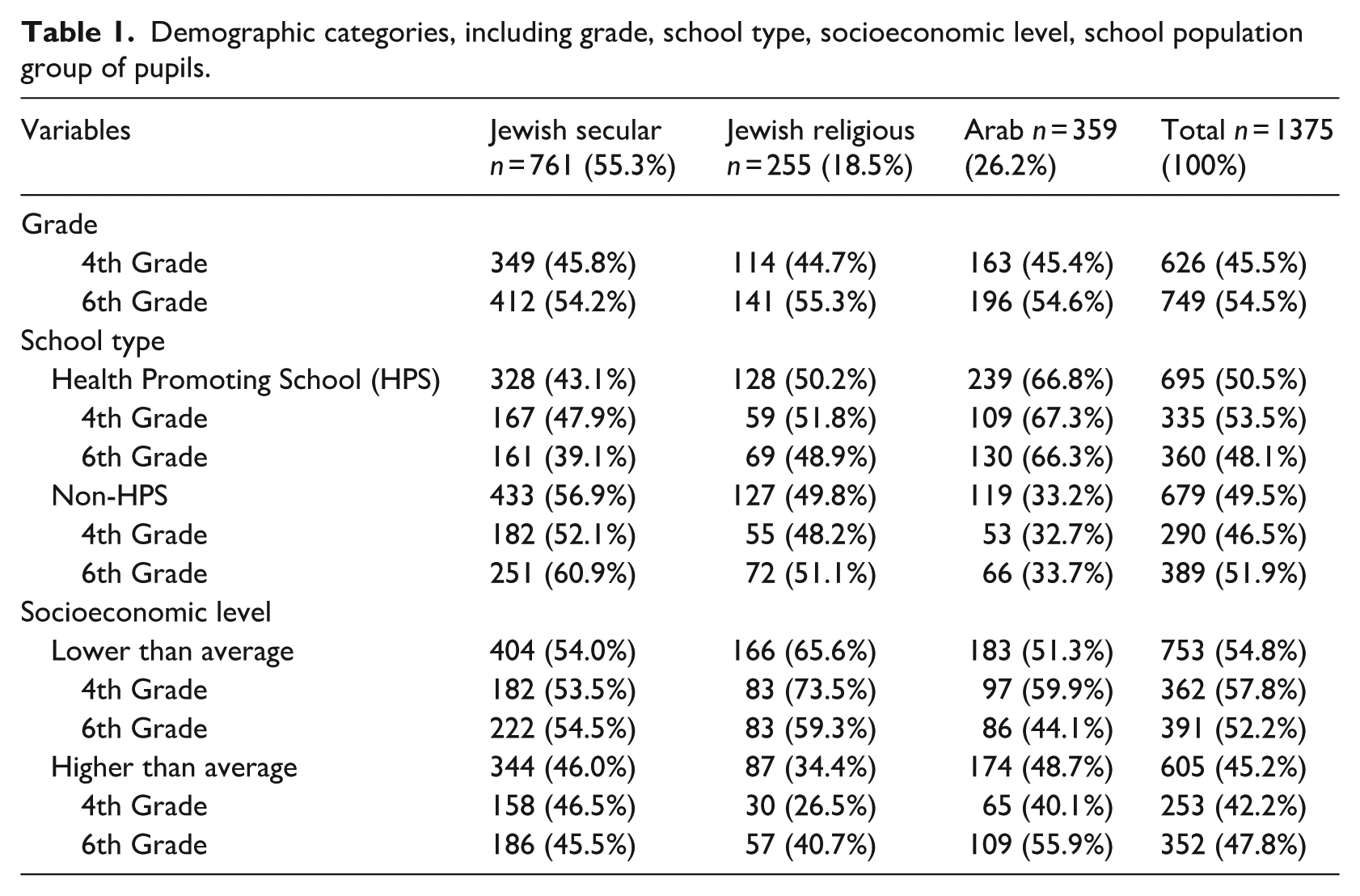
The results shown in Table 1 revealed that of the 1,375 pupils, 55.3% attended a Jewish secular school, 18.5% a Jewish religious school and 26.2% an Arab schools. Slightly more pupils were in sixth grade (54.5%) than in fourth grade (45.5%). Overall, 54.8% of pupils came from lower-than-average socioeconomic backgrounds, with Jewish religious schools’ pupils representing the highest proportion (65.6%) of lower socioeconomic backgrounds.
Demographic categories, including grade, school type, socioeconomic level, school population group of pupils.
Additional analysis presented in Table 2 indicated that of the 133 parents, 71.4% were Jewish secular, 11.3% Jewish religious and 17.3% Arab. Most (74.4%) had children in an HPS – 100% of Arab, 80.0% of Jewish secular and none of Jewish religious parents. Overall, 57.1% reported higher-than-average SES (highest among Jewish religious at 71.4%), while 69.2% of Arab parents reported lower-than-average SES.
Demographic categories, including school type, socioeconomic levels and school population group of parents.

As shown in Table 3, boys were significantly more active than girls, both at school (2.43 vs 2.21; p < .001) and during free time (2.82 vs 2.26; p < .001). No significant differences were observed between fourth and sixth graders. At school level, pupils attending HPS reported higher levels of school-based PA than pupils attending non-HPS (2.39 vs 2.22; p = .006) but no difference during leisure time. Jewish secular pupils reported higher levels of school-based PA (2.37) than Jewish religious pupils (2.14; p = .036). Jewish secular (2.57) and Arab pupils (2.56) had a similar frequency of LTPA, both higher than that of Jewish religious students (2.34; p = .02).
Mean PA in school routine and during leisure time by pupil- and school-level characteristics (independent samples t-test).
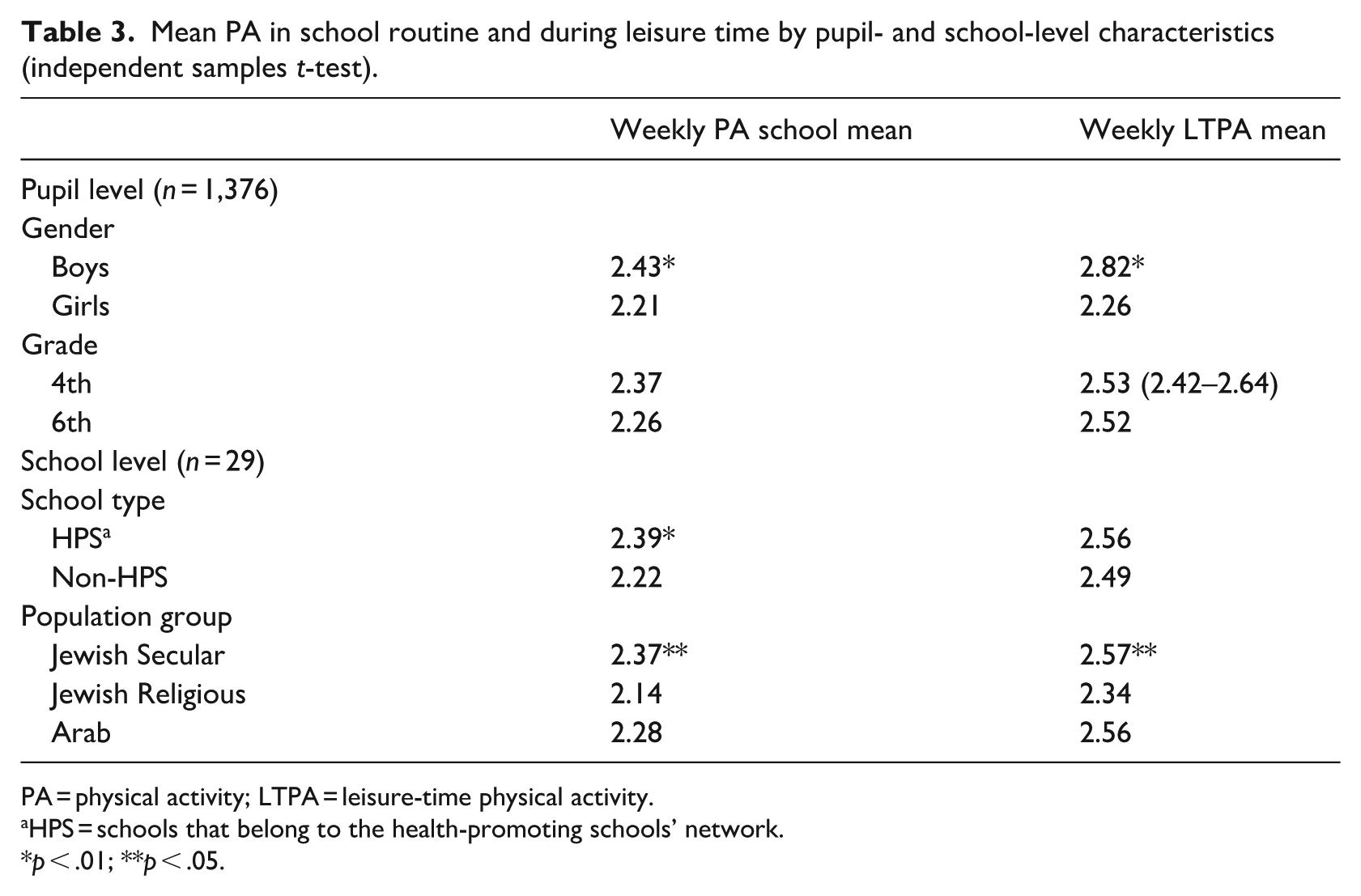
PA = physical activity; LTPA = leisure-time physical activity.
aHPS = schools that belong to the health-promoting schools’ network.
p < .01; **p < .05.
Data in Table 4 indicate that sports activities during school showed the strongest positive correlation with pupils’ LTPA (r = .413, p < .001), especially for fourth graders (r = .469 vs sixth graders r = .368). Positive school climate correlated with pupils’ PA (r = .127, p < .001), notably in fourth graders (r = .163). Staff counselling about PA showed a modest but significant correlation with LTPA (r = .092, p = .015), mainly among sixth graders (r = .114, p = .027), and stronger among parents (r = .329, p = .01). Parental involvement and formal health policies showed weak, nonsignificant correlations with LTPA.
Correlation between school health-promotion characteristics and pupils’ LTPA reported by parents and pupils (Pearson’s correlation).

LTPA = leisure-time physical activity.
p < .01; **p < .05.
Variables for the ordinal logistic regression were selected based on prior results with relevance to LTPA. The ordinal logistic regression model was significant and had good fit (Pearson χ² (1477) = 1530.30, p = .163; Deviance χ²(1477) = 1466.65, p = .571). Sports activities were strongly associated with more LTPA (estimate = 0.906, p < .001). School climate also positively predicted PA (estimate = 0.228, p < .001), while gender was negatively associated, indicating girls were less active (estimate = −0.833, p < .001). SES, population group and HPS affiliation were nonsignificant.
To further examine the potential contribution of random effects, a series of multilevel models were used to identify which variables significantly predicted LTPA. The models examined the effects such as population group, HPS affiliation, gender, school climate and the interactions between these variables.
For each combination, models were tested in four ways:
Each variable on its own
Both variables together
Including an interaction term
Excluding the interaction term
The multilevel analysis showed very low intraclass correlation coefficients (ICCs), indicating that only a very small proportion of variance in PA was attributable to differences between schools, while the majority of variance was explained by individual-level factors. As the degree of clustering was negligible, multilevel regression modelling was not warranted, and analyses were conducted using a single-level regression model (Table 5).
Variables associated with LTPA in ordinal logistic regression analysis (n = 1,376 pupils).

HPS = Health Promoting Schools; LTPA = leisure-time physical activity.
Discussion
Childhood is a crucial period for establishing lifelong PA habits, and schools offer an ideal environment for promoting these behaviours due to the significant amount of time children spend in them. This study explored the relationship between school health-promotion characteristics, pupils’ backgrounds and LTPA among elementary school children in Israel, incorporating both pupil and parent perspectives. The findings highlight the substantial role of embedding sports activities into the school routine and cultivating a positive school climate as key determinants of increased LTPA. These influences persisted irrespective of the pupil’s SES or formal affiliation of the school with the HPS initiative.
Our results suggest that structured sports activities embedded in the daily school routine play a meaningful role in encouraging pupils to be physically active beyond school hours. Pupils who regularly engaged in PA during school were more likely to report higher frequency of LTPA. This aligns with previous literature indicating that integrating PA into the school day, not just during physical education classes, helps develop motor competence, enjoyment and motivation, all of which are known to promote sustained PA after school (Bailey, 2006; Quitério, 2013; Sallis et al., 2015).
While both pupils and parents recognised the value of school-based sports activities, parents reported a weaker connection between school and LTPA. This may be due to parents having limited insight into the daily school environment or underestimating the motivational effect that enjoyable, school-led PA can have on their children.
Fostering a positive school climate, attending to pupils’ well-being and ensuring that pupils perceive their school as a positive and safe environment have been demonstrated to support academic achievement, physical health and the effective implementation of health-promoting activities (Konu and Rimpelä, 2002; Lenz et al., 2021; Tesler and Baron-Epel, 2016; Thapa et al., 2013). Our study reinforces these findings, but in addition, it shows that positive school climate is not only beneficial for overall well-being but is also directly associated with increased frequency of LTPA among pupils.
In this study, pupils who reported feeling safe, cared for by their teachers and happy to come to school were more likely to also report higher frequency of LTPA. This association may be explained by the self-determination theory, with evidence suggesting that environments that fulfil pupils’ basic psychological needs – autonomy and competence – can promote intrinsic motivation towards PA (Bailey, 2006; Sallis et al., 2015).
Our findings regarding gender disparities, with boys consistently exhibiting higher LTPA than girls, align with previous research indicating that gender is a strong and consistent predictor of PA among children (Nilsen et al., 2023). These disparities are evident both in the school setting and beyond, and are likely shaped by a complex interplay of biological, social and cultural factors. Research suggests that boys and girls differ in physical development, motor competence and hormonal factors, which may contribute to their engagement and preferences in PA. For example, boys generally exhibit higher levels of muscle mass and aerobic capacity at earlier developmental stages, which may naturally lead to more vigorous activity patterns (Janssen and LeBlanc, 2010; Trost and Loprinzi, 2008). Gender norms and stereotypes regarding PA, such as the perception that sports are more appropriate for boys than for girls, can influence children’s interests and willingness to participate in PA (Bailey, 2006; WHO, 2018). These stereotypes are often reproduced in school cultures and teacher expectations. As a result, girls may experience reduced encouragement or fewer opportunities to engage in PA, especially in environments where traditional gender roles are more deeply entrenched.
Our study’s focus on diverse groups in Israel revealed that these gender disparities are more pronounced in certain communities, such as within religious Jewish populations. Cultural values, modesty norms and restricted access to gender-appropriate sports facilities may further limit girls’ leisure-time PA in these contexts, aligning with international evidence that gender disparities in PA are greater in conservative cultural settings (Langford et al., 2014; WHO, 2021). Given this evidence, there is a clear need for gender-sensitive interventions that are both age-appropriate and culturally tailored. Schools should aim to create inclusive and supportive environments that address girls’ specific needs and preferences, such as offering a wider variety of activities that appeal to girls and young women, providing female role models in sports, ensuring access to single-gender spaces when needed and actively challenging gender stereotypes in the school culture.
Importantly, in this study, affiliation with the HPS initiative alone was not significantly associated with an enhancement in pupils’ LTPA; this finding aligns with those in previous research (Hayek et al., 2019; Mũkoma and Flisher et al., 2004) and points to the importance of implementation of specific content rather than formal recognition. Schools may achieve better outcomes through adaptable, participatory and appropriate PA programmes rather than relying solely on standard frameworks. Ongoing evaluation and adaptation of school programmes is thus essential, even within formally recognised HPS institutions.
In this study, we found a minimal association between SES and pupils’ LTPA. While SES is often considered a determinant of health-related behaviour, including PA, its relationship to LTPA in children is not consistently supported by the literature. Children from lower SES backgrounds may face several structural barriers to LTPA, such as limited access to safe outdoor spaces, recreational facilities, organised sports or parental support and supervision during after-school hours (Brooks-Gunn and Duncan, 1997; Duncan et al., 1998). These factors can hinder their ability to engage in regular PA outside of school hours.
However, the lack of a significant association between SES and pupils’ LTPA in our findings suggests that when schools provide accessible and inclusive PA experiences during school hours, these may help compensate for those disparities, influencing children’s willingness and ability to be active in their free time. When schools offer structured sports activities, maintain a positive climate and provide supportive staff engagement, they help cultivate intrinsic motivation, physical competence and favourable attitudes towards PA, factors that are shown to promote children’s engagement in LTPA beyond school hours (Bailey, 2006; Quitério, 2013; Sallis et al., 2015).
Supporting this, a systematic review by Stalsberg and Pedersen (2010) reported that 42% of studies found no association between SES and PA in children, particularly in contexts where access to school-based PA was equitable. Together, these studies suggest that school-related environmental and institutional factors, such as school policies and climate, may be associated with variations in leisure-time PA beyond socioeconomic differences (Beck et al., 2021; St Leger, 2001).
Strengths and limitations
Our study was characterised by a diverse sample, incorporating schools from distinct population groups, as well as both HPS and non-HPS schools. As a result, the study was able to capture a wide range of cultural, educational and socioeconomic factors. By including both pupil and parent perspectives, it provides depth to the interpretation of LTPA behaviours and the role of school-based influences in different communities.
Like all research, however, the study had its weaknesses. Because the LTPA item combined the ‘not at all’ and the ‘once a week’ option into a single response option and defined ‘four days a week or more’ as a single upper category, it cannot distinguish between completely inactive pupils and those active only once a week, nor between pupils active 4 days versus every day. Consequently, our outcome should be interpreted as representing broad frequency categories of LTPA rather than detailed dose response levels. This likely led to nondifferential misclassification within the lowest and highest categories and may have biased some associations towards the null, suggesting that our findings offer conservative estimates of the true relationships.
Reliance on self-reported measures for PA and other variables may also have introduced social desirability effects and/or recall inaccuracies, potentially affecting the validity of the findings. Future research should consider the use of more objective measures, such as accelerometers, for improved accuracy. Parent participation in our study was notably low, and this limited parental engagement reduces our ability to draw robust conclusions regarding parents’ influence on children’s PA during leisure time.
Finally, only 24% of the schools initially approached agreed to participate, potentially introducing selection bias, as schools willing to take part in health-promotion research likely differ systematically from those who decline.
Conclusion
This study has highlighted the important role that elementary schools can play in shaping LTPA among pupils. The school-related factors examined in this study, including the integration of regular PA into the school routine and aspects of school climate, were associated with differences in pupils’ LTPA. In contrast, affiliation with the HPS initiative and pupil SES had no significant influence on LTPA. Although limited by its reliance on self-report data, the research provides insights for educators to develop targeted, inclusive and more effective strategies to promote PA among elementary school pupils in leisure time. The findings suggest that structured sports programmes, aspects of the school environment and gender differences are relevant factors to consider in relation to pupils’ PA. Each of these areas warrant further examination in future research. Future research might also focus on developing and examining school-based PA strategies tailored to different population groups (e.g. pupils attending Arab, secular and religious schools), in order to better understand how contextual and cultural characteristics influence pupils’ PA behaviours.
