




Abstract
Objective:
Dating and relationship violence (DRV) and gender-based violence (GBV) are reported to be common among adolescents internationally and can have significant adverse long-term consequences, including widening gender inequalities in health outcomes. There is evidence that while school-based curriculum programmes can be effective in preventing DRV, whole-school elements such as student/staff action groups are important for preventing GBV. However, the processes of implementing whole-school components may be challenging in schools with limited capacity. We designed THINK AGAIN, a multi-component programme aiming to prevent DRV and GBV in English secondary schools.
Design:
Non-controlled feasibility study of THINK AGAIN.
Setting:
State secondary schools in south-east England. The programme targeted all students in year 9 (aged 13–14) in participating schools.
Method:
We recruited four schools to assess the feasibility and acceptability of THINK AGAIN in the 2024–25 school year. Our embedded process evaluation assessed programme feasibility, processes of implementation and how context influenced these. We conducted 16 interviews with school staff and analysed the data informed by the General Theory of Implementation.
Results:
We found that the curriculum component was feasible and prioritised for delivery by schools. However, the whole-school component faced challenges to implementation in terms of both workability and context.
Conclusion:
Study findings support the progression of THINK AGAIN to a phase III trial of effectiveness, pending full assessment of progression criteria and important refinements to the whole-school component.
Keywords
Introduction
Dating and relationship violence (DRV) is intimate partner violence involving young people, including actual or threatened physical, sexual or emotional violence (Barter and Stanley, 2016). Gender-based violence (GBV) is physical, sexual or emotional violence rooted in gender or sexuality inequalities, within and/or outside of dating/relationships, including harassment or bullying on the basis of gender or sexuality, and sexual violence, coercion or assault including rape (Russo and Pirlott, 2006).
DRV and GBV are reported to be common among adolescents internationally (Centers for Disease Control and Prevention, 2024; Leen et al., 2013; Wincentak et al., 2017; Young et al., 2021). The most common reported form of DRV is emotional, followed by physical and sexual DRV (Leen et al., 2013). Although girls and boys report similar levels of emotional and physical DRV victimisation, girls are significantly more likely to report experiencing sexual DRV (Meiksin et al., 2018; Barter, 2015). Young people report that GBV, including homophobic and transphobic bullying, is common in UK schools (Girlguiding, 2021; Ofsted, 2021).
DRV and GBV can have significant consequences for adolescents’ and young people’s health and wellbeing and worsen health inequalities (Barter et al., 2017; Reidy et al., 2016; Wado et al., 2021). Girls experiencing DRV are more likely subsequently to report psychological distress, fear and post-traumatic stress (Bentivegna and Patalay, 2022; Hébert et al., 2017). Longitudinal research finds associations between experiencing sexual violence before the age of 17 and later self-harm and attempted suicide (Bentivegna and Patalay, 2022). GBV is also associated with increases in risky sexual behaviour, substance use and depressive symptoms among victims and perpetrators (Barter and Stanley, 2016; Fellmeth et al., 2013; Johns, 2018; Shorey et al., 2015). Adolescent perpetration and victimisation of DRV and GBV also predict adult perpetration and victimisation of domestic abuse (Costa et al., 2015; Park et al., 2018; Vivolo-Kantor et al., 2016).
DRV and GBV share risk factors for perpetration, including exposure to sexist or heterosexist gender norms and inadequate or inconsistent school policies to prevent violence (Exner-Cortens et al., 2013, 2017; Melendez-Torres et al., 2024b). Gender and sexuality minority young people are more likely to experience physical and sexual DRV and homophobic and transphobic GBV (Johns, 2018; Martin-Storey et al., 2021; Mueller et al., 2015; Norris and Orchowski, 2020). Given these shared features, DRV and GBV may be amenable to prevention via similar mechanisms, so programmes might usefully address DRV and GBV jointly (Melendez-Torres et al., 2024b).
Schools offer a promising site for DRV and GBV prevention, offering a means to reach most adolescents and the potential to transform individual- and group-level determinants. School-based programmes have shown some effectiveness in preventing DRV and some, though more limited, effectiveness for preventing GBV (Farmer et al., 2023). A systematic review of school-based programmes found that preventing DRV can be achieved through curriculum programmes addressing knowledge, attitudes and skills, but preventing GBV requires whole-school actions addressing sexist and heterosexist norms (Farmer et al., 2023). Most studies of DRV or GBV programmes have been conducted in North America (Farmer et al., 2023). Evidence for programmes in Europe is more limited, and before large effectiveness trials can take place, the feasibility and acceptability of potential programmes need to be explored in these contexts.
Findings from Farmer et al.’s (2023) review also suggest that the implementation of DRV/GBV prevention in schools requires external support, an engaging curriculum and the opportunity to integrate programmes into school policies (Melendez-Torres et al., 2024b). Whole-school components are likely only feasible in well-resourced settings (Bonell et al., 2023). There is evidence that whole-school programmes to prevent violence require a supportive school culture, strong leadership and adequate school resources (Melendez-Torres et al., 2024b). May’s general theory of implementation provides a useful framework for understanding how complex programmes are implemented via the enactment of four interdependent processes: sense-making (whereby those involved in implementation come to understand the programme); cognitive participation (whereby those involved become committed to its delivery); collective action (through which those delivering the programme divide up responsibility for implementation, with some tasks carried out by groups and some by individuals) and reflexive monitoring (whereby those who are directly involved in delivery also assess delivery, informally or formally, as to how well it is going and recursively refine delivery accordingly).
The theory suggests these processes can be influenced by: programme capability (whether the programme is regarded as workable and has the potential to be integrated within local systems); local capacity (whether there are sufficient material and cognitive resources, relevant social roles and supportive social norms to enable implementation) and provider potential (whether those charged with delivery possess the individual intentions and collective commitments to see this through).
Evidence suggests that whole-school programmes can sometimes be challenging to deliver in English schools (Sundaram et al., 2023). The feasibility of Project Respect, a pilot trial of a DRV-prevention programme in English secondary schools, was undermined by limited school material resources and relevant social roles to deliver the intervention, which inhibited school leaders’ ability to ensure collective commitment to delivery because of competing priorities (Meiksin et al., 2020). Teaching staff also described a lack of motivation to deliver the programme because of negative assessments of its training and curriculum components.
Seven years on, English schools may now offer a more supportive environment for DRV/GBV prevention. In 2020, the ‘Everyone’s Invited’ (2024) initiative collected thousands of testimonies exposing high rates of sexual abuse and harassment in UK schools. In response, the national school inspectorate for England undertook a review of sexual abuse in schools and colleges, recommending schools take whole-school actions to prevent abuse and harassment (Ofsted, 2021). Also in 2020, relationships, sex and health education (RSHE) became a statutory requirement in English schools, requiring schools to address sexism, misogyny, homophobia, gender stereotypes and sexual harassment and violence as part of their everyday work (Department for Education, 2019).
THINK AGAIN is a programme that aims to prevent DRV and GBV. It includes an engaging curriculum to address knowledge, attitudes and skills. It includes whole-school elements to integrate programme activities into school policies and to promote equitable norms, with schools provided with external support to deliver these. In these regards, it is strongly informed by Farmer et al.’s (2023) review and aims to avoid the challenges encountered by Project Respect (Meiksin et al., 2020; Melendez-Torres et al., 2024a). A fuller description is provided below. The hope was that this learning, coupled with the now more auspicious context in which schools are required to address abuse and harassment, and statutory RSHE would facilitate better implementation. We conducted a non-controlled feasibility study to assess whether THINK AGAIN could be sufficiently well delivered to justify a larger subsequent study of its effectiveness. In this paper, we report on qualitative research with teachers conducted within the feasibility study to address the following research questions: was THINK AGAIN feasible to implement; what processes facilitated delivery and how were these affected by context?
Methods
Study design
We undertook a non-controlled feasibility study with process evaluation in four state secondary schools to assess the feasibility of implementing the THINK AGAIN programme in the 2024–25 school year. Here, we report on qualitative research with teachers examining implementation. Qualitative research with students and quantitative data are reported elsewhere (Hearing et al., in press). Full study details of the overall study are reported elsewhere (Melendez-Torres et al., 2024a).
The THINK AGAIN programme
The programme aims to engage with all students in year 9 (aged 13–14) in participating schools and involves the following components:
(a) a pupil experiences and engagement report (PEER), which presents collective, anonymised data from a baseline survey of students when they neared the end of year 8 the previous summer term, and which describes student needs to inform decisions about lesson selection and whole-school actions;
(b) an ‘action aware’ group (AAG), in which staff and students, guided by an advice within a manual, the PEER and an external facilitator from the Sex Education Forum (SEF) charity work together to choose lessons, decide and implement whole-school actions for DRV/GBV prevention, integrate these into school policies and undertake awareness-raising across the school;
(c) a curriculum menu comprising nine 45-minute lessons, from which schools choose a minimum of five, taught by teachers, focused on knowledge, de-normalising DRV and GBV and promoting prosocial relationship behaviours; and
(d) training provided by SEF to support curriculum teachers (half-day session) and AAG chairs.
The theory of change (ToC) underpinning this work, informed by the theory of planned behaviour, social cognitive theory and the theory of human functioning and school organisation (Ajzen, 1991; Bandura, 2001; Markham and Aveyard, 2003), postulates that DRV/GBV can be prevented by enhancing students’ knowledge and skills relating to DRV/GBV, involving students in decision-making and improving student-staff relationships to build students’ belonging, to promote anti-DRV/GBV norms and to support local relevance.
Recruitment
We sought to recruit four mixed-sex, state secondary schools with at least 100 students in year 8 located in south-east England within a 2-hour travel radius of the training facilitator’s location. A condition of the funding was that schools were located in a ‘violence reduction unit’, a government-funded programme in 18 areas most affected by violence in England and Wales. We excluded schools teaching in languages other than English; catering solely for pupils with special educational needs and disabilities or excluded from other schools and/or without a permanent headteacher. We employed a low-intensity, low-cost approach to recruitment because we sought wide geographical spread but only required four schools. We emailed the general administrative email addresses of 298 schools in south-east England in May–June 2024. 1 Seven expressed an interest and were given information about the programme and study. Members of their senior management teams met with a researcher to discuss participation and returned a signed memorandum of understanding and consent form.
Interviews aimed to involve four teachers in each school, purposively sampled in terms of them being involved in the programme, diversity of gender and school role. Staff were selected through discussion with the lead teacher for the programme.
Data collection
Participants were sent an information sheet two weeks before the interview and asked to provide consent on the day of the interview. Interviews were conducted via MS Teams or phone and lasted 20–40 minutes. Interviews were framed by topic guides enabling exploration of the implementation of the various programme components, the processes involved and the factors affecting these (Supplemental Materials, available from the corresponding author on request). They were conducted by one study researcher (FH) and audio-recorded. Data were transcribed, anonymised and stored securely on password-protected drives and files.
Data analysis
Qualitative data were analysed thematically with the aid of NVivo software (14.23.4). Coding commenced with in vivo inductive coding plus deductive coding informed by the research questions and the general theory of implementation (May, 2013). Axial coding identified higher-order linkages between these in vivo codes, to build an analysis of feasibility and processes and to identify how these are influenced by context. Axial coding used constant comparison and identified deviant cases to deepen the analysis. A qualitative analysis was conducted by one researcher (FH) and reviewed by a second researcher (CB) (Green and Thorogood, 2004).
Ethics
The study was approved by the London School of Hygiene and Tropical Medicine (LSHTM) Research Ethics Committee (Reference: 31187) and the University of Exeter College of Medicine and Health Research Ethics Committee (Reference: 5690846). Interview participants were sent an information sheet at least 2 weeks before data collection and were asked to sign consent to participate on the day of the interview. Interview participants were also asked to provide written signed consent for the study findings to be published anonymously.
Results
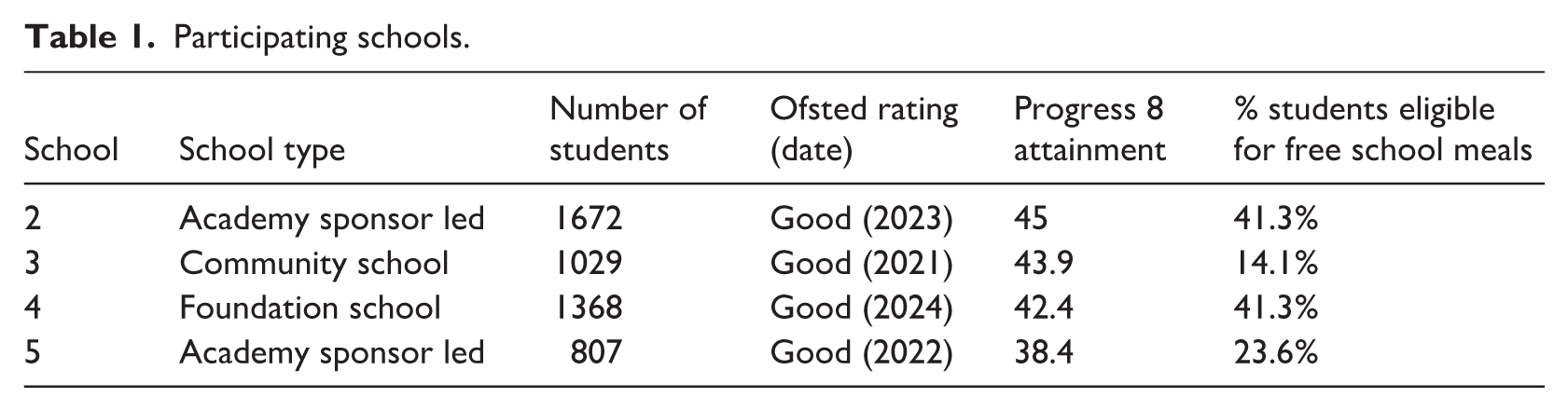
Table 1 provides a brief description of the four participating schools.
Participating schools.
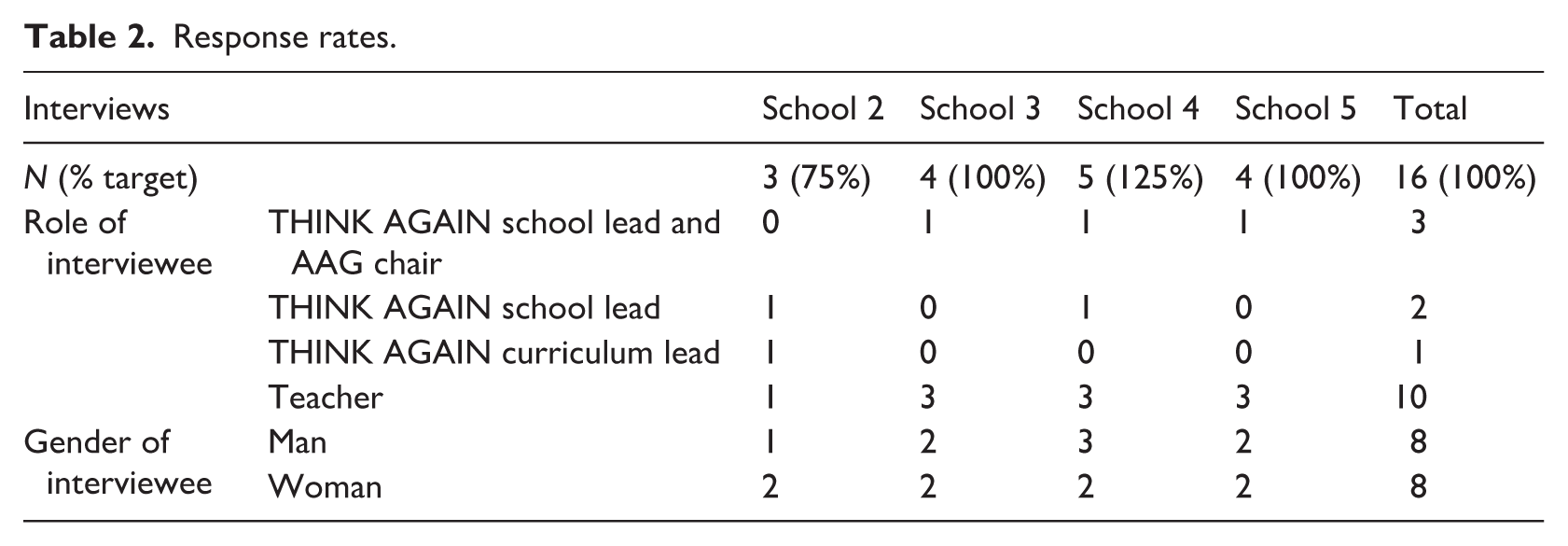
Across four schools between February and July 2025, we conducted 16 interviews with teachers performing various roles (Table 2).
Response rates.
Below, we describe the processes underlying THINK AGAIN implementation and the factors affecting these, structured according to the general theory of implementation (italicising terms to highlight where these align with constructs from this theory) (May, 2013).
Sense-making
The programme required that a member of staff be designated as each school’s lead for work. In three schools, this was the Head of RSHE or equivalent. In one school, the role was shared by two members of the pastoral team. In the summer term before programme delivery, Sex Education Forum (SEF) staff met with these school leads to help them understand the programme and communicate this understanding to their colleagues. Below, we consider how school staff made sense of the various programme components and the factors affecting this.
Curriculum
The training provided by SEF was said by those attending to be critical to their making sense of the curriculum: Being in the room, getting to ask questions, having a go at the tasks and having. . . half a day to go over everything. . . I found the training really valuable. (Teacher, school 3)
Training appeared to be most workable when delivered fully and in-person. In one school, the majority of RSHE teachers could not attend the full training due to lack of cover. SEF arranged a shorter, after-school online session, but participating teachers described feeling distracted, confused and unmotivated. One teacher who had attended the in-person training noticed differences in how teachers who only received the online training made sense of the curriculum: I don’t think [the online training] had the same impact. I think [those teachers] have struggled more to grasp and deliver, and have very much gone with their way of how they would teach it. (Teacher, school 3)
In another school, staffing changes meant that three new teachers were later asked to teach THINK AGAIN. Although SEF provided online catch-up training, the school lead explained that their late entry to the programme and training limited these teachers’ ability to make sense of the programme: If you’d received the training at the beginning, you were on that momentum, whereas [the new teachers] had to catch up. (School lead, school 5)
Action aware group
Sense-making of the AAG varied more between schools. The chair of the group, who in all schools was the school lead, had an important role to play in supporting wider sense-making among AAG members. School 5’s chair described SEF support as important for making sense of the PEER data on student needs: I definitely needed the [AAG] training to work my way around [the PEER]. . . It doesn’t always come naturally, seeing big chunks of numbers. (School lead and AAG chair, school 5)
School leads’ ability to understand the AAG as aiming to involve students in decision-making to transform the school environment was aided by early communication between SEF and the school leads: [The AAG chair] had a really clear idea from Sex Education Forum of what was involved and what it all meant. (Teacher, school 5)
In school 5, this understanding was aided by pre-existing social norms of student involvement: The head likes to call the school a ‘listening school’ [meaning] they actively take on board what the school community are telling them. (School lead/AAG chair, school 5)
In contrast, staff in school 4 recalled only understanding the student-led aspect of the AAG mid-way through the programme year, after meeting for a second time with SEF. This hindered this school’s ability to build cognitive participation and collective action: We could have asked somebody and we could have referred more to the booklets, but we were a little bit confused with what we were doing with [the AAG]. (School lead, school 4)
Sense-making was also affected by each chair’s existing capacity in terms of their experience leading initiatives: There probably was a lack of clarity for me, but I wonder if that’s because I was relatively inexperienced going into this. It was the first thing I was organising as . . . head of department. (School lead/AAG chair, school 3)
School leads/AAG chairs suggested that, especially for staff with less experience implementing such initiatives, greater guidance about facilitation and the workload involved would have improved sense-making: Telling people this stuff is going to need a little bit more organisation than it looks like it might initially need . . . might be helpful. (School lead/AAG chair, school 3)
Finally, two leads felt that simplifying the AAG training manual would have supported sense-making: [The manual] was so comprehensive but. . . you’ve got to chunk out a lot of time . . . It would be good if we had something where you just want a quick answer. (School lead, school 4)
Cognitive participation
School staff generally seemed invested in the aims of THINK AGAIN, reflecting individual and collective commitments to preventing DRV and GBV. However, buy-in varied by component.
Curriculum
School leads generally described feeling committed to implementing the curriculum. In the three schools where the lead’s social role encompassed RSHE, they encouraged buy-in among teachers: I want there to be consistency across the board for the pupils because it’s such an important subject. (School lead, school 5)
Most classroom teachers viewed THINK AGAIN primarily as a curriculum programme. Because of this, they cited their enthusiasm for RSHE in committing themselves to the programme: I enjoy RSHE because it gives me a break from the stuff I’ve been doing over again . . . And normally you’re not testing the kids, so there’s no exam pressure. (Teacher, school 5)
Some teachers described having an individual intention to deliver THINK AGAIN because of its potential to prevent DRV and GBV: I think it gives [students] a much better idea of. . . all the red flags that they need to look out for, in their own actions as well. (Teacher, school 5)
Other teachers cited broader issues of respect which, as one school lead explained, tended to be how such issues were approached by senior leaders:
Int: Are [RSHE] and preventing GBV/DRV a priority in school, particularly among senior leaders?
Yeah. Not specifically gender-based violence, but definitely the whole idea of respect . . . within that, we’re looking at sexism, homophobia, racism, etc. (School lead, school 5)
In contrast, other teachers were described by colleagues as having less buy-in because they were non-specialist staff, only being asked to teach our lessons as part of RSHE because of their availability: [Our RSHE teachers are] not enthusiastic . . . It’s a subject that they have had to take on because their timetable has not been completed by their primary subjects. And a lot of them are not that confident. (Curriculum lead, school 2)
Thus, teachers’ cognitive participation regarding THINK AGAIN lessons was shaped by how schools organised the staffing of RSHE lessons more generally and whether this resulted in a team of committed specialists or not.
Action aware group
Overall, there was lower cognitive participation for the AAG. Some teachers did express their support for an AAG, motivated by how they perceived it could benefit students: If they’ve had this really positive experience of being heard in a very professional way [through the AAG], that’s a brilliant life lesson for them. (Teacher, school 5)
However, buy-in was weakened by the demands of teachers’ wider social roles and the limited sense-making, often due to competing demands on their time, as described earlier. For example, school 4’s lead could not recruit an AAG chair: It’s not that [teachers] are not motivated, it’s just that because of their responsibilities, they might not give so much of themselves. (School lead, school 4)
Collective action
School leads were responsible for collective action to implement the programme, which encompassed both the work of individual teachers delegated to deliver the curriculum to their classes, as well as the collective work of the AAG.
Curriculum
In three schools, the school lead also coordinated the teaching of RSHE, which eased integration of the THINK AGAIN curriculum into school systems. In school 2, where the school leads did not coordinate RHSE teaching, the process of incorporating the THINK AGAIN lessons into the school’s broader RSHE curriculum proved lengthier. Participants’ accounts also suggested that the workability of the THINK AGAIN lessons also aided their integration within schools’ RSHE curricula: We felt that we had the time, and we hadn’t got onto [relationships education] within our own [RSHE] curriculum . . . They seemed to really flow and lead up to that final lesson. (School lead, school 5)
In schools 2 and 5, the selection of teachers for THINK AGAIN (as with RSHE more generally) was determined by availability. In contrast, school 3 deployed form tutors to teach THINK AGAIN lessons while school 4 employed a consistent team of young, motivated teachers whom the lead felt had the potential to deliver RSHE skilfully: We need [teachers] who are younger because they have a better way of talking to the kids. (School lead, school 4)
Teachers described their active engagement with delivering the lessons, putting the SEF training into practice and sometimes adapting the lessons to the work already being undertaken locally: I used the idea of [students] writing on the whiteboard and you walk around the room . . . That helped quite a bit. (Teacher, school 3)
Most teachers valued the lessons’ interactivity, which they often perceived as ‘new’ or ‘different’: Kids really struggle to sit still and listen, and the way that THINK AGAIN lessons are delivered involves them so much more than . . . before. (Teacher, school 5)
The THINK AGAIN curriculum was also seen as workable in the sense that the lesson plans provided all the information needed for delivery. This was especially important for less experienced teachers: [The lesson plans] did give people who may not have had confidence in the subject . . . something to sit with and marinate on before they went into the lesson. (Teacher, school 2)
However, there were some limitations to the perceived workability of the lessons. Many interviewees felt the teacher notes were too lengthy: Our teachers are used to spending five to ten minutes looking at what they need to look at . . . Whereas the [THINK AGAIN] lesson plans were really detailed . . . Some teachers found it a little bit overwhelming. (School lead, school 5)
In addition, in schools where lessons were less than one hour in length, teachers found the timings were not always feasible, as time was needed for quietening the class and concluding the lesson: A lot of the timings . . . are just not realistic in a classroom environment. (School lead, school 3).
Most schools timetabled RSHE as a subject lesson, but school 4 delivered it as part of extended morning registration. Teachers reported that this tended to undermine student engagement with learning, hampering delivery: I think if [THINK AGAIN] was during lesson time, it might have been a little bit easier, because classroom expectations would have been already set. (Teacher, school 4)
Several teachers complained that some of the lessons required a substantial amount of printing of material. This was especially challenging for one teacher with a disability: I’m . . . disabled and use crutches . . . so the printing was sometimes impossible. (Teacher, school 5)
Some school leads eased this process by organising printing collectively.
Action aware group
The collective action between staff and students to deliver the AAG and use the PEER to inform its decision-making appeared most feasible in school 5, where staff described pre-existing social norms supportive of school-wide health and wellbeing promotion, including addressing violence. Furthermore, in this school, the lead was strongly committed to the role of AAG chair and could leverage links with the Senior Leadership Team (SLT) to achieve change: I’ve got a very supportive line manager in SLT and she’s like, go ahead with it. (School lead, school 5)
However, in schools 2, 3 and 4, there were challenges with the workability of the AAG in terms of insufficient time for preparation. Collective action was also hindered by some teachers’ limited individual wish to be involved, preventing leads from distributing tasks effectively.
Time was a limited resource in all schools. This impeded schools’ AAGs from using the PEER data to select lessons relevant to their contexts, so that school leads did so instead. Competing demands on teachers’ time also hindered their involvement, especially for those whose roles included pastoral or management responsibilities: We have a member of SLT [in the AAG], but he’s only made it to one meeting, because we all know how busy senior leadership are. (Teacher, school 5)
Collective action on the AAG could also be undermined by the limitations in sense-making regarding student involvement described earlier. This could hamper the AAG’s ability to use the PEER as planned. One AAG chair suggested that earlier communication about this could have built SLT understanding: [It would be better] if we had had an initial meeting in the summer with Sex Education Forum because the summer is when . . . we sit together as a team to plan everything. (School lead/AAG chair, school 4)
Reflexive monitoring
Those involved in implementation were to varying extents also involved the formal and informal assessment of how the delivery of the intervention was going. Some formal monitoring took place in school 4 through an end-of-year evaluation meeting and a survey assessing students’ perspectives on the curriculum. Mostly, however, reflexive monitoring occurred informally: We’re all in different departments, so we would just discuss [THINK AGAIN] when we saw each other. (Teacher, school 4)
Some teachers used self-reflexive monitoring recursively to extend elements from THINK AGAIN into their broader teaching: It’s not only changed how I manage the lessons with year 9s, but I’ve actually brought that to my year 7s and my year 10s as well. It’s a lot more student-led in my lessons now. (Teacher, school 5)
School leads reported that most colleagues’ teaching lessons lacked the time to attend meetings to engage in reflexive monitoring. Self-evaluation was also hindered by staff being drawn from multiple departments and the need to prioritise work linking to the academic attainment metrics on which schools are judged. Similarly, although reflexive monitoring about the work of the AAG was included as part of the manual guiding AAGs, this often did not take place. Apart from the first AAG, we weren’t together . . . because of our schedules and our timetables. (Teacher, school 4)
Discussion
Summary of key findings
Regarding our first research question, we found that the THINK AGAIN curriculum was feasible to implement, supported by this component’s workability, in terms of it providing all the information teachers needed to deliver a lesson, as well as aligning with the requirements for English secondary schools to deliver RSHE.
However, the AAG proved less feasible to implement despite strong encouragement from the national school inspectorate for schools to take whole-school action to address sexual harassment and abuse (Ofsted, 2021). We found that, across the schools involved in this pilot work, most teachers had little time and capacity for such work. Previous literature suggests that the ability of schools to create groups to coordinate whole-school actions depends not only on school culture and capacity but also on whether the topic being addressed is viewed as a priority and one requiring a whole-school response (as seems to be the case, for example, with mental health and bullying across diverse settings) rather than merely a curriculum response (as might be the case for sexuality education) (Bonell et al., 2018; Devries et al., 2015; Ponsford et al., 2024, 2026; Shinde et al., 2018). Moreover, the AAG component might have been more workable had schools had a longer lead-in time for preparation between their recruitment and the beginning of implementation, something identified in previous studies (Meiksin et al., 2020).
Findings from this study suggest that, although the context for whole-school actions to address DRV and GBV is now more auspicious than earlier, more work is required to support schools in recognising that addressing GBV in particular requires a whole-school response (Farmer et al., 2023).
In terms of our second research question, the evaluation provided evidence in support of the general theory of implementation that implementation occurs through a process of sense-making, cognitive participation, collective action and reflexive monitoring. This was a recursive process in the sense that earlier steps, such as sense-making, critically affected later steps, such as collective action, and because reflexive monitoring, where it occurred, could inform refined iterations of the process. In pilot schools, training delivered as part of the programme helped teachers to make sense of, cognitively commit to, and collectively enact THINK AGAIN lessons, with this provision addressing gaps in teachers’ broader RSHE preparation (Cumper et al., 2024; Walker et al., 2021). Teachers described positive experiences of actively adapting lessons, an important factor in ensuring the feasible implementation of other curriculum programmes (Ponsford et al., 2025). Processes of implementing the AAG were more variable, influenced by the lesser workability of this component and limitations in school capacity.
In terms of our third research question, we found that some implementation processes were dependent on the local context. In some schools, lessons were hindered by the selection of teachers to deliver the lessons based purely on availability. In other schools, consistent teams of teachers appeared to be more motivated and expert enough to deliver the programme lessons and RSHE more broadly (Cumper et al., 2024; Ponsford et al., 2025). Delivering lessons was also challenging in schools where RSHE content was taught in registration periods rather than timetabled subject lessons. Staffing changes in schools could also undermine implementation of the curriculum or AAGs because new staff had not been prepared for the work. AAGs were implemented more successfully in schools that had more experienced and well-connected school leads and a pre-existing norm of involving students in decision-making, a finding reported in previous studies of whole-school programmes to address violence (Warren et al., 2019).
Limitations and strengths
We recruited schools from a broad geographical area using emails to schools’ general administrative email accounts. In previous studies, we found this to be an efficient way to achieve a sufficient number and breadth of schools at reasonable cost, which was also the case here (Meiksin et al., 2020; Ponsford et al., 2021). However, many schools are likely not to have responded to our email, not because they lacked the capacity or commitment but because the email did not reach the relevant person. However, it is also possible that our low response rate indicates the pressures faced by, and depleted capacity of, many English secondary schools at a time of uncertainty and change.
The analysis presented here used interviews with teachers to explore implementation processes and does not report on fidelity. Qualitative coding was undertaken by one researcher but reviewed by another familiar with the data. We clearly documented our methods of data collection and data analysis, which should allow an assessment of study reliability in terms of how our methods informed our results. In this regard, we believe that our interpretations and conclusions are internally valid in terms of being defensible representations about what participants told us as exemplified by the quotes we present.
In terms of external validity, qualitative research aims to develop findings that are theoretically not statistically generalisable (Yin, 1994). Because we used a theoretical framework to inform the development of a relatively ‘thick description’ of the processes underlying implementation and the contextual factors affecting these, we hope our findings offer a nuanced story that those delivering programmes in other school contexts may find relevant to their own experiences.
Implications for future action and research
Our analyses suggests that it is feasible to implement the THINK AGAIN lessons in secondary schools in England. Given their importance for good delivery, refined programme materials should highlight the importance of a consistent, trained and supported team of teachers to deliver RSHE, including THINK AGAIN lessons, as part of timetabled lessons. Lesson plans however might usefully be simplified to lighten RSHE teachers’ workloads when delivering them.
Although the AAG component as delivered in the present study was less clearly feasible, we believe that this element could be rendered more feasible in a future iteration of the programme by modifying certain aspects. For example, the study timeline should incorporate a longer lead-in time from school recruitment to programme delivery to allow schools enough time to prepare to implement AAGs. Furthermore, given the important role of school leads in coordinating AAGs and the wider programme, programme materials should guide schools to ensure that THINK AGAIN leadership is allocated to the head of RSHE or another senior member of staff.
Our findings carry implications for broader policy and practice. Despite RSHE now being a statutory subject in secondary schools in England, many schools lack teachers trained to teach about relationships and sexuality (Department for Education, 2019). Despite guidance from the national schools inspectorate to address sexual harassment and abuse via lessons and whole-school actions, many schools continue to struggle given limited resources, competing priorities and the lack of detailed guidance (Ofsted, 2021). Unless schools are provided with more support, for example, in the form of more staff time and better staff support, education and training, it is unlikely that the high prevalence of and severe harms associated with DRV and GBV can be reduced (Centers for Disease Control and Prevention, 2024; Leen et al., 2013; Wincentak et al., 2017; Young et al., 2021).
Supplemental Material
sj-docx-1-hej-10.1177_00178969261433392 – Supplemental material for Feasibility of THINK AGAIN, a programme to prevent dating and relationship violence and gender-based violence in English secondary schools
Supplemental material, sj-docx-1-hej-10.1177_00178969261433392 for Feasibility of THINK AGAIN, a programme to prevent dating and relationship violence and gender-based violence in English secondary schools by Fran Hearing, Rachel Hayes, Vashti Berry, Honor Young, Lucy Emmerson, Vicky Stubbs, Emma Rigby, G. J. Melendez-Torres and Chris Bonell in Health Education Journal
Footnotes
Acknowledgements
We thank the staff and students in participating schools and Despoina Xenikaki for administrative support.

Funding
The authors disclosed receipt of the following financial support for the research, authorship, and/or publication of this article: funding for this research was provided by The Ending Youth Violence Lab, with the support of/funding from the Youth Endowment Fund (YEF), Stuart Roden and the Behavioural Insights Team. The views expressed are those of the author(s) and not necessarily those of the funding organisations.
Declaration of conflicting interests
G.J. Melendez-Torres is a National Institute for Health and Care Research Senior Investigator. Vashti Berry is supported by the National Institute for Health and Care Research (NIHR) Applied Research Collaboration South West Peninsula. Honor Young (HY) works for DECIPHer, which receives funding from the Welsh Government through Health and Care Research Wales. Fran Hearing works for Islington Council’s Health Determinants Research Collaboration, which is funded by the National Institute for Health and Care Research (NIHR). The views expressed are those of the authors alone and not necessarily those of the National Health Service, the National Institute for Health and Care Research or the Department of Health and Social Care. The authors declared no other potential conflicts of interest with respect to the research, authorship, and/or publication of this article.
Data availability statement
The datasets used and/or analysed during the presented study are not available due to participant confidentiality.
Use of AI
We did not use AI in any way during the study or in developing this paper.
Supplemental material
Supplemental material for this article is available online.
Notes
References
Supplementary Material
Please find the following supplemental material available below.
For Open Access articles published under a Creative Commons License, all supplemental material carries the same license as the article it is associated with.
For non-Open Access articles published, all supplemental material carries a non-exclusive license, and permission requests for re-use of supplemental material or any part of supplemental material shall be sent directly to the copyright owner as specified in the copyright notice associated with the article.
