



Abstract
Objective:
The purpose of this article is twofold: to provide a critical cross-domain evaluation of team cognition measurement options and to provide novice researchers with practical guidance when selecting a measurement method.
Background:
A vast selection of measurement approaches exist for measuring team cognition constructs including team mental models, transactive memory systems, team situation awareness, strategic consensus, and cognitive processes.
Methods:
Empirical studies and theoretical articles were reviewed to identify all of the existing approaches for measuring team cognition. These approaches were evaluated based on theoretical perspective assumed, constructs studied, resources required, level of obtrusiveness, internal consistency reliability, and predictive validity.
Results:
The evaluations suggest that all existing methods are viable options from the point of view of reliability and validity, and that there are potential opportunities for cross-domain use. For example, methods traditionally used only to measure mental models may be useful for examining transactive memory and situation awareness. The selection of team cognition measures requires researchers to answer several key questions regarding the theoretical nature of team cognition and the practical feasibility of each method.
Conclusions:
We provide novice researchers with guidance regarding how to begin the search for a team cognition measure and suggest several new ideas regarding future measurement research.
Applications:
We provide (1) a broad overview and evaluation of existing team cognition measurement methods, (2) suggestions for new uses of those methods across research domains, and (3) critical guidance for novice researchers looking to measure team cognition.
Keywords
Team cognition, defined generally as the cognitive structures and processes within teams (Cooke, Salas, Kiekel, & Bell, 2004), is a topic of increasing interest to organizations and organizational scholars. Recent calls suggest that there is a need for an increased research emphasis on cognition in teams (Salas, Cooke, & Rosen, 2008). Furthermore, a recent meta-analysis by DeChurch and Mesmer-Magnus (2010) found that team cognition, in the form of shared mental models and transactive memory systems, predicted an additional 6.8% of the variance in team performance above and beyond motivational states and behavioral processes. Team cognition is clearly a critical contributor to overall team performance, and the ability to measure team cognition allows team researchers and team managers to study and diagnose problems with team cognition and implement interventions to improve cognition and, consequently, team performance.
A vast, and often confusing, array of team cognition measurement approaches exist, ranging from simple to complex, from quick to time consuming, and covering a wide range of constructs. In fact, enough measurement approaches exist to have spawned reviews of measurement in team cognition in general (e.g., Cooke et al., 2004; Cooke, Gorman, & Rowe, 2009; Cooke, Gorman, & Winner, 2007; Uitdewilligen, Waller, & Zijlstra, 2010), in mental models and team knowledge (e.g., Cooke, Salas, Cannon-Bowers, & Stout, 2000; Langan-Fox, Code, & Langfield-Smith, 2000; Mohammed, Klimoski, & Rentsch, 2000), and in situation awareness (e.g., Salmon, Stanton, Walker, & Green, 2006; Salmon et al., 2008). This proliferation of measurement techniques is encouraging in terms of providing options to researchers, but it also makes it difficult to determine what measurement approaches are most appropriate. Additionally, researchers have suggested that methodology is the biggest challenge in team cognition research, and there is danger of stagnation due to a tendency toward using the most common method in a field (e.g., Salmon et al., 2006). Accordingly, the current review contributes to the research and practice of team cognition measurement in two primary ways. First, by reviewing the methods used across all domains of team cognition research simultaneously, we provide innovative suggestions regarding the cross-domain utility of the methods that no other single-domain review has considered. Second, this review is the first to provide much needed initial guidance for novice researchers that have not yet narrowed their interest to a particular subdomain of team cognition as well as for researchers that believe it is more theoretically appropriate to consider team cognition as a unified field (e.g., Wildman et al., 2012).
In sum, the primary goal of the current article is to take stock of the existing team cognition measurement approaches and to provide critical summaries of those methods, including theoretical and practical issues to consider prior to use. Our evaluation focuses on the theoretical and practical strengths and weaknesses of each method, with a particular emphasis on developing new ideas regarding how measurement approaches traditionally used in one domain can be applied within others. Toward this goal, a thorough literature search on team cognition was conducted. A total of 174 empirical studies along with 92 theoretical articles on the topic of team cognition were reviewed. Based on the results of the review, we provide a brief theoretical background regarding what team cognition is and what constructs have been represented and measured in the literature. Then, we provide in-depth discussions regarding the previous and potential uses of each measurement approach. We also provide a decision-making tool aimed at guiding novice researchers and practitioners through the first few critical decision points prior to selecting, designing, or using any of the listed team cognition measures. Finally, we conclude with a few suggestions for future research on team cognition measurement.
Method
Literature on team cognition was compiled via a comprehensive, multifaceted computerized search of scholarly social science databases including PsycINFO, PsycARTICLES, PsycBOOKS, Academic Search Premier, Business source Premier, Business Abstracts with Full Text, eBook Collection, ERIC, General Science Full Text, Human Resources Abstracts, Military & Government Collection, and OmniFile Full Text Mega literature databases. Search terms included team*, cogni*, team mental model, transactive memory, situation awareness, strategic consensus, macrocognition, sensemaking, metacog*, and meas*. The search was concluded when search returns resulted in no new articles. Additionally, in order to gather any unpublished literature describing team cognition studies or new methods of measurement, key authors identified as having published on team cognition multiple times were contacted directly via email. A total of 266 articles, published between 1981 and 2012, were initially collected and reviewed. Of these 266 articles, 92 were theoretical pieces that did not actually use a team cognition method empirically, though many described various methods, and so the articles were retained for review. The other 174 articles were coded to determine the characteristics of the measures used, and 203 separate instances of team cognition measurement were recorded. The original coding is available from the first author by request.
The measurement techniques were evaluated based on several criteria. First, the theoretical assumption underlying the measurement method was established. Team cognition has generally taken one of two theoretical perspectives that are becoming more distinct in the literature: a knowledge-based approach to cognition (Cooke et al., 2000; Wildman et al., 2012) and an interaction-based approach to cognition (Cooke et al., 2009; Cooke, Gorman, Myers, & Duran, 2013). Each measurement technique was categorized based on the underlying theoretical perspective that it most closely represents. Second, we recorded exactly which team cognition constructs have been studied using that method, with the intention of highlighting theoretical gaps that represent future research opportunities. Third, each measurement approach was evaluated in terms of practical resource requirements including researcher time, data storage needs, and monetary investment. Fourth, the level of obtrusiveness for each method was rated, with a focus on the level of team task interruption or participant time requirements as the primary indicators of obtrusiveness. Finally, the internal consistency or interrater reliability and predictive validity of each measure were established, when appropriate.
Team Cognition Research Domains
Team cognition can be defined very broadly as the cognitive activity that occurs within a team (Cooke et al., 2009). In practice, the research on team cognition has generally taken one of two perspectives: (1) team cognition as represented by relatively stable, emergent team-level knowledge structures that exist within team members’ heads and combine to represent the team, or (2) team cognition as the dynamic cognitive processes that occur within the team as represented by the interactions between the members of the team. The first perspective can generally be seen as conceptualizing team cognition as an emergent state in teams, whereas the second perspective considers team cognition as the enactment of team processes or interactions. In the current article, we reviewed the scientific literature with a conscious effort toward uncovering measurement methods used for capturing cognitive structures as well as cognitive processes in teams. Our review indicates that the majority of published empirical research conceptualizes team cognition as a stable cognitive structure, but the measurement approach is somewhat mixed. The most commonly referenced team cognition research domains (i.e., fields of research that use common terminology, are generally dominated by researchers from one profession, and originate from the same historical research) include team mental models (n = 92), transactive memory systems (n = 54), situation awareness (n = 27), strategic consensus (n = 15), and team cognition as interaction (n = 23). Each of these research domains will be described below, with a focus on highlighting conceptual overlap between the domains.
Team Mental Models
Mental models at the individual level can be described as “mental representations of objects, actions, situations or people” (Langan-Fox, Anglim, & Wilson, 2004, p. 333). As mental representations, mental models include not only the knowledge of objects, actions, situations, or people but also knowledge of the relationships between the concepts and how the individual organizes the information (Johnson-Laird, 1983, as cited in Edwards, Day, Arthur, & Bell, 2006). Team mental models are conceptualized as being relatively stable (i.e., more stable than situation models that change from moment to moment) but are still considered somewhat dynamic in that they exist in dynamic environments and are developed over time (e.g., Cannon-Bowers, Salas, & Converse, 1993; Klimoski & Mohammed, 1994).
Team mental models are by far the most commonly studied construct within this stream of literature with 92 of the recorded instances of team cognition measurement being some form of team mental models. Individuals and teams can hold mental models about a variety of information, but the majority of the reviewed research has examined team mental models regarding task-related knowledge or teamwork-related knowledge. Team mental models are generally operationalized in terms of the similarity of mental models between team members (i.e., the extent to which individual team member mental models are overlapping or shared) and the accuracy of mental models (i.e., the extent to which the team’s mental model is correct as determined by comparison to an expert model). Both, methodologically, are analyzed in similar ways given that accuracy is essentially the similarity between a given mental model and an expert version of that same mental model.
Traditionally, the term shared, when used to describe team mental models, referred to the overlap or similarity between individual team member mental models, but more recent theorizing has started to explore an alternative understanding of the word shared. Specifically, shared can refer to the idea of overlap or commonality (e.g., we share values), but shared can also refer to dividing something up (e.g., we share the pie; Klimoski & Mohammed, 1994). In this second conceptualization in which a shared mental model is the division of knowledge across team members, it seems much more similar to the next team cognition construct to be discussed, transactive memory systems.
Transactive Memory Systems
Transactive memory systems (TMS) can be defined as a shared system used for encoding, storing, and retrieving information about different domains (Ren & Argote, 2011). The concept can be seen as having two primary components: (1) the structured or organized knowledge held by the individuals of a group, and (2) the processes that occur in order to encode, store, and retrieve that knowledge. Historically, transactive memory systems have been viewed as the “other side of the coin” to shared mental models, as shared mental model research originally focused on the overlap of knowledge, whereas transactive memory system research focuses on dispersion, or specialization, of knowledge. As mentioned previously, however, the literature on team mental models has begun to recognize the idea that mental models can indeed be distributed. Therefore, these two constructs have become more similar than different.
Transactive memory systems, when first conceptualized in the context of romantic relationships, referred to the division of labor within relationships in terms of encoding, storing, and retrieving information (Wegner, 1987). As it has been applied to work teams, the conceptualization has changed slightly as new ideas and measures have been developed. On one hand, Austin (2003) defines transactive memory as a four-dimensional construct consisting of (1) group knowledge stock (i.e., the total combination of knowledge across team members), (2) consensus about knowledge sources (i.e., the similarity of mental models regarding who knows what within the team), (3) specialization of expertise (i.e., the extent to which expertise is distributed), and (4) accuracy of knowledge identification (i.e., the accuracy of the mental models regarding who knows what within the team). This particular conceptualization is very clearly linked to the mental model literature in that it essentially focuses on the similarity, accuracy, and structure of knowledge within the team. Lewis (2003), on the other hand, defines transactive memory systems as a three-dimension construct consisting of (1) knowledge specialization, (2) credibility, and (3) coordination. This particular conceptualization includes a focus on both knowledge structure and the coordination processes engaged in by the team to access that knowledge.
Team Situation Awareness
Endsley (1988) defined situational awareness (SA) as “the perception of the elements in the environment within a volume of time and space, the comprehension of their meaning, and the projection of their status in the near future” (p. 97, as cited in Muniz, Stout, & Salas, 1996). This construct differs from team mental models because it represents a dynamic understanding of a specific situation that changes quickly as environmental changes are incorporated into a new understanding, rather than a structured and stable knowledge of the “big picture.” However, it is similar to team mental models in that situation awareness is essentially a team’s dynamic mental model regarding the environmental situation surrounding the team. In fact, some team knowledge research has examined what is known as team situation models, or the “team’s understanding of the situation at one point in time” (Cooke, Kiekel, & Helm, 2001, p. 299). Arguably, the concept of team situation models, drawn from the team mental model literature, is nearly identical to the concept of team situation awareness, and therefore, measurement approaches used to measure one concept could be applied for measuring the other. It should be noted, however, that situation awareness is generally considered to be more dynamic than team mental models, and therefore, some research has focused on developing more dynamic approaches to measuring situation awareness (e.g., Gorman, Cooke, & Winner, 2006).
Strategic Consensus
Strategic consensus is a team cognition construct that has emerged from the management literature and is generally studied within top management teams (e.g., Floyd & Wooldridge, 1992; Kellermanns, Walter, Lechner, & Floyd, 2005). Strategic consensus can be defined as a team’s shared understanding regarding the high-level strategic goals of the team or organization. Studies almost exclusively use field samples of managers and other high-level executives within organizations. The most common measures of strategic consensus either ask individuals to respond to a set of questions regarding a particular strategic approach that organizations can take (e.g., our competitive priority is the development of new products; Camelo-Ordaz, Hernández-Lara, & Valle-Cabrera, 2005) or directly asks respondents to report how much agreement there is within their organization or team on strategic goals (e.g., To what extent is there agreement within the team on the long-term strategic goals of the company; Vissa & Chacar, 2009). Despite the fact that there has been a large amount of disagreement regarding the exact definition of strategic consensus, most research and measures reflect the underlying assumption that consensus refers to the level of agreement or sharedness between individuals (Kellermanns et al., 2005), clearly tying this concept back to the original shared mental model paradigm.
Team Cognition as Interaction
Within a smaller and newer stream of literature that examines team cognition as dynamic interactions or processes, cognition is most often conceptualized as the communication exchanges that occur between team members. Team cognition is seen as an activity, and not a property or a product of that activity (Cooke et al., 2013). It is important to emphasize that within this theoretical perspective, team cognition is not just represented within the communications of the team, but rather the act of communicating is in fact conceptualized as the enactment of team cognition in and of itself. This is distinct from the approach of some research in which communication records are used simply as a data source from which to pull information about conceptually static team cognition structure such as team mental models or transactive memory systems. Studies that truly take a dynamic process perspective to team cognition generally observe team interactions and code particular behaviors and communications as instances of various cognitive processes such as sensemaking or knowledge building.
Integration Across Domains
The research on team mental models tends to refer to the overarching idea that teams hold knowledge, and this knowledge is structured (to some extent shared, to some extent distributed) across team members. Transactive memory systems research has also focused on the structure of knowledge, specifically distribution, but also looks at knowledge-of-knowledge (awareness of expertise location) and coordination of knowledge (cognitive interaction). Strategic consensus can essentially be understood as a shared (in this case, overlapping) mental model of strategy. Situation awareness is also essentially a mental model, but a relatively more dynamic one regarding the changing environment or situation rather than teamwork or taskwork. Finally, team cognition as interaction examines team-level processes, such as coordination or knowledge building, which are conceptually similar to the coordination concept described within the Lewis (2003) conceptualization of transactive memory. In sum, all of the seemingly disparate research domains described above essentially examine different ways to understand the distribution, structure, and interactive manipulation of knowledge within a team. Unfortunately, measurement development has up to this point been relatively restricted to one domain or another, without considering possible options from other closely related team cognition domains despite the fact that measures used in one domain are very likely to be useful in another, given the conceptual similarities. In the following section, we further develop several potential cross-domain applications for various methods.
Evaluation of Data Sources
Coding of the primary empirical studies indicated that there are two primary decision points to be made when measuring team cognition. The first is deciding what approach will be used to gather the data with which team cognition constructs will be assessed. For example, the data can be collected using audio-video recordings of the team’s communications and interactions, or it can be collected using paper-and-pencil self-report measures completed by the team members periodically during their performance cycle. The second decision point, which is and should be kept separate from what source of data will be collected, is to determine how to analyze that data in order to represent team cognition. A large variety of analysis techniques exist, with the most common approach requiring some sort of statistical aggregation of individual-level self-report data to the team level. In the following sections, the data collection and data analysis methods that are represented within the literature are described and evaluated in terms of their potential to measure team cognition across domains.
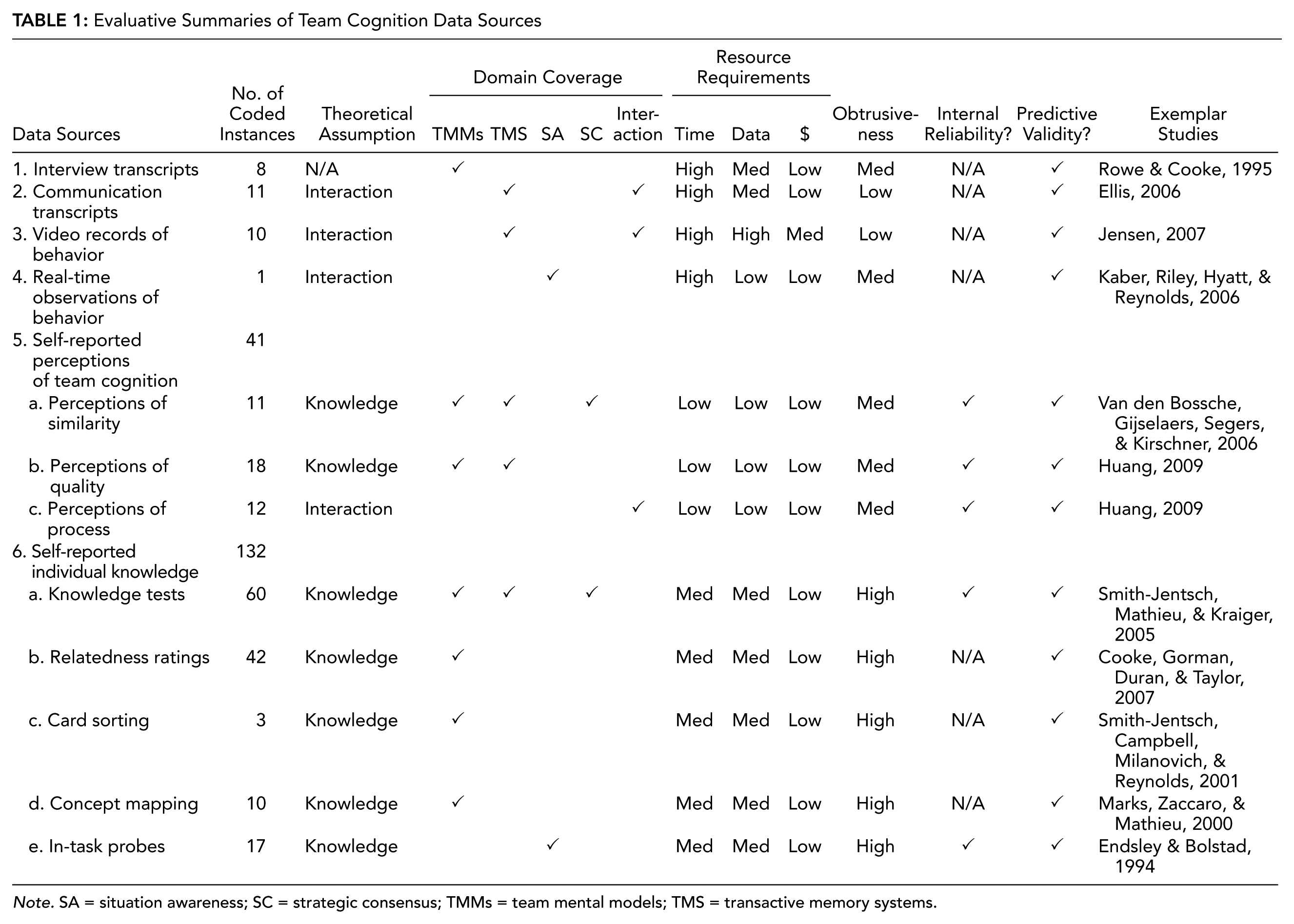
For the purposes of this article, data collection sources refers specifically to the source of the raw data prior to being manipulated or analyzed in such a way as to represent a particular type of or approach to team cognition. We have categorized the data collection sources used within the broader team cognition literature into six primary types: (1) interview transcripts, (2) communication transcripts, (3) video records of behavior, (4) direct observations of behavior, (5) self-reported perceptions of team cognition, and (6) self-reported individual knowledge (see Table 1).
Evaluative Summaries of Team Cognition Data Sources
Note. SA = situation awareness; SC = strategic consensus; TMMs = team mental models; TMS = transactive memory systems.
It should be noted here that we have separated all self-reported survey data into two categories: self-reported perceptions of team cognition and self-reported individual knowledge. We believe these labels clarify several conceptual issues: (1) Both sources are self-reported by the individual team members, and (2) both sources are subjective by definition; however, (3) there is a distinct difference between the types of self-reports in terms of the content. Specifically, self-reported perceptions of team cognition ask the participant to report their personal perceptions regarding team-level cognitive similarity, quality, or process, whereas self-reported individual knowledge measures ask the participant to report their individual knowledge on a topic such as taskwork, teamwork, or strategy. In other words, the referent of the measures is at different levels. We suggest that this is a critical distinction to make, as it changes the theoretical nature of the construct being measured.
Table 1 provides an evaluative summary of each data source, including (1) the number of times this source was coded as being used within our reviewed literature; (2) the theoretical assumption (i.e., team cognition as knowledge or team cognition as interaction) underlying the data source; (3) the research domains that have used each data source; (4) the relative (i.e., as compared to the other sources) resources usually required by each data source in terms of researcher time, data storage needs, and monetary cost; (5) the relative (i.e., as compared to the other sources) level of obtrusiveness in terms of team member time used and interruption; (6) whether or not internal consistency reliability has been established; (7) whether or not predictive validity (i.e., prediction of team performance) has been established; and (8) an exemplar study that used the data source. Once the raw data have been collected via one of the above mentioned data sources, it must be analyzed in some way to represent the team cognition construct of interest. Within each of the six sources, the most common analysis methods are also discussed and evaluated. Analysis techniques are not included in Table 1, as they often cut across multiple data sources.
As we have noted in Table 1, adequate internal consistency reliability and predictive validity (i.e., prediction of team performance) of all coded team cognition measures have been established in at least one published study. The methods that have been used more frequently (e.g., knowledge tests; relatedness ratings) have been shown to be internally reliable and predictive more often than those that have been used less frequently, but that should not be taken to suggest that the less frequently used methods should not be considered for future use. Conversely, the less frequently used methods have yet to be fully explored across settings and should be studied further to determine more concretely if and when they are most useful for capturing team cognition.
Furthermore, measures that are analyzed by human raters, particularly interview transcripts, communication transcripts, video records of behavior, and real-time observations of behavior, cannot be pre-assessed in terms of reliability because the reliability of the measure depends entirely on the expertise and training of the particular raters that are chosen to complete the data analysis. Although the studies that have previously used such approaches often did establish interrater reliability within their data, it does not guarantee that any other researcher selecting this method of data collection will have the same results. Any data analysis approach that requires human raters to complete categorizations or ratings will need to establish adequate interrater reliability via rater training, practice, and interrater discrepancy mediation. Many of the objective self-report measures also do not lend themselves to a discussion of reliability given that the items are not written in such a way as to be expected to form an internally reliable scale. Instead, they are intended to tap into the complex and multidimensional structure, or content, of knowledge held within a team. In sum, given that adequate reliability and predictive validity has been established for all published methods, these issues will only be discussed again for any individual method if it is of particular noteworthiness compared to the others. The evaluations presented below will instead focus on discussing the relative strengths, limitations, and considerations for each method along with the past and potential uses for measuring various team cognition constructs.
Interview Transcripts
Some research has studied team cognition using qualitative textual data as a source. Usually, individual interviews or focus group interviews with the members of teams are transcribed or open-ended surveys are used to collect textual data regarding past performance (e.g., Bourbousson, Poizat, Saury, & Seve, 2011; Espinosa, Slaughter, Kraut, & Herbsleb, 2007; Hare & O’Neill, 2000; Rowe & Cooke, 1995). There are several advantages to interviews for eliciting team cognition content. First, because interviews are conducted outside of performance episodes, they are less obtrusive in terms of performance interruption compared to self-report measures. Teams are not required to divert their attention away from the task at hand for any reason. Second, because they are conducted outside of performance episodes, they are temporally flexible and therefore easier to schedule and conduct from a practical perspective. The researchers and participants are not constrained to any particular performance episode to complete the data collection. Third, because interviews can be structured or designed to elicit any self-reportable information, they can be used to measure all of the commonly studied team cognition constructs including team mental models, transactive memory, strategic consensus, and situation awareness. All that is necessary to use interviews within each of these domains is to carefully develop a set of interview questions designed to elicit the corresponding information. Interview questions can be designed to elicit information regarding static or dynamic knowledge structures (e.g., What is your understanding of the task?), perceptions of knowledge (e.g., How similar are your team members to one another regarding their understanding of the task?), or interactive cognitive processes (e.g., describe the activities your team engages in when new information enters a situation).
One of the primary disadvantages of interviews compared to the other textual approach, communication data, is that interviews that are inherently self-report in nature are therefore less objective. When actual team communications are recorded and transcribed, the textual data that result are an exact representation of the interactions and processes as they occurred within the team. When the team members are interviewed after the fact, however, they can only report to the best of their ability their possibly inaccurate perceptions regarding what happened within the team in the past. This means interview data are susceptible to all of the same human cognitive biases that other self-report data are susceptible to, such as remembering only recent events, selective memory, or general halo bias (see Borman, 1991, for a review of potential rater errors).
Communication Transcripts
A sizeable portion of team cognition research has used communication recording as a method of data collection (e.g., Bierhals, Schuster, Kohler, & Badke-Schaub, 2007; Cooke et al., 2009; Ellis, 2006; Tschan et al., 2009). In most studies that use this method, the verbal interactions between team members in a co-located team (e.g., student teams in a laboratory) are recorded via audio-recording technologies, and then the audio recordings are transcribed into written scripts that represent the word-for-word interactions of team members often along with information regarding who said what, to whom, and at what time. Those scripts are then usually coded for team cognition constructs using some sort of content classification scheme, as will be described later. Theoretically, communication records are in line with the underlying assumption that team cognition is an interactive process, and not a product of that process. However, the majority of past research has actually coded communication data for more static knowledge structures (e.g., shared mental models; Bierhals et al., 2007) and only a small number of studies have coded communication for interactive processes (e.g., Gorman & Cooke, 2011).
In terms of advantages, communication recording is one of the least intrusive methods for collecting team cognition data, as it does not require the team members to stop their activities or shift their attention for any reason during team performance episodes, and it also does not require the presence of a physical human observer during real-time team activities. Audio-recording technology is also widely available and relatively inexpensive. Communication records can be replayed, allowing the actual coding and rating of data to happen under less time pressure after data collection is complete, and ensuring that any raters engaged in coding can revisit missed information. This is one of the primary advantages of communication and video recording as data collection methods that do not require the presence of human observers and also result in a permanent, and therefore reviewable, source of data.
The primary disadvantage of communication records as a source of data actually lies within the analysis rather than the data collection. Specifically, almost all current analysis approaches require that communication transcripts are transcribed into written scripts, and then highly trained experts must spend hours reading and categorizing the information within those scripts. A general rule of thumb, drawn from the experience of the authors, is that the transcribing of 1 hour of audio recording will take 3 or more hours to complete. This proportion may vary depending on the number of team members speaking that must be distinguished from one another, the clarity of the voices, recording quality, and experience of the transcriber. However, assuming this proportion is approximately correct, this means that transcribing the 300 hours of verbal communication recorded in Albolino, Cook, and O’Connor, 2007, for example, would take somewhere around 900 hours of labor.
The second stage of content categorization can often take a similar amount of time as well, putting the estimated total time investment to measure team cognition via communication recording in Albolino et al. (2007) at near 1,800 hours of labor. Communication records are a rich, but time-consuming, source of data. An alternative option to using one’s own time or labor resources to complete these transcribing activities would be to send the communication transcripts to a professional transcribing company that has the experience necessary to get the work done much more quickly. This option, however, requires the monetary resources to pay for transcribing rather than spending time to transcribe, so there is a nearly direct resource tradeoff. Clearly, measuring team cognition in this way can result in some of the most in-depth and informative data on team cognition, but it also requires a large amount of upfront investment either in terms of time or money.
Video Records of Behavior
The use of video recording is the most common, and least intrusive, of the behavioral observation approaches (e.g., Patrick, James, Ahmed, & Halliday, 2006; Prince, Ellisa, Brannick, & Salas, 2007; Reid & Reed, 2000). Video recording equipment is used to capture the interactions of team members, and then trained raters code those videotapes for team cognition-related behaviors and events after the fact. This approach is less intrusive than direct observation because it does not require the presence of a human observer. The known presence of human observers can change the behavior of team members, especially if team members are cognitively aware that they are being evaluated or judged. Research on maximum and typical performance suggests that individuals exert more effort toward performing well when they are being observed by researchers or supervisors (Klehe & Anderson, 2007). Discreet videotaping of interactions and after-the-fact rating can reduce the possible unintended impact of observers on team behaviors. Video records also provide another advantage over direct observation in that the videotapes can be watched multiple times, slowed down, and can be reversed/fast-forwarded in order to replay or pinpoint particular behaviors or events. This reduces the possibility that raters will miss important events.
The disadvantages of video records are generally practical in nature. It is possible that when studying certain high-risk or high-secrecy types of teams, video recording will not be permitted and therefore will not be an option for observing behavior. Video recording equipment is also more expensive than some of the other data collection methods such as self-report measures or communication recording. Video recording also requires a large amount of digital data storage space compared to most other methods. These practical considerations may make video recording a less appealing option for team cognition measurement in particularly restricted situations or when monetary or data resources are limited.
Real-Time Observations of Behavior
Sometimes, for practical or other reasons, video recording is not possible, but direct, real-time observation is possible (e.g., Kaber et al., 2006). This is likely in military or government situations in which video recording would be prohibited but observation can be arranged. In this case, trained raters are required to physically be on location during a team’s task performance and to code and rate behaviors as they occur. This essentially results in the same type of data as video records but presents a unique set of challenges. First, the presence of a human observer may have unintended consequences on the behavior of the team, as mentioned previously (Klehe & Anderson, 2007). This influence can be reduced by training raters to remain as inconspicuous as possible and to stay out of the way of the team while observing. As time passes and the team members become accustomed to the presence of the observer, the potential for contamination should be reduced.
Real-time observation also increases the probability that raters may miss particular behaviors or events as the action cannot be paused or reversed as in videos. There is also a potential for unintended influences on the rater’s ability to accurately rate events, especially if the team context is a highly stressful or dangerous one. Real-time observation can also be costly either in terms of time or money, depending on who does the observing. If the researchers do the observation themselves, this will require a large amount of time spent in observation sessions. If the researchers instead pay for trained observers, they may save themselves time but spend much more money. Direct, real-time observation does have one potential advantage over video recording in that observers have the ability to adjust and respond to the situation at hand, for example, if the action moves into a new location. A fixed video camera, however, would likely not have this capability and may not accurately observe behaviors if they move out of the camera’s visual and audio range.
Self-Reported Perceptions of Team Cognition
Self-reported perceptions of team cognition are a very common approach for eliciting team cognition. This approach asks team members to self-report their personal perceptions of particular team cognition constructs as they exist or occur within their team. Research has examined perceptions of knowledge similarity (i.e., how similar do you perceive the knowledge to be across team members), perceptions of knowledge quality (i.e., how “good” do you perceive the team’s transactive memory to be), and perceptions of cognitive processes (i.e., do you perceive that your team engages in activities such as sense-making or knowledge sharing). For example, Gevers and Rutte (2006) measured the perceived sharedness of temporal cognitions using four self-reported items tapping the perception of each individual team member that their team had shared cognitions such as “in my group, we have the same opinions about meeting deadlines.”
Self-reports of perceptions are very common within the transactive memory literature. The most common measure used to capture transactive memory systems in research is the Lewis (2003) self-report measure. This measure asks individuals to respond to a set of questions regarding their individual perceptions regarding the specialization (e.g., each team member has specialized knowledge of some aspect of our project), credibility (e.g., I trusted that other members’ knowledge about the project was credible), and coordination of knowledge (e.g., our team worked together in a well-coordinated fashion) within the team from a scale of (1) strongly disagree to (5) strongly agree. This measure essentially is a combined self-report measure regarding the team members’ perceptions of (un)similarity of knowledge (i.e., specialization), the quality of knowledge (i.e., credibility), and perceptions of process (i.e., coordination). Another commonly used measure, due to the reduced number of items, is the self-reported measure of perception of expertise location (e.g., the team has a good “map” of each other’s talents and skills) used by Faraj and Sproull (2000) rated on a scale from (1) strongly disagree to (5) strongly agree. This scale is uni-dimensional and only taps into the extent to which team members are aware of the distribution of specialized expertise and knowledge.
In terms of advantages, using written or computerized self-report measures of perceptions requires significantly less time and resources to analyze compared to communication or observational data. In fact, if designed correctly, self-report measures can be collected and analyzed automatically using computer programs, making this a much smaller investment in terms of time and, potentially, money. There has been some advancement in voice-to-text technology that could be used to try to automatically transcribe team communications in real time, but there is some level of error in such computer programs that can negatively affect results. At the very least, researchers would need to double-check the accuracy of automatic voice-to-text transcripts, which can take nearly as much time as transcribing them in the first place. Organizations and individuals interested in measuring team cognition need to carefully consider exactly how much time and money they are willing to invest.
In terms of disadvantages, it is important to note that these measures capture the extent to which team members perceive the cognitions within the team to have a certain content or structure (e.g., they are similar), and not necessarily the actual structure or content of the cognition within the team. It is quite feasible, in fact, that the team members could believe they have perfectly shared perceptions, when in fact they actually do not. This is important to note, not because it makes the findings of studies using self-reported perceptions of team cognition invalid, but because it changes the interpretation of the findings to represent perceptions of team cognition rather than the actuality of team cognition. Several other scholars have discussed the distinction between so-called “perceptual” and “objective” measures as one of the critical issues within team cognition measurement (Mohammed, Ferzandi, & Hamilton, 2010; Mohammed & Hamilton, 2012; Smith-Jentsch, 2009), and it is worth repeating given that scholars outside of the traditional team mental model framework are still discussing results obtained with self-reported perceptions of team cognition as if they can be assumed to represent knowledge structure (e.g., Zheng, 2012). Future researchers should make a concerted attempt to more carefully select measures based on the match to the measurement purpose, and to more clearly and accurately label and interpret the findings associated with different measurement techniques.
Self-Reported Individual Knowledge
The final data collection approach used in the reviewed literature is self-report of individual knowledge within teams. This is the most commonly used data collection method. Self-reported knowledge measures take several forms including knowledge tests, relatedness ratings, card sorts, concept maps, and in-task probes (each described in detail below), but the general idea is that the measure captures in some form the actual knowledge or cognitions of individual team members with the intent of aggregating this information to represent knowledge structure at the team level. These measures are considered somewhat more objective than self-reported perceptions of team cognition because they require the respondents to directly report their own understanding of the relatedness between pre-established concepts rather than simply asking the respondents if they perceive that their team understands concepts in a similar way. This method is more appropriate for measuring the actual content or structure of team cognition rather than the perceptions of team cognition, but it is also relatively more cumbersome and time-consuming. Most of these measures take up a large amount of team member time and are usually completed near or during team performance episodes, and therefore represent some of the most obtrusive measures in that the team members must actually halt performance for relatively long periods of time and focus their attention on the measure instead of the task.
Knowledge tests
The knowledge test approach to team cognition measurement has generally been used to assess the actual structure of existing knowledge within teams. In order to do that, individual self-reports of knowledge are collected. For example, Smith-Jentsch et al. (2005) examined the similarity of positional-goal mental models. The participants, air traffic controllers, were asked to rate to what extent local control can have an impact on other department’s (i.e., group, approach, departure) ability to complete particular activities such as “minimize delays in moving inbound aircraft from the runways to the ramp” (p. 535). The responses to these items essentially represent each team member’s knowledge regarding the interdependencies between the goals of various positions. Knowledge tests have a large amount of potential in team cognition research in that they can be used to analyze the structure or content of team knowledge regarding essentially any topic. Questions could be developed to assess each team member’s knowledge in terms of taskwork, teamwork, goal interdependencies, team member characteristics, and more. Once each team member has responded to the item regarding his or her own knowledge, this information can be combined in a variety of ways in order to represent team cognition.
One of the disadvantages of knowledge tests, and most of the other self-report objective measures, is that, at least for task-related knowledge, the test must be created to tap into the relevant knowledge for a particular task. For example, the knowledge test described above was developed specifically for air traffic controllers based on a detailed understanding of the task at hand. That exact measure could not be used to measure knowledge in any team other than air traffic control teams. There is a possibility of reusing existing taskwork measures that have been developed for experimental laboratory-based tasks (Edwards et al., 2006), but that would require that the researcher also use the exact same task to conduct their research.
Relatedness ratings
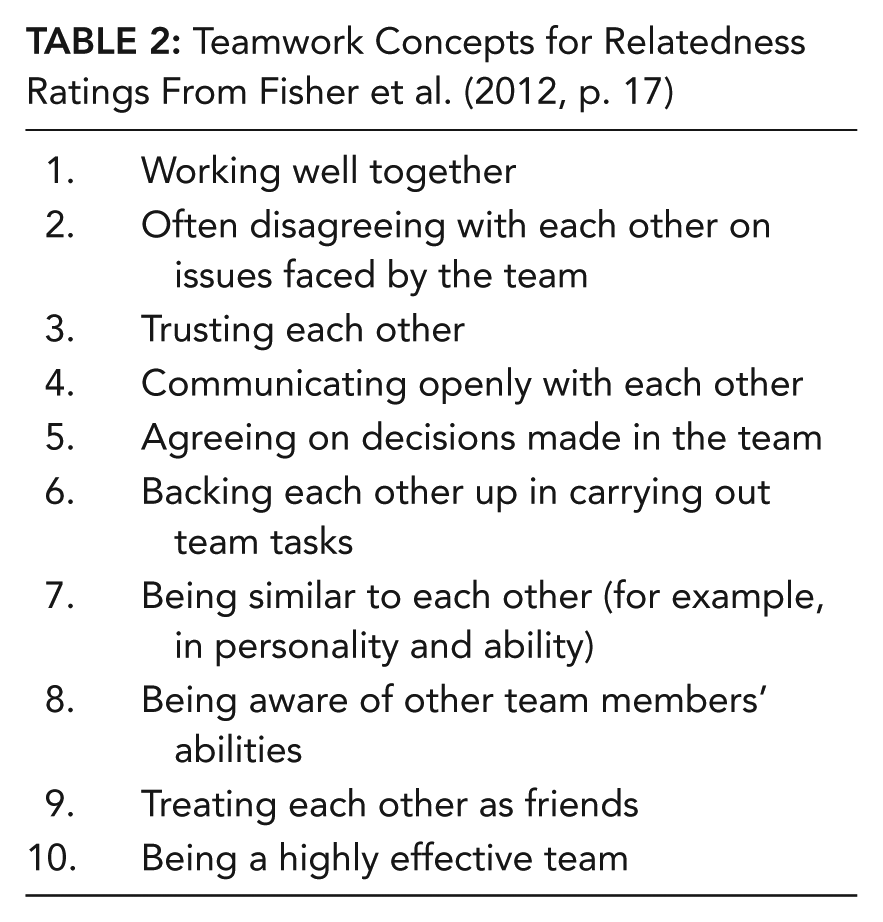
Relatedness ratings have been one of the most common, and most validated, approaches for measuring objective knowledge via self-report. This approach assumes that knowledge structure can be derived from understanding how various concepts are related to one another. Generally, a set of task-related or team-related concepts are given to the participants and they are asked to rate the relatedness of the concepts to one another. This method is similar to knowledge tests in that participants rate items on a Likert-type scale. The difference is that they are rating the relatedness of a pair of concepts rather than rating their agreement to an individual item. For example, Fisher, Bell, Dierdorff, and Belohlav (2012) measured teamwork-related mental models by asking the members of military teams to rate the extent to which a set of teamwork concepts (Table 2) were related to one another on a scale from (–4) unrelated to (4) related. The responses to these pairwise relatedness ratings were then aggregated into one scale to represent the extent to which team members shared an understanding about teamwork overall. In a different example, Edwards et al. (2006) measured the accuracy of task-related mental models by asking team members to rate the relatedness of all possible pairs of task concepts developed based on the team task called Space Fortress, and then used Pathfinder software to calculate how similar the team members’ mental models were to a predetermined expert (i.e., correct) model.
Teamwork Concepts for Relatedness Ratings From Fisher et al. (2012, p. 17)
The primary advantages of relatedness ratings are the fact that they are well-established and validated measures and that they can be used to provide relatively rich data regarding the relatedness between concepts without being overwhelming complex to complete. Past research has primarily used relatedness ratings to examine teamwork mental models and taskwork mental models, but they could potentially be used to study other team cognition constructs as well. For example, situation awareness could be measured using relatedness ratings involving in-the-moment concepts similar to the concepts currently included in situation awareness measures. Rather than simply having the team members provide answers to situation-based questions, they could be asked to rate the relatedness of various environmental stimuli at that particular moment. This may provide a more nuanced understanding of situation awareness not only by examining the team member’s awareness of particular stimuli but by also examining the team member’s awareness of the current relationships between stimuli.
Relatedness ratings could also be used as a technique to gauge the “awareness of expertise location” dimension of transactive memory systems by adjusting the approach slightly from traditional methods. Rather than rating the relatedness of pairs of task concepts, the team members could be asked to rate the extent to which various team members are related to expertise concepts. This could be done both from a self-report standpoint (i.e., I rate my own relatedness to expertise concepts) and from a perceptions of others standpoint (i.e., I provide my perceptions regarding the relatedness of my teammates to expertise) and therefore could be used to ultimately analyze concepts including team knowledge stock, transactive memory consensus, and transactive memory accuracy. This is similar to, but slightly different from, the ranking approach taken in Austin (2003) in that the rank-based measures measure limited responses to the one team member who is most associated with a skill, which may not always accurately represent real-world team composition. It is likely that more complex patterns of expertise exist in most teams. For example, in Table 3, this hypothetical pattern of relatedness ratings suggests that Team Member 3 is an expert only in Skill 1, Team Member 1 is an expert only in Skill 3, and Team Member 2 is somewhere between an expert and a novice across all three skills. In other words, this team appears to be made up of two specialists and one generalist. This measurement approach therefore allows for a more nuanced understanding of a wide variety of expertise distribution.
Example of Relatedness Ratings to Measure Transactive Memory System
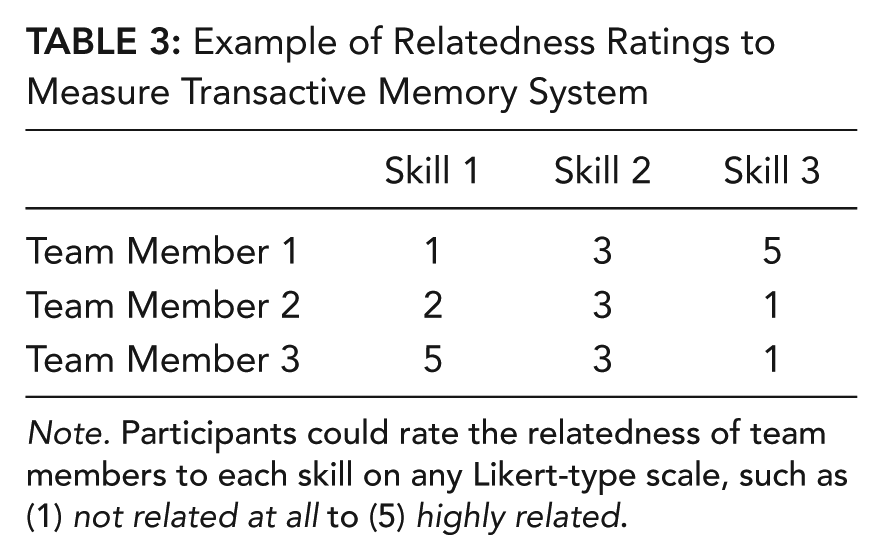
Note. Participants could rate the relatedness of team members to each skill on any Likert-type scale, such as (1) not related at all to (5) highly related.
Card sorting
Card sorting is very similar to relatedness ratings in that the participant is asked to work with a set of concepts. However, rather than rating the relatedness of each pair of concepts, the participant is asked to sort the concepts into categories based on some overarching knowledge organization scheme. For example, Smith-Jentsch et al. (2001) used cards with examples of either effective or ineffective teamwork that had been developed by a group of subject matter experts (SMEs). The participant sorts the cards into piles or categories based on how they feel the concepts are related. This method moves one step past paired comparison ratings by allowing the sorter to compare all concepts simultaneously rather than pair-by-pair only. This allows the resulting network to represent how the user organizes the information as a whole. The administrator can either provide the participant with predetermined categories into which the cards should be sorted or give no instructions and let the participants create their own organization scheme. In other words, this method can be adjusted in terms of structure ranging from completely unstructured—the participants generate their own set of concepts and then organize those concepts into as many categories as they see fit based on whatever structure they determine—to completely structured—the participants are given a predetermined set of concepts and are told to organize them into N number of categories based on X criteria (e.g., which team role they correspond to; which task they are used to complete).
This flexibility in terms of structure may be beneficial for designing measures for varying levels of expertise. For example, unstructured card sorting might be better for eliciting the true mental models of experts that have had the time and experience to establish a strong and complex understanding of a task, whereas novices may need to be provided with an underlying structure to help them complete the sort. The measurement of mental models in novices, of course, calls into question theoretical issues regarding whether or not it is appropriate to try to measure the mental model of an individual that may not have fully developed one yet. It is possible that by providing the number of sorting categories or a predetermined set of concepts, the novices may change or adapt their previously deficient mental model to match the information provided via the measure, and the measure may not be capturing the natural state of that mental model. The issue of whether or not measuring team cognition actually changes team cognition is an issue that continues to create complexity in research.
Like relatedness ratings, card sorting has historically been used within the team mental model domain. However, it has the potential for useful application studying transactive memory, strategic consensus, and situation awareness. Cards containing skills or pieces of expertise could be sorted based on the team member that holds that information, or cards containing strategy-related concepts could be sorted and the resulting patterns could be compared across top management team members to ascertain their level of consensus. Regarding situation awareness, the cards could contain pieces of information found in the environment, though it should be noted that card sorting can often take longer than more basic self-report measures and therefore may be too tedious to use with an in-task probe measurement approach. Future research should consider and explore the utility of card sorting for measuring diverse team cognition constructs.
Concept mapping
Another way to graphically represent shared cognition constructs is for team members to complete a concept map. Concept mapping requires the participant to develop a spatial map based on how the concepts are related (Harper et al., 2003). Participants are asked to choose from several predetermined concepts within a topic such as taskwork or teamwork and, usually, place them into a fill-in-the-blanks–type hierarchical structure (Marks et al., 2000). Eight out of 10 coded instances of concept mapping used a prespecified structure. For example, Marks, Sabella, Burke, and Zaccaro (2002) provided participants with 50 concepts related to team interaction and had them place 12 of the concepts into the accompanying hierarchical structure. Overlap, or similarity, between the team member’s maps was measured as the percentage of shared concepts placed identically. Generally the resulting network is compared to other team members’ maps to calculate a similarity score, or compared to an experimenter-generated expert map to score for accuracy. Some studies did not provide a prespecified structure, however, and instead allowed the individuals or teams to determine their own idiosyncratic concept map within which to place concepts.
Many of the objective self-report measures such as card sorting and concept mapping require that researchers specify task, team, and other concepts or structures ahead of time. For example, the measure described regarding the Space Fortress task used in Edwards et al. (2006) forces respondents to use those 14 concepts when developing their mental model. However, it is possible that individual respondents actually have existing mental models regarding Space Fortress that use concepts different from this list and different from one another. Although this prespecification of concepts and structures allows for quicker, and more comparable, measurement outcomes, it is possible that it may not represent the true or natural knowledge structures of participants (Akkerman et al., 2007).
In response to this limitation, an approach known as idiosyncratic concept mapping (Carley, 1997) may help to counter this drawback by capturing an individual’s knowledge structure through their elicited idiosyncratic (i.e., unique to that individual) content. In this approach, the respondents answer essay questions about the content around which a mental model is to be built, and an automated computerized program is used to extract the dominant concepts within the essay and the relationships among these concepts. In other words, the essay text (i.e., textual data collection) is coded into categories, but the program actually uses the content of the textual information to determine what those categories will be rather than a prespecified communication coding scheme. However, this technique can make it difficult to compare different individual mental models (Mohammed et al., 2000). If one individual’s mental model is built around 10 concepts and another individual’s mental model is built around a different set of 14 concepts, it is difficult to quantify just how “different” or “similar” their knowledge structures are. Therefore, it is important to decide whether comparability or true representation of natural structure is a priority when choosing which elicitation approach to utilize.
Concept maps historically have been used exclusively to measure team mental models. However, just like knowledge tests, card sorts, and relatedness ratings, concept maps could be used to measure any structured knowledge construct including transactive memory, strategic consensus, and situation awareness—assuming that the team knowledge in question lends itself to a spatially organized map format. For example, if a task-related situation involved certain team members engaging in certain tasks at certain times, separate expert “maps” representing their moment-to-moment situation awareness could be developed and team members could be asked to stop and complete the map based on what was happening when the task paused. The completed maps could then be compared to the expert maps in order to assess the quality of the team’s situation awareness. In another example, interactively elicited (i.e., concepts and structure developed by the team member; Mohammed et al., 2000) concept maps regarding task expertise could be compared across team members to simultaneously assess both the sharedness of mental models (i.e., operationalized as overlapping sections of maps) and the distribution of specialized expertise (i.e., operationalized as unique information only held by one individual). Future research should further explore the use of concept maps as measures of team cognition, both within and outside of the mental model domain.
In-task probes
The most common approach for measuring team situation awareness is the use of what can be referred to as in-task probes. These probes are essentially knowledge questionnaires that temporarily stop a simulated team scenario and ask team members to report critical information regarding the current situation (e.g., What are the most critical tracks on a radar screen?). The most commonly used dynamic probe is known as Situation Awareness Global Assessment Technique (SAGAT; Bolstad & Endsley, 2003). The content of SAGAT-style in-task probes is always based on the particular situation at hand, as the information that is assessed in situation awareness measures varies depending on the team task being performed. For example, in Saner, Bolstad, Gonzalez, and Cuevas (2009), military personnel engaged in personnel recovery simulation scenarios during a training course. These scenarios involved situations that require individuals to be recovered, such as fishing boats capsizing or planes being shot down over hostile territory. During the simulations, the information displays were temporarily stopped and SAGAT-style queries (e.g., How many isolated incidents are you aware of? What additional assets do you require to conduct a recovery?) were administered to gauge situation awareness in the moment. These queries were developed based on the incidents that participants should be aware of within the simulations.
Unfortunately, the SAGAT method is relatively obtrusive in that it directly interrupts performance and requests team members to shift attention from the situation to the measure, but there are few other ways to capture cognitive constructs as dynamic as situation awareness without some level of disruption. One relatively creative approach that has been used in simulated team performance situations is to embed a trained confederate as part of the team, and to use that confederate as a sort of real-time measure of situation awareness by having them request specific information from others at key points within the simulation (Camelo-Ordaz et al., 2005). By embedding the measurement method as a confederate, dynamic repeated measurement can occur without actually stopping the simulation. Gorman et al. (2006) used an event-based embedded measurement approach that built novel challenges into the team’s task, thus allowing for the measurement of situation awareness as the response to those challenges rather than via questionnaires or confederates.
The Situation Present Assessment Method (SPAM; Durso et al., 1998) approach to measuring situation awareness is quite similar to SAGAT, but differs because it does not freeze the screen while presenting the queries. Instead, it presents the queries midperformance and allows the users to continue obtaining information from the task environment as they respond to the questions. Cooke et al. (2001) used three SPAM queries in their multimethod study of team knowledge. The questions, just as in SAGAT, asked the participants to report task-related knowledge. Individual responses were compared to an experimenter-generated key for accuracy, and team similarity was assessed by averaging all possible pairwise similarities for the three team members.
In terms of the utility of in-task probes for studying team cognition outside of the realm of situation awareness, they could potentially be used to measure any other dynamic knowledge structures (Wildman et al., 2012). For example, in-task probes could measure dynamic teammate mental models (i.e., What is the current status of my team in terms of task engagement, workload, etc.?) or dynamic goal-related mental models (i.e., What is the team’s current short-term goal? What is the team’s current status in terms of goal achievement?). The key characteristic of this method is that it temporally occurs during task performance episodes (either frozen or in real-time), so any dynamic knowledge could be assessed in this way. Additionally, as we have mentioned previously, the form of in-task probes could be changed into any of the self-report formats used in other team cognition domains including relatedness ratings, card sorting, or concept mapping. The advantage of this approach for measuring dynamic knowledge is that it can be used to capture the changes in momentary understanding over time, rather than retroactively sampling knowledge after the task is completed. The exploration of different forms of in-task probes measuring differing types of dynamic knowledge could result in many new discoveries within team cognition. Future research should be careful about applying embedded confederate methods to the measurement of team cognition processes, however, because the behaviors of the confederate would be contributing directly to the team’s cognitive processes.
Evaluation of Analysis Techniques
The sources of data for studying team cognition are only useful to the extent that they are appropriately analyzed. This section explores the approaches used by a multitude of researchers to analyze team cognition data sources. We’ve separated the discussion of this topic from our discussion on the sources of data because several of these analyses can be used across a number of compatible categories of data. For instance, content analysis can be used to analyze interview transcripts, communication transcripts, and video records or direct observations of behavior. The most common analytic techniques fall under statistical aggregation. In general, analysis techniques can be broken down into five types: content analysis, pattern analysis, statistical aggregation, the holistic approach, and computational scaling.
Content Analysis
As we have briefly alluded to, the primary approach for analyzing textual data, collected via interviews or communication records, is content analysis. This method requires the measurement administrator to either select or develop a theoretical classification scheme into which to code instances of textual data. Content analysis focuses on the linguistic and semantic content of the communication data, such as the topics of discussions, the frequency of certain words, or the types of language used. For example, Banks and Millward (2000) used this approach to code all verbal interactions of teams into nine categories developed to represent various distributed cognitive processes: (1) request, (2) offer, (3) question, (4) propose, (5) hone, (6) support, (7) widen, (8) other, and (9) not relevant. In another example, Bierhals et al. (2007) recorded and transcribed the verbal interactions of teams and then coded the scripts using the KATKOMP categorization system. This system is meant to capture the interactions within the team that deal with the task itself (content), management of intergroup process (process), and interpersonal relationships. Muniz et al. (1996) analyzed communication data for indicators of situation awareness, and categorized utterances as “situationally relevant” and “less relevant” statements with the assumption that more situationally relevant speech would indicate a team with higher levels of situation awareness. In a similar fashion, Ellis (2006) coded speech units into the categories of directory updating, information allocation, and retrieval coordination in order to tap into the team’s TMS.
One specific type of content analysis, latent semantic analysis (LSA; Cooke & Gorman, 2009; Landauer & Dumais, 1997; Landauer, Foltz, & Laham, 1998), is an automated method of assessing discourse content. LSA takes the raw text of communication and separates words by their unique strings of characters. Word meaning is determined by examining how often words occur together in similar contexts (i.e., passages of text) by identifying the latent space of semantic factors, similar to the approach underlying factor analysis. Semantic relatedness is determined by plotting utterances (e.g., words, sentences) in the semantic space and computing the normalized cosine of the angle between those utterances in the space. For an example, LSA can determine if the terms human and user are related by looking at the normalized cosine of the angle between those words in the latent space of semantic factors. One of the advantages of using this method is that the measures are highly related to performance-based scores (some have been as high as R2 = .71). Additionally, there has been some recent success in automating communication analysis using LSA (Foltz & Martin, 2009). One disadvantage of this, and other analysis techniques that require textual data, is the requirement for speech-to-text conversion to produce written transcripts. The transcription process is not very automatable at the present time and can hamper real-time analysis. However, LSA indices have been found to be very highly correlated with the simpler-to-obtain word count metrics, which can be coded and analyzed much more quickly.
Pattern Analysis
Pattern analysis is a technique that has been used for several decades to study interpersonal processes, but has only recently been applied to the study of team cognition in particular (e.g., Gorman, Cooke, Amazeen, & Fouse, 2012; Miller, Scheinkestel, & Joseph, 2009; Xiao, Seagull, Mackenzie, Klein, & Ziegert, 2008). In contrast to examining the semantic content of textual data such as interview or communication transcripts (i.e., what is being said) like in content analysis, pattern analysis is focused on examining the sequence and/or pattern of directed interactions between team members within a team regardless of the content of those interactions. One example of this is communication flow analysis (Cooke & Gorman, 2009). This approach uses communication data regarding who has been talking to whom and for how long, but ignores the semantic content of those communications. These data can be analyzed using a variety of indices such as the dominance statistic (i.e., cross-correlations between team members’ speech quantities) to determine who has more influence on the team’s cognition or simple flow quantity (i.e., the amount of speech to and from particular team members).
Sequential analysis is a pattern analysis technique that is focused on examining the temporal sequencing of communications over time. This method has been used to analyze communication flow by examining the pattern of specific communication behaviors and found that poorly performing teams were more likely to follow action statements with other action statements compared to less poorly performing teams (Bakeman & Gottman, 1997; Bowers, Jentsch, Salas, & Braun, 1998). Sequential methods specifically look for patterns across time (e.g., what follows what). This is in contrast with static analyses that aggregate a team’s communication across time using indices such as mean number of words spoken or mean duration of utterances (Kiekel, 2004). The major benefit of looking at communication in a sequential fashion is that it allows for the study of the interactive processes driving team communication, collaboration, and problem solving (Kiekel, 2004).
One disadvantage of sequential pattern analysis is that it can be extremely data rich (Cooke, Neville, & Rowe, 1996) and can be difficult to interpret without automated methods or methods for reducing the data. Several methods have been developed to increase interpretability and lower the effort cost of the analyses. One method analyzes the flow of communication by building procedural networks (ProNets), via the Pathfinder network scaling technique (Schvaneveldt, 1990), that highlight transitions among the events (in many cases, this would be communication turns, with a turn being a single person’s statements or utterances) being studied (Cooke et al., 1996). Pathfinder is an algorithm that looks at data as pairwise, interconnected “nodes” of information. Pathfinder, essentially, calculates the distance between each pair of nodes based on Euclidean distance measurement (Kiekel, 2004). Kiekel (2004) suggests that Pathfinder can be used to analyze the physical flow of communication over time.
It should be noted that because behavioral observation generally results in auditory (i.e., verbal communication) information similar to communication records, it can also be analyzed using any of the techniques used for coding communication data. The observed or video-recorded communications can be coded for knowledge-based or interaction-based team cognition constructs. However, observation data not only provide auditory information but also provide non-verbal visual information that can be analyzed as well. This information can also be coded using content classification schemes that assign particular behaviors to particular categories.
One pattern analysis method that has been used to analyze observational data is what is known as event data analysis (Cooke & Gorman, 2009). Essentially, event data analysis conceptualizes observed behavior as a sequence of events. One previously utilized event-based analysis tool is Targeted Acceptable Responses to Generated Tasks and Events, otherwise known as the TARGETs method (Fowlkes, Lane, Salas, Franz, & Oser, 1994). One of the key concepts behind event-based observation is that particular team member behaviors of interest must occur, often in a particular order, within an operationally relevant task scenario. In the TARGETs method, SMEs are used to develop realistic and relevant task scenarios as well as identify acceptable responses within these scenarios. The identified responses must be specific, observable behaviors so that the observers can easily record when responses occur. Behaviors are then recorded by observers on a “hit or miss” checklist consisting of the identified responses. Observation has been used to study several cognitive constructs, such as situation awareness (Patrick et al., 2006) and transactive memory (Liang, Moreland, & Argote, 1995; Moreland & Myaskovsky, 2000).
As previously mentioned, Pathfinder can be used for Procedural Networks (ProNets; Cooke et al., 1996) analysis, an “integrated exploratory sequential data analysis technique” (Cooke et al., 1996, p. 32). Pathfinder is particularly suited to the analysis of sequential event data because it is more flexible and unconstrained by hierarchical configurations. Pathfinder can be used to analyze sequences of events coded from communication or observational data. The probability matrices of transition among a set of nodes (i.e., events) are input into the Pathfinder Algorithm, and then a network representation of pairwise connections among the events is generated.
Statistical Aggregation
Statistical aggregation is the most commonly used analysis technique, given that nearly all self-report measures must be aggregated in some way to represent the team. The simplest, and most common, type of statistical aggregation is the use of the arithmetic mean of the team member’s self-reported responses. For example, team members are asked to complete a four-item measure capturing their perceptions regarding whether or not mental models are shared within their team (e.g., in my team, we are on the same page), and these individuals’ responses are averaged to represent the team’s score on “similarity.”
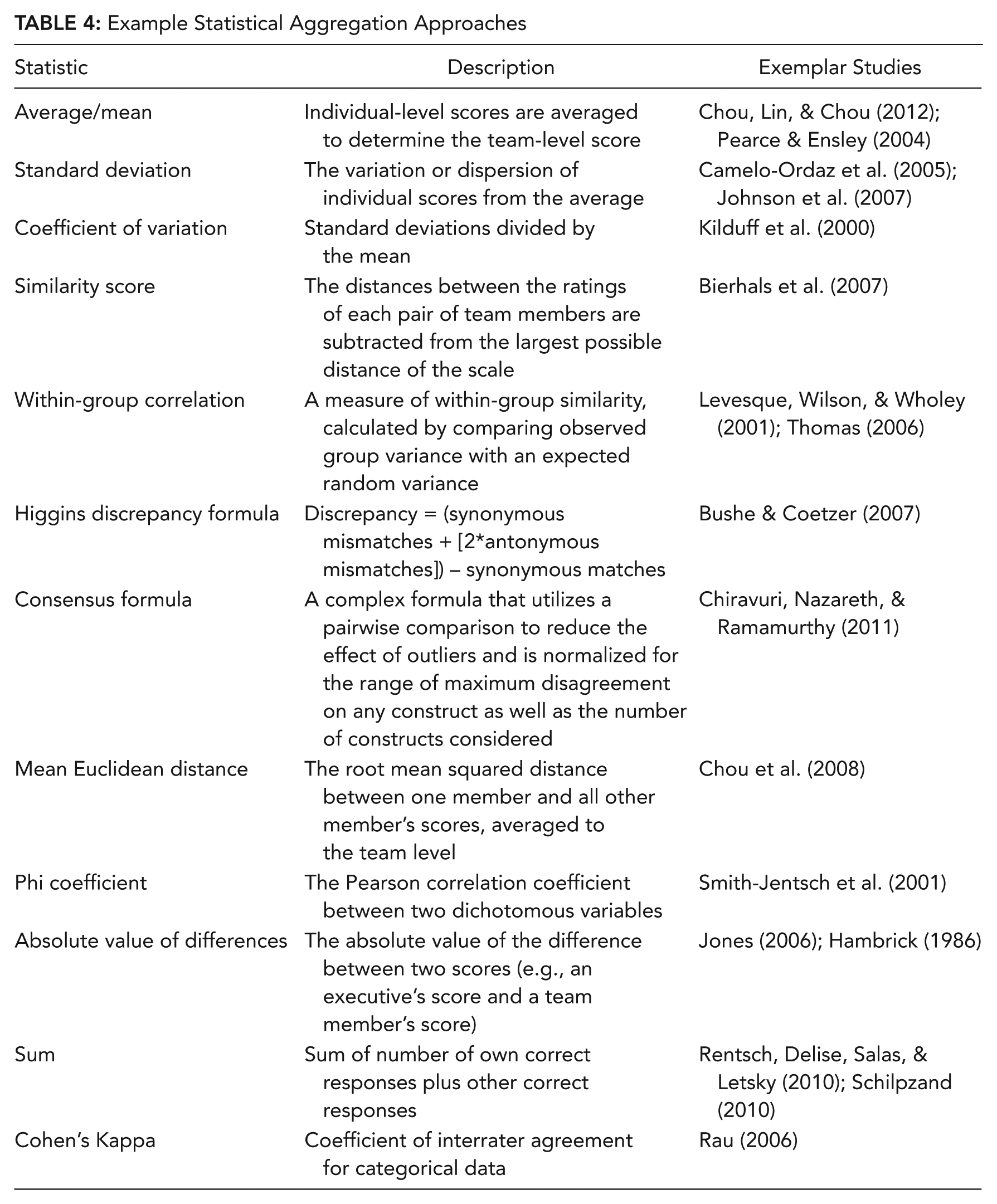
Unfortunately, within the literature, approaches like this are often misleadingly interpreted or labeled as representing the extent to which mental models are actually shared within a team (e.g., mutually shared cognition; Van den Bossche et al., 2006), but it should be emphasized that in reality, this aggregate score only represents the average perception or belief within the team regarding the team cognition construct in question. It does not, in fact, measure the content or structure of mental models and calculate the extent to which they are actually similar or different. Beliefs regarding similarity and actual similarity do not always coincide in teams, and this rule applies to beliefs regarding team cognition among other topics. Other statistical aggregation approaches (see Table 4 for summary) generally assess the similarity or difference between team members such as distance scores (e.g., Clariana & Wallace, 2007), agreement scores (e.g., Blickensderfer, Reynolds, Salas, & Cannon-Bowers, 2010), coefficient of variation (e.g., Kilduff, Angelmar, & Mehra, 2000), rwg (Boies & Howell, 2009), mean Euclidean distance (e.g., Chou, Wang, Wang, Huang, & Cheng, 2008), and standard deviation (Johnson et al., 2007).
Example Statistical Aggregation Approaches
Future research should begin to compare the predictive validity of the large variety of statistical aggregation techniques that exist. Meta-analytic findings have suggested that Pathfinder C statistics derived from pairwise relatedness ratings are more predictive than several other measures. However, it is unknown within, say, measures of agreement if rwg is more or less predictive than standard deviation or vice versa. Because the comparison of various statistical aggregation approaches does not require any extra data collection efforts because the same self-report data can simply be aggregated in multiple ways, the studies could very easily be developed without any extra time or effort necessary. In fact, past research that has already collected self-report measures could be reanalyzed using other statistical aggregation approaches.
Holistic Approach
A newer, and less established, analysis approach that can be used is the holistic approach. Cooke et al. (2007) used what they referred to as a holistic approach to measure the accuracy of team mental models. The team was given the same set of concepts (e.g., altitude, focus, zoom) to rate in pairwise relatedness ratings that they completed as individuals, but were asked to discuss the pairs and determine their relatedness ratings as a group. The concepts rated describe key elements of the unmanned aerial vehicle task undertaken by the team. This means the team ends up with only one set of responses that represent the team’s consensus decisions. Those responses were then submitted to Pathfinder network scaling, so this scoring approach can actually be a step prior to statistical aggregation if there is still a need to calculate accuracy. Cooke et al. (2007) is an example of self-reported knowledge being analyzed using the holistic approach.
Computational Scaling
Another way in which self-report data can be analyzed is via network scaling programs such as Pathfinder and UCINET. Pathfinder, the same program that can also be used for sequential pattern analysis of communication or observation data, has been used more extensively than UCINET for analyzing self-report data, but both should be mentioned as they have both been used in the team cognition literature. Pathfinder has most often been used to develop network structures using randomly ordered relatedness ratings (e.g., Cooke et al., 2003; Marks et al., 2002). In general, Pathfinder takes pairwise estimates of relatedness for a set of concepts and then generates a graphical representation of those concepts and their relations. The results of meta-analytic research has demonstrated that effect sizes between shared mental models and performance are highest when shared mental models are measured using pairwise relatedness ratings analyzed using Pathfinder compared to other methods such as Euclidean distance scores, within-group agreement scores, and other metrics (DeChurch & Mesmer-Magnus, 2010).
UCINET (Borgatti, Everett, & Freeman, 1992) is a similar network analysis program that shows the convergence between two matrices (Quadratic Assignment Procedure correlation). Mathieu, Heffner, Goodwin, Cannon-Bowers, and Salas (2005) used UCINET to create indices of mental model centrality and sharedness. UCINET yielded a centrality index for compared attributes. Mathieu et al. (2005) define this centrality index as “a measure of importance, or interlinkages, of an attribute to the overall network of attributes” (p. 43). This results in revealing network relationships similarly to how multidimensional scaling, Pathfinder, and other related algorithms work. A high centrality index suggests that the attribute is highly related to many or all of the other attributes in the network (e.g., the hub of a spider web). Similarly, the index of sharedness was also derived from the quadratic assignment proportion (QAP) correlation, which was also derived through UCINET. Mathieu suggests that QAP correlations are the equivalent to Pearson’s correlations but between two mental model matrices instead of individual items. This can capture the extent to which team member mental models show similar patterns of relationships. DeChurch and Mesmer-Magnus’s (2010) meta-analysis indicates that this is the only study that used UCINET to represent shared mental models, and the effect size relating shared mental models to performance was smallest for UCINET compared to other structural metrics.
Suggestions for Selecting Measures
Many scholars have already established that there is no best way to measure team cognition; the particular cognitive construct you are interested in eliciting and capturing will determine what measurement approach is most appropriate to use (Langan-Fox et al., 2000; Mohammed et al., 2000, 2010; Salmon et al., 2008; Smith-Jentsch, 2009). Therefore, the flowchart provided below is meant to help guide the interested researcher or practitioner in systematically thinking through some of the critical questions before determining the most theoretically appropriate team cognition measure for a particular purpose (see Figure 1).

Theoretically derived recommendations for selecting a team cognition data source.
The first question anyone interested in measuring team cognition must ask goes back to the primary theoretical distinction in the team cognition literature: Is team cognition being conceptualized as the content or structure of knowledge, or as team interaction? There are several examples within the reviewed literature in which various team cognition constructs have been studied using data sources that do not theoretically match the assumption of the construct. For example, knowledge structure (e.g., sharedness of mental models) has been studied using interaction-based data (e.g., communication transcripts), and interactions (e.g., coordination, knowledge building) have been studied using self-reported perceptions. We suggest that it is most theoretically appropriate to capture team cognition via a data source that fits the theoretical assumption of the construct being studied, if at all possible or feasible.
If the research or practical question at hand is conceptualizing team cognition as knowledge structure or content, then the next distinction that can be drawn between the various team cognition constructs is the temporal nature of that knowledge structure (Wildman et al., 2012). Specifically, some constructs are relatively stable over time (e.g., task or teamwork mental models), whereas others are more dynamic and change rapidly with the team’s environment (e.g., situation awareness). If the construct of interest is conceptualized as changing over time, then an in-task probe approach may be the most appropriate. However, note that we have suggested that in-task probes, although historically formed as basic knowledge tests, could potentially be designed using the formats from relatedness ratings, card sorts, and concept maps. Our decision-making tool only suggests that dynamic knowledge structures may be best measured using relatively more dynamic data collection tools.
Within more static knowledge structures, the next critical issue to consider when deciding between the various team cognition measurement approaches is whether you are interested in the actual structure or content of cognition, or in the perceptions of team members regarding team-level cognition. If you are interested in actual cognition, meaning, the actual existing content or structure of team cognition constructs, or the actual engagement in particular cognitive processes, then measures that tap perceptions are not ideal. Arguably, self-reported perceptions of team cognition tap an entirely different theoretical construct and, although perceptions have the potential to be accurate, they also have the potential to be inaccurate. It cannot be assumed that self-reported perceptions of team cognition represent the reality of team cognition constructs. However, self-reported perceptions of team cognition are entirely appropriate to use if you are interested in examining, for example, whether the extent to which individuals perceive they are on the same page with the rest of their team (i.e., have shared mental models) influences the extent to which they engage in monitoring, based on the logic that if they believe everyone knows what they are doing, they will also believe they do not have to double-check to make sure they are doing it.
Going back to the first decision point in our flowchart, if you are conceptualizing team cognition as interaction, we suggest that interactions are most appropriately captured either via communication or behavior data sources. This is because these are the only forms of data collection that actually capture the true interactions of the team in a relatively objective manner. Only when behavioral observation or communication recording are not possible should self-reported perceptions of process be used instead. In fact, Cooke et al. (2009) suggest that “measuring any aspect of the team independent of the team in action does not directly address team cognition” (p. 20) when taking the interaction-based perspective. Cognitive processes are dynamic interactions that are best measured as they occur over time rather than through other methods after the fact. For example, asking team members to self-report their past behaviors or interactions (e.g., Did your team engage in sense-making?) will likely not be as accurate as observing the actual interactions of the team and recording the occurrence of sensemaking behaviors as they occur. Self-reports of behaviors are sensitive to a host of response bias issues, as mentioned when discussing interview transcripts.
It is important to emphasize that the suggestions provided in the flowchart do not provide a definitive answer regarding what team cognition measurement approach to use in any given situation. Instead, they provide some guidance regarding the initial questions to consider when narrowing one’s search to the most theoretically appropriate set of tools. The flowchart only represents the appropriate theoretical decision points that would guide a researcher toward the best source for data collection when under the assumption that there are few or no restrictions on the researcher’s situation or resources. From there, it is still necessary for the researcher to fully explore the practical advantages and disadvantages of the method in consideration and to further determine exactly how team cognition will be analyzed within that data. There are many practical issues, such as expense, time commitment, and the characteristics of the particular teams in question, that would influence decision making but do not lend themselves to clear “decision points” that can be represented in such a flowchart.
For example, imagine that a researcher interested in studying team cognition has very limited monetary resources. This does not necessarily preclude them from selecting any of the available methodologies. The only data source that could really be considered “expensive” compared to the other sources would be video recording because of the need for video equipment and data storage devices (see Table 1). The other methods are, arguably, all methods that could be completed with very little monetary cost if approached in the right way. All self-reported sources of data (self-reported perceptions of team cognition and self-reported individual knowledge) would be similarly low in cost, as would be real-time observation of behavior and communication transcripts, assuming the researcher engages in all research activities personally. The latter two methods may take more time commitment from the researcher compared to self-report methods, but again, the actual cost associated could vary based on the researcher’s choices regarding the implementation of the method. For example, to individually transcribe and code all communication data for a set of teams would cost almost nothing in terms of money, but plenty in terms of personal time commitment, whereas sending the audio records out for professional transcription and then using multiple well-trained paid research assistants to do the coding would cost much more in terms of money but would simultaneously save time (i.e., the project could be completed more quickly). In other words, practical considerations such as the cost of the majority of the data sources are not constant and, therefore, cannot be included as decision points within the decision-tree. Instead, the following section will discuss several other critical considerations that can be used as supplementary information along with the theoretical decision-point flowchart.
Other Critical Considerations
Our evaluation thus far has focused on providing overarching information regarding the strengths and limitations of various data sources and the theoretical considerations to take into account when selecting a team cognition measurement method. However, it should also be known that some research has begun to directly compare the predictive power of different team cognition measurement approaches. Resick et al. (2010) compared the predictive ability of paired comparison relatedness ratings, priority rankings of task concepts, and importance ratings of task concepts. They found that paired comparison relatedness ratings analyzed using Pathfinder software were the only measures predictive of team performance. Consistent with this finding, DeChurch and Mesmer-Magnus (2010) meta-analytically found that measures that model the structure of knowledge were more predictive than measures that only tap into team member’s perceptions of team cognition. Cooke et al. (2013) have recently provided some evidence that interaction-based measures of team cognition can predict team performance better than those based on shared mental models. Of course, it is unlikely that predictive validity will be the only issue of concern to researchers and practitioners interested in measuring team cognition, but this information is valuable nonetheless.
One interesting theoretical issue that few scholars have discussed is the impact that team cognition measures may have on team cognition itself. Consider this: By asking individuals or teams to respond to questions about their own cognitive maps, structures, or processes, you are actually actively asking them to engage in metacognition. Metacognition, simply defined as “what people know about the way they process information” (Hinsz, 2004), is a relatively new and understudied cognitive process that occurs within individuals and teams. In other words, by measuring team cognition, there is a strong possibility that team cognition is being changed. Furthermore, if team cognition is measured holistically through methods such as team consensus surveys, the impact of measurement on team-level cognition is even more dramatic. Essentially, simply through this knowledge-based measurement, the team has been forced to explicitly engage in the very same activities that are considered team cognition from the interaction-based perspective, such as cognitive sensemaking (e.g., Albolino et al., 2007; Roberson, 2006) and knowledge sharing (e.g., de Vries, van den Hooff, & de Ridder, 2006).
This conundrum can be better understood when put into the metaphorical terms used by Cooke et al. (2009). These authors describe the study of cognitive processes as akin to studying the flow of water over various surfaces. If an instrument, meant to study the exact and natural flow of water, was inserted into a moving stream, it would divert the flow of the water. In the same way, by using measures of team cognition that require the team members to engage in meta-cognition or team-level cognitive processes that were not occurring prior to that measure, the natural progression of cognitive processes is diverted, and the construct being measured is no longer the same. This is a key theoretical difference between self-report data collection and unobtrusive (e.g., observation, communication coding) data collection that should be considered when making decisions regarding measurement.
Not only are there theoretical issues to consider when measuring team cognition, there are also many practical issues. One practical consideration to keep in mind when selecting or designing a team cognition measure is the amount of time that is available for the teams in question to complete measures. In some industries and types of teams, there is simply no time to stop and fill out self-report surveys of any sort, even if that has been determined to be the most theoretically appropriate type of measurement. For example, a military combat team engaging in downrange missions could not stop in the middle of its task to fill out surveys while on the job. This is one of the reasons that the vast majority of team cognition research has occurred in the laboratory or via organizational surveys. However, if the natural team cognition of a relatively action-oriented team is to be measured, it is somewhat more feasible to record its members’ radio communications if they are distributed or their in-person communications if they are colocated.
As another example, in military or other high-risk team situations (e.g., police, firefighting), direct observation may not be possible. However, given the availability of financial and technical resources, many relatively unobtrusive audio recording devices exist that could be used in these relatively hard-to-study contexts.
Team size and team heterogeneity are two more practical considerations for team cognition measurement. For example, imagine a large team with numbers in the double-digits that is composed of many highly differentiated roles. It may not be appropriate to attempt to conceptualize and measure shared mental models in a traditional manner in this team, as it is unlikely that all team members would share large portions of overlapping knowledge. Other methods, such as social network analysis, may be more appropriate for examining the distribution and coordination of knowledge within that situation. In other words, the size and expertise heterogeneity of the team may influence not only the most appropriate measurement approach but also the most appropriate theoretical perspective to study. Researchers and practitioners will need to think carefully about the measurement context before selecting any particular measurement approach.
Finally, there is a practical reality that some measurement approaches discussed are less labor intensive than others. Short, straightforward, Likert-type scale questionnaires such as the Lewis (2003) transactive memory system measure are much easier to administer, much easier for participants to complete, and much easier for researchers to score than techniques such as concept mapping or LSA of communication transcripts. However, as our review has concluded, there is not enough evidence at this point to support the superiority of one particular measurement approach over another in terms of predictive validity or theoretical value. In fact, all of the approaches discussed show promise as potentially useful measures for differing aspects of team cognition. Therefore, the authors would like to take this opportunity to make a request of future researchers: resist the temptation to cut corners and simply select the least labor-intensive method. Instead, we encourage researchers to carefully consider the relative strengths, weaknesses, and theoretical considerations that we have put forth when determining a measurement strategy. We suggest, and believe, that a thoughtful analysis of the wide range of methodologies available will result in more theoretically consistent, innovative, and useful research that cuts across the domains within team cognition.
Directions for Future Research
In terms of using existing measures in a new way, one interesting research direction that has yet to be explored would be to examine self-reported perceptions of team cognition and self-reported knowledge simultaneously in a study. For example, research questions could be formulated regarding the match between perceptions of team cognition and the actual structure of team knowledge and whether or not that match is predictive of important team processes and outcomes. Research has generally supported the fact that actual overlap in team cognition is beneficial for performance, and overlap in perceptions regarding team cognition is also beneficial. However, it is unknown what happens within a team if there is a large mismatch between these two constructs. Is it more important to truly have overlapping knowledge structures, or it is sufficient for team members to just believe that knowledge structures are overlapping even if they are not? Perhaps these two constructs predict different team processes: the overlap of actual knowledge structures has been related to better team coordination, but perhaps the overlap of perceptions of knowledge structures is more important for an interpersonally related process such as team conflict.
Finally, related to the concern raised regarding the potential influence of team cognition measurement on the actual development of team cognition, research should be designed that tests whether or not measurement has a distinguishable effect on the cognition of the team. For example, we suggested that the holistic approach to measuring team cognition may be the most problematic in terms of this potentially unintended influence. When a team is asked to sit down together and actively discuss their own cognition, it essentially represents a metacognition intervention or practice scenario for that team. Research could be used to compare the final cognitive structures in teams that do and do not engage in the holistic measurement approach in order to determine if the measurement method itself is acting as a metacognition intervention. If results confirmed this effect, the holistic approach to team cognition measurement may actually be more usefully described as a team cognition training tool, and future research could begin to examine its training utility.
Emerging Methods
Two interesting, but relatively nascent, methods worth mentioning were recorded in our review of the literature: social network analysis (SNA) and eye tracking. Although it is a pattern analysis methodology, researchers have recently begun to utilize SNA and related network analysis paradigms to study team cognition constructs. SNA is based on the perspective that individual behavior can be understood through the context of that individual’s social network (e.g., who they are linked with through communication, behavior, and family or friend circles). Commonly used for sociological purposes, this methodology is a useful strategy for studying social structures. SNA examines the structural factors of these relational ties such as (1) diameter (e.g., how many agents must be included for information to be communicated from one individual to another), (2) the density of the network (e.g., the proportion of relational links within the network and a proxy for speed of information communication within the team), and (3) the centrality of each individual within the network (e.g., how close each individual is to all others within the network). This appears to be both conceptually and computationally similar to communication flow analysis, which we have discussed previously.
SNA’s use in the team cognition domain is still emerging, but it shows potential to be a useful tool for team cognition research. SNA has already been used to study a variety of team cognition constructs including team SA (Sorensen & Stanton, 2011; Stanton et al., 2006), team mental models (Schneider, Graham, Bauer, Bessiere, & Gonzalez, 2004), and knowledge heterogeneity within teams and organizations (El Louadi, 2008). SNA has several benefits as a measure of team cognition: (1) it could allow for a greater understanding of the directionality and shape of transactive memory systems, knowledge structures, and shared SA within a team; (2) it can be used to identify central figures of great importance to team functioning and cognition; and (3) it allows for a holistic view of the studied contributors to team cognition. Although SNA has been used to study several team cognition constructs, it appears to be exceptionally well suited for studying transactive memory systems. Given that TMS relies on the flow of communication about who knows what information, there is great conceptual overlap between TMS and the network perspective. Indeed, the network perspective has been related to transactive memory systems and “social cognition” already (Borgatti & Foster, 2003).
Eye tracking is a common methodology used in human–computer interaction (HCI) and usability studies. Eye tracking, as the name suggests, tracks the eye’s movement and focus on various visual patterns (Hauland, 2008; Underwood & Everatt, 1992). Eye tracking appears to offer great benefits for team cognition researchers: it can monitor exactly what visual cues an individual is attending to throughout a task in a way that can allow a greater understanding of individual (and potentially team) cognitive processes over time. By tracking the eye’s movement and identifying the location of several cues at that time period, what an individual and what the team attends to over the course of a task can be monitored with a minimum of obtrusiveness within a laboratory setting. This added information could enhance the validity and richness of team cognition measures.
Despite its potential, few researchers appear to have used eye tracking as a team cognition measurement method in studies. Hauland (2008) used eye tracking methodology as part of a validation effort on methods for measuring both individual and team situation awareness. This study investigated the individual and team SA of student air traffic control teams in a simulated scenario. In addition to individual SA, Hauland found that team SA could be measured using eye tracking based on the co-occurrence of visual information seeking and acquisition (p. 301). Hauland’s findings suggest that objective cognitive measurements like eye tracking may be useful in simultaneously identifying both individual-level cognition as well as team cognition. For instance, might similarity in eye movements and focus on visual stimuli over the course of a task relate to shared task mental models? There is, however, at least one drawback to the use of eye tracking for measuring team cognition. Although eye tracking can measure the movements of an eye during a task (Smolensky, 1993), it is an indirect measure. For instance, it may be difficult to identify that the mind actually perceived the visual stimulus even though the eye might fixate on it. Future research should investigate the feasibility of including eye tracking and other objective cognitive measures (e.g., EEG, skin conductivity) into team cognition research and what the potential utility of these objective cognitive measurements might be in understanding and validating team cognition constructs.
Conclusion
The field of team cognition research has no doubt expanded in recent years and is likely to continue expanding. Many more research questions remain to be answered. Research and team managers alike will be faced with a series of choices if and when they decide to measure team cognition constructs. This article has provided an evaluative summary and examples of the various measurement approaches that have been used in the past along with some theoretical and practical advice regarding how to select from among the various methods. It has also provided several intriguing suggestions for using measurement methods across team cognition domains. We hope that the information provided serves as a practical tool as well as an inspiration for future research diving deeper into the realm of team cognition.
Key Points
Team cognition is a powerful and unique contributor to overall team performance, making it a critical construct for team researchers and practitioners to measure and understand.
Team cognition researchers should look across domains for innovative ways to measure constructs of interest.
Novice team cognition researchers beginning the search for a measure can use a series of critical questions to narrow down their choices to the most appropriate methods.
Footnotes
Acknowledgements
This research was supported by the Office of Naval Research (ONR) Collaboration and Knowledge Interoperability Program and Office of Naval Research Multidisciplinary University Research Initiative (ONR MURI) Grant N000140610446. The views, opinions, and suggestions contained in this article are the authors’ and should not be construed as official or as reflecting the view of the Department of Defense.
Jessica L. Wildman, PhD, is an assistant professor at the Florida Institute of Technology and the research director at the Institute for Cross Cultural Management. She earned her PhD in industrial/organizational psychology from the University of Central Florida in 2011. Her current research interests include interpersonal trust, multicultural performance, and team processes and performance. She has coauthored 19 journal articles and book chapters on topics including cognition in teams, virtual teams, performance measurement, interpersonal trust, collaboration, and cultural training. She has personally presented over 20 times at professional conferences.
Eduardo Salas, PhD, is trustee chair and professor of psychology at the University of Central Florida, where he also holds an appointment as program director for the Human Systems Integration Research Department at the Institute for Simulation and Training (IST). Previously, he was the director of University of Central Florida’s Applied Experimental & Human Factors PhD Program. Before joining IST, he was a senior research psychologist and Head of the Training Technology Development Branch of Naval Air Warfare Center Training Systems Division for 15 years. During this period, he served as a principal investigator for numerous R&D programs that focused on teamwork, team training, decision-making under stress, and performance assessment. He has coauthored over 375 journal articles and book chapters and has coedited 24 books. He was president of the Society for Industrial and Organizational Psychologists, and is a fellow of the American Psychological Association and the Human Factors and Ergonomics Society. He received his PhD in industrial/organizational psychology from Old Dominion University in 1984.
Charles P. R. Scott is a PhD student at the Florida Institute of Technology and a product development specialist for the Institute of Cross Cultural Management. He earned his BS in psychology from the University of Central Florida and worked for several years as a researcher for the Naval Air Warfare Center Training Systems Division. Past projects include studying item-response theory, cognitive measurement, and intelligent tutoring systems as they apply to simulation design and training. His current research interests include team processes, intercultural teams, global virtual teams, and leadership within teams.