




Abstract
Objective:
The aim of this study was to understand how the prolonged use of cockpit automation is affecting pilots’ manual flying skills.
Background:
There is an ongoing concern about a potential deterioration of manual flying skills among pilots who assume a supervisory role while cockpit automation systems carry out tasks that were once performed by human pilots.
Method:
We asked 16 airline pilots to fly routine and nonroutine flight scenarios in a Boeing 747-400 simulator while we systematically varied the level of automation that they used, graded their performance, and probed them about what they were thinking about as they flew.
Results:
We found pilots’ instrument scanning and manual control skills to be mostly intact, even when pilots reported that they were infrequently practiced. However, when pilots were asked to manually perform the cognitive tasks needed for manual flight (e.g., tracking the aircraft’s position without the use of a map display, deciding which navigational steps come next, recognizing instrument system failures), we observed more frequent and significant problems. Furthermore, performance on these cognitive tasks was associated with measures of how often pilots engaged in task-unrelated thought when cockpit automation was used.
Conclusion:
We found that while pilots’ instrument scanning and aircraft control skills are reasonably well retained when automation is used, the retention of cognitive skills needed for manual flying may depend on the degree to which pilots remain actively engaged in supervising the automation.
Introduction
Not long after the minimum training and experience requirements for pilots were established, regulators faced another challenge: determining the minimum recency requirements for maintaining the flying skills that pilots had acquired. That is, after painstakingly studying how long it takes to learn how to fly an airplane, researchers were soon after tasked with understanding how long it takes to forget.
Mengelkoch, Adams, and Gainer (1971) took up this question in their classic study of forgetting of instrument flying skills. The approach used by Mengelkoch and colleagues was to train their pilots to proficiency, stop their flying activity altogether, and then test them after 4 months had passed. Their findings served to complicate the original question about how long it takes to forget how to fly by demonstrating that instrument flying relies on different kinds of skills that show different patterns of remembrance and forgetting. One type of skill considered in the Mengelkoch study are the “hand-eye” skills used to scan instruments and manipulate flight controls. The researchers found that when these skills were initially well learned, they were surprisingly resistant to forgetting, even after 4 months of inactivity. Another type of skill considered in the study is the set of cognitive skills needed to recall procedural steps, keep track of which steps have been completed and which steps remain, visualize the position of the aircraft, perform mental calculations, and recognize abnormal situations. Like researchers before them, Mengelkoch and colleagues found that after 4 months of inactivity, pilots’ cognitive skills had significantly deteriorated (Boet et al., 2011; Schendel, Shields, & Katz, 1978).
Mengelkoch et al. (1971) used their findings to provide specific guidance to regulators who were tasked with setting minimum experience requirements and reiterated the point that learning and forgetting were inextricably linked. Hand-eye skills need to be well learned first, then practiced occasionally. Cognitive skills, regardless of how well they are initially learned, have to be practiced more often. The wisdom provided by this early research is evident in the regulations we have today. Pilots can wait almost 2 years without flying and still operate under visual flight rules (with no passengers aboard). If they want to exercise the privileges of operating under the more cognitively demanding instrument flight rules, 6 months of inactivity is the limit.
More than 50 years later, we are once again worried about skill decay among pilots, especially those who fly for commercial carriers. As today’s cadre of airline pilots are kept quite busy, we are now worried about a different kind of inactivity: that sprung from the prolonged and increasing use of cockpit automation.
Cockpit automation systems now routinely assume primary responsibility for many piloting tasks that once relied exclusively on the hand-eye and cognitive skills of human pilots. Pilots no longer have to constantly scan flight instruments; decide which control inputs are needed to pursue a desired heading, course, altitude, or speed; or manually carry out those control inputs. Today, pilots can use a flight director that automatically determines which control inputs are needed and use autopilot and autothrottle systems that automatically manipulate the aircraft controls.
In addition to automating the processes of instrument scanning and control manipulation, two other cockpit automation systems are capable of directly performing many of the cognitive tasks required by instrument flight. A flight management computer (FMC) automates much of the task known as navigation. FMCs allow pilots to enter, in advance, a sequence of waypoints, courses, altitudes, and airspeeds that compose an entire flight route. After performing all of the bearing, distance, time, and fuel calculations, the FMC tracks the position of the airplane at all times, automatically determines when the airplane reaches each waypoint, automatically reconfigures the airplane’s navigation equipment, and sends it on its way to the next waypoint in the sequence. An engine indicating and crew alerting system (EICAS) assists the flight crew in recognizing instrument system failures by automatically monitoring these systems, identifying failures when they occur, and recommending remedial actions for many types of system failures.
The increasing prevalence and use of cockpit automation systems naturally raises the question of what is happening to pilots’ ability to exercise the hand-eye and cognitive skills needed to operate an aircraft “the old-fashioned way.” When assessing the likely impact of cockpit automation systems on pilots’ skills, it is tempting to point to Mengelkoch et al.’s (1971) earlier study and simply reiterate their results. But what is different about our current situation is that cockpit automation does not altogether eliminate pilots’ opportunity to use their manual flying skills. In today’s automated cockpit, two types of opportunity remain for keeping one’s skills sharp. First, many airlines permit their pilots to occasionally turn off automated systems in order to practice their instrument flying skills. Second, it is a matter of standard operating procedure for pilots to maintain a close oversight of the steps taken by these automated systems. For example, when the FMC calculates a new top-of-descent point, the flight crew is expected to back it up with an informal calculation. When the FMC pursues a new course, the crew is expected to consult a chart to make sure the new course is the right one.
Nevertheless, Mengelkoch et al.’s (1971) study leaves us with some specific hypotheses about what we might expect to see if we tested pilots’ ability to fly the airplane without the use of cockpit automation. If pilots initially attain proficiency with instrument scanning and manual control skills, we might expect these skills to remain strong, even if pilots report that they do not practice them regularly. And if pilots remain actively engaged in the navigation and system monitoring process, watching “over the shoulder” of the FMC and EICAS systems as they do their work, we might expect pilots’ cognitive skills to remain reasonably intact. On the other hand, if pilots’ approach to using automation is better characterized as one of “set it and forget it” (Casner & Schooler, 2014), we might expect to see navigation and failure recognition skills in a state of atrophy.
Method
In this experiment, we surveyed pilots about their initial training and recent practice with the instrument flying skills that are now frequently handled by cockpit automation systems. We then tested these skills by asking pilots to fly with and without each automation system through three different phases of flight.
Participants
Sixteen active Boeing 747-400 pilots who are employed by U.S. carriers, seven captains and nine first officers, participated in the study on a voluntary basis. Pilots had an average of 17,844 hr of total flight time (SD = 9,736), an average of 623 hr during the past 12 months (SD = 198), and an average of 13 hr during the past 7 days (SD = 14). Pilots reported having accumulated 73% of their total flight time in airplanes equipped with an FMC and 89% of their time in airplanes equipped with a flight director. In exchange for their participation, pilots received a standard hourly participant pay rate and reimbursement for any travel expenses incurred.
Testing Hand-Eye Skills: Instrument Scanning and Manual Control
To assess pilots’ instrument scanning and manual control skills, we asked pilots to fly the airplane along routes programmed into the FMC using three different combinations of automation systems. In the autoflight condition, pilots used the autopilot, flight director, and autothrottle to follow the FMC-programmed route. In the manual control condition, pilots used the flight director and autothrottle systems while manually manipulating the control yoke in response to flight director commands that directed them along the FMC-programmed route. In the raw data and manual control condition, pilots refrained from using the autopilot or the flight director (e.g., manipulated the control yoke and thrust levels while referencing their primary flight instruments) while following the FMC-programmed route. We asked each pilot to fly during three phases of flight (i.e., arrival, approach, and missed approach) in the three automation conditions as shown in Table 1. To save time, we did not ask pilots to fly all three flight phases using the autopilot as we did not expect to see much variation in pilots’ performance across the three flight phases when the autopilot was used.
Flight Scenarios Flown by Each Participant Pilot

As pilots flew in each of the conditions described in Table 1, we scored them on their ability to meet the course, altitude, and speed assignments that made up the flight route.
Testing Cognitive Skills: Navigation and Failure Recognition
To assess pilot’s navigation skills, we asked pilots to navigate using the flight management computer in one condition and using conventional VHF omnidirectional range (VOR) navigation equipment in another condition as we graded their performance on eight navigation tasks. Aside from requiring different procedures to operate them, the two types of navigation equipment differ more strikingly in how much pilot involvement they require as the aircraft makes its way along the planned flight route. Whereas VORs require the pilot to closely follow the progress of the flight and reconfigure the equipment as it arrives at each waypoint, the FMC permits the pilot to program the entire route prior to departure and to think of the navigation process as a “once-and-done” programming exercise.
We presented pilots with three instrument systems failures while we tested their ability to recognize abnormal instrument indications and to confirm the malfunction by cross-checking instrument indications throughout the cockpit. Without pilots’ knowledge, we disabled the EICAS system warnings that alert pilots to instrument system failures. In the first two failures, we introduced an error in the participant pilot’s heading indicator and altimeter while leaving the heading indicators and altimeters in the cockpit in working order. In the third failure, we blocked the pitot-static system, which caused all airspeed indications in the cockpit to be consistently erroneous.
Measuring Task-Related and Task-Unrelated Thought
Our hypotheses rely on having some sense of what pilots are thinking about while they fly: whether their thoughts remain focused on flight-related concerns or have drifted on to matters that lie outside the cockpit. As pilots flew, an experimenter verbally probed them roughly every 2 min about the content of their thoughts. Rather than asking pilots to explicitly describe their thoughts, pilots were asked to categorize their thoughts using a technique presented in an earlier study of task-unrelated thought among airline pilots (Casner & Schooler, 2014). Pilots reported a thought category of 1 when they felt they were thinking about a “task at hand”; a category of 2 for more abstract flight-related thoughts, such as “thinking ahead”; and a category of 3 for thoughts that were unrelated to the flight. The verbal thought probing technique is a generalization of a technique first used by Singer (1966) and has been shown to be minimally intrusive and correlate well with physiological measures of task-unrelated thought (Smallwood et al., 2011).
Apparatus
The Boeing 747-400 (Level D) flight simulator located at the NASA Ames Research Center was used for the experiment. The avionics configuration used by the employer of each pilot was provided during each simulator session. Pilots used open-microphone headsets to communicate with a simulated air traffic control facility that was located in a different room in the simulation facility. Video cameras and microphones, located throughout the cockpit, were used to capture pilots’ activity. A short paper-and-pencil survey was used to collect information about how much initial training and recent practice pilots had with instrument scanning, manual control manipulation, navigation, and instrument failure recognition skills.
Procedure
Prior to entering the simulator, pilots met with the experimenters in a briefing room. Pilots were told that the experiment would last a total of about 5 hr and would be split up into two sessions with a lunch break in between. At that time, pilots completed the paper-and-pencil survey about training and recent practice with manual flying skills.
In the simulator, each pilot sat in his or her respective seat: Captains occupied the left seat; first officers occupied the right seat. Each pilot was asked to do all of the flying but could delegate tasks to a confederate copilot who occupied the remaining seat. Pilots were told that the confederate pilot would carry out routine delegated tasks at the request of the pilot flying but would not offer the advice or informational assistance (e.g., pointing out anomalous events, suggesting solutions) that a copilot would during an actual flight. The copilot was the same for each session and is currently employed as a B747-400 pilot at a U.S. carrier.
To avoid familiarity with the airport and associated terminal area used during the simulation, we chose an airport (Memphis) to which most pilots in our sample had never flown.
At the conclusion of the simulator session, all pilots were debriefed and told the basic purpose of the study.
Results and Discussion
Hand-Eye Skills: Instrument Scanning and Manual Control
The survey responses summarized in Table 2 show that pilots reported having a strong background in basic instrument flying, moderate recent experience in flying without an autopilot, and very little recent experience flying with both the autopilot and flight director turned off.
Pilot Experience Survey: Hand-Eye Skills
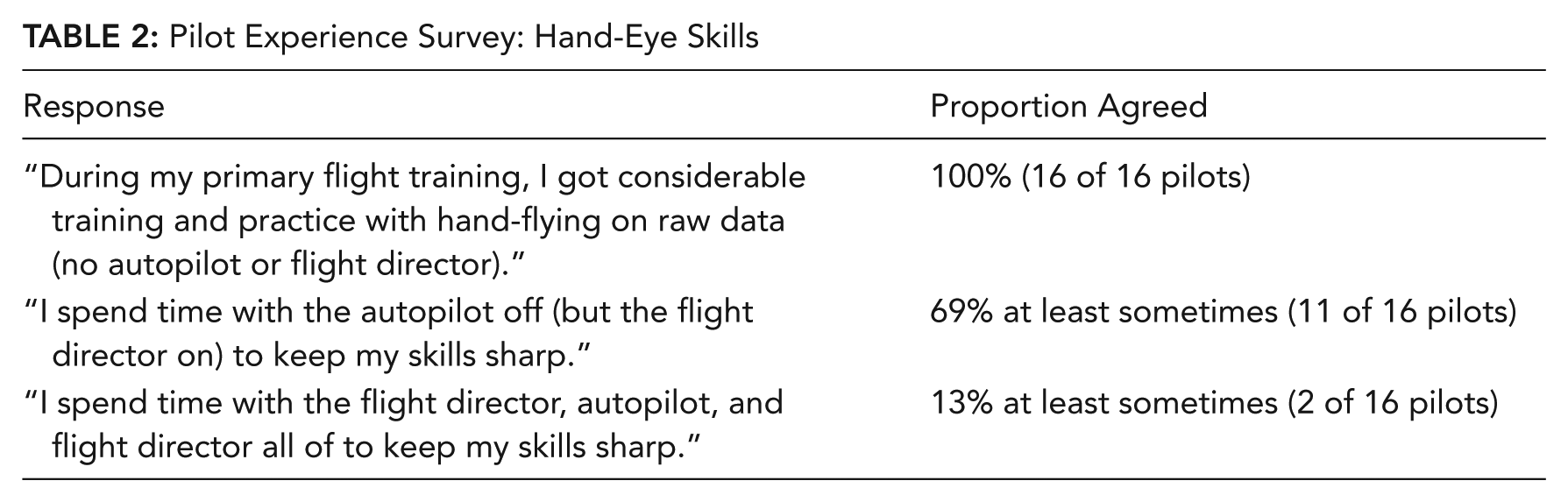
Table 3 shows the percentage of course, speed, and altitude assignments for which pilots committed at least one operationally significant deviation in each of the three automation conditions and during each of the three phases of flight. A speed or altitude deviation was recorded when pilots strayed more than 10 knots (kts) from an assigned speed or 300 feet from an assigned altitude. A course deviation (i.e., deviation from an airway, localizer, or glide slope) was recorded when pilots experienced a full-scale deflection of a course deviation indicator.
Pilots’ Flying Performance (Instrument Scanning and Manual Control Skills) in Three Automation Conditions (N = 16)
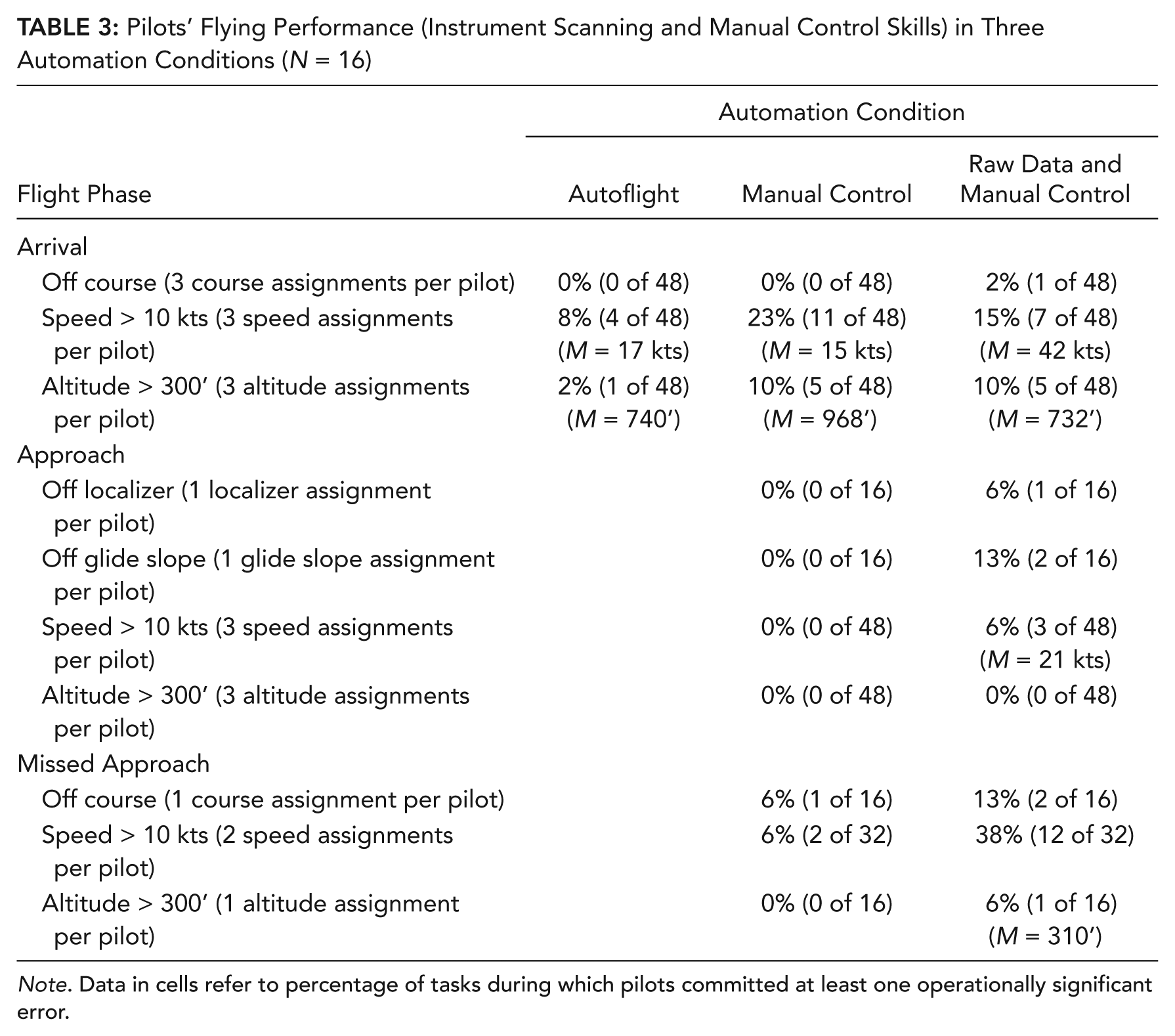
Note. Data in cells refer to percentage of tasks during which pilots committed at least one operationally significant error.
We used binary logistic regression to test the association between automation condition and recent practice experience (two predictor variables) and pilots’ success in carrying out course, speed, and altitude assignments (three outcome variables) for each of the three phases of flight.
For the arrival phase, there was no significant association between automation condition or recent practice on pilot performance. The elevated numbers of missed speed and altitude assignments we observed in the manual control condition and the raw data and manual control condition are quite interesting. These numbers points to possible problems with the autothrottle system, or pilots’ understanding of it, when it is not used together with the autopilot in a totally automated fashion.
During the approach phase, there was again no significant association between automation condition or recent practice and pilot performance. For the few localizer and glide slope deviations we observed, the deviation was quickly recognized by the pilots, who initiated an immediate go-around procedure.
During the missed approach phase, we found a significantly higher likelihood of a speed deviation in the manual control condition when compared to the raw data and manual control condition (χ2 = 9.94, p < .01, odds ratio [OR] = 9.0). Pilots’ scanning and manual control skills seemed to be more likely overwhelmed in the midst of this high-tempo phase of flight.
Overall, the data in Tables 2 and 3 support the findings of the Mengelkoch et al. (1971) study: Pilots’ instrument scanning and manual control skills, which had once been formally trained and tested, seem reasonably well-retained even in the absence of regular practice. Nevertheless, echoing the results of a study by Ebbatson, Harris, Huddlestone, and Sears (2010), these skills still exhibit some atrophy that perhaps merits additional practice.
Task-unrelated thought
There was a significant effect of automation condition on the percentage of time pilots spent engaging in task-unrelated thought: F(2) = 4.09, p < .05. The percentage of time pilots spent engaging in task-unrelated thought in the three conditions was as follows: autoflight = 20.0%, manual control = 11.7%, and raw data and manual control = 6.9%. We observed no significant correlations between the percentage of task-unrelated thoughts and number of course, altitude, and speed deviations observed while pilots flew in any automation configuration. These finding suggest that when scanning instruments and manually operating controls, pilots do not seem to let their thoughts wander to such an extent as to lead to course, speed, and altitude deviations.
Cognitive Skills: Navigation
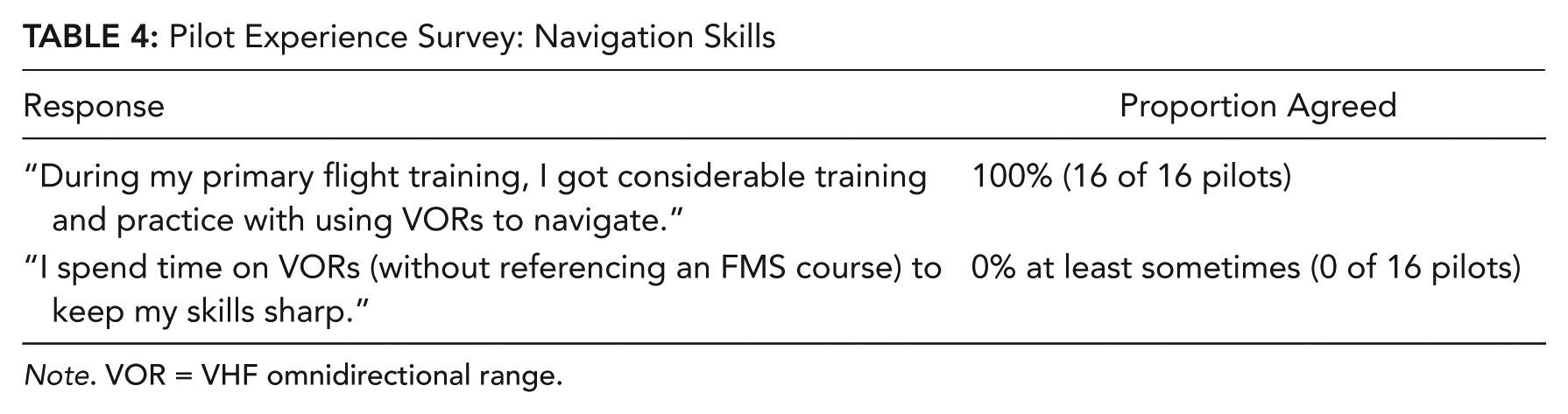
The survey responses summarized in Table 4 show that pilots reported having a strong background but no recent experience with conventional navigation. Table 5 details pilots’ success while performing eight aspects of the navigation task as they flew an arrival, approach, and missed approach without the use of the FMC. The data in Table 5 indicate the percentage of navigational tasks during which pilots committed at least one operationally significant error. The criteria used to score altitude and airspeed deviations are the same as used for Table 3. For the tasks of navigating to a VOR station or missed approach point, a deviation was recorded when pilots missed the assigned point by more than 3 nautical miles (NM). Deviations greater than 10° from an assigned heading were recorded as significant.
Pilot Experience Survey: Navigation Skills
Note. VOR = VHF omnidirectional range.
Pilots’ Performance When Navigating Without the Use of the Flight Management Computer (N = 16)

Note. VOR = VHF omnidirectional range.
All but 1 pilot demonstrated their ability to tune a VOR station and an inbound course to the VOR station, and only 1 pilot experienced difficulty navigating to a VOR station. Five altitude assignments were missed when 4 pilots failed to execute a descent to an altitude that they had read on their chart and verbalized. Four pilots failed to set the final approach course printed on the approach chart. These same 4 pilots flew 2 NM or more to the east of the missed approach point. Another 3 pilots announced the missed approach point 3 or more nautical miles before or beyond the actual missed approach point. Three pilots descended below the published minimum descent altitude, and 6 pilots failed to fly the published heading for the missed approach. Only 1 pilot was able to complete the arrival, approach, and missed approach without committing any of the errors described.
Pilots’ success in operating the VOR equipment and arriving to the VOR station suggests that the other difficulties we observed were not due to forgotten VOR procedures. The more serious errors we observed occurred when pilots failed to periodically reference the charted procedure, assess where they were, and determine what needed to happen next. These failures implicate higher-level cognitive skills related to managing the navigation process. Again, the FMC largely automates these processes and features a map display that provides a simplified picture of the aircraft position with respect to the planned course.
Overall, like instrument scanning skills, pilots reported that navigation skills, once initially mastered, are seldom, if ever, practiced. But rather unlike instrument scanning skills, which are resistant to forgetting, navigation skills that have been supplanted by the use of cockpit automation are highly susceptible to forgetting and likely require frequent practice to keep them sharp.
Task-unrelated thought
We hypothesized that pilots could maintain their navigation skills by actively monitoring the FMC as it handled much of the navigation task. Although we found that all pilots considered together were less likely to engage in task-unrelated thought when the FMC was not available (20% vs. 5%), t(15) = 3.67, p < .01, we observed a significant positive correlation between the number of errors committed and the percentage of task-unrelated thoughts that pilots reported, r(14) = .56, p < .05. This finding demonstrates that pilots whose thoughts drifted more often than others committed more errors than others and that task-unrelated thought accounted for roughly 30% of the variability in performance we observed. Poorer-performing pilots may have fallen out of the habit of closely following the navigational progress of the flight when the FMC is used.
Cognitive Skills: Instrument System Failure Recognition
Table 6 summarizes pilots’ responses to the survey question about how often they practice recognizing instrument system failures. Again, we see a familiar pattern of strong initial preparation combined with modest recent practice.
Responses to Pilot Experience Survey: Recognizing and Dealing With Puzzling Instrument Indications
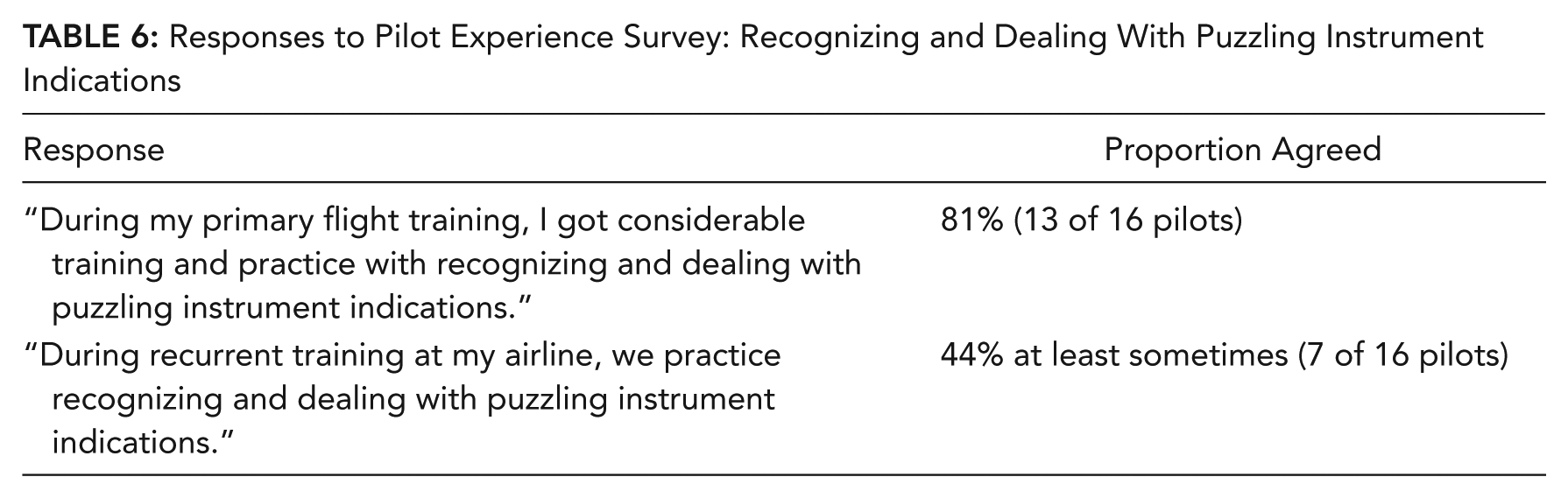
Table 7 shows pilots’ responses to the three instrument system failure events. As shown in the first row for each event, with a single exception, all 16 pilots provided some sort of verbal acknowledgement that something was amiss. Where we observed the interesting differences among pilots was in what pilots did after a problem was announced. The second row for each event shows the percentage of pilots who undertook a cross-check of the other instruments in the cockpit, as evidenced by explicit verbal comments or a turn of the head toward the other side of the cockpit. In the cases of the faulty altimeter and heading indicator, pilots had other instruments available in the cockpit that provided correct readings. Yet only 69% and 63% of pilots were observed looking at or making verbal reference to the alternative altimeters and heading indicators. In the case of the faulty airspeed indications, all but 1 pilot made an obvious attempt to check other cockpit instruments although no reliable indication of airspeed was available in the cockpit as the entire pitot-static system had failed.
Pilots’ Performance During the Three Instrument System Failure Events (N = 16)
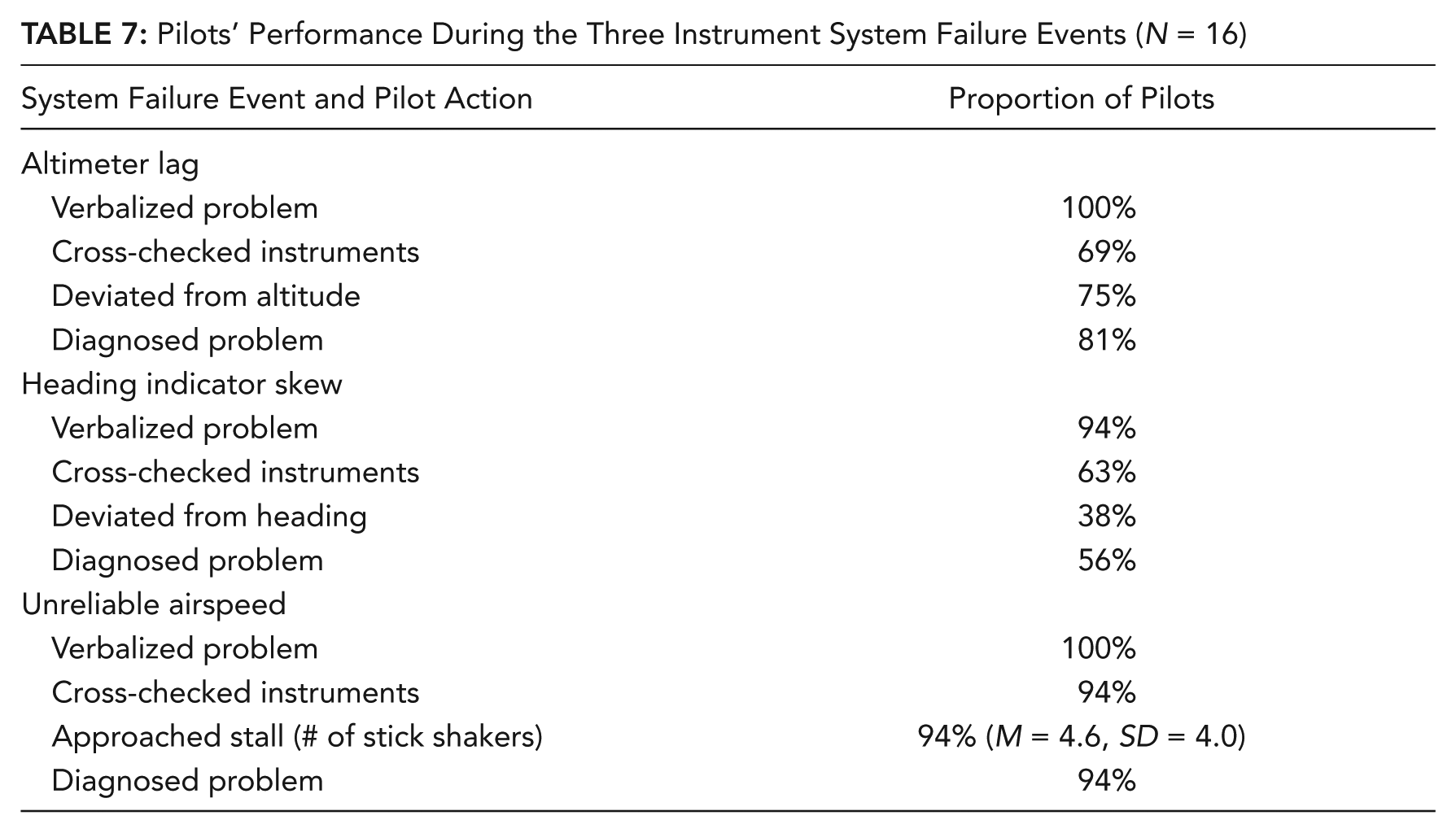
Looking at the third row for each event in Table 7, one can see the percentage of cases in which the faulty instrument or instrument system resulted in a deviation from the assigned altitude or heading or in the airplane approaching a stalled condition. In the case of the faulty altimeter, 75% of all pilots disregarded the flight director and followed the faulty instrument until deviating from the assigned altitude by more than 300 feet and triggering the altitude alerter. Among the five cases in which pilots did not cross-check the other altimeters, all five resulted in an altitude deviation. In the case of the faulty heading indicator, 6 out of 16 pilots followed the faulty instrument and deviated from the assigned heading. In the case of the faulty pilot-static system, all but 1 pilot followed the erroneous airspeed indicator to the point at which the stall warning system was triggered. Interestingly, 14 of the 16 pilots decreased pitch in response to the first stick shaker event, but only 5 increased thrust. Eight of the 16 pilots experienced no more than two stick shakers before resolving the problem. The remaining 8 pilots experienced 4, 5, 6, 7, 8, 10, 10, and 13 stick shakers. It is clear from these data that at least half of the pilots had trouble resolving the puzzling indications they were seeing or in responding to the stick shaker event.
Interestingly, pilots who reported at least sometimes practicing recognizing and dealing with puzzling instrument indications during recurrent training performed no better on any of the three instrument failure events. One possibility is that practice for these events is limited to a few familiar failures and does not extend to a more general treatment of abnormal events (Casner, Geven, & Williams, 2013).
Overall, the data suggest that pilots performed well at detecting failures but often neglected to cross-check other instruments, diagnose the problem, and avoid the consequences of an unresolved failure. In regard to the reported frequency at which pilots receive initial and recent practice in dealing with puzzling instrument indications, our findings suggest that this sort of skill is vulnerable to forgetting and could also benefit from more emphasis during initial and recurrent training.
Task-unrelated thought
Although we did not attempt to administer thought probes during the failure events, we attempted to correlate pilots’ performance on the failure events and the percentage of task-unrelated thoughts pilots reported across the entire simulator sessions. For the unreliable airspeed event, there was a large positive correlation between the percentage of task-unrelated thoughts throughout the simulator session and the number of stick shakers experienced during the failure event, r(14) = .76, p < .001. A higher tendency to engage in task-unrelated thought was associated with prolonged struggles in resolving the conflicting instrument indications that pilots were seeing. These results suggest that pilots who habitually turn to task-unrelated thoughts when automation is used may experience a greater atrophy in their ability to sort out abnormal events.
Summary and Conclusion
We tested the manual flying skills of a sample of airline pilots who have spent the majority of their flying careers operating highly automated airplanes. Like the previous study by Mengelkoch et al. (1971), we observed a dichotomy in pilots’ ability to fly “by hand.” Pilots’ instrument scanning and manual control skills, which at some earlier time had been practiced to the point of implicitness, were found to be largely intact. As observed by Ebbatson et al. (2010), the deficiencies we observed in these skills amounted to a degree of “rustiness,” whereby few operationally significant errors were observed. However, when we tested the cognitive skills that accompany manual flight, we observed more frequent and serious problems. Pilots sometimes struggled to maintain an awareness of where the airplane was with respect to the planned route, to reference their charts to keep track of what came next, to configure the airplane anew as they passed each important waypoint along the planned route, and to recognize and deal with instrument systems failures when they arose. Most ironically, a stated purpose of cockpit automation is to afford pilots more time to concentrate on following the progress of the flight. An explanation for this conundrum may lie in how pilots choose to invest their free time. If pilots reinvest their free time into actively following the progress of the flight, we might expect these skills to remain in fine fettle. On the other hand, if pilots rely on automation alone to perform these tasks, we might expect to see these skills atrophy as a result of disuse. The significant associations we observed between measures of task-unrelated thought and pilots’ performance support the latter explanation. Pilots who kept their minds on task more performed better.
Recommendations
Our results suggest a number of recommendations for how to maintain proficiency with manual flying skills. Our findings suggest that raw-data flying skills could benefit from at least some additional practice and that the current practice of manually operating flight controls in response to flight director commands probably falls short of keeping instrument scanning skills sharp. It is important to note that this recommendation assumes that pilots attain an initial level of mastery with these skills (Farr, 1987; Schendel et al., 1978). Any change in the way that pilots are trained in the future, particularly a reduced emphasis on stick-and-rudder or instrument scanning skills, may invalidate the findings we have presented here.
Our observations of the cognitive skills associated with manual flight, such as navigation and diagnosing instrument system failures, suggest two possible remedies. One possibility is to provide pilots with more frequent practice with these cognitive skills. Pilots might practice these skills during flight or during recurrent training. Alternatively, there is good evidence that computer-based simulators might be effective for maintaining these sorts of skills (Taylor et al., 1999). A second possibility is to promote the use of more active automation monitoring practices (Sumwalt, 2003). This proposal suggests the need for a further study of the effect of active monitoring on procedural skill retention and, perhaps more importantly, if improvements in the human monitoring of automated systems are even possible. There is accumulating evidence of the difficulty in maintaining one’s thoughts focused on the activities of an automated system that seldom fails (Casner & Schooler, 2014).
Key Points
Hand-eye skills (instrument scanning and manual control), if initially well learned, are reasonably well retained after prolonged use of automation.
Cognitive skills, such as navigation and failure recognition and diagnosis, are prone to forgetting and may depend on the extent to which pilots follow along when automation is used to fly the aircraft.
Footnotes
Acknowledgements
We thank Kevin Koehn for assistance in transcribing and analyzing the simulator data. Immanuel Barshi and Mike Feary provided helpful insights throughout the project.
Author(s) Note:
The author(s) of this article are U.S. government employees and created the article within the scope of their employment. As a work of the U.S. federal government, the content of the article is in the public domain.
Stephen M. Casner is a research psychologist at the NASA Ames Research Center. He holds a PhD from the Intelligent Systems Program at the University of Pittsburgh and an FAA Airline Transport Pilot certificate. His research focuses on the impact of technology on humans at work.
Richard W. Geven is a research associate with the San Jose State University Research Foundation. Richard holds an airline transport pilot certificate and is a captain for a corporate air charter company. Richard holds a master’s degree in jazz performance from the Graduate School for the Arts in Arnhem, Netherlands.
Matthias P. Recker is a research associate with the San Jose State University Research Foundation. Matthias holds a BS in earth science from the University of California, Santa Cruz. Matthias flies a Boeing 747-400 as both captain and first officer for passenger and cargo companies.
Jonathan W. Schooler is Professor of Psychological and Brain Sciences at the University of California, Santa Barbara. Jonathan received his PhD in cognitive psychology from the University of Washington. His research focuses on the nature of mind wandering and its impact on cognitive functioning.