




Abstract
Objective:
To determine whether perceived time progression (PTP) moderates participants’ negative reactions to vigilance tasks.
Background:
Vigilance tasks are rated by participants to be unenjoyable and as having high levels of workload and stress. Based on the adage, “You are having fun when time flies,” we tested the possibility that accelerating PTP might reduce these negative experiences.
Method:
Two studies were performed, involving a long 30-min and a short 12-min vigil. We manipulated participants’ PTP by creating a mismatch between their expectations about how long they would perform the task and the actual time that they were engaged.
Results:
PTP was significantly faster for participants who were led to expect that the vigilance task would last longer than it did relative to those led to expect that task duration would be shorter than it actually was and for controls for whom task duration was equal to the expected duration. However, accelerating PTP had no effect in either experiment on undesirable reactions to the vigilance tasks. Participants uniformly rated both tasks as unenjoyable, as having a high level of workload, and as stressful. Apparently, vigilance isn’t fun even when time flies.
Conclusion:
Our findings greatly underscore the depth to which negative subjective reactions are embedded in the nature of vigilance tasks and therefore that these tasks can have potentially serious costs to participants in terms of health, safety, and productivity.
Application:
These costs must be considered at the operational level.
General Introduction
Participants in vigilance or sustained attention tasks are required to maintain their focus of attention and detect infrequent and unpredictable targets over extended periods of time (Davies & Parasuraman, 1982; Hancock, 2017). These tasks play a pivotal role in automated human-machine systems. Advancements in automation technology have relegated workers in many settings to supervisory roles in which they monitor system processes/functions and take action only when problems arise (Endsley, 2017; Hancock, 2014; Sheridan, 1980). Thus, vigilance is a crucial element in a broad array of work environments including military surveillance; air traffic control; airport, border, and cyber security; industrial quality control; and medical monitoring (see Funke et al., 2016; Warm, Finomore, Vidulich, & Funke, 2015, for summaries and Arrabito, Ho, Aghaei, Burns, & Hou, 2015; Greenlee et al., 2016; Meuter & Lacherez, 2016; Sawyer et al., 2015; Stearman & Durso, 2016). In situations such as these, poor vigilance on the part of participants has resulted in documented accidents (Hawley, 2006; Langner & Eickhoff, 2013; Molloy & Parasuraman, 1996; Warm et al., 2015; Wiggins, 2011). To avoid such negative consequences, it is vital to understand as much as we can about the dynamics of participant experiences during the performance of vigilance tasks (Hancock, Volante, & Szalma, 2016; Warm, Parasuraman, & Matthews, 2008).
Since vigilance tasks, like human activities in general, are performed within a perceived temporal framework and since much of human behavior is linked to an understanding of time, the present study addressed the possibility that the temporal context is a moderator variable for behavioral effects associated with vigilance assignments. Initial research along that line was conducted several decades ago by McGrath and O’Hanlon (1967). In their experiment, participants were required to detect brief offsets of a small display light during an hour-long vigil. Signal detection was highest among those who thought that the hour had passed more quickly than it physically did, that is, among those for whom task time seemed to fly. As McGrath and O’Hanlon noted, this type of temporal orientation outcome had been found before in tasks other than vigilance (Loehlin, 1959). As such, it is consistent with a common belief that “you are having fun when time flies” (Sackett, Meyvis, Nelson, Converse, & Sackett, 2010; Simen & Matell, 2016).
Although signal detection was the key dependent variable in the McGrath and O’Hanlon (1967) study, as well it should have been, there is another important aspect to consider. That aspect is how the task affects the participants themselves. Early investigators viewed vigilance tasks as mundane but benign assignments that place little demand upon participants (Frankmann & Adams, 1962; Nachreiner & Hänecke, 1992). In recent years, however, it has become evident that vigilance tasks are quite mentally demanding and stressful (Warm, Parasuraman, et al., 2008). Given the mounting evidence that stress plays a major role in worker health, safety, and productivity (Hancock & Warm, 1989; Huey & Wickens, 1993; Miller, Chen, & Zhou, 2007; Nickerson, 1992; Strauch, 2002), the workload and stress induced by vigilance tasks is concerning. Consequently, the two studies described in this report were focused on how those cognitive/hedonic dimensions are influenced by participants’ perceived flow of time in the course of task performance.
Both studies made use of a procedure developed by Sackett et al. (2010), who employed it to accelerate or decelerate the perceived flow of time or perceived time progression (PTP) while participants were engaged in a mundane task. Participants were required to underline all words containing double letter combinations in selections of text. The investigators created a mismatch between participants’ expectations about how long they would be performing the task and the actual time that they performed. All participants performed the task for an identical period of time, 10 min. However, in a time flies condition, they were told that they would be working for a longer duration—20 min—than they actually did, and in a time drags condition, they were told that they would work for a shorter duration—5 min—than they actually did. Sackett and his colleagues found that upon task completion, participants in the time flies condition rated time as having passed more quickly than did those in the time drags condition and rated the task as more enjoyable. In other aspects of the Sackett et al. (2010) study, acceleration of PTP resulted in judgments that noises were less irritating and songs were more enjoyable. As the authors noted, participants use subjective time progression in hedonic evaluation consistent with the adage “you are having fun when time flies.”
Experiment 1
Much of the evidence concerning task demand in vigilance comes from studies employing the NASA Task Load Index (NASA-TLX; Hart & Staveland, 1988), a widely used subjective workload measure considered to be one of the most effective means of quantifying perceived mental workload (Wickens, Hollands, Banbury, & Parasuraman, 2013). The NASA-TLX provides a reliable measure of overall or global workload on a scale from 0 to 100, and it identifies the contributions of six sources of workload: mental demand, temporal demand, physical demand, performance, effort, and frustration. Vigilance studies employing the NASA-TLX indicate that global scores typically fall within the upper level of the scale, exceeding those characteristics of other types of tasks such as memory search, choice reaction time, mental arithmetic, and grammatical reasoning, and that mental demand and frustration are the chief sources of workload in vigilance tasks (Finomore, Shaw, Warm, Matthews, & Boles, 2013; Warm et al., 2015; Warm, Parasuraman, et al., 2008).
A key element relevant to workload is the identification of factors that influence workload’s subjective evaluation (Liu & Wickens, 1994). In that regard, task difficulty is an immediate consideration, and the NASA-TLX has been found to discriminate among experimentally imposed levels of difficulty in the psychophysics of vigilance tasks (see Warm, Matthews, et al., 2008; Warm, Parasuraman, et al., 2008). The temporal context in which a vigilance task is performed may be another dimension that influences the perceived workload associated with the performance of that type of task. Given that the passage of time is related to task demand (Block, Hancock, & Zakay, 2010) and the finding with the Sackett et al. (2010) procedure that increasing (time flies condition) or decreasing (time drags condition) the speed of PTP, respectively, increases or decreases task enjoyment, it is possible that in comparison to a control condition in which PTP is not manipulated, making time fly will lower the perceived workload of a vigilance task, whereas making time drag will have the opposite effect. One goal for Experiment 1 was to use the NASA-TLX to test that possibility.
The elevated levels of mental workload in vigilance are accompanied by elevated levels of stress as revealed through physiological and self-report measures (Warm et al., 2015). Self-reports of stress were of primary concern in this study. As described in extensive reviews by Warm, Matthews, et al. (2008) and Warm et al. (2015), several self-report studies of the stress of vigilance have found that participants rate themselves as feeling less attentive and more bored, strained, irritated, and fatigued after a vigil than prior to its start. An instrument that has been used extensively in studies of the stress of vigilance is the Dundee Stress State Questionnaire (DSSQ; Matthews, 2016; Matthews et al., 2002), which assesses the manner in which stress is experienced in terms of disturbances in affect, motivation, and cognition. The instrument features three factor-analytically determined scales, which measure task engagement, distress, and worry. Task engagement contrasts enthusiasm and interest with fatigue and apathy, distress incorporates negative moods and lack of confidence, and worry reflects negative self-referent thoughts. A wide variety of vigilance studies with the DSSQ have revealed a consistent stress portrait involving loss of task engagement and increased feelings of distress. The DSSQ stress profile for vigilance tasks is distinct from that of other demanding tasks, such as working memory tasks, which also elicit an increase in distress but, unlike vigilance assignments, lead to enhanced task engagement (Funke et al., 2016; Matthews, Szalma, Panganiban, Neubauer, & Warm, 2013; Warm et al., 2015; Warm, Matthews, et al., 2008).
To date, there has been no attempt to assess the effects of the temporal context in which a vigilance task is performed on DSSQ-determined stress patterns. However, because temporal demand can be a significant source of stress (for reviews, see, e.g., de Pontbriand, Allender, & Doyle, 2008; Hancock & Warm, 1989), it is conceivable that as Sackett et al. (2010) have claimed, “you are having fun when time flies”; the temporal context can be a moderator variable for task-induced stress in vigilance. Indeed, Sackett and colleagues (2010) suggested this possibility, stating that manipulation of temporal context might “improve people’s subjective enjoyment of a wide range of experiences, particularly negative experiences (e.g., waiting) that are virtually inevitable in day-to-day life” (p. 116). In the current experiment, participants in a time flies condition might be expected to find their vigilance assignment to be more enjoyable and to provide higher ratings of task engagement and lower ratings of distress than controls in whom PTP is not manipulated, and that the opposite effects might appear among participants in a time drags condition. A second goal for Experiment 1 was to test those expectations.
Method
Participants
A total of 45 individuals (21 men and 24 women) recruited from the Dayton, Ohio, area served as participants for a single payment of $45. They ranged in age from 18 to 30 years with a mean age of 21.2 years. All participants had self-reported normal or corrected-to-normal vision and normal hearing. The experiment was conducted under conditions approved by the Wright-Patterson Air Force Base institutional review board. Informed consent was obtained from all participants prior to their participation.
From the mean differences reported by Sackett and colleagues (2010, p. 112, Table 1) in their Study 1b, which featured the closest experimental manipulations to our own, the effects sizes for their participants’ ratings of time progression and enjoyment were calculated as d = 2.446 and 0.658, respectively. An a priori power analysis using G*Power (Version 3.1.9.2; Faul, Erdfelder, Lang, & Buchner, 2007) was then calculated using those effect sizes, which suggested a sample size of 12 and 90, respectively, to achieve 80% power (α = .05, 3 groups). However, recruitment in our study fell short of this goal; although we easily surpassed the sample size associated with the time progression ratings, follow-up G*Power calculations suggested that our sample size would achieve a prospective power of 54.5% for effect sizes similar to those related to the enjoyment ratings.
Experimental Design
A 3 (Temporal Manipulations) × 3 (Periods of Watch) split-plot experimental design was employed. We assigned 15 participants, 7 men and 8 women, at random to either a time drags or a time flies temporal manipulation condition, and we assigned an additional 7 men and 8 women to a control condition in which they were informed of the true length of the vigil with no attempt to manipulate PTP. Participants in the 15-min or time drags condition were instructed that the task would last 15 min, those in the 60-min or time flies condition were told the task would last 60 min, and those in the control condition were told the task would last 30 min. The actual duration of the vigil was 30 min for all participants. Information regarding the expected duration of the vigil was provided on the visual display terminal (VDT) described below, on which the vigilance task was presented. Participants were required to acknowledge this information by pressing the spacebar on a computer keyboard to initiate the vigil. Upon initiation, the duration prompt was removed.
Vigilance Task
The 30-min vigilance assignment consisted of 3 continuous 10-min periods of watch. Participants assumed the role of remotely piloted aircraft (RPA) controllers monitoring the flight paths of two RPAs projected on a 17-inch VDT (Hitchcock et al., 2003). As shown in Figure 1, the display consisted of a sector represented by a solid red circle (10.5 mm in diameter; luminance = 21.4 cd/m2) surrounded by a thin white border (0.75 mm thick × 12 mm in diameter), three concentric white outer markers (0.75 mm thick, 28, 53, and 83 mm in diameter, respectively; luminance = 79.9 cd/m2), and two solid lines representing RPA flight paths (1 × 25 mm; luminance = 30.6 cd/m2).

Examples of neutral events (safe flight paths) and critical signals (collision flight paths) in the display. The contrast of the flight paths to the background has been increased in the figure for clarity of presentation (adapted from Hitchcock, Dember, Warm, Moroney, & See, 1999).
All stimuli were displayed against a light-gray background (luminance = 29.5 cd/m2). The Michaelson Contrast ratio (maximum luminance – minimum luminance / [maximum luminance + minimum luminance]; Coren, Ward, & Enns, 1999) of the RPA flight paths to the background was 1.83% (light-gray targets on a light-gray background). The RPAs approached the inner sector from opposite headings (northwest to southeast or northeast to southwest). One of the two RPAs vectored toward the center of the red sector, and the other RPA was parallel to but slightly displaced to the left or the right, resulting in eight possible safe flight paths or neutral events. Critical signals for detection were cases in which both of the RPAs vectored toward the center of the sector on a potential collision path in either the northwest to southeast or the northeast to southwest heading. In all experimental conditions, the display was updated 30 times per minute with a dwell time of 80 ms. For each participant, 10 critical signals, 5 in the northeast to southwest orientation and 5 in the southwest to northeast orientation, occurred at random intervals during each period of watch (overall signal probability = 3.33%). Participants indicated their detection of critical signals by pressing the spacebar on a computer keyboard. Responses made within 1,200 ms of critical signal onset were considered correct detections or “hits.” All other responses were considered errors of commission or “false alarms.”
Participants were tested individually in a 2.48 × 2.45 × 2.16 m windowless sound-attenuated booth. The VDT was mounted on a table 70 cm directly in front of the seated participant. Ambient illumination in the testing booth was 2.5 cd/m2, provided by a fixture containing two 17-watt fluorescent lamps, occluded on all sides and positioned above and adjacent to the seated participant to minimize glare on the VDT. Upon reporting for the experiment, participants surrendered all timepieces and electronic devices. All clocks were removed from the laboratory room, and the date and time were removed from the VDT. Removal of the clocks and timepieces from the laboratory ensured that key elements of Sackett and colleagues’ (2010) findings regarding successful instantiation of a temporal manipulation were present in the current experiment. Specifically, without access to timekeeping devices, participants would be more likely to be surprised by the occurrence of the end of the vigil (Sackett et al., 2010, Study 1), and no alternative explanation would be immediately evident in the experiment or the environment to which to attribute the surprising passage of time (Sackett et al., 2010, Study 5).
Prior to serving in the vigil, participants completed a pretask version of the DSSQ and a 5-min practice session to familiarize them with the task. During the practice session, a computerized female voice (50 A-weighted decibels [dBA]) provided feedback pertaining to correct detections, misses, and false alarms. Participants were required to correctly detect at least 5 of 10 critical signals and commit no more than 12 false alarms during the practice session to be considered for inclusion in the final analysis. All participants in the three temporal manipulation conditions met these qualifying criteria. During the experimental vigil, audio feedback was removed.
Upon conclusion of the vigil, participants indicated how time seemed to progress with a computer-controlled 7-point scale (1 = time dragged, 4 = pretty normal, 7 = time flew). They then used 7-point scales to assess their hedonic evaluation of the task in terms of enjoyment, challenge, engagement, fun, skill required, pleasantness, excitement to participate in a similar task in the future, and excitement to participate in a longer task in the future. The nature of the scales and their order of presentation were drawn from the procedure employed by Sackett et al. (2010). After completion of the temporal and hedonic evaluation scales used by Sackett et al., participants completed the NASA-TLX followed by a posttask version of the DSSQ. Stimulus presentations, vigilance response recording, the temporal and hedonic evaluation scales, and the NASA-TLX and DSSQ presentations/responses were controlled by a Dell PC running Windows XP.
Results
Performance
As is frequently the case in vigilance experiments, performance efficiency was assessed in terms of signal detection theory measures of perceptual sensitivity (the efficacy of an observer in detecting critical signals [d’]) and response bias (the liberality or conservatism in observer response judgments [c]; Matthews, Davies, Westerman, & Stammers, 2000). The measure c was employed instead of the more traditional measure β because of data indicating that c is a more effective measure of response bias in vigilance studies (See, Warm, Dember, & Howe, 1997).
Mean d’ scores for the three temporal manipulation conditions are plotted as a function of period of watch in Panel A of Figure 2. It is evident in the figure that the mean scores for these conditions were similar (means for the 15-min, control, and 60-min conditions = 2.56. 2.30, and 2.65, respectively) and that overall perceptual sensitivity declined over time. These impressions were supported by a 3 (Temporal Manipulation) × 3 (Period of Watch) mixed-model ANOVA in which there was a significant main effect for periods of watch, F(2.00, 83.99) = 8.77, p < .01, ηp2 = .17, but no significant main effect for temporal manipulation condition, F(2, 42) = 0.72, p = .49, ηp2 = .03, and no significant Temporal Manipulation × Period interaction, F(4.00, 83.99) = 0.59, p = .67, ηp2 = .03. In this and subsequent ANOVAs, Box’s epsilon was employed when appropriate to correct for violations of the sphericity assumption (Maxwell & Delaney, 2004). The overall mean d’ scores in the three temporal manipulation conditions fell within the moderately easy to moderately difficult range of task difficulty (Craig, 1984).

Mean efficacy of an observer in detecting critical signals (Panel A) and liberality or conservatism in observer response judgments (Panel B) scores in the three temporal manipulation conditions as a function of period of watch. Data are for Experiment 1. Error bars are standard errors of the mean.
Mean c scores for the three temporal manipulation conditions are plotted as a function of period of watch in Panel B of Figure 2. As in the case of the d’ scores, a 3 × 3 mixed-model ANOVA of the c scores revealed a significant main effect for period of watch, F(1.91, 79.99) = 24.76, p < .01, ηp2 = .37, but no significant main effect for temporal manipulation condition, F(2, 42) = 0.54, p = .59, ηp2 = .03, and no significant Temporal Manipulation × Period interaction, F(3.81, 79.99) = 0.99, p = .41, ηp2 = .05. As is evident in the figure, observers became more conservative over time in a comparable manner in the three temporal manipulation conditions.
Subjective Measures
Perception of time progression
Mean PTP scores for the three temporal manipulation conditions are presented in Figure 3A. It is evident in the figure that the PTP scores for the 60-min condition were between two and three times larger than those in the 15-min and control conditions, indicating that time progression was much faster (higher score) in the former condition than the latter two. A one-way ANOVA revealed a significant difference between the temporal manipulation conditions, F(2, 42) =14.65, p < .01, ηp2 = .41. Bonferroni-corrected t tests with alpha set at .05 indicated that PTP in the 60-min condition was significantly faster than in both the 15-min and control conditions; effect sizes for both tests were d = 1.63 and d = 1.31, respectively. The difference between the 15-min and control conditions was not significant, p = .21, d = .49.

Mean ratings of perceived time progression (Panel A) and task enjoyment (Panel B) in the three temporal manipulation conditions. Data are for Experiment 1. Error bars are standard errors of the mean.
Consistent with the procedure followed in the Sackett et al. (2010) study, the hedonic ratings of task enjoyment, challenge, engagement, fun, skill required, pleasantness, excitement to reengage in a similar task, and excitement to reengage in a longer task were combined into a composite measure of enjoyment on a 1 to 7 scale for each participant in each temporal manipulation condition. Cronbach’s alpha for the composite scale was .73, which is lower than that described by Sackett and colleagues, who reported a mean alpha of .86 associated with the scale. Mean enjoyment scores for each condition are plotted in Figure 3B. The figure shows that the means for all conditions were around 3 or less, indicating that participants’ ratings of enjoyment in all conditions were generally low. A one-way ANOVA comparing mean enjoyment ratings in the three temporal manipulation conditions indicated no statistically significant difference between the conditions, F(2, 42) = 1.82, p = .18, ηp2 = .08. Evidently, although the temporal framework in which the vigilance task was performed significantly modified PTP among the participants, it did not alter the low hedonic evaluations of the vigilance task that they performed.
NASA-TLX
Workload scores on the NASA-TLX were determined using the unweighted scoring procedure recommended by Nygren (1991). Mean global scores are presented in Figure 4A. It is evident in the figure that the global workload rating for each of the three temporal manipulation conditions fell above the midpoint of the scale (50), indicating that participants in each condition generally found the vigilance task to be demanding. The temporal framework in which the vigilance task was performed did not influence the perceived workload of the task since a one-way ANOVA of the workload data revealed no significant difference between the temporal manipulation conditions, F(2, 42) = 0.87, p = .43, ηp2 = .04.

Mean workload ratings (Panel A) and Dundee Stress State Questionnaire change scores (Panel B) in each temporal manipulation condition. Data are for Experiment 1. Change scores in Panel B are for worry, engagement, and distress. Negative scores reflect a pretask to posttask decline, positive scores a pre-post increase. Error bars in Panel A are standard errors of the mean, and those in Panel B are 95% confidence intervals about the mean.
DSSQ
Following the procedure described by Matthews et al. (2002), scores for the DSSQ subscales of task engagement, distress, and worry were calculated in terms of standardized values (M = 0, SD = 1) using normalized data. Task-induced stress for each participant in the three temporal manipulation conditions was indexed in terms of change scores (postvigil minus previgil) for each subscale. Mean change scores from pre- to postvigil within each DSSQ subscale are presented for each temporal manipulation condition in Figure 4B. Note that the error bars in this figure are 95% confidence intervals.
To determine whether the stress state of participants in each of the temporal manipulation conditions within each DSSQ subscale changed significantly as a result of performing the vigilance task, we examined Figure 4B to see if the confidence intervals did or did not cross zero. In the case of the worry subscale, the intervals for each manipulation condition do overlap zero, indicating no significant change from pre- to posttask. By contrast, none of the confidence intervals associated with the engagement and distress subscales crossed zero, indicating significant pre-post changes within each temporal manipulation condition. Perusal of Figure 4B shows that these changes reflected a decreased level of task engagement for each temporal manipulation condition and an increased level of distress for each condition. Subsequent one-way ANOVAs of the data of the engagement and distress subscales revealed no significant differences between the temporal manipulation conditions with regard to engagement, F(2, 42) = 3.15, p = .053, ηp2 = .13, or distress, F(2, 42) = 0.82, p = .45, ηp2 = .04, indicating that the posttask decline in engagement and increase in distress was similar in each condition and, therefore, that the temporal manipulations did not differently affect task-induced stress in this study.
Discussion
Workload and stress were the primary dimensions of interest in the present study. However, prior to focusing on these factors it is important to consider the detection performance of the participants as a manipulation check for representativeness with regard to the general literature on vigilance. In the current study, participants showed the decline over time in perceptual sensitivity and the temporal increase in response conservatism often found in vigilance experiments (Matthews et al., 2000; Warm et al., 2015).
The present study was designed to examine the possibility that the temporal context in which a vigilance task is performed can be a moderator variable for the subjective evaluation of task-induced enjoyment, workload, and stress. Toward that end, we utilized the procedure designed by Sackett et al. (2010) to manipulate participants’ PTP by creating a mismatch between the time they expected to perform the task and the time they actually worked on it. Consistent with Sackett et al.’s findings, PTP was significantly faster for participants in which actual task duration (30 min) was less than the expected duration (60 min), a time flies condition, than for those for whom actual task duration exceeded the expected duration (15 min), a time drags condition.
Although the present investigation was successful in showing that the procedure employed in the Sackett et al. (2010) study can make time appear to fly in a vigilance task, the effect on the hedonic evaluation of participants’ task experience was not consistent with those effects described by Sackett and colleagues. A key element in their study was the finding that accelerating PTP led to higher ratings of task enjoyment in comparison to a condition in which PTP was decelerated. Contrary to the findings of Sackett et al., participants in both the time flies and time drags conditions of the present study provided equally low ratings of task enjoyment. A result of that sort is consistent with a substantial array of findings indicating that vigilance tasks are experienced by participants as unpleasant and stressful (Szalma et al., 2004; Warm et al., 2015) and boring (e.g., Scerbo, 2001). Additional and key support for the view that vigilance tasks promote negative emotional reactions is the finding that control participants who were not misled about expected task duration also found time to drag in the performance of the vigilance task and found the work assignment to be unenjoyable. These results are resonant with research suggesting that withdrawal-motivated negative states, such as fear (Grommet et al., 2011), disgust (Gable, Neal, & Poole, 2016), boredom (Zakay, 2014), and evaluation anxiety (e.g., Bar-Haim, Kerem, Lamy, & Zakay, 2010), may cause perception of time to lengthen, even in the absence of specific temporal manipulation. If participation in vigilance tasks typically elicits negative emotional states from participants, perceived temporal slowing may be expected to accompany those states. As such, the temporal effects observed in the current investigations may be endemic to vigilance tasks (or at least those that are unpleasant, stressful, and boring), and manipulations to slow time progression are not needed to produce them.
With regard to the central question about whether the temporal context in which a vigilance task is performed can serve as a moderator variable for perceived enjoyment, workload, and stress, the answer is apparently no. Although PTP scores differed significantly across the temporal manipulation conditions, ratings of enjoyment and workload were no different in these conditions. As is typical in vigilance tasks, global scores on the NASA-TLX fell above the midpoint of the scale in all three temporal manipulation conditions, indicating that the perceived mental workload in those conditions could be considered high, and scores were similar to those reported in other studies examining the workload of vigilance (e.g., Funke et al., 2016; for further discussions of the workload of vigilance, please see, e.g., Warm, Matthews, et al., 2008; Warm, Parasuraman, et al., 2008). In terms of stress, participants reported feeling less task engaged and more distressed after completing their vigilance assignment, results that replicate the findings with the DSSQ in many vigilance studies (Funke et al., 2016; Matthews et al., 2013; Warm et al., 2015; Warm, Matthews, et al., 2008), and these stress effects were similar in the three temporal manipulation conditions. Apparently, the adage “you are having fun when time flies” does not apply to vigilance tasks that are unpleasant, hard work, and stressful even if time flies.
Experiment 2
Using the Sackett et al. (2010) procedure, Experiment 1 was successful in accelerating PTP in participants performing a vigilance task. However, unlike the finding of Sackett and colleagues, causing time to seem to fly did not promote task enjoyment relative to conditions in which time appeared to drag, the decelerating PTP and control conditions. Moreover, accelerating PTP had no effect on ratings of perceived task-induced enjoyment, mental workload, and distress. Results of this sort would lead to the conclusion that subjective time progression has little impact on participants’ hedonic evaluation of a vigilance task. However, before reaching such a conclusion, it is important to note that the duration of the vigilance task employed in Experiment 1, 30 min, was three times longer than that utilized in the Sackett et al. study. Therefore, the duration employed in Experiment 1 may have been too long for the accelerated PTP manipulation to affect task-related hedonics, workload, and stress. To test that possibility, Experiment 2 employed a 12-min vigilance task that closely resembles the duration employed by Sackett et al. to reexamine the effects of accelerated PTP with regard to enjoyment and task-induced workload and stress in the performance of an abbreviated vigil.
The short vigilance task employed in Experiment 2 was specifically developed by Temple and associates (2000) to be an analog of longer tasks. Participants are required to discriminate letters that are presented against a masking background. It is similar to longer duration vigilance tasks in its sensitivity to psychophysical attributes such as signal salience, the effects of stressors such as noise, and the effects of stimulants such as caffeine (Helton, Matthews, & Warm, 2009; Helton, Shaw, Warm, Matthews, & Hancock, 2008; Helton & Warm, 2008; Szalma & Matthews, 2015; Temple et al., 2000). It also elicits workload and stress responses as reflected in the NASA-TLX and DSSQ scales, respectively, resembling those seen with longer duration vigilance tasks (Helton, Dember, Warm, & Matthews, 2000; Temple et al., 2000).
Method
Participants
A total of 42 cadets (29 men, 13 women) from the U.S. Air Force Academy participated in the study. They ranged in age from 18 to 23 years with a mean age of 19.8 years. All had normal or corrected-to-normal vision and normal hearing as required for Air Force cadets and participated to fulfill a course requirement. The experiment was conducted under conditions approved by the U.S. Air Force Academy institutional review board. Informed consent was obtained from all participants prior to their participation.
As was the case in Experiment 1, our a priori power analysis using G*Power (Faul et al., 2007) suggested a sample size of 12 and 90, respectively, to achieve 80% power (α = .05, 3 groups) to detect effects associated with Sackett and colleagues’ (2010) participants’ ratings of time progression and enjoyment. However, recruitment in Experiment 2 again fell short of this goal. As was the case in Experiment 1, our sample surpassed the size associated with the time progression ratings, but our follow-up G*Power calculations suggested that our sample size would achieve a prospective power of 52% for effect sizes similar to those related to the enjoyment ratings.
Experimental Design
A 3 (PTP Manipulation) × 6 (Periods of Watch) split-plot experimental design was employed. We assigned 14 participants at random to a time drags or a time flies PTP condition. We assigned an additional 14 participants at random to a control condition in which they were informed of the true length of the vigil with no attempt to manipulate PTP. Participants in the time drags condition were instructed that the task would last 6 min, those in the time flies condition were told that the task would last 24 min, and those in the control condition were told that task duration would be 12 min. The actual duration for all participants was 12 min.
Vigilance Task
The 12-min vigilance assignment consisted of six continuous 2-min periods of watch during which participants assumed the role of intelligence analysts looking for a special target designated by a code letter. During their assignment, they monitored the repetitive presentations of 8 × 6 mm light-gray capital letters consisting of an O, a D, and a backwards D centered on a 17-inch VDT. The letters were constructed in 24-point type using an Avant Garde font and were exposed for 40 ms against a visual mask consisting of unfilled circles against a white background. The mask covered the entire visual field. The display is illustrated in Figure 5.

The abbreviated vigilance display showing the target (O) and visual mask (adapted from Temple et al., 2000). Contrast of the target letter to the background is enhanced for visibility in this presentation.
The circular elements of the mask were 1 mm in diameter and were outlined by black lines (0.25 mm thick). The Michaelson contrast ratio (Coren et al., 1999) between the lines of the mask and the white background was 92%. Mask elements were separated by 3 mm in the horizontal and vertical direction and by 2.5 mm diagonally. As a result of interposition, the letter stimuli appeared to lie behind the letters of the mask. Stimuli were presented at a very high event rate of 57.5 events per minute (Warm et al., 2015). The code letter—the critical signal for detection—was the letter O. For each participant, the order of presentation of the three letter stimuli was varied at random within each period of watch, with the restriction that the critical signal occurred 20% of the time. Participants signified their detection of critical signals by pressing the computer spacebar. No response was required for the D or the backwards D. Responses occurring within 1,000 ms after the onset of a critical signal were recorded as correct detections (hits). All other responses were recorded as errors of commission (false alarms).
Participants were tested individually in a 6.40 × 5.18 × 2.44 m windowless quiet room. The VDT was mounted at eye level on a table directly in front of the seated observer; viewing distance was approximately 61 cm. Ambient illumination in the testing room was 6.63 cd/m2 and was provided by overhead fluorescent lamps. The lamps did not induce glare on the VDT. Participants surrendered all timepieces and electronic devices upon arrival for the experiment. No clocks were present in the laboratory room, and date and time of day information was not present on the VDT.
As in Experiment 1, participants completed a pretask version of the DSSQ followed by a practice session that was identical in structure to the main vigilance task that they were to perform to familiarize them with the task. In this case, the practice session lasted for 2 min. During the session, a computerized female voice (50 dBA) provided feedback regarding correct detections, misses, and false alarms. Participants were required to correctly detect 19 of 24 critical signals and make no more than 11 false alarms during the practice session to be considered in the final analysis. All participants in the three temporal manipulation conditions met these criteria. After the practice session, participants were re-presented with task instructions via the computer monitor. Appropriate information concerning the expected duration of the vigil was contained in the task instructions. To ensure understanding, the instructions also were read to the participants by the experimenter. Audio feedback was not provided during the main vigil.
Upon conclusion of the experiment, participants indicated how time seemed to progress and then provided their hedonic ratings of the vigilance task using the 7-point scales devised by Sackett et al. (2010) that were employed in Experiment 1. Consistent with Experiment 1, participants subsequently completed the NASA-TLX followed by a posttask version of the DSSQ. Once again, the presentations of and responses to the temporal and hedonic evaluation scales and the workload and stress scales were computer controlled.
Results
Performance
As in Experiment 1, performance efficiency on the vigilance task was assessed in terms of signal detection theory measures of perceptual sensitivity (d’) and response bias (c). Mean d’ scores for the temporal manipulation conditions are plotted as a function of periods of watch in Figure 6A. It is evident in the figure that the mean scores for the three temporal manipulation conditions were similar (means for the 6-min, control, and 24-min conditions = 2.52. 2.51, and 2.37, respectively) and that overall perceptual sensitivity declined over time. These impressions were supported by a 3 (Temporal Manipulation) × 6 (Period of Watch) mixed-model ANOVA in which there was a significant main effect for periods of watch, F(3.33, 130.00) = 10.45, p < .01, ηp2 = .21, but no significant main effect for temporal manipulation, F(2, 39) = 0.17, p = .86, ηp2 = .01, and no significant Temporal Manipulation × Period interaction, F(6.67, 130.00) = 1.42, p = .21, ηp2 = .07. As was the case in Experiment 1, the overall mean d’ scores in the three temporal manipulation conditions fell within the moderately easy to moderately difficult range of task difficulty (Craig, 1984).

Mean efficacy of an observer in detecting critical signals (Panel A) and liberality or conservatism in observer response judgments (Panel B) scores in the three temporal manipulation conditions as a function of period of watch. Data are for Experiment 2. Error bars are standard errors of the mean.
Mean c scores for the three temporal manipulation conditions are presented as a function of periods of watch in Figure 6B. A 3 × 6 mixed model ANOVA of the c scores revealed no statistically significant main effect for temporal manipulation, F(2, 39) = 0.64, p = .53, ηp2 = .03, but a significant main effect for periods of watch, F(3.95, 153.85) = 13.65, p < .01, ηp2 = .26, and a significant Temporal Manipulation × Periods interaction, F(7.89, 153.85) = 2.13, p < .05, ηp2 = .10. It is evident in the figure that whereas observers in all of the temporal manipulation conditions became more conservative as the vigil progressed, reaching a common level of conservatism at the vigil’s end, the pattern of gain in conservatism was relatively noisy across the three conditions.
Subjective Measures
Perception of time progression
Mean PTP scores for the three temporal manipulation conditions are displayed in Figure 7A. It is evident in the figure that the PTP scores for the 24-min condition were between two and three times larger than those in the 6-min and control conditions, indicating that time progression was much faster (higher score) in the former condition than in the latter two. An ANOVA of the data of Figure 7A revealed a significant difference between the temporal manipulation conditions, F(2, 39) = 13.55, p < .01, ηp2 = .41. Bonferroni-corrected t tests with alpha set at .05 indicated that PTP in the 24-min condition (M = 4.74, SE = 2.16) was significantly faster than in both the 6-min (M = 1.71, SE = 1.14) and control (M = 2.21, SE = 1.42) conditions; effect sizes for both tests were d = 1.74 and d = 1.37, respectively. The difference between the 6-min and control conditions was not significant, p = .31, d = .42.
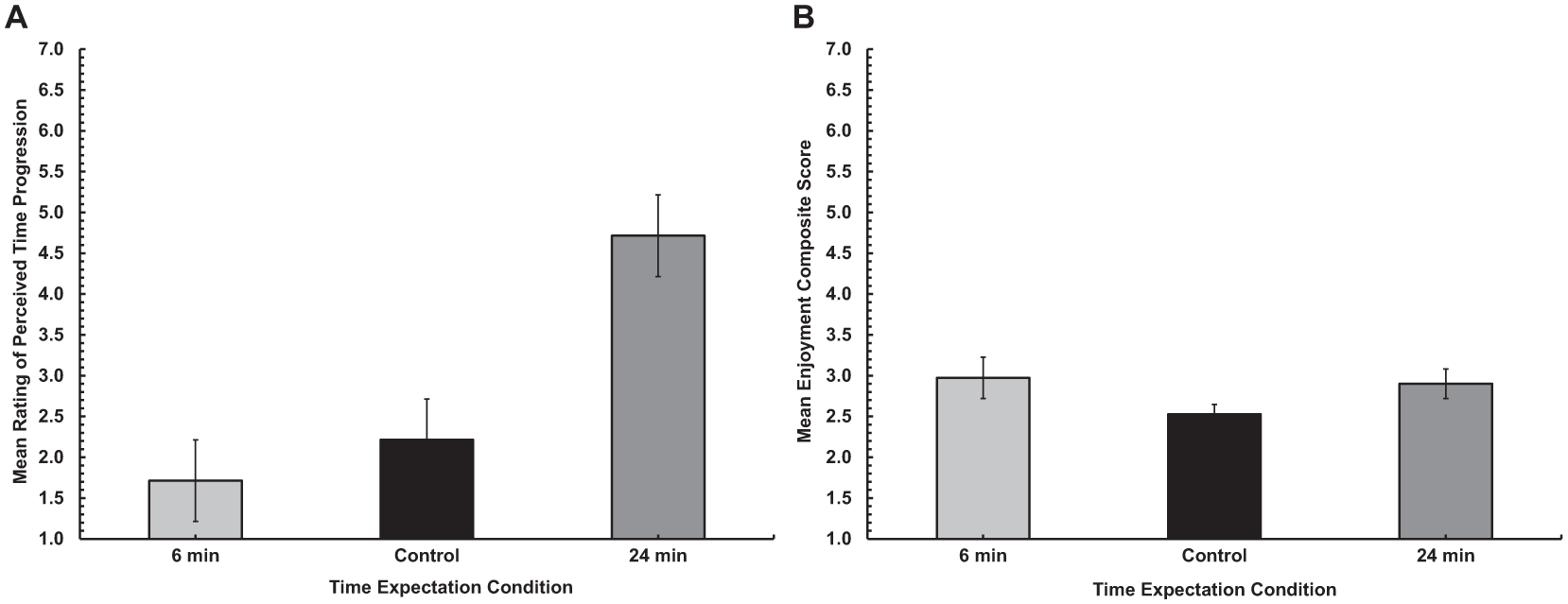
Mean ratings of perceived time progression (Panel A) and task enjoyment (Panel B) in the three temporal manipulation conditions. Data are for Experiment 2. Error bars are standard errors of the mean.
Task enjoyment
As in Experiment 1 and in the Sackett et al. (2010) study, the hedonic ratings of task enjoyment, challenge, engagement, fun, skill required, pleasantness, excitement to reengage in a similar task, and excitement to reengage in a longer task were combined into a composite measure of enjoyment on a 1 to 7 scale for each participant in each temporal manipulation condition. Cronbach’s alpha for the composite scale in Experiment 2 was .65. Mean enjoyment scores for each condition are plotted in Figure 7B. The figure shows that as was the case in Experiment 1, the means for all conditions were around 3 or less, indicating generally low ratings of enjoyment. A one-way ANOVA comparing mean enjoyment ratings in the three temporal manipulation conditions indicated no statistically significant difference, F(2, 39) = 1.55, p = .23, ηp2 = .07. Once again, although the temporal framework in which the vigilance task was performed significantly modified PTP among the participants, it did not alter the low hedonic evaluations of the vigilance task that they performed.
NASA-TLX workload
As before, the unweighted scoring procedure recommended by Nygren (1991) was used in calculating scores on the NASA-TLX. Mean workload ratings for each temporal manipulation condition are presented in Figure 8A. As can be seen in the figure, the global workload ratings for each of the conditions fell above the midpoint of the scale (50), indicating that as in Experiment 1, participants in each of the temporal manipulation conditions generally found the workload of the abbreviated vigilance task to be demanding. Once again, the temporal framework in which the vigilance task was performed did not influence the perceived global workload of the task since a one-way ANOVA of the workload data revealed no significant difference between the temporal manipulation conditions, F(2, 39) = 0.27, p = .76, ηp2 = .01.

Mean workload ratings (Panel A) and Dundee Stress State Questionnaire change scores (Panel B) in each temporal manipulation condition. Data are for Experiment 2. Change scores in Panel B are for worry, engagement, and distress. Negative scores reflect a pretask to posttask decline, positive scores a pre-post increase. Error bars in Panel A are standard errors of the mean, and those in Panel B are 95% confidence intervals about the mean.
DSSQ
The procedures for scoring the DSSQ subscales were identical to those employed in Experiment 1. Mean change scores from pre- to postvigil for each DSSQ subscale are presented for each temporal manipulation condition in Figure 8B. As in its precursor in Experiment 1 (see Figure 4B), the error bars in this figure are 95% confidence intervals. Upon examination, the figure reveals that in the case of the engagement subscale, the mean change scores for all three temporal manipulation conditions are below zero with confidence intervals that do not cross that point, indicating significant posttask declines in engagement in each condition. Inspection of the mean change scores for the distress subscale reveals above-zero values for each temporal manipulation condition with nonzero crossing confidence intervals, indicating significant posttask increases in distress in each condition. Separate one-way ANOVAs for each of these two subscales revealed no statistically significant difference between the temporal manipulation conditions with regard to engagement, F(2, 39) = 0.11, p = .89, ηp2 = .01, and to distress, F(2, 39) = 0.60, p = .56, ηp2 = .03. Thus, as in Experiment 1, task-induced stress, as reflected by a decline in engagement and an increase in distress, was not influenced by the temporal manipulations.
In addition to the engagement and distress scales, Figure 8B reveals posttask changes in the worry scale. In contrast to the task-induced stress effects reflected in the other scales, the changes in worry were beneficial in nature. Negative mean change scores along with nonzero crossing confidence intervals for all three temporal manipulation conditions indicate a significant decline in worry in these conditions. A one-way ANOVA of the worry data revealed no statistically significant differences between the temporal manipulation conditions, F(2, 39) = 0.04, p = .96, ηp2 = .01. Thus, although there was a notable posttask benefit with regard to worry, that benefit was independent of the temporal progression manipulation.
Discussion
The results of Experiment 2 are remarkably similar to those of Experiment 1. As in Experiment 1, participants evidenced a decline in perceptual sensitivity and an increase in response conservatism as time on task progressed. Once again, PTP was significantly faster for participants who were led to expect that the vigilance task would last longer than it did for those led to expect that task duration would be shorter than it actually was and for controls for whom task duration was equal to the duration they were led to expect. However, as in Experiment 1, accelerating PTP had no effect on task enjoyment, workload, or stress. In all three temporal manipulation conditions, participants rated the task as unenjoyable, as having a high level of workload, and as stressful. Clearly the 30-min task duration employed in Experiment 1 was not too long for the accelerated PTP manipulation to affect task-related hedonics, workload, and stress because the duration of Experiment 2, 12 min, was close to the 10-min duration used in the Sackett et al. (2010) studies and accelerating PTP still did not modify these subjective reactions to the vigilance assignment. The finding in the control group that even in a short-duration vigilance task, participants who were not misled about expected task duration also found time to drag and the work assignment to be unenjoyable reinforces the view that these effects are pervasive in vigilance tasks.
With regard to the overall level of stress induced by the vigilance task, it is important to note that the results of Experiment 2 were not completely in accord with those of Experiment 1. In the initial experiment, the general posttask decline in task engagement and the increase in distress were not accompanied by any change in worry. However, in Experiment 2, the negative changes in engagement and distress were supplemented by a positive outcome, a posttask decline in worry. Similar reductions in worry as measured by the DSSQ have been reported in vigilance tasks as the result of psychophysical variations (Matthews, 2016; Matthews, Warm, Shaw, & Finomore, 2014; Szalma & Teo, 2012) and in other experiments employing the abbreviated vigilance task (e.g., Helton et al., 2009; Temple et al., 2000).
General Discussion
The two experiments that constitute this investigation indicate that unlike with other tasks, the enjoyment of vigilance tasks is not subject to the adage, “you are having fun when time flies,” nor is the workload and stress induced by these tasks subject to that adage. Even when time flies, participants report that unpleasantness, hard work, and stress characterize vigilance assignments. An immediate question that arises from this is, Why? In a recent article, Hancock (2013) argues that participants’ negative experiences in vigilance tasks are iatrogenically determined. More specifically, he points out that vigilance tasks are most often situations in which participants need to constrain the normally self-directed information-acquiring capacity of attention and do this under conditions in which they are propelled by external rather than internal imperatives, they have little control of the task or of the nature of how and what is observed, discriminations between signals and noise are difficult, and observers cannot easily remove themselves from the vigilance assignment. Thus, they are placed in a cognitively unfamiliar and disadvantaged role that they are forced to endure, which leads to strongly undesirable psychological processes with regard to hedonics, workload, and stress.
In carrying out this investigation, we viewed it from the perspective of basic science. However, as is often the case in fundamental research, there are practical implications (e.g., Flexner, 2017). Our findings indicate that low enjoyment, high workload, and stress are deeply embedded in the nature of vigilance tasks and therefore highlight once again that through those vectors, such tasks may exert potentially serious costs to participants in terms of health, safety, and productivity (e.g., Hancock & Warm, 1989). In addition, as noted previously, the negative states elicited by vigilance task performance also may cause perception of time to lengthen, even in the absence of specific temporal manipulation. These costs must be considered by the administrators and designers of operational systems in which vigilance tasks play a key role. In addition, human factors psychologists might want to include the ability to tolerate these costs in the development of algorithms for the selection of personnel who are charged with vigilance assignments (cf. Matthews, 2016; Matthews, Warm, & Smith, 2017; Reinerman-Jones, Matthews, Langheim, & Warm, 2011; Szalma & Matthews, 2015).
Thus far, the major focus of this investigation has been the role of the temporal context as a moderator variable for participants’ subjective reactions to vigilance tasks. However, as we noted in the General Introduction of this article, the initial examination of the role of the temporal context with regard to vigilance tasks was McGrath and O’Hanlon’s (1967) study on task performance itself. In that study, which was conducted several decades ago, participants were required to make prospective estimates of time perception (cf. Block, Hancock, & Zakay, 2016) by pressing a button when they believed 10-min intervals had passed during a 1-hour vigil. McGrath and O’Hanlon found that the frequency of signal detection in a vigilance task was highest among observers who thought that task time seemed to pass more quickly than it physically did—or to fly by. To come full circle, the present study offered another opportunity to examine the role of the temporal context on vigilance performance because at task outset, participants were confronted by large differences in the expected duration of the task they were to perform. Conceivably, these differences in temporal foreshadowing could have led participants to develop different strategies for interacting with the task (cf. Fortenbaugh et al., 2015; Matthews, 2016; Szalma & Matthews, 2015), which could influence their performance. However, this was not the case. The perceptual sensitivity and response bias effects in Experiments 1 and 2 were identical in the three temporal modification conditions. Evidently, temporal foreshadowing does not affect vigilance performance. Along that line, it should be noted that McGrath and O’Hanlon also tested participants under conditions in which a visible clock in the testing room ran at a normal rate or at a slow or fast rate. Like temporal foreshadowing, clock rate had no effect on signal detection. These results suggest that to observe the moderator effect of the temporal framework on vigilance performance, it is necessary for participants to execute prospective estimates of time perception. This possibility merits further study.
Key Points
The Sackett et al. (2010) procedure involving mismatches between expected task duration and actual task duration can cause time to seem to fly or drag in long- and short-duration vigilance tasks.
PTP seems to drag in vigilance tasks even when there is no mismatch between expected and actual task duration.
Unlike with other tasks, accelerating PTP does not promote enjoyment in vigilance tasks.
Vigilance tasks are unpleasant, mentally demanding, and stressful even when time flies.
Negative subjective reactions are deeply embedded in the nature of vigilance tasks.
Foreshadowing of task duration does not affect perceptual sensitivity or response bias in vigilance performance.
Footnotes
Acknowledgements
The authors would like to thank 2nd Lieutenant Jason Amick and 2nd Lieutenant Derrick Pee of the U.S. Air Force Academy for technical assistance with regard to Experiment 2. We would also like to thank our anonymous reviewers for their helpful comments. Finally, shortly after submitting the first draft of this manuscript, our coauthor Joel Warm passed away. We would like to dedicate this research to Joel, who was a great mentor, colleague, and friend. The world is a little less vigilant in his absence.
Author(s) Note:
The author(s) of this article are U.S. government employees and created this article within the scope of their employment. As a work of the U.S. federal government, the content of this article is in the public domain.
Michael B. Dillard is a research scientist at Honeywell International, Inc., in Golden Valley, Minnesota. He received his PhD in experimental psychology from the University of Alabama in 2012.
Joel S. Warm was a senior scientist at the Air Force Research Laboratory, Wright-Patterson Air Force Base; distinguished researcher in the Human Factors Group of the University of Dayton Research Institute; and professor emeritus of psychology at the University of Cincinnati. He received his PhD in experimental psychology from the University of Alabama in 1966.
Gregory J. Funke is an engineering research psychologist at the Air Force Research Laboratory, Wright-Patterson Air Force Base. He received his PhD in experimental psychology/human factors from the University of Cincinnati in 2007.
W. Todd Nelson is chief of strategic planning and transformation in the 711th Human Performance Wing, Air Force Research Laboratory, Wright-Patterson Air Force Base. He received his PhD in experimental psychology/human factors from the University of Cincinnati in 1996.
Victor S. Finomore is a Distinguished Visiting Researcher at the U.S. Air Force Academy in Colorado Springs, Colorado. He received his PhD in experimental psychology/human factors from the University of Cincinnati in 2008.
Christopher K. McClernon is a lieutenant colonel in the U.S. Air Force, currently serving as an international program officer in the European Office of Aerospace Research and Development in London, United Kingdom. He received his PhD in modeling and simulation from the Naval Postgraduate School in 2009.
F. Thomas Eggemeier is a professor emeritus and Distinguished Service Professor at the University of Dayton. He received his PhD in experimental psychology from Ohio State University in 1971.
Lloyd D. Tripp is a program manager for aerospace physiology and toxicology at the Air Force Research Laboratory, Wright-Patterson Air Force Base. He received his PhD in experimental psychology/human factors from the University of Cincinnati in 2007.
Matthew E. Funke is a research psychologist at the Naval Medical Research Unit, Dayton. He received his PhD in experimental psychology/human factors from the University of Cincinnati in 2011.