




Abstract
Objective:
To investigate whether depleting self-control prior to vigilance results in a steeper vigilance decrement.
Background:
The resource-control theory of vigilance asserts that an inherent bias toward self-generated mind-wandering draws attentional resources away from the primary task. This study seeks to test whether depleting self-control, the potential mechanism of self-generated mind-wandering, results in poorer vigilance performance.
Method:
This study featured a between-subjects design where participants either completed a typing task that depleted self-control resources or a standard typing task that did not require self-control before performing a vigilance task. In the self-control depletion condition, participants typed a passage while omitting any “e” and “space” keys. In the standard typing task, participants typed the same passage without skipping any keys. Following both typing tasks, participants in both conditions completed an identical 12-min vigilance task.
Results:
Results demonstrated decreased accuracy and increased reaction times over time for both groups. Depleting self-control did not result in significant differences in accuracy, reaction time, nor a steeper vigilance decrement.
Conclusion:
These results provide evidence against resource-control theory and self-control as an explanation for vigilance, and provide further support for cognitive resource theory as the predominant explanation for vigilance impairments.
Application:
It is still unclear exactly what constitutes a “resource.” A better understanding of the nature of these resources can help researchers and practitioners identify how they can be replenished, which could enhance human performance in situations requiring vigilance such as baggage screening.
Keywords
Introduction
The systematic study of vigilance can be traced back to the end of World War II, where there were attempts to explain why British naval radar operators missed critical signals of enemy combatants as watch periods progressed (Mackworth, 1948). This phenomenon, known as the vigilance decrement, has been the critical unit of study in sustained attention research since the inception of the topic. In its over 70 year history, no scientist has done more to advance our understanding of vigilance and the vigilance decrement than Joel Warm. He not only identified factors that are most directly related to vigilance decrements, such as event rate and signal probability (Warm, 1984; Warm & Dember, 1998), but also did much to advance our theoretical understanding of vigilance.
The purpose of this paper is to examine a trait or characteristic that may also contribute to our theoretical understanding of vigilance: self-control (Baumeister, Bratslavsky, Muraven, & Tice, 1998). There have been many theoretical explanations of the vigilance decrement (see Matthews, 2000 for a review), but explanations predominantly take one of two forms: overload and underload theories. Overload theories posit that excessive mental workload is the mechanism driving the decrement. Specifically, the resource depletion theorists suggest that vigilance tasks are taxing and effortful (Warm, Dember, & Hancock, 1996; Warm, Parasuraman, & Matthews, 2008) and the vigilance decrement results from a depletion of information-processing resources over time. Increasing task demands, such as demands associated with working memory, signal saliency, signal cueing, just to name a few, results in a steeper decrement (Caggiano & Parasuraman, 2004; Helton & Russell, 2011; 2013; Hitchcock et al., 2003; Maclean et al., 2009; Parasuraman, 1979).
In contrast, underload theorists posit that the vigilance decrement does not result from high task demands. Instead, the monotonous and understimulating nature of vigilance tasks results in disengagement from the task (Manly, Robertson, Galloway, & Hawkins, 1999; Robertson, Manly, Andrade, Baddeley, & Yiend, 1997). A leading underload theory, mindlessness theory, predicts that people withdraw attention from the vigilance task due to its tedious nature, resulting in “mindless” or automatic behavior (Robertson et al., 1997). This results in underresponding to targets. However, this theory does not explain where attention is directed after it is withdrawn from the task. An extension of the mindlessness theory, the mind-wandering hypothesis suggests that attention is redirected internally to task-unrelated thoughts (TUT; Smallwood & Schooler, 2006). However, the mind-wandering hypothesis does not explain the mechanism that causes increased mind wandering with time on task. Furthermore, if mind wandering occurs because task demands are too low, this does not account for findings that vigilance tasks are stressful and that decrements increase with increased attentional demands (Dillard et al., 2014; Warm et al., 2008).
A newer theory, the resource-control theory of vigilance (Thomson, Besner, & Smilek, 2015) seeks to bridge resource theory, mindlessness theory, and the mind-wandering hypothesis (McVay & Kane, 2010, 2012). This theory posits that self-generated thought is the default state of a person and that mind wandering utilizes attentional resources that would otherwise be available for primary task performance. This theory suggests that the vigilance decrement results from a failure of executive control to distribute attentional resources among external and internal thoughts and goals (Thomson et al., 2015). Performance decreases over time because this controlled processing can only be maintained for a limited amount of time. Failures of control result in attentional resources being consumed by mind wandering, leaving fewer resources allocated to the primary task. In other words, the decrement occurs because resources are being consumed to stave off boredom, or alternatively, the learned bias toward motor inaction (given the rarity of action in a low target probability vigil).
The resource-control theory of mind wandering appears to be highly related to the notion of self-control. Exerting self-control is an individual’s attempt to change the way they would otherwise think, feel, or behave (Baumeister, Heatherton, & Tice, 1994; Muraven & Baumeister, 2000). In Baumeister’s self-control strength model (also called the self-regulatory strength model), it is suggested that exercising self-control depletes the resources associated with self-control strength. If these resources are drained, fewer resources are available for subsequent tasks that require self-control. Previous studies have shown that performing acts of self-control such as controlling one’s emotions (Muraven, Tice, & Baumeister, 1998), or resisting tempting foods such as cookies (Baumeister et al., 1998) leads to poorer performance on a subsequent test of self-control. When it comes to vigilance, there is some evidence that suggests that dietary restriction leads to poorer performance on vigilance tasks (e.g., Green & Rogers, 1995; Green, Rogers, Elliman, & Gatenby, 1994).
The aforementioned resource-control theory of vigilance is similar to the idea of self-control, in that proponents of the resource-control theory of vigilance posit that executive control is needed to override the default bias to allocate resources to mind wandering and instead allocate resources to the primary task. If vigilance requires self-control, then draining the self-control resource should predict poorer performance on a subsequent vigilance task. In the current study, we compared participants who performed a task that has been shown previously to deplete self-control resources (Muraven, Shmueli, & Burkley, 2006) to participants who did not, and then had both groups perform a subsequent vigilance task. If the resource-control theory of vigilance is correct, participants in a self-control depletion condition should have poorer vigilance performance and a steeper vigilance decrement. If there is an inherent bias toward self-generated mind wandering, reductions in self-control should result in fewer attentional resources allocated to the primary task. This study was designed to test that hypothesis.
Methods
Participants and Design
This research complied with the American Psychological Association Ethics Code and was approved by the institutional review board at George Mason University. Informed consent was obtained from each participant. Seventy-six undergraduate students (M age = 21.1 years, SD: 4.4; F = 43) participated in the experiment. The experiment was a between-subjects design with the type of task preceding the vigilance task as the between-subjects factor. Participants were randomly assigned to the task they performed before the vigilance task. Thirty-eight participants performed a self-control depletion task before the vigilance task. The other 38 participants performed a comparable task that did not require self-control before the vigilance task.
Apparatus
Tangney, Baumeister, & Boone Self-Control Scale
Trait self-control refers to the personality trait ability to self-override responses and alter personal states or behaviors that are more dominant responses (Baumeister & Alquist, 2009). To study self-control, we used a 36-item measure (Cronbach’s alpha = .89) that examines trait self-control in relation to habit breaking, resisting temptation, and self-discipline (Tangney, Baumeister, & Boone, 2004).
Self-control depletion typing task
The self-control task was a typing task that has been used in previous self-control studies (Muraven et al., 2006; Rieger, 2004). Participants were instructed to retype a passage as seen on a computer screen but to skip over and not type any “e” and “space” keys. Participants were also told to type as quickly but as accurately as possible. Participants’ vision was occluded so that they were not able to see what they typed, although the computer recorded all keystrokes. This task requires self-control to override the natural inclination to type every letter. It has been used frequently to evaluate ego depletion and has resulted in large effect sizes (Hagger, Wood, Stiff, & Chatzisarantis, 2010; Muraven et al., 2006). The experimenter stopped the participant after 7 min.
Standard typing task
Participants in the control condition performed a standard typing task that involved retyping the same passage as the self-control depletion task, with the exception that participants were told to retype the passage exactly as it appeared on the computer screen. Participants in this condition also could not see what they were typing and were told to type as quickly but as accurately as possible. The experimenter stopped the participant after 7 min.
Dundee Stress State Questionnaire
Matthews et al. (1999; 2002) have developed a comprehensive scale for affective, motivational, and cognitive facets of subjective mental state during task performance: the Dundee Stress State Questionnaire (DSSQ: Matthews et al., 1999). The 96-item scale has been validated in experimental studies that show that the scales are influenced by environmental stressors and task parameters. The scale features 11 factor-analytically determined scales that measure energetic arousal, tense arousal, hedonic tone, intrinsic task motivation, success motivation, self-focused attention, self-esteem, concentration, confidence and control, task-relevant cognitive interference, and task-irrelevant cognitive interference. These scales have been incorporated into three second-order factor-analytically derived dimensions known as task engagement, distress, and worry. Task engagement incorporates the energetic arousal, motivation, and concentration scales and contrasts enthusiasm and interest with fatigue and apathy. Distress brings together negative moods and lack of confidence. Finally, worry reflects the level of intrusive thoughts and other negative self-referent cognitions (Matthews et al., 2002).
Vigilance task
All participants completed a 12-min abbreviated vigilance task (Temple et al., 2000). This task has been shown to result in a vigilance decrement within 5 min and has the stress profile and right cerebral hemisphere dominance characteristic of longer vigilance tasks (Helton et al., 2007; Helton & Warm, 2008). The task was presented on a computer monitor and required participants to respond to a low-frequency, low-saliency critical signal while ignoring neutral signals. Participants responded to a critical signal indicated by the capital letter “O” and ignored forward- and backward-facing capital letter “D” neutral events. In order to increase workload, stimuli were partially masked by a field of small circles in the background. Stimuli were displayed for 40 ms with an interstimulus interval of 1000 ms during which the mask remained. The task was divided into six blocks of 2-min duration. During each block, there were a total of 120 signals; 20% of the signals were critical (24 critical signals in each block).
Procedure
Participants first filled out a demographic questionnaire followed by the pretask portion of the DSSQ (Matthews et al., 1999). Following the questionnaires, participants completed a 2-min typing test in order to obtain a baseline measure of participants’ typing speed (the Aesop’s Fables test from TypingTest.com). This test was administered to ensure there were no baseline differences in typing ability between the two groups. After the typing test, participants performed a 2-min practice of the vigilance task. The practice task mirrored the conditions of the vigilance task used for testing. In order to be included in the study, participants had to detect 80% of the critical signals in the practice with no more than 10% false alarms. If a participant failed to meet these criteria in the first practice, a second 2-min practice was completed. Two participants required two practice sessions to achieve passing criteria. If these criteria were not met with two practice sessions, the participant was not included in the study. One participant was excluded from the study for failing to meet practice criteria. Following the vigilance practice, participants completed either the self-control depletion typing task or the standard typing task. The reason the depletion phase occurred after the vigilance practice was to minimize the amount of time between depletion and vigilance task performance. Next, participants completed the 12-min vigilance task. Following the vigilance task, participants completed the posttask portion of the DSSQ and the Tangney, Baumeister, & Boone Self-Control Scale (Tangney et al., 2004). The entire duration of the experiment was approximately 60 min.
Results
Typing Speed Test
An independent-samples t test was performed on the adjusted words per minute of the typing test as a control to make sure there were no differences in general typing ability between the two groups. Results of the t test revealed no significant difference in adjusted words per minute, t(74) = −0.52, p = .60, d = −0.12 between the two groups.
Typing Task
An independent samples t test was conducted on the performance of the typing task. Results of the typing task failed to save for one participant in the standard typing task condition. Therefore, for these results, there are 37 participants in the standard typing task condition and 38 participants in the self-control depletion condition. Results revealed a significant effect for errors, t(73) = 2.70, p < .05, d = .62. Errors were characterized as any spelling or grammatical mistake. For participants in the self-control depletion condition, this did not include pressing any “e” or “space” keys. Participants in the standard typing condition made significantly more errors when typing the paragraph (M = 29.8, SE = 3.0) compared with those in the self-control depletion condition (M = 19.2, SE = 2.5). Results also revealed a significant effect for the number of backspaces, t(73) = 6.33, p < .05, d = 1.46. Participants in the standard typing condition hit the “backspace” key more (M = 32. 4, SE = 3.1) compared with participants in the self-control depletion condition (M = 9.2, SE = 2.0). These results likely point to the deliberate actions of the participants and a general slowing in typing speed in the self-control depletion condition, providing support that this task requires self-control.
Vigilance Task
A 2 (Group) × 6 (Period) between-subjects analysis of variance (ANOVA) was performed on correct detections. Importantly, period of watch was discretized into six, 2-min periods only for analysis purposes—participants experienced an uninterrupted 12-min vigilance task. For this and all subsequent analysis, the Greenhouse-Geisser correction was used to correct degrees of freedom in cases where the sphericity assumption was not met. Results revealed a significant main effect for Period, F(3.03, 224.52) = 34.50, p < .05, η2 = .32, indicating that correct detections decreased from periods 1 (M = 97.5%, SE = 0.4%) and 2 (M = 95.9%, SE = 0.8%) to period 3 (M = 93.3%, SE = 1.1%), and from period 3 to period 4 (M = 88.5%, SE = 1.7%), and from period 4 to period 6 (M = 83.1%, SE = 2.1%). Results did not reveal a significant main effect for Group, F(1, 74) = 0.13, p = .72, η2 = .002, nor a significant Group × Period interaction, F(3.03, 224.52) = 0.59, p = .63, η2 = .005. Because an extremely large effect size was considered a priori improbable and to be therefore conservative in our test of the null hypothesis, we employed the unit-information Bayes factor (see Rouder, Speckman, Sun, Morey, & Iverson, 2009). For the overall mean correct detection (hit) difference between the experimental and control group, the scaled-information Bayes factor was 3.05 in favor of the null hypothesis. Generally a Bayes Factor > 3 is considered positive evidence in support of the given hypothesis (Kass & Raftery, 1995).We also calculated the mean slope of the correct detections regressed over periods of watch for the experimental and control group to perform a Bayes factor test for a difference in the actual decrement (see Helton & Warm, 2008 and Helton & Russell, 2012). In this case, the scaled-information Bayes factor was 3.14 in favor of the null hypothesis. The false-alarm rate was below 2% across both conditions and six periods, so false alarms were not analyzed further.
A 2 (Group) × 6 (Period) between-subjects ANOVA was also performed on reaction time. Results revealed a significant main effect for Period, F(4.11, 304.09) = 72.94, p < .05, η2 = .49. Reaction time increased from period 1 (M = 372.5, SE = 5.1), to period 2 (M = 404.0, SE = 6.1), to period 3 (M = 423.3, SE = 6.6), and increased from period 3 to period 5 (M = 443.1, SE = 7.4). Results did not reveal a significant main effect for Typing Task, F(1, 74) = 0.003, p = .96, η2 = .000, nor a significant Typing Task × Period interaction, F(4.11, 304.09) = 0.75, p = .56, η2 = .005. Table 1 presents the values for accuracy, false alarms, and reaction times for both groups across all periods.
Vigilance Performance by Condition
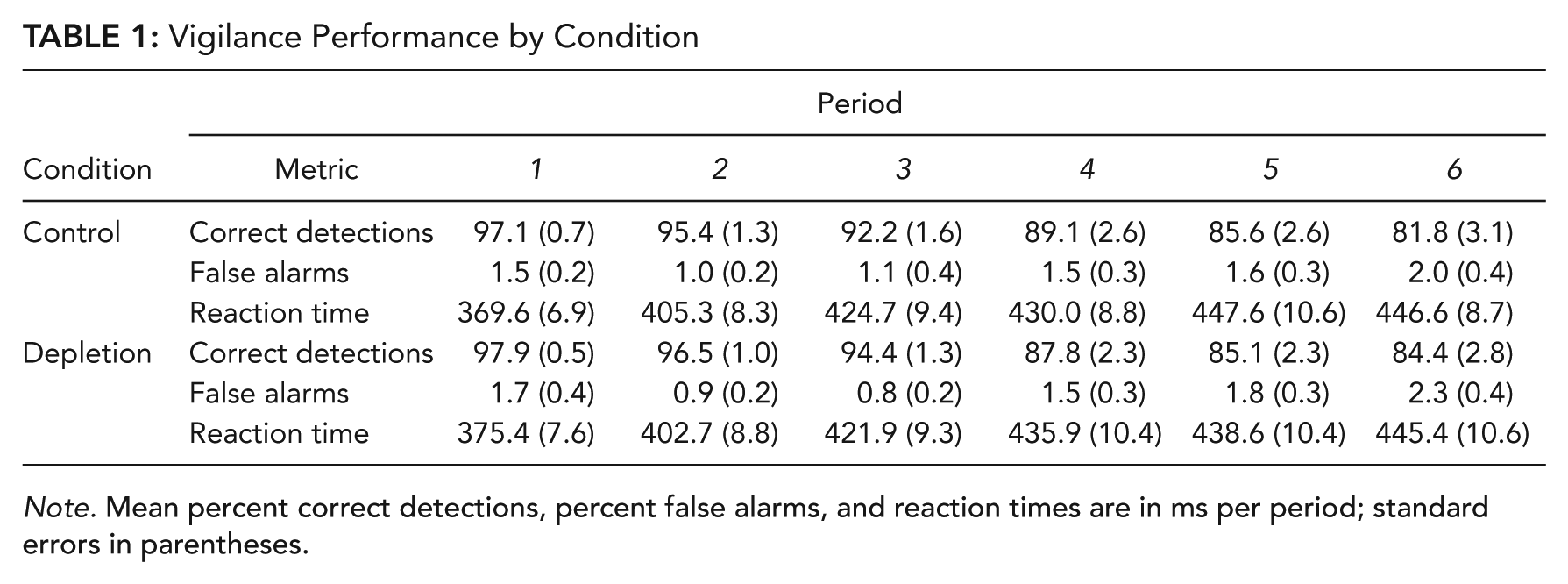
Note. Mean percent correct detections, percent false alarms, and reaction times are in ms per period; standard errors in parentheses.
DSSQ
Pre- and post- scores from the DSSQ were standardized against normative data from a large British sample (Matthews et al., 1999, 2002) based on the formula: z = (raw score – mean of normative sample) / standard deviation of normative sample. Factor scores for task engagement, distress, and worry were calculated using regression weights from the normative sample. Factor scores are distributed with a mean of 0 and a SD of 1, so that values calculated for a sample represent a deviation from normative values in standard deviation units. The analysis revealed that the only dimension that revealed a difference between the two conditions was the distress dimension, t(74) = −2.43, p = .02, d = −0.56. Participants who performed the self-control depletion typing task prior to performing the vigilance task reported a significant increase in distress (M = 0.68, SE = 0.11) compared to participants in the standard typing task condition (M = .26, SE = 0.13). Similar to the Bayesian analysis conducted on the correct detection results, we also conducted a Bayes factor test for the distress scale. In this case, the scaled-information Bayes factor was 4.13 in favor of the alternative hypothesis.
An examination of the three subscales of the distress dimension of the DSSQ (hedonic tone, tense arousal, and confidence and control) revealed that hedonic tone (i.e., positive mood) was the only distress subscale that significantly differed between the two groups. These results can be viewed graphically in Figure 1. Participants who performed the self-control depletion task prior to engaging in the vigilance task reported increased feelings of unpleasantness after the vigil (Change score = −.61, SE = 0.12) than those participants in the standard typing task condition (Change score = .21, SE = 0.12).
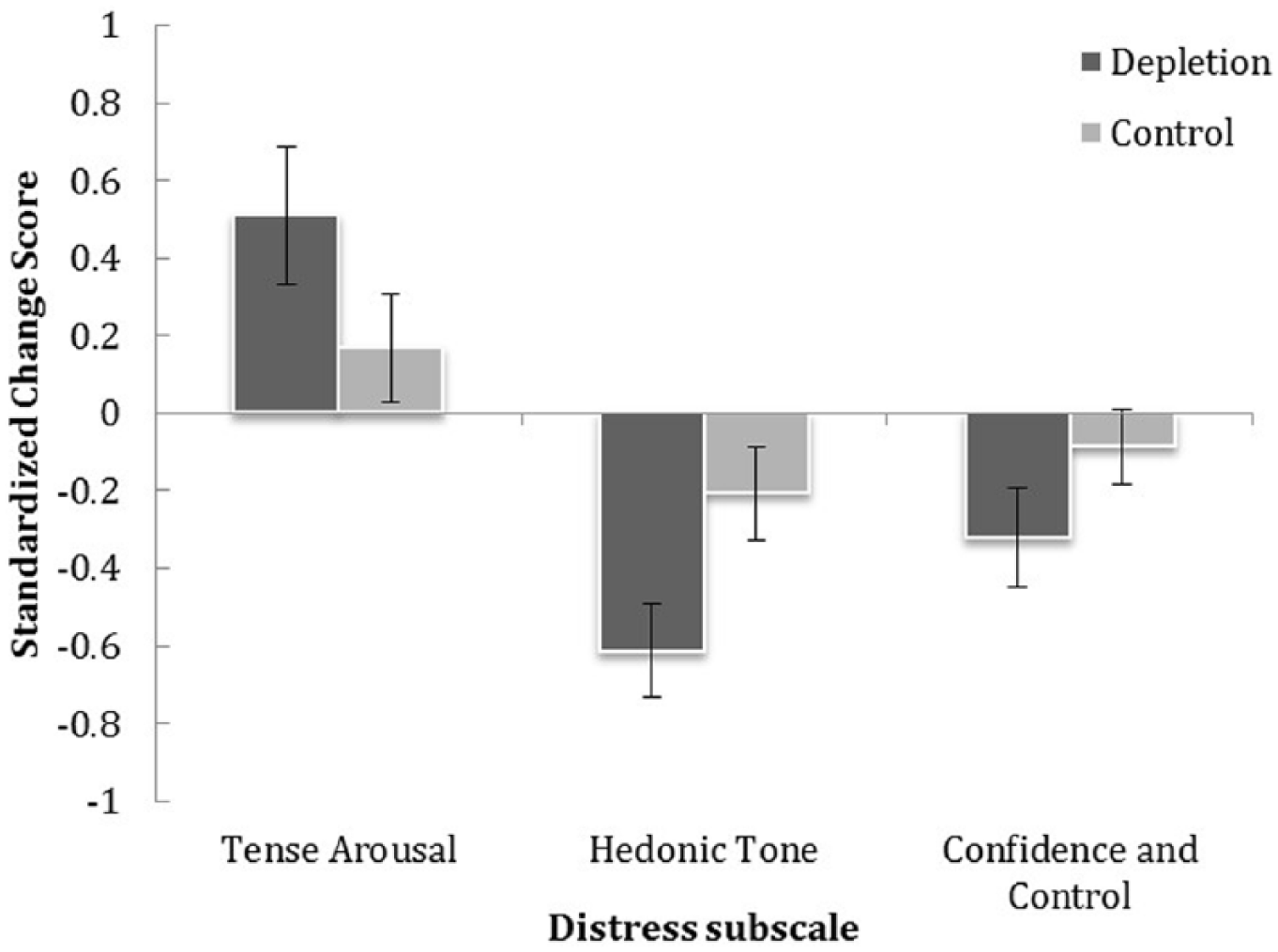
Standardized distress subscale scores plotted for tense arousal, hedonic tone, and confidence and control for the self-control depletion and control groups. Error bars are standard error.
Trait Self-Control
An independent samples t test was performed on scores from the Tangney Self-Control Questionnaire to evaluate any differences in the two groups. Results revealed no significant difference in self-control between the two conditions, t(74) = 1.36, p = 0.18, d = 0.31. More importantly, self-control did not significantly correlate with any of the dependent measures of correct detection, reaction time, or typing performance (p > .05).
Discussion
The purpose of the current experiment was to explicitly test the resource-control theory of vigilance by examining a trait that should be associated with that theory, self-control. Although significant performance decrements were found in both accuracy and reaction time, differences in performance between the self-control depletion group and the control group were not observed. Analyzing the results from a Bayesian perspective found strong evidence for no main effect between the two conditions for either accuracy or reaction time. Researchers have recently surmised that a relation between self-control and sustained attention performance could exist (e.g., Langner & Eickhoff, 2013; Shaw et al., 2013; Steinborn & Huestegge, 2016), and the resource-control theory makes this prediction explicitly (Thomson et al., 2015), but to our knowledge, this is the first attempt to explicitly look at the potential causal relation of self-control resource depletion and vigilance.
Intriguingly, trait self-control, as measured by the Tangney self-control scale, was not associated with the self-control depletion task. The self-control typing task has been previously used as a means of depleting the self-control resource pool (Muraven et al., 2006; Rieger, 2004) and has been shown to affect future tasks that require self-control. It deserves mention that prior research has shown that different measures of self-control correlate only moderately with each other (Duckworth & Kern, 2011). In fact, there is stronger evidence for convergent validity among questionnaire measures than with task measures, possibly suggesting that with self-control tasks there could be a great deal of task-specific error variance. This is a testament to a growing concern that self-control is difficult to define and quantify, and that the specific mechanisms underlying self-control depletion and regulation need to be better refined (e.g., Inzlicht & Schmeichel, 2012). It should be noted, however, that the underlying reliability of tasks is often underreported, which could serve to conflate convergent validity estimates.
Although the self-control typing task did not impact vigilance performance, the task did elevate self-reports of subjective distress. The distress results suggest that participants in the experimental condition who performed the typing task reported increased unhappiness and aversive psychological state after the vigil than those in the control condition. This increase in distress, however, did not seem to affect vigilance task performance. Finkbeiner, Russell, and Helton (2016) also noted a dissociation between feelings of distress and vigilance performance in their study examining different types of break activities during a vigil. A number of the nonresource depletion theories of vigilance outline that the subjective unpleasantness of vigilance tasks results in participants’ withdrawal of their attention from the task; this withdrawal is the cause of the decrement (Kurzban, Duckworth, Kable, & Myers, 2013; Thomson et al., 2015). If this is the case, it is odd that participants who were in the experimental condition reported increased distress (subjective unpleasantness) but with no apparent impact on the decrement. If the decrement is caused by the participant’s attempt to mentally escape an unpleasant experience, the increased mental displeasure caused by making the participant perform a difficult and tedious task prior to the vigil should result in more desire to escape and thus, worse performance. Moreover, it is important to note that the DSSQ also revealed that there was no difference between the two groups on the degree of task-related or task-unrelated thoughts. Perhaps, after some moderate level of unpleasantness is experienced, there is no sensitivity to further unpleasantness, but this strains believability. A more parsimonious explanation is that the vigilance decrement is due to the depletion of the specific cognitive resources necessary to perform the task (Helton et al., 2004; Helton & Russell, 2015; 2017).
Some previous research has suggested a relation between self-control and vigilance, but to date, that evidence is loose at best. For example, studies by Green and associates have suggested that dietary restriction is related to vigilance performance, although that research did not identify self-control as the specific mechanism of action (Green et al., 1994; Green & Rogers, 1995). Moreover, those studies used particularly short versions of a cognitive vigilance task, unlike the sensory vigilance task used here, and could involve more nuanced mechanisms (e.g., specific elements of diet that support cognitive function). In another study, it was demonstrated that a physiological measure that has been shown to be sensitive to cognitive resource expenditure (e.g., Harwood, Greenwood, & Shaw, 2017) reveals differences between individuals high in trait self-control versus low trait self-control (Becker, Mandell, Tangney, Chrosniak, & Shaw, 2015). That study showed that although high self-control participants had better resource allocation strategies, they were not associated with superior performance in that group. Given prior studies and the findings of the current study, it is difficult to assert that a clear relation between self-control and vigilance exists. Future research may want to consider the inclusion of different types of self-control tasks that have been used in the literature. For example, delay of gratification tasks require participants to make a distinction between smaller, immediate rewards, and larger, delayed rewards. It could be the case that self-control is a multidimensional construct and that different types of self-control tasks could be reflective of different aspects of self-control (Duckworth & Kern, 2011).
The research presented here is important because of the theoretical question that lies at the crux of the article and has plagued cognitive resource theorists for several years: What is a resource? A potential mechanism may have been offered by the advocates of the resource-control theory of vigilance, but those arguments unfortunately don’t withstand empirical scrutiny. Even in the self-control literature, theorists identified glucose as a candidate physiological resource, reporting findings that a greater amount of glucose was consumed during self-control tasks. These findings led these theorists to suggest that glucose could be the causal mechanism for self-control depletion (cf. Gailliot & Baumeister, 2007; Gailliot et al., 2007). However, a more recent evaluation of the effects of glucose has revealed that the effect is not as strong as previously thought; it is likely not a causal mechanism and thus not necessarily the “resource” required in cognitive tasks (Kurzban, 2010). Nevertheless, it should be noted that cognitive resource theory is not without its faults and has also been criticized for its circularity (cf. Navon, 1984). Also, it is currently unknown whether or not performance impairments in sustained attention are a function of resource drainage or changes in resource-allocation policy. The vigilance decrement is often interpreted in terms of depletion, and this is supported by neurophysiological evidence (e.g., Hitchcock et al., 2003). However, more recent research focused on individual differences in vigilance has revealed that some of the neurophysiological findings could potentially be interpreted in terms of an observer’s allocation policy (Becker, Mandell, Tangney, Chrosniak, & Shaw, 2015; Mandell, Becker, VanAndel, Nelson, & Shaw, 2015; Shaw, Nguyen, Satterfield, Ramirez, & McKnight, 2016; Shaw, Satterfield, Ramirez, & Finomore, 2013). It seems that the search for the elusive “resource” in vigilance research continues.
The self-control depletion task did not impact subsequent vigilance performance, a result that does not seem to support the resource control theory account of vigilance. It should be noted, though, that several unanswered questions should be explored before that conclusion becomes definitive. For example, although the procedure for the self-control depletion task carried out in the current study was modeled closely after Muraven et al. (2006), it is currently unknown how long it takes to deplete the self-control resource pool, and for how long it will remain depleted. Indeed, there is evidence that rest improves performance on standard vigilance (Helton & Russell, 2015) and cognitive vigilance tasks (Steinborn & Huestegge, 2016), and there is even some evidence that the introduction of an additional task into a vigil may have a restorative effect on vigilance performance (Ralph, Onderwater, Thomson, & Smilek, 2017). Rest breaks are presumed to have a restorative effect via the replenishment of information-processing resources (Helton & Russell, 2015), and it is proposed that the introduction of another task has a restorative effect via increasing energetic arousal (Ralph et al., 2017; Steinborn, Langner, & Huestegge, 2017) or goal reactivation when switched back to the original task (Ariga & Lleras, 2011; although see Helton & Russell, 2011). Clearly identifying the underlying processes involved has proven difficult, and the answer to the question as to whether the resource pool being replenished is attributable to a generalized self-control resource pool or a more domain-specific pool of attentional resources is still unknown. It is the belief of the authors, given the current set of data, that vigilance performance relies on more domain-specific resources. Despite the suggestion that self-control and vigilance are directly related (cf. Muraven & Baumeister, 2000), it appears that the generalized pool of self-control resources do not directly modulate vigilance. More research should be conducted on the self-control resource depletion and its specific relation to cognitive performance, but for now it seems as though the theory championed by Joel Warm—resource theory—remains the best explanation for vigilance (Warm, Parasuraman, & Matthews, 2008).
Practical considerations are also raised with the current research. In operational settings where vigilance is needed, such as baggage inspection and combat identification (Shingledecker et al., 2010), strategies to enhance overall vigilance or to identify operators less susceptible to decrement are often sought. This raises the question: What types of interventions and operators can be employed for jobs that require vigilance? If self-control were a possible explanatory mechanism, then it could be possible to select operators based on trait self-control, or perhaps even the extent to which operators are susceptible to self-control depletion. Given the results of the current study, it seems as though self-control may not be sufficient as a selection criterion for vigilance. Researchers and practitioners may instead want to focus on intervention and selection approaches that are consistent with the cognitive resource theory of vigilance. With regard to intervention approaches that have shown to be successful in vigilance, research points to rest breaks (e.g., Helton & Russell, 2015; Steinborn & Huestegge, 2016) and stimulants (e.g., Temple et al., 2000) as means to replenish cognitive resources available for vigilance performance. With regard to tools that can be used for selection, there has been some promise in using multivariate assessment techniques that combine performance, self-report, and neurophysiological indices to predict future vigilance performance (Matthews et al., 2011; Matthews, Warm, Shaw, & Finomore, 2014).
Key Points
Depleting self-control does not result in a steeper vigilance decrement but does increase stress.
Results do not support resource-control theory’s proposed mechanism for explaining the vigilance decrement.
Cognitive resource theory remains the predominant theory to explain the vigilance decrement.
A better understanding of what constitutes a resource is still needed, to understand and enhance human performance, particularly in situations requiring vigilance such as baggage screening.
Footnotes
Kelly Satterfield was awarded a PhD in psychology from George Mason University in 2016. She is currently fulfilling a postdoctoral research fellowship with Oak Ridge Institute for Science and Education at Wright-Patterson Air Force Base, Ohio.
Amanda E. Harwood is currently enrolled in the human factors and applied cognition PhD program at George Mason University. She received her BS in psychology in 2015 from George Mason University.
William S. Helton was awarded a PhD in human factors psychology from the University of Cincinnati in 2002. He is currently professor of psychology at George Mason University and adjunct professor at the University of Canterbury.
Tyler H. Shaw was awarded a PhD in human factors psychology from the University of Cincinnati in 2008. He is currently associate professor of psychology at George Mason University.