




Abstract
Objective
The study addresses the impact of time pressure on human interactions with automated decision support systems (DSSs) and related performance consequences.
Background
When humans interact with DSSs, this often results in worse performance than could be expected from the automation alone. Previous research has suggested that time pressure might make a difference by leading humans to rely more on a DSS.
Method
In two laboratory experiments, participants performed a luggage screening task either manually, supported by a highly reliable DSS, or by a low reliable DSS. Time provided for inspecting the X-rays was 4.5 s versus 9 s varied within-subjects as the time pressure manipulation. Participants in the automation conditions were either shown the automation’s advice prior (Experiment 1) or following (Experiment 2) their own inspection, before they made their final decision.
Results
In Experiment 1, time pressure compromised performance independent of whether the task was performed manually or with automation support. In Experiment 2, the negative impact of time pressure was only found in the manual but not in the two automation conditions. However, neither experiment revealed any positive impact of time pressure on overall performance, and the joint performance of human and automation was mostly worse than the performance of the automation alone.
Conclusion
Time pressure compromises the quality of decision-making. Providing a DSS can reduce this effect, but only if the automation’s advice follows the assessment of the human.
Application
The study provides suggestions for the effective implementation of DSSs in addition to supporting concerns that highly reliable DSSs are not used optimally by human operators.
Keywords
Automation and specifically computer-based automated assistance systems are present in virtually every field today. The main reasons why automation is introduced in a large number of settings are that it supposedly makes work safer, reduces workload, and improves overall performance (French et al., 2018; Sheridan & Parasuraman, 2005). One special case of automation is a decision support system (DSS), which is intended to aid a human in executing a certain task (Mosier & Fischer, 2010, Mosier & Manzey, 2020). DSSs can vary widely in their complexity, but the general idea is that they provide users information on the true state of the world based on automated processing and evaluation of information from the environment. They include a variety of systems ranging from binary alarm or target detection systems (e.g., smoke detection) to complex expert systems providing automatically generated diagnoses to radiologists or surgeons, based on artificial intelligence applications (e.g., Jiang et al., 2017). Regardless of the type of system though, the final output to the user with DSSs is usually straightforward; that is, it includes a definite recommendation, diagnosis, or just indication of a certain state, even though the processing (e.g., complex image processing) in the background might be highly complex. However, in a number of cases, humans do not use a DSS appropriately, which can result in automation misuse or disuse (Parasuraman & Riley, 1997). With respect to binary DSSs like alarm systems or target detection support, two aspects of automation use that can be closely linked to potential misuse or disuse are compliance and reliance (Meyer, 2001, 2004). Specifically, operator compliance is defined as operators agreeing with the automation when it indicates that a target is present. Conversely, operator reliance is defined as operators agreeing with the automation when it indicates that no target is present. Thus, operator compliance can be considered as reflecting the belief that a critical event is actually present when an alarm occurs, and operator reliance as reflecting the belief that the system will actually alert in case of a critical event (Meyer, 2001, 2004). However, there are cases where the reliance or compliance of operators does not appear to be properly calibrated to the performance of a DSS.
Thus, often when highly reliable DSSs are used, the joint performance of operator and automation is worse than that of the automation alone (see Bartlett & McCarley, 2017, for model-based accounts of that phenomenon; see also Alberdi et al., 2004; Meyer, 2001; Meyer et al., 2014). Note that this refers to a hypothetical comparison of the performance of the automation with the operator possibly intervening (i.e., performance of the human–automation dyad) versus a situation where the automation alone would be in charge of the decision.
This shows that even with highly reliable systems, trust (and accordingly, compliance and reliance) is often mis-calibrated (Parasuraman & Riley, 1997), leading operators to alter outputs of the alarm system that were actually true.
Time Pressure and Automated DSSs
However, the degree of time pressure that operators have in making their decisions while interacting with an automated DSS might make a difference in this respect. Time pressure is an everyday phenomenon in a plethora of workplaces and is usually considered a to-be-avoided workload factor in the human factors literature (e.g., Carayon & Gurses, 2008; Hendy et al., 1997; Moray et al., 1991). Concerning trust in automation, we refer to the three-layered model of Hoff and Bashir (2015), where time pressure would be considered an external situational factor. Note, however, that in the present research, our main focus is on behavioral consequences of trust rather than subjective measures of trust.
Specifically, there is evidence that time pressure can lead to more heuristic decision-making and thus not necessarily lead to concomitant performance decreases (see Gigerenzer & Gaissmaier, 2011; Shah & Oppenheimer, 2008, for reviews). In the context of human–automation interaction, a possible heuristic might be an increased dependence on the automation’s suggestion. Using automation as a heuristic has been referred to as automation bias (Mosier et al., 1996; Parasuraman & Manzey, 2010) and is usually considered something that can negatively impact performance if critical events are overlooked due to automation misuse. However, if a DSS is highly reliable, automation bias can potentially even lead to improved performance—especially if the DSS performs better than the human alone. One factor that is known to increase the use of heuristics is time pressure (Payne et al., 1988), and there are indeed findings that suggest that dependence on a DSS increases under high time pressure (Rice et al., 2010, 2008, Rice & Keller, 2009; Rice & Trafimow, 2012). For example, in their study, Rice and Keller (2009) found overall performance benefits of time pressure if the automation was highly reliable. To investigate this, they used a military context and presented their participants aerial-view photographs with the participants having to decide whether or not there was a tank present. In order to vary time pressure, the time available for inspection of the photographs was different across participants (8 s vs. 2 s). Moreover, participants were assigned a DSS to aid their decisions and DSS reliability was varied in five conditions (65%, 80%, 95%, 100%, manual). The key finding of this study was that participants who worked under high time pressure depended more strongly on the DSS, which led to concordant performance increases under high time pressure. However, in both this study (Rice & Keller, 2009) as well as later corroborating studies (Rice & Trafimow, 2012; Rice et al., 2010), the extremely high time pressure (i.e., 2 s for complex visual stimuli) might have left participants with no real choice but to follow the DSS. Thus, the main finding of a higher dependence on automation with time pressure might just be an artifact of this extreme time pressure condition. Moreover, time pressure was varied between subjects—an occurrence that appears unlikely in the real world where time pressure is expected to vary more frequently across different trials, depending on situational circumstances.
Consequently, we aim to revisit this issue using rather less extreme and more realistic time pressure variation, giving participants an actual chance to inspect the stimulus themselves even under time pressure, as would be the case in most real-world scenarios.
One real-world context where both time pressure and automated DSSs can play an important role is luggage screening at airport security checkpoints (e.g., Chavaillaz et al., 2018). Here, screeners must classify whether or not there is a prohibited article in the bag, and time pressure while performing this screening task may vary frequently across the day depending on the number of passengers waiting in the line. Normally, airport security screeners have around 10 s per image (Buser et al., 2019), which decreases to around 4 s during busier periods (Schwaninger et al., 2004). The basic task to be performed in luggage screening can be considered as a signal detection task. As has formally been described in signal detection theory (SDT; Green & Swets, 1966), the performance in such tasks depends on two variables: the sensitivity (d′) in terms of ability to distinguish between nontarget (e.g., a pen) and target (e.g., a knife), and the response threshold (C), that is, on how much evidence decisions about the presence of targets are based (see Stanislaw & Todorov, 1999, for calculation of d′ and C). DSSs are used in such tasks in order to help operators optimizing both aspects. However, depending on their capability, these systems might differ in their reliability, that is, the probability that their advice is correct. Specifically, due to a safe-engineering approach, such target detection systems often have liberal response thresholds, which make them more or less prone to false alarms. If time pressure does indeed increase DSS dependence, the related human performance consequences should be dependent on the reliability of the DSS. Only in the case that the automation reliability is considerably greater than the human-alone performance, one would expect a visible benefit of the DSS in the joint human–automation performance.
The Present Experiments
The goal of the present experiments was to examine the influence of time pressure in a luggage screening task with and without an automated DSS available. To this end, we used a luggage screening task and participants performed the task either with no DSS support (i.e., manually), with a low-reliability DSS (75% correct suggestions), or with a high-reliability DSS (95% correct suggestions). Corresponding to most applications in safety-critical environments such as luggage screening, both conditions were essentially false-alarm prone. However, some rare misses were also simulated. Seventy-five percent was chosen as the lower reliability level in order to create a clear variation but still have a level that seems to be realistic for false-prone systems and that is still higher than the 70% threshold assumed to be the minimum reliability where automated systems are still considered to be useful (Wickens & Dixon, 2007). In contrast to earlier research (e.g., Rice & Keller, 2009), we varied time pressure blockwise within subjects because real-world operators’ work environments (and thus, time constraints) also change from time to time and do not remain constant. Furthermore, a time pressure condition was chosen, which placed the participants under considerable pressure to perform the task quickly but was also long enough to get the task principally done even without automation.
In Experiment 1, we used a paradigm where participants in the automation conditions were first shown the DSS’s advice and then made their own choice. Then, in Experiment 2, we reversed that order—that is, participants could first make their initial choice and were then shown the advice of the DSS with the possibility of either confirming or changing their own decision based on that advice.
Experiment 1
As previously mentioned, we used both a high-reliability DSS condition and a low-reliability DSS condition as well as an unsupported manual condition. These conditions were varied between subjects because we wanted to avoid prior experiences with a highly (or low) reliable system influence the use of the DSS. We varied time pressure within subjects—that is, time pressure (i.e., low vs. high) was varied blockwise because, in most real-world contexts, time pressure would also likely vary from time to time.
We hypothesized that participants in the high-reliability DSS condition would have better performance than those in the low-reliability condition. The manual condition mainly served as a control condition to understand the effects of time pressure for the luggage screening task without DSS support. Moreover, based on previous findings (e.g., Rice & Keller, 2009), we hypothesized that time pressure would decrease performance, but only if the automation were not highly reliable. This is based on the idea that operators are more dependent on the DSS under time pressure. Conversely, an increased dependence can possibly even lead to performance increases if the automation is highly reliable, although, in this case, operators often show a high level of reliance and compliance, anyway. Thus, in the high-reliability DSS condition, participants should have greater performance than in the manual condition, whereas this difference is not as clear a priori for the low-reliability DSS condition. Moreover, we investigated whether time pressure would make a difference for the level of reliance, which has not been addressed before.
Method
This research complied with the tenets of the Declaration of Helsinki and was approved by the Institutional Review Board at the Technische Universität Berlin, Department of Psychology. Informed consent was obtained from each participant.
Participants
Sixty participants (24 female) were recruited through the online recruiting system of the Department of Psychology at Technische Universität Berlin. Participants took part in the experiment for either course credits or monetary compensation of €9. The mean age of participants was 28.62 (SD: 4.75), and the sample was predominantly right-handed (56 right-handed). Two additional participants in the manual condition were tested but excluded from any analyses because their accuracy did not deviate from chance performance in the experimental blocks.
Apparatus and stimuli
We used images from the X-ray Object Recognition Tests (X-ray ORT) 1.3 and 2.0 (Hardmeier et al., 2005; Schwaninger et al., 2005) as stimuli. These stimuli can be classified as hard or easy based on three dimensions: point of view (i.e., canonical or not), bag complexity (i.e., high or low clutter in the bag), and object overlap (i.e., whether there is little or strong overlap of other objects on the target). To ensure similar difficulty for the stimuli—especially considering the time constraints for responding—we selected images with a similar difficulty according to these dimensions, using the images that were scored as difficult in any two of the three categories. These images could then either contain a target (i.e., gun or knife) or not, and we mirrored the images both horizontally and vertically to double the number of available stimuli, resulting in a total stimulus set of 320 images.
One to six participants were simultaneously tested at independent PC workstations, separated by opaque screens. The experiment was run with E-Prime 3.0. We used 24-inch screens with a 1920 × 1200 resolution, and the stimuli presented were sized 700 × 550 pixels, centered vertically and horizontally on screen. Responses were made using the “q” and “p” keys on a German standard keyboard, with the left and right index fingers, respectively, and it was counterbalanced across participants which response side was associated with a target present/absent response.
Procedure
Participants were randomly assigned to one of the three between-subjects conditions: one-third of the participants was tested in the manual condition, one-third in the high-reliability (95%) automation condition, and one-third in the low-reliability (75%) condition. The experiment consisted of two training blocks and six experimental blocks, with 40 trials each. In every block, half of the trials were target-present trials, and half of the trials were target-absent trials. The full experiment took around 60 min.
At the beginning of the experiment, participants were shown four overview images with all target stimuli (two gun and two knife overview images) for 10 s to familiarize participants with the target items. All participants had the same first training block, with easier stimuli than in the remainder of the experiment (i.e., stimuli with only one of the three dimensions scored as difficult). Because the first training block was used to familiarize participants with the basic screening task, no automation support was given in this block. Participants were instructed to respond as fast and accurately as possible.
In the automation conditions, the second training block introduced the automated DSS, which was visualized by showing two circles with one of them being filled with either red or green color, to indicate a dangerous item or to indicate that no target was present, prior to stimulus onset. The two automation conditions differed in terms of their false alarm rate, but not in their hit rate, and the differences between the automation conditions are shown in Table 1. In addition to the false alarms, one miss each appeared in the last and penultimate block of both conditions. Misses were included only toward the end of the blocks in order to avoid any strong performance consequences of first-failure effects of misses skewing the whole experiment (Wickens & Xu, 2002). We made sure that there were no automation failures of any kind in consecutive trials. Moreover, there were no cases of more than three consecutive trials requiring the same response and also no cases of the same image appearing on consecutive trials. All these constraints were embedded in a sequential trial procedure.
Key Characteristics of the Automated Decision Support Systems in the Experimental Blocks

Note. The signal detection theory (SDT) measures are loglinear-corrected (Hautus, 1995) because some cells of participant × condition produced perfect hit rates, requiring this correction for the empirical data. Thus, we have corrected d′ and the criterion C in this table analogously. C = criterion to measure response bias; d′ = detection performance in SDT; FA = false alarm.
After the DSS was introduced in the second block, participants filled out two questionnaires. First, they were asked to fill out a 2 × 2 contingency table (i.e., hits, FAs, misses, correction rejections [CRs]) on how they perceived the automation in the past 40 trials. Second, they were asked to fill a questionnaire on trust in technical systems (Wiczorek, 2011). Subsequent to filling out the questionnaires, participants were shown the true 2 × 2 contingency table for 100 experimental trials in order to bridge the description–experience gap (e.g., Hertwig & Erev, 2009).
After the first two training blocks, the time pressure manipulation was introduced and the six experimental blocks started. That is, in half of the blocks, participants had 4.5 s to make their response, and 9 s in the other half. These cutoffs were chosen based on a pilot study to allow participants to still process the stimulus but to set them under moderate time pressure. Time pressure alternated blockwise and it was counterbalanced across participants whether time pressure was high in odd/even blocks.
The trial procedure was as follows. In the manual condition, trials started with a fixation cross for 2000 ms. In the automated DSS conditions, trials started with the automation advice by presenting either a red (target present) or green (target absent) circle as the automation advice for 1500 ms, followed by a 500-ms fixation cross. The side where red/green circles were presented corresponded with the response key assignment. Then the stimulus remained on screen for a maximum of 4.5/9 s, depending on the time pressure condition in the respective block or until a response was made. This was indicated by a countdown on the upper left above the image. Each trial was followed by a 500-ms inter-trial interval with a blank screen. In the two practice blocks, instead of the inter-trial interval, participants received feedback on their response after every trial for 1000 ms. The trial procedure for the automation conditions’ experimental blocks is visualized in Figure 1.
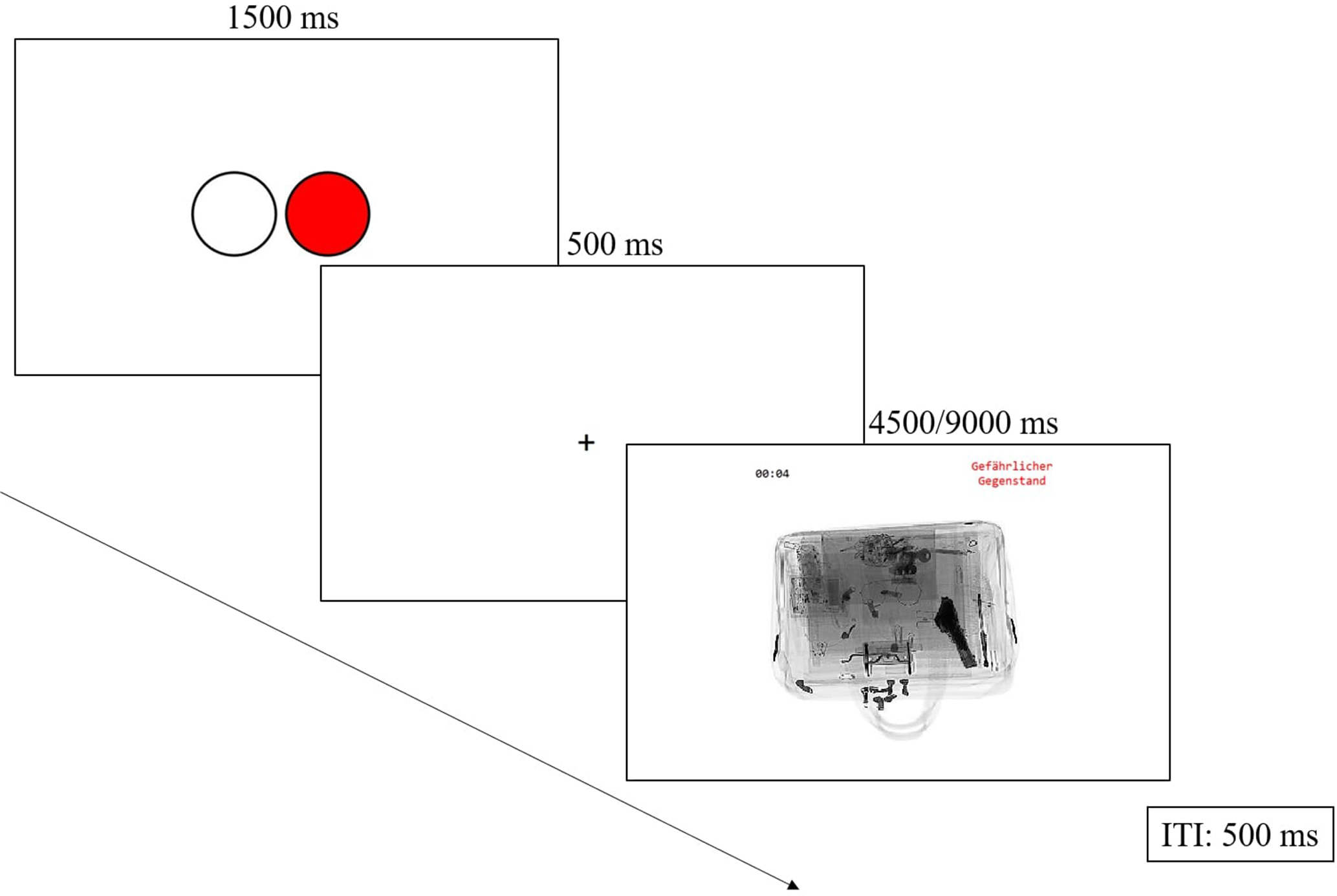
Typical trial sequence in the automation condition of Experiment 1. ITI = inter-trial interval (blank screen).
Design
Automation condition was varied between subjects (i.e., high reliability, low reliability, manual), and time pressure (i.e., high, low) alternated blockwise within subjects. Thus, the present study used a 3 (automation condition) × 2 (time pressure) repeated-measures mixed design.
Results
Performance
We conducted a 3 (automation condition) × 2 (time pressure) analysis of variance (ANOVA) on the percentage of correct responses (PC) as our primary analysis. The α for this and all subsequent analyses was set to the conventional .05 level. The corresponding means of this ANOVA are displayed in Figure 2A. This ANOVA revealed a significant main effect of automation condition, F(2, 57) = 37.774, p < .001,
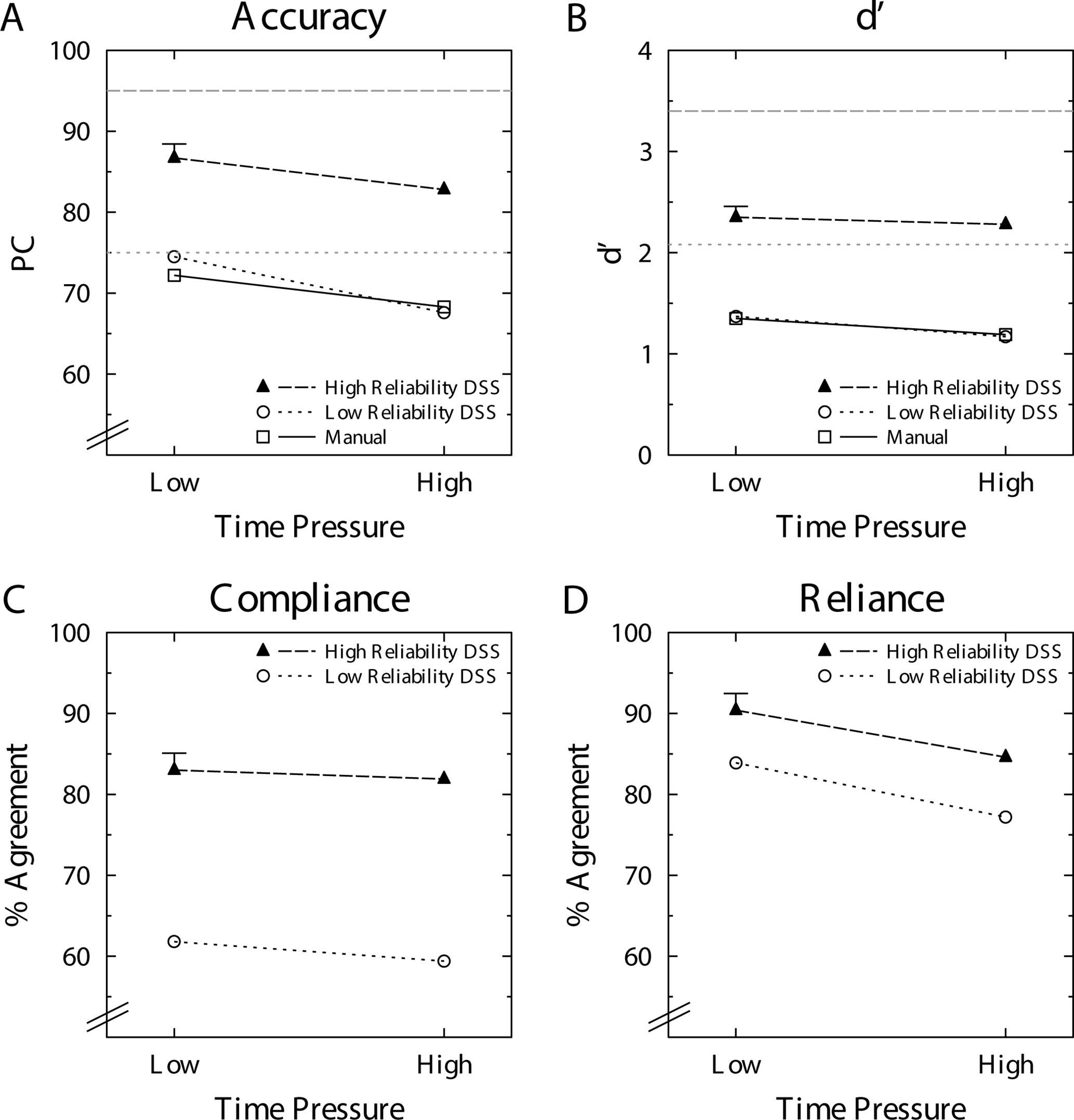
(A) Percent correct (PC). (B) Signal detection theory’s d′ (loglinear corrected). (C) Compliance. (D) Reliance as a function of time pressure, separately for each condition. In subplots A and B, the dotted horizontal lines represent the values (PC and d′, respectively) for the performance of the DSS alone. Error bar represents the pooled standard error. DSS = decision support system.
Additionally, in the high-reliability automation condition, the average performance of the human–automation dyad was significantly worse than the automation alone, even without time pressure (86.7%), t(19) = 7.454, p < .001, clearly showing a suboptimal DSS use. In the low-reliability automation condition, joint performance under low time pressure (74.5%) did not differ from the automation reliability, t(19) = .378, p = .710.
We conducted a parallel analysis on the signal detection measure d′ and the corresponding means which can be found in Figure 2B. Because some cells of participant × condition produced perfect hit rates, we loglinear-corrected all signal detection analyses according to Hautus (1995). Moreover, because it is not that clear for target-absent trials with no response whether this trial should count as a correct rejection or false alarm, we excluded these trials from the SDT analyses. Obviously, target-present trials with no response were counted as a miss. This ANOVA again revealed a significant main effect of automation condition, F(2, 57) = 53.692, p < .001,
Compliance and reliance
The finding that time pressure led to impairments of performance independent of automation reliability was surprising. We analyzed the effects of time pressure separately for compliance and reliance to better understand to what extent the effects on overall performance were related to time pressure-induced changes in compliance and reliance in the two automation support conditions. We defined compliance as the agreement rate with the automation when the automation indicated that there was a target present, and reliance as the agreement rate with the automation when the automation indicated that there was no target present.
We conducted a 2 (automation condition) × 2 (time pressure) ANOVA on compliance. The corresponding means can be found in Figure 2C. This ANOVA revealed a significant main effect of automation condition, F(1, 38) = 48.526, p < .001,
Results of a parallel analysis for reliance are visualized in Figure 2D. The ANOVA revealed a main effect of condition, F(1, 38) = 5.619, p < .023,
Response times
Finally, we also analyzed response times (RTs) as a dependent measure. We excluded incorrect responses from the RT analyses (24.7%), and after visual inspection we also excluded RTs shorter than 500 ms (.2% of the remaining trials). Because a luggage screening task is essentially a visual search task with a self-terminating search, with usually longer RTs for target-absent trials, we added target present/absent as an additional factor in the ANOVA, resulting in a 3 (condition) × 2 (time pressure) × 2 (target present/absent) ANOVA with repeated measures for the last two factors, and the results are displayed in Figure 3A–C. Unsurprisingly, RTs were faster in target-present (2593 ms) than in target-absent (4023) trials, F(1, 57) = 392.93, p < .001,

Response time (RT) data separately for each condition of Experiment 1. Panels (A)–(C) display the mean RTs separately for target-present and -absent trials, as a function of time pressure. Panels (D)–(F) display the deciles of the RT distribution separately for low and high time pressure trials. Error bar in the upper panels represents the pooled standard error. DSS = decision support system.
In an exploratory manner, we extended our RT analyses to distributional analyses, using the deciles of the RT distribution to better understand the effects of time pressure. To that end, we calculated the deciles for each participant, separately for each time pressure condition, and averaged these deciles for each condition across participants. These deciles are visualized in Figure 3D–F. As shown, participants in the high time pressure condition usually responded faster than they had to—as there is already a difference in the 20th percentile of trials.
Questionnaire data
To check how participants perceived the automation, we also analyzed subjective data. That is, we analyzed questionnaire on trust in technical systems (Wiczorek, 2011; scale from 1 to 4). Participants in the high-reliability (3.20) group had higher trust on the trust in technical systems questionnaire than participants in the low-reliability (2.89) group, t(38) = 2.807, p = .008, d = .88. In the contingency table, participants on average estimated the high-reliability DSS to be 89.3% accurate and the low-reliability DSS to be 72.4% accurate. Because participants were informed about the true reliability of their DSS after filling out the table, we are confident that participants generally had a realistic perception of the DSS’s reliability.
Discussion
The key findings of Experiment 1 are that (a) time pressure led to worse overall performance, (b) this negative effect of time pressure was not attenuated (or even led to positive effects) when a highly reliable automation was available, and (c) performance increased with a highly reliable automation but was still worse than the automation alone. Moreover, participants’ overall compliance did not differ between the high and low time pressure blocks but interestingly, participants were more reliant on the automation under low than under high time pressure. The overall performance decreases thus seem to be connected to a decreased reliance under high time pressure, in both automation conditions. Besides the general performance consequences, in the RT data, we found that participants sped up their responses a lot more than necessary, and could have taken more time in a lot of high time pressure trials to inform their decision.
The finding of a general negative effect of time pressure, even with a highly reliable DSS available, clearly contrasts some earlier findings (Rice & Keller, 2009; Rice et al., 2010; Rice & Trafimow, 2012). In this earlier research, time pressure was found to increase the dependence on the automation which clearly improved overall performance in cases of a highly reliable system. The results of the present experiment suggest that these earlier findings could have mainly been due to the extreme level of time pressure used in that study (only 2 s to inspect complex aerial photographs), which probably left participants no other choice than to follow the advice of the automation. In contrast, the present experiment did not use a time pressure manipulation that extreme, leaving the participants the possibility to also at least, to some degree, manually inspect the visual stimuli. In this experiment, it is quite clear that participants made use of this possibility, which is most clearly reflected in the reliance measure that showed that reliance even decreased somewhat with increasing time pressure. Also, the elevated time pressure led them to speed up their responses more than would have been needed. This suggests that time pressure in our study did not seduce participants to delegate their responsibility to the automation but, instead, induced a sort of self-pressure to inspect the X-ray as quickly as possible. Moreover, the data clearly suggest that in our study participants did not use the highly reliable automation adequately, regardless of whether they were under time pressure or not. That is, independent of the level of time pressure, participants would have been better served to just follow the DSS’s advice rather than interfering with the automation. This lack of adequate use of the DSS also reiterates the problem that joint performance of human and automation is often worse than that of the automation alone (Bartlett & McCarley, 2017).
Overall, this pattern of results suggests that the participants were reluctant to just follow the automated decision aid. Perhaps, they wanted to make sense of their role as responsible operators by checking and correcting the automation. Intervening with the DSS’s recommendations then led to more false than proper corrections, particularly with the high-reliability DSS. One reason for this might be because participants always inspected the stimulus after seeing the advice. This could have prompted them to become active and not just accept the automated advice. Thus, we designed Experiment 2 in order to give participants the possibility to first make their own decision and then give them the DSS advice—allowing for the possibility to specifically use the automation in cases of own uncertainty and to still contribute properly to the decision-making process in cases where one is confident in the own decision. One would then assume that under time pressure, participants should feel less sure about their own decisions and depend more on the automation. This setup could then possibly reduce the negative effects of time pressure—or even lead to positive effects if participants realize they should depend on the automation as much as possible under time pressure.
Experiment 2
The second experiment was designed to check whether changing the order of image display (and the concomitant response) and automation advice makes a difference for joint human–automation decision-making. That is, in the automation conditions, participants were always first shown the image and were asked to make their initial response to the stimulus while the stimulus was displayed. Then, they were shown the automation advice and had the opportunity to stay with their choice or to make a change based on the automation’s advice. Note that the automated DSSs were the same as in Experiment 1, and the manual condition was exactly the same as in Experiment 1.
Our hypotheses were largely the same as in Experiment 1. We expected an increased dependence on the automated DSS under high time pressure compared with low time pressure. That is, as was argued above, we expected that because participants can now first make their own decision and then get the advice, they can use it more specifically in trials where they are less secure about their own judgment. Thus, they would still feel in the loop (rather than just following a cue’s advice) but would also benefit from the automation. Again, we hypothesized that time pressure would decrease performance, but only if the automation is not highly reliable. Conversely, high time pressure could even lead to performance increases with a highly reliable automation.
Method
Participants
A fresh sample of 60 participants (34 female, one diverse) was tested in Experiment 2. They ranged in age from 18 to 37 (M = 26.35) and were predominantly right-handed (52 right-handed). Participants took part in the experiment for either course credits or monetary compensation of €9. Two additional participants in the low-reliability condition were also tested but excluded from any analyses due to issues with understanding the instructions in one case and the experiment environment crashing in the other case.
Apparatus, stimuli, procedure, and design
No changes were made in the manual condition. In the automation support conditions, the apparatus, stimuli, procedure, and design were the same as in Experiment 1 except for the following changes. First, in the automation conditions, the fixation cross was always present for 2 s, regardless of automation condition. Second, participants always first made their target-absent/-present choice and only subsequently received automation support for their decision. The time pressure manipulation remained the same, that is, it changed blockwise whether participants had 4.5 or 9 s to make their initial decision. Then, after seeing the automation decision, they had the opportunity to either confirm their initial judgment by pressing the same key again or to change their decision by pressing the other response key. The stimulus disappeared from the screen contingently after the initial response if one was given or after a maximum of 4.5/9 s. Participants were always shown their own response for 500 ms after they made their response, indicated by a green/red circle for target-absent/-present responses or an indication that they did not respond in time, respectively. Subsequently, the automation advice appeared on the screen below their own initial decision, also displayed by a green/red circle, for a maximum of 4.5 or 9 s in the high time pressure blocks and low time pressure blocks, respectively. Participants were instructed that if they decided to not press any response key when the automation was shown, it was interpreted as staying with the initial judgment.
Results
Performance
For the automation conditions, we always used the last response given as the final decision to inform the performance measures. As in Experiment 1, we conducted a 3 (automation condition) × 2 (time pressure) ANOVA on PC, and the corresponding means can be found in Figure 4A. This ANOVA again revealed a significant main effect of condition, F(2, 57) = 28.349, p < .001,
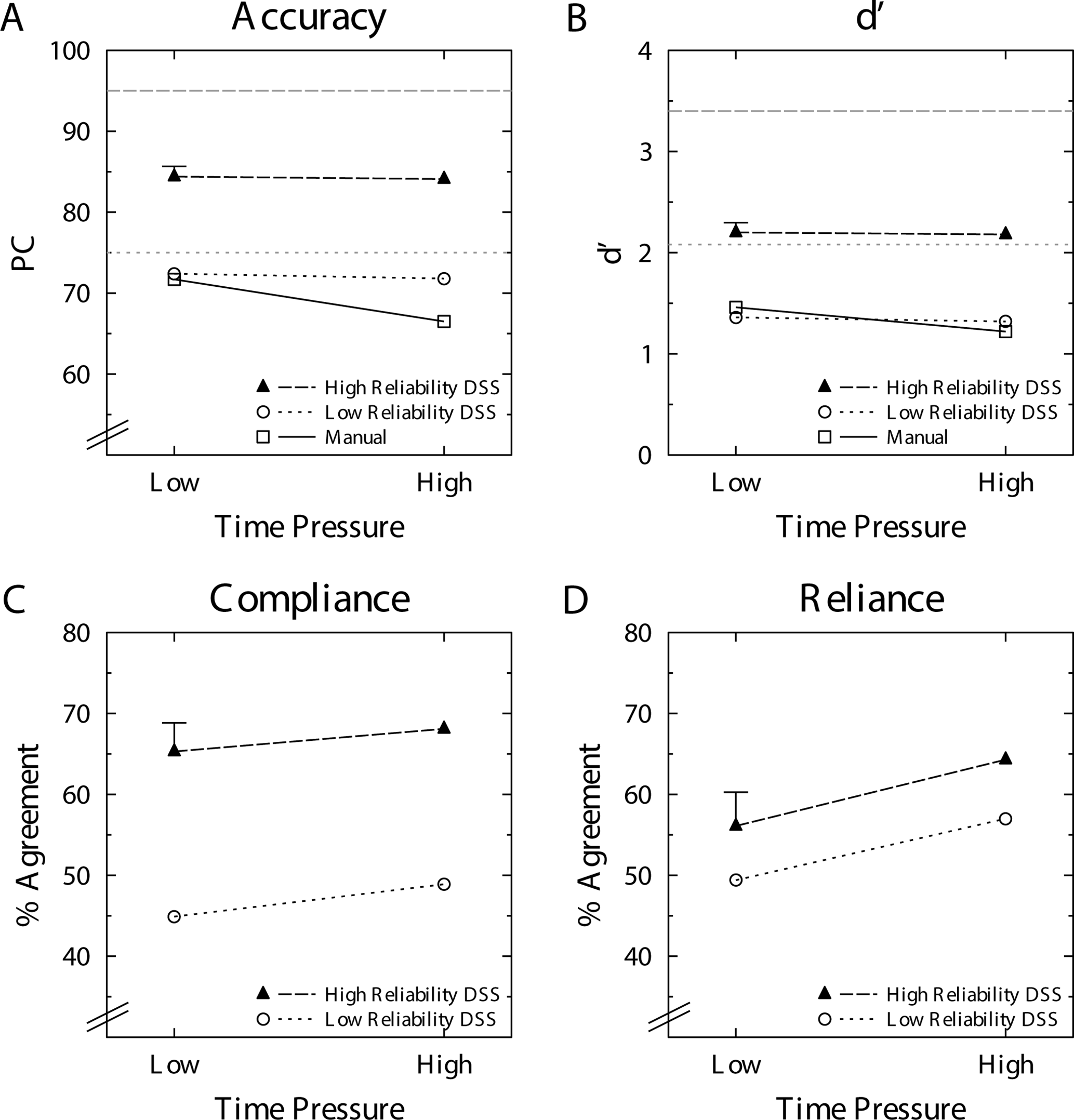
(A) Percent correct (PC). (B) Signal detection theory’s d′ (loglinear-corrected). (C) Compliance. (D) Reliance as a function of time pressure, separately for each condition. In subplots A and B, the dotted horizontal lines represent the values (PC and d′, respectively) for the performance of the DSS alone. Error bar represents the pooled standard error. DSS = decision support system.
As in Experiment 1, we additionally checked whether the performance of the human–automation dyad differed from the performance alone under low time pressure. Again, in the high-reliability automation condition, the average performance of the human–automation dyad was significantly worse than the automation alone, even without time pressure (84.4%), t(19) = 5.249, p < .001. In contrast to Experiment 1, the performance of the dyad in the low-reliability condition (72.4%) also differed significantly from the automation alone, t(19) = 2.328, p = .031.
We again conducted a parallel analysis for d′ and the results are displayed in Figure 4B. This ANOVA revealed a significant main effect of automation condition, F(2, 57) = 18.452, p < .001,
Compliance and reliance
Due to the experimental setup of Experiment 2, we had to take a slightly different approach to measure compliance and reliance. That is, we restricted compliance and reliance analyses to all trials where the initial response was not the same as the automation’s suggestion that was shown to participants. Then, we measured compliance and reliance as the proportion of trials where the participant’s response equaled the automation’s decision after they had seen the automation’s advice. Thus, the agreement rates of both experiments are not directly comparable because the underlying trial base was not the same.
We conducted a 2 (automation condition) × 2 (time pressure) ANOVA for compliance, and the results are visualized in Figure 4C. This ANOVA revealed a significant main effect of automation condition, F(1, 38) = 8.239, p = .007,
A parallel ANOVA was conducted for reliance with the results shown in Figure 4D. For reliance, there was no main effect of automation condition, F(1, 38) = 1.030, p = .317,
Response times
As in Experiment 1, we also analyzed RTs. We used only the RTs during the initial target display before the automation was shown because that most likely represents the actual target search. Again, we restricted our analyses to correct RTs only (exclusion of 34.4% of all trials) with a minimum RT of 500 ms (.2% of all remaining trials). We again included target presence as an additional factor in the ANOVA. The corresponding means of this ANOVA are displayed in Figure 5A–C. This ANOVA revealed faster RTs in target-present (2252 ms) than in target-absent (3597 ms) trials, F(1, 57) = 250.84, p < .001,

Response time (RT) data separately for each condition of Experiment 2. Panels (A)–(C) display the mean RTs separately for target-present and -absent trials, as a function of time pressure. Panels (D)–(F) display the deciles of the RT distribution separately for low and high time pressure trials. Error bar in the upper panels represents the pooled standard error. DSS = decision support system.
We again conducted an exploratory analysis on the RT distribution, which is visualized in Figure 5D–F. As in Experiment 1, it seems like participants responded much faster than necessary under time pressure, again with differences in the faster part of the RT distribution. Thus, without the real need to speed up the fastest responses, it appears that participants still did so under time pressure.
Questionnaire data
In Experiment 2, there was only a slight descriptive trend in the subjective data, with unreliably higher trust in the high-reliability DSS (3.09) than in the low-reliability DSS (2.88) on the scale of Wiczorek (2011), t(38) = 1.656, p = .106, d = .523. In the contingency table, participants on average estimated the high-reliability DSS to be 90.8% accurate, and the low-reliability DSS to be 77.6% accurate, again close to the actual reliabilities.
Discussion
To summarize the key finding of Experiment 2, the initial-decision-then-automation-advice setup appears to have reduced the negative impact of time pressure on performance to little or no effect, as indicated by the PC data. Moreover, we also found interesting results for compliance and reliance, with an increase for reliance under high time pressure and higher compliance in the high-reliability DSS condition. Thus, it seems like the experimental setup of Experiment 2, with participants receiving the automation advice only after having made their own decision, made quite a difference for operator reliance under time pressure. That is, in this scenario, participants’ reliance was greater under high than under low time pressure, probably also playing a role in the significant interaction found for PC. It also makes sense that there was only a significant effect of condition on compliance, as the alarm systems differed in terms of their false alarm rate. The results of Experiment 2 thus seem to confirm the hypothesis that giving participants the DSS’s advice only after they had made their initial choice could reduce the negative effects of time pressure by increasing the use of the DSS in those high time pressure trials, particularly for reliance. The present findings align well with the findings by Ho et al. (2013), who found that giving participants the possibility to only use the automation when they felt it was useful increased overall performance compared with higher levels of automation that always gave recommendations.
General Discussion
The goal of the present research was to investigate performance consequences of time pressure with different automated DSSs (or none) available. To this end, we used a luggage screening task and had participants carry out this task, under both low and high time pressure. Moreover, participants were randomly assigned to one of three conditions using either no automated DSS (manual), a highly reliable DSS (95% reliability), or a low reliable DSS (75% reliability). In Experiment 1, participants in the automation conditions were first shown a cue and then the stimulus, and in Experiment 2, we reversed that order and gave participants the possibility to change their initial decision based on the DSS’s advice. The main findings were that time pressure largely led to negative effects on performance—however, reversing the order of decision-making in Experiment 2 strongly reduced these negative effects. Moreover, regarding the dependence on the automation, our results were rather mixed—with less reliance on the DSS under high time pressure in Experiment 1 and an increased reliance under high time pressure in Experiment 2. Compliance was largely unaffected by introducing time pressure. Perhaps most interestingly, in both experiments and in all four automation conditions, the joint mean performance (in both PC and d′) of the human–automation dyad was descriptively worse than the automation alone.
As previously mentioned, contrary to some earlier findings (e.g., Rice & Keller, 2009), we did not find time pressure induced benefits for performance even with a highly reliable DSS. Thus, it seems as if time pressure—at least in the present study—did not lead to more heuristic or optimized decision-making, as was suggested by earlier studies (e.g., Payne et al., 1988; Rice & Keller, 2009). At best, our results indicate that having a DSS available after having made the initial own choice can reduce the negative effects of time pressure, as was shown in Experiment 2. That is, changing the order of decision-making reduced the negative effects of time pressure, and increased reliance on the DSS, providing some evidence for an increased automation dependence under high time pressure. Thus, it seems like participants used the DSS more selectively in those trials where they were less secure about their own decisions—and it makes sense that those trials were mostly time-pressured trials. However, there were still no positive effects of time pressure as was reported by earlier studies (e.g., Rice & Keller, 2009). From a practical standpoint, changing the order of decision-making could be recommendable in contexts where time pressure cannot be avoided.
The present findings also reinforce earlier concerns (e.g., Bartlett & McCarley, 2017; Meyer, 2001; Meyer et al., 2014) about the joint performance of a human–automation dyad. It seems clear that participants did not use the automation adequately, regardless of whether or not they were under time pressure. That is, if the automation would not have been interfered with by a human, the overall performance would have been higher, especially with the high-reliability DSS. Even under time pressure, there was no more adequate automation use, despite the fact that time pressure decreased manual performance—and one would assume that decreased personal performance capability would lead to stronger dependence on the automation (Rice & Keller, 2009).
The combined findings of a negative impact of time pressure on performance, and the fact that the automation alone mostly showed greater performance than the human–automation dyad, raises the question of whether a higher level of automation (e.g., Kaber, 2018; Sheridan & Verplank, 1978) might be adequate under high time pressure, as previously suggested by Moray et al. (2000), who argued that under high time pressure, one can truly benefit from automation, and particularly if the automation keeps the human out of the loop. This proposal seems particularly promising considering the fact that the joint performance was below that of the automation in the present experiments. Moreover, Johnson et al. (2002) also suggested that “subjects were reticent to deviate from highly automated … suggestions even when significant improvements were still possible” (p. 132); thus, keeping the human out of the loop might be best for overall performance. Obviously, in a lot of work settings, it is not possible to remove the human from the loop, be it for legal reasons or availability in emergency situations, and the present results implicate that time pressure should be avoided in such situations.
Besides the main performance consequences of time pressure and automation, we also analyzed some additional measures, with interesting implications. Specifically, in both experiments, participants under high time pressure took less time than they could have had to make their decision. This not only shows that the manipulation was successful but also that, in real-world contexts, one could try to use recommendations to workers that they should always take the time they have at hand to complete a task, avoiding rushed decisions.
No study comes without limitations and the present experiments are no exception to that. First, the present study used quite a high base rate (50%). Obviously, the base rate at airport security checkpoints is much lower, but this nonetheless gives even more importance to the low-reliability DSS condition with a high false alarm rate. That is, it is necessarily true that with decreasing base rates and a constant automation reliability, more false alarms are produced (Parasuraman & Riley, 1997). Nevertheless, future research might investigate the influence of base rate. Second, the DSS we used was of rather simple nature, and evidence has been provided (Chavaillaz et al., 2018) that direct cues (i.e., cues marking the target) can improve performance compared with a simple cue (such as the one we used). Third, we must acknowledge that giving participants a second chance for their decision in the automation conditions in Experiment 2 might have decreased time pressure, especially because participants responded rather quickly after seeing the DSS’s advice, as this was a rather simple agree/disagree statement. Note also that even though the negative effect of time pressure was ameliorated in Experiment 2, the overall performance in the automation conditions did not really differ between Experiments 1 and 2.
One question that our present research cannot address is what role self-confidence with the task plays for automation dependence, and future research should investigate this. Moreover, establishing a proper mental model of the automations’ capabilities might also change automation use and should be investigated in future research.
To conclude, we argue that time pressure should in fact be avoided—especially in safety-critical environments such as security checkpoints at airports. Moreover, giving automation advice after the initial choice might make it possible to reduce such negative effects of high time pressure. However, our findings also reinforce earlier concerns whether to keep the human in the loop at all if operators worsen the overall performance compared with the automation alone (e.g., Bartlett & McCarley, 2017; Meyer, 2001). Thus, it seems fair to conclude that performance was not optimized ideally in the automation conditions and the human–automation dyad was worse than the high-reliability automated DSS alone would have been—and considerably worse than an ideal human–automation partnership would possibly allow for (Sorkin & Woods, 1985).
Key Points
Time pressure largely leads to negative effects on performance.
Joint human–automation performance falls below automation-alone performance with a highly reliable system, even under high time pressure.
Presenting the automation advice after participants have made their initial choice reduced negative effects of time pressure, but joint performance was still worse than the isolated automation performance.
Footnotes

Author Biographies
Tobias Rieger is a researcher and lecturer at the Department of Psychology and Ergonomics, Technische Universtität Berlin, Germany. He earned his master's in psychology at the University of Freiburg in 2018 and is currently working on a PhD addressing issues of human performance consequences of automation.
Dietrich Manzey is a university professor of work, engineering and organizational psychology in the Department of Psychology and Ergonomics, Technische Universtität Berlin, Germany. He earned his PhD in experimental psychology at the University of Kiel, Germany, in 1988, and his habilitation in psychology at the University of Marburg, Germany, in 1999.