



Abstract
Objective
We describe a methodology that provides a nonobtrusive means of detecting stress and related deficits through the assessment of spontaneous verbal output in ongoing communications.
Background
In high-demand environments, operational personnel are exposed to an array of environmental, task, and interpersonal stressors that can negatively impact performance as well as jeopardize safety and well-being. In these settings, the requirement exists to assess cognitive and emotional state “at a distance” and without interfering with ongoing performance.
Method
We describe a lexical approach to assessing stress effects from ongoing or spontaneous verbal output. This approach is examined in a spaceflight analog setting.
Results
We assess stress effects in terms of five core dimensions and develop lexical indicators of these core stress dimensions and relevant sub-facets. We establish the proof-of-concept of this approach by presenting representative data from a spaceflight analog.
Conclusion
This approach provides an unobtrusive means to evaluate ongoing task communications at the individual and team level in order to assess cognitive/emotional states such as workload, negative affect, attentional focus, anxiety, and team orientation.
Application
There are many high-demand settings in which it is valuable to monitor the potential negative effects of stress on operational personnel. These environments include spaceflight, the military, aviation, law enforcement, and medicine.
Keywords
There are many high-demand settings in which it is valuable to monitor the potential negative effects of stress on operational personnel. These environments include the military, aviation, spaceflight, chemical and nuclear power plant operations, law enforcement, and medical teams. One practical goal in these operational settings is to assess operator state in an unobtrusive manner, without interfering with or disrupting ongoing performance.
Unlike teams in the experimental laboratory that can be examined “under a microscope,” teams in the real world operate autonomously, apart from direct observation and supervision, and operate in a fluid, dynamic manner to achieve the team’s objective (Driskell, Burke, et al., 2014). Therefore, the requirement exists to develop a nonobtrusive means of detecting cognitive performance deficits, stress, fatigue, or anxiety in situ without the intrusion of the psychologist’s typical array of questions and questionnaires. The requirement to assess individual and team functioning “at a distance” suggests the potential efficacy of a methodology to assess cognitive and emotional states in real time from ongoing or spontaneous verbal output.
This article describes a methodological approach to track stress effects in high-demand environments. We describe the development of this approach in the context of long-duration spaceflight. Spaceflight is an interesting exemplar of a high-demand environment in its own right, but is also of interest because performance in long-duration spaceflight is an immediate practical concern. For example, NASA’s mission to Mars, which will incorporate a crew of six on a 70-million-mile journey of approximately 2.5 years, is slated for the 2030s. These long-duration exploratory missions pose a number of challenges. According to the NASA Human Research Roadmap (Slack et al., 2009), “Long-duration missions to remote environments will increase astronaut exposure to extreme isolation and confinement, resulting in higher stress levels and an increased risk of crew morale deterioration.” Furthermore, Strangman (2010) has noted that there exists a large number of reports from the early age of exploration to the present day indicating that mood disturbance, depression, anxiety, and hostility are all substantial concerns for spaceflight (see also Shepanek, 2005; Stuster, 2010).
In order to track and monitor stress effects, we must first (a) define what should be measured, (b) determine how we are going to measure it, and (c) document the value of this approach in relevant settings. In the following sections, we address these topics and describe the development of a lexical analytic tool to assess stress effects.
Assessing Stress Effects
The term stress is broadly defined as a process by which certain environmental demands (e.g., stressors such as time pressure, noise, task load) evoke an appraisal process in which perceived demand exceeds resources, and that results in undesirable physiological, psychological, behavioral, or social outcomes (Salas et al., 1996). It is useful to speak of “stress” in general terms, in referring to high-demand task environments, but it is less useful to try to predict performance at this broad or unidimensional level. We believe, however, that stress effects can be defined in terms of a limited set of psychological mechanisms that are engaged or are impacted by stress.
For example, Poulton (1978) has argued that the detrimental effects of noise on performance are primarily the result of distraction. Others have argued that the detrimental effects of noise on performance are primarily the result of increased task load. In fact, noise can have either effect: noise that is relevant to the task (i.e., sound that has a bearing on the task) can place an increased task load on the operator, whereas noise that is irrelevant to the task (that carries no task-related information) can serve primarily as a distraction.
We propose that there are a limited number of cognitive, emotional, and social mechanisms through which stress impacts performance. The “Big Five” stress mechanisms include the following.
Stress Increases Distraction and Decreases Attentional Focus
One of the more well-established findings in the stress literature is that as stress or arousal increases, the individual’s breadth of attention narrows (Combs & Taylor, 1952; Easterbrook, 1959). For complex tasks, in which the individual must attend to a relatively larger number of salient task cues, this narrowing of attention may result in the elimination of relevant task information and task performance will suffer. Related research shows that stress results in narrowing of attention or perceptual tunneling (Easterbrook, 1959), reduced working memory (Huey & Wickens, 1993), and performance rigidity (Staw et al., 1981).
Stress Increases Cognitive Load and Demand on Capacity
Task load is defined as performing two or more tasks concurrently. However, this construct is related to a number of other terms, including multitasking, dual-task performance, and workload. Typically, the term workload refers to the individual’s perception of the work demands imposed by a task environment, although the term has also been used to describe the demands of the task environment itself in terms of the volume and pace of the work to be performed (see Spector & Jex, 1998). High-stress environments often involve an increase in task load stemming from the imposition of multiple tasks that must be performed, the requirement to shift from one task to another, and having to attend to novel or unfamiliar stimuli. Task load impairs performance because of the increased demands on limited cognitive capacity (Oswald et al., 2007).
Stress Increases Negative Emotions and Frustration
Negative affective reactions to stress may include subjective feelings of anger, annoyance, tension, and frustration. Effective performance under stress requires the capacity to maintain one’s composure and emotional control while remaining task-focused under demanding conditions (Driskell et al., 2001; Singer et al., 1991). Research suggests that emotional stability is a significant factor in any task that requires cooperative behavior (Driskell et al., 1987; Mount et al., 1998).
Stress Increases Fear and Anxiety
Performance in high-demand situations may result in an increase in fear and anxiety, and increased physiological reactivity such as increased heart rate, sweating, or shaking. Anxiety may be viewed as a specific type of negative emotion that incorporates cognitive anxiety (negative expectations and concerns about oneself) and somatic anxiety (perceptions related to physiological arousal of unease or worry; see Martens et al., 1990; Mellalieu et al., 2006; Woodman & Hardy, 2003).
Stress Increases Social Impairment
Social effects of stress may include a reduction in the tendency to assist others, increased interpersonal aggression, neglect of social or interpersonal cues, and less cooperative behavior among team members. The very presence of others can be arousal inducing (Mullen et al., 1997). Research further indicates that, under stress, people tend to be less likely to help others, transfer information more poorly, and have greater difficulty coordinating with other team members (Driskell et al., 1999).
Note that we are not arguing that these are the only major consequences of stress, but simply that these represent a primary or core set of mechanisms through which stress impacts performance. Moreover, this conceptualization suggests that one strategy to assess stress effects in a comprehensive manner is to target these higher-order dimensions of (a) attentional focus, (b), cognitive load, (c) negative emotion, (d) anxiety, and (e) social impairment.
Why Examine Verbal Content?
In the broadest sense, content analysis refers to a research approach that analyzes speech or text in order to draw inferences regarding the text itself or the speaker’s intentions, attitudes, or cognitions. Central to this approach is the emphasis on the importance of language as a means to draw inferences regarding the psychological state of the speaker.
Pennebaker et al. (2007) are perhaps most eloquent in describing content analysis: “The ways that individuals talk and write provide windows into their emotional and cognitive worlds.” That is, the words that people use in natural language can provide important cues to their thought processes, emotional state, intentions, and motivations. Moreover, reasonable success has been achieved in examining word usage to uncover linguistic correlates of various psychological constructs of interest, including depression, deception, and health (see Driskell et al., 2012; Pennebaker et al., 2007). Kanki et al. (1989) examined communication patterns of aircrews to assess shared mental models, and Predmore (1991) coded aircrew communication to examine crew coordination. Waller and Zimbelman (2003) have observed that the use of these types of textual/verbal materials allow the researcher to identify the “cognitive footprint” of ongoing, internal psychological processes from textual or verbal records.
The basic premise of this work is that spontaneous verbal output provides a natural and valid indicator of basic cognitive processes (Pennebaker et al., 2003). Natural word use is not prone to the typical limitations of self-report measurements. That is, natural language use is less subject to social desirability bias, and can be derived in real time without interfering with the cognitive processes being measured, and without interrupting team performance. Moreover, natural word use is reliable and consistent across time and context, and can be meaningfully measured in individuals and teams (Gleser et al., 1959; Mehl & Pennebaker, 2003).
The advantages of this approach are that it is not intrusive, in that it taps into people’s experience without interfering with it. Moreover, it is unobtrusive in that people are not aware they are being observed, and it does not require hanging some device on the individual or disruption of the task. Moreover, there is a reasonable theoretical basis for arguing that words have psychological meaning, and research has documented the value of this approach in various applications, including examining cognitive load and other indices of collaborative communications in bushfire management teams (Khawaja et al., 2012) and analyzing rapport in law enforcement investigative interviews (Driskell et al., 2012).
There are three broad assumptions that underlie this approach. The first assumption is: the more frequently people use certain words, the more salient this content is to them. For example, the more that speech incorporates the word “anger” or a close associate (e.g., annoyed, peeved), the more likely that person is experiencing that psychological or emotional state. A second assumption is that emotional experience corresponds to verbal emotional expression. That is, the emotions that we express verbally should correspond to the emotions that are actually felt. However, there are qualifications to this claim. For example, emotional expression is moderated by situational factors. Brown and Levinson (1987) argue that speakers use more polite language when addressing high status others than low status others (see also Ambady et al., 1996). A third assumption is that linguistic content and linguistic style are both important. Linguistic content refers to what the speaker is talking about (including psychological content terms related to anger or confusion), whereas style refers to how he or she says it (e.g., whether the speaker refers more to self or to other; whether the speaker uses a large number of qualifiers or negations). Content analysis approaches are useful for examining not only content, but especially for examining peculiarities in word choice or usage “behind” the message. Indeed, some argue that words that reflect how people are expressing themselves can be more informative than what they are expressing (Newman et al., 2003).
Development of STRESSnet
The following sections describe the development of a lexical analytic tool to assess stress effects. This tool, STRESSnet, is a simple word count program. That is, it is a computerized program that takes verbal or textual files as input and goes through each file word-by-word and attempts to match each word to specific dictionaries reflecting the constructs of interest (such as words reflecting anger terms). Each word is then incremented into one of these lexicon categories, and the program then calculates the use of each lexicon (e.g., anger terms) as a percentage of total speech.
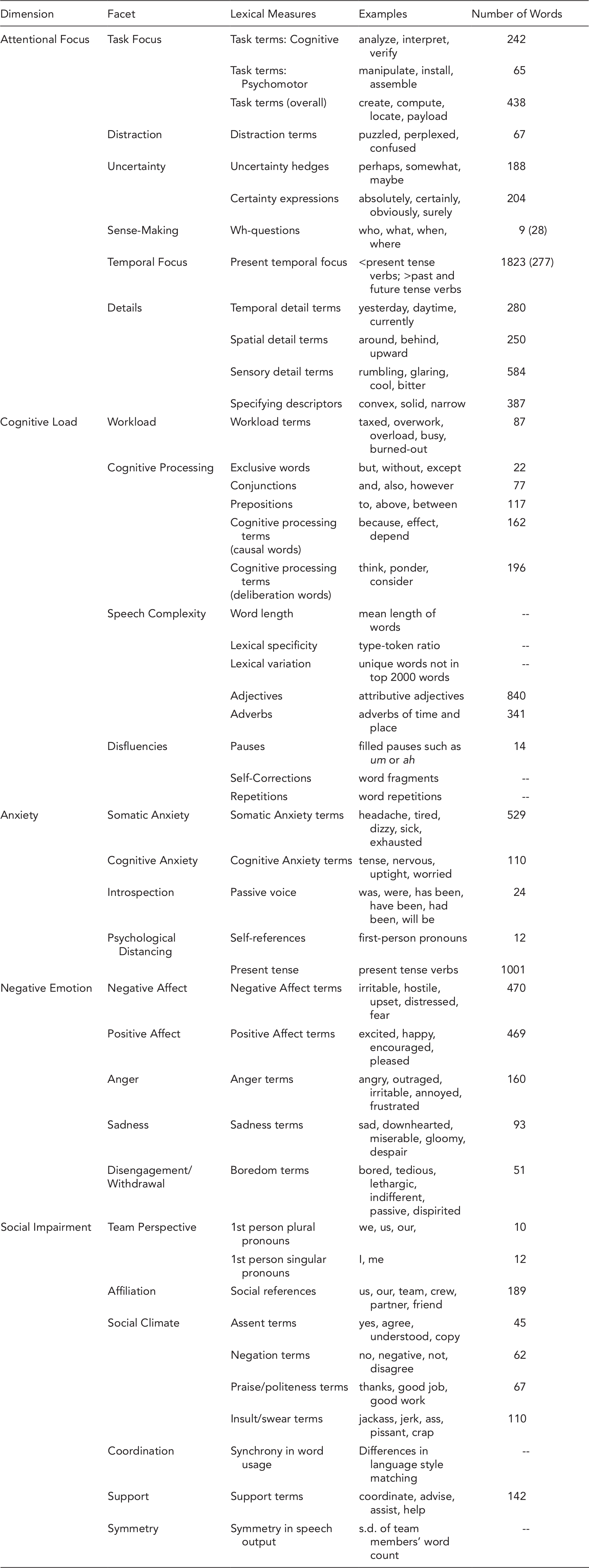
We focus on the five core stress dimensions of attentional focus, cognitive load, anxiety, negative emotion, and social impairment. Each of these five dimensions is comprised of a number of discrete lower-level facets. Each facet, in turn, is measured by specific lexical categories, as shown in Figure 1.
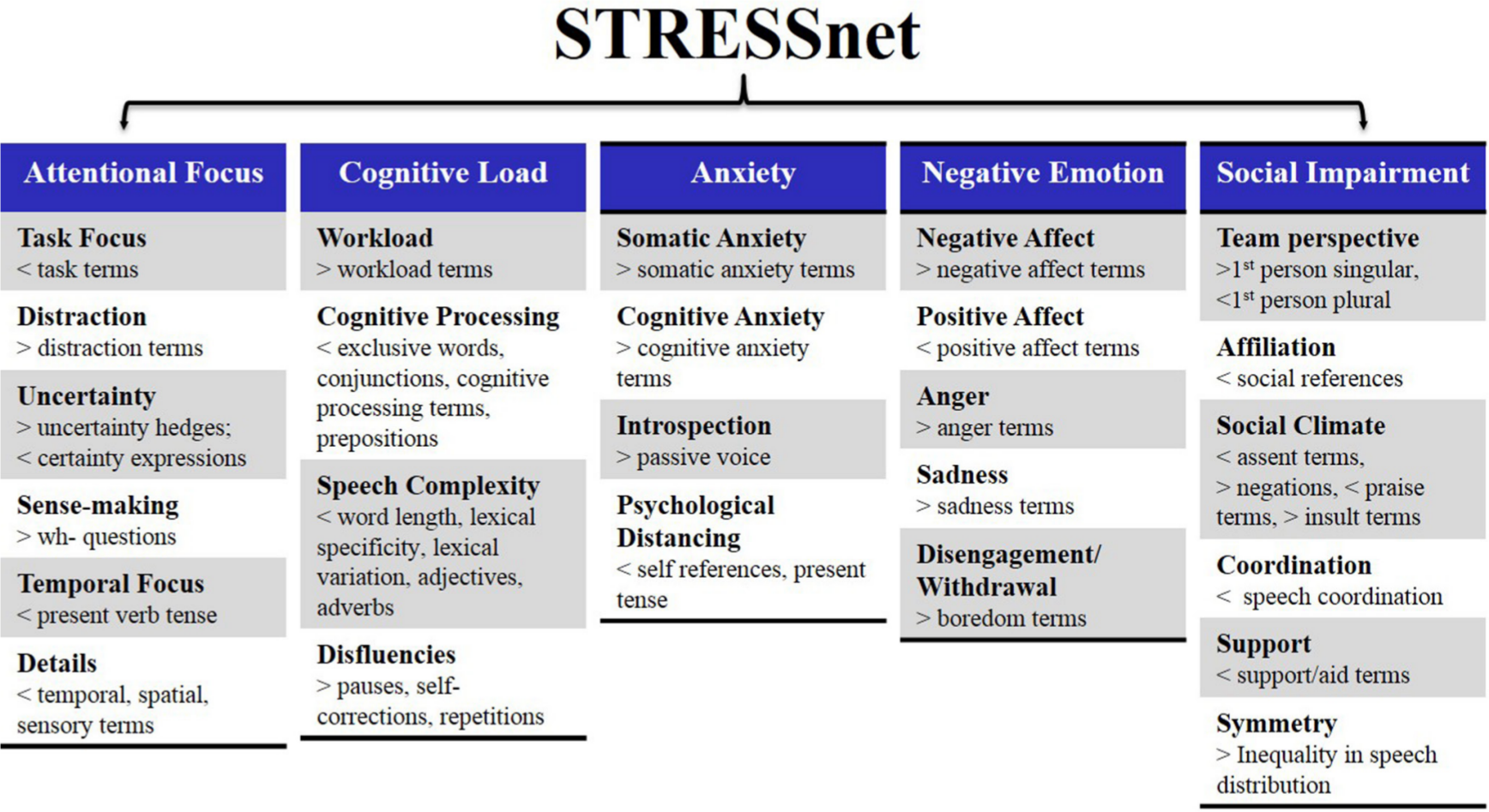
STRESSnet primary dimensions and corresponding facets.
In the following sections, we describe the development of each dimension and subfacet in some detail. We developed the lexicon, or word list, for each of the identified facets according to the following procedure. First, for each facet, such as somatic anxiety, we conducted a review of the extant literature. We reviewed existing theoretical literature within each construct domain, drawing on classic analyses of emotional structure (e.g., Ortony et al., 1988; Storm & Storm, 1987; Watson & Clark, 1984) and devoted special attention to how each specific construct (e.g., somatic anxiety) has been examined within the applied literature relative to the human performance and spaceflight environment.
Second, we reviewed research that had developed existing measures or scales related to that construct, extracting items or words used to assess that construct. For example, somatic anxiety has been measured by a number of pen-and-paper or self-report scales such as the State-Trait Inventory for Cognitive and Somatic Anxiety (Grös et al., 2007) and the Body Vigilance Scale (Schmidt et al., 1997).
Third, we reviewed existing lexical analysis programs, such as the General Inquirer (Stone et al., 1966), LIWC (Pennebaker et al., 2007), SenseNet (Al Masum et al., 2007) and Whissell’s Dictionary of Affect Language (Whissell, 1989), extracting word lists used within these programs to assess these target constructs.
Fourth, we reviewed our Spaceflight Corpus, which included Johnson Space Center (JSC) oral history transcripts and International Space Station (ISS) journals and mission logs in order to extract terms that are unique to the spaceflight environment. For example, for the category of somatic complaints, we included a number of terms related to the medications in the medical kit available in the spaceflight setting.
In the final step, we integrated the results of these searches, deriving comprehensive word lists (such as a list of somatic anxiety terms) for each facet. These lists were reviewed by a set of judges to eliminate redundancies, expand the lists using online thesauri and related tools, and then determine what words should be included or excluded from each word list, resolving disagreements to achieve 100% agreement.
Following this standard procedure, we derived the following STRESSnet dimensions and associated facets. (The resulting measures are presented in the Appendix.)
Attentional Focus
In a space mission…you got a million things on your mind. You’ve got not only the next experiment, but the last experiment, or eating, or exercise, or how you did in your medicals today…Everything’s on your mind.
- CDR Gerald Carr, Skylab 4
The idea that the scope or breadth of attention narrows under stress is well-documented and has been variously labeled attentional narrowing, attentional tunneling, and heightened attentional selectivity or reduction in the amount of information that can be attended to at a given time (Easterbrook, 1959; Hockey et al., 2011; Wickens, 1996). This refers to what is generally viewed as an adaptive response to stress demands in which the individual selectively maintains attention to high priority features of the task, but at the cost of a reduction of attention to secondary task cues. This can result in significant performance degradation when performing complex or multiple tasks. Consistent with this perspective, Manzey et al. (1995) found evidence of impairment in dual-task performance in the examination of an 8-day Mir mission, as well as a longer-duration 438-day mission (Manzey et al., 1998).
In addition, stress can be distracting in a general sense in that, under conditions in which the operator faces novel or disruptive events, attention is displaced or diverted to external or task-irrelevant stimuli. Stuster (1996) notes that “the individual’s attention begins to drift with corresponding degradation of vigilance and…overall task performance” (p. 81). Strangman (2010) concludes that difficulty concentrating or focusing attention is a recurring anecdotal complaint from astronauts, individuals wintering over in the Antarctic, and those in confined or restricted environments, and that these observations are generally supported by empirical data in these analogs.
The Attentional Focus dimension is comprised of the following lower-level facets: (a) Task Focus, (b) Distraction, (c) Uncertainty, (d) Sense-Making, (e) Temporal Focus, and (f) Details.
Facet: Task Focus
One lower-level facet that comprises the upper-level dimension of attentional focus is task focus. Research suggests that, for complex tasks, in which the individual must attend to a relatively larger number of salient task cues, the narrowing of attentional focus that occurs under stress may result in less attention to relevant task information and a resulting loss of task focus (Driskell et al., 1999; Easterbrook, 1959). To assess task focus, we followed our standard lexicon development strategy to develop a dictionary (or word list) of task-oriented words, such as maintain, operate, assemble, build (see Anderson et al., 2001). These lists were expanded to include task-oriented terms in the cognitive domain (e.g., contrast, compare) and the psychomotor domain (e.g., calibrate, manipulate). Moreover, we reviewed the 112 JSC oral history as well as existing ISS journals and mission logs to obtain task terms unique to the spaceflight operational setting, such as flight, mission, orbit, EVA, and payload.
Facet: Distraction
Distraction occurs when competing demands distract attention from the task. For example, Halin et al. (2014) note that distractors such as background noise can divert the locus of attention away from the focal task toward the distraction, interrupting ongoing activity and task engagement. Especially in high-demand environments, effective performance requires a balance between (a) the ability to screen out extraneous stimuli that might interfere with our performance and (b) the ability to detect novel stimuli outside of the current attentional focus that may be relevant to the task at hand. However, this adaptive capability comes at a price of distraction and disorientation from the focal task (Pacheco-Unguetti & Parmentier, 2014).
To the extent that distractors divert attention from task-relevant requirements, we would expect a greater prevalence of speech related to disorientation or distraction. Following our standard approach, we derived a list of terms related to distraction or disorientation (e.g., confused, puzzled, perplexed, lost).
Facet: Uncertainty
Another indicator of loss of attentional focus is uncertainty. Jordan et al. (2012) define uncertainty as: “a sense of wondering, doubt, or unease about how the future will unfold, what the present means, or how to interpret the past” (p. 2). Individuals can be uncertain about their knowledge or understanding, their decisions, their performance, or uncertain because information is incomplete, ambiguous, or contradictory.
Uncertainty in speech can be detected by the use of hedge terms (Clausen, 2010; Rubin et al., 2006) or uncertainty hedges, terms that attenuate the strength of an utterance or convey speculative content. Uncertainty hedges include terms such as maybe, perhaps, somewhat, slightly, or probably. Alternatively, uncertainty in speech can be detected by the decreased use of certainty expressions (also termed intensifiers, boosters, or assertives) that denote certainty. Certainty expressions include terms such as absolutely, certainly, definitely, or obviously. We expect that, under stress, uncertainty will be reflected in a greater proportion of uncertainty hedges and a lower proportion of certainty expressions.
Facet: Sense-Making
A loss of attentional focus and task concentration can result in a decrease in understanding or awareness regarding the task at hand. In speech, people seek information that they do not possess or may have forgotten through the use of questions, or what are termed wh-questions. A wh-question is used for seeking content information relating to persons, things, facts, time, or place. Wh-questions include terms such as who, what, which, when, where, how, and why. We expect that attempts at sense-making will be reflected in a greater proportional use of wh-question terms.
Facet: Temporal Focus
Verb tense (i.e., past, present, or future) may provide an indication of temporal focus of attention (Ehmann et al., 2007; Tausczik & Pennebaker, 2010). We expect that loss of attentional focus will result in greater use of past and future tense relative to present tense.
Facet: Details
Distraction and loss of task focus should result in less specificity, or fewer details, in task communications. This loss of specificity should be reflected in the use of fewer details, including (a) temporal detail terms (e.g., yesterday, today, hour); (b) spatial detail terms (e.g., above, below, between); (c) sensory details, (e.g., sharp, loud, bright); and (d) specifying descriptors, such as terms referring to color, shape, or size.
Cognitive Load
When you are busy…if you make a mistake it is hard to go back and do the task over again. If you do, you get further behind, the work keeps piling up behind you, and you finish the day frustrated because you didn’t accomplish all that had been scheduled.”
- CDR Gerald Carr, Skylab 4 (quoted in Stuster, 1996, p. 78).
Cognitive load, workload, or task load are terms that are used interchangeably to refer to the total work demand placed on the individual, including the amount and intensity of effort required to perform the task (Young & Stanton, 2005). High workload or overload conditions result in performance impairment as well as physical and mental fatigue. In a study of 14 Mir missions, Nechaev (2001) reported a significant correlation between crew errors and episodes of high workload. Harrison and Fiedler (2011) describe the well-publicized account of conflict between the Skylab 4 crew and Mission Control as a result of over-programming of the astronauts’ time (see also Cooper, 1979). Although the crews’ reaction was noted to be hostile and irritable, others have described this response as a legitimate reaction to overwork.
The Cognitive Load dimension is comprised of the following lower-level facets: (a) Workload, (b) Cognitive Processing, (c) Speech Complexity, and (d) Disfluencies.
Facet: Workload
Typically, the term workload refers to the individual’s perception of the work demands imposed by a task environment, although the term has also been used to describe the demands of the task environment itself in terms of the volume and pace of the work to be performed (see Young & Stanton, 2005). One potential reaction to high workload is increased complaints regarding task burden, overwork, and overload. Therefore, we expect that high workload will result in a greater proportionate use of high-workload terms, such as taxed, busy, overloaded, and burdened.
Facet: Cognitive Processing
High workload taxes the individual’s capacity and increases demand on cognitive resources. This should result in less complex thought, or language that reflects a lower level of cognitive complexity. Tausczik and Pennebaker (2010) have proposed that cognitive complexity can be captured by several linguistic categories, including (a) exclusive words such as but or without that make distinctions between different categories, (b) conjunctions such as and or also that link together multiple thoughts or phrases, (c) prepositions such as to or above that indicate greater specificity or concreteness regarding a topic, and (d) cognitive processing terms that include causal terms (because, effect) and deliberation terms (think, consider).
Facet: Speech Complexity
With high levels of cognitive load, we expect to see a corresponding decrease in speech complexity. Grant and Ginther (2000) note that more proficient speech involves greater precision in using words to express ideas and in more sophisticated vocabulary use. Measures of speech proficiency include (a) average word length; (b) lexical specificity, or the type/token ratio reflecting number of unique words divided by the overall number of words used; (c) lexical variation, or the ratio of words not belonging in the top 2000 used words; and (d) adjectives and adverbs, which serve an informational function. Adjectives provide more complex information about the nouns they modify and adverbs elaborate information regarding time and place.
Facet: Disfluencies
High cognitive demand should result in more speech errors or disfluencies. Research indicates that speech disfluencies are related to increased difficulties in speech production (Hartsuiker & Notebaert, 2010). For example, speakers exhibit more pauses during particularly long or difficult utterances. Disfluencies reflect disruptions in the normal flow of speech. Disfluencies may include (a) pauses or hesitations that occur when a speaker delays or interrupts the flow of speech by inserting a filler such as um, ah, or you know; (b) self-corrections, revisions, speech repairs, or speech discontinuities that occur when a speaker interrupts speech to correct an error; and (c) word repetitions (e.g., “This…This seems difficult”).
Anxiety
[M]y nerves were always on edge, I get jumpy at any minor irritation.
- Russian Cosmonaut Valentine Lebedev, (Lebedev, 1998, p. 291)
Stuster (1996) noted that severe psychiatric disorders are unlikely in future space missions, primarily because the astronaut crew is a highly screened and trained population. However, as Gunderson (1963) observed in the examination of Antarctic personnel, although major psychiatric episodes may be rare, more common emotional disturbances are not. Harrison and Fiedler (2011) noted that those in isolated and confined environments “frequently report sleep disturbances, somatic complaints (aches, pains, and a constellation of flu-like symptoms sometimes known as the “space crud”), heart palpitations, anxiety, mood swings including mild depression, inconsistent motivation, and performance decrements” (p. 26).
Anxiety has been defined as an aversive emotional experience that is caused by some type of threat, and that results in heightened arousal, tension, nervousness, fatigue, and worry (Bertrams et al., 2013). Anxiety is viewed as a subcategory of Negative Affect (a nonspecific state of subjective distress) but is distinguished by specific features of somatic tension and physiological hyperactivity (Watson, 2005). Kanas and Manzey (2008) noted that psychosomatic symptoms such as tension, fatigue, and other psychophysiological reactions are commonly encountered in space analog environments such as submarines and the Antarctic. Anxiety impairs processing efficiency because it reduces attentional control and diverts attention away from task-relevant stimuli and toward task-irrelevant thoughts and distractions (Eysenck et al., 2007).
The Anxiety dimension is comprised of the following lower-level facets: (a) Somatic Anxiety, (b) Cognitive Anxiety, (c) Introspection, and (d) Psychological Distancing.
Facet: Somatic Anxiety
Research has distinguished between cognitive and somatic symptoms of anxiety (Grös et al., 2007; Liebert & Morris, 1967). Somatic anxiety refers to the physiological and affective responses to stress that include bodily sensations (tingling, numbness, tension), changes in cardiovascular (palpitations), respiratory (breathing), musculoskeletal (weakness, stiffness), and gastrointestinal response (nausea, unease), as well as the heightened awareness of these symptoms. These related somatic symptoms comprise a general state of physiological hyperarousal (Joiner et al., 1999). Following the lexicon development strategy outlined previously, we derived a list of terms related to somatic complaints (e.g., tired, ache, dizzy, weak, pain).
Facet: Cognitive Anxiety
Liebert and Morris (1967) defined the cognitive component of anxiety as worry, to reflect cognitive reactions to stress that include self-criticism and concern about the consequences of failure. Moreover, research indicates that these worrisome thoughts and self-preoccupation distract from performance as attention is allocated to these task-irrelevant stimuli. Barlow (2002) has noted that what he terms anxious apprehension is accompanied by a state of helplessness or uncontrollability as the individual experiences difficulty in controlling these worries and concerns. We derived a list of terms related to cognitive anxiety (e.g., worried, nervous, tense, troubled).
Facet: Introspection
The subjective feelings of anxiety, hypervigilance, and preoccupation with worrisome thoughts and concerns that accompany anxiety may be manifested in an internal focus of attention. Some researchers have distinguished between introspection, which is viewed as a positive and potentially productive activity, and rumination, which is not. However, at the core of each is a turning inward, or excessive concern about one’s current (negative) state. The active voice is viewed as more direct and vigorous than the passive (Strunk & White, 1999). We expect that the internal focus accompanying anxiety will be reflected in a greater use of passive versus active voice.
Facet: Psychological Distancing. Immediacy reflects psychological closeness with the other, or conversely, nonimmediacy reflects psychological distance. To the extent that anxious persons are preoccupied with internal concerns and subjective feelings of unease, we would expect that their speech would reflect lower immediacy. In fact, Conville (1975) found an inverse relationship between communicators’ anxiety level and immediacy.
Nonimmediacy in speech can be measured by the use of fewer self-references (fewer first-person pronouns; Fuller et al., 2013) and by the reduced use of present tense versus past tense (Bradac et al., 1979).
Negative Emotion
Son of a bitch! That’s inexcusable. Get out here a million miles from nowhere, and the god-dang film packs won’t work…No that’s – God-dang it Tom, I can’t get the damned thing to work!...I can’t get the son of a bitch to work. God…
- Eugene Cernan, Apollo 10 (NASA, 1969)
The Negative Emotion dimension comprises factors generally described as mood disorders: depression, sadness, melancholy, as well as anger and frustration. These emotional states are strongly related to the higher-order factor of Negative Affect. Negative Affect is a broad category of subjective distress that subsumes a wide range of negative emotional states, including anger, sadness, and irritability (Watson, 2005). According to Slack et al. (2009), space flight and its associated stressors will likely have an “exponential impact on behavioral health for long-duration astronauts” (p. 10). They further note that “Anecdotal and empirical evidence indicates that the likelihood of a behavioral condition or psychiatric disorder occurring increases with the length of a mission…and such conditions can, and do, adversely impact individual and crew health, welfare, and performance” (p. 5).
The Negative Emotion dimension is comprised of the following lower-level facets: (a) Negative Affect, (b) Positive Affect, (c) Anger, (d) Sadness, and (e) Disengagement/Withdrawal.
Facet: Negative Affect
Research has converged on the general consensus that there are two primary dimensions of emotional experience: Negative Affect and Positive Affect (Watson, 2005), with each composed of several more discrete emotional facets. Negative affect is described as a “general dimension of subjective distress and dissatisfaction” that subsumes several types of negative emotional states, including fear, anger, sadness, and disgust. In contrast, Positive Affect is a general dimension reflecting positive mood states such as joy and self-assurance.
Using our standard lexicon development strategy, and drawing from existing scales (e.g., PANAS-X; Watson & Clark, 1994), affective lexicons (e.g., Clore et al., 1987) and existing word lists (e.g., Pennebaker et al., 2007; Valitutti et al., 2004), we compiled a lexicon of negative emotion terms (e.g., irritable, upset, stressed).
Facet: Positive Affect
Positive Affect is defined as “feelings that reflect a level of pleasurable engagement with the environment, such as happiness, joy, excitement, enthusiasm, and contentment” (Cohen & Pressman, 2006, p. 122). Watson (2005) notes that Positive Affect “reflects important co-occurrences among positive mood states: for instance, an individual who reports feeling happy and joyful also will report feeling interested, excited, confident, and alert” (p. 13).
We derived the Positive Affect word list concurrently with the procedure for the Negative Affect word list and derived a lexicon of positive emotion terms (e.g., happy, pleased, excited).
Facet: Anger
Anger has been defined as a negatively valenced affect that arises from the blockage of movement toward a desired goal (Carver & Harmon-Jones, 2009), as when one feels slighted by another, or there is a perceived violation in terms of what “should” be. Ortony et al. (1988) describe anger as stemming from disapproval of someone’s actions or displeasure about some undesirable event. Averill (1982) concluded that “Depending upon how records are kept, most people report becoming mildly to moderately angry anywhere from several times a day to several times a week” (p. 1146). Spielberger et al. (1983) noted that anger may encompass both low-intensity feelings such as irritation and annoyance as well as high-intensity feelings such as fury and rage. We followed our established procedure to develop a lexicon of anger terms (e.g., outraged, annoyed, angry).
Facet: Sadness
The term sadness refers to a negative affective state (or closely related family of states) that reflects sorrow, distress, melancholy, gloom, and despondency. Storm and Storm (1987) note that sadness may stem from the absence of something desired in the past, present, or future; from a major loss; from pain or suffering; from someone else’s actions or from one’s own actions; and from causes that are indistinct or unknown. We reviewed and integrated existing research to derive a lexicon of sadness terms (e.g., downhearted, sad, gloomy).
Facet: Disengagement/Withdrawal. Repetitive, monotonous, or understimulating task environments can lead to boredom and depressed arousal and performance (Davis et al., 1983; Driskell, Driskell, et al., 2014). Fisherl (1993) has defined boredom as an “unpleasant, transient affective state in which the individual feels a pervasive lack of interest in and difficulty concentrating on the current activity” (p. 396). van Hooff and van Hooft (2014) distinguish boredom from other negative affective states in that boredom makes people feel unchallenged and that activities are meaningless.
We integrated terms related to deactivated state (Barrett & Russell, 1998), passivity (Storm & Storm, 1987), and no emotion (Hobbs & Gordon, 2011) to derive a lexicon of boredom terms (e.g., tedious, indifferent, bored, detached).
Social Impairment
The time comes that one has nothing left to reveal to the other; when even his pet ideas become a meaningless drool, and the way he blows out a pressure lamp or drops his boots on the floor or eats his food becomes a rasping annoyance....You are hemmed in on every side by…the crowding pressures of your associates.
- Adm. Richard Byrd, Antarctic explorer, (Byrd, 1938, pp. 16–17)
Stuster (1996) noted that even trivial issues will be exaggerated by groups living in isolated and confined environments over time and lead to social impairment. He stated, “Minor annoyances, differences of opinion, or perceived transgressions that would be inconsequential under normal conditions can be magnified by isolated and confined personnel into issues of monumental importance. Evidence of this phenomenon was found in nearly all of the expeditions that I have reviewed” (p. 308). Kanas and Manzey (2008) concur that “interpersonal irritants and problems that can be ignored for short durations become magnified and difficult to deal with during longer periods of time” (p. 89).
According Slack et al. (2009), ineffective adjustment to life in space can take many forms, including withdrawal from fellow crew members or ground support crew and discord or tense relations with fellow crew members. Moreover, Hockey et al. (2011) noted, “The longer the duration of a spaceflight, the greater is the risk that incidents will be triggered by interpersonal conflicts and negative emotional states” (p. 51).
The Social Impairment dimension is comprised of the following lower-level facets: (a) Team Perspective, (b) Affiliation, (c) Social Climate, (d) Coordination, (e) Support, and (f) Symmetry.
Facet: Team Perspective
One lower-level facet that comprises the upper-level dimension of social impairment is team perspective. Research has shown that, in a team context, stress can result in a loss of team perspective and a shift to a more narrow or individualistic self-focus (Driskell et al., 1999). Driskell et al. assessed the decline in team perspective under stress in Naval teams by examining the proportionate use of first-person plural pronoun usage (e.g., we, us, our, ours, ourselves) in team member speech. They found that team members with a more collective or group focus evidenced a greater proportional usage of first-person plural pronouns (e.g., “
Facet: Affiliation
The affiliation facet reflects references to the team or social group. László et al. (2013) refer to these terms as social references, described as the use of we reference words and expressions (e.g., we, us, team, group, crew). Pennebaker et al. (2007) identify the category of social processes to reflect speech that references other people (e.g., friend, partner, companion, co-worker). Following our lexicon development strategy, we derived a list of terms related to affiliation (e.g., team, crew, group, partner).
Facet: Social Climate
Lippett and White (1943) and Exline (1957) introduced the concept of group climate to refer to the social climate or “hedonic tone” of the group, broadly defined. Groups in which the overall climate evidenced greater pleasantness, less conflict, and a more positive team climate are viewed as more likely to pursue team goals.
We expect that a negative social or team climate will be reflected in (a) fewer assent or agreement words, (b) more negations, reflecting disagreement, (c) less praise/politeness terms, and (d) more insulting or swear words.
Facet: Coordination
The term coordination has been used to refer to smoothness and synchrony of interpersonal interaction, or of being “in sync” (Tickle-Degnen & Rosenthal, 1990). Evidence indicates members of a coordinated group exhibit a convergence, or a synchrony, in conversational patterns. We may examine synchrony in word usage at the conversational level by correlating the degree to which one person uses a comparable number of types of words, such as first-person plural words, as the other person (see Niederhoffer & Pennebaker, 2002). For example, when one team member uses the term “we” a lot and the other team member uses the term “we” a lot, this reflects conversational synchrony. One interactive measure of verbal coordination is termed language style matching (LSM; Ireland & Pennebaker, 2010). LSM provides a dyad-level measure of synchrony in social interaction by examining the extent to which two persons in conversation match each other’s speech, providing a measure of verbal coordination between two or more individuals.
Facet: Support
The facet of support refers to terms that are related to providing support, aid, help, or assistance to other team members. Team member behaviors related to this socioemotional function include assisting, supporting, or cooperating with others. We expect that high demand will result in a lower proportionate use of support terms (e.g., assist, support, help).
Facet: Symmetry
According to Fischer et al. (2007), “Symmetric interactions…are characterized by equality: individuals contribute equally and take turns in controlling the topics of their conversation” (p. B87). Lack of symmetry may be indicative of a single team member dominating team interaction or of certain team members withdrawing from team interaction. To assess symmetry in team communications, we adopt the measure used in Fischer et al. (2007) of the standard deviation of team members’ word count as a measure of variability in team members’ amount of speech.
Proof-Of-Concept
We demonstrate the proof-of-concept of this approach by illustrating the types of analyses that can be conducted and the value of the results obtained. The results presented in the following sections are derived from data collected in NASA’s Human Exploration Research Analog (HERA). Specifically, the data come from HERA Campaign II and Campaign III. HERA Campaign II consisted of four 14-day simulated missions and Campaign III consisted of four 30-day simulated missions. All missions were completed by four-member crews, comprised of civilian volunteers who possess what are termed astronaut-like characteristics (e.g., bachelors’ or advanced degree in a STEM field). HERA is a state-of-the-art spaceflight analog designed to study isolation, confinement, and remote conditions (see Flight Analogs Human Research Program, 2019 technical report for more information)
The data collected include crew communication recordings as well as a suite of pen-and-paper measures that were shared among HERA research teams. Crew communication data were extracted from four time periods throughout each day. The time periods were during breakfast, the pre-morning daily planning conference, dinner, and the pre-evening daily planning conference. For each time period, 10–20 min of communication was captured and transcribed for each crew member. The breakfast and dinner communications represent casual communications during the crew’s downtime or leisure activities. During the pre-morning and pre-evening daily planning conference, crews were instructed to discuss and plan their conference with mission control, representing primarily task-oriented communications. The transcripts were analyzed using STRESSnet.
The full complement of analyses is extensive and beyond the scope of this manuscript, so we present data that represent the potential value of this approach in assessing stress in a real-world environment. We focus on three examples. First, is a lexical measure such as Social Impairment consistent with pen-and-paper measures of team orientation? Second, do the lexical measures reflect actual variations in task conditions, distinguishing, for example, between tasks communications and leisure communications? Third, can these measures track operationally important variations in team member socioemotional state?
Example 1: Lexical Measures of Social Impairment and Team Orientation
The following example examines the relationship between STRESSnet’s Social Impairment dictionaries and a more traditional self-report pen-and-paper measure of team orientation in HERA Campaign III. The team orientation scale was composed of four items aimed at assessing the degree to which the crew was focused on themselves versus focused on the team. The four items were (a) Did you feel like you were working with your partner together as a team, or do you feel more like two individuals? (b) Where would you say your attention was primarily focused? (c) Do you feel more responsible for your own performance or the performance of the team as a whole? (d) Did you feel that you concentrated more on doing your own work or on interacting with other? Items were scores on a seven-point Likert scale with poles from 1—team to 7—individual. Cronbach’s α for the 4-items was .94. Note that the items were reverse coded so that a higher score reflects greater team orientation.
The strength of the relationships between the Social Impairment dictionaries and team orientation are represented by standard bivariate correlations. These correlations show the relationship between the crews combined communications and a team-level aggregate of the team orientation scale [Cronbach’s αs, ICC(1)s, ICC(2)s, and r*WG(j) were used to justify data aggregation. The r*WG(j)s were calculated using SPSS syntax based on the equation provided for r*WG(j) by Lindell et al. (1999). The results indicate consistent and small-to medium relationships between the team orientation measure and the lexical Social Impairment measures shown in Table 1. Overall, the results demonstrate that STRESSnet’s social impairment dictionaries are related to the self-report measure of team orientation in the predicted directions.
Correlations Between Social Impairment and Team Orientation

Further analyses demonstrate how a construct such as Social Impairment may be tracked over time. The data presented will reflect the general relationship (i.e., positive or negative) across the Campaign III 30-day mission as well as the within mission variation (i.e., between days).
Table 2 shows the correlations between the social impairment dictionaries and time. Overall, the positive aspects of the social impairment facet of STRESSnet decline across time. That is, assent, first-person plural (“We”), social terms, support/aid, and proportional usage of first-person plural versus first-person singular declines across the 30-day mission.
Correlations of Social Impairment and Time

First-person plural, F(29,391) = 2.36, p < .001, assent terms, F(29,391) = 1.91, p = .004, support/aid terms, F(29,391) = 1.56, p = .03, and We-I (1st person plural–1st person singular), F(29,391) = 1.60, p = .03, showed within-mission variation. As an example (Figure 2), the main variations in first-person plural usage occur on days 12 and 19 (both low workload days) and on days 23 and 27.
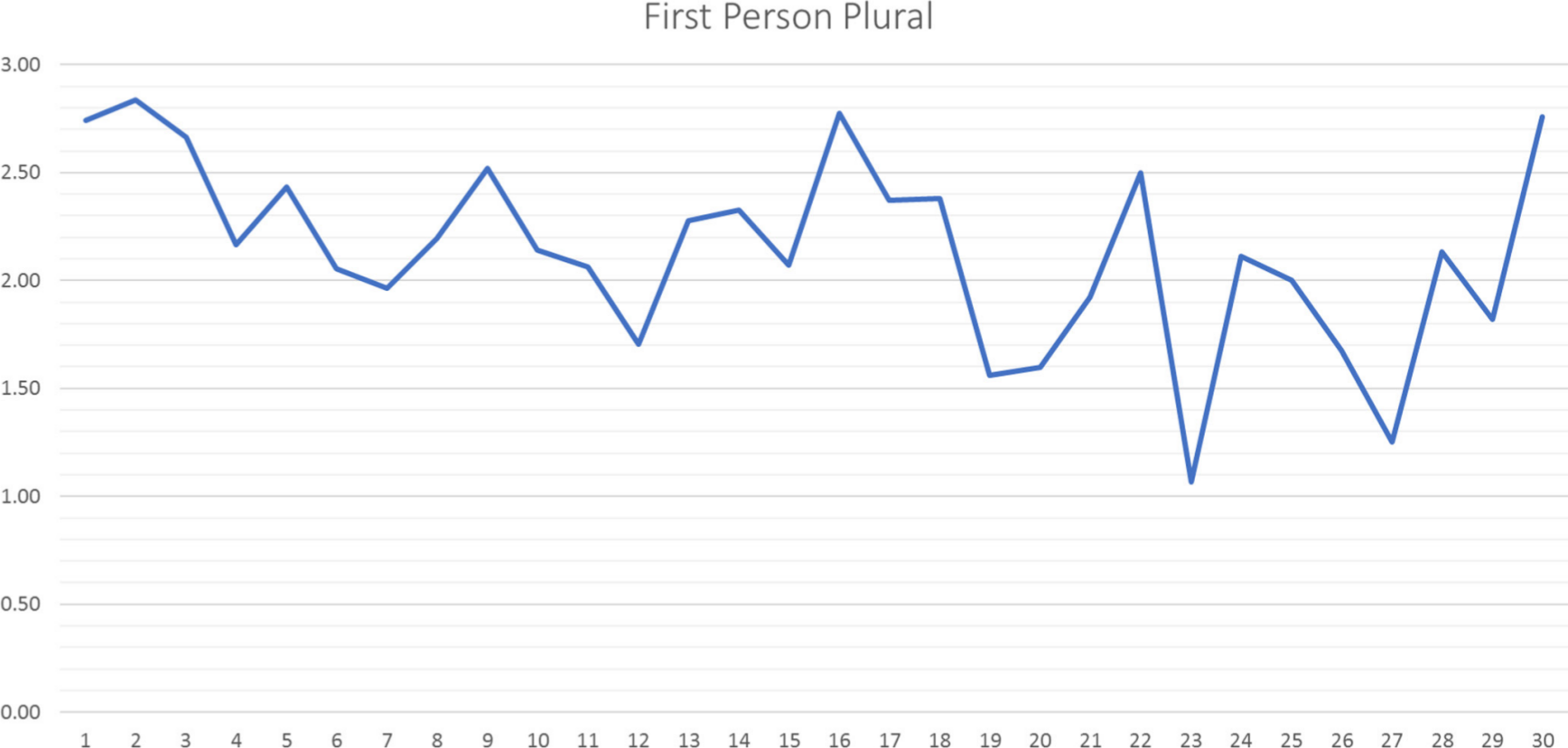
First-person plural across time.
The results suggest that the crews in HERA may have experienced a reduction in team climate across the course of their missions. From an applied perspective, being able to track individual and team well-being allows, for instance, NASA operations personnel to deploy countermeasures to mitigate decrements in well-being.
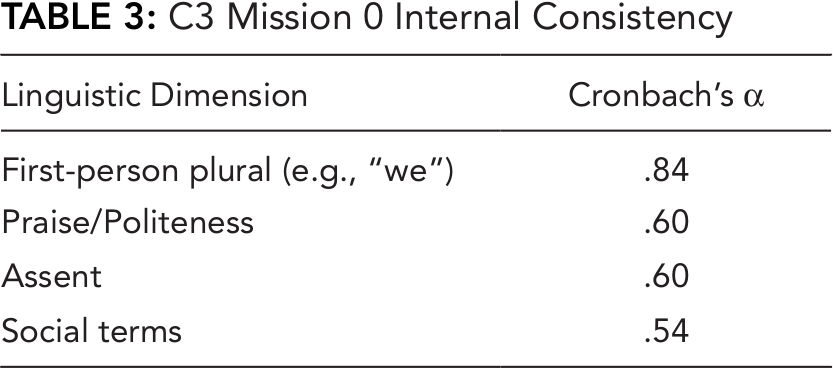
A final illustration of the use of this approach examines synchrony of team communication over time. Niederhoffer and Pennebaker (2002) have defined synchrony as the “matching of behaviors, the adoption of similar behavioral rhythms, the manifestation of simultaneous movement and the interrelatedness of individual behaviors” (p. 339), and research has demonstrated evidence of synchrony in human communication (Driskell et al., 2012). To directly investigate synchrony, we examined the average inter-correlation among the crewmember’s language usage by the consistency measure, Cronbach’s α. Although Cronbach’s α is generally used to measure scale reliability, it allows us to gauge the consistency by which crewmembers use common language. To accomplish this, each crew member’s mean per day was used for each language dimension (e.g., 30 data points per crew member). Thus, Cronbach’s α was assessed by entering each crew member into the reliability analysis. The results for selected Social Impairment measures are presented in Table 3. Overall, the data for each linguistic dimension show that the crewmembers’ communications are relatively consistent. That is, the crewmembers’ language variation was synchronous across the mission. Figure 3 tracks first-person plural usage by team member over time. These results reflect and support theoretical and empirical evidence of contagion and language matching.
C3 Mission 0 Internal Consistency
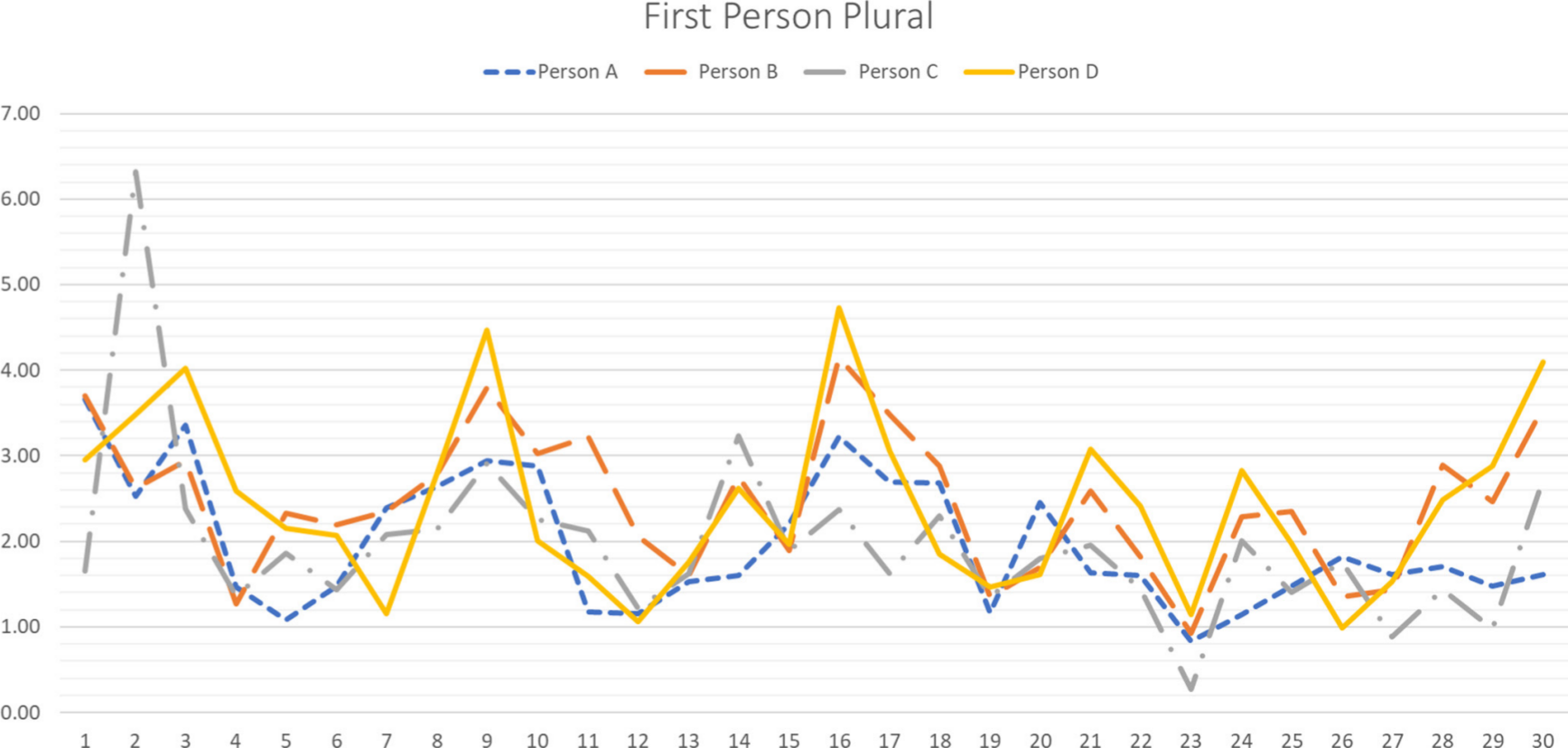
First-person plural usage by team member over time.
Example 2: Sensitivity to Communication Type
As mentioned, the communications that were recorded and transcribed represented both task-based communications and primarily leisure communications (e.g., breakfast and dinner/rest times). Examining differences in language as it varies by task type affords us the opportunity to make some general predictions. Several examples are presented below. The data in this section are analyzed using independent samples t-tests. In the analyses, task type (task vs. leisure) was treated as the grouping variable and each linguistic dimension as a test variable.
First, it is theoretically reasonable to expect measures related to team orientation to differ such that task-based communications are expected to show higher levels of team orientation versus primarily leisure communications. That is, task-based communications involve two or more team members coordinating task activity. What are termed leisure communications in this context are generally times in which the crew is primarily goofing off (e.g., storytelling, watching TV, bull sessions). Therefore, in the following example, we examine each of the social impairment facets (reflecting positive or negative team orientation) of STRESSnet as it varies by task type. There are 10 linguistic dimensions that make up the social impairment facet (Table 4). We predict that task communications would show a higher usage of positive indices (first-person plural (“we”), social terms, assent (i.e., agreement), praise/politeness terms, support/aid terms), whereas leisure communications would show a greater usage of negative indices (first-person singular (“I”), negations (e.g., disagreement), and insult terms)
Social Impairment by Task Type
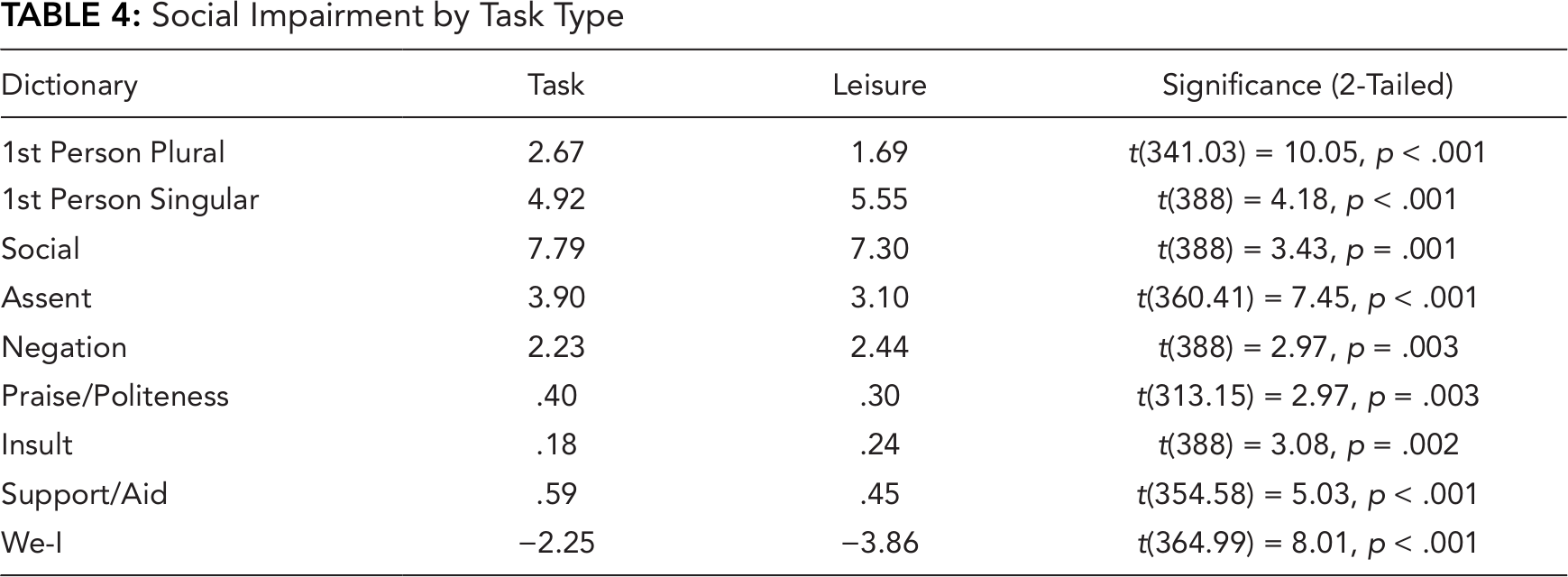
Table 1 supports this assertion. That is, during task-based communications, crews use more team focused terms—“we,” social, We-I; use more helpful and positive terms—support/aid, assent, and praise/politeness; and use less individual-focused and negative terms—“I,” negations, and insult. Figure 4 illustrates that these differences are quite consistent.
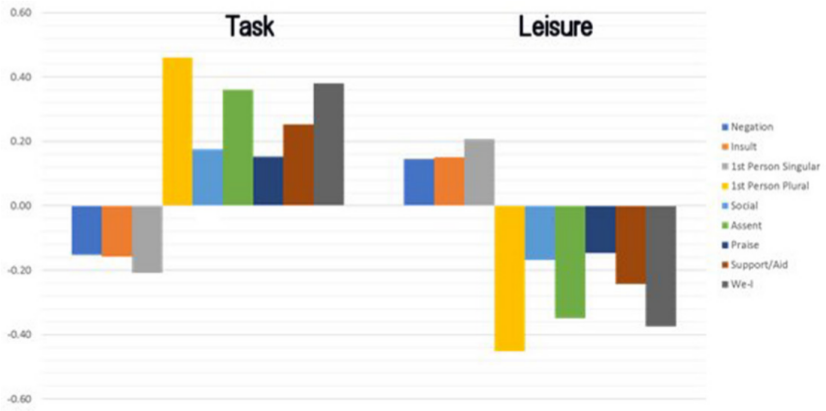
Social impairment by task type.
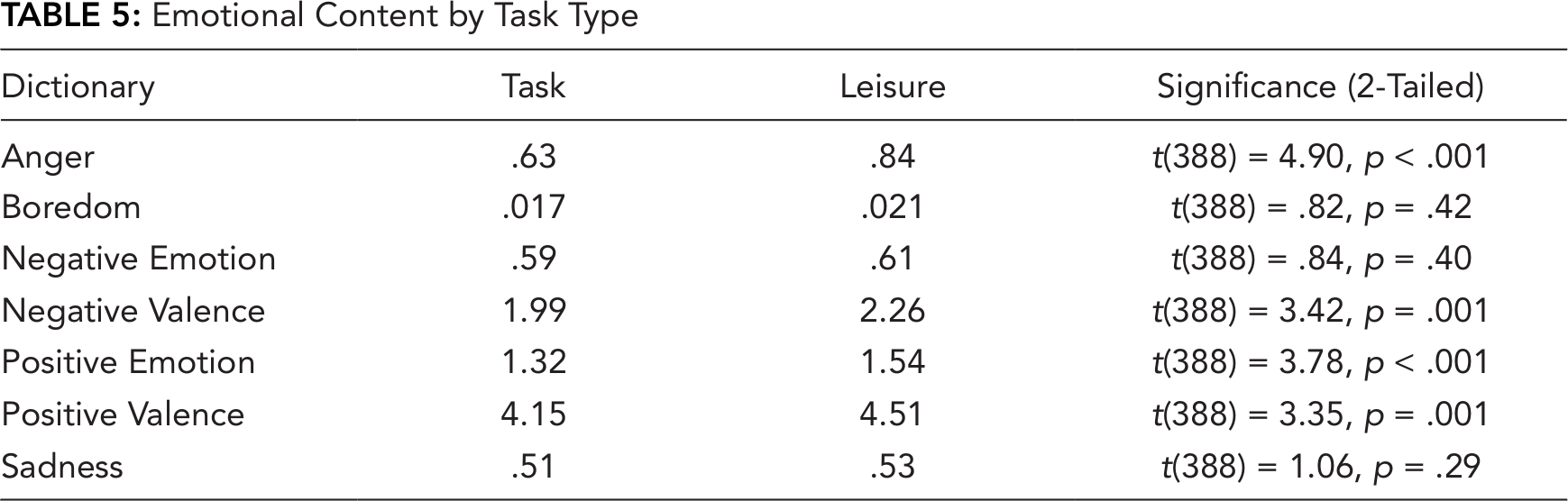
Further analyses indicate differences in emotional content and task focus between task communications and leisure communications. In general, we expect task communications to be more focused and logical, whereas leisure communications are more expressive and emotionally laden. Table 5 and Figure 5 examine the STRESSnet emotion categories by task type and support this prediction.
Emotional Content by Task Type
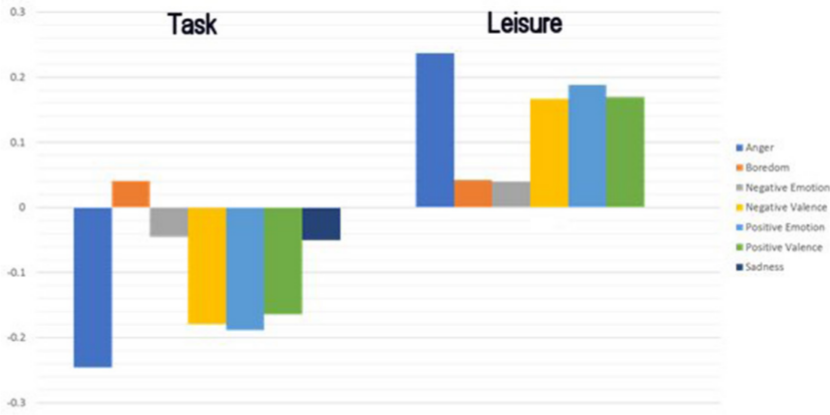
Emotional content by task type.
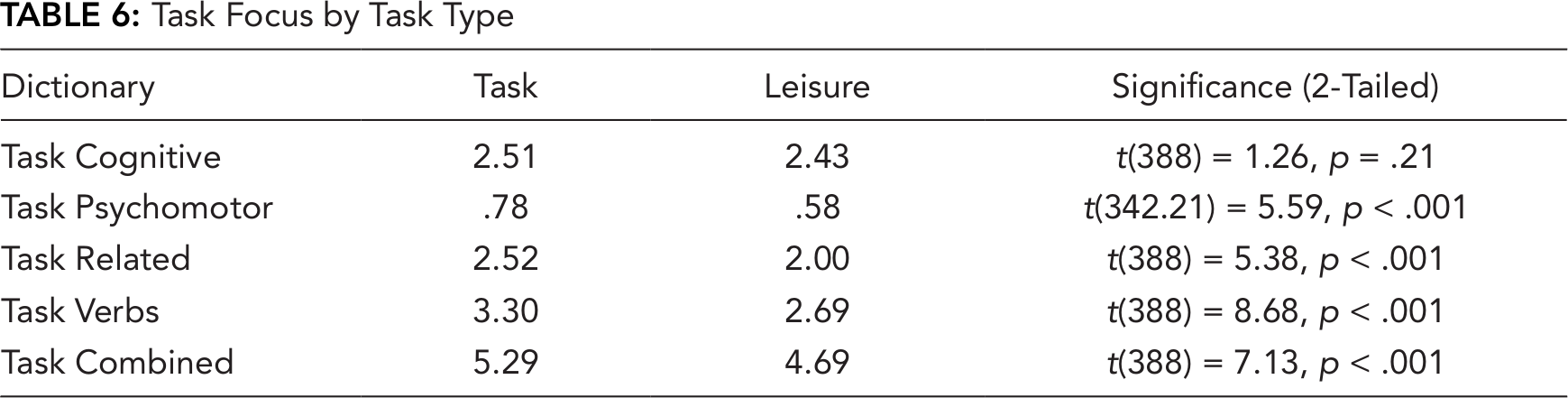
Finally, we expect measures related to task focus to differ such that task-based communications show higher levels of task focus versus leisure communications. Table 6 and Figure 6 support this prediction.
Task Focus by Task Type
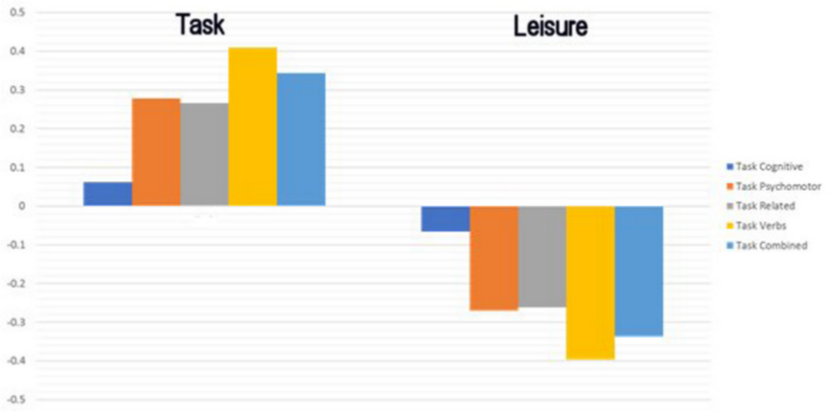
Task focus by task type.
Example 3: Tracking Variability in Individual Team Member Socioemotional State
It is important to demonstrate that this approach is sensitive, or can provide an alert, to events of specific applied interest. During one HERA campaign, there was an instance of elevated anger by one crew member during one of the mission tasks, in which the crew member—as personally stated—“got very upset.” We should be able to use STRESSnet to identify some theoretically meaningful verbal indicators of this episode. In the following, we examine language use as it varies by individual crew members. For privacy purposes, the data presented below are masked such that this specific mission is identified as Mission 0 and the specific crew member is identified as Person D. The first indication of overt anger/aggravation occurred on Mission Day 26. Figure 7 shows that particular mission task and the elevated levels of negative emotion for Person D relative to the remaining crew members.
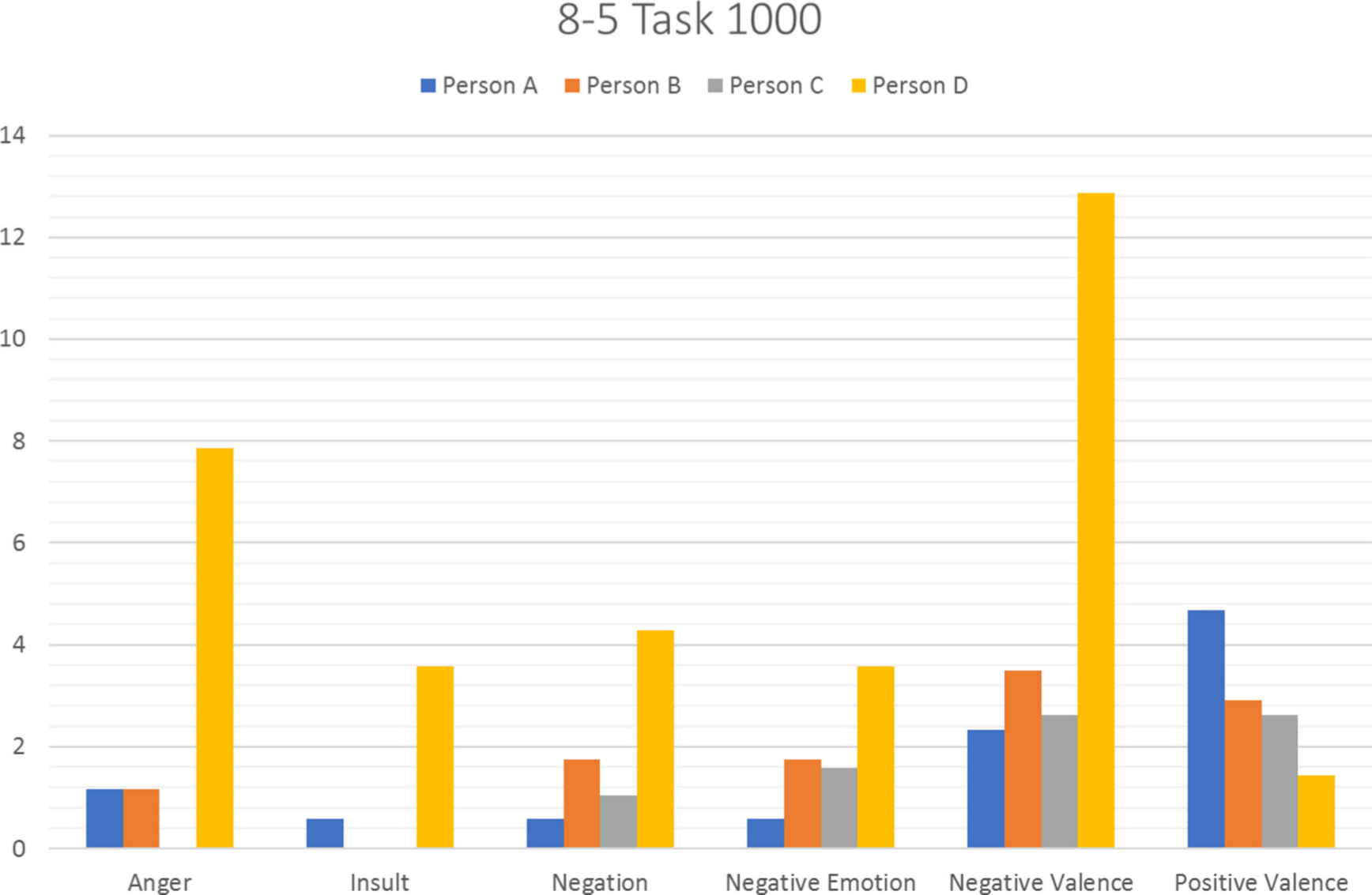
Negative emotion during anger incident.
A second illustration highlights an instance of team member attrition or drop-out during one HERA mission. In brief, the attrition was health related and resulted in a crew member’s withdrawal from the mission. For privacy purposes, the data presented below are masked such that missions are defined as A, B, C, and D and are presented in random order.
The STRESSnet dictionary that is most relevant to health-related issues is the somatic anxiety, or somatic complaints, dictionary. This dictionary is comprised of health-related words that are intended to identify bodily related issues (e.g., headache, sore throat). The graph in Figure 8 shows the overall use of somatic anxiety terms averaged across all four missions. (Note that the term mission is synonymous with crew; there were four missions or crews in this HERA 14-day campaign.) We see from this graph that somatic complaints generally increase across the 14-day period and peak on Days 6 and 11. Using a linear mixed-model analysis, significant differences were found for somatic anxiety usage across the 14-day period, F(13,197) = 2.16, p = .013.
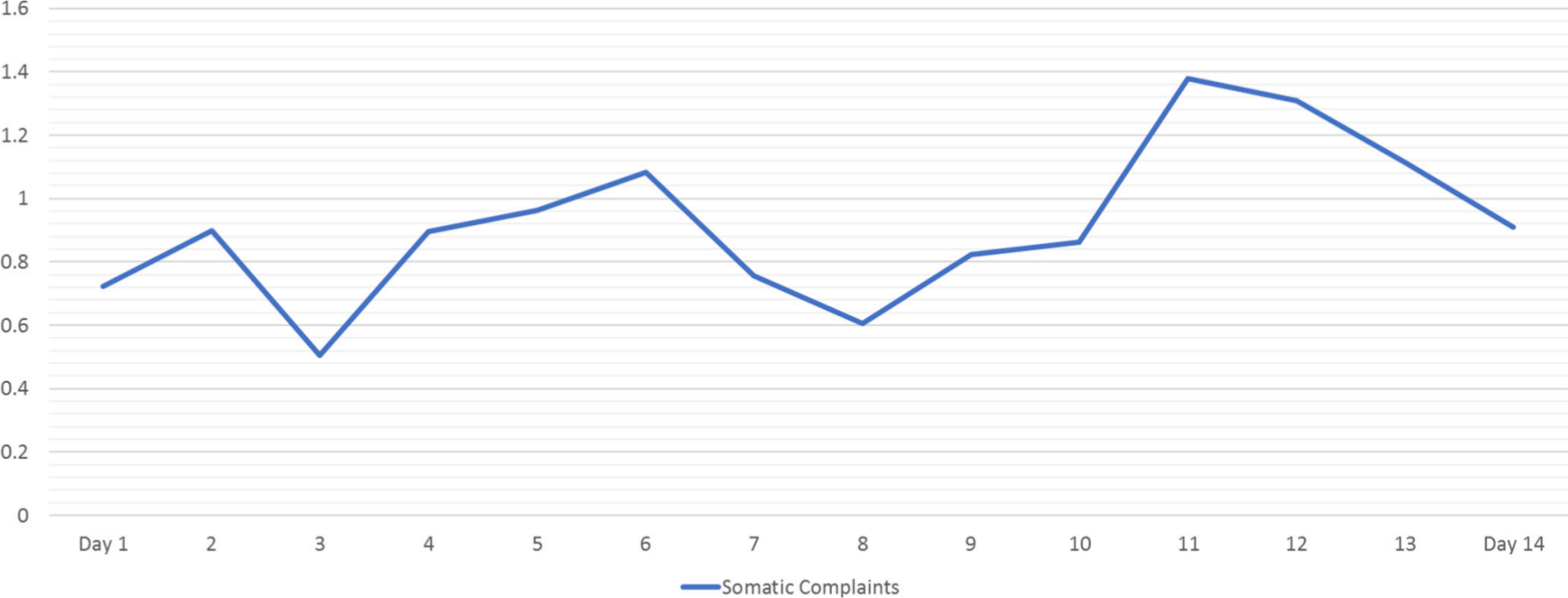
Somatic complaints across Campaign II.
Moreover, when Day, Mission, and the interaction term (Day x Mission) were entered as fixed variables in the linear mixed-model analysis, there was a significant interaction, F(37,197) = 1.45, p = .056. That is, somatic anxiety terms were used at greater or lesser rates by certain missions on certain days. Figure 9 shows the mission by day interaction. As can be seen, the spikes in somatic anxiety terms on Days 6 and 11 can be attributed to Mission D. As expected, Mission D represents the crew that included the health-related incident.
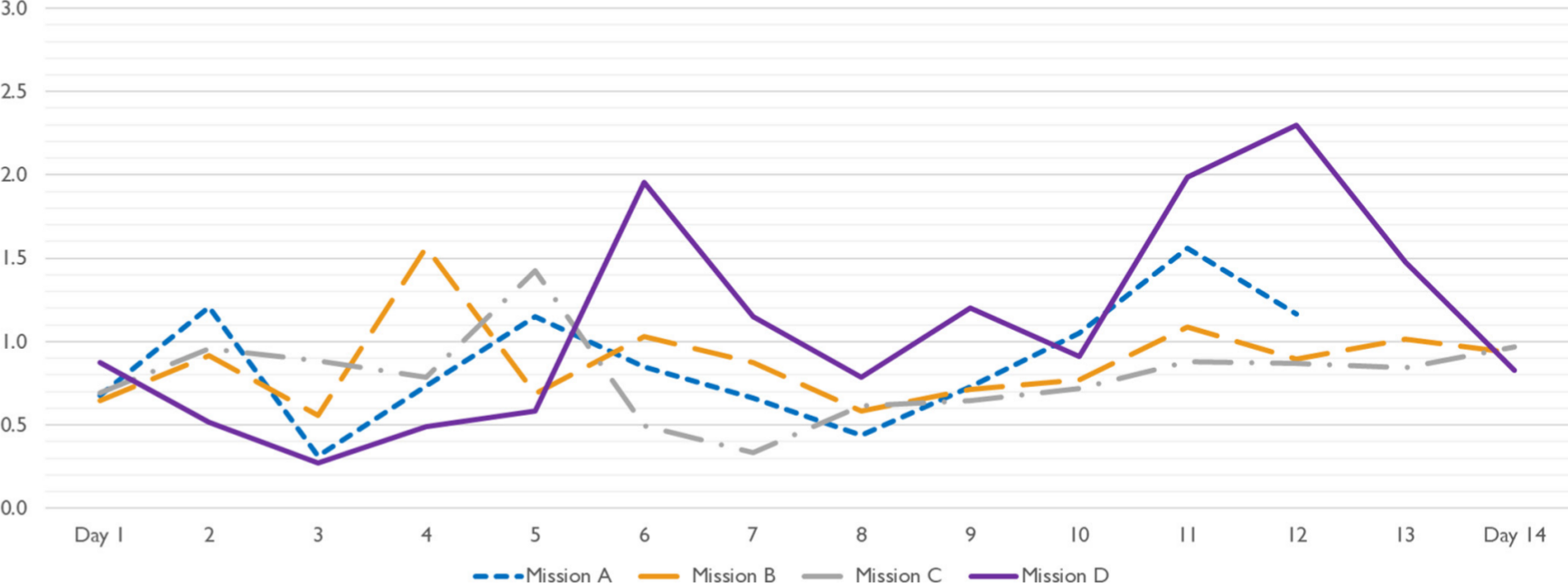
Mission by day interaction for somatic anxiety.
We can further disentangle the data by isolating the speech of each individual crewmember in Mission D. Figure 10 shows somatic anxiety term usage between Participant C, who was identified as having the highest levels of somatic anxiety term usage, and the average of the other crewmembers. This graph shows that the usage of somatic anxiety terms was highest on Days 6 and 11 for Participant C, who then dropped out after Day 11.
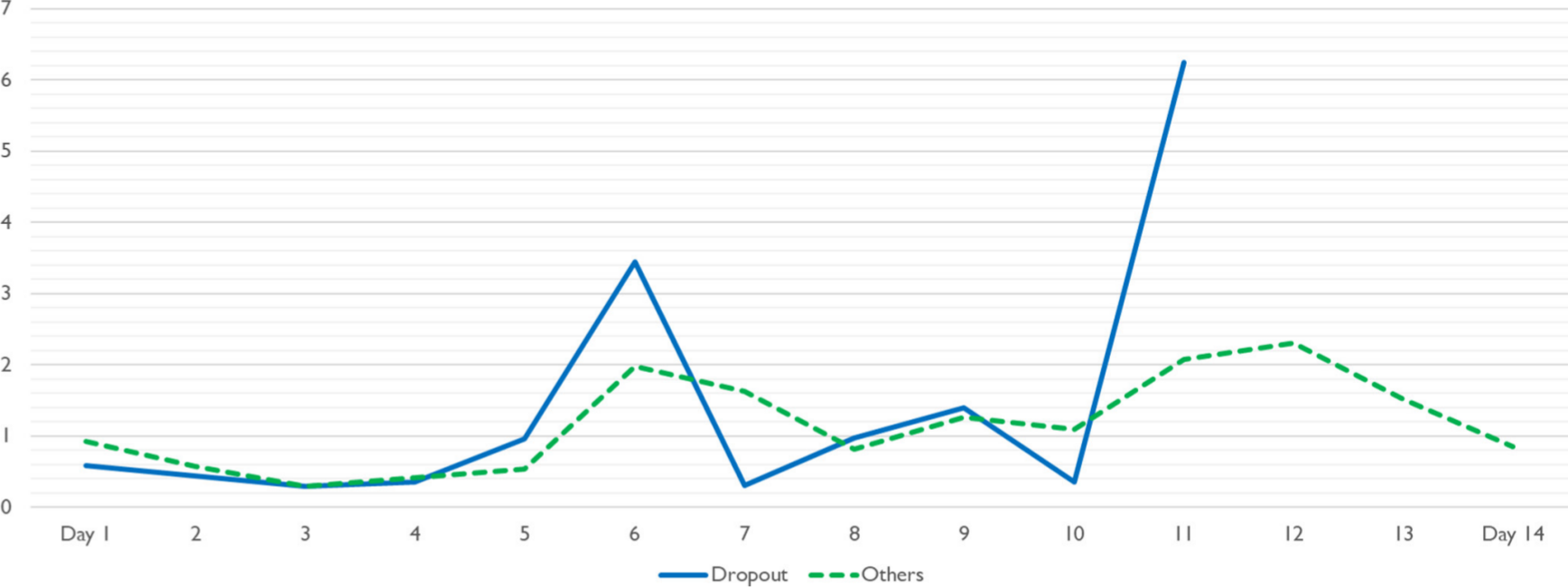
Within-crew somatic anxiety term usage.
These examples illustrate that STRESSnet can identify practically important incidents from spontaneous crew communications. This may be an important tool for diagnosing crew stress and well-being during long duration spaceflight.
Limitations
We have described an approach for assessing stress effects through the assessment of spontaneous verbal output in real-time communications. The STRESSnet tool was developed as a means to track and monitor stress effects in an unobtrusive manner in long duration spaceflight. There are several limitations to this general analytic approach. First, word-count or word-frequency programs attempt to assess certain constructs by simply spotting keywords drawn from user-defined dictionaries. This approach has been pejoratively termed a “bag of words” approach because it examines the frequency of word usage in a sample of text but ignores things like word order or context. In this sense, it is a word-level tool rather than a sentence-level tool.
Carley (1993) has noted a fundamental problem with simply extracting words from text. Different words have different meanings in different contexts, a problem that simple word frequency programs do not address. Under some situations, differences in meaning or intention are revealed not in what words or concepts are used, but in differences in the relationship between concepts. As Tausczik and Pennebaker (2010) acknowledge, this approach disregards context, irony, sarcasm, and idioms. For example, the word “mad” is coded as an anger word, regardless of whether it is used in the context of being enamored (“mad” for someone) or angry. Moreover, the decontextualized approach of word count programs makes it difficult to compare meaning across texts. For example, the two statements “Bob is angry at Joe” and “Joe is angry at Bob” have entirely separate meanings yet they would be scored similarly by a word-count program. If the goal is to determine how frequently the construct of anger is referenced, the word-count approach is appropriate; but if the goal is to examine deeper-level meaning, word frequency is less useful.
On the other hand, proponents argue that word-count approaches have shown considerable success in a broad number of applications in assessing important psychological constructs, such as differences in rapport (Driskell et al., 2013), cognitive load (Khawaja et al., 2012), and depression (Rude et al., 2004). In brief, word-count programs do an effective job of capturing linguistic content and style, which have been shown to predict a number of constructs of interest, whereas these programs do not attempt to extract sentence-level meaning or the relationship between concepts. For these purposes, there are a number of more sophisticated discourse analysis programs that examine context and sentence-level meaning, such as COH-Metrix (Graesser et al., 2004), SenseNet (Al Masum et al., 2007), and SentiStrength (Thelwall et al., 2010). Moreover, this lexical approach focuses exclusively on language content and word usage. It does not attempt to capture other indices of speech such as prosody, intonation, or loudness variations.
It is important to consider how this type of tool would be used in specific operational environments. Context is critical in environments such as spaceflight or other applied settings. For example, spaceflight crews use standardized terms and communication strategies that are unique to this setting. Any tool that will be used in this operational setting must take these context-dependent factors into account. Furthermore, each person’s linguistic profile is unique. That is, our communications patterns (e.g., how we express emotion, how often we refer to ourselves and others, our level of humor) are like a fingerprint, and thus can be used as a baseline to better examine fluctuations in language usage. For example, Person A may rarely curse, and Person B may pepper every other sentence with colorful speech. Thus, excessive profanity may signal a “red flag” for Person A, but less so for Person B. The consideration of individual differences in speech patterns should enhance the application of this approach.
Finally, we have presented a proof-of-concept of this approach by providing selected examples of the analyses that can be performed and the types of results that can be obtained. This is by necessity a limited analysis drawn from a much larger dataset, which we believe is characteristic of much applied research. The examples presented above illustrate how spoken language can be used to provide insight into the emotional and mental states of individuals and teams in a spaceflight environment. One of the key advantages of this approach is that it diverts from traditional obtrusive approaches (e.g., pen and paper measures) and instead draws inferences from naturally occurring communications in an unobtrusive manner. It is important to note that this approach is not intended to replace more traditional measures but is intended to add to the arsenal of tools that NASA operational personal can employ to keep crews effective and safe. We suggest that this approach be used as a type of early warning system where communications of interest can be flagged and be further investigated by operations personnel or used by the astronauts themselves as continuous feedback.
Conclusions
There are many high-demand settings in which it is valuable to monitor the potential negative effects of stress on operational personnel. These environments include spaceflight but also military, aviation, law enforcement, polar missions, and other settings. Moreover, one practical goal in operational settings is to assess operator state in an unobtrusive manner, without interfering with or disrupting ongoing performance. We have described a lexical approach to assessing stress effects from ongoing or spontaneous verbal output. We have addressed two related issues. First, we have proposed a parsimonious means to assess stress effects in terms of five core dimensions. Second, we have described a lexical approach to assess these core stress dimensions and relevant subfacets. The resultant tool, STRESSnet, provides an unobtrusive means to evaluate ongoing task communications at the individual and team level in order to assess cognitive/emotional states such as workload, negative affect, attentional focus, anxiety, and team orientation.
Key Points
There are many high-demand settings in which it is valuable to monitor the potential negative effects of stress on operational personnel.
We describe a methodological approach to track stress effects in high-demand environments in an unobtrusive manner, without interfering with or disrupting ongoing performance.
The resultant tool, STRESSnet, provides an unobtrusive means to evaluate ongoing task communications at the individual and team level in order to assess cognitive/emotional states such as workload, negative affect, attentional focus, anxiety, and team orientation.
Footnotes
Appendix: STRESSnet Dimensions and Corresponding Measures
| Dimension | Facet | Lexical Measures | Examples | Number of Words |
|---|---|---|---|---|
| Attentional Focus | Task Focus | Task terms: Cognitive | analyze, interpret, verify | 242 |
| Task terms: Psychomotor | manipulate, install, assemble | 65 | ||
| Task terms (overall) | create, compute, locate, payload | 438 | ||
| Distraction | Distraction terms | puzzled, perplexed, confused | 67 | |
| Uncertainty | Uncertainty hedges | perhaps, somewhat, maybe | 188 | |
| Certainty expressions | absolutely, certainly, obviously, surely | 204 | ||
| Sense-Making | Wh-questions | who, what, when, where | 9 (28) | |
| Temporal Focus | Present temporal focus | <present tense verbs; >past and future tense verbs | 1823 (277) | |
| Details | Temporal detail terms | yesterday, daytime, currently | 280 | |
| Spatial detail terms | around, behind, upward | 250 | ||
| Sensory detail terms | rumbling, glaring, cool, bitter | 584 | ||
| Specifying descriptors | convex, solid, narrow | 387 | ||
| Cognitive Load | Workload | Workload terms | taxed, overwork, overload, busy, burned-out | 87 |
| Cognitive Processing | Exclusive words | but, without, except | 22 | |
| Conjunctions | and, also, however | 77 | ||
| Prepositions | to, above, between | 117 | ||
| Cognitive processing terms (causal words) |
because, effect, depend | 162 | ||
| Cognitive processing terms (deliberation words) |
think, ponder, consider | 196 | ||
| Speech Complexity | Word length | mean length of words | -- | |
| Lexical specificity | type-token ratio | -- | ||
| Lexical variation | unique words not in top 2000 words | -- | ||
| Adjectives | attributive adjectives | 840 | ||
| Adverbs | adverbs of time and place | 341 | ||
| Disfluencies | Pauses | filled pauses such as um or ah | 14 | |
| Self-Corrections | word fragments | -- | ||
| Repetitions | word repetitions | -- | ||
| Anxiety | Somatic Anxiety | Somatic Anxiety terms | headache, tired, dizzy, sick, exhausted | 529 |
| Cognitive Anxiety | Cognitive Anxiety terms | tense, nervous, uptight, worried | 110 | |
| Introspection | Passive voice | was, were, has been, have been, had been, will be | 24 | |
| Psychological Distancing | Self-references | first-person pronouns | 12 | |
| Present tense | present tense verbs | 1001 | ||
| Negative Emotion | Negative Affect | Negative Affect terms | irritable, hostile, upset, distressed, fear | 470 |
| Positive Affect | Positive Affect terms | excited, happy, encouraged, pleased | 469 | |
| Anger | Anger terms | angry, outraged, irritable, annoyed, frustrated | 160 | |
| Sadness | Sadness terms | sad, downhearted, miserable, gloomy, despair | 93 | |
| Disengagement/ Withdrawal |
Boredom terms | bored, tedious, lethargic, indifferent, passive, dispirited | 51 | |
| Social Impairment | Team Perspective | 1st person plural pronouns | we, us, our, | 10 |
| 1st person singular pronouns | I, me | 12 | ||
| Affiliation | Social references | us, our, team, crew, partner, friend | 189 | |
| Social Climate | Assent terms | yes, agree, understood, copy | 45 | |
| Negation terms | no, negative, not, disagree | 62 | ||
| Praise/politeness terms | thanks, good job, good work | 67 | ||
| Insult/swear terms | jackass, jerk, ass, pissant, crap | 110 | ||
| Coordination | Synchrony in word usage | Differences in language style matching | -- | |
| Support | Support terms | coordinate, advise, assist, help | 142 | |
| Symmetry | Symmetry in speech output | s.d. of team members’ word count | -- |
Acknowledgments
This work was supported by a NASA/NSBRI grant (NCC-9-58-401/NBPF03402). Any opinions, findings, and conclusions or recommendations expressed in this material are those of the author(s) and do not necessarily reflect the views of the National Aeronautics and Space Administration.
Author Biographies
Tripp Driskell is the president and research scientist at Florida Maxima Corporation (New Smyrna Beach, FL). He received his PhD in applied experimental psychology from the University of Central Florida in 2013.
Eduardo Salas is a professor and chair of the Department of Psychological Sciences at Rice University (Houston, TX). He received his PhD in industrial and organizational psychology from Old Dominium University (Norfolk, VA) in 1984.
C. Shawn Burke is a professor at the School of Modeling, Simulation, and Training/IST at the University of Central Florida. She received her PhD in industrial and organizational psychology from George Mason University (Fairfax, VA) in 2000.
James E. Driskell is a senior scientist at Florida Maxima Corporation. He received his PhD from the University of South Carolina in 1981.