



Abstract
Objective
Assess the effects of long-duration microgravity and gravitational transitions on fine motor skills using a tablet-based test battery of four fine motor tasks: Pointing, Dragging, Shape Tracing, and Pinch-Rotate.
Background
While there have been some studies on fine motor skills in microgravity, few have measured the fine motor skills that are core components of interaction with computer-based devices, and none have measured performance systematically, to include preflight, inflight, and postflight space mission time periods.
Methods
Seven astronauts completed the Fine Motor Skills test battery 30–40 times before, during, and up to 30 days after standard duration International Space Station missions, while a matching set of seven ground-based control participants also completed the battery over a comparable period of time. Response time and accuracy were the primary outcome measures.
Results
Relative to controls, astronauts experienced fine motor skill decrements at gravitational transitions (first week on orbit, and first month post landing). No decrements were found inflight after the first week of adaptation.
Conclusion
Gravitational transitions appear to negatively impact fine motor skills needed to operate small controls with accuracy, such as those on touchscreen interfaces. This raises concerns for future long-duration crewmembers who will land on a planetary surface and need to perform critical tasks accurately, such as configuring spacesuits, powering up a habitat, or teleoperating rovers.
Application
Results from this study highlight the need for confirmatory research, and the possible need for countermeasure development. The Fine Motor Skills test battery may have application outside of NASA as a fine motor skills diagnostic screening, rehabilitation, or readiness-to-perform tool.
Precis
This study investigated the effects of long-duration microgravity on fine motor skills. Results showed performance decrements following gravitational transition points, such as the first week on orbit and post landing. Performance impacts for some tasks were still evident 30 days after landing.
Space travelers will endure many challenges as they embark on future long-duration missions beyond low Earth orbit. They will face isolation, confinement, a closed environment, space radiation, and long-duration microgravity. We know that the human body is impacted by the deleterious effects of spaceflight, and International Space Station (ISS) research over the last 20 years has led to a basic understanding of these effects, as well as the efficacy of mitigations (Schorn & Roma, 2021). One lesser studied area of spaceflight performance is fine motor skills. Fine motor skills will be critical for interacting with hardware and software-based controls (including touchscreens) to perform a variety of onboard tasks such as information access, just-in-time training, system configuration and maintenance, and medical or scientific procedures. Fine motor skills are also critical for tasks involving hand controllers—for instance, flying a space vehicle, or teleoperating a robotic arm. Upon arrival at a planetary destination, astronauts will need to accurately operate computer-based controls to secure the vehicle, initialize spacesuits, teleoperate rovers, and start up habitat systems. We must understand the effects of extended microgravity, and gravitational transitions (e.g., Earth gravity to microgravity to Mars gravity) to ensure that crewmembers who arrive on a planetary surface after a long-duration journey are able to perform with accuracy and efficiency. Data on fine motor skills in spaceflight have been sparse and inconclusive; thus, the impetus for this study.
Fine Motor Performance
Fine motor control involves the integration of visual information, and coordination of muscles, bones, and nerves to produce precise movements of the small muscle groups of the hands and fingers. Problems with fine motor performance can either involve mismatches between visual inputs and motor production (Bohan et al., 2010) or an overall decline due to factors such as age, illness, or injury (Hoogendam et al., 2014; Liou et al., 2020).
Classic tests of fine motor performance involve measuring control and coordination of the hands and fingers using pegboard tasks, geometric figure tracing, and copying tasks. The fine motor skills of interest in this investigation—pointing, dragging, shape tracing, and pinch-rotate are skills required to interact accurately with computer-based devices, such as touchscreens and gesture input devices. They are also relevant for the operation of small buttons and switches that are components of current and future vehicle, habitat, and spacesuit hardware.
Past Spaceflight Research on Fine Motor Skills
Several studies of motor control have been conducted on the MIR Space Station, Space Shuttle, and ISS. These studies have revealed detrimental effects of spaceflight, including increased task response times (e.g. Berger et al., 1997; Bock et al., 2001) and decreased task accuracy (e.g. Manzey, Lorenz, Heuers, & Sangals, 2000; Newman & Lathan, 1999). The majority of these studies used a joystick or arm-reaching task. Research has also been done in the context of surgical tasks performed in microgravity. Two studies conducted during parabolic flights (Panait et al., 2006; Rafiq et al., 2006) found that laparoscopic skills were impaired compared to performance on the ground. Participants had increased force production, decreased task performance, and completed fewer tasks in microgravity. A Shuttle Neurolab mission investigated surgery performed on rats (Campbell et al., 2005), and found no decrement in manual dexterity, but increased task time as compared to ground performance.
More recently, Mulavara, et al. (2018) found that ISS crewmembers showed a small but significant decrease in fine motor control after landing, as evidenced by performance on the Grooved Pegboard Test. Moore et al. (2019) showed ISS standard duration (6-month) crew had significant decrements (compared to preflight) in the ability to operate simulated vehicles within 24-hours of landing. Simulated piloting and rover-docking performance were also compromised. The investigators ruled out fatigue alone by testing sleep-restricted control participants; after 30 hr of sleep restriction, control participants reported sleepiness, but did not exhibit the impaired performance observed in the astronauts. Moore, et al. (2019) posit that a combination of factors, such as vestibular changes, fatigue, CO2 levels, altered light-dark cycle, workload, and confinement, may be responsible for the performance decrements found.
Aims
None of the spaceflight studies performed to date have focused on basic touchscreen operations, and none collected data preflight, inflight, and postflight. The aims of the present study were to systematically collect data in all phases of a space mission to determine the effects of long-duration microgravity and gravitational transitions on fine motor skills.
Method
Participants
Seven standard duration (6-month) United States Orbiting Segment (USOS) astronauts, and seven ground-based control participants completed the study. Ground participants were matched for age, education, vision, and fitness level with the astronauts. Each participant group consisted of five males and two females. The average age for astronauts was 46.6 years (SD = 8.6) versus 45.9 years (SD = 7.2) for ground controls.
Task Overview
We designed this study for seven astronauts and seven ground-based matching control participants to repeatedly perform a battery of four different computer-based Fine Motor Skills (FMS) tasks: Pointing, Dragging, Shape Tracing, and Pinch-Rotate. These tasks were developed as alternatives to the 9-hole Pegboard task (Patterson Medical), which is infeasible to perform in a microgravity environment due to the many small parts. The Pointing and Dragging tasks were adapted from the ISO 9241-9 (International Organization for Standardization, 2000) set of standard tasks for evaluating cursor control devices. The Shape Tracing task is a classic test of fine motor performance, and the Pinch-Rotate task was developed by the team to represent a typical multi-touch operation. The Pointing, Dragging, and Tracing tasks are performed with both a stylus and finger, while the Pinch-Rotate task is performed only with fingers.
Each FMS test was administered on an iPad with a clear, protective screen cover. A custom-made adjustable handhold (see Figure 1) was attached prior to the test in order to provide a standard position for performing the task and to minimize non-task-related touches to the screen. All participants were instructed to use the handhold for all sessions. The test battery presents instructions, experimental tasks, and a brief pre-session questionnaire. The questionnaire queries alertness, activities performed prior to the session, location, posture, and use of restraints. Performance data collected by the application includes responses, response times, errors, and X-Y coordinates of touches. Handhold used to stabilize the iPad during performance of the FMS tasks.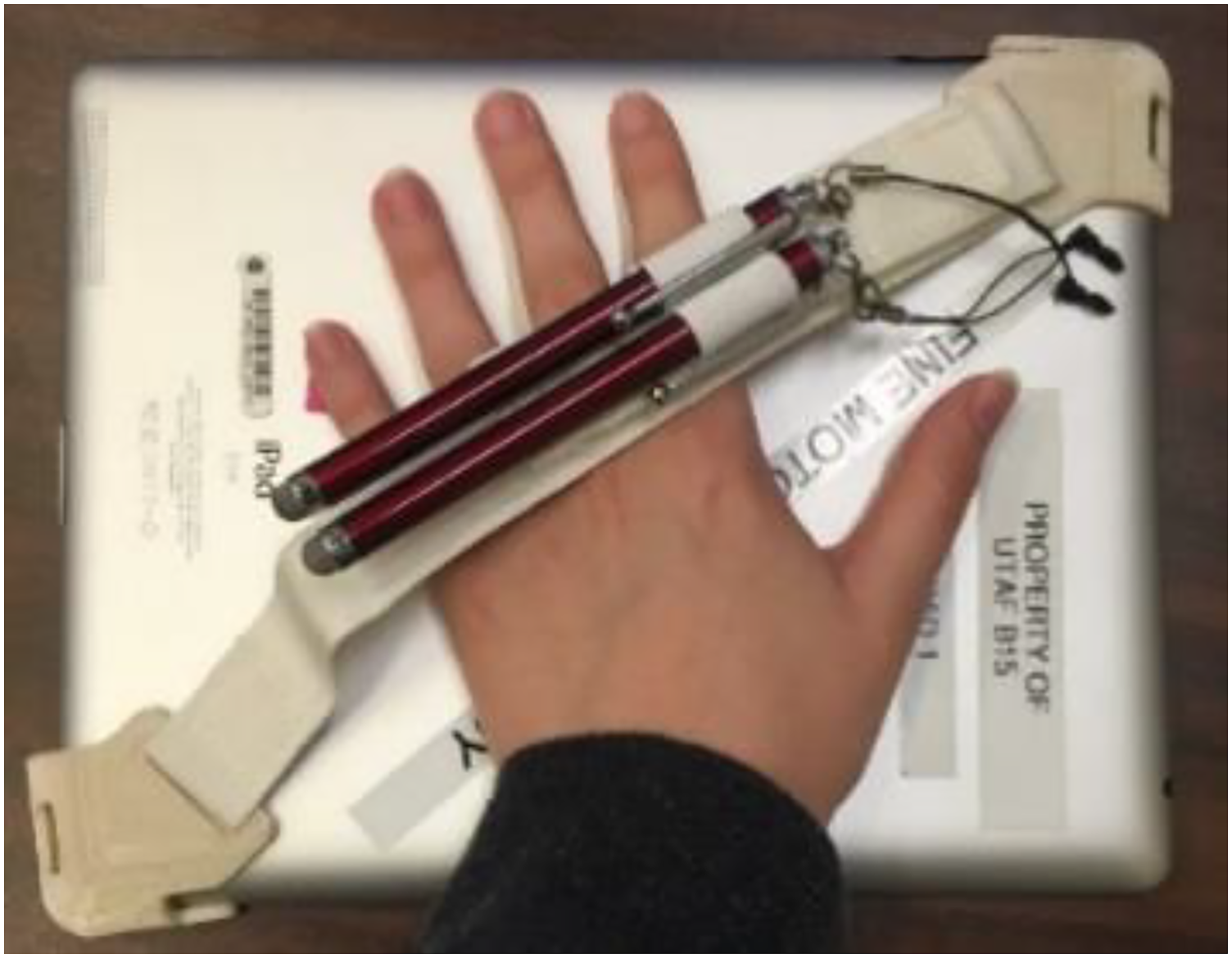
Two versions of the FMS test battery were required in this study due to crew time constraints. The standard test battery was used for the baseline and inflight phases, and took approximately 15 min to complete. The first four postflight test sessions used a shorter test battery, which took approximately 5 min to complete. The remaining three postflight sessions used the standard test battery.
FMS Task Details
Pointing task
Participants perform a reciprocal tapping task (ISO 9241–9) with 16 targets arranged in a circle, progressing in either a clockwise (CW) or counterclockwise (CCW) direction per the onscreen instructions (see Figure 2). A target is colored blue to indicate it is the next target to be tapped. There must be a successful tap of the blue target in order for the task to continue (next target turns blue). Tapping outside of the blue target constitutes an error, and the tap must be repeated until the target is tapped. In addition to direction (CW and CCW), the diameter of the circle of targets may be either large (528 pixels) or small (396 pixels), and two different input devices (finger or stylus) are used, depending on onscreen instructions. Pointing task with onscreen instructions. The blue square target is tapped in sequence/direction shown until the circle has been completed.
Dragging Task
Participants drag and drop a square from one rectangle to another in a back and forth motion for 16 trials (see Figure 3). A square that is dropped anywhere except within the destination rectangle is considered an error. The square must be picked up again and dragged to the target rectangle. The task is performed using a finger or stylus, and the dragging motion is either horizontal or vertical, as instructed. Dragging task with onscreen instructions. The white square is dragged to the blue (lighter gray) rectangle and dropped; sequence is repeated with the opposing rectangle for 16 trials.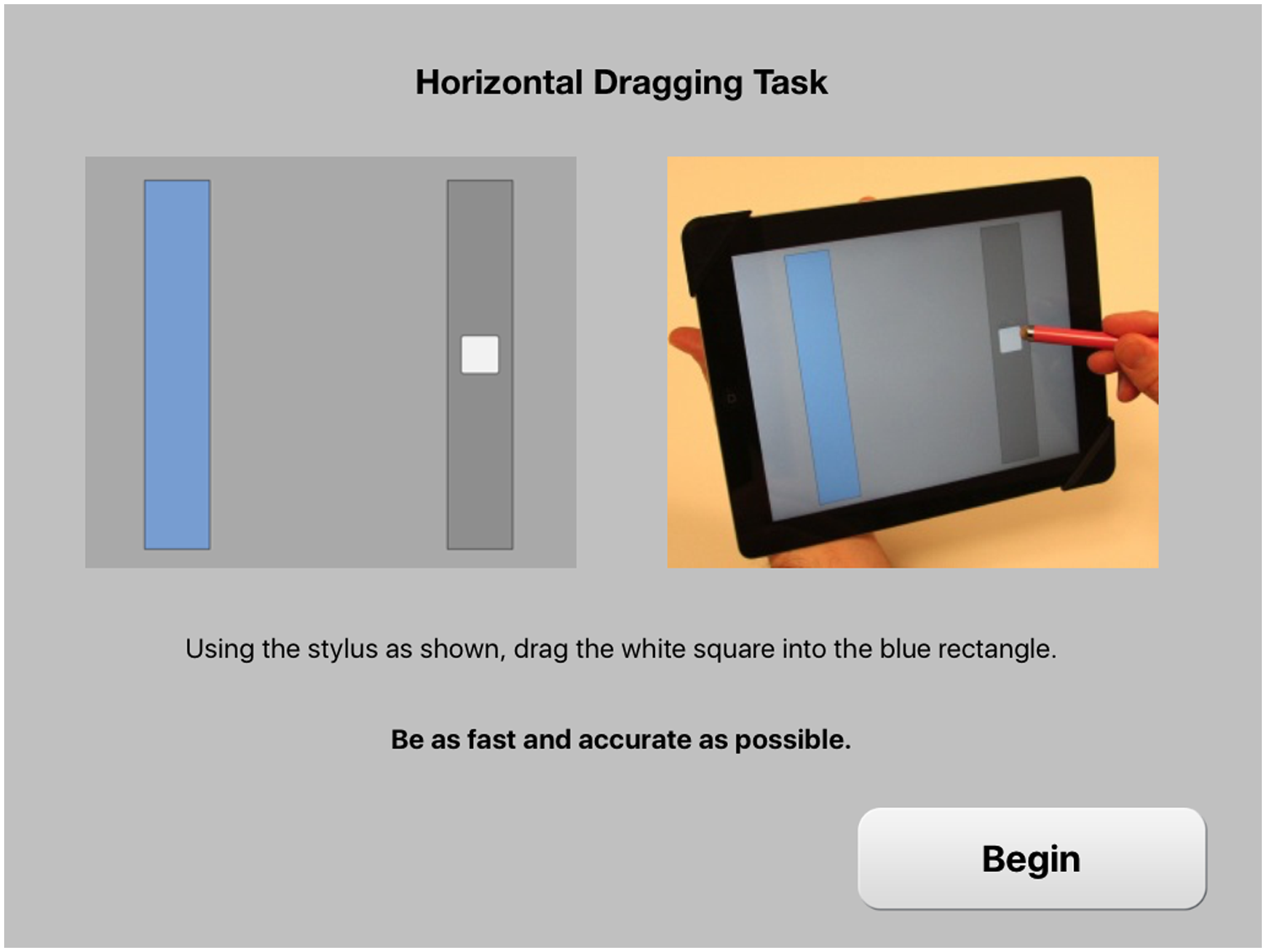
Shape Tracing Task
Participants trace a circle or a square as accurately as possible, progressing clockwise or counterclockwise (see Figure 4). Each shape is presented twice using each input device, once in a clockwise direction and once moving counterclockwise. Each instance of the Tracing task requires the participant to successfully complete five tracing trials. A successful tracing trial is one in which the participant completes the tracing in one continuous motion without lifting the finger or stylus. Accuracy is characterized by distance between the traced shape and the target shape. If the finger or stylus is lifted during the tracing, the trial starts over. Shape Tracing task with onscreen instructions. The shape is traced in the direction shown.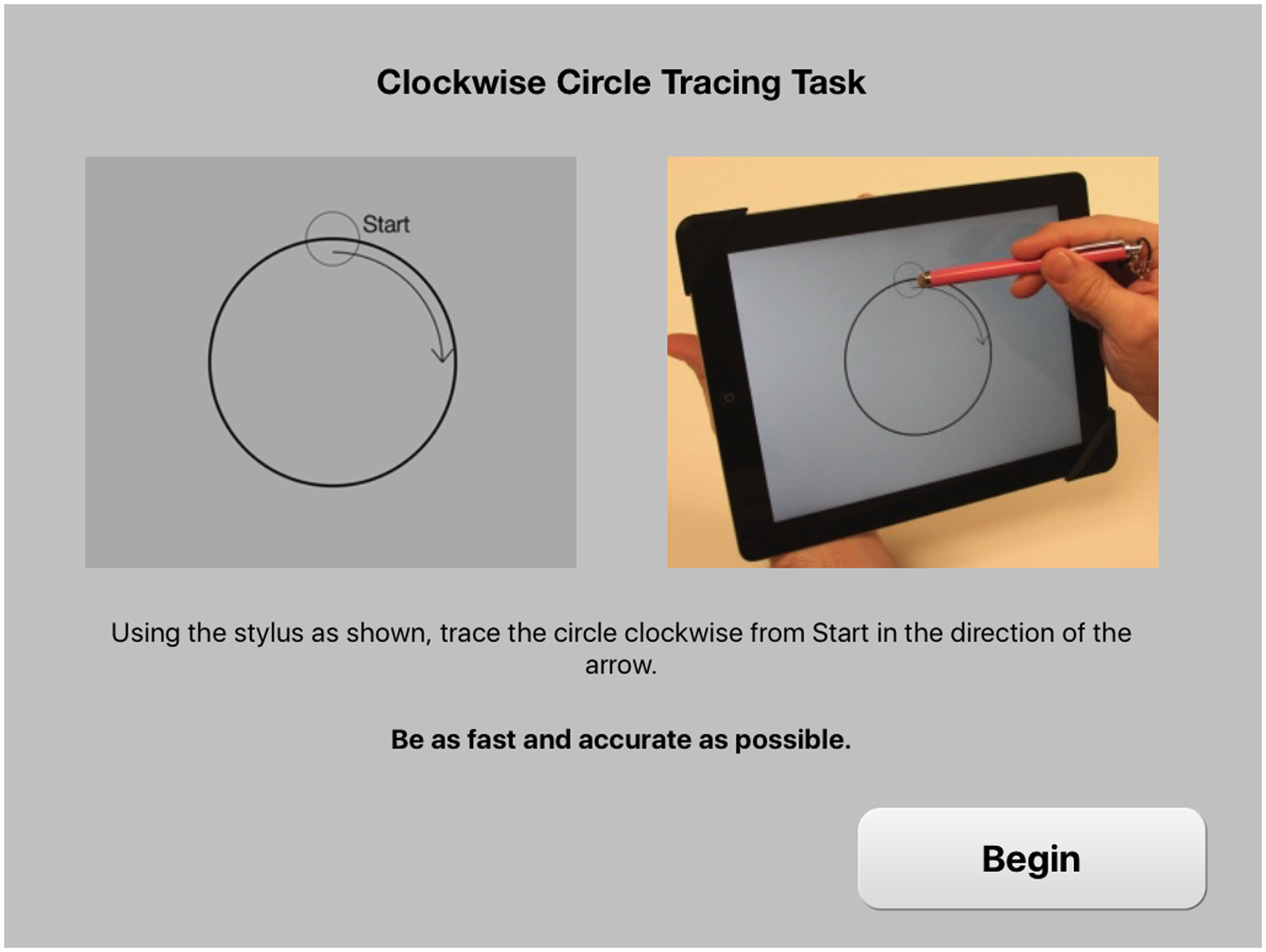
Pinch-Rotate task
Participants use their thumb and index finger to resize and reshape a diamond or square with a pinching and rotating motion (see Figure 5). A successful trial requires the participant to resize and reshape the stimulus in one continuous motion so that it overlays a target shape as closely as possible. Dropping the pinched shape when not aligned on top of the target shape constitutes an error. Each instance of the Pinch-Rotate task requires the participant to successfully complete five Pinch-Rotate trials in a row; thus, the number of trials per block may be larger due to errors. Pinch-Rotate task with onscreen instructions. The outer blue (dark gray) box is pinched and rotated as shown to overlay the inner box.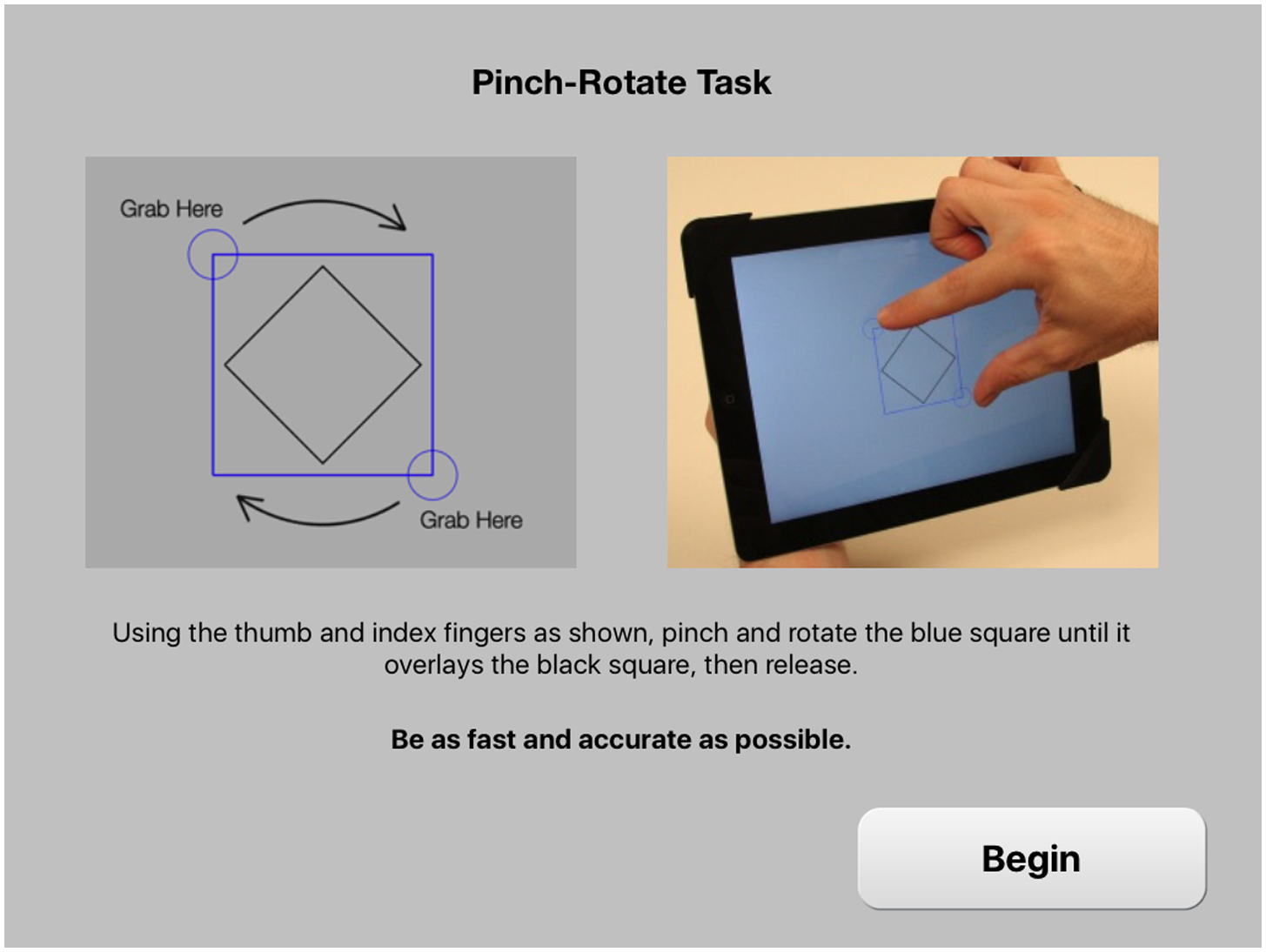
Participants did not receive time or accuracy feedback on their performance. Each time a test session was completed, participants were presented with an optional motivational screen activity (see Figure 6). The screen included a graphic of a fortune cookie, with instructions to click on the fortune cookie for an inspirational message of the day. The messages were positive quotes, some serious in tone, and some humorous. The hope was that participants would be eager to see what message they received that day, and thus motivated to complete the session. Final screen of each experimental session, with example fortune cookie messages below it.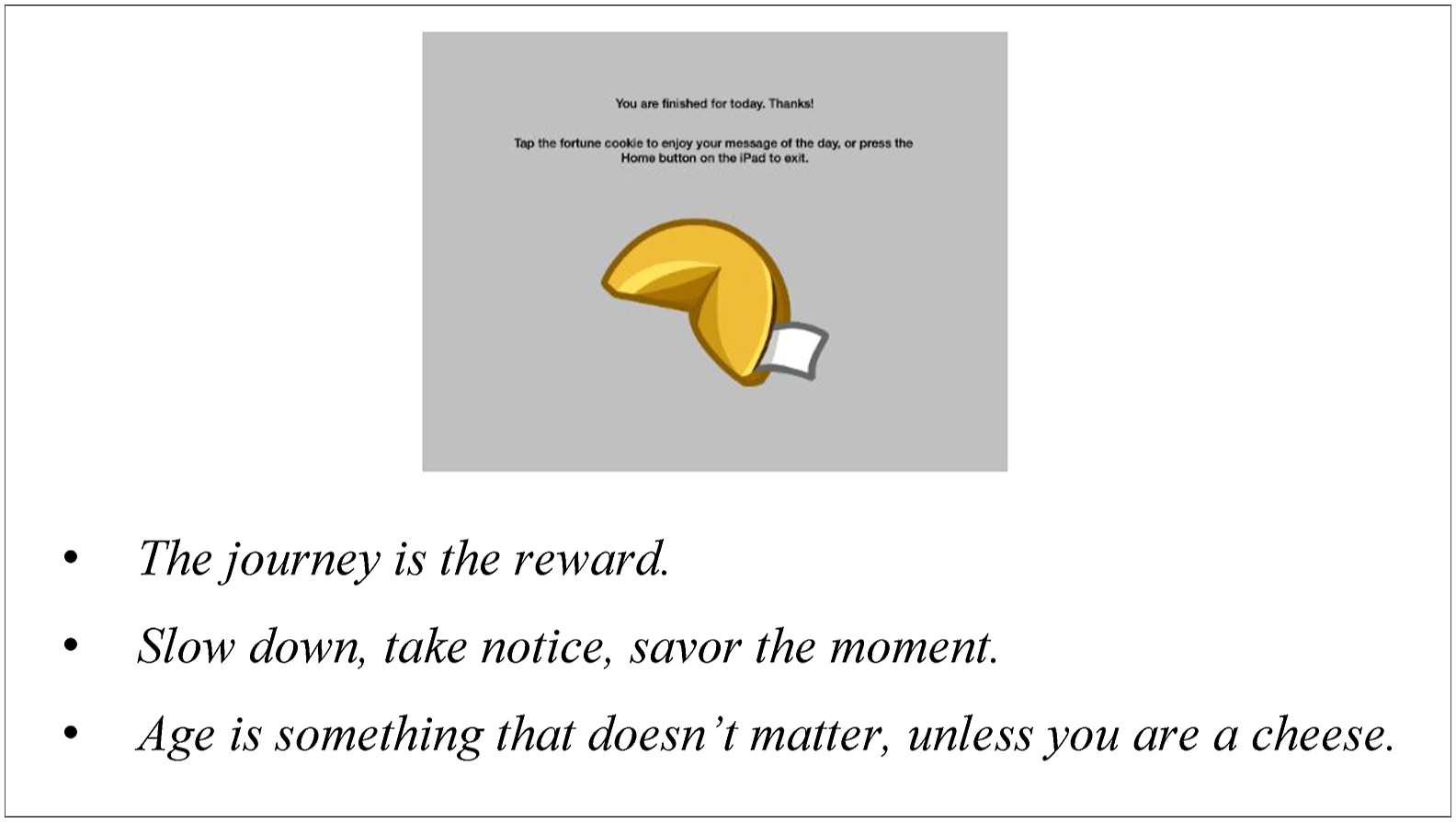
Experiment Design
Schedule of FMS Test Sessions

All tasks were run under combinations of task-specific conditions (“sub-task factors”) such as either finger or stylus input (Pointing, Dragging, Tracing), circle diameter (Pointing), direction (Pointing, Dragging), and target shape (Tracing, Pinch-Rotate). The test battery presented blocks of prescribed variations of each task in each session. The assignment of tasks and task variations to the blocks was balanced, and the order of tasks and sub-task factors was randomized, but held constant for each astronaut/control participant pair (two exceptions due to technical issues). Input device was blocked within sessions to minimize the need to temporarily stow and unstow the stylus between tasks.
Procedure
This research was approved by the Institutional Review Board at the NASA Johnson Space Center (JSC). All participants received an informed consent briefing, signed a consent form, and were trained on the task. In each session, participants completed the four tasks with the finger or the stylus (as directed by the onscreen instructions).
Astronauts performed their tasks in quiet spaces (e.g., crew quarters), and reported stabilizing themselves by wedging or tucking feet under structures or handrails. Early Postflight sessions were completed at airport stopover locations, while later postflight sessions were managed by the crew themselves, performing their sessions at home. Ground-based control participants performed all sessions in the JSC Human Factors Engineering Laboratory (HFEL), with a couple of exceptions for participants who were on travel, and completed the sessions at their location. All participants were debriefed at the end of the study.
Performance Metrics
Response times and error rates were collected for each FMS task. One of the lessons learned from prior studies (Thompson et al., 2015) was that although participants are told to perform the tasks as quickly and accurately as possible, they tend to follow one of two strategies (slow and more accurate vs. fast and less accurate). This makes it difficult to draw useful conclusions from either accuracy or timing data alone. For this study, it was decided that the best approach would be to develop a single performance metric based on both factors using reference models developed from existing data.
The Pinch-Rotate task already integrated response time and accuracy, in that a trial required five correct operations in a row; thus, this task produced response time data only and was analyzed as such. For the other tasks, we used an FMS test battery dataset from a prior ground study (Thompson et al., 2015) to create performance metrics for the Pointing, Dragging, and Tracing tasks. The prior dataset was obtained from a broader participant pool (not necessarily crew-like), but included enough participants (33) to build normative response time distributions (Pointing and Dragging tasks), or a response time vs. accuracy joint distribution (Tracing task), which provided a reference to which the current data could be applied.
For the Pointing and Dragging tasks, the original performance metric was defined as
For the Tracing task, accuracy was defined as the average Euclidean distance
Statistical Analysis
Mixed Models
Inference about the effects of spaceflight and experimental conditions on task performance (Z-values) was made with mixed-effects linear models that included fixed effect terms for main effects of group (astronaut or ground control), flight phase, and sub-task factors (e.g., input device and target shape), as well as two-way interactions and some higher-order interactions. To make the results more robust to possible violation of mixed model normality assumptions, standard errors were calculated from 1000 bootstrap samples of the data. Random-effects terms in the model allowed for variation between participants and within-participant variance over time in terms of both low frequency (between sessions) and high frequency variation (blocks within sessions).
Reporting
Because this was an exploratory study in which we tested multiple hypotheses about the fixed effects and their interactions, p-values were adjusted to control the false discovery rate to 5%, using the method of Benjamini et al. (2006). As such, we reported effects as “significant” only if adjusted p-values were less than 0.05. To give further support to inferential findings, we also used these mixed models to provide descriptive information (point estimates and 95% confidence intervals) about how well we estimated the mean response at each flight phase. After model fitting, we also estimated contrasts of interest (e.g., the mean change between Preflight and Early Flight for astronauts vs. the same change for controls).
Results
Descriptive Summary
FMS Task Performance Metrics

a25th percentile.
b75th percentile.
cinter-quartile range.
Learning
Examination of the control participants’ data revealed a consistent pattern of increasing values of Z for the Pointing, Dragging, and Tracing tasks, which we attributed to increased familiarity with the tasks as participants repeatedly performed them. Figure 7 illustrates this trend for the Pointing task. An analysis of this and similar data for the other tasks revealed that on average, Z tended to increase proportionally to the square root of the number of times to date (N) that a participant had performed a given task. Therefore, we included N1/2 as an additional predictor of performance in the mixed models for these tasks, thus allowing us to adjust for a long-term learning effect that could disguise any actual changes over time. Separate coefficients of N1/2 were included for both astronauts and control participants. There was no evidence of a learning effect for the Pinch-Rotate task, hence no adjustment for it was made in the mixed model for that task. Data trend showing learning in the Pointing task for control participants. Dots represent observed values Z
P
, the performance metric for the Pointing task. The trend line is proportional to the square root of the cumulative block. For a given participant, the cumulative block is the number of times to date the participant had performed a given task.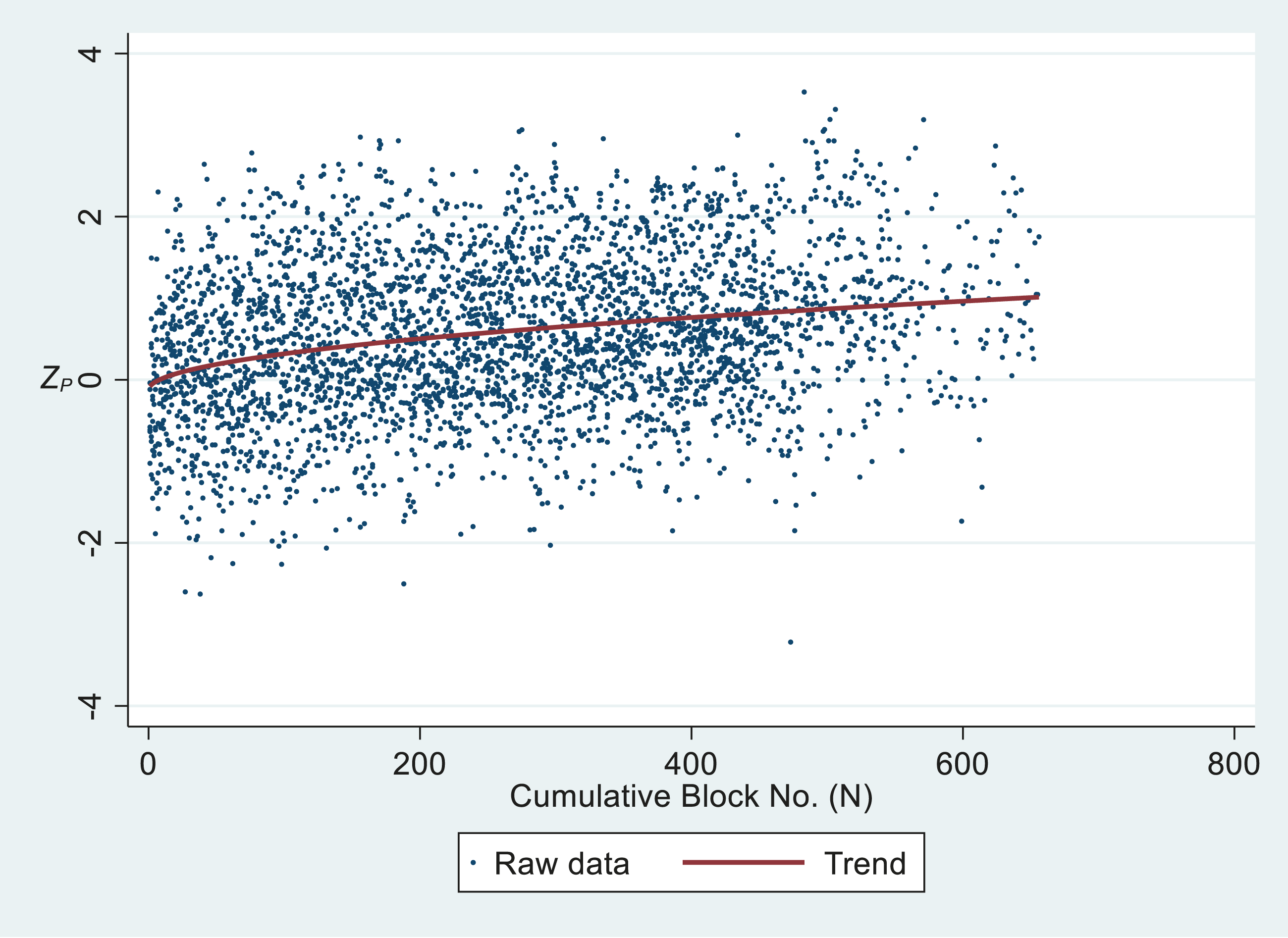
Effects of Flight Phase and Sub-Task Factors
The mixed models with task performance metrics as dependent variables were fit to study data to allow inference about the effects of learning, spaceflight phase, sub-task factors and their interactions. For each task, findings are summarized in terms of estimated model coefficients (b), standard errors, and p-values (adjusted for multiple testing) below.
Pointing Task
Flight Phase
Performance on the Pointing task was significantly degraded for astronauts relative to controls during the Early Flight test session. More specifically, after removing the learning effect, the estimated change in mean Z
P
from Preflight to Early Flight was about +0.11 for controls, and about −0.50 for astronauts. The difference (−0.61) is reflected in the coefficient for the astronaut × Early Flight phase interaction: (b = −0.61 ± 0.14, adj p = 4.2 × 10⁻⁴). Comparing with Table 2, note that a difference of −0.61 in Z
P
is considerable, being about 48% of the overall interquartile range (1.33) of Z
P
. Once astronauts had adjusted to the space environment, we found no evidence of a trend Estimated mean Pointing task performance with 95% confidence limits. Small circle size only. Values adjusted to remove mean learning effect over time.
Sub-Task Factors
Two of the sub-task factors (circle diameter and pointing device) had notable effects on Pointing task performance. For control participants, mean Z P was worse by about 0.33 ± 0.08 (p = 7 × 10⁻⁵, adj p = 0.002) when the stylus pointer was used to point to targets as compared to pointing with a finger. For astronauts, however, this effect was not evident (mean Z P reduced by 0.10 ± 0.17, p = 0.57). The diameter of the circle of targets in this test had an even greater effect, as mean performance was reduced by about 0.56 ± 0.09 (adj p = 3 × 10⁻⁸) for control participants when the circle was larger (528 pixels) as opposed to smaller (396 pixels). For astronauts, the estimated decrease in performance with the larger size was about the same (0.66 ± 0.05). These results are consistent with Fitts’ Law (Fitts, 1954), in that greater pointing distances (e.g., larger circle diameters) led to increased movement times. For the small circle Pointing task variation, Figure 8 shows a plot of estimated mean performance with 95% confidence limits over all flight phases for both participant groups and pointing devices. A similar plot for the large-circle variation is omitted as there were no large-circle observations made during the short test battery at the Early Postflight time point.
Dragging Task
Flight Phase
The Dragging task performance metric Z
D
was not as responsive to differences in the experimental conditions as was the pointing metric Z
P
. For example, the extremes of Z
D
over all study blocks were −1.80 (min) to +3.08 (max); whereas, the minimum and maximum Z
P
scores were −4.72 and +4.42, respectively. This result can be visualized by comparing Figure 9 to Figure 8. In Figure 9 (Dragging), the pattern of results by participant group, phase and dragging device is similar to those in Figure 8 (Pointing), but not as pronounced. There was no evidence that dragging direction affected performance in a consistent way, hence a similar plot for the vertical direction is not shown here. After controlling the false discovery rate (FDR) for multiple testing to 5%, we found no significant differential effect of flight at any phase, nor was there evidence of a trend during the Mid and Late Flight phases. However, baseline mean performance was substantially better for astronauts versus controls (b = + 0.73 ± 0.21, adj p = 0.0015). An average difference of 0.73 corresponds to about 68% of the interquartile range of Z
D
(Table 2). This effect can be clearly seen in Figure 9 for horizontal dragging. Estimated mean Dragging task performance with 95% confidence limits. Horizontal dragging direction only. Values adjusted to remove mean learning effect over time.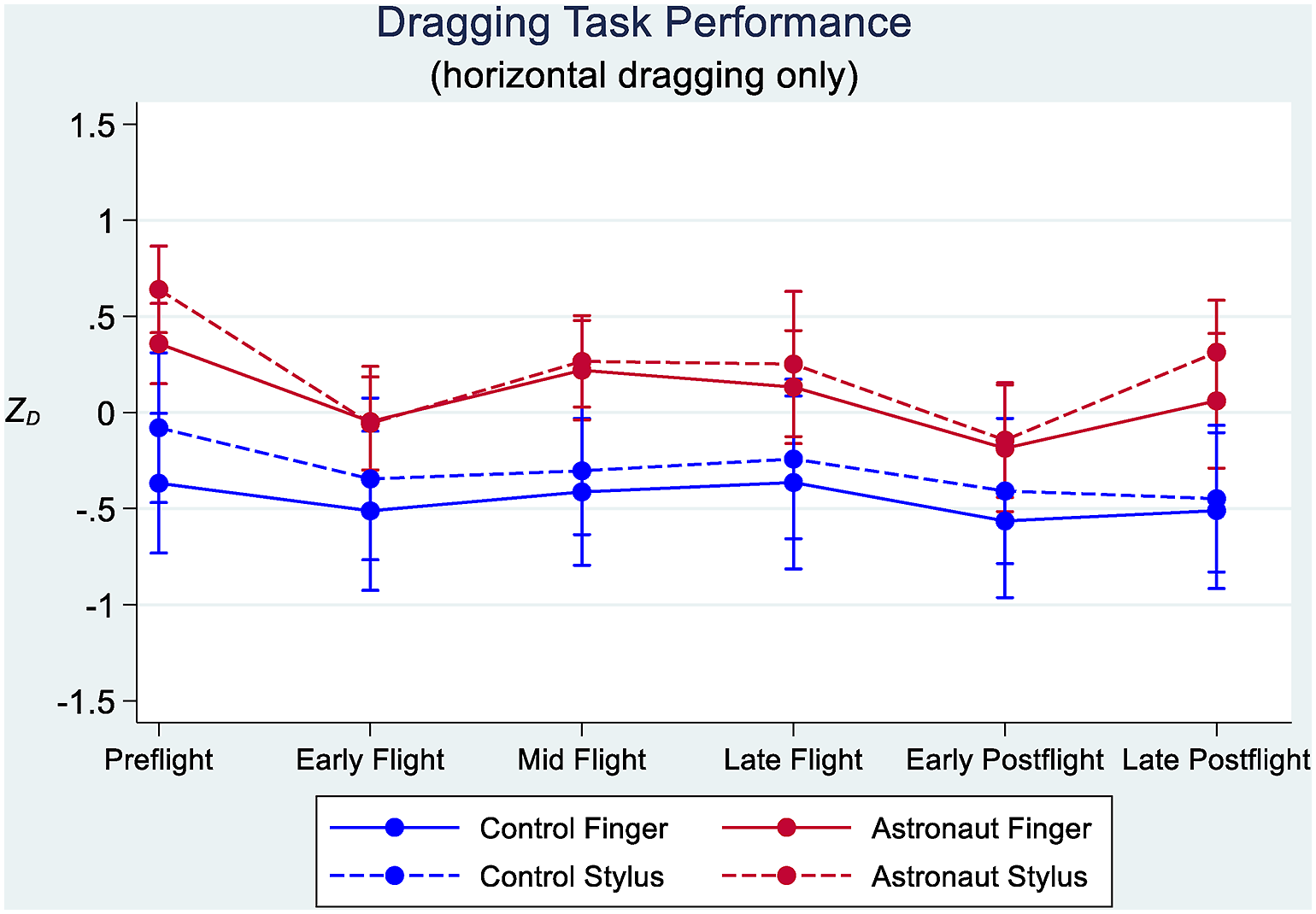
Sub-Task Factors
There was some indication that dragging with a stylus produced better overall mean performance than dragging with a finger, but after adjustment for multiple testing we would hesitate to conclude that using a stylus is better (b = +0.29 ± 0.12, p = 0.016, adj p = 0.49). There was no evidence that the dragging direction (horizontal or vertical) affected mean performance; for example, the estimated average effect of dragging vertically vs. dragging horizontally on Z D was −0.01 ± 0.08.
Shape Tracing Task
Flight Phase
The Tracing task performance metric Z T had about the same range as the Pointing metric Z P (Table 2). After adjustment for learning, we identified a pronounced negative effect of flight on Z T in the Early Flight phase (b = −0.89 ± 0.26; p = 0.001, adj p = 0.03). Although technically not reportable as “statistically significant” with our conservative approach for controlling the FDR to 5%, the data suggested that this early deficit was not made up later in flight (b = −0.54 ± 0.33, and b = −0.80 ± 0.36 at Mid and Late Flight, respectively). The worst relative performance by astronauts for this task was seen at Early Postflight (b = −1.53 ± 0.26; p = 0.0003, adj p = 0.017). This is consistent with a small but definite decrease of 0.26 ± 0.11 in mean Z T between Mid and Late Flight for astronauts. At Early Postflight, the estimated mean deficit of 1.53 relative to preflight actually exceeds the interquartile range of Z T (1.42). By Late Postflight, this deficit was reduced (b = −1.08 ± 0.43; p 0.011, adj p = 0.37), but still suggestive that complete recovery had not been obtained.
Sub-Task Factors
Besides using two types of devices (finger, stylus), this task included two types of shapes to trace (circle, square) in a CW or CCW direction. There was no evidence of a device effect (b = 0.059 ± 0.23, p = 0.8), a shape effect (b = −0.066 ± 0.16, p = 0.7) or a tracing direction effect (b = 0.091 ± 0.072, p = 0.2). Tracing task performance is plotted by flight phase and device in Figure 10 for the circular-shape version of the task. Note that mean performance for astronauts was lower than controls at each time point; however astronauts as a group performed worse at baseline, and comparisons to Preflight were significantly lower only at the Early Flight and Early Postflight timepoints. Estimated mean Tracing task performance with 95% confidence limits. Circular tracing shape only. Values adjusted to remove mean learning effect over time.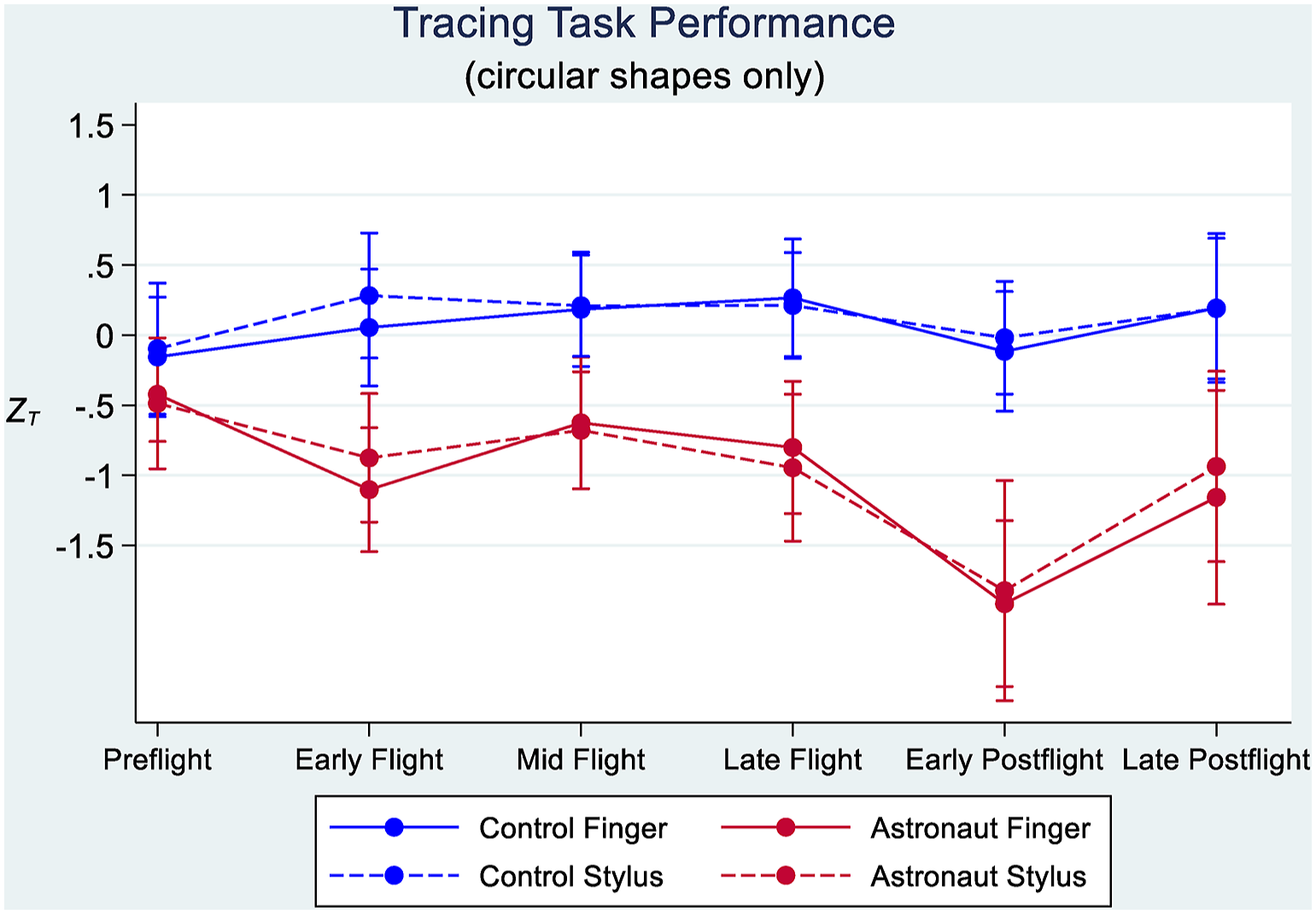
Pinch-Rotate Task
No significant effects of gravitational transitions or interactions between phase and participant group were found after fitting the mixed-effects model to Z
R
the reciprocal mean response time for five trials. Neither was there any noticeable difference between Late Flight and Mid Flight for astronauts. Mean Pinch-Rotate task performance by mission phase is shown in Figure 11 for the square target shape. Pinch-Rotate task. Estimates of mean performance with 95% confidence limits, by flight phase and participant group.
Subjective Feedback Highlights
Each participant was debriefed after study completion. There was a mix of preferences for stylus vs. finger, and participants liked the shorter (5 min) version of the test battery better than the standard (15 minute) version. They also mentioned they would have preferred to receive feedback on their performance after each session. Finally, most participants enjoyed the fortune cookie activity and felt it added entertainment value and motivation.
Discussion
This is the first spaceflight study focused on fine motor skills that included preflight, inflight, and postflight data collection, and we now have a more complete characterization of fine motor performance in microgravity. There was clearly a learning effect in these tasks across the mission, in that mean performance for ground participants generally increased at a rate proportional to N 1/2 . It is reasonable to assume that the astronauts would exhibit a similar learning trend. Due to the impossibility of independently disentangling spaceflight effects from learning effects for the astronauts, it was necessary to apply a learning adjustment to the data for both groups.
Results indicate that long-duration microgravity does not appear to have a significant impact on fine motor skills inflight. It is likely that if there is any detrimental effect, it is overcome by crew continuously exercising fine motor skills in the course of their work during the mission. A much more concerning finding was the effect of gravitational transitions.
Performance on the Pointing and Shape Tracing tasks showed significant decrements the first week in microgravity, as compared to ground controls. This is not surprising since we know that the body undergoes significant adaptation when transitioning to microgravity, after launch. In this early adaptation period, there is some degree of space sickness, and new skills to learn: how to move, how to stop, and how to remain still to perform tasks (Schorn & Roma, 2021). The present results demonstrate that the initial gravitational transition disrupts fine motor performance as well; but once crew adapt, their performance stabilizes and likely improves across the flight portion of the mission.
The fine motor performance decrement seen post landing lasted up to 3 days for the Shape Tracing task (see Figure 10), and as much as 30 days for the Pointing task (see Figure 8). The Dragging task showed a similar pattern of performance, but failed to reach significance. The Pinch-Rotate task did not appear to be impacted by spaceflight. Perhaps extended screen contact with two fingers provided some level of stability during the movement, and more opportunity for course correction. By contrast, the Pointing task requires more precision and the least opportunity to course correct—a possible reason for longer-term performance impacts. Results regarding input device (i.e., stylus, finger) were mixed, favoring the finger for pointing and slightly favoring the stylus for dragging, and with no noticeable effect for tracing. Both methods will be available for use by future spaceflight crews.
Limitations
The present study was a field experiment in an extreme environment. As such, there were many constraints imposed by the environment, and the operational rules and processes of human spaceflight study. One of the largest limitations in this study is the small sample size. Given the cost and availability of crew time for experiments, this study was only approved for seven participants. In addition, crew baseline data collection opportunities were very limited, particularly those close to launch. Post landing crew availability was also highly constrained; thus, the shorter test battery for Early Postflight sessions.
Conclusions
Overall, results suggest that after a long journey to a planetary surface like Mars, astronauts may not be able to immediately perform at their best level with computer-based devices due to the effects of gravitational transitions. This is a concern because it is highly likely that safety critical post landing tasks such as securing the vehicle, configuring spacesuits, powering up a habitat or teleoperating rovers will need to be completed accurately with touchscreens or small controls. It is acknowledged that the gravitational transition to the moon or Mars surface will likely be less severe than our Earth landing data show; however, crew landing on a planetary surface may be deconditioned, and they will not have a large ground-based support team to assist them after a landing. These results, along with those of Moore, et al. (2019) indicate that in order to enable future long-duration missions, we must consider performance impacts caused by gravitational transitions. It may be that changes to the timeline (waiting until adaptation has occurred for critical tasks) or countermeasures (e.g., concentrated practice) will need to be implemented. It may also be that critical early flight or post landing applications need to be adaptive or specially designed with larger targets, to minimize errors. With only seven participants in this study, additional research is warranted to confirm these results with more flight-realistic tasks, and to test potential mitigations.
Supplemental Material
Supplemental Material - Effects of Long-duration Microgravity and Gravitational Transitions on Fine Motor Skills
Supplemental Material for Effects of Long-duration Microgravity and Gravitational Transitions on Fine Motor Skills by Kritina Holden, E. Vincent Cross, Maya Greene, Anikó Sándor, and Brandin Munson in Human Factors
Footnotes
Acknowledgements
The authors would like to thank Kira Matrejek for her development of the Fine Motor Skills test battery. The authors would also like to thank Laura Sarmiento and Paige Ricketts for their outstanding support of our research on ISS. This study was funded by the NASA Human Research Program and performed as part of the Human Health and Performance Contract #NNJ15HK11B at the NASA Johnson Space Center.
Key Points
• Fine motor performance was measured across a 6-month space mission, including preflight, inflight, and postflight data collection. • An iPad-based Fine Motor Skills test battery that included Pointing, Dragging, Shape Tracing, and Pinch-Rotate tasks was used for data collection. • No performance decrements were found inflight, after initial adaptation to space. • Statistically significant performance decrements were found at gravitational transition points (first week in space, first month after landing). • Results raise concerns for long-duration crew needing to perform safety critical operations requiring fine motor skills after a gravitational transition such as landing on a planetary surface.
Author Note
Maya Greene and Anikó Sándor are no longer at KBR. E. Vincent Cross II is no longer at Leidos. Shelby Thompson is no longer at Lockheed Martin. Brandin Munson is no longer at University of Houston.
Supplemental Material
Supplemental material for this article is available online.
Kritina Holden is a Technical Fellow in Human Factors at Leidos, supporting JSC in Houston, TX. She received a PhD in Engineering Psychology from Rice University in 1990.
At the time of this research, Maya Greene was a Human Factors Design Engineer with KBR in Houston, TX. She received a PhD in Psychology from the University of Houston in 2015.
At the time of this research, E. Vincent Cross II was a Senior Research Scientist at Leidos. He received a PhD in Computer Science from Auburn University.
Anikó Sándor is a UX researcher at Google. She graduated with a PhD in Psychology from Rice University in 2007.
At the time of this research, Shelby Thompson was a Human Factors Engineer with Lockheed Martin in Houston, TX. He received a PhD in Psychology from Wichita State University in 2007.
Alan Feiveson is a NASA Emeritus Statistician at the NASA Johnson Space Center in Houston, TX. He received a PhD in Statistics from Texas A&M.
At the time of this research, Brandin Munson was a Human Factors Engineer at NASA Johnson Space Center. He received a PhD in Cognitive Neuroscience from the University of Houston in 2018.
References
Supplementary Material
Please find the following supplemental material available below.
For Open Access articles published under a Creative Commons License, all supplemental material carries the same license as the article it is associated with.
For non-Open Access articles published, all supplemental material carries a non-exclusive license, and permission requests for re-use of supplemental material or any part of supplemental material shall be sent directly to the copyright owner as specified in the copyright notice associated with the article.
