



Abstract
Objective
This study examined the interaction of gait-synchronized vibrotactile cues with an active ankle exoskeleton that provides plantarflexion assistance.
Background
An exoskeleton that augments gait may support collaboration through feedback to the user about the state of the exoskeleton or characteristics of the task.
Methods
Participants (N = 16) were provided combinations of torque assistance and vibrotactile cues at pre-specified time points in late swing and early stance while walking on a self-paced treadmill. Participants were either given explicit instructions (N = 8) or were allowed to freely interpret (N=8) how to coordinate with cues.
Results
For the free interpretation group, the data support an 8% increase in stride length and 14% increase in speed with exoskeleton torque across cue timing, as well as a 5% increase in stride length and 7% increase in speed with only vibrotactile cues. When given explicit instructions, participants modulated speed according to cue timing—increasing speed by 17% at cues in late swing and decreasing speed 11% at cues in early stance compared to no cue when exoskeleton torque was off. When torque was on, participants with explicit instructions had reduced changes in speed.
Conclusion
These findings support that the presence of torque mitigates how cues were used and highlights the importance of explicit instructions for haptic cuing. Interpreting cues while walking with an exoskeleton may increase cognitive load, influencing overall human-exoskeleton performance for novice users.
Application
Interactions between haptic feedback and exoskeleton use during gait can inform future feedback designs to support coordination between users and exoskeletons.
INTRODUCTION
In human augmentation exoskeletons, information flows primarily from the wearer to the system, which gathers kinematic and physiological data on the wearer’s actions through on-board sensors, such as inertial measurement units (IMU) and electromyography. The exoskeleton provides tactile cues to its user by applying forces at body contact sites during operation. Designed feedback is not typically provided to the wearer for augmentative systems. However, rehabilitative exoskeletons do provide additional information combined with other therapeutic techniques, which use sensory channels, for example, visual, auditory, or haptic cues (English & Howard, 2017; Lee et al., 2015; Pan et al., 2017; Tzorakoleftherakis et al., 2015). These sensory cues may provide temporal and proprioceptive information to aid in task performance, such as reaching towards a target (Tzorakoleftherakis et al., 2015), gait speed, and stride length (Lee et al., 2015). The use of additional sensory channels has not been widely explored in human augmentation exoskeletons. Lower limb active exoskeletons apply forces about the hip, knee, or ankle to assist with joint flexion and extension (Viteckova et al., 2013). When supporting gait, lower limb exoskeletons use repetitive stance-swing cycles to move the body forward (Perry, 1992). Incorporating rhythmic feedback to the user throughout the gait cycle may improve human-exoskeleton performance by informing the user on the exoskeleton’s intended actions.
Rhythmic auditory stimulation (RAS) has a long history in rehabilitation (Thaut & Abiru, 2010). In RAS, auditory cues are provided to an individual at a consistent frequency, often while walking, and the individual alters their motion to match the cue frequency or phase (Thaut et al., 1999). Heel strike is a common target gait event when matching a beat (Roerdink et al., 2011). Auditory cues have also been used to compare to visual cues which are presented as “stepping stones” on which the individual steps (Vaz et al., 2020). The altering of motion cadence to a rhythmic cue is called entrainment, which may result in altered gait characteristics, such as stride length, width, and speed (Pau et al., 2016). One thing to note of RAS is that the cues are provided unsynchronized to the gait pattern and the individual alters their gait pattern to match the cues. More recently, this concept has been extended to the use of vibrotactile cues, which has shown similar entrainment effects for individuals with Parkinson’s Disease (Winfree et al., 2013).
With active exoskeletons, the forces or torques applied to the user can be viewed as a type of haptic information. Ochoa et al. (2017) have shown that wearers of an exoskeleton system do entrain to periodic ankle torque pulses provided by the system so that the torques aid in push off. Many exoskeleton systems do not intentionally use torque to provide temporal cues to the user, but this occurs naturally due to the cyclical nature of gait. Zanotto et al. (2013) explored the use of auditory cues as a way of supplementing or replacing visual feedback in an ankle path following task during gait with an exoskeleton. Participants were instructed to match their heel strikes of each foot if given a rhythmic audio cue. They used both unsynchronized gait cues as well as gait-synchronized cues at heel strike and toe off and showed that path following accuracy could be supported with the audio or visual cues. The Zanotto et al. (2013) finding demonstrates that relatively simple cues, a beat at heel strike and toe off, can be useful in increasing a wearer’s coordination with an exoskeleton in a relatively complex task, for example, following an ankle path while walking.
The interpretation of a rhythmic cue may affect the impact of the cue on gait dynamics. Cuing studies typically provide explicit instructions to individuals on interacting with the cue, such as matching heel strike or toe off. The effect of free mapping of the cues to gait dynamics when walking with an exoskeleton is currently unclear. Georgiou et al. (2015) provided rhythmic vibrotactile stimulation to people post-stroke and instructed participants to “follow the rhythm of the cue,” allowing broader interpretation of the cue. The deliberately ambiguous instructions were interpreted by participants in ways different from studies which explicitly instructed participants to match their footfalls to the cues. The Georgiou et al. (2015) study found that it was unclear if the participants’ footfalls became synchronized with the haptic cues. Baldi et al. (2018) evaluated the mental and manual workload of synchronizing with a haptic cue by applying cadence-based vibrotactile stimuli to participants’ wrists and ankles as they balanced a small sphere on the center of a flat surface. The study found that participants aligned with the desired cadence more often and reduced errors on the balancing task when the cue was applied to the ankles compared to the wrists. The Baldi et al. (2018) study highlights the cognitive load when interpreting a haptic cue and its impact on coordinating with the cue and task performance. The location of the cue as well as the instructions on interacting with it may have significant influence on its effect on gait and could have additional emergent behaviors when coupled with an exoskeleton that provides active assistance.
It is currently unknown how stride parameters and speed are affected when cues occur at different points in the gait cycle beyond heel strike and toe off. Previous RAS studies found that asynchronous auditory cues, to which participants matched their heel strike, can yield changes in stride characteristics (Hamacher et al., 2016). The present work examines the interaction and interpretation of the added cues with the haptic signal related to the use of an exoskeleton. The study hypotheses were that the presence of the cue, torque, and explicit instructions would affect (1) self-selected speed, (2) stride length, and (3) stride width. Understanding how gait characteristics are impacted by haptic cues when walking with an exoskeleton will inform the design of human-exoskeleton systems with tactile feedback, as well as how operators are trained in their use.
METHODS
Participants
The study participants (N = 16, 8 female, 8 male, aged 20–56 years, height=
Equipment
Participants walked on a self-paced, split-belt, instrumented treadmill in a Computer Assisted Rehabilitation Environment (CAREN) System (Motekforce Link, Amsterdam, The Netherlands). This system includes an optical motion capture system (Vicon Motion Systems Ltd, Oxford, UK). The treadmill speed was based on the pelvis position relative to the treadmill. There was a neutral zone where the speed was maintained; moving ahead of this region increased the speed until the pelvis was back in the neutral zone. Similarly, if the pelvis fell behind this region, the belt would slow down.
Study participants wore the Dephy Exoskeleton on both legs (DpEb45, Dephy Inc., Maynard, MA, USA) (Figure 1), which uses a brushless direct current motor and a strap-based transmission to provide plantarflexion assistance (Mooney & Duval, 2020). This system has an integrated IMU and encoder on the ankle, and was connected to a Raspberry Pi 4 (Raspberry Pi Foundation, Cambridge, UK), which recorded sensor data from the exoskeleton and determined the ankle torque and cue timing. The haptic display for the cues used eccentric rotating mass motors (307–103, Precision Microdrives Ltd, London, UK) placed on the lateral side of the tibia’s anterior border. The Raspberry Pi controlled an infrared emitter, which was used to synchronize the exoskeleton data with the motion capture system. The Dephy ExoBoot (DpEb45 exoskeleton) consists of a carbon fiber footplate integrated into a standard ankle-high boot. The boot-footplate assembly is connected to a shank assembly on which a unidirectional actuator is mounted.
The torque profile provided by the exoskeleton was based on Zhang et al. (2017), with torque onset at 27.1% of the gait cycle, peak torque at 52.4%, and torque ending at 62.7%. The normalized peak torque used was 0.175 Nm/kg, to keep the current required for a 100 kg user below 25 A, as the exoskeleton’s current sensor is limited to 30 A. Gait cycles were segmented based on an estimate of heel strike using the gyroscope of the exoskeleton’s IMU. Real-time segmentation of the gait cycle occurred when the leg transitions from moving in the anterior direction to the posterior direction following swing. This segmentation method was used instead of the treadmill’s force plate as it allows the system to function outside of a laboratory environment. The percent of the gait cycle was determined by dividing the time since the last segmentation by the expected gait duration, which was the mean duration of the previous three gait cycles. During swing, a small current of 400 mA was applied to the motor to maintain tension in the exoskeleton’s strap transmission. Haptic cues were provided from 90% to 25% of the gait cycle, in 5% increments. Cues near heel strike were selected to be in-line with common practice in which participants are instructed to match their heel strike to the cue. The latest cue timing is before the onset of the exoskeleton torque to prevent the haptic cue from being masked by the pressure on the shank where the exoskeleton attaches.
Procedure
Trial Segments

Trial 1 had a 12-minute segment where only ankle torque was provided so the participants could become familiar with the function of the exoskeleton. Trial 2 contained 16 one-minute segments where haptic cues were provided at different timing for each segment without any exoskeleton torque. For the first 8 segments, the cues swept up in order from 90% to 25%, the next 8 segments swept down from 25% to 90%. Trial 3 was the same as trial 2 but the cues swept down then up. Trials 4 and 5 had 1 minute with only torque followed by the same cuing as trials 2 and 3, respectively, with concurrent exoskeleton torque. Trial order was not randomized.
Participants were distributed into two groups, one which received no instructions and freely interpreted the cue (FI) and one which received explicit instructions on coordinating with the haptic cue (EX). Participants in the FI group were told the study was examining their natural response to the cues and torque. Participants in the EX group were told to match their heel strike with the cue when possible and to walk comfortably while matching the cue to the best of their ability. We expected that synchronizing heel strike with cues applied at 90–95% of the gait cycle would decrease their stride length and increase speed, while cues at 5–25% would increase stride length and decrease speed. Participants were expected to step earlier when cues were applied earlier than their normal heel strike (90–95%) and step later with cues after heel strike (5–25%). Cues applied at 0% were not expected to have a significant impact the gait characteristics.
Data Analysis
Gait cycles were segmented based on the treadmill’s force plates, to directly measure heel strike instead of using the exoskeleton’s estimate for the data analysis. The use of the exoskeleton estimated heel strike based on the on-board gyroscope leads to a difference in the actual cue and torque timing relative to the force plate determined heel strike. To evaluate the magnitude of this difference, the error between the exoskeleton estimated heel strike and force plate based heel strike were calculated.
Three gait characteristics were calculated: normalized stride length, normalized stride width, and treadmill speed. Stride width for a leg was calculated by averaging the lateral position of a heel marker on consecutive heel strikes for that leg, Representation of the points used to calculate the stride length (
Statistical Analysis
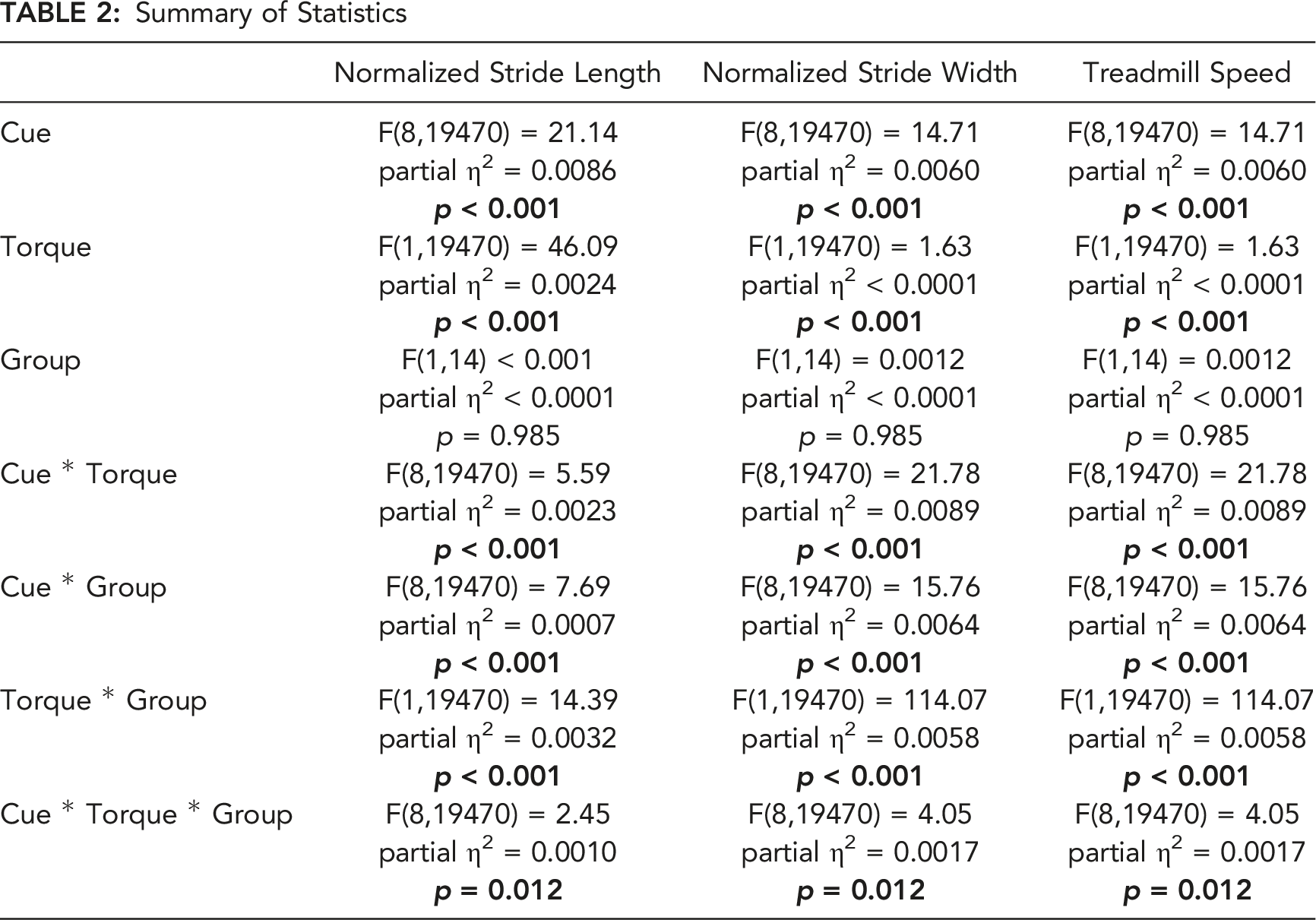
A total of 40 strides per leg from each torque-cue condition were selected for analysis from the end of trial segments. Strides prior to the 40 selected strides were excluded as participants were adapting to the transition between trial conditions. There were two trials that were not used in the analysis: participant 1 had an issue in trial 4 where the exoskeleton did not actuate, and the motion capture data was corrupted for participant 5 in trial 3. The washout segments were not used for the present analysis. A nested ANOVA was fit for each metric, with cue timing (9 levels) and torque (2 levels) as fixed factors, and subject (random factor) nested within instruction group (fixed factor, 2 levels). Pairwise comparisons between cue timing, torque, and instructions were performed. A false discovery rate (FDR) correction (Benjamini & Hochberg, 1995) was used for the post-hoc analysis on cue timing. For all tests, the level of significance was set to 0.05 and was adjusted for post-hoc pairwise comparisons. Cohen’s d effect sizes were calculated for all post hoc comparisons, where
RESULTS
The error in heel strike estimate across all participants was
Summary of Statistics

(a) Normalized stride length, (b) normalized stride width, and (c) speed for torque-instruction groups. Significant differences with effect sizes smaller than 0.2 were excluded for clarity. Error bars are 1.5 interquartile range. Cues presented here are based on the heel-strike estimate. Significant post-hoc difference includes a false discovery rate correction.
The FI group did not experience a significant change in NSW in response to the haptic cue when the exoskeleton torque was off and decreased NSW at cue times of 5%, 15%, 20%, and 25% when torque was on (
There was also an effect on speed due to the presence of a haptic cue when the exoskeleton torque was on and off for both instruction groups (Figure 3(c)). There was a small effect of torque for the FI group, with increased speed with torque regardless of cues (
Similarly, the EX group showed a significant difference in speed between torque on-off states at cue times of 5%, 15%, 20%, 25%, 90%, and 95% (
DISCUSSION
The goal of this study was to examine the interaction of vibrotactile cues with exoskeleton use and the effect of instructions on coordination with cues. The study considered cues from 90% to 25% of the gait cycle with and without the torque from an ankle exoskeleton. The study was conducted on a self-paced treadmill and performance was assessed by examining NSL, NSW, and speed. Cues at 90% and 95% of gait are referred to as occurring at late swing, 0% at heel strike, 5% and 10% at loading response, and 15–25% at early stance.
The effect of exoskeleton torque was dependent on the interpretation of the haptic cue. For participants in the FI group, there was an increase in NSL and speed, with a decrease in NSW with the exoskeleton augmentation. The increase in NSL and speed is not unexpected as energy is added to propel the body and leg forward, affecting the gait dynamics. It has been shown that powered ankle exoskeletons can reduce metabolic cost (Malcolm et al., 2013; Sawicki & Ferris, 2008) and alter gait characteristics, such as increasing NSL and speed (Shi et al., 2019; Viteckova et al., 2013). FI participants increased NSL and speed when the torque was on, regardless of the timing of the cue (Figure 3(a)). In response to exoskeleton torque, the EX group increased NSL only at cues during early stance and modulated speed according to cue time. The EX group also decreased NSW when walking with a powered exoskeleton regardless of cues. The change in strategy may be due to participants’ balancing the haptic cue and coordinating with the exoskeleton’s actuations. According to simplified models of human information processing, information is perceived, analyzed, and used to inform goal-oriented decision making prior to a response or action (Parasuraman et al., 2000). When the user receives information from both the haptic cue and exoskeleton torque, they may align their actions with a goal of synchronizing with the cue, coordination with the exoskeleton, or a weighting between both tasks. EX participants may prioritize the haptic cue when the exoskeleton torque is off, and then prioritize coordinating with the exoskeleton when the torque is on and affects movement. Additionally, exoskeleton torque may act as an entraining signal (Ochoa et al., 2017), thus the presence of torque and cues may result in two competing entraining signals that affect gait characteristics. FI participants showed an overall increase in speed for all cues compared no cue, with small effect sizes when the exoskeleton torque was off and medium to large effect sizes when torque was on. The FI group may have become entrained to the presence of haptic cues regardless of the cue timing, matching their gait cadence to the rhythm of the cues.
The timing of the cues with respect to the gait cycle may further influence the response within the group that received instructions. When the exoskeleton did not provide torque, EX participants increased speed with large effect sizes with cues at terminal swing and decreased speed with small effect with cues at early stance (Figure 3(c)). Cues at terminal swing may be easier to respond to than those occurring during loading response as it may be easier to adjust stepping strategies within step rather than using the information to affect the following step, resulting in the difference in effect sizes.
In addition to coordinating with the haptic cue and exoskeleton, participants must maintain their balance and stability. Stride width can be considered a measure of mediolateral stability and balance control (Arvin et al., 2016). The FI group showed no change in NSW when torque was off and decreased NSW at cues during early stance when torque was on (Figure 3(b)), which may be driven by the corresponding increase in NSL. EX participants increased NSW with cues during terminal swing, heel strike, and early stance when walking with no torque. The EX group may experience an increased cognitive load when coordinating with the haptic cue, thus increasing NSW to widen their base of support. Studies examining dual-task walking, such as walking while texting and with cognitive tasks, have shown that participants walk at slower speeds with shorter steps, increased stride width, and increased double support (Agostini et al., 2015; Licence et al., 2015; Parr et al., 2014; Patel et al., 2014). Additionally, Kelly et al. (2010) demonstrated an effect on gait characteristics and cognitive task performance when participants were instructed to focus on walking or on the cognitive task. EX participants may have altered NSW as the instructions may have caused participants to focus on matching the cue when torque was off, which was aligned with the NSL and speed metrics. When the exoskeleton provided torque, the EX group decreased NSW at all cues. EX participants seemed to shift from focusing on only cues to dividing attention between coordinating with both the exoskeleton and cues as torque is applied. When the exoskeleton torque was on, NSL increases, NSW decreases, and the modulation of speed is reduced, which may indicate that cues have less impact on gait characteristics when torque is present for participants.
The difference in gait modulation between FI and EX groups highlights the importance of instructions on coordinating with the cue. Patla et al. (1989) found that participants were able to increase their stride length at audio cues provided at ipsilateral heel strike (0%) and contralateral toe off (10%) when explicitly instructed to do so for the step immediately after the cue. In this current study, when participants were not given instructions on interpreting the haptic cue (FI), they ignored the timing of the cue and increased NSL and speed regardless of timing. Timing-based mapping of the haptic cue was not enough to change gait behavior without instructions. When provided explicit instructions to match heel strike with the haptic cue (EX), participants primarily adjusted their speed to coordinate with cues applied during terminal swing.
Cuing during walking has shown varied effects on gait and may be impacted by synchronous or asynchronous cues. Hamacher et al. (2016) found that asynchronous rhythmic auditory cues yielded a reduction in stride length when participants were asked to heel strike on cue. Wittwer et al. (2013) found that the use of rhythmic music had the effect of increasing speed during overground walking, primarily due to increases in stride length. The change in stride length with asynchronous cues may be dependent on the beat of the metronome or music, which was initially matched to each participant’s normal gait cadence. In the current study, providing synchronous vibrotactile cues with no explicit instructions had the overall effect of increasing both NSL and speed in most cues. When participants were given explicit instructions, NSL increased for select cues and speed modulation was dependent on the timing of the cue and presence of exoskeletal torque.
Haptic cues can be useful in providing information to the exoskeleton users and encouraging speed modulation when given explicit instructions on coordinating with the cues. The effect of cues, however, is reduced when the exoskeleton provides an assistive torque to the user. Applying vibrotactile cues during terminal swing may encourage increases in speed as hypothesized, but to varying degrees. Cues applied during stance may decrease speed only with explicit instructions and without an exoskeleton. Alternative methods, such as different cue mappings or direct feedback, may be necessary to reduce speed with or without the exoskeleton. Visual or auditory cues may create less interference when coordinating with the exoskeleton, as they utilize different sensory channels, while haptic feedback involves the same modality as the exoskeleton. Koritnik et al. (2010) found that healthy adults who are given a visually guided stepping task performed better with haptic feedback or a combination of haptic and visual feedback to visual feedback alone. Including additional feedback modalities may allow users to better synchronize with both the exoskeleton and cues, while being aware of performance costs associated with multimodal feedback and that unequal weights may be given to different sensory modalities when combining visual and tactile information (Colavita, 1974; Hecht & Reiner, 2008).
A limitation of this study is that cues in only a small portion of the gait cycle were explored. The response may be different in other parts of the gait cycle, such as during push off with gait assistance or during swing. Cues applied during stance are hypothesized to generate smaller effect sizes than those occurring during swing, as cues at swing may be easier to immediately respond to than those at stance. The cues also occurred in a specific pattern, so applying cues in a different order may impact participant response. Participants were novices with the exoskeleton, which may affect how they weigh coordinating the system, responding to haptic cues, and maintaining stability. Future studies may consider users with additional experience with exoskeletons to examine interactions between haptic feedback and exoskeleton actuations. This study also included a limited number of participants who adapted to cues applied over short periods. Future studies may explore adaptation to haptic cues and exoskeletons over long periods of time with a larger participant pool. Additionally, it is known that mechanoreceptors in the skin that sense vibration can become habituated to vibrations that are consistently applied, lessening their perceived strength (Wentink et al., 2011). During the current study, multiple participants asked if the cues were getting weaker as the study progressed, which may indicate that they were becoming habituated to the cues. To prevent this habituation, the cues could be applied less frequently or at alternative locations and modalities (Kotowick & Shah, 2018). The position of the haptic device may also affect the response to the cue. Future work may provide feedback in alternative modalities and stimuli placement to prevent habituation, as well as further evaluating the weighting between task-relevant information with the use of exoskeletons.
CONCLUSION
This study explored exoskeleton users’ response to vibrotactile cues when given explicit instructions for coordinating with cues and freely interpreting the cues. The use of exoskeleton torque and cues had the effect of increasing the wearer’s speed and stride length with free interpretation and modulating speed when given explicit instructions. Haptic cues may be used to influence the user’s behavior or inform them of the exoskeleton’s upcoming behavior, but its effects are mitigated when torque is applied in the present study. The presence of cues while walking with an exoskeleton may lead to increased cognitive load, thereby reducing the increases in NSL and speed. Future studies may explore if longer training periods can improve performance and further investigate interactions between various feedback modalities and exoskeleton use. Our results indicated that haptic cues may be used to mainly increase speed and NSL and have less influence for decreasing speed. Alternative modalities for feedback as well as different mappings may yield larger differences in NSL and speed. The exoskeleton applied an ankle torque and provided haptic information to the user, thus an additional vibrotactile cue on the lower limbs may have increased the user’s cognitive load. Providing different feedback modes or locations may help the user differentiate from the information provided by the torque and the cues. Incorporating feedback into human-exoskeleton systems has the potential to help the user infer the exoskeleton’s actions and improve system coordination and performance.
Footnotes
Acknowledgments
The authors would like to thank Harvey Edwards for his help collecting the data for this paper and Aaron Rodriguez for his help integrating the exoskeleton with the CAREN system. The authors would also like to thank Aditi Gupta for sharing her tools for calculating stride width and length.
Key Points
• Haptic feedback may be used to support human-exoskeleton coordination and performance. • The presence of exoskeleton torque mitigates the impact of haptic cues when participants are given explicit instructions on coordinating with the cues. • Participants who freely interpreted the haptic cues increased normalized stride length and speed regardless of cue timing and exoskeleton torque, while participants with explicit instructions modulated speed according to the cue timing and torque. • Future feedback systems should consider the interaction between exoskeleton torque and haptic cues.
Funding
The author(s) disclosed receipt of the following financial support for the research, authorship, and/or publication of this article: This material is based upon work supported by the Under Secretary of Defense for Research and Engineering under Air Force Contract No. FA8702-15-D-0001 and NSF Award 1952279. Any opinions, findings, conclusions or recommendations expressed in this material are those of the author(s) and do not necessarily reflect the views of the Under Secretary of Defense for Research and Engineering.

Man I Wu is a PhD student in the Robotics Institute at the University of Michigan. She earned her BS in 2020 from Boston University in Biomedical and Mechanical Engineering.
Paul Stegall is currently a postdoctoral scholar in the Mechanical Engineering Department at Northern Arizona University. Paul earned a PhD in 2016 from Columbia University in Mechanical Engineering.
Ho Chit Siu is a research engineer at the Massachusetts Institute of Technology’s Lincoln Laboratory. He earned his PhD in 2018 from the Massachusetts Institute of Technology (MIT) in Aeronautics and Astronautics.
Leia Stirling is an associate professor in the Department of Industrial and Operations Engineering at the University of Michigan and Core Faculty in the Robotics Institute. She earned her PhD in 2008 from MIT in Aeronautics and Astronautics.