



Abstract
Objective
To investigate the effect of gender transfer in virtual reality on implicit gender bias.
Background
Gender bias is a type of discrimination based on gender, which can lead to increased self-doubt and decreased self-esteem. Sexual harassment is a hostile form of gender bias that can cause anxiety, depression, and significant mental health issues. Virtual reality (VR) has been employed to help make people become aware of their biases and change their attitudes regarding gender, race, and age.
Methods
Forty participants were embodied in avatars of different genders and experienced sexual harassment scenarios in VR. A gender Implicit Association Test (IAT) was administered before and after the experience.
Results
There was a statistically significant main effect of participant gender (F (1,36) = 10.67, p = .002, partial η2 = .23) on ΔIAT, where males and females reported a decrease (M = −.12, SD = .24) and an increase (M = .10, SD = .25) in IAT scores, respectively. A statistically significant two-way interaction between gender transfer and participant gender was revealed (F (1,36) = 6.32, p = .02, partial η2 = .15). There was a significant simple effect of gender transfer for male participants (F (1,36) = 8.70, p = .006, partial η2 = .19).
Conclusions
Implicit gender bias can be modified, at least temporarily, through embodiment in VR. Gender transfer through embodiment while encountering different sexual harassment scenarios helped reduce implicit gender bias. There was a tendency for individuals to increase bias for the gender of the avatar in which they embodied.
Applications
The current research provided promising evidence that a virtual environment system may be used as a potential training tool to improve implicit gender bias.
INTRODUCTION
Gender bias, or showing preference for one gender over the other, is a type of discrimination based on a person’s gender which is prevalent in many aspects of society (Grogan, 2019; Lekchiri et al., 2019; Mengel et al., 2019). Although gender bias can be a threat to both men and women, a systematic literature review revealed that women are more likely to experience gender bias (Blau, 1998). Modern gender bias (e.g., sexism) is characterized by the denial of personal bias and prejudice against women, a general conscious belief in equality of the genders, but unconscious attitudes that foster nonsupport for programs and legislation helpful to women (Keller, R.M. and Galgay, 2010). Survey results have shown that gender bias and its experience are “common to almost all women” (Klonoff & Landrine, 1995). For instance, fewer women hold leadership roles in organizations as these roles are commonly seen to be more suited for men. This is revealed in recent data that shows only 21% of board members, 27% of executives, and 5% of chief executives are women among Fortune 500 firms (Barnes et al., 2020; Myers et al., 2020). Women also receive lower pay and are promoted less often than their male peers (Blau, 1998). This negative impact often leads to increased self-doubt and decreased self-esteem (Dardenne et al., 2007).
Sexual harassment is an overt and hostile form of gender bias (Barthelemy et al., 2016) which can cause anxiety, depression, and post-traumatic stress disorder (Berg, 2006; Landrine et al., 1995). Sexual harassment includes unwelcomed sexual advances, requests for sexual favors, and other verbal or physical conducts of a sexual nature (Terpstra & Baker, 1987). Reports of sexual harassment are also common in many working women (Baugh, 1997), especially in male-dominated field (Dresden et al., 2018). Sexual harassment is rooted in the power structure of society which frequently puts male employers in positions of authority over female employees (McLaughlin et al., 2012). Efforts have been made to address inappropriate sexual harassment behaviors, where an individual would bear an embodied perspective of a woman subject to experience sexual harassment and thereby change their attitudes and behaviors (Neyret et al., 2020). Taking on the role of a victim of sexual harassment in virtual reality (VR) has helped to increase empathy (Ventura et al., 2021) and reduce harm toward a potential victim at a later time (Neyret et al., 2020). While studies have provided supporting evidence that one’s attitudes and behaviors can be changed through virtual sexual harassment scenarios (Neyret et al., 2020; Ventura et al., 2021), the influence on one’s gender bias through embodiment has not been fully examined. We expected that by implementing affective processes, like experiencing sexual harassment scenarios from an embodied perspective in VR, could help modify participants’ gender bias.
Taking an embodied perspective may have an influence one’s gender bias can be rationalized by two theoretical concepts: virtual embodiment in embodied cognition theory and theory of mind. Virtual embodiment is stemmed from theories of embodied cognition (Moghimi et al., 2016). A user controls a co-located avatar to achieve virtual embodiment. Usually, the appearance of the avatar is reflected in a virtual mirror to suggest embodiment. By means of avatars, people take on another person’s perspective, while continuously interacting with other objects in the virtual environment (Pan & Hamilton, 2018; Ventura et al., 2021). Avatars can also help bridge a person in the physical environment with VR through virtual embodiment, which consists of three subcomponents: the sense of self-location, the sense of agency, and the sense of body ownership (Kilteni et al., 2013; Riva et al., 2019). Studies that examined the effect of virtual embodiment on perception suggested that multiple sensory experiences could influence cognition (Barsalou, 2008, 2010; Moghimi et al., 2016). In addition, the theory of mind (ToM), which involves mentalizing (Uta & Frith, 2003), is the ability to think about the mental states in oneself and others, and to use this information to understand what other people know and predict how they would act. VR can be a creative approach to enable individuals “to be in another person’s shoes” in a safe experiential setting (Neyret et al., 2020; Vass et al., 2018). The results from the immersive VR-based targeted ToM interventions confirmed that utilizing immersive VR technologies in the remediation of ToM deficits can be a promising direction in the development of interventions (Vass et al., 2018).
There are several technical approaches to enable virtual embodiment in VR. For instance, through real-time motion capture, an avatar can move in synchrony with a person’s real body movements. These movements can be reflected and seen in a virtual mirror, which further contributes to the perceptual illusion of ownership of the virtual body (González-Franco et al., 2010; Neyret et al., 2020). Taking the perspective of another person in VR can lead to changes in cognitive task performance, and one’s attitudes toward gender, race, age (Peck et al., 2013; Schulze et al., 2019; Seinfeld et al., 2018; Tajadura-Jiménez et al., 2017). Relevant studies where embodiment took place at a gender-related context provided insights for the present study (Jouriles et al., 2009; Lopez et al., 2019; Seinfeld et al., 2018). Jouriles et al. (2009) demonstrated that VR can heighten the realism of sexually threatening role plays and used VR-enhanced role plays to help college women resist sexual attacks. Seinfeld and colleagues (Seinfeld et al., 2018) embodied male domestic violence offenders in the virtual body of a woman who was then subjected to an abusive attack from a male virtual character. It was found that the offenders’ emotion recognition skills improved, especially in their ability to recognize fearful faces of females (Seinfeld et al., 2018). Peck et al. (2018, 2020) found that gender body-swap illusions induced stereotype threats. Lopez’s study embodied male participants in different genders of avatars while following the movements of a virtual Tai Chi teacher in a virtual environment, and they found that the participants’ gender bias increased after embodying a female avatar in contrast to a male avatar (Lopez et al., 2019). These findings suggested that embodying participants in avatars of different genders in a virtual environment where they encountered different sexual harassment scenarios could have effects on gender bias.
Researchers have also explored the immediate and long-term effects of VR exposure (not limited to bias-related studies). The duration of interest ranged from several weeks to 1 year after the VR experience (Anderson et al., 2017; Banakou et al., 2016; Cesa et al., 2013; Herrera et al., 2018; Lindner et al., 2021; Viziano et al., 2019). In most of the cases, the positive effects of VR-based interventions mitigated several weeks after the conclusion of VR exposure (Ahn et al., 2016; Herrera et al., 2018), while some studies reported continued improvement even after discontinued VR exposure (Anderson et al., 2017; Batson et al., 1997; Lindner et al., 2021; Viziano et al., 2019). However, studies on the long-term effects of VR exposure on implicit biases and prototypes were limited, especially implicit gender biases (Banakou et al., 2016; Lopez et al., 2019; Maister et al., 2015; Schulze et al., 2019). Given the limited research investigating the effects of VR exposure on implicit gender biases, we aim to contribute to the understanding of the immediate effects of VR exposure on implicit gender biases.
While previous research provided insights to the present study, it also revealed certain areas that were overlooked. While it has been demonstrated that experiencing virtual sexual harassment scenarios could change one’s attitudes, like empathy (Ventura et al., 2021), the influence of virtual harassment scenarios on implicit gender bias has not been covered. Implicit bias is viewed as an unobservable structure in the mind of an individual (e.g., an association in memory) that drives behaviors in an unconscious manner (Amodio & Mendoza, 2010; Gawronski & Bodenhausen, 2006; Sherman, 1996). Although there might be no significant explicit bias against women, there can be implicit biases, especially in male-dominated field (Dresden et al., 2018). Depending on the research objective, some research focused on identifying and characterizing the mental representation of implicit bias (Gawronski & Bodenhausen, 2006; Sherman, 1996), and other research focused on the role of implicit bias in behavior (Amodio & Devine, 2006; Dovidio et al., 2002; Payne, 2005). Individuals may unconsciously exhibit behaviors (of implicit bias) through tasks they perform. The Implicit Association Test (IAT; e.g., A. Greenwald et al., 1998) is a measurement tool that leverages the theoretical concept of implicit tasks to index the strength and nature of implicit bias (an unobservable construct). The IAT has been used to study implicit social cognition in part because of its ease of implementation, large effect sizes, and relatively good reliability (Cattaneo et al., 2011; Hansen et al., 2019; Lopez et al., 2019; Parker et al., 2018; Wang et al., 2019). The IAT can help assess implicit biases and has been used in several domains including race, gender, weight, and age (Carnes et al., 2015; Peck et al., 2013; Schulze et al., 2019; Wang et al., 2019). The gender IAT is sensitive in detecting underlying implicit social attitudes and stereotypes toward or against genders by measuring automatic concept-attribute associations (Cattaneo et al., 2011).
Assessing implicit biases after embodiment in VR has been examined, particularly in the context of racial bias (Banakou et al., 2016; Maister et al., 2013, 2015; Peck et al., 2013). Peck and colleagues (Peck et al., 2013) demonstrated that the embodiment of light-skinned participants in a dark-skinned avatar significantly reduced implicit racial bias against dark-skinned people. However, in a different study, Groom and colleagues (Groom et al., 2009) embodied light-skinned participants in a dark-skinned avatar during a virtual job interview, which exacerbated implicit biases against Black people. The different findings may imply that the plot of scenario itself might influence implicit bias, together with the embodiment experience in VR. Of the studies that examined the effect of virtual experience on implicit gender bias, the results have been inconclusive (Lopez et al., 2019; Schulze et al., 2019; Starr et al., 2019). It is therefore important to provide more evidence for the influence of the virtual embodiment experience on implicit gender bias.
The overarching goal of this study was to explore whether embodying participants in avatars of different genders during different sexual harassment scenarios would affect implicit gender bias. Participants’ sense of body ownership was measured after the virtual experience to show whether a body ownership illusion was elicited among different groups of participants. Implicit gender bias was assessed before and after the participants were embodied in avatars of different genders and experienced seven levels of sexual harassment scenarios. It was expected that experiencing sexual harassment scenarios while experiencing gender transfer (i.e., being embodied in an opposite-gender avatar) in VR would affect participants’ implicit gender bias. The long-term goal is to improve awareness of implicit gender bias through VR, with the ultimate vision of increasing implicit biases awareness for narrowing gender gap.
METHODS
Participants
Forty participants (20 females, 20 males) between 19 and 50 years of age (mean = 26.7, SD = 7.0) were recruited for the study from North Carolina State University (NCSU). This research complied with the tenets of the Declaration of Helsinki and was approved by the Institutional Review Board at NCSU. Informed consent was obtained from each participant. Although gender bias can impact all persons with various gender identities and expressions (Barthelemy et al., 2016), this study focused mainly on cisgender individuals, that is, self-identified women and men. To ensure participant safety in VR and harassment scenarios, the exclusion criteria were history of epileptic seizure or blackout, self-reported tendency for motion sickness, sensitivity to flashing lights, and previously a victim of sexual harassment and/or assault. All participants indicated willingness to experience virtual harassing or stressful situations in a virtual environment. The experimental session lasted approximately 2 hours for each participant.
Equipment
The virtual environment was delivered to the participants using a head-mounted display (HMD; VIVE, HTC, and Valve Corporation). The harassing scenarios were rendered using a game engine (Unity 3D 2018.4, https://unity3d.com/). The 3D models of objects in the scenarios were retrieved from Unity Asset Store (https://assetstore.unity.com/). The 3D models of avatars were created using MakeHuman (http://www.makehumancommunity.org/), which is an application designed for the prototyping of photorealistic humanoids. There were two avatars in each harassing scenario: a participant avatar controlled by the participant that had the perspective of being harassed, and an offender avatar that was programmed to exhibit harassing behaviors. To control the movement of the participant avatar, the participant’s physical movements were monitored by a set of 14 optical motion tracking cameras (Raptor 4S, Motion Analysis) and then mapped onto the participant’s virtual character (i.e., participant avatar) in real-time (Figure 1). The movements of the offender avatar were driven by recorded aminations, which were created by first recording the movements acted out by the research members using a full-body motion tracking system and then mapping the tracked motion onto a rigged humanoid (i.e., virtual skeleton of the offender virtual character) through Unity Recorder. Verbal harassment content was recorded by two voice actors (one male and one female). The interactions were predominantly visual and auditory. There was no haptic device implemented to simulate touching. In terms of data collection, all IAT scores were recorded using the Inquisit by millisecond (https://www.millisecond.com/), which is a precision software for cognitive, social, neurophysiological, and psychological experiments. Participant embodied in a male avatar and standing in front of a mirror with the movements monitored by a set of motion tracking cameras: (a) the motion tracking software view, (b) first-person perspective view in Unity, (c) third-person perspective view in Unity.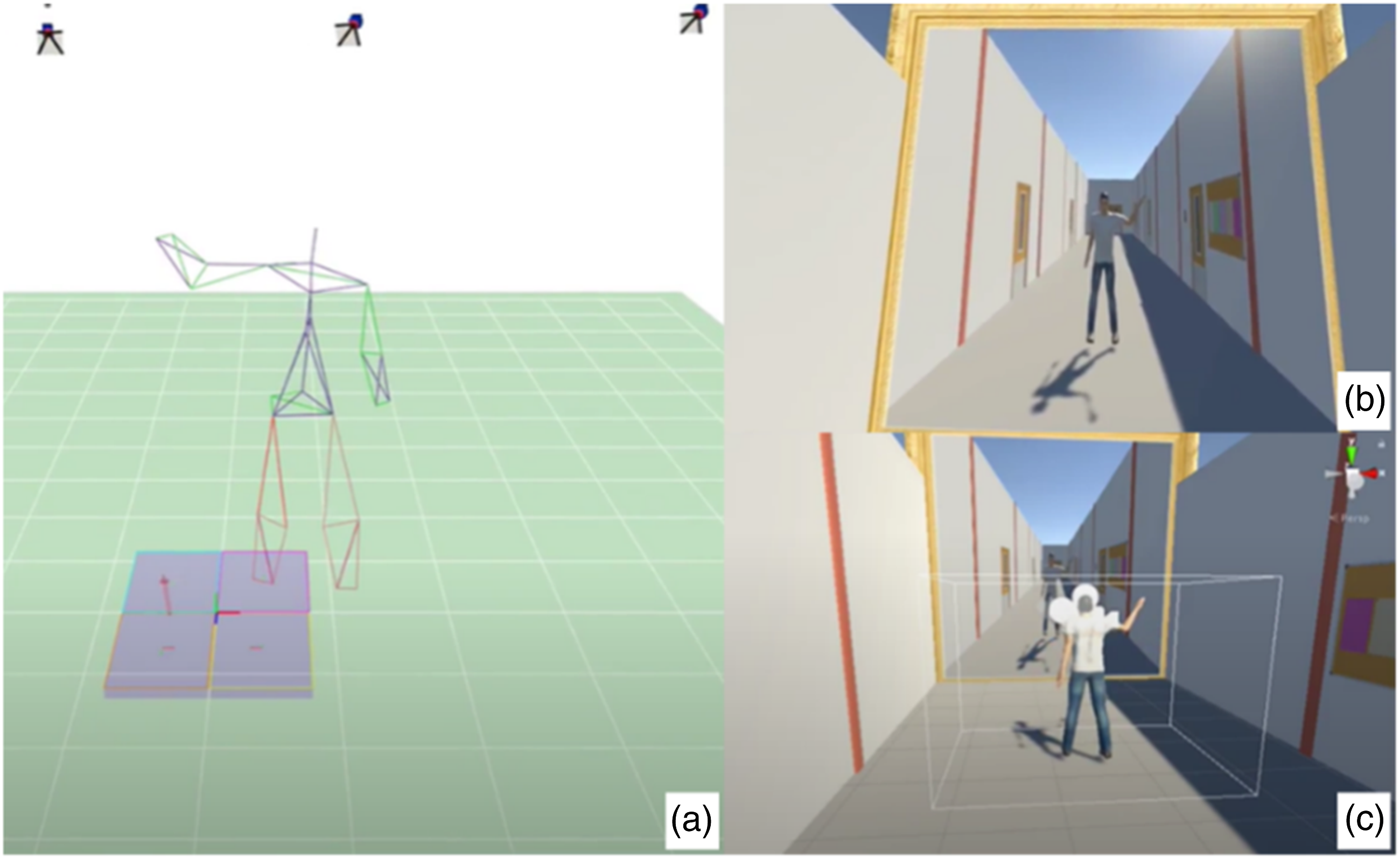
Experimental Design
Four Groups of Participants With 10 Participants in Each Group

Sample Scenarios From Seven Levels of Sexual Harassment Scenarios in Throne’s Study and in VR. Virtual Scenarios Adapted From Sample Scenarios Due to Differences in the Nature of Scenarios Presentation in Text and in Virtual Environment

Experiment Procedure and Task
Pre-experiment Assessment
Upon informed consent, the participant completed a self-reported demographic questionnaire on paper, which included questions on gender, age, and experiences using VR technology. Next, the participant completed a gender IAT (Greenwald et al., 2003, 2009; Nosek et al., 2005) on the lab computer, which produced the baseline IAT score that was denoted as preIAT. The gender IAT evaluated implicit biases by requiring people to quickly categorize faces (female or male) and words (positive or negative) into groups. The scores of the gender IAT test were calculated based on the differences in speed and accuracy in associating faces of different genders and words with positive and negative meanings. A positive IAT score indicated a preference for male and a negative value of IAT score indicated a preference for female. A larger absolute IAT score indicated greater gender bias. The participant then completed the Sensitivity Towards Sexual Harassment Questionnaire (SQ) on paper (Throne, 1995), which assessed the participant’s baseline sensitivity toward sexual harassment. The SQ included 15 items where each item was a written description of a potentially harassing scenario involving two individuals (one female and one male). The SQ was administered to understand whether the participants felt a scenario was appropriate or not. While the sensitivity toward sexual harassment was measured in the overall study and not immediately related to statistical analysis of IAT, the measure was part of the large project and was mentioned to make the study more complete and replicable. Next, 28 reflective motion tracking markers were attached onto the participant’s bony landmarks for capturing the real-time movement of the participant for driving the motion of the participant avatar.
Experimental Experience
Upon entering the virtual environment, the participant first appeared in a lobby area and stood in front of a mirror, which was referred to as the “mirror lobby.” The participant was embodied inside the participant avatar by assuming the same position and movement of the avatar. The participant was able to see the virtual arms and legs by looking at the virtual body segments directly as well as into the mirror. The mirror reflected the entire appearance of the participant avatar, which aimed to help the participant to recognize the gender of the avatar in which they were embodied. A 3-minute priming period was administered during which the participant explored the mirror lobby, observed the avatar reflected in the mirror, and described the appearance of the avatar and the surrounding environment, with the goal of acclimatizing the participant to the avatar and the virtual environment (Figure 2). The 3D models of the virtual characters in which participants embodied: (a) female avatar front view, (b) female avatar left view, (c) male avatar front view, (d) male avatar left view.
After the priming period and before the participant entered the virtual harassing scenarios, the participant was verbally informed that there would be no intimate relationship between the participant avatar and the offender avatar. The experiment protocol about the context of the scenarios was read to the participant, by the experimenter, before entering the scenarios to make sure no participants were confused about the context. During the sexual harassment experience, the offender avatar was programmed to exhibit specific harassment behaviors while the participant avatar did not have to make any responses. For example, in the “sexual request” scenario, the participant avatar would appear standing in a classroom and the offender avatar walked toward the participant avatar and said, “We have spent a lot of time doing homework. I really like you. I’d love to sleep with you.” (Figure 3). The scenarios were randomized with constraints where the same scenario was not seen back-to-back and the scenarios were not in an increasing or decreasing levels of harassment as defined by Throne. There was a two-minute rest break between each scenario. During the rest break, the participant returned to the mirror lobby, which was intended to help increase the participant’s virtual body ownership while the next harassing scenario was loaded. The experiment task was completed when the participant experienced all seven harassing scenarios twice. The participant verbally rated the perceived appropriateness of the various harassment scenarios using the same scale as the SQ after experiencing each virtual sexual harassment scenario as soon as the participant returned to the mirror lobby. All scenarios lasted approximately 30 seconds. The participant was transferred to mirror lobby as soon as the scenario ended, and the way of transmission was fading to black and fading back to the next virtual scene. Examples of harassing scenarios in VR: (a) level “no harassing behavior” from first-person perspective view, (b) level “no harassing behavior” from third-person perspective view, (c) level “touching” from first-person perspective view, (d) level “touching” from third-person perspective view.
Post-Experiment Assessment
Sense of Body Ownership Items From the Post-Experiment Questionnaire

RESULTS
Linear Regression Model on ΔIAT
The primary measure interest was the mathematical difference between the preIAT and postIAT, which was denoted as ΔIAT (ΔIAT = postIAT – preIAT). The means and standard errors of ΔIAT across the four groups are shown in Figure 4 (FEF: Mean 0.06, SD 0.30; FEM: Mean 0.14, SD 0.18; MEF: Mean −0.26, SD 0.19; MEM: Mean 0.01, SD 0.22). A linear regression model was built to examine the effect of gender transfer and participant gender on ΔIAT, with all regressors mean-centered. The statistical significance level was set at 0.05. There was a statistically significant main effect of participant gender (F (1,36) = 10.67, p = .002, partial η2 = .23, Shapiro–Wilk test for normality with p = .54), where male participants reported a decrease in ΔIAT (M = −.12, SD = .24) while female participants reported an increase in ΔIAT (M = .10, SD = .25). While the linear model revealed no significant main effect of gender transfer, there was a significant simple effect of gender transfer for male participants (F (1,36) = 8.70, p = .006, partial η2 = .19). The mean ∆IAT by group, where FEF is female embodied in female, FEM is female embodied in male, MEF is male embodied in female, and MEM is male embodied in male. The error bars are ±1 S.D.
A statistically significant two-way interaction between gender transfer and participant gender was revealed (F (1,36) = 6.32, p = .02, partial η2 = .15). The male participants who experienced gender transfer reported a greater decrease in ΔIAT than those who did not experience gender transfer, while there was no statistically significant effect of gender transfer on ΔIAT in the female participants (Figure 5). A Tukey multiple comparison revealed a statistically significant difference of ∆IAT scores in the MEF group against the other two groups (p < .001 for MEF-FEM, p = .02 for MEF-FEF). The effect of gender transfer on ∆IAT by participant gender. The error bands are ±1 S.E.
Questionnaire Results on Sense of Body Ownership
The mean value of the two variables regarding sense of body ownership (Table 3) was computed to obtain an overall score to represent the sense of body ownership. An overall score of sense of body ownership for each participant was combined from the two questions in Table 3 computed as follows: (Q1 + 6 – Q2)/2. Means and standard errors for the overall score of sense of body ownership were shown in Figure 6 (FEF: Mean 3.75, SD 1.08; FEM: Mean 2.75, SD 1.45; MEF: Mean 3.75, SD 1.06; MEM: Mean 3.10, SD 1.14). Multiple pair-wise comparisons (Tukey’s HSD test) with an overall 5% level of significance showed that there was no difference between all the four groups. Means and standard errors of average body ownership questionnaire score by group. The average body ownership score is obtained as (Q1 + 6 – Q2)/2.
DISCUSSION
This research was the first step to understanding the potential changes in implicit gender biases through embodiment and gender transfer using avatars in VR, with the long-term objective of increasing one’s awareness in implicit gender biases. Overall, the results show that experiencing sexual harassment scenarios with gender transfer (e.g., embodiment in an opposite-gender avatar) in VR can immediately reduce one’s implicit gender biases. The effect on implicit gender bias was most significant for the MEF group among the four groups.
The primary research objective was to investigate the effect of gender transfer in VR on implicit gender bias. The results revealed that both female and male participants who experienced gender transfer, namely the FEM and MEF groups, reported lessening in implicit gender bias immediately after the VR experience. In other words, gender transfer through body ownership of an avatar has helped shift the preference for the gender in which the participant embodied. Although the participants’ physical appearances were different from the avatars, the participants had developed a sense of body ownership and thereby shifted their implicit bias in favor of their avatar’s gender. The results shown that VR technologies can be a promising tool to enable embodied cognition through virtual embodiment where the cognition was influenced by the virtual experience. This finding is aligned with Peck and colleagues (2013) who demonstrated that the embodiment of light-skinned participants in a dark-skinned avatar significantly reduced implicit racial bias against dark-skinned people (Peck et al., 2013). While Peck and colleagues’ study focused on implicit racial bias and the present study investigated implicit gender bias, the outcomes from both studies suggested a tendency to increase bias in favor of the characteristics of the avatar in which individuals were embodied. The gender transfer effect further confirmed that VR-based interventions may support the remediation of ToM deficits (Vass et al., 2018).
There are many other forms of implicit biases and stereotypes in society, such as racism and ageism. These implicit biases and stereotypes can be difficult to avoid because they are what humans unconsciously believe and feel (Shulman, 2017). Yet, these are important societal challenges that are constantly being evaluated (Behrend et al., 2012; Gonzalez-Liencres et al., 2020; Schulze et al., 2019) and needing our attention. Although the present study has focused on implicit gender bias, the implications and methodology may help inform and devise strategies to mitigate and address prejudice and stereotypes, and acknowledge valid appraisal of individuals’ abilities instead of stereotypic decisions (Malos, 2015). As the malleability of implicit biases and stereotypes was shown in previous research (Peck et al., 2013; Schulze et al., 2019; Seinfeld et al., 2018; Tajadura-Jiménez et al., 2017), our results also demonstrated that implicit gender bias could be changed through affective processes such as embodiment in a specific avatar in a virtual environment. However, the present study employed primarily visual and auditory feedback, and no haptic feedback was provided to simulate touching. While the harassing scenarios might have been more impactful if the participants felt that they had been touched by a virtual harasser, the literature has demonstrated visual feedback alone provided sufficient cues for users to sense ownership of their avatars and to perceive body transfer (Ahn et al., 2016). Findings from the present study provided a promising approach in applying VR to reduce individuals’ implicit bias through modifying the appearance, movement, and actions of an avatar in addition to the depicted scenarios in VR.
Of the two groups that yielded significant change in implicit gender biases, namely the FEM and the MEF groups, the magnitude of change in implicit gender bias of the MEF group was greater than the FEM group, as indicated in the statistical interaction between gender transfer and participant gender. This may be due to that male participants were more likely to be influenced by the appearance of avatars than females. This phenomenon has been observed by Mello and colleagues that men were more susceptible to gender transfer illusion, for instance, bearing the perspective of an opposite-sex avatar (Mello et al., 2022). Another plausible explanation could be due to the fact that female victims make up a larger proportion in the reported sexual harassments cases, and women are more likely to be sexually harassed than men (Baugh, 1997; Dresden et al., 2018). Thus, at the subconscious level, embodying a female avatar while experiencing sexual harassment scenarios produced greater cognitive agreement in a harassment scenario. As modern sexism is characterized by the denial of personal bias and prejudice against women (Keller, R.M. and Galgay, 2010) and reports of sexual harassment were mostly common with women (Baugh, 1997), especially in male-dominated fields (Dresden et al., 2018), the virtual sexual harassment system could be considered as a potential tool of increasing implicit biases awareness for narrowing gender gap.
In terms of the two other groups, namely the FEF and MEM groups that shared the same gender as the avatars, they did not have statistically significant changes in implicit gender biases after the virtual harassment experience. This finding suggested that embodying in an avatar of the same gender while experiencing virtual harassment scenarios was unable to change implicit gender bias toward the other gender, which further strengthened the argument that the gender of an avatar has the potential to influence implicit gender biases. While the FEF group did not show a statistically significant change in the IAT score, a nominal increase in the IAT score was recorded in the FEF group suggesting a seemingly bias toward males. The statistical insignificance (p = .06) was likely due to the lack of statistical power, and therefore future work with a larger sample size is needed to further examine the relationship. Although the sample size (n = 40) was determined based on the power analysis (power = .9, alpha = .05, effect size = 1.45) from our initial work (Wu & Chen, 2021), the present study was a between-subject experiment with 10 participants in each group. The results should be interpreted within the context of the experiment.
Taken together, implicit gender biases can be modified, at least temporarily, by embodiment in specific avatars in a virtual environment. In general, there was a tendency for individuals to have increased bias in favor of the gender of the avatar in which they embodied. For the scope of this study, this finding supported the expectation that embodiment in an opposite-gender avatar was able to improve implicit gender bias, and this is in line with the embodied cognition theory suggesting that cognition could be influenced through embodiment in VR (Barsalou, 2008, 2010; Moghimi et al., 2016). Immersive virtual environment can be a promising tool to enable individuals “to be in another person’s shoes” toward the improvement of implicit bias which further expanded the findings utilizing VR-based interventions in the remediation of ToM (Vass et al., 2018). As for the virtual scenarios implemented in VR, there was a primary study conducted by the research team whose results supported that experiencing sexual harassment scenarios in VR could help increase the awareness of sexual harassment. The current research provided promising evidence that virtual environments can be used as a potential training tool to improve implicit gender bias and increase the awareness of sexual harassment.
Limitations
Some limitations in this study needed to be acknowledged. This study did not account for the participants’ cultural background, prior VR experiences, and appearances (e.g., the clothing) of the avatar which may have an effect on implicit gender bias. The study also did not include haptic feedback. These are interesting characteristics and features worth investigation as part of future work.
The study aimed to bridge a person in the physical environment with VR through embodiment to take the perspective of another person, and therefore participants were asked to respond to two questions regarding embodiment. However, the two questions were limited in the ability to fully assess the sense of embodiment because embodiment includes three subcomponents, namely the sense of self-location, the sense of agency, and the sense of body ownership (Kilteni et al., 2013). The post-experiment assessment (Table 3) technically only assessed one of the subcomponents, that is, sense of body ownership (Dewez et al., 2019; Peck et al., 2013). Therefore, to accurately measure participants’ sense of embodiment, a more detailed questionnaire, for example, (Peck & Gonzalez-Franco, 2021) should be administered in future work.
We did not focus on whether with or without sexual harassment scenarios would influence implicit gender bias. In order to answer the above-mentioned question, a future study that involves two conditions (with and without sexual harassment scenarios) is needed. While different degrees of sexual harassment scenarios were displayed to the participants in order to elicit changes in implicit gender biases, the effect of individual levels of sexual harassment was not explicitly studied. In other words, the extent to which the level of sexual harassment was needed to affect implicit gender biases was not examined. The investigation of the effect of different levels of sexual harassment behaviors on the implicit gender bias could be implemented in a future study.
CONCLUSION
Embodying in avatars of different genders in an immersive virtual environment and experiencing different degrees of sexually harassing scenarios, individuals showed changes in implicit gender bias. The findings revealed that implicit gender biases could be modified via gender transfer, at least temporarily. Specifically, embodying people in avatars of different genders to experience sexual harassment scenarios resulted in an improvement in implicit gender bias. The improvement of implicit gender bias was most prominent in male participants who were embodied as a female avatar, which suggested that having men experience the perspective of women could help reduce men’s implicit gender bias. It was also observed that there was a tendency for individuals to have increased bias for the gender of the avatar in which they embodied. The results suggest that gender transfer in VR has the potential to help reduce implicit gender bias and possibly narrow the gender gap.
KEY POINTS
The results indicated that embodying participants in avatars of different genders in a virtual environment where they encounter different sexual harassment scenarios could help reduce implicit gender bias. Implicit gender biases can be modified, at least temporarily, by embodying participants in specific avatars in a virtual environment. In general, there was a tendency for individuals to have increased bias for the gender of the avatar in which they embodied. The virtual system envisioned a potential tool to improve awareness of implicit gender bias through VR, with the ultimate vision of increasing implicit biases awareness for narrowing gender gap.
Footnotes

Linfeng Wu is a PhD student in Edward P. Fitts Department of Industrial and Systems Engineering at North Carolina State University. Linfeng Wu received her Master’s degree from School of Automation at Huazhong University of Science and Technology in Wuhan, China in 2017. Her research focuses on human behaviors and perceptions in virtual reality.
Karen B. Chen is an assistant professor in Edward P. Fitts Department of Industrial and Systems Engineering at North Carolina State University. Karen Chen received her PhD degree from Department of Biomedical Engineering at University of Wisconsin-Madison in 2015. Her interest is in human performance and behavior in virtual reality, and human-computer interaction.