



Abstract
Although work engagement has been shown to be associated with positive job attitudes and behaviors, no research has investigated its relationship with work-family issues. To address this, the current longitudinal, experience-sampling study aimed to determine the relationship between daily work engagement and work-to-family facilitation. A total of 52 extension agents responded to two daily surveys for two weeks. Results indicate that both work engagement and work-to-family facilitation vary considerably from day to day. Daily work engagement had a positive effect on family life. The effect of daily engagement in facilitating work-family relations was partially mediated by positive mood, and the relationship between work engagement and facilitation of work-family relations was moderated by work-family capitalization, or the sharing of positive work experiences at home. Implications and future research directions are discussed.
Keywords
Introduction
Individuals across the globe spend a great deal of their adult lives at work. With so much time and energy devoted to work, it is no surprise that researchers have become increasingly interested in the concept of work engagement. Engagement is a functional form of work involvement that is positively related to beneficial outcomes such as positive emotions, subjective well-being, job satisfaction, organizational commitment, and organizational citizenship behaviors, and is negatively related to detrimental outcomes, such as turnover intentions and burnout (Schaufeli and Salanova, 2007; Schaufeli et al., 2002). Moreover, as a positive indicator of work-related adjustment, work engagement is positively related to enhanced job performance (Demerouti et al., 2009).
Whereas researchers have established positive links to engagement at work, the effects of work engagement on one’s home life remain unclear. Although some research has examined the relationship between engagement at work and work-family interactions (e.g. Halbesleben et al., 2009; Montgomery et al., 2003; Rothbard, 2001), these studies have relied on cross-sectional designs that limit conclusions regarding the causal nature of the relationships between variables. Furthermore, considering the compelling evidence that work can impact family interactions on a daily basis (Ilies et al., 2007; Judge et al., 2006), examining the influence of engagement on work-family interactions using between-individual assessments and cross-sectional data does not provide an adequate examination of the relationships in question. Finally, recent research conducted by Ilies et al. (2011) suggests that individuals who engage in work-family interpersonal capitalization, or the sharing of positive work events at home, can reap greater benefits at home owing to their positive experiences at work. As such, it is important to examine the role of work-family interpersonal capitalization on the relationship between work engagement and work-family interactions.
The primary purpose of this study was to examine the relationship between work engagement and work-family interactions. We propose that engagement facilitates work-to-home interactions through positive affective spillover (Edwards and Rothbard, 2000). That is, by feeling more engrossed in, and invigorated by one’s job, an individual is likely to have heightened positive affect that then spills over into his or her life after work, influencing affect at home and facilitating positive or beneficial interactions with others outside of work (e.g. spouses). In an effort to build upon previous research, we examined this relationship using longitudinal, experience-sampling methodology in which 52 employees responded to two daily surveys for two weeks. Employees were asked to respond to the two daily surveys: 1) immediately after returning home from work; in addition to 2) immediately prior to retiring to bed. In this manner, the current research is better able to speak to the causal nature of the relationship between engagement and work-family issues.
Another purpose of this study was to examine moderators of the relationship between engagement and work-family facilitation. Specifically, we propose that the positive affective spillover process is influenced by a) the extent to which individuals talk with loved ones about their positive work experiences, and b) the personal relevance of one’s work. In line with current theory and research on work-family interpersonal capitalization (Ilies et al., 2011), we suggest that the more individuals talk with loved ones about the good things that happen at work, the stronger the relationship between work engagement and work-family facilitation. Likewise, we propose that the relationship is stronger when individuals place greater personal importance on their work.
This study has both theoretical and practical importance. From a theoretical perspective, by utilizing experience-sampling methodology and focusing on the within-individual relationship between work engagement and work-family facilitation, we are better able to address the causal nature of the relationship. In addition, we extend the nomological network of the newly emergent construct of work-family interpersonal capitalization to provide more support for its construct validity. From a practical perspective, having a better understanding of the beneficial impact of work engagement can provide practitioners with guidance on how to improve the lives of employees. Past research has successfully developed targeted interventions for other such positivity behaviors and cognitions (e.g. Luthans et al., 2006). Thus, if our findings support our contention that engagement has positive effects on work-family facilitation, there is evidence that practitioners can successfully implement interventions targeted toward enhancing one’s engagement, thereby positively impacting employees’ work-family experiences as well. Similarly, as Ilies et al. (2011) noted, work-family interpersonal capitalization can be easily learned and effortlessly implemented by employees, with few resources needed from the organization to do so. Thus, this study has the potential to shed light on several aspects of the workforce that are capable of direct, cost-efficient, and simple change.
Work engagement and work-family facilitation
Work engagement is a type of functional work involvement wherein employees work hard because they enjoy doing so (Schaufeli et al., 2001). Characterized by vigor (a desire to invest energy in one’s work, and includes energy, effort, and persistence), dedication (feelings of pride, inspiration, and enthusiasm regarding one’s work), and absorption (a sense of being engrossed in one’s work whereby such immersion creates a feeling of time passing quickly; Schaufeli et al., 2002), work engagement is associated with several job resources that reduce job strain and stimulate personal growth, such as job control, task variety, and social support from co-workers (Salanova et al., 2003; Schaufeli et al., 2001).
Work engagement has also been shown to be associated with positive spillover effects away from work (e.g. Siu et al., 2010). Theorists have long posited that involvement in multiple roles has positive spillover effects and enhances functioning in both work and family roles (Marks, 1977; Sieber, 1974). This positive component to the work-family interaction has been termed work-family facilitation, defined by Wayne et al. (2004) as ‘occurring when, by virtue of participation in one role (e.g. work), one’s performance or functioning in the other role (e.g. family) is enhanced’ (p. 110). It should be noted that work-family facilitation can originate at work and assist with personal responsibilities or it can originate outside of work (e.g. at home) and aid with work responsibilities (Grzywacz and Butler, 2005). Nevertheless, because the focus of the current study is on the effects of daily work engagement on family functioning, we limit our examination to the work-to-family direction of facilitation. In the interest of brevity, however, we use the general term work-family facilitation when presenting hypotheses and findings.
Work-family facilitation is rooted in ideas first presented by Marks (1977) and Sieber (1974), who suggested that pursuing multiple roles can be advantageous. Specifically, participation in multiple roles benefits the individual by providing ‘access to resources and experiences that contribute to individual fulfillment’ (Grzywacz and Butler, 2005: 98). For example, being involved in multiple roles can result in increased social support, added income, more opportunities to experience success, and the buffering role of success and satisfaction at work on stressors at home (Barnett and Hyde, 2001). Thus, from this perspective, functioning in either domain is made easier by active participation in each (Van Steenbergen et al., 2007).
Given that work engagement is essentially active participation at work in that individuals are dedicated to, absorbed in, and invigorated by their work, it would stand to reason that engaged individuals would be better able to function effectively outside of work as well. Consequently, we propose that being engaged at work aids in the functioning at home (i.e. work-family facilitation):
Hypothesis 1 (H1): Engagement at work is positively related to work-family facilitation.
Engagement, positive affect, and work-family facilitation: Positive affective spillover
Beyond the direct path that links the resources produced at work and optimal functioning at home (see H1), there is also an affective path whereby resources generated at work can promote affective gains (Carlson et al., 2006), which in turn carry over to the family role. Support for this pathway can be found in two theories: affective events theory (Weiss and Cropanzano, 1996) and spillover theory (Edwards and Rothbard, 2000). Affective events theory (Weiss and Cropanzano, 1996) suggests that work activities generate positive and negative affective states that influence attitudes and behaviors. In this manner, we suggest that events at work in the form of being actively engaged generate positive affect, which in turn influences subsequent affect at home. Along these lines, further theoretical support is garnered from spillover theory (Edwards and Rothbard, 2000), which suggests that positive moods and emotions that are generated by work elicit cognitions that are congruent with those moods. These cognitions then transfer to the family domain and trigger positive affective states at home. In short, positive moods resulting from one’s work can positively impact one’s mood at home through the process of positive affective spillover.
Despite researchers suggesting that work engagement and positive affect are highly related (e.g. Siu et al., 2010), there is a paucity of research investigating the empirical relationship between the two constructs. The one exception (Rothbard, 2001) found that work engagement was positively associated with positive work affect. However, Rothbard’s (2001) research was cross-sectional in nature, which is problematic considering the processes linking work and family roles have been shown to be dynamic with considerable day-to-day variation in role demands and affect (Ilies et al., 2007; Judge and Ilies, 2004).
Nevertheless, some within-individual research has associated daily positive affect with constructs that are conceptually similar to engagement. For example, job satisfaction and work engagement have sometimes been regarded as synonymous (Harter et al., 2002) to the extent that engagement has been operationalized as satisfaction with aspects of one’s work (e.g. Burke, 2005). It has been proposed that it is the positive affect, energy, and enthusiasm components of satisfaction that overlap most with engagement (Macey and Schneider, 2008). Along these lines, Judge and Ilies (2004) found that job satisfaction was related to positive mood both between- and within-individuals, and that positive mood spilled over into the home domain. Another concept linked to engagement is that of ‘flow’ (Csikszentmihalyi, 1975). Whereas engagement is a ‘persistent and pervasive affective-cognitive state that is not focused on any particular object, event, individual, or behavior’ (Schaufeli et al., 2002: 74), flow is a more intense absorption with a specific task. However, both contain elements of absorption, dedication, and vigor (Schaufeli and Salanova, 2007). Using an experience sampling method, Fullagar and Kelloway (2009) found that over a 15-week period, flow was consistently associated with momentary positive mood within individuals. Thus, there is empirical support for the assertion that daily work engagement leads to positive affect at work, and subsequently at home.
In line with affective events theory (Weiss and Cropanzano, 1996), we propose that feeling actively absorbed in, dedicated to, and invigorated by one’s work activities can be seen as a type of work event that creates positive affect about work and workplace activities. Furthermore, consistent with Edwards and Rothbard’s (2000) theory that proposes affective spillover from work to home, and given prior empirical support for related findings, we expected daily positive affect immediately after work to be directly related to positive affect at home. In this manner, we propose that daily positive affect immediately after work mediates the positive relationship between daily work engagement and positive affect at home:
H2: The effect of daily work engagement on positive affect at home is mediated by positive affect immediately following work.
Tying together our first two hypotheses, we suggest that positive affect serves as the explanatory mechanism linking work engagement to work-family facilitation. Drawing from role expansionist theory (Barnett and Hyde, 2001), which states that participation in multiple roles benefits individuals by providing them with additional resources and experiences, Carlson et al. (2006) noted that individuals can experience affective gains from work that they can then use to enhance non-work roles. As such, work engagement can lead to changes in affect, which can enhance work-family facilitation through transference into the home domain.
Further support for this mediating hypothesis can be found in the tenets of affective events theory (Weiss and Cropanzano, 1996), broaden-and-build theory (Fredrickson, 2001), and spillover theory (Edwards and Rothbard, 2000). First, according to affective events theory, work activities are what generate the positive states, which in turn influence subsequent attitudes and behaviors. In terms of the current study, we assert that it is the act of being invigorated and absorbed in work (i.e. work engagement) that is generating positive affect. This positive affect leads to behaviors that then enhance functioning at home (i.e. work-family facilitation).
Fredrickson’s (2001) broaden-and-build theory of positive emotions provides further support for the notion that positive affect likely serves as an explanatory mechanism between work engagement and work-family facilitation. Broaden-and-build theory maintains that emotional well-being broadens individual thinking and actions, builds on enduring personal and social resources, and facilitates individual and organizational functioning. For example, Waugh and Fredrickson (2006) demonstrated that positive emotions enhanced the development of more inclusive relationships with significant others by broadening how individuals viewed other individuals and themselves. In terms of the current study, we assert that positive emotions in the form of positive affect (resulting from work engagement) broaden individual resources and thought-action repertories in a way that is likely to result in enhanced functioning at home (i.e. work-family facilitation).
Finally, spillover theory (Edwards and Rothbard, 2000) and prior empirical work (e.g. Judge and Ilies, 2004; Rothbard, 2001) provide support for the mediating role of positive affect in the relationship between work engagement and work-family facilitation. Specifically, Edwards and Rothbard found that positive moods and emotions generated by work elicit cognitions congruent with those moods. These cognitions then transfer to the family domain and trigger positive affective states at home and facilitate functioning in the family role (Judge and Ilies, 2004). Similarly, Rothbard (2001) found some evidence to support the notion that positive emotions mediate the relationship between engagement in work and family roles. However, as Ilies et al. (2007) point out, Rothbard’s between-individual, cross-sectional, analysis only yielded correlational information about the relationship between positive affect at work and at home. Consistent with our reasoning for H2, within-individual analysis is needed to ascertain whether positive affect at home consistently follows an engaging day at work. There is some within-individual research that suggests that positive affect spills over into the family domain (Ilies et al., 2007; Judge and Ilies, 2004). However, this prior research does not focus on work engagement as the trigger mechanism for affective spillover:
H3: The effect of work engagement on work-family facilitation is partially mediated by positive affect.
Moderators of positive affective spillover
Finally, Amatea et al. (1986) proposed that role salience moderates the affective spillover process. Role salience refers to the nature of one’s personal and work role expectations. According to Amatea et al. (1986: 831), these are defined as ‘internalized beliefs and attitudes about (a) the personal relevance of a role, (b) the standards for performance of a role, and (c) the manner in which personal resources (i.e., time, money, and energy) are to be committed to performance of the role’. These variables are likely to help explain role stress and predict the degree of involvement in particular roles (Amatea et al., 1986). Thus, we propose that being more engaged at work will lead to more positive effects (e.g. increased work-family facilitation) to the extent that work is an important, internalized part of one’s self-image.
Work role salience is similar to the construct of work role centrality, which refers to the level of importance individuals believe work has in their lives (Paullay et al., 1994). Distinguishable from work engagement, work role centrality is primarily cognitive in nature (Hirschfeld and Feild, 2000), reflecting a decision orientation regarding where to focus one’s time and effort (MOW International Research Team, 1987). Not surprising, then, work role centrality has been positively associated with the level of planning and organization involved in one’s career (Mannheim et al., 1997) as well as decisions to continue working when work is no longer a financial necessity (e.g. after winning the lottery; Arvey et al., 2004).
As such, it seems likely that the importance that work plays in one’s life is likely to strengthen the effects of work engagement on work-family facilitation. That is, when individuals are engaged in their work and place a high degree of importance on the work, they are likely to reap greater resource-heavy rewards (e.g. positive affect), which are likely to lead to greater functioning outside of work. Rothbard (2001) found that relationships between positive affect associated with work engagement and attention to family are moderated by gender, with men showing greater positive affect transfer from work to the family domain. Rothbard explained this in terms of cultural norms, whereby work is perceived as more salient for men. Thus, saliency appears to moderate work-family boundary permeability such that if work is more salient, then work experiences are more likely to affect family and vice versa:
H4: The effect of work engagement on work-family facilitation is moderated by work role salience such that the relationship between engagement and facilitation becomes stronger as work role salience increases.
Judge et al. (2006: 804) noted that, ‘theoretically, there is a difference between experiencing an emotion and expressing it’. Some individuals are more reluctant to share their emotional experiences than others. Sharing personal experiences from work, however, may benefit individuals. For example, Gable et al. (2004) demonstrated that sharing positive experiences with others (i.e. capitalization) results in increased positive affect and well-being, even beyond the benefits of the positive event itself. Similarly, Bryant and Veroff (2007) suggested that in order to fully enjoy one’s life, individuals must derive positive emotions from their experiences, or savor the experiences. By talking with loved ones about good happenings at work, individuals not only experience the positive events first-hand, but they relive the experience at a later time.
Extending the general notions of capitalization (Gable et al., 2004) and savoring (Bryant and Veroff, 2007) to work-family interactions, Ilies et al. (2011: 118) proposed the construct of work-family interpersonal capitalization, defined as ‘an active response to positive work events that involves sharing or discussing such events with one’s spouse or partner at home’. Drawing from affective events theory (Weiss and Cropanzano, 1996), Ilies et al. (2011) suggested that individuals who engage in work-family interpersonal capitalization are more likely to reap greater benefits at home owing to their positive experiences at work. There are many potential reasons for this, including the possibility that recapping positive work experiences later in the day is a socially-acceptable way of highlighting one’s resources and abilities and affirming one’s self-worth. It is also possible that the mere process of exhibiting one’s positive mood and experiences to one’s partner will, through an emotional contagion effect (see Hatfield et al., 1993), increase one’s partner’s mood, thereby enhancing the positivity of subsequent interactions overall. 1
Therefore, we argue that while work may generate positive affective states, whether these states facilitate family interactions is dependent to some extent on whether the individual expresses or shares information regarding their positive work circumstances with loved ones at home:
H5: The effect of work engagement on work-family facilitation is moderated by one’s propensity to talk with their spouse/partner about the good things that happened at work such that the relationship between engagement and facilitation becomes stronger as the propensity for individuals to talk more with their partners about positive events at work increases.
See Figure 1 for a conceptual model of the proposed relationships.
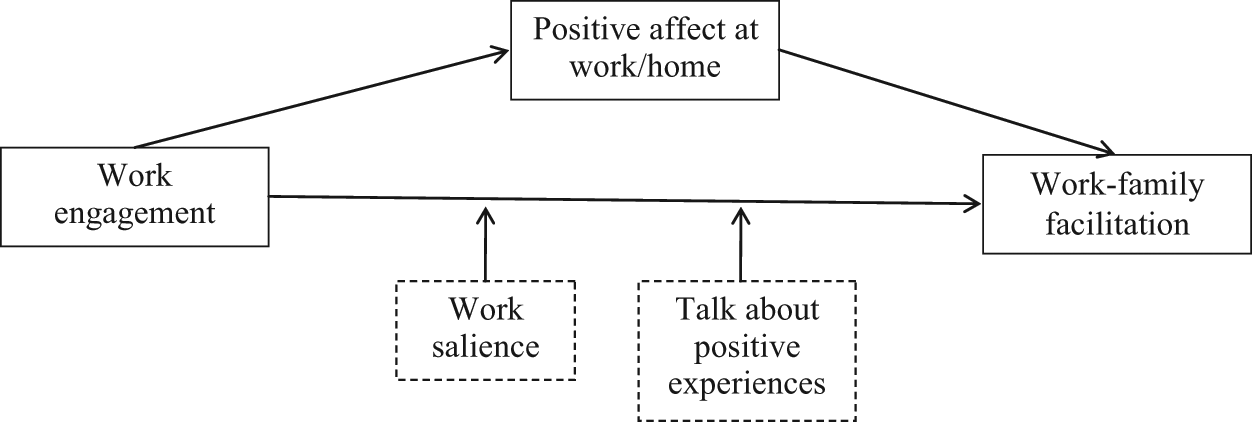
Conceptual model of the relationships proposed. Variables with solid boxes are level one variables; variables with dashed boxes are level two variables.
Method
Participants and procedure
Participants were county extension agents from a Midwestern state in the USA. Extension agents work in service to their communities and in event planning. All 245 agents in the state received an initial email describing the research. In addition, the study was described in person to agents during their annual meeting. Agents were informed that the purpose of the study was to determine which work tasks are most engaging for the extension agent, and how engagement in one’s work might be enhanced while maintaining an enjoyable family life. As an incentive to complete the daily surveys, participants received a $20 gift card conditional upon completion of at least five daily surveys. Agents opting to participate were sent an email with a link to the online daily surveys. A total of 84 agents (34%) agreed to participate in the two-week daily study. However, in order to be included in the final sample, participants had to meet two criteria. First, participants had to live with a significant other. Second, they had to have completed at least five daily surveys over the 10 day period. A total of 52 participants (21% of the full sample, 62% of the volunteers) met both criteria and were included in the final sample.
Two working weeks (10 work days) were selected as the data collection time period for several reasons. First, we chose a two-week period for the daily surveys based on the recommendation of Reis and Wheeler (1991) who argued that ‘the 2-week record-keeping period is assumed to represent a stable and generalizable estimate of social life’ (p. 287). Second, the daily survey was capped at two weeks as data collection over longer periods of time produces significant participant attrition (Ilies et al., 2007). Finally, recent longitudinal studies that have used a similar method to the present study to research daily within-individual variation in work-related variables have used two-week time periods (e.g. Ilies et al., 2007; Judge and Ilies, 2004; Judge et al., 2006). Thus, it appears that the two-week period was sufficient to indicate daily variations (or state fluctuations) and also daily invariance (or trait characteristics).
Respondents were asked to complete one initial survey at the start of the study and two daily surveys over the course of two workweeks. Of the two daily surveys, the first (the work survey) was to be completed immediately after finishing work for the day (mean time for responding = 5.47 p.m.; SD = 37 minutes). The second survey (the home survey) was to be completed just prior to retiring for the day (mean time for responding = 8.44 p.m.; SD = 67 minutes). The time lag, therefore, between responding to the work and home surveys was on average three hours. Finally, although our inclusion criteria stated that the minimum acceptable response rate was five of 10 days, the average was closer to nine of the 10 days, with the mean response frequency being 8.71 daily work and home surveys.
Of the 52 participants, 32 (61.5%) were female. The average age of participants was 43.25 years (SD = 12.04), the average tenure in their current job was 10.59 years (SD = 9.06), and the average hours worked per week were 48.04 (SD = 4.42). Twenty-seven (51.9%) of the agents had at least one child living at home, and 46 (88.5%) had a spouse/partner who was employed. Twenty-four of the participants (46%) held a Master’s degree, with the remainder being baccalaureates. All respondents were Caucasian.
Measures
Initial survey
Prior to the start of the two-week daily survey period, participants were required to fill in a short survey that collected demographic information and assessed work role salience. Work role salience was measured using a five-item scale developed by Amatea et al. (1986) (e.g. ‘It is important to me to feel successful in my work’). Each item was responded to on a scale from 1 (Strongly Disagree) to 5 (Strongly Agree). The internal consistency of this scale was found to be satisfactory (Cronbach’s α = .75).
Daily surveys
The daily work survey assessed several daily work-related variables. Work engagement was measured using the nine-item Utrecht Work Engagement Scale (UWES-9; Schaufeli et al., 2006). The scale assesses all three components of work engagement; vigor (e.g. ‘At work today I felt bursting with energy’), dedication (e.g. ‘I was proud of my work today’), and absorption (e.g. ‘I was immersed in my work today’). These three dimensions have been shown to be highly correlated, motivating arguments to adopt a composite score for the UWES (Sonnentag, 2003). The scale’s instructions and items were modified to focus on daily rather than global work engagement. Response options ranged from 1 (Strongly Disagree) to 7 (Strongly Agree). Across days the average Cronbach’s α was .91.
Perceived workload was also assessed in order to control for its possible confounding effect in the relationship between engagement and work-family facilitation (Bronfenbrenner, 1979). Workload was measured using an eight-item scale developed and validated by Van Veldhoven and Meijman (1994) and used previously in a daily longitudinal study (Ilies et al., 2007) (e.g. ‘I had too much work to do today).’ Responses ranged from 1 (Strongly Disagree) to 5 (Strongly Agree). Across days the average Cronbach’s α was .92.
Affect immediately after work was assessed by a 10-item bipolar scale that has been used to assess positive states of consciousness in experience sampling research (Csikszentmihalyi and Larson, 1987; Fullagar and Kelloway, 2009). This scale uses semantic differential scales that forces participants to choose between opposing negative and positive affective states. It assesses two aspects of an individual’s emotional response: affective tone (e.g. sad-happy, irritable-cheerful) and level of activation (e.g. passive-active, bored-excited). Such a conceptualization of positive affective arousal was determined to be appropriate because our operationalization of work engagement implied an aroused state (i.e. engagement implies vigor, which includes a state of arousal). Each bipolar item requires respondents to score their affect at that moment along a fixed seven-point continuum between each opposing adjective, with higher scores indicating more positive affect. Scores were averaged to calculate a composite score of positive emotion. The average Cronbach’s α of this scale across days was .90.
The daily home survey assessed three variables. Work-family facilitation was assessed by a four-item scale developed by Wayne et al. (2004). Facilitation was operationalized as the extent to which the skills, behaviors, or mood from work positively impact one’s home life (e.g. ‘The things I did at work today helped me deal with personal and practical issues at home’). Response options ranged from 1 (Strongly Disagree) to 5 (Strongly Agree) with higher scores indicating greater facilitation levels. Across days the mean Cronbach’s α was .85.
Affect at home was measured with the same 10-item scale used to assess affect immediately after work (Csikszentmihalyi and Larson, 1987). However, the home daily survey was responded to on average three hours after the daily work survey. Again, respondents rated their momentary mood on a 10-item bipolar scale. The mean Cronbach’s α was .85
Finally, the home survey also assessed the extent to which participants talked with their partner about good things that happened at work, measured using a single item (‘Please indicate the amount of time that you spent talking with your spouse/partner about the good things that happened to you at work’). Response options ranged from 1 (Almost None) to 5 (A Large Amount). To assess the moderating effects of work engagement on work-family facilitation, this variable was aggregated across days to provide a measure of the individual’s propensity to communicate positive events from work with his or her partner upon return home from work.
Analyses
Hierarchical linear modeling (HLM) was used to investigate the mediated and moderated relationships between the study variables. The HLM modeling approach is an extension of multiple regression that allows investigation of the relationships between variables at two levels of analysis. In longitudinal analyses there are a series of repeated measures for each individual that constitute the lowest level of variables and the individual level is the second level. Thus, to examine within-individual relationships between daily workload, work engagement, work affect, home affect and work-family facilitation, several random-coefficient regression models were undertaken. At the second level the parameters estimated at level 1 (intercepts and slopes) were regressed on level 2 variables – in this case, work salience and propensity to talk with one’s partner/spouse about positive work experiences (Bryk et al., 2000; Hofmann et al., 2000).
Results
Means, standard deviations, and inter-correlations across day-level averages for all study variables are presented in Table 1. Before proceeding with the tests of the hypotheses, systematic within- and between-individual variance in daily work engagement and daily work-family facilitation were investigated using two analysis of variance (null) models. Results revealed substantial within- and between-individual variance for both work engagement and work-family facilitation Although HLM does not provide a significance test for within-individual variance (σ2), it does provide a chi-square test that indicated that the between-individual variance was significant for both engagement and work-family facilitation (Engagement: τ00 = 0.33, χ2 (51) = 321.87, p = .00; Work-family facilitation: τ00 = 0.22, χ2 (51) = 460.38, p < .01). The intra-class correlation for work engagement was .38, indicating that between-individual variance accounted for 38 percent of the total variance in work engagement, suggesting that 62 percent of the variance is attributable to within-individual variation. For work-family facilitation, 48 percent of the total variance was accounted for by between-individual variance, leaving 52 percent of the variance owing to within-individual variation. It must be noted that these total variance estimates include variance attributable to measurement error. Nonetheless, the results suggest that work engagement varies considerably from day to day.
Means (M), standard deviations (SD), and intercorrelations across individuals (N = 52) and within individuals a (N = 452) for all study variables
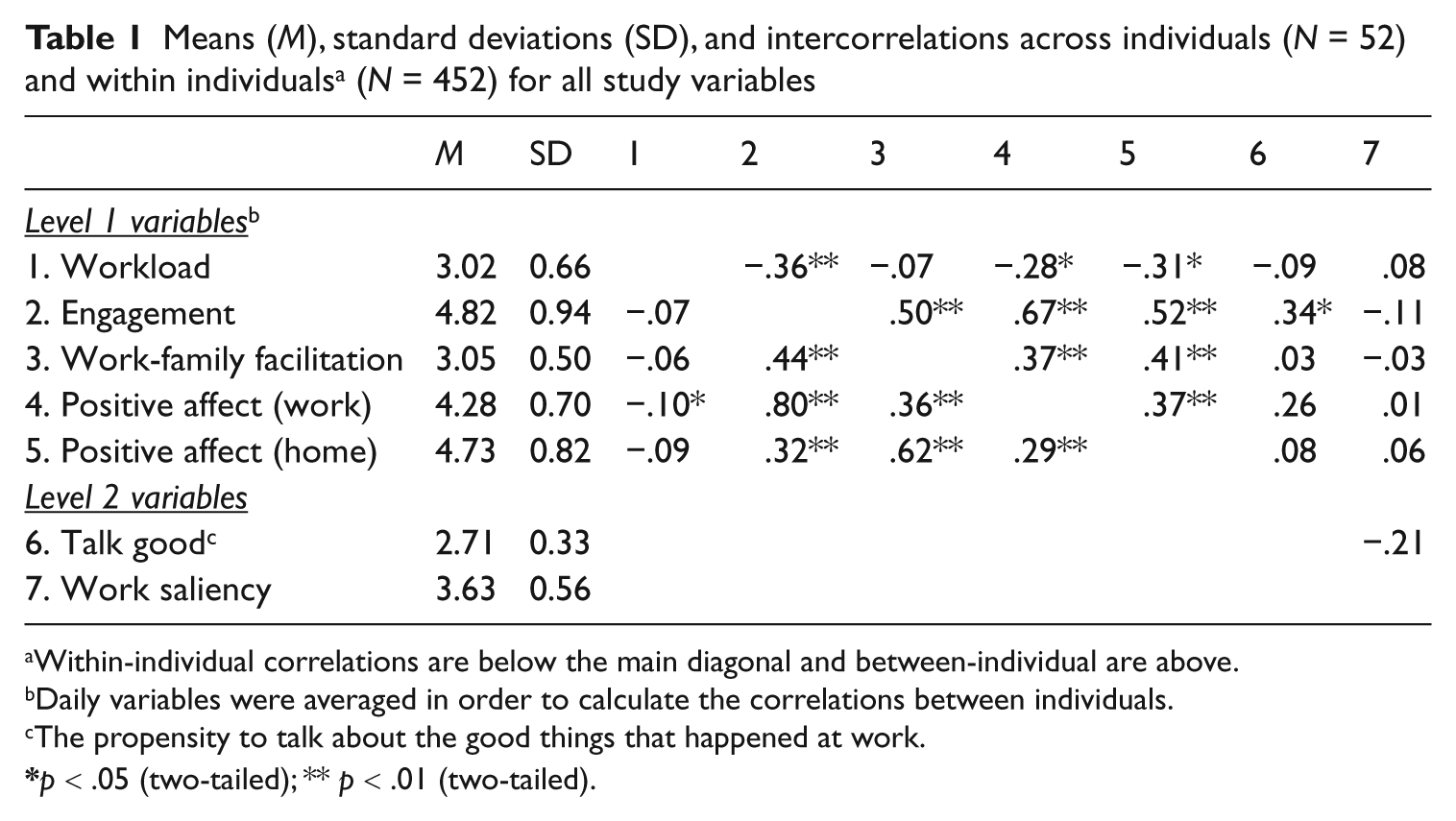
Within-individual correlations are below the main diagonal and between-individual are above.
Daily variables were averaged in order to calculate the correlations between individuals.
The propensity to talk about the good things that happened at work.
p < .05 (two-tailed); ** p < .01 (two-tailed).
Our first hypothesis proposed that engagement at work would be positively related to work-family facilitation. We controlled for possible ‘third variable’ effects by partialling out perceived workload. Following Hofmann and Gavin (1998), the level 1 variables were person centered, where the individual mean of the variable was subtracted from each individual’s daily score. The rationale for using individual-mean centering to test H1 was that we wanted the variance in the intercept term to represent the adjusted between-individual variance in work-family facilitation after controlling for the effects of daily perceived workload. Results of a random-regression coefficients model (see Table 2) indicated that workload was not significantly related to work-family facilitation (γ10 = −0.01, t(51) = −0.20, p > .05). Consequently, workload was not controlled for in subsequent analyses. However, work engagement was significantly related to work-family facilitation, after controlling for workload (γ20 = 0.19, t(51) = 5.20, p < .001). The direction of the regression coefficient shows that higher levels of work engagement are associated with greater work-family facilitation. The magnitude of this relationship was calculated by comparing the within-individual variance in engagement from a model that only had workload as a predictor with the within-individual variance in the random regression model shown in Table 2. Engagement in work accounted for 14 percent of the within-individual variance in work-family facilitation, after controlling for workload. In sum, our results supported H1. It is important to note that nothing changed in the test of this hypothesis when workload was eliminated as a control.
Parameter estimates and variance components testing Hypothesis 1 (Level 1 N = 452, Level 2 N = 52)
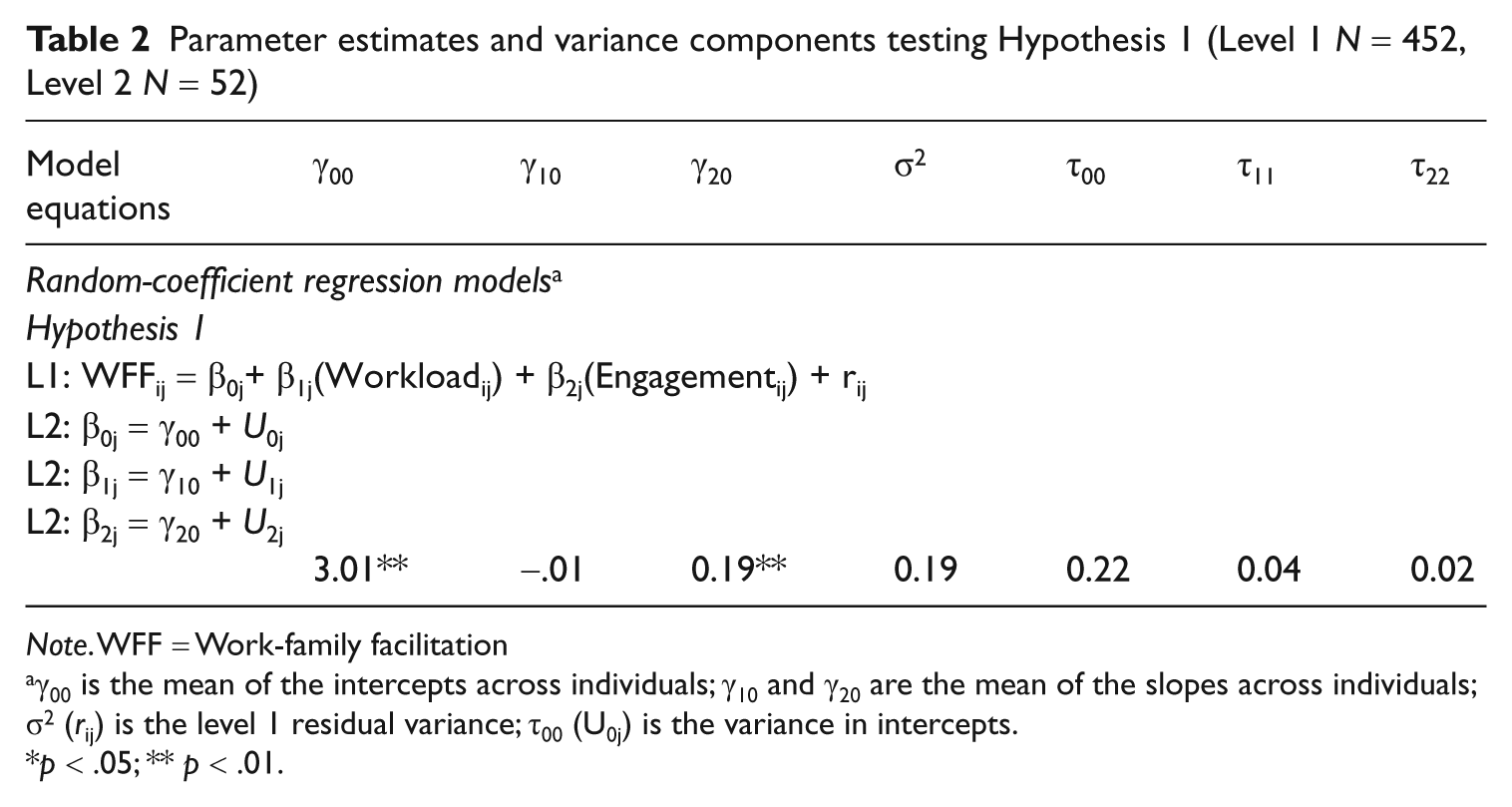
Note. WFF = Work-family facilitation
γ00 is the mean of the intercepts across individuals; γ10 and γ20 are the mean of the slopes across individuals; σ2 (rij) is the level 1 residual variance; τ00 (U0j) is the variance in intercepts.
p < .05; ** p < .01.
H2 stated that the relationship between daily work engagement and positive affect at home would be mediated by positive affect immediately following work. Again the level 1 variables were individual-mean centered. To establish mediation, Baron and Kenny (1989) stipulate that four criteria must be met. First, work engagement must be significantly related to positive affect at home. Second, work engagement must be related to positive affect after work (the potential mediator). Third, positive affect after work must have a unique effect on positive affect at home. Finally, the effects of daily work engagement on positive affect at home diminish with the inclusion of the mediator. However, owing to measurement error, the Baron and Kenny procedure is more likely to overestimate the relationship between variables, thus increasing the likelihood of Type II errors. Consequently we also used a more conservative test for mediation, the Sobel test (Sobel, 1982), which takes into account the standard error of estimates.
Our results indicated that all the criteria for mediation were satisfied (see Table 3). Daily work engagement was found to be significantly related to positive affect at home (γ10 = 0.15, t(51) = 3.141, p < .01). Work engagement was associated with positive affect after work (γ10 = 0.66, t(51) = 10.44, p < .01). Positive affect after work was uniquely associated with positive affect at home (γ10 = 0.12, t(51) = 2.34, p < .01) and the coefficient between engagement and positive affect at home was reduced to non-significance (γ20 = 0.09, t(51) = 1.76, p > .05) suggesting a fully mediated effect. Sobel’s test further confirmed this mediated effect (Sobel = 2.28, p < .05). Consequently, H2 was supported.
Parameter estimates and variance components testing Hypothesis 2 (Level 1 N = 452, Level 2 N = 52)
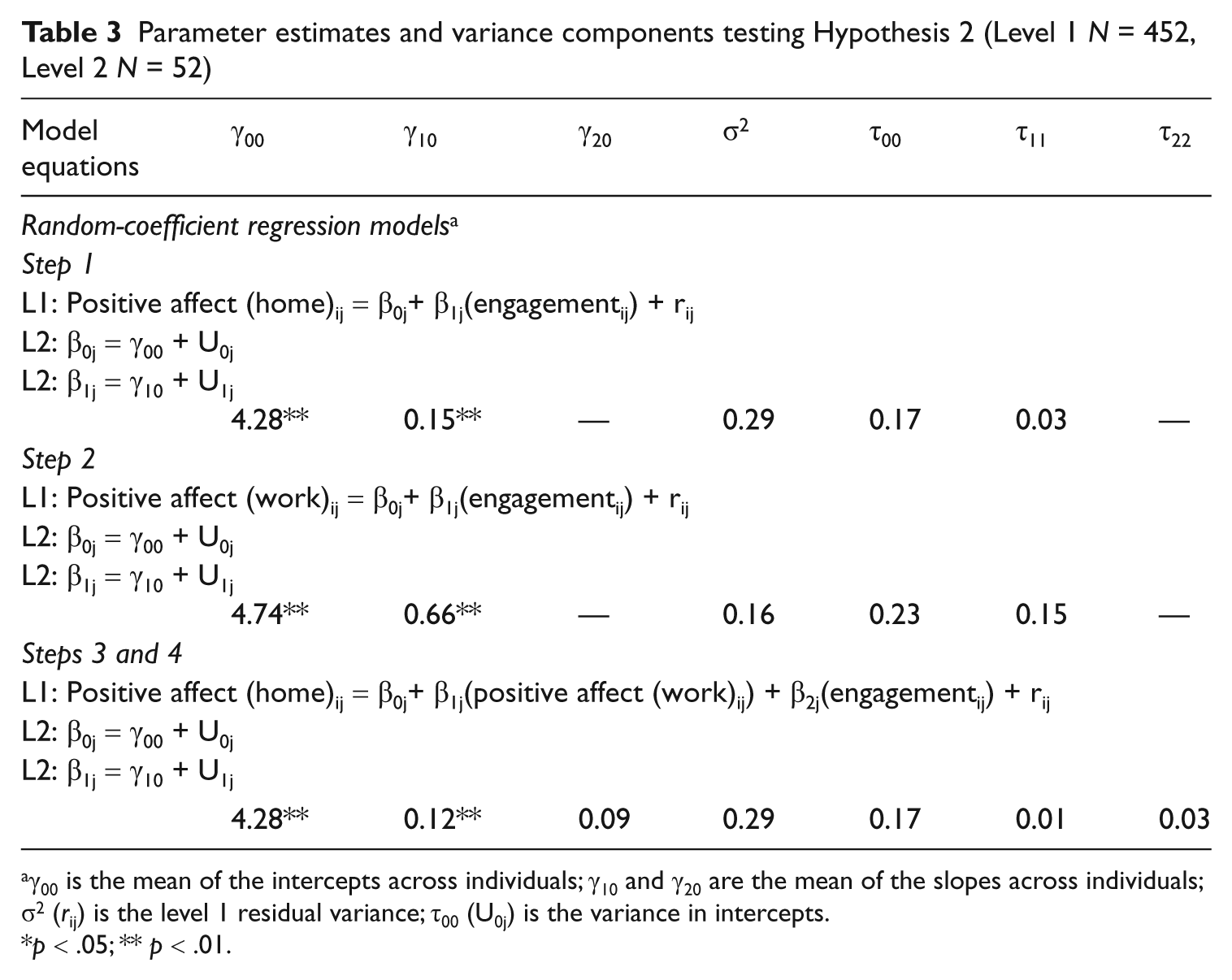
γ00 is the mean of the intercepts across individuals; γ10 and γ20 are the mean of the slopes across individuals; σ2 (rij) is the level 1 residual variance; τ00 (U0j) is the variance in intercepts.
p < .05; ** p < .01.
One of our main objectives was to better understand the nature of the relationship between work engagement and work-family facilitation by establishing the mediating effects of daily positive affect between daily work engagement and daily work-family facilitation. Our results indicate that positive affect after work spills over into positive affect at home. Mediational analyses showed that a more proximal measure of positive affect, namely positive affect at home, mediated the relationship between engagement and work-family facilitation (see Table 4). Specifically, work engagement was positively and significantly related to work-family facilitation (γ10 = 0.19, t(51) = 4.80, p < .01) and also significantly correlated with positive affect at home (γ10 = 0.15, t(51) = 3.14, p < .01). Furthermore, positive affect at home was associated with work-family facilitation after controlling for daily work engagement (γ10 = 0.32, t(51) = 3.38, p < .01). Positive affect at home was found to partially mediate the relationship between daily work engagement and work-family facilitation in that the coefficient for relationship between work engagement and work-family facilitation was reduced from 0.19 (p < .01) to 0.09 (p < .01) when positive affect at home was included as a mediator. Sobel’s test further confirmed this mediated effect (Sobel = 2.30, p < .05). Consequently, H3 was supported.
Parameter estimates and variance components testing Hypothesis 3 (Level 1 N = 452, Level 2 N = 52)
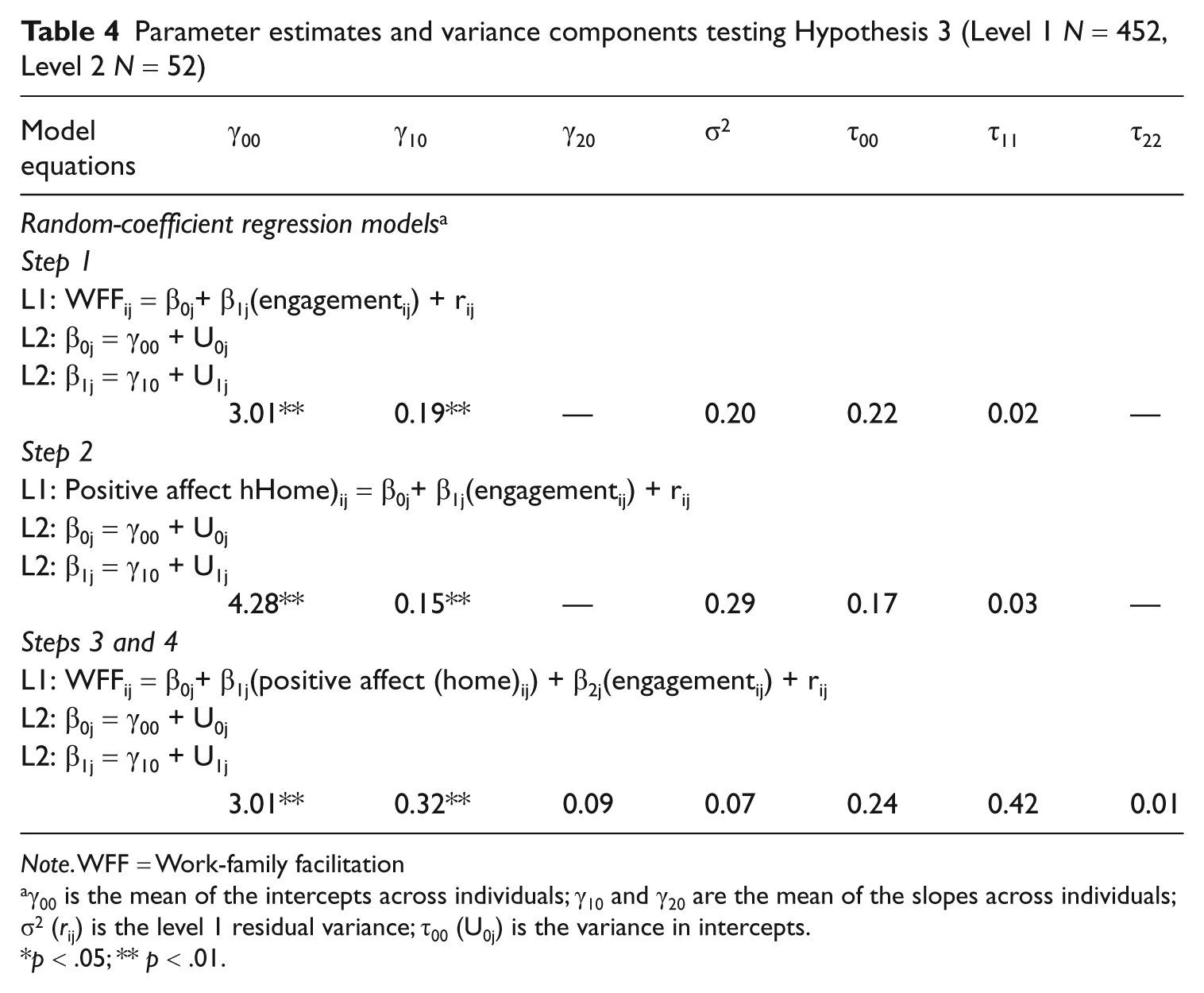
Note. WFF = Work-family facilitation
γ00 is the mean of the intercepts across individuals; γ10 and γ20 are the mean of the slopes across individuals; σ2 (rij) is the level 1 residual variance; τ00 (U0j) is the variance in intercepts.
p < .05; ** p < .01.
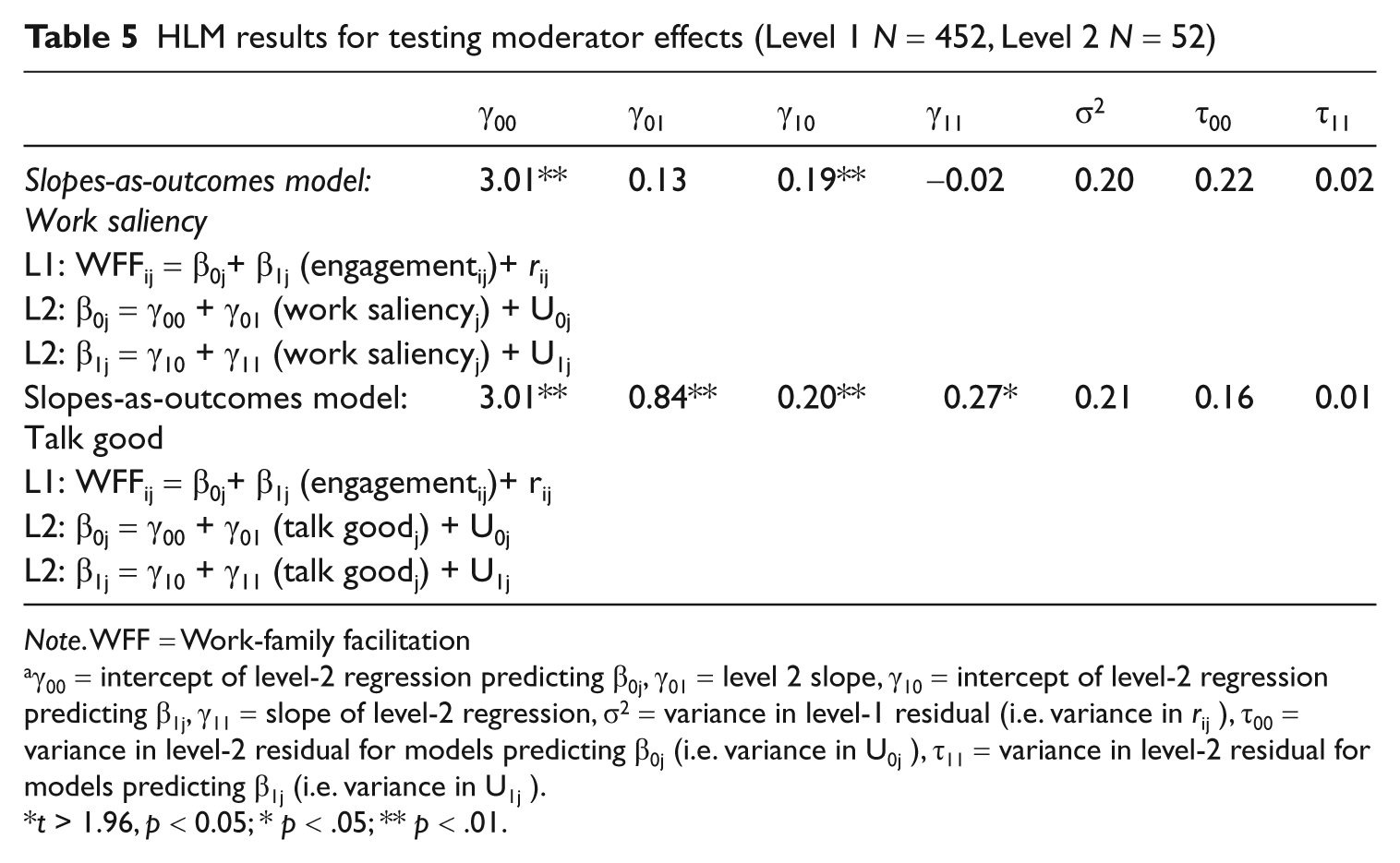
HLM results for testing moderator effects (Level 1 N = 452, Level 2 N = 52)
Note. WFF = Work-family facilitation
γ00 = intercept of level-2 regression predicting β0j, γ01 = level 2 slope, γ10 = intercept of level-2 regression predicting β1j, γ11 = slope of level-2 regression, σ2 = variance in level-1 residual (i.e. variance in rij ), τ00 = variance in level-2 residual for models predicting β0j (i.e. variance in U0j ), τ11 = variance in level-2 residual for models predicting β1j (i.e. variance in U1j ).
t > 1.96, p < 0.05; * p < .05; ** p < .01.
Finally, we were interested in determining if the relationship between daily work engagement and work-family facilitation was moderated by two constructs; the saliency of work (H4), and the propensity of individuals to talk to their partner/spouse about the good things that happened to them at work (H5). Because we wanted to test for moderator effects and to estimate level 1 slopes that were composites of both within-individual and between-individual relationships among independents and dependent variables we used grand-mean centering (Hofmann and Gavin, 1998). 2 To test these moderator hypotheses each level 2 moderator variable was entered into the hierarchical linear model to determine if it affected the strength of the daily relationship between work engagement and work-family facilitation. The resulting slopes-as-outcomes model indicated that work saliency did not moderate the relationship (see Table 3: γ11 = −0.02, t(50) = −0.29, p > .05). Consequently H4 was not supported.
Before testing H5, we checked to see whether aggregating daily scores on talking about the good things that happened at work was justified. We analyzed the between-individual variance and the within-individual variance in the daily variable using an analysis of variance (null) model. The intra-class correlation indicated that the majority of variance (82%) was accounted for by between-individual variance (ICC = .82, τ00 = 0.33, χ2 (51) = 2077.39, p = .00). Even accounting for error variance, it would appear that talking good about work is an individual difference variable that is relatively stable on a daily basis. An individual’s propensity to talk about the good things that happened at work did moderate the relationship between daily work engagement and work-family facilitation (see Table 3: γ11 = 0.26, t(50) = 2.22, p < .05). Comparing the residual slope variances in the slopes-as-outcomes and intercepts-as-outcomes (τ11) models we calculated that talking about good work accounted for 27 percent of the variance in the relationship between daily work engagement and work-family facilitation.
Using asymptotic variances and covariances, we plotted the simple slopes in order to understand the nature of the interaction effects (Bauer and Curran, 2005; see Figure 2). In general, the greater the propensity to talk about the good things that happened at work the stronger the relationship between engagement and work-family facilitation. Therefore, H5 was supported.
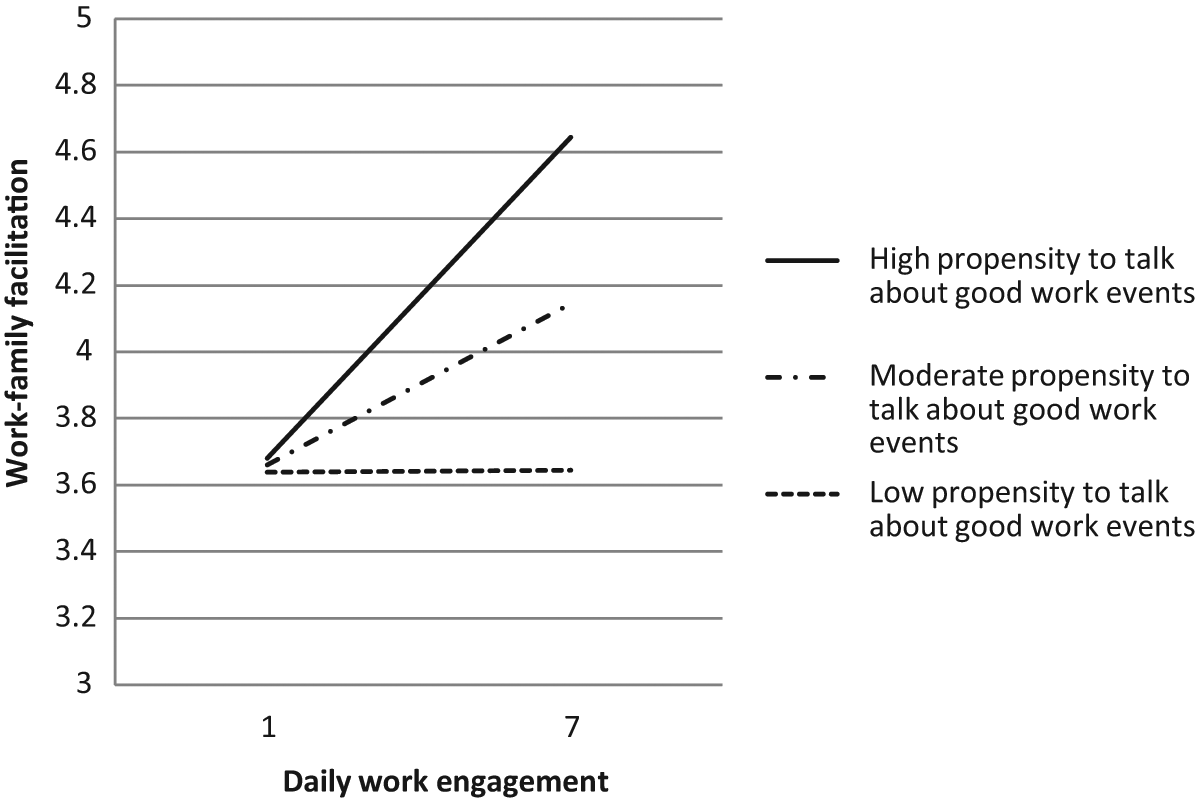
Interactive effect of propensity to talk about good work experiences on the relationship between daily work engagement and work-family facilitation.
Discussion
The focus of the current study was to investigate the relationship of work engagement with work-family facilitation on a within-individual level. Several key findings emerged. First, work engagement varies considerably on a daily basis within individuals, suggesting that it is probably best thought of as a state-like (rather than trait-like) construct. Although this is not an altogether surprising finding, most prior research has either ignored the issue or simply treated engagement as necessarily trait-like (for an exception see Bakker and Xanthopoulou, 2009) by measuring it retrospectively in a broad range of work activities at a single point in time.
The finding that engagement appears to be state-like in nature suggests that it may be a useful construct to examine from an organizational intervention perspective. Researchers in the area of positive organizational behavior, for example, have suggested that constructs should be predominantly state-like in order to allow them to be developed (e.g. Luthans, 2002). Our research suggests this is the case for engagement, and as such, managers and other organizational decision-makers can take steps to actively encourage and develop workplace engagement in their employees. Future researchers would do well to examine how best to go about doing this, and the characteristics that a successful intervention might have. A specific area of future research suggested by the current study is an examination of the characteristics of work that make it engaging, and specifically the cognitive, psychological, and interpersonal resources that engaged work enhances, particularly those resources that enable positive boundary spanning. While some recent research (e.g. Xanthopoulou et al., 2009) has begun exploring such relationships, such work is still in its relative infancy, and the current research reinforces the importance of exploring these relationships, given engagement’s impactful outcomes both in and outside of the work domain.
Our research also indicates that when employees have positive experiences at work, the positive emotions derived from such experiences may in fact serve to enhance those individuals’ experiences in other domains, such as at home. Our findings are supportive of the notion that work experiences, particularly positive ones, may provide individuals with valuable resources that facilitate optimal functioning in both the work and home arenas. An objective of future research would be to identify the nature of these resources to determine if they are primarily cognitive, interpersonal, or psychological.
In terms of explaining the relationship between work engagement and work-family facilitation, we found that daily work engagement was related to positive affect immediately after work, which was in turn related to positive affect at home. This supports the notion of positive affective spillover (Edwards and Rothbard, 2000). Furthermore, positive affect at home partially mediated the relationship between work engagement and work-family facilitation. These findings are in line with tenets from affective events theory (Weiss and Cropanzano, 1986), spillover theory (Edwards and Rothbard, 2000) and broaden and build theory (Fredrickson, 2001).
Our results also revealed that the more that individuals talked with their partner about good happenings at work, the stronger the relationship between engagement and work-family facilitation. These findings are consistent with research that suggests that in order to fully enjoy their lives, individuals must derive positive emotions from their experiences, by capitalizing on, or savoring, the experiences (Bryant and Veroff, 2007). By talking about the good events at work, individuals are able to relive positive experiences and relish the moment for a little longer (Gable et al., 2004; Ilies et al., 2011). Thus, our finding provides some initial support for the notion that interpersonal capitalization is a key moderator of the relationship between positive work experiences and the experience of positive emotions in other non-work domains. It appears that, in some cases, having a partner at home with whom to share one’s positive work experiences can actually enhance an employees’ experience of work and how that work life carries over to affect the home domain. As Ilies et al. (2011) noted, employees can easily and effortlessly implement work-family interpersonal capitalization in their lives, with very few resources needed from the organization. As such, managers can simply tout the benefits of sharing positive work experiences with loved ones, and let employees reap the benefits. Going forward, we urge researchers to further examine this finding that the propensity to talk about the positive aspects of work increases the relationship between engagement and work-family facilitation. Future research needs to establish the extent to which individual differences in the capacity to savor emotions not only moderate the relationship between engagement and family functioning, but also the relationship between work engagement and overall psychological well-being.
We failed to find support for our hypothesis that the effect of work engagement on work-family facilitation would be moderated by work role salience. The rationale for this hypothesis was that if work is more salient, then work experiences are more likely to affect family and vice versa. Our results, however, suggest this is not the case. Extension agents’ jobs can reasonably be considered ‘family-friendly’ in that they are both focused on family issues and also provide a great degree of flexibility in work schedule in order to adapt to and accommodate family needs. Therefore, for this particular sample, the saliency of an extension agent’s work may not influence his or her family life as much. In addition, the relationship between engagement and work role salience in the current study was negative (−.11), which is surprising and, again, may be a function of the type of jobs held by this particular sample.
Limitations and strengths
We acknowledge that our study has some limitations. First, our sample consisted of individuals from a somewhat unique workforce whose jobs were highly flexible and autonomous, both characteristics that are associated with engagement. Because of this, our findings may not be wholly generalizable to other populations. Nevertheless, there are numerous occupations where workers have control over their schedules and workload in much the same manner as extension agents, even if the actual work is different. For example, professors, real estate agents, and consultants are just a few occupations to which these findings may generalize. Second, our data were obtained through self-report measures, thus raising the concern of mono-method bias, which could have led to inflated correlations among our variables. Nevertheless, many of our variables were collected at different times, reducing the potential bias of self-report data. Additionally, Spector (2006) has provided empirical evidence suggesting common method variance does not significantly inflate correlations, thus such effects may be overstated. Third, our analyses are essentially correlational in nature and therefore subject to the limitations associated with the interpretation of correlations. For example, as we note above, our estimates of between- and within-individual variance may be over-estimations as they include error variance. Also, the relationships between the study variables could be explained by third variable effects that were not included in our models. Specifically, factors like marital satisfaction, life satisfaction, day of the week effects, resiliency and propensity to recover from stressful events at work could be the source of a missing variable bias. Studying such third variable effects would be a fruitful direction for future research.
Finally, throughout this study we measured and discussed individuals’ role within the family as a unitary construct (e.g. his or her ‘family’ role). However, a more detailed conceptualization of such non-work roles may have included specific potential relationships within the family, such as a spousal role, a parental role, or the like. Indeed, it is a possibility that any within-person variance in work-family facilitation as evidenced over the multiple-day period investigated herein could result not only from day-to-day experiences, but also – and more specifically – from individual differences in how people experience each of these non-work roles differently. Future researchers would do well to investigate this possibility by evaluating each of these potential non-work roles separately.
However, the study is marked by several key strengths. First, by collecting repeated daily measures of work engagement, affect, and work-family facilitation over a period of 10 working days, we were able to gain a better understanding of within-person variation in the relationship between these constructs. Second, testing our hypotheses using HLM allowed us to distinguish between-individual and within-individual components of variance and to ascertain whether our variables (e.g. work engagement) are behaving more like states or traits. Finally, although HLM is a correlative analysis, and thus cannot ascribe causality, the temporal logic of the study allowed us to make inferences regarding the likely causal order of events.
Conclusion
The current study provides evidence that work engagement leads to positive work-family functioning by creating a positive mood in an individual that transfers from work to home. Additionally, we found that the capitalizing on the positive events in our lives by sharing the experiences with loved ones can lead to even greater work-family relations. Moreover, our findings provide fodder for future researchers as well as implications for practitioners who wish to help employees have greater work-family balance.
Footnotes
Acknowledgements
The authors thank Ann Huffman for helpful comments on earlier versions of this manuscript.
Funding
This research was supported in part by a grant from the Center for Engagement and Community Development, Kansas State University.