



Abstract
The article examines the role of proactive personality in predicting work engagement and job performance. On the basis of the literature on proactive personality and the job demands–resources model, we hypothesized that employees with a proactive personality would be most likely to craft their own jobs, in order to stay engaged and perform well. Data were collected among 95 dyads of employees (N = 190), who were working in various organizations. The results of structural equation modeling analyses offered strong support for the proposed model. Employees who were characterized by a proactive personality were most likely to craft their jobs (increase their structural and social job resources, and increase their job challenges); job crafting, in turn, was predictive of work engagement (vigor, dedication, and absorption) and colleague-ratings of in-role performance. These findings suggest that, to the extent that employees proactively adjust their work environment, they manage to stay engaged and perform well.
Several studies have revealed that employees show the best job performance in challenging, resourceful work environments, as such environments facilitate their work engagement (Demerouti and Cropanzano, 2010). This implies that organizations should offer their employees sufficient job resources, including feedback, social support, and skill variety. Research indeed suggests that management can influence employees’ job demands and resources (Nielsen et al., 2008; Piccolo and Colquitt, 2006), and may indirectly influence employee engagement and performance (Harter et al., 2002).
However, it may be equally important that employees mobilize their own job challenges and resources. Managers are not always available for feedback, and organizations that are confronted with economic turmoil may set other priorities. Under such conditions, it may be particularly important for employees to show proactive behavior and optimize their own work environment. In this article we examine the role of proactive personality in predicting engagement and (other-ratings of) job performance. We expect that employees with a proactive personality are most likely to craft their own jobs, so that they stay engaged and perform well.
This article may contribute to the literature in at least two ways. First, we investigate the fruitfulness of a new, bottom-up approach of job design – employee job crafting – using a quantitative between-persons research design. Do employees who take the personal initiative to optimize their own work environment perform better than those who do not change their work environment? Second, we investigate whether employees with a proactive personality are more likely to engage in specific job crafting behaviors and in this way influence their own work engagement. This may explain why proactive personality is related to job performance. Although previous research has provided ample evidence for the contention that proactive personality is related to performance, it is still largely unknown why this is the case. We will use the literature on proactive personality and the extended version of the Job Demands–Resources model (Bakker, 2011; Bakker and Demerouti, 2008) as a basis for our hypotheses.
Proactive personality
People are not ‘passive recipients of environmental presses’ (Buss, 1987: 1220). Instead, they actively influence their own environment. Proactive personality is defined as the ‘the relatively stable tendency to effect environmental change’ (Bateman and Crant, 1993: 103); it refers to the dispositional tendency to engage in proactive behavior in a variety of situations. Individuals with a proactive personality are inclined to change their circumstances intentionally, including their physical environment (Buss, 1987). They identify opportunities, take action, and persevere until they bring about meaningful change (Crant, 1995). Whereas some people react to, adapt to, and are shaped by their environments, proactive people take personal initiative to have an impact on the world around them.
Research of the past 20 years has shown that proactive personality is a trait that explains unique variance in criteria over and above that accounted for by the Big Five personality factors. For example, Crant and Bateman (2000) showed that managers’ self-reported proactive personality was positively associated with supervisors’ independent ratings of charismatic leadership. More specifically, proactive personality accounted for variance in a manager’s charismatic leadership above and beyond that accounted for by the Big Five personality factors. Similarly, Major et al. (2006) showed that, controlling for the Big Five, proactive personality uniquely predicted objective development activity (i.e. the number of training courses registered for during a six-month period and the number of hours spent in training during that period), through the motivation to learn. These studies indicate that proactive personality captures ‘conceptually and empirically, some unique elements of personality not accounted for by the five-factor model’ (Crant and Bateman, 2000: 66).
The empirical evidence shows that proactive personality is predictive of other important organizational behaviors as well. For example, in their study among 165 employees and their supervisors Greguras and Diefendorff (2010) showed that proactive personality predicted in-role performance and organizational citizenship behaviors (e.g. altruism, courtesy, and sportsmanship), through need satisfaction. Seibert et al. (2001) used a two-year longitudinal design with data from a sample of 180 full-time employees and their supervisors. Among other things, they found that Time 1 proactive personality was positively related to Time 2 innovation and career initiative. Innovation and career initiative, in turn, had positive relationships with career progression (salary growth and the number of promotions during the previous two years) and career satisfaction. According to Crant (2000), proactivity has a positive impact on employee attitudes and behaviors because proactive individuals identify or create opportunities that create favorable conditions for individual or team effectiveness.
Job crafting
Parker and Ohly (2008) have argued that employees may actively change the design of their jobs by choosing tasks, negotiating different job content, and assigning meaning to their tasks or jobs. This process of employees shaping their jobs has been referred to as job crafting (Wrzesniewski and Dutton, 2001). Job crafting has been defined as the physical and cognitive changes individuals make in their task or relational boundaries. Physical changes refer to changes in the form, scope or number of job tasks or relationships at work, whereas cognitive changes refer to changing how one perceives the job.
Berg et al. (2010) describe examples of making ‘physical changes’ to one’s job. They interviewed a maintenance technician who told that he crafted his job in the form of taking on additional tasks. After being in the organization for some time, he started proactively to help newcomers to learn the job. Because he turned out to be good at this, he became formally responsible for the training of new employees. Berg and colleagues also cite a customer service representative who reframed the perception of the job as a meaningful whole that positively impacts others rather than a collection of separate tasks (i.e. cognitive change as a form of job crafting): ‘Technically, [my job is] putting in orders, entering orders, but really I see it as providing our customers with an enjoyable experience, a positive experience, which is a lot more meaningful to me than entering numbers.’ (2010: 167).
Wrzesniewski and Dutton’s (2001) definition of job crafting is restricted to those changes that employees may make in their specific work tasks, relationships at work, and cognitions about work. Some recent studies have suggested that job crafting may take other forms as well. For example, Lyons (2008) found that the salespersons in his study engaged in self-initiated skill development. In addition, research by Petrou et al. (in press) showed that employees asked for feedback and social support when needed, and actively searched for challenges when they wanted more work to do.
In the article, we follow the conceptualization proposed by Tims et al. (2012; see also Tims and Bakker, 2010). Accordingly, job crafting is defined as the changes employees may make regarding their job demands and job resources. This conceptualization takes the job demands–resources (JD-R) model (Bakker and Demerouti, 2008) as a starting point. The JD-R model proposes that all job characteristics can be categorized as either job demands or job resources. By framing job crafting in terms of job demands and job resources, we are able to capture many aspects (i.e. job characteristics) that employees may alter in their jobs. Note that we exclude the cognitive dimension of job crafting from our conceptualization. Our rationale behind this is that we feel that cognitive crafting is more akin to adapting passively to the work situation and less about changing it proactively. In this article, we aim to focus only on the real changes that employees make in their jobs through their behavior.
Tims et al. (2012) have argued and shown that job crafting can take the form of three different types of behaviors: (a) increasing (structural or social) job resources; (b) increasing job demands/challenges; and (c) decreasing job demands. As we were interested in the link between job crafting and work engagement, we decided to focus on (a) and (b). Using Crant’s (2000) theory of proactive personality, we argue that proactive individuals create favorable conditions and opportunities for themselves in their work. Tims and Bakker (2010) have argued that proactive employees strive for congruence with their environment in terms of needs and abilities – they shape the work environment such that their job demands and resources better fit with their own needs and abilities. On the basis of these theories, we expect that employees with a proactive personality are most likely to ask for help and feedback (social resources), and to proactively enrich their work environment, e.g. ask for autonomy, create skill variety, and follow training (structural resources). In addition, we expect that proactive employees are most likely to search for challenges, for example, ask for more work when they feel understimulated. Thus, we formulated the following hypothesis.
Hypothesis 1: Proactive personality is positively related to job crafting (increasing social resources, increasing structural job resources, and increasing job challenges).
Job crafting and work engagement
Work engagement is defined as ‘… a positive, fulfilling, work-related state of mind that is characterized by vigor, dedication, and absorption’ (Schaufeli et al., 2002: 74). In essence, work engagement captures how workers experience their work: as stimulating and energetic and something to which they really want to devote time and effort (the vigor component); as a significant and meaningful pursuit (dedication); and as engrossing and something on which they are fully concentrated (absorption: Bakker et al., 2008). Qualitative research has revealed that engaged employees are highly energetic, self-efficacious individuals who exercise influence over events that affect their lives (Schaufeli et al., 2001).
Previous studies have consistently shown that job resources are associated positively with work engagement (for a meta-analysis, see Halbesleben, 2010). Job resources, such as feedback, social support, and skill variety, are assumed to play either an extrinsic motivational role because they are instrumental in achieving work goals, or an intrinsic motivational role because they foster employees’ growth, learning, and development. Job resources fulfill basic human needs, such as the needs for autonomy, relatedness and competence (Van den Broeck et al., 2008). Importantly, research has shown that job resources particularly have an impact on engagement when job demands are high (Hakanen et al., 2005). When employees face high job demands (challenges) and have sufficient job resources, they can flourish in their work and excel.
It follows that employees who change their work environment proactively such that it becomes more resourceful and challenging (i.e. show job crafting behaviors) will be more engaged. There is indeed some indirect evidence for such a process of self-engagement. For example, in their two-wave three-year panel study among 2555 Finnish dentists, Hakanen et al. (2008) found a positive link between personal initiative and work engagement. Specifically, they found that dentists who took the personal initiative to do more than they were asked to do, and tried to be actively involved in organizational matters, were more likely to be engaged in their work.
Furthermore, a study among almost 750 young Finnish managers (Hyvönen et al., 2009) showed that the managers who were most eager to develop themselves in the job and to increase their occupational knowledge were most engaged. They were also most likely to have positive attitudes towards modernization and increased productivity. They tried to get their teams to function better toward achieving jointly agreed goals, and endorsed the strongest drive to strive. Taken together, these findings imply that engaged employees are not passive actors in work environments, but instead actively change their work environment if needed.
It should be noted that the relationship between job crafting and work engagement is most probably dynamic (Bakker, 2011). Thus, in addition to the causal positive relationship between job crafting and work engagement, a reversed causal relationship is equally likely. Consistent with this idea, Parker et al. (2010) proposed that activated positive affect (including the energy and enthusiasm emotions characteristic of the vigor and dedication dimensions of engagement, respectively) promotes an approach action tendency (see Fredrickson, 1998). Thus, employees who are engaged and experience positive affect are more likely to show proactive behavior because they are better able to see possibilities and think innovatively (Bindl and Parker, 2011; Parker and Griffin, 2011). Indeed, several recent studies support the link between positive affect and proactive behaviors, such as initiative and active feedback seeking (e.g. Fritz and Sonnentag, 2009), and the link between engagement and personal initiative or future change in job resources (Hakanen et al., 2008; Schaufeli et al., 2009; Sonnentag, 2003). Thus, work engagement can be promoted by job crafting, but work engagement may also promote job crafting. This is consistent with Bakker and Demerouti’s (2008) model of work engagement that includes a feedback loop from work engagement to job resources, through job crafting.
In this article, we focus on the job crafting–work engagement link and argue that employees who craft their jobs will be more engaged. Employees who optimize their job demands and resources can be expected to work in a resourceful and challenging environment. Several studies have shown that such an environment facilitates work engagement (for an overview, see Bakker and Demerouti, 2008). For example, in their study among Finnish dentists employed in the public sector, Hakanen et al. (2005) found that, in particular, the combination of high job demands (e.g. work pressure, emotional demands) and high job resources (e.g. variability in the required professional skills, peer contacts) facilitated work engagement. In addition, in their study among managers and executives of a Dutch telecom company, Schaufeli et al. (2009) found that changes in job resources predicted engagement over a period of one year. Increases in social support, autonomy, opportunities to learn, and performance feedback were positive predictors of future work engagement and (reduced) registered sickness absenteeism.
Those who engage in job crafting proactively try to align their working conditions to their own needs and abilities. Proactive employees strive for congruence with their environment (Parker and Collins, 2010; Tims and Bakker, 2010). They mobilize their job resources and create a challenging work environment that fosters the enthusiasm and absorption that is so characteristic of engagement. On the basis of this literature review, we formulated the next hypothesis.
Hypothesis 2: Job crafting is positively related to work engagement.
Work engagement and performance
There are several reasons why engaged workers perform better than non-engaged workers (Demerouti and Cropanzano, 2010), but one of the most convincing arguments is that engaged employees often experience positive emotions, including happiness, joy, and enthusiasm. Positive emotions seem to broaden people’s thought–action repertoires, implying that they build a variety of personal resources (Fredrickson, 2001). These resources may include physical resources (e.g. physical skills, health), social resources (e.g. friendships, social support networks), intellectual resources (e.g. knowledge, executive control), or psychological resources (e.g. self-efficacy, optimism). These personal resources can be used to cope with the job demands and to perform well (Bakker and Xanthopoulou, 2009; Luthans et al., 2010).
The number of studies showing a positive relationship between employee engagement and job performance is increasing (Demerouti and Cropanzano, 2010). For example, Halbesleben and Wheeler (2008) showed, in their study among American employees, their supervisors and their closest coworkers from a wide variety of industries and occupations, that work engagement made a unique contribution to explaining variance in job performance, after controlling for job embeddedness. Salanova et al. (2005) conducted a study among personnel working in Spanish restaurants and hotels. Contact employees (N = 342) from 58 hotel front desks and 56 restaurants provided information about organizational resources, engagement, and service climate. Furthermore, customers (N = 1140) from these units provided information on employee performance and customer loyalty. Structural equation modeling analyses were consistent with a full mediation model in which organizational resources and work engagement predicted service climate, which in turn predicted employee performance and then customer loyalty (see also Xanthopoulou et al., 2009). On the basis of this overview, we formulated the following hypothesis.
Hypothesis 3: Work engagement is positively related to in-role performance.
Our theoretical arguments so far suggest that proactive personality influences performance through job crafting and work engagement. This idea is consistent with Thompson (2005), who showed that individuals with a proactive personality perform well because they take personal initiative and engage in network building. Previous research has shown a positive, direct relationship between proactive personality and job performance (Greguras and Diefendorff, 2010) – and this direct link is therefore included in our theoretical model (see Figure 1). We expect that job crafting and work engagement will act as partial mediators in the link between proactive personality and in-role performance, which leads to Hypothesis 4.

The job crafting model.
Hypothesis 4: Proactive personality has a positive relationship with in-role performance, through first job crafting and then work engagement (sequential mediation).
Method
Participants and procedure
The participants were recruited through several organizations in The Netherlands. Within each organization we could contact a person who had indicated his or her interest in our research during one of the workshops we gave about employee work engagement. When we contacted this person, we explained the purpose of the study and asked whether his or her organization would be willing to participate. In addition, we explained that the individual data of the participants would be confidential and that we would only report aggregated data. In order to obtain dyads who could rate each other reliably, we instructed the contact persons to form dyads of colleagues who worked together on a regular basis. We received the email addresses of employees who were willing to participate with their colleague. Questionnaires were administered online and participants received the link to the questionnaire via their email address. Both employees first filled out the questionnaire for themselves (i.e. self-ratings) and then for their colleague (peer-ratings). The self-ratings concerned job crafting and work engagement, whereas the peer-ratings concerned proactive personality and job performance. To ensure that the participants knew nothing about the content of the peer-rating questionnaire, we distributed the surveys of peer-ratings only once both employees had completed their self-ratings.
We collected data of 95 dyads (N = 190). In this study, 65 percent of the participants were female. The average age of the participants was 38.02 years (SD = 11.32). Participants worked on average 36.08 (SD = 9.96) hours a week and on average 6.46 (SD = 6.89) years for their current organization. Some participants had a supervisory position (17.1%). About half of the participants had at least a bachelor’s degree (57.7%). Participants were employed in a range of occupational sectors, including non-profit (N = 42: teaching, tax office, city hall, general practice) and profit organizations (N = 51: career agency, consultancy, recruitment and selection, shop). Two dyads did not indicate their occupation.
Measures
Proactive personality Peer-ratings of proactive personality were assessed using the Dutch translation (Claes et al., 2005) of the six-item version of Bateman and Crant’s (1993) Proactive Personality Scale (PPS). Sample items include: ‘This employee is always looking for better ways to do things’, and ‘If this employee sees something s/he doesn’t like, s/he fixes it’. Participants’ colleagues could respond on a seven-point scale ranging from 1 = strongly disagree through 7 = strongly agree. The reliability of the scale was good; Cronbach’s α = .88. Previous research has provided convincing evidence for the contention that significant others can act as raters of personality. For example, Mount et al. (1994) examined the validity of observer ratings (supervisor, coworker and customer) and self-ratings of personality measures. Results based on a sample of 105 sales representatives showed that supervisor, coworker, and customer ratings of two job-relevant personality dimensions – conscientiousness and extraversion – were valid predictors of performance ratings, and the magnitude of the validities were at least as large as for self-ratings.
Job crafting was assessed with three subdimensions of the Dutch job crafting scale developed by Tims et al. (2012). Each of the scales included five items. The three scales were ‘increasing structural job resources’ (e.g. ‘I try to develop myself professionally’; α = .77), ‘increasing social job resources’ (e.g. ‘I ask others for feedback on my job performance’; α = .73), and ‘increasing job demands’ (e.g. ‘When an interesting project comes along, I offer myself proactively as project coworker’; α = .77). Respondents could indicate how often they engaged in each of the behaviors (1 = never, 2 = seldom, 3 = regularly, 4 = often, 5 = very often).
Work engagement was assessed with the nine-item, Dutch version of the Utrecht Work Engagement Scale (UWES: Schaufeli et al., 2006). This version includes three items for each engagement dimension: vigor (e.g. ‘At my work, I feel bursting with energy’), dedication (e.g. ‘My job inspires me’), and absorption (e.g. ‘I get carried away when I am working’). Items were scored on a scale ranging from (0) ‘never’ to (6) ‘always’. Cronbach’s α was .92 for vigor, .93 for dedication, and .88 for absorption.
In-role performance was again assessed using peer-ratings. The construct was measured with seven items developed by Williams and Anderson (1991). The items were translated into Dutch and back-translated into English to ensure item equivalence. Participants’ colleagues responded to items including: ‘This employee adequately completes assigned duties’, and ‘This employee meets formal performance requirements of his/her job’. A five-point scale was used with answers ranging from 1 (totally disagree) to 5 (totally agree). Cronbach’s α was .88.
Strategy of analysis
The model in Figure 1 was tested in two steps with structural equation modeling (SEM) analyses using the AMOS software package (Arbuckle, 2005). In the first step, we tested the measurement model. The second step involved the test of our theoretical model with structural paths. We analyzed the covariance matrix using the maximum likelihood method of estimation. To test the fit of alternative models to the data, the traditional chi-square, the goodness-of-fit index (GFI), and the root mean square error of approximation (RMSEA) were assessed. As a rule of thumb, a GFI > .90 and RMSEA < .08 indicate a reasonable fit of the model to the data (Browne and Cudeck, 1993). As recommended by Marsh et al. (1996), the non-normed fit index (NNFI), the incremental fit index (IFI), and the comparative fit index (CFI) were also assessed. These values should meet the criterion of .90 (Hoyle, 1995).
We conducted our SEM-analysis on a partial disaggregation model (Bagozzi and Edwards, 1998) by creating parcels of items as recommended by Hall et al. (1999). A parcel can be defined as an aggregate-level indicator comprising the average of two or more items. The psychometric advantage of parceling is that parcels result in more reliable measurement models (Little et al., 2002). At the model level, parceling is preferable over using more items as indicators of a construct as it reduces type I errors in the item correlations, reduces the likelihood of a priori model mis-specification, takes fewer iterations to converge, and results in more stable solutions.
We created parcels of items for ‘Proactive personality’ and ‘In-role performance’. Both variables were included in the model as latent factors with two indicators. Thus, for example, in-role performance was indicated by two reliable parcels including three and four items, respectively. Further, ‘Job crafting’ was included as a latent factor with the above-mentioned scales as the indicators: increasing social job resources, increasing structural job resources, and increasing job demands. Work engagement was included as a latent factor with the three subscales of vigor, dedication, and absorption as indicators.
We tested whether significant pathways between proactive personality and in-role performance represented indirect relationships by means of bootstrapping. The bootstrap is a statistical resampling method that estimates the parameters of a model and their standard errors strictly from the sample (Preacher and Hayes, 2008). Bootstrapping computes more accurate confidence intervals of indirect effects (x→m→y) than the more commonly used methods, such as the causal steps strategy (Baron and Kenny, 1986), as it does not assume that the sampling distribution is normal (Preacher and Hayes, 2008). This is especially relevant for indirect effects, as their distributions are skewed away from zero (Shrout and Bolger, 2002). The null hypothesis that x has no indirect effect on y via m is rejected when the whole confidence interval lies above or below zero.
Results
Descriptive statistics
Table 1 presents means, standard deviations, and correlations among all study variables. In order to test the construct validity of the scale variables proactive personality, job crafting, work engagement, and in-role performance, we tested a measurement model with the parcels tapping these latent variables. This measurement model showed an adequate fit to the data: χ2(29) = 34.454, RMSEA = .045, GFI = .936, NNFI = .986, IFI = .991, CFI = .991. All parcels had significant loadings on the intended factors (range λ = .49 – .94; p < .001).
Means, standard deviations (SD), and correlations of the study variables, N = 95
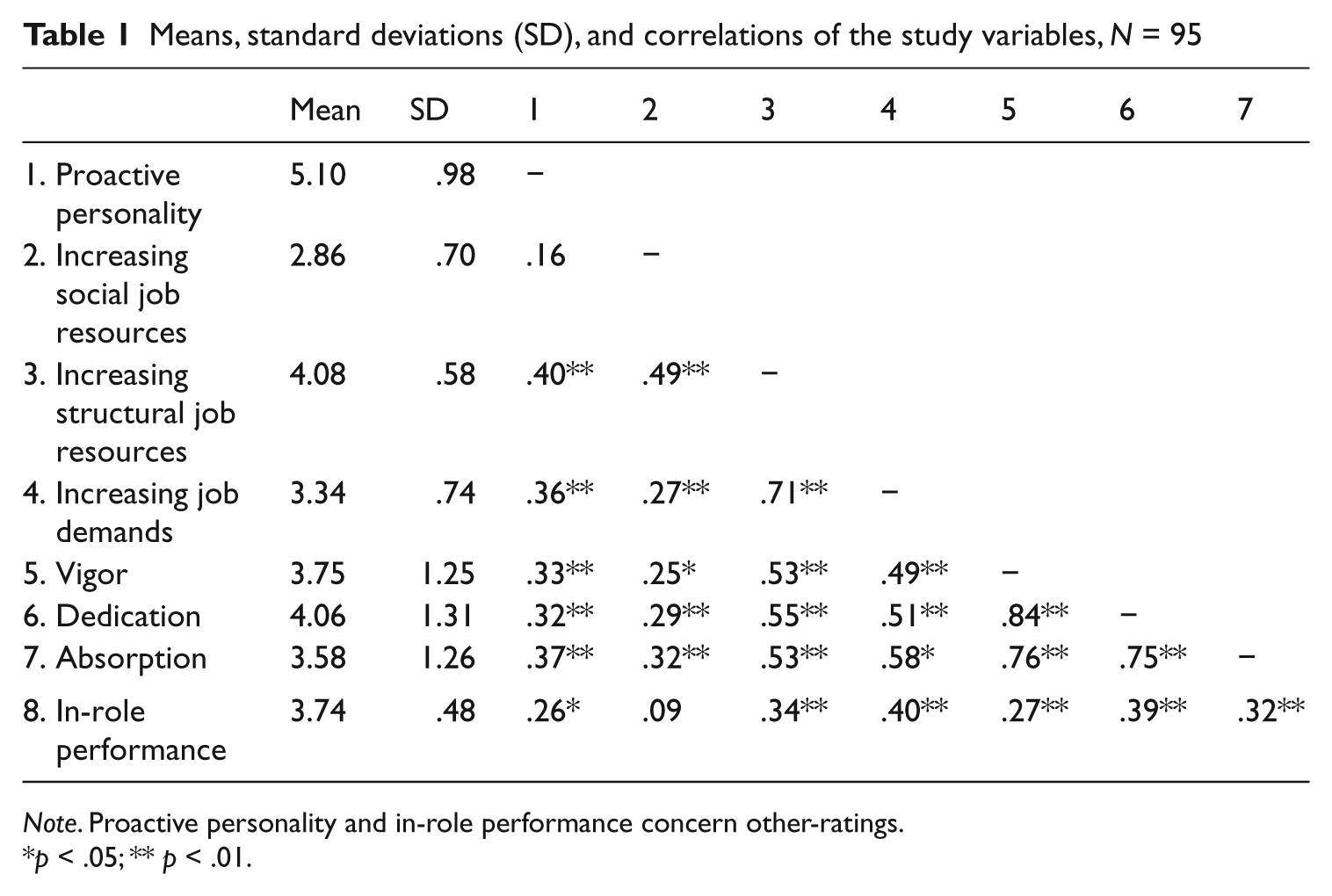
Note. Proactive personality and in-role performance concern other-ratings.
p < .05; ** p < .01.
Test of the job crafting model
The results of the SEM-analyses indicated that the hypothesized job crafting model fit well to the data: χ2(31) = 36.393, RMSEA = .043, GFI = .933, NNFI = .987, IFI = .991, CFI = .991. Results showed that proactive personality was positively related to job crafting (β = .47, p < .001; see also Figure 2). Job crafting, in turn, was a significant predictor of work engagement (β = .68, p < .001). Furthermore, work engagement was significantly related to colleague-ratings of in-role performance (β = .37, p < .001). Finally, as expected, there was also a direct effect of proactive personality to in-role performance (β = .37, p < .001). These findings offer evidence for Hypotheses 1–3.
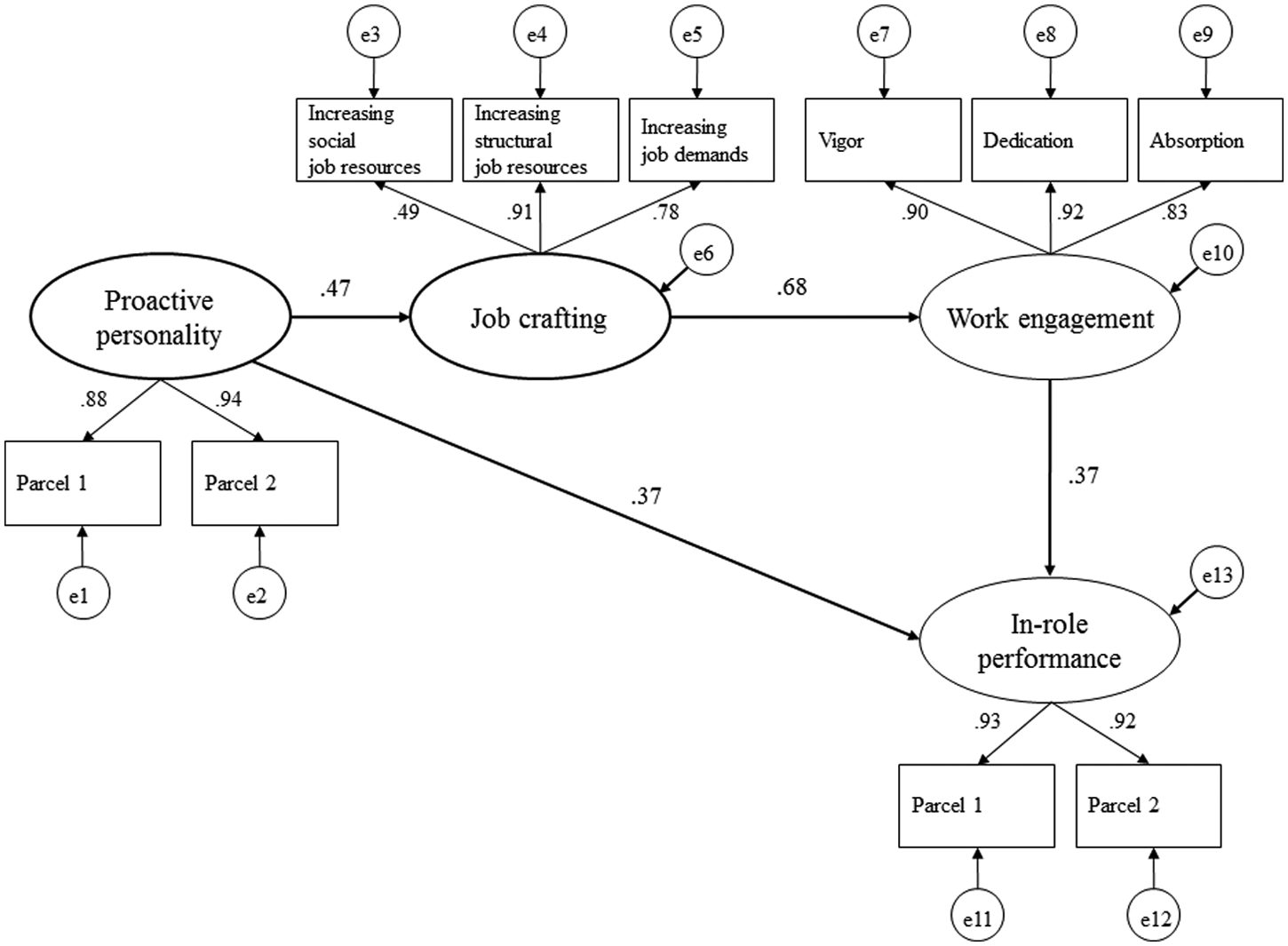
Maximum likelihood estimates for the job crafting model.
To test the theoretically plausible alternative model in which work engagement precedes job crafting, we built a new model in which proactive personality predicted first work engagement, and then job crafting and performance. This alternative model had, of course, the same degrees of freedom as the proposed model, and it also showed a reasonable fit to the data: χ2(31) = 43.251, RMSEA = .065, GFI = .919, NNFI = .971, IFI = .980, CFI = .980. We therefore compared Akaike’s information criterion (AIC) index (Bozdogan, 1987) for the proposed and alternative model. The AIC is a modification of the standard goodness-of-fit χ2 statistic that includes a penalty for complexity. This index does not tell us anything about the fit of a particular model, but it is very useful for making comparisons among non-nested models. Generally, the model with the lowest AIC value is considered to have the best fit. The alternative model yielded a higher AIC value (91.251) than the value obtained for our proposed model (84.393). These results offer additional evidence for the proposed model.
In additional series of SEM-analyses, we tested two alternative models, namely the Indirect effects model and the Direct effects model. The Indirect effects model is similar to the Proposed model, but excludes the direct path from proactive personality to in-role performance. The results showed that the fit of the Indirect effects model to the data was acceptable: χ2(32) = 48.838, RMSEA = .075, GFI = .916, NNFI = .961, IFI = .973, CFI = .972. However, the Proposed model fit significantly better than this alternative model, Delta χ2(1) = l2.45, p < .001. The Direct effects model includes only the direct relationships of proactive personality, job crafting, and work engagement with in-role performance. This alternative model showed a bad fit to the data: χ2(32) = 92.665, RMSEA = .142, GFI = .839, NNFI = .861, IFI = .903, CFI = .901. In addition, the Proposed model fit significantly better to the data than the Direct effects model: Delta χ2(1) = 56.27, p < .001.
According to Hypothesis 4, proactive personality has an impact on in-role performance, through job crafting and work engagement. We examined these indirect effects using the bootstrap analysis option in AMOS (MacKinnon, 2008). Specifically, we tested three indirect effects. First, we tested the indirect effect of proactive personality on work engagement through job crafting. The results of the bootstrap analysis showed that this indirect effect was significant (estimate = .390, p < .001). The bias-corrected confidence interval (B-CCI) ranged from .143 to .710. Second, we tested the indirect effect of job crafting on in-role performance through work engagement. This indirect effect was also significant (estimate = .216, p < .001, .109 ≤ B-CCI ≤ .388). The results of the third and final bootstrap analysis showed that the sequential mediation effect was significant as well (estimate = .068, p < .001, .026 ≤ B-CCI ≤ .151). Taken together, these findings offer support for our hypothesized sequential mediation effect from proactive personality to in-role performance through job crafting and work engagement.
Additional analyses
Although the findings so far offer support for the proposed model, it remains unclear whether each aspect of job crafting is equally important for work engagement, and consequently in-role performance. Therefore, we tested three additional models that were similar to the Proposed model, but in which the latent job crafting factor was replaced with one of the following latent factors: (i) Increasing social job resources; (ii) Increasing structural job resources; and (iii) Increasing job demands. As can be seen in Table 2, each of the three models showed a good fit to the data. Proactive personality was positively related to Increasing social job resources (γ = .34, p < .05), Increasing structural job resources (γ = .50, p < .001), and to Increasing job demands (γ = .44, p < .001). Additionally, in each of these three models, job crafting was positively related to work engagement: Model 1 β = .47, p < .01; Model 2 β = .69, p < .001; Model 3 β = .65, p < .001. The coefficients of the relationships between proactive personality and work engagement on the one hand, and in-role performance on the other hand, were in all models comparable to the coefficients in Figure 2 (ranging from .36 to .39, p < .001). These additional findings suggest that in this article, increasing structural job resources was most important for work engagement and performance.
Goodness of fit indices of the alternative models, N = 95
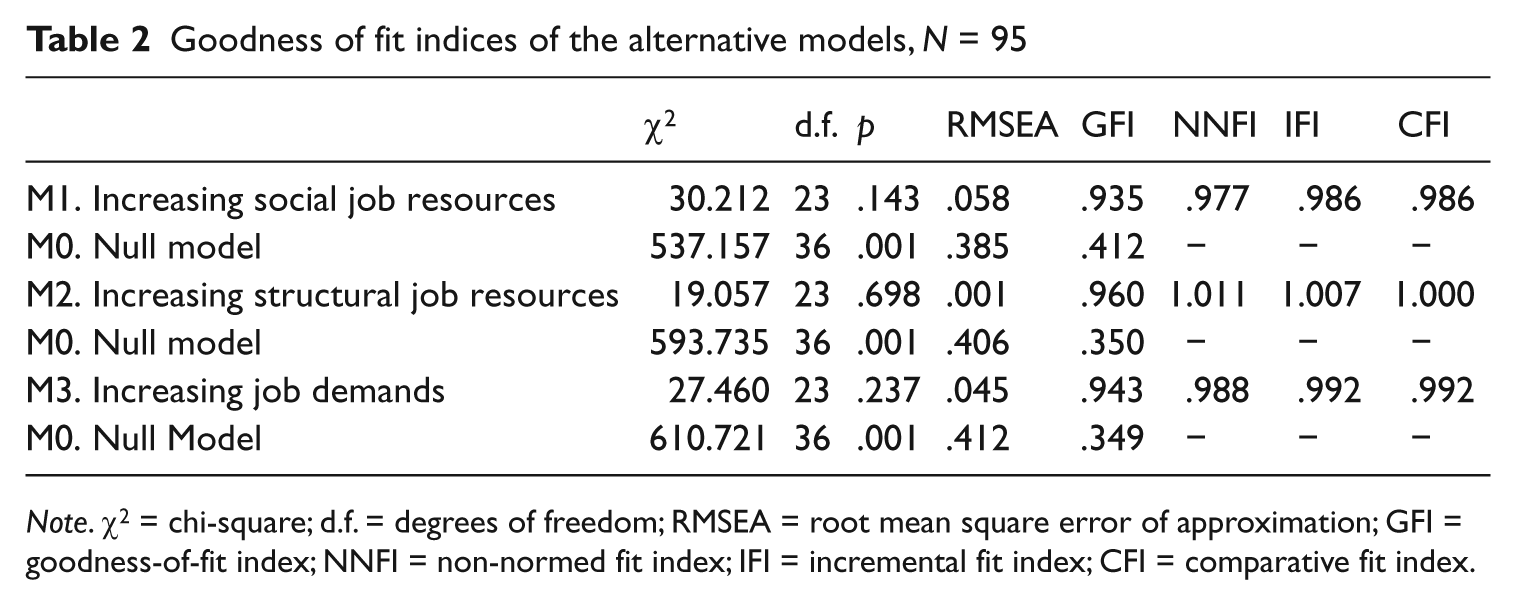
Note. χ2 = chi-square; d.f. = degrees of freedom; RMSEA = root mean square error of approximation; GFI = goodness-of-fit index; NNFI = non-normed fit index; IFI = incremental fit index; CFI = comparative fit index.
Discussion
In this article, we argued that as managers are not always available for their employees, it is important that employees mobilize their own job demands and resources through proactive job crafting behavior. We hypothesized that employees with a proactive personality would be most likely to craft their own jobs, so that they become engaged and perform well. The results of our study were consistent with the hypotheses. Colleague-ratings of proactive personality had a positive relationship with in-role performance through job crafting and work engagement. In the next section, we discuss the most important contributions of our study.
Theoretical contributions
A first contribution of this article is that it offers evidence for a possible reason why proactive personality is positively related to performance. Individuals with a proactive personality intentionally change their physical environment (Buss, 1987). They identify opportunities, take action, and persevere until they bring about meaningful change (Crant, 1995). This article expands these earlier findings, by showing that individuals with a proactive personality are also most inclined to change their work environment in a proactive way, by mobilizing job resources and job demands. This is consistent with Crant (2000), who argued that proactivity has a positive impact on employee performance because proactive individuals create opportunities for effectiveness. Job crafting facilitates engagement and, indirectly, performance, because employees who change their work environment proactively align their job demands and resources with their own abilities and needs (see Tims and Bakker, 2010). In a similar vein, Greguras and Diefendorff (2010) showed that proactive personality predicted in-role performance through need satisfaction. Person-environment fit theory has argued that employees leave the organization when there is no fit between their abilities and needs on the one hand, and organizational demands and supplies on the other hand (Edwards, 2008; Schneider et al., 1997). This article suggests that if employees cannot or do not want to leave, they may engage in job crafting as a means to realize congruence between the person and the work environment.
Conceptually, the finding that proactive personality predicts performance through job crafting and work engagement is consistent with Daniels’s (2006) claim that enactment of general tendencies is the most important predictor of performance in an organizational context. Thus, it is not personality in itself that predicts performance, but rather it seems that it is the enactment of personality. Individuals who are generally inclined to be proactive will not perform better than their passive counterparts, unless they really engage in proactive behaviors in the workplace (job crafting). Indeed, results also indicated that the (indirect) effect of job crafting on performance persisted after controlling for proactive personality, implying that job crafting is related to, but different from, proactive personality. Future studies could further test the enactment hypothesis by using a more robust research design, for example by combining trait proactive personality questionnaire information with a daily diary study of what employees do during their workday (see Ohly et al., 2010).
A second contribution of this study is that it shows a relationship between specific job crafting behaviors and colleague-ratings of performance – an effect that is mediated by work engagement. Previous job crafting studies were either conceptual (Wrzesniewski and Dutton, 2001) or qualitative (Berg et al., 2010) in nature. We predicted that employees who optimize their job demands so that they are challenged, and who increase their social and structural job resources, can be seen as better performers than employees who do not increase their job demands and resources. The job crafting literature is careful in its statements about the effect of job crafting on performance. For example, Wrzesniewski and Dutton (2001) stated that job crafting is not necessarily in line with the goals of the organization. However, Lyons (2008) noticed that all examples used to illustrate job crafting behaviors had beneficial effects on the organization as well. Note that this finding may have been the result of the use of self-reports. Employees may be reluctant to report instances in which they modified job aspects that led to a decrease in their performance level. This article expands these previous findings, because we used self-ratings of job crafting and colleague-ratings of performance and still found convincing support for a positive relationship between job crafting behaviors and in-role performance.
Limitations and strengths
Like most research, this study has several limitations. First, the use of cross-sectional data does not allow us to make cause-and-effect inferences. Although we defended the path from job crafting to engagement using previous findings in the realm of the JD-R model (Bakker and Demerouti, 2008), reversed causality is possible for this relationship. It is conceivable that job crafting is not only a cause but also a consequence of being engaged with the job. Indeed, the alternative model in which work engagement preceded job crafting (and indirectly performance) also fit reasonably well to the data, and previous research has also shown evidence for a reversed causal effect (Fritz and Sonnentag, 2009; Parker et al., 2010; Schaufeli et al., 2009). Thus, work engagement can be promoted by job crafting, but work engagement may also promote job crafting.
A second limitation of our study is that the majority of the participants were highly educated. This may limit the generalizability of our findings. For example, it is conceivable that employees with higher education are more likely to engage in job crafting (see Ghitulescu, 2006; Lyons, 2008; Wrzesniewski and Dutton, 2001) because they generally hold higher positions at work. However, recent research by Berg et al. (2010) showed that this is not always true. These authors showed in their interview study that lower-level employees were also able to craft their jobs. Future research should examine whether job crafting is equally applicable to other samples and work settings (e.g. manufacturing, entrepreneurs).
A third limitation is that we focused solely on the positive consequences of job crafting behaviors for individual employees. Employees usually work in interdependent teams, and it remains unknown what consequences job crafting has for one’s colleagues. If I am asking my colleagues for feedback and support, then my own resources increase but perhaps at the cost of my colleagues’ resources. Future studies among dyads of coworkers or teams should investigate the consequences of job crafting at the group level.
Practical implications
The practical implications of this study may be threefold. First, results indicate that proactive personality is an important predictor of job performance. This suggests that selecting people with proactive personalities may be a useful strategy for human resource managers seeking to enhance job performance. However, we agree with Fuller et al. (2010), who argue that performance maximization is not solely a function of selecting people with proactive personalities, but also a matter of assigning these individuals to jobs where they feel they have a considerable degree of freedom to determine how they do their job. Second, work engagement played an important role in predicting employee performance. This finding is in line with earlier studies that also found a positive relationship between work engagement and job performance (Demerouti and Cropanzano, 2010). Therefore, a first implication, directed at the organizational level, may be to create an organizational climate that fosters work engagement (Bakker et al., 2011). A climate that supports and challenges the employee and at the same time is responsive to their needs makes it very likely that employees are willing to invest time and energy at work and to feel involved in their work (i.e. engaged). A starting point, derived from the JD-R model, may be to build the job and personal resources of the employee (Bakker and Demerouti, 2008). For example, providing employees with opportunities to develop their skills and abilities may increase their work engagement because they can personally grow at work and can take on new challenging tasks.
Third, this study showed that we should not only focus on the organization if we wish to enhance employee engagement and performance. Employees reported that they also influenced their work characteristics themselves. More specifically, employees who crafted their level of job demands and resources were more engaged with their work and, in turn, performed better. This means that employee proactive behavior is also of importance when studying employee engagement and performance. Therefore, interventions that stimulate employees to craft their optimal level of job characteristics seem to be needed. We suggest that regular employee surveys in which employees report how they experience their job demands and job resources could help to guide interventions at the organizational level. If these reports also provide personalized feedback with suggestions on how employees themselves could optimize their job characteristics, this may communicate to the employees that they can bring about meaningful change in their own jobs with the support of the organization.
Conclusion
There has been a growing recognition of the role that employees play in actively shaping and influencing their environment. In this article, we argued that as managers are not always available for their employees, it is important that employees mobilize their own job demands and resources through proactive job crafting behavior. The article has shown that employees with a proactive personality are most likely to craft their own jobs. By mobilizing their own resources and setting their own challenges, employees actively work on their own engagement. This work engagement, in turn, is predictive of other-ratings of performance.
Footnotes
Funding
This research received no specific grant from any funding agency in the public, commercial, or not-for-profit sectors.
 .
.