



Abstract
In responding to climate change, organizations navigate in an increasingly volatile emotional milieu in which feelings of fear, anxiety, hostility and anger shape public debate. In this article, we explore how corporations have responded to the broader ‘emotionology’ surrounding climate change. Our focus is on the role of corporate sustainability specialists as intermediaries, or ‘emotionology workers’, acting between broader social debates and local organizational contexts. Through analysis of interview and documentary data from major Australian corporations we explore both the activities of these individuals in translating and shaping climate change emotionology within their organizations, and how they manage their own emotionality in this work. We find that sustainability professionals are key agents in the design and implementation of a positive emotionology of climate change as a challenge and opportunity for corporate action. However, these activities result in tensions and contradictions for these individuals in reconciling their own emotional engagement with climate change and the negative impact of corporate activities on the environment. Our analysis contributes to an understanding of the roles and activities of ‘emotionology work’, as well as broadening the concept of ‘emotion work’ to include those involved in promoting broader social change in organizational settings.
Introduction
In March 2007, John Doerr, a partner at venture capital firm Kleiner Perkins, delivered a TED talk in Monterey, California, to a packed audience eager to hear about the future of the digital economy (TED, 2007). Doerr had led the financing of ‘new economy’ juggernauts such as Google, Amazon and Netscape and was well known for his upbeat depictions of the digital age. However, to the surprise of the audience, Doerr began his presentation with the following words, ‘I’m scared. I don’t think we’re going to make it’. Over 20 minutes, Doerr highlighted his fears about the climate catastrophe facing humanity and the potential for a new green economy to save the world. He closed his talk in tears as he reflected on a fearful future:
I really, really hope that we multiply all our energy, all of our talent and all of our influence to solve this problem … because if we do, I can look forward to the conversation I’m going to have with my daughter in 20 years.
The audience were stunned and rose to their feet in a standing ovation as Doerr left the stage and hugged those close by. In the ensuing media coverage, business pundits were surprised that the optimistic tech sector had suddenly become very serious and – well – ‘emotional’; what was going on?
While emotions have become an increasingly popular focus for management research, often missing from such accounts is a critical sociological understanding of emotionality in work settings (Fineman, 2010; Loseke and Kusenbach, 2008). As Fineman (2010: 28) has argued, one area that is particularly under-developed in this respect is the interaction of broader social ‘emotionologies’ with the local ‘emotional arenas’ of the organization. Emotionologies involve ‘the attitudes or standards that a society, or a definable group within a society, maintains toward basic emotions and their appropriate expression’ and the ‘ways that institutions reflect and encourage these attitudes in human conduct’ (Stearns and Stearns, 1985: 813). In defining norms of ‘appropriate’ emotional expression in regard to specific issues, subjects or identities, emotionologies are particularly relevant in organizational and work settings where they inform standards of emotional expression for managers and employees of different rank, roles, occupations and genders. However, we know surprisingly little about either the processes through which social emotionologies enter and impact upon organizational contexts or the mechanisms through which this occurs.
In this article, we focus on the example of business engagement with the broader social debate surrounding climate change. In the space of a decade, climate change has materialized as a critical threat to the future of humanity, with the latest scientific data highlighting dramatic changes in climate within a matter of decades (Richardson et al., 2009). Perhaps not surprisingly, future interpretations of a climate-shocked world prompt strong emotional responses whether our concerns focus on the extinction of animal species, humanitarian disasters and geopolitical conflicts, or the future well-being of our society, local community or children (Hansen, 2009; Hulme, 2009). A perusal of media coverage of climate change highlights how this issue has become an increasingly polarized and emotion-laden concern both for those promoting the need for urgent policy action, as well as others who reject climate change as a serious threat (Boykoff, 2011; McCright and Dunlap, 2010). Indeed, the dramatic implications of climate change for humanity have resulted in increasingly emotional statements from a range of actors, whether it is the shock videos of non-government organizations (NGOs) such as Greenpeace, 10:10 or Plane Stupid, the impassioned pleas for government action from youth and community leaders on the floor of United Nations climate negotiations, or the appeals of politicians, commentators and businesspeople for and against the regulation of carbon emissions. At the same time, more passive emotional responses have also been noted in the broader social disengagement and denial of an issue that some consider too large, complex and threatening to existing ideologies (Norgaard, 2006). In short, climate change discourse is associated with new emotionologies in which expressions of passion, anger, fear and hostility, as well as apathy and ambivalence, are central features of social debate (Dörries, 2010; Moser, 2007).
We argue that businesses and many managers are increasingly engaged in the emotionality that surrounds climate change and seek to adapt broader social emotionologies in ways that provide a positive and profitable message. In our study we focus on the activities of specialist corporate sustainability managers and consultants who are charged with helping their organizations respond to the risks and opportunities of climate change. While this involves advising over new strategies and implementing new practices, products and services, a further critical component of their role is ‘emotionology work’ – that is, the adaptation and management of standards of emotional expression within organizations. Through analysis of interview and documentary data from major Australian corporations we explore the activities of these individuals in translating the emotionology of climate change discourse within their organizations, as well as how they manage their own emotions in this work. Here we distinguish between the different processes, roles and activities of emotionology work (e.g. spanning, changing and creating local emotionologies), as well as the emotion work of managing others and the self (e.g. calculative, constraining, compartmentalizing, and championing emotionality). Through our analysis we highlight the processes of ‘emotionology work’, and the tensions that such activities provoke through emotional reflexivity. This is followed by a discussion of the implications of our study for broader considerations of ‘emotionology’, with suggestions for further research.
Emotionologies, organizations and corporate environmentalism
Within socially constructed depictions of emotions at work, an emerging literature has stressed how organizations are made up of ‘emotional cultures’ (Gordon, 1990) and ‘emotional zones’ or ‘arenas’, where ‘a local emotional order is tacitly negotiated and distinct from adjacent zones’ (Fineman, 1993, 2010: 28). A key issue in this regard is the way in which standards of emotional expression are formed and maintained within organizations. Clearly broader social conventions play an important role, with various ‘emotionologies’ developed over time defining emotional standards for different categories of people (Stearns and Stearns, 1985). Building on this concept (see also Parrott and Harré, 2001), Fineman (2010: 27) has developed the term ‘emotionology’ to connote broader social norms of emotional expression, ‘… society’s “take” on the way, and to whom, certain emotions are to be expressed’, as well as ‘local’ norms of emotionality. For example, feminist scholars have highlighted how different emotional standards impact upon the work-roles and expected behaviours of men and women, and the types of jobs they have access to (Acker, 1990; Hochschild, 1979). Emotionologies also provide varying standards of ‘appropriate’ emotional expression for different occupational groups (e.g. social workers, doctors, police officers) (Fineman, 2010; Rafaeli and Sutton, 1989; Van Maanen and Kunda, 1989). Indeed, the oft-noted ‘norm of rationality’ within which managers are expected to display the persona of the ‘cool’ and rational professional (Ashforth and Humphrey, 1995; Watson, 1994) highlights such occupational emotionologies. These variations in norms of emotional expression affect how different occupations ‘are valued and recompensed at work’ (Fineman, 2010: 27).
Key actors in the construction of social emotionologies include the media, advertising, popular culture, religious organizations, political parties, social movements and activist groups (Boltanski, 1999; Goodwin et al., 2001). Fineman (2010: 27) notes that emotionologies as ‘politico-ideological constructs’ are often ‘shaped by prevailing currents of nationalism, ethnocentrism, racism or homophobia, as well as governmental, religious and party-political dogmas’. However, emotionologies are not static and often undergo rapid change owing to economic, demographic, technological and other changes. So, for example, the emotionology surrounding terrorism (at least within the United States) changed significantly after the events of 9/11 (Loseke, 2009). In relation to an issue such as climate change, we can see how emotional norms have radically changed over the last ten years through the influence of opinion setters such as the media, business groups, think-tanks and political parties (Dunlap and McCright, 2011). What used to be a field of sombre science has turned into a minefield of emotions, with scientists undermined for producing ‘junk’ science and even branded public enemies (Oreskes and Conway, 2010).
However, social emotionologies are subject to interpretation, and organizations and communities often demonstrate variations in standards of emotional expression that prevail in spite of their conflict with broader social norms. This ‘interplay between regnant emotionologies and local competing or “contra” emotionologies’ (Fineman, 2010: 28) is particularly relevant in organizational settings where social issues of high emotional import become a source of business concern, resulting in the allocation of resources and expertise. A contemporary area where the process of emotionality has been highlighted within business has been the phenomenon of ‘corporate greening’ (Fineman, 1996, 1997). Indeed, the growth of ‘corporate environmentalism’ provides a new and significant impetus for organizational change, as businesses respond to new government regulation and public criticism over pollution and environmental crisis (Hoffman, 2001; Jermier et al., 2006).
The establishment of sustainability specialists and environmental initiatives provides a useful empirical focus to explore the inter-relationship of broader social and local emotionologies (Tams and Marshall, 2011). For instance, earlier research on the role of emotion in corporate greening (Fineman, 1996, 1997), found significant resistance, ambivalence or apathy on the part of managers to pro-environmental initiatives. Even in contexts where firms had well-developed ‘green’ cultures, managers often engaged in a form of ‘surface acting’ (Hochschild, 1979), where they stated their support for green initiatives but did this from a position of ‘enlightened self-interest’ (Fineman, 1996: 485). Here, local emotionologies conflicted with broader social emotionologies of environmental concern (see also Banerjee, 2001; Harris and Crane, 2002). By contrast, other studies highlight the potential for changes in corporate environmental engagement and related emotional norms. For example, Hoffman (2010) has argued that managers increasingly identify with environmental issues as part of a broader search for meaning and fulfilment at work. He suggests that education and religion have diffused environmentalism within the business community, and identifies more environmentally engaged managers as change agents in a manner similar to Meyerson and Scully’s (1995) ‘tempered radicals’ – working from within to change their organizations into more environmentally sustainable entities. More generally, we can point to the way in which corporate environmentalism has moved from a fringe issue to a core business concern (Hoffman, 2001).
The establishment of specialist sustainability functions can be seen, then, as a response to the clash between broader discourses of business profitability and environmental well-being, each of which is imbued with resident emotionologies. For corporations, engaging with environmental concerns such as climate change offers potential business advantages in terms of improved efficiencies and reduced costs, as well as responding to changing consumer and employee attitudes by presenting themselves as being concerned about the environment (Harris and Crane, 2002). In these scenarios, sustainability specialists occupy not only a technical and managerial role, but also act as key agents in the inter-relationship between social and local emotionologies; they are, in essence, ‘emotionology workers’. In leading corporate ‘green’ initiatives they redesign corporate cultures and encourage emotionality within pre-determined green values and branding. Here they act not only as ‘boundary spanners’ between social and local emotionologies, but also potentially ‘boundary shakers’ (Balogun et al., 2005), in their desire to challenge and change local norms of apathy or antipathy towards environmental degradation.
In addition, while their corporate roles involve managing local emotional norms (that is, managing others), there is also the need for personal emotional engagement (that is, managing the self), which is highlighted in the idea of the change agent as ‘tempered radical’ (Hoffman, 2010; Meyerson and Scully, 1995). Self-management is critical here in not only championing issues (Andersson and Bateman, 2000; Dutton and Ashford, 1993), but also in coping with tensions and contractions (Gabriel, 2010). Spanning emotional arenas, shaping and being shaped by diverse emotionologies, provides room for self-reflection and assessment of lives (Holmes, 2010), which potentially leads to emotional (de-)integration (King, 2006). Thus, in dealing with the subjectivity of the self in relation to social and local emotionologies, emotions of guilt, fear, remorse, pleasure, triumph and satisfaction are likely to be an important feature of these change agents’ work.
In this article we explore how broader social emotionologies associated with climate change impact upon organizations, by focusing on the role of sustainability managers and consultants as ‘emotionology workers’. We are concerned with the process through which social emotionologies are translated, adopted, and resisted within local organizational settings. In doing this we ask two broad research questions. First, how have organizations responded to the evident emotionality of climate change in their corporate environmental practices? Specifically we are interested in the processes through which differences between broader social and local emotionologies are negotiated by sustainability specialists. Second, how do these change agents manage their own emotions in the process of emotionology work? Of interest here is how they deal with their emotions with regard to the potential dissonance between societal and local emotionologies.
Research method
Data collection
In exploring how business organizations have responded to climate change, we conducted interviews and gathered documentary data from major Australian corporations in the resources, energy, manufacturing, transportation, finance and retail industries, as well as several consulting and advisory firms. The research was conducted between 2009 and 2011, a period of significant contestation over climate change both in Australia and globally, which included the failed Copenhagen climate talks, the ‘Climategate scandal’, and changes in the political leadership of both the Australian government and federal opposition, in large part owing to climate change policy (Rootes, 2011). While varied in their approach to environmental sustainability, nearly all of the firms we studied publicly accepted the urgency of anthropogenic climate change and had implemented a range of sustainability practices including energy efficiency programs, carbon emissions measurement and reporting, green products and services, environmental culture change programs, green marketing and branding, as well as advocacy and alliance building.
A total of 36 semi-structured interviews were conducted with sustainability managers and consultants from different companies, including men and women of various ages who occupied middle and senior positions in their organizations (see Table 1). We asked these individuals about their careers, examples of their work, challenges they faced in their jobs, as well as their personal attitudes to climate change. Each interview lasted between 50 and 120 minutes and was recorded and fully transcribed. This provided a rich source of qualitative data (amounting to over 1000 pages of transcript), with most respondents highly reflexive in considering their work activities and personal attitudes towards climate change.
Details of interview respondents

The interview data were supplemented with documentation from the respondents’ organizations, including strategy documents, communications materials, submissions to government inquiries, and media coverage. This provided further insight into climate change practices in these organizations and how such initiatives were presented to employees and external stakeholders.
Data analysis
A key theme that emerged early in our interviews was the intensity of emotions that respondents expressed in discussing climate change, as well as the emotionality implicit in green culture change programs and other environmental sustainability initiatives. We began our data analysis by reading the interview and documentary texts and, via the qualitative software QSR NVivo, coding instances where respondents and organizations made reference to feelings and emotions in regard to climate change (see Table 2). This included emotional expression related to individuals’ work roles, their personal and home life, their perceptions of others’ emotive responses, and observations of broader organizational, social and political developments related to the environment and climate change. Rather than imposing a typology of emotion onto our data, we identified and categorized sections of texts according to the emotional cues and expressions as they arose. Following other qualitative studies of emotionality at work (Ashforth and Humphrey, 1995; Fineman, 1996), we coded not only literal emotive expressions (e.g. ‘I hated him’, ‘I just got so excited’), but also the manner in which statements were made (e.g. laughter, sarcasm, tone and volume of voice), as well as descriptions of situations that denoted the emotional reactions of others, and documentation that made emotional claims.
Examples of data coding
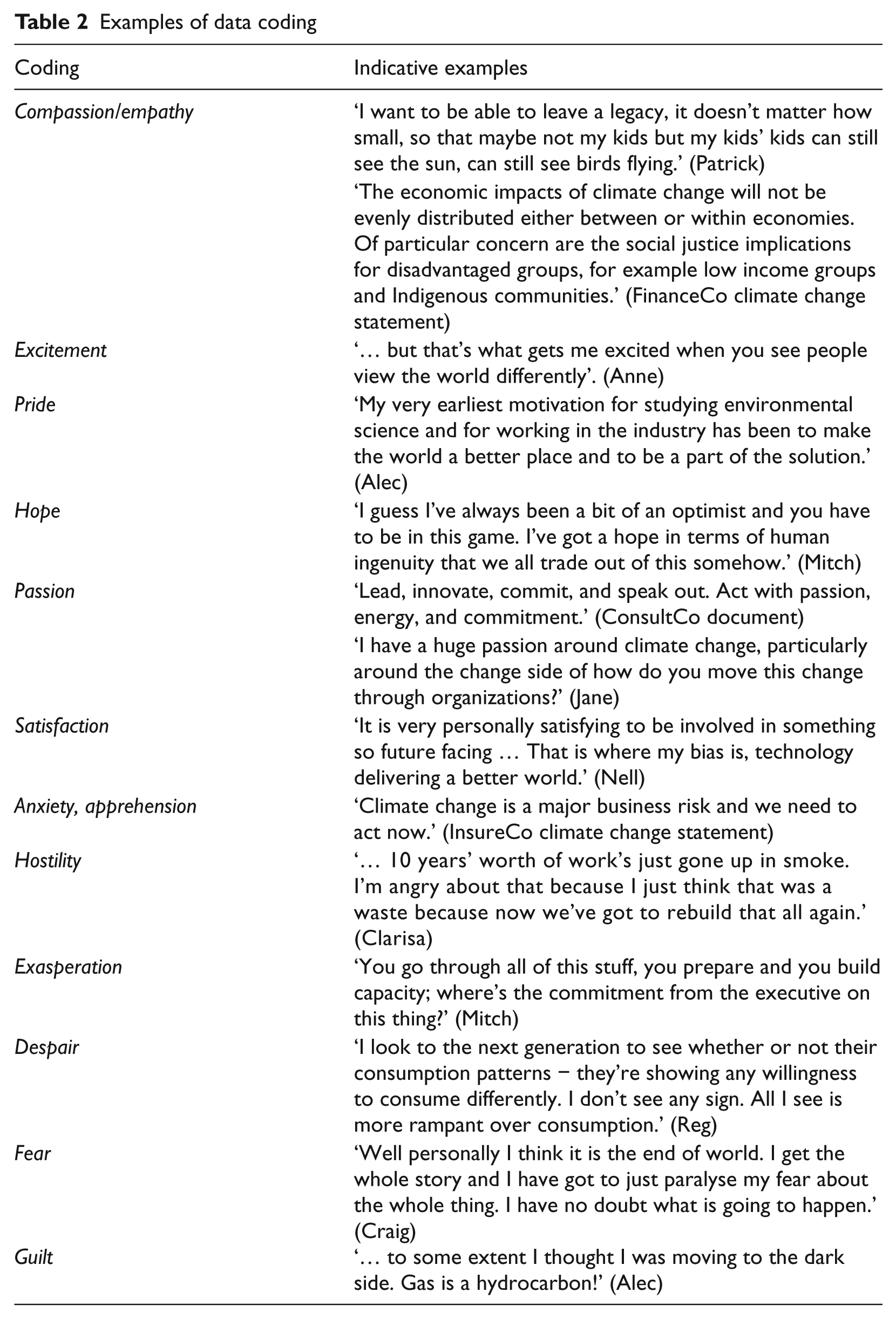
In considering these emotional expressions as part of a sociology of emotion, we engaged with the literature on emotionologies as ‘politico-ideological constructs’ that establish norms of emotional expression in relation to particular issues and subjects (Fineman, 2010: 27). For instance, accounts of social attitudes to climate change have stressed the role of fear, anxiety, anger, concern, passion and guilt as common forms of emotional expression (Dörries, 2010; Moser, 2007). Through an abductive approach (Van Maanen et al., 2007), we re-examined our coding and distinguished different ways in which the issue of climate change as a local discourse was framed, leading to organizational characterizations of appropriate emotional expression.
For example, echoing the broader social emotionology of climate change as threat, we found many managers and corporate statements echoed emotions of anxiety and apprehension in regard to the future implications for society and the economy. Similarly, an alternative social emotionology of climate change as battleground or conflict also found expression in the organizations we studied. Here, emotions of frustration, anger and hostility were a common emotional reaction both for those involved in the work of corporate sustainability and employees more generally. However, the adaptation of these broader emotionologies was also evident in our data, particularly through the framing of climate change as challenge and opportunity. Here, the economic and social risks of climate change were countered within organizations by the up-side potential of new markets, products and technologies, with the key emotions stressed including hope, enthusiasm and even excitement.
In managing the dissonance between societal and local emotionologies, our interviewees also provided insight into the nature of ‘emotionology work’. Our respondents outlined how this involved significant emotional self-management, in terms of demonstrations of personal enthusiasm and commitment to the issue of climate change, as well as the more calculative use of emotional expression in influencing others and implementing organizational change. Hence, emotionology work involved dealing with respondents’ own emotions in relation to different emotionologies.
In the sections that follow, we explore firstly the broader social emotionology of climate change as it has developed in Australia as evidenced in political and social debate, before examining how corporations have responded to these changing emotionologies through the adoption of corporate environmentalism and the work of sustainability specialists as ‘emotionology workers’. In the third section, we consider how these individuals explained their own emotions in regard to climate change and how they sought to manage the tensions of emotionology work. We then go on to discuss the implications of our study for a broader understanding of emotionologies at work and the role of individuals as emotional change agents.
The emotionologies of climate change in Australia
Climate change has rapidly emerged as an issue of major public concern in Australia, reflected in an increasingly partisan and emotive political debate (Tranter, 2011). While opinion polling suggests that levels of public concern about climate change have remained generally consistent over the past two decades, changes in government policy have served to exacerbate public attention towards this issue. For example, while Australia had been an active participant in early international climate change meetings, from 1996 to 2007 the conservative Howard government adopted a minimalist approach to the issue and was strongly resistant to proposals to regulate greenhouse gas (GHG) emissions. In line with the US government, Australia remained one of the few Organization for Economic Co-operation and Development (OECD) nations to refuse to ratify the UN Framework Convention on Climate Change (Kyoto Protocol). Government and industry resistance reflected the country’s reliance on fossil fuels and its role as one of the world’s largest exporters of coal and gas (Crowley, 2007). Indeed, government and media representations of climate change during this period focused on the potential for emissions regulation to increase the cost of living, reduce Australia’s economic growth, and harm the country’s competitive advantage as a fossil fuel exporter (McKewon, 2012; Pearse, 2009).
During 2006 and 2007, growing public awareness of climate change resulted in increasing pressure for government action against the backdrop of a federal election (Rootes, 2008). Coinciding with Al Gore’s influential film An Inconvenient Truth, mass public rallies and opinion polling highlighted the growing public engagement with climate change. Indeed, action on climate change became a key feature of the incoming 2007 Labor government in Australia, which in its first official act symbolically signed the Kyoto Protocol. Soon after taking office, Prime Minister Rudd set a target to reduce greenhouse gas emissions by 60 per cent of 2000 levels by 2050, and developed plans for an emissions trading scheme (Garnaut, 2008).
The rapid prioritization of climate change as a political issue in Australia reflected the emerging social emotionology of climate change as threat, linked to the fear and anxiety of living in a country that is particularly exposed to droughts, storms and rising sea levels (Preston and Jones, 2006). In particular, a series of extreme weather events focused public debate on the country’s vulnerability to a changing climate. These included the worst drought on record, which lasted for nearly 10 years, the demise of the arterial Murray–Darling river system, significant coral bleaching of the Great Barrier Reef, and catastrophic bushfires including February 2009’s ‘Black Saturday’ fire in which 173 people perished (Climate Commission, 2011). A new social movement was also evident in the formation of climate change advocacy groups such as the Australian Youth Climate Coalition (formed in 2006 and with a membership of 57,000), GetUp! and Rising Tide, as well as established NGOs such as Greenpeace and World Wildlife Fund. Indicative of the growing public concern over climate change, opinion polling in 2008 found 56 per cent of Australians favoured the introduction of an emissions trading system (ETS) (although a sizeable minority of 36 per cent remained opposed) (Pietsch and McAllister, 2010).
However, despite the growing public concern and activism surrounding climate change, from 2009 a counter discourse of climate change scepticism and denial also became prominent. Key drivers here included the lack of a global agreement on carbon emissions at the UN Copenhagen Climate Summit, and a change in leadership of the conservative political opposition, which shifted from bipartisan support for carbon regulation to the questioning of climate science itself. Assisted by the media, right-wing think-tanks and industry groups, a growing climate change denial movement became increasingly evident in the public debate (Bacon and Nash, 2012; Manne, 2011). This competing view of climate change as a ‘hoax’ and economic threat grew in popularity after the 2010 federal election when the Labor government was narrowly returned to power with the assistance of the Greens Party and independents, and announced plans to introduce a ‘carbon tax’ as a prelude to a carbon trading system. With the conservative opposition now championing a ‘people’s revolt’ against carbon regulation, the increasingly bitter and emotive nature of public debate was highlighted in anti-carbon tax rallies outside Parliament House where opposition politicians addressed crowds of climate ‘sceptics’ in front of effigies of the Prime Minister and Greens politicians (ABC, 2011).
In contrast to the position in 2007, the social debate surrounding climate change in Australia had by 2010 become increasingly polarized, with climate scientists the subject of death threats and mass rallies against the ‘carbon tax’ vying with competing rallies for climate change action. In contrast to the emotionology of climate change as threat, during the period of our research a rival emotionology of climate change as ideological battleground had also become pronounced. While opinion polling suggested a diminution in support for government action on climate change and belief in anthropogenic global warming (Leviston et al., 2011; Leviston and Walker, 2011), the increasingly contested nature of this issue in the media and in public domains reflected an issue of significant emotional engagement. For Australian businesses the changing emotionology of climate change represented more than just ‘background noise’. Rather, it was an important contextual dynamic that influenced not only corporate marketing and branding but also internal policies, practices and local emotionologies.
Managing the emotionology of climate change: From threat and conflict to challenge and opportunity
For many of the companies we studied, climate change was presented as a strategic business issue of significant import. For example, as the CEO of one of the country’s major media organizations stated, ‘Climate change poses clear, catastrophic threats. We may not agree on the extent, but we certainly can’t afford the risk of inaction’. However, while such statements fitted with the social emotionology of climate change as a threat to social and economic well-being, we found that the corporate discourse surrounding climate change was marked less by expressions of anxiety and fear and more by a positive emotionology in which climate change was presented as a challenge and opportunity. This was expressed on the website of one sustainability consultancy as follows: ‘Climate change is the challenge of our generation. Answering the challenge and being part of the climate change solution can have a multitude of immediate and long-term benefits for business.’ Paralleling the broader discourse of ecological modernization, this corporate emotionology stressed the expression of hope, enthusiasm and even excitement in the ability of the market and technology to resolve the climate crisis (Hoffman, 2007). Indeed, corporations cast themselves as agents of social transformation, with one of the country’s major financial institutions stating in its sustainability report, ‘There is little doubt that climate change is one of the defining issues of our time … we will play a pivotal role helping our customers, employees and the broader community shift to this low-carbon economy.’
Sustainability managers and consultants were key agents in this corporate reframing of climate change as a positive challenge and opportunity. As specialist managers and advisers they were charged with not only developing responses to the broader public discourse of climate change, but also implementing internal practices of environmental sustainability and managing how employees were involved in these initiatives. Following the upswing of public concern in Australia over climate change from 2007 on, many companies made attempts to involve employees consciously in their environmental initiatives. This ranged from ‘green office’ programs encouraging employees to reduce their printing, recycle their waste or switch off their computer at the end of the work day, through to company weblogs and intranets that publicized green initiatives, as well as more elaborate interventions such as designated green ‘champions’ and competitions that promoted carbon emission reductions and innovations to improve energy efficiency.
Sustainability specialists here acted as boundary spanners and intermediaries (Aldrich and Herker, 1977; Leifer and Delbecq, 1978) in translating broader social emotionologies within local emotional arenas. Here, the broader social emotionology of concern and anxiety surrounding climate change as threat was not simply imported, but harnessed in ways that would contribute to improved employee engagement, productivity and corporate reputation through the promotion of community, empathy and compassion. As Christine, the sustainability strategist at a major power utility outlined, addressing climate change created a sense of workforce pride:
… so making staff very proud of the organization that they’re working for … I think particularly in call centres, they love hearing news from Corporate. They like to be included. They like to know they’re working for a good organization.
Encouraging employees’ emotional engagement was particularly pronounced in instances where companies promoted corporate sustainability initiatives based on employees’ personal concerns around climate change. As Nell, the climate change strategist for a major airline noted,
… we have a Green Team which is more than a thousand volunteers now who can be mobilized for a whole bunch of things. They are probably the most passionate and they come from all levels of the organization too which is very cool.
A good example of initiatives that spanned the social and local emotional arenas was an initiative introduced by an environment manager in one of the country’s major media companies. Following an initial roll-out of a carbon neutral program, the sustainability group instituted staff competitions to encourage further improvements in employees’ work and personal lives. This initiative became the dominant theme in the company’s re-branding, with posters of staff and their families adorning offices under the caption, ‘Climate change is about all of us. Everyone can contribute by changing what we do, in lots of ways, every day’ and asking ‘how far would you go to save the planet?’. As Tim, the company’s environment manager noted, employees embraced these themes with passion:
The guy that won, he filled in his swimming pool, grew vegetables, he put in a wind tower in his backyard. He was a pretty smart guy with pretty good engineering. He then decided he was going to change the way the neighbourhood did things, so he got a bag of low energy light bulbs and door-knocked all his neighbours. He wrote a little diary of their quotes of what they said when he door-knocked and stuff. They started to actually have street fairs and things on this topic in their community … he actually sent me a note saying – just wanted to thank us for the competition. It’s actually changed the way his family interacts with itself. His kids now are much closer and they as a family feel the world is a better place. It was a really fantastic outcome!
Through practices such as green office and culture change programs, as well as efficiency improvement and waste reduction initiatives, sustainability specialists sought to not only change attitudes about the relevance of climate change to daily business practice but also alter the emotional salience of this issue within the workplace. However, inculcating new emotionologies also involved challenging and seeking to change established local emotional norms. In particular, sustainability specialists as ‘change agents’ often confronted resistance and scepticism, particularly where managers and employees had absorbed climate sceptic messages. As Anne, the sustainability manager in an insurance company, outlined of the response to her attempts to promote concern about climate change within her business:
It got a lot of pushback … If you look at the profile of people within that business it was predominantly male, overweight, 50 plus, sceptics probably most of them, nice guys but they’re just more interested in going out and boozing with the insurance brokers than really thinking fundamentally about what this (climate change) means to the business.
In creating a new corporate emotionology of climate change, one common approach was the linking of environmental sustainability with locally resonant practices such as measurement, reporting and efficiency improvement; subjects that many managers saw as central to their jobs and also sources of meaning and satisfaction. For instance, sustainability specialists spoke about the excitement of production managers concerned about improving productivity or reducing waste. As Barry, an environment manager in a global food manufacturer explained, he often sought to link his personal environmental concerns with his factory managers’ enthusiasm for efficiency, ‘To me that is absolutely a win-win for everybody’. Similarly, Terry, the partner in a major auditing practice outlined, ‘I’ve a strong passion in efficiency and how you use resources because I think waste is the worst thing’. Here the focus on efficiency and cost was particularly meaningful – ‘being rational is also being emotional’ (Sturdy, 2003: 94). Moreover, these new local emotionologies of corporate environmentalism also served to distinguish and differentiate their companies from competitors through their distinctive ‘green’ branding and promoting the organization as concerned and active in responding to climate change. Here the creation of the local emotionology of climate change as challenge and opportunity fed into broader corporate marketing and branding as a ‘green’ organization.
However, creating a new local emotionology of climate change as challenge and opportunity was not without its contradictions. For instance, in several of the consulting firms we studied, senior managers noted how staff sometimes became ‘too emotional’ around this issue, questioning the environmental record of their company. One way in which firms sought to deal with such criticism was through the vocalization of concerns in staff meetings and committees. As Mitch, the director of one consultancy, outlined:
We’ve got an ethical committee that helps us think through what work we take on … One of the directors chairs that committee and basically there’s a set of criteria and you score it and that gives you the first decision-making tool. What’s the implication of that? And then you sit down and just use good thinking about whether we want to do this and then make a call.
A simpler response was to prohibit the expression of personal environmental concerns during client interactions. As Terry outlined of the policy of his firm, ‘We have some people who have got distinct views, who are very passionate on this subject (climate change) … That’s nice, but if a client doesn’t want to hear it, they’re not allowed to say it!’ However, seeking to control the local emotionology of climate change within committees and rules was a difficult exercise. As Mitch noted in frustration, despite attempts to corral emotional exchanges about client work within the ‘ethics committee’, some client companies were perceived so negatively by staff, that appeals to ‘rational debate’ often fell on deaf ears: ‘[Company X] has got such a bad reputation that they won’t even bother to understand what the rationale of the business case for it is. Especially some of the younger staff.’
Indeed, some managers noted how promoting emotions in response to climate change could have the unintended consequence of raising employee expectations of their companies’ performance beyond levels originally envisaged. In these circumstances, the positive emotionality of passion, commitment and motivation could quickly turn to frustration, disillusion and anger if organizations failed to live up to their professed environmental values. Angie, the sustainability manager in a bank, outlined how a decision to change the corporate car fleet to a more ‘environmental’ model led to an impassioned debate on the company’s weblog:
We converted our fleet cars to Prius and caused all manner of outrage on the intranet blog … that it wasn’t green enough or it was the car that you buy when you seem to be green, not when you really are … So yes, they definitely hold us to account. They are our toughest critics by far.
Moreover, the changing nature of the social debate around climate change in Australia also posed problems for the promotion of local emotionologies. So a common theme in our discussions with sustainability specialists was the way in which public opinion had in recent years become increasingly sceptical and/or fatigued in relation to climate change. In this context, sustainability managers noted how senior managers raised questions about the wisdom of continuing to brand their companies as ‘green’. As Tim stated of the change in public sentiment, ‘It is annoying because this is our carbon neutral year and frankly, I don’t think you could run a campaign celebrating it right now!’
Managing one’s own emotions in emotionology work
As we have shown, the emotionology work of sustainability specialists could result in tensions, unmet expectations and criticism. In explaining their work, our respondents stressed the ways in which they needed to manage their own emotions in order to gain acceptance of their initiatives. More deeply, this involved reflexive consideration of their sense of self and dealing with the potential difference between public displays of emotion and their own beliefs regarding climate change. In analysing our data we identified a number of approaches that these ‘emotionology workers’ adopted in managing the experienced dissonance between social and local emotionologies.
One common approach was a calculative use of emotionality in the way in which environmental sustainability initiatives were presented. For instance, many interviewees spoke of the need to tailor their style of presentation in dealing with often sceptical or disengaged managers and employees. Here the appearance of being rational, ‘professional’ and presenting a clear ‘business case’ for action was a common refrain. Hence Reg related of his experience in multiple corporate settings:
I think our most common strategy would be about the business case. It’s the language they (other managers) understand. It’s the only language they really understand … It’s often about brand health, brand strength. It’s about efficiency, resource efficiency, energy efficiency.
Echoing the broader literature on ‘issue-selling’ (Andersson and Bateman, 2000; Dutton and Ashford, 1993), these managers recognized that to be effective in shaping other managers’ perceptions required their proposals to be framed within appropriate language and accepted business metrics such as increased efficiency or market share. Their passion for the environment needed to be managed and perceptions of zealotry guarded against. As Anne, a sustainability manager, noted, ‘… so that’s the other challenge, how do you have passion without being seen as too passionate?’. This form of calculative emotionality was well expressed by Nigel, the chief climate change consultant in a global resource company, who pointed out how he needed to be careful about how he presented the merits of different organizational change proposals:
If you can demonstrate to peers and superiors that you’re not arguing ideology, that you’re arguing from a position of rigorous analysis, perhaps you last a bit longer in the debate.
Related to such an approach, other managers acknowledged that their work sometimes involved the constraining of their own emotionality, particularly where their own negative emotions contrasted with the positive corporate emotionology of climate change as challenge. Craig, for example, related how he needed to downplay his strong personal environmental concerns in a ‘bottom-line focused’ company. Here he subdued his personal passion for the environment and framed organizational change initiatives, in the emotionality surrounding the challenge of energy efficiency:
If you could save $50 million from this … there’s nothing about climate change and the stuff they can’t get hold of. You can’t talk about drought and floods. We looked at this stuff, but they can’t get hold of it.
However, for many of our respondents the calculative use of emotion or its constraint conflicted with their own strong emotions regarding climate change. Many interviewees spoke of their ‘passion’, ‘excitement’ and the ‘sense of mission’ they felt in their roles as sustainability managers seeking to encourage pro-environmental behaviour in their companies. As Angie stated:
I mean it is part of why I love my job so much because it (environmental sustainability) is something that I feel is really important and it is great to be able to work on it.
Indeed, rather than hiding their feelings about climate change, some stressed the advantages of articulating their emotions explicitly in influencing others in their organization – essentially championing their emotionality. So as Tim outlined of his own passion and public engagement on the subject of climate change, ‘[T]hat inspires others and it gets things done. It’s a fantastic tool. It’s how behavioural change happens’. In a similar vein, Greg emphasized how he often used his personal emotions on this topic as a tool of persuasion:
I come across with a great deal of passion when I talk and I back it up with a lot of my personal story because I think people find it very hard to actually question what you’ve done personally.
Moreover, the concern many of our interviewees expressed about climate change extended beyond their organizational roles and was seen as a defining aspect of their personal and family lives. As Barry outlined, his work as an environment manager in a multinational food company provided significant satisfaction for the contribution he felt he was making to the world and in his role as a father:
I save people and I save the planet and that is what I do. That’s what I tell my kids and that’s what they tell their friends: ‘my Daddy saves the planet’. It is all I want to do.
Not surprisingly, this conflict between individuals’ personal concerns about climate change and sometimes challenging organizational and social emotionologies also gave rise to more negative emotions, although these thoughts often remained hidden from public display and highlighted a fourth pattern of emotion work; compartmentalizing emotionality. For example, frustration, and indeed anger, was commonly expressed in relation to companies, the media and politicians, who were seen as leading the public campaign of climate change scepticism. As Greg, a geologist who had worked in one of the country’s major resource companies, commented of one highly publicized ‘climate denier’, ‘I wonder myself what motivates him, where is he coming from, is he truly evil? He knows that he’s deliberately peddling bullshit or he is incompetent? It’s one or the other!’ Indeed, for some, reflecting on their role in seeking to ameliorate the environmental effects of an economic system that demanded increasing economic growth pointed to a fundamental contradiction. As Reg commented:
I would say that most business’s efforts, probably with a genuine intent, is more about appearing to be environmental and reducing your impact where possible where there’s a business case for doing so … because the best thing a business could do for the environment would be to shut down, but that’s clearly not a viable option.
Such negative emotionality, while rarely expressed at work, also related to individuals’ home and family lives. In particular, working in the area of environmental sustainability re-emphasized the practical problems of living ‘sustainably’ in a modern economy and led to a common refrain of personal guilt and frustration. As Andy commented:
I feel guilty about it and I try and do what I can which is not having a car. I haven’t owned a car since I was 23. I try and use public transport as much as possible. I try and minimize what I can but I haven’t gone to the extent of cutting down all my travel by plane.
Indeed, for quite a number of those we interviewed, the perceived shortcomings of broader social action on climate change and the everyday reminders of expanding consumption and environmental degradation led to feelings of disappointment, disillusion and sometimes despair. As Anne reflected, ‘so I oscillate. I hear those things and then you just look at everything else and you just go it’s all doomed’.
Discussion
While a significant body of literature now exists on emotion at work (e.g. Bolton and Boyd, 2003; Hochschild, 1979, 1983), the processes through which social emotionologies impact upon organizations remain under-examined (Fineman, 2010). In investigating how organizations have responded to the emotionality of climate change, our article makes a contribution in two areas. First, our analysis provides empirical insight into how businesses have responded to the evident emotionality of climate change through their corporate environmental practices and the reframing of existing social emotionologies. In doing this, our study highlights the processes through which broader social emotionologies are interpreted, translated and adapted within organizations. Second, we have explored how sustainability specialists manage their own emotions in the process of emotionology work.
In navigating between the rival social emotionologies of climate change as threat and climate change as battleground, many of the businesses we examined had developed a local emotionology in which climate change was reframed as a challenge and opportunity. Here, echoing the discourse of corporate environmentalism (Hoffman, 2001; Jermier et al., 2006), emotions of fear, anxiety, anger and hostility were replaced by more positive emotions of pride, enthusiasm and passion, which could be linked to business concerns such as reducing costs, improving efficiency and reducing waste. Sustainability managers and consultants acting as ‘emotionology workers’ were key agents in the design and implementation of this new local emotionology. In a manner analogous to depictions of knowledge flows across organizational boundaries, this work involved importing, adapting and legitimizing ‘outside’ ideas and practices within the organizational context – what is often termed ‘boundary spanning’ (Aldrich and Herker, 1977; Leifer and Delbecq, 1978). Here, sustainability specialists acted as ‘shock-absorbers’ in seeking to bridge the divide between changing social emotionologies of climate change and organizational emotional norms in ways that averted the threats of emotional disjuncture and redefined local emotionologies in ways that reinforced value creation. Building on our data analysis, we can identify a number of processes, roles and activities within such ‘emotionology work’ (see Table 3).
Processes of emotionology work
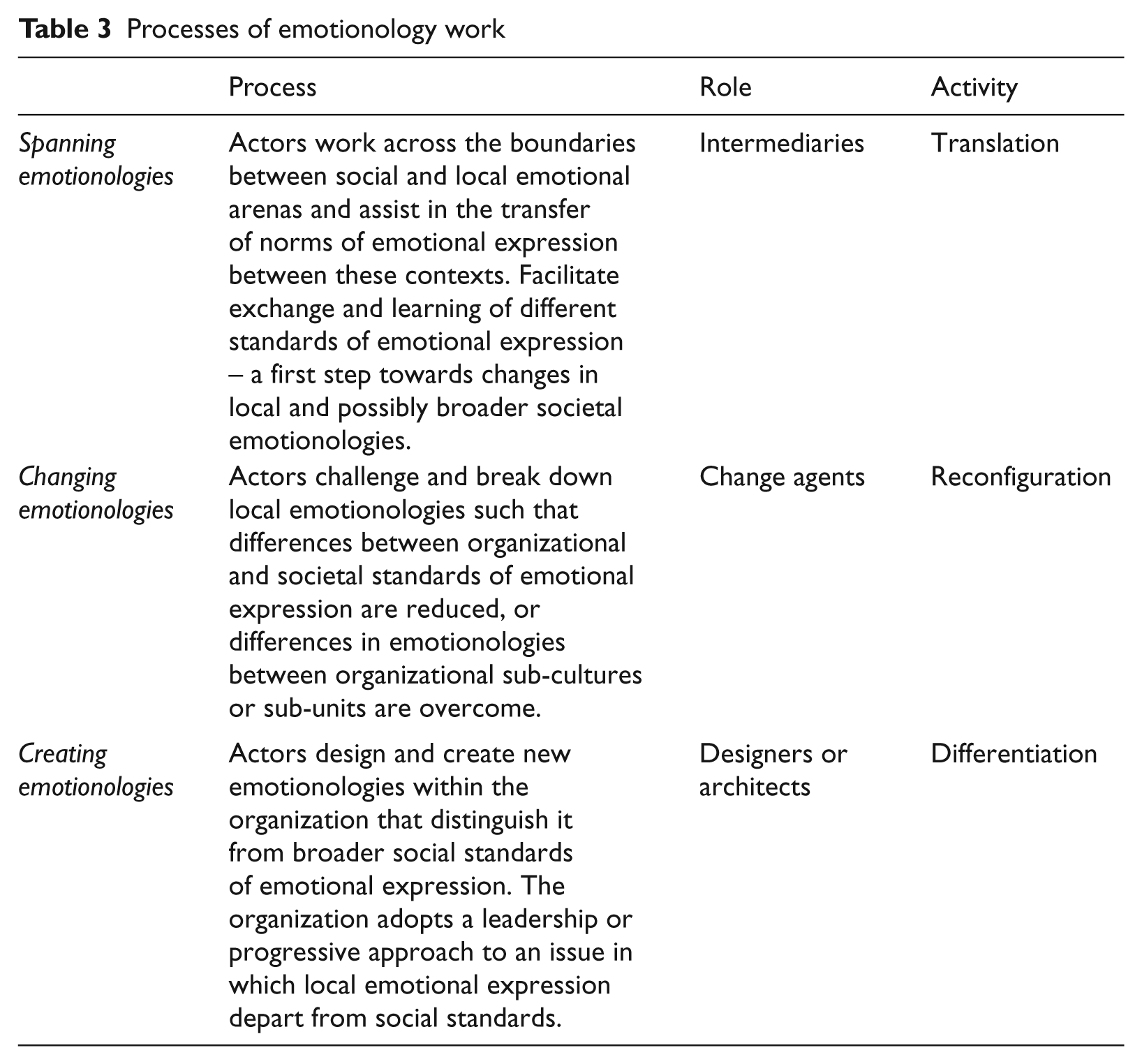
At one level, emotional boundary-spanning involves organizational actors as intermediaries assisting in the transfer of norms of emotional expression between these contexts. The key activity here involves translation of the external emotionology into the local emotional context. So in our study, sustainability specialists identified and imported elements of the external emotionology of climate change as threat (linked to emotions of anxiety and fear), but also translated this for local consumption, by framing climate change as an issue of improved efficiency or waste reduction. Building on this activity, a second aspect of ‘emotionology work’ extends beyond spanning and translating of external emotionologies, to a more fundamental challenging and reshaping of local emotional cultures. Here, sustainability specialists acted more as change agents (Balogun et al., 2005), confronting and reconfiguring emotional norms of scepticism or apathy towards the environment, and seeking greater emotional engagement towards environmental sustainability. In a third form of ‘emotionology work’, sustainability specialists then sought to create and embed new emotionologies. Here their role was more as designers or architects of a new local emotionology. So, for instance, many of the ‘green’ corporate change programs we studied promoted concern, passion and excitement around pro-environmental behaviour that was seen as new and challenging. Moreover, in creating a new local emotionology around environmental sustainability, these managers sought to differentiate their firms from other businesses as part of the vanguard of a new ‘green’ business ethos.
However, the promotion of employee emotionality around climate change could also result in unintended consequences and tensions. So, for example, encouraging employee emotionality about climate change could result in employee responses that senior managers deemed inappropriate or conflicting with business objectives. Similarly, employee perceptions of discrepancies between the rhetoric and the reality of corporate environmentalism could quickly lead to the conversion of positive emotionality of pride, passion and satisfaction into more negative emotions of frustration, disillusion and anger. Moreover, the changing nature of broader social emotionologies, particularly the growth in climate change scepticism and denial, presented further problems for sustainability specialists in the management of a local emotionology that accepted the science of climate change and promoted the need for carbon emissions regulation. In developing local emotionologies, sustainability specialists and senior managers faced the inherent problem of seeking to shape and control features of human behaviour that could exhibit independence and interpret corporate actions in unpredictable ways (see also Harris and Crane, 2002).
Beyond the processes of emotionology work, our second contribution relates to how these emotionology workers managed their own emotions in the process of translating, reconfiguring and differentiating emotionologies. Indeed, as emotional boundary-spanners, our respondents often found themselves operating within a liminal space (Beech, 2011), betwixt and between the social emotionologies of climate change as threat and ideological battleground, and local emotionologies in which climate change was presented as a challenge and opportunity for business growth. The tensions and contradictions in operating in this space led many of our respondents to speak about the conflicting emotions they had about their work, as well as their broader lives and identities. So, for instance, interviewees spoke about shifting between optimism and pessimism depending on the work situations they faced or the latest news report, the hot flash of anger in a workplace confrontation with a climate change denier who thought ‘it was all crap!’, or the anxiety and sadness of thinking about their children and whether they would be able to ‘see the sun, can still see birds flying’. Here, emotionality provided a mechanism for broader self-reflection, although this also involved contradiction and the need to manage their own emotionality in order to function within diverse situations.
A key part of this emotional self-management related to the work of the change agent as ‘tempered radical’ (Hoffman, 2010; Meyerson and Scully, 1995) – seeking to effect change in others based upon one’s own personal beliefs and identity. Unlike existing work on ‘emotional labour’ (Bolton and Boyd, 2003; Hochschild, 1983), here we are not concerned with the commercial use of prescribed emotion in employee–customer interaction, but rather in how individuals exhibit a personal concern for a broader social issue and promote this cause in an organizational setting. In this respect, our article serves to broaden the concept of ‘emotion work’ in overcoming emotional dissonance, by including those involved in championing organizational change, and highlighting the complexities of emotion required by managers, consultants and other change agents in this process (see also Clarke et al., 2007).
As outlined in Table 4, we identify at least four forms of ‘emotion work’ our respondents engaged in to overcome the dissonance between social, and privately accepted, emotionologies and organizational emotionologies. First, emotionology work often involved a calculative dimension in which individuals consciously tailored their emotional expression to fit situational contingencies, so as to best influence others and sell their agendas (Andersson and Bateman, 2000; Dutton and Ashford, 1993). For instance, in seeking to gain ‘buy-in’ and support from different managers and employees, sustainability specialists used their emotional expression in a strategic fashion by appearing ‘professional’ and ‘objective’, or focusing their passion and enthusiasm for objects of particular local relevance (e.g. efficiency improvements, sales figures, cost savings or waste reduction measures). While respondents acknowledged these emotional expressions as somewhat ‘inauthentic’, it was nevertheless justified as necessary to achieve pro-environmental outcomes and improve local legitimacy and status.
Managing emotions in the process of emotionology work
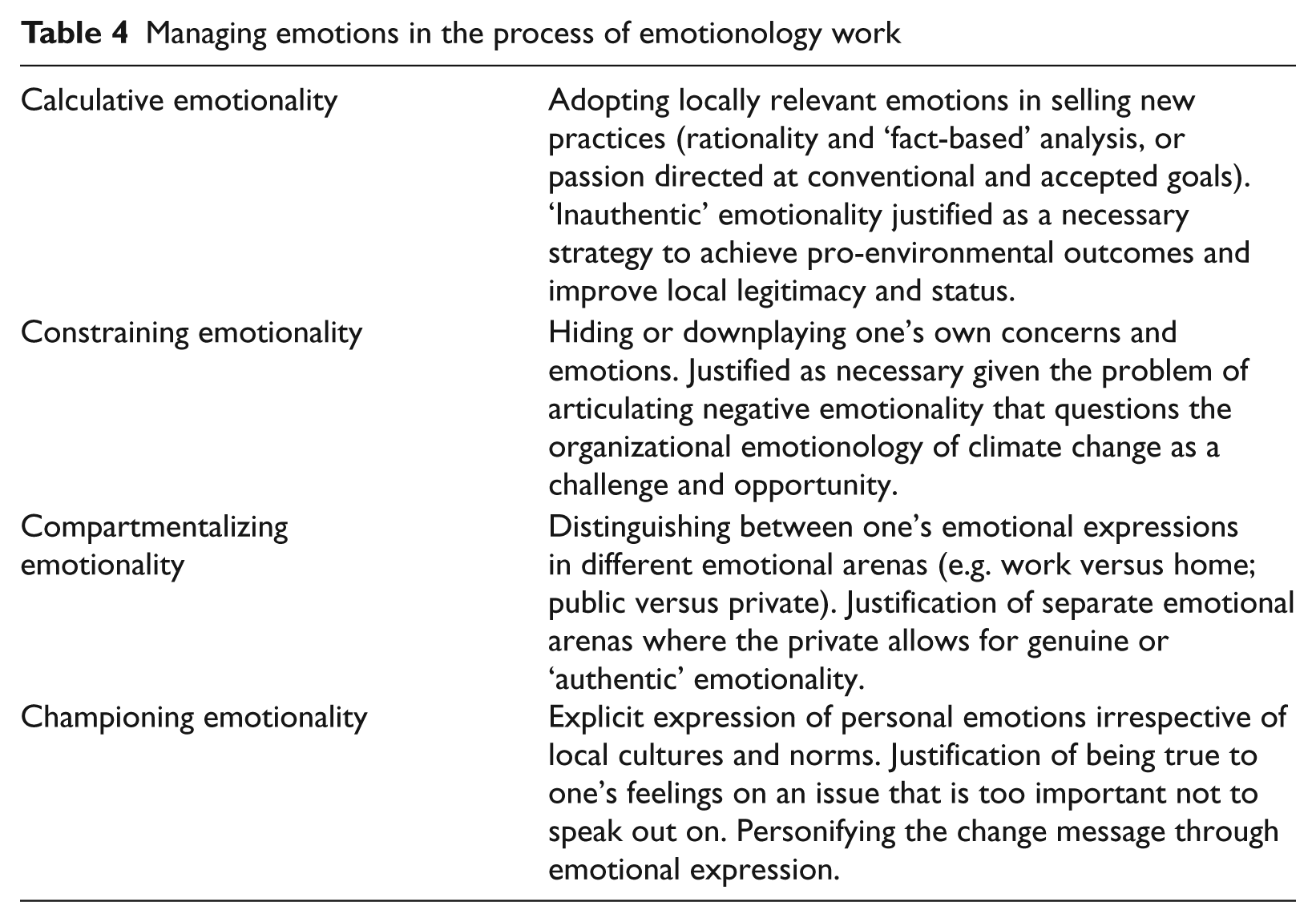
Related to the calculative use of emotionality, a second form of emotion work involved individuals hiding or down-playing their own concerns about climate change and constraining emotionality – what one respondent termed the dilemma of having passion ‘without being seen as too passionate’. While such a response was common for individuals working in organizational contexts unfamiliar with, or resistant to, environmental issues, even in organizations where the new local emotionology of ‘climate change as opportunity’ had become embedded, sustainability specialists still needed to ensure they hid more negative emotions and doubts, and stressed passion, excitement and pride for their organization’s environmental achievements. Indeed, this constraining of emotions led to a third form of emotion work in which interviewees spoke about how they compartmentalized their emotional expression between work and home, and between public display and their own self-reflection. So, positive emotionality at work might contrast with more negative or ambivalent emotions at home and in private.
Our research also highlights a fourth, more positive form of emotion work in which individuals championed their personal emotions and concerns regarding climate change. While sometimes risky, individuals highlighted how giving vent to their emotions provided not only a source of personal motivation for their role as ‘change agents’, but could also be a powerful signal to others in diffusing pro-environmental behaviour. Echoing Meyerson and Scully’s (1995: 596) concept of ‘spontaneous, authentic action’, the expression of deeply felt emotions could have a powerful impact upon others by personifying the change message and championing alternatives (Creed et al., 2010; Moser, 2007).
Conclusion
As the example of John Doerr demonstrates, climate change represents a fundamental challenge to comfortable assumptions of economic growth and social advance. Indeed, our study has focused on a group of managers and consultants who largely share Doerr’s concern that ‘we’re not going to make it’. In their work as sustainability specialists they engaged with an issue that they not only felt strongly about, but which they sought to affect by making their organizations more environmentally sustainable. A key part of their role involved what we have termed ‘emotionology work’, in which they sought to translate, reconfigure and create an organizational emotionology of climate change as a challenge and opportunity for business growth. Unlike more traditional business issues, climate change provided a focus in which they could marry their personal concerns with broader business objectives, and for many this provided significant satisfaction in providing ‘emotional harmony’ (Rafaeli and Sutton, 1987). However, the work of seeking to manage others’ emotions also involved the management of one’s own emotions, and many acknowledged the inherent tensions of such work.
The broader implications of our study for an understanding of emotionologies at work relate to both organizations and individuals. First, our analysis highlights the way in which corporate attention is increasingly directed towards the management of emotion, as businesses become aware of the threats and opportunities that changing emotionologies pose for profits and shareholder value. For instance, issues such as gender, race, sexuality, and social and environmental sustainability have become not only subject to corporate policy and practice but also a focus of emotionology work. While our research demonstrates the tensions and unintended consequences of attempts to reframe and manage such emotional standards, the trend towards a more conscious managerial engagement with emotionologies appears to be growing as issues of corporate social responsibility and organizational sustainability have become institutionalized (Tams and Marshall, 2011).
Second, our study has implications for understanding the role of individuals as ‘emotionology workers’. For instance, our respondents were well aware of the potential contradictions of their activities and acknowledged the compromises involved in their work. Sustainability specialists recognized that, analogous to the politics of ‘dirty hands’ (Walzer, 1973), their role in the translation of climate change into a business opportunity could result in its own emotional tensions. While the different strategies of emotion work we have identified sought to respond to such emotional dissonance, the very nature of our respondents’ work in seeking to make capitalism ‘sustainable’ underpinned the fundamental paradox of their situation. Somewhat ironically, the very people in corporations most concerned with the environment were engaged in practices that furthered business growth and the depletion of natural resources. Emotional dissonance then appeared an inherent part of the job of these change agents in engaging with broader social issues and seeking to bring these into the domain of the market and profit.
We suggest the concept of ‘emotionology work’ is open to a range of further research possibilities. For instance, while we have stressed the processes through which specialist managers and consultants adapt both social and local emotionologies in organizational culture change activities, the role of corporate emotionologies having a wider social impact also needs further investigation. For instance, examination of the growing role of corporations’ public relations and lobbying activities (e.g. Barley, 2007) could be extended to consider the role of corporate emotionologies and their broader social appeal. In the area of corporate environmentalism, for instance, the positive emotionology of ‘green business’, promoted by companies such as Walmart and GE, has had a significant impact on the public policy debate surrounding climate change (Lash and Wellington, 2007). Outside corporate settings, the concept of emotionology could also be explored in NGOs, religious and activist organizations where a strong social purpose is likely to lead to pronounced emotional standards and expectations (Goodwin et al., 2001). Indeed, one limitation of our study is that, while we have focused upon individuals and companies that were generally progressive in their engagement with climate change, many managers and large portions of industry and commerce adopt a more hostile attitude to this topic, rejecting and lobbying against the need for changes in business practice. While the study of climate change denial and its emotional context has been explored in community settings (Norgaard, 2006), studying competing emotionologies of climate change scepticism and denial in corporate settings is clearly an area requiring further detailed research.
Business activities are often characterized in terms of rational decision-making and the management of risk. However, engaging with a concept as significant and potentially cataclysmic as climate change highlights the fundamental emotionality that underlies the rational veneer of organizational life. As the physical reality of climate change becomes increasingly apparent, emotionology work within organizations and society more generally will become significantly more challenging. Social and organizational responses to climate change will therefore involve not only fundamental changes in human behaviour and practice, but also major shifts in accepted norms of emotional expression. In the emerging era of climate crisis that humanity now faces, emotions and the broader emotionologies that seek to shape them are likely to become an increasingly central part of organizational life.
Footnotes
Acknowledgements
The authors would like to thank the Editor, Paul Edwards, and the three anonymous reviewers for their constructive and helpful comments in revising this article for publication.
Funding
Research for this article was supported by an Australian Research Council Discovery Grant [DP110104066].